THE AMBIGUITY OF THE ICT IN
THE OFFICIAL SCHOOL OF
LANGUAGES
Alumna: Sara Maeve Cerezo Magee
Máster en Profesor de Educación Secundaria Obligatoria y
Bachillerato, Formación Profesional y Enseñanza de Idiomas
Valladolid,1 de julio de 2013.
Tutora: Marta María Gutiérrez Rodríguez
2
ACKNOWLEDGEMENTS ... 3
INTRODUCTION ... 4
1. ICT ... 7
1.1. DEFINITION ... 7
1.2. ORIGIN AND EVOLUTION ... 8
1.3. RESOURCES ... 11
1.4. E-LEARNING STYLES AND ELEMENTS ... 13
2. THE EOI ... 16
2.1. DEFINITION ... 16
2.2. HISTORY OF THE EOI... 16
2.3. METHODOLOGIES USED IN THE EOI ... 18
2.4. SPAIN INSIDE EUROPE ... 19
2.5. ICT IN THE EOI ... 20
2.6. LEARNING FACILITIES ... 21
3. LEGISLATION ... 23
4. AMBIGUITIES ... 26
4.1 DEFINITION ... 26
4.2. ANALYSIS OF ICT IN EDUCATION ... 26
4.3. REVIEW ... 33
5. RESEARCH APPROACH ... 34
5.1. STUDENTS ... 35
5.2. RESEARCHERS ... 45
5.3. REVIEW ... 49
6. FUTURE PROSPECTS ... 50
7. CONCLUSION ... 54
8. BIBLIOGRAPHY ... 59
9. APPENDICES ... 64
APPENDIX I. Cuestionario Estudiantes/Students Questionnaire ... 64
3
ACKNOWLEDGEMENTS
This Master of Education dissertation has been a very rewarding experience.
It has been a pleasure to work with everyone participating in the EOI both
students and teachers.
First of all, I would like to thank all teaching staff of the EOI and UVA,
especially my teaching practice tutor Concepción Casas who supervised me
with expertise during my teaching practice. I am very grateful for having been
guided by Marta María Gutiérrez as my dissertation tutor who with relevant
comments and guidelines has led to the completion of this dissertation. A
special mention should also be made to the two groups and the researchers
who completed the online questionnaire which has been the base for the
research approach. Lastly, I would like to express my gratitude to family and
friends, for their support and encouragement throughout this dissertation.
4
INTRODUCTION
I became conscious of the ambiguities in the use of ICT in the teaching and
learning process while I participated in the period of teaching practice that I
completed at the Official School of Languages of Valladolid (EOI). When I was
informed that the topic for the Master of Education dissertation should bear
some relationship to an aspect that we had observed and questioned during our
teaching practice, I became aware of the importance of this ambiguity and
wanted to make an in depth study of it.
The EOI holds mostly adult learners who pay for tuition and their examination
rights. The centre is part of the non-obligatory special education regime of the
Spanish Government. It is surprising the assortment of age scope that can be
gathered in a classroom where we can meet students from 14 years old
upwards and with very different educational backgrounds. Nevertheless, I have
to admit that I wondered many times if these students could work at the same
pace. Thus, for this reason I became interested in the pace of younger and
more mature students in a co-equal level of learning. Would they acquire the
same skills at the same time in the same learning environment?
The importance and increasing use of new technologies has brought the
educational field to be abreast of the times. Nowadays the use of new
technologies has become an integrated part of teaching; teachers and students
have to be familiar with of the Information and Communications Technology
(ICT), and the developing procedures of its usage in the educational world.
However I would like to know why they have become so important in the last
5
The use of ICT has had a strong repercussion in Primary and Secondary
Education, but what impact has ICT in learning at the EOI. There is little doubt
that ICT has probably significantly improved the overall learning and teaching
experiences, but there can be ambiguities.
The aim of this Master of Education dissertation is to question the
ambiguities and success of introducing new technologies into a classroom with
a wide variety of students and with a broad range of ICT skills. What available
tools can be found to limit the differences of these ambiguities in an EOI
classroom? I made a research approximation on this topic where students and
researchers answered a questionnaire focusing on their knowledge, opinion and
use of ICT when learning or researching in the EOI. The questionnaire´s aim
was to collect data for a more in-depth research in the future.
A qualitative and quantitative study and research approximation has been
used with the purpose of describing and interpreting the reality of the use of
new technologies at the EOI with adult learners. Moreover, we will try to find out
how it could change with the passage of time.
This dissertation has been structured into five main areas. Firstly, we will
analyse ICT, its reality and context within the world of teaching. Secondly, the
history and functioning of the EOI will be summarized. Thirdly, we will centre on
the legislation concerning ICT and foreign language learning in Spain, in order
to understand their statutory use in education. Fourthly, we will consider the
ambiguities that have been found in the effectiveness of the use of ICT in the
educational field. In the fifth place we will analyse a research approach
completed during my teaching practice followed by the future prospects of ICT
6
weaknesses in the proposal of this dissertation and above all, the ambiguities
7
1. ICT
1.1. DEFINITION
The term ICT is an acronym that stands for Information and Communications
Technology and is defined as “diverse set of technological tools and resources
used to communicate, and to create, disseminate, store, and manage
information” (Tinio 2002:4). In this case it is applied to Education. It is difficult to
get a universal agreement on what ICT is since methods, concepts and
applications are in constant evolution (Riley 2012, pars.3). Maybe if we
concentrate on the three words which the acronym ICT stands for, we can
clarify its role in Education; it is Information and Communications Technology
that already exists to help teachers and learners as part of the learning process.
ICT also covers any product or application which will store, retrieve,
manipulate, or receive information in a digital form. For example: laptops, smart
phones, e-mails and virtual classrooms (Tinio 2002:7). More importantly, it is
also related with the ways these can be used to work with each other to
facilitate and enhance the teaching methodology and the learning skills of the
students. Educational experts comment on two broad types of technologies: the
traditional computer-based technologies (the programmes that can be used on
a computer at home or in class) and the more recent and fast growing range of
digital communication applications which allow educators and students to
communicate and share ideas and information digitally (European Commission
8
1.2. ORIGIN AND EVOLUTION
ORIGIN
In order to grasp the origin of ICT we should state that it derives from humble
beginnings, which include the abacus. The abacus is thought to have been
originally invented 3000 years ago (Barnes 2003:1). There have been many
revisions on its design that continued to change for many years developing into
early versions of the calculator, which replaced this primitive method of
mathematics. Mechanical versions of the calculator followed in the years to
come. In the 1970s we were swiftly approaching the computers used
nowadays.1 Computers replaced the traditional system of typewriters, which
included backup copies and spell checkers to enable mistake correction and
storage much easier (Barnes 2003:2).
In the 1980-1990s there was a vast development in ICT, Tim Lee developed
the World Wide Web in 1991 and the World Internet Connectivity was officially
launched in 1995. Since then there have been innumerable developments and
innovations towards the use of technology in different fields. (Aston 2002:1).
EVOLUTION
Authors like Martínez Pérez and Suñé Suñé (2011:29-38) remark that the
new technologies have been gradually incorporated and distributed little by little
in the Spanish schools in the last few decades.
In the 1980s the Spanish Educational System started to use ICT, due to
pioneers who thought that technology could help students and furthermore,
1
9
affordable computers appeared on the market, providing an accessible
approach to the utility of ICT.
One of the first times that technology is mentioned in the classroom is in
1979 with the ‘Plan Informático Nacional’ that mentions the inclusion of
Information Technologies (IT) in ‘Bachillerato’ the educational level for students
from the ages of 16 to 18. Throughout the 1980s several meetings took place
referring to the use of IT in education.
In 1985 the ‘Ministerio de Educación y Ciencia’ created a project called
‘Proyecto Atenea’, known afterwards as ‘Programa de Nuevas Tecnologías de
la Información y de la Comunicación’ (PNTIC) which caused IT classrooms to
begin to emerge in schools and high schools. Computer usage was limited due
to the scarcity of educational software and also a complex operating system.
In the mid 1980s a new programming language appeared, LOGO, which
supported the pedagogical use of IT. The activities that took place were
‘informática educativa’ because the objective was then to teach and explain the
use of the computer equipment and its applications (Sadosky 1996:2). They
operated using the basic knowledge that the student had to acquire about IT.
At the beginning of the1990s the terminology of IT changed to ICT due to the
new developments in computer technology. There was a significant emphasis
put on the integration of ICT in the curriculum and in all curriculum areas due to
the approval of the new educational law, LOGSE.
During this decade ICT became more important in all walks of life, such as
business, banking, and commerce and among them of course education (Tinio
2002:3). This rapid growth in the use of ICT was possibly due to the onset of
10
resources to be easily used (Becta 2004:24). The increasing popularity of
multimedia opened up a completely new and constantly growing wide range of
possibilities.
At the start of the new millennium a procedure in the field of education and
training called The Lisbon Process, was approved by the European
Commission which would highlight the importance of globalization, ageing and
the ICT revolution in all European countries. The main aim of this strategy was
to improve the economy by innovation and social and environmental renewal
throughout the decade of 2000-2010. Subsequently, Spain incorporated and
laid more importance on the use of ICT in the Educational System.
In 2002, the ‘Ministerio de Educación y Ciencia’ and the Regional
Governments signed an agreement promoting the use of new technologies.
This agreement is known as “Internet en la Escuela” which was used to make
the network available to the whole educational community in 40 curricular areas
and subjects that concerned all stages of education. This network increased up
to 85% of the basic educational resources.
The year 2005 brought a new plan named, “Internet en el Aula”, aiming at an
increase utility of ICT in the classroom and to strengthen the Internet connection
and the exchange of resources and experiences within the different Regional
Governments (LOE 2/2006).
In 2009, a new initiative was created, “Escuela 2.0” with the intention of
establishing the use of ICT in a teaching and learning context. They digitized
the Primary and Secondary school resources with laptops for students and
teachers, interactive whiteboards and wifi connectivity. This plan acquired a
11
increasing the educational resources online (Pérez 2011:63-70). All this
information is reflected in all Spanish educational laws2 that will be dealt with in
the section on legislation.
1.3. RESOURCES
When we skim through the numerous devices and programmes which are
available in ICT there are many different resources to work within the learning
process. We can get a close approach3 reading Martínez Pérez and Suñé Suñé
(2011:100-127) where they deal with the usage of ICT resources such as the
e-mail address, instant messaging, the creation of web contents, Content
Management System, Scribd, etc. In spite of the diverse assortment of devices
and applications we will only bring into focus those that are used widely
nowadays.
In the first place, blogs are relevant because they gather messages in a
chronological order or from many authors dealing with a topic, or can be used
as a daily journal. In a blog users can share common elements and have the
possibility to comment on the posts. All the publications in the blogs can be
within everybody’s reach by means of offering services and the availability of
easy-to-use tools. The type of material that is published on a blog can be
articles, news and links and images (Martínez 2011:107).
Some other resources that suggest interaction are the wikis and the social
networks. A wiki is a virtual space where any user/login can provide information
and knowledge, which enhances the cooperative and interactive learning
2
For more information about the Spanish legislation check (LOE 2/2006).
3
For a closer approach to these resources read Martínez (2011), Palomo (2008) and
12
process (Martínez 2011:122-124). Social networks are structured networks
formed by groups of people connected by digital technology. There are two
different types of social networks, those in which a user can connect to others
without filters - open networks- and those networks that can prohibit and deny
the access to any person external to the education community –closed social
networks (Pérez 2011:82).
However, there are other applications that have to be installed in a computer
to be used. These are known as Office IT Applications/ Office Suite. They allow
creating and sharing documents in different formats making it possible to work
with several people, who can modify the document and there is proof of those
changes to keep track of them. Some examples are Dropbox, Zoho, ThinkFree,
GoogleDocs, etc (O´Broin 2011:2-4).
Furthermore, focusing on specific resources for teachers, we can find helpful
programmes such as JClic, Webquest, Hot Potatoes, eXeLearning and
Constructor where teachers can make their own resources, adapting them to
the needs of the classroom (Martínez 2011:299-304). There are also many web
pages with educational resources that can be used by teachers and where they
can add and share their activities. Schools’ websites usually attach the links that
access those sites. Some examples of web pages to find foreign language
learning at the EOI can be: eeooii.net, lingo.com/espan.htm,
multimedia-english.com or iteslf.com (EOI-Valladolid 2012).
The use of technology in education is called E-learning, which enables
people to exchange information anywhere and at any time. This use can include
training and guidance from experts and pedagogical approaches (Lucas 2012,
13
1.4. E-LEARNING STYLES AND ELEMENTS
When paying attention to the insertion of ICT in education we can observe
that this use of technology makes it possible for people to learn and to
exchange information without time or place boundaries. There are two different
types of e-learning styles, the asynchronous and synchronous learning (Lucas
2012, pars.1-11).
The asynchronous learning consists of individually paced courses and
discussion groups which are a collection of conversations that occur over time.
The instructor, in this case the teacher, provides material, lectures, tests and
assignments that can be accessed at any time. There might be a time frame
given to the students, during which they need to connect once or twice a week.
Students have the freedom to contribute when they choose to do so (Lucas
2012, pars.1-4). There are several elements that can be used in the
asynchronous classroom such as an intranet, the internet, a CD-Rom and a
virtual library, which encompasses repositories of documents, presentations,
audio files and videos that can be downloaded (Hrastinski 2008:51-55).
To boost the students cooperation there are also discussion boards to ask
and answer questions to clear up difficulties (Hrastinski 2008:51-55). Other
resources are social networks which enhance the collaboration and interaction
among students. Some examples are blogs, Facebook, Twitter or YouTube
(Granda 2010:111-113).
The use of Wikis or collaborative documents also allows students to edit and
to cooperate with each other’s work. Another element that can be used when
14
textbooks include DVDs with video and media content that can be utilized offline
(Tinio 2002:24).
The other e-learning style is the synchronous learning, which encompasses
online classes that require students and instructors to be online at the same
time. Then lectures, discussions and presentations occur at a specific hour. The
synchronous e-learning style encloses some specific class elements that allow
students to log on and interact using the chat video conferencing or web
conferencing4 (Hrastinski 2008:52-55).
An example of a synchronous e-learning tool is the virtual worlds, known as
educational islands, where students can interact (Tinio 2002:12). They are ideal
for learning languages because it is possible to speak to each other through
headsets. These virtual worlds can introduce other cultures and countries,
interacting with native speakers to practice conversation and so becoming a
productive learning environment. However, it can also be frustrating for those
who are new or who do not understand their functioning (Davis 2006:2-3).
One of the technical difficulties that can affect e-learning is the lack of high
bandwidth in the internet connection. In this case, other alternatives are
podcasts and internet radio which can be the perfect solution, because they
provide many opportunities for audio streaming about any topic, from concerts
to political speeches, which can be previously downloaded or used with low
bandwidth. These audio documents or podcasts can be accessed and reviewed
later (Hrastinski 2008:52-55).
4
15
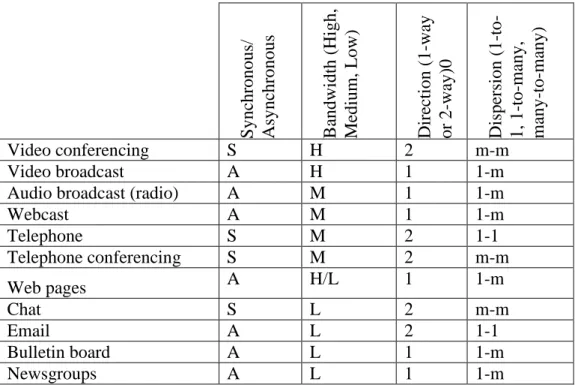
Furthermore the direction of the communication is important because it can
be one-way or two-way, one-to-many or many-to-many (Russia 2000:11-13). An
example of all these categories concerning ICT resources can be understood
with Table 1 below.
S ync hr onous/ Async hr onous B andwidth (High,
Medium, Low) Dire
cti on (1 -wa y or 2 -wa y )0 Dispe rsion ( 1 -to -1, 1 -to -many, many -to -many)
Video conferencing S H 2 m-m
Video broadcast A H 1 1-m
Audio broadcast (radio) A M 1 1-m
Webcast A M 1 1-m
Telephone S M 2 1-1
Telephone conferencing S M 2 m-m
Web pages A H/L 1 1-m
Chat S L 2 m-m
Email A L 2 1-1
Bulletin board A L 1 1-m
Newsgroups A L 1 1-m
Table 1. Summary of communication styles (Russia 2000:11-13).
In conclusion there are two different types of e-learning styles. The
asynchronous learning is where participants can access at any time the material
and online discussions, to participate but not necessarily at the same time,
using tools such as intranet, blogs or wikis. The other e-learning style is the
synchronous learning, which requires students and teachers to be online at the
same time using video or web conferencing. E-learning may also have different
outcomes depending on the number of participants, the bandwidth speed, the
16
2. THE EOI
2.1. DEFINITION
The EOI has existed for over a century and its main purpose has always
been to promote the learning of foreign languages. It is a regulated learning
according to the Common European Framework of Reference for Languages:
Learning, Teaching, and Assessment (CEFR 2009/10). Each level leads to a
Diploma of European recognition. Teaching and learning are organized into two
modalities, namely ‘oficial’ and ‘libre’. The former means that the students are
matriculated to attend classes and are examined, whereas the latter refers to
students who only pay fees to do the official exams. They can also be
‘presencial’ (in-person class) or ‘a distancia’ (distance learning) only available in
English (EOI Valladolid 2011).
2.2. HISTORY OF THE EOI
The Central School of Languages based in Madrid was founded a century
ago under the government of the liberal politician Canalejas and under the
influence of the “free teaching institutions” ideology (EEOOII 2010, pars.1-6).
The objective was to get the Spanish away from their peninsular isolation,
create an opening up towards Europe and also increase and broaden the
cultural level of its students (EEOOII 2010, pars.1-6).
In 1911 this institution was created with the purpose of facilitating the
learning of foreign languages (EEOOII 2010, pars.1-6). From a humble
beginning, the institution has gradually increased the number of enrolments. In
17
remains the same case today. However, it was something considered
revolutionary at that time (Tirado 2011).
The history of the Central School of Languages was influenced by the
history of Spain in the 20th century with its ups and downs5. During the Civil War
the number of students was drastically reduced to 50%, although this would not
last long (Tirado 2011).
The post-war period was not the most ideal time for learning because
Franco’s aim was to enhance the national language. In the 1950s English
became more in demand than French. Nowadays, English is the top language
studied in schools, because this language is an essential tool to communicate in
this globalized world (Tirado 2011).
The Central School of Languages lost its characteristic of “unique centre” in
1966, the year in which it became known as the EOI. Today there is a network
all over Spain which is controlled by each Regional Government, with its own
education system and different educational levels.
When dealing with the problems of learning foreign languages, Spain has an
old cliché, in which it has always been considered a nation where there have
been many difficulties in the learning of foreign languages (Tirado 2011). The
truth is that there was a certain “linguistic isolation” in the past, but in the ever
growing globalised world the situation is different. Times have changed and
more foreigners choose Spain as their permanent residence and more Spanish
18
people, due to personal choice or socioeconomic motives, are travelling and
working abroad.
Nevertheless, there were several factors that affected the foreign language
learning in Spain. Some of these were misguided learning methods, an
influence from the sense of ridicule of the learners and the dubbing of films.
However the most important factor was methodology, which focused more on
the theory rather than on the practice. Furthermore, the emphasis has changed
and is now less theoretical due to the demand from students towards a practical
approach (Tirado 2011)6.
2.3. METHODOLOGIES USED IN THE EOI
At the beginning of the 20th century, languages were studied in a similar
manner as what we would consider as “dead languages” such as Latin or Greek
(Plaza 2010, pars.1-2). This method focused on grammar and translation. Then,
at the beginning of the 20th century, the Central School of Languages then
introduced an innovative methodology called “direct method” which focused on
the oral skills and pronunciation, looking towards a more dynamic and
participative lessons (Plaza 2010, pars.4-5).
The four basic skills which are taught are listening, speaking, reading and
writing which are the bases of the teaching-learning system at the EOI. Today
the “task-based learning” is the most widely used method which is promoted by
the CEFR. Students learn by doing, searching for a practical sense of teaching
and learning (Plaza 2010, pars.18-20).
6
19
The development of the language skills and using the language effectively is
not only found in the writing and reading comprehension, though also in the
speaking and listening comprehension competences. Nevertheless, the EEOOII
are also concerned of the importance of acquiring other significant skills which
are known as pragmatic and communicative skills such as following a
conversation and pronouncing correctly with an accurate intonation (Tirado,
2011). Teachers have to focus on a ‘lifelong learning’ approach for their
students to be communicatively competent in their language learning (Plaza
2010, par.22).
2.4. SPAIN INSIDE EUROPE
The Common European Framework is intended to overcome the
communication barriers that are arising from the different educational systems
in Europe (CEFR 2009/10:1). There are many similarities in all the European
education systems (Rodríguez 2012, pars.3-6), such as the four main stages in
education: primary and secondary education, vocational studies and university
(Rodríguez 2012, pars.4-7). In spite of this, it is also claimed that there are
some differences which may be novel to other European educational systems
due to the Spanish network of EEOOII. The EEOOII are state run schools that
admit learners of all ages; minimum age is from 14 or 16 years of age, with
courses of different foreign and regional languages according with the reference
levels of the CEFR. The EOI certificates according to these standards: A1, A2,
20
2.5. ICT IN THE EOI
Regarding ICT in the EOI we can find a lot of information in the library or
online in the webpage of each school around Spain.
In this Master dissertation there is an interest in analyzing how ICT is
involved in the teaching-learning process at these language schools. Regarding
the EOI of Valladolid, we can check all the information we need to know online
in the website of the school7. If we check the “Documentos Institucionales” for
the “Programa General Annual” (PGA), there are several improvement projects
programmed for this academic year 2012/2013 which include the aim of
Pedagogical Organization and ICT implementation which are mentioned below.
The intention of these projects is to be completed throughout the year (EOI
PGA 2012/13:23).
In 2012, a network for teachers was successfully created where all the
official documentation such as activities, calendars of meetings and official
documents, was available for teachers. Now they are planning to introduce the
same method so students have accessibility to useful documents.
In order to improve the communication of information to the students
concerning exams, results and other documentation, the Director of Studies will
check that the information related to evaluation criteria, academic calendar, the
exam revision dates and final results will be posted on line and also in the
school boards of each department. The amount of links and resources will be
reduced in order to summarize the amount of information.
These improvements deal with the necessity of introducing the New
Technologies and ICT to all the fields of the EOI, especially in language
7
21
learning. There is the need to update digital and computer systems without a
rejection from the members (students, teachers). This can be achieved through
new technologies that require no previous knowledge of programming (EOI,
PGA 2012/13:23-25). The aim is to prove that any teacher with very little
previous specific training in ICT can easily manipulate such documents.
However, there is still the need to digitize audio and video material to make the
most of the virtual classroom and the network. Besides, there exists the
possibility of sharing the material at two different levels, among teachers and
with students. What the proposal states for this year is to:
-Digitize, edit and organize all the audio and video material online or in each
department.
- Create virtual spaces to put those materials in common.
- Make use of the virtual space that is available from the Regional
Government.
- Co-work with a digital/virtual platform (such as Google) for the creation of
web pages connected with each department and learning levels.
- Learn how to use interactive whiteboards to develop teaching efficiently
and in a pleasant way (EOI, PGA 2012/13:23-25).
2.6. LEARNING FACILITIES
The facilities offered at the EOI related to ICT during this school year can be
found in the document called “Proyecto Educativo del Centro 2012-2013”,
where the building and classrooms are described. The building embraces 23
classrooms; each classroom is equipped with the necessary audiovisual
equipment (such as a television, DVD player, etc.). Each classroom also has a
22
projector and loudspeakers. Due to the fact that some courses are
oversubscribed, they have to teach at the Centro Específico Juan the Herrera,
where they use five classrooms with no computers or interactive whiteboard
access.
This year at the EOI a new Language Lab has been installed. It holds up to
35 students, with on line material organized into levels and courses from the
different linguistic departments. There is also a library and a Resource Suite
where all the audio visual material and loans are available for students, as well
as 18 computers connected to the internet and 5 individual lab cabins.
Many students attend the EOI for different reasons, and the EOI tries to cope
with all types of diversity, ICT is used as a tool to support this diversity. When
adapting the curriculum or the environment for students with special learning
needs, we can refer to Medidas de Atención a la Diversidad de Alumnos (EOI
PGA 2012/13:76). They co-work with the ONCE and students who have a visual
impairment, have Braille material at their disposal. Those students with impaired
hearing, have a specially adapted language lab available to their needs with the
guidance of a teacher. Those learners with neurological diseases receive
attention and advice from their teachers and also get extra material with
suggestions about books, listenings or programmes that can be helpful and
23
3. LEGISLATION
Legislation is an aspect to take into account to be able to understand the
process of foreign language learning with the use of ICT. The knowledge and
awareness of what is stated in the Spanish curriculum gives a closer approach
to this concern in education.
The Legislation concerning education in Spain has suffered an evolution in
the last forty years due to the many different legislation changes in the area of
Education.
The “Ley General de Educación” (LGE, 1970: art 18) stated the first use of IT
in schools as we can read in the following quote: “Los métodos didácticos en la
Educación General Básica habrán de fomentar la originalidad y creatividad de
los escolares, así como el desarrollo de aptitudes y hábitos de cooperación,
mediante el trabajo en equipo de profesores y alumnos. Se utilizarán
ampliamente las técnicas audiovisuales” (LGE 1970:art.18).
In the 1990s there was a significant educational reform, “Ley Orgánica
General del Sistema Educativo” (LOGSE 1990), which included and
encouraged the use of ICT and innovation: “Las administraciones educativas
fomentarán la investigación y fomentarán la elaboración de proyectos que
incluyan innovaciones curriculares, metodológicas, tecnológicas, didácticas y
de organización de los centros docentes” (LOGSE1990:art.59).
Since 2006 the “Ley Orgánica de Educación” (LOE 2006) established the
introduction of the new technologies as a right to address the quality and
efficiency of ICT in the educational system: “[…] desarrollar las aptitudes
necesarias para la sociedad del conocimiento, garantizar el acceso de todos a
24
also encouraged critical thinking towards the use of ICT: “Iniciarse en la
utilización, para el aprendizaje, de las tecnologías de la información y la
comunicación desarrollando un espíritu crítico ante los mensajes que reciben y
elaboran”.It also establishes what type of use the ICT has in all different stages
of education (LOE 2/2006: art.17). As regards the EOI it is also important to be
familiar with the ‘Decreto 59/2007’ where we can read the curriculum of the
basic and intermediate levels in Castilla y León of the EOI (BOCyL 21 jun
2012).
Nowadays there is some controversy with the next new education law known
as LOMCE. If this Draft Bill becomes a law in the future, it will affect the EOI
and also the use of ICT in this educational system. This Draft Bill wants to
strengthen the use of ICT which is used less in Spain than in other European
countries and so fomenting and its correct usage.
To deal with these difficulties the improvements suggested are to promote
ICT as an individual learning process so that students can make an adequate
progress related to their speed of learning and to provide access to unlimited
teaching-learning resources. The measures proposed are to promote the use of
ICT as tutoring or technical support for the teaching-learning process. The Draft
Law also foresees the possibility to promote the shared use of digital
educational platforms and finally guarantee a variety of quality digital resources
to benefit learning opportunities (Propuestas para el anteproyecto LOMCE,
2012).
The intention of the Draft Bill is to support learning English in English,
25
the foreign language8. When reading about the EEOOII (Anteproyecto LOMCE,
2013:44), there is an important variation:
“Cuarenta y cuatro. El apartado 1 del artículo 59 queda redactado de la siguiente
manera:
1. Las enseñanzas de idiomas tienen por ob eto capacitar al alumnado para el uso
adecuado de los diferentes idiomas, fuera de las etapas ordinarias del sistema
educativo, y se organi an en los niveles siguientes básico, intermedio y avanzado.
Estos niveles se corresponderán, respectivamente, con los niveles A, B y C del
Marco Com n Europeo de eferencia para las Lenguas. Estos niveles se
subdividen en los niveles A1, A2, B1, B2, C1 y C2.
Las ense an as del nivel básico tendrán las características y la organi ación que
las Administraciones educativas determinen.”
This means that the planning of the different levels of learning at the EOI
would undergo a rearrangement to adjust to the new law and to add one more
level to conform to the linguistic competences of the CEFR, reschedule
timetables and look for teachers and suitable material to teach at that level. This
reform will not only affect the English language but all the different languages
offered at the EOI.
8
For more detailed information read the following documents “Propuestas y Ob etivos”
26
4. AMBIGUITIES
4.1 DEFINITION
As mentioned earlier the different perspectives on ambiguities in the use of
ICT in learning languages in the EOI will be examined in this section. There are
important caveats which need to be explained and explored to gain a critical
understanding of the ambiguities present when using ICT in teaching.
First of all, it is important to define the meaning of the word ambiguity.
According to the Macmillan Dictionary it can be defined as “something that is
not clear because it has more than one possible meaning”, or also as “a
confusing mixture of feelings or ideas that makes something hard to
understand” (Ambiguity, Macmillan 2009). Therefore the main core of this
dissertation is to analyse ideas that could be considered inconclusive when
referring to the impact of ICT on the teaching-learning process.
4.2. ANALYSIS OF ICT IN EDUCATION
Many researchers and studies state the constant idea that there are many
advantages9 concerning ICT. We will explore many of these advantages and
explain what could be considered disadvantages, which correlate to the positive
impact of ICT in education. We will establish how a certain ambiguity in that
field could influence the pedagogical approach and learning procedures.
There are a number of seemingly convincing explanations to affirm that ICT
is perhaps the most important influence in our society when referring to the
handling of information and the media (Martínez 2011:73). The increasing use
of ICT not only helps to develop new skills and connectivity but it also ensures
9
27
that educators and students can avail of the information available in an ever
more digitized world (Wolf 2012:1-3).
The programme “Escuela 2.0” has been analysed regarding the use of ICT
(Martínez 2001:73). The use of new technologies is not an end on itself; it is not
trying to digitize the classrooms rather to improve the usage of different types of
methodologies. Using ICT as a tool can facilitate the teaching-learning process,
the development of cooperative work and a responsible attitude towards ICT. It
is no longer considered a learning accessory but a means to improve “learning
to learn” skills. ICT tools work much more in the communication environments
than the traditional methods, so ICT complements this type of teaching (Granda
2010:113-114). My mindset is influenced by Granda as long as ICT is used as a
facilitator of the learning process in this highly globalised world. We should bear
in mind that the main aim of the teaching process is to provide educational
competences which are valid in society (Wolf 2012:2).
According to Schrum, there is a historical dilemma which educationalists are
familiar with. This dilemma deals with the extravagant promises of technology,
making students smarter and being more time-efficient. Moreover, we can read
that the adaptation of the use of ICT in learning is expected to be easy and
instant “The promise suggests this miracle will occur almost by osmosis. We
need only place a computer in a room, stand back, and watch the magic take
place. If only life were that simple and learning that easy!” (Schrum 2000,
pars.3).
Schrum states that in the 1980s, when computers first made their way into
the classrooms, educators who were unfamiliar with the technology and
28
products to buy and use, the technology drove the educational process and it
did not work. She also analyses the pressure that society may provoke over
education due to all the development that the new technologies have stood out
in society, and how the use of ICT sometimes overshadows the real aim of
education (Schrum 2000, pars.3). I would agree with Schrum’s opinion that the
emphasis in the past has been, on a belief, that ICT would make a huge
difference in the learner’s results and motivation.
With relevance to the above, an ambiguity could be found between Granda’s
and Schrum’s findings. On the one hand educators need to be aware of the
selling policies of the software companies and that ICT or e-learning could not
substitute teaching methodology. On the other hand ICT can enhance the
“learning to learn” skills and facilitate collaborative learning; however both
learning processes require time from both the teacher and the students who
need further training.
One of the positive goals presented in the using of the internet in the
globalised world is the possibility to connect simultaneously all over the world.
On account of this, time and place are to be considered important within ICT
and its impact on education. Online course materials can be accessed 24 hours
a day, seven days a week. Technologies such as teleconferencing will enable
the instruction to be received simultaneously by multiple, geographical
dispersed learners. Thus, ICT can be a time-saver (Wikibooks 2013, pars.2, 4).
On the contrary, there are many things to take into account, especially
considering the unavailability of the internet and electric sources, also known as
mechanical failure. If a teacher fully relies on the use of ICT when teaching, the
29
mechanical failure with any of the ICT tools could create a problem with the
teaching-learning process in a language class (Davis 2006:3). In addition
Ranjan states that some factors could be detrimental to this instant access to
internet, such as low connectivity to the network or mechanical failure of one of
the appliances (Ranjan 2011, pars.25-26). Whilst this dilemma about technical
problems and lack of connectivity will be present in learning environments, the
outlook is more productive than hindering.
When concerning methodology, some of the most useful methods can be
brought into focus with the use of blogs, social networks and wikis in teaching.
There are many advantages in the use of these methods where students
become protagonists of their own learning. Blogs allow all students to have their
opportunity to adopt different roles and provide a comfortable and motivating
environment (Martínez 2011:73).
Furthermore, social networks are useful to create associations of people in
order to keep them in contact, exchange information and experiences and to
have a mutual bond of interest. The educational social network can include from
students of the same classroom to families and academic entities/organizations
(Ranjan 2011, pars.4-5).
Likewise, the use of wikis also has many advantages such as using a
cooperative/collaborative approach in learning, providing easy access to
browse, publish comments, allowing writing posts and modifying the web page
quickly (Martínez 2011:73).
In addition to the above methods, ICT can also have a beneficial influence
in the student’s learning through video, multimedia, computer software and
30
interactivity with the opportunity to connect with interactions and collaboration in
real time, emulating relations within a traditional classroom (Ranjan 2011,
pars.8). In the same manner, there is no need of complex knowledge of
computers in any of these methods. Students and teachers can work within
these methods with basic skills of ICT (Martínez 2011:73).
However, these methods have disadvantages. For instance, with the use of
wikis, information can be deleted or mistakes and inappropriate content added
by users, copyright material can be added without being the authors, etc. When
referring to social networks, problems can arise if the users share private
information. Schools and families have to educate the students in the
importance of making a responsible use of them. These disadvantages can be
avoided because the information can be corrected. The IP of the attacking
source can be blocked, allowing only the registered users to modify the
documents, data, etc. (Ranjan 2011, pars.25-26).
According to Norman (1999:3-4) uncertainties can emerge when in use of
the above types of learning with ICT. Moreover, Wolf (2012; pars.14) claims that
e-learning takes away from the face to face contact between teachers and
learners which could be seen as a drawback to social interaction and a more
individual approach. These types of inconclusiveness can overwhelm teachers
as a result of using these technological tools in a classroom situation.
A number of seemingly convincing explanations promote the many benefits
for teachers since they can share resources, learning and advice. They can
gain enthusiasm and confidence and also work on an easier planning of lessons
and designing materials (Ranjan 2011, pars.7). The quality of education can be
31
is a transformational tool that when used properly can ease the change from the
traditional teacher-directed environment to a learner-centred one (Wolf 2012:2).
Some people may think that teachers who had not experienced the use of
ICT through their learning tend to have a negative attitude towards it, as they
may be lacking training in that area of the curriculum (Ranjan 2011, pars.25-26).
My mindset about the change towards a learner centred approach with ICT is
influenced by Norman (1999:2), who states that: “Most teachers though are not
adequately prepared yet to make use of exciting new educational technologies
because neither their teacher education programmes nor their schools have
provided sufficient time or incentives for them to learn.”
The above arguments can appear to show certain ambiguities in the
statement that ICT can enrich the quality of education by increasing the
student’s motivation and improving teacher training which leads to a more
learner-centred environment (Wolf 2012:2). However, in contrast some research
reports have stated that even with the increasing development of ICT
technologies, many teachers are not ICT experts, they may not have availed of
previous training, which could interfere with the process of learning when using
ICT and so lead to lack of motivation in the participants (Davis 2006:1).
Economical investment in high quality teacher training in and the correct
usage of innovative pedagogical approaches can enrich cooperative work and
self-responsibility for learning through ICT (Wolf 2012:14). In addition, Ranjan
acknowledges that through the use of these tools, students can develop their
skills in understanding and critical analyzing, in reading comprehension and
32
According to Gremmo teacher’s experience has shown that the price of
autonomy has a non-stop vigilance, there will always be a tendency of a new
technology by experts accompanied by a “retroglade and unreflecting
pedagogy”(Gremmo 1995:153). An interesting example is mentioned where he
states that “a grammar drill” on a computer is still a grammar drill and if learners
are given little choice (or no training, which comes to the same thing) then it is a
travesty to call the tool “self-directed”.
However another important drawback to using ICT in schools is the fact that
computers and their maintenance are expensive. ICT can be the largest
curriculum budget cost that may improve the innovation of the school, but that
budget could also be invested or spent in priority needs in education (Ranjan
2011, pars.25-26). The expense does not only concern the school’s budget but
also the students. We have to bear in mind that there is a huge diversity among
the students, and not all of them can pay for computers or internet access in
their homes. Teachers have to know their students´ means and the availability
to access these sources.
As previously discussed within the research above, the use of ICT can be
used as a tool to improve pedagogical approaches whilst certain ambiguities
appear when referring to teacher training, its efficiency and the economic outlay
which is required for its implementation in the classroom. (Granda
2010:113-114). Gremmo outlines that there is evidence which shows the negativity of
implementing an activity without planning correctly. There can be a tendency by
educationalists to accompany new technology by outdated and unreflecting
33
The final ambiguity could be found in the area of the amount of information
found on the internet which, on one hand, can be beneficial, enriching and
motivating (Ranjan 2011, pars.8) but, on the other, can lead to confusion, when
too much information is presented and the learners feel overwhelmed and
unable to complete the task (Davis 2006: 3-4).
4.3. REVIEW
An analysis of the ambiguities found in the use of ICT in the
teaching-learning process which is the core of this dissertation will be summarized.
These inconclusive areas can be recapitulated in the following statements:
ICT or e-learning cannot substitute teaching methodology, in spite of the
fact that teacher training and its efficiency can be affected by the
economic outlay.
ICT can enhance the “learning to learn” skills and facilitate collaborative
learning whereas it can limit the face to face contact between teachers
and learners.
The constant innovations in ICT dominate all fields of life including the
educational world. However, the cost of computers and their
maintenance, in addition to the low connectivity to the network or
mechanical failure of one of the appliances, can hinder the
teaching-learning process.
The amount of information and tools found on the internet can be
advantageous nonetheless overwhelming for the participants.
It is important to confirm if these different ambiguities can be validated in the
34
5. RESEARCH APPROACH
In order to have a practical point of view on the inconclusive use of ICT in the
EOI, during the period of teaching practice for this Master of Education, I was
able to prepare an approximation to what a research on this topic should be.
The core aim of this dissertation is to study the existence of various ambiguities
in the use of ICT, some of which have been analysed in the previous section
from a theoretical point of view. Using a research approach we will see if these
theoretical ambiguities appear in two groups of subjects involved in the learning
process: students and researchers.
This approach consisted in an online survey grid. The questionnaire was
elaborated following the suggestions found in a book of strategies about
evaluation, Enseñanza Superior, Profesores y TIC: Estrategias de Evaluación,
Investigación e Innovación Educativas, 2010 by Maria Paz Prendes Espinosa and
Linda Castañeda10.The application used for the online grid was Google Drive
questionnaire, which offers a wide scope of question styles and requires an
online connection.
There were two different questionnaires. One was addressed to students of
the EOI and the other to educational researchers of the University of Valladolid
interested in the impact of ICT. Templates of these questionnaires are available
in Appendix I and II (see pages 64-70).
The student questionnaire was addressed to students of the EOI who
attended A2 level lessons11. The survey was a mixture of direct and indirect
10
For more information about the elaboration of evaluation grids and strategies read Prendes Espinosa (2010:154-156).
35
questions in order to give the students freedom and flexibility when answering
the questions which were also written in English. This enabled them to practice
their reading and writing skills using the internet survey as an activity online.
However, some key words were translated into Spanish to help students
understand the questions considering their level of English.
This intervention took place at the end of the last two sessions of my
teaching practice, with two different groups from the same level. The interview
took place on the 29th and 30th of April 2013. The time given to answer the grid
with 20 questions was 30 minutes. Most of the students completed the
questionnaire in 20-25 minutes, but they had to be given a margin of time in
case any problems or difficulties could occur.
The researcher questionnaire was written in Spanish because the English
level of the researcher’s was unknown.
5.1. STUDENTS
Students are an essential part in the educational process. It was thought that
their opinion was the most valuable source to analyse their knowledge and
practice concerning the use of ICT in the EOI. The number of students that
cooperated was 38; they were students from two different groups of A2 level of
English, with an average of 19 students per class.
Before analysing the results we have to report that from the start some
setbacks were experienced. We went to the computer suite of the EOI and
there were 18 computers available. Some of the several setbacks that we faced
were: a number of computers were not working, the low connectivity to the
internet and the different levels of knowledge the students had concerning the
36
were able to complete the questionnaire. However, some adult learners needed
some extra minutes to fill in all the questions. The 20 question survey was
organized with a scope of topics such as their age, their learning of English and
their opinion about the use of ICT in the EOI. All the collected data was
analysed and the results can be observed below in the different diagrams and
charts.
Since 1918, the number of female students has always outnumbered the
number of males (Rodríguez 2012: pars.4-6), as we can observe in the
following diagram (Figure 1).
Figure 1. Gender.
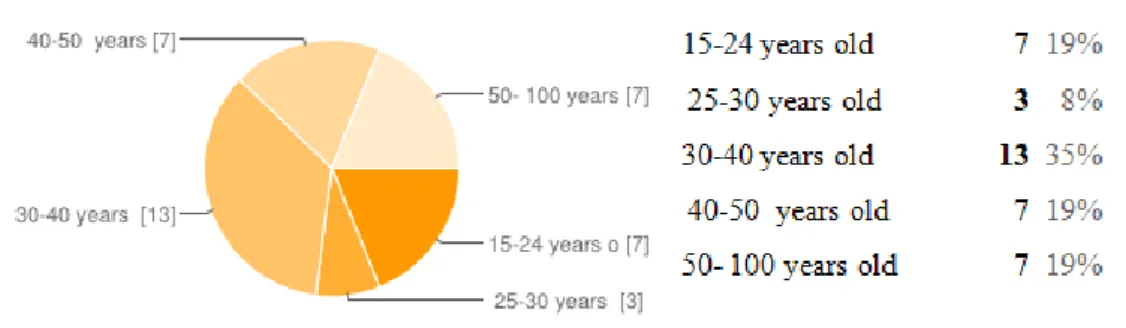
Taking into account the age of the 38 students, 27 are between the 30-100
years old range and 10 students are between 15-30 years old group (Figure 2).
This is important due to the fact that ICT was not introduced into the Spanish
Educational System until 1985, and only as IT, and afterwards the internet was
launched in 1995. We can consider that at least 38% of the students were born
before the 1980s and did not get the opportunity to experience the use of all the
ICT tools that emerged in the 1990s and this decade in their previous
37
Figure 2. Age.
When we asked students how many years they have been studying English,
there are 17 learners within the 2-3 years group (46%), only two participants
have been learning English between 3 to 6 years (5%) and 15 students have
had English classes for 6 years or more (41%). Almost half of the class has
been studying English for more than 6 years. Despite having studied English for
many years, time cannot be a determinant of improvement in learning, unless it
is proved.
After commenting on general topics such as their age range and average of
years studied, we focused on ICT and e-learning. Many of the students (65%)
think it has a significant role in their learning process at the EOI. However 14%
of the students said it was not relevant or useful.
38
As we can see in Figure 4 when students were asked about what they
associated in order of importance with ICT, the majority chose the computer
17%, the internet (16%), e-mail address (14%) and audio listenings (12%).
Whilst those less selected areas were: the interactive whiteboard (7%), learning
platforms (7%), TV (6%) and Social networks (5%). The percentage of the
learning platform was surprising because only 7% voted it as being associated
with ICT (given the fact that the centre’s webpage includes a virtual classroom).
Figure 4. List of ICT Tools.
Concerning the use of the internet, 92% of the students state that the internet
does help them to improve their language skills, whereas 3% say that it does
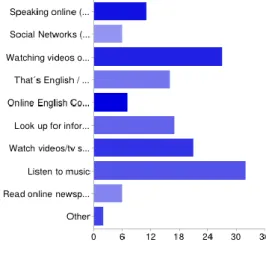
not help (Figure 5). However the internet is considered by students a method of
improving their language skills when listening to music, watching videos on
Youtube or TV shows and looking up information for travelling abroad. They all
look for listening and speaking improvement resources, but not many people
use them as a way to make progress in their reading or writing skills (Figure 6).
39
concern that listening and speaking skills are more difficult when learning
English (Figure 7). Nevertheless, the students writing and reading skills are a
significant part when learning; the results show all four skills are not being
developed equally.
Figure 5. Language skills.
Figure 6. Internet improvement.
40
We asked students for their opinion about the improvement of ICT in their
years of study at the EOI. The following results were obtained: 3% said that it
had not improved, 22% said that it had improved a little bit, 49% said that it
could improve more and 27% said that it had improved a lot.
Concerning the material and methodology engaged in learning English with
ICT, many students prefer printed learning material rather than e-learning
material (Figure 8). From their point of view they prefer that teachers use both
printed and e-learning material. On the contrary teachers using their own
material for teaching are not approved by students (Figure 9), despite the
tendency nowadays towards the innovative methods of teaching focusing on no
books and the teacher’s own material12
.
Figure 8. Learning Material.
Figure 9. Teacher’s Material.
12
41
When asking students about e-learning methods, many of them pointed out
ICT methods such as video, audio and online accounts or the use of the
interactive whiteboard. But not many are aware of the use of wikis or the virtual
classroom. Only three members of the study, who were Secondary School
students, had knowledge of the use of wikis (Figure 10).
Figure 10. E-learning methods awareness.
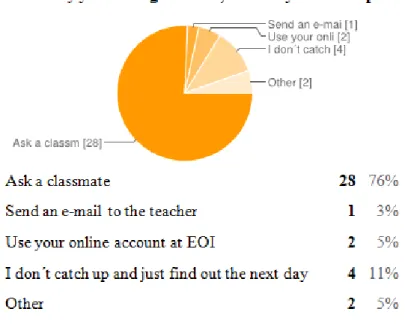
Combining the importance of the internet (Figure 4) and the use of ICT, we
inquired in this survey if in a practical case such as catching up with a session
they had missed, what method the students would used to find out what
material they had to study (Figure 11). Many of the students (75%) would rather
ask a classmate than choose other methods such as sending an e-mail to the
teacher or to a classmate, or checking their own account of the EOI. By choice
they would ask a classmate rather than putting into practice the advantages that
ICT offer. Another aspect to take into account is that the importance of the
online account where they can e-mail the teacher or check their examination
42
Figure 11. Practical case.
Figure 12. EOI online account.
43
Having analysed the different aspects concerning ICT at the EOI, we asked
the students whether ICT had advantages, disadvantages or both (Figure 13).
We found that more than half of the participants stated that there were
advantages, and 38% responded that there were both advantages and
disadvantages. Nobody viewed the internet as only a disadvantage. Anyhow we
wanted students to explain what type of advantages and disadvantages ICT
had at the EOI. Therefore, we asked open questions to give the students
opportunity to express themselves more frankly. Though the questions were in
English, students were allowed to answer this part of the test in Spanish in
order to explain better their own point of view; that is the reason why the
answers may be in Spanish or in English.
The advantages associated to the use of ICT were that it is easier, it
motivates the students, the access can be anywhere and at any time and it is
good to practice listening and speaking. Furthermore there is wide variety of
available material. Some of the most outstanding and representative answers to
this following question are:
- “Más ameno, mas rápido, más interés y más asequible” (Student 3).
- “You can carry a lot of information in you electronic device, the information is
ready there” (Student 7).
- “It´s faster than books, easy and complete” (Student 9).
- “Puedes comunicarte con personas de otros países, es interactivo y es rápido”
(Student 18).
- “…libertad de horario, rapidez y práctico” (Student 26).
- “It´s fast, you can study when you want. You don’t need books and you can
44
Despite some students stating that the use of ICT had no disadvantages,
many other participants did point out disadvantages such as low connectivity,
the different levels of knowledge of ICT between young and more adult
learners, the lack of communication with the teacher and the excess of
information and lack of reliability on the contents found online. These are some
of the more significant answers concerning the disadvantages of using ICT:
- “No todo el mundo tiene el mismo ritmo de aprendizaje, sobre todo la gente
mayor” (Student 2).
- “Menos contacto personal con el profesor, no disponer de internet en un
momento determinado” (Student 6).
- “You spend a lot of time. It is more difficult than traditional books when you want
to see more than a page at the same time” (Student 7).
- “No todo el mundo puede accede a las nuevas tecnologías, no internet en
casa” (Student 8).
- “Nadie te corrige, no puedes comparar tu nivel, falta de conversación” (Student
13).
- “[…] que no sepas utilizarlo, tardas en familiarizarte con las ICT” (Student
17).
- “I don´t have a computer, enough information and don´t have time” (Student 21).
The last question was to ask students to give ideas and suggestions of how
to improve the use of ICT from their point of view and at the EOI. A majority
admitted that they should use ICT more often, there should be a better access
to the internet and they should be trained in how to use ICT. They also stated
that when other facilities are improved then their progress in ICT as a learning
tool will improve at the EOI and that the use of ICT will be very important for the
45 - “Yes, because it´s the future” (Student 4).
- “ICT can be improved when other programmes are improved” (Student 7).
- “Hacerlo más fácil de entender a la hora de manejarlo” (Student 10).
- “Clases con un profesor nativo” (Student 17).
In conclusion many of the students are aware that ICT can have advantages
and disadvantages, although many of them may not be aware of the wide range
of tools, possibilities and methods that the use of ICT covers. We can perceive
a certain ambiguity related to the use of ICT. At first the students appear to be
confident to use ICT but quite a few tools or applications remained unknown or
not included in their lerning process.
All the gathered answers stated that students also notice that not everyone
has the same speed in learning and that they do not have enough knowledge of
ICT. The lack of accessibility when there is no internet connection and the
different skills among young and elderly people can become an ambiguity when
learning a language because the teacher has to work with all the entire group
and adapt to its needs, knowing beforehand what skills they have concerning
ICT. This could be one of the main reasons why ICT can be questioned in the
teaching-learning process at the EOI.
5.2. RESEARCHERS
As in all investigation the maximum number of agents should participate, it is
vital to know the opinion of those who are doing research in the field of ICT
concerning education as they are a fundamental element in discovering the
reality of the educational world. We contacted two researchers from the
Universidad of Valladolid who answered a similar questionnaire given to the