QUALITY OF THE VOCATIONAL TRAINING FOR CONSTRUCTION INSPECTORS
M. IORDACHESCU 1, 2, G. IORDACHESCU2, E. SCUTELNICU2, D. IORDACHESCU3
1 ETSI Caminos, Canales y Puertos, Dep. Ciencia de Materiales, Universidad Politécnica de
Madrid, España, [email protected]
2 Dunarea de Jos University of Galaţi, Romania, [email protected] [email protected]
3 Centro Láser, Universidad Politécnica de Madrid, España, [email protected]
The paper addresses the quality of the continuing training and vocational education for the construction inspector job and the harmonized European recognition of this qualification. It is the result of a survey realized in 5 EU countries (Greece, Hungary, Poland, Portugal and Romania) within the fame of the project entitled “Analysis and Comparative Study on construction inspection job performance regulations. European comparative study – KNOWLEDGE”. The general objective was to give recommendations for improving the qualification of civil construction inspectors by identifying the gap between the existing vocational education / training systems, and people/companies’ expectations and needs, as resulted from current literature, in-depth interviews and questionnaire surveys. The conclusions are related to the necessity of developing a training/certification program for the construction inspector, the magnitude and European dimension of such training and certification program, and the thematic areas that the program will cover to meet the construction industry requirements. Courses approaching New Construction Materials, Quality Control Procedures, Legislation on Town Planning, Private Constructions and Public Works, Legislation on Safety Issues in the Construction Industry, and the EU directives were identified as being necessary for updating the knowledge of the construction inspectors. Relevant graphs presenting the continuing training needs of the construction inspectors resulted from the in-depth interviews are presented. It results as a LLL European policy requisite the development of a European Certification for construction inspector.
INTRODUCTION
The paper addresses the quality of the continuing training and vocational education for the construction inspector job and the harmonized European recognition of this qualification. It is the result of a survey realized in 5 EU countries (Greece, Hungary, Poland, Portugal and Romania) within the project entitled “Analysis and Comparative
Study on construction inspection job performance regulations. European comparative
study - KNOWLEDGE”. Computer-aided (e-mail) and face to face interviews were used
for acquiring the Questionnaire and In-depth interviews based survey. The average interview length per respondent varied between 30 and 60 minutes. Table 1 presents the number of respondents per country and survey type. The questionnaire respondents were persons working as construction inspectors, aged 25 and over, speaking the respective national language. Teachers-trainers working in vocational learning and construction managers expressed (through in-depth interviews) their opinion regarding the construction inspectors’ authorization process and their specific training needs.
The 5th International Seminar on Quality Management in Higher Education
2
the new technologies involved in the construction process and the regulations changes according to the EU main standards and rules.
Table 1: Number of respondents per country and survey type [3]
Country Questionnaire survey In-depth interviews
Greece 50 16
Hungary 50 15
Poland 93 15
Portugal 50 15
Romania 80 15
ENGINEERS/INSPECTORS VOCATIONAL TRAINING ANALISYS
As Figure 1 presents, the survey revealed the strong will of the people involved in construction inspections to receive appropriate vocational training on a long term basis. More than 60% of the respondents in each country replied that constant life-long
learning is indispensable in order to maintain a high level of knowledge. Other answers
quite popular among the respondents revealed that knowledge update is useful to improve the inspectors’ status in the construction industry. Assuming that the respondents form a representative sample of the construction inspectors in each country, their openness to vocational training and new knowledge, as indicated by the survey results, sets a solid ground for the development of training programmes aiming to satisfy their professional knowledge needs.
Figure 1: Need for vocational skills improvement in each participant country
Based on the proved strong interest of the construction inspection practitioners to attend vocational training, it was of extreme importance to examine what kind of vocational training these people have received in the past and what type of training they would be willing to take in the future, on the basis of what they consider the most effective. It should be underlined that not all types of vocational training were equally available in all participant countries, and it is normal to notice that one type was more preferred than another in a particular country.
Quality of the vocational training for construction inspectors
3
obtaining a building authorization were only oral in the last two decades, the majority of the construction inspectors never attended a preparatory course. Finally, in countries were the formal recognition of the profession exists, as Romania and Hungary, courses for construction inspectors are officially organized. Moreover, in Hungary is obligatory to attend the preparatory courses. Figure 2 presents the results of the survey on the existence of the preparatory courses in the analyzed 5 EU countries.
Figure 2: Preparatory courses for construction inspection authorization
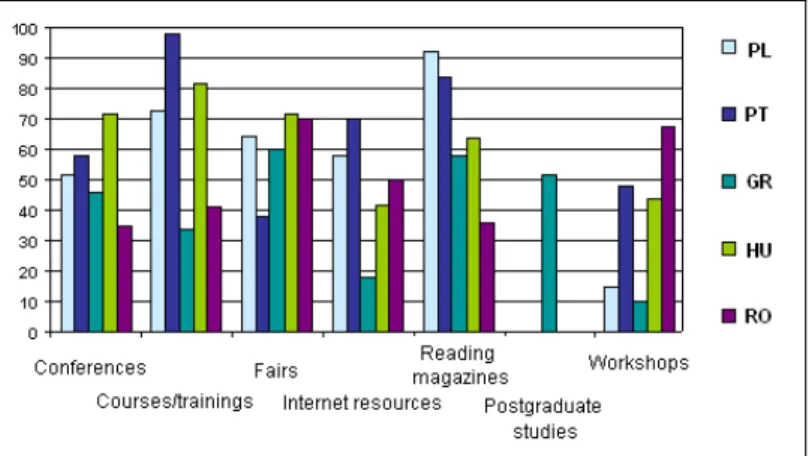
Apart from mandatory courses for inspection, which are not available in all countries, there is a variety of types of vocational training that are preferred by practitioners. Figure 3 presents the most common types of vocational training undertaken by the inspectors, namely attending conferences, workshops and occasional
courses/trainings, participating in fairs, using Internet, reading magazines, and
participating in post-graduate higher education. Notable is that the Internet usage in
acquiring knowledge competes with the traditional training methods. For example, in Romania, 50% of the respondents recognized Internet as the main source of information. Participation in fairs and workshops are seen as up-dating activities, due to the opportunity of gathering material/equipment manufacturers, experts, and direct users.
The 5th International Seminar on Quality Management in Higher Education
4
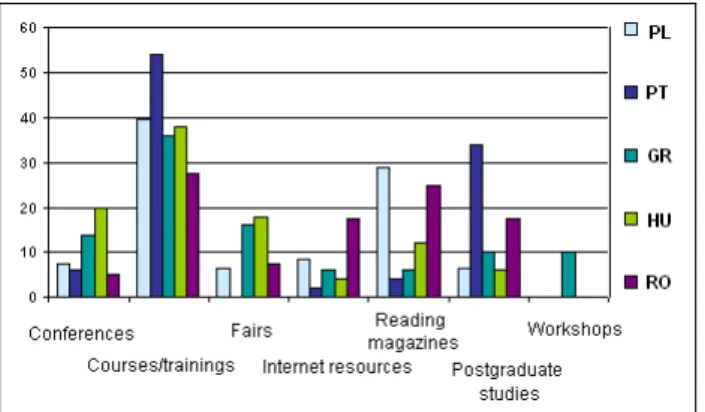
Figure 4 shows the survey results with respect to the most effective type of training from construction inspectors’ point of view. The training courses are preferred, in all countries, due to reasons as personal interaction with the expert delivering the course, opportunity to obtaining immediate answers on practical every day problems, interaction with other classmates, CV improvement, or future career development.
Figure 4: The most effective types of vocational training according to the respondents
It is widely accepted that vocational training complements basic university education. In Europe, the university degree in construction related subjects has a duration varying from three to five years, allowing to providing the necessary background for inspection activities. As Figure 5 shows, the majority of the respondents positively evaluated the knowledge they gained in university, within the context of the construction inspector profession. This supports the opinion that the existing university degrees cover adequately the market requirements for inspection in construction, and the vocational training strengthens and enriches the previously acquired knowledge.
Figure 5: Adequacy of academic education (degree) for inspection jobs
VOCATIONAL TRAINING NEEDS OF THE ROMANIAN INSPECTORS AND INTERNATIONAL CERTIFICATION
Quality of the vocational training for construction inspectors
5
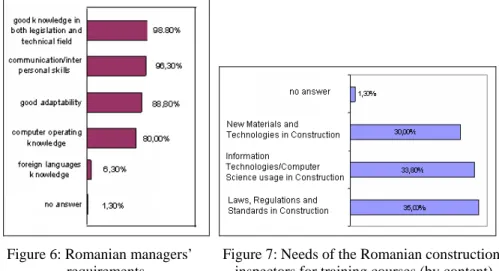
different training courses is positive. Figure 6 presents the main requirements of the management, which the construction inspectors must comply with: good knowledge in
legislation and technical field (98.8%), communication/interpersonal skills (96.3%),
good adaptability (88.8%, computer knowledge (80%) and foreign languages
knowledge (6.3%).
Figure 7 shows the well balanced response on the question about the most needed courses by the Romanian inspectors: Law, Regulations and Standards in Construction (35%), Information Technologies/Computer Science usage (33.8%) and New Materials and Technologies in Construction (30%). Therefore, the training courses offer in Romania must address new technologies implementation, computer usage, and/or
management and quality assurance.
Figure 6: Romanian managers’ Figure 7: Needs of the Romanian construction requirements inspectors for training courses (by content)
The Romanian respondents have heard about the existence of different forms of European harmonized certification, but no one of them is having such authorization. Their opinion is that the European certification should be a voluntary one, due to the fact that this authorization can’t have a significant influence at national level.
Furthermore, the construction inspector profession must be firstly recognized at European level and after that, the debate on its certification could be open.
The only known European harmonized certification is provided by the European Welding Federation, which is a professional association. EWF is having its own training and certification system, implemented in the member states, and fits with the construction-related activities as far as the activity deals with welding. On the other hand, this model can be adapted for construction inspectors, but the specificities of each country generate important issues.
Moreover, the Romanian respondents’ opinion about the development of a European system of construction inspector authorization showed that:
The 5th International Seminar on Quality Management in Higher Education
6
- 47.5% think that it would ensure the main bases of a good development of the European construction sector;
- the rest of the respondents stated that it may not influence the countries construction sectors specificity in terms of high-risk regulations.
CONCLUSIONS
The survey main conclusions are:
- The respondents’ general opinion on the knowledge gained during the university
graduation in terms of quality is quite good, but several changes regarding the basic
training are necessary. On the other hand, new teaching methods including multimedia
techniques must be introduced as training methods.
- The easiest way of up-dating the knowledge in the construction field is the classical participation in training courses; reading of branches magazines or Internet usage and workshop participation follow in the preference scale.
- Although specialized training programs for construction inspectors doesn’t exist in Romania, organized training at post-university level in construction sector exists; the following training needs have been identified: Laws, Regulations and Standards in Construction, Total Quality Management; Quality Assurance in Construction, New Materials and Technologies and Information Technologies/Computer usage.
- The ideal construction inspector definition is related to good communication and attitude towards the constructors, good qualification, skills and knowledge, including computer usage and the knowledge of the professional issues.
- The Romanian respondents’ opinion is that the European harmonized certification in construction should be implemented voluntarily, because this authorization can’t have a significant influence at national level, due to each country specificities. On the other hand, the development of a European system of construction inspectors’ authorization seams to be crucial for the future development of the European construction sector, in terms of quality assurance and safety; some specific rules must co-exist with the general ones, due to the countries natural factors of high-level risk as floods, hail storms, drought, landslides, soil erosion, and earthquakes.
REFERENCES
[1]. *** Synthesis Report (Greece, Hungary, Poland, Portugal and Romania) Analysis and Comparative Study on construction inspection job performance regulations. European comparative study “KNOWLEDGE”, 2006, 48 pages.
[2]. Iordachescu, M., Stan, C., Ilie, I., National State of the Art for Construction Inspector job, KNOWLEDGE Romania Report, PL/04/F/RF-84152, 2243/001-001 LE2-51OREF, ASM, CE-Poland, http://www.construct.ugal.ro/documente/NationalStateoftheArtforConstructionInspectorJob_ro.pdf, 2005, 20 pages.