Election of water resources management entity using a multi-criteria
decision (MCD) method in Salta province (Argentine)
Juan B. Grau, Jose M Anton, Ana M Tarquis
E.T.S. de Ingenieros Agrónomos, U.P.M.
and
Diego Andina
E.T.S. de Ingenieros de Telecomunicación, U.P.M.
Madrid, 28040, Spain
ABSTRACT
At present, the water resources are a strategic element each time more necessary and limited becoming a source of conflicts. For that, it is fundamental to create an independent and competent entity with good reputation and social acceptation. This entity must be able to obtain, store and process all data dispersed in different entities creating a network for these purposes. Finally, it must be able to organize different branches between the government and the final users. Using one of the well-known Multicriteria Decision Methods(MCDM) with several realistic alternatives and several criteria identified in expert seminars in Salta and Madrid, we have obtained hopeful results and more recently new modifications introduced have generated better results.
Keywords: MCDM, Discrete Methods, ELECTRE-I, PROMETHEE, A.H.P., Environment, Water Resources management.
1 INTRODUCTION
In the XXI Century, Water Resources (WR) have got one of the top priorities worldwide. This is not only due to the need of this element for each one of the society sectors (agriculture, industry, residential use, etc) but also for its great irregularity, as much as in time as in space. The consequences of the lack, as well as the excess can be dangerous, since the lost of productions till catastrophic floods and therefore can be a landslide. Besides, the water pollution due to uncontrolled drainages carries out strong consequences for the people’s health, also for the extinction of the natural habitat and the environmental risks.
In the majority of the countries, except, maybe in the Valencian Community (Spain), the worry for the knowledge of the existent WR and its integral dealing have recently started within 4 fields: 1) The transformation into irrigable land, of huge extensions of
dry land, due to a bigger demand of agriculture products. 2) The usage of water for leisure and tourism purposes, since in large areas where water was not used, the population has increased strongly by a factor of 10, having installed golf courses, tourist and residential areas. 3) Bigger worry for environmental issues. 4) The mass-media pressure that derives from what it is known by the climate change
For all that, new laws, and rules for surface water and groundwater are coming up, as well as the creation of an organism to watch, to standardize and to manage the water resource use.
But there is a problem that it is not always easy to deal with, since the competences are spread and in many cases are confronted, being more important political and competence subjects than the rational, technical and economic.
In Valencia (Spain), “The Tribunal de las Aguas” (The Water Jury”) exists for more than 500 years functioning, as a model unique in the world. This model cannot be exported to other parts of the world due to the international e intercommunities relationships. In the limit we should have a special Entity Worldwide that could cope with all the competences and to delegate some of them to other national entities. The ideal is not reachable, but we must arrive as close as possible and we will minimize the distance. We shall have to find a model able to be adapted to the characteristics of each area. [1], [19]
2 GEO-HYDROLOGIC CHARACTERISTICS OF SALTA PROVINCE (ARGENTINE)
important long mountain valleys, has low standards for roads and it has an environment that is “deteriorating progressively”.
Bermejo river is the most important fluvial artery in the area. It presents a zone known as a meander digression since due to low slopes its course changes constantly forming meanders That area in rainy period is transformed into a immense sheet of rain that completely isolates the communities living by the river between 5 to 10 km from the riverside. It produces a constant erosion that makes a great lot of sediments setting down at the Paraná river generating an important cost in the continuous drainage. The majority and more important flowing of the Paraná drain through this region, such us Pilcomayo, San Francisco that flows into Bermejo, Juramento or Salado..The Horcones and the rest like Itiyuro, Rio Seco, Dorado, Del Valle etc., less in water but very important for the Province, end in marshlands, generating wet areas.
In the climate aspect the lack of water is the characteristic in the whole region. Rainfall is concentrated in the summer time. The rainfall presents a strong declive, from 1200 mm per year in the east to 300 mm in the Southwest. In the Northeast it goes up to 1200 mm. The groundwater resources are poor in volume and in quality (salty and with arsenic). It is possible to find good quality groundwater but in deep levels (100m) with high operating costs.
Water is the most critical factor, as much for human and animal consumption, as for the production system in general. For that reason, it is so important to define an official entity for the WR, in order to contemplate all the aspects related with data control and water management since its capture till it is used, as well as those in relation to the social, cultural and economic substratum, where they must be applied. The management of water must include both the surface water and groundwater due to the critical resource in that region. For that, an effort should be made in seeking the best way of extraction and usage in low cost and to implement good management and the best practices.
3 LEGAL SITUATION
3.1 IN SPAIN
Actually, in Spain the competences are with the Ministry of Environment. The general legislation for the ordering of the Water Resources is the Law of Water of 1879 on surface water and the law 29/85 of 2nd August, for surface and groundwater. Rules of Public Water (R.D. 849/1986, 11 of April) modified by Royal Order 1315/1992, of 30th October Rules of water of Public Property modified, by (R.D. 927/1988, of 29th of July). For the water of home use, R D 1138/1990, of 14th September. As regarding resolution of conflicts related
with the arrangement and development of WR exist the Rules of Development of Water Law and the competences of Hydrographic Confederations and General Direction of Hydrologic Works and Water Quality. To fix the price and to get back the expenses, the Water Law, Art 106 is applied. For agriculture use the expenses are shared among the “Comunidades de regantes”. For home use, municipal taxes include distribution, charges, to make drinking water and training, etc…
In Spain exist 7200 Irrigate user Communities “Comunidades de Regantes” that irrigate 2.600.000 Has and 1.160.000 Has are managed directly by the end users (groundwater). Besides, there have been installed 1200 data collection stations (1000 are for periodic checking and 200 for occasional monitoring). They are integrated in the Water Quality Integral Network (ICA). This allows to follow the water characteristics within the 9 Spanish River Basins. All of that by means of taking systematic samples, to further analysis in the Laboratory.
To watch the quality of water more than 200 Automatic Alert Station (EAA), are continuously taking data that indicate the quality and other parameters of the water. This system is completed with 9 outside centers of control set up in each Basin and the Central Unit in Madrid. Information is gathered regularly about the water parameters in the following way: In the agriculture sector by means of Autonomous Communities and Environment Ministry. In the industrial sector through the Ministry of Industry. In the residential sector through Ministry of Health, Environment Ministry and City Council. The information is delivered by the Environment Ministry. In summary:
In Spain the water is a good of public property. The State has the water competences and, it is the Entity that rules the Public WR. The right of using water is given by the State by means of an administrative concession. The State delegates its competences about water to the Hydrographic Confederations. Each one has the competences in a territorial area, usually a river basin. The Confederation manages the river water and grants concessions of water use. Communities of users have a concession for the use of water in an area in which they have also the autonomy to manage the water. It is an administrative entity Corporation formed by the users with the right to use a certain amount of water, being collective in order to get an efficient and coordinated profit with the fulfilment of the rules made by the same members. It manages the public water, distributes the flows, solves the conflict among the users and performs police functions.
At national level, the responsable entity is the “Subsecretaría de Recursos Hídricos” and the “Dirección Nacional de Recursos Hídricos”. In the different provinces we find organisms with similar status. At regional level “Comités de Cuenca” (Basin Committees) are being created with non-executive functions. Since 5 years ago when the privatizations took place, the maintenance and operative functions of waste and drinkable water systems were assigned to licensees. In 2007 the Law Nº 7017 was published. This Law is the “Código de Aguas de la Provincia de Salta y los Reglamentos Técnicos de la Agencia de Recursos Hídricos” (Water Code of Salta Province and the technical rules of the WR Agency). In this Law were included the province competences in relation to provincial, inter-provincial and international public WR. The definition, competences, etc., concerning the Consortia (definition, competences,...) are included in title VI of the above mentioned Law Also in article 198 appear the second degree Consortia (as “Asociación de consorcios”).
Other public entities: “Instituto Nacional del Agua” (INA ex-INCYTH), “Instituto Nacional de Tecnología Agropecuaria” (INTA), “Instituto Nacional de Tecnología Industrial” (INTI) are involved in this area. In the same way Universities and Provincial Technical Organisms. In relation with the water quality the “Dirección Nacional de Emergencia Sanitaria” (DINES) is the responsible entity. It is not yet established a National Data Collection System. For that reason it has been planned to establish the” Sistema Nacional de Información de Saneamiento Para Agua Potable y Saneamiento” in charge of the “Subsecretaría de Recursos Hídricos”.
Regional Commissions have been created linked to the different basins, like the COREBE (Comisión Regional del Rio Bermejo). In the case of international basins there have been created international commissions, the COBINABE (“Comisión Binacional para el Desarrollo de la Alta Cuenca del Rio Bermejo y Rio Grande de Tarija”) created between Argentina and Bolivia at 9th of July of 1995 in Salta (Argentine).
Some of the most important problems are the lack of full WR information, the dispersion of databases and the lack of suitable data processing. The data can be stored in the Air Forces, Airports, INTA, Railways, Universities, Water Entities, etc. It is not possible to obtain complete time series in different zones.
4 MCDMETHODS
4.1 DECISIONAL MATRIX
The data that are included in decisional matrix were obtained from the conclusions of water parameter journeys hold in Salta (Argentine) in 2004. Following those conclusions five i-alternatives were finally selected: Public Entity, Institute, Foundation, Cooperative, Private Company. Besides five j-criteria were considered relevant: Implementation Facility, Implementation Delay, Legislation in Force, Social Acceptance and Flexibility. In order to fix the weights two commissions were created. The order of preferences given was different and there were necessary more meetings to fix them. Last September 2007 we obtained the following weights and the filled decisional matrix shown in Table 1. [2], [5], [6], [7], [8], [9], [10] and [20]
Criteria
Alternatives
Implementation Facility
Implementation delay
Legislation in Force
Social
Acceptance Flexibility
Public Entity 8 12 10 5 5
Institute 7 18 8 6 6
Foundation 6 18 7 7 7
Cooperative 7 20 7 8 8
Private Company 6 15 5 4 9
Weights 0.30 0.10 0.15 0.20 0.25
Index +1 -1 +1 +1 +1
Table 1. Decisional matrix. Index: +1 is “more is better”, -1 is “more is worst”
4.2 ELECTREIM.C.D.M.[4],[11] AND [12] In the first place we apply the Electre I Method with
Election of hydric resources management entity using MCDM ELECTRE-I. Method.
Decisional Matrix Rows i are Alternative, column j criteria Index :
more is better Isubj = 1 more is worst Isubj = -1
Standardized Weights: It 8 7 6 7 6 12 18 18 20 15 10 8 7 7 5 5 6 7 8 4 5 6 7 8 9 =
WT =(0.3 0.1 0.15 0.2 0.25 ) IT =(1 1 1 1 1)
B Matrix C : Concordance: Indexes
C
sss 0
sss sss w j( )
( ) if II j( ).(tt(j i, ) tt(j k, ))>0 sss sss w j( )
2 if (tt(j i, ) tt(j k, ) 0) (i k) j∈1..n
for
ssi k, sss k∈1..m for
i∈ 1..m for ssT CT 0 0.45 0.45 0.45 0.25 0.55 0 0.5 0.6 0.35 0.55 0.5 0 0.825 0.5 0.55 0.4 0.175 0 0.35 0.75 0.65 0.5 0.65 0 =
C(i,k) is a value comparing (i,k), sum of weights for which i is better than k, *0.5 if equal
cc(ii kk, ) Cii,kk
D Standardized and weighted Matrix
jj 1..n ii 1..m RR
tmin tt(j 1, ) tmax tt(j 1, )
tmin tt(j i, )
( ) if tt(j i, )<tmin tmax tt(j i, )
( ) if tt(j i, )>tmax i∈ 2..m
for
rrj tmax tmin j∈1..n for
rrT
RR =(2 8 5 4 4) Dnp ii,jj
Itii,jj.Wjj RRT jj dd(ii jj, ) Dnp ii,jj
Dnp 1.2 1.05 0.9 1.05 0.9 0.15 0.225 0.225 0.25 0.1875 0.3 0.24 0.21 0.21 0.15 0.25 0.3 0.35 0.4 0.2 0.3125 0.375 0.4375 0.5 0.5625 =
Figure 1. ELECTRE I with Mathcad8Pro, part 1
Ds Discordance Index Matrix
Dsc
nmax 0
dmax 0
sdif1 0
sdif2 II j( ) dd k j.( ( , ) dd i j( , ))
pdif max sdif( )
difj pdif j∈1 n.. for
ndif difj
ddif (dd k j( , ) dd i j( , ))
nmax ndif
( ) if ndif nmax>
dmax ddif
( ) if ddif dmax>
j∈1 n.. for
coc nmax
dmax
dsi k, coc k∈1 m.. for
i∈ 1 m.. for ds Dsc 0 1 1 0.8 1 0.41667 0 1 0.24 0.8 0.41667 0.41667 0 0.16667 1 1 1 1 0 1 0.83333 1 0.83333 0.3125 0 =
dsc ii kk( , ) Dscii kk, Tresholds :
ucc sum 0
sum sum
Ci k,
m 1
( ) m.
k∈ 1 m.. for
i∈1 m.. for
sum
Concordance Threshold
ucc =0.5
uds sum 0
sum sum
Dsci k,
m 1
( ) m.
k∈ 1 m.. for
i∈1 m.. for
sum
Discordance Threshold
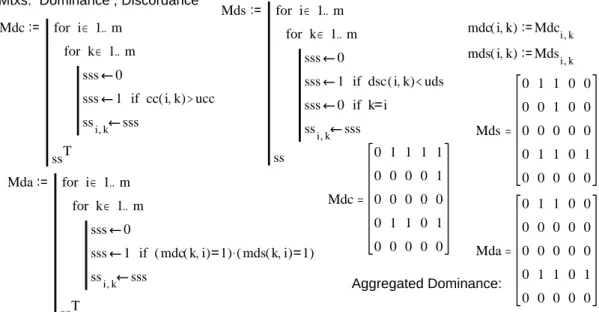
Mtxs: Dominance , Discordance Mds
sss 0
sss 1 if dsc i k(, ) uds<
sss 0 if k i
ss
i k, sss
k∈1 m.. for
i∈1 m.. for
ss Mdc
sss 0
sss 1 if cc i k(, ) ucc>
ssi k, sss k∈1 m.. for
i∈ 1 m.. for
ssT
mdc i k(, ) Mdc
i k,
mds i k(, ) Mds
i k,
Mds 0
0
0
0
0 1
0
0
1
0 1
1
0
1
0 0
0
0
0
0 0
0
0
1
0
=
Mda
sss 0
sss 1 if (mdc k i( , ) 1) mds k i.( ( , ) 1)
ss
i k, sss
k∈1 m.. for
i∈1 m.. for
ssT
Mdc 0
0
0
0
0 1
0
0
1
0 1
0
0
1
0 1
0
0
0
0 1
1
0
1
0
=
Mda 0
0
0
0
0 1
0
0
1
0 1
0
0
1
0 0
0
0
0
0 0
0
0
1
0
=
Aggregated Dominance:
We observe that with ELECTRE-I we have included in the kernel Cooperative and Public Entity
Figure 2. ELECTRE I with Mathcad8Pro, part 2
4.3 USING A.H.P. . METHOD WITH MAPLE11 [3], [16],[17] AND [18]
With Table 2 we obtain the Cooperative as first option endorsing our assumption.
CRITERIA Imp. Facility
Imp. delay
Legisltn. Social
Accep.
Flexibi-lity
Global weights Weights
Alternatives
3/10 1/10 3/20 1/5 1/4
Public Entity 4/17 15/56 10/37 1/6 1/7 0.2069619
Institute 7/34 5/28 8/37 1/5 6/35 0.1949114
Foundation 3/17 5/28 7/37 7/30 1/5 0.1958433
Cooperative 7/34 9/56 7/37 4/15 8/35 0.2166903
Private Company 3/17 3/14 5/37 2/15 9/35 0.1855924
Table 2. Results from A.H.P. method.
4.4 PROMETHEEMETHOD [13],[19] AND [15] To make sure, still more, we analyse the problem with PROMETHEE I and II with the same result, Table 3.
Table 3. Results with PROMETHEE I and with PROMETHEE II Public
Entity
Institute Foundation
Cooperative Private
Company
Phi +
Public Entity --- 0.55 0.55 0.55 0.75 0.6
Institute 0.45 --- 0.45 0.25 0.65 0.45
Foundation 0.45 0.45 --- 0.10 0.35 0.337
Cooperative 0.45 0.45 0.75 --- 0.65 0.575
Private Company 0.25 0.35 0.35 0.35 --- 0.325
Phi - 0.40 0.45 0.525 0.312 0.60
5 CONCLUSIONS
The results obtained with the different methods seem to be the best alternative to give the water management in the Salta Province to a Cooperative. This role could be played by the actual “Asociación de Consorcios de Usuarios de Aguas Públicas de Salta” (Consortium Association) with the competences delegated from the Agencia de Recursos Hídricos (WR Agency). The fundamental hydrology infrastructure works should be paid by the Province Government with funds coming from The Federal Investment Council. The canon due to water use would be transferred to the Cooperative. This Entity would be responsible for hydrologic information network, water distribution, maintenance task and police actions.
We also have considered the evolution of the figures included in the decisional Matrix with Bayesian Methods and we have obtained the only possibility to transfer for transitorily period to the Federal Government. This will be the object of another paper.
6 ACKNOWLEDGEMENTS
This research has been partially supported by the National Spanish Institution "Ministerio de Educación y Ciencia"as part of the project AGL2006-12689/AGR.
We thank J.J. Marcuzzi and Roberto Planelles for the organization of Parameter Journeys hold in Salta in 2003, and Miguel Sastre, Chairman of “Asociacion de Consorcios”, for their help in order to obtain the data and the information.
7 REFERENCES
[1] J. B. Grau, “Curso: Métodos matemáticos para la toma de
decisiones”, Escuela de Postgrado de la Facultad de Ciencias
Naturales, Universidad Nacional de Salta, Argentina, 2003. [2] J. M. Antón, E. Ballestero, C. Bielza. “Compromise-based approach to road project selection in Madrid metropolitan area”. J. of the O. R. Society of Japan,Vol.46, Nº 1, 2003, pp 99-122
[3] J. M. Antón, J. B. Grau, D. Andina. “Electre and AHP MCDM Method and the Oficial choice Applied to High-Speed Railway Layout alternative election”. W.S.E.A.S. transactions on business and economics, Issue 1, Vol.1, Jan. 2004, pp 64-69.
[4]J. M. Antón, J. B. Grau.“The Madrid-Valencia high-speed rail line: a route selection”. Transport Journal,
Institution of Civil Engineers, UK,Vol.157, August 2004, pp. 153-161.
[5] J. M. Antón, J. B. Grau, E. Sánchez. “Compromise Programming in Financial Analysis for Strategic Management”.
Transactions of WAC-2004, Vol. 17, USA, 2004, pp.555–560.
[6] Jamshidi, Mo., Coelho, L. dos S., Krohling, R. A. and
Fleming, P. J. (2003) Robust Control Systems with Genetic
Algorithms, CRC Press, Boca Raton Florida USA.
[7]Keeney, R. L. and Raiffa, H. (1976) Decisions with Multiple Objectives: Preference and Value Tradeoffs, John Wiley & Sons, New York.
[8] Zeleny M. (1982) Multiple Criteria Decision Making,
McGraw-Hill, New York.
[9] Yu P.L. (1985) Multiple Criteria Decision Making:
concepts, techniques and extensions. Plenum Press, New York.
[10] J. Anton, J. B. GRAU, E. Sanchez. “Compromise
programming calibration for financial analysis of firms of a common sector of business, case study for a set of Spanish banks
in 1995”. Applied financial economic, pp 445-461, 2007
[11] B. Roy, D. Bouyssou. Aidé Multicritère à la Décision: Méthodes et cas. Economica, Paris 1993.
[12] B. Roy. Méthodologie Multicritère d’Aide à la Décision.
Economica, Paris (1985).
[13] J.P. Brans, Ph. Vincke, B. Mareschal, “How to select and
how to rank projects: The PROMETHEE method”. European J.
of Operational Research, vol. 44, nº 1, 1986, pp. 138-228. [14] J. P. Brans, Ph. Vincke. “A preference ranking organization
method, the PROMETHEE method”, Management Science.
Vol. 31, 1985, pp. 647-656.
[15] J. P. Brans, B. Mareschal. “The PROMCALC and GAIA Decision Support System for Multicriteria Decision Aid”,
Decision Support Systems, Vol. 12, 1994, pp 297-310.
[16] T. Saaty. The Analytic Hierarchy Process, Mac Graw-Hill,
New York, 1980 and 1988.
[17] T. Saaty. Multicriteria Decision Making: The Analytic
Hierarchy Process, AHP Series (extended edition), Vol. 1, RWS Publications, Pittsburg USA, 1996.
[18] T. Saaty. Decision Making for Leaders, AHP Series
(extended edition), Vol. 2, RWS Publications, Pittsburgh USA, 1996.
[19] C. Romero. Teoría de la decisión multicriterio: Conceptos, técnicas y aplicaciones. Alianza Universidad Textos, Madrid, 1993.
[20] G. Munda, Multicriteria evaluation in a fuzzy environment,
Contributions to economics Series, Physica Verlag,