STRESS CONVENTIONS FOR HISPANIC TEFL STUDENTS
A Monograph Presented to
The Program of B.A. in Teaching English as a Foreign Language School of Education
Universidad Nacional Abierta y a Distancia Colombia
In Partial Fulfillment
of the Requirements for the Degree of Licenciada en Inglés como Lengua Extranjera
by
Giselle Bautista Garcia
December 2019
ABSTRACT
Colombian English teachers and university students from TEFL Bachelor’s degree programs are required by the Ministry of Education of Colombia (MEN) to improve and develop bilingual skills. However, bilingual skills not only rely on grammar and vocabulary, but also on good pronunciation and listening comprehension skills, which facilitates good communication skills in English. One of the major problems experienced by many adult, native Spanish speakers is the existence of erroneous stress placement in most English words and sentences when reading out loud or speaking in English. This has the potential to confuse English speakers, and as a
consequence, this monograph intends to explain why learning and applying stress conventions is essential for adult and Hispanic English learners, and present in the appendices of this work some basic principles and conventions for improving some areas of English pronunciation. This is intended to make communication more intelligible and comprehensible for the audiences of these learners. Adult learners have advantages over children, and these stress conventions can be learned and memorized easily by a motivated adult learner and TEFL student. This will allow them to easily apply the conventions in readings and regular conversations when practicing with a teacher in the classroom and other contexts. In this way, even though there are exceptions to the rules, motivation in adult English learners increases, as well as confidence when participating in advanced English courses, like English conversation.
ACKNOWLEDGMENTS
TABLE OF CONTENTS
ABSTRACT ... ii
ACKNOWLEDGMENTS ... iii
LIST OF TABLES ... vii
LIST OF FIGURES ... viii
INTRODUCTION ... 9
Significance of the Study ... 10
Statement of the Problem ... 12
Objectives ... 13
General Objective ... 13
Specific Objectives ... 13
LITERATURE REVIEW ... 14
Pronunciation in Communication and Comprehension ... 14
What is Pronunciation? ... 15
The Supra-Segmental Features in Pronunciation ... 17
“The Road Signs” of Communication ... 19
Rhythm ... 20
Native Spanish Speakers’ Difficulties ... 20
Stress ... 22
Sentence Stress... 24
Emphatic Stress ... 26
Stress-Placement Conventions by Experts... 27
Syllabification and Morphological Formation ... 28
Stress Conventions based on Word Type ... 29
METHODOLOGY ... 31
Research Approach ... 32
Research Line... 34
Research Tools ... 35
RESULTS AND DISCUSSION ... 37
CONCLUSIONS AND SUGGESTIONS... 44
REFERENCES ... 47
APPENDIX A: INDEX CARDS SAMPLES ... 57
Template ... 57
Sample 1... 57
Sample 2... 58
APPENDIX B: A SUMMARY OF FOCUS WORD PRINCIPLES BASED ON GILBERT’S PYRAMID ... 59
Convention 1 ... 59
Convention 2 ... 59
Convention 3 ... 59
Convention 4 ... 59
LIST OF TABLES
Table 1. English Pronunciation’s Features ...38
Table 2. English Stress and Orthography for Hispanic English Learners ...40
Table 3. Adult Language Learning ...42
Table 4. First and Second Syllable Words ...60
Table 5. Words that operate as nouns and verbs ...61
Table 6. Compound Nouns and Verbs ...63
Table 7. Words ending in -ee, -eer, -ese ...64
Table 8. Words ending in -ology and -osis ...65
Table 9. Words ending in -eous and- ious ...66
Table 10. Words ending in -ia and -ial ...67
Table 11. Words ending in -ic and -ical ...68
Table 12. Words ending in -ify and -ity ...69
Table 13. Words ending in -tion and -sion ...71
Table 14. Words ending in -ate, -cy and -phy ...72
Table 15. Exceptions of words ending in “-cy” ...73
LIST OF FIGURES
CHAPTER 1
INTRODUCTION
Three years ago, UNAD English Conversation Course directors requested that I assist them from my country of residence in Belize, as an online English instructor. The Skype online meetings that this course offers allows Colombian students of different regions to practice their speech and communication skills. As someone who has become accustomed to hearing native English speakers for various years, I noticed poor developed pronunciation skills in most of my students, especially wrong English stress, when they spoke or read written English. Interestingly, I discovered that most of the students who have begun to learn English with UNAD University from scratch have shown a lower pronunciation level in comparison to other students. Some of the gaps in pronunciation and the lack of confidence that I noticed in my students were related with stress placement and rhythm, especially when they read written English in the form of sentences and questions. However, English pronunciation and students’ confidence in these areas can be improved significantly if we address the very issues that relate to the characteristics and functionality that makes English different from Spanish. The purpose of my proposal is to address issues that have not been addressed practically in UNAD English classes, to help foster better pronunciation skills and confidence in these students and other Hispanic English learners.
UNAD students, is due to the inherent characteristics of the English language, as was mentioned previously. For example: in the English language it is not evident how the written words
correspond to the spoken language or vice versa (Jones, 1996), due to its unique history that created a complex alphabetic code, (Hepplewhite, 2012) unless we learn in advance certain conventions and principles that can help us understand the functionality of the English language to pronounce it better. English orthography is one of the more challenging things for Spanish speakers to understand to pronounce the language correctly (Sun-Alperin, 2008).
This monograph will present in the second chapter a literature review and a compilation of the theories, comments and/or discoveries related with English pronunciation that can assist adult Spanish speakers with correct stress placement when reading or speaking in English. In the third section, the type of methodology research and paradigm used in the work are qualitative and pragmatic in nature. Then, in the results and discussion section, the findings will be mentioned and analyzed in chapter four, and the conclusions of the author will be found in chapter 5.
Significance of the Study
According to Hinofotis and Baily (as cited in Gilakjani 2011) the fault which most severely impairs the communication process in EFL/ESL learners is pronunciation, and not so much vocabulary or grammar; for pronunciation is recognized as a fundamental skill which learners must acquire, primarily because it can impact accuracy and comprehension.
(Lambacher, 1996) This means that if “pronunciation is a key element for learning oral skills in a second language,” (Macdonald, 2002) then any teaching approach for improving English
pronunciation will be considered an asset to native Spanish speakers, and appreciated by UNAD English teachers and learners.
Even though this study is going to focus the gaps and weaknesses identified in the pronunciation of UNAD TEFL students (when speaking and reading), it can also impact positively any Hispanic English learner and teacher who may be experiencing the same
difficulty. As adult English learners is important to realize “that second language pronunciation is a cognitive skill for which some people may have more natural aptitude and/or interest and motivation than others, but which everyone can learn to a certain degree if appropriate opportunities and effective guidelines are given”. (Gilakjani 2011) For this reason, the
certain aspects of the Spanish language, like the letters of the Latin alphabet, Latin roots and affixes among other things, that can be used by teacher to motivate English learning.
To conclude, there are two last impacts that this monograph could have on different audiences like elementary and high school students of Spanish speaking countries, (if English teachers see the importance of learning and teaching the stress conventions found in this work) and 2) English teachers from different teaching modalities (online, physical, etc.,.) to encourage them to investigate more on the subject and design more practical teaching materials for
Hispanic English learners.
Statement of the Problem
English Language learning and improvement in linguistic competence, to develop bilingual skills in English teachers and learners, has been supported by the Colombian Ministry of Education. However, poor pronunciation in English affects greatly the quality of the bilingual skills that are intended to be developed in Colombia, for pronunciation allow speakers to produce complete meaningful utterances in English to improve bilingual skills. Davis (1999) reveals that an area of concern and indeed one of the top priorities of English as a Second Language (ESL) students after completing elementary English courses is pronunciation, despite the fact of living in an English-speaking country. Now, if this problem is happening with ESL students, then what happens with English as a Foreign Language (EFL) students, who are indeed learning and practicing English in a non-English speaking country, like Colombia? Specially, when it is evident that poor pronunciation, including English stress, in reading and speaking is one of the most noticeable deficiencies of Spanish native speakers.
pronunciation on teaching materials. However, the single most important theoretical problem underlying the practical problem of teaching English pronunciation is understanding how the writing system relates to the spoken language. (Stubbs, 1980 as cited in Jones, 1996) For example, when Hispanic English learners are not familiar with English spelling and
pronunciation conventions, then stress (rhythm) is one of the supra-segmental features of English pronunciation that adult Spanish native speakers fail to apply correctly, for syllabication, word stress, sentence stress and rhythm are based on a different orthographic system.
According to Cramer (1998) and Pérez (1996, as cited in Perez 2005), in both Spanish and English, spelling (orthography) is awarded slight importance. Therefore, based on the reasons already mentioned, the hypothesis of this monograph is: English stress conventions are necessary to help improve English pronunciation in Spanish native speakers.
Objectives
General Objective
To analyze why stress conventions are necessary for English pronunciation improvement in native Spanish speakers through a pragmatic approach and content analysis.
Specific Objectives
To explain why suprasegmental features of pronunciation like stress and rhythm are essential for English pronunciation improvement in Hispanic English learners.
To compile content of relevant theories, empirical research and principles for English pronunciation improvement.
CHAPTER 2
LITERATURE REVIEW
This section will present theories, empirical literature and definitions related with English pronunciation, but more specifically with supra-segmental pronunciation features like stress and rhythm that relates to written English. Chomsky and Halle (1968) say that “it is noteworthy, but not too surprising, that English orthography, despite its often-cited inconsistencies, comes remarkably close to be an optimal orthographic system for English.” In other words, written English can facilitate clues to native speakers and some English learners to produce proper stress, linking and intonation when reading words and sentences in English, (by knowing certain principles and conventions). Therefore, if this is how native speakers learned English, why cannot this be applied to beginner and intermediate English courses addressed to non-native TEFL students, who would appreciate these conventions to improve their own pronunciation, and their teaching performance? In this section, conclusions and results from experts and research publications will show that not only English orthography and pronunciation are connected, but also that mastering supra-segmental features like stress and rhythm can improve intelligibility in Spanish native speakers who speak in English.
Pronunciation in Communication and Comprehension
communication is good pronunciation. This is recognized as a fundamental skill which students should acquire, primarily because it can affect accuracy and comprehension. Therefore, it is particularly important to integrate pronunciation into beginner classes as it will, from the very beginning, help avoid the risk of fossilization and stabilization of pronunciation (Ratchie & Bhatia, 2008).
What is Pronunciation?
Cook (1996, as cited in Gilakjani, 2016) defined pronunciation as the production of English sounds. Pronunciation is learnt by repeating sounds and correcting them when produced inaccurately. When learners start learning pronunciation, they make new habits and overcome the difficulties resulting from the first language. According to Yates (2002 as cited in Gilakjani, 2016), pronunciation is the production of sounds that is used for making meaning.
Pronunciation is an integral part of foreign language learning since it directly affects learner’s communicative competence as well as performance. Limited pronunciation skills can decrease learners’ self-confidence, restrict social interactions, and negatively affect estimations of a speaker’s credibility and abilities according to Gilakjani (2012). Harmer (2001) expressed that the first thing that native speakers notice during a conversation is pronunciation. Grammar and vocabulary are important elements of language and they can be useless if the speakers cannot pronounce those elements or words accurately. Therefore, communicative efficiency can be guaranteed by correct pronunciation, for without correct pronunciation nobody can say that he/she knows the English language perfectly. For this reason, it is important to secure intelligible pronunciation for the English learners.
According to Yates and Zielinski (2009), much attention to English pronunciation
rules, conventions or principles toward comprehensible pronunciation to their EFL learners, nobody will certainly do it. Morley (1991) expressed that teachers do not teach, but facilitate learners’ learning pronunciation, therefore, the role of teachers is like a coach, a speech coach, and a pronunciation coach. According to Fraser (2000) ESL/EFL teachers need to create or have courses and materials to help them improve their effectiveness in teaching pronunciation.
However, she also concluded that research in second language education should not be
concerned with the importance of teaching pronunciation, but with the methodology of teaching pronunciation. One of the primary goals of teaching pronunciation in any course is ― intelligible pronunciation – not perfect pronunciation. Intelligible pronunciation is an essential component of communicative competence.
Therefore, it is vital that students learning English for international communication learn to speak in an intelligibly and comprehensibly way – not necessarily like natives, but well enough to understand natives and be understood by them. (Morley, 1991). After all, in recent discussions of English-language teaching, the unrealistic idea that learners should sound and speak like native speakers is fast disappearing; for according to Burns (2003) it is more important that English learners and speakers can achieve the following things:
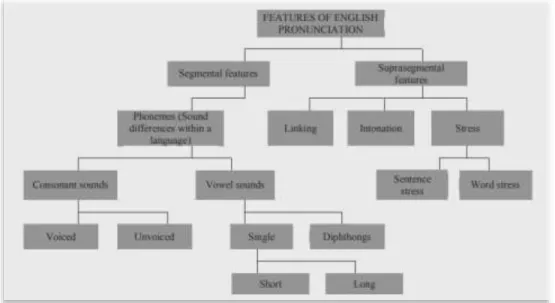
Figure 1. Features of English pronunciation according to Gilakjani (2012, p. 120) As the reader can see, the features of English pronunciation are divided in two main sections: The Segmental Features and the Supra-segmental Features. In former ESL approaches, segmental features were the major focus for pronunciation teaching (for example, minimal pairs such as ship/sheep). However, while these features are important, more recent research has shown that when teaching focuses on supra-segmental features instead, learners’ intelligibility is greatly enhanced. (Burns, 2003). For this reason, the teaching approach must change from
emphasizing segmental elements of pronunciation to supra-segmental elements of pronunciation. (Morley, 1991). For this reason, this work is going to focus mostly on the Suprasegmental
Features of English pronunciation, like English Stress, and a little bit on the prosodic features of Gilbert’s (2008) pyramid.
The Supra-Segmental Features in Pronunciation
WHAT’s his addRESS?) and for this reason “stress (rhythm), linking and intonation are important features for effective pronunciation at the supra-segmental level. (Burns, 2003)
Empirical research and pronunciation materials’ writers suggest that teaching supra-segmental before supra-segmental to intermediate and advanced non-native speakers could be more beneficial in a shorter period of time. (Bott, 2005) In fact, Cheng (1998, as cited in Szyszka, 2016) reported that teachers should be choosing meaningful material to be used as models for practicing pronunciation aspects such as stress, and Field (2005, as cited in Gilakjani, 2011) says that a presentation of pronunciation rules for stress and teaching word stress are strategies which can improve student’s pronunciation.”
To conclude, Gilbert and Brown add the following:
Students who are taught about English prosodic patterns (rhythm and melody often report improved understanding of speech on TV, in movies, and in face-to-face conversation. Why is this? One reason is that prosodically-trained students have learned to understand how rhythmic and melodic cues are used to organize information and guide the listener. Another reason is that these students have learned to notice how prosody changes, how words sound. (Gilbert, 2008, p. 6)
“The Road Signs” of Communication
Gilbert (2008) states the following about rhythm and melody in English learning:
In English, rhythmic and melodic signals serve as “road signs” to help the listener follow the intentions of the speaker. These signals communicate emphasis and make clear the
relationship between ideas so that listeners (native speakers) can readily identify these
relationships and understand the speaker’s meaning. Unfortunately, when English learners speak in class they are typically not thinking about how to help their listeners follow their meaning. Instead, they are often thinking about avoiding mistakes in grammar, vocabulary, and so on. But it is particularly important for English learners to think about their listeners and master the rhythmic and melodic signals essential to “listener friendly” pronunciation, or in other words, intelligible pronunciation. (p. 2)
Learners typically do not use or recognize the cues that native listeners count on to help them follow meaning in a conversation. As a result, conversational breakdowns occur. Emphasis that conveys the wrong meaning or thought groups that either run together or break in
inappropriate places, cause extra work for the listener who is trying to follow the speaker’s meaning. If the burden becomes too great, the listener simply stops listening. In fact, the time spent helping students concentrate on the major rhythmic and melodic signals of English is more important than any other efforts to improve their pronunciation. (p.2)
they are anxious to be understood. This gives an impression of agitation or insistence that they may not intend, and it certainly diminishes the effectiveness of the prosodic “road signs” that the listener needs. The same is true if they speak in a monotone, another common way of dealing with uncertainty in a new language. (Gilbert, 2008 p.14)
Rhythm
English is what is known as a timed language. Because English rhythm is stress-timed, a wrong stressing will lead to a wrong and misleading rhythm. “Comprehensibility depends on rhythm, and therefore the placing of stress within words can play a large part in determining how well a native English hearer will understand the foreign speaker”. (Fudge, 1984) This seriously affects both intelligibility and listening comprehension. According to Aoyama (2017), “it is natural that L2 English learners are predisposed to use the rhythm of their first language.
Gilbert (2008) says the following about the unit of English rhythm in one of her Cambridge publications about teaching pronunciation:
It is important to know that the basic unit of English rhythm is the syllable, and while the number of syllables in a word is usually obvious to a native speaker of English, “L2 English learners that are accustomed to different phonological rules may not hear the syllable divisions in the same way, although an understanding of English rhythm involves more than the ability to identify and count syllables. It also involves an ability to hear and produce the word stress patterns of English. (p.4)
Native Spanish Speakers’ Difficulties
systems have alphabetic foundations and similarities, according to Koda (2007) and Perez (2005), the Spanish language is easier to pronounce when reading Spanish, for the language is more shallow or transparent than the English language, presenting a much more notable
phoneme–grapheme correspondence, which is the relationship between the letters and the sound they produce. (Koda, 2007; Perez, 2005) The English orthographic system, however, is deep and more complex for as Barry (1992), Goulandris (1992), and Seymour (1992) have pointed out, the spelling of words and groups of letters do not always sound as they are written. (Pérez, 2000) For this reason, written English becomes a challenge for Spanish speakers (Sun-Alperin, 2008) when reading out loud.
The second reason for native Spanish speakers for reading or speaking in English with the wrong stress-placement is based on research made by Face (2005), and others like
Eddington’s (2004) and Waltermire’s (2004, as cited in Face 2005) for according to research Spanish speakers take syllable weight into account as they perceive the location of stress within a word. Face (2000) says the following about Spanish stress and English stress based on his
findings:
syllable that is not the rightmost heavy syllable in the word does not attract perceived stress in this way. (Face, 2000)
As a result, Spanish native speakers generally perceive stress according to unmarked stress patterns. However, this same tendency is not as strong for students learning Spanish, not even the most advanced students, and this is likely related to a tendency for antepenultimate stress in English. While descriptions of English stress placement are very complicated, generally based on morphology, not mentioning a default pattern, findings provide evidence of an antepenultimate default for English stress, or at least the influence of English tendency for stressing early in a word. Thus, while a separate language system may be in development, it is certainly not as strong as the native system. (Face, 2000)
This is the main reason why Hispanic English teachers and other ESL teachers can’t ignore or neglect the fact that stress conventions are needed when teaching English to native Spanish speakers. As long as Hispanic English learners continue to stress English words incorrectly, that is, on wrong syllables of monosyllabic, disyllabic, trisyllabic, and polysyllabic words, their speaking in English will not be intelligible, neither comprehensible to others when hearing them speaking. For the above reasons, this study does not only emphasize on the
importance of stress and rhythm to improve intelligibility and comprehensibility, but also on the connection that exist between written English and stress conventions related with pronunciation, that by knowing them in advance they can be identified by reading written words and sentences.
Stress
Gilbert 2008) Therefore, a stress error is particularly damaging to communication. Brown (1990) and Gilbert (2008) put it this way:
The stress pattern of a polysyllabic word is a very important identifying feature of the word . . . We store words under stress patterns . . . and we find it difficult to interpret an utterance in which a word is pronounced with the wrong stress pattern – we begin to “look up” possible words under this wrong stress pattern. (p.51)
It is unfortunately that English learners tend to ignore stress patterns when they learn vocabulary. Not only can this lead to intelligible pronunciation problems, but it can also lead to problems with comprehension. After all, if learners have failed to learn the stress pattern for a new word, they may also fail to recognize that word when it occurs in audio or spoken form. (p.6)
Word-Stress
Word stress or lexical stress essentially picks out one syllable within a multi-syllable word. In English, the syllable singles out in a given word is nearly always the same one, irrespective of the context: the word arrived, for example, is always arRIVED, and never ARrived. (Fudge, 1984) According to Farlex International (2017), there are only two consistent rules about word stress in English, and these ones are:
1) Only one vowel sound within a syllable is stressed; stress is not applied to consonant sounds. Example: FI(ai)ght, PEn, Apple (silent e)
2) Any given word, even one with many syllables, will only have one syllable that receives the primary stress in speech. Some longer words also receive a secondary stress. (By definition, single-syllable words only ever have a single stress, though certain
According to Farlex International (2017), every word in English has one syllable that receives the primary stress – that is, it is vocally emphasized more than any other syllable. Some longer words also have a secondary stress, which is more emphatic than the unstressed syllables, but not as strong as the primary stress.
Some examples with primary stress in CAPITAL letters and the secondary stress in italics are: AB-sen-tee, dis-be-LIEF, in-for-MA-tion, MIL-i-tar-y, etc. Although secondary stress is unpredictable, primary stress, on the other hand, can be often predicted according to other conventions.
Sentence Stress
Sentence stress or prosodic stress refers to emphasis placed in pronunciation on certain words or phrase within a sentence. (Fudge, 1984) “Sentence stress is generally determined by whether a word is considered a “content word” or a “functional word,” and the vocal space between stress words creates the rhythm of a sentence”. (Farlex International, 2017)
In the most basic pattern, content words will always be stressed, while function words will often be unstressed. This is common knowledge for native English speakers.
Content Words
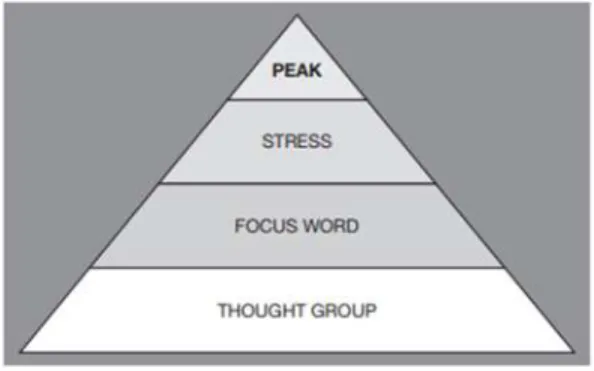
In fact, Gilbert (2008) states in her book, Teaching Pronunciation, that the focus word inside a “thought group” or sentence is usually a content word, for content words carry a great deal of information and are therefore more likely to be the most important word in a thought group or sentence. On the other hand, structure words, which are less information-heavy words are usually de‑emphasized, and English speakers usually reduce (or weaken) them. In fact, reductions help to intensify the contrast between the focus word and the words that surround it. (Gilbert 2008)
Figure 2. The Prosody Pyramid according to Judy Gilbert (2008, p. 10) Function Words
Emphatic Stress
The convention regarding the stress and rhythm of content words and function words is consistent in normal (sometimes called “neutral”) sentence stress. However, English speakers also place additional emphasis on a specific word or words to provide clarity, emphasis or contrast. Consider the following “neutral” sentence, with no stress highlighted at all: Peter told John that a deal like this wasn’t allowed.
Now, let’s look at the same sentence with emphatic stress applied to different words, and the implied meaning starts to change:
Peter told John that a deal like this wasn’t allowed
(This emphatic stress clarifies that Peter, as opposed to someone else, told John not to make a deal)
Peter told John that a deal like this wasn’t allowed
(Emphasizes the fact that John had been told not to make a deal) Peter told John that a deal like this wasn’t allowed
(Clarifies that John was told not to make the deal, not someone else) Peter told John that a deal like this wasn’t allowed
(Emphasizes that Peter said the said the deal was not allowed, indicating that John thought or said the opposite)
Which word the speaker picks out will depend on the situation in which he finds himself, and about which he wants to inform the hearer. For example: John hasn’t arrived can be uttered in three ways:
3) John hasn’t arrived.
Stress-Placement Conventions by Experts
According to experts it is possible to predict where stress placement will fall in an English word based on several characteristics and conventions. Fudge, (1984) emphasizes the following information about word-stress, based on his own experience and agreement with other experts like Chomsky Halle (1986), Kingdon (1958) and Paul Kiparsky (1982):
Chomsky and Halle (1986) identifies stress placement based on the following:
The segmental make-up of the word, i.e. whether particular vowels are long or short, and whether consonants occur singly or in sequences of more than one. Each word is divided into ‘clusters’.i.e. sequences beginning with a vowel and ending immediately before the next vowel, or at the end of the word if there are not further vowels. The difference between ‘weak clusters/syllables’ (which consist of a short vowel followed by at most one consonant) and ‘strong clusters/syllables’ (short vowel followed by two or more consonants, or long vowel followed by any number of consonants) is crucial in determining certain differences in stress-placement.
Kingdom (1958) identifies stress placement based on three types of compounds: ‘Romanic’ – consisting of root plus affixes (suffixes and prefixes)
‘Greek’ – consisting of root plus root, where the roots are not able to stand on their own
as complete words;
compound exerts the greatest influence in that type of word. He demonstrates,
furthermore, that in many cases the suffix or the final root can have only one possible effect on the overall stress pattern. For example, the suffix- ity always causes stress to be placed one syllable back in the word, while the ending -metric invariably attracts stress on its own first syllable.
Fudge and Paul Grande (1968, as cited in Fudge, 1984) agree on the following approach to English stress: It is the last suffix in the word (ignoring inflections and a few other suffixes) that imposes its properties on the word. If there are no suffixes, then a different principle operates; stress falls on the last syllable, but one of the words, or the last but two, depending on properties of the various syllables. Of course, there are some exceptions to this principle, that’s why is more accurately to call them conventions, instead of rules.
Syllabification and Morphological Formation
Fudge (1984) states the following about syllables and morphemes:
It is important for the reader or language learner to know not only how syllables there are, but also exactly where the syllable boundaries are to be placed. This is so because stress placement is often dependent on the number of sounds occurring in a particular position within a syllable. However, syllabification is not the only way of dividing words into parts. Some words can segment according to their morphological formation, i.e. into affixes and roots. Each of the basic parts into which a word may be divided in this way is called a morpheme. (Fudge, 1984)
this will always be the case; farmer is morphologically farm+er, but syllabically far-mer; goes is morphologically go+es, but cannot be divided syllabically at all.
Figure 3. Types of Morphemes by Study.com Stress Conventions based on Word Type
Below are some examples of conventions that determine stress placement on morpheme or word type:
1) Nouns and adjectives with two or more syllables will have stress placed on the first syllable.
2) Verbs and prepositions tend to have their stress on the second syllable.
3) Single-word compound nouns, whether they are conjoined by a hyphen or are simply one word, stress is almost always placed on the first syllable.
5) Reflexive Pronouns receives primary stress on -self – selves.
6) Certain suffixes will reliably dictate where stress should be applied within a word. Suffixes like: “-ee”, “eer”, “-ese”, “-ology”, “-osis”, “-eous”, “-ious”, “-ia”, “-ial”, “-ic” and “-ical”, “-ify”, “-ity”, “-tion” and “-sion”, “-ate”, “-cy”, “-phy”.
7) Suffixes that don’t affect word stress: “-age”, “-ish”, “-hood”, “-less”, “-ness”, “-ous.” 8) However, for verbs ending on “-ish”, the primary stress occurs on the syllable
CHAPTER 3
METHODOLOGY
This study is presented as a monograph, and this modality of research is based on the established guidelines of the School of Education (ECEDU) from the National Open and Distance University (UNAD), with the purpose of elaborating a bachelor’s degree thesis on the TEFL field. The author of this monograph developed a qualitative research. In other words, a research methodology that focuses more on the depth and quality of the information than on the quantity or standardization. It relies on the collection of qualitative data through literature research and on content analysis of the chosen topic. What is content analysis? According to Krisppendorft, K. (2004) content analysis is defined as:
A research technique for making replicable and valid interferences from texts (or other meaningful matter) to the context of their use, (p.24) and when texts have meaning relative to particular contexts, discourses or purposes and validating evidence, which is the ultimate justification of the content analysis (p. 30).
The intention with this monograph was to present a qualitative research based on content analysis, with a pragmatic approach in mind, due to the findings found and shared in the
reading and speaking English, regardless of the methodology and materials used, like reading what the English teacher writes down on boards, teaching materials or present in videos with captions or lyrics.
Before proceeding with the next subsection, “research approach”, it is important to know what some researchers say about the epistemological orientations that influence or mold
qualitative research methodological frameworks. According to Trauth (2001), qualitative research states that “interpretivism is the lens most frequently influencing the choice of qualitative methods”. However, there are some reservations to make against such views, for Myers & Avison (2002) write that “it should be clear that the word ‘qualitative’ is not synonym for ‘interpretive’. Therefore, qualitative research may be or may not be interpretive, depending on the underlying philosophical assumptions of the researcher,” and Wicks & Freeman (1998) who have added “pragmatism” as a third alternative besides “interpretivism” and “positivism”. Fishman (1999) has taken a similar stand in this as well.
In fact, Braa & Vidgen (1999) state that a research-methodological framework consists of three epistemological orientations in Research: 1) aiming for explanation and prediction, 2) aiming for interpretation and understanding and 3) aiming for intervention and change. Therefore, this shows that the knowledge character within pragmatism is thus not restricted to explanations (key form of positivism) and understanding (key form of interpretivism), but also includes other knowledge forms which is essential in pragmatism, such as prescriptive (giving guidelines), normative (exhibiting values) and prospective (suggesting possibilities).
Research Approach
pragmatism is concerned with action and change and the interplay between knowledge and action, which makes it appropriate as a basis for research approaches that are looking to intervene into the world and not merely observing the world. In fact, it is the goal of this monograph to promote change and action by encouraging the teaching of stress conventions, to help Spanish native speakers improve in their English pronunciation, when reading written English, as well as facilitating some English stress conventions samples to English learners and teachers in the appendix section of this work.
According to Morgan (2007), a pragmatic approach is ‘to rely on a version of abductive reasoning that move back and forth between induction and deduction to connect theory and data”, when required. Pragmatism allows the potential and possibility to work back and forth between qualitative data and quantitative data, which often is viewed as incompatible. However, it offers researchers the opportunity to search for useful points of connection between these two types of data when is needed. This paradigm and approach allow the author to convert
observations into theories and then assess those theories through action or personal experience when needed. (Morgan 2007)
Pragmatists argue that there is impossibility of ‘complete objectivity’ or ‘complete subjectivity’ in conducting research, and rejects the idea that researchers have to choose their position between a pair of extremes of either locating their research and research findings in a completely specific to a particular context (constructivism) or designing their research with a generalized set of principles (positivist). Thus, instead of focusing on the issue of context, pragmatism places the central focus on the idea of “enhancing transferability” on the strength of the relation between cause and effect in quantitative data and on the trustworthiness and
than trying to make the research results with either context-bound or generalizable, pragmatists i based on the belief that theories can be both contextual and generalizable, and aim to investigate the factors that ‘affect whether the knowledge we gain can be transferred to other settings.’ (Morgan 2007, 75, Shannon-Baker, 2015). Thus, pragmatism breaks the boundary between positivist, interpretivism and constructivist, and creates a connection between them when looking for what is meaningful from all. (Shannon-Baker, 2015) Therefore, by selecting and teaching those stress conventions that are useful and practical for adult Spanish native speakers to know and practice for English pronunciation improvement, a pragmatic approach has been used in this research, with the intent of producing change and action in ESL/EFL classes, including the online meetings of the “English Conversation” course of the UNAD TEFL program.
Research Line
The lines of research, as defined in Art. 24 of the Statute of Research of the Universidad Nacional Abierta y a Distancia, (2016). These lines consist of research groups that approached problems cooperatively and interdisciplinary in an organized and systematic way. These lines of research are based on a specific field of knowledge which is articulated with researchers,
projects, problems, methodologies and activities that make intellectual production possible. For this reason, UNAD university offers different research lines for students to choose from to present their research projects.
The various reasons why this study has been included in this line of research was based on the following points: First, the target audience that was mentioned in the problem statement of this work, as having poor stress in English pronunciation, were students of an Open and Distance TEFL program from a National Open and Distance University (UNAD). Second, the English and Spanish languages are both involved with this target audience already mentioned, and other Hispanic English learners. Third, the stress conventions facilitated in this study could encourage the improvement, the creation and implementation of online teaching materials, as well as increasing the efficacy of e-learning tools and didactic activities to motivate English
pronunciation learning in Spanish native speakers. Fourth, Colombian and Hispanic English teachers in general, and undergraduate TEFL students, can be motivated to improve their pronunciation skills and implement a more explicit, direct and clear teaching approach toward students, to improve English pronunciation and motivate them to accomplish important short-term goals in this area. Finally, English pronunciation can be improved by learning cognitively and metacognitively the importance and usefulness of these stress conventions in English pronunciation. The strategies and online activities used to practice and master these conventions in online live meeting can be pursued and developed even more by this line of research (to strengthen A1 to B2 English classes).
Research Tools
Different tools were used in the elaboration of this research paper. A reliable internet service that allowed the author to make research in data bases like, Google and Google Scholar, to find empirical and research studies relevant to the ESL/EFL field, and other various
conventions related with pronunciation, to be able to research and write a more accurate and precise literature review.
CHAPTER 4
RESULTS AND DISCUSSION
Based on the literary review, this monograph presents some proven results and analysis on the necessity for adult Hispanic TEFL students to understand the importance of Supra-segmental features of English pronunciation, like stress and rhythm, when reading out loud and speaking in English. For example: It was mentioned that UNAD students who began to learn the English language from scratch relying on the UNAD TEFL bachelor’s degree program had more noticeable pronunciation problems, gaps and errors, for they could not perform well either on listening comprehension quizzes.
Table 1
English Pronunciation’s Features
Results Analysis
An empirical research on Effectiveness of Teaching Pronunciation to Malaysian TESL Students, concluded that teachers needed to incorporate both suprasegmental and
segmental features of pronunciation. Ninety one percent (91%) of 74 students
overwhelmingly rated segmental as more useful in an intensive English program. (Morley, 1991) However, another study based on different types of English
pronunciation instruction, where a group of students was instructed in segmental features (i.e., individual consonant and vowel sounds) and another group was primarily taught the prosodic features of English, (like rhythm and melody) Derwing and Rossiter (2003) do not advocate eliminating segment-based
instruction altogether. However, if the goal is to help students become more understandable when they speak, their findings suggests a
stronger emphasis on prosody signs.
Therefore, stress, emphasis and de-emphasis in words and/or sentences are “prosodic road signs” that are essential for English learner to know and identify in advance to perform better in English pronunciation. (Ratchie & Bhatia, 2008; Gilbert, 2008). In fact, when students are anxious to be understood they emphasize every word, and this certainly diminishes comprehension in the listener. (Gilbert, 2008) For comprehensibility and accentedness were considerably linked to pronunciation measures such as word stress and rhythm, besides grammatical accuracy and lexical type frequency. (Trofimovich, 2012, as cited in Isaacs, 2012)
Pronunciation must be included into beginner classes to help not only avoid the risk of fossilization and stabilization, but also to improve 1) intelligibility, 2)
comprehensibility and 3) interpretability in students’ pronunciation. (Ratchie & Bhatia, 2008; Burns, 2003)
threshold level of understanding of the core system is actually quite simple at its most basic level. In fact, stress conventions can facilitate a simple and most basic system for adult learners in beginner and intermediate English courses.
If students who are taught about English prosodic patterns often report improved understanding of speech on TV, in movies, and in face-to-face conversations. (Gilbert, 2008) Then, prosodic signs like rhythm and stress patterns are essential for ESL/EFL learners to practice hearing and speaking at home and in class, so they can be understood by others and gain confidence. It is important to keep in mind that those English learners who can’t perform well in Listening
on rhythm and stress placement within words, for this can play a large part in determining not only how well a native English hearer will understand the foreign speaker, but also how effective the listening compression becomes in English learners. (Bourjan, 2003)
Table 2
English Stress and Orthography for Hispanic English Learners
Results Analysis
According to an empirical study, adult Thai students, from first year at Nakhon Ratchasima Rajabhat university, were reported to have stress placement problems when pronouncing most words in English, and the need for stress to be included. (Field, 2005; Kenworthy, 1987, as cited in Yahgklang, 2013)
One of the most important theoretical problem underlying the practical problem of teaching English pronunciation is
understanding how the writing system relates to the spoken language. (Stubbs, 1980) It is English orthography what makes it more challenging for Spanish speakers to learn to pronounce English correctly. (Sun-Alperin, 2008)
Not only does written English use punctuation as an aid to separate thought groups and stress words and sentences correctly, but adult language learners can always reread a piece of text if they become confused about the organization or grouping of information, for comprehension. (Gilbert, 2008)
Adult Hispanic English learners rely more on reading and writing English texts for their learning experience, due to their previous familiarity with the Spanish language and the Latin alphabet. This, somehow, make them feel more confident to begin learning English, when they identify the same letters of the alphabet, and many cognate words that both the English and Spanish language share in common, by having the same Greek and Latin influence.
Even though the written system of English may be challenging for Spanish native speakers to master it, is not impossible to become familiar with its orthographic conventions related with word stress and pronunciation. This useful tool can become quite practical, encouraging and effective for students learning experience, specially TEFL students who want to become English
conventions should be facilitated. Otherwise, bilingual skills in Colombian English students and teachers can’t materialize in a near future.
Table 3
Adult Language Learning
Results Analysis
One of the main strengths of adult learners is that they have the ability for logical and critical thought, which is contrary to children. (Fenghua Yao, 2011) And as a result the following six principles of the Center of Applied Linguistics, 2015 apply to effective adult language instruction, which based on research are: a) Adult learners’ existing assets and interests. b) Methods relate with adult learners’ goals.
c) Communication modalities are integrated. d) Promotion of input that is just above the learner’s current level with illustrations and explanations. e) Explicit teaching of specific features of the language and promotion of critical thinking skills. f) Encourages
If adult learners have the capabilities to learn and memorize in a logical and critical
manner, then any reference or guideline that is useful for their needs and practical
responsibility and progress in the learning experience.
CHAPTER 6
CONCLUSIONS AND SUGGESTIONS
Stress conventions are necessary for adult Hispanic English learners who desire to improve in English pronunciation, for various reasons. First, it helps improve the intelligibility and comprehensibility of what they say when they speak, and when others are listening to them, either by reading out loud a text or speaking in conversation. Second, native Spanish speakers take syllable weight into account as they perceive the location of stress within a Spanish word, therefore, they should also be more conscious and aware of the importance of stress patterns and rhythm in English, especially, if they want to perform better in conversations and English oral exams. Third, adult native Spanish speakers, like TEFL and ESL students, rely mostly on written English as a language learning tool for they already know the Latin alphabet, and how to read. Finally, the good news about the stress conventions and principles is that they can be learned, memorized, practiced and mastered by adult learners, when learning to identify segments or syllables in English words and sentences, for this encourages them to improve on the suprasegmental areas of English pronunciation.
comprehensibility (the listener is able to understand the meaning of what is said) and interpretability (the listener is able to understand the purpose of what is said) when applied correctly. Therefore, if there is only time to teach awareness of the core system and practice these vital rhythmic and melodic cues, as well as certain critical sounds (e.g., the grammar cues at the end of words and other segmental features) students will have achieved a great deal of communicative competence. However, if these prosodic cues are not taught, then efforts at achieving communicative competence by drilling individual sounds will prove frustrating to adults, and discouraging for English learners.
There was enough material to compile content about the importance of English stress for ESL/EFL learners, however, not much academic sources on English stress conventions themselves, to help ESL/EFL learners improve in their English pronunciation. For this reason, the content of this monograph, with its appendices, becomes a useful reference to help Hispanic English learners understand why stress placement is important in English pronunciation and how important the ‘body of knowledge’ of stress conventions become to them for stressing words correctly when reading and pronouncing monosyllabic and polysyllabic words, based on syllabification rules or the morphological nature of words. The results of this monograph are considered successful, in regard to the objectives of this monograph.
REFERENCES
Barry, C. (1992). Interactions between lexical and assembled spelling (in English, Italian and Welsh). In C.M. Sterling & C. Robson (Eds.), Psychology, spelling and education (pp. 71–86). Clevedon, UK: Multilingual Matters.
Bott, A. (2005). Computer-aided self-access pronunciation materials designed to teach stress in American English. Unpublished MA dissertation. Brigham: Brigham Young University. Bourjan, T. (2003) Problem on Stress in English Pronunciation of Mathayomsuksa 6 students.
M.A. Thesis. Mahasarakham University
Braak, V. R (1999) Interpretation, intervention, and reduction in the organizational laboratory: a framework for in-context information system research, Accounting, Management & Information Technology, Vol 9, p 25–47
Brown, G. (1977, 1990). Listening to Spoken English. London, Longman. [On-line] Retrieved from
https://www.academia.edu/26353337/Teaching_Pronunciation_Using_the_Prosody_Pyra
mid
Barnes, W.G.W. (1992). The developmental acquisition of silent letters in orthographic images. In S. Templeton & D.R. Bear (Eds.), Development of orthographic knowledge and the foundations of literacy: A memorial festschrift for Edmund H. Henderson (pp. 191–212). Mahwah, NJ: Erlbaum.
Journal of Social Research Methodology, 10 (1), 5-20. doi:10.1080/13645570600655282. Burns, A. (2003). Clearly speaking: pronunciation in action for teachers. National Center for
English Language Teaching and Research, Macquaire University, Sydney NSW 2109 Center for Applied Linguistics (2015) Fundamental Principles of Effective Adult Language
Education. [On-line] Retrieved from http://www.cal.org/adultesl/pdfs/fundamental-principles-of-effective-adult-languageeducation.pdf
Cheng, F (1998). The teaching of pronunciation to Chinese students of English. English Teaching Forum, 37-39. [On-line] Retrieved from
https://www.researchgate.net/publication/304539062_English_Pronunciation_Teaching_
at_Different_Educational_Levels_Insights_Into_Teachers'_Perceptions_and_Actions/link
/578e5cd608aecbca4caace16/download
Chomsky and Halle (1968, 1986). The Sound Pattern of English. [On-line] Retrieved from
http://www.linguist.univ-paris-
diderot.fr/~edunbar/ling499b_spr12/readings/Chomsky,%20Halle%20-%201968%20-%20The%20Sound%20Pattern%20of%20English.pdf
Condelli, L., Wrigley, H., & Yoon, K. S. (2009). “What works” for adult literacy students of English as a second language. In S. Reder & J. Bynner, Tracking adult literacy and numeracy skills: Findings from longitudinal research (pp. 132-159). New York and London: Routledge. [On-line]. Retrieved from
http://www.cal.org/adultesl/pdfs/fundamental-principles-of-effective-adult-language-education.pdf
Davis, C. (1999). Will the use of videos designed for the purpose of teaching English
12-week period? In Action Research Monographs Pennsylvania Action Research
Network. A Section 353 Project of the Pennsylvania Department of Education, Bureau of Adult Basic and Literacy Education. ERIC Document [ED440 219]. [On-line] Retrieved from
https://www.researchgate.net/publication/265821016_Why_is_Pronunciation_So_Difficu
lt_to_Learn
Derwing, T. & M. Rossiter. 2003. The effects of pronunciation instruction on the accuracy, fluency and complexity of L2 accented speech. Applied Language Learning, 13:1–18 Eddington, David. 2004. A computational approach to resolving certain issues in Spanish stress
placement. In Timothy Face (ed.), Laboratory approaches to Spanish phonology, 95– 116. Berlin: Mouton de Gruyter.
Face, L.T. (2005) Reference Journal of Language and Learning Vol 3 No.1 Syllable Weight and the Perception of Spanish Stress Placement by Second Language
Face, Timothy. 2000. The role of syllable weight in the perception of Spanish stress. In Héctor Campos, Elena Herburger, Alfonso Morales-Front & Thomas Walsh (eds.), Hispanic linguistics at the turn of the millennium: papers from the 3rd Hispanic Linguistics Symposium, 1–13. Sommerville, MA: Cascadilla Press.
Farlex International. (2017). The Farlex Grammar Book III: Complete English Spelling and Pronunciation Rules. Farlex International Limited.
Fenghua, Yao. (2011). A Study of the Advantages and disadvantages of Adult Second Language Acquisition. Continue Education Research, 1, 139-140. [On-line] Retrieved from
http://www.academypublication.com/ojs/index.php/tpls/article/viewFile/tpls0604776780/
Field, J. (2005). Intelligibility and the listener: The role of lexical stress. TESOL Quarterly, 39(3), 399-423. [On-line] http://dx.doi.org/10.2307/3588487
Fishman, D.B (1999). The case for pragmatic psychology. New York University Press, New York
Fraser, (2000). Coordinating improvements in pronunciation teaching for adult learners of English as a second language. [On-line]. Retrieved from http://metz.une.edu.au/~hfraser
/docs/HF_ANTA_REPORT.pdf.
Fudge, E.C. (1984). English Word-Stress. Kindle Version Published by Routledge in 2016. Garrigues, S. (1999). Overcoming pronunciation problems of English teachers in Asia. [Online].
Retrieved from http://asianbridges.com/pac2/presentations/garrigues.html.
Gilakjani, P. A. (2016). What Factors Influence the English Pronunciation of EFL Learners? Modern Journal of Language Teaching Methods (MJLTM), 6(2), 314-326.
Gilakjani, P. A. (2012) A Study of Factors Affecting EFL Learners' English Pronunciation Learning and the Strategies for Instruction. International Journal of Humanities and Social Science Vol. 2 No, Azad University, Iran. [On-line] Retrieved from
https://s3.amazonaws.com/academia.edu.documents/32894704/17.pdf?AWSAccessKeyI
d=AKIAIWOWYYGZ2Y53UL3A&Expires=1555940907&Signature=yOXvJSbQ1Y%2
FwlcimslHgjRrgQIY%3D&response-content
disposition=inline%3B%20filename%3DA_Study_of_Factors_Affecting_EFL_Learner.p
df
Gilakjani, P. A. (2011). A Study on the Situation of Pronunciation Instruction in ESL/EFL Classrooms. Islamic Azad University of Lahijan [On-line]. Retrieved from
https://files.eric.ed.gov/fulltext/EJ1080742.pdf
Gilbert, J.B (2008). Teaching Pronunciation: Using the Prosody Pyramid. Cambridge University Press. Retrieved from
http://dl.ueb.vnu.edu.vn/bitstream/1247/10050/1/Teaching%20Pronunciation.pdf Granados, C. (2015) Formación inicial de docentes de lenguas extranjeras. Revista Nodos y
Nudos. Vol 4 N.o39. p.59-69. [On-line]. Retrieved from:
https://www.researchgate.net/publication/323563767_Formacion_inicial_de_docentes_de
_lenguas_extranjeras
Goldkuhl, G. (2010) Practice research: Three kinds of pragmatism in social research. Linköping University. Sweden. Retrieved
https://www.sosnet.fi/loader.aspx?id=f2395345-0719-4fbf-a6a8-40530ef6f7f1 Gonzalez, N., Moll, L. C., & Armanti, C. (2015) Funds of knowledge. Routledge. [On-line].
Retrieved from http://www.cal.org/adultesl/pdfs/fundamental-principles-of-effective-adult-language-education.pdf
Kingdom, R. (1958). The groundwork of English stress. London, etc.: Longmans, Green & Co.
Kiparskly, Paul (1982) From cyclic phonology to lexical phonology. In The structure of phonological representations. Vol.1, ed. Harry van der Hulst and Norval Smith, 131-175. Doordrecht: Foris.
http://www.cal.org/adultesl/pdfs/fundamental-principles-of-effective-adult-language-education.pdf
Harmer, J. (2001). The Practice of English Language Teaching. London: Longman. Haugen, Einar (1956) Bilingualism in the Americas: A Bibliography and Research Guide.
Alabama: University of Alabama Press
Hepplewhite, B. (2012) The English Alphabetic Code. [On-line]. Retrieved from
http://www.rrf.org.uk/pdf/DH%20Alph%20Code%20with%20teaching%20points%20PL
AIN%20A4x7-1%20final%20version.pdf
Isaacs, T., & Trofimovich, P. (2012). Deconstructing comprehensibility: Identifying the linguistic influences on listeners’ L2 comprehensibility ratings. Studies in Second Language Acquisition, 34, 475 – 505. Retrieved from
https://www.researchgate.net/publication/259425340_Disentangling_accent_from_compr
ehensibility
Jones, M. L. (1996). Phonics in ESL Literacy Instruction: Functional or Not? Paper presented at the World Conference in Literacy, Philadelphia, PA
Koda, K. (2007). Reading and language learning: Crosslinguistic constraints on second language reading development. Language Learning, 57, 1–44. doi: 10.1111/0023-
8333.101997010-i1 Retrieved from
http://nflrc.hawaii.edu/rfl/April2015/articles/ijalba.pdf
Krispendorf, K. (2004). Content analysis: An Introduction to its Methodology. University of Pennsylvania. [On-line] Retrieved from
https://usu.instructure.com/files/67974091/download?download_frd=1&verifier=qSU7x
YWottTv6ZBbrn2n9XVCX50rZ9b7EaHVx6Uq
Consonants by Japanese Learners. Computer Assisted Language Learning. 12(2). 137-156
Levelt, W. (1989). Speaking: From intention to articulation. Cambridge, MA: MIT Press Lorscher, W. (2012) Bilingualism and Translation Competence. SYNAPS – A Journal of
Professional Communication, Universität Leipzig, Germany. [On-line]. Retrieved from
https://brage.bibsys.no/xmlui/bitstream/handle/11250/2393971/Lorscher_27.pdf?sequenc
e=1
Maniruzzaman, M. (2008). Teaching EFL pronunciation: why, what and how? Norderstedt, Germany
Marshall, H. W., & DeCapua, A. (2013). Making the transition to classroom success: Culturally responsive teaching for struggling second language learners. Ann Arbor, MI: University of Michigan Press. [On-line]. Retrieved from
http://www.cal.org/adultesl/pdfs/fundamental-principles-of-effective-adult-language-education.pdf
McDonald, S. (2002) Pronunciation – views and practices of reluctant teachers. La Trobe University. [On-line]. Retrieved from
https://www.researchgate.net/publication/285517759_Pronunciation-views_and_practices_of_reluctant_teachers/link/56d0437f08ae4d8d64a3451a/download Miller, S. F. (2010). Promoting learner engagement when working with adult English language
learners. Washington, DC: Center for Applied Linguistics. Retrieved from
http://www.cal.org/adultesl/resources/digests/promoting-learner-engagement-when-working-withadult-english-language-learners.php
combining qualitative and quantitative methods.” Journal of mixed methods research no. 1:48-76.
Morley, J. (1991). The pronunciation component in teaching English to speakers of other languages, TESOL Quarterly, 25 (1), 51-74.
Myers M, Avisond (2002) Qualitative research in information systems: A reader, Sage, London Pérez, M.L. (2005). English and Spanish Spelling: Are They Really Different? Universidad de
Jaén. [On-line]. Retrieved from
https://www.researchgate.net/publication/250055750_English_and_Spanish_Spelling_Ar
e_They_Really_Different
Pérez, M.L. (2000). The diagnosis of English spelling difficulties in Spanish primary education. Unpublished master’s thesis, University of Granada, Spain.
Ratchie C.& Bhatia K., (2008). Phycholinguistics. In B. Spolsky and F, M. Hult, The handbook of educational linguistics, 27, 184-202.
Seferoglu, G. (2005). Improving students' pronunciation through accent reduction software. British Journal of Educational Technology, 36(2), 303-316.
Seymour, P.H.K. (1992). Cognitive theories of spelling and implications for education. In C.M. Sterling & C. Robson (Eds.), Psychology, spelling and education (pp. 50–70). Clevedon, UK: Multilingual Matters.
Shannon-Baker, P. (2015). Making paradigms meaningful in mixed methods research. Journal of Mixed Methods Research.
Szyszka, M. (2016) English Pronunciation Teaching at different educational levels: Insights into teachers’ Perceptions and Actions. Research in Language, 2016, vol. 2. [On-line]
Retrieved from
https://www.researchgate.net/publication/304539062_English_Pronunciation_Teaching_
at_Different_Educational_Levels_Insights_Into_Teachers'_Perceptions_and_Actions/link
/578e5cd608aecbca4caace16/download
Ullman, B.L. (1922) Our Latin-English Language. The Classical Journal, Vol. 18, No. 2, pp. 82-90. Retrieved from https://www.jstor.org/stable/3289139
Universidad Nacional Abierta y a Distancia. UNAD. (2016). Licenciatura en Ingles Como Lengua Extranjera. [On-line] Retrieved from https://estudios.unad.edu.co/licenciatura-en-inglescomo-lengua-Extranjera
Universidad Nacional Abierta y a Distancia. (n.d.). Líneas de investigación de la ECEDU. Retrieved from https://academia.unad.edu.co/ecedu/investigacion-y-productividad/lineas-de-investigacion
Trauth, E M (2001) Qualitative research in IS: Issues and trends, Idea Group, Hershey Trauth, E M (2001) The choice of qualitative research methods in IS, in TRAUTH E M (ed,
2001) Qualitative research in IS: Issues and trends, Idea Group, Hershey
Waltermire, Mark. 2004. The effect of syllable weight on stress in Spanish. In Timothy Face (ed.), Laboratory Approaches to Spanish Phonology, 171–191. Berlin: Mouton de Gruyter.
Students of Nakhon Ratchasima Rajabhat University through and E-Learning. [On-line] Retrieved from https://cyberleninka.org/article/n/1134988/viewer
Yates, L., & Zielinski, B. (2009). Give It a Go: Teaching Pronunciation to Adults. Sydney, Australia: AMEPRC. [On-line] Retrieved from
APPENDIX A: INDEX CARDS SAMPLES Template
Author:
Year:
Citation:
Analysis
Designed by Giselle Bautista Garcia
Sample 1
Author:
Koda Year:
2007 Citation:
The Spanish language is easier to pronounce when reading Spanish, for the language is more shallow or transparent than the English
language, presenting a much more notable phoneme–grapheme correspondence, which is the relationship between the letters and the
sound they produce.
Analysis
Sample 2
Author:
Fudge Year:
1984 Citation:
“Comprehensibility depends on rhythm, and therefore the placing of stress within words can play a large part in determining how well a native English hearer will understand the foreign speaker”. (Fudge, 1984)
Analysis
Native Spanish speakers take syllable weight into account as they perceive the location of stress within a word, which means they need to be more aware of the importance and difference that exist in English rhythm and stress patters for their listeners to
APPENDIX B: A SUMMARY OF FOCUS WORD PRINCIPLES BASED ON GILBERT’S PYRAMID
Convention 1
The stressed syllable of a focus word is extra-long, extra clear, and has a pitch change. Convention 2
The focus word in a sentence is usually a content word. Convention 3
Structure words are usually de-emphasized to contrast with the focus word. This contrast makes it easier for the hearer to notice the focus word.
Convention 4
At the beginning of a conversation, the last content word in a clause or sentence is usually the focus word.
Convention 5
After a conversation begins, the new thought in each sentence is the focus word.
APPENDIX C: STRESS CONVENTIONS BASED ON WORD TYPE
1. Nouns and adjectives with two or more syllables tend to have stress placed on the first syllable. Verbs and prepositions tend to have their stress on the second syllable. Table 4
First and Second Syllable Words
First Syllable Second Syllable
Nouns Adjectives Verbs Prepositions
PA.per SAM.ple SATCH.el TA.ble TEL.e.phone TON.ic WIN.dow PRE.tty PUR.ple QUI.et SIM.ple SUB.tle TRICK.y UG.ly suc.CEED tra.VERSE un.FURL with.HOLD out.SIDE un.TIL u.PON with.IN with.OUT
2. Initial-stress-derived nouns: When a word can operate as either a noun or a verb, the English language differentiate the meanings by shifting the stress from the second syllable to the first (or initial) syllable. In other words, these nouns are derived from verbs according to their initial stress.
Table 5
Words that operate as nouns and verbs
Word Noun Verb
invite object permit present project protest rebel record refuse refund rewrite subject survey update INvite OBject PERmit PRESent PROject PROtest REbel RECord REFuse REfund REwrite SUBject SURvey UPdate inVITE obJECT perMIT preSENT proJECT proTEST reBEL reCORD reFUSE reFUND reWRITE subJECT surVEY upDATE
3. Compound Nouns: Single-word compound nouns, whether they are conjoined by a hyphen or are simply one word, stress is almost always placed on the first syllable. 4. Compound Verbs: For most single word compound verbs, stress will be on the first
Table 6
Compound Nouns and Verbs
Single-word Compound Nouns Single-word Compound Verbs
Back.PACK Bath.ROOM Draw.BACK Check-IN Foot.BALL Hand.BAG Green.HOUSE Hair.CUT Log.IN Motor.CYCLE On.LOOK.ER Pas.SER.BY Son-IN-LAW Table.CLOTH Wall.PAPER Web.SITE AIR.condition BAby.sit COPy.edit DAY.dream DOWN.load ICE.skate JAY.walk KICK.start PROOF.read STIR-fry TEST-drive WATER.proof Over.HEAT (t wo sy l l a b l e p re po si t i on )
Under.COOK (t wo sy l l a b l e p re po si t i on )
5) Reflexive Pronouns: These pronouns receive primary stress on -self – selves.
6) Suffixes: Certain suffixes will reliably dictate where stress should be applied within a word. For example:
a) Stress is placed on the suffix itself in words ending in “-ee”, “eer”, “-ese”, even though they have different functions.
-ee indicates someone who benefits from or is the recipient of the action of a verb. -eer indicates someone who is concerned with or engaged in a certain action. -ese is attached to place names to describe languages, characteristics of certain nationalities, or (when attached to non-place names) traits or styles of fields or professions.
Table 7
Words ending in -ee, -eer, -ese
-ee -eer -ese