HIFI-AV: An Audio-visual Corpus for Spoken Language
Human-Machine Dialogue Research in Spanish
Fernando Fern´andez-Mart´ınez
1, Juan Manuel Lucas-Cuesta
1,
Roberto Barra Chicote
1, Javier Ferreiros
1, Javier Mac´ıas-Guarasa
21Universidad Polit´ecnica de Madrid,
E.T.S.I. de Telecomunicaci´on, Ciudad Universitaria s/n, 28040, Madrid, Spain, 2Universidad de Alcal´a, Escuela Polit´ecnica Superior,
Carretera Madrid-Barcelona, Km 33,600, 28871, Alcal´a de Henares (Madrid), Spain 1{ffm,juanmak,barra,jfl}@die.upm.es,2[email protected]
Abstract
In this paper, we describe a new multi-purpose audio-visual database on the context of speech interfaces for controlling household electronic devices. The database comprises speech and video recordings of19speakers interacting with a HIFI audio box by means of a spoken dialogue system. Dialogue management is based on Bayesian Networks and the system is provided with contextual information handling strategies. Each speaker was requested to fulfil different sets of specific goals following predefined scenarios, according to both different complexity levels and degrees of freedom or initiative allowed to the user. Due to a careful design and its size, the recorded database allows comprehensive studies on speech recognition, speech understanding, dialogue modeling and management, microphone array based speech processing, and both speech and video-based acoustic source localisation. The database has been labelled for quality and efficiency studies on dialogue performance. The whole database has been validated through both objective and subjective tests.
1.
Introduction
This paper describes the generalities of the HIFI-AV cor-pus. The central idea of the corpus is providing relevant audio-visual data to a broad range of different research ar-eas related to speech and video processing in intelligent environments, specifically addressing a spoken dialogue task to control a HIFI audio equipment. In this sense, this database differs from others such as the AV16.3 cor-pus (Lathoud et al., 2004) (not dealing with the actual speech content), the CHIL audiovisual corpus (Mostefa et al., 2008) and the AMI project corpus (Carletta, 2007) (both containing audiovisual information of lectures and natural meetings).
Summarising, the HIFI-AV corpus was designed to fulfil the following objectives:
• Allow the evaluation of speech understanding and spo-ken dialogue modules in a home device control sce-nario, more specifically for controlling a HIFI audio system.
• Allow the evaluation of microphone array based speech processing tasks.
• Allow the evaluation and fine tuning of the multi-channel audio acquisition systems used in the EDEC ´AN project (EDECAN, 2006) demonstration room at the Speech Technology Group site in the Uni-versidad Polit´ecnica de Madrid, shown in figure 1.
• Allow the performance evaluation of the acoustic modules: mainly speaker localisation and tracking, recognition and beam-forming.
• Allow the performance evaluation of the artificial vi-sion modules: mainly speaker localisation, tracking and identification.
• Allow the evaluation of audio-visual sensor fusion techniques, mainly oriented to multimodal speaker lo-calisation, tracking and identification.
2.
General description
HIFI-AV is a spontaneous speech database composed of 190 human-machine spoken dialogues, uttered by 19
Speakers (12 males and 7 females). The actual speech length is around115minutes and every speaker speaks for around7minutes on average.
The application domain of the HIFI-AV corpus is control-ling a HIFI system (Sharp model CDC410) using the voice (handling playback of Cd’s, tapes, use of the radio, record-ing operations, etc.).
2.1. The Spoken Dialogue System
The dialogue manager of our system is based on Bayesian networks and it is provided with a set of domain indepen-dent dialogue strategies for handling contextual informa-tion (e.g. the dialogue history). These strategies provide the ability to deal with dialogue phenomena such as: ellip-sis, anaphora or deixis.
As an alternative to classical dialogue solutions (e.g. finite state automata or FSMs, script based or plan based systems, and so on) Bayesian Networks based dialogue approaches (Fern´andez-Mart´ınez, 2008) allow a greater flexibility and naturalness thanks to a more convenient definition of dia-logue as the interaction with an inference system. Regard-ing our application of BNs to dialogue modelRegard-ing and man-agement we can highlight:
Figure 1: Panoramic view of the recording room.
• The BNs based inference system enables a better identification of the dialogue goals (i.e. actions or activities that the system can perform)from the con-cepts provided by the user(i.e. semantic informa-tion) andconsistently with the dialogue context.
• BNs allow ananalysis of congruencebetween the di-alogue goals that the system thinks the user has re-quested and all data collected during the interaction. Thanks to this analysis, the system candetermine the dialogue flowand react according to the logic of the application domain (e.g. doing the work required by the user or requesting him the information necessary to do so). In particular, it is possible to automatically de-tectwhich concepts are necessary(available or not), erroneous or optional regarding the inferred goals. The DM makes the decision on how to continue the dialogue using all the available information. In this way, dialogue can be directed towards the production of messages requesting the missing items, clarifying the erroneous and ignoring the optional ones. This helps to fulfil the dialogue goals in a more agile and ef-ficient way avoiding unnecessarily lengthy dialogues.
• The BNs enable a true mixed initiative dialogue modellingthat allows the response of the system to be flexible as there is no predefined goal or data sequence which the user has to follow. The user is free to decide the set of dialogue goals which he wants the system to offer him. This flexibility is double-edged since, besides allowing the user to decide the goals at the beginning of the interaction, the system also lets the user to jump or switch to different goals, even without having completed the previous ones. Furthermore, the user can respond with more data than requested in a question or even with data regarding a goal different to the target goal decided by the system.
• Thanks to the negotiation processbetween the user and the system, based on the Forward and Backward inference procedures (Meng et al., 2003), the system is capable of responding to complex issues (e.g. when the user provides less information than is strictly nec-essary to meet the required dialogue goals) andto as-sist or guide the usertowards achieving his dialogue goals driving the dialogue in an efficient manner, min-imising the number of questions or queries and mak-ing maximum use of available information in the con-text of dialogue.
2.2. On the use of contextual information
In relation to the possible use of contextual information for dialogue management:
• Some dialogue phenomena (i.e. ellipsis, anaphora and deixis) can mean aloss of crucial information. That information loss may hinder or difficult the proper out-come of the dialogue. However, we have solved that problem through the proper use of the dialogue con-text information.
• Thanks to the BNs based dialogue modeling, and through the negotiation process mentioned above, the dialogue system is able to resolve situations where the user provides an incomplete or inaccurate infor-mation in relation to the inferred goals from the on-going utterance corresponding to the intention of the user. Nonetheless, we have provided appropriate dis-ambiguation proceduresfor the immediate retrieval of information fromthe dialogue context. These pro-cedures allow to exploit the contextual information to improve the robustness of dialogue and producing co-herent answers from:
– the history of the ongoing dialogue (∼short term),
– the state of the system,
– the specific knowledge of the application domain,
– and the history of dialogue (∼long term).
• Regarding the latter case, we would like to point out the evidence attenuation mechanism that we have in-cluded for keeping the dialogue history permanently updated. As a result of that mechanism, the contents of the history are constantly renewed removing the in-formation that becomes too old.
The convenience and appropriateness of the designed strategies for the use of contextual information have already been proved. (Fern´andez-Mart´ınez et al., 2008) presents an evaluation of the developed prototype with real users aimed at measuring their true significance.
2.3. Evaluation scenarios
Table 1:Dialogue example showing the interaction of the user with the system.
Turn (U:user; S:system) Details
...
-U: “Volume” The user does not specify any “volume” value.
S: “What do you want to do with the volume?” The system identifies the “volume” value as “missing” and prompts the user about it.
U: “Play track number five” Now, the user is not interested in modifying the volume.
S: “Track number five is playing, would you like to do something with the volume?”
Though decreasing due to an evidence attenuation procedure, the previous evidence level of the “volume” parameter (recovered from the Ongoing Dialogue History) is still significant enough so that the corresponding goal, e.g. “setting the volume”, is positively inferred; consequently the system continues trying to solve it.
U: “Play track number seven” New evidence decrease.
S: “Track number seven playing, what would
you like me to do with the volume?” Still trying.
U: “Track number nine” After several turns the evidence level of the “volume” parameter falls below a predefined
threshold, therefore the system decides to remove it from the history.
S: “Track number nine now playing” The system stops prompting the user about the volume since only the “track selection”
goal is inferred as active.
...
-All scenarios were classified according to the following nomenclature:
• 23Basicscenarios, in which the user must pursue one major goal (e.g. “The user should try to stop the CD
currently being played”).
• 19 Advanced scenarios: combining more than one goal, to allow the system to demonstrate advanced in-teraction capabilities (e.g.“The user should try to play a particular track without referring to the specific disk
the track belongs to”).
• 3Freescenarios: with no restriction for the interaction except that the user was suggested to mainly focused on one of the three main devices the Hifi system was equipped with (i.e. a Cd player, a tape player and a radio).
Table 1 contains an example of a typical dialogue between the user and the system. More details regarding those ca-pabilities are detailed in (Fern´andez-Mart´ınez, 2008) and (Fern´andez-Mart´ınez et al., 2005).
Each speaker was requested to fulfil 3 basic, 6 advanced and1free scenarios. To address research tasks on speaker localisation and tracking, users were requested to interact with the system in given positions of the recording room and facing different orientations (for basic and advanced scenarios) or to freely move around the room (in the free scenarios).
3.
Recording equipment and setup
The recording process was controlled by an operator in a room next to the recording scenario. The operatorcon-trolled the recording application and had the chance to talk to the speaker at any time.
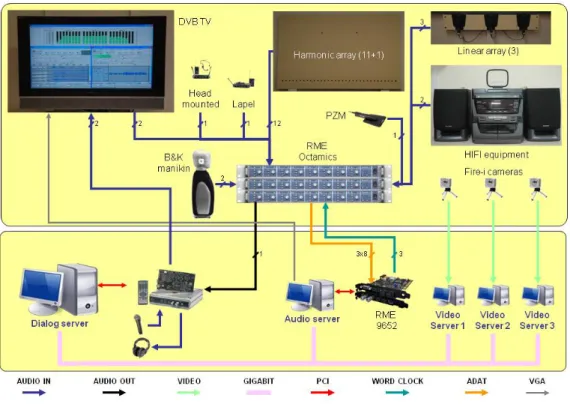
Recording equipment was able to synchronously record24
audio channels and3firewire video camera signals. Figure 2 shows the general architecture of the recording setup.
3.1. Audio Recording Hardware
Every channel’s audio is sampled at 48 kHz with 24
bits/sample. The24audio channels are devoted to record-ing audio streams from different microphones/sources (close talking, lapel, linear and harmonically-spaced linear array, table top, output from the system (HIFI and text-to-speech modules) and binaural audio from a Bruel&Kjaer manikin).
3.2. Video recording hardware
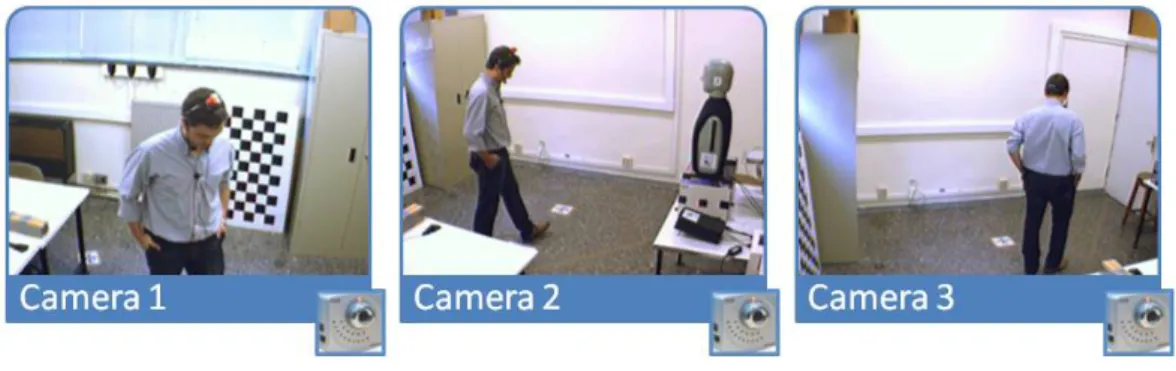
In order to maximise the visible area in the demonstration room and to reduce the large amount of data to store or transmit, we have decided to use three low-cost firewire cameras. Each of the cameras is connected to a dedicated GNU/Linux workstation running as a video server. Figure 4 shows some of the images captured by the cameras at res-olution640x480and30frames per second.
4.
Database content
The main data and information which has been collected and generated during the recording and the labelling stages are:
Figure 2: Schematic of the recording setup.
stream the Qualcomm-ICSI-OGI front end has been used (Adami et al., 2002).
• Video data: the video corresponding to every dia-logue has also been recorded.
• References and dictionary: HIFI-AV has been man-ually transcribed. Additionally, automatic references (i.e. spoken sentences as recognised by the system) are also provided for each audio file. The dictionary in the HIFI-AV task is composed of419entries.
• Geometrical information on speech sources: speaker “mouth” positions and orientations are pro-vided for evaluating speaker localisation and tracking algorithms, with data following the format used in the CHIL 2006 evaluation campaign for reference files in the Acoustic Person Tracking Task (Stiefelhagen, 2006).
• Speaker information: speakers’ identity information is also provided.
• Dialogue related information: the dialogue man-agement system used in the recordings automatically generated a large amount of information to be able to make precise evaluations on every used module (Fern´andez-Mart´ınez, 2008). More precisely the fol-lowing logging information has been generated:
– General Log information: the general log files include all the relevant information of the dia-logue process:
∗ Preamble: showing general information on the dialogue context (date, time, scenario, etc.).
∗ Dialogue turn sections: Providing informa-tion on the speech recogniinforma-tion results (in-cluding confidence values at word and sen-tence levels), understanding module informa-tion (the set of concepts parsed by the system, with a final confidence figure), and dialogue information (the inferred dialogue goals at any time with a probability figure).
∗ Actuator module information: the sequence of actions to be performed by the HIFI.
∗ Response generation information: the se-quence of answer concepts used to generate a text message which is given to the text to speech (TTS) module.
∗ TTS output information.
∗ Dialogue context information: information regarding the dialogue status (i.e. all the vari-ables and values describing the current status of every device in the HIFI equipment) and the dialogue history (i.e. all the relevant vari-ables and values kept in the dialogue manager history) before and after each turn.
– HIFI equipment status information: includ-ing all the variables+values describinclud-ing the current status of every device in the HIFI equipment.
– Status files of the dialogue history: including all the relevant variables+values kept in the dia-logue history.
5.
Evaluation
Several research tasks have already been approached and evaluated using the HIFI-AV corpus, namely the perfor-mance of the speech recognition module, while others are currently being addressed, such as speaker localisation and tracking, or the evaluation of the whole spoken dialogue system through a set of automatically collected metrics re-lated to both dialogue quality and efficiency.
5.1. Speech recognition performance
As we stated in Section 2., HIFI-AV comprises 190 full dialogues, uttered by 19 speakers. The labelling process showed that the database contains1844different sentences, with a number of reference words (i.e. correctly labelled words) of6243.
The availability of labelled data allowed us to evaluate the performance of the automatic speech recognition engine. We have measured the Word Error Rate of the system, mea-sured as the percentage of substitutions, insertions, and deletions on the recognition hypotheses when compared with the labelled references. Table 2 shows the average WER of each scenario type over the different speakers.
Table 2: Speech recognition performance (measured as Word Error Rate).
Scenario Number of Reference WER Confidence
Type sentences words (%) interval
Basic 356 1010 28.51 2.78
Advanced 1065 3568 34.14 1.56
Free 423 1668 42.99 2.38
ALL 1844 6243 35.61 1.19
As could be expected, the better performance takes place during the simplest scenarios, in which the number of in-teractions remains relatively low, and the tasks to be per-formed are easy to ask for, whereas the WER is worse for more complex scenarios, in which the degree of freedom allowed to the users is greater than in other scenarios. We also have analysed how the different Spanish accents and regions of origin of the different speakers (namely, Madrid, Arag´on, Valencia, and Basque Country), affected the recognition performance. The main results of this anal-ysis are shown on Table 3. The WER results presented in the table have been averaged among the three scenario types.
These results may look a bit surprising, providing that both Arag´on and Madrid are regions in which Spanish is the only official language, whereas in Valencia and in the Basque Country there are co-official languages (Valencian, and Basque, respectively). Therefore, the worst results (in terms of speech recognition accuracy) may have been ex-pected to take place during the interactions of those speak-ers from regions with several official languages, and with quite stronger accents. However, a deeper analysis of the
Table 3: Speech recognition performance according to di-alectal regions.
Dialectal Number of Reference WER Confidence
region sentences words (%) interval
Madrid 152 513 16.37 3.20
Arag´on 513 1927 47.79 2.23
Valencia 770 2617 34.77 1.82
Basque C. 409 1186 25.97 2.50
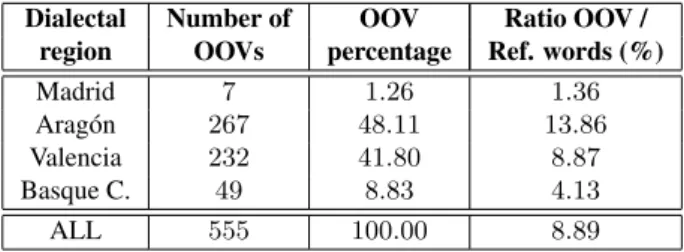
interactions of each speaker showed that the percentage of Out-Of-Vocabulary words (OOV) that the speakers of each region used, was unexpectedly higher in the case of Valen-cia and, particularly, Arag´on (see Table 4), not only in abso-lute terms (see column 3), but also considering the relative ratio between the number of OOVs, and the total number of reference words (column 4). This was a decisive reason for the lower performance that the system reaches in both cases, in comparison to Madrid and Basque Country.
Table 4:Distribution of Out-Of-Vocabulary words accord-ing to dialectal regions.
Dialectal Number of OOV Ratio OOV /
region OOVs percentage Ref. words (%)
Madrid 7 1.26 1.36
Arag´on 267 48.11 13.86
Valencia 232 41.80 8.87
Basque C. 49 8.83 4.13
ALL 555 100.00 8.89
5.2. Evaluation of the Spoken Dialogue System
As many labelling sources are available, we can evaluate the performance of complex spoken dialogue systems us-ing the information of the database. In this regard, a sim-ilar study to that presented in (Fern´andez-Mart´ınez et al., 2008) is being addressed based on different dialogue qual-ity and efficiency metrics that were automatically collected for each scenario by the spoken dialogue system.
5.2.1. Objective Evaluation
Figure 3: Sample images captured by the cameras.
As another interesting issue, we could try to assess the rel-evance of the contextual information handling strategies in terms ofdialogue efficiency, a metric related to dialogue fluency which could be measured as the average number of actions executed per turn. On one hand, higher values of contextual turns should be associated with lower values of system requests. On the other, lower values of system requests should mean better turn efficiencies. Dialogue ef-ficiency results have been presented in Table 5 for each type of scenario. We have also included a column reporting the difference between both metrics: contextual and request turns. For instance, by comparing the results corresponding to the Basic and Advanced scenarios, it is clear that there is a strong dependency between efficiency and the number of requests formulated by the system. Advanced and Free sce-narios are pretty similar in this regard (i.e.1.75and1.71 re-spectively), nonetheless it can be observed a slightly worse behaviour for the latter which could be due to the worse performance of the speech recogniser (see Table 2, particu-larly due to a higher number of OOVs).
Advanced and Free scenarios allow the user to better ex-ploit the contextual information handling strategies, thus re-sulting in a lower amount of requests and therefore, speed-ing up the dialogue makspeed-ing it more fluent and flexible (e.g. users are free to make more use of ellipsis).
Table 5: Dialogue efficiency and its connection with the percentage of contextual turns and system requests.
Scenario Type
Dialogue Efficiency (# actions/turn)
Contextual turns - System requests
(%)
Basic 1.48 14.22
Advanced 1.75 36.19
Free 1.71 28.88
ALL 1.69 30.61
5.2.2. Subjective Evaluation
As in (Fern´andez-Mart´ınez et al., 2008), in order to get subjective ratings of the spoken dialogue system we con-ducted user satisfaction surveys. Every user was requested to rate task or scenario success after each scenario on a1
(worst) to5(best) scale (see Figure 5). An average user
sat-45% 50% 55% 60%
Contextual Turns Vs. System Requests Contextual Turns System Requests
20% 25% 30% 35% 40% 45% 50% 55% 60%
BASIC ADVANCED FREE ALL
% T
u
rns
Scenario Type
Contextual Turns Vs. System Requests Contextual Turns System Requests
20% 25% 30% 35% 40% 45% 50% 55% 60%
BASIC ADVANCED FREE ALL
% T
u
rns
Scenario Type
Contextual Turns Vs. System Requests Contextual Turns System Requests
Figure 4: Percentage of contextual turns and system re-quests.
isfaction rate of4.25shows the goodness of our Bayesian Networks based dialogue modeling approach (Fern´andez-Mart´ınez et al., 2005). Subjectively, the system’s response has been assessed very positively by users as it can be de-duced from the presented results. In particular, the individ-ualised analysis conducted for each type of scenario puts the “free” scenarios as the highest-rated throughout the as-sessment process. This is undoubtedly a result of particular importance because the complexity of the “free” scenarios is maximum. These are scenarios without any restriction in which the initiative of the user reaches its top.
6.
Conclusions and Future Work
4,00 4,05 4,10 4,15 4,20 4,25 4,30 4,35 4,40 4,45 4,50
BASIC ADVANCED FREE ALL
1-5 s
c
a
le
Scenario Type
User Satisfaction per scenario type
Figure 5: Average user satisfaction for each type of sce-nario.
saving a significant amount of system’s requests, and thus speeding up the dialogue.
Audio and Video-based speaker localisation and tracking are also being addressed with strategies such as the ones described in (Castro, 2007) and (Marron et al., 2009). Our main interest in the near future is the evaluation of audio-visual sensor fusion techniques on this task.
7.
Acknowledgements
This work has been supported by ROBONAUTA (DPI2007-66846-c02-02) and SD-TEAM (TIN2008-06856-C05-03).
8.
References
Andre Adami, Lukas Burget, Stephane Dupont, Hari Garu-dadri, Frantisek Grezl, Hynek Hermansky, Pratibha Jain, Sachin Kajarekar, Nelson Morgan, and Sunil Sivadas. 2002. Qualcomm-icsi-ogi features for asr. InProc. IC-SLP, pages 4–7.
Jean Carletta. 2007. Unleashing the killer corpus: experi-ences in creating the multi-everything ami meeting
cor-pus. Language Resources and Evaluation, 41(2):181–
190.
Carlos Castro. 2007. Speaker localization techniques in re-verberant acoustic environments, master thesis.
EDECAN. 2006. EDECAN project. http://www.
edecan.es/en/index.html.
F. Fern´andez-Mart´ınez, J. Ferreiros, V. Sama, J.M. Mon-tero, R. San Segundo, J. Macas, and R. Garca. 2005. Speech interface for controlling an hi-fi audio system based on a bayesian belief networks approach for dia-log modeling. InEurospeech, pages 3421–3424, Lisboa (Portugal).
F. Fern´andez-Mart´ınez, J. Blazquez, J. Ferreiros, R. Barra, J. Macias-Guarasa, and J.M. Lucas-Cuesta. 2008. Eval-uation of a spoken dialogue system for controlling a hifi audio system. pages 137 –140, dec.
F. Fern´andez-Mart´ınez, J. Ferreiros, R. Cordoba, J. M. Montero, R. San-Segundo, and J. M. Pardo. 2009. A bayesian networks approach for dialog modeling: The fusion bn. In ICASSP ’09: Proceedings of the 2009 IEEE International Conference on Acoustics, Speech and
Signal Processing, pages 4789–4792, Washington, DC,
USA. IEEE Computer Society.
F. Fern´andez-Mart´ınez. 2008. An´alisis, dise˜no y apli-caci´on de modelos de di´alogo flexibles, contextuales y
din´amicos basados en Redes Bayesianas. Ph.D. thesis,
E.T.S.I. de Telecomunicaci´on, Universidad Polit´ecnica de Madrid, Madrid, Spain, Octubre.
Guillaume Lathoud, Jean-Marc Odobez, and Daniel Gatica-Perez. 2004. AV16.3: an audio-Visual Corpus for Speaker Localization and Tracking. RR Idiap-RR-28-2004, IDIAP, Martigny, Switzerland. Published in “Proceedings of the 2004 MLMI Workshop”.
M. Marron, D. Pizarro, J.C. Garcia, A. Marcos, R. Jalvo, and M. Mazo. 2009. Multi-agent 3d tracking in intelli-gent spaces with a single extended particle filter. pages 305 –310, aug.
H.M. Meng, C. Wai, and R. Pieraccini. 2003. The use of belief networks for mixed-initiative dialog modeling.
Speech and Audio Processing, IEEE Transactions on,
11(6):757 – 773, nov.
D. Mostefa, N. Moreau, K. Choukri, G. Potamianos, S. M. Chu, A. Tyagi, J. R. Casas, J. Turmo, L. Cristoforetti, F. Tobia, A. Pnevmatikakis, V. Mylonakis, F. Talantzis, S. Burger, R. Stiefelhagen, K. Bernardin, and C. Rochet. 2008. The chil audiovisual corpus for lecture and meet-ing analysis inside smart rooms. International Journal of Language Resources and Evaluation. Special issue on Multimodal Corpora for Modelling Human Multimodal
Behavior, 41(3-4):389–407. ISSN 1574-020X.