i
UNIVERSIDAD TÉCNICA DE AMBATO
FACULTAD DE CIENCIAS HUMANAS Y DE LA EDUCACIÓN CARRERA DE IDIOMAS
MODALIDAD PRESENCIAL
Proyecto de Investigación previo a la obtención del Título de Licenciada en Ciencias de la Educación
Mención Inglés.
THEME:
“THE COLLABORATIVE LEARNING AND THE WRITING SKILL.”
AUTHOR: Evelin Fernanda Acuña Cortes
TUTOR: Lcda. Mg. Ana Jazmina Vera de la Torre
Ambato-Ecuador 2019
ii
SUPERVISOR APPROVAL
CERTIFY:
I, Lcda. Mg. Ana Jazmina Vera de la Torre, holder of the I.D No. 1801249341, in my capacity as supervisor of the Research dissertation on the topic: “THE COLLABORATIVE LEARNING AND THE WRITING SKILL” investigated by Evelin Fernanda Acuña Cortes confirm that this research report meets the technical, scientific and regulatory requirements, so the presentation of it is authorized to the corresponding organism in order to be submitted for evaluation by the Qualifying Commission appointed by the Board of Directors.
Lcda. Mg. Ana Jazmina Vera de la Torre C.C. 1801249341
iii
COPYRIGHT REUSE
I, Evelin Fernanda Acuña Cortes with I.D. No. 180479938-3, confer the rights of this undergraduate dissertation “THE COLLABORATIVE LEARNING AND THE WRITING SKILL”, and authorize its total reproduction or part of it, as long as it is in accordance with the regulations of the Universidad Técnica de Ambato, without profit.
Evelin Fernanda Acuña Cortes C.C. 180479938-3
iv
APPROVAL OF THE HIGH COURT OR DEGREE COURT TO THE DIRECTIVE COUNCIL OF THE FACULTY OF HUMAN SCIENCES AND
EDUCATION
The Board of Directors which has received the defense of the research dissertation with the purpose of obtaining the academic degree with the topic “THE COLLABORATIVE LEARNING AND THE WRITING SKILL” which is held by Evelin Fernanda Acuña Cortes undergraduate student from Carrera de Idiomas academic period march 2019- august 2019 and once the research has been reviewed, it is approved because it complies with the basic, technical, scientific and regulatory principles. Therefore, the presentation before the pertinent organisms is authorized.
Ambato, August, 2019.
REVISION COMMISSION
Dra. Mg. Elsa Mayorie Chimbo Cáceres Lcda. Mg. Lorena Fernanda Parra Gavilánez. C.C. 180269645-8 C.C. 180310352-0
v DEDICATION
To my daughter Celeste, who is the engine of my life, my impulse to continue and fight to achieve my most desired dreams for being my motive of inspiration to be able to improve myself every day to obtain a better future. At your young age you have taught me that everything effort is worth it and everything is rewarded when you get home and see that you receive me with a big hug a kiss and a big smile that God always blesses you daughter.
vi ACKNOWLEDGMENTS
To God who is my guide for giving me the necessary strength to move forward and carry out my dreams and goals.
My parents and my siblings who have been a fundamental pillar to finish my career with their support and love have driven me to achieve what seemed impossible
I want to deeply thank Mg. Ana Vera, tutor of my research work who with patience and motivation, has helped me to carry out this research work guiding and supporting me in the process of preparing this work.
The teachers of the Language Course, who have been a guide throughout this student stage sharing their knowledge and nurturing their wisdom has been a great help to grow as a professional and be ready for working life.
To the director of the San José de Poalo Educational Unit and to the entire educational community for giving me the necessary support to carry out this research work.
vii
TABLE OF CONTENT
SUPERVISOR APPROVAL ... ii
COPYRIGHT REUSE ... iii
APPROVAL OF THE HIGH COURT OR DEGREE COURT TO THE DIRECTIVE COUNCIL OF THE FACULTY OF HUMAN SCIENCES AND EDUCATION ... iv
DEDICATION ... v
ACKNOWLEDGMENTS ... vi
TABLE OF CONTENT ... vii
TABLE-INDEX ... x GRAPHIC INDEX ... xi ABSTRACT ... xii ABSTRACT ... xiii CHAPTER I ... 15 1.1 Investigative background ... 15 1.2 Objetives ... 26 1.2.1 General ... 26 1.2.2 Specific ... 26 CHAPTER II ... 27 2.2 Methods ... 27
2.2.1. Basic mode of investigation ... 27
2.2.3. Level or type of investigation... 28
viii
2.2.4.1 Determination of sample ... 30
2.2.5 Data collection... 31
2.2.6 Data collection techniques and tools ... 32
CHAPTER III ... 33
3.1 Analysis and discussion of the results. ... 33
3.2. Interpretation of data ... 33
3.2.1 Results of the students survey ... 33
3.2 Hypothesis verification ... 55
3.2.1 Selection of significance level... 55
3.2.2 Population description ... 55
3.2.3 Statistical Specification ... 55
3.2.4 Specification of acceptance and rejection zones ... 55
3.2.5 Gaussian bell ... 55 3.2.6 Variables analysis ... 56 4.1 Conclusions ... 59 4.2 Recommendations ... 60 REFERENCE MATERIALS ... 61 Bibliographic references ... 61
ANNEX 1. COMMITMENT LETTER ... 65
ANNEX 2. SURVEY ADDRESSED TO TEACHERS ... 66
ANNEX 3. SURVEY ADDRESSED TO STUDENTS ... 68
ANNEX 4. VALIDATION OF QUESTIONARIE ... 70
ix
ANNEX 6. VALIDATION OF QUESTIONARIE ... 72
ANNEX 7. VALIDATION OF QUESTIONARIE ... 73
ANNEX 8. VALIDATION OF QUESTIONARIE ... 74
ANNEX 9. CLASSROOM OBSERVATION CHECKLIST... 75
ANNEX 10. CLASSROOM OBSERVATION CHECKLIST... 76
x
TABLE-INDEX
Table 1 Types of writing ... 24
Table 2 Population and sample ... 29
Table 3 Determination of sample ... 30
Table 4 Information collection plan ... 31
Table 5 Innovative strategies ... 34
Table 6 Writing skill development ... 35
Table 7 Group activities motivation ... 36
Table 8 The teacher value the work... 37
Table 9 The teacher promotes the development of student writing ... 38
Table 10 The teacher promotes and motivate students incorrect writing ... 39
Table 11 The teacher emphasizes syntax, semantics, and morphology ... 41
Table 12 The teacher emphasizes the correct use of English spelling ... 42
Table 13 The teacher promotes the correct writing of sentences ... 43
Table 14 The teacher uses scales of evaluation-rubrics ... 44
Table 15 Dynamic strategies ... 45
Table 16 Group activities ... 46
Table 17 Motivation to the students ... 47
Table 18 To value the work done by each of the group ... 48
Table 19 Development of student writing ... 49
Table 20 Correct writing... 50
Table 21 Development of writing skills ... 51
Table 22 Use of english spelling ... 52
Table 23 Logically sequence ... 53
Table 24 Rating scales-rubrics ... 54
Table 25 Observed frequencies ... 56
Table 26 Expected Frequencies ... 57
xi
GRAPHIC INDEX
Figure 1 Innovative strategies ... 34
Figure 2: Writing skills development ... 35
Figure 3: Group activities motivation... 36
Figure 4: The teacher promotes the development of student writing ... 38
Figure 5: The teacher promotes and motivate students in correct writing ... 39
Figure 6: The teacher emphasizes syntax, semantics, and morphology ... 41
Figure 7: The teacher emphasizes syntax, semantics, and morphology ... 41
Figure 8: The teacher emphasizes the correct use of English spelling ... 42
Figure 9 The teacher promotes the correct writing of sentences ... 43
Figure 10 The teacher uses scales of evaluation-rubrics ... 44
Figure 11 Dynamic strategies ... 45
Figure 12 Group activities ... 46
Figure 13 Motivation to the students ... 47
Figure 14 To value the work is done by each of the group ... 48
Figure 15 Development of student writing ... 49
Figure 16 Correct writing ... 50
Figure 17 Development of writing skill... 51
Figure 18 Use of English spelling ... 52
Figure 19 Logically sequence ... 53
Figure 20 Rating scales-rubrics ... 54
xii
UNIVERSIDAD TÉCNICA DE AMBATO
FACULTAD CIENCIAS HUMANAS Y DE LA EDUCACIÓN CARRERA DE IDIOMAS
ABSTRACT
TITLE: “THE COLLABORATIVE LEARNING AND THE WRITING SKILL” AUTHOR: Evelin Fernanda Acuña Cortes.
TUTOR: Lcda. Mg. Ana Jazmina Vera de la Torre
The writing of the English language as a second language and as a foreign language has a vital contribution to the student`s life. Generally, the student concentrates exclusively on the lexical and syntactic levels rather than on the discursive level, that is, textual coherence. For this reason, most students feel that their only sense of security comes from what they have learned about grammar and that grammar is the only tool they can use when writing material in the English language is presented. That is why collaborative learning in the classroom represents an opportunity for teachers, through the design of their activities, to promote in their students the development of skills, attitudes, and values. The objective of this project is to determine the use of collaborative learning and its impact on the development of English language writing skills in the first-year high school students of the "San José de Poalo" Educational Unit. The results indicate that the students do not develop the writing skills of the English language, for various reasons such as the limited time of class hours; a large number of students in the classroom and Lack of interaction due to individual learning which prevents the teacher from checking the correct use of spelling in all students.
WORDS: Collaborative learning, foreign language, writing, pedagogical approach, teaching, grammar, skills development.
xiii
UNIVERSIDAD TÉCNICA DE AMBATO
FACULTAD CIENCIAS HUMANAS Y DE LA EDUCACIÓN CARRERA DE IDIOMAS
ABSTRACT
TITLE: "EL APRENDIZAJE COLABORATIVO Y LADESTREZA DE ESCRITURA AUTHOR: Evelin Fernanda Acuña Cortes.
TUTOR: Lcda. Mg. Ana Jazmina Vera de la Torre
La escritura del idioma inglés como segunda lengua tiene una contribución vital a la vida estudiantil de las personas. Generalmente, el estudiante se concentra exclusivamente en los niveles léxico y sintáctico más que en el nivel discursivo, es decir, en la coherencia textual. Por esta razón, la mayoría de los estudiantes sienten que su único sentido de seguridad proviene de lo que han aprendido sobre gramática y que la gramática es la única herramienta que pueden usar cuando escriben material en inglés. Es por ello que el aprendizaje colaborativo en el aula representa una oportunidad para que los profesores, a través del diseño de sus actividades, promuevan en sus estudiantes el desarrollo de habilidades, actitudes y valores. El objetivo de este proyecto es determinar el uso del aprendizaje colaborativo y su impacto en el desarrollo de la escritura en inglés en los estudiantes de primer año de bachillerato de la Unidad Educativa "San José de Poalo". Los resultados indican que los estudiantes no desarrollan las habilidades de escritura del idioma inglés, por diversas razones como el tiempo limitado de las horas de clase; un gran número de estudiantes en el aula y la falta de interacción a causa del aprendizaje individual lo que impide que el profesor compruebe el correcto uso de la ortografía en todos los estudiantes.
PALABRAS CLAVE: Aprendizaje colaborativo, lengua extranjera, escritura, enfoque pedagógico, enseñanza, gramática, desarrollo de habilidades.
14
INTRODUCTION
It is important to state that the role of the teacher is not limited to teaching subjects according to pre-established guidelines, rather, it must be responsible for the use of good teaching strategies and extend to the complex task of encouraging and directing learning towards students in a collective way, because in an independent environment, students do not consider different options and their learning is limited, so it is necessary to consider other dynamics that contribute to this complexity and encourage the development of writing based on collaborative strategies.
For this reason, the present research work has been carried out with the theme “THE COLLABORATIVE LEARNING AND THE WRITING SKILL”
The present investigation consists of 4 chapters each one of them in relation to the subject to be investigated.
Chapter I: This chapter presents the research background, which serves as a guide for the development of the research. In addition, it defines a general objective and three specific objectives that are fulfilled in the development of the document.
Chapter II: Explains the materials and methods used for the development of research, it also covers the research approach, basic modality of research, level or type of research population and sample, information collection, processing, and analysis.
Chapter III: It describes the analysis and interpretation of results obtained in student surveys to determine the verification of the hypothesis and the problem it.
15 CHAPTER I
THEORETICAL FRAMEWORK
1.1 Investigative background
The following researches and papers mentioned serve as the basis for an in-depth analysis of the use of collaborative learning in the development of writing skills, taking into consideration the following documents of significant contribution. It is important to emphasize that the selected documents contain themes similar to this work, carried out by professional graduates, whose digital files are freely accessible in their institutions’ digital repository.
The first one is the research carried out by Albán (2018) titled “Community language learning (el aprendizaje comunitario) en el desarrollo de la destreza oral del idioma inglés (speaking) en los estudiantes de la carrera de pedagogía de los idiomas nacionales y extranjeros de la Universidad Técnica de Ambato” The author maintains a general objective to determine the incidence of the use of Community Language Learning and Speaking in first level students. The approach is quantitative because it will try to determine the causes that converge as triggers of the problem based on statistical data and more and qualitative type as it considers creativity as one of the most relevant characteristics of the human personality. Through the collection and processing of the data offered by the participants, the incidence of community learning in the development of oral skills is better explained. In addition, the author uses a survey from a structured questionnaire for teachers and students as a data collection tool. The study population designated by the author is made up of English students, thus working with 34 students. The research work points to several conclusions that can help and use as guide for the development of this investigation, of which two stand out. The interaction between the teacher and the student as a strategy contributes to a positive role within the classroom in an environment without stress, without pressure and without fear of making mistakes since the active role of the student allows them to be part of the learning process.
On the other hand, cooperative work in oral activities in the classroom contributes to the group and makes it dependent on self-learning as there are students with greater
16
knowledge of the language who support their peers to improve their shortcomings by ignorance of vocabulary or poor pronunciation.
In this way, the research contributes significantly and allows us to establish the benefits of maintaining collaborative learning for the development of the English language in a given educational institution, as a reference to the fact that teamwork must essentially be developed in order to adequately integrate the educational system.
Similarly, the study carried out by Orna and Mancheno (2016) titled “The cooperative learning for improving student’s motivation, in octavo año “c” at Unidad Educativa “Camilo Gallegos” in the city of Riobamba, Chimborazo province”. The author proposes as a general objective to determinate if cooperative learning improves student’s motivation. The author uses a qualitative and quantitative approach because, during the process, the root causes of the problem were investigated. The research used was from Campo, because it was carried out in the place where the events took place, having a better perspective of reality. With a descriptive level given that analyzes the problem or study phenomenon that in this case mentions the cooperative strategy. The data collection was done by means of a survey by means of an elaborated questionnaire. The study population was 36 students.
After the analysis of the research, it is obtained that learning is most effective when groups of students undertake a common activity using real instruments and colleagues willing to collaborate i.e. using the cooperative strategy correctly. However, the teacher must play an active role in learning and understand the purpose that students learn best either in pairs, groups or individually as this helps those who are less able to solve problems. Also, Cooperative Learning is a good resource that is easy to use it in the classroom, also catches the attention of the students, and activates their willingness to learn English.
In this case, working cooperatively is fundamental in the learning of the English language, as it allows the students to be the main builders and beneficiaries of the cooperation, as well as in some cases it is better not to use it since it can cause some kind of difficulty. For which it is necessary to propose different group activities that apply in English classes to help students develop and produce fluent language, thus achieving excellent
17
communication and companionship while learning and practicing English in cooperation with their teacher and classmates.
Additional consideration is given to the research carried out by Guerrón and Rincón (2016), in his research titled “Ambiente de aprendizaje cooperative en la enseñanza del ingles como lengua extranjera”, a thesis delimited with a general objective to identify which relationships are present within an environment of learning English as a foreign language and their relationship to cooperative learning. The author describes his project as a description of the relationship between the learning environment of English as a foreign language and cooperative learning. It was guided by the qualitative approach. Because it is a social research project, it focuses on everyday situations, originating from relationships or interactions that took place in the classroom. The sample of this research was determined from the student survey. This was applied to 20 of them randomly, within a total group of 40 students among boys and girls from 11 to 15 years of age. The instruments that were designed for the investigation were: field diaries, the interview to teachers and the student survey, being these the most appropriate methods and used to collect information.
From the conclusions that the author explains that the relationship between Cooperative Learning and the environment of learning English as a foreign language share similar elements such as Group learning, which sought to achieve the same goal in an equal and equal way at the time of implementing working groups. Second, the description of the learning environment, where the characteristics of each group could make the work a generator of knowledge.
Also, the characteristics of student relationships within the environment of learning English as a foreign language are determined by the concession made when group work is organized, in which particularities such as age diversity, needs, attitudes, interests, traits arise.
Finally, these research carried out by Reyes (2016) titled “El aprendizaje cooperativo y la competencia comunicativa oral en los estudiantes del tercer año de bachillerato general unificado de la Unidad Educativa “Guayaquil” de la ciudad de Ambato, provincia de Tungurahua.” The main objective is to find out how cooperative learning influences the communicative competence of the English language. Its approach is
18
qualitative-quantitative since it is based on real data. The project uses an inductive method as it focuses on the development of learning strategies and a deductive method as it determines the causes by which cooperative learning can affect oral communicative competence. In addition, the research employs descriptive, bibliographic and field type as support. The data collection instrument is a survey based on a questionnaire addressed to students and teachers of the English subject. In this way, the population forms a total of 296 students and 6 teachers.
This is how it can be concluded that the cooperative learning activities that are applied in the classroom for the development of oral communicative competence, for the most part, are limited only to the presentation of dialogues and conversations, which are simply memorized and repeated by the students orally; which restricts the students in the practice of other oral activities in which cooperative learning and critical thinking can be applied progressively and permanently.
In addition, the communicative activities that are usually used in class like interviews, dialogues, speeches, debates, dramatizations, conversations, among others, are used in a limited way, preventing the student from developing his communicative abilities in an adequate way.
Theoretical foundation
Multiple Intelligences
Multiple Intelligence (MI) Theory, Gardner (1994) posits intelligence as the "ability to solve problems or create products that are valuable in one or more cultural environments”. In this case, Aina (2018), expresses that intelligence is "the bio psychological capacity to process information to solve problems or create products that are valuable to a community or culture. On the other hand, Akinbobola (2015), mentions that the Theory of Multiple Intelligences facilitates the application of novel, motivating, integrating and creative strategies. So, students in their leading role construct broad schemes of knowledge allowing them to acquire a vision of reality that surpasses the limits of daily knowledge and brings them closer to the knowledge and creative potential which they possess developing or activating other intelligence(Paavola, Lipponen, & Hakkarainen, 2016).
19
The Theory of Multiple Intelligences questions traditional visions of intelligence because they focus primarily on cognitive aspects, neglecting the role of personality, emotions and the cultural environment in which mental processes are developed, which is why they form an ideal context for understanding and developing the cognitive skills of apprentices, since it undoubtedly has a surprising and interesting applicability in the field of education (McCoy & Mathur, 2017).
Learning teaching strategies
According to Amir (2018), there is a need to prepare present and future generations to assume a more active and creative role in the process of building their own development, for the benefit of society, is a current concern of all of us who in one way or another assume a part of the responsibility in achieving that purpose. This is equivalent to say that the student must be able to learn to learn, which means preparing him or her to direct his or her own learning by putting into practice appropriate strategies that are the result of conscious, intentional and contextualized decisions on how to proceed in order to achieve a certain objective related to his or her learning (Shim, 2016).
On the other hand, Darko (2018) expresses that learning teaching strategies have been conceptualized as a set of mental operations and procedures of coding, acquisition, retention, and evocation as general plans to achieve instructional objectives as a combination of cognitive skills (Serevine, 2018). In this way, it is about procedures, conscious and intentional, in which the student chooses and activates, in a coordinated manner, the declarative and procedural knowledge needed to meet a given demand, depending on the conditions of the situation in which the demand occurs(Benhima, 2016). Gardner (1999) has identified eight different types of intelligence:
Logical-mathematical intelligence: used to solve problems of logic and mathematics. It is the intelligence that scientists have. It corresponds with the way of thinking of the logical hemisphere and with what culture has Always considered as the only intelligence.
Linguistic intelligence: that which writers, poets, and good writers have. It uses both hemispheres.
20
Spatial intelligence: consists of forming a mental model of the world in three dimensions. It is the intelligence of sailors, engineers, surgeons, sculptors, architects, or decorators.
Musical intelligence: it is naturally that of singers, composers, musicians, dancers.
Corporal-kinesthetic intelligence: or the ability to use one's own body to carry out activities or solve problems. It is the intelligence of athletes, craftsmen, surgeons, and dancers.
Intrapersonal intelligence: is what allows us to understand ourselves. It is not associated with any specific activity.
Interpersonal intelligence: that allows understanding others, and we usually find it in good salespeople, politicians, teachers or therapists. Intrapersonal and interpersonal intelligence make up emotional intelligence and together they determine our ability to direct our own lives satisfactorily.
Naturalistic intelligence: the intelligence we use when observing and studying nature. It is the one shown by biologists or herbalists
Teaching strategies
According to Stollhans (2016), there are different strategies for activities and different ways of classifying them. Implicitly, it assumes that, as teachers, there is a reflection on how to plan, present and evaluate the different contents of the subject being taught. To teach them to know themselves better as "apprentices", to identify the format and origin of their difficulties, abilities and preferences at the time of learning, with the triple objective of, on the one hand, trying to anticipate and compensate for their gaps and deficiencies during learning (Hwang, 2014), on the other, to achieve a better adjustment between their expectations of success and the performance obtained and, finally, to favor the adaptation of the activities and exercises presented to their own characteristics; in short, to help them to construct their own cognitive identity (McCoy & Mathur, 2017). On the other hand, with respect to the role of teachers, to consciously reconstruct the meanings as "teachers", with respect to what should or should not be taught and how it should be done so that the student learns in a consistent way; it supposes, in the end, a recognition of the abilities and deficiencies as teachers (teaching style) that places them
21
in the position of undertaking changes that improve our professional performance (Baker, 2015).
According to Song and Chai (2018) teaching strategies implies teaching the student to consciously decide the acts he will perform, teaching them to consciously modify their performance when oriented towards the desired objective and teaching them to consciously evaluate the process of learning or resolution followed.
Collaborative learning
Within teaching methodologies and strategies there is an endless range of options that can currently be used. Collaborative learning can be mentioned as one of the didactic strategies to be used. This, according to Baker (2015), is basically the use of groups in such a way that the student, by working together, manages to maximize his own learning and that of other individuals. The definition is similar to Song and Chai (2018) that mentions that it is a strategy that complements the individual work; the idea is basically to achieve a set that works for the totality of members in search of a common end that enlarges the learning process.
Collaboration among students as part of the methodology in traditional teaching methods or approaches has not had much participation or prominence. In fact, within all the methods described, it only appears as an option within the communicative approach (Benhima, 2016).
Despite the above, collaborative learning does not solve the problems that both teachers and students might face in an academic context, but rather is an alternative to consider when teaching content or putting it into practice. It should also be noted that students do not necessarily learn as a group or that it is impossible to learn without the help of others. However, cooperative learning is an interesting and different way that can eventually bring very good results if appropriate and relevant activities are developed (Baker, 2015). As it points out Shim (2016), the goal that is sought to achieve with this structure is to cooperate in order to learn more and better. In the same line Hwang (2014) they state that cooperating means working together to achieve shared objectives since it is intended to obtain beneficial results for both sides.
22 Language
The learning of a foreign language is considered as the acquisition of knowledge of a language other than the mother tongue, which is not used on a daily basis in the life of the learner since it belongs to another culture rooted in other regions, sometimes distant from the place where the student lives (Darko, 2018).
Thus, the first structure a list approaches to the design of language programs are based on vocabulary and grammar as basic units; students have the same needs anywhere in the world and are identified only in terms of linguistic needs; the learning process is determined solely by the book; the classroom and the book are the essential providers of input for the teaching-learning process (Karkehabadi, 2013).
According to Akinbobola (2015), language is a structured communication system for which there is a context of use and certain formal combinatorial principles. There are both natural and artificial contexts. The language indicates a characteristic common to humans to express their experiences and communicate them to others through the use of symbols, signals, and sounds recorded by sense organs (Amir, 2018).
Language skills
The communicative purpose connects the four basic skills, which is why many authors prefer to talk about communicative skills: a concept that aims to encompass the skills giving a communicative and integrative approach (Manaj, L., 2015). One skill leads to another; depending on how we treat them, there is an interrelationship between them. For Honey and Mumford (2015) a student will greatly increase their vocabulary during the school years. He or she is more likely to learn and understand words that name objects and activities in which he or she has the first-hand experience. The greater the student's ability to understand the language.
The development of language is one of the fundamental objectives of school education since it is the main tool through which human beings construct and understand the world around them and enter into dialogue with themselves and with others. Language is the form that our thinking takes, relates us to others and makes us part of a cultural community (Steinre & Mahn, 2017). According to Amir (2018), it is the ability of the individual to use language appropriately in the diverse social situations that present
23
themselves to us every day, to develop a rich and varied vocabulary as they mature. They have good social interactive skills and use gestures and facial expressions effectively to aid communication.
Productive skills
Productive skills are those innate abilities that the human being possesses to give information such as writing and speaking (Mamina, 2017). Also, productive ability that the human being uses to transmit information whose main characteristic is the use of the logical graph system with meaning for example: consonants and vowels (the letters of the English alphabet consists of 21 consonants and 5 vowels) to provide models of written language in the form of texts with different uses and purposes (Stollhans, 2016).
On the other hand, a productive ability that human beings use to transmit information whose main characteristic is the use of the system of meaningful sounds. In the process of interpleading the English language in the classroom (Hwang, 2014), the teacher must provide a receptive experience previously to help him as a model and thus provide opportunities for students to develop oral practice inside and outside the classroom (Stollhans, 2016).
Writing skill
Writing is done by learning to write words, phrases, paragraphs, allowing communication on any topic. It is one of the skills that students must develop within the foreign language, is a process to broaden their knowledge, and apply in each writing that this makes (Hawkins, 2015). Baker (2015), considers that in non-specialized courses, writing is an instrument since students at this stage do not seek to communicate through it and is an objective in specialized courses.
However, Serevine (2018) expresses that it is a linguistic practice in order to increase written communication, for which there must be a correct grammatical structure. It is the last skill to develop and use it correctly.
Writing, at this stage where sentences and paragraphs are written that may have errors, we examine if the content is what they want to express, someone else can read the work to give an opinion of it, we can decide if the content is what we really want to express (Scott, 2013). Revision, it is necessary to read, again and again, make the analysis and
24
reflection of the changes suggested by the teacher and colleagues, remove or add phrases, words, and statements, replace unclear ideas, read the work orally (Borko & Davinroy, 2018).
Types of writing
Paragraphs and essays can be written in different types of styles. A writer will choose a type depending on what he or she wishes to accomplish, what sort of material is to be discussed, and what kind of effect s/he wants to have on the reader. Generally speaking, there are four types of writing, though normally these types are mixed together (Orna & Mancheno, 2016).
Table 1 Types of writing
Narrative The narrative paragraph or essay tells a story, just like a narrator in a play (though it should be a true story, unlike a short story or a play). Narrative writing is best used to illustrate the "personal developmental path" a person (often yourself) has taken to reach a particular point in his/her life. As a result, it is normally written in the first-person point of view. True narrative writing is unusual because it is demanding. A narrative must have a conflict that is overcome.
Descriptive Descriptive writing paints a picture. In its pure form, nothing much happens. "Description," tells us what something looks like, feels like, tastes like, sounds like or smells like ‐ without action or events. It doesn't explain a relationship or a process beyond oneself; it focuses on one's immediate subjective perceptions. Thus, descriptive writing connects the outer world with our inner feelings. It is usually concerned with creating a verbal picture of what we experience and feel at one moment, and it will use many rich and vivid adjectives and adverbs. Expository Expository writing "exposes" or explains things about a subject. It is
also sometimes called "information writing" because it gives information about a person, place, thing, relationship or idea. To accomplish that, it is best developed by the use of clear reasons, facts, and statistical information, cause and effect relationships, or examples. Since expository paragraphs are factual, they are written without emotion and usually written in the third person.
25
Persuasive This type of writing is probably the most common form of writing at the university level. Persuasive (or argumentative) writing attempts to convince the reader that the point of view or course of action recommended by the writer is valid. To accomplish this, the writer must develop a limited topic which is well defined and debatable and has more than one side. It is important that the author understand other sides of the topic so that the strongest information to counter the others can be presented. You may present these opposing points of view, but they must be summarized at the beginning and then quickly refuted (to refute something means to show it is false or not particularly important). If you're not sure how to do this, then simply stick to your side of an argument
Elaborated by: Acuña, E. (2019) Source: (Orna & Mancheno, 2016)
Sub skills
The process of writing method is a valuable tool for any ESL teacher who wants to improve the writing of their students. Heald – Taylor (1986) describes his method, Process of writing is an approach which encourages ESL youngsters to communicate their own written messages while simultaneously developing their literacy skills in speaking and reading rather than delaying involvement in the writing process, as advocated in the past, until students have perfected their abilities in handwriting, reading, phonetics, spelling, grammar, and punctuation. In process writing the communication of the message is paramount and therefore the developing, but inaccurate, attempts at handwriting, spelling, and grammar are accepted. These skills are further developed in individual and small group conference interviews.
The writing skills incorporate a number of sub-skills. The sub-skills are classified under 7 seven categories. According to Sobana, (2003) writing has the following types of sub-skills.
Mechanics: Handwriting, spelling, and punctuation
Organization: Vocabulary, Idioms
Organization: Paragraphs, topic and support cohesion, and unit
26
Grammar: Rules of verbs, agreement, articles, pronouns etc.
Contents: Relevance, clarity, originality, logic, etc.
The writing process-getting ideas, getting started writing drafts, revising, etc.
1.2 Objetives 1.2.1 General
Determine the use of collaborative learning and its impact on the development of writing skill in the students of the baccalaureate at "Unidad Educativa San José de Poalo”
1.2.2 Specific
Establish strategies of collaborative learning and writing skills
Identify the importance of the development of writing skills in students from the baccalaureate.
27 CHAPTER II METHODOLOGY
The perspectives of students and teachers from a sample properly calculated for this study were analyzed. The participants are part of "San Jose de Poalo" Educational Unit. The main contributors of this study were 153 people, 149 were students, 3 teachers and 1 the principal of the institution. The students have an average age between 14 and 18 years old. The native language of the participants is Spanish with a basic level of English in Speaking and listening skills.
First, a socio demographic data sheet was used to collect information from participants related to gender, age, years of service, among other variables, in order to describe the sample in this study. In order to measure the first variable, which is collaborative learning, the questionnaire of Samadian (2014)was adapted to the reality to which this study is focused. This consists of a scaled format that goes from "Always" to "Never" in a numerical continuum from 1 to 3. The validity of the scales is supported by an analysis of factors which supports the questionnaire.
2.2 Methods
The approach of this research is qualitative because it is characteristic of the human sciences, it has an emphasis on the process, a social phenomenon, and it is quantitative because by means of the accuracy of the data obtained verification of hypotheses is carried out. Also, is quantitative, because the results of the field research and the facts that are part of the reality of the institution in the study are presented. This generates numerical data, which have been treated on the basis of a study and statistical processing of data in order to present the results in an adequate and comprehensible way.
2.2.1. Basic mode of investigation
The modalities to be used in the research work will be as follows:
Field research.
The same one that will allow obtaining information of the same place where the problem is developed that is to say the investigator will move to the same place of the facts to obtain information of high value to establish an adequate diagnosis of the current reality of the institution.
28
This will allow the research to be based on an adequate way by means of the information that can be obtained from books, journals, reports, Internet, etc. so that the research can contrast the reality of theory and practice in the professional field.
2.2.3. Level or type of investigation 2.2.3.1 Descriptive research
It allows describing in an objective way how the problem develops in the place of the fact, to relate the two variables subject of study.
The focus of this research is quantitative qualitative. Qualitative because it is characteristic of the human sciences it has an emphasis in the process a social phenomenon, and it is quantitative since by means of the exactitude of the obtained data confirmation of hypothesis is going to be made (Bazeley, 2014). The predominant paradigmatic approach of this investigation is qualitative-quantitative. It is qualitative, first, because it is part of the human sciences and then because the researcher will go to the very place of the problem, where she will maintain close contact with those involved in the problem to obtain both primary and secondary information (Murphy & Dingwall, 2016). In this way she will understand, understand and know all the aspects of the problem and the reasons for it, also to those involved, only then I propose a solution to it. Secondly, this research has a quantitative approach because it looks for accuracy in the results after having applied surveys.
2.2.3.2 Exploratory research
The "San José de Poalo" Educational Unit was visited in order to see if the problem exists, a situation that noticeable in the students' lack of written expression of the English language. The influence of the methods used in the written expression of the English language of baccalaureate students of the "San José de Poalo" Educational Unit was determined. Only by identifying the two variables will it be possible to identify whether collaborative learning really influences the students' English writing skill (Samadian, 2014).
29 2.2.3.3 Level of association of variables
It is determined if the method of teaching written expression applied by teachers gives good results in the performance of students, otherwise, new teaching techniques could be applied and thus improve their performance. It is demonstrated that there is some kind of influence in applying collaborative learning in the written expression of the English language of the students. It is assessed whether the implementation of this strategy is really effective, as some students improve, others remain at the same level, and others likely decline in performance, although ideally, everyone should respond in the best way to the application of this method.
2.2.3.4 Explanatory level
It detects the willingness of teachers to change their way of teaching and students to get their collaboration at the time of applying the techniques of collaborative learning so that with both educational entities collaborating a better written expression in English is produced and consequently there is a better performance in the class, making use of the language that is being learned (Prieto, 2017). Research is done to find out what is causing students not to write properly. There are several, however, several stands out that are analyzed and therefore a solution is proposed.
The hypothesis is tested experimentally through the entire research process, using surveys of the population immersed in the problem, obtaining and tabulating the same results that give way to the acceptance and rejection of one of the variables and the other (Morgan, 2016). Finally, we propose a solution to the problem, which in this case is the application of the techniques proposed by the collaborative learning strategy for the development and improvement of the written expression of the English language (Kothari, 2018).
2.2.4 Population and sample
It is necessary to indicate the population with which I worked to solve the problem in the present study work.
30
Teachers 3
Principal 1
Students 153
TOTAL 157
Elaborated by: Acuña, E. (2019)
Source: Unidad Educativa "San José de Poalo"
2.2.4.1 Determination of sample
Table 3 Determination of sample
Reliability level 95% 0,745 Probability of occurrence 50% Z= 3,8416 Probability of non-occurrence 50% Population 254% Sampling error 5% Sample 1,529030964
Elaborated by: Acuña, E. (2019)
Source: Unidad Educativa "San José de Poalo"
By applying the finite population formula, it is determined that the sample is 152.90 people who should be subject to the study so it is applied to 153 people of the total population.
31 2.2.5 Data collection
2.2.5.1 Information collection plan
For the purposes of this research, a total population of 153 people is considered, including teachers and students at the school.
On the other hand, the tabulation of the information is carried out by means of the application of google docs, the same that allows us to have information online and in real-time.
The results obtained from the survey is subjected to a hypothesis verification using the Xi² (Chi-square) formula, in order to establish statistically if the solution of the problem is feasible for the institution. Finally, three different ways of presenting statistical data in written form, by means of tables and graphically in cakes with statistical representation have been foreseen.
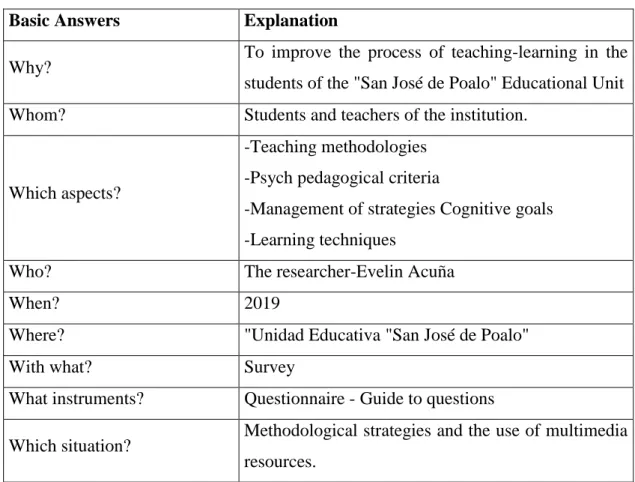
Table 4Information collection plan
Basic Answers Explanation
Why? To improve the process of teaching-learning in the students of the "San José de Poalo" Educational Unit Whom? Students and teachers of the institution.
Which aspects?
-Teaching methodologies -Psych pedagogical criteria
-Management of strategies Cognitive goals -Learning techniques
Who? The researcher-Evelin Acuña
When? 2019
Where? "Unidad Educativa "San José de Poalo"
With what? Survey
What instruments? Questionnaire - Guide to questions
Which situation? Methodological strategies and the use of multimedia resources.
Author: Acuña, E. (2019)
32 2.2.6 Data collection techniques and tools
The different techniques that the researcher uses to collect the necessary information to achieve the objectives of the research are indicated.
2.2.6.1 Techniques Survey
It is necessary to use the survey in the research since it allows the researcher to collect information from the population under study and diagnose efficiently what their perceptions are on the topic of study and verify whether it is feasible to solve the virtual classroom that is presented to the problems of the deficient process of teaching-learning that is presented in the research work.
2.2.6.2 Instruments Questionnaire
In order for the diagnosis to be efficient, a questionnaire is used with different questions than with multiple options, with the purpose of making the tabulation of results the closest to the reality of the institution.
Guide of questions
It is worth mentioning that the interview was conducted orally by the researcher to those directly involved in the study problem.
33 CHAPTER III
RESULTS AND DISCUSSION 3.1 Analysis and discussion of the results.
The statistical results of the research presented in this chapter are related to the operationalization of the variables, which allowed the elaboration of the research instrument (Surveys questionnaires) to be applied in the sample.
The statistical graphics and tables were designed based on the information provided and contain the percentages of the opinion of the population surveyed around each of the questions proposed for each of the variables.
The following is a general percentage summary of the influence of the independent variable on the dependent variable, with its respective graph and interpretation of results by the researcher. This information obtained responds to the objectives proposed in the research that was used for statistical verification of one of the hypotheses proposed. 3.2. Interpretation of data
34
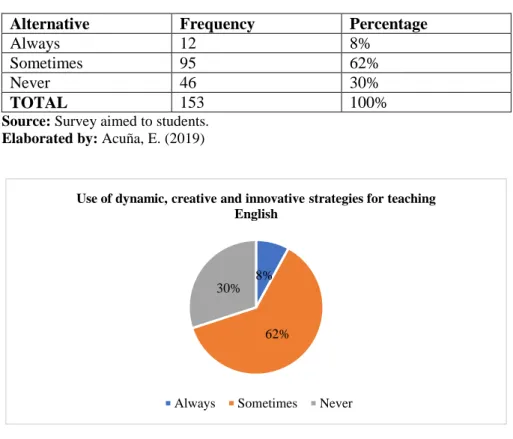
1. Does the teacher use dynamic, creative and innovative strategies for teaching English, using different techniques to group students?
Table 5Innovative strategies
Alternative Frequency Percentage
Always 12 8%
Sometimes 95 62%
Never 46 30%
TOTAL 153 100%
Source: Survey aimed to students. Elaborated by: Acuña, E. (2019)
Figure 1Innovative strategies Source: Survey aimed to students. Elaborated by: Acuña, E. (2019)
ANALYSIS AND INTERPRETATION
Of a total of 153 students surveyed, 8% said that the English teacher always employs dynamic, creative and innovative strategies, while 62% time and 30% never. group activities are a social experience of integral learning, in which different types of learning are combined and the transfer of learning to daily practice is also a good way to establisha relationship between knowing, being, living and doing.
The creative Strategies are creative activities in the group, fluency conceptual verb, can be through word-formation, complete a drawing, is a significant concept that teachers should take into account in their English classes (Avila, 2015). Therefore, communication is the essential tool for group work so information must move in all directions; in addition, each member of the team must have enough confidence and security to say what you think and whatnot.
8%
62% 30%
Use of dynamic, creative and innovative strategies for teaching English
35
2. For writing skills development, does the teacher organize group activities (2-3 students per group) to which specific roles are assigned?
Table 6 Writing skill development
Alternative Frequency Percentage
Always 0 0%
Sometimes 31 20%
Never 122 80%
TOTAL 153 100%
Source: Survey aimed to students. Elaborated by: Acuña, E. (2019)
Figure 2: Writing skills development Source: Survey aimed to students. Elaborated by: Acuña, E. (2019)
ANALYSIS AND INTERPRETATION
According to the results obtained in the survey it is demonstrated that 0% of the students agree that the teacher does not organize group activities for the development of writing skills and it is evident that he does not assign specific roles, while 20% sometimes does and 80% state that the teacher never carries out the aforementioned activities. This shows that students do not work in groups and therefore do not develop writing skills collaboratively.
Teamwork is a method of "coordinated" collective work in which participants exchange their experiences, respect their roles and functions, in order to achieve common objectives when carrying out a joint task (Tinuke, 2013).
This criterion shows the importance that the students work in a team where all the members of the group contribute their ideas, knowledge, and experiences to develop the activities since all of them are looking for the same objective.
0% 20%
80%
Writing skills development by group activites
36
3. Does the teacher motivate and encourage students to take part in group activities, where each student plays a specific role in achieving a specific goal?
Table 7 Group activities motivation
Alternative Frequency Percentage
Always 9 6%
Sometimes 54 35%
Never 90 59%
TOTAL 153 100%
Source: Survey aimed to students. Elaborated by: Acuña, E. (2019)
Figure 3: Group activities motivation Source: Survey aimed to students. Elaborated by: Acuña, E. (2019)
ANALYSIS AND INTERPRETATION
According to the results of this question, 6% of students say that the teacher always motivates them and encourages them to take part in group activities where each student plays a specific role for the consequence of a certain end, while 35% says the teacher does it sometimes and 59% that the teacher never motivates them. Taking into account the results, it can be deduced that the students are not motivated in the English classes by the teacher. Playfulness and active motivation promote human skills". Motivation is the motor that moves students to work and collaborate with the teacher in the activities, the words of motivation help the student to raise their self-esteem and helps to awaken the interest to learn (Sunddip, 2016). Motivation is the accomplishment of a task with the combination of effort and the desire to learn makes students show interest in learning with a positive attitude.
6% 35% 59%
Group activities, where each student plays a specific role in achieving a specific goal
37
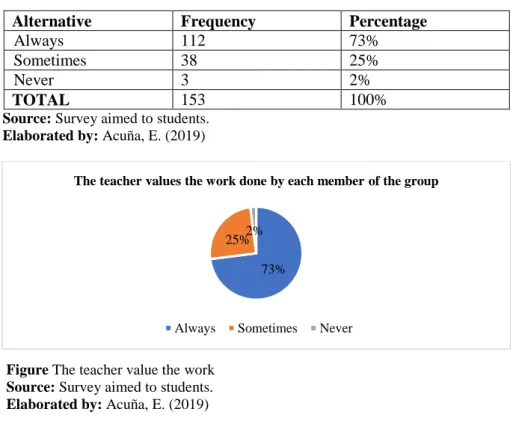
4. Does the teacher value the work done by each member of the group; as well as the final work of the group, who are motivated by encouragement phrases and/or grades?
Table 8 the teacher value the work
Alternative Frequency Percentage
Always 112 73%
Sometimes 38 25%
Never 3 2%
TOTAL 153 100%
Source: Survey aimed to students. Elaborated by: Acuña, E. (2019)
Figure The teacher value the work Source: Survey aimed to students. Elaborated by: Acuña, E. (2019)
ANALYSIS AND INTERPRETATION
The following results were obtained from the student survey: 2% was always obtained in the variant, 25% in the variant sometimes and 73% in the variant never. Therefore, it can be deduced that the teacher does not value the students individually and does not evaluate them frequently through activities other than traditional tests, such as exhibitions, debates, portfolios, stage performances, question-answer, short essays, and narrations, among others. The problem lies in the lack of hours of English classes, as well as the lack of knowledge of the application and execution of other forms of evaluation apart from the traditional test on the part of the teacher and the students. "Motivation is one of the factors, along with intelligence and prior learning, which determine whether students will achieve the desired academic results” (Fatih, 2016). The student is an active subject of learning means that if the learning is significant, there is a favorable attitude on the part of the student which means that there is motivation on the part of the teacher. One of the most relevant aspects of motivation is to arrive at a determined and pre-existing behavior of the student and that this behavior has to do with his future
73% 25%2%
The teacher values the work done by each member of the group
38
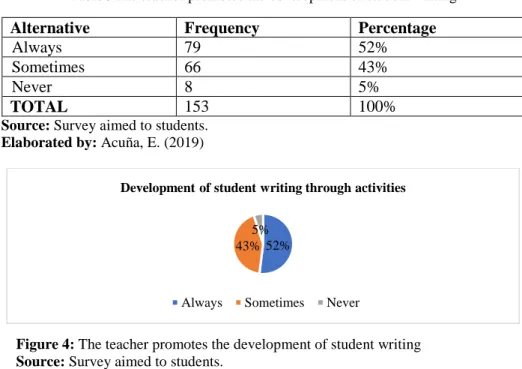
5. Does the English teacher promote the development of student writing through activities where students write words, phrases, sentences and/or paragraphs in the English language?
Table 9The teacher promotes the development of student writing
Alternative Frequency Percentage
Always 79 52%
Sometimes 66 43%
Never 8 5%
TOTAL 153 100%
Source: Survey aimed to students. Elaborated by: Acuña, E. (2019)
Figure 4: The teacher promotes the development of student writing Source: Survey aimed to students.
Elaborated by: Acuña, E. (2019)
ANALYSIS AND INTERPRETATION
52% of students surveyed said that the English teacher always promotes the development of writing through activities, while 43% of students say that the English teacher sometimes promotes the development of writing through activities, and 5% reveal that the English teacher never promotes the development of writing. It is important that the teacher applies playful activities that help students improve English writing. Creativity should be a necessary tool in the classroom where the student takes the main role in the process of teaching and learning.
There is little information and knowledge about how English is taught in public and private schools (Mamina, 2017). It is unknown how effective teaching methods and strategies are, how much and how well students learn English, and about the appropriateness and effectiveness of assessment processes. The proper application of a correct method to promote English language writing helps students not make the same mistakes if they do not improve and increase their vocabulary.
52% 43%
5%
Development of student writing through activities
39
6. Does the teacher promote and motivate student’s incorrect writing and appropriate spelling of vocabulary through activities where antonyms, synonyms, homophone words (words with the same sound and different meaning, etc.) are written and practiced?
Table 10 The teacher promotes and motivate students incorrect writing
Alternative Frequency Percentage
Always 32 21%
Sometimes 94 61%
Never 27 18%
TOTAL 153 100%
Source: Survey aimed to students. Elaborated by: Acuña, E. (2019)
Figure 5: The teacher promotes and motivate students in correct writing Source: Survey aimed to students.
Elaborated by: Acuña, E. (2019)
21%
61% 18%
To promote and motivate students in correct writing
40 ANALYSIS AND INTERPRETATION
According to the data obtained 21% of the students state that the teacher always promotes and motivates students incorrect writing and proper spelling of vocabulary, on the other hand, 61% reveal that the teacher sometimes promotes and motivates students incorrect spelling and proper spelling, while 18% of the students say that the teacher never promotes and motivates students. through correct writing the student is able to understand that through it they can communicate, and what is even better: to express themselves being so that the role of the teacher is to convince the student that this form of work gives a twist to the traditional, this clearly shows that writing is a cognitive process, dynamic, where creation plays a very important role.
English teachers should promote contextualized learning experiences that respond to the interests and needs of their students, thus modeling a pedagogical practice consistent with the current trend of language teaching as well as learning theories (Mofareh, 2015).
When there are motivated teachers, we have interested and motivated students, when a teacher knows the real needs of his students; he or she plans better and therefore teaches with quality. All this will translate in the short term into a change in the students' attitude towards English, in the medium term into better grades and performance in the area and in the long term into students who will have a solid knowledge of the language by the end of high school.
41
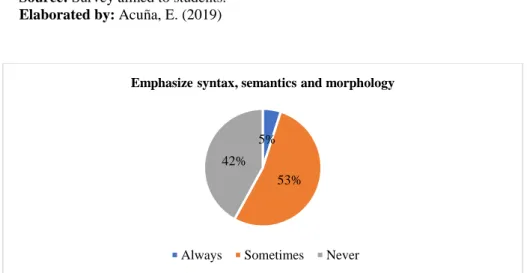
7. In the development of writing skills, does the teacher emphasize correct sentence structuring (syntax); correct word order within the sentence (semantics); a combination of minimum units that have meaning for correct word formation (morphology)?
Table 11The teacher emphasizes syntax, semantics, and morphology
Alternative Frequency Percentage
Always 7 5%
Sometimes 81 53%
Never 65 42%
TOTAL 153 100%
Figure 6: The teacher emphasizes syntax, semantics, and morphology Source: Survey aimed to students.
Elaborated by: Acuña, E. (2019)
Figure 7: The teacher emphasizes syntax, semantics, and morphology Source: Survey aimed to students.
Elaborated by: Acuña, E. (2019)
ANALYSIS AND INTERPRETATION
According to the data obtained 5% of the students say that in the development of writing skills, the teacher always emphasizes the correct structuring of sentences, on the other hand, 53% say that the teacher sometimes emphasizes the correct structuring of sentences, and 42% of the students say that the teacher never emphasizes the correct structuring of sentences. Written activities can facilitate oral expression indirectly and can be used as warm-up activities or an individual study (Velandia, 2008). If students already know the basic elements of written expression such as grammar, vocabulary, and punctuation, the activity becomes simpler, writing should be a tool to express feelings and emotions, to establish effective and aesthetic contact with others through the written message is why writing is closely linked to other skills.
5%
53% 42%
Emphasize syntax, semantics and morphology
42
8. Does the English teacher emphasize the correct use of English spelling, understood as the correct spelling of words and the correct use of upper- and lower-case letters?
Table 12The teacher emphasizes the correct use of English spelling
Alternative Frequency Percentage
Always 11 7%
Sometimes 88 58%
Never 54 35%
TOTAL 153 100%
Source: Survey aimed to students. Elaborated by: Acuña, E. (2019)
Figure 8: The teacher emphasizes the correct use of English spelling Source: Survey aimed to students.
Elaborated by: Acuña, E. (2019)
ANALYSIS AND INTERPRETATION
The data obtained show that 7% of the students say that the teacher always emphasizes the correct use of spelling, 58% reveal that it is done sometimes and finally 35% of students maintain that it is never emphasized.
A student who successfully organizes words in a written activity must have mastered grammatical rules. Traditionally, correct word placement was proof of a student's effective writing ability (Segura, 2013). Students are sometimes exposed to the rules of writing from the beginning without developing the ability to express their ideas, just as ideas are usually discussed before they are written and listened to before they are written. Whether students are writing an exam, a letter to a friend, a newspaper article, or simply filling out a worksheet, it is important for them to communicate effectively and this depends on their ability to structure and organize words and sentences into a meaningful whole.
7% 58% 35%
To emphasize the correct use of English spelling
43
9. Does the teacher promote the correct writing of sentences in the English language so that the student logically sequences their ideas?
Table 13 The teacher promotes the correct writing of sentences
Alternative Frequency Percentage
Always 35 23%
Sometimes 92 60%
Never 26 17%
TOTAL 153 100%
Source: Survey aimed to students. Elaborated by: Acuña, E. (2019)
Figure 9 The teacher promotes the correct writing of sentences Source: Survey aimed to students.
Elaborated by: Acuña, E. (2019)
ANALYSIS AND INTERPRETATION
According to the data obtained, 23% of the students say that the teacher always promotes the correct writing of sentences in the English language, while 60% say that the teacher sometimes promotes the correct writing of sentences in the English language, and 17% of the students reveal that the teacher never promotes the correct writing.
Writing, an important part of language learning, is essentially a reflective activity that requires time to think about the specific topic and to analyze and classify any preceding knowledge. This means that when writing students need adequate language to structure these ideas in the form of a coherent discourse (Clegg, 2007). The purpose of the teacher is, therefore, to help his students produce their own compositions. But for students to do so they have to establish links and develop information, ideas or arguments in a logical sequence. Without writing practices, students have difficulty achieving the clarity that is the goal of any writing exercise.
23% 60% 17%
To promote the correct writing of sentences in the English
44
10. In order to evaluate the writing of sentences, and/or paragraphs in the English language, the teacher uses scales of evaluation-rubrics; which group certain parameters to be taken into account?
Table 14 The teacher uses scales of evaluation-rubrics
Alternative Frequency Percentage
Always 0 0%
Sometimes 28 16%
Never 125 84%
TOTAL 153 100%
Source: Survey aimed to students. Elaborated by: Acuña, E. (2019)
Figure 10 The teacher uses scales of evaluation-rubrics Source: Survey aimed to students.
Elaborated by: Acuña, E. (2019)
ANALYSIS AND INTERPRETATION
Rubrics are scoring guides used in the assessment of student performance that describe the specific characteristics of a product, project or task at various levels of performance, in order to clarify what is expected of the student's work, to assess its performance and to facilitate the provision of feedback (Karkehabadi, 2013).
The rubrics evaluate the student's performance in various tasks, including their performance in the classroom, is very useful for group and individual evaluations, through them you can verify what the student has acquired in relation to the expected learning of the level he is studying, its use allows not only assess the intellectual level, the skills he has developed but also the attitudes that are part of the competencies. In the survey, 0% of the students say that the teacher uses rating scales, while 16% of the students say that the teacher sometimes uses rating scales and 84% say that the teacher never uses rating scales.
SURVEY FOR TEACHERS 0%16%
84%