
Agrarian reform and employment, the colombian case
21
0
0
Texto completo
(2) Reprinted {rom the lnternalional Labour Review Vol. 102, No. 3, September 1970. Agrarian Reform and Employment: the Colombian Case Peter DORNER 1 Herman FELSTEHAlJSEN 2. • A GRARIAN. REfORM. is not initiated and carried forward sole1y. 011. the. .t-\. basis of rational and deliberate al'guments of planners and analysts. Batdes for reform are fought in political arenas by representatives of differing vested ínterests. But, even though the struggle is polítical, many questions about the role and consequences of proposed measures are not answered by politicians. There is always ¡he additional task of devising and evaluating new courses of aclion. This arliele provides an evaluation of agrarian reform and employmen! in Colombia. It firs! examines land and income distribution and relates them to employment opportunities. After reviewing existing conditions, it explores alternative policies and programmes. Finally, il argues for íncreased rural development assistance to the small-farm sector and discusses the policy implications of such a programmc. Distribulion of Jand and income, and its reJalion to empJoyment. •. ~. The basic statistics of land ownership concentration in Latin American countries are well known. 3 In 1960, 70 per cent of Colombia's agricultural land was in multi-family units. There is no evidence, and 1 Professor of Agricultura! Economics and Director of the Land Tenure Center at the Univers.ity of Wisconsin. 2 Associate Professor of Agricultural Joumalisrn in the Land Tenure Center. The authors thank Mary Kay Vaughn and Fernando Víllamizar for their helpful research assistance. Also appreciated are comments on an earlier draft by our coUeagues Susana Amaya, Don Kanel, William Thiesenhusen, Raymond Penn and Marion Brown. AH responsibility, of course, rests with the authors. 3 Solon Barraclough and Arthur Domike:" Agrarian structure in seven Latin American countrjes ", in Land Economics (Madison (Wisconsjn)), Vol. 42, No. 4, Nov. 1966, pp. 391424, also issued as Land Tenure Center Reprint No. 25 (Madison, Universüy of Wisconsin, 1966). See also M. J. Stemberg: " Agrarian reform and employment, with special reference to Latin America ", in lnternational Labour Review, Vol. 95, Nos. 1-2, Jan.-Feb. 1967, pp. 1-26.. 221.
(3) lnternational Labour Review no reason to believe, that this distribution is basicalIy different today. In the same year over 70 per eent of Colombia's farm families lived on sub-family-sized farms or were headed by farm workers without land. Despite the faet that sub-family and family farms utilised les s than one-third of Colombia's agricultural land, they accounted for twothirds of the value of agricultural output.' The basic misallocation of land and labour resources under these conditions is evident-too much land and too httle labour on the large farms and too little land and too much labour on the small ones (table 1). This is further illustrated by the density of population in small-farm areas. Slightly more than onehalf (53 per cent) of Colombia's rural population is eoncentrated in 429 mountainous munieipalities whieh comprise 8 per eent ofthe national territory.2 In the 200 most denscly populated of those municipalities there are only 1.3 hectares of land per rural inhabitant, including forest areas, towns and roads, and wastelands. The figures given in table 1 are for a single year and thus give a stalic picture of the relationships shown. However, sinee there has been little subdivision of large farms and limited settlement on public lands, but substantial inereases in the farm population, it is evident that lhe trend towards misallocation of land and labour is becoming even more pronouneed. Colom bia has about 80 million hectares of public lands. This may seem extensive in relation 10 the amount of land in farms (see lable U). However, in the past twenty years approximately 50 million heetares ha ve been set aside for national forest and watershed reserves. Mueh of the remaining area is already occupied or is nol suitable for settlement' Colombia thus has much less available land than is commonly supposcd. lts rural population is concentrated on the naturaJ1y fertile mountain soils v.'here, as we havc seen, pressure in sorne areas is very intense. To meet peasant demands for new farms, Colombia has enacted a series of agraria n reform measures starting with Act No. 200 of 1936. The mos! comprehensive legislative programme was passed in 1961 providing for land redistribution and titling through the Colombian Agrarian Rcform Institute (INCORA). The 1961 programme, while widely hailed 1 Since these farms contain the great mass of the farm population, much of this production is af course consumed on the farm. Thcrefore, thcy would account for a much smaller proportion of the valuc of agricultural output marketed. And it is the amouot marketed (the surplus) both ror feeding the urban population and for export that seems to be of greatest interest to devc1opn1ent planners. 2 Departamento Administrativo Nacional de Estadística (DANE): XIII censo nacional de población: resumen general (Bogotá, Imprenta Nacional, 1967); and data on the size of municipalities from the Colombian Geographic lnstitute. 3 Charles H. Mullenax, James S. Plaxico and James M. Spain: Alternative bee[producliol1 5yYlem.\· lor fhe eastern pla;ns o[ Colombia (Cali, Centro Internacional de Agricultura Tropical, 19(9). See also Ernesto Ghul: Colombia: bosquejo de su geografía tropical (Rio de Janeiro, Instituto Panamericano de Geografía e Historia, 1967).. 222. •. •.
(4) Agrariall Reform alld Employment TABLE L DISTRIBUTIO~ QF FARMS, WORK FORCE, AGRICL'LTLRAL LAND ANO VALUE OF PRODUCTrON BY FARM SIZE GROUPINGS IN COLOMBIA, 1960 Farm size grouping. Farms. !. 64. 58. Family. 30 5. 31. \. 4 \00. 100. 100. Z. MuIti.family, large. •. I I I. Sub-family 1 Multi-fami¡y, medium. •. AgriCUltUral! AgriCUltUral! VaJuc of work force [ami " product1on. 3. 4 •. AH sizes. 7. 100. 23. 21 45. 21. 19. 50. 15. 6. I. Source: Comité Interamericano de Desarrollo Agrícola (eIDA): Ten('}1cia de la tierra y desarrollo socio-econrimico del sector agrícola.' Colombia (Washington, DC. [966). Similar studic:-> were aLso candueted in Argentina, Brazil, Chile, Ecuador. Guatemala and Pew . • Farms ¡arge enough lO pro vide employment for less than twO persons with the typical iacomes, markets and lewls of technology and capital now prevailing in each n:gion. 2 Farm-; large enough to provide employment for two to 3.9 persons on the assumption that mO$t of the farro work is being carried out by the members of (he farro family_ 3 Farms ¡aTge enough to proyide employment for four to twe!ve person,;. • Farms large enough to providc emploYl1lcnt for over tweIve persons. • Cu!tivated and pasture fand.. as agraria n reform, has done little to exp"d income Ol" employment opportunities for peasants or to rearde" tl.¡" aver-al! distribution of land. A decade of rhetorie following the agraria n reform turos out lo be mainly a commentary on the qua lit y of legislation rather than a report on reform accomplishments. INCORA statistics show that 88,200 pareels of land were titled between 1961 and June 1969, adding 2.8 million heetares 10 e registered land area 1 But mos! of this land came fram the public domain and does not represent exprapriated or redistributed land. Ninety-one per eent of the litles accountíng for 95.9 per cent of the land dístríbuted represent de jure recognition of established settlemen! claims to public lands . In addition, INCORA continues to titIe land applied for under customary procedures in force before the agrarian reform law was passed. Finally, a limited amount of land has been redistributed following government acquísition through purchase, gift or expropriation. Only 18,000 heetares have beell aequírcd by direct expropriation. Most of this land has been reserved by INCORA for construction of public facilities, transportation rautes and irrigation canals. About 105,000 hectares have been purchased or received as gifts. Of the land acquired by purchase or exprapriation, only 13,600 hectares have been retitled to 1,!94 private owners. This number of owners is abou! equa! to the number of new farm [ami!ies formed each week in Colombia. 1". La reforma agraria en cifras ", in Boletín mensual de estadÍstica (Bogotá, DANE),. No. 222, Jan. 1970, pp. 111-132.. 223.
(5) lnternational Labour Review. Other major programmes of lNCORA inelude irrigation installalions and supervised farm credit. About 3,000 farm families have been relocated on irrigalion projects, but nOne of them has yel reeeived ownership of irrigated lands, Supervised credit is operated to assist farmers in buying inputs and supplies, lt is not avai1able for 1and purehase, In many cases INCORA eredit is a substitute for credit previously obtained from other sources} Evidenee from the Colombia n agrarian reform programme is that it has not ehanged eilher the skewed distribution of Jand ownership or the trend loward greater subdivision of already tiny farm holdings in Ihe mouniains, The law was never designed to address the problems of unemployment or the question of more labour-intensive methods of production, Migralion of surplus rural labour lo urban arcas has continued al a high rate following the agrarian reform, At the end of 1968 the total population of Colombia was eSlimated at more Ihan 20 million,' In the thirteen-year period 1951 to 1964 Ihe annual rate of rural populatíon growth was 1,2 per cent and Ihat of the urban population 5,6 per cenLa The growth rate of the total population approached 3 per cent during the same period! Rural lo urban migration ís laking place at a rapid rate and is reflecled in the dramatie growlh of eities in the past twenty years, For example, three-fourths of Bogotá's 2 million population aged 15 to 59 were born outside the city, Half migrated to Bogotá during the past eleven years,' A1though the agricultural population as a percentage of lhe total is dec1ining (61,5 per eenl in 1951 and only 47,2 per cent in 1964) " even with major migrations popu!ation growth adds over 100,000 peop!e 10 rural areas eaeh year, Evidence is quite clear thal this inerease is reflected in greater crowding in minifundia farming regions and aceelerated fragmentalion and subdivision of already tiny sub-family-sized farms,' Along with inereasing population pressure on !and resourees in Ihe minifundia arcas has 1 Dale W. Adams, Antonio Giles and Rodrigo Peña: Supervised credit in C%mbia's agrarian reform: an evaluatlve sludy (Bogotá, Centro Interamericano de Reforma Agraria, 1966). 2 Boletín mensual de estadística, op. cit., No. 213, Dec. 1968, p. 9. 3 T. Pau! Schultz: Populatíon growth and internal migration in Colombia, prepared for the Agency for Ihternational Development (Santa Monica (California), The Rand Corporation, 1969). 4 The annual population growth rate published by DANE is 3.2 per cent. This figure overstates the annual rate due to underenumeration in the 1951 population census. Several independent correction factors have beeo calculated and are reported in Schultz, op. cit. ¡¡ Schu1tz, op. cit. 6 XII! censo nacionaL., op. cit. 7 Emil B. Haney, lr.: "The economic reorganization of mitlifundia in a highland community ofColombia "(PhD dissertation, University ofWisconsin, 1969); and Dale W. Adams and Sam Schulman: "Minifundia in agrarian reform: a Colombian example", in Land Eronomics, op. cit., Vol. 43, No. 3, Aug.1967, pp. 274-283, also issued as Land Tenure Center Reprint No. 47 (Madison, University of Wisconsin, 1967).. 224. •. .,. .;..
(6) Agrarian Reform and Employment. •. come a majar destruction of soil resources due to intensive eropping with poor soil management practices.' Based on historical experience, the number of people in Colombia dependent on agrieulture for a living can be expected to inerease for many more years. 2 This is true even if migration to urban areas continues al a high rateo The number of young people on farms is incrcasing rapidly and has nearly doubled during the past fifteen years. To be sure, some job opportunities are being ereated in lhe nonfarm sectors. Nevertheless, because of capital-intensive investments required for industrial development, output from manufacturing usually inereases at a fas ter rate than new employment 3 This is lhe typical case and holds true for Colombia during the period 1951-64. During these years employment in manufacturing grcw at only about 2.2 per eent annual1y while urban population inereased by 5.6 per eent! Consequently the proportion of workers in modern manufaeturing dec1ined, while employment in personal services and other low-skill, low-productivity employment grew proportionately faster than the total nonagricultural labour force. As a result, the income distribution among urban \Yorkers became more skewed-workers in the top ineomeearning deciles increased their lead substanlially over those in lhe lower income-carning deciles. 5 ~ Modern manufacturing currently provides about 10,000 new jobs per year. 5 The futílity of meeting cmployment needs through industrialisation is evident whcn lhis figure is compared with annual increases in lhe labour force. The total labour force, including agriculture, is incrcasing by an estimated 168,000 lo 200,000 persons per year.' These numbers will grow even larger as bulging populations of young people reach working age. New jobs in manufacturing are falling further and Haney, op. dt. In absolutc numbers the rural population is still increasing. For example the numbcr of rural people increascd by quarter of a millian adults (persons 15 years of agc and oldcr) in the thjrtecn~year periad 1938-51, and incrcased again by halr a millian adults in thc next thirtecn-year period 1951-64. Cafculations are bascd on data fram DANE, National Populatiao Cemuses. ~¡ WilIíam C. Thicsenhusen: .. Population growth and agricultural employment in Latin America, with $Qffie US comparisons ", in American Journal of Agricultural Economics (Ithaca (Ncw York)), Vol. 51, No. 4, Nov. 1969, pp. 735-752. Solon Barraclough has pointed out that "the creation of new manufacturiog jobs through rapid industrialisation is surprisingly slight. From 1950 lo 1965 manuracturing output in Latin America is estimated to have increascd by 140 per cent, whilc manufacturing employmcnt gtew by only 45 per cent-an output-employment ratio of more than 3: l." Cited from " Employment problems aifecting Latin American agricuItural development ", in Month(v Buf{etin 01 Agricultura! Economics and Statistics (Rome, PAO), Vol. 18, Nos. 7-8, July-Aug. 1969, pp. 1-9. 4 Unitcd Natioos, Economic and Social Counci[: El desarrollo industrial de Colombia (Santiago (Chile), Economic Commission for Latin America, Jan. 1966). 5 Robert L. Slighton: Relatire wages, skit! shortarres, and changes in income distribu(ioft in Colombia, Memorandum RM-5651-RC,lAID (Santa Monica (California), The Rand Corporatioo, 2968). 1. ~. .. 6. Schultz, op. cito. 225.
(7) International Labour Review. further behind the growth in the labour supply despite the fae! that in recent years manufacturing employment appears to have been growing more rapidly in Colombia than in Latin America as a whole. Given this experience, there seemS to be little prospee! of dramatic increases in industrial employment rates. A recent study shows that for the past eighteen to twenty years agricultural output in Colombia has increased at about the same rate as population growth. Likewise, food production available for domestic consumption has about kept pace with population increases. Thus output of food per head has changed very little in two decades.' Yet nutritional surveys show average calorie consumption on the low side, average COnsumption of animal protein considerably below recommended nutritional standards, and total consumption below average for low-income families in both rural and urban areas. The tendency in agriculture has been to reduce employment possibilities on the larger farms as a result of mechanisation. For example over the past several decades most of the expansion in crop production was concentrated in cotton, sugar cane, and rice. Each of these expanded in both area under cultivation and yield per hectare. These crops were cultivated with relatively modern technology and were on farms that were large in relation to peasant holdings.' Increased production of some of the major cropsis of course important not only from the standpoint of internal consumption needs but also for export. Colombia is sti]] dependent primarily on agriculture for its export earnings. Colfee alone represented more than three-fourths of the total value of Colombian exports until recent years. In 1966 this percentage was still as high as 65. Colfee, sugar, cotton and bananas accounted for 85 per cent of export earnings in 1955 and over 73 per cent in 1967.' Attempts are being made to replace declines in colfee exports with increases in sugar and cotton. These, then, are sorne of the condítions as they exist in Colombia. There is a need for increased agricultural production both for improved nutrition of a rapidly growing population and for expanded export earnings. Yet the record on this score has hardly been outstanding. Over-all agricultural production per head has actualIy declined since 1960 although [ood production has approximately kept pace with population growth. 3 1 L. Jay Atkinson: Changes Ín agricultural production and technology in Colombia, ERS Foreign Economic Report No. 52 (Washington, De, US Department of Agriculture, 1969), a study conducted in co-operation with the Ministry of Agriculture and the Central Planning Agency of Colombia. Z Superintendencia de Comercio Exterior: Análisis del comercio exterior colombiano 1957-1967 (Bogotá, Imprenta Nacional, 1968). 3 US Senate, Committee on Foreign Relations:" Colombia: a case history ofUS aid together with a report of the Comptroller General", in Survey of the Aliianee for Progress, Document No. 91-17, 91st Congress, Pirst Session (Washington, OC, 1969) pp. 659-865.. 226. ---. -------"-"---_. - ."._---.
(8) Agrarian Reform and Employment. •. There is an urgent need to inerease employment opportunities in both rural and urban sectors. But the trend has been towards capitalintensive developments based on imported technology with low labour absorption capacity. The individual entreprencur finds il mueh simpler to deal with a relativelys mal!, skillcd work force, than with large numbers of unskilled workers 1 Yet estimates of current unemployment rates in Colombia range as high as 20 per cent of the total labour force, and one study has projected that, by 1971,36 per cent of Colombia's labour force will be unemploycd. 2 Colombia,like most countries in Latin America, needs increascd agricultural output, increased employment, and increased average productivity per worker. The combination of al! three oC these wil! be extremely difficult to achieve given present !and tenure patterns and agricultural assistancc po!icies. Attempts at modernisation without redistribution of land and \Vider availability of rural services may yield inereases io the output oC sorne crops aod in the labour productivity oC skilled workers. However, it will reduce rural employment opportunities and throw the burden oC adjustment on the disadvantaged, who will then join the ranks of the landless, become migrant workers, continue to crowd into existing smallfaml areas, move to lhe frontier, 01' join the underemployed in the cities.s Alternative policies and programrnes. In an earlier issue oC this joumal, Sternberg showed that a shortage of agricultura! land resourees is not a basie problem in Latin America. 4 Of course lhere are regions within eaeh eountry (and even sorne en tire countries such as El Salvador) where there is serious overcrowding. But on the average, a redistribution would io mos! situations permit sufficient land for a farm family to make a decen! living (table Il). The ratio of arable land per worker in Colombia is below the regional average and índeed consíderably below wha! one would estimate on an a priori basís. However, as Stemberg explains, "in the case of Colombia (he faet that ... improved pastures are excluded from (he arable land area could in par! account for this low ratio. More geoerally, however, it can be argued that the land classified as arable under present land use patterns is eonsiderably below the potential." & 1 James E. Grunig: "Econom1c dec1sjon~makjng and entrepreneursh¡p among Colombian latifundistas ", in Inter-American Economic Affairs (Washington, DC), Vol. 23, No. 1, 1969. pp. 21-46. : US Senate, Committee on Foreign Relations, op. cit. 3 Peter Domer, Marion Brown and Don Kanel: "Land tenure and reform: issues in Latin American development ", in War on Hunger, Vol. 3, No. 9, Sep. 1969, pp. 8-13. <1 Stcrnberg, loe. cít., pp. 8-9. ú Ibid., p. 6. Sternberg notes the case of Chile, as an example, jn which the 2.6 million hectares of arable land in use contrast with the 6.2 to 11.8 million hectares of land that are potentially cultivable (at dífferent levels), according to estimates by officials of the Ministry of AgricuJture.. 227.
(9) International Labour Review TABLE 11. AGRICULTURAL LAND AND ARABLE LAND PER HEAD OF ACTIVE AGRICULTURAL POPULATION IN SELECTED LATIN AMERICAN COUNTRlES, 1960 Active. agricultural. Country. popuJatian. (thousands). , Argentina. Brazil. Chile Colombia. Ecuador Guatemala. Peru. 1466 15522 773 2650 776 779 1556 '. Land resourees. 1. (thousands of hectares). Agricultural land. 2. 142829 161 039 12963 19677 3336 2058 13034. I. Arable land 8. 33740 68379 2632 5055 • 2081 1475 2546. Land per person (hectares). Agricultura} land. !. Arable land. 97.5. 23.4. 10.4 16.8 7.4 4.3 2.6 8.4. 4.4 3.4 1.9 2.7 1.9 1.6. Source: Sternberg, op. cit. Sternberg used the CIDA studies as his source. 1 Pertains solely to that area in farms induded in the ceosus. • Ineludes arable land and land in natural pasture. • lncludes land in permanent erors, seasonal crops, improved pastures and fallow land. 4 Does not inelude improved pastures. "ILO: Year book o[ labour sra¡útics, 1966 (Geneva, 1966).. The present pattern of land ownership is one of the major faetors limiting employment in agrieulture. The low average productivity per worker and the uneven distribution of benefits resulting from this system restrict demand and growth in manufacturing as well as in the agricultura1 sector. Poverty among large numbers of people is not only a welfare and humanitarian problem. It is a problem that has direct and importan! implications for development. Supply does no! create its own demand under conditions of a highly skewed ineome distribution. lt is impossible to separate the issues of production expansion and income distribution when a large proportion of the working population reeeives very low wages. Under these circumstances, measures to redistribute resourees and employment opportunities may be the keys to achieving increased produetion. Meanwhile, a redistribution of land resources from the large-farm sector to the small-farm sector is vigorously opposed in Latin America-not only by the owners, of whom it is to be expected, but also by some planners and analysts. Two basic arguments are advanced by present-day defenders of the large uni!. The firSI is a philosophical argument based on the nature of private property and the rights vested in it. What is frequently, and conveniently, overlooked is that private property is a creation of lhe Nation State. Without a State to protect it and resolve disputes about its control and use, private property cannot exist. This is evident from historical analysis. In the absence of Nation States, feudal lords had lo have Iheir own army to protect their "property ". Private property does 228. •.
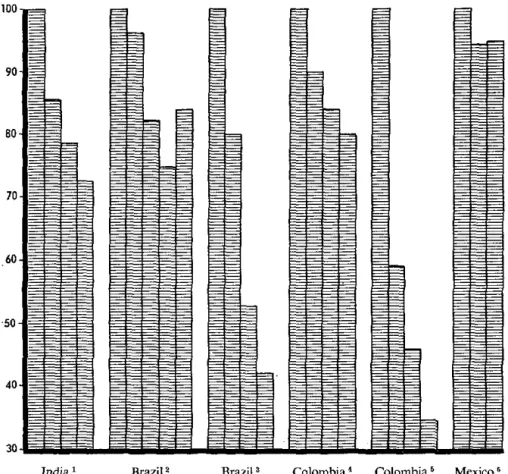
(10) Agrarian Reform and Employment. not imply an absolute right. In al! counlries many reslrictions are placed it, and the Slate reserves lhe righl lo alter the rules io lhe foture.' The second argument is based on ecooomic consideratíons. The belief is that the large farm is more efficient than the small one. However, economies of scale are primarily related lo ¡abour-saving techniques. Land-saving technologies, such as improved seed varieties, ferlilisers, insecticides, and improved weeding, can usually be applied equatly well and efficiently on smal1 farms. Under conditions of abundant rural labour and continuous, rapid population growth, productivity per unit of land rather than per unit of labour is the most relevant measure of efficiency for policy purposes. It is false logic to argue from analogy with Uniled States cxperience relative lo farm size. The big difference between the United States and Latin America is ¡he labour-absorptive capacity of the industrial sector. Even with highly capital-intensive produclion processes, the stock of capital in the United States has grown rapidly enough to maintain a high capacity to absorb labour. Still, the substantial rural and urban poverty in ¡he United Stales indicates that insufficicnt attention has bcen given to the training and education of many of those migrating from farms to seek employment in the cilies.' This has raised the question whether labour displacement from United States farms may no! have been too rapid, given this neglect of investment in human resourees. Several studies in Latin America and elsewhere show that output per unit of land is inversely related lo farm size. Sorne have shown Ihat Ihis is true even for the amount markcted per unit of Jand. The results of a few of these sludies are shown in figure l. Morton Paglin, working with the same lndian data as that represented in figure J, drew the following conclusions: 00. ..•J. .. . Both input seríes [one for cash outlays, the ather for total outlaysJ establish thc inverse relationship between farm size and the intenslty of cultivation, and indicate that higher outputs per acre generally result from higher inputs. Hence, the reasan for the inversc relationship betwecn size of farm and Qutput per acre is found in the inverse corrclation between size of fann and inputs per acre .... Despite the structural weakness of the small farms, their fragmentation, lack of credit, etc., they make up [or this by intensive application of family labour and more inputs of complementary factors.:1. l'. 1 The arguments and evidence on farro size and productivity draw heavily on Dorner, Brown and Kanel, op. cit. See too Don Kanel: "Size of farm and economic development ", in lndian Journa! oi Agricultura! Economics (Bombay), Vol. 22, No. 2. Apr.-June 1967, pp. 2644, also issued as Land Tenure Center Reprint No. 31 (Madíson, University of Wisconsin, 1968). 2 Thiesenhusen. op. cit.; also Peter Dorner: "Fourteen million rural poor ", in Ya/e Review, Vol. 58, No. 2, Wintcr 1969, pp. 282-292. 3 Morton Paglin: ., 'Surplus' agriculturallabor and development: facts and theories ", in American Economic Review (Menasha (Wisconsin)), Vol. 55, No. 4, Sep. 1965, pp. 815-834. Paglin's work is cited in the discussion of this issue by Zubeida M. Ahmad and Marvin J. Sternberg: " Agrarian reform and employrnent, with spedal reference to Asia ", in lnfernaflonal Labour Review, Vol. 99, No. 2, Feb. 1969, pp. 159-183.. 229.
(11) International Labour Review FIGURE 1. RELATIVE üUTPUT PER HECTARE OF FARMS OF DIFFEREI'\T SIZE GROUPS. India 1. BraziJ 2. Brazj1 3. Colombia 4. Colombia 5. Mexico 6. Note: For each countI)' the left-hand bar represents Qutput pef hectare of the smallest farro size group, Bars to the right represent successively larger farms with their Qutput per hectare expressed as a percentage of that of the smallest farms. 1 India: Erven J. Long: .. The economic basis of land reforrn in underdeveloped economies", in Land Economics, op. cit., May 1961, pp. 113-123. The paper uses data for the midand late 1950s presented in Government ofIndia, Ministry of Food and Agriculture: Studies in the economics 01 farm management. Output as gross value in rupees per acre. Long classified actual farm sizes into four size groups-smallest, second smaJlest, second largest, largest-for each of eight areas in seven states, and presented output per sire group as the average of the eight areas. (Data from more than 1,000 fanns from seven states.) 2. Brazi/: Roger G. Johnson and Reuben C. Buse: A study 01 farm size and eeonomie performance in old Santa Rosa, Rio Grande do Su!, Land Tenure Center Research Paper No. 27 (Madison .• University of Wisconsin, 1967), pp. 40-61. Output as net sales per productive hectare, in thousands of cruzeiros (1963). Actual farm sires included in each sire c1ass.. are: (1) 0-10 ha.; (2) 10.1-20 ha.; (3) 20.1-40 ha.; (4) 40.1-100 ha.; (5) more Ihan 100 ha. (Sample of 311 farros.) 3 Brazil, 1950: Barraclough and Domike, op. eit. Qutput as percentage of value of sub-family (smaJlest) farm production per cultivated hectare. The authors classed actual farm sizcs into four groups: sub-family. family. muJtj-famj]y medjum, and multi~family largc. (Based on national census data.) (Notes contillued opposite). 230.
(12) Agrarian Reform and Employment. •. Sorne argue that lhe higher produetivity per unit of land on existing small farms is no real evidence thal new units to be created by dividing large farms would aehieve increased produetivity. But the evidenee available on posl-reforrn experiences-in Mexico, Bolivia, Chile, Japan, Taiwun, Egypt, Yugoslavia-shows that, allhough in sorne cases lhere was an initial drop, average productivily per unit of land increased rather subslantially after these reforms. Al! cases involved a reduetion in lhe average size of farms. Taiwan offers an interesting example. From 1940 lo 1965 land per farm was redueed by almost one-half while outpul per hectare more than doubled. 1 [t is also evident from studies in Mexico, Venezuela and Chile, and from sorne comparisons of large fanns on lhe Bolivian and Peruvian high plateaux, that the reformed situation provides substantial1y more employmenl than the traditional one. Some of lhe projects in Chile, for example, indicate an inerease of over 20 per cenl in lhe number of families productively employed on reformcd haciendas. The BolivianPeruviun comparisons show a deercase in employmenl on Peruvian haciendas sinee 1953, while the number of people employed on Bolivian farms erealed from former haciendas has incrcased sinee lhe reform. 2 Most of the literature on eeonomic development continues lo cmphasise investrnenl and supply inereases and neglecls employmenl and incame distribution. In agriculture these formulations have been translaled inlO investment programmes aimed al modernising lbe largcfarm seelor, frequently inc1uding rapid meehanisation. The majar push by lhe Colombian Government, as wel! as by intemalional lending agencies, seems to have been in lhis direction. 3 Yel the existenee of yield1 Raymond P. Chrjstenscn; TaiwalJ's agricultural development " ;ts relerance lor developillg cowltries today, ERS Foreign Economic Rcport No. 39 (Washington, De, US Department of Agriculture, 1968), p. 40. Evidence 00 aU thc above cases and others is summarised in .. Relation of size of farm ta productivity " by Lester Schmid which appcars as Appendix 111 of the Land Teoure Center's 1968 Annual reporto Copies are available from the Land Tcnure Center, University of Wisconsin. 2 Mc1vin Bnrke: Afl ilna/ysis o/lhe Bolh'¡{}ll Iand reform by means 01 a comparison beu,'een Peruvian haciendas and Bolivian ex~haciendas, a PhD dissertation, University of Pittsburgh (Ann Arbor (Michigan), University Microfilms, lnc., 1967). 3 US Senate, Committee on Foreign Relations, op. cit.. (.lIjo/es 10 fig~re. 1. continlll.'d). Colombia, 1960: lbid., using same mcasures of output and same farm size criteria. (Bascd on national census data.) [, Colombia, /966: Haney, op. cit. OulpO[ as gross valuc per hcctare, in US dollars. Actual farm sizes incJuded in each size class are: (l) less than 111a.; (2) 1-2.99 ha.; (3) 3-9.99 4. ha.; (4) 10 ha. and overo (Sample of 203 farms in a highland area.) G Afexico, /960: Folkc Dovring: "Land refonn and prodLlcüvity: the Mexican case, a preliminary analysis .. (Departmcnt of AgricLlllural Economics, Agricultura! Experiment Station, Univcrsity of 1I1inois, 1966), also issued as Land Tcnure Center Paper No. 63 (Madi· son, University of Wisconsin, 1969). Oulput as gross va1ue per hect are of arable land, in pesos. Actual farm sizes inc1uded in each size dass are: (1) less than 5 ha. in the private ~ector (average about 1.45 ha.); (2) ejido lands averaging about 7 ha. per ejido member (onty about 2 per cent oí 1.6 miHion ejido members engagc in coHcctive farming); (3) more than 5 ha. in the private sector (averag~ ahout 27 ha.). (Based on national census data.). 231.
(13) Inlernational Labour Review. increasing inputs such as fertilisers and better seeds are neutral to scale and consisten! with commercialisation of small-sca1e agriculture. Such inputs increase "the advantages of the labour-intensive, capital-saving alternative ".' In recent years several Colombian agricultural agencies, as well as Ihe Alliance for Progress country programmes, have tried to assist both large and smalI farms. But such a policy requires a basic restructuring of administrative procedures before each farm size group can be assured assistance appropriate to its needs. In "free and open competition" the smaIl farmer will lose out. For example more than half of Ihe instítutionalised eredit goes lo fewer than 10 per cent of the borrowers. 2 Many Colombian producer associations and public assistance agencies which have historieally directed services to the large-farm sector have not changed their polieies. Small producers are less welI organised and not able to wield the same infiuence to cause services to fiow in their direction. There is a basie fallacy in placing priority on the development of a capital-intensive, ¡abour-extensive, large-farm agriculture. The eventual goal of development policies may indeed be a large-farm agricultural system in an industrial economy. But such an end product must be achieved through a continuous process of reorganisation and the use of production Icchniques appropriale to Ihe factor endowments existing at particular points in time. It is Ihe attempl at one huge leap from the prescnt situation to sorne sueh future goal that underlies Lauchlin Currie's poliey prescriptions for rapid Colombian development.' Bu! the high capital requirements and the difficult problems of trying to provide urban employment for the increased fiood of peasant farmers who would then pour into the cilies have made such prescriptions unacceptable. Capital-intensive, meehanised development of lhe large farms may also be self-defealing in terms of olher goals-especially the desire to reduce shortages of foreign exchange. The coUon boom in Nicaragua serves as an example. lt has been heavy on machinery imports, thus negating al least part of the foreígn exchange earnings from collon exports. lt has also displaced many farm people who produeed basic grains on these farms befare they were put into eolton. As cotton acreage inereased, basie grain acreage dec1ined to the point where grains now have lo be imported 4 1 Bruce F. Johnston and John Cownie: "The seed-fertilizer revolution and labor force absorption ", in American Economic Aeview, op. cit., Vol. 59, No. 4, Sep. 1969, pp. 569-582. 2 República de Colombia: "Los problemas de crédito agropecuario y el desarrollo económico en Colombia ", paper presented to the Latin American Semina! on Rural Credit, El Salvador, October 1968. 3 Lauchlin Currie: Acceleraling deveJopment: the necessity and the means (New York, McGraw-Hill,1966). (Dorner, Brown and Kanel, op. cit.; the basic information is taken froro Rodolfo. Quiros: " Agricultural development and economic integration in Central America" (PhD dissertation, Univcrsity of Wisconsin, 1970).. 232. ......
(14) Agrarian Reform and Employment. •. The urgenl need lo inerease food produelion lo feed growing populalions is unqueslioned. Likewise il is understandable thal governmen!s and international lending agencies are anxious lo inerease exports of farm produels lo meel balance-of-paymenls needs. If increasing produetion to meet these requiremenls were Ihe only goal, then it might be reasonable lo focus on Ihe modernisation of large farms. The supporting services needed lo inerease production-farm inpuls, credit, marketing, informalion, and so forth-ean be provided more easily lO a smal! number of deeision makers. However, this does not resolve, but merely postpones and thereby complicates, the need for positive steps to providc more viable opportunities for Ihe large number of rural people squeezed on to smal! parcels of land or out of agriculture altogether. Experience over Ihe pasl deeade supports the proposition thal inereased agricultural produetion and a more equitable dislribution of the fruits of lhat produetion must be viewed as parts of the same problem. If developmenl requires bOlh increased produclion and increased employment with a more equitable distribution of income, why are polieies not formulated to achieve lhe two logelher" Are present econol1lic theories deficienl in thal lhey fail to recognise that these goals are complementary? O,. could il be thal lhe social sciences are" culture bound ", growing as lhey did out of dcvelopment issues common to Ilineteenthand twentielh-century England, Western Europc and the United Stalcs" Seen in historical perspective, theoretical brcak-throughs in cconomies have come aboul in response lo policy crises. The poor eountrics today faee erises as great as the eeonomic depression of the industrial world in the 1930s. Even so, development issues eontinue to be defilled on lhe bases of lessons and theoretical formulations growing out of United Sta les and European experienee. Resouree ownership pattcrns are usually taken as fixed and do nor enter as variables into cconomic analyses. Criteria for measuring resouree alloeation ,and efficieney are based on presenl ownership patterns while distriburional questions are eonfined to "tracing out the elfecrs of various polieies in distributing economic fruits among persons who own or otherwise eommand control over resourees ".' This formulation is bascd on an implicit faith in the "Irickle down " theory of dislribution which has never worked out in practice, especially under conditions of concentraled eeonomic and polilical power. The employment ¡ssue has received very little atlention in developmen! literature. Keynesian ceo no mies, lhe major body of formal theory dealing wilh this question, assumes a large industrial base with a highly , monetised eeonomy in which manipulations of a large central govern, ment budget and associated instruments of fiscal and monctary poliey 1 Erven J. Long: "Some theoretical issues in econornic development", in Jouma! Farm Economics (Ithaca (New York)), Vol. 34, No. 5, Dcc. 1952, pp. 723-733.. 01. 233.
(15) 1I1ternational Labour Review. can be utilised to infiuence aggregate demand and thereby investment and employment. But these eonditions do not describe reality in most developing and agrarian eountries. If development poliey is formulated in aecordance with existing theorie" strategie questions sometimes fall between the slats-questions Iikc how to aehicve productive employment of a growing rural labour f,'ree; and how to ereate opportunities whieh permit men to develop their abilitic, and eapacities. Development polieies must be specificaJly and deliberatelv designed to address these questions, sinee they are not resoh cd by investment polieies, the main objectives of whieh are inerease:! production by the most efficicnt means within present ownership slruclurcs.. i Development assistance for the small-farm sector. Colombia is faced with the need lo ereate employment for nearly 200,000 ncw worke" annuaJly, improve the purchasing power of lowincome elasses and expand total output, all at the same time, If a large potential existed for cxpanding agricultural exports or producing to offset food imports, eontinued emphasis on investments in the large-farm sector might have so me foundation. However, this is not the situation faeing Colombia at this time. Future increases in demand for farm produets will depend largely on the domestic market. And unless this markct can be stimulated by a better distribution of ineomes resulting from a more equitable distribution of productive opportunities among the farm population, the inerease in effective demand will probably be insullieient to justify continued future investmenls in large farms. Likewise, (he demand for manufactured goods will continue to have a narrow base, and (he problems of unemployment and underemployment will become evcn more serious. 1. Colombia is at a point where it must experiment with new policy rncasures for agriculture. However, these experiments are not likely lo inelude the two prescriptions often voieed in development diseussions: (J) a widespread land redistribution programme to establish a system of family farms within a relatively short time, or (2) state collectivisation of agriculture. We shall not review the relative merits of sueh alternatives here; however, it is our judgment that neither eourse holds politieal promise in Colombia now or in the near future. A poliey which at least partially meets the objectives stated aboye would be one of devising special programmes direeted at the smallfarm subseetor. The immediate purpose of sueh programmes is to ereate new and more secure income-earning opportunities in rural afeas. The longer-term objeetive is to speed up the required structural transforma1. 234. Johnston and Cownje, loe. cit..
(16) Agrarian Reform and Emp!oyment. •. tion of the traditional agricultural system. Several studies in Colombia suggest the need for such a policy and its potentialities.' The Colombian farm economy consists of two subsectors characterised by farm size-Iarge numbers of re\atively small. unmechanised peasant farms in a small-fann subsector, and fewer large, often meehaniscd and frequently extensively farmed estates eonstituting a large:farm subsector. The essence of our proposal (which we shall refer to as .. Contrived dualism .. in contrast to the existing dualism) is to shifl resaurees and assistance deliberately to the smaJJ-farm subsector in arder 10 increase its productivity and commercialisation.' This proposal recagnises that basic reforms are needed in Colombia but that existing economic and political frameworks will not allow massivc reorganisation al a single stroke. While contri ved dualism provides [or gradual transformation, it also initiates shifts which can be expected to chip away at existing struciures, eventually produeing more profound changes. Sorne of the mea sures discussed below can be pul into elfcet immediately. Others, such as redistribulion of some of the exislÍng land from the large-farm subsector to the smal!-farm subsector. can be adopted as participants in the latler beco me better organised and more influentia!. Over time it could be expecled that the organisation and the polítical and economic power of the two subseclors would become more equa!. The two most important poliey measures are; (1) to take stcps to reduce the direet compelition belwecn small and large farmers for land, capital and services, and (2) lo manage the a]Jocations of land, capital and technology in such a way as to inerease output and emplaymcnt in bolh subsectors. The small farmer is al a serious disadvanlage in cOo1peting for cost-reducing technologies and services withaut specific polieies aimed al re-allocating resourees in his favour. Without special programmes many peasant farmers are driven eilher out of agrieulture altogelher or back lo lhe margins ofsubsistence. Rapid population growth and slow industrial expansion serve to reinforce the economic advantage of large producers and lo aggravate the problems of peasant underemployment. Detailed below are four key areas in whieh a policy of conlrived dualism mus! serve to strengthen the po sitian of the smal! farm sub sector. (1) Allocalion of land 011 lhe basis ol ilS ahi!il)' lo employ labour. A Jand redislribution programme as wel! as a land settlement policy for 1 Fefstchausen, Haney and Grunig in different studies concJude that separa te programmes are needed for the peasant and commercial subsectors. Thcse conclusions have been presented on various occasions to representatives of Colombian planning groups and international lending agencies in Bogotá. See Herman Felstehausen: Fitting agricultura! eXtension lO deve!opment needs 01 Colombia, Land Tenure Ccnter Paper No. 57 (Madison. Uniwrsity of Wisconsin, 1969); Hane)', 0J). dt.; and Grunig, op. ciL ~ The term "contrived duaJism" is from Thiesenhusen, op. cit. See also Wyn F. Owcn: " Structural planning in densely populated countries: an introduction with applicalions to Indonesia ", in l'vlalayan Economic Review (Singaporc), Vol. 14, No. 1, Ape 1969, pp. 97-114.. 235 2.
(17) International Labour Review Colombia 's remaining public lands must be an integral part of a poliey of assistance to smaIl farms. The smaIl-farm subsector needs additional land in order to employ a growing population of new workers without further dividing existing smaIl holdings. Some of this land must eventually come from existing large holdings, ir peasant farmers are to be accommodated within farming regions similar to the ones they now occupy. A number of measures will be needed: an upper limi! on farm size, progressive land taxation, speciallong-term credit for land purchases by the landless or those who have too Iittle land, and a method for obtaining a property title quickly and at low cost with an effieient form of transfer. A measure which can be directIy and ímmediately enacted ín land redistríbution policy concerns the settlement of remainíng state lands. Colombia is one of the few Latin American countries whích stíll possesses large frontíer territories. Unfortunately much of this land ís poorly suited to agriculture and most of it can be brought under cultivation only after making large public investments in land improvements and local infrastructure.' Existing legislation makes no provision for systematically measuring and recording public lands or for creating infrastructure in new areas. Therefore, the State has little basis for formulating a general policy of small-farm settlement on the frontier. Persons with greater access to transportation, legal services and capital are often able to dominate new regions. Programmes are needed for guiding the pattern of future settIement and land use with complementary improvements in land measurement, titling and registration. 2 International lending agencies could play a direct and important role by providing technical personnel to assist in designing rural infrastrueture, and improvíng land measurement and registration systems, and by financing the resulting programmes. To date such agencies have tended to be indifferent to public land polieies related to redistribution and spontaneous settlement. (2) Development and introduction 01 new technology lo in crease employment and production. There is notrung new or unique about having the publie sector fnance the development of new technology for agriculture. Most agricultural research and extension throughout the world is carried on at public expense. A policy of contrived dualism, however, would require the development of some separate technologies for the small-farm subsector. Agricultural research in Colombia generaUy has given overwhelming emphasis to large-farm agriculture. Research and demonstrations are 1J. M. Spain and A. Ruiz: The Colombian Llanos Orientales: a preliminary report, (Bogotá, Rockefeller Foundation, 1968) (mimeographed). 2 Luis Arévalo: "The legal insecurity of rural property in Colombia: a case study of the notarial and registr}' systems " (PhD dissertation, University of Wisconsin, 1970).. 236. ~..
(18) Agrarian Refúl"m and Employmel1l. •. usually geared to mechanised ficld cropping or larg~-sca)e ranching as opposed to small-farm practices. ' Some argue Ihat it would be impracticable to develop modern technology for the small farms. At the same time lhe record of agricultural performance in countries with small-farm systems. sueh as Japan. Taiwan, the Netherlands and Denmark, supports the oppositc argumento Landsaving technologies like fertilisers, improved seeds, and pest controls can be applied just as elfectively on smal! farms as 011 large. Large-scale mechanisation, by contrast, is mainly labour-saving and consequently its advantages accrue only if labour can be displaced and (he land area enlarged. Under Colombian conditions, primary emphasis should be placed on land-saving technologies, if both increased production and employment objectives are to be served. This does no! preclude the introduction of some types of mechanisatjon into the smal!-farm subseclor, provided they are specifically designed with smal! farms in mind. For example, a wel!-adapted, hand-operated garden tractor with complementary implements would be particularly valuab1c on smal! farms. 2 A garden tractor may indeed be labour-saving, but it is also land-saving inasmuch as it permits working the land more intensivcly, often improving yields as well as utilising marginal areas which would otherwise be left in brush or pasture. Even more important than improved cultivation practices is lhe direet relationship that sometimes exists between land-saving and laboursaving technologies. Peasant farmers in the Puebla n:gion of Mexico, for example, find lhal even with the cultivation of a traditional crop like corn, it becomes more and more eritical to plant and to apply fertilisers within very limited lime spans as they change from native rorn varietíes to hybrids. In other words, weather patterns often severely restriet lhe number of days available for field work. If the package of more productive technology is to be applied al al!, some form of mechanisation may be required in order lo complete the work within Ihe scasonal schedule. 3 What one is arguing, in a policy of contri ved dualism, is Ihat both subseetors need new technologies, but that some of these technologies will be separale and distinct for the !wo subseetors. This means that the task of researeh and development mus! be based on the separate needs and eonditions of eaeh ,ubseetoL A reallocalion of agricultural research elfor!s is cal!ed for in order to develop new teehnologies appropriate to the type of farming engaged in by small farms. 1 This can be Doted, fol:' example, by an examination of the annuaJ reports of the Insti~ tuto Colombiano Agropecuario and the various producer federatjons. 2 Haney, op. cit. The Colombian Agricultural Experiment S(alÍon is tcsting a loeany devdoped garden tractor. a International Maize and Wheat Improvcment Center: Thc Puebla project, 1967-69 (Mexico City, 1969).. 237.
(19) lnlernational Labour Review. Besides the development of technology, its introduction and distribution lo two distincl subsectors will require additional investments in information and farm services. The very large number of small farms and their greatér isolation from Iransportation and communicalion make them more difficult lo reach. Here again the Puebla project in Mexico oITers sorne interesting experience. Special extension techniques were developed and a ma.ior eITorl undertaken lo educatc the governmental bureaucracy and copcmercial firms lo the needs of small farmers. (3) Modijl'cariofl 01 rural ser vice structures lo ensure access lo smal! farmers. Both subseclors require a variely of human as wel! as production and marketing services. Bolh would, for example, benefit from ¡mproved procedures for lhe registration of property documents and the rapid consideratíon and resolution of conflicts. Yet the needs of the small·farm subscctor with respect to most services diITer from those of the large-farm subsector.' For example large farmers usuaJly send their children lo urban schools, own their own transportation and storage facilities, by-pass local market channels, and depend less on village service and supply agencies. The small-farm subsector, on the other hand, is the main client for rural schooling and hea1th facilities, collective forms of transporlation and communication, and local producl-handling and marketing facilities. This being the case, neither urban residents por farmers in the large-farm subsector can be expected lo be very s. pathetic to the needs and demands of farmers who live on small plot, in the conntry. Improved average incomes for the large number of small farmers would give them more economic and political leverage with which to influence decision-making bodies on lhe question of improved rural services. Improved income would al so strengthen the demand for non-farm inputs and consumer goods by the small-farm subsector, pulling additional commercial services into the countryside and creating additional jobs. \'.'ith increased production and income to \ift lhe average peasanl somewhat above the margin of subsistence, one would expeet rising demands for education and training. Adequate accommodation of these demands wOllld obviously increase the costs. Part of Ihe new revenue could be raised by improved tax measures on agricultural lands, but a large transfer would initially have lo come from the non-agricultural sector. lnternational lending agencies eould great1y aid in the transition period if loans were made specificalIy for small-farm service struelures. Investments in manufacturing should be co-ordinated with public investment policies in order 10 encQurage the location of small manufacturíng and processing plants in rural areas. Often urban sites are lhe 1 Herman Felstehausen: Local gOl'ernment and rural sen'ice lmrriers lO economic developM menJ in Colombia (Bogotá, 1968) (mimeographed); published in Spanish by the Secretary of Agriculture of Antioquia, in MedelUn, as Special Publication No. SS, September 1968.. 238. -_.. _-'.
(20) Agrarian Reform and Employment. only ones considered for new industries and food and libre processing plants, because economies of scale and transportation costs rule out small towns and isolated areas. This is usually true when standard cost and efficiency criteria are used. If employment expansion, however, is introduced into the investment decisions and additional consideration is given to processing products close to the point of production, some small agricultural industries couId logically be located in the countryside. Such plans, however, require deliberate government action, sinee most private investors will prefer loeations where people are concentrated. (4) Provision for dual syslems of capital and credil. Credit management is one of the subjects discussed most in Colombia in relation to the present dualism in agriculture. The Agricultural Credit Bank of Colombia operates separate programmes for small and large borrowers. Shortly after the Colombian Agrarian Reform Institute was established in 1961, this agency started credit services for small and medium-sized farmers through a $10 milIion loan from the Agency for International Development. A second loan raised the amount to more than $18 million. The programme ineludes a provision that aIl farm loan s be supervised by a trained agricultural technician. While these approaches recognise that small farms as well as large need capital, the amounts fail to meet the needs. At the same time, ¡he terms and conditions for borrowing are still set by the large farmers and commercial lenders. In the credit market lhe small farmer remajns in an insecure and vulnerable position. Not only must credit programmes for the small-farm subsector be expanded, they should likewise have special terms and conditions for borrowing. Subsidised lending lo small farmers should not be ruled out if it assists in making agricultural adjustments, increases employment and generalIy aids in improving income distribution. ConcIusion This analysis leads to the conclusion that new policies are required for the development of agriculture in Colombia. The approach suggested in tbis paper, we believe, would serve to increase both production and employment. It is not possible, of course, to give any real assurance as to the pay-off of the proposed policy changes. But we believe they are possible and would be worth trying-especially since they can be implemented in stages withaut a single massive transformation. Sbifts in the allocation of national investment and land resources would be called for. In some cases these shifts could be made within existing agricultural budgets and investment programmes. Part of the new capital couId come from increased taxation within both the largeand small-farm subsectors. It may also be necessary to move away from 239.
(21) International Labour Review. current investments in high-cost infrastructures like irrigation to projects facilitating land settlement and property security. Although the f10w of capital available for industrialisation would be temporarily reduced, ¡he over-all effeet would probably not be serious compared with the advantages aceruing to the Colombian eeonomy from ir.creased employment and ineomes in agricuIture. The major impact of the aboye measures on employrnent would be to inerease produetive opportunities on the land. A secondary effeet would be inereased employment in the rural service sector. Both of these clreets should result in a reduetion in the rate of migration to the cities. One likely and important indireet impaet is that, as resourees shift from ¡he large·farm subseetor to the small-farm subsector, small farmers will gain new economie and political power with which to bargain for further developmental changes.. Biblioteca Agropecuaria. ji¡lllllm'. 010100000991. 240. 4j.
(22)
Figure


Documento similar