
An evolutionary framework for producing hyper heuristics for solving the 2D irregular bin packing problem
190
0
0
Texto completo
(2) An Evolutionary Framework for Producing Hyper-heuristics for Solving the 2D Irregular Bin Packing Problem A dissertation presented by Eunice López Camacho Submitted to the Graduate Programs in Electronics and Information Technologies in partial fulfillment of the requirements for the degree of Doctor of Philosophy in Information Technologies and Communications Major in Intelligent Systems. Thesis Committee: Dr. Hugo Terashima Marin Dr. Gabriela Ochoa Dr. Peter Ross Dr. Eduardo Uresti Charre Dr. Manuel Valenzuela Rendon. -. ITESM, Campus Monterrey University of Nottingham Edinburgh Napier University ITESM, Campus Monterrey ITESM, Campus Monterrey. Instituto Tecnológico y de Estudios Superiores de Monterrey Campus Monterrey May 2012.
(3) Instituto Tecnológico y de Estudios Superiores de Monterrey Campus Monterrey School of Engineering and Information Technologies Graduate Program The committee members, hereby, certify that have read tbe dissertation presented by Eunice López Camacho and that it is fully adequate in scope and quality as a partial requireraent for the degree of Doctor of Philosophy in Information Technologies and Communications, with a major in Intelligent Systems.. i.
(4)
(5) Copyright Declaration. I, hereby, declare that I wrote this dissertation entirely by myself and, that, it exclusively describes my own research.. Eunice López Camacho Monterrey, N.L., México May 2012. ©2012 by Eunice López Camacho A l l Rights Reserved. iii.
(6)
(7) Dedication To my husband Arturo To my children Arturo, Pablo and Rebeca To my parents Salomón and Felı́citas Thanks for all your unconditional confidence, support, patience, and encouragement. You were my main motivation for pushing through this work.. v.
(8)
(9) Acknowledgements. I would like to express my deepest gratitude to all those who have been side by side with me. Many people have played an important role in the successful completion of the research presented here. The number of people to whom I want to express my gratitude is incredible large, since I have been supported in many different ways. I would like to express my sincere thanks to my advisors and committee members who have provided too much help and excellent guidance with the preparation of this work. Very special thanks to Dr. Hugo Terashima, Dr. Gabriela Ochoa and Dr. Peter Ross. They devoted much time guiding me. I would also like to thank to my fellow researchers: Dr. Juan Carlos Gomez and Dr. Jose Carlos Ortiz. My husband, Arturo Rodríguez, have supported me any time that I have needed, and more. Without his love, help and advice, I would not have completed this dissertation. M y parents also have provided me a great support, especially during the time I did my research stay. The love of my children was a great inspiration all over the time. I thank Tecnológico de Monterrey to trust me and for gave me the opportunity to grow as a professional. Special thanks to the Research Chair on Evolutionary Computing CAT144, the C O N A C Y T project grant 99695, the Mathematics Department and the Planning and Organizational Development Department for all the support and confidence.. vii.
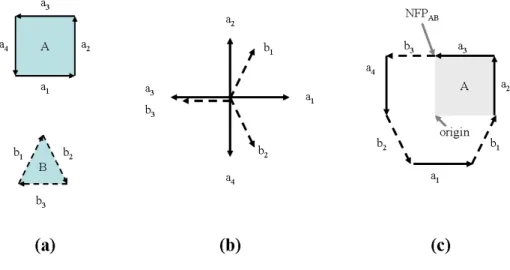
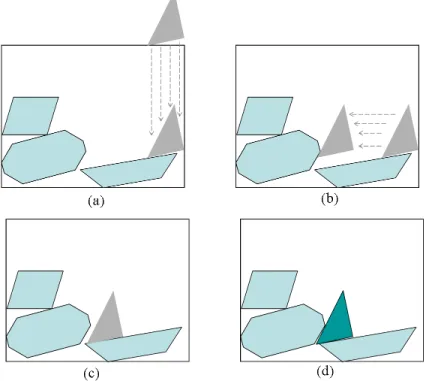
(10)
(11) An Evolutionary Framework for Producing Hyper-heuristics for Solving the 2D Irregular Bin Packing Problem by Eunice López Camacho Abstract This document presents a doctoral dissertation which is a requirement for the Ph.D. degree in Information Technologies and Communications from Instituto Tecnológico y de Estudios Superiores de Monterrey (ITESM), Campus Monterrey, major in Intelligent Systems in the field of Hyper-heuristic Search for the Bin Packing Problem. This dissertation works with an evolutionary framework that produces hyper-heuristics for solving several types of bin packing problems introducing relevant improvements to the solution model. The Bin Packing Problem is a particular case of the Cutting and Packing Problem, where a set of pieces are placed into identical objects and the objective is to minimize the number of objects needed. Given the NP-hard nature of this optimization problem, many heuris¬ tic approaches have been proposed. In this work a solution model is proposed, based on a genetic algorithm, in which a hyper-heuristic is built as a rule or a high-level heuristic that combines several low-level heuristics when building a solution from scratch. Therefore, the hyper-heuristic takes advantage of the main strengths of the low-level heuristics to solve par¬ ticular kinds of problem instances. A hyper-heuristic is a list of several representative states of the problem, each one labelled by a low-level heuristic. A problem instance to be solved by a hyper-heuristic is first summarized by a numerical vector that carries some of its main features. This vector is then compared with the hyper-heuristic representative states and the correspondent heuristic is chosen to be applied. After one or several pieces are placed, the problem state is updated. This process continues until the problem instance is completely solved. The main inputs of the evolutionary framework in order to produce a hyper-heuristic are: (1) a vector-based way of representing the problem state; (2) a set of low-level heuristics; and (3) a set of training problem instances. The research presented in this document improves each of these elements. First, a data mining based methodology was developed to select the best set of features that can represent the state of the problem instances. This six-step methodology includes the application of the k-means clustering technique and a Multinomial Logistic Regression model to find a subset of features that best predict heuristic performance. This methodology does not require intensive knowledge of the problem domain. Promising results were found when comparing hyper-heuristics produced employing an intuitive representation and a representa¬ tion built with this methodology. Besides, there are some other solution approaches developed for other combinatorial optimization problems that also require to represent instances with a limited number of features. Therefore, the proposed methodology can be exported for other ix.
(12) search space approaches. Second, the Djang and Finch selection heuristic was properly adapted from the onedimensional to the two-dimensional Bin Packing Problem. This adaptation includes a timesaving routine based on avoiding repetitive computations. With the pieces in decreasing order, this heuristic starts filling an object until it is at least one-third full. Then it tries combinations of one, two or three pieces that completely fills the object. If this is not possible, a small waste is allowed and it is increased as necessary until there are not remaining pieces that fit. Then, a new object is opened. Several experiments were conducted with the initial fraction of the object that is full before trying combination of pieces. We found that filling the object up to one-fourth, one-third and one-half produces effective heuristics that behaves differently in different kinds of instances. Third, the level of generality handled by the evolutionary framework was increased in terms of the kind of instances solved. The solution model can be trained with one- and twodimension regular and irregular instances. Irregular instances include convex and concave polygons. Once the hyper-heuristic is evolved, it is able to solved any instance from any of these types with good results and without further parameter tuning. The framework was tested with a large dataset of 1417 instances. One-dimensional instances were drawn from the literature. A n algorithm was designed for randomly producing two-dimensional instances with concave pieces. Therefore, geometric functions had to be implemented for dealing with concavities. Twenty hyper-heuristics were generated and tested. Broadly speaking, hyperheuristics were able to learn a combination of single heuristics that produce, at least, the same result than the best single heuristic for each testing case. Finally, an analysis was performed to find which feature values of the Bin Packing Pro¬ blem are more likely to lead to a good performance of heuristics and hyper-heuristics. With the Principal Component Analysis technique, a two-dimensional map was built in which the 1417 instances were plotted. The more similar two instances are according to nine selected features, the closer the two instances are plotted in the map. It is possible to find combination of feature values that characterize each section of the map. By over imposing the performance of heuristics and hyper-heuristics over the map, we can draw conclusions about the main re¬ lations among features and performance. Understanding the Bin Packing Problem structure will help in the design of new solution approaches.. x.
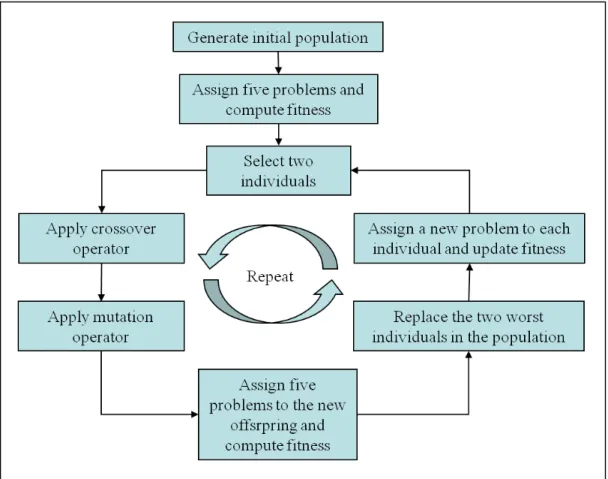
(13) List of Figures 1.1 1.2 1.3 1.4. General scheme of the 1D Bin Packing Problem. . . . . . . . . General scheme of the 2D Irregular Bin Packing Problem. . . . Simplified representation of a problem state. . . . . . . . . . . . General structure of the solution model studied. Fonts in italics main improvements to the solution model. . . . . . . . . . . . .. . . . . . . . . . . . . . . . . . . . . . explain the . . . . . . .. Basic and intermediate problem types for the C&P problem in Wäscher’s Typology [154]. . . . . . . . . . . . . . . . . . . . . . . . . . . . . . . . . . . 2.2 Interpretation of the D-function. . . . . . . . . . . . . . . . . . . . . . . . . 2.3 Generation of the NFP between a square (fixed polygon) and a triangle (orbiting polygon). . . . . . . . . . . . . . . . . . . . . . . . . . . . . . . . . . . 2.4 (a) The orientation of A and B; (b) the slopes diagram; and (c) the NFP. . . . 2.5 Bottom-left heuristic for irregular pieces. . . . . . . . . . . . . . . . . . . . 2.6 Positions to be considered in the Constructive Approach. . . . . . . . . . . . 2.7 Positions to be considered in the Constructive Approach. An example with two pieces already placed. . . . . . . . . . . . . . . . . . . . . . . . . . . . 2.8 Constructive Approach Heuristic. . . . . . . . . . . . . . . . . . . . . . . . . 2.9 Rectangle with minimum area, located at the bottom-left corner and containing all pieces so far. . . . . . . . . . . . . . . . . . . . . . . . . . . . . . . . 2.10 Candidate rectangles when locating a piece. . . . . . . . . . . . . . . . . . . 2.11 Two concave pieces that can not fit with a sliding operation. . . . . . . . . .. 4 5 7 9. 2.1. 3.1 3.2 3.3. 17 22 23 23 28 28 29 29 30 30 31 46 48. 3.4 3.5 3.6 3.7. Solution Model for Hyper-heuristic generation through GA. . . . . . . . . . . A chromosome is a set of blocks. . . . . . . . . . . . . . . . . . . . . . . . . A chromosome is a set of blocks. Each block represents a point in the hypercube (space of states) labelled with a single heuristic. The solution process of a problem using a hyper-heuristic consists of finding the closest single heuristic at every solution stage. . . . . . . . . . . . . . . . . . . . . . . . . . . . . General process of the genetic algorithm. . . . . . . . . . . . . . . . . . . . An example of the two-point crossover operator. . . . . . . . . . . . . . . . . Representation of problem instances in a text file. . . . . . . . . . . . . . . . Origin of the coordinates of the pieces of a problem instance. . . . . . . . . .. 4.1 4.2 4.3. Degree of concavity. . . . . . . . . . . . . . . . . . . . . . . . . . . . . . . A piece and its convex hull. . . . . . . . . . . . . . . . . . . . . . . . . . . . Procedure for selecting a point inside a shape. . . . . . . . . . . . . . . . . .. 62 62 64. xi. 48 51 52 54 54.
(14) 4.4 4.5 4.6. 4.7. 4.8 6.1 6.2. 6.3 6.4 6.5 6.6 7.1. 7.2. 8.1 8.2 8.3. 8.4. One convex and one non-convex polygon created by the developed algorithm. (a) A convex problem instance. (b) 5 pieces were randomly selected to build 5 non-convex polygons. . . . . . . . . . . . . . . . . . . . . . . . . . . . . . Ray from point P to the right actually touches 4 times the shape boundaries. The ray crosses the shape at vertex B. In contrast, the ray touches vertex A only tangentially and does not cross the shape at this point. Therefore, the count for crosses is 3. Since 3 is an odd number, we conclude that P is inside the shape. . . . . . . . . . . . . . . . . . . . . . . . . . . . . . . . . . . . . Piece AEF G is inside piece ABCDEF G. In this case, checking if all vertices and edges midpoints of AEF G are inside ABCDEF G will return false. Only when a point very close to vertex E is found inside ABCDEF G, the algorithm returns true to the question about if one of the pieces is inside the other. In this case, reviewing intersection of these two pieces with Algorithm 1 will return false because none of the sides crosses another (although they coincide). . . . . . . . . . . . . . . . . . . . . . . . . . . . . . . . . . . . . Piece ABCDEF GH contains all area to the (a) left and (b) below a given piece. . . . . . . . . . . . . . . . . . . . . . . . . . . . . . . . . . . . . . .. 64. Matrix of normalized performance. . . . . . . . . . . . . . . . . . . . . . . . General idea for identifying those features related with heuristics performance. First, instances are clustered according to heuristic performance and then features are related with cluster membership. . . . . . . . . . . . . . . . . . . . Lineal mapping to the interval [0, 1] for feature measures. . . . . . . . . . . . Normalized performance of heuristics BF+BLI (h1 ) and BFD+CA (h2 ) related with instances mean number of sides. . . . . . . . . . . . . . . . . . . . . . Normalized performance of heuristics BF+BLI (h1 ) and BFD+CA (h2 ) related with the instance variance of the number of sides. . . . . . . . . . . . . . . . Average fitness of the whole population for all experiments conducted under each representation scheme. . . . . . . . . . . . . . . . . . . . . . . . . . .. 83. 65. 70. 72 72. 86 89 91 91 94. DJD1/3 in combination with CAD heuristic solves an instance of type C. This solution needs one more object than the optimal solution in which there would be zero waste. In this solution, fitness is 0.776 measured with equation 3.2 . . 104 Comparison of means for the 11 heuristics considered, using the Bonferroni adjustment. DJD1/4 and DJD1/3 are the better heuristics and there is not significant difference between them . . . . . . . . . . . . . . . . . . . . . . . . 106 Number of pieces vs. computational time for the 397 one-dimensional instances. Six single heuristics. . . . . . . . . . . . . . . . . . . . . . . . . . . . . Number of pieces vs. computational time for the 1020 two-dimensional instances. Six single heuristics. . . . . . . . . . . . . . . . . . . . . . . . . . . Number of pieces vs. computational time for the 80 one-dimensional instances of types Trip60, Trip120, Trip249 and Trip501. Heuristic DJD1/3 . The line is the graph of the cubic polynomial which fits best all the points. . . . . Number of pieces vs. computational time for the average of the hyper-heuristics tested in each instance. 1D and 2D instances. . . . . . . . . . . . . . . . . . xii. 127 128. 129 129.
(15) 9.1. 9.2. 9.3 9.4. 9.5. 9.6. 9.7 9.8. 9.9. An example of principal component analysis for a dataset of 2 variables. (a) PCA identifies the two orthogonal directions (PC1 and PC2) along which the data have the largest spread. (b) Observations plotted in one dimension using their projections onto PC1. . . . . . . . . . . . . . . . . . . . . . . . . . . . (a) The 1417 instances plotted along PC1 and PC2. (b.1) The 397 instances of the 1D BPP. (b.2) The 540 instances of the 2D BPP (convex). The 30 rectangular instances are all plotted almost in the same place inside the circle. (b.3) The 480 instances of the 2D irregular BPP (non-convex). . . . . . . . . PCA 2D-loading plot of the two first principal components. . . . . . . . . . . Distribution of feature values across the PCA map (black shows maximum value for each feature). Horizontal axis is for PC1 score, while vertical axis is for PC2 score. . . . . . . . . . . . . . . . . . . . . . . . . . . . . . . . . . . Performance of the 6 heuristics across all instances in the PCA map (black shows maximum value). Horizontal axis is for PC1 score, while vertical axis is for PC2 score. . . . . . . . . . . . . . . . . . . . . . . . . . . . . . . . . . Normalized performance of the 6 heuristics across all instances in the PCA map (black shows maximum value). Horizontal axis is for PC1 score, while vertical axis is for PC2 score. . . . . . . . . . . . . . . . . . . . . . . . . . . Instances in each of the 8 clusters built based on the normalized performance. Horizontal axis is for PC1 score, while vertical axis is for PC2 score. . . . . . Best heuristic. Color grey is for instances better solved by 1-piece heuristics (FFD, Filler or BFD). Points in color black are instances better solved by the DJD heuristics. . . . . . . . . . . . . . . . . . . . . . . . . . . . . . . . . . From all instances, only 28 were solved with fewer objects by the best hyperheuristic than any of the 6 heuristics (plotted with the letter b). Whilst in 9 cases, none hyper-heuristic could reach the best single heuristic result (plotted with the letter w). In all the remaining cases, the best hyper-heuristic got the same number of objects than the best heuristic for each case (gray dots). . . .. xiii. 133. 135 136. 138. 139. 140 141. 142. 142.
(16)
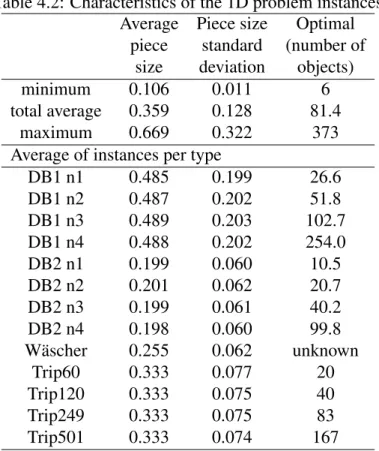
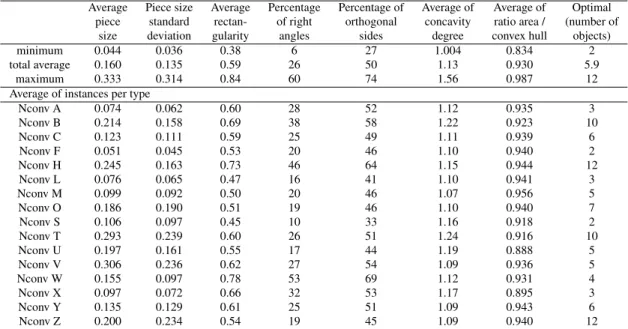
(17) List of Tables 4.1 4.2 4.3 4.4. Description of problem instances. . . . . . . . . . . . . Characteristics of the 1D problem instances . . . . . . . Characteristics of the convex 2D problem instances. . . . Characteristics of the non-convex 2D problem instances.. . . . .. 59 60 61 63. 5.1 5.2. Representation of actions. . . . . . . . . . . . . . . . . . . . . . . . . . . . . Number of extra objects for the testing set and compared against results of the best single heuristics. Experiment I, for first and second independent runs. Figures in last 10 columns average the performance of four heuristics. These heuristics are indicated by the numbers under the selection heuristic name (see Table 5.1). . . . . . . . . . . . . . . . . . . . . . . . . . . . . . . . . . . . . Number of extra objects for the testing set and compared against results of the best single heuristics. Experiment II. Figures in last 10 columns average the performance of four heuristics. These heuristics are indicated by the numbers under the selection heuristic name (see Table 5.1). . . . . . . . . . . . . . . . Number of extra objects for the testing set and compared against results of the best single heuristics. Experiment III. Figures in last 10 columns average the performance of four heuristics. These heuristics are indicated by the numbers under the selection heuristic name (see Table 5.1). . . . . . . . . . . . . . . . Number of extra objects for the testing set and compared against the best results of the best single heuristics. Experiment IV. Figures in last 10 columns average the performance of four heuristics. These heuristics are indicated by the numbers under the selection heuristic name (see Table 5.1). . . . . . . . . Number of extra objects used by the hyper-heuristics in the testing set with respect to the average obtained by the 40 single heuristics. . . . . . . . . . .. 75. Representation 1 of the instance state. . . . . . . . . . . . . . . . . . . . . . Representation 2 of the instance state. . . . . . . . . . . . . . . . . . . . . . Number of extra objects delivered by hyper-heuristics using representation scheme 2 compared with those using representation scheme 1. Experiments I through IV. . . . . . . . . . . . . . . . . . . . . . . . . . . . . . . . . . . . Average number of extra objects obtained by hyper-heuristics using representation scheme 2 compared with those using representation scheme 1. . . . . .. 82 90. 5.3. 5.4. 5.5. 5.6 6.1 6.2 6.3. 6.4 7.1. . . . .. . . . .. . . . .. . . . .. . . . .. . . . .. . . . .. . . . .. . . . .. . . . .. 77. 77. 78. 78 79. 93 94. Average fitness for all the combinations of selection and placement heuristics over the 540 instances. . . . . . . . . . . . . . . . . . . . . . . . . . . . . . 104 xv.
(18) 7.2. 7.3 8.1. 8.2 8.3 8.4 8.5. 8.6 8.7 8.8. 8.9 8.10 8.11 8.12 8.13 8.14 8.15 8.16 9.1. Average fitness obtained by all the selection heuristics when combined with the CAD placement heuristic for each instance type. The best selection heuristic for each instance type is in bold font. . . . . . . . . . . . . . . . . . . . . 105 Average computational time (in seconds) for all the combinations of selection and placement heuristics over the 540 instances. . . . . . . . . . . . . . . . . 105 Number of instances associated to each cluster for all the instance types considered. The clusters are obtained according to the fitness of the six single heuristics selected. . . . . . . . . . . . . . . . . . . . . . . . . . . . . . . . Cluster membership for the 1D and 2D instances. According to fitness of the six single heuristics considered. . . . . . . . . . . . . . . . . . . . . . . . . Representation of the instance state. . . . . . . . . . . . . . . . . . . . . . . Hyper-heuristic generated in the first run of Experiment 1. . . . . . . . . . . Number of extra objects obtained by hyper-heuristics and single heuristics compared against results of the best single heuristic for each instance (percentage of cases). Zero values are displayed as blank cells. . . . . . . . . . . Average number of extra objects delivered by the best hyper-heuristic, compared against results of the best single heuristic for each instance. . . . . . . . Percentage of selection of each single heuristic when solving the testing set with hyper-heuristics of Experiment 1. . . . . . . . . . . . . . . . . . . . . . Solving non-convex instances compared when solving their convex version. Percentage of cases when non-convex instances require fewer, equal and more objects than convex instances. Instances are solved by the best single heuristic and by the best hyper-heuristic from experiments 1 through 4. . . . . . . . . Percentage of single heuristic changes when solving all testing sets. . . . . . Average of heuristic changes according to the number of extra objects against results of best single heuristic. . . . . . . . . . . . . . . . . . . . . . . . . . Average length of single heuristic sequences when applying our hyper-heuristic solution model. . . . . . . . . . . . . . . . . . . . . . . . . . . . . . . . . . Percentage of sequences of single heuristic pairs when solving 1D instances in all testing sets. . . . . . . . . . . . . . . . . . . . . . . . . . . . . . . . . Percentage of sequences of single heuristic pairs when solving 2D convex instances in all testing sets. . . . . . . . . . . . . . . . . . . . . . . . . . . . Percentage of sequences of single heuristic pairs when solving 2D non-convex instances in all testing sets. . . . . . . . . . . . . . . . . . . . . . . . . . . . Average computational time (in seconds) per category of instances. . . . . . . Average computational time (in seconds) per type of instances. . . . . . . . .. 113 114 115 116. 117 118 119. 120 120 121 122 122 123 123 124 125. Loadings for the two main principal components of the data. Features 1 through 9 are those referred in Table 8.3. Figures with largest absolute values are in bold font. . . . . . . . . . . . . . . . . . . . . . . . . . . . . . . 135. xvi.
(19) List of Algorithms 1 2 3 4 5 6. 7 8 9 10 11. Decide if two pieces intersects each other. . . . . . . . . . . . . . . . . . . . 66 Decide if a point is inside a shape. . . . . . . . . . . . . . . . . . . . . . . . 67 Decide if a shape is completely inside another shape. . . . . . . . . . . . . . 68 Measures the distance in which two segments coincide. . . . . . . . . . . . . 69 Builds a piece containing all the area at the left of a given piece. . . . . . . . 69 Computes the horizontal distance from a point to a given segment. Distance is zero if the point is along the segment. Distance is positive if the point is in the right of the segment. Otherwise it is negative. . . . . . . . . . . . . . . . 71 Computes the distance that a given piece can be moved to the left without overlapping other pieces and without exceeding the object limits. . . . . . . . 71 The original DJD heuristic. . . . . . . . . . . . . . . . . . . . . . . . . . . . 98 The proposed DJD algorithm. Trying pieces one by one. . . . . . . . . . . . 100 The proposed DJD algorithm. Trying groups of 2 pieces. . . . . . . . . . . . 100 The proposed DJD algorithm. Trying groups of 3 pieces. . . . . . . . . . . . 101. xvii.
(20)
(21) Contents Abstract. ix. List of Figures. xiii. List of Tables. xvi. List of Algorithms 1. Introduction 1.1 1.2 1.3 1.4 1.5 1.6 1.7. 2. xvii 1. Problem Statement and Context Motivation Hypothesis and Research Questions Solution Overview Main Contributions Scope and Limitations Thesis Organization. Related Background 2.1 Cutting and Packing (C&P) Problems 2.1.1 Dyckhoff's Typology 2.1.2 Wäscher's Typology 2.2 Industrial Applications for the C & P Problem 2.2.1 Industrial Constraints 2.3 Packing and NP-Hardness 2.4 The Geometry for Placing Irregular Polygons 2.4.1 Pixel/raster Method 2.4.2 Direct Trigonometry 2.4.3 The No-Fit Polygon (NFP) 2.4.4 The Phi Function 2.5 Exact Solutions for the 2D C & P Problem 2.5.1 Linear Programming 2.5.2 Tree-Search Procedures 2.6 Heuristic Search for the 2D C & P Problem 2.6.1 Selection Heuristics 2.6.2 Placement Heuristics 2.6.3 Local Search Heuristics xix. 3 5 7 8 10 11 12 13 13 14 15 16 18 19 21 21 21 22 24 24 24 24 25 26 27 31.
(22) 2.7. Meta-heuristic Search for the 2D C&P Problem . . . . . . . . . . 2.7.1 Evolutionary Computation (EC) . . . . . . . . . . . . . . 2.7.2 Simulated Annealing . . . . . . . . . . . . . . . . . . . . 2.7.3 Tabu Search . . . . . . . . . . . . . . . . . . . . . . . . . 2.7.4 Ant Colony Optimization (ACO) . . . . . . . . . . . . . . 2.7.5 Greedy Randomized Adaptive Search Procedure (GRASP) 2.7.6 Agent-Based Approach . . . . . . . . . . . . . . . . . . . 2.8 Hyper-heuristic Search . . . . . . . . . . . . . . . . . . . . . . . 2.8.1 Heuristic Selection: Iterative Hyper-heuristics . . . . . . . 2.8.2 Heuristic Selection: Constructive Hyper-heuristics . . . . 2.8.3 Heuristic Generation . . . . . . . . . . . . . . . . . . . . 2.9 Hyper-heuristic Search for the 2D C&P Problem . . . . . . . . . 2.9.1 Hyper-heuristics with Evolutionary Computation . . . . . 2.9.2 Learning Classifier Systems . . . . . . . . . . . . . . . . 2.9.3 Genetic Programming . . . . . . . . . . . . . . . . . . . 2.9.4 Genetic Algorithms . . . . . . . . . . . . . . . . . . . . . 2.9.5 Hyper-heuristics with Ant Colony Optimization . . . . . . 2.9.6 Hyper-heuristics with Hill Climbing . . . . . . . . . . . . 2.10 Hyper-heuristic Search for other Optimization Problems . . . . . . . . . . . . . . . . . . . . . . . . . . . . . . 2.10.1 Timetabling Problems . . . . . . . . . . . . . . . . . . . 2.10.2 Constraint Satisfaction Problems (CSP) . . . . . . . . . . 2.11 Meta-learning . . . . . . . . . . . . . . . . . . . . . . . . . . . . 2.12 Summary . . . . . . . . . . . . . . . . . . . . . . . . . . . . . . 3. 4. Hyper-heuristic Solution Model 3.1 General Process for Generating Hyper-heuristics 3.2 Representation of Problem Instances . . . . . . . 3.3 Representation of Chromosomes in the GA . . . 3.4 Fitness Function . . . . . . . . . . . . . . . . . . 3.5 The GA Cycle . . . . . . . . . . . . . . . . . . . 3.5.1 Genetic Operators . . . . . . . . . . . . 3.6 Rotation Scheme . . . . . . . . . . . . . . . . . 3.7 Codification of Problem Instances . . . . . . . . 3.8 Summary . . . . . . . . . . . . . . . . . . . . .. . . . . . . . . .. . . . . . . . . .. . . . . . . . . .. . . . . . . . . .. . . . . . . . . .. . . . . . . . . .. . . . . . . . . .. . . . . . . . . .. Research Methodology and Experimental Setup 4.1 Methodology . . . . . . . . . . . . . . . . . . . . . . . . . . . 4.2 Problem Instances Testbed . . . . . . . . . . . . . . . . . . . . 4.2.1 1D Instances . . . . . . . . . . . . . . . . . . . . . . . 4.2.2 Convex 2D Instances . . . . . . . . . . . . . . . . . . . 4.2.3 Non-convex 2D Instances . . . . . . . . . . . . . . . . 4.2.4 Algorithm for Producing Random Instances that Include Non-convex Pieces . . . . . . . . . . . . . . . . . . . . 4.3 Algorithms Developed for Geometric Computation . . . . . . . xx. . . . . . . . . . . . . . . . . . .. . . . . . . . . . . . . . . . . . .. . . . . . . . . . . . . . . . . . .. . . . . . . . . . . . . . . . . . .. . . . . . . . . . . . . . . . . . .. . . . . . . . . . . . . . . . . . .. 31 32 34 34 34 35 35 36 37 38 38 39 39 39 39 40 40 40. . . . . .. . . . . .. . . . . .. . . . . .. . . . . .. . . . . .. 41 41 42 42 43. . . . . . . . . .. . . . . . . . . .. . . . . . . . . .. . . . . . . . . .. . . . . . . . . .. . . . . . . . . .. . . . . . . . . .. 45 46 47 47 49 50 50 53 53 53. . . . . .. . . . . .. . . . . .. . . . . .. . . . . .. . . . . .. . . . . .. 55 55 58 58 59 60. . . . . . . . . . . . . . .. 62 64.
(23) 4.4 5. 6. 7. 8. 9. Summary . . . . . . . . . . . . . . . . . . . . . . . . . . . . . . . . . . . .. Hyper-heuristics for 2D Irregular BPP (Convex) 5.1 Experimental Setup . . . . . . . . . . . . . . . . 5.1.1 Set of heuristics . . . . . . . . . . . . . . 5.1.2 Chromosomes . . . . . . . . . . . . . . 5.1.3 Representation of problem instance state 5.1.4 Testbed Instances . . . . . . . . . . . . . 5.2 Experiments . . . . . . . . . . . . . . . . . . . . 5.3 Results and Discussion . . . . . . . . . . . . . . 5.4 Summary . . . . . . . . . . . . . . . . . . . . .. . . . . . . . .. . . . . . . . .. . . . . . . . .. Defining a Problem-State Representation Scheme 6.1 Methodology for Developing a Representation Scheme 6.2 Developing a New Representation Scheme . . . . . . . 6.3 Experiments . . . . . . . . . . . . . . . . . . . . . . . 6.4 Results and Discussion . . . . . . . . . . . . . . . . . 6.5 Summary . . . . . . . . . . . . . . . . . . . . . . . .. . . . . . . . .. . . . . . . . .. . . . . . . . .. . . . . . . . .. . . . . . . . .. . . . . . . . .. . . . . . . . .. . . . . . . . .. . . . . . . . .. . . . . . . . .. . . . . . . . .. 70. . . . . . . . .. 73 73 73 73 74 74 74 76 79. . . . . .. . . . . .. . . . . .. . . . . .. . . . . .. . . . . .. 81 83 86 91 93 94. An Effective Heuristic for the 2D Irregular BPP 7.1 The DJD Heuristic . . . . . . . . . . . . . . . . . . . . . . . . . . 7.2 The Proposed DJD Heuristic for the 2D Irregular BPP . . . . . . . . 7.3 Experiments . . . . . . . . . . . . . . . . . . . . . . . . . . . . . . 7.3.1 The Other Selection Heuristics and the Placement Heuristics 7.4 Results and Discussion . . . . . . . . . . . . . . . . . . . . . . . . 7.5 Summary . . . . . . . . . . . . . . . . . . . . . . . . . . . . . . .. . . . . . .. . . . . . .. . . . . . .. . . . . . .. . . . . . .. 97 98 99 102 102 103 106. Hyper-heuristics for 1D and 2D Bin Packing Problems 8.1 Implementation . . . . . . . . . . . . . . . . . . . . . . . . . . . 8.1.1 Developing a Problem-state Representation for the Testbed Instances . . . . . . . . . . . . . . . . . . . . . . . . . . 8.2 Experimental Design . . . . . . . . . . . . . . . . . . . . . . . . 8.3 Results and Discussion . . . . . . . . . . . . . . . . . . . . . . . 8.3.1 Comparison Against the Best Single Heuristic . . . . . . . 8.3.2 Analyzing Results per Instance Category . . . . . . . . . 8.3.3 Comparing Results for Convex and Non-convex Instances 8.3.4 Alternation of Single Heuristics . . . . . . . . . . . . . . 8.3.5 Time Complexity . . . . . . . . . . . . . . . . . . . . . . 8.4 Summary . . . . . . . . . . . . . . . . . . . . . . . . . . . . . .. . . . . . . . . .. . . . . . . . . .. . . . . . . . . .. . . . . . . . . .. . . . . . . . . .. . . . . . . . . .. 111 114 115 116 118 119 120 122 126. A Deeper Understanding of the BPP Structure 9.1 Principal Component Analysis (PCA) . . . . . . . . 9.2 Experimental Setup . . . . . . . . . . . . . . . . . . 9.2.1 Meta-data for the Bin Packing Problem . . . 9.3 Results and Discussion . . . . . . . . . . . . . . . . 9.3.1 Distribution of Features across the PCA Map. . . . . .. . . . . .. . . . . .. . . . . .. . . . . .. . . . . .. 131 132 133 134 134 137. xxi. . . . . .. . . . . .. . . . . .. . . . . .. . . . . .. . . . . .. . . . . .. . . . . .. . . . . .. . . . . .. . . . . .. . . . . .. . . . . .. 109 . . . . . . 110.
(24) . . . . .. 137 137 138 140 143. 10 Final Conclusions and Future Work 10.1 Dissertation Summary and General Discussion . . . . . . . . . . . . . . . . 10.1.1 Hyper-heuristics for Solving 2D Irregular Bin Packing Problems (convex) . . . . . . . . . . . . . . . . . . . . . . . . . . . . . . . . . . . 10.1.2 Defining a Problem-State Representation Scheme . . . . . . . . . . . 10.1.3 The DJD Heuristic as an Effective Heuristic for the 2D Irregular BPP 10.1.4 Hyper-heuristics for Solving 1D and 2D Irregular Bin Packing Problems (concave) . . . . . . . . . . . . . . . . . . . . . . . . . . . . 10.1.5 A Knowledge Discovery Approach for Understanding how Features Impact in Heuristic and Hyper-heuristic performance . . . . . . . . . 10.1.6 General Discussion . . . . . . . . . . . . . . . . . . . . . . . . . . . 10.2 Main Contributions . . . . . . . . . . . . . . . . . . . . . . . . . . . . . . . 10.2.1 Hyper-heuristics for Solving 2D Irregular Bin Packing Problems (convex) . . . . . . . . . . . . . . . . . . . . . . . . . . . . . . . . . . . 10.2.2 Defining a Problem-State Representation Scheme . . . . . . . . . . . 10.2.3 The DJD Heuristic as an Effective Heuristic for the 2D Irregular BPP 10.2.4 Hyper-heuristics for Solving 1D and 2D Irregular Bin Packing Problems (concave) . . . . . . . . . . . . . . . . . . . . . . . . . . . . 10.2.5 A Knowledge Discovery Approach for Understanding how Features Impact in Heuristic and Hyper-heuristic performance . . . . . . . . . 10.3 Future Direction . . . . . . . . . . . . . . . . . . . . . . . . . . . . . . . . . 10.4 Closing Remarks . . . . . . . . . . . . . . . . . . . . . . . . . . . . . . . .. 145 145. 9.4. 9.3.2 Distribution of Heuristic Performance Across the PCA Map 9.3.3 Clustering . . . . . . . . . . . . . . . . . . . . . . . . . . . 9.3.4 The Best Heuristic . . . . . . . . . . . . . . . . . . . . . . 9.3.5 Hyper-heuristic Performance . . . . . . . . . . . . . . . . . Summary . . . . . . . . . . . . . . . . . . . . . . . . . . . . . . .. . . . . .. . . . . .. . . . . .. . . . . .. 145 145 146 146 147 147 148 148 148 148 148 149 149 150. A Contributed Scientific Publications. 151. Bibliography. 165. xxii.
(25) Chapter 1 Introduction The problem of finding an arrangement of pieces to cut or pack inside larger objects is known as the Cutting and Packing (C&P) Problem. This problem has huge practical relevance since it has a large number of practical applications. The two-dimensional Bin Packing Problem (2D BPP) is a particular case of the C&P problem, which consists of finding an arrangement of pieces inside the identical objects such that the number of objects required to contain all pieces is minimum. The case of rectangular pieces is the most studied one; although, there are many instances where irregular patterns arise, for example the metal, shoe and garment manufacturing. There is not a polynomial-time algorithm to solve optimally the 2D BPP, that is why heuristics are developed to find a good, frequently suboptimal, solutions. A heuristic (from Greek heuriskein, to find) is a practical rule or procedure that tries to exploit problem-specific knowledge and usually comes from a logical idea with common sense, although its goodness is not formally proved [9]. For many practical applications, an optimal solution is not absolutely necessary. Sometimes, instead of a solution very close to the optimum, it is preferred a good enough - soon enough - cheap enough solution [22]. An approximation algorithm, as well as a heuristic, does not guarantee to find the best solution, but a good enough solution instead in a time polynomially bounded. The difference between a heuristic and an approximation algorithm is that the latter give us a guarantee as to how bad solutions we can get. Normally specified as c times the optimal value [108]. Moreover, some heuristics are very problem-specific and their performance is rather poor in a different instance domain. There is a spectrum which ranges from cheap but fragile heuristics at one extreme and knowledge-intensive methods that can perform very well but are hard to implement and maintain, at the other extreme. Nevertheless, even complex heuristics may face problem instances where they perform badly. In general, some methods work well for particular instances, but not for all of them. Hyper-heuristics is an emerging search technology that is motivated, to a large extent, by the goal of raising the level of generality at which optimization systems can operate [22]. Hyper-heuristics might be thought as heuristics or algorithms to choose or generate heuristics. The idea behind hyper-heuristics is to discover some combination of straightforward heuristics to solve a wide range of problems, taking advantage on the strength each heuristic may have in a particular kind of problems. Raising the level of generality can be interpreted as building an optimization algorithm that tackles: (1) a wider range of instances from the same problem still producing good enough solutions, and/or (2) a wider spectrum of combinatorial problems with little implementation effort. 1.
(26) 2. CHAPTER 1. INTRODUCTION. Terashima et al. [143] described a genetic-algorithm-based method that produces hyperheuristics to solve two-dimensional regular (rectangular) and irregular (convex polygonal) Bin Packing problems. This solution model is the building block for this dissertation and it is described in Chapter 3, while the implementation for the 2D BPP with convex polygons is presented in Chapter 5. The genetic algorithm included in the model uses a variable-length representation, producing hyper-heuristics after going through a learning process which includes training and testing phases. Such hyper-heuristics constructed by the evolutionary procedure are sets of condition-action rules, where the condition is a numerical vector that represent the state of the problem taking into account problem relevant features. The action of every rule is one of the available low-level heuristics, and it is the heuristic to be applied. After applying the corresponding heuristic, the problem of placing the remaining pieces is again characterized by a vector and, maybe, another low-level heuristic is applied to reduce the number of pieces remaining to be placed. This process continues until every piece is placed solving the problem completely. This doctoral dissertation looks deeper into this solution model, investigating four important aspects, which are developed in Chapters 6 to 9. • Improvement of the numerical problem instance representation. Each instance to be solved by the hyper-heuristic is characterized by a numerical vector that summarizes some of its relevant features. Each numerical term of the vector quantifies an aspect of the instance at hand, for example, number of pieces, percentage of small pieces or average number of pieces sides, etc. According to this numerical vector, the hyperheuristic decides which low-level heuristic to apply every time. The 2D irregular BPP may have many features and not all of them are relevant in the selection of a low-level heuristic, so not all of them should be included in the problem state representation. An adequate problem state representation scheme is critical for the good performance of the hyper-heuristic. The procedure for designing the problem representation deserves attention. Moreover, this investigation creates a general methodology for building a problem representation without much knowledge about the problem properties (see Chapter 6). • Generalization of the solution model through the kind of problem instances that the solver can handle. The model that constructs hyper-heuristics for the 2D BPP accepts instances that are either rectangles or irregular convex polygons. After obtaining good results with this kind of instances [143], the following natural step is to extend the methodology to instances that include concave polygons (at least one internal angle greater than 180 degrees). This involves additional geometric complexity increasing the computational burden. To make the solution framework even more general, the 1D BPP is included as well. So, hyper-heuristics generated are able to choose the best single heuristics to any problem instance from 1D to 2D irregular (non-convex) without human intervention. Chapter 8 develops this framework in detail. • Analysis and improvement of the repository of low-level heuristics. The quality and diversity of the low-level heuristics combined by a hyper-heuristic is crucial. On one hand, we choose one of the single heuristics of the model and improved its performance making an adaptation for the 2D case in such a way that is fast in execution and delivers high quality solutions. This heuristic, called Djang and Finch (DJD), is designed for.
(27) 1.1. PROBLEM STATEMENT AND CONTEXT. 3. selecting which pieces are the next to be placed (Chapter 7). On the other hand, an analysis of the repository of low-level heuristics is performed expecting to obtain a better understanding of how the interaction of heuristics works during the resolution of a problem instance. Sequence, frequency and alternation of heuristics are important issues analyzed in Sections 8.3.2 and 8.3.4. • Analysis of the structure of the Bin Packing Problem and its relation with heuristics and hyper-heuristics performance. The BPP, specially the 2D irregular case, has a complex structure, since it can be characterized by many features. Insights about which combination of features have impact in heuristic and hyper-heuristic performance are developed in Chapter 9, where the mathematical technique called Principal Component Analysis is employed to visually assess multivariate data in two dimensions. In the next section the problem is stated in a more specific and restricted way, describing the specific problem under study along with the objectives that are sought for in this project. Section 1.2 presents a more thorough explanation of what motivates this research. After, the hypothesis that supports all this research is presented plus the research questions to which an answer is being looked for. Following, an overview of the proposed solution is presented along with the main contributions that this research project has provided. Scope and limitations of this dissertation are presented next. Finally, a description of how the dissertation has been organized is laid out.. 1.1. Problem Statement and Context. The main problem to work with during the investigation is stated in this section. The Cutting and Packing Problem is among the earliest problems in the literature of operational research. Due to the extensive work done in this NP-problem, in 2006 Wäscher et al. [154] suggested a complete typology which is an extension of Dychoff’s [48]. In the 1D BPP, there is an unlimited supply of bins, each with capacity c > 0. A set of n items (each one of size si < c) is to be packed into the bins. The task is to minimize the total number of bins used. In the 2D BPP, there is a set L = (a1 , a2 , . . . , an ) of pieces to cut or pack and an infinite set of identical rectangular larger elements (called objects) with dimensions x0 and y0 . Then, the 2D BPP consists of finding an arrangement of pieces inside the objects such that the number of objects required to contain all pieces is minimum. A feasible solution is an arrangement of pieces without overlaps and with no piece outside the object limits. A problem instance or instance I = (L, x0 , y0 ) consists of a list of elements L and object dimensions x0 and y0 . An instance state is every intermediate phase in the solution process until all pieces are placed and a solution for the instance is found. The problem is called 2D irregular BPP when pieces are not rectangular [154]. A typical way of representing elements (and used in this research) is with a list of sets of coordinates L = (c(a1 ), c(a2 ), ..., c(an )); where c(ai ) is the set of coordinates in the Cartesian plane corresponding to piece ai . A set of coordinates c(ai ) is a set of points represented by pairs (x, y). For example: c(ai ) = {(xi1 , yi1 ) , (xi2 , yi2 ) , ..., (xiki , yiki )}, where ki is the number of vertices of piece ai . Each piece coordinates has an arbitrary reference (see Section 3.7)..
(28) 4. CHAPTER 1. INTRODUCTION. The term 2D regular Bin Packing Problem (2D regular BPP) is mainly used when all pieces are rectangular (although circles and other regular shapes could fall under this name too [154]). Otherwise, the problem is called 2D irregular Bin Packing Problem (2D irregular BPP). The research presented in this dissertation is focused mainly on the 2D irregular BPP, but it also considers the 1D BPP in Chapters 8 and 9. The case of rectangular pieces is the most widely studied. However, the irregular case is seen in a number of industries where parts with irregular shapes are cut from rectangular materials. For example, in the shipbuilding industry, plate parts with free-form shapes for use in the inner frameworks of ships are cut from rectangular steel plates, and in the apparel industry, parts of clothes and shoes are cut from fabric or leather [109]. Other direct applications include the optimization of layouts within the wood, metal, plastics, carbon fibre and glass industries. For the 1D case, it is common to use the terms items and bins; whereas, for the 2D case, a variety of terms have been used. The small elements have been named pieces, shapes or items; and the large elements have been called objects, stock or sheets. In this investigation, we use the terms items and bins regarding the 1D case, and pieces and objects when referring to the 2D case. This investigation considers pieces that are irregular polygons (sides and internal angles may not be equal) with unrestricted number of sides. We call 2D irregular BPP (convex) to the problem when all pieces are convex polygons (internal angles less than 180 degrees); when including some concave polygons as pieces, the problem is called 2D irregular BPP (nonconvex) in this research. We assume the polygons are in standard form: no three consecutive vertices are collinear [145]. Pieces may rotate orthogonally in their attempt to fit inside an object. Cuts are infinitely thin. Figure 1.1 presents the 1D BPP, while Figure 1.2 shows an instance of the 2D irregular BPP (non-convex) problem, in which pieces are packed into two objects.. Figure 1.1: General scheme of the 1D Bin Packing Problem. The Strip Packing Problem is a popular variant of the 2D Cutting and Packing problem which has only one large rectangular object with fixed width, its length is variable and has to be minimized after placing all the small pieces (some approaches and reviews in [44, 74, 23]). A variation of this typical strip packing problem consists of nesting irregular pieces in one large irregular object (examples in [93, 92, 155, 120]). The amount of research devoted to the strip packing problem has been larger when compared to the research about the 2D irregular BPP. We found that [109] studied a problem similar to our 2D irregular single bin size BPP but using variable bin sizes, where the problem solution involves finding appropriate sizes of material objects (bins) among given standard sizes in order to reduce waste. We found.
(29) 1.2. MOTIVATION. 5. Figure 1.2: General scheme of the 2D Irregular Bin Packing Problem. only one study about, specifically, the 2D irregular single bin size bin packing problem where Ponce-Pérez et al. [117] proposed a genetic algorithm based approach. They tested it with one four-piece instance whose best result had some overlapping of pieces. As far as we know, there are no other studies for the 2D irregular single bin size bin packing problem. Therefore, all 2D irregular problem instances in the literature are intended for the strip packing problem; and there are not 2D irregular BPP instances available. Also, since the strip packing problem is similar to the 2D irregular BPP, many heuristic implementations may be similar; although, results for both kind of problems are not comparable. Nevertheless the lack of research in the 2D irregular BPP, there exist many practical applications where irregular pieces are cut from identical rectangular objects [109]. The main objective of this work is to increase the level of generality of a solution model for the 2D irregular BPP based on an evolutionary hyper-heuristic approach. This main objective has the following building blocks: (1) developing a general scheme for finding a good representation of the problem state; (2) upgrading the model to solve instances with some concave polygons as well as 1D instances without requiring parameter tuning after a hyperheuristic was developed; (3) improving the single heuristics repository and performing an analysis of the single heuristics inside the hyper-heuristic model; and (4) developing insights in the way that some features and combination of features impact heuristic and hyper-heuristic performance.. 1.2. Motivation. The motivation to reach this problem comes mainly from the practical relevance the Bin Packing Problem has, especially when it is about two dimensional irregular pieces. Section 2.2 details the most important practical applications. Moreover, in most cases it is still difficult to outperform an experienced worker with a purely automatic algorithm, so that the irregular problem has become an attractive research topic [76]. Any kind of improvement towards the.
(30) 6. CHAPTER 1. INTRODUCTION. resolution of this problem would benefit to the practical and industrial areas in which these type of problems appear. On the other side, the motivation to utilize a hyper-heuristics approach comes from the fact that higher level of generality is becoming a trend in optimization. There is a current school of thought in meta-heuristic and search technology that states that one of the main goals of the discipline over the next few years is to raise the level of generality at which meta-heuristic and optimization systems can operate. For example, Burke et al. [20] conducted an empirical study that ran the same high-level strategies (hyper-heuristics) with three different domains: 1D bin packing, permutation flow shop and personnel scheduling. They used a software framework for the development of cross-domain search methodologies called Hyflex [21]. The term hyper-heuristic has been defined to broadly describe the process of using (meta-)heuristics to choose (meta-)heuristics to solve the problem in hand. One of the main motivations for studying hyper-heuristic approaches is that they should be cheaper to implement and easier to use than problem specific special purpose methods and the goal is to produce good quality solutions in this more general framework [22]. The No free lunch (NFL) theorem [156] establishes that all algorithms have the same average performance when considering all possible problems. In other words, for any algorithm, any elevated performance over one class of problems is exactly paid for in performance over another class. An optimization problem, as defined by Wolpert and Mcready [156] is a function which maps a search space X with an element of the space of possible cost values Y. Both spaces, though huge, are finite according to the NFL statement. Their sizes are |X | and |Y|. The size of the space of all possible functions is |Y||X | . It is worth noting that many (or most) of this possible functions (problems) are trivial or unrealistic. For example, the instance where all possible x ∈ X correspond to the same cost value y. Besides, most real instances have the property that most points x ∈ X that are close to each other have corresponding points y ∈ Y close to each other as well. The problems we humans are interested in have some internal structure and some degree of predictability or continuity about them. Intuitively, the NFL theorem illustrates that if knowledge of the problem is not incorporated into the algorithm, then there are no formal assurances that the algorithm will be effective. Rather, effective optimization relies on a fortuitous matching between the problem and the algorithm. It is very important to incorporate problem-specific knowledge into the behavior of the algorithm. Based on the NFL theorem emerges the motivation to find a set of heuristics that jointly (and complementarily) can perform well among a wide range of realistic and interesting possible instances. Poli and Graff [115] argue why in most realistic fitness functions there may be a free lunch for computer scientists developing hyper-heuristics. Representation is a simplification of an instance state needed in several existing evolutionary models for hyper-heuristic construction [128, 138, 139, 141, 143]. In those models, the numerical representation is applied for complete instances to be solved (in BPP: where no piece has been placed yet) as well as for instances partially solved (in BPP: where some pieces have already been placed). For a given problem instance, a numerical representation is computed in every intermediate state until it is completely solved (see Figure 1.3). Not all features related to a problem can be taken into account. From the selection of these features relies highly the performance of the hyper-heuristic, since the problem state is related with the selection of single heuristics. In those models where an instance state representation has.
(31) 1.3. HYPOTHESIS AND RESEARCH QUESTIONS. 7. been required, feature selection has been done with domain knowledge of the particular problem. It is required to have a more general method for establishing an adequate problem state representation.. Figure 1.3: Simplified representation of a problem state. There is also the interest in analyzing the BPP structure. The BPP structure regards those features that are able to characterize particular instances. We want to discover the BPP structure by understanding those features that have a high impact in approximation algorithm performance. Some feature values may influence some heuristics to be better than others. Similar analysis have been done for other optimization problems, such as the Quadratic Assignment Problem [134], the Early/Tardy Machine Scheduling Problem [135] and the Traveling Salesperson Problem [85], but never for the Bin Packing Problem, as far as we know.. 1.3. Hypothesis and Research Questions. The work is conducted under the hypothesis that utilizing hyper-heuristics is a way of increasing the level of generality of a solution model. This is because utilizing hyper-heuristics for the 2D irregular BPP will increase the range of problems in which a good solution can be obtained. Also, there is the hypothesis that improving the representation scheme would improve the hyper-heuristic performance. Furthermore, modifying (even reducing) the set of heuristics employed in the model, the hyper-heuristics quality would be better. Only this way, combining low-level heuristics into a hyper-heuristic would effectively take advantage of each heuristic strength. We hypothesize that the number, nature and interaction of the lowlevel heuristics do have an effect in the hyper-heuristic solution quality. We also hypothesize that understanding better the BPP structure is important in a practical way. Knowledge about which feature values have higher impact in which heuristics may be useful in the development of new heuristic-combination techniques. That is why, the following research questions are generated:.
(32) 8. CHAPTER 1. INTRODUCTION • Is it possible to improve the execution in the 2D BPP of the single heuristic called Djang and Finch, even though it was initially designed for the 1D case? • Is it possible to develop a general methodology for finding significant features for the 2D irregular BPP without domain knowledge? • Which are the most important features of the 2D irregular BPP that characterize every instance in such a way that it is possible to determine which is the best heuristic for solving the instance? • How is the performance of a hyper-heuristic solution model when the most significant features are taken into account in the representation of the problem state? • Is it possible to generalize a hyper-heuristic model to a wider range of instances including those with non-convex polygons? • Is it possible to generalize the hyper-heuristic model for other variants of the Bin Packing Problem (for example, 1D)? • What sort of changes can be made in the set of selection and placement heuristics that would enable the approach to work well for non-convex polygons too? • How is the performance of a hyper-heuristic solution model when tackling the 2D irregular BPP (non-convex)? • How are the different heuristics used in the hyper-heuristic, in terms of frequency, sequence of heuristics and the time each heuristic is used before changing to another? • Is it possible to obtain BPP domain knowledge through a multivariate data analysis such as the Principal Component Analysis? • Could we find some particular BPP features that make some heuristic more suitable than others?. These questions guided the conducted research as answers to them were found and provided. Worth pointing out is that the list is not in the order answers were found.. 1.4. Solution Overview. The general solution model is depicted in Figure 1.4. The hyper-heuristic generation framework (rectangle in the middle) receives a set of single heuristics and a set of problem instances as main input. After a training process with a genetic algorithm, our framework produces one or several hyper-heuristics which consist of a set of rules that relate different instances states with the better single heuristic to apply in every case. This dissertation works in four different parts of this general framework (rectangles of text with font in italics in Figure 1.4). First, instances are characterized by a numerical vector before going into the training process of the solution model. Regarding this part of the general scheme, this investigation develops a robust methodology to represent instances employing a numerical vector, leaving.
(33) 1.4. SOLUTION OVERVIEW. 9. Figure 1.4: General structure of the solution model studied. Fonts in italics explain the main improvements to the solution model. behind intuitive ways for selecting the most relevant features (Chapter 6). The main idea consists in clustering the available instances according to heuristic performance. Then we find which features may predict instances clusters. For clustering, the k-means algorithm was employed while the Multinomial Logistic Regression technique was used for determining which features can predict instance cluster. Multinomial Logistic Regression is used to predict a categorical dependent variable (cluster), given a set of independent variables (features). The most significant features in the Multinomial Logistic Regression model are as the most related with heuristic performance. The proposed methodology was tested with the 2D irregular BPP with convex polygons. The GA-based process for building hyper-heuristics was run with two different representation schemes concluding that our developed representation shows a significant improvement in performance with respect to a more conventional representation. The second element from the framework that was analyzed was the heuristic repository. Single heuristics are studied and one selection heuristic (Djang and Finch (DJD)) is selected for further analysis and improvement. The DJD heuristic was originally designed for the 1D BPP. In the two-dimensional case, not only is it the case that the piece’s size is important but its shape also has a significant influence. Therefore, DJD as a selection heuristic has to be paired with a placement heuristic to completely construct a solution to the underlying packing problem. A successful adaptation of the DJD requires a routine to reduce computational costs, which is also proposed and successfully tested in this paper. Results, on a wide variety of instance types with convex polygons, are found to be significantly better than those produced by more conventional selection heuristics (Chapter 7). Still working with the single heuristics part of the model, the number of single heuristics in the heuristic repository was reduced dramatically from 40 (in the first implementation, Chapter 5) to only six. This was done after discarding those heuristics that were not the best in any of our testbed instances. Having only good heuristics in the repository, the speed in which the genetic algorithm converges to a good hyper-heuristic increases. Also, in order to.
(34) 10. CHAPTER 1. INTRODUCTION. improve our understanding of the single heuristics role when employing hyper-heuristics, an analysis of the interaction among single heuristics in hyper-heuristic solutions is performed. We found some interesting patterns about heuristic alternation when solving instances with hyper-heuristics. These findings give us interesting ideas for further improve the solution model. Statistical analysis is included to support our study (Sections 8.3.2 and 8.3.4). The third aspect to be improved is regarding the kind of instances that the produced hyper-heuristics can solve. The hyper-heuristic framework is tried with a more general testbed of instances that goes from 1D to 2D instances with convex and non-convex polygons (Chapter 8). The idea is to find hyper-heuristics in the form of rules that automatically choose the best heuristic to apply to a given instance of any kind. In the past, these problems had been tackled separately by using a variety of methods and techniques because they exhibit different properties. With our framework, once a hyper-heuristic has been evolved using a training set of instances, it can be reused on any new instance of any kind producing competitive results, and comparable against those provided by the best single heuristic per problem. Finally, a knowledge discovery approach is used to reveal the problem features or combination of features that influence the performance of bin packing heuristics and hyper-heuristics. Our instance testbed includes 1417 instances for this part of the dissertation. Using the Principal Component Analysis method, the problem instances, characterized by 9 features, are visualized in two dimensions. These 9 features were selected from a larger set of 23 by the proposed methodology that selects the subset of features that are more strongly related with algorithm performance. Different combinations of features characterize instances in each section of the 2D graph produced by the Principal Component Analysis method, and heuristic performance is over imposed over the 2D graph. This visualization approach reveals new knowledge on the relationship between bin packing problem features and heuristic and hyperheuristic performance (Chapter 9).. 1.5. Main Contributions. The main contribution of this work is to build a more robust and reliable framework to generate hyper-heuristics that intelligently combine single heuristics to solve a wide range of instances of the Bin Packing Problem. By doing this, the following are the given contributions: • The design and implementation of an algorithm that produces random problem instances with irregular convex polygons. This algorithm requires several user-defined parameters to control the irregularity of the produced random instances. • An implementation of the proposed evolutionary framework to produce hyper-heuristics for solving the 2D irregular BPP (convex). The analysis of the results of this first implementation produced several suggestions for improving the framework. • A robust six-step methodology to find the most relevant features of a problem that are most related with heuristic performance. The features selected through this methodology will represent each problem instance state in the genetic algorithm process. • A new way to represent an instance of the BPP in a numerical vector. Expertise is not required to establish this new representation scheme..
(35) 1.6. SCOPE AND LIMITATIONS. 11. • A design of a time-saving routine for the DJD heuristic, making this heuristic a fast and effective algorithm for selecting the next pieces to be placed. • An analysis of two important parameters of the DJD heuristic: the initial level of fullness and the allowed waste incremental; finding those values where the DJD heuristic produces the best results. • A review and improvement of the parameters employed in the genetic algorithm of the solution model. • The design and implementation of an algorithm that cuts a convex polygon into two new shapes, one of which is a concave polygon. This algorithm is the basis for generating random instances with concave polygons. • An implementation of geometric functions required to deal with concavities. • A solution framework able to generate hyper-heuristic for solving at the same time 1D and 2D instances of the Bin Packing Problem. • A deeper understanding about how the single heuristics interact in a hyper-heuristic solution. We analyzed how the different single heuristics alternate when hyper-heuristics solved different kinds of instances. The number of times that a given single heuristic is applied before changing to another is analyzed as well. • A deeper understanding of the BPP structure based on the Principal Component Analysis technique as a graphic tool. We visualize in two dimensions our instances testbed which are characterized by a larger number of variables. This analysis finds relationships between features and heuristic/hyper-heuristic performance. We expect that this new knowledge will help in the design of new solution approaches for the BPP. • A large part of the code programmed for this research was used further in a development of a hyper-heuristic solution model for a multiobjective 2D Bin Packing Problem [64]. Along the development of this dissertation, there has been a set of published papers that has also shown the contributions that this research has provided to the scientific community. The complete list is presented in Appendix A.. 1.6. Scope and Limitations. The proposed solution tackles the problem delimited in the problem statement section. Conclusions from this work are related with the Bin Packing Problem of one and two dimensions. The Strip Packing Problem, another popular version of the C&P problem, is not touched in this dissertation. One-dimensional problem instances were drawn from the literature and present a variety of characteristics. Two-dimensional problem instances were built artificially because of the lack of benchmark problems in the literature; nevertheless, these instances have a wide range of characteristics as well. Allowed rotation for pieces is 90, 180 and 270 degrees. All problem instances have identical object sizes and all 2D objects are squares. It is worth.
(36) 12. CHAPTER 1. INTRODUCTION. noting that 2D instances does not allow curves or holes. We do not consider concave shapes with more than one internal angle larger than 180 degrees. So, pieces with an entrance to an interior area that fit exactly with pieces with a protuberance (see Figure 2.11) are discarded from this investigation. As a consequence of this, all positions in the optimal solutions can be achieved using sliding operations. All single heuristics presented in this work are constructive and single-pass, which means that they are algorithms that build solutions from scratch placing pieces one after another and never revising a piece already placed. This kind of heuristics has the advantage of being very fast, but their performance would be unfairly compared with (meta-)heuristics that consider many positions before giving a solution. The idea is to build a hyper-heuristic that successfully combine single heuristics to produce good solutions in only one pass. Part of the available code was previously employed in the investigation reported in [52] and [138]. The framework was done with the JAVA programming language.. 1.7. Thesis Organization. This dissertation is organized in nine chapters. The following chapters present all the technical details that are relevant to this research. Chapter 2 talks about the state of the art regarding the tackled problem and presents some related background relevant to the research, including topics about computational complexity, geometry and hyper-heuristic approaches. Then, Chapter 3 explains in detail the solution model this dissertation works with. Chapter 4 talks about the research methodology and the experimental setup. It shows the main steps followed during the research process and presents the problem instances in which the proposed contributions are tested. The testing instances are described as well as the algorithm employed to randomly create 2D instances with some concave pieces. Finally, some algorithms implemented for dealing with geometry are presented in this chapter. In Chapter 5 a first experimentation employing the solution model is explained. Chapter 6 focuses in the problem-state representation and develops a novel way of selecting relevant features of a given problem. Chapter 7 develops the adaptation to the 2D BPP of the DJD heuristic. Chapter 8 extends the solution model making it capable of generating hyper-heuristics for 1D and 2D instances, including instances with non-convex polygons. This chapter integrates improvements to the single heuristics repository and the problem state representation scheme from previous chapters ensuring better quality hyper-heuristics. Chapter 9 presents 2D maps where many instances are plotted to visually assess differences and similarities among instances. By superimposing heuristic performance we are able to produce insights into the BPP structure. Finally, Chapter 10 provides some conclusions related to the work that was carried out throughout this research project. Some future guidelines and challenges are presented along with some possible ways to tackle them and improving obtained results and performance..
(37) Chapter 2 Related Background The Bin Packing Problem is a particular case of the more general C&P problem. In this chapter the C&P problem is described with emphasis in the two dimensional case. Although, some review is devoted to the one-dimensional case, because this problem is solved in the framework described in Chapter 8. The C&P problem has been theoretically tackled in the last decades and the main approaches utilized for the 2D version are discussed showing that the most recent approach, called hyper-heuristic, had not been applied to the 2D irregular BPP (non-convex) until this investigation. This is a wide problem, with many variations, that is why several typologies have been built. The C&P problem is reviewed in Section 2.1 in which two different typologies are presented. Then, Section 2.2 shows the importance of studying the cutting problem because of its numerous applications. Section 2.3 discusses the complexity of the problem. Some issues about geometry are addressed in Section 2.4 while Sections 2.5, 2.6 and 2.7 talk about some approaches for solving the 2D C&P problem found in the literature. Section 2.8 presents the basics about the hyper-heuristic search approach; Section 2.9 goes deeper in how hyperheuristics has been applied to the 2D C&P problem and Section 2.10 shows some examples of hyper-heuristics implemented in other combinatorial problems.. 2.1. Cutting and Packing (C&P) Problems. With only a couple of exceptions, research in Cutting and Packing (C&P) problems started after the middle of the twentieth century. According to Haessler in 1991 [66], the earliest work appeared in the paper industry with the first known formulation stated, in 1939, by the Russian economist Kantorovich [86], whose paper was translated into English in 1960. In 1940, Brooks et al. [19] wrote a mathematical paper about the dissection of rectangles into squares. Another one of the earliest publications in the topic was from Gilmore and Gomory [57], who introduced, in 1961, a delayed pattern generation technique for solving a one dimensional cutting problem using linear programming. Since then, scientific work has grown rapidly through several disciplines. The same logic structure of the problem appears in areas such as Computer Science, Mathematics, Logistics, Operational Research and Engineering. That is why, there has been used a variety of terms according to specific applications. For example: 13.
(38) 14. CHAPTER 2. RELATED BACKGROUND • Parts nesting in the ship-building industry [44]. • Marker layout problem in the garment industry [44]. • Memory allocation, Multiprocessor scheduling and Compaction problem [65] in the computer industry. • Floor planning in the VLSI (very-large-scale integration) industry [121]. • Coil Slitting [49]. • Container loading which is a three-dimensional problem [53] and it is similar to Pallet loading, though in practical applications the two variants of the loading problem can be distinguished by their constraints [74]. • Capital Budgeting and Change Making [49]. • Scheduling where dealing with a one-dimensional set of objects (jobs) that need to be assigned to a finite set of containers (machines).. Jacquenot et al. [79] talks about a higher problem category: placement problems which gather C&P problems as well as the layout problems. In a C&P problem, components are only geometrically related to each other, whereas in a layout problem, components are geometrically and functionally related to each other. Also, according to different variations or characteristics of the Cutting and Packing problem, many terms have been used. For example, bin packing when there are several objects in which a number of parts are to be packed; strip packing in the case in which a number of parts are to be cut from an object of indefinite length. Knapsack problem is usually related to the one dimensional problem. The assortment problem addresses the issue of choosing proper dimensions for the large objects. Wäscher et al. [154] did an important effort of unifying all these terms, clarifying the characteristics to apply to each (see section 2.1.2). Due to the extensive work done in this and related problems, several typologies have been proposed. Dyckhoff’s typology [48] was the one which ruled since 1990. In 2006 Wäscher et al. [154] suggested a more complete one. These typologies are described in sections 2.1.1 and 2.1.2.. 2.1.1. Dyckhoff’s Typology. Because C&P problems are found in many different application areas, Dyckhoff in 1990 [48] built a systematic and comprehensive classification for an adequate exchange of solution approaches across disciplines. His purpose was to unify the different names and the different use of notions in the literature and to concentrate further research on special types of problems. The Dyckhoff’s classification integrates a system of 96 types of cutting and stock problems according to four main features and their subtypes as follows: 1. Dimensionality: One (1), Two (2), Three (3) or n (N)..
Figure



![Figure 2.1: Basic and intermediate problem types for the C&P problem in W¨ascher’s Typo- Typo-logy [154].](https://thumb-us.123doks.com/thumbv2/123dok_es/2265040.513842/41.918.183.820.111.561/figure-basic-intermediate-problem-types-problem-ascher-typo.webp)
+7

Documento similar
Para el estudio de este tipo de singularidades en el problema de Muskat, consideraremos el caso unif´ asico, esto es, un ´ unico fluido en el vac´ıo con µ 1 = ρ 1 = 0.. Grosso modo,
Finally, experiments with solar [17–34], atmospheric [35–45], reactor [46–50], and long-baseline accelerator [51–59] neutrinos indicate that neutrino flavor change through
The general idea of the language is to “thread together,” so to speak, existing systems that parse and analyze single web pages into a navigation procedure spanning several pages of
The homotopy analysis method is a seminumerical scheme applied for the solution of the proposed model problem of heat transfer phenomena in a viscoelastic fluid through a
This condition, related to the normal component on ∂D of the ∂-operator, permits us to study the Neumann problem for pluriharmonic functions and the ∂-problem for (0, 1)-forms on D
K) is the Banach space of continuous functions from Vq to K , equipped with the supremum norm.. be a finite or infinite sequence of elements
Government policy varies between nations and this guidance sets out the need for balanced decision-making about ways of working, and the ongoing safety considerations
No obstante, como esta enfermedad afecta a cada persona de manera diferente, no todas las opciones de cuidado y tratamiento pueden ser apropiadas para cada individuo.. La forma
