
Assessing the impact of the implementation of a WebQuest for learning English as a second language
72
0
0
Texto completo
(2) Marta Pesudo Marco WebQuest Màster Professorat (UJI) A Top Secret Mission ______________________________________________________________________________ ABSTRACT In this technological era we live in, the educative scenario is changing rapidly and significantly due to the incorporation of Internet. Therefore, education should pay special attention to society needs and for this reason computers and Internet have to be part of the teaching process in order to make students ready for this new world. Yet, Internet opens a wide range of options and materials ready to be used in the teaching and learning process, particularly in the language learning. This final Master Thesis is focus on the implementation and assessment of a computer-based approach, the WebQuest, in a third year of compulsory secondary education. The didactic unit implemented deals with the different English-speaking countries and their particularities. This activity has been carried out using in-class sessions together with autonomous work and group work. The purpose of this study is to analyse and discuss students' opinions and reactions towards the use of this teaching and learning strategy in an English as a Second Language class. Thus, the study aims at showing whether students 1) gain a higher motivation in learning English, 2) have improved their digital competence and 3) have acquired cultural knowledge. For this reason, students' task and two post-questionnaires are taking into account. The results of the post-questionnaires have suggested that the use of new technologies have motivated students towards the teaching and learning of the English subject. Moreover, their digital competence as well as their cultural competence have improved while working with the designed WebQuest..
(3) Marta Pesudo Marco WebQuest Màster Professorat (UJI) A Top Secret Mission ______________________________________________________________________________ TABLE OF CONTENTS 1. Introduction..................................................................................................................................1 2. Theoretical Framework.................................................................................................................2 2.1 Technology and Internet..........................................................................................................2 2.2 E-learning................................................................................................................................3 2.3 E-tools......................................................................................................................................4 2.3.1 Blog..................................................................................................................................4 2.3.2 Wiki..................................................................................................................................5 2.3.3 Forum................................................................................................................................5 2.4 WebQuest.................................................................................................................................6 2.4.1 Origin................................................................................................................................6 2.4.2 Definitions........................................................................................................................7 2.4.3 Types of WebQuest...........................................................................................................8 2.4.4 Critical attributes..............................................................................................................9 2.4.5 Non-critical attributes.....................................................................................................11 2.4.6 WebQuests in an ESL context.........................................................................................12 3. Method........................................................................................................................................13 3.1 Research questions................................................................................................................13 3.2 Students and school setting....................................................................................................14 3.3 Didactic unit..........................................................................................................................15 3.3.1 Objectives.......................................................................................................................15 3.3.2 Contents..........................................................................................................................16 3.3.3 Key Competences...........................................................................................................16 3.3.4 Methodology...................................................................................................................17 3.3.5 Materials.........................................................................................................................18 3.3.6 Timing.............................................................................................................................19 3.3.7 Sessions..........................................................................................................................20 3.3.8 Development...................................................................................................................21 3.3.9 Assessment......................................................................................................................22 3.4 The WebQuest........................................................................................................................25 4. Results........................................................................................................................................32 4.1 Task........................................................................................................................................32 4.2 Analysis of the questionnaires...............................................................................................35.
(4) Marta Pesudo Marco WebQuest Màster Professorat (UJI) A Top Secret Mission ______________________________________________________________________________ 4.2.1 Pre-questionnaire............................................................................................................35 4.2.2 Students' post-questionnaire...........................................................................................36 4.2.3 Secondary English teacher's post-questionnaire.............................................................42 5. Discussion...................................................................................................................................42 6. Conclusions................................................................................................................................44 7. Limitations and further implementation.....................................................................................45 8. References..................................................................................................................................46 9. Annexes......................................................................................................................................50.
(5) Marta Pesudo Marco WebQuest Màster Professorat (UJI) A Top Secret Mission ______________________________________________________________________________.
(6) Marta Pesudo Marco WebQuest Màster Professorat (UJI) A Top Secret Mission ______________________________________________________________________________ 1 INTRODUCTION Technology along with the impact of Internet has led to rapid progress of our history, consisting of sudden changes, globalization and multiculturalism of the society which has brought new challenges to the citizens to face. These challenges need that people may have a great command of new technologies such as computer and Internet in order to become a competitive person. The ability of the World Wide Web inspired Dodge (1998) in creating a new model of teaching that incorporates the use of technological tools in the classroom, this model was named WebQuest, hereinafter WQ. The objective of this study is to implement a WQ for an ESL environment in a high school. For this purpose, a WQ dealing with culture of the different English-speaking countries has been designed in order to assess the usefulness of this activity in terms of digital competence, cultural competence and motivation. In this sense, this didactic unit is based on the Valencian Decree 112/2007, on July 20th, in which the curriculum is established. According to the Decree, knowing a foreign language gives us access to different information. At the same time it offers the possibility of using it to communicate. Foreign languages require contact with various linguistic models and the use of digital learning resources. All this contributes directly to the development of the digital competence (Decree, 2007). This Master Thesis is structured in different sections. The first section aims at giving an overview of our educational context, particularly the English subject, and stating the problem to which the study is based on. In addition, the theoretical framework focuses on explaining relevant concepts such as e-learning together with eactivities, for example: blogs, wikis and forums. At the end of this part, a description of the WQ model is described, highlighting its elements, benefits and finally explaining the WQ as a teaching and learning tool for L2. Next section describes the research questions as well as the methodology followed to carry out the study with a full description of the WQ. Afterwards, the results are shown and discussed regarding students' task and two postquestionnaires fulfilled by the students and their secondary English teacher. To close, a conclusion is provided considering the results and the experience in the implementation of the aforementioned model.. 1.
(7) Marta Pesudo Marco WebQuest Màster Professorat (UJI) A Top Secret Mission ____________________________________________________________________________ 2 THEORETICAL FRAMEWORK 2.1. Technology and Internet. According to Gallego & García (2011) the integration of technology and knowledge are two important pillars of nowadays society. The emerging advance of technology invades much of our daily activities, for instance education. Thus, schooling and particularly teaching methods should take the lead and make use of Internet and digital tools in everyday activities. A recent article appeared in El País stated that the Spanish government has agreed to give Internet access to more than 16.500 schools between 2016 and 2017, thanks to a project called “Connected schools”, a program funded by the European Regional Development Fund (ERDF). The goal is to improve or to give connectivity to schools that are in rural or isolated regions to give them the same opportunities that those from the city (Muñoz, 2015). If this occurs, it will be much easier for teachers to promote digital competence, regardless school location. This technological progress in education, especially in the process of teaching and learning, is developing the integration of information and communication technologies (ICT) in the classroom. Although its incorporation has significantly improved the quality of teaching in all ways, it does not necessarily imply either integration or innovation of the teaching process (Area, 2010). To success in the incorporation of the ICTs in school, it is paramount that teachers should have a high level of digital competence, so they will be able to transmit this knowledge to their students (Mutka, Punie & Redecker, 2008). According to EC Recommendation on Key Competences, the digital competence involves the confident and critical use of ICT for employment, learning, self-development and participation in society (EC, 2006). Nonetheless, this brisk arrival of technology in our classrooms has led some drawbacks, particularly what is called the digital literacy. There is a disadvantage in the development of digital competence among teachers, which Prensky (2001) called digital immigrants and students of the 21st century, which Prensky (2001) named digital natives, causing a digital divide. Unfortunately, in our classrooms, another problem apart from the digital divide is also found that is the level of English of our students. A study carried out by Corpas (2007) which aimed at assessing the level of English that students get at the end of the compulsory secondary education, showed a profound lack in the proficiency of English. Average students of the. 2.
(8) Marta Pesudo Marco WebQuest Màster Professorat (UJI) A Top Secret Mission ____________________________________________________________________________ compulsory education have trouble in writing a similar text to one already studied. In addition to that, they present also problems to reach a decision or to think about a content exposed. Furthermore, they are unable to produce a comprehensive oral message to advise a friend about the most important cultural traits of the United Kingdom (Corpas, 2007). On this respect, Samuel & Bakar (2006) argued that the use of ICT in teaching and learning English has beneficial effects on behavior, motivation, communication and process skills because it gives bored students with a different and innovative way to learn. Furthermore, the authors affirmed that integrating ICT tools will enable students to become life-long learners by being aware of their learning experience. A lot of research has been done in this sense, to mention another author, Madrid (2002) in Garrigo & Ortega (2014) established that the use of new technologies and group work has one of the most powerful strategies when considering motivation. Additionally, Internet provides users with a wide range of information resources, in this sense Dodge (1998) compared Internet with the world's largest library which contained some high quality information or, on the contrary, some of it completely useless. Based on these assumptions, Moya (2013) stated that a great emphasis must be placed on the most appropriate methodology in order to put technology at the service of knowledge. For this reason, the WQ seems a very interesting tool to improve digital competence, to engage students in their learning process and, last but not least, to teach content related with the curriculum. 2.2. E-learning. To begin with the definition, e-learning is understood in the eLearning action plan of the European Comission (2005) as “the use of new multimedia technologies and the Internet to improve the quality of leaning by facilitating access to resources and services as well as remote exchanges and collaboration”. In contrast to e-learning, blended learning or b-learning is an educational approach that combines distance learning with face-to-face teaching (Bartolomé, 2004). Technological progress, electronic communication and the impact of globalization have increased the need for raising the educational level of the citizens that has led to greater demand on distance learning. This fact is leading to the use of tools such as WebQuests that can be used in all forms of learning such as classroom teaching or distance learning.. 3.
(9) Marta Pesudo Marco WebQuest Màster Professorat (UJI) A Top Secret Mission ____________________________________________________________________________ The e-learning model might have some benefits and some drawbacks considering it as an educational tool. This has been widely discussed by Cabero (2006). According to Cabero (2006), there are several advantages of using e-learning. The greatest advantage might be that the use of technology keeps students with up-dated information, which could be used just in time and just for me. A second convenience is that e-learning favours multimedia training, since it is possible to listen to songs, watch videos, etc. Another quality of using technology might be that it offers a wide range of information on a single format, such as the computer screen, so that students have all the information they will need at their fingertips. Nevertheless, Cabero (2006) found some disadvantages too. The main inconvenience might be that digital competence is needed by both, the teacher and students which would contribute to the reduction of the digital divide. At the same time, there is no experience in their use yet, so students and teachers have to be properly trained. Another disadvantage of using e-learning is that students might need to work alone, therefore autonomous learning is required. This type of learning depends on a proper Internet access, which sometimes is not available. Finally, it should be noted that some of these problems will disappear as we go gaining experience in their use and its presence in our educational system may be more usual. 2.3. E-tools 2.3.1. Blog. Around 1997 there were just a few sites which nowadays suit the term weblog or blog. Barger (1997) coined the name “weblog”, which means logging the web (Duffy & Bruns, 2006). Dyrud, Worley & Flatley (2005), defined a weblog as “a Web-based journal in reverse chronological order. It allows the writer to post ideas and thoughts quickly.” According to Duffy and Bruns (2006), the use of a weblog or a blog in an educational system might involve numberless benefits as identified by educational experts Fernette and Brock Eide: •. It promotes critical and analytical thinking.. •. It encourages creative, intuitive and associational thinking.. •. It boosts analogical thinking.. •. It exposes students to a greater access and exposure of quality information.. •. It combines both autonomous and cooperative learning.. 4.
(10) Marta Pesudo Marco WebQuest Màster Professorat (UJI) A Top Secret Mission ____________________________________________________________________________ 2.3.2. Wiki. The first Wiki was created and developed by Ward Cunningham in 1995. The term Wiki comes from the Hawaiian word Wikiwiki which means “fast”. This tool is defined as “a set of linked pages, created through the incremental development by a group of collaborating users” (Leuf & Cunningham, 2001). Any user of Wiki is able to create, edit, re-organise or delete any piece of information, using a web browser. Therefore, a wiki is a collaborative web page which can be easily edited by any user visiting the site (Chao, 2007). According to Gallego & García (2011) some educational advantages offered by wikis can be summarized as: •. It enables collaboration among teachers, students and parents.. •. It allows access to several information sources.. •. It modifies the roles of students and teachers.. •. It develops basic skills.. •. It motivates students towards the learning process, since they become authors. Therefore, the roles of students and teachers are modified.. According to Bakardjieva and Gradinarova (2012), the most important benefit offered is the online space devoted to interaction and collaboration. For this reason, the wiki is an extremely useful tool since it allows teachers to monitor students' assignments while they are drafted rather than correcting only the final task. 2.3.3. Forum. According to Stewart (2014) an Internet forum is “an online communication between multiple users, generally through text-style communication.” It allows people to interact and converse about any kind of information, such as ideas, tips, tricks, experiences and so on. Discussion forums are a key online conversational knowledge exchange and the core technology for many on-line communities (Wagner, 2004). Some benefits of using this tool in an educational context are the interaction with other participants who are not in the same place. Compared with face-to-face communication, this tool boost the development of the strategic competence as well as communication strategies due to its written nature. Teachers' goal is to give students the instruments to develop their own strategies in order to think independently and learn by doing (Sauvignon & Roithmeier, 2004).. 5.
(11) Marta Pesudo Marco WebQuest Màster Professorat (UJI) A Top Secret Mission ____________________________________________________________________________ 2.4. WebQuest. Firstly, it is worth mentioning that this teaching tool has spread all around the world since Dodge and March developed it in 1998. If you search the term “WebQuest” in Google, it shows 1,030,000 results (20-03-2015).. Figure 1: WebQuest results in Google. 2.4.1. Origin. The origin of the WQ took place in a project designed by Dodge and Muñoz called San Diego Microworlds Project. The project involved students creating invented worlds in the form of historical-adventure games, and it took place from 1990 to 1994 (Dodge & Muñoz, 1997). The project was implemented in an urban middled school, named O'Farrell Community school. This school was located in an economically deprived school with a high average of immigrants. Microworlds Project was basically based on an interdisciplinary approach, a cooperative learning and within five different scenarios where the students played different roles according to the different locations. The results shown were more than satisfactory in terms of students historical knowledge and the collaborative group work. The conclusions reached from this experience derived directly on the Webquest model we know currently (Dodge & Muñoz, 1997). The reason why Dodge (1998) developed a WQ later on was due to a course he was teaching at San Diego State University for second-semester students teachers. His idea was to show them how to work in an educational simulation called Archaeotype. Dodge formed. 6.
(12) Marta Pesudo Marco WebQuest Màster Professorat (UJI) A Top Secret Mission ____________________________________________________________________________ different groups for researching with the aid of different information sources, a few web sites, an evaluation report on the project and a virtual chat with an expert in the field. The task was to read, select, transform the information and to discuss whether, and how, the Archaeotype program could be successfully implement it or not (Starr, 2012). 2.4.2. Definitions. In order to understand how a WQ works, first it is needed to take into consideration the definitions given by its developers. Dodge (2001) described the WQ as (...) an inquiry-oriented activity in which most or all of the information used by learners is drawn from the web. WebQuests are designed to use learners’ time well, to focus on using information rather than looking for it, and to support learners’ thinking at the levels of analysis, synthesis, and evaluation. According to March (2003) A WebQuest is a scaffolded learning structure that uses links to essential resources on the World Wide Web and an authentic task to motivate students’ investigation of a central, openended question, development of individual expertise and participation in a final group process that attempts to transform newly acquired information into a more sophisticated understanding. The best WebQuests do this in a way that inspires students to see richer thematic relationships, facilitate a contribution to the real world of learning and reflect on their own metacognitive processes. In our country, there has been a lot of research into this educational model, conducted by Adell (2004) and Pérez (2006), so their definitions should be also considered. As far as Adell (2004) is concerned, the WQ is (...) una actividad didáctica que propone una tarea factible y atractiva para los estudiantes y un proceso para realizarla durante el cual, los alumnos harán cosas con información: analizar, sintetizar, comprender, transformar, crear, juzgar y valorar, crear nueva información, publicar, compartir, etc. Likewise, Pérez (2006) defined the WQ as Una actividad práctica de aprendizaje significativo en la que el ordenador tiene un rol de herramienta y el alumno construye su propio conocimiento a partir de la investigación que realiza y de la transformación de la información encontrada, todo ello utilizando recursos. 7.
(13) Marta Pesudo Marco WebQuest Màster Professorat (UJI) A Top Secret Mission ____________________________________________________________________________ auténticos de la www y ayudado por el andamiaje que le facilita el profesor, con el objetivo de cumplir una tarea final. 2.4.3. Types of WebQuest. At this point, WQ are divided into two groups according to task duration: short-term and long-term. Apart from this distinction, different purposes are also applied. However, both types follow the same methodology. On the one hand, a short-term WQ can be devoted from one session to three class sessions. The main aim is that students achieve knowledge through the acquisition and organization of information, in terms of observation, analysis and synthesis. When learners finished the shortterm WQ, they “will have grappled with a significant amount of new information and made sense of it” (Dodge, 1995). On the other hand, a long-term WQ can typically take between one week and a month classroom context. The objective is to extent and process the knowledge about a specific field or topic. Learners have to process the new information through complex cognitive processes such as induction, deduction, classification, abstraction, etc. After having completed it, they have to “transformed it in some way, and demonstrated an understanding of the material by creating something that others can respond to, on-line or off-line” (Dodge, 1995). All in all, according to this classification, it is crystal clear that we can implement these types of WQ depending on complexity of the cognitive processes we would like to work with. Consequently, it should be advisable to bear in mind students' age, students' level, prior knowledge of the topic, etc; and obviously all these features can alter the timing of the WQ. 2.4.4. Critical attributes. So as to implement a well-designed WQ, Dodge (1995) considered that this activity should include some compulsory parts, named as critical attributes, and other referred to non-critical which were appropriate but not necessary. The WQ should contain at least the following parts if we consider Dodge's definition (1995): a) an introduction, b) a task, c) a set of information sources, d) a process, e) some guidance f) an assessment and g) a conclusion. All the sections have to be relatively short and clear.. 8.
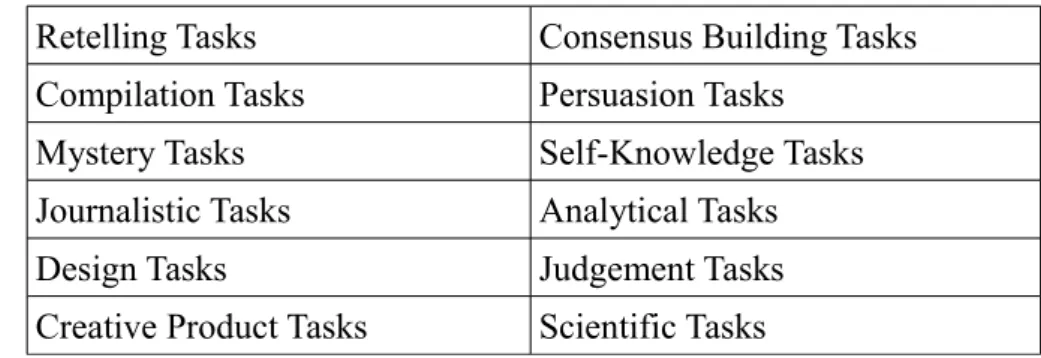
(14) Marta Pesudo Marco WebQuest Màster Professorat (UJI) A Top Secret Mission ____________________________________________________________________________ a) Introduction The aim of this part is to grab student's attention, in order to make it desirable and fun for them. The purpose of the motivational component is to present the topic visually appealing, relevant to the learner's both experiences and future interests (Dodge, 1995). b) Task This part focuses on what the learner has been asked to do, usually it states a specific problem or situation to be solved. Moreover, “a well designed task is doable and engaging, and elicits thinking in learners that goes beyond rote comprehension” (Dodge, 2002). Another important feature is that the WQ might relate the content of the WQ to the curriculum. In 2002, Dodge provided a Webquest taskonomy, related to higher level thinking: Retelling Tasks. Consensus Building Tasks. Compilation Tasks. Persuasion Tasks. Mystery Tasks. Self-Knowledge Tasks. Journalistic Tasks. Analytical Tasks. Design Tasks. Judgement Tasks. Creative Product Tasks. Scientific Tasks. Table 1: Taskonomy (Dodge, 2002). c) Process This section is where the teacher guides their students through different steps toward reaching their goal, the task itself. The steps might be broken into different sub-tasks so that all students can easily follow the activity. This section also includes students' roles. It may also include some guidance, also known as scaffolding, on how to organize the group as well as some strategies regarding collaborative work or linguistic reinforcement, when considereing WQ for L2. d) Resources This part consists of a list of web pages that the teacher preselects. Then, students have to read or watch or even search for more information in order to complete the task. It is crucial to insert not only web pages but also other kind of resources such as videos, songs, maps and so on. e) Scaffolding This is a temporary structure that encourages learners to do an activity more skilfully than they really are (Dodge, 2001). There are three types of scaffolding (Dodge, 2001):. 9.
(15) Marta Pesudo Marco WebQuest Màster Professorat (UJI) A Top Secret Mission ____________________________________________________________________________ •. Reception provides help to students to plan and to better understand what they are learning. Some examples of reception scaffolds are observation guides, timelines, glossaries and organisational charts.. •. Transformation refers to the guidance given to help students take the information and transform it into new knowledge using processes such as comparing, contrasting or reasoning.. •. Production relates to give students instruction to create a final product. This can be scaffolded by providing them with templates, writing and presentation guidelines.. Scaffolding is a key component in the design of a WQ, because some guidance is given beforehand by the teacher so that students might be able to fulfil the task. This idea was first developed by Vigotsky (1978) by introducing the idea of the “Zone of Proximal Development” which can be defined as the distance between what a student is able to do by his own and what he can do with the help of an adult or through collaboration with peers. f) Assessment In this part the students are given the different criteria upon they are going to be assessed on. This part of the WQ, although it comes at the very end, it has to be acknowledged since the beginning of the project. The most popular form of assessment is the rubric, which enables critical thinking due to its pattern of self-assessment and self-improvement (Stevens & Levi, 2011). g) Conclusion The goal of this section is to summarise and reflect upon what students have learned and also to encourage them to continue searching about the topic. The main critical attribute of a WebQuest according to March (2003) is to facilitate this transformation of information into a new constructed, assimilated understanding.. Figure 2: Transformation of information (March, 2003). 10.
(16) Marta Pesudo Marco WebQuest Màster Professorat (UJI) A Top Secret Mission ____________________________________________________________________________ 2.4.5. Non-critical attributes. There are as well some non-critical elements defined by Dodge (1995), which are the following: a) Group work Another important aspect is that students can work in groups, thus promoting team learning. Each student plays a role in the team and has a responsibility as well. Understanding something to subsequently explain it to the members of the team requires more effort than the traditional way of assessing by a final examination (Adell, 2004). It is important to mention that Johnson, Johnson & Smith (1998) concluded after a study that group learning is more effective than individual learning. b) Motivational elements The term motivation related to the learning and the acquisition of a second language has been at the centre of much discussion and research. Motivation is a term complicated to understand which depends on the way the different information learners receive in relation to a specific topic is assessed (Arnold & Fonseca, 2004). As it is known, motivation is crucial for the successful acquisition of knowledge and Dörnyei (1994) considered that motivation is determined by course-specific motivational components, teacher-specific motivational components and finally group-specific motivational components. In relation with the above, March (2003) argued that WQ are authentic tasks which motivate students to the pursuit of learning. In order to do so, WQ should follow the ARCS Model of Motivational Design by Keller in 1983 which stated that motivation is related to Attention, Relevance, Confidence and Satisfaction. The design of a motivational WQ should address these four elements according to its co-creator. March (2003) stated that in order to address attention and relevance teacher should choose a compelling topic and then create a task related to the real world. Regarding confidence, a solid scaffolding stage have to be delivered, so students will not get lost during the fulfilment of the activity. And finally, as for satisfaction, the election of an authentic task as well as appropriate web pages would increase the engagement of students' participation, otherwise they would feel as doing a traditional exercise but with a computer. c) Interdisciplinarity As Dodge (1995) stated, it is much more stimulating and challenging working with an. 11.
(17) Marta Pesudo Marco WebQuest Màster Professorat (UJI) A Top Secret Mission ____________________________________________________________________________ interdisciplinary WebQuest that with a single discipline area. However, it always depends on the purpose of the final activity. 2.4.6. WebQuests in an ESL context. In the last years, the inclusion of WQ in our classrooms have been very successful, so numberless web pages have been formed in order to help teachers to create new ones or to reuse WQ from other teachers. For example, here in Spain, there are well-known pages where collections of WQ for all levels and ready to be carried out with students appeared. This is the case of WebquestCat and Aula21.net. Besides, there are several authors who have created WQ and put it into practice in an educational context. It might be highlighted the work of Pérez, who developed a WQ for undergraduate students of English Studies related to the British press with the idea of improving their lexical competence. It is significant to explain Pérez work due to the fact that she had focused on the design and implementation of a WQ from the point of view of second language learning (Pérez, 2005). It is obvious that the implementation of WQ for teaching and learning a second language might be more complex than learning any other subject in the first language of the student. It is for this reason that a difference in the structure of WQ must be applied to make it a useful tool also in the area of language teaching in a L2 context. Pérez (2005) wrote that A WebQuest for teaching and learning a second language is an inquiry-oriented activity placed in a relevant thematic context, in which the development of the task implies using web resources and developing high order thinking processes in a collaborative environment. At the same time, it provides the students the opportunity to learn and put into practice some linguistic skills, supported by a set of linguistic and procedural scaffolding. Pérez (2005) defends that the main traits that have to be applied in the design of a WQ for second language learning are the following: •. Significant use of the L2. •. The level of linguistic knowledge. •. Linguistic and non linguistic goals. •. The result of the task. •. The process. 12.
(18) Marta Pesudo Marco WebQuest Màster Professorat (UJI) A Top Secret Mission ____________________________________________________________________________ •. The WQ must be integrated into the syllabus. •. The WQ should be planned to practise the language skills. As it has been said before, it is important to provide students guidance by providing the appropriate scaffolds, however when dealing with second language WQ, this part becomes much more relevant. Then, direct instructions in the original WQ model have to be considered to ensure that the WQ is a language oriented activity and in this way learners will be conscious of their language learning experience (Pérez, 2005). Bearing in mind all these aspects, the WQ “A Top Secret Mission” has been created. 3 METHOD 3.1. Research questions. In order to analyse the impact of learning English when implementing a WQ, the following questions are addressed: •. To what extent does the WQ contribute to improve students' digital competence?. •. To what extent does the WQ contribute to acquire cultural competence?. •. To what extent does the WQ contribute to motivate students towards learning English?. These questions are going to be answered after the implementation of the computer-based activity and the post-questionnaires, in order to see students' attitudes and opinions about this new teaching tool. It has to be pointed out that the main objective of this study is to assess whether the strategy of the WQ is useful to motivate students to learn a foreign language. In addition, the study wants to check if this tool also helps at improving participants' digital competence as well as cultural competence. For this purpose, the WQ model has to be designed in order to prove that this would be possible. 3.2. Students and school setting. This didactic unit has been carried out in the IES Vila-Roja which is located in Almassora, a town near Castelló. Almassora has a total population of over 27.000 inhabitants and there are two high schools, both of them states centres. The IES Vila-Roja is a centre of recent construction, which dates from 2003. This centre covers the gaps and complements the activities of the other high school, IES Álvaro Falomir. For this reason, IES Vila-Roja might be considered a modern secondary school, with a wide range of ICT equipment available for students and for teachers. The facilities available in this. 13.
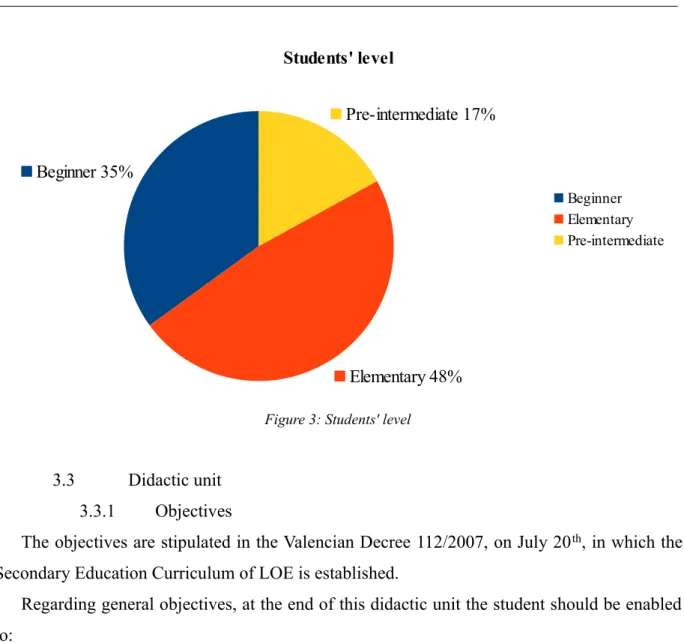
(19) Marta Pesudo Marco WebQuest Màster Professorat (UJI) A Top Secret Mission ____________________________________________________________________________ high school are an assembly hall, two computer laboratories, one audiovisual laboratory, two technology classrooms, one science laboratory, one sport centre and a multifunctional room. Moreover, the classrooms assigned to Bachillerato sessions are well-equipped with a computer, a screen, a projector and a set of speakers. It is worth mentioning that the high school has a good Internet connectivity, that meets the basic teachers' needs to work with ICT. Currently, the educative institution gathers over 600 students from first ESO to second of Bachillerato, as well as the vocational training courses. A total of 70 teachers are working at present. It is interesting to point out that the IES Vila-Roja has obtained one of the highest grades in the university entrance examination that took place at the Universitat Jaume I in June 2015. This high school is the third centre with the highest average mark in the province of Castelló, with a grade of 7.14 (SCP, 2015). This didactic unit has been implemented in a third year of compulsory secondary education, in a class composed by 23 students where Núria Ortiz Soler teaches English three times per week. Taking into account the results presented after passing the level test Essential Grammar in Use from Cambridge, it could be firmly stated that there are significant differences among the students' proficiency of English. The level test comprises 50 questions regarding grammar from an elementary level to a pre-intermediate level (see Annex 1). Results show that 35% of students did not achieve a minimum of 25 corrected answers. Then, it could be affirmed that 48% of students would be considered to be at an average level as long as they have answered correctly between 25 and 35 questions. It is important to mention that 17% of students have obtained 36, 37, 40 and 45 respectively in the level test. To sum up, it is crystal clear that there is a considerable gap among the students, which might be taking into consideration when forming the working groups. Considering the Common European Framework of Reference for Languages (CEFR) the students are divided into three different levels which describes what a learner is able to do in English. Therefore, there is the beginner level (A1), the elementary level (A2) and the preintermediate level (A2+).. 14.
(20) Marta Pesudo Marco WebQuest Màster Professorat (UJI) A Top Secret Mission ____________________________________________________________________________ Students' level Pre-intermediate 17% Beginner 35% Beginner Elementary Pre-intermediate. Elementary 48% Figure 3: Students' level. 3.3. Didactic unit 3.3.1. Objectives. The objectives are stipulated in the Valencian Decree 112/2007, on July 20 th, in which the Secondary Education Curriculum of LOE is established. Regarding general objectives, at the end of this didactic unit the student should be enabled to: •. Read real pieces of text autonomously in English.. •. Participate in activities and group work which develop confidence and initiative to express themselves in public and in writing.. •. Identify and respect the customs and daily life features of other countries and their cultures, in this case the different English-speaking countries.. •. Foster critical thinking by sharing and discussing different topics related with culture.. Considering specific objectives, the students will be enabled to: •. Produce a short and coherent oral text about certain topics.. •. Be interested in a neat presentation of the written texts, on paper or digital.. •. Use words and expressions related to the topics.. •. Use the most common structures and functions of the language, with an adequate pronunciation and intonation. 15.
(21) Marta Pesudo Marco WebQuest Màster Professorat (UJI) A Top Secret Mission ____________________________________________________________________________ 3.3.2. Contents. As concepts, students will work through a WQ called “A Top Secret Mission”, they will gain cultural-consciousness. At the end of this didactic unit they will be asked to elaborate a visual presentation along with an individual document as final products. Oral language will be practised in terms of expressing opinion and showing interest. As procedures, students will be able to read specific information in English, understand and interpret different sources of information, as well as, write in English autonomously. The use of Internet as well as PowerPoint will be practised in order to fulfil the main task. And finally, as attitudes, students will be more autonomous, they will do group work, for this reason they have to discuss and foster critical thinking. They will learn the most significant differences among the customs, behaviours, attitudes and values of different societies whose language is being studied. 3.3.3 •. Key Competences. Linguistic competence. It refers to the use of language as a means of both oral and written communication. All the activities designed for the WQ have a communicative outcome of some kind. On the one hand, students are asked to read several web pages in English in order to enrich their communication skills by understanding the way language is structured. Besides, students must show that they are able to use the language in an appropriate situation, both in writing and speaking. •. Autonomy and personal initiative competence. Generally speaking, the learning of a foreign language using a WQ contributes to the achievement of this competence because it encourages teamwork in the classroom. Students should be encouraged to adopt procedures which allow them to use their own initiative and decision-making skills during the organization of the WQ and during other stages. •. Digital competence and treatment of information. It refers to the ability to search, obtain, process and communicate information and turn it into knowledge. It includes different aspects that go from information access and selection to the use and transmission of it in different media, such as on paper or digital. The use of ICT has a key role in this didactic unit. Firstly, teaching a foreign language can be a natural and spontaneous way to indirectly use ICT tools. Secondly, students can have an authentic input of the English language by means of the different web pages provided by the teacher. Finally, ICT. 16.
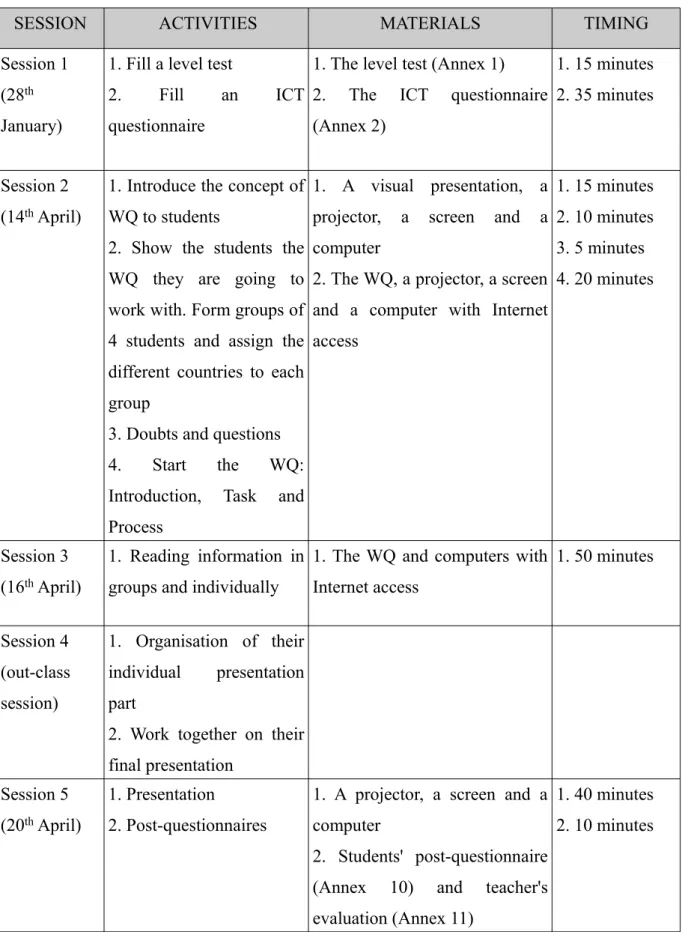
(22) Marta Pesudo Marco WebQuest Màster Professorat (UJI) A Top Secret Mission ____________________________________________________________________________ tools are truly useful to develop other key competences of the curriculum, such as developing autonomous learning, knowledge and interaction with the physical world and treatment of information. •. Knowledge and interaction of the physical world competence. It is the ability to interact with the physical world, this competence is achieved while surfing the different sources preselected. The understanding of the geographical, historical and artistic aspects of a country increases students' awareness of the physical world of a country. •. Learning to learn. This competence implies that students are aware of their own ability to learn a foreign language. By working through a WQ, which implies a learner-centred work, students must organise and manage their own work and time. Thus, the organisation of one's work not only individually but also in groups is the most obvious way in which this competence can be developed. •. Cultural competence. One of the most important competence implied in this didactic unit. This competence involves appreciating, understanding and valuing cultural expressions from a critical perspective, as well as to use them as a source of enjoyment. In addition to that, learning a foreign language gives students the means to express their opinions or create a piece of original spoken and written work, in this case a visual presentation. 3.3.4. Methodology. The WQ is an inquiry-oriented activity in which most or all of the resources and scaffolds used by learners are drawn from the web (Dodge, 1995). This web environment promotes the autonomous learning by means of the digital tools. This kind of teaching is in connexion with a learner-centred approach (March, 2003). This approach involves a different role for the teacher, since he becomes a guide helping students to form groups, checking learners understand the tasks and controlling individual and group work. Furthermore, this web-based model fosters autonomy in the sense that it includes scaffolding as best suits learner by increasing or fading it (March, 2003). Not to mention, group work which is also key in this kind of methodology since every member must contribute to the fulfilment of the final task.. 17.
(23) Marta Pesudo Marco WebQuest Màster Professorat (UJI) A Top Secret Mission ____________________________________________________________________________ 3.3.5. Materials. a) WebQuest The WQ requires the use of a computer with Internet access, at least it would be advisable that each group might have access to one computer to work with. Students will need to work autonomously at home from time to time. However, some lessons will be devoted to let them work in groups or to elaborate the final presentations. One of the main sections of the WQ is the 'Resources' section. In this section, the teacher has provided the students with several web sites selected beforehand. According to Dodge (2001), March (2003) and Pérez (2006), it is not the task of students to search for information but to process it, thus the importance for the teacher to select the appropriate materials. b) Pre-questionnaire The pre-questionnaire (see Annex 2) consists of 5 questions, which have the purpose of knowing the digital competence the classroom has. The items asked are the following: •. Internet access at home. •. Devices used when searching information. •. Use of digital tools. •. Purpose of using these digital tools. •. Familiarity with WQ. c) Students' post-questionnaire The post-questionnaire (see Annex 10) comprises 8 questions which are close-questions, apart from one which is an open-question. The items expected to answer are the following ones: •. Close-questions: ◦ Usefulness of WQ to learn English ◦ Motivation using ICT ◦ Usefulness of ICT to acquire knowledge ◦ Perceptions about the WQ in terms of improving the digital competence ◦ Appropriateness of selected pages to learn culture ◦ Perceptions to learn culture through the WQ ◦ Willingness to work with a WQ. 18.
(24) Marta Pesudo Marco WebQuest Màster Professorat (UJI) A Top Secret Mission ____________________________________________________________________________ •. Open-question: ◦ Students' feelings while working with the WQ. d) Secondary school teacher's post-questionnaire Teacher's evaluation (see Annex 11) consists of 7 open-questions which aimed at ensuring the perceptions whether it has been successful to implement a web-based teaching approach in a 3rd year of compulsory secondary education or not. The questions have as a goal responding the following items: •. Students' implication. •. Students' interest. •. Improvement on cultural competence. •. Improvement on digital competence. •. Improvement on searching information. •. Students' reflections upon the importance of using ICT and acquiring a second language. •. Implementation in the curriculum 3.3.6. Timing. This didactic unit is intended to be implemented in four in-class sessions of approximately 50 minutes. Apart from this, one out-class session might be required with a varying duration depending on the different group's rhythm, it might vary from 1 to 3 hours.. 19.
(25) Marta Pesudo Marco WebQuest Màster Professorat (UJI) A Top Secret Mission ____________________________________________________________________________ 3.3.7 SESSION. Sessions ACTIVITIES. MATERIALS. TIMING. Session 1. 1. Fill a level test. (28th. 2.. January). questionnaire. Session 2. 1. Introduce the concept of 1. A visual presentation, a 1. 15 minutes. (14th April). WQ to students. Fill. an. 1. The level test (Annex 1) ICT 2.. The. ICT. 1. 15 minutes. questionnaire 2. 35 minutes. (Annex 2). projector,. a. screen. and. a 2. 10 minutes. 2. Show the students the computer. 3. 5 minutes. WQ they are going to 2. The WQ, a projector, a screen 4. 20 minutes work with. Form groups of and a computer with Internet 4 students and assign the access different countries to each group 3. Doubts and questions 4.. Start. Introduction,. the Task. WQ: and. Process Session 3. 1. Reading information in 1. The WQ and computers with 1. 50 minutes. (16th April). groups and individually. Session 4. 1. Organisation of their. (out-class. individual. session). part. Internet access. presentation. 2. Work together on their final presentation Session 5. 1. Presentation. 1. A projector, a screen and a 1. 40 minutes. (20th April). 2. Post-questionnaires. computer. 2. 10 minutes. 2. Students' post-questionnaire (Annex. 10). and. evaluation (Annex 11) Table 2: Sessions. 20. teacher's.
(26) Marta Pesudo Marco WebQuest Màster Professorat (UJI) A Top Secret Mission ____________________________________________________________________________ 3.3.8. Development. a) First in-class session Firstly, two different tests were handed. The first one related to the ICT knowledge, which is relevant in order to obtain an overall view of students' abilities with the new technologies, as well as know if they have access to Internet at home. This last piece of information is very important due to the lack of time available to implement this didactic unit, so one out-class session is needed. The second test is addressed to know the level of English of the group. This is also paramount to start designing the WQ. b) Second in-class session Here, a presentation about the WQ is going to be made in order to make students familiar with the concept. The reasons for using this tool are going to be explained as well as the organization of the next sessions. Some time is spent discussing about the idea of working with computers and Internet in class, so they make suppositions about the difference between learning with books compared to learning with computers. Then, the session is devoted to form groups of four students considering their results in their last English exam. The criteria followed to divide students was based on an idea developed by Sheila Silversides (in Gregory & Chapman, 2002) where students are grouped into four that include a beginning-level student, two average-level students, and an expert-level student. Hence, they would be able to give the most of them in the development of the activity. Groups are responsible of assigning the different countries. Finally, the WQ is started: Introduction, Task and Process. c) Third in-class session This session is entirely dedicated to search information on the computer lab. First of all, the students are placed in groups because there are some web pages they have to see together. Then, they are seated individually in order to work on their specific role. From time to time, they may be seated in groups in order to discuss the information found. During the session, the teacher explains some important aspects of their work which is already included inside the WQ. However, the teacher wants to be sure that every student gets to the minimum. The teacher writes in the blackboard: •. Full sentences. •. Use of pictures. •. Cooperation. •. Useful language for the final presentation. 21.
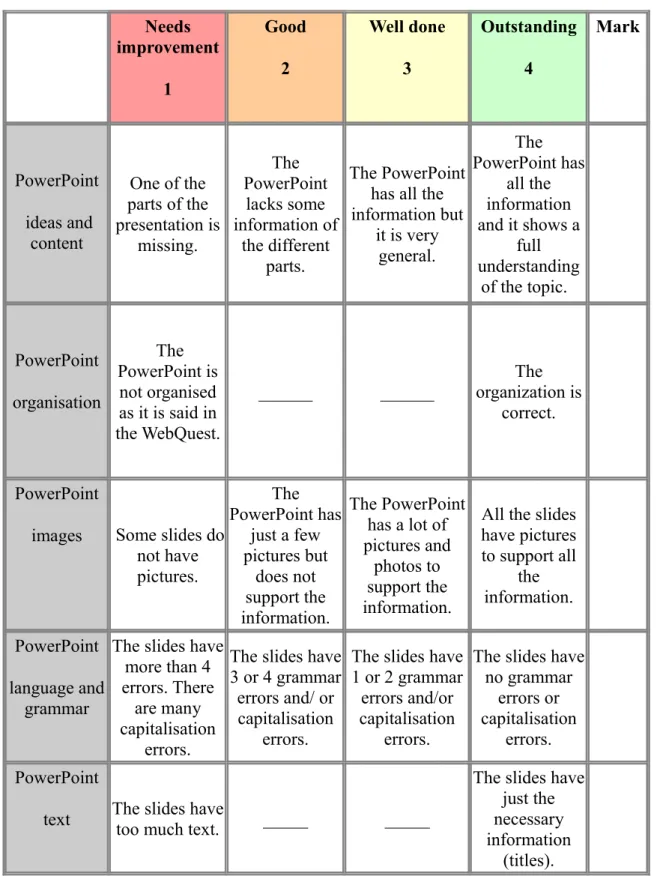
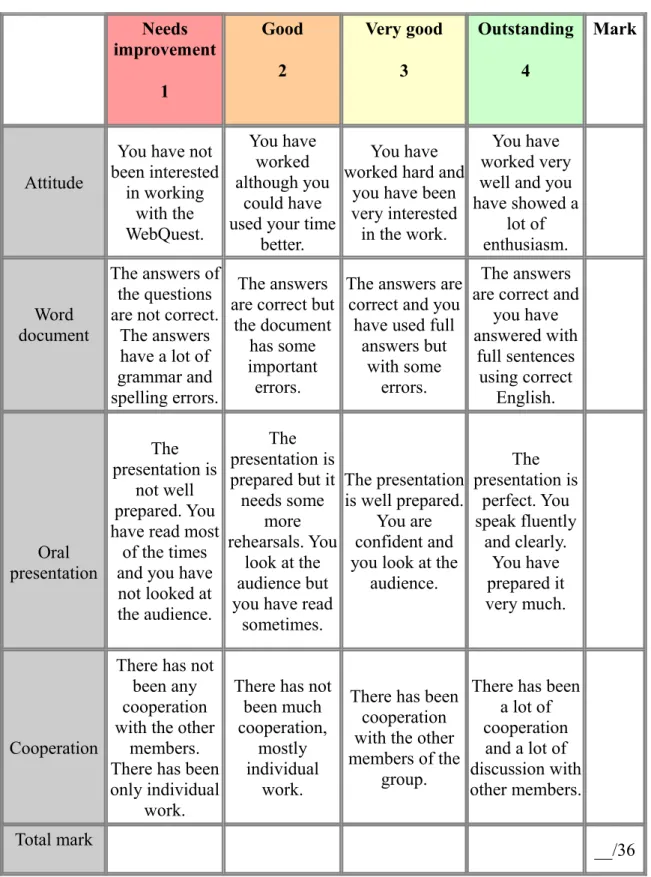
(27) Marta Pesudo Marco WebQuest Màster Professorat (UJI) A Top Secret Mission ____________________________________________________________________________ d) Fourth in-class session This session is devoted to listen to the oral presentations from the different groups. They are assessed following the different rubrics (see Annexes 3-4). At the end of the session, the students are asked to complete a post-questionnaire to know their opinions about the implementation of the WQ. Their English teacher is also asked to write down her impressions about the activity and students' work. e) Out-class sessions Depending on the students' rhythm, some extra sessions may be needed to finish the searching or the elaboration of the oral presentation. 3.3.9. Assessment. Evaluation is considered in terms of group working and individual work, following two different rubrics. The individual rubric (Annex 4) is composed of four different items. The first one takes into account the attitude towards the activity and the English language. The second one is related to the cooperation among peers. The third one is aimed at ensuring that students have read the different web pages provided, so a written document has to be delivered at the end of the lab session. The last item evaluates their performance in the oral presentation. The group work rubric (Annex 3) consists of five items. The first one deals with the content and the ideas appeared in the PowerPoint presentation. The second one is about organisation. The third item focuses on the good use of the graphics. The fourth item is related to the correctness of the language and the grammar mistakes. Finally, the last one deals with the amount of text used.. 22.
(28) Marta Pesudo Marco WebQuest Màster Professorat (UJI) A Top Secret Mission ____________________________________________________________________________ Rubric group work Needs improvement. Good. Well done. Outstanding. 2. 3. 4. 1 The The PowerPoint has The PowerPoint PowerPoint One of the PowerPoint all the has all the parts of the lacks some information ideas and presentation is information of information but and it shows a it is very content missing. the different full general. parts. understanding of the topic. The PowerPoint is not organised organisation as it is said in the WebQuest. PowerPoint. PowerPoint images. ______. ______. The The PowerPoint PowerPoint has All the slides has a lot of Some slides do just a few have pictures pictures and not have pictures but to support all photos to pictures. does not the support the support the information. information. information.. PowerPoint The slides have more than 4 language and errors. There are many grammar capitalisation errors.. The slides have The slides have The slides have 3 or 4 grammar 1 or 2 grammar no grammar errors and/ or errors and/or errors or capitalisation capitalisation capitalisation errors. errors. errors.. PowerPoint text. The organization is correct.. The slides have too much text.. _____. _____. Table 3: Rubric group work. 23. The slides have just the necessary information (titles).. Mark.
(29) Marta Pesudo Marco WebQuest Màster Professorat (UJI) A Top Secret Mission ____________________________________________________________________________ Rubric individual work Needs improvement. Good. Very good. Outstanding. 2. 3. 4. Mark. 1. Attitude. Word document. You have You have You have not You have worked worked very been interested worked hard and although you well and you in working you have been could have have showed a with the very interested used your time lot of WebQuest. in the work. better. enthusiasm. The answers of The answers The answers are the questions are correct but correct and you are not correct. the document have used full The answers has some answers but have a lot of important with some grammar and errors. errors. spelling errors.. The presentation is not well prepared. You have read most of the times Oral presentation and you have not looked at the audience.. The presentation is prepared but it needs some more rehearsals. You look at the audience but you have read sometimes.. The answers are correct and you have answered with full sentences using correct English.. The The presentation presentation is is well prepared. perfect. You You are speak fluently confident and and clearly. you look at the You have audience. prepared it very much.. There has not been any There has not There has been There has been cooperation been much a lot of cooperation with the other cooperation, cooperation with the other Cooperation members. mostly and a lot of members of the There has been individual discussion with group. only individual work. other members. work. Total mark. __/36 Table 4: Rubric individual work. 24.
(30) Marta Pesudo Marco WebQuest Màster Professorat (UJI) A Top Secret Mission ____________________________________________________________________________ 3.4. The WebQuest. The didactic unit can be found at http://www.webquest.net63.net/start.htm which was created for the purpose of this study. Start. Figure 4: Start (Pesudo, 2015). As it is said in the definition of the WQ by Dodge (1998), it is crucial that students get hooked at the very beginning. This was the idea when naming it as “A Top Secret Mission”, it is supposed that students think that they are going to work through something that has to be kept in secret.. 25.
(31) Marta Pesudo Marco WebQuest Màster Professorat (UJI) A Top Secret Mission ____________________________________________________________________________ Introduction. Figure 5: Introduction (Pesudo, 2015). The introduction provides a clear explanation of the lesson. In this case, it is explained that they have been asked to work for Angelina Jolie and Brad Pitt in order to help them to decide where to go this summer. Moreover, a picture of them appears in order to catch students' attention since they are a well-known American couple and to make the task more credible. In addition, it is said that they are going to work in groups.. 26.
(32) Marta Pesudo Marco WebQuest Màster Professorat (UJI) A Top Secret Mission ____________________________________________________________________________ Task. Figure 6: Task (Pesudo, 2015). The next section is the task where two activities are described. They are asked to answer some questions depending on the role they have chosen, and then to create a PowerPoint in group. The first task which is a guideline document (see Annexes 5-8) serves as reception scaffold which has been demonstrated to positively affect student accomplishment (March, 2003). These documents consist of several questions to help students understand better the task. Their goal is to find the answer in the different pages appeared in the Resources section. Furthermore, it encourages them to create an appealing presentation, thus their goal is to persuade the couple.. 27.
(33) Marta Pesudo Marco WebQuest Màster Professorat (UJI) A Top Secret Mission ____________________________________________________________________________ Process. Figure 7: Process (Pesudo, 2015). 28.
(34) Marta Pesudo Marco WebQuest Màster Professorat (UJI) A Top Secret Mission ____________________________________________________________________________ This part consists of steps that guide carefully students towards the final task. This part is formed by six clear instructions as well as some tips for making a good presentation. Therefore, this is the scaffolding part of the lesson. The first step aims at dividing the class into six different groups formed of four members, it has to be said that the groups have been designed by the teacher, as it has been explained before. The instruction number two gives students the opportunity to decide which role each student desires to take. The roles are described as well. The objective of step three is to guide them on how to start the research of information. First of all, a video has to be seen in group and some web pages. Afterwards, they are asked to work individually according to their assigned role by visiting web sites already selected. As it has been explained before, students have to fill four guideline documents with the specific information appeared on the different web pages, each document corresponds to each role (see Annexes 5-8). The aim of the fourth direction is to stimulate them to share their findings and to discuss about them so as to organise the different information in their PowerPoint. This step is in connexion with the transformation scaffold because it facilitates the transformation of the information they have read. The fifth step makes them work collaboratively to build the presentation. In addition, the use of pictures is crucial for their final mark. And finally, the sixth step suggests that only a good presentation will be delivered if they practice it at home with the aid of the pages the teacher has uploaded in the WQ. The web sites offered here are related to the production scaffold since they are useful to create students' final task.. 29.
(35) Marta Pesudo Marco WebQuest Màster Professorat (UJI) A Top Secret Mission ____________________________________________________________________________ Resources. Figure 8: Resources (Pesudo, 2015). This section gathers the different web pages students have to visit in order to search the specific information asked in the previous part. The web sites are classified according to countries and then depending on the specific role. The structure is very clear so students can easily find them. Each member has three different web pages to visit that contain the appropriate information to answer the questions appeared in the guideline document. The web pages selected, although they are assigned to native English speakers, they are easy and with a lot of images to make the information clearer. As it has been emphasized before, a solid scaffolding should be delivered. In this part, the Wordreference dictionary, the PowerPoint tutorial and the British Council web page are used as scaffolds. In particular, the Wordreference dictionary works as a reception scaffold according to Dodge (2001) because students can look up for any word to better understand the text. In the. 30.
(36) Marta Pesudo Marco WebQuest Màster Professorat (UJI) A Top Secret Mission ____________________________________________________________________________ same way, the PowerPoint tutorial and the British Council web page, the latter displays some useful expressions and an oral presentation is presented as an example, are delivered as production scaffolds because they are important for students to elaborate the task. These resources are very important to make students more autonomous in their teaching and learning process. Assessment This part includes two different rubrics in order to grade on student's work during the different sessions. What is more, the rubrics are also a guide for students so they know since the beginning what the teacher will take into consideration to give them a final mark. Assessment includes group and individual work. To see the different items visit the WQ page: http://www.webquest.net63.net/assessment.htm. The different items have been explained previously. Conclusion. Figure 9: Conclusion (Pesudo, 2015). 31.
(37) Marta Pesudo Marco WebQuest Màster Professorat (UJI) A Top Secret Mission ____________________________________________________________________________ This is the last part of the lesson, in this part the teacher tries to outline what students should have learned. In this case, what is more important here is to encourage learners to keep on reading as well as discussing general topics in English. The aim is to reflect upon what they have been able to do through the WQ and that all has been done in English. Teacher's page This section has been included in the WQ to help other professionals ready to use it or to create a similar one considering some academic standards such as students' background, curricular objectives, contents, key competences, timing and assessment. 4 RESULTS This section consists of two parts. In the first part, the development of students final presentations is described. The second section analyses the results of both the pre-questionnaire and the post-questionnaire fulfilled by students and the secondary English teacher. 4.1. Task. WebQuests are characterized by the use of web resources in a constructivism way, that is to say, students construct their own knowledge by interpreting their personal learning experience according to their beliefs and prior knowledge. This approach is basically based on the works of Piaget (1972) and Vigotsky (1978). At the end of the activity, students will have done a research work which concludes with the final task. This task consists of a heading, and four different parts related to each role. They have used pictures rather than text, thus their explanation have to be supported by images instead of blocks of text. Even though it was a challenging task for them, the vast majority succeed in including just pictures and giving a good presentation. As mentioned before, each student has a different role, and their aim is visiting the different pages preselected by the teacher so they will become experts. Next, they should explain what they have found to the members of their group and, then, collaboratively prepare the PowerPoint presentation. Groups consist of four students corresponding to the different roles: the geographer, the historian, the gastronome and the entertainment researcher. An example of the final presentation of the United Kingdom is given (Annex 9).. 32.
(38) Marta Pesudo Marco WebQuest Màster Professorat (UJI) A Top Secret Mission ____________________________________________________________________________ The geographer makes a small presentation about the location of the country, its main cities, as well as other aspects such as the meaning of the flag, currency and other languages.. Figure 10: Geographer, students' task. The historian talks about the main monuments and a description of a festivity, focusing on what citizens usually do on that particular day.. Figure 11: Historian, students' task. 33.
(39) Marta Pesudo Marco WebQuest Màster Professorat (UJI) A Top Secret Mission ____________________________________________________________________________ The gastronome describes the most common food and explains one of the most typical recipes from the UK. Finally, the British and the Spanish cuisine is compared.. Figure 12: Gastronome, students' task. The entertainment researcher speaks about cultural aspects such as music, bands and other important celebrities born there.. Figure 13: Entertainment researcher, students' task. 34.
(40) Marta Pesudo Marco WebQuest Màster Professorat (UJI) A Top Secret Mission ____________________________________________________________________________ 4.2. Analysis of the questionnaires 4.2.1. Pre-questionnaire. The objective of the pre-questionnaire is to know the digital competence of the students as well as the availability of working through a WQ at home, since it was foreseen that an extra out-class session might be needed. Results from Question 1 show that the 100% of students in class have access to Internet at home, so they would be able to work with the WQ at home with any problem. Results from Question 2 aim at knowing the type of devices they usually work with when they search on the Internet: 96% out of all the students usually use their mobile phones, however the use of laptop 87% and the use of a desktop computer 70% are broadly used as well. Therefore, it could be said that their level of computer skills is advanced. Results from Question 3 focus on the use of some digital tools such as PowerPoint, the Word processor and the search engines which are paramount for the right development of this WQ. Regarding search engines, 91% of students make use of them daily. Moreover, Word processor is also used since 65% out of students claim to use it regularly. Nevertheless, 74% of students state that they use the PowerPoint on rare occasions and 13% claim that they have never used it. Results from Question 4 show students' purpose regarding the use of ICTs. •. To communicate using social networks: 70% use them daily and 13% state that they have never used them to do so.. •. For boredom: 70% claim that they use ICTs in order to not get bored.. •. To find information about personal interests: 52% of students employ it monthly and 39% use it daily for this purpose.. •. To do homework of any subject: 61% claim to surf the Internet to search information weekly.. •. To do homework of English subject: 56% say they make use of the web weekly. Results from Question 5 want to check whether the students were already familiar to the WQ or not, 30% of the students answered they do, however, regarding the answers about their personal experience with the WQ, it is clear that there must have been a misunderstanding because answers were: ➢ S1: Sí, l'he consultada alguna vegada. ➢ S2: Sí, en una enquesta de futbol.. 35.
(41) Marta Pesudo Marco WebQuest Màster Professorat (UJI) A Top Secret Mission ____________________________________________________________________________ ➢ S3: Sí, però quasi mai l'utilitze. 4.2.2. Students' post-questionnaire. The purpose of the post-questionnaire is to assess the implementation of the WQ in terms of motivation, improvement of their digital competence and their cultural competence to obtain the usefulness of this web-based approach in a third year of ESO. An evaluation questionnaire carried out by the English teacher is also taken into account. Question 1 aims at asking students about the suitability of the WQ to acquire a language, there is 83% of conformity among students, however a 17% refuse it. Some arguments from Question 1 have been the following: ➢. S4: Sí, crec que és interessant perquè ens dóna molta fluïdesa amb l'anglés oral i és una. forma diferent d'aprendre. ➢. S5: Sí, és una forma diferent d'estimular les nostres ambicions per l'anglés o bé, pel. tema en qüestió i a més aprens vocabulari. ➢. S6: No, perquè és molt més útil aprendre'l a classe que amb un ordinador.. Usefulness of the WQ to learn English 90. 83%. 80 70 60. Yes No DK/DA. 50 40 30 20. 17%. 10. 0%. 0 Question 1. Figure 14: Question 1, post-questionnaire. 36.
(42) Marta Pesudo Marco WebQuest Màster Professorat (UJI) A Top Secret Mission ____________________________________________________________________________ The objective of Question 2 is to know students' reactions and opinions while learning with the computer-based model. This has been an open question, here there are some answers from students: S7: M'he sentit amb ganes perquè feia temps que volia fer una cosa pareguda i per fi ha. ➢. arribat el moment. S8: No m'ha agradat. Buscar informació em dóna igual, però eixir davant dels meus. ➢. companys fatal, perquè em pose nerviosa. ➢. S9: Bé, perquè els meus companys i jo ens ajudàvem.. ➢. S10: M'ha paregut una feina fàcil i molt entretinguda. Sempre està bé conèixer coses. d'altres països. S11: Divertit perquè m'agrada fer presentacions.. ➢. Question 3 is designed to ask students about the motivation towards using ICTs in the learning process, a great percentage of students 83% agree with the statement, although 13% disagree with this, and 4% have no view. Some arguments from Question 3 have been the following: S12: Sí, perquè com tot l'any seguim el guió del llibre, és interessant eixir-nos del guió i. ➢. fer coses noves. S13: No, perquè és millor estudiar-lo pel llibre, ja que poden haver-hi problemes o. ➢. errors en pàgines. Motivation using ICT 90 80 70 60 50 40 30 20 10 0. 83%. Yes No DK/DA 13% 4% Question 3 Figure 15: Question 3, post-questionnaire. 37.
(43) Marta Pesudo Marco WebQuest Màster Professorat (UJI) A Top Secret Mission ____________________________________________________________________________ Responses to Question 4 reveal that 83% of students consider that, thanks to ICTs, they have been able to acquire knowledge. Only 17% of students differ with that. Some reason they have given are: S14: No, crec que s'adquireix el mateix coneixement, però com és una forma diferent,. ➢. resulta més motivant per als alumnes. S15: Sí, perquè a banda d'aprendre temari, aprenem a utilitzar l'ordinador i a moure'ns. ➢. per internet. ➢. S16: Sí, perqué és una forma fàcil d'accedir a tot tipus d'informació.. ➢. S17: Sí, perqué pots conéixer gent nativa (d'Estats Units, Regne Unit, etc.) i, ja com. abans havia dit, veure vídeos, llegir articles d'allò que ens interesse.. Usefulness of ICT to acquire knowledge 90. 83%. 80 70 60. Yes No DK/DA. 50 40 30 20. 17%. 10. 0%. 0 Question 4. Figure 16: Question 4, post-questionnaire. 38.
(44) Marta Pesudo Marco WebQuest Màster Professorat (UJI) A Top Secret Mission ____________________________________________________________________________ Regarding Question 5 that aimed at knowing whether the WQ helped at improving their digital competence, the responses show that 65% agree with that, while 35% of students disagree. Some reasons are: ➢. S18: No, jo ja sabia bastant sobre buscar informació.. ➢. S19: Sí, perquè te dóna els passos per buscar les coses.. ➢. S20: Sí, perquè es tracta d'incloure sols el necessari i elimines continguts que poden. resultar avorrits o poc importants. S21: No, perquè teníem les pàgines que havíem de buscar i no havíem de buscar-les. ➢. nosaltres.. Perceptions of the WQ in terms of improving the digital competence 70. 65%. 60 50 40. Yes No DK/DA. 35%. 30 20 10 0%. 0 Question 5. Figure 17: Question 5, post-questionnaire. 39.
Figure

+7



Documento similar
On the other hand at Alalakh Level VII and at Mari, which are the sites in the Semitic world with the closest affinities to Minoan Crete, the language used was Old Babylonian,
“ CLIL describes a pedagogic approach in which language and subject area content are learnt in combination, where the language is used as a tool to develop new learning from a
Critical period effects in second language learning: The influence of maturational state on the acquisition of English as a second language.. Encyclopedic dictionary of
Critical Period effects in second language learning: The influence of maturational state on the acquisition of English as a Second Language.. The high school achievement of
Parameters of linear regression of turbulent energy fluxes (i.e. the sum of latent and sensible heat flux against available energy).. Scatter diagrams and regression lines
It is generally believed the recitation of the seven or the ten reciters of the first, second and third century of Islam are valid and the Muslims are allowed to adopt either of
In the preparation of this report, the Venice Commission has relied on the comments of its rapporteurs; its recently adopted Report on Respect for Democracy, Human Rights and the Rule
In two dimensions, we have considered the prob- lem of prescribing Gaussian and geodesic curvatures on topological disks via confor- mal transformation of the metric, while we
