
TítuloAssessing Renewable Energy Sources for Electricity (RES E) Potential Using a CAPM Analogous Multi Stage Model
20
0
0
Texto completo
(2) Energies 2019, 12, 3599. 2 of 20. Portfolio Theory to design efficient power-generation real asset portfolios [9–22]. This proposal is in the line with other well-known optimisation models such as multi-period linear programming [1,5], interval linear programming [3,23,24], or stochastic programming [2,25–27]. Energy planning can be seen as a long-term investment selection problem. The aim is to design the composition of the generation mix by complying with the economic, social, and environmental criteria set for a territory or region [10,14–17]. This approach is similar to that of the Energy Trilemma from Stempien and Chan (2017) [28], which encompasses energy security, energy sustainability, and energy equity. The proposal includes both the traditional energy planning approach about the minimisation of cost of the future power-generation portfolio that satisfies the power demand [2,4,11,29] and the current trends observed in the literature about the need of considering the risk and the uncertainty of the energy and climate context [2–4]. We employ the Modern Portfolio Theory (MPT) methodology. It allows us to include some fundamental matters in the analysis, like energy security [30–32]—through the study of the portfolio diversification—and its positive effects on the power supply disruption [12–14,17,33]. Energy security is a key element in the agenda of the energy-resource-importing countries [34]. Setting and managing their energy policy objectives are essential for these countries to reduce the energy risk arisen from importing resources [7,35]. Increasing the renewable energy sources (RES), improving the energy efficiency, and reducing CO2 emissions [34] are objectives that empower the environmental aspect as well as improve the level of energy security. The aim is to adjust the available resource consumption and to give priority to indigenous technologies (renewable technologies) in power generation. This leads to reducing the dependence on imported fossil combustibles, to decreasing the pollutant gas emission—as these technologies are non-pollutant—and to using natural resources that are not constrained by a future depletion of reserves [5,36,37]. Thus, we can conclude that energy planning and environmental protection are two sides of the same coin [38,39]. Our approach falls within the research line aiming at including sustainable development principles inside long-term environmental and energy planning [40–42]. Examples of this environmental commitment are establishing objectives for the reduction of pollutant gases emission [14,17,31–33], for including the externalities derived from power generation [10,41–45], or for taking into account the CO2 emission costs [10,18,29,46–48] by establishing markets like the EU Emissions Trading System (EU-ETS) [49–52]. Such a set of measures helps policy makers fix the “market failure” [44] and assign resources in a way that is optimal and efficient [41,45]. In this context, renewable technologies appear as a part of the solution due to their multiple positive features: they do not emit pollutant gases, they do not depend on fossil fuels, and thus they are not subject to geopolitical risks; as they have an autonomous character, they reduce the energy dependency [16,33,53–55]. Our proposal may improve the previous approach of Martinez et al. (2018) [56], employing and developing the initial financial concept of the Capital Market Line to a realistic power portfolio case. The process starts by characterizing the power-generation-emitting technologies according to their emission and risk. The objective is to minimize the power-generation emission level. In other words, we opted to minimize the emission amount (kg-CO2 /MWh) instead of minimizing its monetary value. This allows us to achieve a result that equalises the imbalance caused by the minimization of emission costs [57]. The model solution results in the power-generation mix that minimizes CO2 emissions. The model consists of a multi-stage MPT model of quadratic optimization. Among the criticism of employing the MPT to implement power-generation optimization, we find the original MPT being applied to fungible and almost infinitely divisible financial assets. As a matter of fact, power-generation plants are neither fungible nor divisible assets. We commented that the MPT, when applied to power generation, should be understood as a tool for decision-making in the mediumand long-term and for a relatively vast territory (a country or region). Under these assumptions, power-generation plants can be considered fungible and divisible assets. This study could be presented as a case of the European Union, due to the definition of technological limitations in the proposed MPT.
(3) Energies 2019, 12, 3599. 3 of 20. model. However, data on technological costs and emission factors belong to international institutions (IEA), which could allow us to talk about a general case and not only a European one. It is important to highlight that the application of the MPT to power generation entails a supply approach. An optimal energy mix is clearly dependent on the demand level, and that level is the one to which the energy supply is matched. Nevertheless, the MPT approach does not deal with demand-side issues and focuses uniquely on the optimization of the power-generation mix. Two fundamental elements are in the basis of the contribution of our work. First, this approach focuses on the environmental dimension of the power-generation portfolio. We modify the objective function, which becomes an emission-minimization function instead of a cost—or cost risk—minimization function. Hence, the model solution shows the minimum possible emission level instead of the accomplishment of the emission reduction objectives [14,17,20,32]. The second element is that the Capital Asset Pricing Model (CAPM) is employed coming from the financial field of yield optimization. The following section is dedicated to briefly explaining the MPT and the CAPM. 2. Materials and Methods 2.1. The Modern Portfolio Theory and the Capital Asset Pricing Model According to finance theory, given a portfolio of financial assets, it is assumed that their expected yield and risk can be calculated. In the original model [57], the average of historical yields of every asset is used as an estimator of the expected yield of that asset, while the variance of those historical yields is used to assess the risk of every asset. The overall yield of a portfolio is a weighted average of the yields of its components. Likewise, the risk of the portfolio can be calculated as a quadratic weighted function of the risk of its components. MPT aims to calculate the asset participation shares that minimize the risk of the portfolio subject to certain constraints: the participation shares must sum up to one and, eventually, they must be positive, indicating that short positions are not allowed. By solving the previous problem, we obtain the so-called efficient frontier. That is the line, in a risk-return coordinate axis, on which every efficient portfolio lies. An efficient portfolio is a portfolio that shows the minimum risk for a given return or the maximum return for a given level of risk. The efficient frontier is concave, and it represents the upper-left limit of the feasible set: the part of the plane on which every combination of risk and return lies. MPT has not given the “best” portfolio among the efficient portfolios yet. If now we assume that there is a riskless asset, an investor can spend part of their budget in this riskless asset and the other part in an efficient portfolio [58]. The set of possible linear combinations define a line that connects the point corresponding to the riskless asset yield (in the ordinate axis as its risk is zero) and the efficient frontier. As the efficient frontier is concave, this line will be tangent to it. The tangency point is known as the tangent portfolio or the market portfolio and represents the efficient portfolio that best summarizes the market behaviour. This tangent line is called the “Capital Market Line” or CML, and every investor should choose a point on that line as it shows higher yields for any level of risk. In fact, this line can be drawn further from the tangency point, indicating that the investor is borrowing money. The CML is a relevant concept of the Capital Asset Pricing Model or CAPM [59]. Another important issue of the CAPM focuses on a single asset in order to calculate its “Security Market Line” or SML. The slope of this SML, on a market risk–return coordinate axis, defines how the asset behaves in relation to the market. The slope of the SML is known as the beta of an asset. If the beta is less than one, the asset is less volatile (less risky) than the market. If it is higher than one, the asset is more volatile (riskier) than the market. 2.2. Applying MPT and CAPM Beyond Finance The portfolio optimization approach can be classified inside risk-control management [60] and focuses on minimizing the portfolio risk by its diversification [16,19,60,61]. A significant number of.
(4) Energies 2019, 12, 3599. 4 of 20. works in the literature support the conclusion that it is a proven methodology for its application to energy planning [16,17] and for optimizing the operation of demand response resources [62]. The MPT approach allows the joint inclusion of both cost and cost-risk of the different available technologies. This duality allows that the objective function can be expressed both as a power-generation portfolio cost minimization function and as a power-generation portfolio risk minimization function. By introducing the binomial cost-risk in the energy planning optimization model, the approach (traditionally based on the cost minimization [11,13,29]) is improved. MPT applications are extensive in the literature. Particularly, it has been helpful to analyse different environmental elements. Among the last works published about MPT applied to biodiversity, the one from Yemshanov et al. (2014) [63] stands out. Their work deals with the pest surveillance problem from a diversification point of view, and they study the optimal allocation of surveillance resources by employing MPT. Later, Akter et al. (2015) [40] applies MPT analysis to asset-based biosecurity decision support. These works underline the value of MPT as a valid and relevant tool against the uncertainty derived from the lack of knowledge about species invasion dynamics. These authors’ approach is the opposite of the one maintained by others like those of References [31,64–66], who point out that, in contexts characterized by ignorance and uncertainty about the analysed assets, using historical data as the only source to develop the MPT model can drive to non-robust results. To solve this pitfall, Hickey et al. [31] employed, complementarily to MPT, other tools like diversification indexes or an approach based in real options. Regarding CAPM, recent studies applied it to the energy field. It is worth highlighting some of these studies. Inside the power retailer portfolios management, Charwand et al. (2017) [67] studied the maximization under uncertainty of the total expected rate of return of an electricity retailer. They broadened the work of Karandikar et al. (2007) [68] who used CAPM to determine the retail electricity price for end users. In this line, Rohlfs and Madlener (2013) [69] applied CAPM to calculate every technology rate of return inside a stochastic NPV approach—they proposed a cost effectiveness model to analyse different clean-coal technology pathways from the value of capture-readiness. Other authors [70–72] confirmed the suitability of using discount models as assessment tools when valuing investment projects under conditions of risk and uncertainty. In these models, one of the key variables is the discount rate and the CAPM arises as an optimal tool for its estimation. Recently, Zhang and Du (2017) [73] referred to the work of Broadstock et al. (2014) [74] as an example of CAPM application—in this case, to investigate the possible relationship between the international oil prices and the energy stock quotes in China. In a similar line, Schaeffer et al. (2012) [75] used CAPM to study the evolution of different oil companies’ stock prices and to estimate their beta, which allows to foresee the behaviour of every company in the face of changes in the market portfolio. Additionally, Mo et al. (2012) [76] put forward a multifactor market model based on the CAPM theory to study the impact of the EU-ETS on the corporate value of EU electricity firms. 2.3. Developing the Multi-Stage Model Throughout this subsection, we are going to explain how to develop our model. This part is divided in three main steps. In the first one, we will explain how to devise the instrumental model, which considers all the power-generation technologies in order to draw a reference efficient frontier. In the second step, we deal with non-pollutant power-generation technologies—nuclear, onshore wind, offshore wind, hydro, small hydro and photovoltaic (PV)— to build a non-pollutant efficient frontier. These two first steps constitute the first stage of our model. Finally, in the third step, we will put forward the emission-risk model based on the CO2 emissions of the pollutant technologies and in the risk or variability of the CO2 emission cost. This will give us a pollutant-technology-efficient frontier which corresponds to the efficient-pollutant-generation portfolios—those that offer the lowest emission level to a given level of risk or vice versa—that are to be combined with the efficient non-pollutant generation portfolios obtained in the first stage of the model..
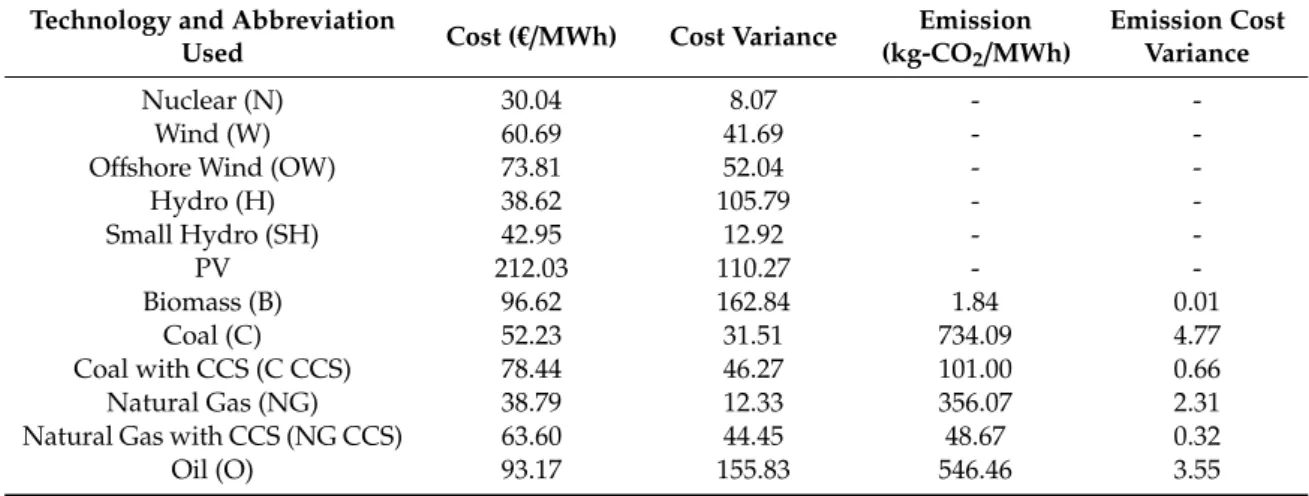
(5) Energies 2019, 12, 3599. 5 of 20. 2.3.1. The Cost-Risk Instrumental Model Based on MPT, we devise a model to find the efficient frontier or the set of portfolio cost-risk pairs that offers the lowest cost for a given level of risk or the lowest risk for a given level of cost. We will work with twelve technologies: Six of them are non-pollutant—nuclear, onshore and offshore wind, large and small hydro, and large photovoltaic (PV)—and the other six are pollutant—coal, coal with carbon capture and storage (CCS), natural gas, natural gas with CCS, oil, and biomass. In MPT, the cost risk of a specific technology is measured by its cost standard deviation. Table 1 shows the expected costs, the cost standard deviation, the expected emission factor, and the emission cost standard deviation for every technology in our model. We used some information available in the literature about the different categories of costs in a power-generation plant (capital expenditures and operational expenditures, such as operation and maintenance costs, fuel costs, emission costs, and dismantling costs) to calculate the average generation costs by technology, their standard deviation, and the correlation among them. We also use the emission cost standard deviation as a proxy of the real emission standard deviation, as we have no real emission data. It is important to underline that we consider the nuclear generation technology as non-pollutant, even though it involves other important environmental risks not related with carbon emission. Moreover, we decided to include biomass generation in the pollutant set of technologies as it has carbon emissions, although it could be considered testimonial. In fact, this decision (considering the biomass as a pollutant technology) will have some effects on our results that will be conveniently explained. Another point to take into account is the fact that the current emission factor can vary along time, but we do not consider this concern in this work. Table 1. Cost, emission, and standard deviations by technology. Source: Authors’ own work, based on data collected from DeLlano et al. (2014, 2015) [14,77]. Technology and Abbreviation Used. Cost (€/MWh). Cost Variance. Emission (kg-CO2 /MWh). Emission Cost Variance. Nuclear (N) Wind (W) Offshore Wind (OW) Hydro (H) Small Hydro (SH) PV Biomass (B) Coal (C) Coal with CCS (C CCS) Natural Gas (NG) Natural Gas with CCS (NG CCS) Oil (O). 30.04 60.69 73.81 38.62 42.95 212.03 96.62 52.23 78.44 38.79 63.60 93.17. 8.07 41.69 52.04 105.79 12.92 110.27 162.84 31.51 46.27 12.33 44.45 155.83. 1.84 734.09 101.00 356.07 48.67 546.46. 0.01 4.77 0.66 2.31 0.32 3.55. A power-generation portfolio is a specific set of participation shares or weights of every technology in the model. For technology i, with i = {1, 2, . . . , 12}, its participation share will be denoted by wi . w ∈ R12×1 represents the vector with twelve participation shares of a specific portfolio. These participation shares are the unknown variables of which the values are to be determined. With c ∈ R12×1 , the vector containing the expected cost associated to every generation technology, the cost of a portfolio P can be calculated by Equation (1), where the supraindex t indicates the transposition operation. c P = wt × c (1) Now denote by V ∈ R12×12 the variance-covariance matrix of the twelve technologies in the model. Thus, the portfolio risk, the standard deviation of the portfolio cost, will be as shown in Equation (2). Table 2 contains the cost variances-covariances used in the model. 1. σP = (wt × V × w) 2. (2).
(6) Energies 2019, 12, 3599. 6 of 20. Table 2. Cost variance-covariance matrix. Source: Authors’ own work, based on data collected from DeLlano et al. (2014, 2015) [14]. Technology. N. C. C CCS. NG. NG CCS. O. W. H. SH. OW. B. PV. N. 8.07. 3.84. 5.07. 3.54. 4.26. 15.32. −0.07. −0.42. −0.46. −0.10. −6.40. 0.20. C. 3.84. 31.51. 7.04. 4.02. 4.81. 20.82. −0.21. 0.03. 0.03. −0.31. −14.1. -0.21. C CCS. 5.07. 7.04. 46.27. 5.43. 6.60. 27.16. −0.45. 0.06. 0.07. −0.68. −18.5. -0.46. NG. 3.54. 4.02. 5.43. 12.33. 6.55. 15.44. 0.00. −0.08. −0.08. 0.00. −3.16. 0.05. CCS NG. 4.26. 4.81. 6.60. 6.55. 44.45. 18.33. 0.00. −0.16. −0.17. 0.00. −3.38. 0.11. O. 15.32. 20.82. 27.16. 15.44. 18.33. 155.8. −4.02. −1.95. −2.11. −6.07. −86.4. -0.16. W. −0.07. −0.21. −0.45. 0.00. 0.00. −4.02. 41.69. 0.94. 1.01. 4.68. −0.31. 0.09. H. −0.42. 0.03. 0.06. −0.08. −0.16. −1.95. 0.94. 105.8. 3.64. 1.41. −0.33. 0.56. SH. −0.46. 0.03. 0.07. −0.08. −0.17. −2.11. 1.01. 3.64. 12.92. 1.53. −0.36. 0.60. OW. −0.10. −0.31. −0.68. 0.00. 0.00. −6.07. 4.68. 1.41. 1.53. 52.04. −0.48. 0.13. B. −6.40. −14.1. −18.5. −3.16. −3.38. −86.4. −0.31. −0.33. −0.36. −0.48. 162.8. 0.25. PV. 0.20. −0.21. −0.46. 0.05. 0.11. −0.16. 0.09. 0.56. 0.60. 0.13. 0.25. 110.3. The problem of minimising the risk can be expressed in terms of a constrained quadratic optimization problem: minσP , subject to a set of constraints that are described hereunder. When applying MPT to power-generation planning, there are some technical constraints to keep in mind. First, the total sum of every participation share wi must be equal to one. Also, every participation share wi must be 0 or positive, and from the first constraint, it must also comply with wi ≤ 1. The use of technologies for power generation is usually limited for the sake of the necessary power supply security, one of the main objectives of a country or territory power policy. Diversification of power-generation technologies leads inarguably to a more secure power supply. Moreover, another aim of a country or territory power policy is to preserve the environment and this can be reached by imposing stricter limits to the most pollutant technologies. Hence, our model has a set of technological and environmental constraints, imposing an upper limit on those weights wi . These limits come from some diverse institutional forecasts (IEA, EU-IPTS, and the European Union Commission) and should be taken as reference limits as they can be adapted to specific country demands and as they are subject to changes over time. Table 3 details these limits. Table 3. Limits by generation technology. Source: Authors’ own work, based on data collected from DeLlano et al. (2015) [14]. Technology. Maximum Participation. Nuclear Wind Offshore Wind Hydro Small Hydro PV Biomass Coal with and without CCS Natural Gas with and without CCS Oil. 29.80% 20.30% 2.00% 10.80% 1.50% 5.5% 8.50% 23.40% 27.60% 0.80% 18% of the non-CCS coal and natural gas, and oil participations. CCS technologies as a whole. Just by using the aforementioned constraints—technical, technological, and environmental constraints—we are able to obtain a unique portfolio called the global minimum variance portfolio or.
(7) Energies 2019, 12, 3599. 7 of 20. GMV portfolio. This portfolio shows the least risk level of every possible portfolio. As we want to obtain not only the GMV portfolio but also the set of efficient portfolios or efficient frontier, we must add an additional constraint to our model: the cost constraint. As a matter of fact, the GMV portfolio is the portfolio with the least risk but it is also an efficient portfolio with the highest cost. On the opposite end of the efficient frontier, we will find a portfolio with the lowest cost of all the efficient portfolios—but also with the highest risk of all the efficient portfolios. We can easily find this global minimum cost (GMC) portfolio by solving a linear programming problem of which the objective is to minimise the portfolio cost, mincP = minwt × c, subject to the same constraints described above, except the cost constraint. This constraint is added to the quadratic model as cP = c∗ , with c∗ as an objective cost for the portfolio. Iterating the quadratic model by changing this objective cost between the GMV cost and the GMC cost, we are able to draw the efficient frontier. The model can then be expressed as in Equation (3). 1. Energies 2019, 12, 3599. minσP = min(w × V × wt ) 2 , subject to : wi ≥ 0, ∀i, i = {1, 2, . . . , 12} 12 X wi = 1 i = 1 Technological and environmental constraints [c = wt × c = c∗ ] P. (3) 8 of 22. Solving this model, obtain the efficient frontier shown Figure where also draw Solving this model, wewe obtain the efficient frontier shown in in Figure 1, 1, where wewe also draw thethe extreme points of this frontier—the GMV portfolio and the GMC portfolio—along with their cost extreme points of this frontier—the GMV portfolio and the GMC portfolio—along with their cost and and risk values. In the we alsothe represent cost-risk points corresponding to those risk values. In the graph, wegraph, also represent cost-riskthe points corresponding to those technologies technologies that fit into the graph’s limits—nuclear, natural gas, and small hydro. that fit into the graph’s limits—nuclear, natural gas, and small hydro.. Figure 1. Instrumental model’s efficient frontier.. Figure 1. Instrumental model’s efficient frontier.. Figure 2 represents the participation shares of the different technologies in the efficient frontier portfolios of the instrumental model. As we can see, the GMV portfolio, the one on the left side of the figure, shows a higher diversification—its Herfindahl–Hirschman index is 18.40%, less than the GMC portfolio with a Herfindahl–Hirschman index of 23.64%, which is considered good for energy security..
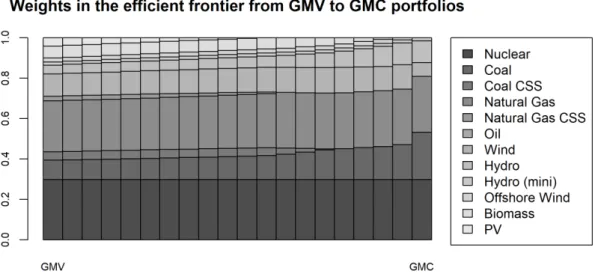
(8) Energies 2019, 12, 3599. 8 of 20. Figure 2 represents the participation shares of the different technologies in the efficient frontier portfolios of the instrumental model. As we can see, the GMV portfolio, the one on the left side of the Energies 2019, 12, 3599 9 of 22 figure, shows a higher diversification—its Herfindahl–Hirschman index is 18.40%, less than the GMC portfolio with a Herfindahl–Hirschman index of 23.64%, which is considered good for energy security.. Figure 2. Technology participation in the instrumental mode.. Figure 2.the Technology participation mode. Moreover, the nuclear, small hydro, as wellin asthe theinstrumental offshore wind technologies participate in the GMV portfolio at their maxima. On the other hand, in the GMC portfolio, the nuclear, the coal, the The next step will be to classify the different generation technologies into two different subsets: natural gas, the hydro, the small hydro, and the offshore wind technologies play a part at their maxima. one for the pollutant technologies—coal, coal with CCS, natural gas, natural gas with CCS, oil, and Therefore, nuclear, small hydro, and offshore wind are regarded as highly efficient technologies in biomass—and another one for the non-pollutant technologies—nuclear, wind, offshore wind, hydro, terms of cost and risk by the model. small hydro, and PV. For the first subset, we are going to set out a model quite similar to the The next step will be to classify the different generation technologies into two different subsets: instrumental one just exposed. For the second subset, we will consider an emission-risk model one for the pollutant technologies—coal, coal with CCS, natural gas, natural gas with CCS, oil, instead of a cost-risk model. and biomass—and another one for the non-pollutant technologies—nuclear, wind, offshore wind, hydro, small hydro, and PV. For the first subset, we are going to set out a model quite similar to the 2.3.2. The Non-Pollutant Technology Efficient Frontier instrumental one just exposed. For the second subset, we will consider an emission-risk model instead the same of Using a cost-risk model.data shown in Table 1 and Table 2 but considering only those non-pollutant technologies, we will adapt the technological and environmental constraints of the instrumental 2.3.2.toThe Non-Pollutant Technology Efficient Frontier model obtain the constraints pertinent to this non-pollutant technologies model. To adapt the technological and environmental constraints of the instrumental modelnon-pollutant to the non-pollutant Using the same data shown in Tables 1 and 2 but considering only those technologies, technologies, we decided to work on the basis of the non-pollutant technology’s participation shares we will adapt the technological and environmental constraints of the instrumental model to obtain in the the constraints efficient frontier calculated in the previous section. Briefly, we raised the participation share pertinent to this non-pollutant technologies model. To adapt the technological of and every non-pollutant technology relative to the total non-pollutant technologies participation environmental constraints of the instrumental model to the non-pollutant technologies, weshares decided in to every efficient andnon-pollutant took the maximum by technology, resulting in the presented in work on theportfolio basis of the technology’s participation shares inlimits the efficient frontier Table 4, where the column “Maximum Weight” refers to the maximum weight reached in the calculated in the previous section. Briefly, we raised the participation share of every non-pollutant efficient frontier of thetoprevious and the technologies column “Maximum Participation” this technology relative the total model non-pollutant participation shares inrefers everytoefficient maximum considering only the technologies. portfolioweight and took the maximum by non-pollutant technology, resulting in the limits presented in Table 4, where. the column “Maximum Weight” refers to the maximum weight reached in the efficient frontier of the previous model and the column “Maximum Participation” refers to this maximum weight considering only the non-pollutant technologies..
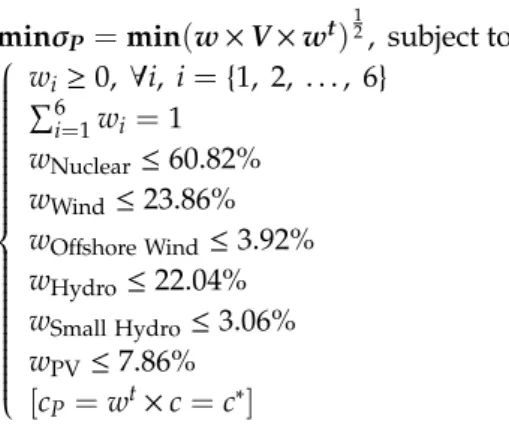
(9) Energies 2019, 12, 3599. 9 of 20. Table 4. Non-pollutant technological and environmental limits. Source: Authors’ own work, based on data collected from DeLlano et al. (2015) [14]. Energies 2019, 12, 3599. 10 of 22. Technology. Maximum Weight. Maximum Participation. Nuclear technological and 29.80% 60.82% Table 4. Non-pollutant environmental limits. Source: Authors' own work, based on data collectedWind from DeLlano et al. (2015) [14]. 12.66% 23.86% Offshore Wind 2.00% Weight Maximum 3.92% Technology Maximum Participation Nuclear 29.80% 60.82% Hydro 10.80% 22.04% Wind 12.66% 23.86% Small Hydro 1.50% 3.06% Offshore Wind 2.00% 3.92% PV 4.16% 7.86% Hydro 10.80% 22.04% Small Hydro 1.50% 3.06% Thus, the non-pollutant model is presented in Equation (4); keep in mind that the cost restriction PV 4.16% 7.86%. is used to calculate the efficient frontier as described in the previous section.. Thus, the non-pollutant model is presented in 1Equation (4); keep in mind that the cost t ) 2 , subject to : minσ = min(frontier w × V ×as wdescribed restriction is used to calculate theP efficient in the previous section.. . w ≥ 0, ∀i, i = {1, 2, . . . , 6} 𝟏 Pi𝐦𝐢𝐧 6 𝝈𝑷 = 𝐦𝐢𝐧 𝒘 × 𝑽 × 𝒘𝒕 𝟐 , subject to: i = 1 wi = 1 𝑤 ≥ 0, ∀𝑖, 𝑖 = 1, 2, … , 6 wNuclear ≤ 60.82% ⎧ =1 ⎪∑ ≤𝑤23.86% wWind ⎪𝑤Nuclear ≤ 60.82% wOffshore ≤ 3.92% ⎪𝑤Wind Wind ≤ 23.86% wHydro ≤ 22.04% 𝑤Offshore Wind ≤ 3.92% ⎨𝑤Hydro ≤ 22.04% wSmall Hydro ≤ 3.06% ⎪𝑤 Small Hydro ≤ 3.06% wPV 7.86% ⎪ ≤ 𝑤 ≤ t [cP⎪ =PVw ×7.86% c = c∗ ]. (4) (4). ⎩[𝑐 = 𝑤 × 𝑐 = 𝑐 ∗ ]. Solving this model, we obtain thethe efficient frontier shown thatthe thedashed dashedgrey grey Solving this model, we obtain efficient frontier shownininFigure Figure3. 3. Note Note that line shown is the instrumental model efficient frontier from the previous section. Comparing both line shown is the instrumental model efficient frontier from the previous section. Comparing both efficient frontiers, the one from instrumental model and the one the non-pollutant technology efficient frontiers, the onethe from the instrumental model and from the one from the non-pollutant technology model,that we the caninstrumental observe thatmodel the instrumental model higher costs but lower model, we can observe shows higher costsshows but lower risks—as its efficient risks—as its efficient frontier is displaced upward and toward the left. frontier is displaced upward and toward the left.. Figure 3. Non-pollutant technology model’s efficient frontier. Figure 3. Non-pollutant technology model’s efficient frontier..
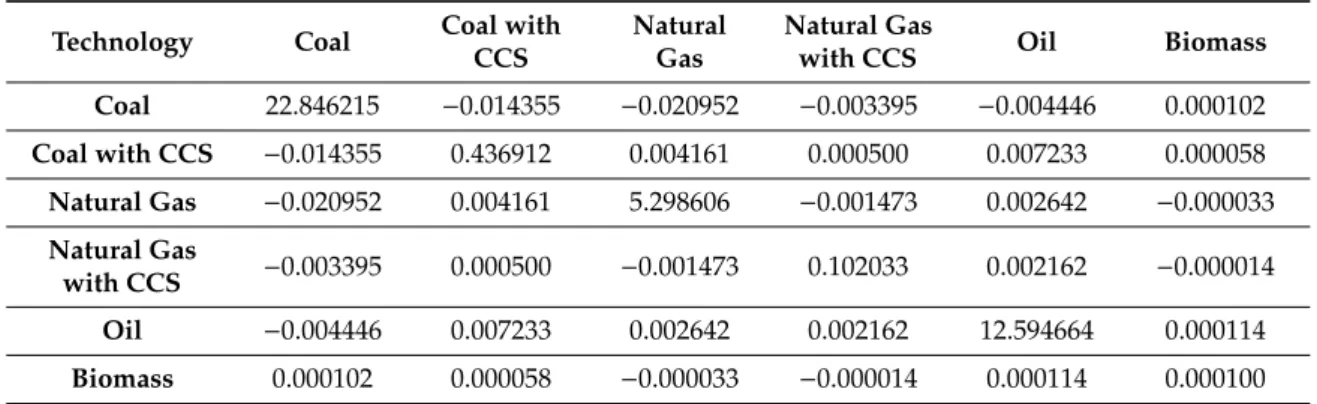
(10) Energies 2019, 12, 3599. 10 of 20. Analysing the weights in the GMV and GMC portfolios, we see that nuclear and small hydro participate again at their maxima in both portfolios. In particular, in the GMV portfolio, the offshore wind also participates at its maximum, while in the GMC portfolio, it is the hydro technology that also enters at its maximum. Not surprisingly, the Herfindahl–Hirschman index is worse than in the instrumental model, the non-pollutant technology model has fewer technologies, and again, the GMV portfolio is more diversified than the GMC portfolio. 2.3.3. The Emission-Risk Pollutant Technology Efficient Frontier We will replace our cost-risk orientation with an emission-risk orientation in this second stage of the model presented in this work. As stated, we have no emission data, apart from the emission average shown in Table 1, and hence, we use the CO2 cost standard deviation as a proxy for the emission standard deviation. According to this information, we simulated 100,000 normal distributed values to calculate the variance-covariance matrix shown in Table 5. Table 5. Emission variance-covariance matrix. Technology. Coal. Coal with CCS. Natural Gas. Natural Gas with CCS. Oil. Biomass. Coal. 22.846215. −0.014355. −0.020952. −0.003395. −0.004446. 0.000102. Coal with CCS. −0.014355. 0.436912. 0.004161. 0.000500. 0.007233. 0.000058. Natural Gas. −0.020952. 0.004161. 5.298606. −0.001473. 0.002642. −0.000033. Natural Gas with CCS. −0.003395. 0.000500. −0.001473. 0.102033. 0.002162. −0.000014. Oil. −0.004446. 0.007233. 0.002642. 0.002162. 12.594664. 0.000114. Biomass. 0.000102. 0.000058. −0.000033. −0.000014. 0.000114. 0.000100. The pollutant technology emission-risk model presented in this section is highly similar to the instrumental model except for the following two aspects. Firstly, we are not using costs in the current model but emission factors for the six pollutant technologies—coal, coal with CCS, natural gas, natural gas with CCS, oil, and biomass. Secondly, we will show five different adaptations of the current model, four of them without constraints other than the model technical constraints. In the other model adaptation, we include technological constraints for the pollutant technologies. The limits of these constraints were built in a quite similar manner as that for the non-pollutant technology model presented in Section 2.3.2., i.e., raising every pollutant technology participation in the instrumental model efficient frontier portfolios relative to the total pollutant technologies in those portfolios and getting the maximum participation as the limit. A problem arises as the oil technology is not participating in any of the calculated portfolios. To fix it, its technological and environmental limits in the instrumental model are relatively raised to the limits set for the pollutant technologies. 2.3.4. Model Adaptation with All the Non-Pollutant Technologies For the six pollutant technologies, we solved the model presented in Equation (5), in which eP ∈ R is the emission factor of the portfolio and e ∈ R6×1 is the emission vector of which the elements can be found in Table 1: 1 t ) 2 , subject to : ( minσ = min w × V × w P wi ≥ 0, ∀i, i = {1, 2, . . . , 6} (5) P6 i = 1 wi = 1 [eP = wt × e = e∗ ].
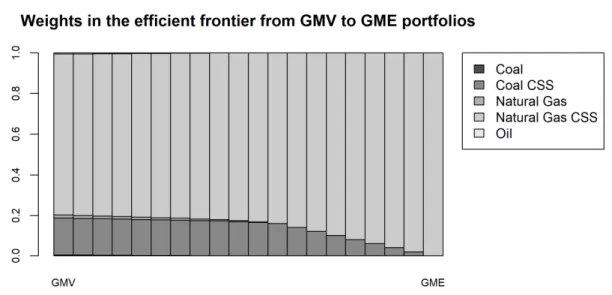
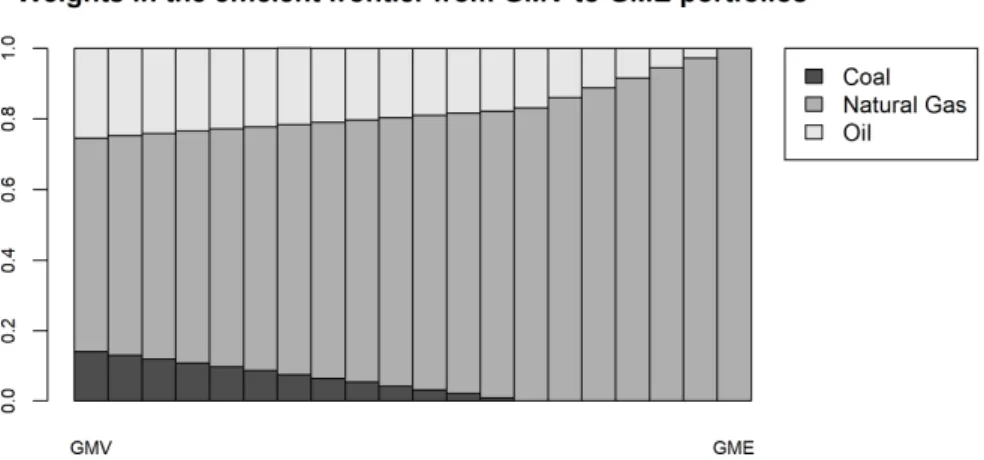
(11) Energies 2019, 12, 3599 Energies 2019, 12, 3599. 11 of 20 12 of 22. The results of thiswemodel are trivial because, in for thean GMV portfolio, 99.88% of are theworking power with In this model substituted the cost constraint emission constraint as we generation is assigned biomass and, in the global minimum emission portfolio (GME), biomass emission-risk pairstoinstead of cost-risk pairs. captures 100% of the power generation. The efficient is portfolio, hence insignificant andpower practically The results of this model are trivial because, infrontier the GMV 99.88% of the generation indistinguishable from a portfolio with 100% biomass generation. These results were expected as 100% is assigned to biomass and, in the global minimum emission portfolio (GME), biomass captures biomass shows a very low level CO2 emission to the rest of practically pollutant technologies of the power generation. Theofefficient frontierasis compared hence insignificant and indistinguishable and afrom negligible level of risk. In fact, this result is completely in line with the optimization features a portfolio with 100% biomass generation. These results were expected as biomass showsofa very the model. low level of CO2 emission as compared to the rest of pollutant technologies and a negligible level of A single-technology portfolio, or athegeneration portfolio one single risk. In fact, this resultgeneration is completely in line with optimization featuresinof which the model. technologyA is responsible for such a big part of the power generation, is quite far from being an single-technology generation portfolio, or a generation portfolio in which one single technology acceptable solutionforfrom point of the view of energy planning. we being develop some model is responsible suchthe a big part of power generation, is quiteNext, far from an acceptable solution adaptations to deal with this circumstance from the point of view of energy planning. Next, we develop some model adaptations to deal with this circumstance. 2.3.5. Model Adaptations without CCS Technologies and Without Biomass Technology 2.3.5. Model Adaptations without CCS Technologies and without Biomass Technology The first adaptation is similar to the previous one, but CCS technologies, both coal and natural gas, are removed prevent the possibility these technologies being ableboth to reach a feasible The first to adaptation is similar to theof previous one, but CCSnot technologies, coal and natural gas, commercial availability. Thethe results are therefore similar: biomass hoards ofathe generation are removed to prevent possibility of these technologies not being able99.99% to reach feasible commercial in theavailability. GMV portfolio and 100% of the generation in the hoards GME portfolio of the reasons The results are therefore similar: biomass 99.99% ofbecause the generation in the GMV exposed above.and 100% of the generation in the GME portfolio because of the reasons exposed above. portfolio In theInsecond model adaptation, biomass technology is is removed the second model adaptation, biomass technology removedfrom fromthe themodel. model. The The results results offer offer aa bit bitmore moreinformation informationthan than previous models. Figure 4 shows the weights theconsidered five in in thethe previous models. Figure 4 shows the weights of theof five considered technologies GMV portfolio—first column the GME technologies from thefrom GMV the portfolio—first column on the left—toon the the GMEleft—to portfolio—last column. portfolio—last GMV portfolio allows entry of technology the generation The GMV column. portfolioThe allows entry of every technology to every the generation mixtoalthough naturalmix gas with although with CCS takes the lion’s share—the index Herfindahl–Hirschman index is As 65.96% CCS natural takes thegas lion’s share—the Herfindahl–Hirschman is 65.96% for this portfolio. we move for this portfolio. As portfolio we movetofrom the GMV portfolio the that GMEnatural portfolio, is clear natural its from the GMV the GME portfolio, it istoclear gasitwith CCSthat is increasing gas with CCS is increasing its itparticipation share until it reaches 100% in the GME portfolio. participation share until reaches 100% in the GME portfolio.. Figure 4. Non-pollutant technology model’s efficient frontier. Figure 4. Non-pollutant technology model’s efficient frontier.. The third model adaptation shows what happens if neither CCS technologies nor biomass are The third to model adaptation happens neither CCS technologies biomass are available generate power. shows Again, what natural gas, in if this case without CCS, is the nor dominant generation available to generate power. Again, natural in this caseThis without CCS, is the dominant between generation technology. Surprisingly, oil takes the gas, second place. is due to the correlations oil and technology. Surprisingly, oil takes This isFigure due to5the correlations between and the other two technologies in the thissecond model place. adaptation. shows the weights of theoil considered the other two technologies in this model adaptation. Figure 5 shows the weights of to thethe considered technologies in the efficient frontier portfolios—from the GMV portfolio on the left GME portfolio technologies in the efficient frontier portfolios—from the GMV portfolio on the left to the GME on the right. portfolio on the right..
(12) Energies 2019, 12, 3599. 13 of 22. Energies 2019, 12, 3599. 12 of 20. Figure 5. Model adaptation without both carbon capture and storage (CCS) and biomass technologies. Figure 5. Model adaptation without both carbon capture and storage (CCS) and biomass technologies.. 2.3.6. Model Adaptation with Technological Constraints. In this model adaptation, the problem to solve will be the one presented in Equation (6). 2.3.6. Model Adaptation With Technological Constraints 1. t ) 2 ,besubject In this model adaptation, solve the oneto presented in Equation (6). : minσPthe =problem min(w to ×V × wwill. . 𝟏 wi ≥ 0, ∀i, i = {1, 2, . . . , 6} 𝐦𝐢𝐧 𝝈𝑷 = 𝐦𝐢𝐧 𝒘 × 𝑽 × 𝒘𝒕 𝟐 , subject to: 6 X 𝑤 ≥ 0, ∀𝑖, 𝑖 = 1, 2, … , 6 ⎧i = 1 w. i=1 ⎪. ⎪. 𝑤 =1. wCoal ⎪ + wCoal with with CCS ≤ 54.84% 𝑤Coalgas +𝑤 54.84% wNatural +Coal wNatural with CCS ≤ gas with CCS ≤ 66.40% ⎨ Natural gas + 𝑤Natural gas with CCS ≤ 66.40% wOil⎪𝑤 ≤ 1.33% 𝑤 ≤ 1.33% ⎪ Oil ≤ 12.56% wBiomass ≤ 12.56% ⎪𝑤Biomass ∗] ∗ [eP ⎩ =[𝑒wt=×𝑤e = × 𝑒e = 𝑒 ]. (6) (6). As stated, the limits were taken from the instrumental model efficient frontier participation As stated, the limits were taken from the instrumental model efficient frontier participation shares shares of the pollutant technologies, except for the oil technology limit that was taken from the of the pollutant technologies, except for the oil technology limit that was taken from the instrumental instrumental model technological limits of the pollutant technologies. model technological the pollutant technologies. Solving thislimits modelof adaptation, the results shown in Figure 6 are achieved. As expected, in light Solving this model adaptation, the results shown in Figurein6 every are achieved. As expected, of the precedent results, biomass is participating at its maximum efficient frontier portfolio.in light of the precedent results, biomass is risky participating its natural maximum in every efficient frontier portfolio. When they participate in the less portfolios,at coal, gas, and oil have participation shares 1%. In the GME natural gas withcoal, CCSnatural participates the oil maximum set for natural shares When around they participate in theportfolio, less risky portfolios, gas,atand have participation with CCS. The little variation in participation shares due themaximum imposed constraints aroundgas 1%. Inand thewithout GME portfolio, natural gas with CCS participates attothe set for natural will give us a short efficient frontier. Energies 2019, 12, 3599 14 22 gas with and without CCS. The little variation in participation shares due to the imposedofconstraints will give us a short efficient frontier.. Figure 6. Model adaptation with technological constraints. Figure 6. Model adaptation with technological constraints.. 3. Results In this section, we present our main results related to cross-drawing the instrumental model and the pollutant-technology model. Additionally, we will discuss how this model can help policy.
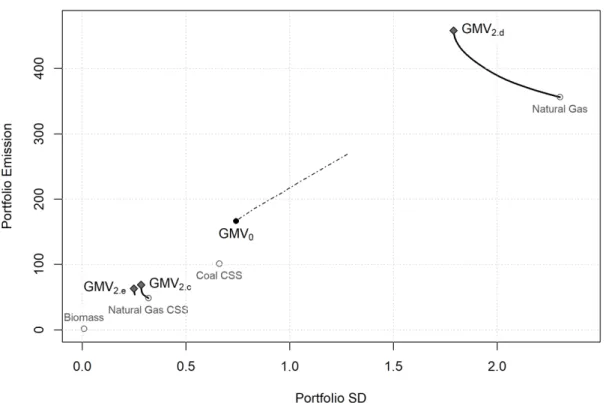
(13) Energies 2019, 12, 3599. 13 of 20. 3. Results In this section, we present our main results related to cross-drawing the instrumental model and the pollutant-technology model. Additionally, we will discuss how this model can help policy makers make their decisions. 3.1. Cross-Drawing the Cost-Risk and Emission-Risk Models and Selecting an Adequate Combination of Non-Pollutant and Pollutant Technologies So far, we have one instrumental model that includes all the technologies and constraints, a non-pollutant efficient frontier that shows higher risk but lower cost than the instrumental efficient frontier, and a set of several adaptations of a model with pollutant-technologies. Figure 7 represents some of the efficient frontiers calculated in an emission-risk coordinate axis. Specifically, we depict the instrumental model numbered with 0 and with a dot-dash line, the model adaptations without biomass numbered as 2.c, those without biomass and CSS technologies numbered as 2.d, and those with all the pollutant technologies and with technological constraints numbered as 2.e. It is important to note that 2019,adaptations 12, 3599 of 22 theEnergies first two were practically 100% biomass participated, and for this reason, we are15not showing them in the graph—they would be located practically where the biomass technology is drawn.. Figure 7. Efficient frontiers in an emission-risk plane.. Figure 7. Efficient frontiers in an emission-risk plane.. Regarding the pollutant models, the traditional pollutant technologies—coal, natural gas, and oil—show higher levels of emission and risk; model 2.d efficient frontier appears on thenatural top right side Regarding the pollutant models, the traditional pollutant technologies—coal, gas, and of oil—show the figure. higher If CCSlevels technologies are included, both the emission and the risk levels are drastically of emission and risk; model 2.d efficient frontier appears on the top right reduced; 2.c If in CCS the figure. In fact, models 2.a and 2.b would be represented overrisk the biomass side ofsee themodel figure. technologies are included, both the emission and the levels are point in Figure 6. Moreover, the technological constraints are able to lower even more the risk, keeping drastically reduced; see model 2.c in the figure. In fact, models 2.a and 2.b would be represented a similar level of emission—model over the biomass point in Figure2.e. 6. Moreover, the technological constraints are able to lower even By representing in the same emission-risk plane our instrumental model, model 0, it is worth more the risk, keeping a similar level of emission—model 2.e. comparing it with the pollutant models—the non-pollutant model would drawnmodel on the 0, coordinate By representing in the same emission-risk plane our instrumentalbemodel, it is worth origin. The instrumental model showsmodels—the a higher levelnon-pollutant of emission andmodel risk, inwould terms of thanthe comparing it with the pollutant beemission, drawn on. coordinate origin. The instrumental model shows a higher level of emission and risk, in terms of emission, than those models allowing biomass and CCS technologies because coal and natural gas participate largely in it, as shown in Figure 2. When approaching the GMC portfolio, these technologies reach their technological limit and, actually, they participate at their maxima in the GMC portfolio..
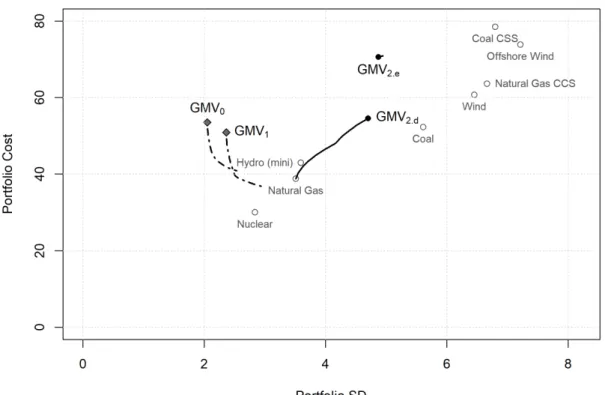
(14) Energies 2019, 12, 3599. 14 of 20. those models allowing biomass and CCS technologies because coal and natural gas participate largely in it, as shown in Figure 2. When approaching the GMC portfolio, these technologies reach their technological limit and, actually, they participate at their maxima in the GMC portfolio. The efficient frontier of our models is drawn in a cost-risk coordinate axis in Figure 8. Both the instrumental model, model 0, and the pollutant models, models 2.e and 2.d, present smaller levels of risk with similar or lower levels of cost. As stated, pollutant models with biomass, models 2.a and 2.b, Energies 2019, 12, 3599 16 of 22 would be drawn on the point corresponding to biomass technology that is far out of the graph’s limits with a cost variance of 162.84 (standard deviation: 12.76 €/MWh) and with a cost of 96.62 €/MWh.. Figure 8. Efficient frontiers in a cost-risk plane.. 3.2. The CML-Analogous Area. Figure 8. Efficient frontiers in a cost-risk plane.. far,CML-Analogous we have a pollutant-technology efficient frontier from an emission-risk perspective and a 3.2.SoThe Area point of the emission-risk coordinate axis origin representing all the non-pollutant efficient portfolios. So far, we have a pollutant-technology efficient frontier from an emission-risk perspective and a A policy maker could compile a portfolio from the pollutant-technology efficient frontier with the point point of the emission-risk coordinate axis origin representing all the non-pollutant efficient in the origin to determine a power-generation portfolio with the whole set of technologies. Therefore, portfolios. A policy maker could compile a portfolio from the pollutant-technology efficient frontier it is possible to set the best portfolio given a desired emission factor or a risk limit. with the point in the origin to determine a power-generation portfolio with the whole set of The limits of the pollutant-technology efficient frontier are the GMV and the GME portfolios. technologies. Therefore, it is possible to set the best portfolio given a desired emission factor or a risk The efficient frontier itself connects them together. Combinations of either the GMV or the GME limit. portfolio with any of the non-pollutant efficient portfolios in the origin will fall inside an area delimited The limits of the pollutant-technology efficient frontier are the GMV and the GME portfolios. by these three portfolios: the GMV portfolio, the GME portfolio, and the non-pollutant efficient portfolio The efficient frontier itself connects them together. Combinations of either the GMV or the GME chosen. In Figure 9, this area is the shaded area below and to the left of the pollutant-technology portfolio with any of the non-pollutant efficient portfolios in the origin will fall inside an area efficient frontier. delimited by these three portfolios: the GMV portfolio, the GME portfolio, and the non-pollutant Being under the efficient frontier reflects that any point inside that area shows a lower emission efficient portfolio chosen. In Figure 9, this area is the shaded area below and to the left of the factor than the point on the frontier with the same level of risk. This was expected as we are combining pollutant-technology efficient frontier. a pollutant portfolio with a non-pollutant one. On the other hand, the fact of being to the left of the Being under the efficient frontier reflects that any point inside that area shows a lower emission pollutant efficient frontier indicates that the risk is lower for any emission factor considered. A portfolio factor than the point on the frontier with the same level of risk. This was expected as we are inside the CML-analogous area (CML-A) is then more efficient than a portfolio in the efficient frontier combining a pollutant portfolio with a non-pollutant one. On the other hand, the fact of being to the with the same emission factor or level of risk. left of the pollutant efficient frontier indicates that the risk is lower for any emission factor considered. A portfolio inside the CML-analogous area (CML-A) is then more efficient than a portfolio in the efficient frontier with the same emission factor or level of risk. Focusing on the CML-A, the problem is to determine the best portfolio for a given emission factor or for a given level of risk. It is easy to conclude that the answer must be found on the CML-A.
(15) In this section, there is a brief explanation of how a policy maker could employ this model to design power-generation portfolios. In Figure 9, we draw one of our pollutant efficient frontiers, specifically model 2.e, with all the pollutant technologies and with technological constraints in an emission-risk coordinate axis. In this graph, the non-pollutant model portfolios will be all of them on the coordinate origin; they have no emission and, consequently, no emission risk.. Energies 2019, 12, 3599. 15 of 20. Figure 9. A Capital Market Line (CML)-Analogous analysis.. Figure 9. A Capital Market Line (CML)-Analogous analysis.. Focusing on the CML-A, the problem is to determine the best portfolio for a given emission factor or for a A given level of risk. is easy any to conclude that the answer be foundbetween on the CML-A borders.on policy maker canItchoose combination: any linearmust combination any portfolio Indeed, when determining the best portfolio the CML-A for a givenfrontier level ofwhich, risk, the solution must the pollutant efficient frontier and on theinnon-pollutant efficient from an emission bepoint that one located on the segment joining the coordinate axis origin and the GME portfolio that of view, lays on the coordinate origin. In Figure 9, the shaded area delimited by the coordinate shows that level of risk. Likewise, if we want to determine the best portfolio in the CML-A for a given origin and the pollutant efficient frontier of model 2.e represents these combinations. We can see that emission wethe must findmaker it on the intersection of for the asegment joining the GMVor portfolio with the the areafactor, allows policy to lower the risk given level of emission the emission for a coordinate axis origin and the line representing the desired emission factor. In the next section, we given level of risk. For instance, given the emission and risk values for GMV and GME portfolios of present example these6,ideas. modela brief 2.e shown in of Table it is easy to calculate the portfolio proportions needed to reach an. emission risk of 0.10 kg/MWh. Obviously, the policy maker will prefer the lowest emission possible 4. Discussion for that level of risk and so they will choose the pollutant GME portfolio for the combination, In this section, is a brief explanation of how a policy maker could employ this model to resulting in point there A in Figure 9. Point A can be reached by combining the pollutant GME portfolio design power-generation portfolios. Figure 9, of we39.39–60.61%. draw one of Also, our pollutant frontiers, and the non-pollutant portfolio in aIn proportion the policyefficient maker could want specifically model 2.e, all the pollutant and with in reach an to set the emission ofwith the resultant portfolio,technologies say, at 30 kg/MWh. In technological this case, they constraints would like to emission-risk axis. In for thisthat graph, theofnon-pollutant portfolios bewant all ofto them on a minimumcoordinate risk combination level emission. Formodel this reason, theywill will combine thethe coordinate origin; they have no with emission consequently, no emission risk. in point B, which pollutant GMV portfolio the and, non-pollutant portfolio, resulting A policy maker can choose any combination: any linear combination between any portfolio on corresponds to a 47.44–52.56% proportion of pollutant GMV and non-pollutant portfolios. the pollutant efficient frontier and on the non-pollutant efficient frontier which, from an emission point of view, lays on the coordinate origin. In Figure 9, the shaded area delimited by the coordinate origin and the pollutant efficient frontier of model 2.e represents these combinations. We can see that the area allows the policy maker to lower the risk for a given level of emission or the emission for a given level of risk. For instance, given the emission and risk values for GMV and GME portfolios of model 2.e shown in Table 6, it is easy to calculate the portfolio proportions needed to reach an emission risk of 0.10 kg/MWh. Obviously, the policy maker will prefer the lowest emission possible for that level of risk and so they will choose the pollutant GME portfolio for the combination, resulting in point A in Figure 9. Point A can be reached by combining the pollutant GME portfolio and the non-pollutant portfolio in a proportion of 39.39–60.61%. Also, the policy maker could want to set the emission of.
(16) Energies 2019, 12, 3599. 16 of 20. the resultant portfolio, say, at 30 kg/MWh. In this case, they would like to reach a minimum risk combination for that level of emission. For this reason, they will want to combine the pollutant GMV portfolio with the non-pollutant portfolio, resulting in point B, which corresponds to a 47.44–52.56% proportion of pollutant GMV and non-pollutant portfolios. Table 6. Emission and risk of the global minimum variance (GMV) and global minimum emission (GME) portfolios of model 2.e. Portfolio. Emission (kg-CO2 /MWh). Risk (kg-CO2 /MWh). GMV2.e GME2.e. 63.24 53.79. 0.2502 0.2539. In the last example, it is easy to see that the combination B’ with a 46.75% GME portfolio and a 53.25% non-pollutant portfolio has the same risk value as combination B but with a lower emission of 25.15 kg/MWh. It does not seem reasonable to lose the opportunity to lower emissions without increasing the risk. This is why the lower segment of the shaded area is more efficient in the sense used in this work than the rest of the points in the area when the aim is to adapt the generation portfolio to a predetermined risk. This insight is similar to the financial CML, but in our case and due to the convexity of the efficient frontier, instead of having a tangency or market portfolio, we propose to use the corresponding GME portfolio instead. 5. Conclusions Throughout the present work, we proved that it is possible to separate the generation technologies into two different sets and to proceed to a double optimization of the generation mix. When we compare the non-pollutant-technology efficient frontier with the efficient frontier of the instrumental model, we are able to generate at a lower cost but at a higher risk using only non-pollutant technologies (nuclear, wind, offshore wind, hydro, small hydro, and PV). When analysing the sharing weights in the non-pollutant efficient frontier, nuclear energy, defending its position as a base-load generation technology, and small hydro participate at their maxima in both the minimum-risk GMV and the minimum-cost GMC portfolios: • •. Nuclear and small hydro are preferential technologies that act as if it intends to obtain the minimum cost or to get the minimum risk of the portfolio. In a complementary way, offshore wind technology participates at its maximum share if the minimum risk is searched, while large hydro technology is the third technology to enter its maximum in the minimum cost portfolio.. Replacing the cost-risk perspective with emission-risk perspective pollutant technologies allows to highlight the important role of biomass and CCS technologies in an efficient portfolio. Their commercial development is crucial in order to achieve low-carbon emission portfolios. Oil generation is not included in the power-generation mix in the instrumental model, highlighting its excessive cost and risk. In the emission-risk models, it is only considered when we take out the biomass or when we set upper limits to the participation shares of the technologies. These limits cause the preferred technologies to participate at their maxima in almost every efficient portfolio. Solar PV generation takes part only in the efficient portfolios close to the GMV portfolio. Its participation is needed in order to achieve a highly diversified and lower risk portfolio. The cross-drawing approach proposed between the pollutant and non-pollutant efficient frontiers calculated in both cost-risk and emission-risk coordinate axes leads to relevant conclusions: • •. A pollutant-only generation mix shows a higher cost than a complete generation technology portfolio and even in relation to the non-pollutant-only efficient frontier. A highly diversified portfolio makes it possible to achieve the lowest risk (instrumental model)..
(17) Energies 2019, 12, 3599. • •. 17 of 20. Renewable energy sources are needed to reduce portfolio cost and risk. Pollutant-generation-efficient frontiers show a higher risk mainly because of the fuel cost risk.. Finally, drawing an analogy with the CML from CAPM, we presented the CML-A area that could helpful a policy maker design the long-term generation mix in a decarbonisation scenario. Author Contributions: The Contributor Roles Taxonomy (CRediT) of this work is as follows: conceptualization, P.M.-F., F.d.-P. and I.S.; methodology: P.M.-F., F.d.-P. and A.C.-S.; software, P.M.-F.; validation, F.d.-P.; formal analysis, P.M.-F., F.d.-P. and A.C.-S.; investigation: F.d.-P.; resources, F.d.-P. and I.S.; data curation, P.M.-F. and F.d.-P.; writing – original draft preparation, P.M.-F. and F.d.-P.; writing – review and editing, P.M.-F.; visualization, P.M.-F. and F.d.-P.; supervision, A.C.-S. and I.S.; project administration, P.M.-F. and F.d.-P.; funding acquisition: A.C.-S. Funding: This research received no external funding. Conflicts of Interest: The authors declare no conflict of interest.. References 1.. 2. 3. 4.. 5. 6. 7. 8. 9. 10. 11. 12.. 13. 14.. 15. 16. 17.. Cormio, C.; Dicorato, M.; Minoia, A.; Trovato, M. A regional energy planning methodology including renewable energy sources and environmental constraints. Renew. Sustain. Energy Rev. 2003, 7, 99–130. [CrossRef] Huang, Y.-H.; Wu, J.-H.; Hsu, Y.-J. Two-stage stochastic programming model for the regional-scale electricity planning under demand uncertainty. Energy 2016, 116, 1145–1157. [CrossRef] Liu, Y.; He, L.; Shen, J. Optimization-based provincial hybrid renewable and non-renewable energy planning—A case study of Shanxi, China. Energy 2017, 128, 839–856. [CrossRef] Nie, S.; Li, Y.P.; Liu, J.; Huang, C.Z. Risk management of energy system for identifying optimal power mix with financial-cost minimization and environmental-impact mitigation under uncertainty. Energy Econ. 2017, 61, 313–329. [CrossRef] Kim, S.; Koo, J.; Lee, C.J.; Yoon, E.S. Optimization of Korean energy planning for sustainability considering uncertainties in learning rates and external factors. Energy 2012, 44, 126–134. [CrossRef] Codina Gironès, V.; Moret, S.; Maréchal, F.; Favrat, D. Strategic energy planning for large-scale energy systems: A modelling framework to aid decision-making. Energy 2015, 90, 173–186. [CrossRef] Sáfián, F. Modelling the Hungarian energy system—The first step towards sustainable energy planning. Energy 2014, 69, 58–66. [CrossRef] Gómez, A.; Dopazo, C.; Fueyo, N. The “cost of not doing” energy planning: The Spanish energy bubble. Energy 2016, 101, 434–446. [CrossRef] Allan, G.; Eromenko, I.; McGregor, P.; Swales, K. The regional electricity generation mix in Scotland: A portfolio selection approach incorporating marine technologies. Energy Policy 2011, 39, 6–22. [CrossRef] Arnesano, M.; Carlucci, A.P.; Laforgia, D. Extension of portfolio theory application to energy planning problem—The Italian case. Energy 2012, 39, 112–124. [CrossRef] Awerbuch, S. Portfolio-Based Electricity Generation Planning: Implications for Renewables and Energy Security. Mitig. Adapt. Strateg. Glob. Chang. 2004, 11, 693–710. [CrossRef] Awerbuch, S.; Jansen, J.C.; Beurskens, L. The Role of Wind Generation in Enhancing Scotland’s Energy Diversity and Security: A Mean-Variance Portfolio Optimization of Scotland’s Generating Mix. In Analytical Methods for Energy Diversity & Security; Elsevier: Amsterdam, The Netherlands, 2008; pp. 139–150. Bhattacharya, A.; Kojima, S. Power sector investment risk and renewable energy: A Japanese case study using portfolio risk optimization method. Energy Policy 2012, 40, 69–80. [CrossRef] Dellano-Paz, F.; Calvo-Silvosa, A.; Iglesias Antelo, S.; Soares, I. The European low-carbon mix for 2030: The role of renewable energy sources in an environmentally and socially efficient approach. Renew. Sustain. Energy Rev. 2015, 48, 49–61. [CrossRef] Delarue, E.; De Jonghe, C.; Belmans, R.; D’haeseleer, W. Applying portfolio theory to the electricity sector: Energy versus power. Energy Econ. 2011, 33, 12–23. [CrossRef] Dellano-Paz, F.; Calvo-Silvosa, A.; Antelo, S.I.; Soares, I. Energy planning and modern portfolio theory: A review. Renew. Sustain. Energy Rev. 2017, 77, 636–651. [CrossRef] Kumar, D.; Mohanta, D.K.; Reddy, M.J.B. Intelligent optimization of renewable resource mixes incorporating the effect of fuel risk, fuel cost and CO2 emission. Front. Energy 2015, 9, 91–105. [CrossRef].
(18) Energies 2019, 12, 3599. 18. 19. 20. 21. 22. 23.. 24. 25. 26. 27. 28. 29.. 30. 31. 32. 33. 34. 35. 36. 37. 38. 39. 40. 41.. 42.. 18 of 20. Gao, C.; Sun, M.; Shen, B.; Li, R.; Tian, L. Optimization of China’s energy structure based on portfolio theory. Energy 2014, 77, 890–897. [CrossRef] Gökgöz, F.; Atmaca, M.E. Financial optimization in the Turkish electricity market: Markowitz’s mean-variance approach. Renew. Sustain. Energy Rev. 2012, 16, 357–368. [CrossRef] Lucheroni, C.; Mari, C. CO2 volatility impact on energy portfolio choice: A fully stochastic LCOE theory analysis. Appl. Energy 2017, 190, 278–290. [CrossRef] Roques, F.; Hiroux, C.; Saguan, M. Optimal wind power deployment in Europe—A portfolio approach. Energy Policy 2010, 38, 3245–3256. [CrossRef] Zhu, L.; Fan, Y. Optimization of China’s generating portfolio and policy implications based on portfolio theory. Energy 2010, 35, 1391–1402. [CrossRef] Chen, Y.; He, L.; Guan, Y.; Lu, H.; Li, J. Life cycle assessment of greenhouse gas emissions and water-energy optimization for shale gas supply chain planning based on multi-level approach: Case study in Barnett, Marcellus, Fayetteville, and Haynesville shales. Energy Convers. Manag. 2017, 134, 382–398. [CrossRef] Shaban Boloukat, M.H.; Akbari Foroud, A. Stochastic-based resource expansion planning for a grid-connected microgrid using interval linear programming. Energy 2016, 113, 776–787. [CrossRef] Falsafi, H.; Zakariazadeh, A.; Jadid, S. The role of demand response in single and multi-objective wind-thermal generation scheduling: A stochastic programming. Energy 2014, 64, 853–867. [CrossRef] Koltsaklis, N.E.; Liu, P.; Georgiadis, M.C. An integrated stochastic multi-regional long-term energy planning model incorporating autonomous power systems and demand response. Energy 2015, 82, 865–888. [CrossRef] Tajeddini, M.A.; Rahimi-Kian, A.; Soroudi, A. Risk averse optimal operation of a virtual power plant using two stage stochastic programming. Energy 2014, 73, 958–967. [CrossRef] Stempien, J.P.; Chan, S.H. Addressing energy trilemma via the modified Markowitz Mean-Variance Portfolio Optimization theory. Appl. Energy 2017, 202, 228–237. [CrossRef] Jansen, J.C.; Beurskens, L.W.M.; Van Tilburg, X. Application of Portfolio Analysis to the Dutch Generating Mix; Reference case and two renewables cases, Year 2030, SE and GE scenario (No. ECN-C-05-100); Energy research Centre of the Netherlands ECN: Sint Maartensvlotbrug, The Netherlands, 2006. Dellano-Paz, F.; Martínez Fernandez, P.; Soares, I. Addressing 2030 EU policy framework for energy and climate: Cost, risk and energy security issues. Energy 2016, 115, 1347–1360. [CrossRef] Hickey, E.A.; Lon Carlson, J.; Loomis, D. Issues in the determination of the optimal portfolio of electricity supply options. Energy Policy 2010, 38, 2198–2207. [CrossRef] Jano-Ito, M.A.; Crawford-Brown, D. Investment decisions considering economic, environmental and social factors: An actors’ perspective for the electricity sector of Mexico. Energy 2017, 121, 92–106. [CrossRef] Chuang, M.C.; Ma, H.W. Energy security and improvements in the function of diversity indices—Taiwan energy supply structure case study. Renew. Sustain. Energy Rev. 2013, 24, 9–20. [CrossRef] Böhringer, C.; Bortolamedi, M. Sense and no(n)-sense of energy security indicators. Ecol. Econ. 2015, 119, 359–371. [CrossRef] Muñoz, B.; García-Verdugo, J.; San-Martín, E. Quantifying the geopolitical dimension of energy risks: A tool for energy modelling and planning. Energy 2015, 82, 479–500. [CrossRef] Apergis, N.; Payne, J.E.; Menyah, K.; Wolde-Rufael, Y. On the causal dynamics between emissions, nuclear energy, renewable energy, and economic growth. Ecol. Econ. 2010, 69, 2255–2260. [CrossRef] Johansson, B. Security aspects of future renewable energy systems–A short overview. Energy 2013, 61, 598–605. [CrossRef] Labandeira, X. Sistema Energético Y Cambio Climático: Prospectiva Tecnológica y Regulatoria (No. 02); Working Papers 2012; Economics for Energy (eforenergy.org): Vigo, Spain, 2012. Labandeira, X.; Linares, P.; Würzburg, K. Energías Renovables Y Cambio Climático (No. 06); Working Papers 2012; Economics for Energy (eforenergy.org): Vigo, Spain. Akter, S.; Kompas, T.; Ward, M.B. Application of portfolio theory to asset-based biosecurity decision analysis. Ecol. Econ. 2015, 117, 73–85. [CrossRef] Tolmasquim, M.T.; Seroa da Motta, R.; La Rovere, E.L.; Barata MM de, L.; Monteiro, A.G. Environmental valuation for long-term strategic planning—The case of the Brazilian power sector. Ecol. Econ. 2001, 37, 39–51. [CrossRef] Urhammer, E. Celestial bodies and satellites—Energy issues, models, and imaginaries in Denmark since 1973. Ecol. Econ. 2017, 131, 425–433. [CrossRef].
(19) Energies 2019, 12, 3599. 43. 44. 45. 46. 47. 48. 49.. 50. 51. 52.. 53. 54.. 55. 56.. 57. 58. 59. 60. 61.. 62. 63. 64. 65. 66. 67.. 19 of 20. Bennink, D.; Rooijers, F.; Croezen, H.; de Jong, F.; Markowska, A. VME Energy Transition Strategy: External Costs and Benefits of Electricity Generation, Transition; CE Delft: Delft, The Netherlands, 2010. Eyre, N. External costs. What do they mean for energy policy? Energy Policy 1997, 25, 85–95. [CrossRef] Söderholm, P.; Sundqvist, T. Pricing environmental externalities in the power sector: Ethical limits and implications for social choice. Ecol. Econ. 2003, 46, 333–350. [CrossRef] Awerbuch, S.; Yang, S. Efficient Electricity Generating Portfolios for Europe: Maximising Energy Security and Climate Change Mitigation; EIB Papers; EIB: Kirchberg, Luxembourg, 2007. Cucchiella, F.; D’Adamo, I.; Gastaldi, M. Optimizing plant size in the planning of renewable energy portfolios. Lett. Spat. Resour. Sci. 2016, 9, 169–187. [CrossRef] Lynch, M.Á.; Shortt, A.; Tol, R.S.J.; O’Malley, M.J. Risk–return incentives in liberalised electricity markets. Energy Econ. 2013, 40, 598–608. [CrossRef] Antimiani, A.; Costantini, V.; Kuik, O.; Paglialunga, E. Mitigation of adverse effects on competitiveness and leakage of unilateral EU climate policy: An assessment of policy instruments. Ecol. Econ. 2016, 128, 246–259. [CrossRef] Monjon, S.; Quirion, P. Addressing leakage in the EU ETS: Border adjustment or output-based allocation? Ecol. Econ. 2011, 70, 1957–1971. [CrossRef] Oberndorfer, U. EU Emission Allowances and the stock market: Evidence from the electricity industry. Ecol. Econ. 2009, 68, 1116–1126. [CrossRef] Rogge, K.S.; Schneider, M.; Hoffmann, V.H. The innovation impact of the EU Emission Trading System—Findings of company case studies in the German power sector. Ecol. Econ. 2011, 70, 513–523. [CrossRef] Dincer, I. Renewable energy and sustainable development: A crucial review. Renew. Sustain. Energy Rev. 2000, 4, 157–175. [CrossRef] Escribano Francés, G.; Marín-Quemada, J.M.; San Martín González, E. RES and risk: Renewable energy’s contribution to energy security. A portfolio-based approach. Renew. Sustain. Energy Rev. 2013, 26, 549–559. [CrossRef] Panwar, N.L.; Kaushik, S.C.; Kothari, S. Role of renewable energy sources in environmental protection: A review. Renew. Sustain. Energy Rev. 2011, 15, 1513–1524. [CrossRef] Martinez-Fernandez, P.; deLlano-Paz, F.; Calvo-Silvosa, A.; Soares, I. Pollutant versus non-pollutant generation technologies: A CML-analogous analysis. Environ. Dev. Sustain. 2018, 20 (Suppl. 1), 199–212. [CrossRef] Jaffe, A.B.; Newell, R.G.; Stavins, R.N. A tale of two market failures: Technology and environmental policy. Ecol. Econ. 2005, 54, 164–174. [CrossRef] Markowitz, H. Portfolio Selection. J. Financ. 1952, 7, 77–91. [CrossRef] Sharpe, W.F. A Simplified Model for Portfolio Analysis. Manage. Sci. 1963, 9, 277–293. [CrossRef] Sharpe, W.F. Capital Asset Prices: A Theory of Market Equilibrium under Conditions of Risk. J. Financ. 1964, 19, 425. [CrossRef] Min Liu Wu, F.F.; Yixin, N.I. A survey on risk management in electricity markets. In Proceedings of the 2006 IEEE Power Engineering Society General Meeting, Montreal, QC, Canada, 18–22 June 2006; IEEE: Piscataway, NJ, USA, 2006; p. 6. [CrossRef] Westner, G.; Madlener, R. The benefit of regional diversification of cogeneration investments in Europe: A mean-variance portfolio analysis. Energy Policy 2010, 38, 7911–7920. [CrossRef] Chae, J.; Joo, S.-K. Demand Response Resource Allocation Method Using Mean-Variance Portfolio Theory for Load Aggregators in the Korean Demand Response Market. Energies 2017, 10, 879. [CrossRef] Yemshanov, D.; Koch, F.H.; Lu, B.; Lyons, D.B.; Prestemon, J.P.; Scarr, T.; Koehler, K. There is no silver bullet: The value of diversification in planning invasive species surveillance. Ecol. Econ. 2014, 104, 61–72. [CrossRef] Stirling, A. Diversity and ignorance in electricity supply investment: Addressing the solution rather than the problem. Energy Policy 1994, 22, 195–216. [CrossRef] Stirling, A. On the Economics and Analysis of Diversity; Science and Technology Policy Research (SPRU) Electronic Working Paper Series; Paper No. 28; University of Sussex: Brighton, UK, 1998. Kruyt, B.; van Vuuren, D.P.; de Vries, H.J.M.; Groenenberg, H. Indicators for energy security. Energy Policy 2009, 37, 2166–2181. [CrossRef].
Figure


+7
Documento similar