Johann A.
This paper presents experimental research about the behavior of different storage devices such as Li-ion, Ni-MH and supercapacitors when charged by a solar photovoltaic system. Photovoltaic systems work as variable current source, depending on the solar radiation. These devices present a different profile charge compared to a constant and controlled charge generated by a traditional charger. For this work, several charging and discharging cycles of batteries and supercapacitors under the same environmental conditions were carried out in order to observe the different characteristics of each technology, and some harmful effects on the storage devices operation such as the memory effect and partial discharges involved in the proper functioning of the solar photovoltaic system.
Keywords: Supercapacitors, Memory Effect, Discharge, Accumulators.
1. Introduction
In recent decades, solar photovoltaic systems have been booming due to the reduction costs of solar panels, and the development of complementary devices to this technology such as regulators and inverters, which increasingly have better technical features. But the reason why solar photovoltaic systems have not been implemented massively is the cost of storage devices which usually are the most expensive part of the system and even more expensive when dealing with acquiring an accumulator that is friendly with the environment.
The most commonly used accumulator in solar photovoltaic systems are the lead-acid and nickel cadmium ones. These have a high-energy density and efficiency, but their reuse is not sustainable, as the fuse of these batteries for giving them a second use produce highly toxic gases that substantially affect human health. According to Michael and Henderson in their article “Recycling Batteries”: “Battery recycling should be a careful process, due to the deterioration of the battery containing toxic materials, electrolytes corrosion and mixed waste plastics that hamper the reuse of such elements” [1].Other types of batteries such as Nickel-Metal Hydride batteries, present cycling processes more environmental friendly, in which the metal hydrides, nickel and steel is separated for later use in scientific purposes, nickeled or even used to manufacture new batteries. However, all batteries cannot be reused in their completely as Lithium Ion batteries. Although it is possible to extract lithium, a second use for this element is still undefined. Therefore it is necessary to make reference to the “Cleaner production and good environmental practices handbook” of the ministry of environment, housing and territorial development of the government of Colombia [2]. This handbook describes the necessary procedure for the implementation of good environmental practices in recycling batteries.
There are several kinds of batteries available in the market. For example, batteries made with less toxic chemicals, such as the nickel-metal hydride (Ni-MH), Lithium-Ion (Li-ion) and subsequent alloys batteries such as nickel iron polymers and lithium, among others. These batteries have advantageous characteristics for their implementation in solar photovoltaic systems because they are lighter, have smaller self-discharge, and have a high-energy density. However, technology storage battery is conveyed through an electrochemical process, which produce a reduced battery life-time, requiring constant maintenance, and harmful effects to make charging and discharging in an inappropriately way. But these disadvantages would be insignificant when referring to a technology such as ultracapacitors and superconducting coils.
Ultracapacitors technology has been developed over 50 years ago, the charging and discharging speeds are in the range of seconds, they require no maintenance, can support high currents and have a high-power density. However, nowadays the technology is still expensive compared with batteries but its advantages at the environmental level are significant. Another important factor in these devices is their size: they can be five or more times the size of a battery with the same capacity. Therefore, this technology has not been popularized. On the other side, superconducting coils can inject or absorb large amounts of energy in very short periods of time, being used to solve quality grid problems. Both, Supercapacitors and Superconducting coils have a high renewable potential, but its widespread implementation has not been possible due to their high production costs and its limited distribution in the market.
prevent internal damage and many of these chargers are often disconnected once they detect that the battery reached full charge. However, when loaded with a photovoltaic generator whose current is proportional to the radiation received, totally different behavior is observed, even in the presence of regulators that help battery to not exceed its limits.
In the plotting curves in Matlab of this experiment the memory effect in Nickel batteries is clearly seen, where the battery reached a constant value of tension of approximately 76% of its nominal voltage value, not being able to reach 100% of its rated voltage and without being able to discharge completely. This effect is attributed to frequent incomplete recharges in which crystals accumulates inside, preventing the battery of being fully charged. For their part the Li-ion batteries presented small discharges with duration of a few minutes at different moments of charging, but this effect did not affect their subsequent behavior. The supercapacitor charging process generates a similar voltage-time curve like the one of a traditional capacitor charged with a conventional source but furthermore presents supercapacitor voltage peaks in instants where radiation was taking considerable high values.
2. Photovoltaic Systems
An isolated solar photovoltaic system is a system that is not connected to the electricity grid, so it should be designed to supply all the energy for the system and should be able to store energy for periods when the solar resource is not abundant. This system usually consists mainly of a photovoltaic generator or panel, a regulator, a battery and a load, as shown in Figure No 1. Some have an inverter to convert the direct current into alternating current supplying equipment that work under this type of current. In this paper three isolated solar photovoltaic systems were implemented: with Li-ion, NiMH batteries and supercapacitor respectively. Photovoltaic generators used in this work were polycrystalline panels of 5W each one, connected to regulators MPPT adjusted nominal voltage value of each battery and supercapacitor as shown in Figure 2, where the whole system connection is observed. Losses in photovoltaic solar systems are very high, mainly due to the fact that photovoltaic generators have limited efficiencies and do not convert 100% of the radiation into useful electrical energy, in addition to the losses generated by the wiring and power electronics elements as regulators and inverters.
Fig.1: Diagram of a photovoltaic solar system isolated
Fig.2: Connection of solar photovoltaic system for data acquisition.
3. Accummulators
The storage system of an isolated solar photovoltaic system must be designed to store more energy and thus ensure that the system has a couple or more of days of autonomy and to have a regulator that fits the voltage values, avoiding high current that the battery cannot support and thereby preventing further damage. Accumulation systems used in this work were the nickel-metal hydride, lithium ion and a supercapacitor each with about the same capacity energy storage as shown in Table 1.
discharge of the batteries can be calculated with the next equation, where corresponding to discharge time in hours. is the capacity of the battery in amperes/hour, and is the discharge current in Amperes.
(1)
For their part supercapacitors although are more robust devices have many advantages not only in terms of being friendly to the environment but also in terms of functionality. According Menendez Diaz, in his book “Coal in everyday life”, “the main virtue of ultracapacitors is the power that is able to develop, also accumulating amounts considerable energy, which added to its fast charging and discharging, and a large cyclability, make it an optimal device for use in different storage systems” [5]. The charge and discharge of a supercapacitors can be compared with a traditional capacitor. The supercapacitor discharge voltage can be calculated from the equation
(2)
TABLE I.
CHARACTERISTICS OF ACCUMULATORS
In this work the discharge was made through constant loads of 22, 27 and 49 ohms, which allows fast downloads, in the table below the expected discharge times battery and Supercapacitor is observed in table II.
TABLE II.
DISCHARGE TIMES OF THE BATTERIES AND SUPERCAPACITORS IN HOURS
Accumultor
Fig.3: Labview Scheme for connection with the DAQ Assistant
4. Results
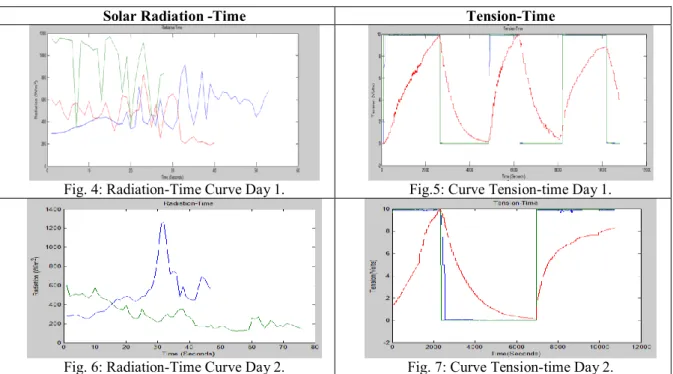
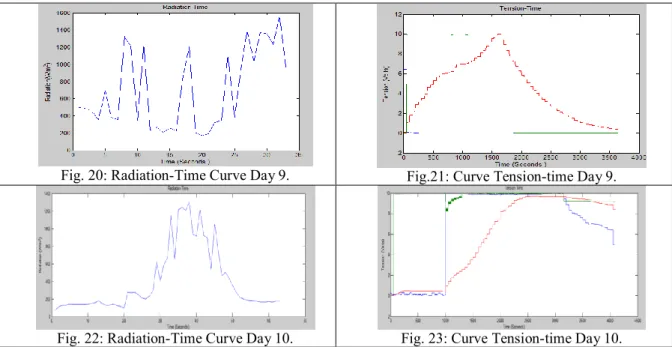
Table 3. provides graphics of solar radiation, charging and discharging. The red line represents the supercapacitor and blue and green one’s Ni-MH and Li-ion respectively. In the graphics for radiation the blue line corresponds to the first charge and the green and red lines describe the second and third charge respectively, if exists.
In Figures 9 and 11, respectively, the process of partial discharge in the nickel battery can be appreciated, whereby the battery is discharged for a few seconds, recovering its voltage value before discharge. This effect reaches a 19% reduction of its rated voltage. The reaction of the nickel battery in Figures 17 and 19 respectively is known as memory effect, which is characterized by the temporary loss of the battery discharge capacity. In this case the voltage reached 76% nominal value recovering its capacity after 4 cycles, as shown in figures 21 and 23 respectively. Figure 19 shows the appearance of two simultaneous effects: the memory effect and partial discharge effect, which appears for 6 minutes, and disappears the next day in the battery Nickel Metal Hydride. In the other hand, the lithium battery even when having the same number of cycles than the Nickel Hydride battery, doesn’t present memory effect as expected. However, on day 10 as shown in Figure 23, the lithium ion battery presents a partial discharge, recovering a few minutes later.
The scale factor of time in the Voltage-Time curve is 1: 2 seconds, in order to appreciate that the supercapacitor charges vary within a range of 25 minutes to 90 minutes, depending on the current generated by the panel. It should be noted that not every day more than one charge could be obtained due to weather conditions and radiation that often was so low that provided very long charge in the supercapacitor. In Figure 15 a voltage peak in the supercapacitor first charge the can be observed, and repeated voltage peaks in the second supercapacitor charge the even supercapacitor has not presented memory effect, or partial discharging during charge, additionally these voltage peaks did not generated effects on their subsequent behavior.
TABLE III.
TENSION-TIME AND SOLAR RADIATION-TIME CURVES.
Solar Radiation -Time Tension-Time
Fig. 4: Radiation-Time Curve Day 1. Fig.5: Curve Tension-time Day 1.
Fig. 8: Radiation-Time Curve Day 3. Fig. 9: Curve Tension-time Day 3.
Fig.10: Radiation-Time Curve Day 4. Fig.11: Curve Tension-time Day 4.
Fig. 12: Radiation-Time Curve Day 5. Fig.13: Curve Tension-time Day 5.
Fig. 14: Radiation-Time Curve Day 6. Fig.15: Curve Tension-time Day 6.
Fig .16: Radiation-Time Curve Day 7. Fig.17: Curve Tension-time Day 7.
Fig. 20: Radiation-Time Curve Day 9. Fig.21: Curve Tension-time Day 9.
Fig. 22: Radiation-Time Curve Day 10. Fig. 23: Curve Tension-time Day 10.
5. Results
Although authors ascribe the memory effect only to Ni-Cd batteries, this effect is also present in Ni-MH batteries in a relatively small percentage, albeit it is a temporary effect, it reduces the battery life, however it is reversible through the application of complete cycles of charge-discharge as mentioned by Viera Perez in his work "fast battery charging Ni-Cd and Ni-MH, medium and large capacity, synthesis and comparison of new methods" [6] in which he argues that "the temporary loss of capacity can be recovered fully after applying two complete cycles of charge-discharge consecutively". This statement can be corroborated in the present work. Despite charge control in photovoltaic systems is done by regulators, that measure the voltage and protect the battery, in this work, the value of the battery voltage does not correspond to the state of charge of the battery generating partial loads, producing memory effect as stated by Martinez Garcia and Gualda Gil in their book "Electronic components power topologies and equipment" [7], "memory effect is the result of successive cycles of partial loads, in which grouped granules of active material offering less surface contact with the electrolyte ", causing that the battery do not reach full charge. Another relevant factor in implementing solar photovoltaic systems is the correct calibration of the voltage regulator, since a misadjusted or damaged regulator may affect measurements and battery life causing overload, over-discharge and even the above-mentioned memory effect.
Being the radiation a variable factor, which is presented in photovoltaic solar systems, storage devices typically do not have full charges, or may present a series of mixtures between fast and slow charges during different periods of
time in the same cycle. This factor affects batteries notoriously, generating harmful effects to them and reducing its life, in contrast, the supercapacitor doesn’t appear to be affected by abrupt changes. Supercapacitors, when receiving more current reduce charging times. Although ultracapacitors are one of the most expensive storage devices, it is easy to adjust the behavior of a solar photovoltaic system, due to the high currents that can it support, their satisfactory behavior against incomplete deep
charging and discharging, that can notably affect the batteries, but in the case of supercapacitor it can be supported without producing health problems, presented daily related to the use of photovoltaic solar systems. In addition, ultracapacitors would be appropriate for photovoltaic installations where consumption increase with time, as they have high power density, which allows high currents to dissipate quickly. Eventually, when using supercapacitors, regulators functionality is limited, since less complex regulatory circuits would be required in order to avoid deep discharge and therefore making them less expensive. Supercapacitors are known for their fast charges and discharges compared to batteries, however as can be seen in Table 2, the charge times on the capacitor is longer than the charge in the battery, this is due to the high capacitance of the supercapacitor that increases the time constant, being for the battery, discharge depending directly of the current, in this case the accumulators has a small storage energy capacity of 2.1 Wh, but for high values of storage energy ,the supercapacitor present times of charge faster than batteries as it is possible to calculate for 21 Wh.
Acknowledgment
A special thanks to the district University Francisco José de Caldas, who made possible this research.
[1] F. Mc Michael & C. Henderson, “Recycling Batteries”, 2002, IEEE, Vol.35, p.36, August 2002. [2] Ministerio de ambiente, vivienda y desarrollo territorial del gobierno de Colombia,
“Manual de producción más limpia y buenas prácticas ambientales: Fabricación y Reciclaje de Baterías”. 2006, Available:
http://www.metropol.gov.co/ProduccionLimpia/Documents/Cl%C3%BAster%20Transporte/Manual_PL_Fabricacion_Reciclaj e_Baterias.pdf.
[3] I.Gil, “Diseño de un sistema de Almacenamiento Híbrido basado en baterías y Supercondensadores para su uso en
microred eléctrica” Universidad de Sevilla, Sevilla
España,2012.Available:http://bibing.us.es/proyectos/abreproy/4740/fichero/3.+Sistema+de+almacenamiento+hibrido.pdf [2007].
[4] M.Abella, “Sistemas solares fotovoltaicos”, Centro de investigaciones Energéticas, Medioambientales y tecnológicas, Available:http://api.eoi.es/api_v1_dev.php/fedora/asset/eoi:45337/componente45335.pdf.
[5] J. Menéndez, “El carbón en la vida cotidiana: De la pintura rupestre al ascensor espacial”, ISBN 9781479386086, p.108, 2012.
[6] J.Viera ,”Carga rápida de Baterías de Ni-Cd y Ni-MH, de media y gran capacidad, síntesis y comparación de nuevos
métodos” Universidad de Oviedo, España, 2003. Available:
http://www.tdx.cat/bitstream/handle/10803/11142/UOV0036TJCVP.pdf [April 2003].
* Corresponding author: Johann Alexander Hernández Mora, PhD in Electrical Engineering, Director of LIFAE
Email:[email protected]