
Developing reading comprehension in english in science classes through clil methodology
72
0
0
Texto completo
(2) Table of Content ABSTRATCT. ii. INTRODUCTION. 1. 1. RESEARCH PROBLEM. 2. 1.1. 1.2. 1.3. 1.4.. 2 3 4 4. Background of the study Problematic situation Research question Importance of the study. 2. OBJECTIVES. 5. 2.1. 2.2.. 5 5. General objective Specific objectives. 3. JUSTIFICATION. 6. 4. THEORETICAL FRAMEWORK. 7. 4.1. 4.2. 4.3. 4.4.. 7 8 9 11. Reading instruction: models and classroom practice Reading comprehension strategies: definition and findings CLIL methodology Skills improvement. 5. RESEARCH METHODOLOGY. 13. 5.1. 5.2. 5.3.. 13 13 14. Research design Participants Instruments. 5.3.1. Reading comprehension rubric 5.3.2. Skills chart 5.3.3. Reading strategies. 15 16 17. 5.3.3.1. 5.3.3.2. 5.3.3.3. 5.3.3.4. 5.3.3.5. 5.3.3.6.. 19 19 20 21 22 24. 5.4.. Reading for meaning Scanning the text Active learning / incorporate higher thinking skills Anticipatory reading guides Frame routine and jigsaw charts Double entry journal. Procedure 1. Identification and diagnostic of the situation 2. Design of the intervention of the group. 25 25 26.
(3) a. Teaching new strategies to the target group b. Assessment c. Questions analysis: reading comprehension Questions lots and hots d. Decision making on strategies. 26 26 27 28. 6. RESULTS. 30. 7. ANALYSIS AND DISCUSSION. 44. 8. CONCLUSIONS. 48. 9. RECOMMENDATIONS. 50. BIBLIOGRAPHIC REFERENCES. 51. WEBOGRAPHY. 52. APPENDIXES. 53.
(4) List of tables TABLE 1. RESULTS OF READING ASSESSMENT FINAL TERMS 5TH GRADE. 31. TABLE 2. RESULTS OF READING ASSESSMENT PER TERM. MID-TERM AND FINALS. 32. TABLE 3. TEACHER’S READING COMPREHENSION RUBRIC. 37. TABLE 4. LEARNERS’ SELF-ASSESSMENT RUBRIC. 38.
(5) List of graphs GRAPH 1. AVERAGE FINAL EXAM 3 TERMS 5TH GRADE. 31. GRAPH 2. AVERAGE MID-TERMS AND FINALS 3 TERMS 6TH GRADE. 33. GRAPH 3. MID-TERM 1 AND FINAL 1. 34. GRAPH 4. MID-TERM 2 AND FINAL 2. 35. GRAPH 5. MID-TERM 3 AND FINAL 3. 36. GRAPH 6. RUBRIC ANALYSIS CRITERION 1. 39. GRAPH 7. LEARNERS’ ASSESSMENT. CRITERION 1. 39. GRAPH 8. RUBRIC ANALYSIS CRITERION 2. 40. GRAPH 9. LEARNERS’ ASSESSMENT. CRITERION 2. 41. GRAPH 10. RUBRIC ANALYSIS CRITERION 3. 41. GRAPH 11. LEARNERS’ ASSESSMENT. CRITERION 3. 42. GRAPH 12. RUBRIC ANALYSIS. CRITERION 4. 43. GRAPH 13. LEARNERS’ ASSESSMENT. CRITERION 4. 43.
(6) Dedication I dedicate this research to my family, that supports me in every step of the way; my loving husband, who never gives up on me; my mother and father, and all of those who believe in me.. Acknowledgement I want to thank my supportive tutor, Cristina Peñafort, who was a very important referent for me and whose support and commitment have been incredible; all the professors in my master’s program who help me to grow as a teacher; Aspaen Liceo Tacurí for their continue support and faith in me. Thank you from the bottom of my heart..
(7) Abstract This action research study explored the effects that reading strategies had in developing reading comprehension competence in English of a group of 6th graders in their Science class in a private school in Cali Colombia, associated with a Cambridge International Program. Data collected through skills charts filled with exams results and the information collected through a rubric assessment adapted from the reading continuum (Christopher-Gordon Publishers, 2001) showed evidence of advance in most learners of the group according to their individual abilities, learning styles and development. The assessment rubric allowed to categorize the developmental stages of learners, most learners were in bridging and fluent developmental stages, which could be linked to the scaffolding process done through the strategies. Although results showed these advances, deeper analysis of the rubric categories evidenced lack of language structure and awareness of language use. A possible explanation is, as research has stated before (Mariño, 2014; Nikula, 2015), that integration between language and content in areas like Science using Content and Language Integrated Learning (CLIL)1 methodology can be challenging because there is usually a focus on content, while language becomes secondary. Also, scaffolding language in a communicative methodology can be difficult for teachers without the proper training, which should be continuous and innovative. Therefore, this research feedbacks the teachers’ practice in schools that use methodologies like CLIL, that requires a proper adaptation to the context taking into account learners’ needs in a monolingual country like Colombia. Language scaffolding training, grammar in context and strategies to develop skills should be part of teaching trainings to improve their classroom practice.. 1. Content and Language Integrated Learning methodology will be further explained in Theoretical framework section 4.3.
(8) Introduction Reading comprehension is one of the most critical academic skills because it has a direct connection to the academic writing ability, then it is expected that students comprehend what they have read and use the information to apply it to written tasks, debates, and the development of critical thinking. It is key to develop reading skills since young age. Considering the fact that this reading process takes place in a bilingual education institution in Cali, Spanish as the mother tongue is privileged from the beginning of pre-school. From first grade, learners start taking some subjects in English. Hence, they develop skills with both languages through a reading model that is an interaction between decoding and reading for meaning.. Nonetheless, learners need to practice reading strategies to relate with texts. This would help to stimulate cognitive activation and development of high thinking skills in reading tasks. Beyond the models of processing reading information (top-down; bottom-up), all teachers should promote active, meaningful, and guided reading tasks to make learners aware of their reading styles.. After the teacher found difficulties in the reading comprehension of a group of students in 5th grade during the last school year, her aim was to provide them with reading strategies in 6th grade to foster the development of their reading competence in English. Therefore, to achieve this goal, CLIL reading strategies were used supported by other strategies that line up with the methodology to promote an active reading environment.. The teacher expected that by the end of the school year the students could cope cognitively with the reading of texts, solving problem situations and tests by using information appropriately. Also, it was expected to support their language learning process by providing enough vocabulary for comprehension. To achieve this purpose, an action research approach helped the teacher to find in every day practice the opportunity to apply the strategies and vocabulary scaffolding necessary to improve learners’ results in tests. Through a rubric assessment and selfassessment, the teacher could develop a formative assessment type that provided more information about learners’ needs.. Reading strategies were necessary and learners recognized advancements in this field, but the research aided the teacher to identify a deeper root of the problem since strategies for building language structure were also necessary. Both a good structure for decoding and reading for meaning will become essential to improve the CLIL lessons in this institution. 1.
(9) 1. Research Problem 1.1 Background of the Study Aspaen Liceo Tacurí is a private school located in Cali. This institution focuses on the development of competences to be proficient in English as a second language. It belongs to a group of schools from ASPAEN Colombia, which gathers coeducation schools in Bogotá, Medellín, Cali, Manizales, Cartagena and Bucaramanga. The school population is around 220 students, all of them female, and a group of 25 female teachers.. To accomplish its objectives, Liceo Tacurí has integrated the Cambridge International Education program (CIE) into its curriculum during the last 4 years. The CIE program promotes teaching English through content in subjects like Math, Science, Arts and English. Science curriculum is divided in four cores: Biology, Chemistry, Physics and Scientific Enquiry that goes through the other three. Each school year Science teachers decide the order of these cores according to the previous year diagnostic that describes the topics studied and the topics missing.. Because of this, Liceo Tacurí continuously assesses students in both language and content using Cambridge progression tests and checkpoints but also assesses content in Spanish with Pruebas Saber. These assessments reveal that reading comprehension plays an essential role in improving students' language and proficiency in different tasks. Understanding questions and problem situations are necessary to solving workshops, class tasks, examinations, and homework.. During school year 2015-2016, an analysis of Science and Math results in international examinations and Pruebas Saber showed that students exhibited difficulties comprehending what they read even when they know the concepts or procedures. Also, after each period evaluation in 5th-grade Science class, the teacher filled in a skill chart (reading, writing, listening and speaking) which showed difficulties in reading tasks. After implementing reading strategies according to CLIL methodology used in the institution, learners did better in their results but they still had difficulties identifying the main ideas and using the texts properly for the tasks.. The strategies were based on the CLIL methodology because this allows language and content integration, providing the students with a context to use language and developing it stage by stage. Reading comprehension skills in a CLIL classroom are related not only to vocabulary but thinking skills which allow students to infer, analyze and be critical towards a text.. 2.
(10) Because the evaluations are done through the local and external examinations, one of the school’s objectives during the year 2016-2017 was to improve students’ reading comprehension, particularly to obtain better results in the examinations. To achieve this objective, the school planned a training for students where they could learn about the examination style, the types of question and the strategies to approach them. However, these strategies did not have as an aim to develop the reading comprehension competence beyond examinations. Therefore, the purpose of this research was to find out how, following the school’s methodology, the application of CLIL strategies in the Science class might help the aforementioned sixth graders to develop their reading comprehension competence in English.. 1.2 Problematic Situation During the school year 2015-2016, the students of fifth grade were divided into two groups, both of which had the same Science teacher and studied the same topics in class. Because this was the teacher’s first year she realized that Science exams included the four language skills (Reading, writing, speaking and listening). Therefore, it was important for her to develop these skills during lessons but that was not done at the beginning, the focus of the lessons was in content and not in language. The first improvement was to balance these four skills in every class with content.. The results after the second term continued worrying the teacher because the learners showed knowledge of concepts but struggled with reading comprehension, particularly, when questions were beyond concrete parts of the reading and asked for analysis, comparison, contrast or inference. Also, they developed writing activities with some spelling mistakes. Listening and speaking scored highly in exams. The second improvement the teacher did was to apply readings with similar characteristic like topics, structure and length in the class and in the exam, but learners keep struggling with comprehension, inference and main ideas. Basically, students read the texts trying to understand each word but not the whole gist of the text. Lack of vocabulary then blocked the comprehension process because students focused in word by word translation instead of meaning construction.. Therefore, it became important to introduce a second change by providing learners with reading strategies that aided them to comprehend the texts instead of trying to comprehend each word in them or translate them.. 3.
(11) 1.3 Research Question According to what has been presented the research will explore: How does the use of CLIL strategies help to construct the competence in reading comprehension in English of the 6th grade students of a private school in Cali in their Science class?. 1.4 Importance of the Study According to Mera’s article in El País (2012), Colombian students can read but they cannot use the information in a critical and creative way. The results of 2009 Pruebas Saber showed that 57% of fifth graders cannot achieve the minimum in critical reading. These results urged the Colombian government to find a way to lead these students to improve reading. One of the first issues is the access students have to a meaningful material, this a reason why the Plan Nacional de Lectura y Escritura “Leer es mi cuento” (PNLE) was implemented during January 2012. The program focused on infrastructure and material and training for teachers to provide pedagogical strategies to approach reading in their classrooms and share reading activities (Ministerio de Educación (MEN), 2016).. A similar situation was noticed during the analysis of Math and Science in Pruebas Saber 2014-2015 in this private school from Cali. Results evidenced that students could handle mathematical procedures and recognized scientific concepts but the tasks related to problem-solving and comprehension scored less than expected by the school standards. Also, the results of exams of Science for 5th graders during the school year 2015-2016 evidenced that students required approach reading guided by strategies.. The strategies used and proposed in this study are part of the CLIL methodology repertoire, which has been implemented in this particular school during 3 years. It is important to evaluate how successful these strategies were to develop the reading comprehension skills of the learners connecting language and cognitive activation.. 4.
(12) 2 Objectives 2.1 General Objective To develop the reading comprehension competence in English of the 6 th graders in their Science class.. 2.2 Specific Objectives • To identify the reading comprehension competence level in English of 6thgraders in Science class after applying CLIL strategies. • To apply CLIL reading strategies that develop the reading comprehension competence in English of 6th -graders in Science class. • To determine the effect in the reading comprehension competence in English of 6th-graders in Science class through CLIL strategies.. 5.
(13) 3 Justification Education has been changing through the years moving from content to skills development. Reading and writing academically is a challenge in a country where national and international exams evidence difficulties in comprehension and high thinking skills.. That is the particular case for this research, where poor results in exams ignited the teacher’s reflection around the possible causes of failure in Science exams during school year 2015-2016. The teacher was learning to use a new methodology as part of the international program ran by the school. CLIL methodology focused in skills more than in content was an exercise of change of mind. The teacher had to make an exercise to redefine her position in the classroom and to promote reading skills if there was going to be an assessment for them.. The study began then as an action research because it was an exercise executed during 2 school year periods, reflecting on what was going on in the process changing strategies, adapting the questions that guided the research and finding, more problems to the course of it. Finally, this methodology helped the teacher to apply reading strategies in her classroom and to discover that a language structure issue was affecting learners’ comprehension. Therefore, this study provided an opportunity of growth for the teacher’s practice adapting strategies to a methodology she was learning and building the awareness about the differences between teaching content and promoting skills. Also, the research produced results that made the teacher aware of other difficulties with language besides vocabulary, leading to a reflection about the role of language in content areas when CLIL is involved. Teachers need to have all the strategies necessary to enrich their methodological process inside the classrooms, they need training to really promote skills development and go beyond content.. 6.
(14) 4 Theoretical Framework 4.1 Reading Instruction: Models and Classroom Practice Reading comprehension proficiency starts when we learn how to read, but since this is a complex process there are several models to introduce it; those models have ended in what has been known as the “Reading Wars” a political confrontation between the models (Flippo, 2012).. Historically, there have been two recognized models of the reading process and a third derived from them. The bottom-up model, which starts by decoding words/sounds, transforms them into syllables to build words and finishes by understanding a whole text or doing meaning construction. This process is also known as the traditional model, and it can be considered as a student passive process. The Top-down model is a process where the reader’s role becomes active and he/she constructs the text from the meaning and not from its parts. Flippo, (2012) calls it the whole language process because the reader searches for specific or meaningful information using prior knowledge. Finally, there is an interactive model that combines bottom-up and top-down models, where lower-level processing is the main base to comprehend texts, particularly because they are the first step for comprehension. Then the higher-level processing where the reader builds meaning through text information and his own interpretation of the text (Skoguen, 2013; Khanam, Zahid & Mondol, 2014).. According to Mraz and Vacca (2012), political issues and media encouraged what was known as “Reading Wars” between the reading models in the United States. Reading policies defend or attack the models without really considering the research about the topic. Societies move back and forth through the models induced by media, as a result, the reading comprehension issue is not being considered from the expert point of view. The fact is that beyond the models, reading comprehension can be affected by positive and negative class practices; in Flippo, (2012) different experts, from different models, gather to conclude that contexts and practices can become facilitators of or can affect the reading process and therefore the reading comprehension.. Flippo, (2012) gathered 5 clusters of agreement related to positive practices, such as: “´Combining Reading with Other Language Processes’, ´Contexts, Environments, and Purposes for Reading’, ´Developing (or Shaping) Students’ Perceptions and Expectations’, ´Materials’, and ‘Reading Instructions’” (p. 13). These 5 clusters would demonstrate that the reading issues are not affected by the model of teaching reading but by the strategies and practices to promote it. A positive reading comprehension process results from making the reading meaningful, combining it with the other language skills, accepting mistakes as part of the process, providing positive expectations, using different materials, and providing clear 7.
(15) instruction. Therefore, teaching reading strategies and promoting an environment towards it can have a positive influence in developing this skill, because the strategies have to promote not only decoding, identification and several lower thinking skills but also to promote inference, meaning, and analysis (higher-thinking skills).. On the other hand, taking into account this study is done with a content area, Ness, (2017) presented important evidence about the limited instruction for reading strategies in areas like math, science, and geography, which supports the fact that without proper instruction reading skills cannot improve (Flippo, 2012). According to the evidence, the main issue is the absence of teacher instruction on reading strategies; thus teachers limit reading strategies to identify main ideas through questions and summaries. Another relevant fact is that “teachers are likely to see their major instruction responsibility as covering their particular content in preparation for state test” (Ness, 2017, p. 230). Content areas, like science in the case of this study, have to obtain results in state and internal tests and this can mislead the reading objective. Actually, in the case of this study, the reading comprehension issue derived from test results; therefore, reading became such an important objective. Students who improve their reading comprehension proficiency can be more effective in their national and internal tests. 4.2 Reading Comprehension Strategies: Definition and Findings In order to comprehend what kind of strategies would be adequate to accomplish this task, this study will consider those that promote higher thinking skills and fit into the school methodology to have coherence with its model.. First of all, a reader does not achieve proficiency since the initial process. The reading models mentioned above show that cognitively there are several ways of processing information; aside from cognitive processing, strategies have an effect on the reading development. Skoguen (2013) (citing Bråten, 2007; Koda, 2014; Stangeland & Forsth, 2001) highlights strategies as an active and conscious act that will help students to gain knowledge and to organize the text. Then, students require strategy reading instruction in order to process text information.. Since reading models and strategies belong to cognitive processing, students require activating their prior knowledge. Once they have managed to relate meaningful information stored in their memory with the text, they can decode and fill in information with assumptions. These assumptions known as schemata help to identify familiar information, reorganizing it according to relations established among them; this means they interact in a dynamic way with the text (Khanam et al 2014).. 8.
(16) Hence, findings demonstrate that when texts or activities done with them do not activate prior knowledge, it is difficult for students to comprehend readings. Khanam et al (2014) conclude that “teaching L2 students to read is not achievable by simply choosing any text or reading materials and expecting the students to make sense of it” (p. 91). It is essential for a teacher to recognize there is a prior construction of knowledge in their students. Accordingly reading should take place within meaningful constructions. Enhancing cultural background around several cultures, enriching schemata through different reading or writing styles, promoting prediction, establishing relationships between schemata and new content would help learners to obtain the most from their readings. On the other hand, Yen-Hui (2016) using the think-aloud technique compared the use of reading strategies in more successful and less successful readers. Students provided an external evidence of their thinking while developing a reading task. Evidence supports the role of schemata in reading comprehension, even though schemata are not the objective of this research. The proficient readers showed they had enough content knowledge and language proficiency to relate with the texts. They also had an active metacognition process to monitor their comprehension, learning, and meaning construction, while the less proficient readers showed gaps in the information about language and content. Therefore, this affected the way they related with the text, leading to poor reading strategies to cope with the lack of information.. In summary, reading comprehension strategies become an important objective of research because students have to be aware of their reading process. The reading comprehension boosts the use of higher-thinking skills to grasp meaning, constructing opportunities for critical analysis and use of problem-solving strategies. All of these elements can be found on different approaches and methodologies coherent with the CLIL methodology used in the school where the study took place.. 4.3 CLIL Methodology CLIL means “Content and Language Integrated Learning. It is an approach that teaches the content of curricular subjects through a non-native language” (University of Cambridge. ESOL Examinations, 2011, p. 3). With this in mind, CLIL makes the second language use meaningful for learners because they have to use language to achieve content knowledge. Consequently, they require building a specific content language to be productive in class. The reading assignments have to be planned considering the specific content language.. Usually, a CLIL lesson is founded on four essential pillars or as Coyle (1999) called them the 4 C’s. Every lesson plan has to have a content that, as mentioned before, uses specific language structures and vocabulary. Another essential element is the role of scaffolding in building the language, so students can start using their L1 and 9.
(17) then increasing L2 knowledge. The notion of prior knowledge goes through all the 4 C’s. Therefore, content is connected to communication because specific language, content-compatible language, and everyday language are necessary to communicate in the classroom. Cognition is also essential because learning both content and language depends on a set of skills; students on a CLIL classroom will start activating lower processes known as LOTS, or lower order thinking skills such as identifying, naming, describing, comparing. After this, learners will take their skills and language to the next level HOTS, or higher order thinking skills, developing critical thinking, analysis, and problem-solving strategies. Finally, the cultural element connects everything because learners have to activate prior information linking their own context with other cultural backgrounds. Then culture provides the meaningful context to talk in English about one’s culture and others too (University of Cambridge. ESOL Examinations, 2011).. Once CLIL pillars have been described, several convergent points can be linked with the research on the importance of reading strategies. Both Wang (2016) and Khanam et al (2014) highlight in their research the activation of prior knowledge as a significant part of reading strategy activation; at the same time CLIL methodology commands activation of prior knowledge as an important part of each class. There is also a continuous work in scaffolding and L1 use to build the target language, as Yen-Hui (2016) found the lack of language background can lead to poor strategic action to deal with gaps in the information. But, not only in the language component there are linking points.. Reading comprehension is essentially a cognitive process, that goes from decoding to constructing meaning (Skoguen, 2013), while CLIL methodology moves from lower skills in communication and content towards critical thinking skills to use a complex language to communicate ideas (University of Cambridge. ESOL Examinations, 2011). When learners predict, it is because they can construct schemata from what they read, every category stored in long-term memory will help to build schemata prediction (Khanam et al, 2014). The cognitive challenge in CLIL increases through the spiral model, while content is visited and revisited language and cognitive challenge increase, and for science, this implies biology, physics, chemistry and scientific inquiry. Thus, schemata prediction changes through time (University of Cambridge. International Examination, 2011). Learners use their communicative skills to produce knowledge, which is an important step in methodologies based on content like CLIL because they provide a rich environment to promote different forms of communication inside the classroom.. 10.
(18) 4.4 Skills Improvement As mentioned before, CLIL gathers several procedures from different approaches, which allows a possible relation between CLIL findings and the strategies mentioned above because both rely on a cognitive process. Both target high thinking skills and support cultural background construction to change schemata, providing a contextual setting.. All of these elements demand from the teacher a continuous training process. In the Colombian context, CLIL methodology training becomes urgent to use it properly. As Mariño (2014) introduces in her article, teachers require ongoing instruction and training to apply CLIL methodology according to standards. One of the contradictions about CLIL is that content can be more relevant because of the internal and state tests, leaving language behind. This is not the purpose of the methodology that attempts a balance between language and content; hence, a key difficulty with CLIL is that even when it promotes a meaningful context for using language, it becomes difficult to keep the balance between language and content. The remaining question is up to what extent is this balance possible? Ness, (2017) presents this issue in her article, concluding that as long as a teacher has a qualified training, it is possible to achieve a balance between both elements.. Nevertheless, CLIL has proven to have a positive effect on English learners and its student-centered philosophy may have to do with it. CLIL prepares students for internationalization. There is also an important emotional component, and a high level of intercultural communication (Lasagabaster, 2008). Cambridge program counts with the assessment to observe the progress in learners’ language level. Hence most of the studies reviewed here used in their methodology Cambridge Test to assess students’ progress. But, in other cases, exams’ results are not enough, then analysis of classes and language use are also important (Mariño, 2014; Nikula, 2015).. In early stages of learning English in a bilingual context like the Basque community, CLIL has proven that learners have a better language performance than students in non-CLIL contexts. Language aspects like vocabulary, fluency and writing shows a better performance even in groups with early exposure to CLIL compared with nonCLIL learners. These results support communicative and sociocultural advantages of CLIL (Lasagabaster, 2008).. In spite of these results in English classes, other results contrast in content areas. Nikula (2015) observed language use and scaffolding in hands-on science activities; she found that content area classes are mostly content oriented, while language is subject-specific focused. Then, the objective of developing language through content seems unbalanced, particularly with science, where everyday language 11.
(19) seems to be undervalued, prioritizing the scientific language. This is not a negative issue, but CLIL's goal is to promote language and content at the same time; hence, both of them should have the priority. These results do not mean CLIL learners cannot do better than EFL learners in several skills, although it is very important to have clear CLIL criteria if teachers want to achieve successful results. Mariño (2014) found similar results in Colombia, where content and language are taught in an isolated way, though content areas are taught in English using language support. These results would support the fact that reading strategies used in this study help learners to use language for comprehension, and to use prior knowledge to build new knowledge. Language and content should have an important balance in reading texts and in the strategies used.. Several studies did research in classes or periods of time during school year. PerezVidal and Roquet (2015) designed a study in a CLIL science program for a whole academic year and a pre- and post-test analysis showed that CLIL students performed better than Formal Instruction (FI) learners. Though CLIL learners do not do better in all language domains, it is important to highlight that they performed better in the science class in reading, grammar, and writing than in communicative skills like listening and speaking. These results compared with Nikula’s would show that language focus is the scientific language and that in the science tasks reading and writing have an important role in cognitive skills development.. 12.
(20) 5 Research Methodology 5.1 Research Design This research started exploring possible strategies that would help students to cope with reading in a second language, therefore, the most suitable design was an exploring action research (Cohen, Manion, and Morrison. 2007).. Action research is a real life intervention that can impact practice by testing models, methods, assessment and learning strategies (Cohen et al. 2007). Teachers are able to do their everyday job in the classroom by systematizing the information they can recollect from their experience. One of the advantages of action research is that feedback allows to change the path and try new strategies, becoming a cyclical process (Cohen et al. 2007). During the process of these intervention strategies, assessment and information recollection changed through feedback and continuous analysis of the situation.. At the beginning of this research the data collection was focused on quantitative information since the skill charts in each exam were an important indicator of advance. Measuring learners’ performance in each test provided statistical information to compare their achievements during the school year. Also, the descriptive rubric used to analyze the reading stages provided qualitative information about the reading developmental level of learners.. But, there was also a necessity to engage learners with the process because reading is also a personal experience and they needed the motivation to find a goal in these exercises; besides, previous tasks to the exam required a qualitative recollection of the experience instead of an indicator of success. Because of this, the analysis would use the quantitative data collection to describe how strategies helped to construct the learners’ reading comprehension. Patterns discovered through quantitative data would be later observed under the context of the situation.. 5.2 Participants The subjects of this study were 22 girls from 6th grade from a feminine private school in Cali. These students were around 11 and 12 years old. Most of the students that had been in the school during their whole process, had acquired a good level of English proficiency and were able to communicate their ideas. They, however, required scaffolding for vocabulary and structure to comprehend written texts.. 13.
(21) In these group only two students were new but came from bilingual schools. The other 20 students were part of the research process during their 5th grade school year. In this stage of the research the participants started working with skimming and scanning of texts, there were strategies to scaffold language of learning (content area language) and improving the validity of the exams using appropriate texts in the reading part of the exam.. This particular group of learners showed important characteristics to take into account. Most learners showed artistic and sports interests, lacking the motivation towards academic tasks making difficult to engage them in reading and writing tasks. Therefore, the teacher decided to make the participants aware of the process and how they could help to the process. Once this was done the attitude of some students changed positively. Also there were specific learners who showed cognitive and emotional difficulties treated by the school with their Psychology and Family Departments.. 5.3 Instruments The instruments used were: • A rubric to measure the performance in reading activities applied in science class. The process for the rubric construction started with the assessments done by the teacher and the learners with the Reading Continuum chart (Christopher-Gordon Publishers, 2001). Once the teacher analyzed the information obtained could decide which elements were essential for the rubric.. 14.
(22) 5.3.1 Reading Comprehension Rubric Criteria. 4 Proficient. 3 Fluent. 2 Bridging. 1 Expanding. Types of text and reading. 1. Reads complex texts related with science concepts 2. Develops criteria for selecting reading material independently. 1. Reads challenging texts related with science concepts 2. Begins to develop criteria for selecting reading material. 1. Reads medium level chapter books related with science concepts 2. Expands criteria for selecting reading material independently. 1. Reads easy chapter books related with science concepts 2. Expands criteria for selecting reading material with guidance.. Attitude. 1. Reads silently for extended periods (35-45 minutes). 1. Reads silently for extended periods (35-40 minutes). 1. Reads silently for longer periods (20-35 minutes). 1. Reads silently for longer periods (15-30 minutes). Reading strategies. 1. Uses several resources to gather information and increase vocabulary independently 2. Gathers, integrates and analyses information from multiple sources including graphs, charts and tables with guidance. 1. Begins to use several resources to gather information and increase vocabulary independently 2. Begins to gather, integrates and analyses information from multiple sources including graphs, charts and tables with guidance. 1. Uses several resources to gather information and increase vocabulary with guidance 2. Gathers information from multiple sources including graphs, charts and tables with guidance. 1. Uses cues to gather information and increase vocabulary independently 2. Uses reading strategies to gather information from graphs and tables with guidance.. 1. Discusses text purposes and elements. 2. Uses reasons and examples to support ideas and conclusions.. 1. Begins to discuss text purposes and elements. 2. Uses reasons and examples to support ideas and conclusions with guidance.. 1. Discusses just some text elements with guidance 2. Begins to use reasons and examples to support ideas and conclusions with guidance.. 1. Retells some text elements in a sequential order 2. Identifies examples in the text.. Comprehension and response. Adapted from Christopher-Gordon Publishers, 2001.. 15.
(23) 5.3.2 Skills chart • Skills chart is a school document that provides information about the development of language skills through content. During each mid-term and final term exams teachers upload the points obtained in writing, reading, speaking and listening and makes and action plan accordingly. During 5th grade the final exams skill chart was filled in, but mid-terms were not. On 6th grade both skills charts were filled in. Below the chart format used at the School is shown:. Test: SCIENCE STUDENT’S NAME. CIE* DEPARTMENT MID TERM TEST REPORT FIRST TERM 2016-2017 Grade: 6 Teacher: ANGELICA MARIA YUSTY SPEAKING LISTENING READING WRITING 1 Point 2 Points 2 Points 2 Points. Date:. 1. XXXXXX 2. XXXXXX 3. XXXXXX 4. XXXXXX 5. XXXXXX 6. XXXXXX 7. XXXXXX 8. XXXXXX 9. XXXXXX 10. XXXXXX 11. XXXXXX 12. XXXXXX 13. XXXXXX TOTAL PER SKILL. * Cambridge International Examinations.. 16.
(24) 5.3.3 Reading Strategies Developing high thinking skills through all four language skills and developing science inquiring abilities required specific reading strategies. The reading strategies had to be applied with specific content topics according to each term focus as it follows: first term biology, second term physics and third term chemistry. The teacher applied CLIL reading strategies and a set of general reading strategies for reading in a second language2. The teacher decided to apply the strategies according to the needs learners showed during the process. The first topic required very specific language, also learners needed to identify the importance of certain content language over other words that were not needed for comprehension. Regardless, the teacher would have had to enhance language for learning, which is the language related with the structure required to operate in English (University of Cambridge ESOL examinations, 2011). After working in language the teacher decided to use strategies to organize information from the texts. This strategy first focused in activities with concrete words (descriptors) and simple sentences. Then, text organization moved to making inferences, re-writing the texts in charts and making summaries.. The following are the type of strategies that were selected:. 2. The references of those lists are found in webography page 49 17.
(25) Strategies to build language of learning (Content specific languge). Reading for meaning.. Prior-knowledge activation strategies. Anticipatory reading.. Active learning strategies.. Scanning and skimming, to find information, to construct meaning and to comprehend.. Strategies to analyze the text, summarize it and find the main ideas.. Strategies that allow learners to provide a critical opinion about the readings.. 18.
(26) At the beginning of the school year 2016-2017 the objective was to aid the learners to improve their language of learning (content area language) by using dictionaries, providing key words or obtaining these key words through reading before doing the practical activities like labs or map organizers. Even before having the results of the rubric the teacher realized learners lack a scientific language (language of learning). So during the first part of the first term, there were not a full scope of strategies. Instead they built language and focused on key words, concepts and content as recommended by CLIL. The first topic was Microorganisms. Then the first aim was to build language around this topic. 5.3.3.1. Reading for meaning (e.g. bacteria and viruses) These strategies help learners to construct language vocabulary, identify concepts and find specific information on a text. • Scanning • Using dictionaries • Using subject words with appropriateness • Understanding definitions • Giving evidence of understanding through questions and group debate • Giving a copy of the text to each students and ask them to read it, then underline 5 words they don’t understand and ask for the meaning to a partner or look them up in a dictionary. • Asking the student to fill in the gaps when the definitions of the key-words are clear. In this case, learners were asked to read a text to find a new vocabulary, they made a list of key words for the topic according to the aim of the class. Then by the end, they had to develop a graphic organizer with the most important trades of bacteria and viruses. Once vocabulary input had been provided, it followed providing strategies to organize information, which lead to the next set of strategies. 5.3.3.2. Scanning the text (e.g. body systems) Learners go deeper in texts finding main ideas. The objective is to help learners to recall the main ideas of the texts. • Reporting back the comprehension of the texts • Introducing a text • Continue working skimming and scanning • Continue giving language input • Putting the students in groups of 3/4. Give a copy of the text to each student. Tell them to skim the text for general meaning. • Reading a slip of paper, you show to one member of the group, who holds the information in their head, and report the group what they read. • Scanning the text until they find the word/sentence and underline/color and number it.. 19.
(27) •. Taking the texts away and asking the groups to write down everything they can remember. Variation: you can use pictures, diagrams, charts and graphs instead of written texts only. This strategy was used with the activities developed with the body systems topic, students found important information in the texts and re-organized it presenting a report of it with different sources. Learners presented a video describing the body systems’ functions. Also filled in a map organizer with essential information about the body systems. Name Use this map to organize your thoughts and make connections to your topic. Write the main idea in the center, and add supporting ideas or related topics in each surrounding oval. Continue to expand on your thoughts by adding more spokes to the map.. Then during second and third terms students received feedback about their performance in reading and how to improve it. The teacher explained to them that besides identifying key words and language, they needed to use reading strategies to identify the purpose of the text and respond to it. The strategies applied during these terms moved to the purpose of the text and the parts students could use from it. First, it started with activating prior knowledge: 5.3.3.3.. Active learning / incorporate higher thinking skills (Environmental project) Giving constant EVIDENCE OF LEARNING by doing some observable action or behavior that the teacher has requested. Learners discussed the reading in a debate and provided arguments using evidences from the text. The groups built their environmental project after constructing the sustainability concept through the reading/debate process.. 20.
(28) The activation of prior knowledge did not end with the environmental project, learners also used it to make inferences about the texts previous to the reading. The objective was to show the learners that they could construct the meaning of texts before reading them and adjusting this meaning according to the information obtained. 5.3.3.4. Anticipatory reading guides (e.g. Microorganisms, energy) The objective is to activate prior-knowledge to establish relationships between concepts and predicting the type of information the reading could provide. • • • • • •. Activating prior-knowledge Predicting the content of a text Facilitating the reading of a text Skimming and scanning Deciding whether statements about a text are true or false, putting a tick in the appropriate column. Checking if their predictions where right or not.. Using the anticipation guide template allowed learners to check their own previous knowledge. Also during this activity teacher started applying a co-evaluation process where learners checked their peers’ work and provided feedback. This allowed learners to follow their reading process, which made them aware of how to use the chart properly. Name Topic Read each statement below. Respond in the left column whether you agree (A) or disagree (D) with each statement. Think about why you agree or disagree, and be prepared to share. Before Reading. Statement/Question. Agree/Disagree. After Reading Agree/Disagree. 1. 2. 3. 4.. 21.
(29) 5.3.3.5. Frame routine and jigsaw charts (e.g. energy, rocks and minerals) The objective was to learn how to re-write ideas adding secondary information that enhance the main idea. These charts aided learners to summarize texts. • • •. Reading the text Discussing in groups Identifying the gist and secondary ideas. Once learners had identified what they knew and contrasted with a text, the last part of the second and third term the work was focused on deconstructing the text and identifying its parts. This was one of the hardest strategies for learners and they had to repeat the activities several times. They showed difficulties using language to re-write the text because the chart was filled with incomplete parts of the original reading. Frame routine Name Key Topic. is about…. Main Idea. Essential Details. Main Idea. Essential Details Details. Main Idea. Essential. Big Idea 22.
(30) Jigsaw chart Name Topic As you read and discuss with your group, write down important facts about your topic. After you have become an expert on your own topic, you will share your findings with a group of classmates, and learn about their topics as well. Important Ideas 1. 2. 3. Summary Other Facts. 23.
(31) 5.3.3.6. Double entry journal (e.g. energy, rocks and minerals) Finally, closing the third term, the last strategy used concluded with the opinions that students developed from texts. Unfortunately, the third term was affected by several extracurricular activities and time for lessons and deeper use of strategies was not possible. Also, the teacher had a long period of sick leave and making the process as planned was impossible. Name Topic. As you read the text, select a few phrases that you find meaningful or interesting. Write each phrase in the first column below, then write your reaction (a comment, question, connection made, or analysis) to each quote in the second column. Page in text. From the text. My thoughts. Taken from http://www.adlit.org/strategy_library. To provide validity to the assessment, the strategies applied in lessons activities were the same strategies used in the exams; texts were also similar in length, vocabulary and topic. Actually, the same text could be used in different moments of the class for working a whole group of activities with it and using it in the exam to go further.. 24.
(32) 5.4 Procedure This part describes the general procedure before, during and after applying the strategies mentioned above.. 1. Identification and diagnostic of the situation in the target group 2. Design of the intervention to the group: a. Teaching new strategies for the target group. b. Assessment: skill charts, feedback, rubric c. Question analysis based on Bloom's Taxonomy d. Decision making on pertinent strategies and questions based on b and c. 3. Analysis of results. 1. Identification and Diagnostic of the situation in the target group The teacher started in this school in the 2015-2016 school year. One of the groups she taught was 5th grade, at that time because of the number of students they were divided in two groups. The science lessons under the CLIL model required the use of language and content, therefore it was important to develop the language skills in class. Even though, skills were not divided in the class, reading comprehension was part of the elements of an active learning class where students transformed information in a useful resource.. When the teacher started planning the assessment, she realized that exams were divided into skills, a division that did not occur in the learning process. Results showed that some skills were more difficult for the learners than others. Skills like listening and speaking scored better than reading and writing. At the beginning, language scaffolding focused in the vocabulary because learners expressed lack of understanding, but beyond that, reading comprehension was still an issue starting by comprehension of the instruction and concluding with lack of inferential abilities.. 25.
(33) After the first test, the teacher started using more readings in class to identify how learners read, the vocabulary they could not recognize and to make a fair test because learners could practice in class before tests. The teacher also worked skimming and scanning strategies with the learners helping them to find important information and constructing meaning.. 2. Design of the intervention to the group a. Teaching new strategies to the target group The use of new strategies with CLIL methodology started at the beginning of the new school year 2016-2017. Some changes had occurred and both 5th grades became one group in 6th grade, including two new learners with previous bilingual education. The strategies started focusing in searching information through students skimming and scanning strategies used the previous school year, as well as organizing information using graphic organizers and searching vocabulary.. Then, the second period focused in activating prior knowledge to infer what the readings were about. Afterwards, they identified the structure of the reading and learned to summarize, organized the main ideas, discussed the gist of the text and they could paraphrase it.. The third period was a sensitive one because many extracurricular activities took place at that time and many of the lessons were affected and also the assessment. Some of the reading strategies provided by CLIL methodology in science classes were given to students with vocabulary and scaffolding in order to improve reading comprehension.. Students were measured in their performance both in class and in the internal test, to observe if there was any improvement in their ability to comprehend and use reading text information to solve science-related tasks.. b. Assessment Once strategies were applied in class, the second step was to assess adequately and providing feedback. There were two ways to assess learners: one was Formative which was qualitative by giving the opportunity to students to improve their work in class. Learners received verbal feedback instead of a grade, which allowed them to follow instructions, comprehend the text and interact with it beyond decoding.. 26.
(34) The second type of assessment, the summative, was a quantitative recollection of data which provided the statistical information required to measure the learners’ improvement. The summative assessment was done twice during the term. After the first two weeks of each term learners had a mid-term exam and at the end of the term a final exam.. Measurements were divided in a skill chart allowing to have a pattern of performance in each, but this external division in the assessment was not coherent with the integrationist model of CLIL methodology. It is still a concern the fact that lessons integrate language and content with skills, while assessment separates them Nevertheless, it was an advantageous way to collect the data and analyze it.. c. Reading comprehension questions developing LOTS (Lower Order Thinking Skills) and HOTS (High Order Thinking Skills) In CLIL lessons developing first LOTS questions and then HOTS questions becomes key for developing comprehension (University of Cambridge ESOL Examinations, 2011). It was significant for this research to rule out the possibility that learners had not developed their LOTS yet and struggled with HOTS affecting their comprehension.. The lessons developed in science class were divided in 4 stages: first there was always a warm-up, the questions for this stage looked for priorknowledge activation so they usually asked students for their opinion about a topic, asking them to write a prediction or a hypothesis, or expecting them to identify a particular concept through videos or pictures.. The questions of this stage were between the range of knowledge and comprehension according to Bloom’s taxonomy (University of Cambridge ESOL Examinations, 2011). Ex. Predict why the unit is called brick on the wall? Collect one of the cardboards with a body system, gather in groups and make a role play to represent the main function of that system, in groups observe the different pictures of living things and create as many food chains as you can.. Then the lesson continued with the main activity. During this stage, learners had to construct the concepts required for the topic, the teacher could help guiding the concepts but the main role belonged to learners.. 27.
(35) The activities for this stage included matching information with definitions, learners read from the book or other resources and took specific information using graphic organizers, drawings, skimming for specific concepts. Also these activities could be done with videos or pictures. Since the objective was to build comprehension about the topic and its concepts, most of the exercises used reading comprehension through written texts, but also videos, audios, and previous lab planning (University of Cambridge ESOL Examinations, 2011).. The questions in this stage were comprehension questions through activities such as reading different source to fill in a chart, read a text or categorize the information. Afterwards, students could compare concepts, provided definitions or used information to solve real life situations.. Usually these two steps went together and were developed during two-hour classes of 45 minutes each. Then it came the other half of the class, practice and review. The objective was to challenge students’ knowledge and their ability to “use” what they had learned.. The questions for these two stages belonged to application and analysis. Most of the activities asked them to plan their lab practices: first, they had to write a hypothesis (prediction); then, they would list materials and wrote the procedure (planning). Then, they would write the results and did the correspondent analysis; with this analysis they would confirm if their hypothesis was accurate (contrasting, explaining what happened, analysing fair test).. When the topic did not consider a lab practice they would use the comprehension from the previous stage to contrast it with other situations or examples. E.g. use the information collected to draw the chicken bone or wing and a human arm comparing the labeled parts, do they work the same? Do they share the same parts? What does it tell you about the joints? Another example would be to use a reading to obtain information and then using that information in a creative way instead of just only presenting: design and present the video with the main facts about their system: organs involved, function, relations with other organ system, diseases.. d. Decision making on strategies Since this was an action research investigation during the information recovering the teacher was able to make decisions about the strategies and the tasks applied in class. Though, different situations existed during the 28.
(36) course of the research the focus on reading strategies remained without ignoring those situations aiding learners with special needs to cope with the assignments.. It became a key factor to involve the learners in the research which was essential for this kind of investigation but also because learners needed the motivation to find in these strategies a path for learning. Then, strategies were selected according to exams results which evidenced the importance of aspects like organizing the texts to find main ideas, using organizers to locate specific content information, providing an opinion, inferring or predicting reallife situations based on information obtained through reading. As mentioned in the point 5.3.3. strategies were applied through the course of the lessons according to the learners’ needs. First doing language scaffolding, then reporting text to check comprehension, after that identifying main and secondary ideas, activating prior-knowledge to infer aspects about texts, finally summarizing the texts identifying their main parts.. 29.
(37) 6. Results This chapter presents the data obtained through the assessment from the exams during the whole year process. The results presented were obtained through the reading part in each exam which receives two points. Deductions occurred because the answer was not as expected. The terms had two exams: one midterm and one final exam. The midterm exam covered one to two topics studied up to that time, while the final covered all the topics studied during the term.. During 5th grade, the first school year for the teacher, she was not aware that Science exams were divided in the 4 language skills because in the lessons the skills were combined. It can be challenging to have all 4 langue skills in one class according to the aims. The teacher had a learning process using the appropriate readings and helping students with reading tasks during lessons. Then, the readings used in the exams were very similar to those from the lesson to guarantee the validity in the exams. During this period the teacher filled only final term assessment chart skills. During 6th grade strategy was different. The teacher planned carefully the texts used in lessons and exams, filled skills charts for mid-term and final exams, and assessed using the same strategies used in each lesson.. This section also presents the contrast between the teacher assessment of the students’ reading process and the students’ self-evaluation, which would allow identifying the developmental process during the time where strategies were applied. The teacher marked the abilities she felt students have developed in a reading continuum assessment rubric. The learners did the same in their self-assessment rubric.. Following there will be tables and graphs showing the average results obtained during 5th grade in the reading part during final exams only because at that time midterm skill charts were not filled in. Also, the number of students and groups changed because the 5th graders where mixed to form 6th grade and the number of students increased. Therefore, the 6th grade table and graphs will evidence the average results obtained by the learners during the first mid-term and final exams where they worked mostly with skimming and scanning strategies and the results obtained during the second and third term where CLIL and reading strategies were applied.. 30.
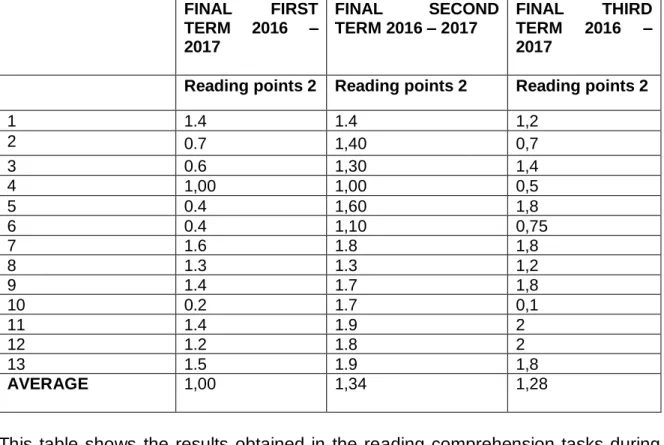
(38) Table 1. Results of reading assessment Final terms 5th grade FINAL TERM 2017. 1 2 3 4 5 6 7 8 9 10 11 12 13 AVERAGE. FIRST FINAL SECOND 2016 – TERM 2016 – 2017. FINAL TERM 2017. THIRD 2016 –. Reading points 2. Reading points 2. Reading points 2. 1.4 0.7 0.6 1,00 0.4 0.4 1.6 1.3 1.4 0.2 1.4 1.2 1.5 1,00. 1.4 1,40 1,30 1,00 1,60 1,10 1.8 1.3 1.7 1.7 1.9 1.8 1.9 1,34. 1,2 0,7 1,4 0,5 1,8 0,75 1,8 1,2 1,8 0,1 2 2 1,8 1,28. This table shows the results obtained in the reading comprehension tasks during final exams in 5th grade. These results made the teacher aware of the difficulties presented by the learners. Graph 1. Average final exam 3 Terms 5th grade. FINAL TEST REPORT - READING 2.0. 1.6. 1.34 1.2. 1.28 FIRST TERM 2015 2016. 1.00. SECOND TERM 2015 2016. 0.8. THIRD TERM 2015-2016. 0.4. 0.0. AVERAGE. 31.
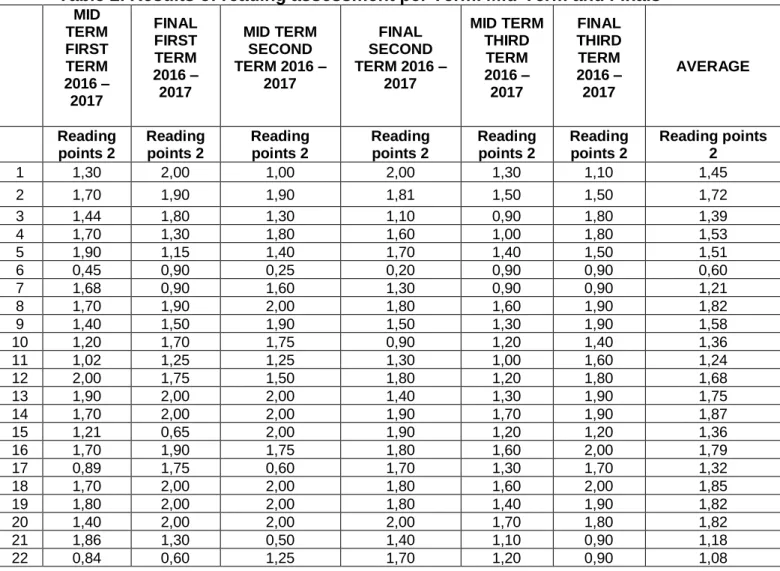
(39) Comparing these results with those from 6th grade would demonstrate that an advanced occurred during the application of the reading strategies. Table 2. Results of reading assessment per Term. Mid-Term and Finals. 1 2 3 4 5 6 7 8 9 10 11 12 13 14 15 16 17 18 19 20 21 22. MID TERM FIRST TERM 2016 – 2017. FINAL FIRST TERM 2016 – 2017. MID TERM SECOND TERM 2016 – 2017. FINAL SECOND TERM 2016 – 2017. MID TERM THIRD TERM 2016 – 2017. FINAL THIRD TERM 2016 – 2017. Reading points 2 1,30 1,70 1,44 1,70 1,90 0,45 1,68 1,70 1,40 1,20 1,02 2,00 1,90 1,70 1,21 1,70 0,89 1,70 1,80 1,40 1,86 0,84. Reading points 2 2,00 1,90 1,80 1,30 1,15 0,90 0,90 1,90 1,50 1,70 1,25 1,75 2,00 2,00 0,65 1,90 1,75 2,00 2,00 2,00 1,30 0,60. Reading points 2 1,00 1,90 1,30 1,80 1,40 0,25 1,60 2,00 1,90 1,75 1,25 1,50 2,00 2,00 2,00 1,75 0,60 2,00 2,00 2,00 0,50 1,25. Reading points 2 2,00 1,81 1,10 1,60 1,70 0,20 1,30 1,80 1,50 0,90 1,30 1,80 1,40 1,90 1,90 1,80 1,70 1,80 1,80 2,00 1,40 1,70. Reading points 2 1,30 1,50 0,90 1,00 1,40 0,90 0,90 1,60 1,30 1,20 1,00 1,20 1,30 1,70 1,20 1,60 1,30 1,60 1,40 1,70 1,10 1,20. Reading points 2 1,10 1,50 1,80 1,80 1,50 0,90 0,90 1,90 1,90 1,40 1,60 1,80 1,90 1,90 1,20 2,00 1,70 2,00 1,90 1,80 0,90 0,90. AVERAGE. Reading points 2 1,45 1,72 1,39 1,53 1,51 0,60 1,21 1,82 1,58 1,36 1,24 1,68 1,75 1,87 1,36 1,79 1,32 1,85 1,82 1,82 1,18 1,08. 32.
(40) Graph 2. Average mid-terms and finals 3 Terms 6th grade. FINAL TEST REPORT - READING 2.0. 1.6. 1.48. 1.56. 1.53. 1.56. 1.56 1.29. 1.2. 0.8. 0.4. 0.0. AVERAGE MID TERM FIRST TERM 2016 - 2017. FINAL FIRST TERM 2016 - 2017. MID TERM SECOND TERM 2016 - 2017. FINAL SECOND TERM 2016 - 2017. MID TERM THIRD TERM 2016 - 2017. FINAL THIRD TERM 2016 - 2017. The comparative of the average per grade shows a better performance during the time of reading strategies application. Although, the comparative only in 6th grade shows better results usually in the final terms, there is not a statistical prominent advance in the results of the students. This could show they are developing better reading strategies but still lacks more domain in the reading process.. Also, the following graphs show the performance of each student in each period during the mid-terms and finals in 6th grade. The graphs evidence advances in some students and difficulties in others. It is worth to mention that strategies are not going to have a positive effect in all students since their cognitive processes and learning styles could require a different approach. Some students require the guidance of psychology department. In general, the group evidenced lack of motivation toward academic challenges.. 33.
(41) Graph 3. Mid-term 1 and Final 1. FIRST TERM 2016 - 2017 2.0. 1.6. 1.2. 0.8. 0.4. 0.0 1. 2. 3. 4. 5. 6. 7. 8. 9. 10. 11. MID TERM FIRST TERM 2016 - 2017. 12. 13. 14. 15. 16. 17. 18. 19. 20. 21. 22. FINAL FIRST TERM 2016 - 2017. In this graph, the results obtained in the final exam were superior to those obtained in the midterm exam. Midterm exams took place 3 weeks after the term had started, while for final exams students had more time to develop concepts, knowledge and activities, this could be a factor that influenced the results.. 34.
(42) Graph 4. Mid-term 2 and Final 2. SECOND TERM 2016 - 2017 2.0. 1.6. 1.2. 0.8. 0.4. 0.0 1. 2. 3. 4. 5. 6. 7. 8. 9. 10. 11. MID TERM SECOND TERM 2016 - 2017. 12. 13. 14. 15. 16. 17. 18. 19. 20. 21. 22. FINAL SECOND TERM 2016 - 2017. The second graph shows mid-term and finals in the second term, during the term learners were aware of the reading process and the strategies that they were going to use. Mid-term results were slightly better than finals. The reason could be on the adjustment that means using new strategies, learning something new and using new strategies can imply a cognitive re-organization.. 35.
(43) Graph 5. Mid-term 3 and Final 3. THIRD TERM 2016 - 2017 2.0. 1.6. 1.2. 0.8. 0.4. 0.0 1. 2. 3. 4. 5. 6. 7. 8. 9. 10. 11. MID TERM THIRD TERM 2016 - 2017. 12. 13. 14. 15. 16. 17. 18. 19. 20. 21. 22. FINAL THIRD TERM 2016 - 2017. During the third period, most students diminished their performance during midterms, though in this period they were using more reading strategies than before. Regardless, during this term, several activities took place in the school and some lessons were missing affecting the continuity of the process. But then some strategies were used continuously and worked in class with several topics, providing more practice time, which could help to explain the improvement in final exam results.. During the application of the strategies a reading comprehension rubric was adapted from Reading Continuum’s Christopher-Gordon Publishers (2001). The teacher assessed the reading comprehension abilities of the learners during class activities that were not assessed only by grades but by taking into account the skills developed. The following is the adapted rubric, taking into account that the original Reading continuum is designed for general reading, while the adaptation takes into account science reading types only.. 36.
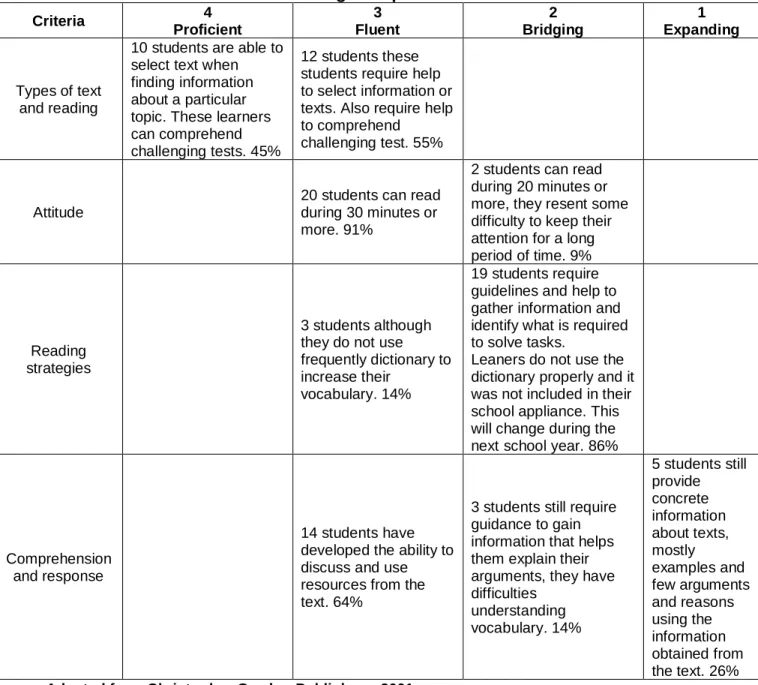
(44) The following is the result of the assessment done during the application of the reading strategies in class, then in the middle of the process, finishing the second term, learners did their own self-assessment, the results are below. Table 3. Reading Comprehension Rubric Criteria. Types of text and reading. Attitude. Reading strategies. Comprehension and response. 4 Proficient 10 students are able to select text when finding information about a particular topic. These learners can comprehend challenging tests. 45%. 3 Fluent. 2 Bridging. 1 Expanding. 12 students these students require help to select information or texts. Also require help to comprehend challenging test. 55%. 20 students can read during 30 minutes or more. 91%. 3 students although they do not use frequently dictionary to increase their vocabulary. 14%. 14 students have developed the ability to discuss and use resources from the text. 64%. 2 students can read during 20 minutes or more, they resent some difficulty to keep their attention for a long period of time. 9% 19 students require guidelines and help to gather information and identify what is required to solve tasks. Leaners do not use the dictionary properly and it was not included in their school appliance. This will change during the next school year. 86%. 3 students still require guidance to gain information that helps them explain their arguments, they have difficulties understanding vocabulary. 14%. 5 students still provide concrete information about texts, mostly examples and few arguments and reasons using the information obtained from the text. 26%. Adapted from Christopher-Gordon Publishers, 2001.. 37.
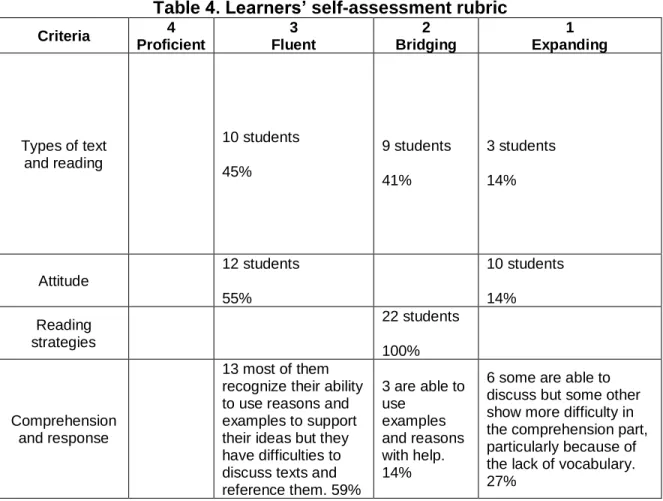
(45) The following chart and graphs show how students assessed themselves in the process, this self-assessment took place after starting with the strategies during second term. Table 4. Learners’ self-assessment rubric Criteria. Types of text and reading. 4 Proficient. 3 Fluent. 10 students 45%. 2 Bridging. 1 Expanding. 9 students. 3 students. 41%. 14%. 12 students. 10 students. Attitude 55% Reading strategies 13 most of them recognize their ability to use reasons and Comprehension examples to support and response their ideas but they have difficulties to discuss texts and reference them. 59% Adapted from Christopher-Gordon Publishers, 2001.. 14% 22 students 100% 3 are able to use examples and reasons with help. 14%. 6 some are able to discuss but some other show more difficulty in the comprehension part, particularly because of the lack of vocabulary. 27%. 38.
(46) Graph 6. Rubric Criterion 1. Types of text and reading Proficient 45%. 55%. Fluent Bridging Expanding. This category relates to the ability of choosing texts or parts of a text in an independent way. This means that learners were able to find specific information, being aware when a text is scientific, identifying if it is describing a process, giving evidence about investigation results or showing a prediction. Although learners usually did not choose the texts read in class, they had to find information, organized it and used it in tasks. The learners that showed proficiency in this category were the ones that identified in the texts what they needed to solve a task. The fluent learners also could do it but needed the guidance of the teacher. Graph 7. Learners’ assessment. Criterion 1. Types of text and reading Proficient. 14% 41%. 45%. Fluent Bridging Expanding. Learners felt their performance was different. 45% of learners pointed out a proficient performance. The rest of the group located itself in bridging and expanding. The answers given by the expanding group was that they did not recognize different types of texts and they felt unable to identify the characteristics of texts. The strategies used during the third term to identify the parts of the texts like the Jigsaw chart could be a tool that made learners aware of the structure of texts. 39.
(47) Though the teacher could not develop more strategies or variations to focus on each criterion presented for this research, she could apply in the future these variations according to the learners’ needs.. Graph 8. Rubric analysis Criterion 2. Attitude 9%. Proficient Fluent. 91%. Bridging Expanding. This category refers to the attention span a learner can dedicate to reading. Learners read during 30 minutes or more, but for some learners it was difficult to keep track of their reading, even they could dedicate 20 minutes to a reading they tended to lose track of the ideas. Training the group to read longer periods in each part of the terms was a challenge. The first part of the term the teacher read with the learners to do the scanning and then skimming process. Then the teacher used longer readings with key points and graphs to provide visual aid to those learners with a visual learning style. After that, the teacher tried using tables and graphs organizers that provided specific information, to provide then full texts. During the process the learners coped better with shorter versions with visual aids that they did with full texts.. 40.
(48) Graph 9. Learners’ assessment. Criterion 2. Attitude Proficient. 14%. Fluent 55%. Bridging Expanding. Learners also identified themselves as fluent readers, but there is a 14% of learners that worryingly set themselves as 15 to 30 minutes’ readers, which highlights the importance of the attention span of these learners. These results would explain why full texts with academic information were more difficult for them than those with specific information presented with visual aids. In this case learners would need a training to focus in the reading during longer time periods. Graph 10. Rubric analysis Criterion 3. Reading strategies 14%. Proficient Fluent. 86%. Bridging Expanding. This is the most important analysis category for this research, since the rubric was applied after the first term and learners were aware of the reading strategies work.. The teacher could identify that learners used skimming and scanning strategies to gather information, but learners still needed guidance to increase their vocabulary, to organize information and to integrate all with the tasks done. Only 14% use. 41.
(49) dictionary to gain vocabulary, had strategies to organize information and evidenced a process of information through texts. The learners and the teacher agreed that the reading strategies were still in process. 100% of the learners identified themselves in bridging stage, while the teacher identified that 3 (14%) students had developed the fluent stage because though they did not use properly the dictionary as a tool, they used the strategies practiced in class to identify the information required. They also adapted successfully the strategies to their learning process according to their exams results. Graph 11. Learners’ assessment. Criterion 3. Reading strategies Proficient Fluent 100%. Bridging Expanding. As mentioned before learners assessed themselves in bridging level. Although the teacher recognized the ability of 14% of student to increase language and integrate that knowledge with the text. Most learners manifested they were not independent when using strategies, they needed help either to organize the information or to integrate it with other tasks. Therefore, the strategies applied following the modeling of the teacher and the constant feedback provided could be the guidance required in their process. The challenge that remains is to move them towards an autonomous use of these strategies.. 42.
(50) Graph 12. Rubric analysis. Criterion 4. Comprehension and response Proficient. 23% 14%. 64%. Fluent Bridging Expanding. This criterion shows an aspect that the teacher did not take into account during the analysis of the problem, the comprehension and response, the students were in different language levels because of this and their development of autonomy to learn language comprehension could be affected and results show different stages. Graph 13. Learners’ assessment. Criterion 4. Comprehension and response Proficient. 27% 14%. 59%. Fluent Bridging Expanding. Both results, evidenced that learners had issues dealing with their ability to explain the text and use concepts in it to develop thinking skills like inference, prediction, explanations and so on. It is important to consider that besides reading strategies having a better input in language, the whole concept of CLIL is providing enough input to learners so they can cope with their tasks. Previous researches have proven that in content areas teachers tend to focus more on content than on language, except for the language of learning specific to the subject (Mariño, 2014; Nikula, 2015, Perez et al, 2015).. 43.
Figure
Documento similar
In the preparation of this report, the Venice Commission has relied on the comments of its rapporteurs; its recently adopted Report on Respect for Democracy, Human Rights and the Rule
Although some public journalism schools aim for greater social diversity in their student selection, as in the case of the Institute of Journalism of Bordeaux, it should be
In the “big picture” perspective of the recent years that we have described in Brazil, Spain, Portugal and Puerto Rico there are some similarities and important differences,
The main ACs reported in different studies are pharmaceuticals (diclofenac, ibuprofen, naproxen, o floxacin, acetaminophen, progesterone ranitidine and testosterone),
Since forest variables (forest productivity and for- est biomass) and abiotic factors (climate variables, soil texture and nu- trients, and soil topography) were only calculated at
We evaluated the performance of Partial Least Squares Regression (PLS) models to predict crude protein (CP), neutral detergent fibre (NDF), acid detergent fibre (ADF) and
Keywords: Metal mining conflicts, political ecology, politics of scale, environmental justice movement, social multi-criteria evaluation, consultations, Latin
Even though the 1920s offered new employment opportunities in industries previously closed to women, often the women who took these jobs found themselves exploited.. No matter
