
Goal setting, task analysis and genre analysis: Three strategies to guide students to be Self Directed readers
88
0
0
Texto completo
(2) Running Head: GOAL SETTING, TASK & GENRE ANALYSIS.. Goal Setting, Task Analysis and Genre Analysis: Three Strategies to Guide Students to Be Self-Directed Readers. Marisol Lozano Ñustes. A research report submitted in fulfillment of the requirements for degree of Master in English Language Teaching for Self-directed Learning. Directed by: Dr. Joan Rubin, Prof. Claudia Acero & Prof. Edgar Lucero. Department of Foreign Languages and Cultures Universidad de La Sabana Chía, Colombia 2016.
(3) ii GOAL SETTING, TASK & GENRE ANALYSIS. Abstract This action-research study emerged to target self-directed readers’ comprehension skills of setting reading objectives, identifying author’s purpose and text structure under specific, measurable, achievable, relevant and time-based goals (SMART), task analysis and genre analysis respectively. 24 tenth-graders of English as a foreign language (EFL) participated in the inquiry carried out during 2014 in a Colombian school. After identifying the problem, a needs analysis survey was applied to configure the research implementation. A pre-test, post-test, as well as students’ and teacher’s journals were administered for data collection. Statistics were used to analyze quantifiable information while the non-quantifiable one was interpreted through the coding process of the grounded theory methodology. A triangulation design was used during the interpretation phase to integrate the results. Findings reveal that task analysis, as a metacognitive strategy to plan reading tasks, was a valuable process because it not only enabled students to identify main ideas, recognize structure and genre of a text and set learning goals, but also revealed students’ improvement as self-directed readers. Participants could plan their learning objectives in association with their own personal goals or ambitions, making reading more significant for them. Keywords: Task Analysis, goal setting, self-directed learning, reading comprehension strategies..
(4) iii GOAL SETTING, TASK & GENRE ANALYSIS. Resumen Este estudio de investigación-acción surgió para promover habilidades de comprensión en lectores auto dirigidos para el planteamiento de objetivos de lectura, identificación del propósito del autor y estructura del texto, mediante la formulación de objetivos específicos, medibles, alcanzables, relevantes y programados (SMART, por sus siglas en inglés), análisis de tareas y análisis de género respectivamente. 24 estudiantes colombianos de inglés como lengua extranjera participaron de la investigación durante 2014. La implementación se diseñó luego de identificar el problema e indagar acerca de las necesidades de los estudiantes. Se administraron un preexamen, un post-examen y diarios de clase de estudiantes y docente-investigadora para la recolección de información. Los datos cuantitativos se analizaron mediante estadísticas, mientras que los cualitativos se interpretaron con el proceso de codificación de la teoría fundamentada. Los resultados revelaron que el análisis de tareas como estrategia meta cognitiva para planear actividades de lectura facilitó a los estudiantes identificar las ideas principales de un texto, reconocer su estructura y género y establecer objetivos de aprendizaje, así como mejorar sus habilidades como lectores auto dirigidos, ya que planificaron sus objetivos de lectura asociándolos con metas propias o ambiciones personales, convirtiendo la lectura en un proceso más significativo para ellos. Palabras Clave: Análisis de tareas, planteamiento de objetivos, Aprendizaje autodirigido, estrategias de comprensión de lectura..
(5) iv GOAL SETTING, TASK & GENRE ANALYSIS. Declaration I hereby declare that my research report entitled: Goal Setting, Task Analysis and Genre Analysis: Three Strategies to Guide Students to Be Self-Directed Readers: . is the result of my own work (or research circle members’ work) and includes nothing which is the outcome of work done in collaboration except as declared and specified in the text;. . is neither substantially the same as nor contains substantial portions of any similar work submitted or that is being concurrently submitted for any degree or diploma or other qualification at the Universidad de La Sabana or any other university or similar institution except as declared and specified in the text;. . complies with the word limits and other requirements stipulated by the Research Subcommittee of the Department of Languages and Cultures;. . has been submitted by or on the required submission date.. Date: September 1st 2016 Full Name: Marisol Lozano Ñustes Signature:.
(6) v GOAL SETTING, TASK & GENRE ANALYSIS. Acknowledgements. This research paper was made firstly thanks to God, Whose plan is perfect. Secondly, to all those angels and beings who gave light on my path. Thanks.
(7) vi GOAL SETTING, TASK & GENRE ANALYSIS. Table of Contents Abstract................................................................................................................................ ii Resumen ............................................................................................................................. iii Introduction ....................................................................................................................... 11 Statement of the Problem ............................................................................................... 12 Research Question .......................................................................................................... 13 Research objectives ........................................................................................................ 13 Rationale ............................................................................................................................ 13 State of the Art................................................................................................................ 15 Theoretical Framework ..................................................................................................... 19 Reading ........................................................................................................................... 19 Task ................................................................................................................................ 22 SMART Goals Theory ................................................................................................... 24 Genre Analysis Strategy ................................................................................................. 29 Self-directed Learning Strategies ................................................................................... 30 Research Design ................................................................................................................ 34 Type of Study ................................................................................................................. 34 Context ........................................................................................................................... 36 Researcher’s Role ........................................................................................................... 38.
(8) vii GOAL SETTING, TASK & GENRE ANALYSIS. Data Collection Instruments and Procedures .................................................................... 38 Validity ........................................................................................................................... 42 Reliability ................................................................................................................... 42 Ethical Considerations ................................................................................................ 43 Pedagogical Implementation ............................................................................................. 44 Instructional Design........................................................................................................ 45 Pedagogical Intervention ................................................................................................ 45 Data Analysis and Results ................................................................................................. 48 Students’ Journal Results ............................................................................................... 48 Teacher’s Journal Results ............................................................................................... 51 Pre-test and Post-test Results.......................................................................................... 59 Conclusions and Pedagogical implications ....................................................................... 62 Limitations ...................................................................................................................... 64 Further Research ............................................................................................................. 65 References ......................................................................................................................... 66 Appendixes ........................................................................................................................ 71 Appendix A ....................................................................................................................... 71 Appendix B........................................................................................................................ 74 Appendix C........................................................................................................................ 77 Appendix D ....................................................................................................................... 80.
(9) viii GOAL SETTING, TASK & GENRE ANALYSIS. Appendix E ........................................................................................................................ 81 Appendix F ........................................................................................................................ 82 Appendix G ....................................................................................................................... 83 Appendix H ....................................................................................................................... 84 Appendix I ......................................................................................................................... 86 Appendix J ......................................................................................................................... 87.
(10) ix GOAL SETTING, TASK & GENRE ANALYSIS. Table of Figures Figure 1. Reading strategies, reading skills and self-directed learning. Illustration of how task analysis, goal setting and genre analysis strategies make self-directed readers……………..32 Figure 2. Action Research Model. Illustration of how action research phases were conducted in this research study..................................................................................................... 35 Figure 3. Data Collection Instruments employed to compile information in this research study. .............................................................................................................................................. 39 Figure 4. Pedagogical Intervention carried out in this study during three stages. ............. 44 Figure 5. Weaknesses and problems identified in the students to perform third task analysis intervention..................................................................................................................................... 50.
(11) x GOAL SETTING, TASK & GENRE ANALYSIS. Table of Tables Table 1. Timeline of pedagogical interventions…….…………………………………….46 Table 2. Comparative table of Pre-test and Post-test Results…………………………….61.
(12) GOAL SETTING, TASK & GENRE ANALYSIS. 11. Goal Setting, Task Analysis and Genre Analysis: Three Strategies to Guide Students to Be Self-Directed Readers Introduction One of the most meaningful weaknesses of Latin America is the low level of English Language Proficiency, according to the World Ranking of Language Proficiency prepared by Education First in 2014, over half of Latin American countries are below the lowest rate on the general list of Language Proficiency. The Latin-American nations with better positions in the ranking are Argentina (15), Peru (34), Ecuador (35), Brazil (38), and Mexico (39) (Gestión, 2014). Colombia is far down on the list of English proficiency, being in the 57th position out of the 70 countries assessed. The main reasons attributed to this result are related to untrained English teachers, income inequality, and weak economy in the country (Semana, 2015). Colombia has made great efforts to overcome poor knowledge of English. The Ministry of National Education [MEN] (2004) has developed the Programa Nacional de Bilingüismo 20042019, whose strategies consist of 1) Teacher training strategies and teaching material oriented towards Basic Education; 2) Quality, support and funds for higher education and 3) Articulation strategies with the productive sector. The program is based on the principles of the Common European Framework of Reference (CEFR) for language teaching and learning, assessment approaches, levels of proficiency, and language-skill development. One of the policy goals is to increase the communicative competence in English throughout the national educational system, from preschool to higher education. This research report gives an account of the study created to boost the communicative competence through an action-research methodology. The study pursued two objectives: one, to develop higher levels of reading comprehension skills in a group of 24 EFL students in a public school, and two, to implement goal setting, task analysis and genre analysis as strategies that help.
(13) GOAL SETTING, TASK & GENRE ANALYSIS. 12. students become better self-directed readers. Some studies carried out in Colombia were examined with a view to finding out the status of reading comprehension enhancement through the empowerment of reading strategies in order to stimulate students’ self-direction regarding reading process. This research report outlines the theoretical framework by defining reading, task analysis, goal setting and self-directed learning in the second chapter. Followed by the procedures related to research design and data collection instruments in chapter three. The fourth and fifth chapters describe the data analysis process and the results of the pedagogical intervention. The final chapter draws conclusions and pedagogical implications derived from the study. Statement of the Problem Before starting this study, students had developed activities, tasks, workshops and exams that assessed their reading comprehension skills in the English class. The results of these activities, translated into low grades, demonstrated that they did not take suitable actions to accomplish the reading goals. On the basis of these results, reading comprehension represented hard work for the students. As a result, a study to enquire about these students’ difficulties when reading was structured. A diagnostic survey that intended to determine the language learning needs of the 24 students in 10th grade was applied at the beginning of the study. The information collected in this survey demonstrated that the students demanded not only improving reading more than any other language skill, but also being provided with strategies that could foster their competences to address reading comprehension tasks in a more autonomous way. The skills with which students revealed to have problems in reading were the ones related to recognizing the author’s purpose, understanding text organization, determining their reasons for reading it, and formulating objectives and purposes to read it..
(14) GOAL SETTING, TASK & GENRE ANALYSIS. 13. Certainly, I, as the teacher-researcher in this study, interpreted that these 10th-graders could improve their reading comprehension skills and learning strategies to become more selfdirected language learners with the implementation of goal setting, task analysis and genre analysis strategies. With the aim of studying this proposal, the following main research question was stated: Research Question How do the reading strategies of task analysis, goal setting and genre analysis help 10 thgrade students strengthen their reading comprehension skills and become more self-directed readers in their English language classes? Research objectives The objectives to reach in this research study are: . To boost the participant students’ development of reading comprehension skills as a result of a designed implementation on the indicated reading strategies.. . To identify whether or not the designed implementation turns the participant students into more self-directed readers.. Rationale Grabe (as cited in Ediger, 2001, p. 153) stated that “reading is probably the most important skill for second language (L2) learners in academic contexts”. In this regard, Colombian Governmental authorities, in their mission to increase the quality of English learning educational projects, have planned to develop articulation strategies with the productive sector. In this regard, strengthening reading skills, as this study intended, would empower learners to take on multiple challenges related to acquisition and production in a second language. Equally, they would have a suitable performance with the target language in academic contexts and potential.
(15) GOAL SETTING, TASK & GENRE ANALYSIS. 14. job opportunities, since reading “is the primary means for independent learning, whether the goal is performing better on academic tasks, learning more about subject matter, or improving language abilities” (Grabe & Stoller 2001, p.187). To succeed in this endeavor, I did a review of the state of reading literacy in the Colombian context. The Progress in International Reading Literacy Study-PIRLS (2011) test, which provides information of trends in reading literacy achievement of fourth-grade students around the world, affirms that, in Colombia, only 1% of the participants reached the advanced level in reading literacy, 9% scored high level, 28% the medium level and 34% were at low level. The remaining 28% did not reach the minimum levels of reading literacy (results below 400 points). These percentages corroborate the ineffectiveness of the education system in the development of reading skills (Instituto Colombiano para la Evaluación de la Educación [ICFES], 2011). In a like manner, the information collected during the preliminary class observations, grade reports and notes about this research participant-students’ reading performance demonstrated that they had difficulties in their reading literacy too. Those difficulties were specifically in recognizing the author’s purpose, understanding text organization, determining their reasons for reading and formulating objectives and purposes to read any text. An implementation of goal setting, task analysis and genre analysis strategies was decided to develop the reading comprehension skills of 24 students of English as a foreign language who were in tenth grade in a public school located in Bogotá, Colombia and guide them to become more selfdirected language learners. Given these points, this research may be a benchmark for foreign language teachers interested in attending to students with low levels of reading skills since goal setting, task analysis and genre analysis, the strategies used to deal with the identified difficulties, prepare.
(16) GOAL SETTING, TASK & GENRE ANALYSIS. 15. learners to draw an action plan for approaching their tasks by identifying and analyzing possible threats and solving them in advance. Subsequently, they will be able to develop those tasks more efficiently, not only regarding reading skills, but also for other academic, personal or job performances. Essentially, this research study will be of interest to those people who desire to know the way in which reading comprehension can become better by applying effective and practical reading strategies. State of the Art Some similar studies have been carried out in Colombia concerning reading comprehension improvement through the boosting of reading skills to guide students to be selfdirected readers; in addition some researchers have shown interest in analyzing how reflective procedures enhance reading comprehension. Initially, Gaona, Suarez and Gonzalez (2001) suggested that reading should be taken by students as a pleasant activity that not only expands learners’ knowledge, but also one that enhances other skills. In the same way, they agreed that providing students with reading skills encourages them to become efficient readers. The researchers developed students’ reading skills through activities based on students’ interests on themes, length and reading target. The pedagogical process consisted of firstly, stimulate students to identify and recognize the phonemes. Secondly, improve their reading ability and understanding. Then, it is expected that students read fluently, using punctuation marks and fomenting comprehension. Going a further, Perdomo (2001) carried out a research study with the aim of revealing the importance of making of students autonomous readers by providing them with reading strategies and by developing their thinking skills. In this research it is stated that comprehensive reading can develop thinking skills and that school and family environments must train students in the process of understanding texts. Then, reading strategies and thinking skills can be.
(17) GOAL SETTING, TASK & GENRE ANALYSIS. 16. transferred in a conscious or unconscious way when learning a new language. “For example, when reading a book, the reader can distinguish the diversity of genres, and can easily identify the writer’s points of view” (p.57). In that way, readers become more autonomous. Finally, the author concludes that teachers are essential actors in the students’ process of learning a foreign language, since the context in which communication takes place is not precisely in that language, but in learners’ mother tongue. For that reason teaching methodology may point out to help apprentices to connect the previous knowledge to the recent acquired to later being put in practice in the learning environment. Studies that considered different populations in the training of strategies have also been carried out; for example, strategies to support high school students’ reading comprehension in the English language by Zabala (2004). The main objective of his research was to aid eleventh graders in the development of their reading comprehension competence in English. Decodification mechanisms, formal and semantic strategies were the approaches implemented by the researcher to help students comprehend better texts in English. The principal findings had to do with the improvement in text organization, relationships between propositions and terms, and increasing and upgrading vocabulary. Novice researchers carrying out their dissertations for their master’s degree have also shown great interest in students’ training on reading strategies was the one developed by Mahecha, Urrego & Lozano (2011) aimed at encouraging students to improve reading comprehension of texts in English by implementing two reading strategies: text coding and double entry organizer. Teachers-researchers guided students to identify related vocabulary, grammar categories and the findings of relations among them to help readers to state texts’ topics. Researchers concluded that the level of reading comprehension in students improved meaningfully and deduced that it is very probably that their success when answering.
(18) GOAL SETTING, TASK & GENRE ANALYSIS. 17. comprehension questions and grasp of main ideas was affected by the reading strategies of text coding and double entry organizer. They also highlighted the fact that students could actively participate in tasks and their self-evaluation demonstrated that readers gained autonomy in their process, since they were able to establish the meaning of unknown words and main ideas without using neither dictionaries nor ask someone else for their definition. A second study by school teachers focusing on setting the extent to which reading comprehension in English language learners could be fostered by using the model of Collaborative Strategic Reading (CSR) and how this approach could facilitate students’ selfdirection was the study carried out by Mendieta, Múnera, Olmos, Onatra, Pérez and Rojas (2015). After implementing the strategy through workshops, classroom reading tasks and selfassessment rubrics, the researchers found that reading performance could be improved through CSR model and self-direction could be fostered by means of independent work and selfmonitoring tasks. As shown in the studies above, teachers and researchers have been interested in finding ways to improve language learners’ reading comprehension. In this sense, the principal similarity between Gaona, Suarez and Gonzalez´s study (2001) and this research resides in students’ motivation, since learners interests and preferences when reading were taken into account during the pedagogical implementations. Consistently, in Mahecha, Urrego and Lozano (2011) exists a close correspondence in students’ active participation in tasks which gave as a result improvements in reading comprehension. Concerning self-direction, in both of the researches revised: Perdomo (2001) and Mendieta, Múnera, Olmos, Onatra, Pérez and Rojas (2015) and certainly in this research, self-evaluations and self-assessments rubrics were essential components when analyzing the results of the study, as through them learners were able to carry out selfmonitoring of their own work, which revealed students’ autonomy as independent readers..
(19) GOAL SETTING, TASK & GENRE ANALYSIS. 18. Regarding differences among the studies above mentioned and this research, semantic approaches and increasing of vocabulary as means to foster reading comprehension were strategies that this study did not contemplate, but that Zabala (2004) and Mahecha, Urrego and Lozano (2011) did. Equivalently, only one of the researches, Gaona, Suarez and Gonzalez’s (2001) one, in comparison with all the studies, including this one, looked for training students in reading fluency to get comprehension. Thus, the most important dissimilarities among all the studies analyzed and that by all means make this study valuable, are found on: 1.The absence of a metacognitive strategy which could empower students to analyze and plan a reading task before approaching it, as well as enable learners to consider possible difficulties in advance, to be able to anticipate solutions to all those obstacles found before developing the task, key aspects that all elements of task analysis provide: a) Task goal, b) Task purpose, c) Task classification and d) Task demands. 2. Clearly specify what aspect of reading comprehension was wanted to improve, which in the case of this research was main idea identification. 3. Provide students with a meaningful strategy which they could apply not only for dealing with reading tasks in order to improve comprehension, but also useful to be applied in life purposes, which in this research corresponds to set specific, measurable, achievable, relevant and time-based goals (SMART goals), making reading more significant for them..
(20) GOAL SETTING, TASK & GENRE ANALYSIS. 19. Theoretical Framework This section explores the theoretical underpinnings of this research. The constructs outlined were set according to the major fundamentals of the research question and the implementation. The following components will be described: Reading, reading comprehension strategies and skills. Concerning task analysis strategy, the constructs of task, goal setting, task analysis, task purpose, task classification, task demands and genre analysis will be developed. Finally, self-directed learning strategies will be defined, a figure will expose its relationship with reading comprehension, goal setting and task analysis. Reading The definition of reading comprehension, as understood in this research, is based on seeing reading as the dialogue between the reader and the author of the text. Carrell, Devine and Eskey (1998) define reading as “a receptive language process. It is a psycholinguistic process that starts with a linguistic surface representation encoded by a writer and ends with meaning which the reader constructs” (p. 12). Reading is much more than a single skill, it involves the coordination of a range of abilities, strategies and knowledge. Macceca (2007, p. 4) states that reading is a dialogue between the reader and the author of the text; during this “dialogue”, the reader should generate questions to anticipate meaning, search for information, respond intellectually and emotionally, and infer ideas from it to further explain the content of the text. Ideally when reading students should collect information related to author’s purpose and text structure and associate it with their own goals and purposes to get meaning. Grabe and Soller (2001) state that the most frequent way to explain reading comprehension is by seeing it as “the ability to read [that] requires that the reader draws information from a text and combines it with information and expectations that the reader already has” (p. 188). In addition, McNamara (2012).
(21) GOAL SETTING, TASK & GENRE ANALYSIS. 20. explains that reading comprehension “refers to the ability to go beyond the words, to understand meaning and the relationships between ideas conveyed in a text” (p. xi). Such intercommunication among author, text and reader is precisely what this research study intends to consolidate by implementing task analysis, which is a metacognitive strategy that enables readers to plan, anticipate and define actions for a reading task. In other words, the dialogue established among author, text and reader starts once the learner carries out goal setting, task analysis and genre analysis strategies for getting comprehension of a text. Reading Comprehension Strategies. Reading comprehension strategies are essential to facilitate understanding of texts. McNamara (2012) explains that “a reading comprehension strategy is a cognitive or behavioral action that is enacted under particular contextual conditions, with the goal of improving some aspect of comprehension” (p. 6). The reading comprehension strategy implemented in this research was based on asking questions before reading a selected text. First, students were inquired about the purpose and goal for reading (the reasons to read the text and the information to look for, respectively). After, they looked for understanding the organization of the text (its structure). Finally while reading, they classified the type of task to do and its demands. In this sense, after learning how to set goals, purpose, task classification and task demands, pupils learnt to focus all those strategies on identifying the main idea of a text. Although implementing all these strategies may seem exhausting because of the effort and change of habits that represents for the students planning a reading task before approaching it, McNamara (2012) states that any reading strategy “will take the reader much more time and effort, and may even seem inefficient. But with practice such strategies become more automatic, and then they become a natural part of reading” (p. xii)..
(22) GOAL SETTING, TASK & GENRE ANALYSIS. 21. Reading Comprehension Skills. As well as reading strategies influence comprehension, reading comprehension skills are involved within the process of making meaning to comprehend what is read. Eddiger (2001) explains six general skills of this type (p. 154): 1. Automatic recognition skills: the mental process done to recognize the text for word identification. 2. Vocabulary and structural knowledge: the sound interpretation of language structure and a large recognition of vocabulary. 3. Formal discourse structure knowledge: the interpretation of text organization and the way in which information is put together into various genres of text (e.g. a report, a letter, a narrative). 4. Content/world background knowledge: the interpretation of prior knowledge related to general and cultural information involved in a text. 5. Synthesis and evaluation skills/strategies: the interconnection done by a reader among the text and other sources, the critically thought about what is read, and the selection of meaningful information according to the reading purpose. 6. Metacognitive knowledge and skills monitoring: the self-awareness done by a reader about the mental processes involved while reading, and the reflection on the strategies employed while doing so. All these six skills were cross-curricular through the implementation of the pedagogical design of this research study which looked for strengthening learner’s reading comprehension skills. Each reading comprehension skill was developed in unison with reading comprehension strategies as follows: 1. Automatic recognition skills: When students were asked to identify the purpose of the text through a task purpose strategy..
(23) GOAL SETTING, TASK & GENRE ANALYSIS. 22. 2. Vocabulary and structural knowledge: When they reflected about the necessary vocabulary to understand meaning; they did it through a task demand reading strategy. 3. Formal discourse structure knowledge: When they looked to understand how the text is organized by using the task classification reading strategy. In the same way, they recognized the genre of the text when implementing genre analysis reading strategy. 4. Content/world background knowledge: Both when they related text information to their prior knowledge and when they had to plan their reading task by using task analysis reading strategy. 5. Synthesis and evaluation: at the moment they defined their purpose for life by doing the reading task (task purpose reading strategy). 6. Metacognitive knowledge and skills monitoring: When they set the SMART goals and prepared the actions to get meaning before approaching reading tasks (Appendix I). In that way, reading comprehension skills and reading comprehension strategies could complement each other and help learners to plan and understand reading tasks before approaching them. Task The meaning of task is an essential compound to better understand the students’ reading difficulties stated in this research study. With the purpose of elucidating how the conceptualization of this term has evolved, a suitable issue for this theoretical framework, four different interpretations of the term task will be exposed..
(24) GOAL SETTING, TASK & GENRE ANALYSIS. 23. Earlier definitions of task talked about everyday activities that resulted after performing an instruction and understanding language; however, they did not demand production of language as an essential component. By way of example, Long (as cited in Nunan, 1989, p. 5) defines task as “a piece of work undertaken for oneself or for others, freely or for some reward. Thus, by ‘Task’ is meant the hundred and one things people do in everyday life, at work, at play, and in between”. Another definition that reflects this absence of language production is presented by Richards, Platt and Weber (as cited in Nunan, 1989) as follows: An activity or action which is carried out as the result of processing or understanding language (i.e. as a response)… Task may or may not involve the production of language. A task usually requires the teacher to specify what will be regarded as successful completion of the task. (p. 6) A third definition under the same perspective belongs to Breen (as cited in Nunan, 1989) which defines a task as a language learning aim structured through work plans to achieve a particular objective. In Breen’s definition of task, new elements appeared, such as an attempt to achieve a goal, the suitability and specificity about a process and content, as well as the obtained results; all of them focused on making the language learning process easier. Finally, Ellis (2003) states that a task is an organization of work in which the understanding of language is necessary to reach the aim of getting communication in real contexts. Linguistic resources used by the reader him/herself are essential to get meaning. This is the meaning that better describes the concept of task that this research study contemplated. The reason of this resides in the fact that this meaning of a task integrates a language process in which an outcome and a criterion that evaluates its achievement are evident which are related to set SMART goals theory. In the same way, it incorporates additional components, such as the use of unique linguistic resources to get meaning, which on the subject.
(25) GOAL SETTING, TASK & GENRE ANALYSIS. 24. of this research coincides with task analysis as a metacognitive procedure. Finally, it establishes that after doing a task, it is expected an outcome with a production or reception of language in the real world, whose correlation with this inquiry has to do with achieving reading comprehension. SMART Goals Theory Considering that a task is a work plan done in order to achieve a communicative outcome, it is necessary to provide learners with a strategy that allows them to reflect on the learning objective of that task. The definition of goal used in this research report is based on Rubin’s (2009) theory of goal setting, which indicates how to set (S) Specific, (M) Measurable, (A) Achievable, (R) Relevant and (T) Time-based goals for a task. Formulating objectives with these features enables learners to have a better control of their own learning as it is done in selfdirected learning strategies. Definitions of goal will be provided as follows. Goal Setting. When approaching a reading task, readers require to set learning objectives to be motivated and understand better the activities proposed in the task. Campbell (2007) mentions that “a goal is defined when an individual is knowingly trying to complete an objective that is considered the main motivating force behind the behavior” (p. 54). According to Locke and Latham (as cited in Campbell, 2007, p. 55), two specific attributes of goal are 1) content and 2) intensity. In this respect, content is concerned with the objective or desired action being sought, while goal intensity is related to the effort needed to generate the goal. Goal setting and reading comprehension skills were connected in this research in the way that, as McNamara (2007) argues, having goals is a logical starting point for readers to improve their reading comprehension skills. In this sense, he states that each reader may have a different goal when approaching the text:.
(26) GOAL SETTING, TASK & GENRE ANALYSIS. 25. The nature of the goal and the specificity of the goal will depend greatly on the nature of text being read but it will also be affected by the level of the readers pre-existing knowledge… as well as the reader’s comprehension abilities. (McNamara, 2007, p. 474) Likewise, Grabe (2009) adds that “goals can range from basic comprehension of text information such as carrying out simple task as part of functional literacy skills (e.g. finding simple information, checking facts, entertainment oneself) to advanced academic goals that may involve critically interpreting text” (p.51). However, Schunk, Pintrich, and Zimmerman (as cited in Woolley, 2011) find that: Although readers may construct motivational goals and believe they are able to accomplish their goals, readers nevertheless require an appropriate repertoire of cognitive strategies for text comprehension. They must have sense of self-efficacy by believing that in using a particular strategy their performance will improve. (p. 156) In this respect, Zimmerman (as cited in Squier, Nailor & Carey, 2014) reports that “goal setting reflects the specific skills associated with directing and maintaining effort toward the achievement of goals... Self-directed learners need to develop specific skills in self-regulating their learning behavior toward their self-chosen goals” (p. 28). Considering this, during the implementation stage of this research study, task analysis was the metacognitive strategy selected. This strategy was presented through samples, activities and tasks to make students recognize each of its components: 1) Goal setting, 2) Task purpose, 3) Task classification, 4) Task demands and 5) Genre analysis. Thereby, they could have a sense of self-efficacy when reading to get comprehension since it was expected that students implemented the metacognitive strategy of task analysis when doing a post-test after the implementation. As a result, this metacognitive strategy was assessed to see how it helped for a better readers’ performance..
(27) GOAL SETTING, TASK & GENRE ANALYSIS. 26. Additionally, setting goals has an added value for pupils in terms of confidence gained through the establishment of learning objectives, since in addition to make learning easier, they find an internal motivation for completing the reading task. In this sense, Rubin (2009) declares that setting goals “helps learners direct their attention, reduces anxiety, lets them know when they accomplish their goals, can increase learner involvement, makes task more manageable, helps learners feel in control, helps learners feel more efficient” (p. 3). Furthermore, it is essential setting the objectives according to SMART goals inasmuch as this theory guarantees their achievement by requiring explicit features that help them visualize and define what is expected. In this regard, goals must be Specific, which indicates who, and what and why the goal will be reached; Measurable, which means quantifiable; Achievable, which defines how to get success in the purpose and that is available for the student; Relevant, when learners provide detailed reasons about why the goal is important according to their interests, and Time-based, which means that the learner states a clear and realistic time for accomplishing the Goal (Rubin, 2015, p. 74). After clarifying the theory about setting SMART goals, students had a practice stage to apply this theory and design their learning objectives for the reading tasks. Once this had been done, they implemented task analysis to plan the approach of the reading task and improve their reading skills. Task analysis (TA). According to Rubin (2015), task analysis (TA) is the preliminary process that help learners plan how they will approach a task. TA is the previous analysis before beginning to develop a task, in the sense of this research, a reading task. The TA strategy that was used by the students aimed at identifying the aspects of time, background, unfamiliar knowledge and appropriate strategies to accomplish such task. Rubin and McCoy (2008) state that:.
(28) GOAL SETTING, TASK & GENRE ANALYSIS. 27. In order to understand the role of task analysis, it is important to understand its place in the entire set of metacognitive procedures. Following Rubin, 2001 and Rubin 2005, there are five major procedures: planning, monitoring, evaluating, problem identification/problem-solution, and implementation of a problem-solution. (p. 1) Wenden (as cited in Rubin & McCoy, 2008) also mentions that there are three parts to Task Analysis: Task Purpose, Task Classification, and Task Demands. Task Purpose provides the motivation for doing the task and must be related to life purposes. Task Classification answers the questions: What kind of task is this? What do I know about the task? How do I feel about the task? And Task Demands uses the results of Task Classification to consider what strategies and actions could I use? (p. 1). These components of the task analysis strategy will be described in terms of their relationship with reading tasks and the way in which students were able to implement this strategy in order to improve reading comprehension. Task Purpose (TP). TP is the opportunity that learners have to ask themselves about the reason for doing every proposed reading task. Learners need to find their own motivations and importance to their own current or coming life. In Rubin’s (2015) words Task Purpose (TP) asks the question: Why do I want to achieve a particular goal? As a result, learners find motivations which are their own compelling reasons in terms of their immediate academic needs or coming life purposes, all of this by noticing the applicability of the task. With this in mind, students would be able to inquire themselves about the personal or subjective motivations they have for achieving the learning goal which they have already proposed before approaching the reading task. In other words, each learner needs to realize or discover by themselves the way in which such reading task will be relevant for their own life. Once determined these two aspects of the reading task (SMART goals and Task purpose), students were prepared to plan the next aspect of their reading strategy: Task classification..
(29) GOAL SETTING, TASK & GENRE ANALYSIS. 28. Task Classification (TC). TC is the moment learners take to inquire about their current state of knowledge in relation to a) the organization of the text, b) the style in which it is written, c) the way language is used, and d) the implicit semantic field. Rubin (2015) describes it as the questioning done by the learners in terms of what do they already know about a particular kind of task. For that matter, once pupils had set SMART learning goals and relate them to their life purposes through the task purpose strategy, they classified the reading task in steps to follow for better comprehending the information exposed in the text. In fact, they projected on the paper the behavior they adopted to approach the reading instead of starting to observe, look at it or read it randomly. It is important to realize that task classification and task demands are strongly associated since task demands requires setting out each one of the actions necessary to perform the steps planned from students in task classification. Task Demands (TD). TD is the instant in which students reflect on the strategies and actions they will adopt to address their findings after doing TC. In the same way, learners can consider the emotions experienced while doing TC because the management of those emotions can be anticipated when facing the task. Rubin (2015) explains that: Task Demand requires that once a learner completes a TC, he/she then asks him/herself: Given the TC I developed, what can I do about these identified characteristics; what strategies (e.g., cognitive and socio-affective) can I use to complete the task? (p. 72) Equally to SMART goals, students develop task purpose and task classification with a view to have a better understanding of the text. It was then the time to make students elaborate on the following actions to classify the task. In that way, they had anticipated possible difficulties and solutions when reading a text. Put in another way, they had a big advantage over the text..
(30) GOAL SETTING, TASK & GENRE ANALYSIS. 29. Once students are able to plan the approach of a reading task through TC and TD, they also require an estimate of the language that will be found in the text. Thus, genre analysis is the complementary strategy that enables learners to situate the document in a societal framework and comprehend its purpose. Genre Analysis Strategy It makes reference to the awareness about the way in which a text is written. Learners can do it by analyzing the social purpose and context of the text. Swales (1990) affirms that genre analysis is useful to know: How language is used within an important discourse community, and is a model of applied linguistics in its best sense - it draws on linguistic and sociolinguistic theory to clarify the nature of language use and language learning in an educational setting. (p. vii) Accordingly, genre analysis strategy enriches the explanation the learner tries to construct about the purpose of the text and therefore about its structure. By genre analysis, pupils categorize the text in parts and get an outline of its organization. In this respect, Bhatia (1993) suggests that genre analysis provides information about purpose, meaning and cognitive structure of a text (p. 13). For this research, the key aspect to define through genre analysis is sociolinguistic. It means, teaching learners how to reflect on how language is used in the text, by whom and for which purposes. It is also important to give them the opportunity to assess what they know about the type of language, the vocabulary used according to the style, the structure in which the reading will be presented and its purpose. In that way, they will be able to prepare in advance the way to approach the reading as related to such aspects when doing task classification and therefore task demands..
(31) GOAL SETTING, TASK & GENRE ANALYSIS. 30. Self-directed Learning Strategies Guiding students in the execution of planning activities to approach a reading task through task analysis and its components makes them become self-directed readers, since they will carry out goal setting, task classification, task demands and genre analysis by themselves and without receiving the guide or instruction of an external agent while dealing a task. Coll (2008) defines self-directed learning as “a process where apprentices establish a goal in a period of time and they are prepared to plan, develop and regulate their own learning processes through their resources that they have at their disposal to reach their own objectives” (Coll, 2008, p. 179). In the same way, Gibbons (2002) argues that: In student-directed learning, the teacher teaches students to set their own goals and eventually choose what they will study. It enlightens students to the skills and processes involved in setting goals, making plans and initiating action. Guides students through selfdirected challenge activities and reviews students’ assessment of their work (p. 3). Coll and Gibbons’ definitions mention in general terms key concepts for this research study: goal setting, planning, knowledge skill increase and strategies. However, Knowles (as cited in Väljataga & Fiedler, 2009) defines self-direction by deepening into all the mentioned key concepts, because he considers it: As a process in which individuals take the initiative with or without the help of others, in diagnosing their learning needs, formulating learning goals, identifying human and material resources for learning, choosing and implementing appropriate learning strategies, and evaluating outcomes. (p. 58) Additionally, learners will have the opportunity to reflect on the development of their learning process after implementing each reading strategy in a journal. Regarding this aim, selfdirected learning needs students’ discipline since they plan their individual strategies of study,.
(32) GOAL SETTING, TASK & GENRE ANALYSIS. 31. consult their partners and teachers about doubts, and explain to others their own advantages and problems in the learning process (Moust, Bouhuijs & Schmidt, 2007). As one would expect, if students follow the planning strategy in the way it has been presented (starting with goal setting and task purpose, continuing with task classification, task demands and ending with genre analysis), they can become self-directed readers. This is why they are following the process of setting learning goals, determining their abilities and weaknesses regarding the reading task, selecting the strategies and sources to overcome such weaknesses, and finally assessing results according to the set in the learning goals. Figure 1 below pictures this process in a graphic organizer that matches these strategies with the reading comprehension skills that they are expected to develop..
(33) GOAL SETTING, TASK & GENRE ANALYSIS. 32. Figure 1. Reading strategies, reading skills and self-directed learning. Illustration of how task analysis, goal setting and genre analysis strategies make self-directed readers.. Altogether, the connection among the reading strategies previously described, reading skills, and self-directed learning are illustrated in the above figure. It summarizes how those concepts give foundation to goal setting, task analysis and genre analysis, the strategies used in this research study to guide students to be self-directed readers. Firstly, to identify the main idea in a text, being successful in reading comprehension is necessary. It can be done by connecting.
(34) GOAL SETTING, TASK & GENRE ANALYSIS. 33. the message from the text to background and expected knowledge. Reading strategies can be followed as practical actions in order to improve such comprehension. That practice consists of asking specific questions before reading, questions that are directly connected to reading skills (abilities involved within the process of making meaning to comprehend what is read). By following this process, every time students are intended to approach a text and to reflect on planning a task, setting life purposes, learning goals, as well as language and organization used in the text, they have a chance to become self-directed readers..
(35) GOAL SETTING, TASK & GENRE ANALYSIS. 34. Research Design This chapter describes the research methodology of the present study, the context where it took place, participants, researcher’s role and data collection instruments and procedures. Type of Study This study follows the principles of an action research approach as an academic research that aims to identify a problem, plan strategies to solve it, take action, evaluate results and identify findings. The implementation of this research methodology in the present study strengthens educational practices in order to develop the participant students’ reading skills and strategies. Greenwood and Levin (2006) state that, “Action research aims to alter the initial situation of the group, organization or community in the direction of a more self-managing, liberated and sustainable state” (p. 11). In addition, Bailey and Nunan (2009) explain that: This method consists of the same elements as regular research, that is, questions, data, and interpretation. What makes classroom action research unique is that it is conducted by classroom practitioners investigating some aspect of their own practice. In other words, it is carried out by those who are best placed to change and, as a result, improve what goes on in the classroom. (p. 17) Because of this relation with educational settings is that action research has been selected for carrying out this research, as it is a process to study a situation in a school in order to comprehend and improve that educational process. In the same way, the present research study followed the action research stages proposed by Wallace (1998), which can be seen in Figure 2..
(36) GOAL SETTING, TASK & GENRE ANALYSIS. 35. Figure 2. Action Research Model. Illustration of how action research phases were conducted in this research study. The previous figure represents the five phases that the study followed within the action research model. The stages have been related to the actions done in this research study to reach a better understanding of the process: 1. A problem was identified: Tenth grade students need to strengthen their reading comprehension skills and become more self-directed readers. 2. A detailed diagnosis through a needs analysis survey was applied to configure the implementation. 3. The implementation focuses on the manner in which task analysis, goal setting and genre analysis strategies help tenth-grade students strengthen reading comprehension skills and become (more) self-directed readers..
(37) GOAL SETTING, TASK & GENRE ANALYSIS. 36. 4. Data were collected during the implementation by using students and teachers’ journals, students’ self-assessment checklists, and records and samples of students’ works. 5. Data collected were interpreted. Statistics were used to evaluate quantifiable data. Nonquantifiable data were interpreted through tables of analysis. 6. Findings were explained considering the results of the action and determining the level of improvement. As the present study uses statistics, those quantifiable data are understood as “those data that have been generated through a processes of counting or measuring” (Nunan & Bailey, 2009, p. 371), or the numerical information that has “to do with meanings” (p. 412). In the current research study, qualitative data give emphasis to the experiences and points of view of the participants (gathered through a survey and pre-test & post-test based on task analysis), while qualitative information was assembled by way of the teachers and students’ journal. A triangulation design was used during the interpretation phase to integrate the results. Context This research was carried out in a public school in Colombia located in the south of Bogotá, Cundinamarca. This is a co-ed school, which offers preschool, elementary and secondary education with a total population of 2,800 students who belong to the socioeconomic strata levels 1, 2 and 3. The school has three computer science rooms, a computer room for purposes of study of English, two general audio-visual rooms, one audio-visual room assigned to each study area, as well as a large library with various authors and publications in Spanish and English. The school is part of the eight public schools that have implemented the bilingual pedagogical model subsidized by Secretaría de Educación del Distrito. For this reason, elementary school science and mathematics are taught in English; students from sixth to ninth.
(38) GOAL SETTING, TASK & GENRE ANALYSIS. 37. grades have a higher hourly intensity (5 hours) in English as a foreign language than other schools do. Tenth and eleventh graders receive a secondary specialized education in one of the three programs (1. English for teaching purposes, 2. Arts, and 3. Technological Design). Students who need extra support in English are provided with a program of tutoring. In spite of these courses of specialized education, the students who were part of this study were not enrolled in the elementary bilingual model taught in English, since the bilingual model started in 2008 with students of first grade. Participants The group of participants in this study was formed by 24 students who were in tenth grade, a group assigned to the teacher-researcher by the school whose age range was from 15 to 18. One of the advantages of this study concerning the population has to do with the fact that learners had a great readiness during the whole process. Forasmuch as this research was received with interest by the group. It was evinced in the punctuality with which learners arrived to the classes and the noticeable motivation they showed through questions, active participation and positive attitudes towards the instructions, proper development and eventual improvement of the proposed exercises. In the same way, each student filed the different documents and activities provided during the implementation in a folder. The material collected in those portfolios were useful to get the required evidences when doing the data analysis. This readiness was also supported by the fact that 1) learners had a high hourly intensity in English during secondary education and 2) they were part of the specialized education in English for teaching purposes offered by the school. In terms of cognitive needs, students recalled and understood data after putting in practice the given strategies of task analysis, task classification and task demands. In the same way, they were able to apply that knowledge towards strengthening reading comprehension skills since they.
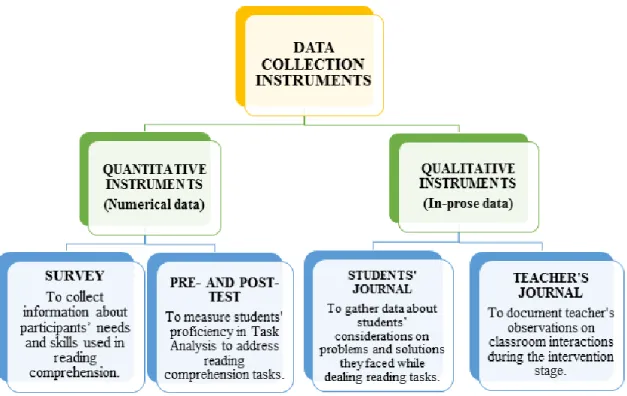
(39) GOAL SETTING, TASK & GENRE ANALYSIS. 38. took into account each one of the steps provided when approaching reading tasks. Besides, they were able to relate goal setting and task purpose strategies to their own life projects and current activities. Concerning affective needs, they were directly related to self-directed learning and their ability to analyze their emotions, feelings and problem solving skills on task analysis through a students’ diary. Researcher’s Role Throughout this study, I, as the teacher-researcher, performed different roles. As a teacher, I designed the lesson plans in order to project the action plan to follow. Likewise, I guided students in their reading skills’ development by providing them with metacognitive strategies. As a researcher, I observed students’ progress all through the research and took field notes in a teacher’s journal. I also designed the instruments: pre-test & post-test, survey for needs analysis on reading comprehension, rubrics to measure and interpret the gathered data. Finally, I analyzed data and drew conclusions on the research findings. Data Collection Instruments and Procedures Four instruments were applied to collect quantitative and qualitative data. At first, a survey for needs analysis on reading comprehension; afterward, a pre-test and post-test for task analysis; and the students and teacher’s journal. Data collection instruments of the present research study are summarized in Figure 3 below. In this regard, quantitative and qualitative data collection instruments are presented and defined in terms of their purpose..
(40) GOAL SETTING, TASK & GENRE ANALYSIS. 39. Figure 3. Data Collection Instruments employed to compile information in this research study. Instrument 1: Survey for needs analysis in reading comprehension. The survey completed by the students previous to the interventions was a quantitative-type instrument employed to determine the particular language skills that the students needed to train with respect to reading comprehension. It was adapted from Needs Analysis questionnaire for non-Englishbackground students designed by Richards (2001). With regards to needs analysis, he states that, “Needs analysis in language teaching may be used for a number of different purposes, for example: to collect information about a particular problem learners are experiencing” (p. 52). This instrument had seven questions divided into three groups of items: a) skills and difficulties, b) general statements and c) reading skills. It was divided in this way for the purpose of identifying the students’ needs so that appropriate lessons would be planned specifically for them. The questions were oriented to ask about the frequent use of language skills in class.
(41) GOAL SETTING, TASK & GENRE ANALYSIS. 40. (reading, writing, speaking and listening), importance of these abilities in their English classes, levels of difficulty and the particular skills they needed to improve in reading (Appendix A). Instrument 2: Pre-test and Post-test. According to Nunan and Bailey (2009), the onegroup pre-test post-test design “is an improvement over the one-shot case study because you can at least tell if the students made progress by comparing their scores at the beginning of the class with their scores at the end” (p. 91). They explain that comparing the pre-test and post-test scores let know whether students had any progress during, but not necessarily because of the interventions. The pre-and post-test in this research study were the next quantitative instruments fulfilled by the students based on task analysis, aimed to measure how much they were able to do a reading task based on task purpose, goal setting, task classification and task demands. These two tests were composed of three types of texts: A recipe, an editorial, and a report on an experiment (in the post-test, the last text was changed by a cover letter in order to help students understand that task analysis is a strategy that can be useful to approach any kind of reading tasks, even difficult texts). Each one of the texts were selected according to its content and vocabulary and syntax complexity: simple, more difficult and even more difficult (Appendix B and C). This selection of texts was done in order to show to the learners that goal setting, task purpose, task classification and task demands were four metacognitive strategies that could be applied for improving comprehension of any kind of texts no matter their difficulty level. The students had to answer four questions for each one of the readings in both the pre-test and post-test as follows: Why would you want to read this text? What would you look for when reading it? What is the organization or structure of this text? What can you do to help you read this text more easily? These questions were directly related to purpose of reading in terms of the implementation, task classification and task demands, respectively..
(42) GOAL SETTING, TASK & GENRE ANALYSIS. 41. Two sets of rubrics were designed to analyze the students’ answers in both tests, one set for the pre-test and another set for the post-test. In total, six rubrics were analyzed (two per type of reading in each test); in that way, answers could be compared to collect data and establish the outcomes (Appendix D). Instrument 3: Students’ Journal. It was the first qualitative instrument that gathered data about the students’ observations. An entry was added just at the end of each lesson of the intervention. According to Alexandrache (2014), "The reflexive diary allows not only the expression of the feelings and the attitudes manifested, but it can also be considered a part of learning, self-evaluation/ self-knowledge processes” (p. 22). In this sense, students were requested to write about the activities carried out during each of the sessions. They needed to focus on the problems and solutions they faced, as well as their feelings and clarifications about their learning process (). Tables were designed to analyze learners’ entries. Tracy (2012) explains that this methodology “refers to a systematic inductive analysis of data that is made from the ground up. Rather than approaching the data with preexisting theories and concepts and applying this theory to the data, the researcher begins instead by collecting data, engaging in open line-by-line analysis, creating larger themes from these data, and linking them together in a larger story” (p. 30). Instrument 4: Teachers’ Journal. This instrument was enriched through observation used as an introspective technique to better understand the research problem. Observations were registered during or after the interventions by the teacher-researcher through entries describing the happenings of each lesson. Teacher’s journal was the second qualitative instrument that collected field notes about classroom observations, comments, students’ behaviors, and general insights about the ongoing research in each lesson (Appendix F)..
(43) GOAL SETTING, TASK & GENRE ANALYSIS. 42. Nunan and Bailey (2009) define the introspective technique used in the data collection with this instrument as: The process of observing and reporting on one’s thoughts, feelings, motives, reasoning processes, and mental states, often with a view to determining the ways in which these processes and states shape behavior. Data collection happens at the same time as or very shortly after the events being investigated. (p. 285) Validity On the subject of validity, all the four instruments used to gather information in this investigation were designed with regard to getting the research objectives. Equally, they were based on the theories adequately selected to solve the problem. Briggs and Coleman (2007) explain that validity deduces if the research correctly illustrates the subject of study. (p. 97) In this sense, quantitative instruments measured students’ ability to approach a reading task based on task purpose, goal setting, task classification and task demands. In the same way, the qualitative instruments (teacher and students’ journals) were filled during the classes by each one of the actors participating in the research at the same time or very shortly after each lesson. It was done in that way as to ensure that they recorded what they were really experiencing. Reliability Data gathered through the quantitative and qualitative instruments triangulated as they provided the teacher researcher with the required information to answer the stated research question. Likewise, such instruments were designed to collect the required information to know the students’ conditions in each stage of the research process. With regards to this, Crocker and Algina (1986) state that the test developer must “identify the sources of measurement error that would be most detrimental to useful score interpretation and design a reliability study that.
(44) GOAL SETTING, TASK & GENRE ANALYSIS. 43. permits such errors to occur so that their effects can be assessed” (as cited in Kimberlin & Winterstein, 2008, p. 2277). Ethical Considerations This study also took into account ethical considerations. The researcher informed and asked for permission to the school principal about the research implementation through a consent letter in which the most important components of the research were described, such as name, objectives, stages, population and management that would be given to the results (Appendix J). In the same way, both parents and students signed a consent letter and were informed about the actions and instruments that would be followed during the study. Objectivity was also considered in this research, personal biases and opinions did not intervene in the execution of this study in order to give fair considerations. In the same way, anonymity was guaranteed to students who participated like population. Results reported represent accurately the findings that emerged from the design, implementation and triangulation of data collected..
(45) GOAL SETTING, TASK & GENRE ANALYSIS. 44. Pedagogical Implementation This chapter describes the stages followed during the pedagogical intervention to strengthen tenth graders’ reading comprehension skills and self-directed learning. The implementation took place from July to October 2014. In the first stage, the instructional design was planned; then, the selection of the strategies was carried out to finish with the pedagogical intervention stage executed during ten sessions. Figure 4 below plainly describes the implementation process that comprises a diagnosis stage, definition of the instructional design, procedures and materials.. Figure 4. Pedagogical Intervention carried out in this study during three stages. Diagnosis During this stage, the needs analysis survey about reading comprehension was administered to the participants with the aim of collecting information about their needs and skills (Appendix A). Once the data collected was analyzed, the strategy to address the stated problem and the instructional design was outlined..
(46) GOAL SETTING, TASK & GENRE ANALYSIS. 45. Instructional Design Four lesson plans were designed in order to implement validly the strategy of goal setting, task analysis: task classification, task demands and genre analysis during a total of ten sessions of 90 minutes each. The template followed was the suggested by Universidad de La Sabana, adapted from Dr. Joan Rubin’s (n.d.) lesson planner. It consisted of three parts: First, planning to set lesson goals in both language and reading, as well as the criteria or evidence to assess each one. Second, lesson planning, which followed these format: a) Preparation, b) Presentation, c) Practice, d) Expansion, e) Self-evaluation and f) Problem Identification - Problem Solution, this, in turn, constituted the students’ journal. Third, Teacher Evaluation with checklists. Pedagogical Intervention For achieving the pedagogical intervention on goal setting, task analysis and genre analysis, a total of ten sessions were designed to implement the four lesson plans. The first lesson plan intended to teach students to set SMART Goals based on a song’s story, shared through a video screening. It took three sessions of 90 minutes each one to accomplish this planning. The second lesson plan required of two sessions of 90 minutes each to achieve the goals set and was oriented to enlighten and train students to establish the goal and purpose of a reading task, what means to set task goal and task purpose, through a mind map and a scrambled activity, in which samples of task, task goal and task purpose had to be identified and classified. The third lesson plan was oriented to present and enable students to do task classification and task demands. It was done through a reading task concerning a biography. The application of this lesson plan required of five sessions of 90 minutes. Finally, the fourth lesson plan sought to identify the main idea of a text by developing all elements of task analysis: a) Task goal, b) Task purpose, c) Task classification and d) Task demands, through samples of main ideas and a narrative text..
Figure



Documento similar
• El verbo “to be” es el primer tema de la unidad I que conforma el PAI (programa académico institucional) de la materia de conversaciones introductorias en lengua
Considering that the main goal of a longitudinal study is to trace closely the movement of the cohort as they live their university experience in order to identify
In contrast, two populations were found for the mutant: a minor population, with distances ranging between 3.5-7 Å, and a major population, with highly oscillating distances,
De las respuestas a estas preguntas puede surgir el inicio de un plan de recuperación personal y algunas ideas para encontrar una red de personas que puedan y estén dispuestas
The gener- ated transformation is expressed in the form of operational triple graph grammar rules that transform the static information (initial model) and the dynamics (source
Validation of the index for inclusion questionnaire for parents of non-university education students
The Index for Inclusion for families of non-university education students was shown to be a robust and adequate psychometric instrument to assess the degree of development of
As Pajares (2003) suggests, at high school, which is equivalent to the levels studied here, these differences tend to disappear, especially when writing self-efficacy beliefs are
To the analysis of the goals of the season previous to the changing regulation, it was used the study ‘Analysis of the offensive actions ending goal in the Spanish Professional
