
A discussion on algorithmic thinking in product design process
8
0
0
Texto completo
(2) changes made to the input values of each parameterized object, can be evidenced preserving the overall concept into the design [Betancourt 2013]. Current economies require efficient and fast designers to solve problems, to define user requirements, and to translate these into products in record time, with awareness that the decisions taken at the beginning of the design process have a larger impact in terms of energy, cost, and sustainability [Chandrasegaran et al. 2013]. A designer must present diverse options that fill the requirements of a very tight schedule. This is prevalent when the deadline approaches and the designer should finish the creative process and present few proposals that he or she could develop. The process of design schools is similar, but the student does not turn in various proposals; only one is developed and evolves during several weeks following the direction of a tutor. Generally, the students are not capable of managing various proposals and carry them all at a final similar level. In the previous discussion, it can be said that the ideal scenario in both cases (real life and academic work) would be to be able to explore many solutions that fill the initial design requirements. To solve a problem using parametric design, the creation of an unlimited number of similar objects that meet the same criteria is allowed. Planning the series of parameters that control a structure is the most challenging part in the preparation of a parametric system. This change from one project to another [El Sayed 2012] and can be classified depending on their relation with form, function, or object structure. This article was developed from the observations and surveys made by the professors of a parametric design course during two (2) semesters, in which industrial design, interactive media design, and industrial engineering students participated. In order to carry out this article, class experiences, practical exercises, project development, blog uploads and general commentaries were taken into account. The next sections discuss the main implications in parametric design use in the designer’s mind using Rhinoceros® and Grasshopper®. 2.1 Algorithmic Thinking and Visual Programming The Grasshopper® Visual Programming allows the user to manage components that help to define forms, mathematical operations, and autoprogramable components. An intuitive method is utilized based on interface by nodes where the user defines the sequence of instructions that later are converted into tridimensional models. Product design is based on the solution of problems. Experimenting with parameters implies solving a geometric problem beginning with the breakdown of a particular structure and a geometric association. The traditional design as well as the parametric design is considered iterative processes. Exploring variations of the same parameterized object permits the designer to consider other options within a wider research space. It is not possible to have direct control over the final results, but rather over the parameters that rule said results. This way of thinking should be constructed gradually in order to comprehend a new way to create objects. Parametric design explains how an object is done and does not center on the form that it has. The first design idea should be broken down into a logical sequence that later will help to think and understand language utilization. If the user has had knowledge of programming languages related with logical thinking, this becomes less complex at the moment of generating forms and geometries. In parametric design, it is necessary to take the initial sketch made in an intuitive manner and break it down in basic geometries in order to construct step by step a determined form, starting with geometries association. Becoming familiar with the visual programming can be new for the designers, where one should understand that from the parametric modeling, it is required to think of each unit as an object inside the computational language that makes up part of a general model conforming to the final design. Each entity possesses input parameters and delivers output parameters (Figure 1). In this way, the readings that designer may find about these components, represent the initial input at the moment of facing in an independently approach a parametric modeling tool like Grasshopper®.. 1036. DESIGN SUPPORT TOOLS.
(3) Figure 1. Components with input and output parameters 2.2 Student Group description and evaluation This observation exercise went on for a year and it was applied to two student groups that participated in the elective course during two different semesters. At the beginning the work was done with a group of ten students of Industrial Design, without any formal instruction in parametric design, notions of algorithmic thought or visual programming. Given the results observed in this first phase, it was decided to involve students from another design major (Interactive Media Design). This second group was interdisciplinary, nterdisciplinary, where seven out of the 18 participants had notions of algorithm design. They also had knowledge about logic and visual programming software, but no training in product design. Both groups were supervised and evaluated the same way. The st students udents attended a 3 hours/week class/lab during a 4 month period, where they were taught the concepts and basic tools to use the software. During the process, students were evaluated in three stages. The course was designed considering three moments of eva evaluation luation where each student would solve real-world real world problems from the parametric design point of view. Some evaluations were individual, some others were group group--based. The difficulty of the exercises increased with the development of the algorithmic thinking. The first exercise was oriented to evaluate basic notions in the use of Grasshopper. The transformation of surfaces and volumes in space was fundamental to produce objects designed from serialized planes. The second exercise emphasized the use of logical functions that presented the handling of large volumes of data through patterns and points in space applied to the design of furniture. Lastly, the last exercise of the lab consisted in the application of all the knowledge and skills acquired during the semester mester to the production of an object completely designed with a parametric point of view. In every moment of evaluation, we asked the students to identify which methodologies were used, solution approaches from an algorithmic point of view, and the inputs and outputs of the parametric model they designed. 2.3 Creative Thinking vs. Results of Parametric Design Different from a traditional design process where the design sequence is done in an intuitive and unaware manner,, the parametric process implies stop stopping ping to think about the elements that compose a design,, the relations between these elements, and the establishment of some parameters parameters for each one. In order to obtain a flexible system, this thinking must acquire an order, a logical sequence and a structure. This is later balanced out at the moment in which the variations are possible with only one action, as it would be to use the sliders (Figure (Figure 2).. Figure 2. Creation of a structure modified with sliders This flexibility allows form exploration that is impossible to achieve with software that is not parametrical or freehand sketching because of the time that these actions imply. The available mathematical models in the computational tools (e (e.g. g. Voronoi or Delaunay), do not represent limitations iin n the creative process, but rather represent a source of inspiration and creativity creativity [Gomes et. DESIGN SUPPORT TOOLS. 1037.
(4) al. 2012]. In the majority of the cases seen in class, the initial ideas do not look like the end product in many cases. It can be frustrating not to find similar similarity ity between the initial aand nd final idea (Figure 3 and 4).. Figure 3. The original design of a table result of an initial sketching. Figure 4. Final result using parametric design 2.4 Information Control In traditional design, the changes made to the compo components nents of geometry or entirely, are done manually by the designer. While in the parametric model the changes are easily made from the properties assigned to each element of which it is composed. These geometries can be adjusted once you have made a judiciou judiciouss process of assigning properties, rules and relations between the parts that are part of certain design system. The control of information facilitates developing a much more agile design of trial and error, even though the final result is never known, the objects seem like the ones initially planned and the ideas begin to transform themselves. The parametric design allows experimenting through pieces and configurations, which for a time it would not be possible in tthe he traditional design process. In some cases the users show that they can create interesting geometries and of high complexity without the necessity of having a good understanding of the software. The results of experimentation in the control of information can be unexpected. In many ca cases, ses, they generate structures with surprising aesthetics (Figure igure 5).. Figure 5. Experimentation with Delaunay triangulation in a furniture project. 1038. DESIGN SUPPORT TOOLS.
(5) Grasshopper® incorporates in its components data structures that provide the user an easy way to manipulate and visualize information. These components are crucial within the parametric modeling, the control of high volumes of data input and output lead to an affordable level for the designer, allowing the person to manipulate, operate and visualize data intuitively. By encapsulating within the components actions such as search, selection, insertion, among others in data trees and lists, it is possible to contain and to manipulate large quantities of information of an object, giving the designer better control over the design and versatility. In this way, users with better software comprehension show that by understanding and taking control of the lists and data trees, new design possibilities are opened. They find in this kind of components and operations the way to guarantee speed and control of the parameters, but without possessing technical knowledge of the same data structures. 2.5 Impact of Computational Thinking in design students It is interesting to see how some students without the need of a wide knowledge in the managing of forms or descriptive geometry are able to construct objects and to create interesting projects. They found in the software a language model focused on logic with a conductor thread similar to other programming languages. Thanks to the wide knowledge in programming languages of some designers, the way that objects are generated became coherent, but always with the direct control limitation over the direct control of final results, and with the ease of control over the parameters that regulate them. This group of students presented problems with modeling tasks and space location. On the other hand, those who did not have previous knowledge of programming languages had outstanding performance in the generation of new geometries and in the experimentation with complex solid intersections represented by other means. They considered that the visual programming language was too complex, it required too much time generating in some cases frustration in the modeling process. Once the logic of algorithmic thinking was understood, they realize that one of the benefits of this method was saving time when the project needs modifications. At the end, everyone could expand their knowledge frontiers and agreed that the parametric exploration was necessary in order to find different solutions to the same problem. 2.6 Limitations in Parametric Design Parametric modeling in Grasshopper® encapsulates the algorithmic complexity in a user-friendly visual environment constituted by components, which allow the designer to approach this type of modeling, it is necessary to highlight the limitations that can be found during modeling process. There are certain geometries that seem most appropriate to be manipulated parametrically, such complex and uncommon geometries can be treated effectively with the use of a top-level manipulation of geometry parameters and algorithms [Gürsel 2012]. However, it is at this point where the designer feels limited at the moment of identifying the characteristics that can be feasibly parameterized, without understanding that the object being designed is the sum of individual geometries (where each geometry can be represented in a parametric environment by a component and the use of parameters that frame the algorithmic structure of the design). In this way, users claim that is not possible to have the entire control over the structure while parameters are not correctly identified. Furthermore, it is necessary to be able to associate geometric components through inputs and outputs, a task that in some cases can be problematic for the designers. This presents difficulties at the moment of expressing the logical sequences that should be followed to obtain the desired object, and confirms the logical thinking to identify the interconnections that should exist are gradually reached. Additionally, the designer should understand that he has no complete flexibility on the model, although the parametric tools allow changes eon geometry, there are limitations as space exploration of the solutions is determined by the maximum and minimum that these parameters can reach. The parametric models are not infinitely flexible; on the contrary, changes can be accommodated only when they are inside the problem definition. A drastic reformulation of the problem that requires alterations in the algorithm can cause the collapse of the parametric model [Gürsel 2012]. In parametric modeling, another aspect that can limit the designer’s action is the managing of large volume data and the develop of specific skills that are needed for the manipulation of parametric tools.. DESIGN SUPPORT TOOLS. 1039.
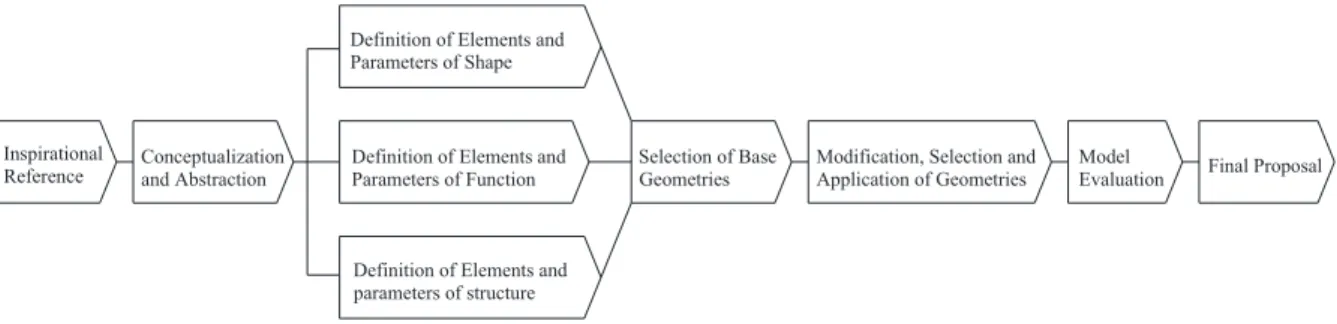
(6) This implies the development of computational abilities, making designers switch between creative and algorithmic thinking during the design process. Finally, during the research many users indicated that in an initial stage of parametric learning, and given the variety of operations and components in Grasshopper®, it is difficult to know which one can precisely complete some specific actions, i.e. understanding that each component requires a specific type of data input and then generates a specific type of data output, which can be manipulated in future stages of the algorithm. Users claim that these concepts and components selections became intuitive only through software exploration.. 3. Identification of Skills for Algorithmic Thinking The new educational models promote teaching based on the idea that each individual builds his own knowledge based on the study, discussion and experience, in order to develop certain skills [González 2006]. In a digital world these characteristics should center on skills of superior order thinking and between them the ability of solving problems. In a digital world this should focus on high order thinking skills and including the ability to solve problems. The particular work with Grasshopper® implies the application of systemic thinking, e.g. the skill to visualize as a whole the constitutive elements of a situation and the interaction between them [González 2006]. This work involves the application of systems thinking, understood as the ability to visualize on a system the elements of a situation and the interaction between these elements [González 2010]. The particular work with Grasshopper® implies the application of the thinking system as the capacity to visualize as a system the constructive elements of a situation and the interaction among the elements New digital tools will change the way of representing design and forge new bases of thought grounded in the relationship between the tool, representation and conception process [Natividade 2012]. In a personal-capabilities level, there must be an interest from the individual side, a desire to experiment, self learning, curiosity in the search for information, and mental adaptability. In order to tackle a design problem from parametric point of view, a series of changes in the designer’s mental structure is implied. This entails a logical organization of the entire model construction process that has been represented in a graphic way in Figure 6. Definition of Elements and Parameters of Shape. Inspirational Reference. Conceptualization and Abstraction. Definition of Elements and Parameters of Function. Selection of Base Geometries. Modification, Selection and Application of Geometries. Model Evaluation. Final Proposal. Definition of Elements and parameters of structure. Figure 6. Logical Construction Model of a Parametric Design Achieving that the student may apply systemic and formalized thinking on his design process in a particular computational environment (in this case Grasshopper®), it's barely one of the implications that parametric design brings with. As is shown in the diagram and as some other authors propose, the parameterization increases complexity. Designer should not only model the product, but also build a logical structure that allows parametric variations. The parametric process presupposes a geometric knowledge in order to be able to take advantage of the possibilities of the generative systems [Alcantara et al. 2012]. This would make it necessary to include concepts of parametric systems in the initial stages of formation. In the survey done in the courses, the students were asked about the identification of essential skills for the managing of the complexity that this type of design represents. A very high percentage showed the necessary personal skill and desire to experiment and explore, besides a curiosity for researching the information.. 1040. DESIGN SUPPORT TOOLS.
(7) 3.1 The design of the survey and its results as empirical evidence for the conclusions of the paper Parametric tools are typically being applied in early stages of design, with this premise and in the interest of discussing algorithmic thought in the process of product design, we designed a survey that was applied to the students once they finished the semester. Many of the ideas related to algorithmic and parametric thinking that were present in the state of the art were discussed with the students in 22 open questions aimed to gather the insights of the participants. Parametric design can be defined as a series of questions to establish the variables of a design and a computational definition that can be utilized to facilitate a variety of solutions [Karle and Kelly 2011]. Parametric systems give the designer more control over the design process, but they require for the designer to understand them effectively to be able to use them in an optimal manner. We asked the students about their perceptions on the control over the design process that parametric structures generate. They responded that the possibility of developing a design from this perspective enables them to have different alternatives, even without them understanding completely the scope of the software being used. The students conclude that parametric systems help designers to master new complexities of design systems, during a Q&A session. They also pointed that parametric systems were a useful tool to explore new alternatives in the generation of geometries that are out of the ordinary. Also, a large percentage of students said that they could perform modifications of parts or specific characteristics of an object in a more agile manner. In summation, even though the questions proposed that each student reflected on their particular experience, some issues emerged, such as the difficulty to work with data lists, the complexity of orienting the design process towards a linear structure, the advantages to modify shapes changing only input values, the possibility to create interactive objects, and the use of thought patterns for the creation of design solutions.. 4. Conclusions There exist similarities and differences between the traditional design method and the parametric design. The students should understand the potential of use of algorithmic tools but also should be aware of its limitations. The systemic and algorithmic thinking are indispensible skills to wrestle with the parametric design and should be considered as an introduction to any parametric design course. It is necessary to be mentally flexible in order to adapt to a new way of thinking. This implies to change from being intuitive to start being aware during the construction process of a parametric design, even though the results are not predictable in some cases. The use of parametric tools should be seen as a powerful instrument for creativity and innovation, but it has not been sufficiently explored in the product design field with difference to architecture. The possibility of achieving form optimizations and product performance evaluations is a complex mental operation that implies knowledge in code programming and knowledge of complementary applications that have not been explored in depth in the industrial design field with great possibilities for the generation of innovation in forms and processes. Acknowledgement We are grateful to the students of the Parametric Design Digital Fabrication Course of 2013, that have assisted in the realization of the course survey and who have made available their work images done in class without any hesitation whatsoever. These are available at http://icesiparametrico.blogspot.com/. References Brod, G. A., Pires, J., Borda, A., "Um ensaio para inserção do conceito de processos generativos digitais em estágios iniciais da formação em arquitetura", Proceedings of Sigradi 2012. Expressão gráfica Editora, Fortaleza, Brasil, 2012, pp. 611-614. Betancourt, M. C., "Generative design of openings for tropical housing comfort", Doctoral Thesis. Universidad del Bío-Bío, Chile, <http://cybertesis.ubiobio.cl/tesis/2013/betancourt_m/html/index-frames.html>, 2013.. DESIGN SUPPORT TOOLS. 1041.
(8) Cambridge Econometrics and AEA Technology for the Environment Agency, "Securing the future, delivering UK sustainable development strategy", Departament of Environment, Food and Rural Affairs (DEFRA), <http://archive.defra.gov.uk/sustainable/government/publications/uk-strategy/documents/Chap3.pdf>, 2005. Chandrasegaran, S. K., Ramani, K., Sriram, R. D., Horváth, I., Bernard, A., Harik, R. F., Gao, W., "The evolution, challenges, and future of knowledge representation in product design systems", Computer-Aided Design, Vol. 45, No. 2., 2013, pp. 204-228. Clarimón, L., Cortés, A., Aragonés, E., "ECODISEÑO, estado de la cuestión, prospectiva del eco diseño para su impulso en Aragón", Observatorio de Medio Ambiente de Aragón OMA, Departamento de Medio Ambiente, Gobierno de Aragón, 2009. Gomes, L. A., Barbosa, W., Araújo, A. L., Celani, G., "Exercício Projetual de uma Estrutura de Cobertura com a Utilização do diagrama de Voronoi no plug-in Grasshopper", Proceedings of Sigradi 2012, Expressão gráfica Editora, Fortaleza, Brasil, 2012, pp. 636-640. González, J. H., "Discernimiento. Evolución del pensamiento crítico en la educación superior. El proyecto de la Universidad Icesi", (Discernment. Evolution of critical thinking in higher education. The project of Universidad Icesi), Universidad Icesi, Cali, Colombia, 2006. González, J. H., "El aprendizaje activo y la formación universitaria", (Active learning and college education), Universidad Icesi, Cali, Colombia, 2011. Gürsel, İ. Dino, "Creative Design exploration by parametric generative systems in architecture", METU Journal of the Faculty of Architecture, (29:1), 2012, pp. 207-224. Karle, D., Kelly, B. M., "Parametric Thinking", ACADIA Regional 2011: Parametricism: (SPC), Lincoln: University of Nebraska, 2011, pp. 109-113. Kobayashi, H., "A systematic approach to eco-innovative product design based on life cycle planning", Advance Engineering Informatics, Volume 20 Issue 2, April 2006, pp. 113-125. Mohammad, K., Hanafi, M., Nasr, M. A., "Closer Perspective on Fabrication Realities", Proceedings of the 30th eCAADe, Achten, Henri; Pavlicek, Jiri; Hulin, Jaroslav; Matejdan, Dana (eds.), Czech Republic, 2012, pp. 169179. Natividade, V., "Para além dos clichés paramétricos", Proceedings of Sigradi 2012. Expressão gráfica Editora, Fortaleza, Brasil, 2012, pp. 584-588. Tedeschi, A., "Parametric architecture with Grasshopper", Edizioni Le Penseur, Brienza, Italia, 2011. Maria Clara Betancourt Velasco PhD, Head of design department Faculty of Engineering, Icesi University Calle 18 No. 122-135. Cali, Colombia Telephone: (572) 555.23.34 ext. 8420 Telefax: (572) 555.23.34 ext. 8862 Email: [email protected] URL: http://www.icesi.edu.co. 1042. DESIGN SUPPORT TOOLS.
(9)
Figure

Documento similar
In this paper we deal with the problem of diagnosis, feature selection, and ranking of the features as a function of their classification importance, and the design of a
Abstract —This paper extends some results for waveguide irises to obtain accurate design formulas for the design of circular waveguide irises in coupled-resonator rectangular
In this case using Design for manufacturing, the material and the manufacturing process used to make the product will be identified to simplify the design of
Lab session 2: Use of software tools for the simulation and design of wastewater treatment facilities.. Lab session 3: Use of software tools for the simulation and design of
Informe de Buena Práctica - Proyecto Europeo VALS y Semester of Code: Prácticas Virtuales en Empresas y Fundaciones relacionadas con el Software Libre a nivel
In this paper the design and operation of a HLDS is presented, for the air conditioning of a high latent load application with high ambient humidity levels.. An analysis of
This conception forces the design process on the fundamental problem of the identity of each architecture: what a character/architecture is, what is its role in the whole scene/city
The Dwellers in the Garden of Allah 109... The Dwellers in the Garden of Allah
