
Search for direct chargino production in anomaly mediated supersymmetry breaking models based on a disappearing track signature in pp collisions at root s=7 TeV with the ATLAS detector
40
0
0
Texto completo
(2) Prepared for submission to JHEP. Search for direct chargino production in anomaly-mediated supersymmetry breaking models based on a disappearing-track signature in pp √ collisions at s = 7 TeV with the ATLAS detector. The ATLAS collaboration CERN, 1211 Geneva 23, Switzerland. E-mail: [email protected] Abstract: A search for direct chargino production in anomaly-mediated supersymmetry √ breaking scenarios is performed in pp collisions at s = 7 TeV using 4.7 fb−1 of data collected with the ATLAS experiment at the LHC. In these models, the lightest chargino is predicted to have a lifetime long enough to be detected in the tracking detectors of collider experiments. This analysis explores such models by searching for chargino decays that result in tracks with few associated hits in the outer region of the tracking system. The transverse-momentum spectrum of candidate tracks is found to be consistent with the expectation from the Standard Model background processes and constraints on chargino properties are obtained..
(3) Contents 1 Introduction. 1. 2 The ATLAS detector. 2. 3 Data and simulated event samples. 3. 4 Event reconstruction and selection 4.1 Event reconstruction 4.2 Kinematic selection criteria 4.3 Disappearing-track selection criteria. 3 4 5 5. 5 Estimate of the pT spectrum of the background contributions 5.1 Interacting charged hadrons 5.2 Electrons failing to satisfy identification criteria. 7 7 8. 6 Estimate of systematic uncertainties. 9. 7 Statistical analysis. 11. 8 Results. 12. 9 Conclusions. 13. 1. Introduction. Anomaly-mediated supersymmetry breaking (AMSB) models [1, 2], where soft supersymmetry (SUSY) breaking is caused by loop effects, provides a constrained mass spectrum of SUSY particles. In particular, the ratios of the three gaugino masses are given approximately by M1 : M2 : M3 ≈ 3 : 1 : 7 , where Mi (i = 1, 2, 3) are the bino, wino and gluino ± masses, respectively. The lightest gaugino is the wino, and the lightest chargino (χ̃1 ) and 0 neutralino (χ̃1 as the lightest supersymmetric particle) are the charged and neutral winos. ± 0 The mass of χ̃1 (mχ̃± ) becomes slightly heavier than that of χ̃1 due to radiative correc1 tions involving electroweak gauge bosons. The typical mass splitting between the charged and neutral winos (∆mχ̃1 ) is 160–170 MeV1 . This phenomenological feature of the nearly ± ± 0 degenerate χ̃1 and χ̃1 has the important implication that the χ̃1 has a considerable life0 time and predominantly decays into χ̃1 plus a low-momentum (∼ 100 MeV) π ± . The mean ± lifetime of the χ̃1 (τχ̃± ) is expected to be typically a fraction of a nanosecond. Therefore, 1 some charginos will have decay lengths exceeding a few tens of centimeters at the energies 1. Throughout this paper, natural units are used, such that ~ = c = 1.. –1–.
(4) of the Large Hadron Collider (LHC) and their tracks may have no or few associated hits in the outer region of the tracking system, causing them to be classified as “disappearing tracks”. This paper describes a search for the production of long-lived AMSB charginos, via √ electroweak processes in pp collisions at s = 7 TeV: ± 0. pp → χ̃1 χ̃1 j,. + −. pp → χ̃1 χ̃1 j.. with their subsequent decays, where j denotes an energetic jet from initial-state radiation ± used to trigger the signal event. Since the χ̃1 could decay in the inner tracking volume and 0 the χ̃1 escapes from the detector, the resulting signal topology is characterized by a high-pT (transverse momentum) jet, large missing transverse momentum (its magnitude is denoted miss ), and a high-p disappearing track. A previous search for a disappearing-track by ET T signature [3] by the ATLAS collaboration was based on signal production via the strong miss . Given the interaction, resulting in final states with multiple high-pT jets and large ET ratio M3 /M2 ≈7, the masses of coloured particles are comparatively large and thus the cross-sections are small compared to those from electroweak production.. 2. The ATLAS detector. ATLAS is a multi-purpose detector [4], covering nearly the entire solid angle2 around the collision point with layers of tracking devices surrounded by a superconducting solenoid providing a 2 tesla axial magnetic field, a calorimeter system, and a muon spectrometer. The inner detector (ID) provides track reconstruction in the region |η| < 2.5 and consists of pixel and silicon microstrip (SCT) detectors inside a straw tube transition radiation tracker (TRT). Of particular importance to this analysis is the TRT detector. The barrel TRT covers the region |z| < 780 mm and is divided into inner, middle, and outer concentric rings of 32 modules each, comprising a stack in azimuthal angle. They cover the radial ranges 563 mm to 694 mm (inner), 697 mm to 860 mm (middle), and 863 mm to 1066 mm (outer). A module consists of a carbon-fiber laminate shell and an array of straw tubes. The average numbers of pixel, SCT and TRT hits on a track going through the inner detector in the central region are about 3, 8 and 34, respectively. The calorimeter system covers the range |η| < 4.9. The electromagnetic calorimeter is a lead/liquid-argon (LAr) detector in the barrel (|η| < 1.475) and endcap (1.375 < |η| < 3.2) regions. The hadronic calorimeters are composed of a steel and scintillator barrel (|η| < 1.7), a LAr/copper endcap (1.5 < |η| < 3.2), and a LAr forward system (3.1 < |η| < 4.9) with copper and tungsten absorbers. The muon spectrometer consists of three large superconducting toroids, trigger chambers, and precision tracking chambers which provide muon momentum measurements up to |η| of 2.7. 2. ATLAS uses a right-handed coordinate system with its origin at the nominal interaction point (IP) in the centre of the detector and the z-axis coinciding with the axis of the beam pipe. The x-axis points from the IP to the centre of the LHC ring, and the y-axis points upward. Cylindrical coordinates (r, φ) are used in the transverse plane, φ being the azimuthal angle around the beam pipe. Pseudorapidity is defined in terms of the polar angle θ as η = − ln tan(θ/2).. –2–.
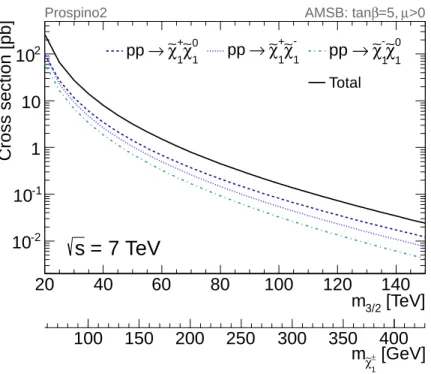
(5) 3. Data and simulated event samples. √ This search is based on pp collision data at s = 7 TeV recorded by the ATLAS detector in 2011, corresponding to an integrated luminosity of 4.7 fb−1 after the application of beam, detector, and data quality requirements. The large cross-section of QCD di-jet events especially at small pT is suppressed at miss > 55 GeV, and the trigger level by requiring at least one jet with pT > 55 GeV, ET jet−E miss. jet−E miss. ∆φmin T > 1 rad, where ∆φmin T indicates the smallest azimuthal separation between the missing transverse momentum and either of the two highest-pT jets with pT > 30 GeV. miss for the trigger are based on calorimeter information and measured The jet pT and ET miss is usually aligned with a highat the electromagnetic scale. For background events ET miss jet−ET. pT jet (∆φmin jet−E miss ∆φmin T. ≈ 0 rad) since it is due to jet mis-measurements while for the signal. ≈ π rad as it arises from the outgoing neutralinos. Simulated Monte Carlo (MC) events are used to assess the experimental sensitivity to given models. The minimal AMSB model is characterized by four parameters: the gravitino mass (m3/2 ), the universal scalar mass (m0 ), the ratio of Higgs vacuum expectation values at the electroweak scale (tan β), and the sign of the higgsino mass term (µ). Isasusy from Isajet v7.80 [5] is used to calculate the SUSY mass spectrum and the decay tables. The MC signal samples are produced using Herwig++ [6] with MRST2007 LO* [7] parton distribution functions (PDFs). All simulated samples used in this paper are produced using a detector simulation based on Geant4 [8, 9], and include multiple pp interactions per event (pile-up) to model that observed in data. Signal cross-sections are calculated at nextto-leading order (NLO) in the strong coupling constant using Prospino2 [10], as shown in figure 1. The nominal cross-section and its uncertainty are taken from an envelope of crosssection predictions using different PDF sets and factorisation and renormalisation scales, as described in ref. [11]. Simulated points with chargino masses ranging from 70–300 GeV are studied, and in particular two reference points with mχ̃± ∼ 100 GeV and 200 GeV are 1 illustrated in this paper. A large value of 1 TeV is used for m0 in order to prevent the existence of a tachyonic slepton. However, the production cross-section is determined only by the wino mass (∝ m3/2 ), and the results presented in this paper are largely independent of the other parameters. The mean lifetime τχ̃± is set to 1 ns, the value for which this 1 analysis has the highest sensitivity. Samples with different mean lifetimes are obtained by applying event weights to the original sample, such that the distribution of the proper lifetime follows that for a given mean lifetime value. The branching fraction for the decay 0 ± χ̃± 1 → χ̃1 π is set to 100%.. 4. Event reconstruction and selection. Kinematic selection criteria are applied which ensure high trigger efficiency while reducing the Standard Model (SM) background arising from unidentified charged leptons that survive a lepton veto. The vast majority of background events are removed by the TRT-based selection criteria that are used to identify the decay of the chargino.. –3–.
(6) AMSB: tanβ=5, µ >0. Cross section [pb]. Prospino2 + 0 pp → ∼ χ1∼ χ1. 102. + pp → ∼ χ∼ χ. 1 1. - 0 pp → ∼ χ∼ χ 1 1. Total. 10 1. 10-1 10-2 20. s = 7 TeV 40 100. 60 150. 80 200. 250. 100 300. 120 140 m3/2 [TeV] 350 400 mχ∼± [GeV] 1. √ Figure 1. The cross-section for direct chargino production at s = 7 TeV as a function of m3/2 . The corresponding mχ̃± values for each m3/2 are also indicated. 1. 4.1. Event reconstruction. The primary vertex [12] is required to have at least five associated tracks; when more than one such vertex is found, the vertex with the largest total |pT |2 of the associated tracks is chosen. Jets are reconstructed using the anti-kt algorithm [13] with a distance parameter of 0.4. The inputs to the jet reconstruction algorithm are topological calorimeter energy clusters. The measurement of jet transverse momentum at the electromagnetic scale (pjet,EM ) underestimates hadronic jets due to the nature of the non-compensating T calorimeters and dead material. Thus, an average correction depending on η and pjet,EM . T is applied to obtain the correct transverse momentum. The details of the jet calibration procedure are given in ref. [14]. In the analysis, requirements of pT > 20 GeV and |η| < 2.8 are applied. Electron candidates are selected with “loose” identification requirements, as described in ref. [15] and required to fulfil the requirements of transverse energy, ET > 10 GeV and |η| < 2.47. Muon candidates are identified by an algorithm which combines an ID track with either a track reconstructed in the muon spectrometer, or with a track segment in the innermost muon station [4, 16]. Furthermore, muons are required to have at least one hit in the innermost layer of the pixel detector (Nb−layer ) if crossing an active module of that layer, more than one pixel hit (Npixel ), at least six SCT hits (NSCT ), pT > 10 GeV and |η| < 2.4. Following the object reconstruction described above, overlaps between q jets and leptons are resolved. First, any jet candidate lying within a distance of ∆R ≡ (∆η)2 + (∆φ)2 = 0.2 of an electron is discarded. Then, any lepton candidate within a distance of ∆R = 0.4. –4–.
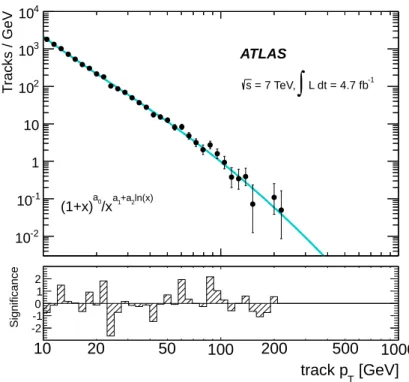
(7) of any surviving jet is discarded. miss is based on the transverse momenta of jets and lepton candiThe calculation of ET dates described above and all calorimeter energy clusters that are not associated to such objects [17]. 4.2. Kinematic selection criteria. Following the trigger decision, selection requirements to suppress non-collision background events, given in ref. [14], are applied to jets. Candidate events are then required to have no electron or muon candidates (lepton veto) to suppress the background events from W/Z + miss > jets and top-quark pair-production processes. The candidates are required to have ET 90 GeV and at least one jet with pT > 90 GeV. In order to further suppress the QCD jet−E miss. background, ∆φmin T > 1.5 rad for the two highest pT jets with pT > 50 GeV is imposed. The trigger selection is 98% efficient for signal events satisfying these selection requirements. 4.3. Disappearing-track selection criteria. The TRT detector provides substantial discrimination between penetrating and decaying charged particles: the average number of hits on a track going through the TRT in the barrel region is about 34 and consecutive hits can be observed along the track with small radial spacing between adjacent hits, while a smaller number is expected for charged particles that decay in the TRT volume. If a chargino decays in the TRT volume, the track is still found with a high efficiency based on hits in the pixel and SCT detectors. Such a chargino track candidate can therefore be fully reconstructed by the ATLAS standard track reconstruction algorithm. The tracks originating from charginos are expected to have high-pT and to be isolated. Therefore, chargino candidate tracks are required to fulfil the following criteria: (I) The track must have Npixel ≥ 1, Nb−layer ≥ 1 if crossing an active module of the innermost pixel layer, NSCT ≥ 6, |d0 | < 1.5 mm and |z0 sin θ| < 1.5 mm, where d0 and z0 are the transverse and longitudinal impact parameters with respect to the primary vertex. (II) The track must be isolated: there must be no tracks having pT above 0.4 GeV within a cone of ∆R = 0.1 around the candidate track. There must also be no jets having pT above 50 GeV within a cone of ∆R = 0.4. (III) The candidate track must have pT above 10 GeV, and must be the highest-pT isolated track in the event. (IV) The relative uncertainty on the momentum measurement must be below 20%. (V) The candidate track must point to the TRT barrel layers but not the region around |η| = 0 (0.1 < |η| < 0.63). outer ) must (VI) The number of hits in the TRT outer module associated to the track (NTRT be less than five.. –5–.
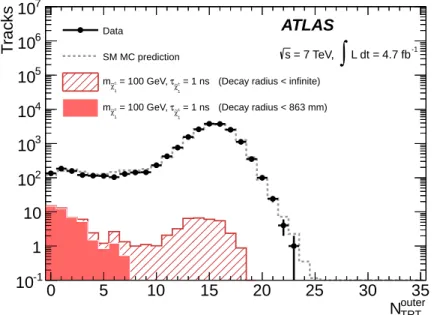
(8) Tracks. Criterion (I) is applied in order to ensure well-reconstructed primary tracks. Criteria (II) and (III) are employed to select chargino tracks that are isolated and have the highest pT in most cases. Tracks seeded from an incorrect combination of SCT space-points could have anomalously high values of pT and worse momentum resolution; criterion (IV) suppresses such tracks. Criterion (V) is based on the extrapolated track position and is used to avoid inactive regions of the TRT and reject muons failing identification due to a small gap in outer is calculated by counting TRT hits acceptance around η = 0. For criterion (VI), NTRT lying on the extrapolated track. This criterion selects charginos decaying within the volume between the SCT outer layers and the TRT outer modules. Hereafter, unless explicitly stated otherwise, “high-pT isolated track selection” and “disappearing-track selection” inouter distributions dicate criteria (I)–(V) and (I)–(VI), respectively. Figure 2 shows the NTRT with the high-pT isolated track selection requirements for data, simulated signal MC events, and simulated MC SM background events. Details of the SM background MC samples are outer described in ref. [18]. When charginos decay before reaching the TRT outer module, NTRT is expected to have a value near zero; conversely, charginos that reach the calorimeters outer ≃ 15. The purity of and SM charged particles traversing the TRT typically have NTRT chargino tracks in the signal MC events, defined as the fraction of candidate tracks matched to generated charginos, is almost 100% at this stage; criterion (VI) removes the vast majority of background events. Although it also reduces the signal efficiency, it strongly enhances the expected signal to background ratio. A summary of kinematic selection criteria, disappearing-track requirements, and the data reduction are given in table 1. Signal efficiencies are low at the first stage due to the trigger based on initial-state radiation. After the application of all selection criteria, 710 candidate events are selected. 107 106. ATLAS. Data. s = 7 TeV,. SM MC prediction. 105 10. -1. mχ∼± = 100 GeV, τχ∼± = 1 ns (Decay radius < infinite) 1. 4. ∫ L dt = 4.7 fb. 1. mχ∼± = 100 GeV, τχ∼± = 1 ns (Decay radius < 863 mm) 1. 1. 103 102 10 1 10-1 0. 5. 10. 15. 20. 25. 30. 35 Nouter TRT. outer Figure 2. The NTRT distribution for data and signal events (mχ̃± = 100 GeV, τχ̃± = 1 ns) with the 1 1 high-pT isolated track selection. The expectation from SM MC events, normalized to the number of observed events, is also shown.. –6–.
(9) Requirement. Observed. Quality requirements and trigger Non-collision background rejection Lepton veto Leading jet pT > 90 GeV miss > 90 GeV ET. 3765627 2899498 2186581 2054262 1233864. ∆φmin T > 1.5 rad High-pT isolated track selection Disappearing-track selection. 1191298 18493 710. Signal events (efficiency [%]) mχ̃± = 100 GeV mχ̃± = 200 GeV 1. jet−E miss. 1. 1983 1958 1906 1497 1420. (3.0) (3.0) (2.9) (2.3) (2.2). 1402 (2.1) 90.5 (0.14) 42.9 (0.066). 283.3 279.6 274.8 237.7 230.2. (6.7) (6.6) (6.5) (5.6) (5.5). 227.4 (5.4) 9.1 (0.26) 4.1 (0.12). Table 1. Summary of selection requirements and data reduction for data and expected signal events (τχ̃± = 1 ns). The signal selection efficiencies are also shown in parentheses. 1. 5. Estimate of the pT spectrum of the background contributions. According to MC simulation, the background contribution after the high-pT isolated track selection comes predominantly from the W (→ τ ν)+jets production in which τ decay products fulfil the selection criteria. Sub-leading contributions to the background come from prompt electrons failing to satisfy their identification criteria. A background estimation based on the MC simulation suffers from large uncertainties due to low numbers of tracks after all the selection requirements and has difficulty in simulating the properties of these background tracks. Therefore, an approach using data-driven control samples enriched in these background categories is employed to estimate the background track pT spectrum. A simultaneous fit is then performed for signal and background yields using the pT spectrum of observed tracks. 5.1. Interacting charged hadrons. High-pT charged hadrons (mostly charged pions) can interact with material in the TRT detector and some tracks can be labelled as disappearing tracks; according to MC simulation, they are responsible for more than 80% of the background in the signal search sample. The pT spectrum of interacting hadron tracks is obtained from that of non-interacting hadron tracks, in a data-driven way using a data sample enriched in this background category as described in ref. [3]. In the pT range above 10 GeV, where inelastic interactions dominate, the interaction rate has nearly no pT -dependence [19]. By adopting the same kinematic selection criteria as those for the signal and ensuring a penetration through the TRT detector outer > 10, a sample of high-p non-interacting hadron tracks is obtained. by requiring NTRT T The contamination from electron tracks and any chargino signal is removed by requiring the cone20 /ptrack , to be larger than 0.2, where E cone20 is the associated calorimeter activity, ET T T calorimeter transverse energy deposited in a cone of ∆R = 0.2 around the track, excluding ET of its corresponding calorimeter cluster, and ptrack is the track pT . According to MC T simulation, the purity of non-interacting hadron tracks is > 99% after these requirements.. –7–.
(10) Tracks / GeV. These hadron tracks have a steeply falling pT spectrum, as shown in figure 3. An ansatz functional form (1 + x)a0 /xa1 +a2 ln(x) is then fitted to the pT spectrum of the control sample, where x ≡ ptrack and ai (i = 0, 1, 2) are the fitted parameters. The data distribution T is well described by this functional form; a χ2 per degree of freedom (DOF) of 39/50 is calculated from the difference between the data and the best-fit form.. 104 103. ATLAS. 102. s = 7 TeV,. ∫ L dt = 4.7 fb. -1. 10 1 10-1. a0. (1+x) /x. a1+a2ln(x). Significance. 10-2 100. 1000. 2 1 0 -1 -2. 10. 20. 50. 100. 200. 500 1000 track pT [GeV]. Figure 3. The pT distribution of the hadron-track background control sample. The data and the fitted shape are shown by solid circles and a line, respectively. The significance of the residuals between the data and the fit model on a bin-by-bin basis is shown at the bottom of the figure.. 5.2. Electrons failing to satisfy identification criteria. The charged lepton background is mostly due to large bremsstrahlung where, predominantly, low-pT electrons contribute to this background. Muons failing to satisfy the identification criteria could be also classified as disappearing tracks; however, this contribution is negligibly small since the probability of bremsstrahlung photon emission is proportional to 1/m2ℓ , where mℓ is the lepton mass. In order to estimate the electron background, a control sample is defined by requiring the same kinematic selection requirements as for the signal search sample, but requiring one electron that fulfils “medium” identification criteria [15] and the isolated track selection criteria; the purity of electrons is close to 100% according to MC simulation. The pT spectrum of electrons without any identification requirements is obtained by applying the correction for the medium identification efficiency [15]. This efficiency depends on pT and η,. –8–.
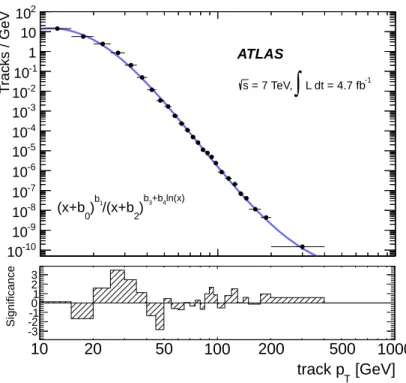
(11) with an average value around 0.8. The pT distribution of electron background tracks is then estimated by multiplying the corrected distribution (described above) by the probability of failing to satisfy the loose identification criteria (hence being retained in the signal search sample) and passing the disappearing-track selection criteria for electrons (Pedis ). For the measurement of Pedis , a “tag-and-probe” method is applied to Z → ee events collected with unprescaled single-electron triggers. In order to ensure a very pure sample of Z → ee events, tag-electrons must be well isolated from jets and also required to fulfil “tight” identification criteria [15] and have ET > 25 GeV. First, the Z → ee sample is selected by requiring no identified muons, at least one tag-electron and one high-pT isolated track. Probe-electrons are selected without any identification requirements but with exactly the same high-pT isolated track selection criteria used for chargino candidate tracks. Then, the reconstructed invariant mass is required to be within the range from 85–95 GeV; its value is calculated using the calorimeter energy for the tag and the track momentum for the probe. The track momentum is used for the probe electron, since in the absence of any electron identification the precise calorimeter energy is not well defined. The probability Pedis is finally given by the fraction of events in which the probe-electron passes the disappearing-track selection criteria; it ranges from 10−2 to 10−4 for 10 < pT < 50 GeV. Due to too few data events, the nominal values of Pedis are derived using MC events; no visible dependence on pT is found, and the average Pedis values for data and MC events agree within 13%, which is taken as a systematic uncertainty. Figure 4 shows the resulting pT spectrum of electron background tracks; the systematic uncertainties on the identification efficiency are included. The pT -dependent identification efficiency and Pedis produce a complicated spectrum; therefore, the electron background shape is determined by a fit to an extended functional form (x + b0 )b1 /(x + b2 )b3 +b4 ln(x) where x ≡ ptrack and bi (i = 0, 1, 2, 3, 4) are the fitted parameters. The χ2 per DOF is T calculated to be 45/29. Using this function the number of electron background tracks in the signal search sample is estimated to be 115 ± 15. Statistical errors and uncertainties on the identification efficiency and Pedis are considered in deriving the results.. 6. Estimate of systematic uncertainties. The sources of systematic uncertainty on the signal expectation which have been considered are the: theoretical cross-section, parton radiation model, jet energy scale (JES) and resolution (JER), trigger efficiency, pile-up modelling, track reconstruction efficiency, and the integrated luminosity. Theoretical uncertainties on the signal cross-section, already described in section 3, range from 6–8% depending on mχ̃± . High-pT jets originating from initial- and final-state 1 radiation alter the signal acceptance. The uncertainties on these processes are estimated by varying generator tunes in the simulation as well as by generator-level studies with an additional jet in the matrix-element method using MadGraph5 [20]+Pythia6 [21], after applying the kinematic selection criteria. By adopting PDF tunes that provide less and more radiation and taking the maximum deviation from the nominal one, the uncertainty due to jet radiation is evaluated. The uncertainty arising from the matching of matrix. –9–.
(12) Significance. Tracks / GeV. 102 10 1 10-1 10-2 10-3 10-4 10-5 10-6 10-7 10-8 10-9 10-10. ATLAS s = 7 TeV,. -1. b3+b4ln(x). b. (x+b ) 1/(x+b ) 0. 2. 100. 3 2 1 0 -1 -2 -3. 10. ∫ L dt = 4.7 fb. 20. 50. 100. 1000. 200. 500 1000 track pT [GeV]. Figure 4. The estimated pT distribution of electron background tracks. The data and the fitted shape are shown by solid circles and a line, respectively. The error bars representing statistical errors and uncertainties on the identification efficiency are invisibly small. The significance of the residuals between the data and the fit model on a bin-by-bin basis is shown at the bottom of the figure.. elements with parton showers is found by doubling and halving the default value of the matching parameter [22]. The resulting changes are combined in quadrature and yield an uncertainty of 10–15% depending on mχ̃± . The uncertainties on the JES and JER result in 1 a variation of the signal selection efficiency; the variation of the signal selection efficiency arising from these uncertainties is assessed according to ref. [14], and an uncertainty of 5–10% is assigned. An uncertainty of 3% on the trigger efficiency is assigned by taking the difference between data and MC W → µν samples. The uncertainty originating from the pile-up modelling in the simulation is evaluated by weighting simulated samples so that the average number of pile-up interactions is increased or decreased by 10%; an uncertainty of 0.5% is assigned. The ID material affects the track reconstruction efficiency and the uncertainty due to the material description in the MC simulation is assessed as described in ref. [23]. By comparing the track reconstruction efficiency to that obtained with the MC samples with an extra 10% of material in the tracking system, an uncertainty of 2%, in particular for tracks in the region of |η| < 0.63, is assigned. The absolute luminosity of pp collisions is determined with an uncertainty of 3.9% [24, 25]. The contributions of each systematic uncertainty in the signal expectation are summarized in table 2 for the two. – 10 –.
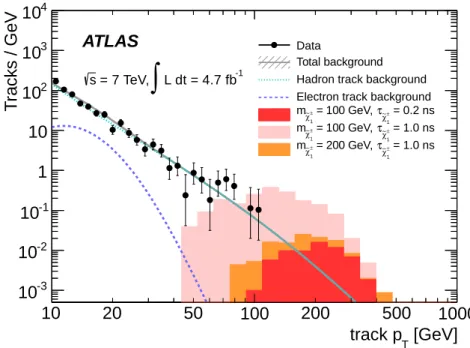
(13) reference signal samples. Systematic uncertainties on the background are determined from the statistical uncertainties on the fit parameters and the full correlation matrix. In addition, the 13% uncertainty on the disappearing-track probability for electrons is considered (see section 5.2). Alternative fit functions for the pT shapes of the electron and interacting hadron tracks are also checked, showing that these agree with each other and with the original form within the fit uncertainties. The effect on the sensitivity to the signals due to the choice of functional forms is thus found to be negligible. Source. mχ̃± = 100 GeV [%]. mχ̃± = 200 GeV [%]. 7. 7. 10 10 3 0.5 2 3.9 15. 13 6 3 0.5 2 3.9 15. 1. (Theoretical uncertainty) Cross section (Uncertainty on the acceptance) Modeling of initial/final-state radiation JES/JER Trigger efficiency Pile-up modelling Track reconstruction efficiency Luminosity Sub-total. 1. Table 2. Summary of systematic uncertainties [%] on the expectation of signal events.. 7. Statistical analysis. In order to evaluate how well the observed data agree with a given signal model, a statistical test is performed based on maximizing a likelihood. The likelihood function for the track pT in a sample of observed events (nobs ) is defined as n obs Y. ns Fs (pT ) + nh Fh (pT ) + ne Fe (pT ) × Lsys , ns + nh + ne. (7.1). where ns , nh and ne are the number of signal events for a given value of the chargino mass and lifetime, the number of interacting hadron track events, and the number of electron track events, respectively. The probability density function of the signal (Fs ) is defined for a given value of the chargino mass and lifetime, and that of the interacting hadron (electron) tracks, Fh (Fe ), is shown in figure 3 (4). In the fit, ne is constrained to be its estimated value (see section 5.2). The effects of systematic uncertainties on the normalizations and the shape parameters describing the two pT distributions of the background tracks are incorporated via the constraining terms, Lsys , representing the product of normal and multivariate-normal distributions in which the variances are set to their uncertainties. Figure 5 shows the pT distribution for the selected data events compared to the background model obtained by the “background-only” fit in the pT range above 10 GeV. The. – 11 –.
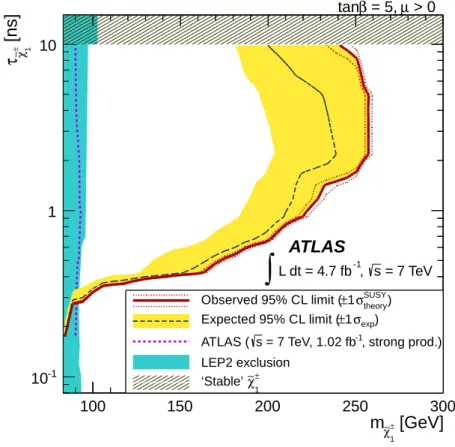
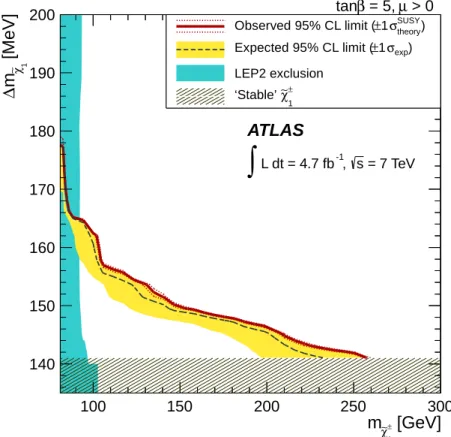
(14) Tracks / GeV. best-fit values of nh and ne are 610 ± 30 and 105 ± 13, respectively. The probability of the fit to describe the data is 0.54. The numbers of expected background and observed tracks in the region pT > 50 (100) GeV are 14.8 ± 0.3 and 19 (2.20 ± 0.05 and 1), respectively, exhibiting no significant excess in the data. The selected examples for the signal are also shown in figure 5. The values of ns for them, derived from the “signal + background” fit, are found to be consistent with zero.. 104 103 102. ATLAS s = 7 TeV,. ∫ L dt = 4.7 fb. -1. Data Total background Hadron track background Electron track background m∼χ± = 100 GeV, τ∼ ± = 0.2 ns 1. χ1. 1. 1. m∼χ± = 100 GeV, τ∼χ± = 1.0 ns 1 1 m∼χ± = 200 GeV, τ∼χ± = 1.0 ns. 10 1 10-1 10-2 10-3 10. 20. 50. 100. 200. 500 1000 track pT [GeV]. Figure 5. The pT distribution of candidate tracks. The solid circles show data and lines show background shapes obtained using the “background-only” fit. The contributions of two background components and the signal expectations are also shown.. 8. Results. In the absence of a signal, constraints on mχ̃± and τχ̃± are set. The upper limit on the 1 1 production cross-section for a given mχ̃± and τχ̃± at 95% confidence level (CL) is set by a 1 1 point where the CL of the “signal+background” hypothesis, based on the profile likelihood ratio [26] and the CLs prescription [27], falls below 5% when scanning the CL along various values of signal strength. The constraint on the τχ̃± –mχ̃± parameter space is shown 1 1 in figure 6. The expected limit is set by the median of the distribution of 95% CL limits calculated by pseudo-experiments with the expected background and no signal. The expected number of background events is derived from the background-only fit in the region 10 < pT < 50 GeV, where the systematic parameters are varied according to their systematic uncertainties when generating the ensemble of pseudo-experiments. Figure 7 shows the constraint on the ∆mχ̃1 –mχ̃± parameter space of the minimal 1 AMSB model. The limits on τχ̃± are converted into limits on ∆mχ̃1 following ref. [28]. The 1. – 12 –.
(15) tanβ = 5, µ > 0. 1. τχ∼± [ns]. region excluded by the LEP2 searches [29–32] is also indicated. For ∆mχ̃1 = 160 (170) MeV (τχ̃± ∼ 0.3 ns), the value most probable in the model, a new limit of mχ̃± > 103 (85) GeV 1 1 at 95% CL is obtained. For ∆mχ̃1 ∼ 140 MeV, a more stringent limit of mχ̃± > 260 GeV 1 is set. The analysis is not performed for signals having τχ̃1 > 10 ns (corresponding ∆mχ̃1 being below the charged pion mass) because a significant fraction of charginos would traverse the ID before decaying, thereby reducing the event selection efficiency. These scenarios are considered as ‘stable’.. 10. 1. ATLAS. ∫ L dt = 4.7 fb , -1. s = 7 TeV. (±1 σSUSY ) theory. Observed 95% CL limit Expected 95% CL limit (±1 σexp). ATLAS ( s = 7 TeV, 1.02 fb-1, strong prod.) LEP2 exclusion ± ‘Stable’ ∼ χ. 10-1. 1. 100. 150. 200. 250. 300. mχ∼± [GeV] 1. Figure 6. The constraint on the τχ̃± –mχ̃± space for tan β = 5 and µ > 0. The black dashed 1 1 line shows the expected limits at 95% CL, with the surrounding shaded bands indicating the 1σ exclusions due to experimental uncertainties. Observed limits are indicated by the solid bold contour representing the nominal limit and the dotted lines on either side are obtained by varying the crosssection by the theoretical scale and PDF uncertainties. The previous result from ref. [3] and the combined LEP2 exclusion at 95% CL are also shown on the left by the dotted line and the shaded region, respectively.. 9. Conclusions. The results of a search for the direct production of long-lived charginos in pp collisions with the ATLAS detector using 4.7 fb−1 of data have been presented in the context of AMSB scenarios. The search is based on the signature of a high-pT isolated track with few. – 13 –.
(16) 1. ∆mχ∼ [MeV]. tanβ = 5, µ > 0. 200. Observed 95% CL limit (±1 σtheory ) SUSY. Expected 95% CL limit (±1 σexp). 190. LEP2 exclusion ± ‘Stable’ ∼ χ 1. ATLAS. 180. ∫ L dt = 4.7 fb , -1. 170. s = 7 TeV. 160. 150. 140 100. 150. 200. 250. 300. mχ∼± [GeV] 1. Figure 7. The constraint on the ∆mχ̃1 –mχ̃± space of the AMSB model for tan β = 5 and µ > 0, 1 where τχ̃± is varying as described in figure 6. The dashed line shows the expected limits at 95% CL, 1 with the surrounding shaded bands indicating the 1σ exclusions due to experimental uncertainties. Observed limits are indicated by the solid bold contour representing the nominal limit and the dotted lines on either side are obtained by varying the cross-section by the theoretical scale and PDF uncertainties. The combined LEP2 exclusion at 95% CL is also shown on the left by the shaded region. Charginos in the lower shaded region could have significantly longer lifetime values for which this analysis has no sensitivity.. associated hits in the outer part of the ATLAS tracking system, arising from a chargino decay into a neutralino and a low-pT pion. The pT spectrum of observed candidate tracks is found to be consistent with the expectation from SM background processes. Constraints on the chargino mass and the mass splitting between the lightest chargino and neutralino are set. A chargino having a mass below 103 (85) GeV with a mass splitting of 160 (170) MeV, the most favoured scenario in the AMSB model, is excluded at 95% CL. This analysis provides a result complementary to the previous search based on signal production via the strong interaction [3] and improves the sensitivity. It also provides a largely AMSB-modelindependent constraint on the chargino properties. From the viewpoint of self-annihilating dark matter, a wino-like lightest SUSY particle with a mass of O(100) GeV as obtained in certain AMSB scenarios, which simultaneously explains the observations by PAMELA [33] and Fermi LAT [34] as well as the WMAP relic density data [35], is of particular interest;. – 14 –.
(17) it could be addressed with an increased LHC energy, more integrated luminosity and an extension of the analysis using shorter tracks.. Acknowledgments We thank CERN for the very successful operation of the LHC, as well as the support staff from our institutions without whom ATLAS could not be operated efficiently. We acknowledge the support of ANPCyT, Argentina; YerPhI, Armenia; ARC, Australia; BMWF and FWF, Austria; ANAS, Azerbaijan; SSTC, Belarus; CNPq and FAPESP, Brazil; NSERC, NRC and CFI, Canada; CERN; CONICYT, Chile; CAS, MOST and NSFC, China; COLCIENCIAS, Colombia; MSMT CR, MPO CR and VSC CR, Czech Republic; DNRF, DNSRC and Lundbeck Foundation, Denmark; EPLANET and ERC, European Union; IN2P3-CNRS, CEA-DSM/IRFU, France; GNSF, Georgia; BMBF, DFG, HGF, MPG and AvH Foundation, Germany; GSRT, Greece; ISF, MINERVA, GIF, DIP and Benoziyo Center, Israel; INFN, Italy; MEXT and JSPS, Japan; CNRST, Morocco; FOM and NWO, Netherlands; BRF and RCN, Norway; MNiSW, Poland; GRICES and FCT, Portugal; MERYS (MECTS), Romania; MES of Russia and ROSATOM, Russian Federation; JINR; MSTD, Serbia; MSSR, Slovakia; ARRS and MVZT, Slovenia; DST/NRF, South Africa; MICINN, Spain; SRC and Wallenberg Foundation, Sweden; SER, SNSF and Cantons of Bern and Geneva, Switzerland; NSC, Taiwan; TAEK, Turkey; STFC, the Royal Society and Leverhulme Trust, United Kingdom; DOE and NSF, United States of America. The crucial computing support from all WLCG partners is acknowledged gratefully, in particular from CERN and the ATLAS Tier-1 facilities at TRIUMF (Canada), NDGF (Denmark, Norway, Sweden), CC-IN2P3 (France), KIT/GridKA (Germany), INFN-CNAF (Italy), NL-T1 (Netherlands), PIC (Spain), ASGC (Taiwan), RAL (UK) and BNL (USA) and in the Tier-2 facilities worldwide.. References [1] G. F. Giudice, M. A. Luty, H. Murayama, and R. Rattazzi, Gaugino Mass without Singlets, JHEP 12 (1998) 027, [hep-ph/9810442]. [2] L. Randall and R. Sundrum, Out of this world supersymmetry breaking, Nucl. Phys. B557 (1999) 79–118, [hep-th/9810155]. [3] ATLAS Collaboration, Search for anomaly-mediated supersymmetry breaking with the √ ATLAS detector based on a disappearing-track signature in pp collisions at s = 7 TeV, Eur. Phys. J. C72 (2012) 1993, [arXiv:1202.4847]. [4] ATLAS Collaboration, The ATLAS Experiment at the CERN Large Hadron Collider, JINST 3 (2008) S08003. [5] F. E. Paige, S. D. Protopopescu, H. Baer, and X. Tata, ISAJET 7.69: A Monte Carlo event generator for pp, p̄p, and e+ e− reactions, [hep-ph/0312045]. [6] M. Bahr, S. Gieseke, M. Gigg, D. Grellscheid, K. Hamilton, et al., Herwig++ Physics and Manual, Eur. Phys. J. C58 (2008) 639–707, [arXiv:0803.0883].. – 15 –.
(18) [7] A. Sherstnev and R. S. Thorne, Parton Distributions for LO Generators, Eur. Phys. J. C55 (2008) 553–575, [arXiv:0711.2473]. [8] GEANT4 Collaboration, S. Agostinelli et al., GEANT4: A simulation toolkit, Nucl. Instrum. Meth. A506 (2003) 250–303. [9] ATLAS Collaboration, The ATLAS Simulation Infrastructure, Eur. Phys. J. C70 (2010) 823–874, [arXiv:1005.4568]. [10] W. Beenakker, R. Hopker, M. Spira, and P. Zerwas, Squark and gluino production at hadron colliders, Nucl. Phys. B492 (1997) 51–103, [hep-ph/9610490]. [11] M. Kramer, A. Kulesza, R. van der Leeuw, M. Mangano, S. Padhi, et al., Supersymmetry √ production cross sections in pp collisions at s = 7 TeV, [arXiv:1206.2892]. [12] ATLAS Collaboration, Performance of primary vertex reconstruction in proton-proton √ collisions at s =7 TeV in the ATLAS experiment, ATLAS-CONF-2010-06, http://cdsweb.cern.ch/record/128134. [13] M. Cacciari, G. P. Salam, and G. Soyez, The anti-kt jet clustering algorithm, JHEP 04 (2008) 063, [arXiv:0802.1189]. [14] ATLAS Collaboration, Jet energy measurement with the ATLAS detector in proton-proton √ collisions at s = 7 TeV, [arXiv:1112.6426], submitted to Eur. Phys. J. [15] ATLAS Collaboration, Electron performance measurements with the ATLAS detector using the 2010 LHC proton-proton collision data, Eur. Phys. J. C72 (2012) 1909, [arXiv:1110.3174]. [16] ATLAS Collaboration, Measurement of the Transverse Momentum Distribution of W √ Bosons in pp Collisions at s = 7 TeV with the ATLAS Detector, Phys. Rev. D85 (2012) 012005, [arXiv:1108.6308]. [17] ATLAS Collaboration, Performance of Missing Transverse Momentum Reconstruction in Proton-Proton Collisions at 7 TeV with ATLAS, Eur. Phys. J. C72 (2012) 1844, [arXiv:1108.5602]. [18] ATLAS Collaboration, Search for squarks and gluinos with the ATLAS detector in final √ states with jets and missing transverse momentum using 4.7 fb−1 of s = 7 TeV proton-proton collision data, [arXiv:1208.0949], submitted to Phys. Rev. D. [19] Particle Data Group, K. Nakamura et al., Review of particle physics, J. Phys. G37 (2010) 075021. Corresponding data may be found at pages 398–399. [20] J. Alwall, M. Herquet, F. Maltoni, O. Mattelaer, and T. Stelzer, MadGraph 5 : Going Beyond, JHEP 1106 (2011) 128, [arXiv:1106.0522]. [21] T. Sjöstrand, S. Mrenna, and P. Z. Skands, PYTHIA 6.4 Physics and Manual, JHEP 0605 (2006) 026, [hep-ph/0603175]. [22] J. Alwall, S. Hoche, F. Krauss, N. Lavesson, L. Lonnblad, et al., Comparative study of various algorithms for the merging of parton showers and matrix elements in hadronic collisions, Eur. Phys. J. C53 (2008) 473–500, [arXiv:0706.2569]. [23] ATLAS Collaboration, Measurements of underlying-event properties using neutral and charged particles in pp collisions at 900 GeV and 7 TeV with the ATLAS detector at the LHC, Eur. Phys. J. C71 (2011) 1636, [arXiv:1103.1816].. – 16 –.
(19) √ [24] ATLAS Collaboration, Luminosity Determination in pp Collisions at s = 7 TeV Using the ATLAS Detector at the LHC, Eur. Phys. J. C71 (2011) 1630, [arXiv:1101.2185]. √ [25] ATLAS Collaboration, Luminosity Determination in pp Collisions at s = 7 TeV using the ATLAS Detector in 2011, ATLAS-CONF-2011-116, http://cdsweb.cern.ch/record/1376384. [26] G. Cowan, K. Cranmer, E. Gross, and O. Vitells, Asymptotic formulae for likelihood-based tests of new physics, Eur. Phys. J. C71 (2011) 1554, [arXiv:1007.1727]. [27] A. L. Read, Presentation of search results: The CL(s) technique, J. Phys. G28 (2002) 2693–2704. [28] C. Chen, M. Drees, and J. Gunion, Addendum/erratum for ‘searching for invisible and almost invisible particles at e+ e− colliders’ [hep-ph/9512230] and ‘a nonstandard string/SUSY scenario and its phenomenological implications’ [hep-ph/9607421], [hep-ph/9902309]. [29] ALEPH Collaboration, A. Heister et al., Search for charginos nearly mass degenerate with the lightest neutralino in e+ e− collisions at center-of-mass energies up to 209 GeV, Phys. Lett. B533 (2002) 223–236, [hep-ex/0203020]. [30] OPAL Collaboration, G. Abbiendi et al., Search for nearly mass degenerate charginos and neutralinos at LEP, Eur. Phys. J. C29 (2003) 479–489, [hep-ex/0210043]. [31] DELPHI Collaboration, J. Abdallah et al., Search for SUSY in the AMSB scenario with the DELPHI detector, Eur. Phys. J. C34 (2004) 145–156, [hep-ex/0403047]. [32] LEP2 SUSY Working Group, http://lepsusy.web.cern.ch/lepsusy/www/inoslowdmsummer02/charginolowdm_pub.html. [33] PAMELA Collaboration, O. Adriani et al., An anomalous positron abundance in cosmic rays with energies 1.5-100 GeV, Nature 458 (2009) 607–609, [arXiv:0810.4995]. [34] Fermi LAT Collaboration, M. Ackermann et al., Measurement of separate cosmic-ray electron and positron spectra with the Fermi Large Area Telescope, Phys. Rev. Lett. 108 (2012) 011103, [arXiv:1109.0521]. [35] N. Jarosik et al., Seven-Year Wilkinson Microwave Anisotropy Probe (WMAP) Observations: Sky Maps, Systematic Errors, and Basic Results, Astrophys. J. Suppl. 192 (2011) 14, [arXiv:1001.4744].. – 17 –.
(20) The ATLAS Collaboration G. Aad48 , T. Abajyan21 , B. Abbott111 , J. Abdallah12 , S. Abdel Khalek115 , A.A. Abdelalim49 , O. Abdinov11 , R. Aben105 , B. Abi112 , M. Abolins88 , O.S. AbouZeid158 , H. Abramowicz153 , H. Abreu136 , B.S. Acharya164a,164b , L. Adamczyk38 , D.L. Adams25 , T.N. Addy56 , J. Adelman176 , S. Adomeit98 , P. Adragna75 , T. Adye129 , S. Aefsky23 , J.A. Aguilar-Saavedra124b ,a , M. Agustoni17 , M. Aharrouche81 , S.P. Ahlen22 , F. Ahles48 , A. Ahmad148 , M. Ahsan41 , G. Aielli133a,133b , T. Akdogan19a , T.P.A. Åkesson79 , G. Akimoto155 , A.V. Akimov94 , M.S. Alam2 , M.A. Alam76 , J. Albert169 , S. Albrand55 , M. Aleksa30 , I.N. Aleksandrov64 , F. Alessandria89a , C. Alexa26a , G. Alexander153 , G. Alexandre49 , T. Alexopoulos10 , M. Alhroob164a,164c , M. Aliev16 , G. Alimonti89a , J. Alison120 , B.M.M. Allbrooke18 , P.P. Allport73 , S.E. Allwood-Spiers53 , J. Almond82 , A. Aloisio102a,102b , R. Alon172 , A. Alonso79 , F. Alonso70 , A. Altheimer35 , B. Alvarez Gonzalez88 , M.G. Alviggi102a,102b , K. Amako65 , C. Amelung23 , V.V. Ammosov128,∗ , S.P. Amor Dos Santos124a , A. Amorim124a,b , N. Amram153 , C. Anastopoulos30 , L.S. Ancu17 , N. Andari115 , T. Andeen35 , C.F. Anders58b , G. Anders58a , K.J. Anderson31 , A. Andreazza89a,89b , V. Andrei58a , M-L. Andrieux55 , X.S. Anduaga70 , S. Angelidakis9 , P. Anger44 , A. Angerami35 , F. Anghinolfi30 , A. Anisenkov107 , N. Anjos124a , A. Annovi47 , A. Antonaki9 , M. Antonelli47 , A. Antonov96 , J. Antos144b , F. Anulli132a , M. Aoki101 , S. Aoun83 , L. Aperio Bella5 , R. Apolle118,c , G. Arabidze88 , I. Aracena143 , Y. Arai65 , A.T.H. Arce45 , S. Arfaoui148 , J-F. Arguin93 , E. Arik19a,∗ , M. Arik19a , A.J. Armbruster87 , O. Arnaez81 , V. Arnal80 , C. Arnault115 , A. Artamonov95 , G. Artoni132a,132b , D. Arutinov21 , S. Asai155 , S. Ask28 , B. Åsman146a,146b , L. Asquith6 , K. Assamagan25 , A. Astbury169 , M. Atkinson165 , B. Aubert5 , E. Auge115 , K. Augsten127 , M. Aurousseau145a , G. Avolio30 , R. Avramidou10 , D. Axen168 , G. Azuelos93,d , Y. Azuma155 , M.A. Baak30 , G. Baccaglioni89a , C. Bacci134a,134b , A.M. Bach15 , H. Bachacou136 , K. Bachas30 , M. Backes49 , M. Backhaus21 , J. Backus Mayes143 , E. Badescu26a , P. Bagnaia132a,132b , S. Bahinipati3 , Y. Bai33a , D.C. Bailey158 , T. Bain158 , J.T. Baines129 , O.K. Baker176 , M.D. Baker25 , S. Baker77 , P. Balek126 , E. Banas39 , P. Banerjee93 , Sw. Banerjee173 , D. Banfi30 , A. Bangert150 , V. Bansal169 , H.S. Bansil18 , L. Barak172 , S.P. Baranov94 , A. Barbaro Galtieri15 , T. Barber48 , E.L. Barberio86 , D. Barberis50a,50b , M. Barbero21 , D.Y. Bardin64 , T. Barillari99 , M. Barisonzi175 , T. Barklow143 , N. Barlow28 , B.M. Barnett129 , R.M. Barnett15 , A. Baroncelli134a , G. Barone49 , A.J. Barr118 , F. Barreiro80 , J. Barreiro Guimarães da Costa57 , P. Barrillon115 , R. Bartoldus143 , A.E. Barton71 , V. Bartsch149 , A. Basye165 , R.L. Bates53 , L. Batkova144a , J.R. Batley28 , A. Battaglia17 , M. Battistin30 , F. Bauer136 , H.S. Bawa143 ,e , S. Beale98 , T. Beau78 , P.H. Beauchemin161 , R. Beccherle50a , P. Bechtle21 , H.P. Beck17 , A.K. Becker175 , S. Becker98 , M. Beckingham138 , K.H. Becks175 , A.J. Beddall19c , A. Beddall19c , S. Bedikian176 , V.A. Bednyakov64 , C.P. Bee83 , L.J. Beemster105 , M. Begel25 , S. Behar Harpaz152 , P.K. Behera62 , M. Beimforde99 , C. Belanger-Champagne85 , P.J. Bell49 , W.H. Bell49 , G. Bella153 , L. Bellagamba20a , M. Bellomo30 , A. Belloni57 , O. Beloborodova107,f , K. Belotskiy96 , O. Beltramello30 , O. Benary153 ,. – 18 –.
(21) D. Benchekroun135a , K. Bendtz146a,146b , N. Benekos165 , Y. Benhammou153 , E. Benhar Noccioli49 , J.A. Benitez Garcia159b , D.P. Benjamin45 , M. Benoit115 , J.R. Bensinger23 , K. Benslama130 , S. Bentvelsen105 , D. Berge30 , E. Bergeaas Kuutmann42 , N. Berger5 , F. Berghaus169 , E. Berglund105 , J. Beringer15 , P. Bernat77 , R. Bernhard48 , C. Bernius25 , T. Berry76 , C. Bertella83 , A. Bertin20a,20b , F. Bertolucci122a,122b , M.I. Besana89a,89b , G.J. Besjes104 , N. Besson136 , S. Bethke99 , W. Bhimji46 , R.M. Bianchi30 , L. Bianchini23 , M. Bianco72a,72b , O. Biebel98 , S.P. Bieniek77 , K. Bierwagen54 , J. Biesiada15 , M. Biglietti134a , H. Bilokon47 , M. Bindi20a,20b , S. Binet115 , A. Bingul19c , C. Bini132a,132b , C. Biscarat178 , B. Bittner99 , K.M. Black22 , R.E. Blair6 , J.-B. Blanchard136 , G. Blanchot30 , T. Blazek144a , I. Bloch42 , C. Blocker23 , J. Blocki39 , A. Blondel49 , W. Blum81 , U. Blumenschein54 , G.J. Bobbink105 , V.B. Bobrovnikov107 , S.S. Bocchetta79 , A. Bocci45 , C.R. Boddy118 , M. Boehler48 , J. Boek175 , N. Boelaert36 , J.A. Bogaerts30 , A. Bogdanchikov107 , A. Bogouch90,∗ , C. Bohm146a , J. Bohm125 , V. Boisvert76 , T. Bold38 , V. Boldea26a , N.M. Bolnet136 , M. Bomben78 , M. Bona75 , M. Boonekamp136 , S. Bordoni78 , C. Borer17 , A. Borisov128 , G. Borissov71 , I. Borjanovic13a , M. Borri82 , S. Borroni87 , J. Bortfeldt98 , V. Bortolotto134a,134b , K. Bos105 , D. Boscherini20a , M. Bosman12 , H. Boterenbrood105 , J. Bouchami93 , J. Boudreau123 , E.V. Bouhova-Thacker71 , D. Boumediene34 , C. Bourdarios115 , N. Bousson83 , A. Boveia31 , J. Boyd30 , I.R. Boyko64 , I. Bozovic-Jelisavcic13b , J. Bracinik18 , P. Branchini134a , A. Brandt8 , G. Brandt118 , O. Brandt54 , U. Bratzler156 , B. Brau84 , J.E. Brau114 , H.M. Braun175,∗ , S.F. Brazzale164a,164c , B. Brelier158 , J. Bremer30 , K. Brendlinger120 , R. Brenner166 , S. Bressler172 , D. Britton53 , F.M. Brochu28 , I. Brock21 , R. Brock88 , F. Broggi89a , C. Bromberg88 , J. Bronner99 , G. Brooijmans35 , T. Brooks76 , W.K. Brooks32b , G. Brown82 , H. Brown8 , P.A. Bruckman de Renstrom39 , D. Bruncko144b , R. Bruneliere48 , S. Brunet60 , A. Bruni20a , G. Bruni20a , M. Bruschi20a , T. Buanes14 , Q. Buat55 , F. Bucci49 , J. Buchanan118 , P. Buchholz141 , R.M. Buckingham118 , A.G. Buckley46 , S.I. Buda26a , I.A. Budagov64 , B. Budick108 , V. Büscher81 , L. Bugge117 , O. Bulekov96 , A.C. Bundock73 , M. Bunse43 , T. Buran117 , H. Burckhart30 , S. Burdin73 , T. Burgess14 , S. Burke129 , E. Busato34 , P. Bussey53 , C.P. Buszello166 , B. Butler143 , J.M. Butler22 , C.M. Buttar53 , J.M. Butterworth77 , W. Buttinger28 , M. Byszewski30 , S. Cabrera Urbán167 , D. Caforio20a,20b , O. Cakir4a , P. Calafiura15 , G. Calderini78 , P. Calfayan98 , R. Calkins106 , L.P. Caloba24a , R. Caloi132a,132b , D. Calvet34 , S. Calvet34 , R. Camacho Toro34 , P. Camarri133a,133b , D. Cameron117 , L.M. Caminada15 , R. Caminal Armadans12 , S. Campana30 , M. Campanelli77 , V. Canale102a,102b , F. Canelli31,g , A. Canepa159a , J. Cantero80 , R. Cantrill76 , L. Capasso102a,102b , M.D.M. Capeans Garrido30 , I. Caprini26a , M. Caprini26a , D. Capriotti99 , M. Capua37a,37b , R. Caputo81 , R. Cardarelli133a , T. Carli30 , G. Carlino102a , L. Carminati89a,89b , B. Caron85 , S. Caron104 , E. Carquin32b , G.D. Carrillo-Montoya173 , A.A. Carter75 , J.R. Carter28 , J. Carvalho124a ,h , D. Casadei108 , M.P. Casado12 , M. Cascella122a,122b , C. Caso50a,50b,∗ , A.M. Castaneda Hernandez173,i , E. Castaneda-Miranda173 , V. Castillo Gimenez167 , N.F. Castro124a , G. Cataldi72a , P. Catastini57 , A. Catinaccio30 , J.R. Catmore30 , A. Cattai30 , G. Cattani133a,133b , S. Caughron88 , V. Cavaliere165 , P. Cavalleri78 , D. Cavalli89a , M. Cavalli-Sforza12 , V. Cavasinni122a,122b , F. Ceradini134a,134b ,. – 19 –.
(22) A.S. Cerqueira24b , A. Cerri30 , L. Cerrito75 , F. Cerutti47 , S.A. Cetin19b , A. Chafaq135a , D. Chakraborty106 , I. Chalupkova126 , K. Chan3 , P. Chang165 , B. Chapleau85 , J.D. Chapman28 , J.W. Chapman87 , E. Chareyre78 , D.G. Charlton18 , V. Chavda82 , C.A. Chavez Barajas30 , S. Cheatham85 , S. Chekanov6 , S.V. Chekulaev159a , G.A. Chelkov64 , M.A. Chelstowska104 , C. Chen63 , H. Chen25 , S. Chen33c , X. Chen173 , Y. Chen35 , Y. Cheng31 , A. Cheplakov64 , R. Cherkaoui El Moursli135e , V. Chernyatin25 , E. Cheu7 , S.L. Cheung158 , L. Chevalier136 , G. Chiefari102a,102b , L. Chikovani51a,∗ , J.T. Childers30 , A. Chilingarov71 , G. Chiodini72a , A.S. Chisholm18 , R.T. Chislett77 , A. Chitan26a , M.V. Chizhov64 , G. Choudalakis31 , S. Chouridou137 , I.A. Christidi77 , A. Christov48 , D. Chromek-Burckhart30 , M.L. Chu151 , J. Chudoba125 , G. Ciapetti132a,132b , A.K. Ciftci4a , R. Ciftci4a , D. Cinca34 , V. Cindro74 , C. Ciocca20a,20b , A. Ciocio15 , M. Cirilli87 , P. Cirkovic13b , Z.H. Citron172 , M. Citterio89a , M. Ciubancan26a , A. Clark49 , P.J. Clark46 , R.N. Clarke15 , W. Cleland123 , J.C. Clemens83 , B. Clement55 , C. Clement146a,146b , Y. Coadou83 , M. Cobal164a,164c , A. Coccaro138 , J. Cochran63 , L. Coffey23 , J.G. Cogan143 , J. Coggeshall165 , E. Cogneras178 , J. Colas5 , S. Cole106 , A.P. Colijn105 , N.J. Collins18 , C. Collins-Tooth53 , J. Collot55 , T. Colombo119a,119b , G. Colon84 , G. Compostella99 , P. Conde Muiño124a , E. Coniavitis166 , M.C. Conidi12 , S.M. Consonni89a,89b , V. Consorti48 , S. Constantinescu26a , C. Conta119a,119b , G. Conti57 , F. Conventi102a ,j , M. Cooke15 , B.D. Cooper77 , A.M. Cooper-Sarkar118 , K. Copic15 , T. Cornelissen175 , M. Corradi20a , F. Corriveau85 ,k , A. Cortes-Gonzalez165 , G. Cortiana99 , G. Costa89a , M.J. Costa167 , D. Costanzo139 , D. Côté30 , L. Courneyea169 , G. Cowan76 , C. Cowden28 , B.E. Cox82 , K. Cranmer108 , F. Crescioli122a,122b , M. Cristinziani21 , G. Crosetti37a,37b , S. Crépé-Renaudin55 , C.-M. Cuciuc26a , C. Cuenca Almenar176 , T. Cuhadar Donszelmann139 , M. Curatolo47 , C.J. Curtis18 , C. Cuthbert150 , P. Cwetanski60 , H. Czirr141 , P. Czodrowski44 , Z. Czyczula176 , S. D’Auria53 , M. D’Onofrio73 , A. D’Orazio132a,132b , M.J. Da Cunha Sargedas De Sousa124a , C. Da Via82 , W. Dabrowski38 , A. Dafinca118 , T. Dai87 , C. Dallapiccola84 , M. Dam36 , M. Dameri50a,50b , D.S. Damiani137 , H.O. Danielsson30 , V. Dao49 , G. Darbo50a , G.L. Darlea26b , J.A. Dassoulas42 , W. Davey21 , T. Davidek126 , N. Davidson86 , R. Davidson71 , E. Davies118,c , M. Davies93 , O. Davignon78 , A.R. Davison77 , Y. Davygora58a , E. Dawe142 , I. Dawson139 , R.K. Daya-Ishmukhametova23 , K. De8 , R. de Asmundis102a , S. De Castro20a,20b , S. De Cecco78 , J. de Graat98 , N. De Groot104 , P. de Jong105 , C. De La Taille115 , H. De la Torre80 , F. De Lorenzi63 , L. de Mora71 , L. De Nooij105 , D. De Pedis132a , A. De Salvo132a , U. De Sanctis164a,164c , A. De Santo149 , J.B. De Vivie De Regie115 , G. De Zorzi132a,132b , W.J. Dearnaley71 , R. Debbe25 , C. Debenedetti46 , B. Dechenaux55 , D.V. Dedovich64 , J. Degenhardt120 , J. Del Peso80 , T. Del Prete122a,122b , T. Delemontex55 , M. Deliyergiyev74 , A. Dell’Acqua30 , L. Dell’Asta22 , M. Della Pietra102a ,j , D. della Volpe102a,102b , M. Delmastro5 , P.A. Delsart55 , C. Deluca105 , S. Demers176 , M. Demichev64 , B. Demirkoz12,l , J. Deng163 , S.P. Denisov128 , D. Derendarz39 , J.E. Derkaoui135d , F. Derue78 , P. Dervan73 , K. Desch21 , E. Devetak148 , P.O. Deviveiros105 , A. Dewhurst129 , B. DeWilde148 , S. Dhaliwal158 , R. Dhullipudi25 ,m , A. Di Ciaccio133a,133b , L. Di Ciaccio5 , C. Di Donato102a,102b , A. Di Girolamo30 , B. Di Girolamo30 , S. Di Luise134a,134b , A. Di Mattia173 , B. Di Micco30 ,. – 20 –.
(23) R. Di Nardo47 , A. Di Simone133a,133b , R. Di Sipio20a,20b , M.A. Diaz32a , E.B. Diehl87 , J. Dietrich42 , T.A. Dietzsch58a , S. Diglio86 , K. Dindar Yagci40 , J. Dingfelder21 , F. Dinut26a , C. Dionisi132a,132b , P. Dita26a , S. Dita26a , F. Dittus30 , F. Djama83 , T. Djobava51b , M.A.B. do Vale24c , A. Do Valle Wemans124a,n , T.K.O. Doan5 , M. Dobbs85 , D. Dobos30 , E. Dobson30,o , J. Dodd35 , C. Doglioni49 , T. Doherty53 , Y. Doi65,∗ , J. Dolejsi126 , I. Dolenc74 , Z. Dolezal126 , B.A. Dolgoshein96,∗ , T. Dohmae155 , M. Donadelli24d , J. Donini34 , J. Dopke30 , A. Doria102a , A. Dos Anjos173 , A. Dotti122a,122b , M.T. Dova70 , A.D. Doxiadis105 , A.T. Doyle53 , N. Dressnandt120 , M. Dris10 , J. Dubbert99 , S. Dube15 , E. Duchovni172 , G. Duckeck98 , D. Duda175 , A. Dudarev30 , F. Dudziak63 , M. Dührssen30 , I.P. Duerdoth82 , L. Duflot115 , M-A. Dufour85 , L. Duguid76 , M. Dunford58a , H. Duran Yildiz4a , R. Duxfield139 , M. Dwuznik38 , F. Dydak30 , M. Düren52 , W.L. Ebenstein45 , J. Ebke98 , S. Eckweiler81 , K. Edmonds81 , W. Edson2 , C.A. Edwards76 , N.C. Edwards53 , W. Ehrenfeld42 , T. Eifert143 , G. Eigen14 , K. Einsweiler15 , E. Eisenhandler75 , T. Ekelof166 , M. El Kacimi135c , M. Ellert166 , S. Elles5 , F. Ellinghaus81 , K. Ellis75 , N. Ellis30 , J. Elmsheuser98 , M. Elsing30 , D. Emeliyanov129 , R. Engelmann148 , A. Engl98 , B. Epp61 , J. Erdmann54 , A. Ereditato17 , D. Eriksson146a , J. Ernst2 , M. Ernst25 , J. Ernwein136 , D. Errede165 , S. Errede165 , E. Ertel81 , M. Escalier115 , H. Esch43 , C. Escobar123 , X. Espinal Curull12 , B. Esposito47 , F. Etienne83 , A.I. Etienvre136 , E. Etzion153 , D. Evangelakou54 , H. Evans60 , L. Fabbri20a,20b , C. Fabre30 , R.M. Fakhrutdinov128 , S. Falciano132a , Y. Fang173 , M. Fanti89a,89b , A. Farbin8 , A. Farilla134a , J. Farley148 , T. Farooque158 , S. Farrell163 , S.M. Farrington170 , P. Farthouat30 , F. Fassi167 , P. Fassnacht30 , D. Fassouliotis9 , B. Fatholahzadeh158 , A. Favareto89a,89b , L. Fayard115 , S. Fazio37a,37b , R. Febbraro34 , P. Federic144a , O.L. Fedin121 , W. Fedorko88 , M. Fehling-Kaschek48 , L. Feligioni83 , D. Fellmann6 , C. Feng33d , E.J. Feng6 , A.B. Fenyuk128 , J. Ferencei144b , W. Fernando6 , S. Ferrag53 , J. Ferrando53 , V. Ferrara42 , A. Ferrari166 , P. Ferrari105 , R. Ferrari119a , D.E. Ferreira de Lima53 , A. Ferrer167 , D. Ferrere49 , C. Ferretti87 , A. Ferretto Parodi50a,50b , M. Fiascaris31 , F. Fiedler81 , A. Filipčič74 , F. Filthaut104 , M. Fincke-Keeler169 , M.C.N. Fiolhais124a,h , L. Fiorini167 , A. Firan40 , G. Fischer42 , M.J. Fisher109 , M. Flechl48 , I. Fleck141 , J. Fleckner81 , P. Fleischmann174 , S. Fleischmann175 , T. Flick175 , A. Floderus79 , L.R. Flores Castillo173 , M.J. Flowerdew99 , T. Fonseca Martin17 , A. Formica136 , A. Forti82 , D. Fortin159a , D. Fournier115 , A.J. Fowler45 , H. Fox71 , P. Francavilla12 , M. Franchini20a,20b , S. Franchino119a,119b , D. Francis30 , T. Frank172 , M. Franklin57 , S. Franz30 , M. Fraternali119a,119b , S. Fratina120 , S.T. French28 , C. Friedrich42 , F. Friedrich44 , R. Froeschl30 , D. Froidevaux30 , J.A. Frost28 , C. Fukunaga156 , E. Fullana Torregrosa30 , B.G. Fulsom143 , J. Fuster167 , C. Gabaldon30 , O. Gabizon172 , T. Gadfort25 , S. Gadomski49 , G. Gagliardi50a,50b , P. Gagnon60 , C. Galea98 , B. Galhardo124a , E.J. Gallas118 , V. Gallo17 , B.J. Gallop129 , P. Gallus125 , K.K. Gan109 , Y.S. Gao143,e , A. Gaponenko15 , F. Garberson176 , M. Garcia-Sciveres15 , C. García167 , J.E. García Navarro167 , R.W. Gardner31 , N. Garelli30 , H. Garitaonandia105 , V. Garonne30 , C. Gatti47 , G. Gaudio119a , B. Gaur141 , L. Gauthier136 , P. Gauzzi132a,132b , I.L. Gavrilenko94 , C. Gay168 , G. Gaycken21 , E.N. Gazis10 , P. Ge33d , Z. Gecse168 , C.N.P. Gee129 , D.A.A. Geerts105 , Ch. Geich-Gimbel21 , K. Gellerstedt146a,146b ,. – 21 –.
(24) C. Gemme50a , A. Gemmell53 , M.H. Genest55 , S. Gentile132a,132b , M. George54 , S. George76 , P. Gerlach175 , A. Gershon153 , C. Geweniger58a , H. Ghazlane135b , N. Ghodbane34 , B. Giacobbe20a , S. Giagu132a,132b , V. Giakoumopoulou9 , V. Giangiobbe12 , F. Gianotti30 , B. Gibbard25 , A. Gibson158 , S.M. Gibson30 , M. Gilchriese15 , D. Gillberg29 , A.R. Gillman129 , D.M. Gingrich3,d , J. Ginzburg153 , N. Giokaris9 , M.P. Giordani164c , R. Giordano102a,102b , F.M. Giorgi16 , P. Giovannini99 , P.F. Giraud136 , D. Giugni89a , M. Giunta93 , P. Giusti20a , B.K. Gjelsten117 , L.K. Gladilin97 , C. Glasman80 , J. Glatzer21 , A. Glazov42 , K.W. Glitza175 , G.L. Glonti64 , J.R. Goddard75 , J. Godfrey142 , J. Godlewski30 , M. Goebel42 , T. Göpfert44 , C. Goeringer81 , C. Gössling43 , S. Goldfarb87 , T. Golling176 , A. Gomes124a,b , L.S. Gomez Fajardo42 , R. Gonçalo76 , J. Goncalves Pinto Firmino Da Costa42 , L. Gonella21 , S. González de la Hoz167 , G. Gonzalez Parra12 , M.L. Gonzalez Silva27 , S. Gonzalez-Sevilla49 , J.J. Goodson148 , L. Goossens30 , P.A. Gorbounov95 , H.A. Gordon25 , I. Gorelov103 , G. Gorfine175 , B. Gorini30 , E. Gorini72a,72b , A. Gorišek74 , E. Gornicki39 , B. Gosdzik42 , A.T. Goshaw6 , M. Gosselink105 , M.I. Gostkin64 , I. Gough Eschrich163 , M. Gouighri135a , D. Goujdami135c , M.P. Goulette49 , A.G. Goussiou138 , C. Goy5 , S. Gozpinar23 , I. Grabowska-Bold38 , P. Grafström20a,20b , K-J. Grahn42 , E. Gramstad117 , F. Grancagnolo72a , S. Grancagnolo16 , V. Grassi148 , V. Gratchev121 , N. Grau35 , H.M. Gray30 , J.A. Gray148 , E. Graziani134a , O.G. Grebenyuk121 , T. Greenshaw73 , Z.D. Greenwood25,m , K. Gregersen36 , I.M. Gregor42 , P. Grenier143 , J. Griffiths8 , N. Grigalashvili64 , A.A. Grillo137 , S. Grinstein12 , Ph. Gris34 , Y.V. Grishkevich97 , J.-F. Grivaz115 , E. Gross172 , J. Grosse-Knetter54 , J. Groth-Jensen172 , K. Grybel141 , D. Guest176 , C. Guicheney34 , S. Guindon54 , U. Gul53 , J. Gunther125 , B. Guo158 , J. Guo35 , P. Gutierrez111 , N. Guttman153 , O. Gutzwiller173 , C. Guyot136 , C. Gwenlan118 , C.B. Gwilliam73 , A. Haas108 , S. Haas30 , C. Haber15 , H.K. Hadavand8 , D.R. Hadley18 , P. Haefner21 , F. Hahn30 , S. Haider30 , Z. Hajduk39 , H. Hakobyan177 , D. Hall118 , K. Hamacher175 , P. Hamal113 , K. Hamano86 , M. Hamer54 , A. Hamilton145b,p , S. Hamilton161 , L. Han33b , K. Hanagaki116 , K. Hanawa160 , M. Hance15 , C. Handel81 , P. Hanke58a , J.R. Hansen36 , J.B. Hansen36 , J.D. Hansen36 , P.H. Hansen36 , P. Hansson143 , K. Hara160 , G.A. Hare137 , T. Harenberg175 , S. Harkusha90 , D. Harper87 , R.D. Harrington46 , O.M. Harris138 , J. Hartert48 , F. Hartjes105 , T. Haruyama65 , A. Harvey56 , S. Hasegawa101 , Y. Hasegawa140 , S. Hassani136 , S. Haug17 , M. Hauschild30 , R. Hauser88 , M. Havranek21 , C.M. Hawkes18 , R.J. Hawkings30 , A.D. Hawkins79 , T. Hayakawa66 , T. Hayashi160 , D. Hayden76 , C.P. Hays118 , H.S. Hayward73 , S.J. Haywood129 , S.J. Head18 , V. Hedberg79 , L. Heelan8 , S. Heim88 , B. Heinemann15 , S. Heisterkamp36 , L. Helary22 , C. Heller98 , M. Heller30 , S. Hellman146a,146b , D. Hellmich21 , C. Helsens12 , R.C.W. Henderson71 , M. Henke58a , A. Henrichs176 , A.M. Henriques Correia30 , S. Henrot-Versille115 , C. Hensel54 , T. Henß175 , C.M. Hernandez8 , Y. Hernández Jiménez167 , R. Herrberg16 , G. Herten48 , R. Hertenberger98 , L. Hervas30 , G.G. Hesketh77 , N.P. Hessey105 , E. Higón-Rodriguez167 , J.C. Hill28 , K.H. Hiller42 , S. Hillert21 , S.J. Hillier18 , I. Hinchliffe15 , E. Hines120 , M. Hirose116 , F. Hirsch43 , D. Hirschbuehl175 , J. Hobbs148 , N. Hod153 , M.C. Hodgkinson139 , P. Hodgson139 , A. Hoecker30 , M.R. Hoeferkamp103 , J. Hoffman40 , D. Hoffmann83 , M. Hohlfeld81 , M. Holder141 , S.O. Holmgren146a , T. Holy127 ,. – 22 –.
(25) J.L. Holzbauer88 , T.M. Hong120 , L. Hooft van Huysduynen108 , S. Horner48 , J-Y. Hostachy55 , S. Hou151 , A. Hoummada135a , J. Howard118 , J. Howarth82 , I. Hristova16 , J. Hrivnac115 , T. Hryn’ova5 , P.J. Hsu81 , S.-C. Hsu15 , D. Hu35 , Z. Hubacek127 , F. Hubaut83 , F. Huegging21 , A. Huettmann42 , T.B. Huffman118 , E.W. Hughes35 , G. Hughes71 , M. Huhtinen30 , M. Hurwitz15 , N. Huseynov64,q , J. Huston88 , J. Huth57 , G. Iacobucci49 , G. Iakovidis10 , M. Ibbotson82 , I. Ibragimov141 , L. Iconomidou-Fayard115 , J. Idarraga115 , P. Iengo102a , O. Igonkina105 , Y. Ikegami65 , M. Ikeno65 , D. Iliadis154 , N. Ilic158 , T. Ince99 , J. Inigo-Golfin30 , P. Ioannou9 , M. Iodice134a , K. Iordanidou9 , V. Ippolito132a,132b , A. Irles Quiles167 , C. Isaksson166 , M. Ishino67 , M. Ishitsuka157 , R. Ishmukhametov109 , C. Issever118 , S. Istin19a , A.V. Ivashin128 , W. Iwanski39 , H. Iwasaki65 , J.M. Izen41 , V. Izzo102a , B. Jackson120 , J.N. Jackson73 , P. Jackson1 , M.R. Jaekel30 , V. Jain60 , K. Jakobs48 , S. Jakobsen36 , T. Jakoubek125 , J. Jakubek127 , D.O. Jamin151 , D.K. Jana111 , E. Jansen77 , H. Jansen30 , A. Jantsch99 , M. Janus48 , G. Jarlskog79 , L. Jeanty57 , I. Jen-La Plante31 , D. Jennens86 , P. Jenni30 , A.E. Loevschall-Jensen36 , P. Jež36 , S. Jézéquel5 , M.K. Jha20a , H. Ji173 , W. Ji81 , J. Jia148 , Y. Jiang33b , M. Jimenez Belenguer42 , S. Jin33a , O. Jinnouchi157 , M.D. Joergensen36 , D. Joffe40 , M. Johansen146a,146b , K.E. Johansson146a , P. Johansson139 , S. Johnert42 , K.A. Johns7 , K. Jon-And146a,146b , G. Jones170 , R.W.L. Jones71 , T.J. Jones73 , C. Joram30 , P.M. Jorge124a , K.D. Joshi82 , J. Jovicevic147 , T. Jovin13b , X. Ju173 , C.A. Jung43 , R.M. Jungst30 , V. Juranek125 , P. Jussel61 , A. Juste Rozas12 , S. Kabana17 , M. Kaci167 , A. Kaczmarska39 , P. Kadlecik36 , M. Kado115 , H. Kagan109 , M. Kagan57 , E. Kajomovitz152 , S. Kalinin175 , L.V. Kalinovskaya64 , S. Kama40 , N. Kanaya155 , M. Kaneda30 , S. Kaneti28 , T. Kanno157 , V.A. Kantserov96 , J. Kanzaki65 , B. Kaplan108 , A. Kapliy31 , J. Kaplon30 , D. Kar53 , M. Karagounis21 , K. Karakostas10 , M. Karnevskiy42 , V. Kartvelishvili71 , A.N. Karyukhin128 , L. Kashif173 , G. Kasieczka58b , R.D. Kass109 , A. Kastanas14 , M. Kataoka5 , Y. Kataoka155 , E. Katsoufis10 , J. Katzy42 , V. Kaushik7 , K. Kawagoe69 , T. Kawamoto155 , G. Kawamura81 , M.S. Kayl105 , S. Kazama155 , V.A. Kazanin107 , M.Y. Kazarinov64 , R. Keeler169 , P.T. Keener120 , R. Kehoe40 , M. Keil54 , G.D. Kekelidze64 , J.S. Keller138 , M. Kenyon53 , O. Kepka125 , N. Kerschen30 , B.P. Kerševan74 , S. Kersten175 , K. Kessoku155 , J. Keung158 , F. Khalil-zada11 , H. Khandanyan146a,146b , A. Khanov112 , D. Kharchenko64 , A. Khodinov96 , A. Khomich58a , T.J. Khoo28 , G. Khoriauli21 , A. Khoroshilov175 , V. Khovanskiy95 , E. Khramov64 , J. Khubua51b , H. Kim146a,146b , S.H. Kim160 , N. Kimura171 , O. Kind16 , B.T. King73 , M. King66 , R.S.B. King118 , J. Kirk129 , A.E. Kiryunin99 , T. Kishimoto66 , D. Kisielewska38 , T. Kitamura66 , T. Kittelmann123 , K. Kiuchi160 , E. Kladiva144b , M. Klein73 , U. Klein73 , K. Kleinknecht81 , M. Klemetti85 , A. Klier172 , P. Klimek146a,146b , A. Klimentov25 , R. Klingenberg43 , J.A. Klinger82 , E.B. Klinkby36 , T. Klioutchnikova30 , P.F. Klok104 , S. Klous105 , E.-E. Kluge58a , T. Kluge73 , P. Kluit105 , S. Kluth99 , E. Kneringer61 , E.B.F.G. Knoops83 , A. Knue54 , B.R. Ko45 , T. Kobayashi155 , M. Kobel44 , M. Kocian143 , P. Kodys126 , K. Köneke30 , A.C. König104 , S. Koenig81 , L. Köpke81 , F. Koetsveld104 , P. Koevesarki21 , T. Koffas29 , E. Koffeman105 , L.A. Kogan118 , S. Kohlmann175 , F. Kohn54 , Z. Kohout127 , T. Kohriki65 , T. Koi143 , G.M. Kolachev107 ,∗ , H. Kolanoski16 , V. Kolesnikov64 , I. Koletsou89a , J. Koll88 , A.A. Komar94 , Y. Komori155 , T. Kondo65 ,. – 23 –.
(26) T. Kono42,r , A.I. Kononov48 , R. Konoplich108 ,s , N. Konstantinidis77 , R. Kopeliansky152 , S. Koperny38 , K. Korcyl39 , K. Kordas154 , A. Korn118 , A. Korol107 , I. Korolkov12 , E.V. Korolkova139 , V.A. Korotkov128 , O. Kortner99 , S. Kortner99 , V.V. Kostyukhin21 , S. Kotov99 , V.M. Kotov64 , A. Kotwal45 , C. Kourkoumelis9 , V. Kouskoura154 , A. Koutsman159a , R. Kowalewski169 , T.Z. Kowalski38 , W. Kozanecki136 , A.S. Kozhin128 , V. Kral127 , V.A. Kramarenko97 , G. Kramberger74 , M.W. Krasny78 , A. Krasznahorkay108 , J.K. Kraus21 , S. Kreiss108 , F. Krejci127 , J. Kretzschmar73 , N. Krieger54 , P. Krieger158 , K. Kroeninger54 , H. Kroha99 , J. Kroll120 , J. Kroseberg21 , J. Krstic13a , U. Kruchonak64 , H. Krüger21 , T. Kruker17 , N. Krumnack63 , Z.V. Krumshteyn64 , M.K. Kruse45 , T. Kubota86 , S. Kuday4a , S. Kuehn48 , A. Kugel58c , T. Kuhl42 , D. Kuhn61 , V. Kukhtin64 , Y. Kulchitsky90 , S. Kuleshov32b , C. Kummer98 , M. Kuna78 , J. Kunkle120 , A. Kupco125 , H. Kurashige66 , M. Kurata160 , Y.A. Kurochkin90 , V. Kus125 , E.S. Kuwertz147 , M. Kuze157 , J. Kvita142 , R. Kwee16 , A. La Rosa49 , L. La Rotonda37a,37b , L. Labarga80 , J. Labbe5 , S. Lablak135a , C. Lacasta167 , F. Lacava132a,132b , J. Lacey29 , H. Lacker16 , D. Lacour78 , V.R. Lacuesta167 , E. Ladygin64 , R. Lafaye5 , B. Laforge78 , T. Lagouri176 , S. Lai48 , E. Laisne55 , M. Lamanna30 , L. Lambourne77 , C.L. Lampen7 , W. Lampl7 , E. Lancon136 , U. Landgraf48 , M.P.J. Landon75 , V.S. Lang58a , C. Lange42 , A.J. Lankford163 , F. Lanni25 , K. Lantzsch175 , S. Laplace78 , C. Lapoire21 , J.F. Laporte136 , T. Lari89a , A. Larner118 , M. Lassnig30 , P. Laurelli47 , V. Lavorini37a,37b , W. Lavrijsen15 , P. Laycock73 , O. Le Dortz78 , E. Le Guirriec83 , E. Le Menedeu12 , T. LeCompte6 , F. Ledroit-Guillon55 , H. Lee105 , J.S.H. Lee116 , S.C. Lee151 , L. Lee176 , M. Lefebvre169 , M. Legendre136 , F. Legger98 , C. Leggett15 , M. Lehmacher21 , G. Lehmann Miotto30 , X. Lei7 , M.A.L. Leite24d , R. Leitner126 , D. Lellouch172 , B. Lemmer54 , V. Lendermann58a , K.J.C. Leney145b , T. Lenz105 , G. Lenzen175 , B. Lenzi30 , K. Leonhardt44 , S. Leontsinis10 , F. Lepold58a , C. Leroy93 , J-R. Lessard169 , C.G. Lester28 , C.M. Lester120 , J. Levêque5 , D. Levin87 , L.J. Levinson172 , A. Lewis118 , G.H. Lewis108 , A.M. Leyko21 , M. Leyton16 , B. Li83 , H. Li148 , H.L. Li31 , S. Li33b,t , X. Li87 , Z. Liang118,u , H. Liao34 , B. Liberti133a , P. Lichard30 , M. Lichtnecker98 , K. Lie165 , W. Liebig14 , C. Limbach21 , A. Limosani86 , M. Limper62 , S.C. Lin151,v , F. Linde105 , J.T. Linnemann88 , E. Lipeles120 , A. Lipniacka14 , T.M. Liss165 , D. Lissauer25 , A. Lister49 , A.M. Litke137 , C. Liu29 , D. Liu151 , H. Liu87 , J.B. Liu87 , L. Liu87 , M. Liu33b , Y. Liu33b , M. Livan119a,119b , S.S.A. Livermore118 , A. Lleres55 , J. Llorente Merino80 , S.L. Lloyd75 , E. Lobodzinska42 , P. Loch7 , W.S. Lockman137 , T. Loddenkoetter21 , F.K. Loebinger82 , A. Loginov176 , C.W. Loh168 , T. Lohse16 , K. Lohwasser48 , M. Lokajicek125 , V.P. Lombardo5 , R.E. Long71 , L. Lopes124a , D. Lopez Mateos57 , J. Lorenz98 , N. Lorenzo Martinez115 , M. Losada162 , P. Loscutoff15 , F. Lo Sterzo132a,132b , M.J. Losty159a,∗ , X. Lou41 , A. Lounis115 , K.F. Loureiro162 , J. Love6 , P.A. Love71 , A.J. Lowe143 ,e , F. Lu33a , H.J. Lubatti138 , C. Luci132a,132b , A. Lucotte55 , A. Ludwig44 , D. Ludwig42 , I. Ludwig48 , J. Ludwig48 , F. Luehring60 , G. Luijckx105 , W. Lukas61 , L. Luminari132a , E. Lund117 , B. Lund-Jensen147 , B. Lundberg79 , J. Lundberg146a,146b , O. Lundberg146a,146b , J. Lundquist36 , M. Lungwitz81 , D. Lynn25 , E. Lytken79 , H. Ma25 , L.L. Ma173 , G. Maccarrone47 , A. Macchiolo99 , B. Maček74 , J. Machado Miguens124a , R. Mackeprang36 , R.J. Madaras15 , H.J. Maddocks71 , W.F. Mader44 , R. Maenner58c , T. Maeno25 , P. Mättig175 , S. Mättig81 , L. Magnoni163 ,. – 24 –.
(27) E. Magradze54 , K. Mahboubi48 , J. Mahlstedt105 , S. Mahmoud73 , G. Mahout18 , C. Maiani136 , C. Maidantchik24a , A. Maio124a,b , S. Majewski25 , Y. Makida65 , N. Makovec115 , P. Mal136 , B. Malaescu30 , Pa. Malecki39 , P. Malecki39 , V.P. Maleev121 , F. Malek55 , U. Mallik62 , D. Malon6 , C. Malone143 , S. Maltezos10 , V. Malyshev107 , S. Malyukov30 , R. Mameghani98 , J. Mamuzic13b , A. Manabe65 , L. Mandelli89a , I. Mandić74 , R. Mandrysch16 , J. Maneira124a , A. Manfredini99 , P.S. Mangeard88 , L. Manhaes de Andrade Filho24b , J.A. Manjarres Ramos136 , A. Mann54 , P.M. Manning137 , A. Manousakis-Katsikakis9 , B. Mansoulie136 , A. Mapelli30 , L. Mapelli30 , L. March167 , J.F. Marchand29 , F. Marchese133a,133b , G. Marchiori78 , M. Marcisovsky125 , C.P. Marino169 , F. Marroquim24a , Z. Marshall30 , F.K. Martens158 , L.F. Marti17 , S. Marti-Garcia167 , B. Martin30 , B. Martin88 , J.P. Martin93 , T.A. Martin18 , V.J. Martin46 , B. Martin dit Latour49 , S. Martin-Haugh149 , M. Martinez12 , V. Martinez Outschoorn57 , A.C. Martyniuk169 , M. Marx82 , F. Marzano132a , A. Marzin111 , L. Masetti81 , T. Mashimo155 , R. Mashinistov94 , J. Masik82 , A.L. Maslennikov107 , I. Massa20a,20b , G. Massaro105 , N. Massol5 , P. Mastrandrea148 , A. Mastroberardino37a,37b , T. Masubuchi155 , P. Matricon115 , H. Matsunaga155 , T. Matsushita66 , C. Mattravers118,c , J. Maurer83 , S.J. Maxfield73 , A. Mayne139 , R. Mazini151 , M. Mazur21 , L. Mazzaferro133a,133b , M. Mazzanti89a , J. Mc Donald85 , S.P. Mc Kee87 , A. McCarn165 , R.L. McCarthy148 , T.G. McCarthy29 , N.A. McCubbin129 , K.W. McFarlane56,∗ , J.A. Mcfayden139 , G. Mchedlidze51b , T. Mclaughlan18 , S.J. McMahon129 , R.A. McPherson169,k , A. Meade84 , J. Mechnich105 , M. Mechtel175 , M. Medinnis42 , R. Meera-Lebbai111 , T. Meguro116 , S. Mehlhase36 , A. Mehta73 , K. Meier58a , B. Meirose79 , C. Melachrinos31 , B.R. Mellado Garcia173 , F. Meloni89a,89b , L. Mendoza Navas162 , Z. Meng151,w , A. Mengarelli20a,20b , S. Menke99 , E. Meoni161 , K.M. Mercurio57 , P. Mermod49 , L. Merola102a,102b , C. Meroni89a , F.S. Merritt31 , H. Merritt109 , A. Messina30,x , J. Metcalfe25 , A.S. Mete163 , C. Meyer81 , C. Meyer31 , J-P. Meyer136 , J. Meyer174 , J. Meyer54 , T.C. Meyer30 , S. Michal30 , L. Micu26a , R.P. Middleton129 , S. Migas73 , L. Mijović136 , G. Mikenberg172 , M. Mikestikova125 , M. Mikuž74 , D.W. Miller31 , R.J. Miller88 , W.J. Mills168 , C. Mills57 , A. Milov172 , D.A. Milstead146a,146b , D. Milstein172 , A.A. Minaenko128 , M. Miñano Moya167 , I.A. Minashvili64 , A.I. Mincer108 , B. Mindur38 , M. Mineev64 , Y. Ming173 , L.M. Mir12 , G. Mirabelli132a , J. Mitrevski137 , V.A. Mitsou167 , S. Mitsui65 , P.S. Miyagawa139 , J.U. Mjörnmark79 , T. Moa146a,146b , V. Moeller28 , K. Mönig42 , N. Möser21 , S. Mohapatra148 , W. Mohr48 , R. Moles-Valls167 , A. Molfetas30 , J. Monk77 , E. Monnier83 , J. Montejo Berlingen12 , F. Monticelli70 , S. Monzani20a,20b , R.W. Moore3 , G.F. Moorhead86 , C. Mora Herrera49 , A. Moraes53 , N. Morange136 , J. Morel54 , G. Morello37a,37b , D. Moreno81 , M. Moreno Llácer167 , P. Morettini50a , M. Morgenstern44 , M. Morii57 , A.K. Morley30 , G. Mornacchi30 , J.D. Morris75 , L. Morvaj101 , H.G. Moser99 , M. Mosidze51b , J. Moss109 , R. Mount143 , E. Mountricha10 ,y , S.V. Mouraviev94,∗ , E.J.W. Moyse84 , F. Mueller58a , J. Mueller123 , K. Mueller21 , T.A. Müller98 , T. Mueller81 , D. Muenstermann30 , Y. Munwes153 , W.J. Murray129 , I. Mussche105 , E. Musto102a,102b , A.G. Myagkov128 , M. Myska125 , O. Nackenhorst54 , J. Nadal12 , K. Nagai160 , R. Nagai157 , K. Nagano65 , A. Nagarkar109 , Y. Nagasaka59 , M. Nagel99 , A.M. Nairz30 , Y. Nakahama30 ,. – 25 –.
Figure
+5
![Table 2. Summary of systematic uncertainties [%] on the expectation of signal events.](https://thumb-us.123doks.com/thumbv2/123dok_es/7290724.445122/13.892.134.763.295.553/table-summary-systematic-uncertainties-expectation-signal-events.webp)
Documento similar
In order to derive limits on new physics, the expected number of signal events for the event selections are estimated using simulated signal samples, taking into account uncer-
The impact of contamination due to pair produced top quarks contaminating the signal or control regions has been explicitly evaluated and is observed to be less than 5% (10%) for
33 Institute of High Energy Physics and Informatization, Tbilisi State University, Tbilisi, Georgia.. 34 RWTH Aachen
Institute of High Energy Physics, Chinese Academy of Sciences, Beijing; (b) Department of Modern Physics, University of Science and Technology of China, Anhui; (c) Department
33 (a) Institute of High Energy Physics, Chinese Academy of Sciences, Beijing; (b) Department of Modern Physics, University of Science and Technology of China, Anhui; (c) Department
50b High Energy Physics Institute, Tbilisi State University, Tbilisi, Georgia. 51 II Physikalisches Institut, Justus-Liebig-Universita¨t Giessen,
With a total cross section to same-sign leptons equal to 0.7 pb, small with respect to the expected b ′ or same-sign top-quark production, SM diboson events are a rare but
ATLAS Collaboration, Search for squarks and gluinos using final states with jets and missing transverse momentum with the ATLAS detector in √.. s = 7 TeV
