PHD THESIS:
Small area estimation. An application to the
estimation of the labour market variables in Galician
counties.
Author:
M. Esther L´
opez Vizca´ıno
Supervised by:
M. Jos´
e Lombard´ıa Corti˜
na
Domingo Morales Gonz´
alez
Antonio Vaamonde Liste
Facultade de Inform´atica Departamento de Matem´aticas
Los abajo firmantes hacen constar que son los directores de la Tesis Doctoral titulada ”Estimaci´on en ´areas peque˜nas. Una aplicaci´on a la estimaci´on de las variables del mer-cado de trabajo en las comarcas gallegas”. desarrollada por M. Esther L´opez Vizca´ıno en el ´ambito del programa de doctorado de Estad´ıstica e Investigaci´on Operativa ofertado por el Departamento de Matem´aticas de la Universidade da Coru˜na, dando su consen-timiento para que su autora, cuya firma tambi´en se incluye, proceda a su presentaci´on y posterior defensa.
16 de Enero de 2014 Directores:
M. Jos´e Lombard´ıa Corti˜na
Domingo Morales Gonz´alez
Antonio Vaamonde Liste Doctoranda:
Agradecimientos
En primer lugar quiero agradecer a los directores de esta tesis, la profesora Ma Jos´e
Lom-bard´ıa Corti˜na, el profesor Domingo Morales Gonz´alez y el profesor Antonio Vaamonde Liste, por su ayuda en el desarrollo de este trabajo y su est´ımulo constate, sin ellos este trabajo no hubiera sido posible. Quiero extender este agradecimiento al Departamento de Estad´ıstica e Investigaci´on Operativa de Santiago, en especial a M Jos´e Ginzo, a Beatriz Pateiro, Manuel Febrero y Manuel Oviedo por la ayuda en diferentes momentos de esta investigaci´on y al Departamento de Matem´aticas de la Universidade da Coru˜na, en espe-cial a Rub´en Fern´andez por la ayuda para hacer el paquete mme y a Borja Lafuente por echarme una mano con el ingl´es.
Quiero agradecer al Instituto Galego de Estat´ıstica, y en particular al director Jos´e Antonio Campo Andi´on, por haberme facilitado los datos para realizar este trabajo. Mere-cen una menci´on especial en estos agradecimientos mis compa˜neros de servicio en el IGE: Esther, Bego˜na, Noa, Antonio, Miki, Pili, Ana y Andr´es, que me ayudan a creer todos los d´ıas que la estad´ıstica puede ayudar a cambiar la sociedad que nos rodea y por la amistad y buen ambiente que me brindan. A los compa˜neros del Servicio de Inform´atica por su ayuda con los ordenadores para realizar las simulaciones de este trabajo y por lo agradable que es trabajar con ellos. En general a todos los compa˜neros en el IGE con los que he trabajado en los ´ultimos a˜nos, por tantos buenos momentos: Estefan´ıa, Sara, Marta, Trini, Barriuso, Ra´ul, Carlos, Rosa, Esteban, Isa, ´Angel, Carmen, Loli, Solmary, Manuel, ...
Resumen
Abstract
Resumo
Contents
1 Introduction 18
2 Statistical sources for measuring the labour force: employment and
un-employment 24
2.1 The Labour Force Survey . . . 24
2.1.1 Estimators provided by the LFS . . . 29
2.2 Employment measurement: Registrations in the social security system . . . 31
2.3 Unemployment measurement: Registered unemployment . . . 32
3 Multivariate generalized linear mixed models 34 3.1 The model . . . 35
3.2 The Penalized quasi-likelihood algorithm . . . 36
3.2.1 Estimation and prediction of β and u. . . 36
3.2.2 PQL estimation of the variance components . . . 38
3.2.3 The PQL algorithm . . . 41
3.3 Prediction and mean squared error . . . 41
4 Multinomial logit mixed model 46 4.1 The model . . . 46
4.1.1 The PQL-REML fitting algorithm . . . 47
4.1.2 Model-based small area estimation . . . 52
4.2 Simulation study . . . 55
4.2.1 Sample simulation . . . 55
4.2.2 Simulation experiment 1: model fit . . . 56
4.2.3 Simulation experiment 2 . . . 59
4.3 Application to real data . . . 61
4.3.1 Data Description . . . 61
4.3.2 Model estimation . . . 64
4.3.3 Model diagnostics . . . 65
4.3.4 Small area estimates and RMSE . . . 66
5 Multinomial mixed model with independent time and area effects 74 5.1 The model . . . 75
5.2 The PQL-REML fitting algorithm . . . 76
5.4 Simulation study . . . 87
5.4.1 Sample simulation . . . 88
5.4.2 Simulation experiment 1 . . . 89
5.4.3 Simulation experiment 2 . . . 91
5.5 Application to real data . . . 93
5.5.1 Data description . . . 93
5.5.2 Model estimation . . . 94
5.5.3 Model diagnostics . . . 97
5.5.4 Small area estimates and RMSE . . . 98
6 Multinomial logit mixed model with correlated time and area effects 106 6.1 The model . . . 106
6.2 The PQL-REML fitting algorithm . . . 108
6.3 Model-based small area estimation . . . 116
6.4 Simulation study . . . 119
6.4.1 Sample simulation . . . 119
6.4.2 Simulation experiment 1 . . . 120
6.4.3 Simulation experiment 2 . . . 122
6.5 Application to real data . . . 124
6.5.1 Data description . . . 124
6.5.2 Model estimation . . . 126
6.5.3 Model diagnostics . . . 127
6.5.4 Small area estimates and RMSE . . . 130
7 Conclusions and future lines 142 8 Software: The mme package 146 mme-package . . . 149
addtolist . . . 149
addtomatrix . . . 150
ci . . . 151
data.mme . . . 152
Fbetaf . . . 154
Fbetaf.ct . . . 156
Fbetaf.it . . . 157
initial.values . . . 159
mmedata . . . 161
model . . . 162
modelfit1 . . . 163
modelfit2 . . . 165
modelfit3 . . . 167
mseb . . . 169
msef . . . 171
msef.ct . . . 173
omega . . . 175
phi.direct . . . 177
phi.direct.ct . . . 178
phi.direct.it . . . 180
phi.mult . . . 181
phi.mult.ct . . . 183
phi.mult.it . . . 184
print.mme . . . 186
prmu . . . 187
prmu.time . . . 188
simdata . . . 189
simdata2 . . . 191
simdata3 . . . 192
sPhikf . . . 193
sPhikf.ct . . . 195
sPhikf.it . . . 196
wmatrix . . . 198
Chapter 1
Introduction
The study of the national labour market is a critical issue in every kind of analysis of the economic structure of a country. It affects to different aspects of productive sectors and, in fact, it is a valuable aid for sectorial analysis. Therefore, the knowledge of the balances and imbalances between supply and demand in the labour market is important for economical researchers (P´erez-Infante, 2006).
Unemployment is one of the most important problems nowadays. Sociological surveys usually place it as one of the main concerns of citizens, and the fight against unemploy-ment is a priority of the political action at all levels of Public Administration. Moreover, in the context of the crisis in which the European Union is involved, the impact on the Spanish labour market has been much more intense than in most advanced economies. The Spanish unemployment rate in the third quarter of 2013 reached 25.98%, more than 14 percentage points higher than in 2008. The labour market situation in Galicia is not very different, the unemployment rate is 21.6% and the number of unemployed people has reached 277000. At this point, politicians at all levels of the administration are planning and acting toward reducing unemployment.
Global political measures are not often satisfactory for local authorities, which can also develop their own strategies for employment. They need some tools to determine, with precision, reliability and acceptable punctuality, the main variables and labour market indicators in order to implement their strategies. Among the main labour market indica-tors, we can cite the totals of employed, unemployed and inactive people, the employment, unemployment and occupation rates, and the corresponding disaggregations by gender, age and economic activity.
size could be enlarged but this, in addition to cause an increase in the costs and in the denial by the respondents to answer the sample questionnaire, can lead to other kind of damages due to delays in obtaining results and to the impact of non-sampling errors. Therefore the increase of the sample size is not always advisable and even sometimes unfeasible from an economic point of view.
The interest in developing small area estimation techniques to solve these problems in a reasonable way is growing among statisticians. The term ”small area” is often used to refer to geographic areas but it can also be applied to other interesting areas with non geographical boundaries (domains), like age groups, economic activity sectors and so on. It is the small sample size in the domain, and consequently the large variance of the direct estimators, the key point defining the concept of small area. It is not the actual size of the area. In the small area estimation context, an estimator of a parameter in a given domain is direct if it is based only on the sample data of the specific domain. A drawback of these estimators is that they can not be calculated when there is no sample observations in an area of interest.
Small area estimation (SAE) is a part of the statistical science that combines sample information and inference in finite populations with statistical models. The use of small area statistics was originated centuries ago. Brackstone (1987) mentions the existence of these statistics in the eleventh century in England and in the seventeenth century in Canada. These early statistics were based on censuses and administrative registers. Over time, the sampling has been replacing the census as the most effective and economical tool to obtain information on a wide range of topics.
Generally small area estimation techniques can be divided into design-based methods and model-based methods. Model-based methods are used both from a frequentist point of view and from a Bayesian perspective. In some cases, as a combination of the two approaches, which in SAE literature is known as ”empirical Bayes”. Design-based meth-ods often employ a model for the construction of the estimators, but the bias, variance and other properties of the estimators are calculated taking into account the probability distribution induced by the sampling design. However, the model-based methods make inference by taking into account the underlying model. The estimators based on these methods are useful because they give to practitioners an idea of how the data generation process is and how the different sources of information are incorporated.
Although these two methods have differences, they also have common characteristics. In both cases, they use auxiliary information obtained from samples and administrative or census registers. The use of auxiliary information in SAE is critical, because in many cases we find very small sample sizes. In small area estimation studies, even the most elaborate model will not produce accurate estimates if it cannot be feeded with proper auxiliary information about the target variable.
Depending on the availability of auxiliary information, small area models are classified into two main types:
• Area level models: when auxiliary information is available only at the area level. These models link the direct area estimator with an area specific covariate. It is assumed that the area-level direct estimator follows a population model.
• Individual level models: when auxiliary information is available on the units of the population. These models link the target variable with the covariates at the unit level. Unit-level data is assumed to be a realization of a population model and the sampling design distribution is not taken into account.
Model selection and validation play a vital role in the estimation process, because the properties of the model-based estimators rely on the assumed model distribution.
Mixed models have been used in the U.S. to estimate the per capita income in small areas (Fay and Herriot, 1979), the not included population in the census (Dick, 1995; Ericksen and Kadane, 1985) and the poverty in schoolchildren studies (Council, 2000). It is important to mention that using these estimators, the Department of Education of the United States allocates more than 7000 million dollars in general funds to the counties, and then the states distribute these funds among school districts (Rao, 2003). The use of these techniques is not restricted to socioeconomic data. The work of Battese et al. (1988) is an example of application in the field of agriculture using a linear mixed model to estimate the area under cultivation of corn and soy in 12 counties of North-Central Iowa. The inclusion of area random effects in the model is also a common practice in the literature of SAE (Herrador et al., 2009; Molina et al., 2007; Rao and Yu, 1994; Saei and Chambers, 2003). The random effects model the variability across the areas that is not explained by the auxiliary variables and, additionally, allow the correlation between them. The objective of this thesis is the estimation of labour market indicators (totals em-ployed and unemem-ployed people and unemployment rate) in the counties of Galicia using small area estimation techniques under area level multinomial mixed models. The totals of unemployed and employed people can be estimated by using two separate linear mixed models relating the direct estimations of the respective proportions with other auxiliary variables. In that case we cannot ensure that the estimated proportions are in the interval [0,1], which is an important disadvantage. Another disadvantage is that these models do not take into account the natural relationship between the unemployed, employed and inactive population, since the sum of totals of the three categories is the total of the population aged 16 and over. These disadvantages can be overcome by using multinomial logistic models. These models have been discussed in the literature. See for example, Saei and Chambers (2003), Molina et al. (2007), Morales et al. (2007) and Gonz´alez-Manteiga et al. (2008b).
litera-ture. The first MSE simplification was obtained by Kackar and Harville (1981) assuming normality in the errors and in the random effects. In a second paper Kackar and Harville (1984) obtained an approximation of the MSE and proposed an estimator based on it. Prasad and Rao (1990) gave a new approach to covariance block diagonal matrix. Datta and Lahiri (2000) obtained analogous MSE estimator for models with covariance block diagonal matrices and variance components estimated by ML or REML. More recently Das et al. (2004) studied the prediction error approach in a wider class of models when the variance components are estimated using ML or REML methods. When there are not suitable estimators, the best option is to use resampling methods. Jiang et al. (2002) using jackknife give asymptotically unbiased estimators specifying the order of consis-tency. Pfeffermann and Tiller (2005) introduce parametric and nonparametric bootstrap procedures in order to estimate the MSE in state space models. Hall and Maiti (2006) present double bootstrap algorithms, Gonz´alez-Manteiga et al. (2008b) apply bootstrap procedures in mixed logistic regression models at area level and Gonz´alez-Manteiga et al. (2008a) introduce bootstrap procedures in mixed linear models at individual level. Their simulations show a reduction of bias compared with other estimators.
The fact that the estimators are biased has to be complemented with an accuracy gain. Hence, in this thesis different approaches to estimate the mean square error (MSE) are used, first through an analytical expression and second by bootstrap techniques. At this point it is desirable to take into account that in the statistics of labour the Office for National Statistics (ONS) in the UK considers that an estimate is publishable, and therefore official, if the coefficient of variation is less than 20% (ONS, 2004).
Chapter 2
Statistical sources for measuring the
labour force: employment and
unemployment
2.1
The Labour Force Survey
In Spain there are only two regular statistics that measure simultaneously the different situations of the labour force in the labour market (active or inactive people and employed or unemployed people): The Population Census and the Labour Force Survey (LFS), both conducted by the Spanisgh National Institute of Statistics (INE).
The Population Census is a comprehensive and decennial statistic operation, which since 1981, is elaborated in the years ending in one (until 1970 was made in the years ending in 0). The target population of the census is the whole population living in the country. The variables related to the labour market considered in population censuses are the active and inactive population, employed and unemployed people classified by variables such as sex, age, professional status, studies, economic sectors and with a geo-graphical breakdown reaching the census section level.
Despite the enormous advantages at obtaining information with the Census, it has two major problems. The information obtained from the Census is very expensive and consists on a collection of demographic, social and/or economical variables. The time reference does not have, in many cases, the necessary update for users because of, among other reasons, the delay in obtaining results due to the large size of the operation.
Labour Organisation (ILO).
For all the above reasons, LFS is the only existing Spanish statistic with suitable periodicity to carry out the study of the labour market situation and evolution. It also permits international comparability because it uses ILO criteria for classifying people in different situations related to the activity. The LFS is a sample survey conducted by the INE since 1964 and is addressed to the population living in the country. From that date, and until the end of 1968, results were obtained quarterly. From 1969 to 1974, results were obtained every six months. Since 1975, it became quarterly once again.
In 1987, the survey questionnaire was modified and adapted to the latest international recommendations given in the International Conference of Labour Statisticians in Geneva 1982. As one year before Spain became member of the European Community, at that year the Spanish LFS was also adapted to the European Community Labour Force Sur-vey. Further, retrospective series were recalculated with the new methodology beginning in the third quarter of 1976. This is the origin of the so-called ”homogeneous series” of the LFS that is currently offered to users of INEBASE and other supports via the final survey files available from that period and up to date.
Until 1999 the Labour Force Survey interviews were conducted during 12 weeks of the 13 weeks of each quarter. Since 1999 the Labour Force Survey became a continu-ous survey, given that the interviews were conducted throughout the whole period of 13 weeks. In 2002, a new operative definition of unemployment was introduced, producing a break in the series of unemployed and active people. The impact of this modification was calculated by compiling a double estimation of both definitions throughout the year 2001.
Finally, the last substantial methodological change up to date was produced in 2005. It introduced a new questionnaire and a centralised control of the collection system, via a computer-assisted telephone survey. On that year, part of the survey variables were collected exclusively in an annual sub-sample that was representative of the average sit-uation for the year, instead of obtaining them quarterly. These are the so-called annual sub-sample variables, and the corresponding results are disseminated annually. With the purpose of maintaining the homogeneity of the estimates, retrospective series were also calculated in 2005 for the period 1996-2004. These calculations were done under the new population base established for 2005. No more variations has been introduced since 2005. The current figures of the survey are encompassed in the methodology founded in 2005.
other countries.
Detailed results are available for the whole country. As regards autonomous commu-nities and provinces, information is provided on the main characteristics with the level of breakdown allowed by the variation coefficient of the estimators.
The LFS is aimed at the population living in family dwellings, namely, those used throughout the whole year (or most of it) as the habitual or permanent dwelling. There-fore, the survey does not consider group dwellings (hospitals, residences, barracks, etc.) or secondary or seasonal dwellings (used during holiday periods, at weekends, etc.). The survey does include families that, forming an independent group, reside in said group establishments (for example, the director or caretaker of the centre).
The reference period for the results of the Survey are quarters. The reference period for the information is the week (Monday to Sunday) just before the interview according to the calendar. The answers to the questionnaire will, therefore, always refer to said week. Nevertheless, some questions have special reference periods, such as seeking work meth-ods, peculiarities of the working day and questions about studies refer to the four weeks prior to the interview and the availability to work refers to the two weeks subsequent to the Sunday of the reference week.
After the inclusion of Ceuta and Melilla in the second quarter of 1988, the LFS covers the whole of the Spanish territory.
Definitions are based on the recommendations endorsed by the ILO:
• Active population: All persons 16 years old and older who, during the reference week (week prior to the interview according to the calendar), fulfil all the conditions required to be included among the employed or unemployed persons, as defined below.
• Employed population: All persons 16 years old and older who, during the reference week, either were employed by others or performed freelance work, according to the next definitions:
– Persons employed by others or wage-earners are all persons described in the following categories:
∗ Working: Persons who worked for at least one hour during the reference week, even sporadically or occasionally, in exchange for a salary, wages or another form of remuneration in cash or in kind.
∗ Employed but not working: Persons who, having worked in their current job, were absent from said job during the reference week, but are closely tied to the job.
∗ Working: Persons who worked for at least one hour during the reference week, even sporadically or occasionally, in exchange for personal gain or family earnings, in cash or in kind.
∗ Employed but not working: Persons who should have worked during the reference week in exchange for personal gain or family earnings, but were temporarily absent from work, due to illness or accident, holidays, public holidays, bad weather or other similar reasons. According to this defini-tion, the following persons perform freelance work: entrepreneurs, inde-pendent workers, members of cooperatives who work in said cooperatives and unpaid family workers (family assistance).
• Unemployed population: Unemployed persons are those persons 16 years old or older who combine the following conditions simultaneously:
– without work, in other words, who have not been employed by others or have not freelanced during the reference week.
– seeking work, in other words, who have taken specific measures to look for work employed by others or who have performed procedures to set up as freelancers during the previous month.
– available to work, in other words, in conditions to start working within two weeks from Sunday of the reference week.
Unemployed persons are also persons 16 years old and older who were without work during the reference week, who are available to work and who were not seeking work because they have found a job which they would be starting in the three months following the reference week. This case does not require the effectively seeking work criterion.
• Economically inactive population: comprises all persons 16 years old and older who do not classify as employed, unemployed or population counted separately during the reference week. This definition covers the following functional categories:
– Persons who perform household chores: persons who perform household chores without performing an economic activity; for example, housewives and other family members looking after houses and children.
– Students: persons who receive systematic instruction in any degree of education without performing an economic activity.
– Retired or pre-retired persons: persons who have had a previous economic activity and who because of their age or other reasons have abandoned it, thereby receiving a pension (or some pre retirement income) because of their previous activity.
– Persons currently perceiving a pension other than a retirement or pre retirement income.
– Incapacitated to work.
– Another situation: persons who, without exercising any economic activity, re-ceive public or private aid and all those who are not included in any of the previous categories, for example the independently wealthy.
• Unemployment rate: Quotient between the number of unemployed persons and the active population.
Moreover, all defined characteristics refer to the national concept, not to the domestic concept, in line with the definitions of the European System of National and Regional Accounts (ESA-95, EUROSTAT-1996). This is due to the fact that information cannot be collected for the population who work in Spain and live abroad, since the Survey is aimed at the population resident in family dwellings on the Spanish territory.
The sample size is about 4000 dwellings in Galicia until the second quarter of 2009, which are uniformly distributed throughout the 13 weeks of each quarter (every week is interviewed the thirteenth part of the sample). In 2008, a collaboration agreement was signed between the INE and the Galician Statistics Institute (IGE) increasing the sample size in the Autonomous Community of Galicia. The goal of this sample increase is to allow the population analysis related to the economical activity with further breakdown of what was done until that time. As a result of this agreement, in the third quarter of 2009 additional sample is included, collected by the IGE (234 sections) using the same methodology and the same system of fieldwork that INE. In the second quarter of 2009 the sample in Galicia is about 8000 households.
The survey uses a two-stage sampling with primary sampling units stratification. Pri-mary sampling units (PSU) are composed by census sections, which are geographical areas with a maximum of 500 dwellings or about 3000 people. Secondary sampling units are composed by main family dwellings and permanent accommodations. Sub-sampling is not carried out in secondary sampling units, information is collected on all persons who regularly live in the same.
Census sections are grouped in strata, according to the province and the type of municipality considering the following classification:
1. Stratum 1: Province capital municipality.
2. Stratum 2: Self-represented municipalities, important areas compared to the capital or municipalities with more than 100.000 inhabitants.
7. Stratum 7: Municipalities between 2.000 and 5.000 inhabitants. 8. Stratum 8: Municipalities under 2.000 inhabitants.
Census sections are grouped in substrata inside each strata, according to socioeconomic conditions.
Sample selection is performed to ensure that in each stratum all family dwellings have the same probability of being selected, in other words, to ensure that there are self-weighted samples in each stratum. First stage units are selected with a probability proportional to the number of main family dwellings. In each section selected in the first stage, a pre-set number of family dwellings with the same probability is selected by im-plementing a random start systematic sample. For this survey, 18 dwellings have been selected per section.
LetP be the population of individuals aged 16 years old and older residing in family households in Galicia. This population is divided in 4 provinces Pp, p = 1,2,3,4. Each
province is divided into 9 strata, denoted by Pph, p= 1,2,3,4,h= 1, . . . ,9. The samples
are independent in each province, therefore we simplify notation and usedPh. In addition,
the provinces are divided into domains Pd, defined by sex groups and regions. These
domains are not always nested in strata. Let S be the full sample andSp, Sh,and Sdthe
sub-samples inside the province p, stratum h and domain d, respectively. Let Vha be the
number of dwellings in the P SU a and in the stratumh, Vh is the number of dwellings in
the stratum h and mh is the number of P SU selected in the stratum h. Therefore, the
probability of selection of each dwelling V of theP SU a, belonging to the stratumh, can be calculated by
P(Vha) =P(P SUha)P(Vha|P SUha) =mh
Vha
Vh
18 Vha
= 18mh Vh
.
As all residents in the dwelling aged 16 years old or older are interviewed, the probability πj of selecting an individual j of dwelling v coincides with the probability of selecting
the dwelling v. From the above formula it follows that this probability is constant within each stratum. Thus, the selection probability and the sample weights of the individual j in the stratum h are
πj =
18mh
Vh
wj(1) = 1 πjrh
= Vh 18mhrh
∼
=wh(1), ∀j ∈Sh.
where rh is the relative frequency of responses in the stratum h.
2.1.1
Estimators provided by the LFS
LetNh be the size of the population aged 16 years old or older in the stratumh, according
to the population projections given by the INE, and let nh be the number of individuals
of the sample in the stratum h. Until the year 2001, the total Yp of a province p was
calculated by using the ratio estimator b
YpLF S = X
h∈Pp Nh
b Nh
X
v∈Sh X
j∈v
wj(1)yj, where Nbh = X
v∈Sh X
j∈v
The ratio estimator can also be written as a weighted sum of the values yj, i.e.
b
YpLF S = X
j∈Sp
wj(2)yj, where w
(2)
j =
Nhw
(1)
h
b Nh
= Nh nh
,∀j ∈Sh.
Since the year 2002, calibration techniques are applied to the weights w(2)j (Deville and Sarndal, 1992) in order to adjust the estimates of the survey with the information from external sources. New weights w(3)j are obtained by minimizing the sum of the weighted differences between the old weights w(2)j and the new ones w(3)j . This is to say, by mini-mizing
X
j∈S
wj(2)G(w
(3)
j
w(2)j ) in wj(3), subject to
X
j∈S
wj(3)xjk =Xk, k = 1, . . . , K,
whereXk,k= 1, . . . , K are known population quantities. INE uses the disparity function
G(z) = 1
2(z−1)
2 if 0.1≤z ≤10,
∞ otherwise
Calibration equations match the totals of K known population variables with the cor-responding weighted sums of the elements of the sample. The calibration variables are category indicators, so that restrictions are used to match the sum of the calibrated weights to the population sizes of
1. the sex-age groups in the autonomous region, with the age groups 16 −19,20−
24,25−29,30−34,35−39,40−44,45−49,50−54,55−59,60−64,≥65, and 2. the provinces.
To simplify the notation, the final calibrated weights will be denoted by wj =w
(3)
j ,j ∈S,
so that the final expression of the estimator of totals Yp in thep province is
b
YpLF S = X
j∈Sp wjyj
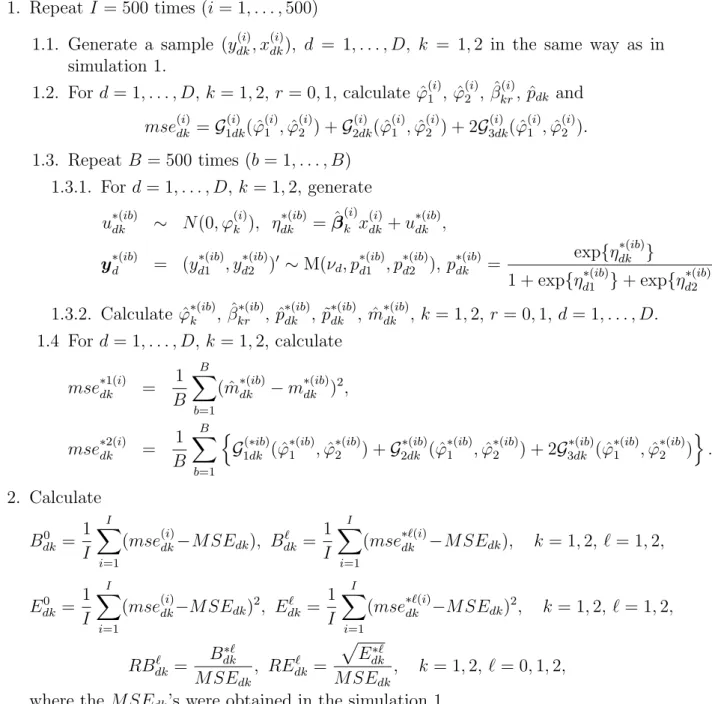
In Galicia there are 53 counties but in this thesis we consider D= 96 domains. For all the quarters preceding the third quarter of 2009, the considered domains are obtained from crossing the 48 counties represented in the sample with the two sexes. Since the third quarter of 2009, D = 102 domains will be considered because on that period there were 51 counties with sample representation.
We divide the D domains Pd into subsets Pd1, Pd2 and Pd3 of employed, unemployed
and inactive people. Our goal is to estimate the totals of employed and unemployed people and the unemployment rate, defined by
Ydk =
X
j∈Pd
ydkj, Rd=
Yd2
Yd1 +Yd2
where ydkj = 1 if thej individual of the d domain is inPdk and ydkj = 0 in other case.
Official LFS data are not related to the domains (counties × sex) but the analogue direct estimators of the total Ydk, the mean ¯Ydk =Ydk/Nd, the sizeNdand the
unemploy-ment rate Rd are
ˆ
Ydkdir= X
j∈Sd
wdjydkj, Yˆ¯dkdir = ˆY dir dk /Nˆ
dir d , Nˆ
dir
d =
X
j∈Sd
wdj, Rˆdird =
ˆ Ydir
d2
ˆ Ydir
d1 + ˆYddir2
, k = 1,2. (2.1.1) where Sd is the sample domain and wdj’s are the official calibrated sample weights that
take into account the non-response.
2.2
Employment measurement: Registrations in the
social security system
Besides LFS, which periodically estimates the unemployment and employment totals, there is another source of statistical information that provides regular information on the occupation: people registered in the social security system. The social security system (SSS) register is an administrative register that is not intended to estimate direct employ-ment but people registered and paying to Social Security. It is published monthly with the data referring to the last day of each month and the average of the month. In this work we use the data at the last day of the month.
The registration data shows the number of workers enlisted, doing a labour activity (excluding unemployed or students) and are therefore forced to contribute to the public system for the protection of at least retirement situations, disability and death. The reg-istration data, as all data from registers, is sensitive to law changes that affect it. The file can also contain fictitious contributors looking to get a pension in the future or the right to receive unemployment insurance. There are people employed according to LFS that are not required to pay into Social Security, as is the case with some family assistance (this category of workers must be registered in the Social Security only when they work daily, fundamentally and directly). There are also people who are required to be registered in the Social Security and they are not.
Although the two statistics, LFS and SSS, have important differences. They also have many similarities which will make us to use the variable registered in the social security system as an auxiliary variable in the models proposed in the following chapters.
2.3
Unemployment measurement: Registered
unem-ployment
The two most important sources about unemployment in Spain are LFS and people reg-istered as unemployed in the administrative register of employment claimants. There are important differences between the two sources, which can be of methodological or con-ceptual type and of dissimilarity of contents or considered population groups. Therefore the two data sources produce significantly different estimates of labour force indicators.
Registered unemployment consists of the total employment demands, registered by the administrative register of employment, existing on the last day of each month, ex-cluding the ones that correspond to work situations described in the Ministerial Order of 11 March 1985 (B.O.E. of 14/3/85) by introducing statistical criteria for measuring registered unemployment.
Labour demand is the application for a job that makes a worker, unemployed or not, to an administrative register of employment. For measuring the registered unemployment, the unemployment register excludes all demands that, at the end of the reference month, are in any of the following situations:
• Claimants seeking other employment compatible with their current job (moonlight-ing). They are also excluded of the LFS unemployment.
• Claimants who, being employed, apply for a job to change it. They are also excluded of the LFS unemployment.
• Claimants with unemployment benefits participating in Social Collaboration works. They are also excluded of the LFS unemployment.
• Claimants who are retirement pensioners, pensioners with a huge absolute disability and claimants aged 65 years or older (Retired). They are not excluded from LFS unemployment.
• Claimants seeking employment for a period less than three months. They are not excluded from LFS unemployment.
• Claimants applying for a time working less than 20 hours a week. They are not excluded from LFS unemployment.
• Claimants attending to occupational training courses when their teaching hours exceed 20 a week, with at least a scholarship to support and be seeking their first job. They are not excluded from LFS unemployment.
• Claimants with suspended request while remaining in this situation since the sus-pension of the request, usually processed at the request of applicant and good cause, interrupts the job search. If demand is suspended for not being available for work, they would not be LFS unemployed.
• Claimants with unemployment benefits which are compatibles by having a part-time job. They are also excluded from LFS unemployment.
• Claimants who are receiving the farming benefit or who, having it spent, has not elapse a period longer than one year from the date of entitlement (Benefited Agricul-tural Temporary Workers). They are not excluded from LFS unemployment, unless they had been working.
• Claimants who refuse job placement activities suited to their characteristics, as pro-vided in Article 46, 1.2 of Law 8/88 of 7 April. The exclusion of LFS unemployment depends on the characteristics of each person included in this group.
• Claimants not immediately available for work or in incompatible situation with it, as claimants in situation of temporary disability or sick leave, claimants who are performing military service or alternative service, claimants registered to participate in a selection process for one particular job, job claimants exclusively for overseas, claimants of a home-based work, claimants who, under an employment regulation file, are in situation of suspension, and other causes.
If the claimants are available to work within 15 days, they would be LFS unemployed As both data sources use different definitions of employment and unemployment, they give different estimations of unemployment rates. On the one hand, in the LFS people can seek employment in various ways, not only by registering in the administrative reg-ister of employment; this fact would expect the LFS figure to be higher. On the other hand, enrollment in the administrative register of employment within the registered un-employment community does not include other conditions that are indeed necessary in the LFS to assign the condition of unemployed (such as availability for working in the next two weeks). This would favor a higher number of registered unemployment. The reg-istered unemployment, like all figures from administrative registers, is strongly influenced by changes in legislation that affects it. Also the potential attractiveness of registration (ability to receive benefits, to receive training courses, etc.) has influence on registered unemployment figures. Moreover, data from the LFS, like any survey, reflect the state-ments made by the interviewees, which in some cases may not correspond to reality. Their estimates have also the associated sampling error inherent to any survey.
Chapter 3
Multivariate generalized linear
mixed models
This chapter gives an introduction to multivariate generalized linear mixed models (GLMM) and their applications to small area estimation. The more simpler linear mixed models (LMM) and the linear models (LM) belong to the family of GLMM. To understand how the GLMM works in practice, it is better to start by describing the behavior of the LM and the LMM. Therefore, we first give some comments about the linear regression model. This model can be expressed as y = Xβ +, where y is a vector of observations, X is a matrix of known covariates, β is a vector of unknown regression coefficients and is a vector of errors. In this model the regression coefficients are fixed unknown constants. However, there are some cases where it is better to assume that some of these coefficients are realizations of random variables. These cases typically are when the observations are correlated.
Let us see how a linear mixed model may be useful for modeling the correlations among observations. Consider, for example, the mortality in 53 counties of Galicia. Assume that the response variableyij, measured at individualiof countyj, depends on a random effect
uj associated to the countyj and whose value is unobservable. A linear mixed model may
be expressed as yij = xij +uj +ij, i = 1, . . . , m, j = 1, . . . ,53, where xij is a vector
of known covariates, β is a vector of unknown regression coefficients, the random effects u1, . . . , u53 are assumed to be i.i.d. with mean zero and variance σ2 and the ij’s are i.i.d.
errors with mean zero and variance τ2. This is a simple LMM. In a general form LMM may be expressed as
y=Xβ+Zu+,
where y is a vector of observations, X is a matrix of known covariates, β is a vector of unknown regression coefficients, which are often called fixed effects, Z is a known matrix, u is a vector of random effects and is a vector of errors. Note that u is unobservable and β is unknown. This model assumes that the random effects and errors have mean zero and finite variances and that u and are uncorrelated (Jiang et al., 2002). These models are used in small area estimation
for smaller geographic areas for which adequate samples are not available. The usual design-based estimator are unreliable for these areas. This makes necessary to ”borrow strength” from related areas for finding precise estimators without increasing the sample size. Such estimators are typically based on linear mixed models or generalized linear mixed models that provide a link to related small areas through the use of supplementary data. This data may be a recent census data or current administrative records.
The LMM have been widely used in situations where the observations are continuous. However, there are practical cases where the observations are discrete or categorical. For example, the number of forest fires in a country or the number of employed, unemployed and inactive people in a county. McCullath and Nelder (1999) proposed an extension of linear models, called generalized linear models (GLM). They pointed out that the key elements of a classical linear model are that the observation are independent, the mean of the observation is a linear function of some covariates and the variance of the observation is constant. The extension to GLM modifies the second and the third assumption. In GLM the mean of the observation is associated with a linear function of some covariates through a link function and the variance of the observation is a function of the mean. The GLM include as special cases, linear regression and analysis-of-variance models, logit and probit models for binary responses, log-linear models and multinomial response models for counts and some commonly used models for survival data. Therefore, these models are applicable to cases where the observations may not be continuous.
The GLM have in common with linear models that the observations area assumed to be independent. But, in many cases, the observations are correlated, as well as discrete or categorical. It is clear that it is necessary to extend the linear mixed models to cases where the responses are both correlated and, at the same time, discrete or categorical. Besides, many variables of interest in small area estimation are not normally distributed, and therefore cannot be adequately modeled via the linear mixed models. For such variables we can instead consider using a GLMM. Under this type of models, the distribution of the vector y of population values of the variable of interest is assumed to depend on a vector quantity η that is related to regression covariates and random components through the equation η =Xβ+Zu. The linear predictor η is connected to y via a known function g, defined byE(y|u) = g(η) (Saei and Chambers, 2003).
In the rest of the chapter we introduce the general theory of the multivariate gener-alized linear mixed models (MGLMM) that we use in this work. First, we present the model and then we describe the penalized quasilikelihood algorithm used to fit the model and the predictors. Finally, we introduce an explicit-formula procedure to estimate the mean squared error.
3.1
The model
Let u1, . . . ,um be independent vectors such that
whereΣu1, . . . ,Σumare known symmetric and positive-definite matrices. Letu= (u01, . . . ,u
0 m)
0
and ν=Pm
i=1νi be such that
u ∼Nν(0,Vu), with Vu = diag(ϕ1Σu1, . . . , ϕmΣum).
Lety1, . . . ,yn beq×1 independent vectors whose densities, conditioned to u, belong to the exponential family, i.e.
f(yj|u) =c(yj) expθ0jyj−b(θj) , j = 1, . . . , n,
whereθj ∈Θ,j = 1, . . . , n, are the unknownq×1 vectors ofnatural parameters. Letµj =
µ(θj) and Σj = Σ(θj) be the mean vector and the covariance matrix ofyj conditioned to
u. If we use the matrix notation ∂a∂b = ∂b∂ ·a, where “·” denotes the product of the column vector ∂b∂ = (∂b∂
1, . . . , ∂ ∂bm)
0
m×1 by the row vector a1×n, then
µ(θj) = E[yj|u] =
∂b(θj)
∂θj
, Σ(θj) = cov[yj|u] =
∂µ0j ∂θj
= ∂
2b(θ
j)
∂θj∂θ0j
, j = 1, . . . , n. Let xj and zj be matrices of sizesq×p and q×ν respectively. Thelinear predictors are
ηj =xjβ+zju, j = 1, . . . , n.
Let us consider an injective link function g : M 7→ Rq, where M ⊂ Rq is the subset of
possible values of µ(θj), and such that
g(µ(θj)) =ηj, j = 1, . . . , n.
The dependency of the natural parameters from the random effects is explicitly given by the function d= (g◦µ)−1, i.e.
θj =d(ηj), j = 1, . . . , n.
The natural link is g =µ−1, so that
θj =xjβ+zju, j = 1, . . . , n.
In the next sections we present a penalized quasi-likelihood (PQL) method to estimate the model parameters and to predict the random effects of multivariate generalized linear mixed models (MGLMM) with natural link.
3.2
The Penalized quasi-likelihood algorithm
3.2.1
Estimation and prediction of
β
and
u
The joint probability density function of y= (y01, . . . ,y0n)0, conditioned to u is
f1(y|u) =
" n Y
j=1
c(yj) #
exp ( n
X
j=1
θ0jyj −b(θj)
and the log-likelihood is
The probability density function of u is f2(u) = (2π)−ν/2|Σu|
and the log-likelihood is l2(u) =c2−
The ML-PQL estimator of β and predictor of u (see Breslow and Clayton (1993)) maxi-mizes the joint likelihood
l(y,u) =l1(y|u) +l2(u).
In this section we derive a Newton-Raphson algorithm to calculate ML-PQL estimator of β and predictor of u.
Proposition 3.2.1. Under the MGLM model with natural link defined in the Section 3.2.1, the score vector and the Fisher information matrix of l(y,u) are
S(θ) =
Finally Fββ =−Hββ, Fuβ =Fβu0 =−Huβ and Fuu=−Huu.
Algorithm A. Let ϕ1, . . . , ϕm be known. The ML-PQL estimator and predictor of β
and u can be calculated by applying the following Newton-Raphson algorithm: (A.1) Set initial values: Do r = 0, β(0) =βinicial and u(0) =uinicial.
(A.2) Iteration r+ 1: Calculate θ(jr)=xjβ(r)+zju(r), µ
3.2.2
PQL estimation of the variance components
As β◦ and u◦ maximizel1(β,u), the linear term of (3.2.1) is null. Therefore
l1(y|u) ≈ c+
1 2(β
0
−β◦0,u0−u◦0)
X0
Z0
∂2l 1
∂η∂η0
(X,Z)
β−β◦ u−u◦
≈ c−1
2(η
◦−
η)0W(η◦−η)=. `1(η◦|u),
where
W =−E
∂2l 1(y|u)
∂η∂η0
η=η◦
. (3.2.2)
For the natural link we have ηj =θj and
W =−E
∂2l 1(y|u)
∂θ∂θ0
θ
=θ◦
= cov(y|u)|θ=θ◦ = diag
1≤j≤n
(Σ(θ◦j)).
Remark. Under the natural link it holds that ηj = θj and the partial derivatives of
l1(y|u) with respect to θ are
∂l1(y|u)
∂θj
= ∂(θ
0
jyj −b(θj))
∂θj
=yj− ∂b(θj)
∂θj
, j = 1, . . . , n, ∂2l
1(y|u)
∂θj∂θ0j
= −∂
2b(θ
j)
∂θj∂θ0j
, j = 1, . . . , n, ∂2l1(y|u)
∂θj∂θ0k
= 0 ∀j 6=k, j, k = 1, . . . , n. Therefore
∂2l 1(y|u)
∂η∂η0 =
∂2l 1(y|u)
∂θ∂θ0 =−diag(Σ1, . . . ,Σn) = −Σ and W =E[Σ] =Σ, because the expectation is taken with respect to f(y|u) andu is fixed.
In summary, we have got that l1(y|u)≈`1(η◦|u) =−
1 2(η
◦−Xβ−Zu)0
W (η◦−Xβ−Zu).
This is to say,l1(y|u) can be approximated to the likelihood function of multivariate linear
mixed model. The marginal probability distribution function should also be approximately the same, i.e. l1(y)≈`1(η◦). Therefore, the values ofϕ1, . . . , ϕm maximizingl1(y) should
be approximately the same to those maximizing `1(η◦). On the other hand `1(η◦) can be
obtained from `1(η◦|u) and l2(u), which are both normal log-likelihoods. Therefore, we
have
• `1(η◦) is the loglikelihood of η◦ ∼N(Xβ,Σy), withΣy =Z0ΣuZ+W−1,
• The values ϕ1, . . . , ϕm maximizing `1(η◦) and `1(η◦|u) +l2(u) should be
approxi-mately the same.
McGilchrist (1994) proposed to maximize `1(η◦) for obtaining an updating equation for
ϕ1, . . . , ϕm. The PQL algorithm of McGilchrist for ϕ1, . . . , ϕm can be implemented by
applying the ML or the REML method to `1(η◦,u) =`1(η◦|u) +l2(u).
The ML-PQL approach
The penalized maximum likelihood estimation of ϕ1, . . . , ϕm maximizes `1(η◦) after
ap-proximating l1(y|u) +l2(u) by `1(η◦|u) +l2(u). We assume the approximate model
η◦ =Xβ+Zu+e,
where e ∼N(0,W−1) and u ∼N(0,Σu) are independent. Thereforeη◦ ∼ N(Xβ,Σy),
with Σy =ZΣuZ0+W−1 andΣu = diag(ϕ1Σu1, . . . , ϕmΣum). The marginal density and log-density of η◦ are
f1◦(η◦) = (2π)−nq/2|Σy|−1/2exp
−1
2(η
◦−
Xβ)0Σ−y1(η◦−Xβ)
,
`M L(η◦) = −
nq
2 log 2π− 1
2log|Σy| − 1 2(η
◦ −
Xβ)0Σ−y1(η◦−Xβ). Let Gi =ZiΣuiZ0i. By taking derivatives with respect to ϕi, i= 1, . . . , m, we get
∂Σy
∂ϕi
= ZiΣuiZ0i =Gi,
Sϕi =
∂`M L(η◦)
∂ϕi
=−1
2tr
Σ−y1∂Σy ∂ϕi
+ 1
2(η
◦−
Xβ)0Σ−y1∂Σy ∂ϕi
Σ−y1(η◦−Xβ) = −1
2tr(Σ
−1
y Gi) +
1 2(η
◦−
Xβ)0Σ−y1GiΣ−y1(η
◦−
Xβ),
∂2`
M L(η◦)
∂ϕi∂ϕj
= 1
2tr(Σ
−1
y GjΣ−y1Gi)−(η◦−Xβ)0Σ−y1GiΣ−y1GjΣ−y1(η
◦−
Xβ).
We recall that
E[y0Qy] = tr{Qv(y)}+E[y]0QE[y]. The Fisher amount of information associated to ϕi is
Fϕiϕj = E
−∂
2`
M L(η◦)
∂ϕi∂ϕj
=−1
2tr(Σ
−1
y GjΣ−y1Gi) + tr(Σ−y1GiΣ−y1GjΣ−y1Σy)
= 1
2tr(Σ
−1
y GiΣ−y1Gj).
For ϕ= (ϕ1, . . . , ϕm) the updating equation of the Fisher-scoring algorithm is
The REML-PQL approach
The REML log-likelihood is lreml(η◦) = −
1
2(qn−p) log 2π− 1
2log|K
0
ΣyK| −
1 2η
◦0
P η◦,
where
P =Σ−y1−Σy−1X(X0Σ−y1X)−1X0Σ−y1, K =W −W X(X0W X)−1X0W. The first order partial derivatives of lreml(η◦) with respect to ϕi are
Sϕi =− 1
2tr(P Gi) + 1 2η
◦0
P GiP η◦, i= 1, . . . , m.
The elements of the Fisher information matrix are Fϕiϕj =
1
2tr(P GjP Gi), i, j = 1, . . . , m.
For ϕ= (ϕ1, . . . , ϕm) the updating equation of the Fisher-scoring algorithm is
ϕk+1 =ϕk+F−1(ϕk)S(ϕk).
3.2.3
The PQL algorithm
The PQL algorithm is
Algorithm B. This algorithm calculates the PQL predictors of u and estimators of β and ϕi, i= 1, . . . , m.
(B.1) Do` = 1, where ` counts the external iterations. Set the values β(0), u(0) and ϕ(1)
i ,
i= 1, . . . , m.
(B.2) Run Algorithm A. Use ϕ(1`), . . . , ϕ(m`) as know values and β(`−1), u(`−1) as algorithm
seeds. Let β(`) and u(`) be the output of Algorithm A.
(B.3) Update ϕi by using the ML or the REML Fisher-scoring updating equation
ϕk+1 =ϕk+F−1(ϕk)S(ϕk).
(B.4) Repeat the steps (B.2)-(B.3) until the convergence ofβ(`),ui(`)andϕ(i`),i= 1, . . . , m.
3.3
Prediction and mean squared error
We are interested in predicting
If we fit the model µ =E[y] = h(η), where η =Xβ+Zu, we get the prediction of y, h(ˆη), where ˆη=Xβˆ +Zu. The predictor ofˆ δ is
ˆ
δ =Ah(ˆη),
and the difference is ˆδ−δ =A[h(ˆη)−y]. Therefore, the MSE of the predictor ˆδ is M SE(ˆδ) = E[(ˆδ−δ)(ˆδ−δ)0] =EA{h(ˆη)−y} {h(ˆη)−y}0A0. Let VG=E[(y−h(η))(y−h(η))0]. By summing and substracting h(η), we get
M SE(ˆδ) = E
A{h(ˆη)−h(η)} {h(ˆη)−h(η)}0A0
+AVGA0
+ AE{h(ˆη)−h(η)} {h(η)−y}0 A0 + AE{h(η)−y} {h(ˆη)−h(η)}0
A0.
From the results in Kackar y Harville (1984), we have that the two last terms are null. It is possible to obtain an approximation to the first term on the right hand side of the above equality. Let us take an arbitrary element of h(η), for example hj(ηj). We recall
that hj(ηj) is a vector of size q, i.e. hj(ηj) = (hj1(ηj), . . . , hjq(ηj)) 0
. Let ζj be an
admissible value of ηj. We make a first-order Taylor series expansion of hjk(ζj) around
ηj = (ηj1, . . . , ηjq)0, and we do the substitution ζj = ˆηj. This to say,
hjk(ˆηj)−hjk(ηj)∼= q
X
`=1
∂hjk(ηj)
∂ηj`
(ˆηj`−ηj`).
If we do the same with hj0k0(ηj0) and we multiply both expressions, we get
[hjk(ˆηj)−hjk(ηj)][hj0k0(ˆηj0)−hj0k0(ηj0)]∼=H0jk(ˆηj −ηj)(ˆηj0 −ηj0)0H0j0k0,
where
H0jk = ∂h
jk(ηj)
∂ηj1
, . . . ,∂hjk(ηj) ∂ηjq
.
By doing the same calculations on the pairs j, k and by defining the matrices
Hj =
∂hj1(ηj)
∂ηj1
· · · ∂hj1(ηj)
∂ηjq
..
. . .. ... ∂hjq(ηj)
∂ηj1
· · · ∂hjq(ηj)
∂ηjq
, j = 1, . . . , N, and H = diag{H1, . . . ,HN},
we obtain
[h(ˆη)−h(η)][h(ˆη)−h(η)]0 ∼=H(ˆη−η)(ˆη−η)0H0. Therefore, we can write
EA{h(ˆη)−h(η)} {h(ˆη)−h(η)}0A0 ∼= E[AH(ˆη−η)(ˆη−η)0H0A0]
where
τG=AGη=AG(Xβ+Zu), τˆGE =AGηˆ =AG(Xβˆ +Zu),ˆ AG =AH.
In the case of using the maximum penalized likelihood approach for estimating β andϕi,
i= 1, . . . , m, we do following:
1. For estimating β and predicting u, maximize l1(y|u) +l2(u).
2. For estimatingϕ1, . . . , ϕm, maximize the loglikelihood of the distributionN(Xβ, V),
where
V =ZΣuZ0+W−1, W =−E
∂2l
1(y|u)
∂η∂η0
η=η◦
, η◦ =Xβ◦+Zu◦.
and (β◦,u◦) are the values of (β,u) maximizingl1(β,u) =l1(y|u).
Observe that in step 2 we assume a normal mixed model with Σ−e1 =W. In what follows, we show how to estimate the mean squared error M SE(ˆτGE).
Let ˆτGB = AGηˆ = AG(Xβˆ +Zu) be the estimator ofˆ τG that is obtained from
maximizing el1(ye|u) +l2(u) when the variance components ϕi, i = 1, . . . , m, are known. For the predictor ˆτGE, the MSE is
M SE(ˆτGE) = M SE(ˆτGB) +E[(ˆτGE−τˆGB)(ˆτGE −τˆGB)0]
+ E[(ˆτGE −τˆGB)(ˆτGB−τG)0] +E[(ˆτGB−τG)(ˆτGE−τˆGB)0].
As the estimators ˆϕj, that maximizeel1( e
y|u) +l2(u), are translation invariant, we have
M SE(ˆτGE) = M SE(ˆτGB) +E[(ˆτGE−τˆGB)(ˆτGE −τˆGB)0].
Furthermore, the MSE of the ˆτGB is
M SE(ˆτGB) =
AGX AGZ
IF−1(β,u)
X0A0G Z0A0G
,
where IF(β,u) is the Fisher information matrix derived from the joint p.d.f f◦(y◦,u) =
exp{l◦1(y◦|u) +l2(u)}. It holds that
IF(β,u) =
X0W X X0W Z Z0W X Z0W Z +Σ−u1
.
Define T = Σ−u1+Z0W Z−1 and V =ZΣuZ0 +W−1. The inverse ofIF(β,u) is
IF(β,u)−1 =
P Q Q0 R
,
where R =T +T Z0W XP X0W ZT, Q= −P X0W ZT and P = (X0V X)−1.
There-fore
where G1(ϕ) and G2(ϕ) are
G1(ϕ) = AHZT Z0H0A0,
G2(ϕ) = [AHX−AHZT Z0W X]Q[X0H0A0−X0W ZT Z0H0A0].
In a similar way, we can adapt the results of Prasad and Rao (1990) to obtain the approximation
G3(ϕ) = E[(ˆτGE −ˆτGB)(ˆτGE −τˆGB)0]≈ m
X
k1=1 m
X
k2=1
cov( ˆϕk1,ϕˆk2)AHL
(k1)V L(k2)0H0A0,
where
T = Vu−VuZ0V−1Z Vu, Q= (X0V−1X)−1,
L(k) = (I −R) ˙VkV−1, V˙ k=
∂V ∂ϕk
Chapter 4
Multinomial logit mixed model
This chapter introduces the multinomial logit mixed model that will be used for the estimation of totals of employed and unemployed people and of unemployment rates in the D = 96 domains defined by the combination of the 48 counties of Galicia and the two sexes. Section 4.1 describes the model, gives an algorithm to estimate the model parameters and proposes small area estimators of labor market indicators. It also shows how estimating the mean square errors. Section 4.2 presents two simulation experiments. The first simulation compares the small area estimators obtained under the introduced multinomial model with the corresponding ones obtained under the multinomial model of Molina et al. (2007) and under independent binomial logit mixed models. The second simulation studies the behavior of the three introduced MSE estimation methods. Finally, Section 4.3 applies the proposed methodology to data from the SLFS in Galicia.
4.1
The model
This section introduces an area-level multinomial logit mixed model with domain random effects associated to the categories of the response variable. We first give some notation and assumptions. Let use indexes k = 1, . . . , q −1 for the q−1 multinomial categories of the target variable and d= 1, . . . , D for the D domains. In the real data presented in Section 4.3 there are q = 3 categories, i.e. employed, unemployed and inactive people. However, there are only q−1 = 2 categories in the multinomial model, i.e. employed and unemployed people. Let udk be the random effect associated to category k and domain
d, and define ud = col
1≤k≤q−1(udk). We assume that ud ∼N(0,Vud) are independent with
covariance matrices Vud = diag
1≤k≤q−1
(ϕk). We further assume that the response vectors
yd= col
1≤k≤q−1(ydk), conditioned toud, are independent with multinomial distributions
yd|ud ∼M(νd, pd1, . . . , pdq−1), d= 1, . . . , D, (4.1.1)
where the νd’s are known integer numbers. The covariance matrix of yd conditioned to
ud is Wd = var(yd|ud) = νd[diag(pd)−pdp 0
d], where pd = col
diag
1≤k≤q−1
(pdk). For the natural parameters ηdk = log(ppdk
dq), we assume the model
ηdk =xdkβk+udk, d= 1, . . . , D, k = 1, . . . , q−1, (4.1.2)
where xdk = col0
1≤r≤lk
(xdkr), βk = col
1≤r≤lk
(βkr) and l =Pq −1
k=1lk. The mean and the variance
of ydk, conditioned to ud, are µdk = νdpdk and ωdk = νdpdk(1−pdk), respectively. The
probability of the multinomial category k in the domain d is pdk =
exp{ηdk}
1 +Pq−1
`=1exp{ηd`}
, d= 1, . . . , D, k = 1, . . . , q−1. In matrix notation, the model is
ηd =Xdβ+Zdud, d= 1, . . . , D, (4.1.3)
where ηd = col
1≤k≤q−1(ηdk), Xd = 1≤diagk≤q−1
(xdk), β = col
1≤k≤q−1(βk) and Zd = Iq−1 with
Iq−1 being the (q−1)×(q −1) unit matrix. If we introduce the additional notation
η = col
1≤d≤D(ηd), X =1≤cold≤D(Xd),u=1≤cold≤D(ud) and Z = diag1≤d≤D(Zd), then (4.1.3) can be
represented in the matrix form
η=Xβ+Zu, (4.1.4)
with Vu = var(u) = diag
1≤d≤D
(Vud) and W = var(y|u) = diag
1≤d≤D
(Wd).
Alternatively, (4.1.3) can be expressed in the form
ηd=Xdβ+Zdu, d= 1, . . . , D, (4.1.5)
where u = col
1≤k≤q−1(uk), the uk = 1≤cold≤D(udk) ∼ ND(0, ϕkID) are independent and Zd =
diag
1≤k≤q−1
( col0
1≤`≤D(δ`d)). We also can express (4.1.5) as
η=Xβ+Zu, (4.1.6)
where Z= col
1≤d≤D(Zd). We recall that (4.1.4) and (4.1.6) define the same model.
4.1.1
The PQL-REML fitting algorithm
To fit the introduced multinomial mixed model we combine the PQL method, described by Breslow and Clayton (1993) for estimating and predicting the βk’s and the ud’s, with
the REML method for estimating the variance components ϕk’s. The presented method
The log-likelihood of y conditioned to u is l1(y|u) =
D
X
d=1
(q−1 X
k=1
ydklog
pdk
pdq
+νdlogpdq+ log
νd
yd1!· · ·ydq!
)
=
D
X
d=1
(q−1
X
k=1
ydkηdk −νdlog 1 + q−1
X
k=1
exp{ηdk}
+ log νd yd1!· · ·ydq!
) .
The partial derivatives of ηdk =
pk X
r=1
xdkrβkr+udk, d= 1, . . . , D, , k= 1, . . . , q−1,
with respect to βkr and udk are
∂ηdk
∂βkr
=xdkr,
∂ηdk
∂udk
= 1. The first order partial derivatives of l1 are
S1,βkr =
∂l1(y|u)
∂βkr
=
D
X
d=1
(
xdkrydk−
νdxdkrexp{ηdk}
1 +Pq−1
`=1exp{ηd`}
) =
D
X
d=1
xdkr(ydk−µdk),
S1,udk =
∂l1(y|u)
∂udk
= (ydk−µdk).
The vector expressions of the first order partial derivatives of l1 are
S1,βk =
∂l1(y|u)
∂βk =
D
X
d=1
x0dk(ydk−µdk), S1,β = col
1≤k≤q−1(S1,βk),
S1,u =
∂l1(y|u)
∂u =1≤cold≤D(1≤kcol≤q−1(S1,udk)).
The second order partial derivatives of l1 are
H1,βkrβks =
∂2l1(y|u)
∂βkr∂βks
=−
D
X
d=1
νdxdkrxdkspdk(1−pdk),
H1,udkβkr = ∂2l
1(y|u)
∂udk∂β
=−νdxdkrpdk(1−pdk),
H1,udk,udk = ∂2l
1(y|u)
∂udk∂udk
=−νdpdk(1−pdk),
and for the case k1 6=k2, we have
H1,βk1rβk2s = ∂2l
1(y|u)
∂βk1r∂βk2s
=
D
X
d=1
νdxdk1rxdk2spdk1pdk2,
H1,udk1βk2s =
∂2l1(y|u)
∂udk1∂βk2s
=νdxdk2spdk1pdk2,
H1,udk1,udk2 =
∂2l1(y|u)
∂udk1∂udk2
=νdpdk1pdk2, H1,ud1k1,ud2k2 =
∂2l1(y|u)
∂udk1∂udk2
The vector expressions of the second order partial derivatives of l1 are
H1,βk1βk2 =
H1,βk1rβk2s
r= 1, . . . , pk1
s= 1, . . . , pk2
, H1,ββ =
H1,βk1βk2
k1= 1, . . . , q−1 k2= 1, . . . , q−1
,
H1,udβk2 =
H1,udk1βk2s
k1= 1, . . . , q−1 s= 1, . . . , pk2
, H1,uβ =
H1,udβk2
d= 1, . . . , D k2= 1, . . . , q−1
,
H1,ud1ud2 =
H1,ud1k1,ud2k2
k1= 1, . . . , q−1 k2= 1, . . . , q−1
, H1,uu =
H1,ud1ud2
d1= 1, . . . , D d2= 1, . . . , D
.
It holds that H1,uu = diag
1≤d≤D
(H1,udud). The likelihood of u is
f2(u) =
1 (2π)D(q−1)/2|V
u|1/2
exp
−1
2u
0V−1
u u
.
The loglikelihood of u is
l2(u) =κ−
D
X
d=1
q−1
X
k=1
D
2 logϕk+ 1 2
u2dk ϕk
,
where κ=−D(q2−1)log 2π. The first order partial derivatives of l2 are
S2,udk =
∂l2(u)
∂udk
=− 1
ϕk
udk.
The vector expression of partial derivatives of l2 are
S2,u = col
1≤d≤D 1≤kcol≤q−1 S2,udk
.
The second order partial derivatives of l2 are
H2,udkudk = − 1 ϕk
, H2,ud1k1ud2k2 = 0, d1 6=d2 ork1 6=k2. The matrix of the second order partial derivatives of l2 are
H2,ud1ud2 =
H2,ud1k1,ud2k2
k1= 1, . . . , q−1 k2= 1, . . . , q−1
, H2,uu =
H2,ud1ud2
d1= 1, . . . , D d2= 1, . . . , D
.
The log-likelihood of (y,u) is
l(y,u) =l1(y|u) +l2(u).
The first order partial derivatives l are
The blocks of the Fisher information matrix associated to l are
Fβ,β =−H1,ββ, Fu,β =−H1,uβ, Fβ,u=F0u,β, Fu,u =−H1,uu−H2,uu.
We define
S =S(β,u) =
Sβ
Su
, F =F(β,u) =
Fββ Fβu
Fuβ Fuu
, F−1 =
Fββ Fβu Fuβ Fuu
.
It holds that
Fββ = (Fββ−FβuF−uu1Fuβ)−1, Fβu=−FββFβuF−uu1,
Fuβ = (Fβu)0, Fuu =F−uu1+F−uu1FuβFββFβuF−uu1.
The combined algorithm has two parts: A and B. Algorithm A updates the values of βkand ud,k = 1, . . . , q−1,d= 1, . . . , D. Algorithm B updates the variance components.
Algorithm A.
(A.1) Beginning: Assign the initial values l= 0, β(0) =βinitial and u(0) =uinitial.
(A.2) Iteration l + 1: For d = 1, . . . , D, k = 1, . . . , q − 1, calculate F(β(l),u(l)) and
S(β(l),u(l)) and update β(l) and u(l) by using the equation
β(l+1) u(l+1)
=
β(l) u(l)
+F−1(β(l),u(l))S(β(l),u(l)), (4.1.7) where S and F are the vector of scores (first order partial derivatives) and the Fisher information matrix (minus expectation of second order partial derivatives) of the joint log-likelihood of (y,u).
(A.3) End: Repeat the step (A.2) till convergence of β(l) and u(l) and obtain the final values ˆβ and ˆu.
Algorithm A maximizes l(y,u) in β and u for fixed values of ϕ1, . . . , ϕq−1. To update
the values of the variance components, we assume that β and u are known and we adapt the ideas of Schall (1991) to a multivariate setting. For this sake, we consider a Taylor expansion of
ξdk =gk(yd) = log
ydk
νd−
Pq−1
`=1yd`
around the point µd=νdpd. We obtain
ξd≈Xdβ+Zdud+ed, (4.1.8)
where ξd = col
1≤k≤q−1(ξdk), ed = W
−1
d (yd−µd). By assuming equality in (4.1.8), it holds
that E[ξ] = Xβ and V = var(ξ) = ZVuZ0 +W−1. Schall (1991) proposed to update