
Promoting three reading strategies (scanning, skimming and making predictions) to foster autonomy
167
0
0
Texto completo
(2) DOCUMENTO DIGITAL PARA REPOSITORIO El presente formulario debe ser diligenciado en su totalidad como constancia de entrega del documento para ingreso al Respositorio Digital (Dspace).. TITULO. Promoting three reading strategies (scanning, skimming and making predictions) to foster autonomy. SUBTITULO Izquierdo Castillo, Alexander AUTOR(ES) Apellidos, Nombres (Completos) del autor(es) del trabajo Lectura PALABRAS CLAVE (Mínimo 3 y máximo 6). motivación. Estrategias de lectura en inglés autonomía. RESUMEN DEL CONTENIDO (Mínimo 80 máximo 120 palabras). En este artículo se reportan los resultados de un proyecto de investigación-acción llevado a cabo en un colegio público rural en Gachetá, Cundinamarca, Colombia, con estudiantes de noveno grado. El propósito de este estudio fue determinar el impacto de tres estrategias de lectura en inglés (scanning, skimming and making predictions) para promover la autonomía y la compresión lectora. La primera estrategia se refiere a saber hallar información específica en un texto, la segunda hace referencia a identificar la idea principal de un texto, y la tercera a la capacidad de predecir el posible contenido de un texto. La recolección de datos incluyó el uso de una lista de verificación inicial para el estudiante, un cuestionario para cada estrategia vista, un reporte de auto evaluación para el docente, y una lista de verificación al finalizar el proyecto para los estudiantes, con el objetivo de analizar si los estudiantes mejoraron su autonomía y comprensión lectora. Adicionalmente, se administró un test a los estudiantes con el fin de constatar si hubo avances en la comprensión de lectura. Los resultados evidenciaron que los estudiantes adquirieron algunos rasgos de autonomía tales como tomar decisiones para aprender y hacer sus tareas asignadas, ser más conscientes de su proceso de lectura, y estar más motivados para el aprendizaje. Asimismo, la capacitación referente a las estrategias de lectura les permitió a los estudiantes mejorar su comprensión lectora. Se puede concluir que estas estrategias de lectura son herramientas que le sirven al estudiante para su formación en autonomía.. Autorizo (amos) a la Biblioteca Octavio Arizmendi Posada de la Universidad de La Sabana, para que con fines académicos, los usuarios puedan consultar el contenido de este documento en las plataformas virtuales de la Biblioteca, así como en las redes de información del país y del exterior, con las cuales tenga convenio la Universidad. De conformidad con lo establecido en el artículo 30 de la Ley 23 de 1982 y el artículo 11 de la Decisión Andina 351 de 1993, “Los derechos morales sobre el trabajo son propiedad de los autores”, los cuales son irrenunciables, imprescriptibles, inembargables e inalienables..
(3) Running head: PROMOTING THREE READING STRATEGIES (SCANNING, SKIMMING AND MAKING PREDICTIONS) TO FOSTER AUTONOMY. Promoting three reading strategies (scanning, skimming and making predictions) to foster autonomy. Alexander Izquierdo Castillo. Research Report submitted in partial fulfillment of the requirements for the degree of Master in English Language Teaching –Autonomous Learning Environments. Directed by: Sonia Jimenez. Department of Foreign Languages and Cultures Universidad de La Sabana. Chía, Colombia April, 2013. I.
(4) Running head: PROMOTING THREE READING STRATEGIES (SCANNING, SKIMMING AND MAKING PREDICTIONS) TO FOSTER AUTONOMY. Acknowledgements:. I am deeply indebted to Professor Sonia Jimenez, an inspiring teacher, for her friendly input, guidance, and assistance at all stages of this dissertation. She worked hand to hand with me to accomplish this dissertation successfully. Also, I would like to thank Professor Luz Dary Arias, my research professor, for her continuous input and strategies to see research as a requirement to solve problems detected in my classroom. I would also like to express my sincerest gratitude to Professor Hope Goodwin, for her every possible help during the entire period of this work. At the same time, I would like to express my heartfelt gratitude to the respected teachers of the department Universidad de la Sabana for their valuable input. Finally, I want to acknowledge the invaluable support of all my family, especially my parents and sisters for their encouragement in all my projects.. III.
(5) Running head: PROMOTING THREE READING STRATEGIES (SCANNING, SKIMMING AND MAKING PREDICTIONS) TO FOSTER AUTONOMY. Abstract This article reports on an action research project conducted with ninth grade students in a rural public school in Gachetá, Cundinamarca, Colombia. The purpose of the study was to determine how the implementation of three reading strategies (skimming, scanning and making predictions) when reading topics selected by learners promotes autonomy. Data collection techniques included a students’ pre-implementation checklist, three questionnaires (one for scanning, one for skimming and one for making predictions), a students’ post-implementation checklist, a post-lesson self- evaluation for teacher’s reflection and an achievement test. The results showed that these learners acquired some autonomous features such as making decisions for learning and doing assigned tasks, increasing reading awareness and promotion of motivation. Additionally, the training on reading strategies allowed them to succeed in their reading comprehension. I conclude that these reading strategies are tools that take learners into the path of autonomy. Key words: Reading, Reading strategies, autonomy, motivation. Resumen En este artículo se reportan los resultados de un proyecto de investigación-acción llevado a cabo en un colegio público rural en Gachetá, Cundinamarca, Colombia, IV.
(6) Running head: PROMOTING THREE READING STRATEGIES (SCANNING, SKIMMING AND MAKING PREDICTIONS) TO FOSTER AUTONOMY. con estudiantes de noveno grado. El propósito de este estudio fue determinar el impacto de tres estrategias de lectura en inglés (scanning, skimming and making predictions) para promover la autonomía y la compresión lectora. La primera estrategia se refiere a saber hallar información específica en un texto, la segunda hace referencia a identificar la idea principal de un texto, y la tercera a la capacidad de predecir el posible contenido de un texto. La recolección de datos incluyó el uso de una lista de verificación inicial para el estudiante, un cuestionario para cada estrategia vista, un reporte de auto evaluación para el docente, y una lista de verificación al finalizar el proyecto para los estudiantes, con el objetivo de analizar si los estudiantes mejoraron su autonomía y comprensión lectora. Adicionalmente, se administró un test a los estudiantes con el fin de constatar si hubo avances en la comprensión de lectura. Los resultados evidenciaron que los estudiantes adquirieron algunos rasgos de autonomía tales como tomar decisiones para aprender y hacer sus tareas asignadas, ser más conscientes de su proceso de lectura, y estar más motivados para el aprendizaje. Asimismo, la capacitación referente a las estrategias de lectura les permitió a los estudiantes mejorar su comprensión lectora. Se puede concluir que estas estrategias de lectura son herramientas que le sirven al estudiante para su formación en autonomía. Palabras clave: Lectura, Estrategias de lectura en inglés, autonomía, motivación. V.
(7) Running head: PROMOTING THREE READING STRATEGIES (SCANNING, SKIMMING AND MAKING PREDICTIONS) TO FOSTER AUTONOMY. TABLE OF CONTENTS. 1. Chapter 1. Introduction……………………………………………………………Pg. 9 1.1. Rationale for the Study……………………………………………………......Pg. 9 1.2. Statement of the Problem …………………………………………………..Pg. 12 1.3. Research Question…………………………………………………………...Pg. 13 1.4. Research Objectives…………………………………………………………Pg. 13 2. Chapter 2. Literature Review…………………………....................................Pg. 15 2.1. Theoretical Framework………………………………………………………Pg. 16 2.1.1. Reading…………………………………………………………………….Pg. 16 2.1.2. Motivation in L2 Reading…………………………………………………Pg. 19 2.1.3. Autonomy……………………………………………………………….....Pg. 21 2.1.4. Cognitive Strategies in L2 Reading……………………………………..Pg. 28 2.1.5. The benefits of Reading Strategies……………………………………..Pg. 31 2.2. State of the Art………………………………………………………………..Pg. 35 3. Chapter 3. Research Design…………………………………………………....Pg. 41 3.1. Type of Study………………………………………………………………....Pg. 42 3.2. Context………………………………………………………………………...Pg. 44 3.3. Participants…………………………………………………………………....Pg. 46 3.4. Researcher’s Role…………………………………………………………....Pg. 48 3.5. Ethical Considerations……………………………………………………….Pg. 50 3.6. Instruments…………………………………………………………………....Pg. 51 3.7. Validation Process……………………………………………………………Pg. 54 4. Chapter 4.Pedagogical Intervention and Implementation……………………Pg. 57 4.1. Design………………………………………………………………………….Pg. 58 4.2. Materials and Resources…………………………………………………….Pg. 69 VI.
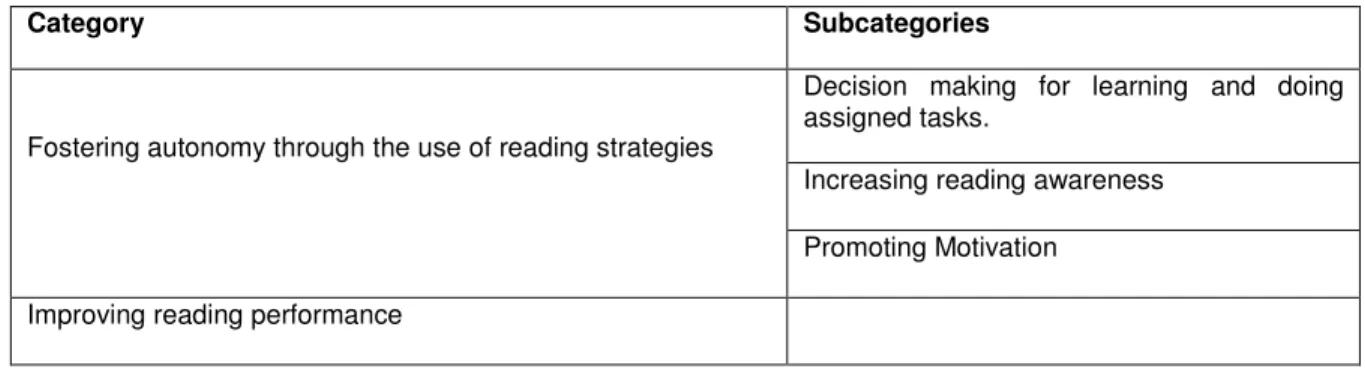
(8) Running head: PROMOTING THREE READING STRATEGIES (SCANNING, SKIMMING AND MAKING PREDICTIONS) TO FOSTER AUTONOMY. 5.0. Data Analysis and Findings…………………………………………………...Pg. 71 5.1. Data Management…………………………………………………...............Pg. 73 5.2. Data Reduction…………………………………………………………….....Pg. 74 5.3 Data analysis (Open Coding, Axial Coding, and Selective Coding………Pg. 74 5.4 Data Display and Verification………………………………………………...Pg. 79 5.4.1 Categories………………………………………………………………….Pg. 79 6. Chapter 6. Conclusions………………………………………………………...Pg. 101 Pedagogical Implications………………………………………………………….Pg. 105 Limitations…………………………………………………………………………..Pg. 107 Further Research…………………………………………………………………..Pg. 108 References………………………………………………………………………....Pg. 110 TABLES Table 1 Phases of Reading………………………………………………………...Pg. 63 Table 2 Research Timeline………………………………………………………...Pg. 65 Table 3 Open Coding Process……………………………………………………Pg. 76 Table 4 Axial Coding Process……………………………………………………..Pg. 77 Table 5 Selective Coding Process………………………………………………..Pg. 78 Appendices…………………………………………………………………………Pg. 123 Appendix A Principal Consent Letter Form……………………………………..Pg. 123 Appendix B Parents Consent Letter Form………………………………………Pg. 124 Appendix C Students Consent Letter Form…………………………………….Pg. 126 Appendix D Pre-Implementation Checklist/ Post-Implementation Checklist..Pg. 127 Appendix E Questionnaire for Scanning………………………………………...Pg. 132 VII.
(9) Running head: PROMOTING THREE READING STRATEGIES (SCANNING, SKIMMING AND MAKING PREDICTIONS) TO FOSTER AUTONOMY. Appendix F Questionnaire for Skimming………………………………………..Pg. 135 Appendix G Questionnaire for Making Predictions…………………………….Pg. 138 Appendix H Sample: Post-Lesson Self-Evaluation Report…………………....Pg. 141 Appendix I Adaptation ICELT Lesson Plan……………………………………..Pg. 145 Appendix J A Sample of a Reading Text………………………………………..Pg. 149 Appendix K Achievement Test…………………………………………………...Pg. 153 Appendix L Axial Coding Process………………………………………………..Pg. 156. VIII.
(10) Running head: PROMOTING THREE READING STRATEGIES (SCANNING, SKIMMING AND MAKING PREDICTIONS) TO FOSTER AUTONOMY. CHAPTER 1: Introduction. 1.1.. Rationale for the Study. Reading is one of the most vital skills that any person should acquire in his life because it is an interactive process which allows the reader to access information about the latest achievements of science and technology. Reading in English will facilitate the learner to be updated and in contact with knowledge in many issues such as agriculture, culture, economics, politics, tourism, and telecommunications. Moreover, reading in English is essential because people depend on the Internet for information. Therefore, if they want to understand it, they must be able to read English.. An important aspect to take into account when dealing with English in Colombia is that students in state schools must take the Saber PRO exam in eleventh grade in order to have access to higher education and the English component of this exam is mainly based on reading comprehension. However, the researcher noticed in his context, which is a rural institution that learners faced a variety of difficulties while reading in English. Even though they were expected to understand the main idea and identify specific information in a text, they could not 9.
(11) Running head: PROMOTING THREE READING STRATEGIES (SCANNING, SKIMMING AND MAKING PREDICTIONS) TO FOSTER AUTONOMY. do it. This was mainly due to the fact that they did not apply any strategy while reading in English. Additionally, they lacked motivation to carry out their assigned tasks. As a result, their reading skills were elementary. Consequently, he considered it useful to implement three reading strategies (scanning, skimming and making predictions) to promote autonomy when learners read topics selected by them. The main purpose was to help them become effective and efficient readers as well as autonomous learners in terms of making decisions for learning and doing assigned tasks and promotion of motivation. With well-developed reading skills, learners would make greater progress and accomplish better results in all academic areas.. Consequently, students will be able to learn by themselves particularly by checking information about their work in the countryside. For instance, they can find new ways of managing and operating the farms for effective rising of cattle, how to process and grow agricultural products like coffee, bananas, sugar cane, blackberries, and pineapples. Thus, applying these reading strategies might contribute to improve their quality of life, for example to become better farmers, housewives, and merchants in the future because they will be able to read, and keep updated about their environment and their living conditions.. 10.
(12) Running head: PROMOTING THREE READING STRATEGIES (SCANNING, SKIMMING AND MAKING PREDICTIONS) TO FOSTER AUTONOMY. These strategies were taken into consideration because most students in this remote context do not have the opportunity to access formal education after high school. For this reason, training this group of learners to use reading strategies will enable them to be in charge of their learning process by enhancing learner autonomy, independence and self-direction (Oxford and Nyikos 1989). In addition, reading strategies might make them feel more comfortable when reading topics related to their interests and needs, which may motivate them to read and improve their reading skills. Chapter 1 introduces and establishes the topic focus, and what the researcher took into consideration to implement the three reading strategies to improve reading skills and autonomy. It also outlines the objectives, and discusses the significance of this study. Chapter 2 provides the reader with the theory that supports this research project, by reviewing some of the existing literature related to the constructs: reading, cognitive strategies in L2 reading, motivation and autonomy that emerged in this study with the research problem. Additionally, the researcher presents the state of the art, which includes other national and international research studies in the area of ELF reading. Chapter 3 presents the design of the research study, the type of study conducted, the research objectives, and the context which includes the mission and vision of the institution, the participants, the researcher’s role and the instruments used to gather the data as 11.
(13) Running head: PROMOTING THREE READING STRATEGIES (SCANNING, SKIMMING AND MAKING PREDICTIONS) TO FOSTER AUTONOMY. well as the validation and triangulation processes. Chapter 4 explains the pedagogical intervention consisting of the steps and processes followed to carry out the project. Chapter 5 is dedicated to data collection and the analysis of categories and subcategories through a careful open, axial and selective coding process. Finally, the researcher presents in chapter six the conclusions, pedagogical implementation, limitations, as well as some possible areas for future research. 1.2.. Statement of the problem. The importance of the reading skills in English has reached new heights in the present context of the globalized world for those who want to be acquainted with knowledge and learn on their own. However, as the researcher described previously, the learners had serious difficulties identifying main ideas and finding specific information in an English text; learners attempted to translate everything when they read. In other words, students’ proficiency in reading was very poor. Also, students were very dependent on the teacher to carry out their tasks and they lacked responsibility to do their tasks as well.. Another aspect the researcher detected in this group was that learners were unmotivated to fulfill their tasks. Consequently, the researcher decided to implement three reading strategies (skimming, scanning and making predictions) to 12.
(14) Running head: PROMOTING THREE READING STRATEGIES (SCANNING, SKIMMING AND MAKING PREDICTIONS) TO FOSTER AUTONOMY. empower learners to be effective readers, be committed to their tasks, and be less dependent on the teacher. By doing this, learners will be able to use most resources to acquire knowledge and information, and they could improve their level of autonomy by making decisions for learning and taking responsibility for their own learning, which would give them the possibility of modifying and transforming their lives according to their needs.. 1.3.. Research Question This research Project is aimed at investigating the impact of. implementing cognitive reading strategies (skimming, scanning and making predictions) in students’ reading skills as well as to their autonomy in ninth grade at a public rural school in Gachetá,Cundinamarca, Colombia. This action research project examined this by answering the following research question:. •. To what extent does the implementation of three reading strategies (scanning, skimming and making predictions) when reading topics selected by learners promote autonomy?. By answering the research question, the researcher attempted to accomplish the objectives described below. 1.4.. Research objectives: 13.
(15) Running head: PROMOTING THREE READING STRATEGIES (SCANNING, SKIMMING AND MAKING PREDICTIONS) TO FOSTER AUTONOMY. General objective •. To determine how the implementation of three reading strategies (skimming, scanning and making predictions) when reading topics selected by learners promotes autonomy.. Specific objectives: •. To analyze the effects of the three reading strategies (skimming, scanning and making predictions) on students’ reading skills when reading topics selected by learners.. 14.
(16) Running head: PROMOTING THREE READING STRATEGIES (SCANNING, SKIMMING AND MAKING PREDICTIONS) TO FOSTER AUTONOMY. CHAPTER 2: Literature Review. Introduction This research was aimed at determining how the implementation of three reading strategies (skimming, scanning and making predictions), when reading topics selected by learners, contributed to the development of students’ reading skills as well as to their autonomy. In this chapter the researcher provides the background of this study by reviewing some of the existing literature related to it. The first section provides some relevant definitions of reading and what it implies. The second part focuses on motivation in reading while the third focuses on autonomy in L2 reading and cognitive strategies in L2 reading. Then, the benefits and importance of teaching reading strategies are explained in detail. After that, the definition of the strategies dealt with in this study (scanning, skimming and making predictions) is conceptualized. Then, as part of the state of the art, some studies regarding reading strategies and autonomy conducted internationally and locally are described in detail.. 15.
(17) Running head: PROMOTING THREE READING STRATEGIES (SCANNING, SKIMMING AND MAKING PREDICTIONS) TO FOSTER AUTONOMY. 2.1 Theoretical Framework This study is based on the following theoretical constructs: reading, cognitive strategies in L2 reading, motivation in L2 reading and autonomy in L2 reading. 2.1.1. What is reading? Many authors have defined and analyzed reading in different ways, which are briefly explained here. One of them, Alderson (2000), defines reading as a “process of interaction between a reader and the text” (p. 3). I agree with this thought about reading because I believe that reading is a purposeful activity where the reader interacts dynamically with the text while he/she attempts to elicit the meaning of the text. For this reason, there must be a deep contact between the reader and the text for a better understanding of each detail there. Likewise, Alderson (2000) highlights that during the reading process the reader is conscious that many things happen. While reading, the reader is presumably ‘thinking’ about what he is reading: what it means to him, how it relates to other things he has read, to things he knows, to what he expects to come next in the text by making predictions. He also states that the reader is presumably thinking about how useful, entertaining, boring, crazy, the text is. According to this author, this process is likely to be dynamic, varied, and different for the same reader on the same text at a different time or with a different purpose in reading. 16.
(18) Running head: PROMOTING THREE READING STRATEGIES (SCANNING, SKIMMING AND MAKING PREDICTIONS) TO FOSTER AUTONOMY. (Alderson, 2000 p. 174). Therefore, whenever we read, the interaction between the reader and the text must be a powerful tool to grasp exactly what the essence of the text and message is. Nuttall (1996: 4) states that reading is the process of “getting out of the text as nearly as possible the message the writer put into it”. Likewise, she states that effective reading involves ‘word attack’ skills, ‘sentence attack’ skills and ‘text attack’ skills. To her, reading involves not only looking at sentences and words and going through them at random but also recognizing and understanding them intellectually. It helps students pick up new words, syntax and style of writing. Jimenez (2000: 10) defines reading as “the learners’ ability to interpret or work out the meaning of a written text and react towards it as a result”. It means that reading is seen as an interactive process where the reader interacts with the author and the text. Similarly, Nunan (1999) states that reading is an interactive process that involves the exploitation of linguistic knowledge (sound, symbol correspondences, grammatical knowledge), and real-world (content) knowledge. He outlines that skilled readers have a range of strategies at their disposal, and select those strategies that match the purposes for which they are reading. Rios and Valcárcel (2005) state that reading is an individual process which develops self-study habits. Also, they think that reading is a good resource to 17.
(19) Running head: PROMOTING THREE READING STRATEGIES (SCANNING, SKIMMING AND MAKING PREDICTIONS) TO FOSTER AUTONOMY. make students become conscious of their own learning processes particularly using reading strategies such as making predictions, skimming, scanning, extensive reading, and intensive reading. Moreover, they outline that reading comprehension is extracting efficiently what is essential in a written text and reading must have a specific intention or purpose. It is a way to open our minds to other cultures and fields of knowledge.. Carrell (1998, p.2) explains that reading as a cognitive process must be related to other processes such as “thinking, reasoning, studying, or motivational strategies”. According to this author, reading is a process that involves many actions that the reader performs to have a better comprehension of the text. Good readers use different types of strategies to access a text. Not only should readers know how reading strategies work but, also, they should understand how to synchronize the strategies in order to use them more effectively and efficiently.. Another important aspect to highlight when dealing with reading is its social and cultural dimension because reading operates in a social context. For this reason, the researcher allowed learners the opportunity to read topics selected by them in order for them to activate their previous knowledge and experiences. Thus, students could experience reading as a tool to talk about their background 18.
(20) Running head: PROMOTING THREE READING STRATEGIES (SCANNING, SKIMMING AND MAKING PREDICTIONS) TO FOSTER AUTONOMY. and see that what they were learning was related to their world. This way they were able to interact and communicate their ideas, thoughts, and feelings effectively while reading. Additionally, this social and cultural dimension of reading helped them to strengthen their language development and foster their autonomy.. 2.1.2. Motivation in Reading The researcher of this study viewed motivation as a key factor when undertaking the reading process, especially with the target group as it was particularly unmotivated to read and perform their assigned tasks. As Komiyama (2009) observes, research on reading points to the importance of the use of successful methods and techniques in the classroom, such as choosing reading topics that appeal to students, assigning material and tasks at the right level, organizing collaborative work, and offering positive feedback and other incentives for students’ efforts. The researcher therefore believed that the implementation of the three reading strategies as well as giving learners the option of selecting reading topics by themselves would provide the motivation they needed to carry out their reading process in a meaningful way. Reading challenges can be overcome more easily if students are highly motivated to read. As Guilloteaux and Dörnyei (2008) note: 19.
(21) Running head: PROMOTING THREE READING STRATEGIES (SCANNING, SKIMMING AND MAKING PREDICTIONS) TO FOSTER AUTONOMY. Motivation provides the primary impetus to initiate second or foreign language learning and later the driving force to sustain the long and often tedious learning process. Without sufficient motivation, individuals with the most remarkable abilities cannot accomplish long term goals. Similarly, appropriate curricula and good teaching are not enough on their own to ensure student achievement. (p. 55-56). Guthrie, Wigfield, Metsala and Cox carried out two studies to explore the relationship between reading and motivation. Study 1 included 3rd and 5th graders, while study two included 8th and 10th graders. They found that motivation had a major impact on reading comprehension, providing the best single explanation for reading performance. Motivation was also the strongest single factor predicting the amount of reading done by students. Guthrie et al, (1999, p. 250). Takase (2007) carried out a study with 219 female Japanese high school students in order to examine how reading extensively English related to L2 reading and motivation. The results of this study showed students’ intrinsic and extrinsic motivation to read as the most influential factors. Intrinsic motivation corresponds to what Mori (1999; 2002) labeled as the positive intrinsic value of reading (e.g., I 20.
(22) Running head: PROMOTING THREE READING STRATEGIES (SCANNING, SKIMMING AND MAKING PREDICTIONS) TO FOSTER AUTONOMY. like reading English novels); indicating a love of reading. This study showed that motivation was useful for learners to improve their performance towards reading. Regarding extrinsic motivation, the authors stated that the participants were expecting to take university entrance examinations in a year.. Concerning L2 reading, Day and Bamford (1998) have attempted to explain motivation to read in an L2 through their expectancy value model (Day & Bamford, 1998, p. 28). According to Day and Bamford, L2 reading motivation has two equal components: expectations and value. The expectancy value model is made up of four major variables that are hypothesized to influence the decision to read in an L2: (a) materials, (b) reading ability in the L2, (c) attitudes toward reading in the L2, and (d) sociocultural environment, including the influences of family and friends. Materials and reading ability are related to the expectation component of successful L2 reading, and attitudes and sociocultural environment are related to value component. Regarding the weight of the components, Day and Bramford stated that motivation to read in an L2 is strongly influenced by extensive reading materials and attitudes and less by reading ability and the sociocultural environment. 2.1.3. Autonomy in Second Language Reading 21.
(23) Running head: PROMOTING THREE READING STRATEGIES (SCANNING, SKIMMING AND MAKING PREDICTIONS) TO FOSTER AUTONOMY. Autonomy is a relevant issue nowadays because we live in a society which is in constant change day by day; therefore, education must deal with those challenges it brings, which means that educators must provide learners with the appropriate strategies to be proactive. Autonomy has currently become a key issue in today’s world, particularly because it offers learners the possibility of modifying and transforming their lives according to their needs. Therefore, it is mandatory for learners to be aware of those new challenges that society presents and to be able to make decisions for learning, they must have the tools and skills to become responsible for their own duties by taking control of the process and finding the motivation to succeed.. The aforementioned features will empower them to integrate themselves successfully in any context. Little (1991) supports this idea when reflecting on the importance of autonomy, defining it as the capacity to reflect critically, to make decisions and to act independently. Autonomy refers to the way the learner transfers what he/she has learned to different contexts. Furthermore, Holec (1981) states that individuals must develop the abilities that society demands, as those abilities enable them to take more responsibility in solving the new challenges of the society they live in. Reflecting on the same issue, Dickinson (1995) highlights. 22.
(24) Running head: PROMOTING THREE READING STRATEGIES (SCANNING, SKIMMING AND MAKING PREDICTIONS) TO FOSTER AUTONOMY. that autonomy is an attitude toward learning in which students are equipped to take responsibility for their own learning. Dickinson (1995) argues that: There is a link between autonomy and motivation due to the fact that learning success and enhanced motivation is conditional upon learners taking responsibility for their own learning, being able to control their own learning and perceiving that their learning successes or failures are to be attributed to their own efforts and strategies rather than to factors outside their control. Consequently, he outlines that motivation is a condition for learners to become autonomous learners. (p. 173-174). Boud (1988) also points out that “the main characteristic of autonomy as an approach to learning is that students take some significant responsibility for their own learning”. This author also outlines that “autonomous learners might take responsibility by setting their own goals, planning practice opportunities, or assessing their progress”. (Boud, 1988, p. 23).. Cortés and Sanchez (2005) state that autonomy in foreign languages is considered an important component for creative development in communication, moving away from conventional and restrictive contexts and moving towards self23.
(25) Running head: PROMOTING THREE READING STRATEGIES (SCANNING, SKIMMING AND MAKING PREDICTIONS) TO FOSTER AUTONOMY. direction and self-regulation where the individuals reorganize, restructure and evaluate their learning experience. The introduction of these new contexts encourages them “to become authors of their own worlds” (Benson & Voller 1997, p. 53). Furthermore, Cortés and Sanchez (2005) outline that the concept of autonomy in the field of language learning has been understood from the outset as self-learning and, in the classroom, as the gradual transfer of the learning process from the teacher to the students. Self- learning centers attention on the individual and on independence.. Nevertheless, developed independence through autonomy is conditioned to interdependence; this being one of the characteristics of social beings. Consequently, they emphasize that autonomy, therefore, may be understood as freedom of control, not only of the teacher, but also of the curriculum; the preconceived ideas of learning a new language and the students’ weaknesses. Then, the process of transfer presupposes the development of an active relationship among the learner, the process and the content of learning in the way in which he/she transfers this learning to contexts outside the classroom (Little, 1991), thus, “empowering” the learner to be confident in new surroundings.. 24.
(26) Running head: PROMOTING THREE READING STRATEGIES (SCANNING, SKIMMING AND MAKING PREDICTIONS) TO FOSTER AUTONOMY. Interpretations of autonomy are presented by different authors and researchers such as Leguthke & Thomas (1991), Little(1991), Dickinson (1992), Nunan (1997) Benson & Voller (1997), Pennycook (1997), Cotterall & Crabbe (1999), Zimmerman (2000), Benson (2001), cited in Luna & Sánchez (2005: 134). The authors consider that the existence of tendencies, procedures and behaviors evidence a series of characteristics that help us to identify autonomous individuals. For this reason, an autonomous learner might show one of the following features or behaviors: •. Regularly participates in the definition of the objectives, understands the purpose of the task and influences the content and structure of the program.. •. Shows responsibility and initiative in the development of pre-planned actions.. •. Collaborates in the orientation of work and with those who form a collective with learning preferences.. •. Systematically reviews the agenda, reflects on what has already been learnt, evaluate effect, develops and uses self-evaluative criteria.. •. Self-regulates his/her interaction with other participants and the proper employment of resources. 25.
(27) Running head: PROMOTING THREE READING STRATEGIES (SCANNING, SKIMMING AND MAKING PREDICTIONS) TO FOSTER AUTONOMY. •. Maintains a positive attitude and behavior despite possible learning difficulties and manages to generate high levels of motivation.. •. Successfully transfers what has been learnt to new contexts.. •. Has a positive image of himself/herself, is creative and disciplined.. •. Enjoys activities that favor social interaction.. Matsubara and Lehtinen (2007) point out that “in order to promote autonomy in a reading course, an instructor must first define autonomy within the context of a reading classroom” (Matsubara and Lehtinen 2007, p. 2). Also, these authors mention that “in a reading classroom autonomy would refer to the students controlling in what way they would read, such as setting their own reading pace or deciding what comprehension tasks to complete” (Matsubara and Lehtinen 2007, p. 2).. To Aguirre and Ramos (2009), after conducting five workshops concerning reading strategies, including skimming, scanning, and predicting in a semi-distance learning program, it was evident that the use of reading strategies did contribute to the reading process. The students’ attitude and motivation changed towards 26.
(28) Running head: PROMOTING THREE READING STRATEGIES (SCANNING, SKIMMING AND MAKING PREDICTIONS) TO FOSTER AUTONOMY. English. Through the guidance in terms of how to use reading strategies, students were able to develop meta-cognitive skills and, as a result, they were able to build confidence and motivation to work by themselves on the assigned tasks.. The outcomes of this research also indicate that English courses in SemiDistance Learning Programs can incorporate different reading strategies practices in their lessons as a way to provide the opportunity for students to select or combine them when reading a passage. When students know how to use a reading strategy, they build confidence and motivation among themselves. Thus, building confidence and motivation among students is a big step towards autonomy. Knowing different reading strategies does not give learners an automatic ticket to autonomy, but it initiates them into a broad path of learning since they are equipped with strategies for reading.. Xiaoxia (2005) points out that EFL learners can become autonomous readers and effective readers by providing them explicit reading strategies. These reading strategies give learners the intrinsic motivation to learn, and their intrinsic motivation is closely related to the perception of being able to make decisions for learning and of being somehow in control of their own learning. Furthermore, he cites Mikulecky (1990) who suggests that in classroom instructions the teacher 27.
(29) Running head: PROMOTING THREE READING STRATEGIES (SCANNING, SKIMMING AND MAKING PREDICTIONS) TO FOSTER AUTONOMY. should introduce reading strategies such as skimming, scanning, making predictions among others and explain them explicitly their functions in reading comprehension.. 2.1.4. Cognitive Strategies in L2 Reading. One research study done by Ozek and Civelek (2006) at Dicle University in order to find out which reading strategies are generally employed by ELT students while reading a text, and which reading strategies are needed to be developed to understand the text better. The population of this study was composed of the 1st and 4th year students. Two different methods were used to collect data. In the first part, a self-report questionnaire consisting of 25 items was administered to 185 students. In the second part, Think-Aloud Protocol was conducted with 23 subjects. Reading strategies were evaluated under three headings: pre-reading, while-reading, and post-reading in both parts. The results of TAPs analysis revealed that the students used only one strategy namely, “relating the title to the text content” in the pre-reading phase. As for the while-reading phase, the most effectively employed strategies were: using the dictionary parsimoniously, guessing the meaning of a word from the context, skipping some unknown words, thinkingaloud during reading, and assimilating the text with the background knowledge. 28.
(30) Running head: PROMOTING THREE READING STRATEGIES (SCANNING, SKIMMING AND MAKING PREDICTIONS) TO FOSTER AUTONOMY. However, none of the post-reading strategies were found to be used by the participants. The data collected from the questionnaire was analyzed statistically.. The results of the analysis indicated that there were some significant differences on the effective use of cognitive reading strategies with regard to students’ gender, age, and proficiency in reading, school source, and duration in learning English. This study suggests the importance of employing reading strategies effectively which would help learners to cope with the demands of their academic studies.. Reading strategies are essential to learn a language since they are varied and unified by a common function: manipulation and transformation of the target language. Oxford (1990: 43) This implies that students could search for main ideas that they want to get across and locate specific information in a text to improve their reading comprehension for effective reading.. Kerr (2009) suggests that:. 29.
(31) Running head: PROMOTING THREE READING STRATEGIES (SCANNING, SKIMMING AND MAKING PREDICTIONS) TO FOSTER AUTONOMY. Well - designed skimming and scanning for a low level student can and should provide a very positive sense of achievement. Readers interact with a text to decode and construct meanings. Well designed skimming and scanning tasks can help in this process, and such tasks might be seen as part of a communicative methodology for language acquisition. Additionally these strategies are useful to perform well in examinations. (e.g. the Cambridge First Certificate). (p. 28). The use of the reading strategies makes learners comfortable of their reading process since they allow them to read easier, faster and in a more enjoyable way. Therefore, learners will see they are making progress and thus are willing to work harder to achieve their goals.. According to Hedge (2003) points out that: Training cognitive strategies are a group of learner training activities which can be introduced progressively by the teacher into a programme are those which aim to increase students’ knowledge of useful ways to learn and develop the strategies they need. Some of these will be cognitive strategies and will replace the techniques which learners previously expected to come from teachers. For example, instead of expecting the teacher to explain the 30.
(32) Running head: PROMOTING THREE READING STRATEGIES (SCANNING, SKIMMING AND MAKING PREDICTIONS) TO FOSTER AUTONOMY. meaning of new words, students can be trained to go through a series of techniques such as using clues in the text to guess meaning, locate specific information, searching for main ideas, using knowledge of affixation, and checking in a dictionary to establish a word´s meaning by themselves. (p. 90) 2.1.5. The Benefits and Importance of Teaching Reading Strategies Reading strategies are defined as readers’ “conscious use” (Nuttall, 1996, p 40) of techniques, operations or steps a learner takes to “conceive a task, what textual cues they attend to, how they make sense of what they read, and what they do when they do not understand” (Block, 1986, p 465). Doing so, readers should be aware of the strategies used and how to control them when they read (Paris et al., 1986, pp 92- 108, cited in Ghuma 2011: 14).. Oxford (1990: 201) points out that:. Learners need to learn how to learn, and teachers need to learn how to facilitate the process. Although learning is certainly part of the human condition, conscious skill in self-directed learning and in strategy use must be sharpened through training. Strategy training is especially necessary in the 31.
(33) Running head: PROMOTING THREE READING STRATEGIES (SCANNING, SKIMMING AND MAKING PREDICTIONS) TO FOSTER AUTONOMY. area of second and foreign languages. Language learning requires active selfdirection on the part of learners; they cannot be spoon- fed if they desire and expect to reach an acceptable level of communicative competence. Many language teachers advocate explicit training of language learners in the “how to” of language study. The general goals of such training are to help make language learning more meaningful, to encourage a collaborative spirit between learner and teacher, to learn about options for language learning, and to learn and practice strategies that facilitate self-reliance. Strategy training should not be abstract and theoretical but should be highly practical and useful for students. (p. 201). It has been observed that students, especially EFL learners, confront a variety of difficulties while reading, particularly they do not know how to use reading strategies. Going back to the situation lived with my group of learners of ninth grade I can state that they did not understand what they were asked to read at this level. They were expected to understand the main idea and identify specific information in a text; however, they did not apply any reading strategy while reading in English such as scanning, skimming and making predictions. Therefore, their reading skills were elementary. Greenwood (1998) highlights that It is likely that for many of them, reading was seen as “a passive, boring activity, performed 32.
(34) Running head: PROMOTING THREE READING STRATEGIES (SCANNING, SKIMMING AND MAKING PREDICTIONS) TO FOSTER AUTONOMY. constantly in isolation and perhaps associated with skills which they feel they do not possess” (Greenwood, 1998, p. 5).. This study is therefore concerned with the cognitive reading strategies identified by Oxford (1990), Williams (1996), Nuttall (1982), Nuttall (1996), Grellet (1996), Greenall and Swan (1998). The types of cognitive reading strategies and their definitions are described as follows. • Scanning has to do with looking for specific information, for example, the relevant times on a timetable, items in a directory, or key points in an academic text. Williams (1996) states that scanning is “reading for particular points of information.” It is a selective reading, and its purpose is to achieve very specific ‘reading goals’. ( Williams, 1996, p. 107). According to Nuttall (1996) scanning is “glancing rapidly through a text either to search for a specific piece of information (e.g. a name, a date) or to get an initial impression of whether the text is suitable for a given purpose.” (Nuttall, 1996, p. 49). 33.
(35) Running head: PROMOTING THREE READING STRATEGIES (SCANNING, SKIMMING AND MAKING PREDICTIONS) TO FOSTER AUTONOMY. • Skimming deals with getting main ideas of the text without reading every single word. An example could be previewing a newspaper by reading rapidly, skipping large chunks of information, and focusing on headings and first lines of paragraphs. Nuttall (1996) has defined skimming as: Glancing rapidly through a text to determine its gist, for example in order to decide whether a research paper is relevant to our own work …or to keep ourselves superficially informed about matter that are not of great importance to us; much newspaper reading is skimming (p. 49) • Making predictions has to do with making assumptions regarding what the text will be about by giving them images, pictures, charts. Training learners in the use of this skill will ensure their active involvement and make reading easier to practice; Nuttall (1982: 120). This strategy implies confirmation of expectations. Predicting is ‘the faculty of guessing what is to come next, making use of grammatical, lexical and cultural clue’ (Grellet, 1996: 17). According to Greenall and Swan (1986: 3) prediction is to know what information is new to the reader and what information s/he already knows about as s/he goes to read the text.. 34.
(36) Running head: PROMOTING THREE READING STRATEGIES (SCANNING, SKIMMING AND MAKING PREDICTIONS) TO FOSTER AUTONOMY. From the researchers’ point of view, it is important to consider the usefulness of teaching reading strategies such as scanning, skimming and making predictions to give learners the appropriate tools to foster their autonomy and consolidate the reading process in a more effective way. 2.2. Research on reading strategies as related to autonomy (Conducted internationally and locally). A large number of studies have been carried out internationally and locally. They show the importance of the three reading strategies (scanning, skimming and making predictions) as a mechanism to promote learners’ autonomy.. One study carried out by Lück (2008) describes how reading strategies such as skimming and scanning increase productive outcomes and enhance student participation and motivation. Forty-six students enrolled in two German 3 classes at the high school level were selected. The participants read texts about German culture and politics. Qualitative and quantitative findings indicated that the students in the treatment group (Group A) increased their skimming and scanning performance significantly when compared to the students in the control group (Group B). Furthermore, the students in Group A were able to foster their reading skills in such a way that they were able to use it with linear materials as well. 35.
(37) Running head: PROMOTING THREE READING STRATEGIES (SCANNING, SKIMMING AND MAKING PREDICTIONS) TO FOSTER AUTONOMY. Besides skimming and scanning, the students also increased their participation and motivation. Although the participants in Group B made some progress in the following research period, their achievement remained significantly lower than that of the participants in the treatment group.. A study conducted by Sau (n.d) in Hong Kong in relation to reading strategies (skimming, scanning, and making predictions) found that the appropriate teaching of these strategies in class can facilitate their reading comprehension. Moreover, he emphasizes that teachers should improve their teaching skills, so that students can enjoy the reading process and become independent learners through the use of the reading strategies.. Another study done by Zhang (2001) in Japan found that low –level second language readers used few strategies when reading. The study was conducted with a group of ten Chinese L1 students from two academies proficient levels. They participated in interviews in which they were asked about knowledge of themselves as readers, their knowledge of reading tasks, and of strategic reading. The results indicated that low level readers were not as knowledgeable of themselves as readers, reading tasks, and strategic reading as their more proficient counterparts. In fact, more proficient readers 36.
(38) Running head: PROMOTING THREE READING STRATEGIES (SCANNING, SKIMMING AND MAKING PREDICTIONS) TO FOSTER AUTONOMY. reported frequently engaging in skimming, predicting text meaning, and comprehension monitoring. Low-level readers, in contrast, used more bottomup strategies such as using the dictionary, and analyzing sentence-level grammar, which are time-consuming strategies that frequently do not contribute to understanding the overall meaning of a text.. Research in reading has found that effective readers are aware of the strategies they use and that they use strategies flexibly and efficiently (Garner, 1987; Presley, Beard El, Dinary & Brown, 1992). Researchers believed that these strategies could be taught to ineffective language learners so that they can become more successful in language learning. As Oxford (1990:1) states, language learning strategies "... are especially important for language learning because they are tools for active, self-directed movement, which is essential for developing communicative competence." As a result, the researcher sees the necessity to train learners in the use of the three reading strategies to promote autonomy as well as improve reading skills on ninth graders.. One study conducted by Aguirre and Ramos (2009) found that the use of reading strategies, such as skimming, scanning, and predicting, is a first step towards autonomous learning. The project was conducted at a Colombian 37.
(39) Running head: PROMOTING THREE READING STRATEGIES (SCANNING, SKIMMING AND MAKING PREDICTIONS) TO FOSTER AUTONOMY. university with two groups of business administration students who belonged to a semi distance education program. Informal talks with students, questionnaires, interviews and a teacher’s diary were used to collect the information in this action research study. Findings revealed that by knowing about these reading strategies the students could reflect upon their learning; meta-cognition processes were enhanced and confidence for students to work by themselves was built up.. Perdomo (2001) also conducted a research study at Universidad Nacional de Colombia about autonomous readers and the importance of developing thinking skills among students. The purpose of this research was to identify the need to make students autonomous readers. The author states that a good reader in his/her mother tongue has skills previously acquired which can be transferred when learning a new language. The research revealed that reading topics should not always be imposed by the teacher, but be chosen by the students based on what matters to them. The researcher concluded that it is important to take advantage of students’ interest, skills and motivation as a way of assuring that they will become autonomous learners. Though, this study was not focused on the same age range, the researcher found it useful for his research study. 38.
(40) Running head: PROMOTING THREE READING STRATEGIES (SCANNING, SKIMMING AND MAKING PREDICTIONS) TO FOSTER AUTONOMY. Correales, Mendivelso and Santacruz (2000) conducted a research study in the Diana Turbay state school in Colombia with students of one eighth grade class with a low English level. The purpose of this study was to determine if students could improve their reading comprehension in English by applying specific reading strategies such as skimming, scanning, and making predictions. Results showed that students from state schools can achieve good comprehension of English texts through adequate training despite the fact that they start their English learning very late.. Gaona, Suarez & Gonzalez (2001) conducted a research study about becoming an efficient reader with beginners (pre-school), intermediate (primary) and advanced (high school) in a private female high school in Bogotá, Colombia. The study mentions that reading efficiently not only involves fluency and understanding but also the application of students’ knowledge in order to promote critical thinking. It also talks about the importance of acquiring reading skills and stimulating students towards becoming efficient readers, which means developing students’ abilities to understand and comprehend a text. This research project is connected to the present study since it is important to allow learners to make decisions for learning. The researcher believes that by giving learners the 39.
(41) Running head: PROMOTING THREE READING STRATEGIES (SCANNING, SKIMMING AND MAKING PREDICTIONS) TO FOSTER AUTONOMY. opportunity to select reading topics by themselves help them to activate their schemata, which not only empowers them to be effective readers but also critical thinkers due to the fact that learners develop some understanding on how to make decisions for learning and setting up goals based on the application of the reading strategies.. The research studies presented above show the necessity to know first who our students are. This is to say, what their interest and needs are. Besides, they emphasize that reading strategies are helpful tools to empower learners to be effective readers as well as to foster some features of autonomy such as making decisions for learning, promoting motivation, taking responsibility of one’s own tasks, and working independently. Therefore, these studies support my research project in that it aims at implementing three reading strategies (skimming, scanning, and making predictions) to promote autonomy and comprehension. Through this research project, the academic community might have a wider picture of the usefulness of reading strategies to empower learners as effective readers who are less dependent on the teacher.. 40.
(42) Running head: PROMOTING THREE READING STRATEGIES (SCANNING, SKIMMING AND MAKING PREDICTIONS) TO FOSTER AUTONOMY. Chapter 3: Research Design. This chapter presents the design of the research study, the type of study conducted, the research objectives, and the context which includes the mission and vision of the institution, the participants, the researcher’s role and the instruments used to gather the data as well as the validation and triangulation processes. As the researcher mentioned in Chapter 1, reading is one of the most important tools we have to access knowledge. Every time we read we deepen our knowledge or gain new insights about the issue we read about. So, promoting reading strategies for our learners was a way to open their minds to other cultures and fields of knowledge making them aware of their own learning processes. Therefore, reading strategies such as scanning, skimming and making predictions could become tools to empower learners to be effective readers and guide them to be less dependent on the teacher. They might be able to learn how to make decisions for learning and work on their own after taking part in training on the three reading strategies.. 41.
(43) Running head: PROMOTING THREE READING STRATEGIES (SCANNING, SKIMMING AND MAKING PREDICTIONS) TO FOSTER AUTONOMY. 3.1. Type of Study The type of study the teacher researcher followed was qualitative action research because he carried out a pedagogical intervention to solve a problematic situation which he identified through observation of his teaching experience. Likewise, in this study the researcher had to analyze the context to see what was happening concerning the situation he identified in class (Nunan, 1992). Also, the researcher had to collect data on his everyday practice and analyze it in order to identify the problem and make decisions to improve his future teaching practices (Wallace, 2002). (See description on how this was done in Chapter 4) Nunan (1992) claims that action research is conducted in natural occurring settings, using methods common to qualify research. So, this is the case of this study which was developed in a high school, where the researcher was working as a teacher. In this context he needed to observe, analyze, reflect, and give alternatives to specific problems as they happen in action research. In addition, as stated by Arhar, Holly and Kasten (2001), “Action research is a process of theorizing and testing our own, as well as other people’s ideas and theories in practice. It is grounded in ideas about how knowledge is generated” (p. 91). In the researcher’ s personal case, he was interested in describing and theorizing about his students’ reading strategies particularly developing scanning, skimming and 42.
(44) Running head: PROMOTING THREE READING STRATEGIES (SCANNING, SKIMMING AND MAKING PREDICTIONS) TO FOSTER AUTONOMY. making predictions as a manner to promote autonomy and reading skills. Therefore, learners were expected to take some significant responsibility for their own learning, responding to instructions and, particularly, they were expected to make decisions for learning. This action research project was set to answer the following research question: To what extent does the implementation of three reading strategies (scanning, skimming and making predictions) when reading topics selected by learners promote autonomy? By answering the research question the researcher aimed to accomplish the objectives described below. Research objectives: General objective • To determine how the implementation of three reading strategies (scanning, skimming and making predictions) when reading topics selected by learners promotes autonomy.. 43.
(45) Running head: PROMOTING THREE READING STRATEGIES (SCANNING, SKIMMING AND MAKING PREDICTIONS) TO FOSTER AUTONOMY. Specific objective: • To analyze the effects of the three reading strategies (scanning, skimming, and making predictions) on students’ reading skills when reading topics selected by learners. 3.2. Context (Mission- Vision) This study was carried out at a rural agricultural public high school. This school is located in Vereda Tasajeras, thirteen kilometers from Gachetá, Cundinamarca. Gachetá is located exactly in la Provincia Del Guavio. It has a population of 9000 inhabitants, it has a small public library, and there are 8 cyber cafes. It is 2 hours and 30 minutes from Bogotá. The school is 1 hour from Gachetá by car and, since there is not regular transportation available to get there, people usually walk for about 2 hours and a half to get from the school to Gacheta and vice versa. The school has a few outdated computers but there is not access to the Internet. Most of the time, there is not electricity either. There is not a library at the school where learners could go and read when they are free or have the need to. The students attend only two hours of English class per week where they need to work with eighth grade the two hours because of school policies. 44.
(46) Running head: PROMOTING THREE READING STRATEGIES (SCANNING, SKIMMING AND MAKING PREDICTIONS) TO FOSTER AUTONOMY. As mentioned before, this is an agricultural school; for this reason, it pays a lot of attention to agricultural issues more than other subjects like English. However, the school tries to integrate agricultural content into the English lessons to activate schemata knowledge from learners. The mission of the school is to educate technical farming-competent learners who will be able to apply their knowledge and strengths in their social environment. The vision is that this institution becomes a pioneer in the year 2013 as an enterprising and innovative institution of human beings with ethical and moral values who will be able to implement their knowledge, strengths and abilities in their region. Furthermore, the school has the aim to integrate all the subjects around the emphasis of the school in the year 2015. So, English will be one of the subjects that will play an important role to improve the academic processes of the school. Moreover, the PEI (Educational Institutional Project) focused on developing students’ holistic education. This educational project is based on the Constructivist approach and how students use their knowledge to build up new knowledge. Therefore, the learners select and transform information, construct hypotheses and make decisions, relying on a cognitive structure to do so. This cognitive structure provides significance and organization to experiences and allows the learner to go beyond the given information. The teacher and students engage in an active dialogue in which the instructor translates information to be 45.
(47) Running head: PROMOTING THREE READING STRATEGIES (SCANNING, SKIMMING AND MAKING PREDICTIONS) TO FOSTER AUTONOMY. learned into a format that is suitable to the learner’s current stage of understanding. The curriculum must be organized in a spiral manner so that the students continually build upon what they have already learned, (Bruner, 1973). Likewise, the English area follows the communicative approach and works under the Common European Framework standards.. 3.3. Participants The criteria for selecting the participants for this study came from the needs analysis of a group of 6 students in ninth grade aged between 14 and 15 years old. There were 3 girls and 3 boys. The researcher must highlight that the number of students in rural schools is scarce as the one the teacher researcher is describing here. There are about 1120 rural schools in Cundinamarca where learners have the same conditions as the ones stated in this section. Therefore, this study has significant relevance to help learners to become effective readers and at the same time to empower them through the use of the reading strategies to make decisions for learning and taking responsibility of their own learning which are features of autonomy. These students belong to a low socioeconomic level. All the learners come from farming families; the learners’ parents never had the opportunity to go to 46.
(48) Running head: PROMOTING THREE READING STRATEGIES (SCANNING, SKIMMING AND MAKING PREDICTIONS) TO FOSTER AUTONOMY. school, thus they do not know how to read and write. Students’ parents have the conception that the farming chores are more important than studying, so learners must help their parents with the farming duties particularly milking cows, feeding the hens, cows, horses, cooking the food, cutting grass and timber. In addition, none of the learners had a computer at home to make academic investigations or any other resources such books or dictionaries. Moreover, they had to make a big effort to go to school by walking long distances. Their English level was very elementary because they only had the opportunity to learn English at school. They had just two hours of English per week. They were particularly strong at writing. However, they had serious difficulties with reading comprehension. The class was a mixture of visual and interpersonal learners according to the needs analysis. So, they felt confident doing teamwork, principally interacting with others, playing games, guessing games, using flashcards, maps, videos. The researcher selected this group because they were interested in improving their reading skills and he could find evidence of the need to improve reading skills particularly reading for main ideas and finding specific information in a text. Furthermore, this target group was very dependent on the teacher to carry out their tasks and was unable to make decisions for learning and taking 47.
(49) Running head: PROMOTING THREE READING STRATEGIES (SCANNING, SKIMMING AND MAKING PREDICTIONS) TO FOSTER AUTONOMY. responsibility of their own learning. For this reason, the researcher had the insight that they needed to be involved in this investigation and was willing to work on the present study regarding promoting reading strategies to foster autonomy when reading topics selected by them. By applying the three reading strategies, they would be expected to gain independence to work on their own and become less dependent on the teacher. 3.4. Researcher’s role Qualitative research assumes that the researcher is an integral part of the research process, an instrument that interacts and collaborates with the participants, and also gathers data himself/herself. According to Loughran (2002), a teacher researcher can be characterized as a practitioner who attempts to better understand his/her practice, and its impact on his/her students, by researching the relationship between teaching and learning in his/her professional development. For this study, the researcher was a teacher, an observer and a researcher who provided a reading environment to students in which they had the opportunity to use reading strategies such as scanning, skimming and making predictions for fostering autonomy as well as providing them with the tools to improve students’ reading skills when reading topics selected by learners. Furthermore, the 48.
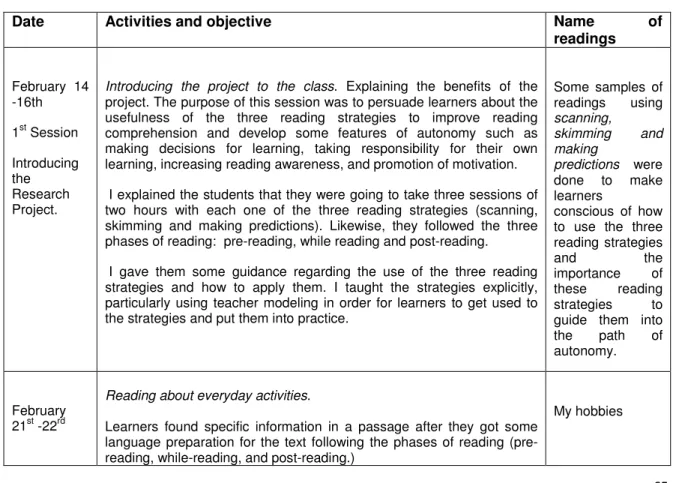
(50) Running head: PROMOTING THREE READING STRATEGIES (SCANNING, SKIMMING AND MAKING PREDICTIONS) TO FOSTER AUTONOMY. researcher took into account the three stages considered by Williams (1996) for implementing reading. They were pre-reading, while-reading and post-reading. Cotterall (1995) outlines that the researcher must first establish a good communication with the learners, and set up and clarify objectives. Secondly, the researcher must assess and discuss the learners’ progress, and provide constructive advice and feedback. The teacher as a researcher carried out the following tasks during the reading process. These were: •. Assess students’ reading needs.. •. Define meaningful instructional goals and objectives.. •. Design (and redesign) readings.. •. Plan purposeful reading lessons.. •. Adopt, adapt and develop instructional materials and assessment instruments.. •. Provide feedback to students on various aspects of reading.. •. Adjust daily lessons in response to students’ immediate needs, responses and attitudes.. •. Redefine and adjust curricular priorities to meet students’ evolving needs.. 49.
Figure
Documento similar
SOLOMON (1989): The influence of prior reading instruction on fourth grade students 1 attitudes toward reading according to select national assessment of educa- tional
This study aims to identify the research topics in educational technology research in three countries (Germany, Spain and the United King- dom), each with their own
Gender gaps (score-point differences between girls and boys) in PISA 2012 in three literacy areas: maths, science and reading, in all participating countries 8.. READING
The reading of Fanon’s main concepts becomes here the object of a certain cultural-political interpretation, in which strategies of adaptation or even appropriation make it possible
There are common and divergent patterns in the answers to a questionnaire that delves into motivational and teaching aspects linked to reading education: leisure reading habits,
The aim of this study was to compare the three-point line delimited by the free throw lane and the three-point line delimited by a rectangular area to analyze which of the
The aim of this study was to analyze associations between motivational orientation and perceived autonomy support and satisfaction of three basic psychological
It was never in my plans to become an anthropologist, but being an opportunist, is something that I have always enjoyed thoroughly.. Even on the surface both cities are
