
The effect of self revision on the target text: do self revisions deliteralise the final translation? A case study
22
0
0
Texto completo
(2) Claudine Borg. result of the source text (ST) influence on the translator’s cognitive processes. Furthermore, this is also assumed to be the result of cognitive overload during the drafting phase. The literal translation hypothesis is a major hypothesis in Translation Studies; it has been discussed by numerous scholars although different labels were sometimes applied to denote a similar concept (see, e.g., Ivir, 1981; Toury, 1995; Englund Dimitrova, 2005; Tirkkonen-Condit, 2005; Schaeffer and Carl, 2014). For reasons of space and to avoid repetition, the discussion will not be replicated here. As Chesterman (2011: 26) sustains, the literal translation hypothesis denotes a move from a more literal translation to a less literal one. In other words, the translator first produces a more literal translation and as the work is selfrevised, the translation becomes less literal. The move towards a less literal target text (TT) therefore occurs during self-revision. It is important to note that the way Chesterman conceptualises the literal translation hypothesis does not imply that the initial translation is literal but it indicates a change from a more literal TT to a freer one. Hence, the initial translation could already be a non-literal rendering of the ST and through self-revision it becomes even less literal. On the other hand a literal TT could become somewhat less literal after undergoing self-revision but the final TT could still be considered literal. The literal translation/deliteralisation hypothesis is a general hypothesis which is thought to concern all translations, irrespective of text types and genres, language pairs and translation contexts. Scholars generally agree that the translation process is divided into three phases (e.g. Mossop, 2000; Jakobsen, 2002; Englund Dimitrova, 2005). Mossop (2000: 40) names the three phases i) pre-drafting, ii) drafting and iii) post-drafting. In a nutshell, during the pre-drafting phase the translator gets acquainted with the ST; the translation is written in the second phase, while in the third phase the translator checks and/or fine-tunes the translation. Self-revision is often spread over more than one phase and empirical evidence shows that it occurs both during the drafting and the post-drafting phases (e.g. Jakobsen, 2002; Englund Dimitrova, 2005). Following Jakobsen (2002: 193), the present study distinguishes between self-revisions performed during the drafting phase and those performed later (please see section 3). The next section discusses empirical evidence from the literature as well as the deliteralisation hypothesis. Since the literal translation/deliteralisation hypothesis does not distinguish between text types, language pairs nor translation situations, section 1 draws on a variety of studies involving various text types and translation contexts. Furthermore, to my knowledge, there are yet no studies testing Chesterman’s. 16.
(3) The Effect of Self-Revision on the Target Text. deliteralisation hypothesis involving one translator working on one long text. Consequently, this paper draws on relevant studies currently available in the literature.. 1.. Empirical evidence from the literature and the deliteralisation hypothesis. In her monograph, Englund Dimitrova observed (2005: 121) that translators first translate short segments literally which are then revised to a less literal version. She studied syntactic revisions and her analysis revealed that professional translators’ online self-revisions (OSRs)1 make the text less literal. This tendency was noted also for OSRs made by student translators and language students as well as for self-revisions performed during the postdrafting phase but it was especially evident in OSRs carried out by professional translators. Likewise, Tirkkonen-Condit et al. (2008: 4-5) report that 20.5% of the self-revisions carried out by their participants pertain to the removal of literal translations and that this phenomenon occurs for all linguistic categories, that is, at the lexical, morpho-syntactic, syntactic and textual levels. Toury (1995: 204) studied the self-revisions a translator made to a literary translation and made an analogous finding: the first solutions were more literal and they were revised into less literal alternatives. A similar finding is made by Munday (2013: 132) whose study also involved a literary text. Therefore, previous research has shown that one of the effects of self-revision is a decrease in word-for-word translations. Many translators seem to start off by translating segments literally, and afterwards they revise their texts to remove some of their literalness. Hence, they tend to move away from the ST as the translation process progresses. This phenomenon seems to be independent of the text type/genre since the findings outlined above encompass both non-literary and literary texts. However, Pavlović and Antunović (2013) tested the literal translation hypothesis and their findings challenged it. Their study involved twelve professional translators and interpreters (6+6) who translated a short nonliterary text under time constraints using Translog. They examined the selfEnglund Dimitrova does not use the term online self-revisions but she terms them “revisions in the writing phase” (2005: 118). Nevertheless, the two terms refer to revisions carried out by the translator during the production of the first draft. 1. 17.
(4) Claudine Borg. revisions made by these two groups of professionals to see whether they literalise or deliteralise the text. Interestingly, they found that 39.47% of all selfrevisions deliteralised the text, 26.75% literalised the TT while 33.77% were neutral self-revisions that neither literalised nor deliteralised the translation. Pavlović and Antunović (2013: 243) maintain that their findings do not provide conclusive evidence for the literal translation hypothesis. Although their results show that deliteralising self-revisions are the highest (39.47%) they question whether this is predominant enough to “unequivocally” claim that the selfrevision process moves from more literal to less literal renderings. As stated above, Chesterman (2011: 26) puts forward a deliteralisation hypothesis which could be tested by comparing different draft versions of the same translation. His deliteralisation hypothesis claims that “initial (or earlier) draft version A is formally closer to the source than the later version B”. He (2011: 28) asserts that the deliteralisation hypothesis can be tested empirically in a number of ways and that “the hypothesis can also be falsified. It is therefore vulnerable, which is a merit.” Nevertheless Chesterman affirms that studies refuting it would be really surprising (2011: 30). In view of this and of the empirical findings mentioned above, it is interesting to test the deliteralisation hypothesis as the present study analyses self-revisions and interim solutions in Draft 1 (D1) as well as in subsequent draft versions of the same translation. This is also in line with the aims of the current study, that of examining i) the effects of self-revision on the TT and ii) whether self-revisions deliteralise or literalise the final translation. Moreover, Englund Dimitrova (2005: 148) encourages other researchers to examine this phenomenon in studies involving different language pairs and text types. The participants in Englund Dimitrova’s study translated a short biographical text from Russian into Swedish. The present study deals with a whole literary translation rendered from French into Maltese and thus it can offer a contribution by investigating this aspect in an alternative language pair and a different genre.. 2.. Research questions. This case study seeks to determine the effects of self-revision on the literary translation being investigated. More specifically, it analyses whether the self-. 18.
(5) The Effect of Self-Revision on the Target Text. revision process affects the literality of the translation by making it more or less literal. It addresses the following research questions: -. What are the effects of self-revision on this TT?. -. Do self-revisions deliteralise the final translation?. 3.. Background to the study, data and participant. In my doctoral study (Borg, 2016), I carried out an in-depth investigation of the evolution of a whole literary translation from first draft up to publication. The ST was Monsieur Ibrahim et les Fleurs du Coran (2001), a French novella written by Eric-Emmanuel Schmitt which is almost 11,000 words long. It was translated into Maltese by Toni Aquilina as Is-Sur Ibrahim u l-Fjuri fil-Koran. The first draft of the Maltese translation was produced handwritten in pencil on a copybook in 2008 and it was revised in 2013, and published in 2014. The entire process yielded nine draft versions and the final published TT. D1 was translated out of the translator’s initiative with the intention to publish it one day; it remained in draft form until 2013 when it was taken up again in the context of my doctoral project. Hence, the present research deals with authentic translation material and situation: a first version of a literary translation was created and it was subsequently revised and published. In view of this, no fictitious brief2 was needed as the translator had set his own real one, that of publishing the book. Apart from draft versions and the final TT, the larger study collected data through think aloud, ethnographic observation, retrospective and semiNord (1997: 47) defines a translation brief as “the intended purpose of the translation process”. Empirical research (e.g. Fraser 1996: 89) has shown that translation briefs influence the translation process. For this reason, various process researchers (e.g. Krings 2001; Englund Dimitrova 2005) highlight the importance of incorporating a translation brief in process studies’ research design and include a fictitious brief in their studies. For instance Englund Dimitrova (2005: 78) told her participants that the translation is needed by a museum for an art exhibition, whereas Kolb’s (2011: 262) fictitious brief instructed the literary translators participating in the study to translate a short story for a new edition featuring a collection of Hemingway’s work. 2. 19.
(6) Claudine Borg. structured interviews, and video recordings. It documented all the revisions performed to the TT during the entire process as well as in which drafts they were made. All changes executed in the translation were considered as revisions. Three types of revisions were distinguished: ‐ online self-revisions (OSRs)3 are self-revisions carried out during the. production of D1, before it was concluded;4 ‐ self-revisions encompass all revisions carried out by the translator to his TT; ‐ other-revisions comprise revisions performed to the TT by third parties. D1 contained a number of OSRs and numerous written alternative translation solutions (ATSs); please see Appendix 1 for examples. Written ATSs are several possible solutions simultaneously present in the draft: during the translation process the translator wrote down various solutions and postponed the choice between the variants to a later phase. Analysis of D1 also showed that D1 contains various instances of lexical variety. In other words, repeated lexical items in the ST were rendered variously in D1. In this article, only textual data (i.e. draft versions of the translation, namely D1 and Draft 2 (D2), and the final published TT) will be analysed. The participant involved in this case study is Toni Aquilina, an experienced Maltese literary translator and a professor at the Department of Translation, Terminology and Interpreting Studies at the University of Malta. Aquilina is a prolific translator who over the past twenty five years has published fifteen Maltese translations of French literary texts as well as other translations from other languages. He has won several prizes for his literary translations. Born in 1954, Aquilina received his doctorate from the University of Poitiers (France) in 1993 with a thesis on the work of French existentialist writer Albert Camus. Like most translators of his generation, Aquilina did not study translation; he studied modern languages and specialised in French literature. Nevertheless, when he was studying in France in the late eighties he attended a Summer School in French to English translation and he has been translating on a daily basis since then. Translation forms part of his academic profile, with Analysis of D1 revealed sporadic use of a rubber. For obvious reasons, these changes to D1 cannot be retrieved for examination. Henceforth the term ‘OSR’ denotes visible OSRs. 4 These are what Jakobsen terms as online revisions (2002: 193). Here, they are called online self-revisions (OSRs) in an effort to increase terminological clarity as these consist of revisions carried out by the translator to his own translation while generating the first draft. 3. 20.
(7) The Effect of Self-Revision on the Target Text. literary translation constituting a significant portion of his intellectual production. Aquilina is a native speaker of Maltese and has an excellent command of his mother tongue. Apart from French, he also translates from English, Italian and German, and occasionally from Maltese into English. Although literary translation is his field of specialisation, he also translates nonliterary works, LSP documents, and has co-subtitled ten films into Maltese. He is the author of various original works and is the editor of the Translation Series of Faraxa Publishing.. 4.. Data Analysis Methodology. 4.1. Counting system: how were written ATSs and OSRs counted? All written ATSs and OSRs present in the D1 were identified, listed and counted. The counting system implemented is very similar to the method adopted by other studies of self-revisions (Englund Dimitrova, 2005; Malkiel, 2009; Antunović and Pavlović, 2011). As these scholars assert, sometimes one amendment results in various revisions; such instances were counted as different revisions. To exemplify, OSR009 in D1/00775 (see example below) għadu fuq tiegħu (‘is still lively’)6 was deleted and substituted with kellu wieħed (‘had one’) resulting in a lexical change as well as a syntactic change since the translator also moved this item to a later position in the sentence: Example – OSR009: ST/0077 Tout ce qui a un sexe rue Bleue, rue Papillon et Faubourg-Poissonnière, est en alerte.. Each sentence in the text corpus was numbered and allocated a reference number. ST/0077 means Source Text segment 77; D1/0077 means Draft 1 segment 77; D2/0077 means Draft 2 segment 77 etc. 6 The style of the gloss translations from Maltese into English is literal, at times very literal so as to reflect as closely as possible the word order and syntax of the Maltese TT while at the same time maintaining the comprehensibility of the translations. It should be stressed that the translations into English do not reflect the quality of the Maltese translation itself. 5. 21.
(8) Claudine Borg. D1/0077 Kulmin (għadu fuq tiegħu) fi Triq Bleue, fi Triq Papillon u fil-FaubourgPoissonière kellu wieħed, kien fuq ix-xwiek (‘Whoever (is still lively) in Bleue Road, in Papillon Road and in Faubourg-Poissonière had one, was on tenterhooks’). The two revisions in the above example were counted as two since the lexical change did not impose the syntactic one because in Maltese the translator could have revised għadu fuq tiegħu with kellu wieħed without undertaking the syntactic change. Moreover, also in line with these scholars, if one change imposes another change, this is only counted as one. 113 OSRs were identified in the handwritten draft. Ten out of these were counted as two different revisions, thus the total number of OSRs amounts to 123. With regards to written ATSs, 188 sets were identified in D1. A classification system was devised to analyse OSRs and written ATSs which is explained in section 4.2. The text corpus was labelled and processed manually. It was aligned at sentence level in a Microsoft Excel spreadsheet, which was used for both counting and coding.. 4.2. Classification system In order to determine the effect of self-revisions on the translation, OSRs and the final solution chosen in the published TT for segments containing written ATSs in D1 were examined and classified in three categories: i). Away The OSR/final solution moves the TT away from the ST thus rendering it less literal.. 22.
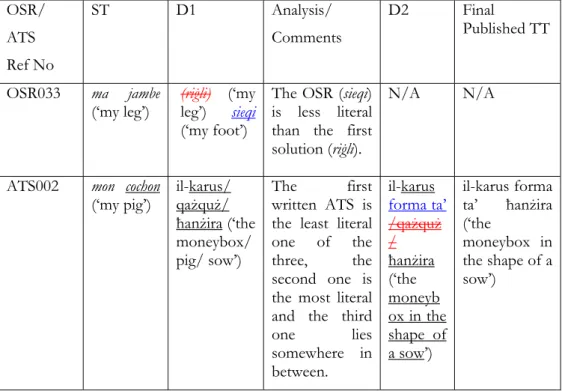
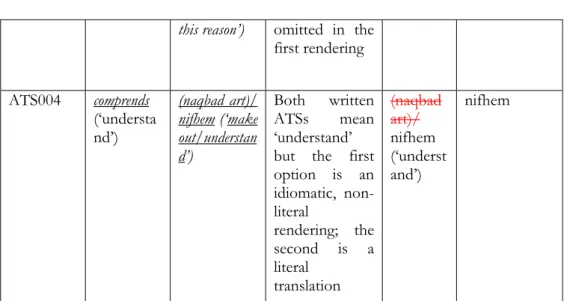
(9) The Effect of Self-Revision on the Target Text Table 1. Examples of OSR/final solution that moves the TT away from the ST OSR/. ST. D1. ATS. Analysis/. D2. Comments. Final Published TT. Ref No OSR033. ma jambe (‘my leg’). ATS002. mon cochon il-karus/ (‘my pig’) qażquż/ ħanżira (‘the moneybox/ pig/ sow’). ii). (riġli) (‘my The OSR (sieqi) N/A leg’) sieqi is less literal (‘my foot’) than the first solution (riġli). The first written ATS is the least literal one of the three, the second one is the most literal and the third one lies somewhere in between.. il-karus forma ta’ /qażquż / ħanżira (‘the moneyb ox in the shape of a sow’). N/A. il-karus forma ta’ ħanżira (‘the moneybox in the shape of a sow’). Nearer The OSR/final solution brings the TT nearer to the ST thus rendering it more literal. Table 2. Examples of OSR/final solution that brings the TT nearer to the ST. OSR/. ST. D1. ATS. Analysis/. D2. Comments. Final Published TT. Ref No OSR006. c’est bien huwa pour cela tabilħaqq għalhekk ('it’s really for. OSR adds N/A tabilħaqq to mirror the bien in the ST which was. N/A. 23.
(10) Claudine Borg. ATS004. iii). comprends (‘understa nd’). this reason’). omitted in the first rendering. (naqbad art)/ nifhem (‘make out/understan d’). Both written ATSs mean ‘understand’ but the first option is an idiomatic, nonliteral rendering; the second is a literal translation. (naqbad art)/ nifhem (‘underst and’). nifhem. Neutral The OSR/final solution is similar to the previous one thus effecting no change in this regard. Table 3. Examples of OSR/final solution that is similar to the previous solution. OSR/. ST. D1. Analysis/. ATS. D2. Final Published TT. N/A. N/A. Comments. Ref No l-tal- orthographic correction, neutral change in view of the ST. OSR008. de. ta’ (‘of’). ATS006. Puisque (‘Since’). Ladarba/ Ġaladarba (‘Since/ Since’). The two Ladarba written ATSs /Ġalada are synonyms rba (‘Since’). Ladarba. 24.
(11) The Effect of Self-Revision on the Target Text. In line with Chesterman (2011), it is important to note that the solutions classified in these categories are not necessarily a literal (word for word) translation but are more/less literal when compared to the solutions they replaced. Every move was counted. For instance, if the translator added a word in the text (e.g. OSR002) this is counted as one OSR moving the TT away from the ST. However, in OSR045 (ST: coup de poing (‘punch’) the translator added the tentative solution ħarta (daqqa ta’ ħarta ‘slap on the face’) above the initial solution ponn (daqqa ta’ ponn ‘a blow with the fist’) which is a less literal option thus moving the TT away from the ST, but then he deleted this alternative solution and opted for the more literal solution (poing (‘fist’). These were counted as two separate moves. The categorisation and counting systems were adapted from Englund Dimitrova’s (2005: 117) and Pavlović and Antunović’s (2013: 237-238) studies which examine self-revisions. In addition to OSRs, the present study investigates written ATSs in order to determine the effect of selfrevision on the translation as well as to test the literal translation/deliteralisation hypothesis. Furthermore, various examples of repeated lexical items in the ST that were rendered variously in D1 will be analysed in section 5.3 to determine whether the lexical variety identified in D1 is retained, reduced or increased during the self-revision process. Examples are provided in section 5.3.. 5.. Results. 5.1. The effect of OSRs on the TT First, the effect of OSRs on the translation was analysed. This was done by examining each OSR to determine whether the change moves the TT away from the ST, thus rendering it less literal, or makes it more literal by opting for a solution nearer to the ST or else the OSR is similar to the previous one hence the move is neutral, effecting no change in this regard. The results are presented in Table 4:. 25.
(12) Claudine Borg Table 4. The effect of OSRs on the TT OSRs. Away. Nearer. Neutral. 123. 42. 61. 20. 100%. 34.1%. 49.6%. 16.3%. Of the 123 OSRs, 34.1% fall in the away category as they implement less literal solutions while 49.6% move the TT nearer to the ST since the new solutions are more literal than the ones they replaced. 16.3% of the OSRs are neutral: they neither make the TT more literal nor less so. Interestingly, the findings seem to refute the literal translation/deliteralisation hypothesis. 5.2. The effect of written ATSs on the TT: literality of the solutions in the published TT Furthermore, the solutions selected in the published translation for those segments exhibiting a set of written ATSs in D1 were examined to establish whether the final solution chosen is more literal, thus bringing the TT nearer to the ST, or less literal thereby increasing the distance between the ST and the TT. Cases where the selected solution is similarly literal or similarly non-literal to the previous solution were qualified as neutral. Table 5 displays the findings, which help examining the effect of self-revision on the TT: Table 5. Analysis of the final solution chosen for segments containing written ATSs in D1 Segments. Away. Nearer. Neutral. 188. 69. 92. 27. 100%. 36.7%. 48.9%. 14.4%. In the final TT, 36.7% of the segments containing written ATSs in D1 bring the TT away from the ST whereas 48.9% move the TT nearer to the ST. The remaining 14.4% are neutral. Interestingly, these results also seem to go against the literal translation/deliteralisation hypothesis.. 26.
(13) The Effect of Self-Revision on the Target Text. 5.3. The effect of self-revision on lexical variety 5.3.1. Lexical variety in D1 Being a relatively long text, the ST contains several recurrent lexical items scattered along the story. A succinct analysis of D1 revealed that certain recurrent lexical items in the ST are rendered variously in the manuscript by means of synonyms or near-synonyms with the result that D1 exhibits a larger lexical diversity than the ST. Some examples are: Croissant d’Or found in three ST segments (ST/0049, ST/0054, ST/0696) is rendered in various ways in D1: -. pajjiż tan-Nofs Qamar Dehbi/.(Croissant d’Or) (‘country of the Golden Half Moon/.(Croissant d’Or’) (D1/0049). -. Nofs Qamar Dehbi (‘Golden Half Moon’) (D1/0054). -. Croissant d’Or (D1/0696). The four instances of boîte(s) (ST/0053, ST/0117, ST/0119, ST/0202) and the three similar occurrences of boîte(s) de conserve (ST/0042, ST/0071, ST/0086) feature as: -. ikel tal-bottijiet/fil-laned (‘canned food/food in tins’)(D1/0042). -. landa ta’ l-ikel (‘tin of food’) (D1/0053, D1/0071). -. laned (tal-ikel)/tal-priserv (‘tins (of food)/of preserved [food]’) (D1/0086). -. laned (‘tins’)(D1/0117, D1/0119). -. landa/(bott) (‘tin/ (can)’ (D1/0202). Likewise, the title is translated in three slightly different ways: Monsieur Ibrahim et les Fleurs du Coran (ST). 27.
(14) Claudine Borg. -. Is-Sur IBRAHIM u l-FJURI fil-/ta’ ġol-KORAN. (‘Mister IBRAHIM and the FLOWERS in/of in the KORAN’) (D1). -. Is-Sur Ibrahim u l-Fjuri fil-Koran (‘Mister Ibrahim and the Flowers in the Koran’) (D1). -. Is-Sur Ibrahim u fjur fil-Koran (‘Mister Ibrahim and flowers in the Koran’) (D1). At first Moïse, the name of the narrator and one of the protagonists, is domesticated7 and translated as Mosè (D1/0007) but further down this becomes Moïse (D1/0058, D1/0074, D1/0076 etc.), which is a foreignisation. Hesitation between foreignisation and domestication is also seen in the Croissant d’Or example above as well as in other occurrences. Since several of these instances concern culture-bound items it could be argued that, at the drafting phase, the translator has not yet decided on a strategy for the rendering of such items.. 5.3.2. Lexical variety in D2. Examination of the three examples cited in section 5.3.1. indicates that in D2 this variety decreases and the TT segments are harmonised, reflecting the repetition of the ST: in D2, Croissant d’Or (ST/0049, ST/0054, ST/0696) is rendered uniformly as Nofs Qamar Dehbi (‘Golden Half Moon’) (D2/0049, D2/0054, D2/0696). The four instances of boîte(s) (ST/0053, ST/0117, ST/0119, ST/0202) and the two occurrences of boîte(s) de conserve (ST/0042, ST/0071, ST/0086) in D2 feature as: landa (‘tin’) (D2/0202), laned (‘tins’) (D2/0117, D2/0119); landa tal-priserv (‘tin of preserved [food]’) (D2/0053, D2/0071), laned tal-priserv (‘tins of preserved [food]’) (D2/0042, D2/0086). Lexical variety is reduced in the title too, although in D2 there are still two versions of the title (Is-Sur Ibrahim u l-Fjuri fil-Koran (‘Mister Ibrahim and the Flowers in the Koran’) & Is-Sur Ibrahim u fjur fil-Koran (‘Mister Ibrahim and flowers in the In this paper, the terms domestication and foreignisation (Venuti, 1995) signify TT-oriented and ST-oriented solutions respectively; they are not used in relation to a particular theory but for convenience. 7. 28.
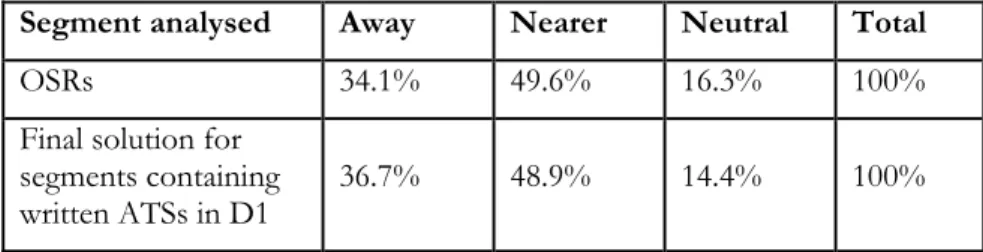
(15) The Effect of Self-Revision on the Target Text. Koran’)). However, TPP01/002 indicates that the translator overlooked Is-Sur Ibrahim u fjur fil-Koran, in other words he skipped it but then harmonised it in D3, where the three D1 versions have been uniformed. Apart from the last example mentioned, all the other lexical items mentioned are fixed in D2 and this is how they appear in the final TT. This brief analysis hence indicates that lexical variety is reduced in D2 and hence D2 moves closer to the ST in this case too.. 6. Discussion This study sought to explore the effects of self-revision on the TT. In so doing, it also tested the literal translation/deliteralisation hypothesis. Analysis of OSRs and of the solutions selected in the published translation for those segments exhibiting a set of written ATSs in D1 yielded the following results, aggregated in Table 6: Table 6. The effect of self-revision on the TT Segment analysed. Away. Nearer. Neutral. Total. OSRs. 34.1%. 49.6%. 16.3%. 100%. Final solution for segments containing written ATSs in D1. 36.7%. 48.9%. 14.4%. 100%. In both cases, the nearer type are the most numerous, implying that this translator’s self-revisions tend to bring the TT closer to the ST both during drafting and post-drafting, represented by the OSRs and written ATSs respectively. Surprisingly, these results do not lend support to Chesterman’s (2011: 26) deliteralisation hypothesis nor to Englund Dimitrova’s (2005: 121) findings that self-revisions make the translation less literal. As outlined in section 1, Pavlović and Antunović’s (2013) study also challenged the literal translation hypothesis. These findings raise very interesting questions about the deliteralisation/literal translation hypothesis, particularly in view of Chesterman’s (2011: 30) assertion that findings going against the hypothesis. 29.
(16) Claudine Borg. would be surprising. Consequently, further studies delving deeper into this aspect are needed. According to this study’s findings, one of the effects of self-revision on the translation involved in this study is moving it nearer to the ST. As Chesterman hints, this might be explained in terms of the translator’s process profile8: the results in Borg (2016) indicate that in D1 the participant produces a rough, freer draft in which he explores a number of different avenues through the writing down of various ATSs and in D2 he reins himself in. Chesterman suggests that: There may be more than one tendency at work: some translators (perhaps under certain working conditions, or with certain language pairs or translation directions or text types, or with certain personality types, or whatever) may tend to process in a deliteralizing direction, from more literal towards less literal, while others work in the opposite direction, beginning with a freer version and then pulling it back closer to the source text during processing or revision (i.e. literalizing). (Chesterman 2011: 30, emphasis in original). The participant, at least in this case study, seems to form part of the latter group of translators, and it could be argued that this may be due to his process profile. The impact of the translator’s process profile on the translation process should not be ignored: it seems to condition the way the translator approaches the entire translation task (Borg 2016). Interestingly, Chesterman (2011: 33) in his concluding remarks asks “Would the knowledge of the coming revision encourage more risk-taking at the initial stage, for instance? Such new questions might lead to interesting new hypotheses.” One explanation for the present study’s results could be that in the drafting stage (i.e. in D1) the translator is more adventurous, more ready to take risks as he knows full well that he will be self-revising his text thoroughly. As the findings in Borg (2016) show, the subsequent drafts are revised rigorously and thoroughly; during this self-revision process the translation is moved closer to the ST. My hypothesis is that whether self-revision deliteralises or literalises the TT is linked to process profiles. Moreover, the indications are that the process of self-revision reduces lexical variety in the TT. In the examples scrutinised in section 5.3., self-revision cancelled lexical variety in these TT segments and introduced a repeated item, The present study applies the term ‘process profiles’ to refer to how translators approach a task and distribute the activities performed over the different phases of the translation process (Antunović & Pavlović 2011: 216). 8. 30.
(17) The Effect of Self-Revision on the Target Text. with the result that the final TT mirrors the repetition of the original. Now, Ben-Ari (1998: 68), looking solely at product data, argues that avoiding repetition is such a frequent and predominant phenomenon in translator behaviour that it could be called a “universal of translation”. She maintains that avoiding repetition is an innate need, an instinctive translatorial behaviour. Kolb’s (2011: 272) process study on the translation of repetition and ambiguity in a literary text brings “some evidence of what is often seen as universal tendencies such as […] the avoidance of repetitions” as two of her four participants removed repetitions while the other two kept them in their TTs. Interestingly, the process data gathered by the present study show that the instinctive unconscious behaviour during the drafting phase was indeed to avoid repetition. In fact, Aquilina’s D1 exhibits a larger lexical diversity than the ST (section 5.3.1.). However, although at first the translator seemed inclined to avoid repetition by using the variants offered by the target language, at the end of D2 this variety disappears and the TT segments are harmonised, reflecting the repetition of the ST. At the end, the translator did not shy away from repetition, often reputed as awkward, but gave precedence to adequacy and loyalty to the ST. Hence, the few examples analysed here do not corroborate Ben-Ari’s (1998: 68) argument. As a result of this repetition, the TT moves closer to the ST. This is therefore another indication that this translator’s selfrevision process brings the TT nearer to the ST. The above also highlights one of the benefits of process studies, as such insights cannot be offered by product studies.. 7.. Concluding comments. This paper investigated the effects of self-revision on the final translation product. It was found that this translator’s self-revisions tend to bring the target text closer to the source text, in other words they literalise the translation. These findings went counter to Chesterman’s (2011: 26) deliteralisation hypothesis and Englund Dimitrova’s (2005: 121) results, amongst other studies, and it was proposed that this might be due to the translator’s process profile. To my knowledge, this is the first study testing this hypothesis on a whole literary text by examining various drafts of the same translation. Being a case study involving one translator and one translation generalisation of the results is, of course, not possible. Yet, Susam-Sarajeva. 31.
(18) Claudine Borg. (2009: 44) holds that single-case studies are valuable to refute a theory in Translation Studies. This paper is not claiming that the hypothesis is null but that in this particular translation situation the hypothesis is not supported. Chesterman (2011: 34) allows for this possibilty and argues that if “the hypothesis turns out to be largely supported by empirical evidence (as now seems) but now always […]” several questions could then be asked which could help us to create more links between the translation acts and events. Although at face value the present study might seem a limited case study, in reality it analyses more examples than previous studies. To illustrate, Englund Dimitrova (2005: 118-121) analysed a total of 223 syntactic self-revisions (104 in the drafting phase and 119 in the post-draft phase) produced by nine participants having variable translation experience and Pavlović and Antunović (2013: 239) examined 248 self-revisions performed by twelve professional translators and interpreters. The current study scrutinised over 300 instances (123 self-revions, 188 written ATSs, as well as various instances of lexical variety) carried out by one experienced translator on one literary text. These three studies vary in the number of participants, their translation experience, the language pair, the text type and the length of text used. Nevertheless, the deliteralisation hypothesis does not specify any of these variables, it simply claims that the first draft is closer to the ST than the subsequent draft (Chesterman 2011: 26). It is therefore a general hypothesis pertaining to all translation situations. Another innovation of this study is that it examined written ATSs to test the literal translation/deliteralisation hypothesis, which to my knowledge was not done before. Hence, it tested this hypothesis from a different angle. One of the study’s limitations is that certain self-revisions were rubbed out in D1, which implies that several OSRs were not available for investigation. As already stated above, this case study cannot make generalisations, however, case studies are a good springboard to raise questions for further investigation (Saldanha and O’Brien, 2013: 209). Based on the above-mentioned findings, the following questions ensue which could be taken up in future studies: Do self-revisions necessarily deliteralise the translation process? Could it be that certain translators work in the opposite direction, that is, they start with a freer version and then as the translation process progresses they move it closer to the ST? Could this be linked to their process profiles? More studies are encouraged to investigate these questions in texts of different genres of in different language pairs.. 32.
(19) The Effect of Self-Revision on the Target Text. References. Antunović, G. and Pavlović, N. (2011). ‘Moving on, moving back or changing it here and now: self-revision in student translation processes from L2 and L3.’ Across Languages and Cultures, 12(2) pp. 213–234. Ben-Ari, N. (1998). ‘The ambivalent case of repetitions in literary translation. Avoiding repetition: a “universal” of translation?.’ Meta, 18(1) pp. 68–78. [Online] [Accessed on 10th June 2015] DOI 10.7202/002054ar. Borg, C. (2016). ‘A literary translation in the making: an in-depth investigation into the process of a literary translation from French into Maltese.’ Unpublished PhD dissertation. Aston University. Chesterman, A. (2011). ‘Reflections on the literal translation hypothesis.’ In Alvstad, C., Hild, A. and Tiselius, E. (eds.) Methods and strategies of process research: integrative approaches. Amsterdam: John Benjamins, pp. 23–35. Englund Dimitrova, B. (2005). Expertise and explicitation in the translation process. Amsterdam: John Benjamins. Fraser, J. (1996). ‘Mapping the process of translation.’ Meta, 41(1) pp. 84–96. Ivir, V. (1981). ‘Formal correspondence vs. translation equivalence revisited.’ Poetics Today, 2(4) pp. 51–59. Jakobsen, A. L. (2002). ‘Translation drafting by professional translators and by translation students.’ In Hansen, G. (ed.) Empirical translation studies: process and product. Copenhagen: Samfundslitteratur, pp. 191–204. Kolb, W. (2011). ‘The making of literary translations: repetition and ambiguity in a short story by Ernest Hemingway.’ Across Languages and Cultures, 12(2) pp. 259–274. Krings, H. P. (2001). Repairing Texts: Empirical investigations of maching transltion post-editing processes. Translated by G. S. Koby, G. M. Shreve, K. Mischerikow and S. Litzer. Kent OH: Kent State University Press. Malkiel, B. (2009). ‘From Ántonia to my Ántonia: tracking self-corrections with Translog.’ In Göpferich, S., Jakobsen, A. L. and Mees, I. M. (eds.) Behind the mind: methods, models and results in translation process research. Copenhagen: Samfundslitteratur, pp. 149–166.. 33.
(20) Claudine Borg. Mossop, B. (2000). ‘The workplace procedures of professional translators.’ In Chesterman, A., San Salvador, N. G. and Gambier, Y. (eds.) Translation in context: selected papers from the EST congress, Granada 1998. Amsterdam: John Benjamins, pp. 39–48. Munday, J. (2013). ‘The role of archival and manuscript research in the investigation of translator decision-making.’ Target, 25(1) pp. 125–139. Nord, C. (1997). ‘Defining translation functions. The translation brief as a guideline for the trainee translator.’ Ilha do Desterro, Special Issue Translation Studies in Germany, 2 pp. 39–53, https://periodicos.ufsc.br/index.php/desterro/article/view/9208 (last accessed 23 May 2018). Pavlović, N. and Antunović. G. (2013). ‘The effect of interpreting experience on distance dynamics: testing the literal translation hypothesis.’ Translation and Interpreting Studies, 8(2) pp. 233–252. Saldanha, G. and O’Brien, S. (2013). Research methodologies in translation studies. Manchester: St Jerome. Schaeffer, M. and Carl, M. (2014). ‘Measuring the cognitive effort of literal translation processes’. In Germann, U. (ed.) Proceedings of the workshop on humans and computer-assisted translation (HaCaT). Stroudsburg, PA: Association for Computational Linguistics, pp. 29–37. Schmitt, E.-E. (2001). Monsieur Ibrahim et les fleurs du Coran. Paris: Albin Michel. Schmitt, E.-E. (2014). Is-Sur Ibrahim u l-fjuri fil-Koran. Translated by T. Aquilina. Rabat: Faraxa Publishing. Susam-Sarajeva, Ş. (2009). ‘The case study research method in translation studies.’ The Interpreter and Translator Trainer, 3(1) pp. 37–56. Tirkkonen-Condit, S. (2005). ‘The monitor model revisited: evidence from process research.’ Meta, 50(2) pp. 405–414. [Online] [Accessed on 17th May 2013] http://id.erudit.org/iderudit/010990ar. Tirkkonen-Condit, S., Mäkisalo. J. and Immonen, S. (2008). ‘The translation process – interplay between literal rendering and a search for sense.’ Across Languages and Cultures, 9(1) pp. 1–15. Toury, G. (1995). Descriptive translation studies and beyond. Amsterdam: John Benjamins.. 34.
(21) The Effect of Self-Revision on the Target Text. Venuti, L. (1995). The Translator’s Invisibility: A history of translation. London: Routledge.. 35.
(22) Claudine Borg. Appendix 1 Extract from page 11 of D1: ovals indicate examples of written ATSs and rectangles indicate examples of OSRs in D1.. 36.
(23)
Figure

Documento similar
English borrowed an immense number of words from the French of the Norman invaders, later also from the court French of Isle de France, appropriated a certain number of affixed
In the preparation of this report, the Venice Commission has relied on the comments of its rapporteurs; its recently adopted Report on Respect for Democracy, Human Rights and the Rule
Public archives are well-established through the work of the national archive services, local authority-run record offices, local studies libraries, universities and further
In the “big picture” perspective of the recent years that we have described in Brazil, Spain, Portugal and Puerto Rico there are some similarities and important differences,
Keywords: iPSCs; induced pluripotent stem cells; clinics; clinical trial; drug screening; personalized medicine; regenerative medicine.. The Evolution of
Astrometric and photometric star cata- logues derived from the ESA HIPPARCOS Space Astrometry Mission.
The photometry of the 236 238 objects detected in the reference images was grouped into the reference catalog (Table 3) 5 , which contains the object identifier, the right
In addition to traffic and noise exposure data, the calculation method requires the following inputs: noise costs per day per person exposed to road traffic
