i
BENEMÉRITA UNIVERSIDAD AUTÓNOMA DE PUEBLA
FACULTAD DE LENGUAS
‘Interlanguage transfer’: A study through stimulated
recall about Spanish-speaking students who transfer
elements from English in order to learn German
A thesis submitted to the School of Languages for the Degree of
LICENCIATURA EN LENGUAS MODERNAS
By:
GABRIELA ALEJANDRA JIMÉNEZ MORENO
Thesis Director:
NANCY S. KERANEN
ii
‘Interlanguage transfer’: A study through stimulated recall about
Spanish-speaking students who transfer elements from English in
order to learn German
This Thesis has been read by the members
of the thesis committee of
And is considered worthy of approval in partial fulfillment of the
requirement for the degree of
LICENCIATURA EN ENSEÑANZA DEL INGLÉS
Thesis director
Dra. Nancy S. Keranen
Committee Member Committee Member
iii Abstract
This thesis reports a qualitative study of interlanguage transfer. This study was carried out at a public university in a faculty of modern languages in the city of Puebla. The main purpose of my research was to study the phenomenon of transfer from one foreign language to another, in order to investigate if the previous knowledge of the participants’ L2 let the learning of another subsequent language depending on their closeness. The research data were collected through participants’ written productions and stimulated recall interviews that were applied to 7 students who belonged to early German levels: beginners or A1.
The research found that the genetic relatedness and language closeness maintains features in common among languages which are highly associable and transferable. Thus providing students an advantage for learning when they apply that previous knowledge as a learning strategy, too.
Findings also revealed that there were negative outcomes because of the nature of L2 (e.g., English) and L3 (e.g., German).
iv ACKNOWLEDGEMENTS
In this little section I want to express gratitude for all the people who intervene in
my personal and professional formation while studying at the Language Faculty. Those
people who supported and helped me to achieve my main goal till this point of my life:
Finishing my major. I would like to thank to all the teachers who gave me their knowledge
and advice. Particularly I would like show my thankfulness to the following teachers and
persons, to the teacher Jose Julio Demetrio Gonzales Martinez, who was my tutor for
around three years, for having been willing to help me in every bad situation I faced in the
language faculty, to the German teacher Astrid Langholz because without her help I had
not been able to finish my thesis, as she let me to work with her students, also I thank to her
for motivating, guiding, and believing in me; but overall for having given me not only her
knowledge about German language but also her knowledge about life; thanksto my thesis
director Nancy Keranen for all her patience and good guidance during the researching
process and for teaching me that a thesis is more than an academic task, researching is
also a source of invaluable knowledge. I want to add a special thanks to my thesis readers
Leonel Ojeda and Laura Lima for their time and valuable feedback to my thesis project.
But especially I want to thank my family and boyfriend Luis Galeana Palacios who have
always loved and supported me unconditionally even in the hardest moments of my life.
Without them I could have never been able to achieve my goals and of course I would not
be the way I am.
-Thanks-v DEDICATIONS
To my parents: José Javier Delfino Jiménez y Priego and Adela Moreno Diaz for
vi
1.4 Background of the researcher 2
1.5 Research location 3
2.1.2 Similarities between English and German 8
2.2 Contrastive analysis 10
5.1 Findings and results significance 50
5.2 Research aims 51
5.2.1 Accomplishment of the aims 51
5.2.2 Answer to the research questions 52
5.3 Reflective account 53
5.4 Recommendations 55
5.5 Limitations of the research 56
5.6 Suggesstions for further reserach 57
vii Appendices
Appendix A: Writing format
Appendix B: Stimulated recall interview
List of tables
2.1 Genetic relatedness among Germanic and Romance languages
4.1 Examples of cognates between English and German
4.2 Examples of words with similar spelling
4.3 Examples of cognates most frequently used in the participants’ productions
4.4 Cognates: Months of the year
4.5 Short expressions with the same word order in English as well as in German
4.6 Similar verbs between English and German
4.7 Semantical equivalence between German and English words.
4.8 The use of the preposition ‘in’ as a locative preposition in German and in English.
4.9 The preposition ‘in’ as a preposition of time
4.10 Compound words similar in German and in English
4.11 Words with similar spelling and pronunciation
List of figures
2.1 Germanic languages’ family tree
2.2 Classification on the cognitive learning strategies
1 CHAPTER ONE: INTRODUCTION
1.0 Chapter Introduction
German is a difficult language to learn because of its complexity, even more difficult for the Spanish-speaking students than the ones who have some knowledge about English. Some students use English as a strategy for learning German. Phenomenon such as language transfer might be influencing this which is concerned to language acquisition studies; but also the belonging of a certain language family might be another factor because of the similar elements that exist between these two Germanic languages. Those elements in common let the positive transfer occurs while some others elements might cause problems or confusions at the time of learning, which is known as negative transfer.
1.1 Study Justification
2 1.2 Study Significance
This study attempts to explore the phenomenon of language transfer and how it works in students whose mother tongue (e.g., Spanish) does not help them for learning a foreign language (e.g., German). As a consequence they are forced to use a third language (e.g., English) as an intermediary for achieving the target language they aim to learn. This study could be useful for other students who are experiencing the language transfer phenomenon in a similar way; as a result, they would understand their meta-cognitive processes and be able to use learning strategies more efficiently in the target language.
1.3 Research Context
This study fits into the context of second language acquisition studies. The study was mainly focused on the language transfer which at the same time is a subcategory of Cross -linguistic influence (CLI). Language transfer is also divided into positive transfer and negative transfer which means that the transference of some linguistic elements (e.g., word order, verbs, vocabulary, cognates, morphemes, and so on) of the individual’s native language might help or complicate the learning of the target language. In order to encourage positive transfer and to avoid the negative one, similarities must exist between these two languages. In that case the language families also play an important role while transferring, for instance, English and German belong to the Germanic languages. Particularly this study attempts to explore the kind of transfer that occurs from one foreign language to another.
1.4 Background of the researcher
3 of a speaking-workshop of three people. However as the students were beginners, they did not produce a lot of spoken language. They only produced isolated words and they were able to identify cognates. The most interesting part is that those cognates did not have any similarity with the Spanish language; they had it with the English language instead. Since the moment I observed that, I wished to identify what kind of elements of English language they were using and which they were producing positive transfer and and/or negative transfer at the time of learning German.
1.5 Research Location
The research was made at a prestigious language faculty in a German speaking-workshop. Spanish-speaking students belonging to that workshop who had knowledge about English were the subjects of this study. At the time of carrying out this research project, they were beginning German learners who had just started to learn that language as part of their curricula and professional formation.
1.6 Study Aims
This study had several aims. The first one was to have a short students’ writing in German in order to analyze and to detect positive and/or negative transfer. Another aim was to do a stimulated recall method with each student, and finally to find reasons for which they were using English.
1.7 Research questions
4 1.8 Chapter summary and overview of the thesis document
5 Chapter II: Literature review
2.0 Introduction
As presented in the previous chapter, this study is about language transfer which lets the transference of linguistic elements from one language to another in order to learn a determined target language (TL). The central topic of this research is to identify the transference that occurs from one second language to a third language e.g., from English to German. One of the aims of this thesis was to identify similarities between these two Germanic languages and what kind of elements encourage positive and/or negative transfer in students whose native language (e.g., Spanish) is not useful for achieving the their target language (e.g., German). Thus, determining how beneficial or disruptive this kind of transfer is, this study was supported in related research and in a number of studies that have been one in the same context: Language acquisition which is a relatively new area of study. This chapter presents the theoretical framework – those studies, research and literature review associated with the thesis topic.
2.1 Language family
The term ‘language family’ can be defined as all the branches or languages that belong to the same group; these branches resemble a family tree which tries to represent the relation among languages that descend from a common ancestor, called proto-language. That is to say that, languages come from the same origin; therefore they share linguistic features between them.
6 languages occur. Only an examination of these languages shows that many of them belong to some group of related languages, and some of these are very large, constituting what we call linguistic families (Barber, 1990 p. 53).
The ‘family tree theory’ was developed by the German linguist August Sleicher. This theory states that there are genetic relationships among languages, and the similarities and differences among them are regular when they are related (Fennel, 2001 p.18). If we follow the metaphor used by August Sleicher of the ‘language family tree’, then it is possible to trace back every single language to a common ancestor (Fennel, 2001 p. 18).
According to Fennell (2001 p .19) “there are natural indications that some languages seem closer one another to than others. As she explained, German speakers can usually learn Swedish rather than Russian. This is because German and Swedish are closely related languages – they are both members of the same language family. Therefore they have many linguistic features in common – whereas Russian is a member of the Slavonic family”. As Fennell said: “Languages within the same language group resemble each other” (Fennell, 2001 p. 19). As the following table shows:
Table 2.1 Genetic relatedness among Germanic and Romance languages
Source: Adapted from Fennell, B. (2001)
Germanic languages
Romance languages
English German Swedish French Italian Spanish
winter Winter Vinter hiver inverno invierno
foot Fu fot pied piede pie
two zwei två deux due dos
7 This study attempts to find a close relationship between English and German which belong to the same branch or language family e.g., the Germanic languages which will be presented in the following section.
2.1.1 Germanic languages
8 The most spoken languages belonging to this family are English and German which along the centuries have evolved differently. However both have maintained some features in common.
2.1.2 Similarities between English and German
Although in these days a great difference exists between English and German, they maintain certain features in common as they descend from the same language family. One of the greatest differences between them is that English is an analytic language while German is a synthetic language. That means that throughout its evolution English has lost most of its inflectionswhileGerman has kept most of them.
Among the similarities that have prevailed between English and German is the history, cognates which lead to vocabulary and word order in some phrases. Some quick, easy examples are house/Haus, man/Mann, here/hier, and good/gut. Of course, several similar examples like this exist. For instance, the German word for "dog" is "Hund." That looks pretty different, but if you know that "hound" is another English word for "dog," then you can see the similarity. In the same way, "chair" is "Stuhl" in German; it looks very different, but it is pronounced quite similar to "stool," a synonym for "chair." (In Sitzman ABC, 2011).
Through these comparisons it is possible to appreciate the close relation between English and German rather than Spanish, the following excerpt gives support to this idea:
9 too. For example, the English verb "to swim" is conjugated swim - swam - swum; in German, it is schwimmen - schwamm - geschwommen. It is not exactly the same, but if you compare it to a Romance language like Spanish (nadar - nadé - nadado), then you can see English is quite a bit closer to German than Spanish. (In Sitzman ABC, 2011).
If we look at the following table, we observe that the similarities between the same language family members are evident. Through this table now it is possible to represent what has been explained so far. In the table, it can be observed the closeness of English and German, which are Germanic languages in a comparative way towards Spanish which is a Romance language:
Table 2.2 Genetic relatedness of Germanic and Romance languages
Germanic languages Romance languages
10 there is no an equivalent word in Spanish for it; but in German there exists one with the exact meaning ‘heimweh’. The similarities that have prevailed between English and German are just a few and merely concern to some linguistic elements.
The features described above and these linguistic elements are perfectly transferable from English to German and vice versa as they descend from the same language family. Both have features in common which let learners make an association between them. In the same way, a Spanish - native speaker could transfer elements of his L1 to any Romance language as they are pretty similar as shown in Table 2.1. In the following section we will review an analysis which function is to compare and to detect features in common among languages like the ones revised in this section.
2.2 Contrastive Analysis:
Contrastive analysis was developed by Lado (1957). It is the study of comparing a pair of languages to identify their structural differences and similarities. Contrastive Analysis was used extensively in the field of Second Language Acquisition (SLA) as a method of explaining why some features of a target language were more difficult to acquire than others. Therefore, the difficulty in learning certain structures in a second language depend on the difference between the learners' first language and the target language they are trying to learn. The following lines describe how this method arose and its purpose:
11 mother tongue) of the students will know better what real problems are and can provide for teaching them.
In order to identify areas of difficulty, Contrastive analysis was developed. This was founded on the belief that it was possible to predict what problems the learner of a particular L2 would face. To this end, descriptions of two languages were obtained and an interlingual comparison was carried out. This resulted in a list of features of the L2 which, being different from those of the L1 were presumed to constitute problem areas (Ellis, 1990 p. 7).
The type of analysis through comparison or contrast has two main aspects which characterizes it: a psychological and a linguistic aspect. The linguistic aspect has to do with the comparison of linguistic elements in common between the L1 and the L2. In order to establish a point of comparison between them, it was carried out among languages of the same language family. However some problems arose from this particular characteristic:
How can an effective comparison be executed if languages do not have any categories in common? This problem was ignored, however contrastive studies were carried out in the United States (e.g., Stockwell & Bowen 1965; Stockwell, Bowen & Martin 1965). These studies compared languages from languages belonging to the same language family (e.g. English and Spanish), so the problem of identifying a set of categories which were common to both languages was not acute. However, for practical purposes the problem of establishing the linguistic basis for comparison could be overlooked, the theoretical problem remained” (Ellis, 1990 p.25).
12 ideally CA needs to be based on universal categories. For this purpose Chomsky (1965, in Ellis 1990 p. 25) proposed a model, based on his theory of grammar that served as the theoretical basis for CA. The procedure followed was:
1. Description (i.e., a formal description of the two languages is made) 2. Selection (i.e., certain items are selected for comparison)
3. Comparison (i.e., the identification of areas of difference and similarity) 4. Prediction (i.e., identifying which areas are likely to predict problems)
13 2.3 Second Language Acquisition
Second-language acquisition (SLA), also known as second-language learning or L2 acquisition, has as aim of study the cognitive processes by which people learn any other language in addition to their first language (L1). That means that this research area not only focuses on second language learning, as its name points out. In other words, it includes the learning of subsequent languages. According to Gass and Selinker (2008, p. 7), SLA is the study of how second languages are learned; that is the learning of a language beyond the native language (NL). L2 can refer to any language learned after the L1, regardless of whether it is second, third, fourth of fifth language.
14 2.3.1 Cross-linguistic influence
15 take the form of the substitution of an intended L3 word by an L2 word” (Murphy, n.d.). According to him cross-linguistic influence promotes the use of L2 items into an L3 utterance by making in some way a kind of hybrid among languages that intervene.
2.3.2 Language transfer
Language transfer (also known as L1 interference) concerns cross-linguistic influencewhich was briefly described in the section above. As its name itself indicates, it refers to the direct transference of words, concepts, or structures from one language to another in order to understand or produce expressions in the target language (Oxford, 1990, p. 47). One of the most asserted definitions about it is the one given by Odlin (1989, p. 27) who defines transfer as: “The influence resulting from similarities and differences between the target language and any other language that has been previously (and perhaps imperfectly) acquired”. As one of the central issues in SLA some discussions have arisen about its nature, as Ellis commented:
16 term cross-linguistic influence is often preferred to that of transfer (Ellis, 1990, p. 29).
On one side, Corder (1978; Ellis 1990, p. 37) “outlines one way in which L1 interference can be recast as a learner ‘strategy’. He suggested that the learner’s L1 may facilitate the developmental process of learning a L2 by helping him to progress more rapidly along the ‘universal route when the L1 is similar to the L2 (Ellis, 1990). Krashen made a similar proposal, too. He suggested that learners can use the L1 to initiate utterances when they do not have gained enough knowledge of the target language for this purpose. From these two suggestions, it is essential to mention that Corder and Krashen viewed L1 as a resource that learners use in order to overcome their limitations; but also the strategies used by them are their input existing knowledge (Ellis, 1990, p. 37). In order to support the idea of transfer as a strategy, it is necessary to review the following information. Cohen defines language learning strategies as: “Those processes which are consciously selected by learners and which may result in action taken to enhance the learning or use of a L2 or FL, through the storage, retention, recall, and application of information about that language” (Gass & Selinker, 2008 p. 439).
17
Figure 2 2. Source: Adapted from Oxford, R. (1990)
18 The interlanguage development reflects the operation of cognitive learning strategies. As Ellis attempts to clarify in the following lines:
The process by which interlanguages are constructed has been explained in various ways. One type of explanation identifies a number of cognitive learning processes such as L1 transfer, overgeneralization and implication (Cancino et al., 1974). According to this view, L2 learning, like L1 learning involves the learner discovering how the general principles that constitute any learner’s innate knowledge of language are realized in the target language (cf. Cook, 1985)” (Ellis, 1990, p. 52).
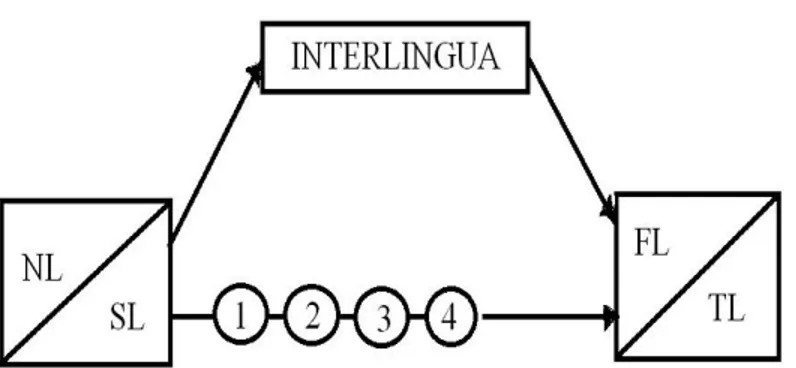
A basic definition about it provided by Gass and Selinker (2008, p. 14) establishes that learners create a language system, known as interlanguage (IL). The following scheme shows that the learners create and develop ‘approximate systems’ while attempting to learn a FL:
Figure 2.3: The field of interlanguage studies
Source: Adapted from James, C. (1980)
19 further on. Interlanguage has been used to refer with different but related meanings; one of which fits better to the present study, refers to the combination that exists between a particular mother tongue and a target language (i.e., French mother tongue/ English target language vs. German mother tongue/English target language). According to its creator himself there are five principal processes operated in IL:
1) Language transfer
2) Overgeneralization of the target language rules 3) Transfer of training
4) Strategies of L2 learning 5) Strategies of communication
(Selinker, 1972; Ellis 1990 p. 48) After reviewing this information, we can see that transfer or L1 interference is one of the several processes responsible for interlanguage (Ellis, 1990, p. 48); indeed, it is the initial and main process of IL.
In this section we have reviewed a general definition of transfer. It can be defined as the direct transference from one language to another. So far it has been mentioned the sort of transfer which occurs from the L1 or NL to the L2, known as substratum transfer; however the idea of transferring linguistic features from one L2 to a L3 must not be dismissed. The term assigned to it is interlanguage transfer. The reasons for focusing in this less conventional type of transference were provided in Section 2.1 of this same study. At this point, the study will be focused on that kind of transfer which the thesis topic is closer.
20 term) over another” (Gass & Selinker, 2008, p.152). In words of Gass & Selinker (2008, p. 152) in order to more completely understand the language transfer, it is necessary to go beyond the NL or L1 and the TL. According to them there is a number of variables that can impact the extent to which one of the languages involved (the L2 and the L1) will influence the acquisition of L3. Among these are the age at which L3 learning begins, the context of acquisition, individual characteristics, and language distances among the three or more languages (2008 p. 21). Cenoz (cited in Gass & Selinker, 2008, p. 154) discussed a number of factors that might influence cross-linguistic influence in general (e.g., age, context of use, proficiency)”.
Within the area of multiple language acquisition studies SLA language similarity
and its effects have been extensively investigated. A number of researchers like De Angelis, 1999; Dewale, 1998; Ringbom, 1987; Selinker and Baumgartner Cohen, 1995; Stedje, 1977; Vildomec, 1963; Williams and Hammarberg, 1998 (as cited in Gass & Selinker, 2008) have explored the particular phenomenon of interlanguage transfer. On one side, Vildomec (cited in Gass & Selinker 2008, p. 154) observed that L3 production tends to come from the second language and not from the native language. “This may occur even when the two languages are not phonetically similar” (Gass & Selinker, 2008, p. 154). These researchers explored the influence of a L2 over the L3. They discussed the use of function words from a second language rather than the native language in third language production (Gass & Selinker, 2008, p. 154). The results of their studies showed that the similarity between or among languages made an activation of the learner’s previous knowledge, but also they show how the transference for one L2 to an L3 happens.
21 Gass & Selinker, 2008, p. 152) examined the production of Italian by a French-Canadian L1 speaker with three foreign languages: Spanish, English and Italian. She found that interlanguage transfer occurred from Spanish to Italian because of the strong similarity patterns in phonology which served as an activation as was explained previously; the L2 knowledge formed the basis of associating and generating a new one in the L3. Another study carried out by Stedje attempted to examine the interlanguage transfer in Finnish learners of German as L3 with Swedish as L2 (cited in Gass & Selinker, 2008 p. 154). In this case Stedje found that the predominant transference was from the Swedish (L2) to German (L3) as it was explained in Section 2.1 of the present study. On the other hand, Williams and Hammarberg ( cited in Gass and Selinker, 2008 p. 154) carried out a study but this time with an English native speaker who has German as L2 and Swedish as L3. “The authors proposed that the German second language was activated in parallel to the third language” (Gass & Selinker, 2008, p. 154). Although they did not find a direct similarity, some German features such as lexical or structural features were transferred to Swedish. The transference from LI (e.g., English) could also happen to L2 (e.g., Swedish) because of a common characteristic that these three share: they belong to the Germanic languages (Section 2.1.1). However there must be more closeness between German and Swedish for the researchers to obtain those results.
22 better learners than monolinguals. Her study had support from a similar study carried out by Ramsay (cited in Gass & Selinker, 2008).
To conclude this section, I will say that language transfer is under the influence of several factors: cross-linguistics, interlanguage, learners’ cognitive processes, learning strategies, and the relation that exists between or among languages; that is to say that it has to do with certain similarities and/or differences they share. As Ellis (1985, p. 7) explained, in the case of similarities among them, it functions positively while in the case of differences it functions negatively. That means that language transfer has its beneficial and/or disruptive outcomes in the language learning. Those phenomena are known as
positive transfer, and negative transfer.
2.3.3 Positive transfer
In the previous section positive transfer was briefly described. It is caused by the similarities and close relatedness between the L1 or L2 and the TL. Positive transfer also receives the name of ‘facilitation’ because those existing similarities help the learner to make associations and in consequence to get positive outcomes while learning a foreign language. Corder describes the transfer as a facilitation strategy (cited in Gass & Selinker, 2008 p. 153).
Ellis made clear the facilitative effect of the L1 is evident in other aspects of L2 acquisition:
23 English learners because of the similarity of the Chinese and Japanese writing systems” (1994, p. 304).
What is said above is clear evidence of how positive transfer takes place. But also it shows that the starting point for transferring elements from language to another are the cognates; words that have a common origin or etymology therefore they have similar or identical meaning. Then cognates form the basis of vocabulary, as explained above, because they are easy to remember and resemble existing knowledge. But not only Ellis attempted to explore this kind of phenomenon. Odlin (1989 p. 1) gives a similar explanation about it by suggesting that the close relatedness of some languages facilitates their learning, he stated:
Many believe that the study of one language (e.g., Latin) will make easier the study of one closely related language (e.g., French). Similarly, people often believe that some languages are “easy” in comparison with others. For example, many English speaking university students see European languages such as French as less difficult than Oriental languages such as Chinese. Since the similarities between English and French seem to be relatively great, French is often considered “easy”.
24 which let the ‘facilitation’ happen depend on the language families. Originally the study mentioned was carried out by a researcher named Ringbom who argued that positive transfer affected notably the L2 learning. Ringbom (cited in Doughty & Long, 2003, 438-441) made a cross-linguistic comparison of Swedish and Finnish native speakers who aimed to learn English. In their explanation they give the following information as Swedish are Indo-European and Germanic languages Swedish speakers showed a greater succeed and progress over the Finnish speakers. This was encouraged by the similarity of the prepositional system but also by the large amount of cognate vocabulary – those aspects give a tremendous advantage in learning English – as Doughty and Long explained. On the other hand, Finnish speakers had problems because the Finnish language belongs to the non-Indo European languages; that is why “countless hours must be spent in remembering English words having little or no similarity to those of their NL” (Doughty & Long, 2003 p. 441). In these three examples about how positive transfer occurs, it is possible to observe that the belonging to specific language families plays quite a relevant role while learning a foreign language. This is because the similarities that prevail among languages let the learners generate new knowledge from the existing one. However not all researchers see transfer as beneficial. According to Ellis (1994 p. 304) some researchers have ignored the L1’s positive contribution and have only focused on the transfer’s negative aspects such as learners errors.
2.3.4 Negative transfer
25 transfer is more interesting than positive transfer (Doughty & Long, 2003 p. 438). He put special emphasis on the interference effects because he considered the language transfer as an impediment for correctly learning the structures belonging to the TL.
In the section 2.3.1 it was mentioned that transfer also receives the name of interference. However as explained by Odlin “the term interference implies (…) negative transfer”. Also Doughty and Long (2003) commented that transfer should not be equated to interference. From this information we can say that according to those researchers ‘interference’ has a negative connotation related to errors and in consequence with negative transfer. As explained in Section 2.3.2 positive transfer is the result of similarities between or among languages while negative transfer is the result of differences. Odlin (1989) establishes that the cross-linguistic influences result in errors, overproduction, underproduction, miscomprehension, and other effects that constitute a divergence from norms in the target language.
1) Underproduction consists of producing a very few or no examples of a target language structure.
2) Overproduction. According to Odlin, it is sometimes simply a consequence of underproduction referring to the excessive use of a structure.
3) Production errors. In speech and writing there are three types of errors especially likely to arise from similarities and differences in the NL and the TL: (1) substitutions and (2) calques:
-Substitutions involve use of NL forms in the TL.
-Calques are errors that reflect very closely a NL structure.
26 suggest that transfer always involves an obvious correspondence between the NL and the TL” (1989, p. 36 -37). Theorists such as Krashen (1993; Odlin 1989 p. 38) proposed that transfer is a falling back on the “L1 rule”.
2.4 Conclusion
This chapter served as the theoretical framework for supporting the thesis topic. The information that served as the basis for carrying out this study was provided. The first largest area to be focused on was language evolution in order to establish a close relationship between English and German, as they belong to the same language family. Thus, stating that those languages have features in common which make the transference of certain elements possible that might help English students to learn German.
The second largest area of this study was SLA, which as explained previously has to do with the acquisition and/or learning of subsequent languages in addition to the L1. Research in this area was consulted in order to explore closely the influence of interlanguage and cross-linguistics over the language learning, the phenomenon of transfer, its positive and negative outcomes, and how it works.
27 CHAPTER 3: RESEARCH METHODS
3.0 Chapter introduction
28 learned and taught. Those are the reasons why this methodology was ideal for reaching the aims of this research project.
The following sections provide detailed information about the participants and the instruments used during the research process.
3.1 Study participants
For the purposes of the thesis topic the participants involved in this study had to possess certain characteristics. First of all, I must mention that the subjects were Spanish-speaking students who were beginning German learners whose mother tongue constantly complicated their target language learning. However they possessed knowledge about English language as their L2. That knowledge started to form the basis of their German knowledge.
As those learners belonged to a German workshop in which only three or four people could attend, I decided to take that sample to analyze their productions. Everything was planned in convenience of the study aims; so far the methodology and the participants were mentioned. The following section presents the instruments which served for handling, collecting and analyzing data.
3.2 Study instruments
29 therefore the writing had to be under control by giving the participants a specific topic to talk about and specifying the number of words.
Another instrument was the ‘stimulated recall interview’ which was carried out after the written productions. the learners’ responses were important for answering the research questions and to discover how the input received through stimuli was being processed. The advantage is that the ‘stimulated recall methodology’ lets the researcher discover the participants’ language strategies and how they were generating their L3 amount of knowledge.
3.3 Data handling procedures
30 3.3.1 Data collection procedures
As explained in the previous sections the students were asked to write a short text in German for identifying similarities between English and German. Thus detecting what kind of elements promotes the positive and negative transfer. The type of stimulated recall used in this research receives the name of ‘consecutive recall’. The composing process happened as follows:
First, a text was handed in to serve as a model. Immediately after finishing revisions of the texts produced by the learners the participants were interviewed about the language choices they made during the composing process, using the initial and final products as stimuli, as proposed by Mackey and Gass (2000, p. 51).
3.3.2 Data Analysis procedures
31 3.4 Chapter Conclusion
32 CHAPTER 4: RESULTS
4.1 Chapter introduction
The previous chapter explained the methodology and the procedures followed to collect and analyze the data. Now to continue with the research project, this chapter will reveal the results obtained during the research process; that is to say the information gathered through the methodology applied and the instruments used for collecting and analyzing data. The results were the ones expected at the beginning of the research. Thus, as researcher, I can say that the interlanguage transfer, the transference from one foreign language to another, is possible to happen and to be used as a strategy for learning or as a facilitator between two related languages. This relation between English and German represents an advantage for students at the time of learning especially some vocabulary expressions. However it also causes confusion as English has been simplified along its evolution, thus losing most of the inflections while German has kept them. Then the grammar cannot be the same. In order to identify elements in common between these two, the participants were asked to write a composition in which positive and negative outcomes were observable resulting of the interlanguage transfer. In the sections below the results are described in detail.
4.2 Research questions
The research questions which guided the research project were the ones that follow.
33 4.3 Results
At the beginning of the research I planned to work with a small group of three or five people, all of them belonging to a German workshop. However because of the circumstances that could not be possible as the schedule of it was inaccessible. In consequence I was forced to look for participants who had characteristics I needed for carrying out the research. Although the plan underwent some changes and I could not work as expected in that workshop through an observation made for monitoring the students L3 learning the following information was obtained. The teacher is the key for understanding why the students transfer linguistic elements from English to German. He constantly encourages that kind of transfer which is referred as ‘transfer in training’, and it is part of the dynamics of each session. For starting each lesson the teacher shows the students a text in German, then they read the text and later he asks them to look for cognates which in most of cases have close relations with English rather than Spanish, their mother tongue. Those cognates help students to interpret the texts. After that, the sense and the content of it seem to be clearer for all of the students.
In general terms although in most cases the learners are not totally aware of the ‘family tree language’ as the lessons were in progress the students themselves realized that is a great similarity between English and German and started to make associations between them. Now that these aspects were explained I can say that this is the starting point for the rest of the research.
34 As explained in Chapter 3, the methodology employed for gathering and analyzing data was ‘stimulated recall’ that applied in SLA studies attempts to determine the knowledge that leaners possess about an L2 or other additional languages, and the source of that knowledge.
After making the necessary modifications the stimulated recall sessions were planned originally for five German students. However in the sessions 7 students participated. Those two extra participants were volunteers. The dynamics of the stimulated recall session consisted of watching three videos in which vocabulary and some phrases similar in English and in German were shown. This vocabulary had to do with ‘the weather’ (Das Wetter in German). Those videos attempted to work as stimuli for refreshing their minds and previous knowledge which seemed to have worked in the expected way.
After watching the videos, students had to write a letter in which they took into account certain aspects for composing the text. The type of text to be written was a letter because as I knew their teacher asked them to write lots of them. for that reason I thought that a letter with at least fifty words would be the most suitable for their level. The fact of setting a determined quantity of words was decided to make students organize a text and not only writing lines or isolated sentences. The topic of the letter ‘the weather’ was chosen because of the quantity of similarities between both languages; in the writing they could include vocabulary related to months and seasons of the year, adjectives and some expressions for describing the weather.
35 thought a lot while others showed a major facility at the time of composing while some others tried to look for notes in their notebook.
As soon as they finished writing, they were interviewed about their experiences during the composing process. Their comments were quite interesting and most of the times they seemed to support the topic of the present research project. Some of the students mentioned that English helps them and it works as a facilitator between their L2 and their L3 because English and German are similar. And that those languages have many words in common which receive the name of cognates. They identified those words in the videos shown at the beginning of the session. Some of them commented that these words are easy to remember because English words resemble German words: For instance:
Table 4.1 English – German cognates
Or even they are just different in only one letter, for example:
Table 4.2 Examples of words with similar spelling
36 for which he transfers elements from English as a facilitator; but also he produced errors as German grammar is more complex than English grammar.
Even there were two extra participants who told that they do not have enough or any knowledge of English. However they could make the connection between English and German through the stimuli done at the beginning of the session and could recall the vocabulary presented and use them in the text. Also there was a participant who mentioned that she never made a connection between English and German as they are totally different languages and they are not related in any way. Because of that, her composition had to be analyzed differently because she made many errors at the time of writing. Doubtless they were not result of the interlanguage transfer. It is possible that her errors were produced because of a lack of knowledge of German syntax or even because of the transference from Spanish to German; in that case the mother tongue or L1 might be causing interference. To justify this I will say that the structures used had no relation with the German language nor with English as that participant denied any kind of relation. Maybe these comments were the result of her absence at the beginning of the session while the other participants were exposed to the stimuli which she was not. Anyway her responses provided worthy information for this thesis project as she made more errors than the ones who declared that English was helping them in some way.
37 Now, from this point and the study will only focus on describing the positive and negative outcomes of the ‘interlanguage transfer’.
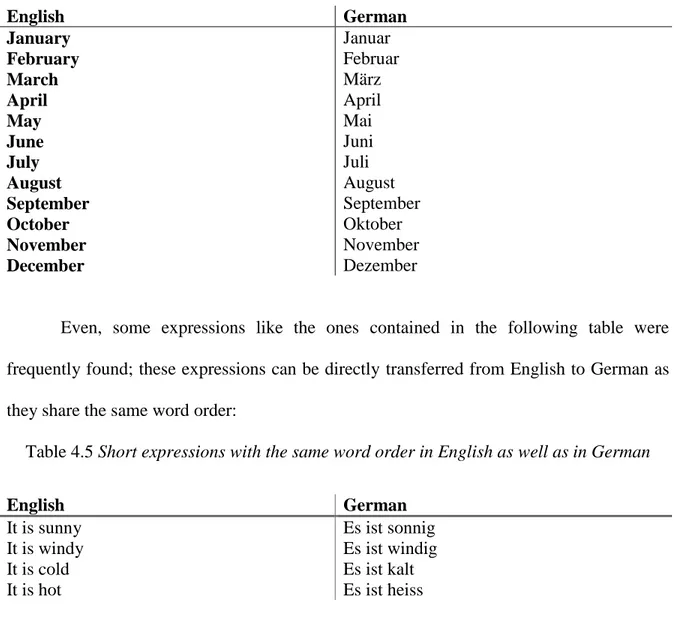
As mentioned in Chapter 2, Chomsky set parameters for contrasting language grammar in order to predict possible errors in learning, especially when a language is being taught, known as the contrastive analysis hypothesis. However that is not the case of this study as I am not trying to predict errors but studying the effects of interlanguage transfer. That is the reason why that approach was not used for analyzing data obtained. The results were interpreted in terms of spelling and syntax. Through the analysis of the productions it was possible to observe likenesses between these two Germanic languages: German and English to identify which elements were transferred directly and brought good outcomes. The writings showed that learners effectively looked for cognates at the time of writing. At first sight cognates are easy to find throughout the texts. Mainly they refer to vocabulary related to ‘the weather’ as it was the topic of their productions. Some of them were the ones shown in the following table:
Table 4.3 Examples of cognates most often used in the participants’ productions
38 frequently found; these expressions can be directly transferred from English to German as they share the same word order:
Table 4.5 Short expressions with the same word order in English as well as in German
But what about other words which are not necessarily related to the selected topic in the written productions? Of course there are many words which share a morphological root, like in the case of some verbs, such as:
39 Table 4.6 Similar verbs between English and German
English German
In the particular case of the verbs ‘hope’ and ‘hoffen’, we can say that these words are equivalent as they have exactly the same meaning and connotation. This property is called lexical semantics. English and German words are also similar in terms of semantics as can be appreciated in following examples:
Table 4.7 Semantic equivalence between German and English words
English German
In Spanish there is the same word for referring to these three concepts assuming that they have almost the same meaning. That is another point to take into account as the German words have more or less the same connotation as the English ones. Therefore these elements are highly transferable and helpful, too. The participants could clearly distinguish that connotation in their productions with the verb ‘hoffen’ and ‘warten’ as shown:
‘Ich hoffe, dass dir gut gehst’ I hope you are fine
40 ‘is’. While in the Spanish language a distinction is made and two different verbs are used for addressing those verbs, in English and in German it is not.
This is also the case of the modal verb ‘können’ which resembles the English modal verb ‘can’ especially when conjugated in the first and third person of the singular ‘kann’. These two modal verbs ‘können’ and ‘can’ have exactly the same meaning, use and function. Another similar modal verb is the verb ‘müssen’ which resembles to the modal
‘must’ particularly when conjugated in the second person of the singular ‘musst’. In fact
there is not much difference between the English and the German modal verbs as they have almost the same function.
But that is not all, there are other words in those texts which have close relatedness and are semantically equivalent, too. For example, the use of prepositions of place such as ‘in’ which is quite similar in German and in English. But although both have the same meaning, in some cases in German language the preposition ‘in’ is accompanied by a declension in accusative and/or dative, something that does not occur in English. In the case of the participants’ compositions it was employed to express that they were in a determined city or place which did work satisfactorily. See the examples below:
Table 4.8 The use of the preposition ‘in’ as a locative preposition in German and in
41 In the examples of Table 4.8 above it is evident that the word order is also concordant except in the last one. The German preposition ‘in’ can also be used as a preposition of time but that entails exceptions. In the following examples that preposition is adequately used and does not require any declension, also the word order is concordant:
‘Mein Geburtstag ist in Januar’ My birthday is in January
The compound words facilitate the learning of L3 students. German language makes extreme use of these, but also English tends to join words called lexemes in order to create others. Some examples found in the participants’ compositions are:
Table 4.9 Compound words similar in German and in English
Certainly, knowing how these words are compounded, they can give advantage for learning a language which lexicon contains lots of words just like the ones above.
And finally, we will revise words which are written or pronounced similarly. That is the case of the conjunction ‘und’, the adjective and also adverb ‘gut’, the cognate ‘Bier’,
and the adverb of place ‘hier’. These words were found in the compositions written by the participants. They were analyzed in terms of spelling. See below:
Table 4.10 Words with similar spelling and pronunciation
42 For concluding this section, these are some of the English elements found in the written productions which helped the participants write in German. To summarize I will say that cognates are highly useful for acquiring vocabulary and making associations between similar languages. Some words in English as well as in German may be identical or even just being different in one letter. There is a number of those between them which are highly distinguishable. Also some short expressions or phrases have the same word order in both languages which make them transferrable. The morphological roots also help learners make connections with similar words although they had been inflected like in the case of verbs. Semantics also play an important role in this matter as many words in English and German are semantically equivalent. The use of determined words is almost the same like in the case of modal verbs, something similar happens with the prepositions of place. Even, words which sound similar and are written similarly are also distinguishable and transferable. But not only that, the compound words help even more if the language which is attempted to learn combines lexemes in order to create new words. These are the elements which lead to the positive transfer from English to German; some linguistic items which have prevailed throughout centuries of evolution maintaining the ‘genetic relatedness’ of the Germanic languages.
43 English, which means that they clearly transferred the syntactical structure of their L2 to L3.
For interpreting the data in terms of syntax the book ‘Second Language Syntax’ by Hawkins (2001) was consulted as it contained German syntactical patterns which served as a guide for analyzing the utterances produced by participants into a whole text. Hawkins (2001) attempts to explain the developmental phases of syntax learning,.
First of all, syntax is the set of properties which determine the constructions of sentences in a language, explained (Hawkins, 2001). “If a sentence is constructed according to those properties, it is well formed (Hawkins, 2001 p. 2)”. If the contrary happens then the sentence is ungrammatical. Once this point is clear, the analysis starts.
German syntax is variable as word order is freer and more flexible than English; although in many cases German word order may be identical especially in main clauses:
Subject + Verb + Object
According to Hawkins (2001 p.125) “in declarative main clauses in German, where the verb is in a simple tense form, word order is similar to English (SVO)”. But this syntactical pattern cannot be applied for all the German sentences as there are several possible ways to arrange the words into a sentence in that language and maintain the same sense. Throughout the participants’ productions several sentence types predominate with that particular structure (SVO). See the following examples:
1a ‘Hier ist das Wetter wirklich schön, es ist heiss und sonnig’. Here the weather is beautiful, it is hot and sunny. b ‘Manche Tage es ist windig’
44 d ‘Das ist alles heute von mir, ich warte deine Antwort’.
That’s all from me for today, I wait for your answer. e ‘Wenn hier Sommer ist, das Wetter ist warm’.
When here is summer, the weather is warm
The examples (1a – 1e) are taken from the participants’ compositions. All of those are ungrammatical sentences for only one reason. If we observe the main clauses separately they are correct, but the sentences after the comma are considered errors as there is not verb inversion after it which automatically makes them ungrammatical sentences or errors. All those sentences (1a – 1e) followed the SVO structure. The correct syntactical pattern after the comma had to be as follows VSO. Then the correct arrangement must follow a pattern like this: SVO, VSO.
45 2a Wie du weisst der Frühling hat angefangen.
As you know the spring has begun.
b Heute das Wetter ist sehr schön aber im Winter das Wetter ist schlecht. Today the weather is beautiful but in winter the weather is bad.
c Ich lebe mit meine Familie
I live with my family d Ich bin sehr gut
I am very well
The examples from 2a to 2d show a clear correspondence between English and German, but that does not mean that they are well formed sentences indeed all of them resemble literal translations or calques:
(2a): The sentence is an example of an embedded clause as it starts with ‘wie’. There are two verbs in the sentence (V1 – V2). Then the verb tensed must be in clause-final position. That verb serves as auxiliary of the perfect tense.*Wie du weisst der Frühling angefangen hat.
(2b): In German when a sentence starts with an adverb the subject and the verb are inverted that is called inversion. There is not any inversion where it should be. In German before the coordinating conjunction ‘aber’ (‘but’ in English) there must be a comma while in English there must not. *Heute ist das Wetter schön, aber im Winter ist das Wetter schlecht.
46 (2d): The emissary used the wrong sentence for expressing well-being. *Mir geht’s
gut.
It is incorrect to say something as example 2d. First, it resembles a literal translation from English to German, and second it falls into another type of negative transfer error called misinterpretation. That is something to consider otherwise the emissary would be misunderstood and his message would not be well received. Besides this, all participants failed in a particular German syntactical pattern: the verb separation effect which implies the separation of V1 and V2 especially with compound tenses. The transference also followed the SVO word order, but with an error as shown in the following example:
3a Du musst trägt Kleidung für Sommer. You must wear clothing for Summer.
As shown in example (3a) V1 and V2 are together. In the case of the modals,
German language has a different syntactical structure from English, and even from Spanish. Example (3a) did not undergo the verb separation effect which implies that the V1 (musst)
is correctly arranged but V2 (trägt) should be placed in the sentence last position of the
sentence, as follows: *Du musst Kleidung für Sommer trägt.
Besides this, there is an error because V1 (musst) and V2 (tragen) were conjugated.
In this sense learners committed errors for they transferred from one language to another and/or calquing syntactical patterns.
One of the most frequent errors is the substitution of words, another type of negative transfer. For example, Ringbom (1986) noted the use of a Swedish word bort
(away) into an English sentence written by Swedish native speakers:
47 The word had been substituted for another which meaning was the same. As it occurred in the participants’ compositions, for example:
4a Ich schreibe diese Letter
I write this letter
b Mein lieblings Jahreszeit ist Summer. My favorite season of the year is summer.
As shown in sentence (4a), the writer did not use the German word for ‘letter’ (Brief) he used an English word instead. The demonstrative pronoun was not inflected in its correspondent grammatical case (accusative). *Ich schreibe diesen Brief.
In example 4b, the writer substituted again a German word with an English one. There is an error in gender in the possessive pronoun as the word Jahreszeit is feminine, then the ending should be –e. In English that gender differentiation it is not made.*Meine liebsling Jahreszeit ist Sommer.
Those are the elements that produce negative transfer errors at the time of being transferred directly from English to German. Most of them have to do with the syntactical structure and the inflectional morphemes which are quite different between English and German. Most of these errors are result of production errors such as calques or substitutions, misinterpretations, underproduction and overproduction.
4.4 Chapter conclusion
48 properties and words semantically equivalent that English and German share. Even, word order may be identical in some sentences or expressions. The genetic relatedness which descends from the language family tree also plays an important role in this resemblance. As Odlin (1989) stated these similarities arose from historical relationships. Besides this, cognitive processes also took part in this process of second language acquisition as the previous knowledge about an L2 encourages the learning of an L3. These are the reasons why students transfer elements from one Germanic language to another: English to German.
However this interlanguage transference was not beneficial in all instances especially in terms of grammar. German has a more complex structure governed by four grammatical cases and numerous inflections which complicates its learning. The negative outcomes in participants’ performance were related to these syntactical characteristics of the German language. The problems and confusions arose from these characteristic, problems such as: underproduction, overproduction, substitution, calques and misinterpretations.
For concluding, the phenomenon studied in this research project does not entirely concern linguistics. It has to do also with history and language evolution, as well as cognitive processes and learning strategies from the constructivist perspective as learners make use of their preexisting knowledge in order to generate new knowledge.
49 patterns. That might be one of the reasons for which it is easier for them to calque familiar patterns belonging to English or even Spanish language.
50 CHAPTER 5: CONCLUSIONS CHAPTER
5.0 Chapter overview
In this final chapter, the conclusions and the significance of the study will be presented. This chapter also contains a reflective account about the research project. The chapter also presents the limitations that affected the research process as well as recommendations and a section for further research.
5.1 Findings and results significance
The results of the research showed that the participants’ L2 and their L3 are related. There are elements that help them and they work as an advantage or as a strategy for learning. But also there are some other parts of the language which were confusing and make them commit errors. As mentioned in previous chapters, the languages to be analyzed belong to the Germanic branch, these are English and German. This study attempted to explore the phenomenon of transfer and how it works in students whose mother tongue (e.g., Spanish) does not help them for learning a foreign language (e.g., German). As a consequence they are forced to use a third language (e.g., English) as a facilitator for learning the TL they aim to learn.
51 5.2 Research aims
This study had several aims. The first one was to have a short students’ writing in German in order to analyze and to detect positive and/or negative transfer outcomes. Another aim was to do a stimulated recall method with each student, and finally to find reasons for which they were using English as a learning strategy or facilitator.
5.2.1 Accomplishment of the aims
The aims of the research were successively achieved. In the case of the first aim which was the obtaining of participants’ written productions in German I had to look for participants who had exactly the same characteristics; that is to say that it had to be a convenience sample. I had to expose participants to a stimulus which were videos and then monitor the composing process of the texts that would be analyzed later. Subsequently for achieving the second aim, I had to do stimulated recall interview with each participant, which means that I asked them about the composing process and what was happening in their minds while writing the text. Their answers gave worthwhile information for carrying out and supporting this study.
52 5.2.2 Answer to the research questions
Two research questions guided the data collection and analysis.
R.Q. 1 - What elements from English are students using to help themselves write in German?
To answer this question it was necessary to get a written production of the participants in order to detect similarities and differences between the participants L2 and L3. The results showed the following. There is a number of cognates that exist between English and German; those help the learners to acquire vocabulary for those are words which are easy to remember. The word order of some German sentences may be identical to English in some cases it helps them at the time of writing simple sentences. Furthermore there are words which have exactly the same meaning and function in both languages that make them semantically equivalent. The formation of compound words also helps them to write because German tends to join lexemes in order to create new words, something that English language does too. But overall the joining of some of those lexemes, it is very similar in which the words can be substituted for their equivalents. In the particular case of the participants’ productions, a pair of those examples were found.
The second research question guided us into another direction which clearly showed all the negative aspects of transferring directly grammatical rules from one language to another:
R.Q2 – Which elements are causing problems?
53 such as (a) substitutions, (b) calques and (c) alterations of structures. In any moment participants fell into one of those. Errors which were product of the interlanguage transfer as when students were interviewed one by one, they mentioned that they were mixing languages or even they found a close relationship between them which made them get confused. Those errors were a kind of direct translation from one language to another.
For concluding this section I will say that the results as presented in Chapter revealed that the kind of transference takes place while learning. Students themselves look for those similarities that exist between one language and another and use them to their benefit. But not all the outcomes were positive because there are quite different structures between English and German which at the time of being transferred directly produced errors and confusions. Those structures do not work satisfactorily; therefore they will have to be changed in order to avoid errors of negative transference.
5.3 Reflective account: Personal reflections about the researching process
In this section I will express in a very personal way. I will show my experiences while carrying out this project and also about the changes that I have undergone while doing research, and the benefits that it has brought to me.
54 Some ideas came to me but all them seemed silly and unworthy to research. I tried many topics which I found interesting but none of them made any contribution to the community of the language faculty in which I studied. Some people recommended choosing a subject which was attractive to me and then I chose a specific topic. But I could not choose easily. It was at the very end of my social service when I finally decided what topic to research about. At that moment I was immersed in a learning environment because I designed material for learning German. During a session of a German workshop and also throughout my German language learning process I realized that when students did not understand something in German they tried to associate it to English, as it was their L2.
In addition, as a student, I observed several times that many language learners left German aside because it was too difficult to learn, and in most of cases they opted for learning Italian or French which are romance languages as well as their mother tongue, Spanish. Therefore it was easier for them to learn rather than learning a synthetic Germanic language such as German. Considering that German and English belong to the same language family, then I thought of the possibility of making associations and transferences between them were logical. In that moment I felt motivated to investigate and learn more about that phenomenon, and I would also have the opportunity of going deeper and writing a document about what was taking place in those learning environments. Since that time I started enjoying researching and writing process of a document of which I would be the author.