Benemérita Universidad
Autónoma de Puebla
FACULTAD DE LENGUAS
Enhancing Business Lexical Phrases in
intermediate LEMO students
A thesis submitted to the Faculty of Languages for the Degree of
LICENCIATURA EN LENGUAS MODRENAS
By:
ELADIZMER ESTÉVEZ ALVARADO
Thesis Director:
GASPAR RAMÍREZ CABRERA
ENHANCING BUSINESS LEXICAL PHRASES IN INTERMDIATE LEMO STUDENTS.
After reading the research work conducted by
EladizmerEstévez Alvarado
The jury members considered thesis should be accepted as it meets one of the conditions required to obtain the title.
LICENCIATURA EN LENGUAS MODERNAS
Thesis director
____________________________
Mtro. Gaspar Ramírez Cabrera
Committeemember Committeemember
__________________________ __________________________
Dra. Elizabeth Flores Salgado Dr. Michael Thomas Witten
Benemérita Universidad Autónoma de Puebla
Puebla
ACKNOWLEDGEMENTS
I am honored to give these special acknowledgments to Professor Gaspar
Ramirez Cabrera, my thesis director from whom I have received all his support and
DEDICATIONS
I want to dedicate this work to my aunt Selene Alvarado Silva who has been
always there for me supporting me, to my mother who knows all the effort that I
have made to get here and to my family and friends who are an important element
TABLE OF CONTENTS
Chapter I: Introduction Page
1.1 Introduction to the problem 1
1.2 Purpose of the study 2
1.3 Research question 3
1.4 Hypothesis 4
1.5 Significance of the study 4
1.6 Key terms 4
Chapter II: Literature review
2.1 Defining pragmatics 6
2.2 Defining competence and performance 6
2.2.1 Language learning, competence and performance 7
2.3 Communicative competence 8
2.4 The importance of lexical competence 9
2.4.1 Lexical items 11
2.4.2 Lexical Approach 14
2.4.3 The dimensions of lexical competence 14
2.4.4 Vocabulary size 16
2.4.5 Organization 21
2.5.1 Social interactions 24
2.5.2 Necessary topics 28
2.5.3 Discourse Devices 29
2.6 Lexical phrases in transactional discourse 31
2.7 Adjacency pairs 33
2.8 Collocations 34
2.8.1 Grammatical collocations 34
2.8.2 Lexical collocations 34
2.8.3 The semantic approach 36
2.8.4 The structural approach 36
2.9 English for specific purposes Business Purposes 37
2.10 Lexical landscaping in business meetings 40
Chapter III: Methodology
3.1 Introduction 43
3.2 Instruments 43
3.3 Procedures and data analysis 44
3.4 Coding Scheme 45
Chapter IV: Findings
4.1 Overview 49
4.2.1 Social interactions 50
4.2.1.1 Conversational maintenance 51
4.2.1.2 Conversational purpose 53
4.2.2 Necessary topics 56
4.2.3 Discourse Devices 58
4.3 Collocations 60
4.3.1 Lexical Collocations 60
4.3.2 Grammatical Collocations (prep) 62
Chapter V: Conclusions
5.1 Discussion 63
5.2 Pedagogical implications 66
5.3 Limitations of the study 67
5.4 Suggestions for further research 67
References List 68
Appendix: Instrument
First situation: Book a cruise (Receptionist vs. client) 70
Second situation: Book a ticket (Receptionist vs. client) 72
Third situation: Telephone call (Receptionist vs. client) 73
Fourth situation: Telephone call (Receptionist vs. client) 74
Sixth situation: Make an appointment (Secretary vs. client) 76
Seventh situation: Apply for a credit card (Employee vs. client) 78
Eighth situation: Conversation (Manager vs. Employee) 80
Ninth situation: Job interview (Manager vs. Employee) 82
Tenth situation: Asking for information about a course
(Receptionist vs. client) 84
Eleventh situation: Ticket booking conversation (Receptionist vs. client) 85
Twelfth situation: Book a ticket for a flight (Receptionist vs. client) 86
Thirteenth situation: Telephone call (Receptionist vs. client) 88
CHAPTER I: INTRODUCTION
1.1 Introduction to the problem
In the Field of Foreign Language Acquisition (FLA), developing competence
and performance in the language is the most important goal in the learner´s
achievement, to raise awareness about the notions of using the L2 in the most
appropriate way. The term competence proposed by Chomsky (1965) is the
capacity of knowledge the language between speaker and hearer, which implies
grammatical and contextual issues. Later on, (Hymes, 1972, cited in Bachman,
1990) adds to the term psycholinguistic, sociocultural and probabilistic
subcomponents. Performance, on the other hand, is the usage of the language in
concrete situations. (Chomsky, 1965). So it can be said that competence and
performance are the abilities to use the language according to the social context,
producing correct utterances and appropriate messages (Bachman 1990, Canale &
Swain 1980).
But, what is understood by lexical competence? According to Brown,
Malkmkjaer & Williams (1996), is the ability of knowing a word and its meaning,
and then related them to other words in language. Furthermore, Saussure exposed
that “Language is a system of interdependent terms in which the value of each
term results solely from the simultaneous presence of others” (1916) 197:114, a
word has not meaning in isolation. A learner might have an extensive vocabulary,
but if he does not know how to use or to relate it to the context and other words,
2 Most of the times, words per se are meaningless, but all together give to the
speaker the capacity to command, to deny, to request, to regret to produce
complex and fluent utterances and as a result, the learner will be communicatively
competent. But, learners do not take advantage of their knowledge, in other words,
they only use a limited number of words instead of fully exploits it. So, it becomes a
big problem to deal with when learners use English for academic purposes,
because they prefer to use a simple set of word instead of a complex one.
The use of collocations and lexical phrases is of crucial importance in
Business English learners because students use vocabulary, but sometimes they
don´t know how to correlate it in common transactional situations. For this reason it
is very important for learners to be familiar to the lexical phrases and most
important, to know their function, in this way, learners are aware of the functional
organization of lexical phrases for business English and it‟s easier for them to
communicate in a correct way.
1.2 Purpose of the study
The aim of this investigation is to make a lexicographical study about the
functional aspects of collocations regarding Business English within the following
situations: telephone calls, booking, making appointments, job interviews, and
business conversations.
For Business English students it is very important to know the use of lexical
phrases and the functional aspects, in order to communicate in a correct way
3 vocabulary that people use when they to talk to a friend than when they talk to a
customer.
The main concern is to inventorize and identify lexical phrases in different
kind of situations in order to explore their functions. There are several types of
lexical phrases that are related to particular functions for this reason Nattinger and
De Carrico (1992) attempt to group these phrases in three categories and they
refer these groups as “social interactions”, “necessary topics”, and “discourse
devices”.
It is very important to make an emphasis and mention that the purpose of
this study is to help students to familiarize to the lexical phrases and the most
important to know their function in this way learners will be aware of the functional
organization of lexical phrases for business English.
1.3 Research question
This paper sets out to answer the following question.
1. Which of the three categories of the lexical phrases: social interactions,
necessary topics and discourse devices, tend to appear more in the
transactional language conversations and why is it important for learners to
4
1.4 Hypothesis
The hypothesis below is related to the research question.
a) Learners are not taught to comprehend their vocabulary. They receive
several new words without being related between them and to their context.
1.5 Significance of the study
According to Meara (1996) (cited in Brown et al., 1996), “Lexical
competence is at the heart of communicative competence” (p. 35). Unfortunately,
lexical competence has not been fully researched because it has been placed into
grammatical aspects, since they include “phonological forms, morphological forms,
syntactic patterns, lexical items; and emphasizes the way in which these forms
may be combined to form grammatical sentences” (Canale &Swain, 1980, p. 2).
So, this study pretends to support Meara´s idea that lexical competence must be of
great importance for FLA.
This study will demonstrate how communicative units of a text, that are
associated with each situation, can be identified linguistically by employing the
notion of fixed or quasi fixed expressions (mainly collocations).
1.6 Key terms
Pragmatics: Pragmatics is concerned with the study of meaning as communicated
by a speaker and interpreted by a listener. It is the study speaker meaning. (Yule,
5 Competence: It is the capacity of knowledge the language between speaker and
hearer. (Chomsky, 1965).
Performance: It is the ability of using the language correctly. (Chomsky, 1965).
Communicative competence: The ability to use the language for communication. It
implies producing correct and understandable utterances, according to the context
(Canale & Swain, 1980).
Lexical competence: It is the ability of knowing a word and its meaning, and then
related them to other words in language. (Brown et al., 1996).
Vocabulary: The body of words known to an individual person (Oxford Dictionary).
SLA: Second Language Acquisition.
ESL: English as a Second Language.
6
CHAPTER II: LITERATURE REVIEW
In this chapter, the theoretical framework of this research is presented. The
perspectives from different authors are discussed to emphasize the importance of
the main concepts considered in the thesis. Concepts that are involved in the
development of this research are defined.
2.1 Defining pragmatics
According to Yule (1996), pragmatics is concerned with the study of the
speaker meaning, contextual meaning and the expressions of the relative meaning.
In addition to this, Green (1996) defines Pragmatics as the “successful
interpretation by an address of a speaker´s intent in performing a linguistic act”
(p.1), that is, the speaker´s success in the communicative role. Furthermore,
Levinson (1983) suggest that Pragmatics is the study of language usage and is
focused solely with per formative principles of language use. So, it can be said that
Pragmatics is the study of the speaker´s usage of the language in concrete
situations.
2.2 Defining competence and performance
Chomsky (1965) defines linguistic competence as the speaker-hearer´s
knowledge of the language, whereas performance is the actual use of language in
concrete situations (cited in Brown et al., 1996). But, Hymes (1972) adds to the
term competence grammatical and contextual aspects such as grammatical,
psycholinguistic, sociocultural and probabilistic subcompetences. In additions to
7 “the perfect knowledge of the ideal speaker-listener in a homogeneous speech
community whereas performance is the process of encoding and decoding” (p.11).
In sum, competence and performance are surely important for the speaker´s
handle of the language, which most of the times occurs unconsciously.
2.2.1 Language learning, competence and performance
Brown (1996) suggests that, given an initial, fixed set of fundamental
constraints which determine the possible forms which human languages can take
the relationship between linguistic competence and performance is most usefully
perceived as one of continual, mutual modification of one by the other. Linguistic
competence, in Lyons´ sense of the knowledge which enables a speaker to use
language, is treated as only minimally dependent on the initial system, and as
maximally dependent on experience, including practice in receptive and productive
linguistic performance.
On this view, the developing competence becomes inherently variable,
because no two persons´ sets of experience are identical, and any postulated
differences between L1 and L2 learners´ competence become differences of
degree rather than one of type.
Brown (1996) further reminds us that L2 learners are not alone in performing
variably; the question, then, is why we should wish to suggest that variable
performance? In adult L1 users is caused by various “external” features which
interfere with the perfect reflection in performance of their stable competence,
8 their competence, and this competence should be considered a stage on the way
towards the unreachable, ideal goal of acquisition of the “stable” competence of a
native speaker.
The interesting difference between L1 and L2 speakers´ performance,
Brown (1996) suggests lies in the difference in nature between the types of
variability produced by the two groups. This difference can be measured along
three dimensions: pattering, frequency, and distribution. Brown suggests that if we
conceive of individual competences as holistic fluxes rather than as distinct sets of
rules and systems, one set for each language to which the individual is exposed, at
least some differences in performance variability between L1 and L2 learners can
be explained simply in terms of the general differences in linguistic experience
which must, perforce, exist between the two groups of language users.
2.3 Communicative competence
Savingnon (1983) characterizes communication as:
Dynamic rather than…static… It depends on the negotiation of meaning
between two or more persons. Communication takes place in an infinite
variety of situations, and success in a particular role depends on one´s
understanding of the context and on prior experience of a similar kind
9 Kramch´s (1986) discussion of communicative interaction echoes these notions:
Interaction always entails negotiating intended meanings, i. e., adjusting
one´s speech to the effect one intends to have on the listener. It entails anticipating
the listener´s response and possible misunderstanding, clarifying one´s own and
the other´s intentions and arriving at the closest possible match between intended,
perceived, and anticipated meanings. (Kramsh 1986:367)
Communicative competence is more than being able to communicate in a
successful way. It is to use the knowledge possessed by the speaker in the
appropriate context. This is the main issue in pragmatic competence, which is a
term that takes part in the communicative competence concept. As it is showed
communicative competence is very important to have the knowledge required to
use language to achieve particular communicative goals and the recognition of
language use as a dynamic process. (Bachman 1990)
2.4 The importance of lexical competence
Since the terms linguistic competence and performance were proposed by
Chomsky, many linguistics have been modifying these term, whether adding
definitions or changing them (Hymes 1972, Canale and Swain 1980) but, lexical
competence has not been recognized as an important aspect of communication.
“Whichever way you look at it, lexical competence is at the heart of communicative
competence and it also enhances students´ awareness of semantic networks”
(Meara, 1996, cited in Brown, 1996). Semantic networks allow us to see how
10 Chomsky (1965) explained linguistic competence as a static concept based
only in grammatical rules, in which lexical competence is implied, but never
mentioned. Later, Canale and Swain (1980) proposed grammatical competence
which included knowledge of syntax, grammar, lexical items; but the capacity of
using and understanding those lexical items were sidelined. In fact, words are units
par excellence; they have power (Michnick et al., 2000). Lexical competence is an
aspect of L2 competence which has not been fully studied. Canale and Swain
(1980) describe grammatical competence into rules of morphology, syntax,
sentence grammar, semantics and phonology.
Communicative competence became an important issue of study by 1980´s,
when Rudzka, Channell, Putseys and Ostyn (1981) suggested applying structural
semantics to vocabulary teaching. That is, that the learners develop
communicative competence with a very limited vocabulary. But, their ideas did not
change the way of teaching vocabulary, which methodologies remained strongly
rooted in practices of the past. In other words, “most of the teachers are
remarkably ill informed about the role that lexis plays in language” (Meara, 1996)
p.36. In fact, the awareness about owns vocabulary will influence the way that a
teacher teaches vocabulary. Zechmeister, D´Anna, Hall, Pass and Smith (1993)
developed a set of questions in order to find some evidence about this issue:
a) How many words are there in English?
b) How many of these words would you estimate are part of your passive
11 c) How many of these words would you estimate are part of your active
vocabulary?
That is, the amount of teacher´s vocabulary will affect the way of teaching.
For example, if a teacher´s repertoire is about 400 active words and it is going to
be taught about 2000 words, it is going to be the half of what the teacher thinks to
know. But, if its repertoire is about 20, 000 words and the learners will only learn
2000; they will only learn ten per cent of what the teacher knows. So, the real
problem here is that teachers do not know to teach vocabulary and then, to
develop lexical competence in learners (Meara, 1996).
This thesis aims to describe lexical competence in a set of easily
measurable dimensions. “These dimensions are not properties attached to
individual lexical items: rather they are properties of the lexicon considered as a
whole” (Meara, 1996 p.37).
2.4.1 Lexical items
Lexical items or “chunks” are learned and used as single items. Lewis
(2000, p.91) categorized lexical items (same definition, different name) into three
sets:
a) Words: they are the main units of the lexicon that may contain words of low
information content such as articles and conjunctions, and words of high
information content such as nouns, verbs, pronouns and so on. These
groups of words are subdivided in multiple-words items and polywords that
12 include phrasal verbs, idioms and slang (e.g. put off, all at once, by the way,
taxi rank).
b) Collocations: they are a group of words that can have different meanings
depending on the word that precedes the other. Furthermore, there are
collocations that vary according to the speaker´s context and culture or are
highly institutionalized or ossified forms; these are known as fixed
collocations.
c) Institutionalized expressions: they allow to the speaker´s interact in a certain
context, these items that permit to give a continuum to a speech. Lewis
subdivided them in three sets:
1) Short, hardly grammaticalised utterances such as not yet, certainly not,
just a moment, please.
2) Sentence heads of frames, usually with some pragmatic purpose.
3) Full sentences that are recognized very easily as institutionalized
expressions that contain an explicit pragmatic purpose.
However, Lewis (2000, p.7) redefines these terms into four sets:
a) Words: they may stand alone and have a meaning per se, but they may
stand attached to other words as well. This is known as multi-words, these
combinations vary according to the context and some of them are already
established. For example: on the other hand or by the way.
b) Collocations: they are those chunks of words with variations of meaning
according to the context. Those variations are purely pragmatical and
13 __________, chase/miss the bus, make/do a mistake. In addition to this
fixed collocations are those already established: a broken home, to catch a
cold; but it does not mean that they can be collocated in different forms.
Fixed idioms are collocations as well such as: you can´t pull the
__________ over my eyes.
c) Fixed collocations: they are lexical items that permit daily speech and they
allow some changes in its structure such as: good morning/ afternoon/ night
or no thank you, I´m fine. This category includes chunks of easy
identification. They include social greetings, politeness phrases and idioms.
d) Semi-fixed expressions: they are expression that permit variations and many
of them occur in both spoken and written language. There is a vast number
of these expressions and “they are from very short to very long and from
almost fixed to very free” (Lewis, 1996). This category includes:
1) Almost fixed expression: those that allow a minimal variation. (it´s/that´s
not my fault)
2) Spoken sentences with a simple slot (Could you pass____, pleas?)
3) Expressions with a slot that permit to be filled with a particular kind of
word (I haven´t seen you for/since…)
4) Sentence heads that can be completed in different ways (What was
really annoying/ interesting/ surprising was…)
In sum, lexical items or phrases are at the core of language. They are those
that construct and permit speech, both spoken and written language, and
14 1996), lexical items are the master pieces of lexical competence. Furthermore,
daily language is made of those chunks already established in the speaker´s
repertoire, capable of use them according to the context. Nattinger and DeCarrico
(1993) give good explanations about lexical phrases, categorized them by their
type and usage. However, they made clear distinctions about vocabulary and lexis.
But, this will be mentioned later on this chapter.
2.4.2 Lexical Approach
A lexical approach, in language teaching, refers to one derived from the
belief that the building blocks of language learning and communication are based
on lexis, that is, words and words combinations (lexical items).
“Lexical approaches in language learning seek to develop proposals for
syllabus design and language teaching founded on a view of language in
which lexis plays the central role” (J. Richards & T. Rodgers, 2001: 133).
The lexical approach goes back to Firth (1951), who holds that meaning by
collocation is an abstraction at the syntagmatic level and is not directly linked to the
conceptual of the meaning of the words in the collocation.
2.4.3 The dimensions of lexical competence
Meara (1990) proposes that actual knowledge of lexical items, rather than
merely the ability to recognize items as belonging to the vocabulary of a given
language, can be tested by tapping a person´s ability to make connections
15 Theories of meaning have, during this century, tended towards the type of
holism expressed by Saussure: “Language is a system of interdependent terms in
which the value of each term results solely from the simultaneous presence of the
others” (1916) 1974:114. Even in the Firthian, somewhat modified, view of
language as composed of several subsystems of interdependent signs, the holistic
view has clear consequences for theories of word meaning: a word does not have
meaning in isolation, but derives its meaning, at least in part, from interaction with
a number of other words in the language.
The vocabulary-related difficulties experienced by even highly competent L2
users are well documented, and Meara (1990) is clearly right to posit lexical
competence as an important component of communicative competence, especially
in view of the fact referred to by Brown that in many current models of syntax.
Meara (1990) states that even if vocabulary organization is centrally
involved in lexical competence and provides a good measure of advanced
learners´ level of lexical competence, the question of the degree to which it is
necessary, desirable, possible and useful for an L2 speaker´s vocabulary
organisation to be like that of an L1 speaker remains of fundamental importance
and is still unresolved.
According to Meara (1990) lexical competence might not be such an
intractable idea as it is sometimes made out to be. Traditionally, people have
16 knowledge that a speaker might have about a word in his/her lexicon-a fully
specified model of the way individual words work in the language.
What Meara (1990) have put forward instead is the idea that, for practical
purposes, it might be possible to describe the salient features of lexical
competence in terms of a small number of critical dimensions. The two that the
author identified are size and organisation; these two dimensions have the
advantage that they are relatively independent of the items that contribute to them,
and do not require a detailed understanding of the way individual lexical items
function. The crucial idea is that lexical competence is probably not just the sum of
speakers´ knowledge of the items their lexicons contain. There might be some
advantage to be gained from backpedalling on this item-based approach to lexical
competence, and from considering lexical competence in terms of a small number
of global properties, rather than an accumulation of attributes of individual words.
2.4.4 Vocabulary size
Lexical competence (Brown et al., 1996) is mainly important ruled by the
vocabulary´s size. A learner with a big repertoire will be more proficient in language
in a wide range of skills than learners with a small repertoire. Yoshida (1978)
focused his interest in how vocabulary grows. He studied a three and a half-year
old Japanese child in a naturalistic research. He found that the subject learnt about
500 words in a full year. Unfortunately, these results cannot be generalized to older
learners in formal learning situations. Actually, there are more studies about people
17 Later Takala (1985) made a large scale study to finish learners of English. The
results vary between 450 and 1500 annual total words learnt. However, no
distinction between active productive vocabulary and passive receptive vocabulary
was made. Conclusions were unclear, so the results were not reliable.
The problem is that probably there is not a reliable test in order to find out
the vocabulary size and then to resolve the Zechmeinster et al. questions. It seems
that creating a test to inquire into vocabulary size and how quickly it grows is not a
matter of interest. The Nation´s Vocabulary Level Test (Nation, 1990) seems to be
the most standardized test in vocabulary. This test assesses a small number of
words grouped by frequency. Nation argues it gives a guide it the extent of a
learner´s vocabulary and many studies have supported it (Meara, 1996).
Actually, to measure a learner´s vocabulary may be easy. In theory, you can
take a dictionary and take a sample of words. Later, devising a suitable test for
these words and then calculating the proportion of words that a testee knows. If the
learner knows the same proportion of words then the test is a good one, but in the
other hand it may present some disadvantages.
The first problem is counting the number of word in a dictionary. Many words
belong to the same word family such as “happy, happiness, happily, unhappy,
etc.”; the mainly problem is to what should be counted as a word. However, words
such as “Talk” may have many entries in a dictionary and it may seem wrong to
count all these entries as separate words. (Meara, 1996) Furthermore, in order to
18 vocabulary is formed by. Nation estimates that a native speaker´s vocabulary is
around 17 000 word families (Read, 1990).
The second problem is to make a small test for something huge. Actually, to
obtain accurate results, the test should be created by the 10% of tested words.
That is, if a learner´s vocabulary is around 400 words, the result will be a 40 words
test. However, if a learner´s vocabulary has 5000 words, as 500 words test may be
long for the most commonly tests formats. For instance, the bigger the learner´s
vocabulary is, the more of a problem this becomes.
The third problem is scoring. The score depends on the type of tests used.
In many cases, the testees just guess or eliminate the words they know are not
connected to the target words. But, the results at the end may not be what the test
designer is focused in.
All these problems have discouraged people to create a standard
vocabulary test, which may be used to research about how many words people
know, how faster vocabularies grow and how these factors are relates to other
aspects of linguistic competence. Some tests have been done an applied, but all of
them are incompatible with each other. This makes it difficult to collect data and to
contribute to the fragmentation of the field.
A solution proposed by Meara and Jones (1988, 1990) was to develop a
standardized vocabulary test in a foreign language. This test consist in a set of real
and imaginary, non-existing words. The testee only had to identify which of these
19 techniques based on the “Signal Detection Theory” (McNichol, 1975). So, it may be
known how many real words the testee knows with some degree of accuracy.
Nation (1986) developed a checklist test in which the target vocabulary is well
defined. This test is called the “Nation University Word list”, which consists of 2000
most frequent words in English. Once the target vocabulary is known, a testee who
scores 50% will know about 50% of that vocabulary. In fact, using a set of three or
four set of tests makes it possible to build up a profile of a testee´s vocabulary
knowledge so, it can be measured how vocabulary growth over short periods of
time.
There are many advantages about those checklist tests over other forms of
vocabulary testing. One of the advantages is that it can measure a very large set of
word in a very short of time. This test only takes a few of minutes to complete and
this makes it very easy to test. These tests can be applied to beginners and with
advanced learners, and are less complex from other test such as multiple choice
batteries.
The conclusions were that the checklist tests were very promising. On the
computerized version the testee receive feedback about its vocabulary size just
after of finishing the test. The test also correlates well with other tests of linguistic
skills, particularly in those where it would be expected vocabulary knowledge such
as listening comprehension and reading comprehension. These correlations were
good enough in order to allow the usage of the vocabulary test as a rough
20 However, some disadvantages were discovered through the time. First, the
test did not work well with low-level learners who often misread items in
unpredictable ways. Second, it did not work well for certain L1 groups. For
example, French native speakers correlate much less well with other linguistic
skills than other L1 groups. Third, a more worrying problem was that some testees
were more over-willing to say “yes” to imaginary words. So, all these problems
affect the performance of the test.
Nevertheless, the checklist tests still being a good methodology to the
problem of measuring vocabulary size in the foreign language learners.
Furthermore, these tests help to look at the way that vocabularies grow at
advanced learners, how this growth is affected by the circumstances and how this
affects the learner´s performance.
The major criticism is that checklist test only measures the number of words
in a learner´s repertoire, but in principle, they are incapable of measure how well
these words are known, and how far they have been internalized. It is truth that
checklist tests do not prove if the learner knows the word; it only measures the
vocabulary size. But, the argument may be that a L1 speaker with a big vocabulary
knows at least all the meanings of the words: “a learner with a huge vocabulary
and nothing else is a possibility, but something of a freak” (Meara, 1996) p. 44.
Most of the people acquire L2 words from the exposure some knowledge about the
use of these words than learners with small vocabularies. Then, vocabulary size
21 For English, a small lexicon is around five or six thousand words. (Meara,
1996), but for other languages with more morphological derivations, the number
may be lower. So, vocabulary size per se becomes less important, because
English appears to have rather a lot of different lexical items and relatively less in
the way of a lexical system. For other languages, it may be rather different.
2.4.5 Organization
So, it seems that vocabulary size becomes less important as the lexicon is
bigger. As a matter of fact, it is important to measures how well these words are
known. This distinction is based between tests of vocabulary depth and tests of
vocabulary breadth. Tests of vocabulary breadth are design to assess detail
knowledge of words and their attributes. Thus, the question that is asked is: “does
the testee really know this word?” (Meara, 1996).
According to Richards (1976), seven different aspects exist in order to
consider knowing a word:
a) Knowing the degree of probability of encountering the word in speech or
print.
b) Knowing the limitations of the word according to certain circumstances
(function and situation).
c) Knowing the syntactic behavior associated to the word.
d) Knowing the underlying form for a word and the derivations that can be
22 e) Knowing the association between the word and other words in the
language.
f) Knowing the semantic value of the word.
g) Knowing the different meanings associated with the word.
Richards gives a good specification list of what it means to know a word.
But, the real problem is to develop a good word knowledge test because it would
be very difficult. If we want to measure a 50 word sample, then the resulting test
would need at least 350 separate items, one for each set of words that we want to
measure. Furthermore, Nation (1990) developed a word knowledge list of eight
types of word knowledge and 16 different subcomponents. For him, testing a 50
word sample require a test with 800 separate questions. Both of the tests are too
far for practical test, not only for the testees, but for the test constructor. (Meara
1996).
However, these measures are only taken for individual, separate words, but
they are no generalized to a learner´s entire vocabulary. So, the importance is a
measure for an entire vocabulary that could be used alongside the size dimension
to characterize vocabularies of different types. One possibility that is hinted to
Richard´s list is the “network of associations between a word and another word in
the language.” (based on Deese, 1965). These networks show the learner´s ability
to make associations between L2 words in a native-like way. For example, the
word butterfly is the centre of the complex web of associations for Native English
speakers. Those associations that they made were some emotional, some
23 These measures could include the degree of connectivity of a network, the average
distance between randomly selected words and so on. Measures of this kind are
what distinguish a true vocabulary form a mere list of words. Furthermore, it was
seen that L2 learners found less easy to find connections between words or they
just could not find any relation between them, than L1 speakers.
This measure was that really distinguish learners with different levels of
proficiency, because it not only assess the word knowledge, but it assesses the
vocabulary as a whole. For nonnative speakers, it seems much harder to make
connections between different parts of the lexicon, because L2 lexicons are much
smaller than L1 lexicons.
Meara (1996) argues that people whose vocabularies highly structured will
be better performers than people with less structured vocabularies of an equivalent
size. For instance, it is necessary to develop an alternative way of characterizing a
lexicon independent of size. Lexical competence is characterized by size and
organization. Some questions about vocabularies growth and the knowledge about
what should be categorized as a word have been arisen. The way that beginners
and advanced learners performance might be very different each other. “Maybe
adding a handful of items, to a relatively unstructured lexicon is very different from
what happens when items are added to a lexicon that already has a rich internal
24
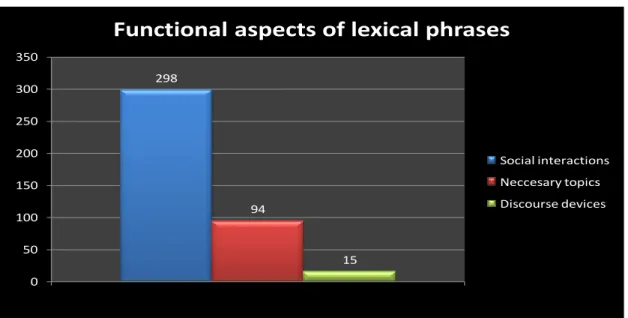
2.5 Functional aspects of lexical phrases
Nattinger and DeCarrico (1992) states that speaking a language means
conversing in it, and comprehending a language means understanding phrases,
not as isolated bits of grammatical structure, but as the flow of the surrounding
discourse.
There are several types of lexical phrases that are related to particular
functions for this reason Nattinger and De Carrico (1992) attempt to group these
lexical phrases according to function in a way that will reflect the requirements of
spoken and written language and, at the same time, be pedagogically useful.
Nattinger and De Carrico (1992) group these lexical phrases in three
categories and they refer these groups as “social interactions”, “necessary topics”,
and “discourse devices”. To illustrate the distinctions between each category, the
authors list typical examples, these examples do not represent an exhaustive list,
of course, but they do suggest some of the kinds of lexical phrases.
2.5.1 Social interactions
In discussing social interactional Nattinger and De Carrico (1992) establish
those that describe social relations and these consist of:
(a) Categories of conversational maintenance (regularities of conversational
interaction that describe how conversations begin, continue, and end).
25 Summoning: excuse/pardon me (sustained intonation);
hey/hi/hello, (NAME), how are you (doing)?;
lookit; I didn´t catch/get your name; do you live
around here?; hello, I´m + NAME; good
morning/afternoon/ evening, (how are you?);
what´s up?
Responding to summons: hi/hello, (NAME); how are you (doing)?; what´s
going on/happening?; hello, I´m + NAME; (I´m)
fine, thanks, (and you)?
Nominating a topic: what´s X; (by the way) do you know/remember
X?; have you heard about X?
Clarifying:
(1) audience: excuse/pardon me?; what did you mean by
X/when you said X?
(2) speaker: what I mean/I´m trying to say is X; how shall I put
it ?; let me repeat
Checking comprehension: all right?; (do you) understand (me)?
Shifting a topic: (say,) by the way; this is (a bit) off the
subject/track, but X; where were we/was I?; oh
26 Shifting turns; (well,) so OK; excuse/pardon me; could I say
something here?
Closing: well, that´s about it; I must be going; (it´s been)
nice talking to you/meeting you; I´ve got to
run/go/do X; I mustn´t keep you any longer
Parting: goodbye; see you later; (well) so long (for now)
(b) Categories of functional meaning relating to conversational purpose
(types of speech acts, i.e. functions that describe the purposes for which
conversations take place).
Expressing politeness: thanks (very much); (please,) if you don‟t mind
Questioning: (rising intonation), do you X?; is/are there/it/they
X?
Answering: yes, (there/it/they is/are) (X); no, (there/it they
is/are not) (X)
Requesting: Modal + Pro + VP (i.e. would you (mind) X?); may
I X?
Offering: Modal + Pro + VP (i.e. may/can I help (you)?);
would you like X?
27 Refusing: of course not; no way; I´d rather you X; I´m sorry
but (I´m afraid/I think that) X
Complimenting: NP + BE/LOOK + (intensifier) + Adj; I +
(intensifier) + LIKE/LOVE+NP
Asserting: it is (a fact/the case that) X; I think/believe that X;
it´s said that X; word has it that X; it seems X; I
read (somewhere) that X; there is/are/was/were
X
Responding:
(1) acknowledging
(simple reinforcers): (and then) what happened (next/then/after that)?
(2) accepting: (yeah,) I know; (oh,) I see, no kidding
(3) endorsing: yes, that´s so/correct/right; I
absolutely/certainly/completely agree; (that´s) a
(very) good/excellent point; there you go; that´s
great
(4) disagreeing: yes, but (I think that) X; I don‟t (really) agree (with
you/X)
Expressing gratitude: thanks (very much/a lot) (for X); I (really)
28 Expressing sympathy: I´m (very) sorry about /to hear (about) X; (wow),
that´s/how terrible/awful; what a
shame/pity/terrible thing
2.5.2 Necessary topics
Authors Nattinger and De Carrico (1992) argue that in necessary topics
lexical phrases mark topics about which learners are often asked, or ones that are
necessary in daily conversations like:
Autobiography: my name is _____; I´m from _____; I´m (a) _____
(years old)
Language: do you speak _____?; how do you say/spell
____?; I don‟t speak _____ very well; I speak
_____ (a little)
Quantity: how much/big is _____?; (not) a great deal; lots
of ___
Time: when is X?; what time X?; for a long time/____
years; a _____ ago, since X; at/it´s ____ o´clock;
on____ day; the _____ before/after ____
Location: where is ____?; what part of the ____?; across
from ____; next to ____; to the right/left (of ____);
29 Weather: is it going to X? it´s (very) _____ (today)!; I´m
____
Likes: I like/enjoy _____ (a lot); I don‟t like/enjoy ____
(at all); I´d like to X; _____ is lots of fun; (what) do
you like to X?
Food: I´d like (to have) _____/ to make a reservation
(for_____); the check; a table for _____; serve
breakfast/lunch/dinner
Shopping: how much is ____?; I want to buy/see _____; it
(doesn‟t) fit (s); (not) too expensive; a (really)
good/ bad buy/bargain; _____ cost(s)
(me/you/them) _____ dollars
2.5.3 Discourse Devices
According to Nattinger and De Carrico (1992) discourse devices are lexical
phrases that connect the meaning and structure of the discourse such as:
Logical connectors: as a result (of X); nevertheless; because (of) X; in
spite of X
Temporal connectors: the day/week/month/year before/ after_____; and
then; after X then/ the next is Y
30 Fluency devices: you know; it seems (to me) that X; I think that X;
by and large; at any rate; if you see what I mean;
and so on; so to speak; as a matter of fact
Exemplifiers: in other words; it´s like X; for example; to give you
an example
Relators: the (other) thing X is Y; X has (a lot)/ doesn´t
have (much) to do with Y; not only X but also Y
Qualifiers: it depends on X; the catch is X; it´s only in X that
Y
Evaluators: as far as I know/ can tell; there´s no doubt that X;
I´m (not) absolutely sure/ positive/certain
(but)_____; I guess; at least; at all
Summarizers: to make a long story short; my point (here) is that
X; OK (level intonation)
Nattinger and De Carrico (1992) employ three formal categories for each
one of the three functional groups which are: polywords, phrasal constraints and
sentence builders.
Authors Nattinger and De Carrico (1992) talk about lexical phrases in
conversational discourse; they establish that comprehending and producing a
language means understanding how the parts of language fit together as parts of a
31 organizers and provide patterns for the framework of the discourse; necessary
topics, introduced here basically for their pedagogical usefulness, provide patterns
for the subject of discussion.
In the patterns in conversation, Nattinger and De Carrico (1992) states that
one of the most basic interactions at the beginning of a conversation is to get the
attention of the person one is talking to. So when that person responds to the
summons, the next step is to get the partner to attend to the topic of discourse; one
then begins to offer information about the selected topic. In this way, the
participants co-operate to build a conversation. After the purpose of the
conversation has been satisfied, the participant close the dialogue, and part.
2.6 Lexical phrases in transactional discourse
In the excerpt from interactional versus transactional discourse, Nattinger
and De Carrico (1992) establish that conversation, interpreted by listening, and
written language, interpreted by reading, are to some extent different kinds of
discourse. As well social conversation is viewed as basically interactional, used for
working out social relationships, and the resulting discourse is characterized, both
in form and function, by this interactional nature. On the other hand, writing is
basically transactional, used for transmitting factual information rather than
maintaining social relationships.
According to Nattinger and De Carrico (1992), the role of discourse devices
is to indicate the overall direction and organization of the informational content of
32 lexical phrases that are appropriate to social conversation versus those appropriate
to discourse that is basically non-social, and knowing how these functions are
differently codified by the various types of lexical phrases.
It has been said that the spoken discourse of conversation has been
characterized as mainly interactional. However, although social conversation is
indeed basically interactional, that is, formed through social interaction, this is not
necessarily so for other kinds of spoken discourse. Nattinger and De Carrico
(1992).
Although transactional spoken discourse and transactional written discourse
share the primary purpose of transmitting factual information, and although
discourse markers function in the same way in both, it does not follow that these
discourse markers are necessarily identical in form. Nattinger and De Carrico
(1992) emphasize that the point here with respect to lexical phrases, is that
transactional spoken discourse is still spoken discourse, and for the most part it is
characterized by the same types of discourse markers found in social
conversation, rather than by those found in writing.
In this topic of lexical phrases, the authors Nattinger and De Carrico (1992)
discussed lessons that lead students to use “prefabricated language” in much the
same way as first language learners do in order to learn how to produce,
33
2.7 Adjacency pairs
The author McCarthy (1991) states that pairs of utterances in talk are often
mutually dependent; a most obvious example is that a question predicts an
answer, and that an answer presupposes a question. According to McCarthy
(1991) it is possible to state the requirements, in a normal conversational
sequence, for many types of utterances, in terms of what is expected as a
response and what certain responses presuppose: Some examples might be:
Utterance function Expected response
Gretting greeting
Congratulation thanks
Apology acceptance
Inform acknowledge
Leave-taking leave-taking
McCarthy (1991) establishes that adjacency pairs are of different types.
Some ritualized first pair-parts may have an identical second-part (hello-hello,
happy New Year- happy New Year), while others expect a different second
pair-part (congratulations-thanks). Equally, a second pair-pair-part such as thanks will
presuppose quite a wide range of firs pair-parts (offers, apologies, informing
34 According to McCarthy (1991) the principle of adjacency pairs and how they
are realized in natural speech point to the importance of creating minimal contexts
in the teaching of common communicative functions and the limited value of
teaching single utterances.
2.8 Collocations
In lexicology and phraseology collocation refers to the regular co-occurrence
of words also it is an expression consisting of two or more words that correspond
to some conventional way of saying things (Lewis, 2000).
A collocation is often defined as either a recurring combination of words that
is often arbitrary, or just a recurring combination of few words without emphasizing
its arbitrariness (Sinclair, 1991 p.123).
2.8.1 Grammatical collocations
Grammatical collocations consist of a noun, an adjective, or a verb plus a
preposition or a grammatical structure such as infinitive or a clause. Examples:
account for, advantage over, adjacent to, by accident, o be afraid that.
2.8.2 Lexical collocations
Lexical collocations consist of various combinations of nouns, adjectives,
verbs and adverbs. Lexical collocations, in contrast to grammatical collocations, do
35 Examples:
verb + noun (inflict a wound, withdraw an offer)
adjective + noun (a crushing defeat)
noun + verb (storms rage)
noun + noun (a world capital)
adverb + adjective (deeply absorbed)
verb + adverb (appreciate sincerely) (Benson, Benson & Ilson, 1998)
Different proposals have been put forward as to how lexical material might
be organized for instruction. The most ambitious attempt to realize a syllabus and
accompanying materials based on lexical rather than grammatical principles is the
Collins COBUILD English course.
Nattinger and DeCarrico propose a functional schema for organizing
instruction. Distinguishing lexical phrases as social interactions, necessary topics,
and discourse devices seems to us the most effective distinction for pedagogical
purposes. (Nattinger and DeCarrico 1992:185 taken from Richards & Rodgers
2001:135)
Their book Lexical Phrases and Language Teaching (Nattinger, J.R. &
DeCarrico J.S., 1992) provides some recommendations for having students
practice “useful invariable phrases commonly used in written discourse”, some with
36 Michael Hoey in his book, Patterns of Lexis in Text, (1991) demonstrates the
central role lexis plays in cohesion, even across sentence boundaries and over
distances with texts.
“The lexical view holds that only a minority of spoken sentences are entirely
novel creations and that multiword units functioning as “chunks” or memorized
patters form a high proportion of the fluent stretches of speech heard in everyday
conversation” (Pawley and Syder 1983 taken from Richards & Rodgers 2001: 133)
2.8.3 The semantic approach
The semantic approach tries to determine the specific shape collocations
take, why words collocate with certain other words, how the meaning of a word is
reduced to its ultimate contrastive elements resulting in the atomization of meaning
(Katz and Fodor, 1963)
2.8.4 The structural approach
This approach takes collocation to be determined by its structural patterns.
This grammatical perspective contrast somewhat from the previous two
approaches in that its concentration is chiefly grammatical and lexical (Gitsaki,
1996). Lexis cannot be separated from grammar, because the two are distinct but
related aspects of the same phenomenon (Bahns, 1993)
Examples:
Do my hair/ the cooking/ the laundry/ my work
37 Many other lexical units also occur in language.
For example:
Binomials: clean and tidy, back to front,
Trinomials: cool, calm and collected
Idioms: dead drunk, to run up a bill
Similes: as old as the hills
Connectives: finally, to conclude
Conversational gambits: Guess what! (Richards & Rodgers 2001:133)
2.9 English for Specific Business Purposes
The author Belcher (2009) argues that an important characteristic of
business discourse research is that many researchers in the field are also active in
teaching. As a result, many of the methodologies associated initially with LSP/ESP
research, such as needs analysis, surveys, genre analysis, and close text analysis,
have also been used in investigating discourse. Unlike LSP/ESP research,
however, business discourse research on the hole has been motivated less by
pedagogical concerns and more by the desire to gain an understanding how
people communicate effectively and strategically in an organizational context.
This has led to Belcher (2009), an increasing interest in the use of Business
English as a Lingua Franca (BELF) and in the impact of the intercultural on
38 English can perhaps be considered one of the biggest money spinners in terms of
global education, again reflecting the dominance of English as an international
business language.
Research on business discourse is particularly relevant as a source of
inspiration for English for Special Business Purposes (ESBP) teaching, as
business discourse “is all about how people communicate using talk or writing in
commercial organizations in order to get their work done” and can be regarded as
“language as social action in business contexts” (Bargiela-Chaiappini, Nickerson &
Planken, 2007, p. 3).
Diane Belcher has pointed out that the very fact that ESP teaching tends
traditionally toward setting narrow objectives is regarded by its critics as “the
essence of the shortcomings of the ESP approach to English language teaching”
(Belcher, 2004). In the critics´ view, by narrowing the focus of ESP to carter to the
specific needs of a specific target group, ESP training teaches learners “enough
English to survive” in certain pre-defined contexts, but “not enough to survive” in
certain pre-defined contexts, but “not enough to survive in the world at large,” while
ESP materials remain “too far removed from the real-life contexts that learners aim
for” (Belcher, 2004, p. 165).
Belcher (2009) states that in the past five years, researchers interested in
business discourse have begun to refer to theories on multimodality put forward by
39 incorporation of multimodality and hypertextuality, in the theory of hypermodality,
which is proposed by Lemke (2002).
Kress and Van Leeuwen (2001) provide a comprehensive framework in their
2001 publication Multimodal Discourse that views speech and writings as only two
ways of making meaning within a range of other options that may also include
other modes of making meaning, such as colors, objects portrayed in photographs,
type-face, voice, quality, type of recording, etc.
On the other hand, Belcher (2009) argues that in recent years, a growing
group of researchers has investigated the BE that I used as a common language in
business interactions involving people who are speakers of languages other than
English. Such BELF can be seen “as a ´neutral´ and shared communication code”:
neutral because “none of the speakers can claim it as his/her mother tongue” and
shared as “it is used for conducting business within the global discourse
community, whose members are BELF users and communicators in their own
right-non “non native speakers” or “learners” (Louhiala-Salminen, Charles, &
Kankaanranta, 2005, pp. 403-404).
Belcher (2009) point the number of important influences on the research on
written Business English (BE), including the work of the genre analyst Vijay Bhatia,
the concern with the business letter in much of the research in the 1980s and
1990s, and the continuing dominance of English an international business langue.
40 a profile of four publications that show evidence of the influence of research in the
generation of teaching materials.
It has been showed the relevance that Business English has in this time
since the point of view of the author Belcher (2009) also she pointed in different
ways, what this learning might entail, and moves us forward in our thinking about
how we might help ESP learners do and create other researches.
2.10 Lexical landscaping in business meetings
Collins and Scott (1997) intend to describe how non-sequential topic is
organized, i.e., how topics and sub-topics of different business meetings emerge
through lexical connections and how topics themselves are lexically linked to each
other.
There are three central tools from a set of fundamental notions which
support the lexical analysis which are:
Repetition: there are two main types of repetition: simple repetition,
it occurs when a lexical item is repeated with no greater alteration
than is entirely explicable in terms of a closed grammatical paradigm
(Hoey 1991: 53) and complex repetition, it occurs when two lexical items share a lexical morpheme, but are not formally identical, or
when they are formally identical but have different grammatical
functions (Hoey 1991:55).
Keyness of words: according to Collins and Scott (1997) the notion
41 retrieval. It is inextricably linked to the notion of text, because it
derives from perusal of a whole text. A word is only key in the context
of a particular text. Sugar may be key in one text but incidental in
another.
Collocational links: a collocate is a word which occurs within the neighborhood of a word under investigation. Thus, collocates of
business (a word under investigation) in one of the meetings include
community, profit, development as well as common function words
such as the, of, was. As collocates intercollocate (Phillips 1989), sets
of collocates can be observed, i.e., links between words can be
distinguished. Linkage can work in several ways.
A fourth notion, at more abstract level, is the notion of aboutness as proposed by Phillips (1989) who is interested in exploring aspects of “the
relationship between structure of written texts and the psychological perception of
subject matter, that is, the awareness in the reader that the text is about
something” (Phillips 1989: 7). He refers to the term aboutness as a large scale
phenomenon, as a notion that derives from the reader´s perception of the
large-scale organization of text, and not as a function of particular structures responsible
for the local organisation of linguistic comprehension.
For Phillinps, aboutness is manifested in text on the plane of propositional
meaning, as a notion that motivates and requires “an analysis which makes no
appeal to any beliefs about language derived from sources outside the text”
42 Collins and Scott (1997) argue that the keywords of a communicative event,
with the links between them and among their collocates can be coherently and
visually displayed as a topical landscape of that event. That is, the combined effect of tracing keywords (which relate to whole-text aboutness) and collocational
linkage (which derives from a narrow co-text span, a localised aboutness of a few
words) produces a topical landscape for the text in question.
Collins and Scott (1997) states that context can refer to a whole text (in this
case a whole meeting), and this is the sense in which keywords are identified, but
context is also commonly used to refer to a narrow sentential or clausal
neighborhood. Aboutness has to do not only with important lexical items, but also
43
CHAPTER III: METHODOLOGY
3.1 Introduction
In Chapter I, it was highlighted that the main aim of this study is to identify
and analyze the functional aspects of collocations in Business English
conversations. As a result, in Chapter II a description of the perspectives from
different authors were discussed to emphasize the importance of the main
concepts considered in the thesis. This information was crucial to make the
analysis and conduct this study coherently.
As a sum in the previous chapters we assumed that language is patterned
and that each situation can be associated with a particular set of communicative
units. This chapter provides specific information about the lexicographic study
realized. The analysis of the data collected is the most important thing in this
research, for this reason a description of the data collecting and analysis
procedures are given of this research.
3.2 Instruments
This research considers the following distinct situations regarding Business
English: telephone calls, booking, making appointments, job interviews, and
conversation between managers vs. employee. In the research, communicative
units of a text that are associated with each situation can be identifying
linguistically by employing the notion of fixed or quasi fixed expressions (mainly
44 This study was carried out through fourteen different situations that were
taken from two different teacher´s books: Click on 3 Evans V. & O ´Sullivan N. and
Click on 3 Workbook teacher´s. Evans, V. & O „Sullivan, N. These books were
consulted at the library from the Facultad de Lenguas in Puebla City. The data was
collected from these books because they are related to business English but also
because they are located within an intermediate level.
The fourteen situations are very similar, these were elected in the following
way: five of them are telephone calls, three are to book a ticket, one is to book a
cruise, one is to make an appointment, one is asking for information about a
course, another is a job interview, other is to apply for a credit card and other is a
conversation between manager vs. employee.
Most of the conversations have between ten to twenty lines written, but the
shortest has six lines and the longest conversation has twenty eight lines. In nine
of the fourteen situations it was found that the interaction is between receptionist
vs. client, in two of them the conversation is between secretary vs. client, in
another two the interaction is between manager vs. employee and in one of them
the interaction is between employees vs. client.
3.3 Procedures and data analysis
First of all, the methodology followed to develop this thesis project was
qualitative and quantitative research, which involves collecting data via