UNIVERSIDAD LAICA VICENTE ROCAFUERTE
FACULTAD DE EDUCACION
CIENCIAS DE LA EDUCACION MENCIÓN INGLES
RESEARCH PROJECT
THE IMPORTANCE OF SOCIO - AFFECTIVE STRATEGIES AND THEIR
INCIDENCE ON MOTIVATION IN SEVENTH AND SIXTH GRADE
STUDENTS AT UNIDAD EDUCATIVA MARISCAL SUCRE
PREVIO A LA OBTENCION DEL TITULO DE:
LICENCIADO EN LENGUA INGLESA ESPECIALIZACION LINGÜÍSTICA Y
LITERATURA
AUTHOR:
KARINA RODRIGUEZ PUGA / LOURDES VIL
L
ALVA RIVERA
TUTOR:
MSC. JENNY CHAVEZ URBINA
GUAYAQUIL - ECUADOR
Abstract
One of the problems in Teaching English as a Second Language in many bilingual and non-
bilingual schools is the negative attitude that a group of students in each classroom may
have towards the English Learning Process. We can observe experienced teachers ready to start their English classes with a well-organized plan on hand, a big group of students ready to learn, but when the teaching process takes place some students demotivation is easily observable by their negative attitudes. This research project has been developed with the intention to build a positive attitude towards learning English as a second language in 6th and 7th graders at Unidad Educativa Mariscal Sucre, providing a socio-affective environment and discovering the students' learning styles. The basic aim of this proposal is to determine the importance of socio-affective strategies and their incidence on motivation
in seventh and sixth grade students to help them improve their English language learning
Dedication
First of all we dedicate all this work to the Unique, Greatest and Powerful God, who has
been our support and strength during this process and also to our family because they are
our motivation to keep on trying our best. We cannot forget our teachers who have given
us values and models of dedication and overcoming.
To Msc. Jenny Chavez, for her useful comments, remarks and appreciated help, without her guidance and patience we have not concluded our project.
We also dedicate our work to Unidad Educativa Mariscal Sucre because it gave us the
opportunity to develop this project and helped us with the interviews and surveys.
Table of Contents
2.3.1 The non -Implementation of socio affective strategies by the teacher. ...22
Which is the impact in students in sixth and seventh grade? ...22
2.4 Types of socio- affective Strategies ... 24
Motivation that occurs in the class, the students’ experiences and what the teachers do. ...33
2.9.3 Extrinsic motivation.- ...33
Motivation that comes from outside the classroom, the desire when getting a new job, establishing a conversation with others or being able to use the language. ...33
2-9-5 Affect.- ...33
2.9.6 Personal Engagement. ...34
2.9.8 Motivation.- ...34
2.9.9 Variety of the tone of voice...34
2.10 Summary ... 34
CHAPTER III ... 37
3. - Research methodology and findings ... 37
3.1 Methods and Techniques ... 37
3.4.4. Student Surveys (Before Students´ intervention) ...52
1 CHAPTER I
1. Introduction
Learning a foreign language is a real need for people around the world. Nowadays, learning
English at different levels of study is fundamental, that is the reason why the process of
learning and teaching the English language has been affected by negative and positive
changes through the years.
Schools and teachers have constantly been looking for methods and different strategies in
order to achieve their goals with their English classes and specially the students.
Nevertheless, many external factors such as: the environment, the information received by
the media and the bad experiences in classrooms with previous programs and teachers, have
caused wrong reactions and attitudes against the English learning process
Even though a lot of people in Ecuador and around the world want to learn English, there is
always a group of students in each classroom who no longer feel the need to acquire
knowledge in the language and who have really lost their motivation to learn the English
Language.
This reality makes researchers, teachers and schools find possible solutions to replace
unhelpful methods and traditional strategies that have been applied in the classrooms, with
the objectives to break down barriers created in some students ‘mind, to avoid frustration,
demotivation and lack of interest in the language learning and to bring a wave of
motivation that can bring back the desire to learn and teach the English language.
It is important to emphasize that these external factors have not only affected a group of
2 English teachers not only face difficulties with their profession, these external factors affect
the student-teacher relation which brings as a result, apathy, and lack of motivation and
interest in the classrooms.
1.1 Background of the problem
Unidad Educativa Mariscal Sucre has been a coeducational school for 60 years which is
located on Juan Tanca Marengo Avenue in Guayaquil-Ecuador. It has approximately 2000
students , and a total of 100 teachers who are distributed in 3 sections: Pre-school, Primary
and Secondary. The school also has 74 classrooms. There are approximately 30 students
in each one. The English Teaching Staff consists of 20 English teachers who work 32
periods a week at different levels , the students have 8 periods of English Lessons a week,
thirty five - minute periods a day which are distributed in Grammar and word recall ,
reading and Writing, Listening and Speaking skills.
Unidad Educativa Mariscal Sucre has demonstrated a high performance in English
language learning and teaching through the years.
In 2014 Unidad Educativa Mariscal Sucre began a process of preparation for taking
international Certifications Cambridge ESOL in the English language , more than 250
students will be certified. However, during the daily teaching process, and having observed
a few classes which were having misbehavior problems, which were also having troubles
with their academic record, the researchers were able to identify that in a group of students
in sixth and seventh grades there was rejection to the English classes and it was revealed by
their poor performance, in this classrooms sometimes there was a bad atmosphere. Students
3 This fact made the researchers feel curiosity about the possible reasons that could affect the
teaching-learning process. On the other hand, researchers made a deep observation, this
observation helped the researchers to start working in this research project. It was quite
obvious that the teacher-student relationship did not contribute to any learning in class. As
a result, there was lack of interest and little motivation from the students. The main
problem in this group of students was the negative attitude and demotivation towards
learning English as a Second Language. Some English classes were taught mechanically
and made students feel little interest to the class and frustration when learning the language.
1.2 Statement of the problem
This research project seeks to answer and inform the educational community in relation
to the following question How does the implementation of socio affective strategies
Influence student’s ´motivation in sixth and seventh grade at Unidad Educativa Mariscal
Sucre in the School Year 2015-2016?
1.3. Objectives: Broad and specific
The basic aim of this project is to determinethe importance of socio-affective strategies and
their incidence on motivation in seventh and sixth grade students, to help them improve the
acquisition of English Learning.
1. To analyze the possible causes that affect the acquisition of the English Language.
Jeremy Harmer, ( 2007) mentions that ‘‘A variety of factors can create a desire to learn,
4 society and, family, but there are also some factors that can influence the motivation to
learn such as the teachers ´methods.” (p.20).
Students can start learning English with all possible interest, but things that happen inside
and outside the classroom will definitely affect the learner´s motivation.
Family problems, experiences of failure, mental block, and bad experiences in class, lack of
self-confidence, boring classes or misbehavior are identified as the major demotivating
factors in the class.
The teacher’s physical approach, voice and personality in the class is one aspect of class
management to consider because the way we handle these problems can help us make our
English classes more effective and dynamic. Harmer (p.36).
2.To identify the wrong strategies used by the teachers in the classroom on the teaching
learning process.
Intrinsic motivation generated by what happens in the classroom is always related with the
teacher´s methods, the activities the students take part in and how the students feel about
the learning process, if students feel they are supported and valued, they will be motivated
to learn.
3.To analyze teacher’s attitude dealing with student’s problem. Students may cause
problems in a number of ways.
Some students come to classes with family problems or lack of self-confidence and few
teachers can notice these situations in class.
“A teacher should be tactful or humorous and try to win the real problem student round.”
5 only have to give the class itself, but also to know what possible factors can cause a
problem in a student e.g. Family problems, bad health and so on.
In order to deal with student’s problems we have to consider some aspects, for example:
The age of the students: The teachers’ attitude for young learners is different to the teacher
who works with teenagers where the teacher has to find methods to get their students
attention.
Macmillan, (2007) expresses “The reasons for learning and the motivation of the students”.
if they are obliged to be in class or whether they are volunteers. The size of the class. It is
more difficult to keep control in a large class than a small one. (p 60)
Taking into consideration these aspects our English classes will be more comfortable and
the students are willing to learn the language.
4.-To apply the socio- affective strategies to increase students participation.
A good English teacher is not only the person who gives his classes and share knowledge
but also who can get students attention by being interested in his students needs and who
look for the way to change their minds by using socio affective strategies , some students
are self-motivated, with a natural love of learning.
But even with the students who do not have this natural drive, a great teacher can make the
learning process really funny and inspire students to reach their full potential
.Socio-affective strategies give a connection from the teacher to the learner, creating a good
English classroom atmosphere.
5. To apply the different learning styles to get students involved in the class. Learning
6 Teachers should discover their students learning styles in order to help them to learn
better. Teachers benefit their students when they use their multiple intelligences because
they give them the opportunity to solve problems and to discover their potential. This
research project has been developed with the intention to build a positive attitude towards
learning English as a second language in 6th and 7th graders, providing a socio-affective environment and discovering the students' learning styles.
1.4. Significance of the study
English Language is considered one of the most important languages around the world, but
it is also considered a global language, and millions of people have the necessity and the
desire to communicate in English. On the other hand, it is no longer a luxury to learn
English, In fact, it has become mandatory at work and university level, so many schools,
high schools and academies, offer English in their study programs because it is part of the
academic curriculum. “Our first responsibility as teachers is to keep the students motivated
to learn the language.’’ Crystal, (2003). As teachers, we must make them want to learn and build their own learning, teachers must implement new strategies each day and they
must use the most appropriate methods, but especially they must take into account the
emotional part of our students and provide a good environment day by day in their
classrooms. Socio affective strategies use a major role in teaching English as a second
Language.
They involve stimulating learning through establishing a level of empathy between the
instructor and student. That means, that there is a real cognitive- affective connection and it
7 feelings, personal values, appreciation, enthusiasm and sensitivities to student´s
performance in the classroom. This research project emphasizes the importance of these
socio- affective strategies in the classrooms. Furthermore, it demonstrates that it is not good
for teachers to avoid this important part in their roles, this research studies that there is a
tremendous incidence on motivation in students to learn English.
This research project will help teachers to foster confidence to their students and also to
motivate them to learn English in a natural and better way. In addition, it will help
teachers and students to be more enthusiastic about teaching- learning English because
they feel their work is recognized and valued. In the same way, it will help teachers’
performance in the classroom because the teaching process will be different: more
motivating and effective. Moreover, students will get a good level of English because of
their dynamic and interesting English classes.
This research project will help teachers to inspire students to reach their full potential with
useful tips to improve and encourage their students to keep on working in their English
Language classes, so students will be satisfied and motivated to learn because they will find
not only a class itself, but also a person who cares about them and their needs.
CHAPTER II
2. Literature Review
2.1 Introduction
Nowadays, succeeding in school is a necessity, and learning another language especially
8 pieces in the English Language Learning, because the teacher is who has the task to find the
appropriate methods and techniques to make motivation one useful tool to make students
feel interested in the English class.
Nevertheless, the cognitive growth of students is concerned with their emotional and social
understanding. However, many English teachers have a misconception of what learning is
because they attribute it to the academic achievement and intelligence. First, they follow a
wrong model of mechanical teaching -learning. Second, they focus on the cognitive
results which are measured by numbers and finally most of their effort in teaching is
for a minority of students who seem to be motivated to learn English. For example, they
have good results in their English - academic report.
Some English teachers sometimes forget that when they enter in a classroom it is not only
to teach a new language, the teacher´s duty is also the formation of more humane, just and
efficient people. On the contrary, teachers must also ensure the social and psychological
development of the students. Teaching is a form of social contact between student and
teacher. McLuhan, (1966) said that, “The manner is the message” it refers to the fact that
education is essentially a social process. It can be said that social interactions are those that
seek the highest impact and not just the subject matter. The social climate of the teaching
should stimulate an efficient job.
Platon, 347 AC. expresses “We have said that a good education is which can give the
body and soul all the beauty and perfection”. Education is the art of building, and providing
the necessary forms.
Education is a practice of social activity that is why there are facts that are important:
9 Through all this we can say that there is no successful working class if it doesn´t work with
students´ socio affective strategies, motivation and learning styles. Therefore, learning is
affected in a positive manner when such strategies are used.
There is always a group of students who seem not to be motivated to learn and have poor
performance in the classroom, they apparently fail in acquiring the language knowledge,
actually they sometimes are simply ignored by teachers, and also excluded. In addition,
some teachers consider them as lazy students or students with little desire to learn, so
teachers do nothing to help them.
On the contrary, there are teachers who can no longer control a group of students and try
to lead a class authoritatively through fear or punishment.
Which should be the reality in the English classroom?
First of all, teachers should all be interested in 100 % of their students , teachers should
work daily with learning styles and socio affective strategies, teachers should produce
positive changes in the social climate of their classroom, and they should experience a
social and emotional growth in their students and their cognitive development .
Cohen, (1999). Mentions that “Education which is based on the use of socio affective
strategies and learning styles, reduces violence, enriches the adaptive capacities and
contributes to the learning and healthy development in the students”. That means , if
teachers focus on different learning styles and socio affective strategies for their English
– teaching, they can motivate students to continue learning the language , while they are
maintaining a good atmosphere in the classroom because learning is affected in a positive
10 Socio affective strategies are intended to encourage students’ motivation for the language
they are learning, because students are social beings and good or bad experiences allows
individuals to engage more strongly with their learning.
The affective component is very important; it makes the human souls to grow and to meet
the human side as sensitive. Therefore, strengthening such strategies can affect positively in
the learning process.
As expressed by Oxford (1990).The implementation of affective strategies in the individual
develops self-confidence and perseverance to continue on with their learning process, the
implementation of socio-affective strategies can give positive results in students to
overcome the fear of making mistakes, So creating an atmosphere of trust between equals,
giving and receiving help, learn from others, overcoming fears, among others, put
participants in optimum condition to receive knowledge on the foreign language they are
receiving.
We can also say that while it is true that the socio-affective component of individuals is
very private, intimate and difficult to access is no less true that this may be sensitized with
the implementation of strategies to strengthen that point specifically.
On the other hand, we need to know what the role of motivation is in individuals learning
Solé, 2000 states that motivation is linked to emotional relationships that individuals and
it can establish what they want to accomplish and the objectives they want to achieve.
2.2 Theoretical Review
A good English teacher is not only the person who gives his classes and shares knowledge,
but also the one who can get students attention by being interested in their needs and who
11 Education and family relationship have important roles in our students´ lives, but that is
really different to understand and try in our society , because parents work and leave
their children alone nowadays, children do not have communication with their parents and
they grow without love and attention. These kinds of students go with wrong attitudes to
classes; they cannot give what they do not receive.
There is another aspect, where students and their parents go well at home, but the teacher is
the problem. Teachers, who only use traditional methods, do not use the correct way to
teach (learning styles) or teachers who just follow the sequence of the book without taking
into consideration their students , at this level is where the socio affective method should
take place in the teacher’s work.
In addition, there are also teachers who reject what they do in their classes and students
notice their bad attitude, those teachers just speak, but the students do not care about their
words. At this level the English Language is known, but a correct methodology is not being
used to catch students’ attention.
2.2.1 Socio affective strategies
Harmer, (2007) expresses ‘‘Students need to feel that the teacher really cares about them; if
students feel supported and valued them will be motivated to learn”. (p.21). It means that a
good teacher supports, and really cares about students, sometimes taking parents ‘role in
order to fulfill that empty place in their hearts and that is love! The socio affective part is
absolutely necessary and brings excellent results in our kids. It changes metal barriers,
12 It is important to mention that students need to receive love and attention from their
teachers, especially who have misbehavior problems, considering that every child is like a
different world each, and considering that it is our job to help them discover how to
develop their skills in class enthusiastically. ‘‘There may be some who do not want to
work or find the class boring so they behave badly to call the teacher’s attention’’. Gower
et al, (pag.61). Students behave in a wrong way or they want to call their teachers attention
when the teacher does not have any interest on students´ needs, so they demonstrate
rejection and demotivation during the teaching-learning process.
Every teacher should recognize these kinds of problems; the teacher should be tactful and
humorous to catch students´ interest. “They mention that another idea is to give them tasks,
to put the student in a position of responsibly in the class like collecting paper, taking the
attendance, helping the teacher, so they can feel responsible and useful about their progress
in the class”. Gower et al, (pag. 61). Every student needs to feel productive by giving
them any kind of activities.
Students come to classes with the expectation of knowing themselves; a teacher should
provide all the strategies to wake up competitive and productive students.
The socio-affective learning strategies have been studied by several authors, among them:
Tarone( 1981), Thompson & Rubin (1982), Wenden & Rubin (1987), Chesterfield and
Chesterfield (1985), O'Malley and Chamot (1990) , Rebecca Oxford (1990), Brown
(1994), among others. These authors agree that the socio affective have an important role
13 socialize, to get involve and, they have to be able to apply the language without fear, no
matter the place where they are or they people the talk to.
All these authors consider that learning a foreign language is a difficult task, but when
teachers give students the opportunity to know themselves by using different strategies,
learning styles and the correct motivation to learn, they will get involved into the language
learning and they will be willing to participate in the class.
In this section we want to make a short explanation from different authors about the socio
affective strategies during the language process.
They agree that the process of learning a foreign language, usually occurs when students
feel motivated by their needs. Socio affective strategies involve the social-cultural
environment in the students; it is not only the individual itself but also how the person
interacts with others, so he can develop a best way to learn the language.
We as teachers should apply the learning strategies in order to increase students
participation, each one of them is a world, each one of them is facing different situations or
frustrations and the socio-affective help them to appreciate and value themselves. This
strategy stimulates the motivation of the students about the language they are learning.
“The socio affective strategies give students the opportunity to solve problems; the
strategies are divided into two groups: learning strategies and communication strategies.
The first has to do with the entry process, storage and retrieval of information received and
the second with the output; that is, how it reflects the information received in an exchange
14 problems in and out of the class, the learner can discuss a topic in pair or group work, and
also has enough confidence to express ideas. Brown also mentions that students learn from
what they give and receive in or out of the class.
Meanwhile, Tarone ( 1981) proposes. ‘‘A classification of communication strategies:
paraphrasing, helping, miming, which help us satisfy an individual´s need collectively. If
we look in detail each of them, we can see that all of them implement a social aspect
because they look for someone’s help to solve their problems related to the language’’.
It refers easily that some students learn by miming, paraphrasing, acting and in this way
students can solve their problems because others can understand them. This author
mentions that socializing is a very important aspect to increase students’ participation
because they learn by interaction.
Similarly, Chesterfield and Chesterfield (1985) ‘‘Present a classification on communication
strategies in a second language: repetition, memorization, preparation anticipation,
monitoring, dramatization, respond loudly, talking to himself, seeking help and ask to
clarify’’ We can observe that in the process of learning all students are important, they need
social interaction to make the learning process more functional and effective. These
authors mention how important the contact with others is.
Another author that studies the learning strategies is Rubin,(1981) who mentions that
“There are 3 categories: cognitive , metacognitive , and social communication where the
student is who creates opportunities for learning and implementing their knowledge such
as: discussions with other students, teachers, native speakers ,ask questions , spend more
15 articles, newspapers , pamphlets and consult other textbooks that are different from the
books they have in the class’’.
The students are the ones who discover what they can achieve during the learning process
with the different opportunities and situations they face at different places by socializing
with others. Socializing is very important to learn a new language. It is the student who
creates the opportunities to interact with others for example in a trip, parties, meetings etc.
where they can feel motivated to use the language.
Rebecca Oxford , (1990). ‘‘Affective strategies are related to the emotions , attitudes ,
motivations and values, they are factors that affect the learning process directly and the
best way to take them into account is with the appropriate use of strategies aimed at these
specific points, such as: lower anxiety, encourage themselves and take the emotional
temperature’’. According to this, a good teacher is the person who can control their
students´ emotions and attitudes because the teacher is who causes a positive effect in his
students when the socio-affective strategies are applied in the classroom. He mentions that
the teacher is who manages students ‘emotions, the teacher is who knows students quite
well, the teacher is who can handle with anxiety and other problems in the classroom.
Oxford also mentions that ‘‘Language is a form of social behavior that involves
communication between individuals , the process of learning a language is not alone , but
also involving others ; therefore it proposes three social strategies: ask questions ,
cooperate with others and to empathize with others’’. She refers about communication as
16 with others. She also refers about the necessity that some students have to interact or to get
involved in the society, and to use the language. Nobody learns alone, we need someone
else to learn.
However , Leng (2002) mentions that “The socio affective strategy is very important but at
the same time difficult to access ; and it is a difficult area because it is hidden , is not easy
to express , is subjective , personal and very private ; therefore , it is very hard to see and
even harder to measure”. We could say that the application of socio-affective is a hard
work at the beginning because some students do not want to reveal their thoughts or they
do not want to express their feelings or some of them keep quite because of the bad
experiences they had and is at this point where the teacher has the intensive work on
discovering his students´ learning styles and applying a socio-affective factor.
In addition , Macdonald ( 2003) points out “ Cooperative work like group work and
mutual trust make the learning process easier and more comfortable”. It refers that we are
not alone when learning, that there are other people living the same situation, doing the
same things. It also means that every student is a unique world with different problems or
situations and group works help students to get confidence to learn the language.
Solé, (2000) states that “Motivation is closely linked to emotional relationships that
individuals can establish and the goals they want to achieve’’ It is easy to understand that
motivation is very important to establish a good relationship among teachers and students.
Teachers cannot motivate students without knowing their needs, students are able to
achieve their goals but it depends on the teacher’s work. This author mentions that
17 a topic or giving a speech in front of an audience where they have to try their best to
communicate effectively
2.2.2 Learning styles
Learning styles are the different ways in which students learn the best, which reflect the
relative strengths or weaknesses of a student.
Howard Gardner and his colleagues at the prestigious Harvard University mentioned
‘’A good example of this idea is observed in people who, despite getting excellent
academic qualifications, present problems to communicate with other people or to handle
other aspects of their life problems.’’ We could say that is not important to get the best
grades to measure the intelligence because sometimes these students have problems to
communicate or solve problems.
A grade does not judge knowledge but also the application of learning styles can help
teachers to discover different ways of learning in the students without taking into account
their excellent academic qualifications.
Howard Gardner mentions seven different types of intelligence: interpersonal,
intra-personal, body/kinesthetic, visual/spatial, logical/mathematical, verbal/linguistic, and
musical/rhythmic. For this project we are going to focus on the following simplified list of
three learning styles: Auditory, Visual, and Tactile.
1 Auditory (hear )
‘’The auditory learner is a student who learns the best when the information is delivered
in auditory formats such as lectures, discussions, oral readings, audio recordings, or
18 students´ discussions are the norm. These students also do well with taped courses and
group study situations’’. These students love readings, group work and discussions.
2. Visual ( See)
‘’The visual learner is a student who learns the best when information is presented in
visual formats such as books, articles, web pages, images, videos, or diagrams. Visual
learners do well with class handouts, power point presentations, movies, and chalkboards.
These students take detailed notes, highlight their texts, and use flow charts for study aids’’.
These students love to see, read, take notes and underline the information.
3. Tactile (Touch )
“The tactile learner is a student who learns the best when the information is given in
“hands-on”. Settings such as trade positions, labs, workshops, or participatory classes.
Tactile learners respond well by touching and creating things in areas such as art and
science. These students want to hold and manipulate the information’’.
These students love touching and have hands-outs while giving the exposition
2.2.3 Motivation
One of the most important things in our English classes is motivation because it is here
where students learn effectively, they will get interested about the language they will also
be interested about participating and sharing opinions. Students who are not motivated will
not learn they will not retain information; they will not participate because they will be
19 that they have no interest in the subject, they may find the teacher´s method very traditional
or maybe they may have difficulty when learning and as result they will need a more
personalized support.
Motivated students are more excited to learn and participate in the classroom. When a class
is full motivated, the teacher and the students interact each other making the class funny
and dynamic .Some students are self-motivated, with a natural love when learning but even
when the students do not have this natural drive, a great teacher can make them learn in a
funny way inspiring them to reach their full potential.
2 2.3.1 . The importance of students’ motivation.
There are many factors that can create a desire to learn. Some students specially young
learners, feel motivated with some small rewards, such as stickers or stamps, teenagers like
extra points and also affective words and they provoke a decision to participate. There are 2
kinds of motivations: extrinsic and intrinsic.
Extrinsic is the motivation that comes from outside the classroom and may be influenced
by external factors such as the attitude of society and family.
Intrinsic is the motivation that comes from inside the classroom and may be influenced by
the teacher´s methods, the activities that students take part in, and the perception of their
success or failure.
One of the teacher´s interests should be to help students to sustain their motivation, teachers
can do this with different ways: help them to be interested in the subject, teachers need to
display appropriate qualities so that students can get confidence in their work and
20 Harmer ,(2007) mentions that “ We as teachers need to consider the affect- this is how the
students feel about the learning process”. (p 20). During schooldays students meet and
work next to many teachers, some of them are called “special teachers” and this is because
of their personality.
There are many reasons which students consider a teacher as a special teacher but it
could be because that teacher seems to be in love with the teaching job, and because that
teacher seems to be interested in students´ progress or because students at school think
of the teacher as a fascinating person.
2 2. 3.2 Techniques to manage and motivate our English classes:
Eye contact
Eye contact is so important because it gives students a sense of security and confidence. A
teacher who never looks at students, shows lack of confidence, careless and insecurity. The
teacher has to look at students to see their reaction and to know if they understand the class.
Gestures
Gestures and body language help the teachers to catch students´ attention because maybe
students do not understand the topic with a lot of words but with the gestures they can
guess what the teacher is talking about. It also helps managing the class.
The voice
The voice helps the teacher to get the control of the class. A teacher without a good tone of
voice faces misbehavior and lack of attention. A teacher with a good tone of voice,
transmits the energy to the class; students will behave well and will concentrate. “It is
important to mention that applying these 3 strategies, students will be motivated, students
will have confidence with the teacher and they will also be enthusiastic learning the
21 2.3 Conceptual Framework
Many researchers and teachers have studied through the years about the most suitable
methods, techniques, and material for English Language – teaching, On the other hand,
English Language teaching is part of the Ecuadorian curriculum and in other cases such as
private schools, it is mandatory to learn English. Thus, here there are some interesting
questions:
If learning another language is essential to succeed in life and learning English
Language is essential to succeed at school, why does rejection to some English
classes still exist?
If there are English teachers who work daily on lesson plans and material. Why are
some English classes still affected by poor students´ performance?
If there are teachers who are constantly being prepared and updated because it is
mandatory for them to be certified. Why does a bad atmosphere exist in some
classrooms where English is being studied?
If there are a lot of well-planned and updated programs to learn English, why are
there students who are not willing to speak or write in English even though they
have studied English for many years?
There could be a variety of answers to these questions but after observing a few
English classes and studying possible reasons it is easy to know that all these new
methods, materials and techniques are not enough if teachers do not apply socio
22 The most accurate methods and plans and the most beautiful materials do not work
appropriately if teachers do not motivatetheir students constantly by finding their students
learning styles.
2.3.1 The Implementation of socio affective strategies by the teacher.
Which is the impact in students in sixth and seventh grade?
Students without a real guide in the classroom are not able to acquire knowledge by
themselves; because they depend on an adult who can help them to create productive
relationships.
As a result, if they do not find this support in their teacher, students will go steps back into
the line of development. For example, it is easy to find in a classroom a group of motivated
students but also another group of students who feel that are not included, students who are
anxious, students who feel isolated, students with negative marks on the process of learning
the language and all this creates negative expectations.
In addition, we will also find in a classroom unruly students or with their minds wandering.
Otherwise, the application of socio-affective strategies and learning styles in English
Language learning-teaching, affects positively students´ motivation, teachers who help
students to work on their own learning styles, project confidence to them and motivate
them to learn English in a better way.
Socio affective strategies help teachers and students to be more enthusiastic about
teaching- learning English; they will make teachers´ performance different: it will be
more motivating and effective. Teachers who motivate students inspire and encourage them
23 Students of sixth and seventh grade learn the English Language as an important part of the
Ecuadorian curriculum and sometimes they learn the language because it is mandatory, that
is why that among the learning activities, teachers should apply the socio affective
strategies to motivate students, because they are social beings with previous knowledge and
experiences.
Teaching English through socio affective strategies refers to the teaching and learning of
abilities, knowledge and values that promote the emotional and social attitudes that will
help the child to learn a new language, the teacher is the first pattern to follow, to promote
the emotional and social attitude
2.3.1.1 The students.
According to Lavigne, we could summarize that there are several studies which show that
from an early age, children have emotional problems, and there are problems of great
impact on our students such as:
Bad experiences with other teachers in previous years, illnesses, divorce, students without
parental support because of overwork.
All this undoubtedly affects teaching at school, but what will help these students to
improve their participation and development in their English classes?
Students need teachers who are full of expectations about them.
For example, students need someone who supports them; they need a teacher who
constantly motivates them, with love and attention, they need someone who really cares
about their needs and expectations, they need a guide and a someone who is monitoring the
24 2.3.1.2 The English Teacher
The English teachers are role models for their students, they do not only transmit
knowledge but also they transmit their mood. For example, stressed teachers do not feel
motivated towards their profession. First, teachers should have a vocation and they
should be open to the dialogue and the innovation and second, they must be motivated
towards their profession and towards their students.
“The English teacher should be a guide and a constant observer and someone who is
constantly interested in the students´ interests”. Steven Covey (1992).
According to this the English teacher has not only to be alert to finish a lesson plan but it
will also apply the appropriate styles of teaching- learning and the socio affective
strategies in accordance with the students´ needs in this way the teaching of English will
effectively reach easily students without problems but also students who are emotionally
vulnerable students.
2.4 Types of socio- affective Strategies
Socio - affective strategies are applied to promote the emotional and social attitude those
will help the child to learn a new language such as English Language. There are plenty of
socio affective strategies, and among them we mention.
1. Help students to control their emotions by lowering anxiety in a safe, sensible and friendly environment.
The behavior of a student always has reasons and motivations and it is a form of
25 For example, If the students are anxious and depressed or distracted they will have
difficulties in their English language learning, but if they feel focused on, and calm, they
will be able to process knowledge.
This socio - affective strategy is based on the principle that, the teachers express interest in
the students´ experiences and show respect for their opinions while the students are
learning a new language in this case the English language,
Instead of encouraging children to save their feelings to concentrate on the cognitive part,
teachers must encourage children to express their feelings verbally in a controlled and
secure way.
For instance, teachers planning a special class activity, they will not make emphasis on
acquiring new grammar rules or vocabulary, but they will focus on a reading, a sentence,
or a video that has a meaningful message. Therefore, students can express themselves and
discuss about the moral, and will be encouraged to talk about their experiences.
The teachers will take time to listen to their students, and will seem to be very interested in
their points of views. For instance, students will receive a deep impact; Students will
develop a healthy sense of self-worth to observe the reactions that others have towards
them. “When children talk about themselves become more aware of him and improves the
atmosphere in class”. (Jones, 1968) This promotes positive relationships between teachers
and students.
2. Give students the opportunity to share with cooperation and ask for clarification.
This strategy has to do with socio-emotional interaction between individuals. Cooperation
26 student’s interest by asking the teacher or another student about everything which produces
doubts, so the student can request a new explanation, a paraphrase or examples that help
their needs.
Communicative- social strategies give students the opportunity to get involved to the
language and to participate in the class among them we mention: miming, paraphrasing,
acting repetition, preparation, anticipation, monitoring, and dramatization, respond loudly,
talking to himself, seeking. discussions with other students, teachers, native speakers, ask
questions, spend more time in the lab, cinema, watching television,read magazine, articles,
newspapers, pamphlets and consult other textbooks that are different from the books they
have in the class’’.
“These strategies implement a social aspect because they give students the opportunity to
look for someone’s help to solve their problems related to the language”. Chesterfield,
(1985) We could say that the student is who discovers opportunities for learning in
different places by socializing with others. Socializing is very important to learn a new
language.
This type of strategy will help the teacher to find and to form new leaders; those will be
based on the following principles.
The leader emerges in the group by necessity and mutual protection.
The leader emerges as a conflict resolver or as a creator of new roads. Moran, 2001(p. 55).
Macdonald , (2003) expresses that “ Cooperative work like group work and mutual trust
make the learning process easier and more comfortable”. He refers that we are not alone,
27 encourages facing the same problems, in some way, a kind of self-confidence results in
progress in the learning process.
The teacher should encourage students to be able to share with their peers in school; there
is a link between the group relationship and the relationship that children make from their
social competence.
“Cooperative learning strategies promote social competence and values , there is a major
peer .The pair and group work contributes to good school climate”. Garmez (1989).
“Teachers should encourage students to engage in activities in which they can share in them
can discover common interests and things you can share with others”.
Dalton et Watson, (1997). Students should have activities where they can interact and share
with others where they can use the language effectively. They will feel motivated to learn
with interesting activities.
3. Make students feel supported and valued
Harmer (2007) indicates. “Students need to feel that the teacher really cares about them; if
students feel supported and valued they will be motivated to learn”. The feeling of
wellness which is transmitted to students by teachers who pay attention to them is what
promotes development. Teachers who are constantly a support, teachers who are trust and
accessible, give students the opportunity to share with their concerns. Teachers who are
willing to provide guidance and support to academic problems are the ones who motivate
students to learn.
Haynes et Emmons, (1997) indicates that children in the primary school stage, are
influenced by the relationship they establish with their teachers, the student - teacher
28 The teacher who is proactive and who has contact with the student's home if possible are
the ones who make students have a sense of trust and respect.
4. Every student needs to feel productive by giving them any kind of activities.
Gower et al express. ‘‘The idea is to give them tasks, put the student in a position of
responsibly in the class, so they can feel responsible and useful about their progress in the
class”. That means to put the student in a position of being responsible in the class, so they
can feel useful about their progress in the class. Many students like helping people and this
could be an opportunity for teachers to motivate students with additional tasks those
students can accomplish, these tasks could be rewarded or not, depending on the teachers´
decision. For example, delivering worksheets, erasing the board, which could be good
activities for the students. We need to apply the socio affective strategies to motivate
students to learn the language and motivation has an important role in English language
learning. On the other hand, we have the learning styles where we refer to the different
ways in which students learn.
2.5 Learning Styles
29
Every student learns in a different way, a group of students who have received the same
explanation and the same activities can learn and work differently, have a different
perception and work better in some areas.
We as teachers should analyze that not all the students learn in the same way or in the same
speed. In any group where more than two people begin to study a subject all together and
start from the same level, we could find after a very short time with large differences in
knowledge of each member of the group and that despite the fact that apparently all have
received the same explanations and done the same activities and exercises. Each member of
the group learns differently, and has different concerns and is better in some areas than in
others.
2.5.1. Visual learners
Visual learners need visual and concrete materials to learn, they learn better when they see
their teacher using body language. Facial expressions are very important for them because
they help them to catch their attention.
Visual learners need to underline or highlight important points in a reading and they like to
take notes from the teacher while the teacher is explaining, visual learners need
concentration and prefer studying in quite places.
2.5.2Auditory learners
Auditory learners love reading and dictating to someone the information they got. They like
expressing in public and being in debates. Auditory learners need to read tests aloud and
30 They are not afraid of making errors because speaking and expressing their ideas is what
they prefer.
2.5.3 Tactile/Kinesthetic Learners
Tactile learners need to move around and touch things to learn. For example, moving a
pencil with their hands, walking around the class or listening to music while working, they
also need to underline with bright colors the most important parts of a test, because they
need to visualize and move themselves constantly to learn better. They need posters or
charts to present some piece of work.
2.6 Research Questions
It was easily observable a group of students who seem not to be motivated to learn and with
poor performance in the classroom, they were simply ignored by the teachers, teachers did
nothing to help them. On the other hand, there was a teacher who could no longer control
a group of students and tried to lead a class authoritatively.
There are some important questions that we could ask after the problem observation.
1. How does the application of socio affective strategies help English teachers in their
classes in sixth and seventh grade?
2. Which is the role of motivation in a good classroom environment?
3. In which ways does the feeling of being supported and valued affect students due to the
classroom environment?
4. What will help students to improve their participation and development in their English
31 5. What obstacles and difficulties do students experience when engaging in learning
activities?
6. What are some students’ beliefs, attitudes, and anxieties, regard to learning?
7. How does the application of socio-affective strategies help students to learn themselves
using the school resources?
Socio-affective strategies are even more essential in the EFL context as the student does not
have the social and cultural environment, socio - affective strategies are influences on
learning because they impact beliefs, attitudes, anxieties and motivations of a group of
students.
2.7 Hypothesis
A real application of socio affective strategies in sixth and seventh graders will improve
students´ performance in their English classes through activating motivation.
Unidad Educativa Mariscal Sucre has plenty of well-prepared teachers and updated
material to work with students. However the non-implementation of socio affective
strategies in some English Classes brings obstacles when engaging students in the English
learning activities. If we use the socio -affective strategies in the classroom and the
appropriate teaching methods, 6th and 7th graders will increase motivation and improve the
classroom atmosphere.
2.8 Variables and indicators
There are 3 variables that we are going to focus on this project and they are:
32 2.8.1 Socio Affective Strategies
It is the ability to apply or discover the best way we learn, understand and tolerate others,
control emotions and behavior or the ability to communicate with others. These are some of
the socio affective skills. The socio –affective strategies have some indicators among them
are:
2.8.1.1 The ability to understand oneself Recognize our emotions
Recognize our values, interest and abilities
Self-valuation
Self- knowledge
2.8.1.2 The ability to regulate oneself Self-control
Control impulse and behavior management
Management of emotions
Motivation
Achievement of personal goals
The ability to understand others
Empathy
Perspective
2.8.1.4 Interpersonal skills Good relationships
Group work and cooperation
33 Assertive communication
Solve problems
2.8.2 Learning Styles
It means that each person uses their own strategy when learning. People have their own
individual style and learning strategy. There are 3 styles for learning.
Auditory Learner is the student who learns by hearing and listening.
Visual learner is the student who learns by reading or looking at pictures.
Tactile learner is the student who learns by touching and doing things.
2.9 Definition of terms
2.9.1 Socio-affective strategies.-
Different forms a teacher applies to enroll or engage students with the topic- class by using affect, love and attention to help them communicate and integrate with others.
2.9.2 Intrinsic motivation.-
Motivation that occurs in the class, the students’ experiences and what the teachers do.
2.9.3 Extrinsic motivation.-
Motivation that comes from outside the classroom, the desire when getting a new job, establishing a conversation with others or being able to use the language.
2.9.4 Group work.-
Students working together. To have the opportunity to interact each other and report
something got from the investigation.
2-9-5 Affect.-
Emotional factor that influences when learning a new language. Affect helps students to get
34 2.9.6 Personal Engagement.
To encourage students to make personal relationship among them, to help students to
integrate with others by giving them the opportunity to do it with role plays, pair work or
socializing.
2.9.7 Learning styles.-
Ways that students have to learn better and which the teacher discovers and uses to help
students to respond to different stimuli: tactile, visual and auditory
2.9.8 Motivation.-
The desire to do something with previous stimuli.
2.9.9 Variety of the tone of voice
Different tone of voice a teacher can use throughout a lesson.
2.10 Summary
The fact of living in a productive and competitive country in learning languages and
technologies makes the English language to be considered as a stronger necessity. Every
year through the days, most educational institutions offer English language teaching as
one of their academics resources, English teachers are morally and legally committed to
be wellprepared, certified and updated to give their classes .
On the other hand the material provided for the English language teaching, with the help of
technology is getting better every day.
Unidad Educativa Mariscal Sucre with the passing of the years has been committed to
35 a qualifies English Language teaching, but despite this great effort, when observing two
English classes Why is it clearly observable, a poor performance in a small group of
students of sixth and seventh grades?
Applying this research we could answer that question.
The teachers did not implement socio affective strategies in their classrooms , in addition
to that, they did not give emphasis on the different learning styles, that´s why motivation
to learn from a student was being affected .
Socio affective strategies are largely the essence in all students which they are the engine
for all learning relationship.
Harmer indicates that “Students need to feel that the teacher really cares about them; if
students feel supported and valued, they will be motivated to learn’’. Harmer, (2007, page
21). He refers that there is not significant learning if the student does not feel that their
needs are satisfied, there is no learning if the student does not feel valued, and there is no
learning if students are not constantly motivated by a learning relationship with their
teachers and their peers.
In the first instance , if a teacher does not himself motivated with his profession and
valued as the professional it is, he will reflect all his anxiety and his lack of motivation,
Otherwise it would have no value all the preparation and all available material. Once
analyzing the first principle, socio affective strategies appear which help teachers and
students to be more enthusiastic about teaching- learning English, They will make teachers'
performance different; it will be more motivating and effective.
“The socio affective strategy is very important but at the same time difficult to access ;
36 ,personal and very private ; therefore, it is very hard to see and even harder to measure’’ .
Leng, ( 2002) These words refers that some teachers avoid working with socio affective
strategies because they think they are not necessary in their classes, they just omit them,
some students do not express their feelings with words but they express everything with
their behavior in class in different ways such as: anxiety, lack of interest, smiling, crying,
37 CHAPTER III
3. - Research methodology and findings 3.1 Methods and Techniques
Picture 2 : escaladaagras 1415.weebly.com
This research project is based in the qualitative and quantitative method based on the
scientific method. It has surveys applied to students, surveys applied to teachers we used
research questions, theories, interviews, surveys and class observation. They helped us to
obtain relevant information about negative attitude and lack of interest through the English
learning process.
Surveys provided us an opportunity to investigate ideas and beliefs of participants and gave
us some information centered upon the English learning process at School.
3.2 Research Population and Sample
This research project was conducted at Unidad Educativa Mariscal Sucre, where there are
38 distributed in 3 sections: Pre-school, Primary and Secondary. There are approximately
20 English teachers.
The sample universe of this research project will be:
Two English teachers that makes up the 10% of the English Area and the 2% of the
total number of teachers in the School.
190 students, 95 students in sixth grade and 95 students in seventh grade, which
corresponds to approximately the 12 % percent of the number of the students in
primary section.
3.3 Research Instruments
Research Instruments Content Objective
Survey 1 10 questions To assess students´
achievement in the English class,
Survey 2 10 questions To evaluate the teacher´s
performance.
2 Observation sheets 10 statements. To evaluate the English
class in general.
Chart 1: Research Instruments
3.4 Results /Finding and Analysis
They are a variety of answers to the question , why do some English learners have wrong
reactions and attitudes against the English learning which are caused by their lack of
motivation and interest to learn?. A good answer to this question is the
39 teacher still insists on using traditional strategies to teach, and besides that some teachers
do not focus on students learning styles to teach in their classrooms.
During two English classes it was easily observable that not all the students were engaged
and interested in the activities the teacher was working on.
The following form describes the observer’s impression on the students and teachers and
the given lesson in general.
3.4.1 Class Observation 1
Evaluation aspects Yes No
1. The teacher is motivated, friendly and dynamic in the
classroom. x
2. Students are motivated to participate. x
3. The teacher applies different activities that seem to be according to the different learning styles in the classroom.
x
4. The teacher answers students questions appropriately. x
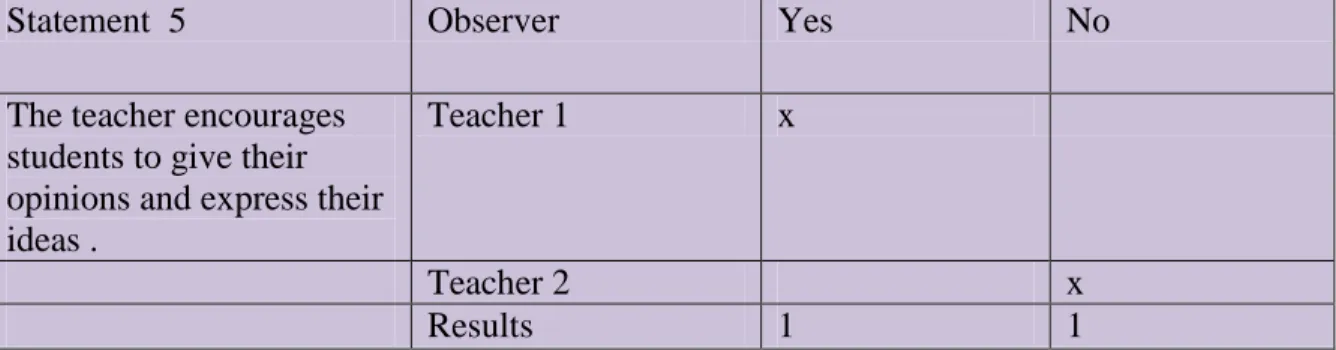
5. The teacher encourages students to give their opinions and express their ideas.
x
6. All the students get involved x
7. Teacher checks understanding x
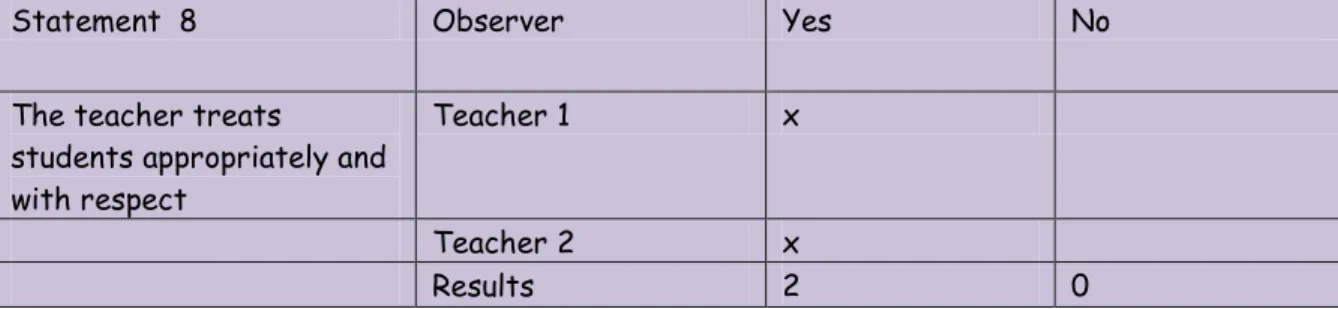
8. Teacher treats students appropriately and with respect x
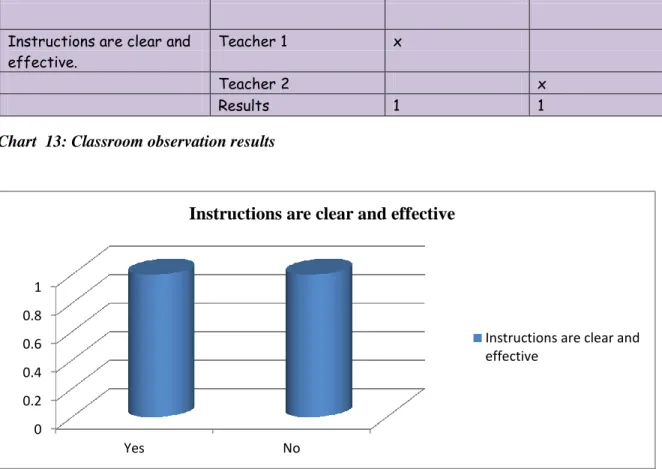
9. Instructions are clear and effective x
10.Effective group and per work is observed x
40 3.4.2 Class Observation 2
Evaluation aspects Yes No
1. The teacher is motivated, friendly and dynamic with
their students. x
2. Students are motivated to participate. x
3. The teacher applies different activities that seem to be according to the different learning styles in the classroom.
x
4. The teacher answers students questions appropriately. x 5. The teacher encourages students to give their opinions
and express their ideas.
X
6. All the students get involved X
7. Teacher checks understanding X
8. Teacher treats students appropriately and with respect x
9. Instructions are clear and effective x
10. Effective group and per work is observed X
41 3.4.3 Classroom observation results
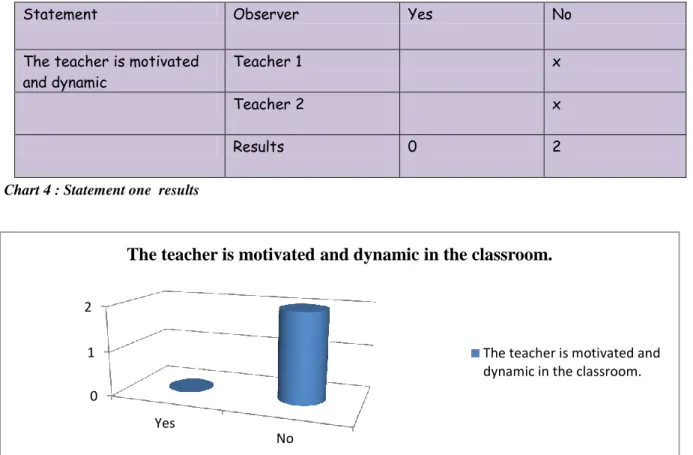
3.4.3.1 Statement one
The teacher is motivated and dynamic in the classroom.
Statement Observer Yes No
The teacher is motivated and dynamic
Teacher 1 x
Teacher 2 x
Results 0 2
Chart 4 : Statement one results
Graphic 1 Source: Classroom observation results .
Prepared by: Karina Rodríguez and Lourdes Villalva
Graphic 1: Classroom observation results
Two observers agreed that the teacher was neither friendly not motivated or dynamic, in the
classroom. 0 1 2
Yes
No
The teacher is motivated and dynamic in the classroom.
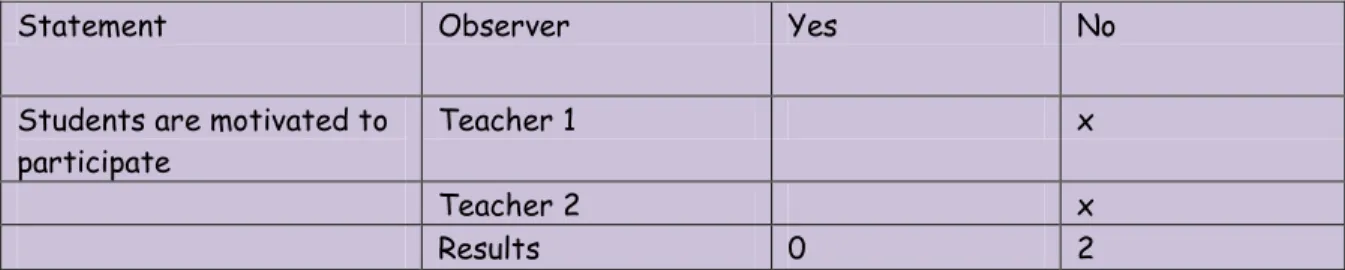
42 3.4.3.2 Statement two
Students are motivated to participate
Statement Observer Yes No
Students are motivated to participate
Teacher 1 x
Teacher 2 x
Results 0 2
Chart 5: Class Observation results
Graphic 2 Classroom observation results
Source: Classroom observation results, teachers from sixth and seventh grades
The two observers agreed that students were not motivated to participate. 0
0.5 1 1.5 2
Yes No
Students are motivated to participate.