UNIVERSIDAD LAICA VICENTE ROCAFUERTE DE GUAYAQUIL FACULTAD DE EDUCACIÓN
CIENCIAS DE LA EDUCACIÓN MENCIÓN INGLÉS
RESEARCH PROJECT:
THE INFLUENCE OF THE MOTHER TONGUE ON THE LEARNING OF
LEXICON FOR READING SKILL IN A 4TH GRADE (EFL) CLASS AT
BALMARA UNIDAD EDUCATIVA BILINGUE IN GUAYAQUIL SCHOOL YEAR 2016-2017
PREVIO A LA OBTENCIÓN DEL TÍTULO DE:
LICENCIADOS EN LENGUA INGLESA MENCIÓN EN ENSEÑANZA
Y
ADMINISTRACIÓN DE SISTEMAS EDUCATIVOS EN TEFL
AUTHOR:
GÉNESIS MAGDALENA YANEZ VALENCIA
TUTOR:
MSC. FRANCISCO ANTONIO VALENCIA CHÁVEZ
I CERTIFICACIÓN DE ACEPTACIÓN DEL TUTOR
En mi calidad de Tutor del Proyecto de Investigación, nombrado por el Consejo Directivo de la Facultad de Educación- Carrera de Ciencias de la Educación mención Inglés.
CERTIFICO
Yo, MSC. FRANCISCO ANTONIO VALENCIA CHÁVEZ, certifico que el Proyecto de Investigación con el tema: “THE INFLUENCE OF THE MOTHER TONGUE ON THE LEARNING OF LEXICON FOR READING
SKILL IN A 4TH GRADE (EFL) CLASS AT BALMARA UNIDAD
EDUCATIVA BILINGUE IN GUAYAQUIL SCHOOL YEAR 2016-2017”, ha sido elaborado por la señorita GÉNESIS MAGDALENA YANEZ VALENCIA, bajo mi tutoría y que el mismo reúne los requisitos para ser defendido ante el tribunal examinador, que se designe al efecto.
TUTOR
___________________________________
II DECLARACIÓN DE AUTORÍA Y CESIÓN DE DERECHOS DE AUTOR
DECLARACIÓN DE AUTORÍA
Yo, GÉNESIS MAGDALENA YANEZ VALENCIA, con cédula de ciudadanía No. 0951480755, en calidad de autor, declaro bajo juramento que la autoría del presente trabajo me corresponde totalmente y me responsabilizo de los criterios y opiniones que en el mismo se declaran, como producto de la investigación que he realizado.
Que soy el único autor del trabajo del Proyecto de Investigación: “THE INFLUENCE OF THE MOTHER TONGUE ON THE LEARNING OF LEXICON FOR READING
SKILL IN A 4TH GRADE (EFL) CLASS AT BALMARA UNIDAD EDUCATIVA
BILINGUE IN GUAYAQUIL SCHOOL YEAR 2016-2017”.
Que el perfil del proyecto es de mi autoría, y que en su formulación he respetado las normas legales y reglamentarias pertinentes, previa la obtención del título de “Licenciada en Lengua Inglesa mención en Enseñanza y Administración de Sistemas Educativos en TEFL”, de la Facultad de Educación- Carrera de Ciencias de la Educación mención Inglés de la Universidad Laica Vicente Rocafuerte de Guayaquil.
CESIÓN DE DERECHOS DE AUTOR
De conformidad con lo establecido en el Capítulo I de la Ley de Propiedad Intelectual del Ecuador, su reglamento y normativa institucional vigente, dejo expresado mi aprobación de ceder los derechos de reproducción y circulación de esta obra, a la Universidad Laica Vicente Rocafuerte de Guayaquil. Dicha reproducción y circulación se podrá realizar, en una o varias veces, en cualquier soporte, siempre y cuando sean con fines sociales, educativos y científicos.
El autor garantiza la originalidad de sus aportaciones al proyecto, así como el hecho de que goza de la libre disponibilidad de los derechos que cede.
__________________________
GÉNESIS MAGDALENA YANEZ VALENCIA
III Dedication
This thesis work is dedicated to my parents, who were always my pillar around the University career, my sisters and friends who anyway have been giving me support with their words and encouragement to achieve a goal in my life.
IV Acknowledgements
First I want to thank God for always having his blessing, my family who were with me
every step of this achievement. My dad and my mom are unconditional and who also
have been with me in this university stage are those who are with me in my way of life,
without them none of this would be possible.
In addition I want to give special thanks to my teachers for their supports and guides,
but especially for their patience during the development of this project
Finally, but not least important my friends who were also part of this process and those
who knew me courage, you have been always aware of my progress.
V
1.3. Systematization of the problem ... 8
1.4. Broad Objectives ... 8
1.5. Specific Objectives... 8
1.6. Significance or justification of the study... 9
1.7. Scope and delimitations of the study ... 10
1.8. Hypothetical approach ... 10
1.9. Identification of variables ... 10
1.10. Operationalization of the variables ... 11
2. RESEARCH THEORETICAL FOUNDATIONS ... 12
2.1. Theoretical review ... 12
2.2. Theoretical framework ... 14
2.3. Legal framework ... 47
2.4. Conceptual framework ... 48
3. RESEARCH METHODOLOGY ... 51
3.1. Type of research description ... 51
3.2. Methods, techniques and research instruments ... 52
3.3. Research population and sample ... 54
3.4. Sources, resources and timeline ... 55
3.5. Processing, presentation and analysis of results... 56
3.6. Preliminary conclusions ... 68
4. PROPOSED PROJECT PLAN ... 70
4.1. Title ... 70
4.2. Justification ... 70
4.3. Objectives (Broad and specific) ... 71
4.4. Content framework of the proposed project plan ... 71
4.5. The proposed project plan ... 73
4.6. Validation of the proposed project plan ... 84
4.7. Impact/benefits of the proposed project plan ... 86
CONCLUSIONS ... 88
RECOMMENDATIONS ... 90
REFERENCE LIST ... 91
VI LIST OF TABLES
TABLE 1 CAUSES AND EFFECTS ON THE RESEARCH ... 7
TABLE 2 ORGANIZATION OF VARIABLES ... 11
TABLE 3 MONTESSORI METHOD ... 15
TABLE 4 COMPARISONS OF THE MONTESSORI METHOD AGAINST THE TRADITIONAL ONE ... 16
TABLE 5 WORDS WITH SIMILAR WRITING AND DIFFERENT PRONUNCIATION ... 25
TABLE 6 WORDS WITH SIMILAR WRITING AND DIFFERENT PRONUNCIATION ENDING IN “TION” ... 28
TABLE 7 WORDS WITH SIMILAR WRITING AND DIFFERENT PRONUNCIATION ENDING ‘ARY’ ... 28
TABLE 8 WORDS WITH SIMILAR WRITING AND DIFFERENT PRONUNCIATION ENDING “IC” ... 29
TABLE 9 WORDS WITH SIMILAR WRITING AND DIFFERENT PRONUNCIATION ENDING “OUS” ... 29
TABLE 10 WORDS WITH SIMILAR WRITING AND DIFFERENT PRONUNCIATION ENDING “CT” ... 30
TABLE 11 WORDS WITH SIMILAR WRITING AND DIFFERENT MEANING ... 30
TABLE 12 MISLEADING WORDS... 31
TABLE 13 RESOURCES... 55
TABLE 14 TIMELINE ... 55
TABLE 15 RESULTS OF PRE-TEST ... 59
TABLE 16 QUALITATIVE SCALE OF PRE-TEST ... 60
TABLE 17 RESULTS OF POST-TEST ... 61
TABLE 18 QUALITATIVE SCALE OF POST-TEST ... 62
TABLE 19 COMPARATIVE ORAL PROFICIENCY SKILL OF PRE-TEST AND POST-TEST ... 64
TABLE 20 FREQUENCY OF TEACHER SURVEY ... 65
VII LIST OF FIGURES
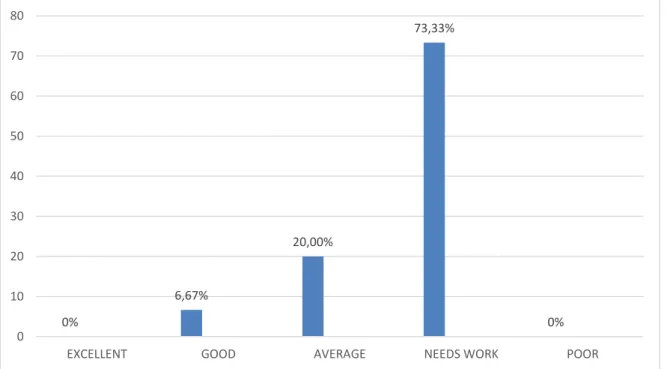
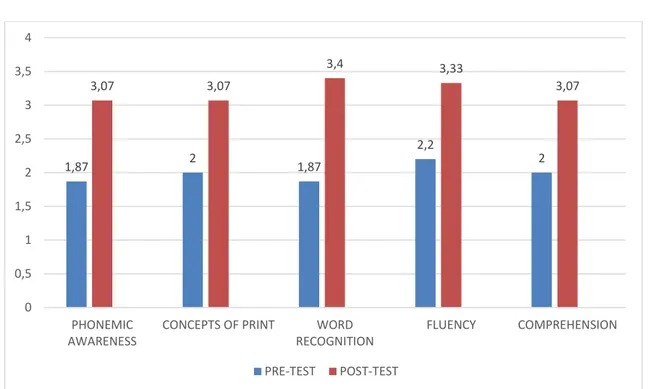
FIGURE 1 QUALITATIVE SCALE RESULTS OF PRE-TEST ... 60 FIGURE 2 QUALITATIVE SCALE RESULTS OF POST-TEST ... 63 FIGURE 3 COMPARATIVE READING AND VOCABULARY PROFICIENCY SKILLS RESULTS
VIII Abstract
Knowing a second language is important nowadays for students according to
rules by education, practice the skills is hard but for students reading skill has
been difficult because mother tongue (Spanish) has an influence on the
students who are learning and acquiring a second language (English). This
issue is unknown by a significant number of educators. Consequently, they
attribute this phenomenon as a lack of interest to the learning of the foreign
language rather than as an issue that learners can suffer principally when they
have to accomplish reading activities. Especially they have a connection
between L1 and L2 with the lexicon and for that reason there is not a good
convey of reading. As a result of this influence many learners cannot interpret
readings ideas or comprehend stories objectives. That is why; it was proposed
the application of reading activities that can handle with the influence of
mother tongue. This experimental study adopted a Mixed-methods regarding
to the collection of data and followed the next steps such as surveys, class
observation, pre-test and post-test after it was determined the factor that
generated the language influence the next step was the implementation of a
booklet and some activities that helped learners. The project is aimed to
demonstrate how using a set of activities could reduce the level of influence
on them. Finally, after the application of these activities, author could notice
that the proposal had a positive impact and cope with the mother tongue
influence in reading skills in learners.
1 INTRODUCTION
This study investigates an important area of English language teaching and
learning. It examines the present situation of teaching reading skills of English, the
problems students encounter during reading an English text and the learners’
proficiency level of reading skill when they are at the Balmara Unidad Educativa
Bilingue. It also examines the reading syllabus and reading materials used at the
intermediate level.
The study discusses the recent developments in reading pedagogy. It also
presents an evaluation of teaching the different sub-skills of reading and then through an
empirical study examines whether both higher and lower order sub-skills are covered in
the reading syllabus, and taught properly in the country. The empirical investigation
examines whether the modern methods of reading pedagogy are used in teaching
reading in Ecuador. The methods for empirical investigation in the study include
students’ and teachers’ questionnaire survey, students and teachers’ interview,
classroom observation and administering reading tests. Reading components of the
syllabus and the reading materials are also evaluated.
The thesis consists of 5 chapters: Chapter 1 introduces and establishes the topic
focus, outlines the objectives, highlights the problems in the field of study and discusses
the significance of the study. It also outlines research methodology briefly, and defines
the key terminology used in the study.
Chapter 2 describes theoretical development in reading pedagogy which includes
the definition of reading, purposes of reading, techniques of and approaches to teaching
2 students face while reading. It has also points out how to select an appropriate text for
reading classes or for an appropriate purpose.
Chapter 3 briefly discusses the methods usually used in EFL research of this
type, and the methods used in the present study. It discusses the instruments used for
questioner like pools, interview, classroom observation and tests of reading skills. It
also presents sampling plans for each method.
Chapter 4, this research proposes to develop a didactic guide like tool of help for
the students. After that, this research finishes with the recommendations and
3 1. THE RESEARCH PROBLEM
1.1.Background of the Problem
It is necessary to know the meaning of words as it is the key to understanding
reading; as it know, reading is not only deliver a set of signs, vocalize words and
phrases; reading is the culture and education of a country; also is the core of personal
construction. Educators and parents should be concerned about the importance of
students are reading. Understanding is the direct result of decoding.
The vocabulary in the English language allows it to have good oral and written
expression because if you read well can write well and at the same time to understand
the different issues that arise. Understanding vocabularies education is to cultivate a
system of values that were respectful, caring and honest in the construction of
multinational, intercultural and inclusive society members.
Students’ abilities of reading English are very poor in Ecuador. A large majority of
students at the undergraduate level in our country cannot access English textbooks
prescribed in their syllabus for their lack of required proficiency of reading skills in
English. Therefore, they depend only on Spanish books, and the resources in the
libraries being in English remain unutilized. As a result, in the majorities cases, for
example teachers in public schools don´t use the correct methodical of teaching in the
students.
Children when begin high school cannot understand the English. Higher education
in this country suffers miserably; it falls far below the international standard.
4 The most acknowledged cause of failure of the students in effective reading is the
lack of vocabulary. Many students inspired by friends or guided by teachers sometimes
try to read a book but soon they lose the interest for reading the text. In every paragraph,
or even in every sentence, or every phrase they come across some new words, which
create a constant barrier for them to understand the meaning.
Sometimes, they do not understand long sentences, and they miss the links between
parts of a text. As a result, they lose their patience and their interest, and they give up
reading. Sometimes they may feel inspired to look up the words in the dictionaries, but
checking the dictionary too many times proves boring, and at last, their enthusiasm for
reading the text dies down.
There are some other problems that discourage the students to continue reading a
text. Most students fail to understand the syntax, especially when the sentence structures
are long. They also have problems with understanding text organization. Additional,
knowing new words and improving pronunciation will get the students to have a better
lexicon.
Rodríguez (2011) comments:
At present, reading and writing are becoming more important, starting with the
insertion of new technologies and a new competitive field, however, it is also observed
with amazement that every day are less the lovers of reading and writing, due to that
many people view these two processes as tedious and meaningless ... In schools, the
situation does not change, few children are interested in doing a spontaneous reading
5 Reading skills are processes that do not have the merit of the students, whatever their
level of education. However, the potentialities that read include, they are seen as two
tasks imposed by the school and cannot be avoided. There are different hypotheses and
various studies of the situation mentioned above, since that accuse for diverting the
attention of the young from textual processes, passing through those who exalt the
power of audiovisual media and decree the virtual death of books and with it the loss of
importance of practices so old to those that explain this rupture by the treatment that
given it to texts in the school space.
(Universo, 2014) Mention:
In 1912, for more than a century, in the educational establishments of the country
began to teach English. But the subject entered the curriculum more formally in the
fifties, during the government of Galo Plaza Lasso. Then, as now, the biggest problem
was the teacher deficit. So in schools there was only one hour a week, nothing in
primary. At that time, it was not taught by experts but by amateurs, who knew
something of the language. The future teachers began to form in faculties like the
Philosophy and Sciences of the Education, of the Central University.
It was since the year 1993 when a real concern was evidenced for the teaching of
English, with the creation of the Curricular Reform Project for the Teaching of English
(CRADLE) through a bilateral agreement between the Ecuadorian and British
governments. The implementation of the new English curriculum privileges the
development of skills without set aside grammar and vocabulary, which are essential for
6 About reading, it is necessary to clarify that the development of this skill is not to
read aloud, but to read in silence and progressively increase the speed of reading and the
quality of reading comprehension. For this reason the new English texts have graduated
readings according to the level that the student has supposedly acquired.
In the schools of the province, reading skills were developed according to the
suggestions presented by the National Program of English for Ecuadorian Schools.
There were a large number of teachers who used reading aloud and the translation of the
text, so preventing the development of reading comprehension and turning the lesson
into a simple vocabulary session.
This research was carried out in in a 4th grade (EFL) class at Balmara Unidad
Educativa Bilingue of the Guayaquil city. This educational institution was created on
May 10, 1987. At present the institution consists of 20 teachers; 7 of them correspond to
the English area. Most students are children of employees, agricultural workers, and
self-employed micro entrepreneurs. At present, the careers that it offers are those of
Sciences, Informatics, Accounting and Administration, Industrial and Agricultural.
There was strong student resistance to reading texts, whether written or scanned.
Many chose to memorize the reading, but fail to understand the message and become
repeaters of the ideas that the text transmit. In the case of English it is more complex,
because apart to be a different lexicon, the phonetic and grammatical structure becomes
complicated because at bottom there are methodological failures that have not been
assumed by teachers and that persist through time. One of them is the way in which you
teach to read.
There were several factors by which some obsolete methods for the development
7 which does not require greater linguistic development, since it could be done with the
automatic translator of a computer, which did not fit within the communicative
methodology that is tried to implement with the new curriculum of English.
For the teachers it was very comfortable do not have to elaborate reading
comprehension questions and also they are not familiar with the silence at the time of
reading. The more noise is made in the classroom, the more teaching activity is
developing. Nothing more wrong, because reading aloud reduced the possibility of
improving comprehension and reading speed.
1.2.Statement of the problem
What technique of reading skills must be developed in the students for the teaching process of reading English?
1.2.1 Causes and Effects
Table 1 Causes and Effects on the research Categories
Note:This table explains about the posibles causes anf effects about the problem, in this case the poor reading in the students .
8 1.2.2 Formulation of the Problem
How does the influence of the mother tongue on the learning of lexicon for reading
skill in a 4th grade (EFL) class at Balmara Unidad Educativa Bilingue in Guayaquil school year 2016-2017?
1.3.Systematization of the problem
How is lexicon important in reading skills?
Why do students have error in comprehension readings?
How is the mother tongue connected in learning foreign vocabulary?
How can students identify the misleading words in reading?
1.4.Broad Objectives
To analyze the influence of lexicon and vocabulary in reading comprehension skills, through literature review field study and statistical analysis in order to design a booklet
focused on vocabulary.
1.5.Specific Objectives
To characterize the influence of vocabulary, through literature review field study
and statistical analysis.
• To practice the reading comprehension using synonyms and antonyms.
• To design a booklet focused on vocabulary through the most important data collected.
• To create a didactic guide for that the teachers can teach of a practical way.
• Identify skills applied in reading skills in the process of teaching English language
9 1.6.Significance or justification of the study
For this project a vocabulary booklet for Promoting the vocabulary in reading
comprehension will be create, so students will be benefit to develop their abilities and
capabilities to understand. Additional, we focus in a vocabulary booklet, because it can
help to the teachers When They Need to improve the confidence, verbally and written
abilities and motivation, because many texts have a lot new words, so the students need
to Understand and learn new information.
Then the symbols or graphics serve to remember or retain lot information that
the students can infer with their prior knowledge, experiences and new knowledge.
Education is not an end in itself, but a continuous process in the public interest,
integrating all levels of learning. The National Education System - from initial and basic
schooling through high school. Sometimes, the lack of domain of students in the
English language is because many times institutions not provided to students the
necessary materials and resources for development of learning English language.
One of our proposals will we start to give most classes only in English. At first it
will be 50% 50% Spanish and English, so they will adapt to the system. Another idea is
to make contests within the institution and provide incentives to students who best
unfold in English. What we seek with this project is to help the academic growth of our
students and thus contribute to the future of Ecuador, giving young trained to perform
jobs in which knowledge of English language is required.
One advantage of English over other languages is that we always know a little
vocabulary because even without realizing it, we use the language a daily basis and we
see everywhere: billboards, commercials, radio and TV , almost all magazines in the
10 that the world is not all the same, that there is an appreciation for differences and an
understanding of other viewpoints different from their own.
Globalization, the Internet, television and the possibility that our children enjoy a
future of more and better opportunities than we are factors that are influencing so that as
parents we are more interested in giving them the ability to speak another language,
especially English.
1.7.Scope and delimitations of the study
The field of this investigation is of Basic general education, it been foreign language the area of learning of the students. For that, the topic is the influence of the mother
tongue in the learning of lexicon for reading skill in a 4th grade (EFL) class at Balmara
Unidad Educativa Bilingue. The proposal of this research is to design a vocabulary
booklet.
1.8.Hypothetical approach
Confusing words can dismiss the correct message or idea for Readings, so if students
don´t practice frequently reading, they cannot gain a good lexicon.
1.9.Identification of variables
Dependent Variable
Lexicon for reading skill in a 4th grade (EFL) class at Balmara Unidad Educativa
Bilingue.
Independent Variable
11 1.10. Operationalization of the variables
Table 2 organization of variables
VARIABLES DEFINITION INDICATORS INSTRUMENTS
Independent Variable Mother tongue or first language is a language
Dependent Variable Lexicon: the vocabulary
of a language, an
Note: this chart shows the relation between dependent variable and independent variable with their definition, indicators and instruments.
12 2. RESEARCH THEORETICAL FOUNDATIONS
2.1.Theoretical review
At present, it is very important to master another language; globalization has motivated people to become interested in learning English as this is considered the
language of world trade. Therefore, the English language is taught from school to the
end of school. However, when they finish their studies, students do not master the
language, and in many cases the pronunciation plays a fundamental role, because
bounded reading, vocabulary and grammar are very important.
In this case, it will focus on the research on the reading and the lexicon that is used
by the students from 4th grade, this is part of the dependent variable; it would be analyzed the factors that lead to their domination, for this it will analyze this research
from previous studies on this subject, which affects much of Latin America, and
Ecuador is no exception.
The influence of the mother tongue as part of the learning of the L2 will also be
analyzed. This fact is based on student of the language translates from English to
Spanish, and in doing so literally, the sentence often loses meaning, which causes
frustration in Latin speakers. For this, it is important that the student begins to interpret
the language as if it were his mother tongue; what has been mentioned is the
independent variable of this research that will be developed later.
In this chapter, it will analyze the independent and dependent variable of this
research, which deal with the influence of the mother tongue on learning and lexicon for
13 Finally, the conceptual framework will be elaborated, in which the main aspects
found in the theoretical foundation will be detailed.
This research investigates the influence of mother tongue on the learning
of the second language in reading skills. The two distinguishing variables
compared learners that were taught in their mother tongue and how that
vocabulary and cognitive knowledge can affect their learning of reading skills,
from 4th grade class the dependent variable was tested in 2 ways: a vocabulary, and an oral communication test, having as a result that students can connect the
meaning of words that have similar pronunciation, on the other hand there are
words that have same pronunciation in English and Spanish and the same
meaning too. Being easier for the students to understand the purpose of some
reading in a positive way.
So it compares the two kinds of groups of words, working with different
material and different techniques with a target of students from 7 to 8 years old.
This research is working with this group of children because this age is the
perfect one when students acquire the enough understanding and adsorb all the
sufficient information for using in their school days, even because in this stage
they work hard with reading strategies while learning the second language (L2).
14 languages, but they pronounce differently. Others look more or less the same,
but there are different letters. Fortunately, there is an order in how it is changed,
so it is going to be easy for students to understand reading purposes.
One of the objectives of this research is to analyze the influence of
lexicon and vocabulary in reading comprehension skills, through literature
review field study and statistical analysis in order to design a booklet focused on
vocabulary, which is going to be developed during the whole study
2.2.Theoretical framework
Montessori Method
This theory holds that the child needs stimuli and freedom to learn. The teacher
has to let the student express his / her preferences,and something even more important.
Let him / her make mistakes and try again. Montessori insisted that the role of the
dominant teacher had to be changed and let the learner have a more active and dynamic
role in the learning process.
For the first time, a pedagogical technique included in its formula the idea that
learning should bring happiness and encourages children's own creativity and natural
ability. The most important thing is to motivate children to learn with pleasure and to
allow them to satisfy their curiosity and to experience the pleasure of discovering their
own ideas instead of receiving the knowledge from others. Montessori considered that
geniuses could not be created; but rather, give each individual the opportunity to fulfill
15 Some of the ideas that Maria Montessori put into practice are summarized here:
Table 3 Montessori Method
First level
The brain reaches 80%of its adult size. The plasticity of
children shows that the education of potentialities must be
exploited beginning early.
Allow
The child to find the solution of problems. Try do
not bring new knowledge from outside. Allow
them to be the ones who build on their concrete
experiences.
Learn style
Each child marks their own pace or speed to learn and
those times must be respected.
Note: Between the ages of 6 and 12, the child is creating her intelligence, and more importantly, a conscience. This is why we emphasize modeling the behavior that we, as teachers, would like to see in the classroom.
16 Table 4 Comparisons of the Montessori Method against the Traditional One
MONTESSORI METHOD
Emphasis on cognitive structures and social development
The teacher plays an unobstructed role in classroom activity
The environment encourages internal self-discipline
Children are motivated to teach, collaborate and help each other
Individualized and group teaching is adapted to each style of learning
according to the student
TRADITIONAL METHOD
Emphasis on: memorized knowledge and social development.
The teacher plays a dominant and active role in the classroom activity
The teacher acts with a main force of external discipline.
Group teaching is according to the style of teaching for adults.
Note: So much of traditional education seems focused on what we, as a society believes. Montessori education, on the other hand, encourages the development of the whole child.
Resource: Genesis Yanez
In her book (Montessori M. , The Absorbent Mind, 1949) The Absorbent Mind,
Maria Montessori writes, “The child is endowed with unknown powers which can guide
us to a radiant future. If what we really want is a new world, then education must take
as its aim the development of these hidden possibilities."What she expected was that
children use tools and elements around themselves for acquiring their knowledge
without any obstruction during the process. By this stage the child is saying, “Help me
17 contrary, through existing information knowledge must be perceived by them as a result
of their reasoning.
THE INFLUENCE OF THE MOTHER TONGUE ON THE LEARNING.
How First Language Affects Second Language: Transfer or Interference
The term transfer in language learning is defined by (Odlin, 1989) as “the
influence resulting from similarities and differences between the target language and
any other language that has been previously acquired”.
Transfer is a psychological term that is used to describe a situation where one
learned event influences the learning of a subsequent learning event. The influence in
this case has two facets; commonly known as interference or negative transfer and
positive transfer. Positive transfer or facilitation entails transfer of skill or part of the
native language which facilitates the learning of the target language.
On the other hand, negative command of transfer or interference is transfer of a
skill which impedes the learning or has negative influence on the command of a skill in
the target language. This study endeavors to find out whether use of mother tongue in
the context under study influences (interferes or transfers) acquisition of skills in
English and thus performance of English.
According to (Wardhaugh, 2006) transfer is a tool used to account for or explain
the errors which actually occur. He further argues that transfer is the basis for predicting
which patterns in second language (L2) will be learnt more readily and which will prove
more troublesome. The assumptions held under this point of view are: the chance of
second language learning problems occurring will increase proportionally to the
linguistic differences between first language (L1) and L2- linguistic differences give
18 learning problems occurring decreases proportionally to the absence of linguistic
differences between L1 and L2- absence of linguistic differences give rise to positive
transfer or facilitation.
Thus, this is important to this study because the researcher endeavored to find
out whether the difference in mother tongue influences the performance in English.
(Corder, 1981) Observes that when people are learning a second language, they already
have a first language (L1). He also realized that the rules they have learned and
understood in first language are used in second language (L2).
As a result, people form habits of using the rules of first language in the second
language and therefore make errors. These findings are important to this study because
the researcher needs to figure out the influence of mother tongue (first language) on
acquisition of English (second language) skills and thus performance of English.
Researches that have been done in the area of native language show there is interference
of native language on the target language.
Various scholars have addressed the issue of interference: (Schumann, 2003)
consider interference as the automatic transfer, due to habit, of the surface structure of
the first language onto the surface of the target language. (Stubbs, 2006) defines
interference as errors in the learner ‘s use of the foreign language that can be traced
back to the mother tongue. (Wardhaugh, 2006) Refers to interference “as transfer which
he says is 'the influence that the learner‘s L1 exerts over the acquisition of an L2”. He
argues that transfer is governed by learners’ perceptions about what is transferable in L2
learning.
In learning a target language, learners construct their own interim rules with the
19 task or when they have become sufficiently proficient in the L2 for transfer to be
possible. (Ellis, 2001)
This study sought to find out the influence of mother tongue (L1) on acquisition
of English (L2) thus performance. Perception of teachers and students on the influence
of mother tongue on English were sought in terms of whether they thought mother
tongue influenced the performance of English.
Errors are deviations from correct usage because a learner does not know the
relevant language rule yet. Furthermore, a distinction between mistake and error is
made. Reveal a criterion that helps us to do so: it is the self-correct ability criterion. A
mistake can be self-corrected, but an error cannot (Ellis, 2001).
This is important for this study since it investigated the influence of mother
tongue on written English. Thus, it essentially endeavored to find out whether the
transfers or errors emanating from using mother tongue influenced the performance of
English. It was noted that teachers identified direct translation as an error that went
unnoticed by the learners.
(Robinson, 1994) notes that there is an influence between the first and second
languages because acquiring one ‘s first language gives one a certain ″routine″ or
experience, strategies and metacognitive skills, which can be generalized to subsequent
languages, but there are also language-specific constraints in perception and
comprehension.
Thus, this study strived to find out the extent to which mother tongue influence
the performance of English. The study wanted to find out the extent in terms of
perceptions from teachers and students, to which the first language affects the second
20
Mother Tongue Use Advocacy
United Nations Educational, Scientific and Cultural Organization (1968)
maintain that literacy acquisition and second language proficiency depend on
well-developed first language proficiency; that is, proficiency in mother tongues. However,
United Nations Educational, Scientific and Cultural Organization (1968) cautions that a
mother tongue needs necessarily not be the language which a child’s parents use or need
it be the first language a child speaks.
Mother tongue is the language, which a person acquires in early years and which
becomes his or her natural instrument of thought and communication. (UNESCO, 1953)
However, mother tongue in most cases will be the language spoken by the parents
because the parents are normally the first people to be in contact with the child and
hence their language.
In addition, the question of whether proficiency in mother tongue leads to
proficiency in acquisition of the second language is not well explained, in that, United
Nations Educational, Scientific and Cultural Organization (1953) does not take into
consideration the use of the second language as the medium of instruction and how the
previous and current use of the mother tongue affect later performance in English.
Essentially, the above argument shows that use of mother tongue is favorable for
learners especially at the elementary level. It implies that when English is used at
elementary level, it becomes a challenge in terms of making sense out of the abstract
21
Language Use in Diverse Contexts
According to (Asher, 2006), it is important to check how students use language
both written and spoken to make sense of their own lives and what they learn in school.
This can therefore insinuate that teachers need to check out the kind of language
student’s use in school. United Nations Educational, Scientific and Cultural
Organization (2006) argue that the best medium to teach a child is through their mother
tongue.
“A misconception lays in the belief that many bilingual students appear to experience restricted educational success, with bilingualism the attribute of liability”
(Schumann, 2003).
This statement provides the substance of the study to what extent does bilingual
students who use mother tongue in an educational context that emphasizes the use
English as the language of instruction perform well in English? Is use of mother tongue
a liability or an asset? The answer to this question provides us with the opportunity to
evaluate the influence of mother tongue on performance of English; whether positive or
negative; transfer or interference.
Therefore, this puts us in a situation that raises the query as to what is the
influence of use of mother tongue or first language on academic performance. (Stubbs,
2006) Claims that reading problems in second language emanate from inadequate
knowledge in second language since the reader may lack adequate proficiency to pick
22 “It is equally argued that individuals proficient in first language will also be
proficient in second language” (Stubbs, 2006).
This argument tends to simplify the proficiency in mother tongue and assume
that this proficiency will automatically lead to proficiency in the second language. The
argument does not consider the effort made by individuals in acquiring the second
language through reading, writing, listening and speaking.
It does not consider orthographic and phonological processing which require sets
of knowledge and strategies. In as much as the researcher has tried to show a correlation
between proficiency between first and second language, there is a gap that is left in
terms of how direct translation from mother tongue to second language influences
communication.
“Use of mother tongue can affect both reading and writing and thus
performance of English since the more the students’ dialect departs from the Standard
English, the great the students show problems in learning in printed words both in
reading and writing” (Asher, 2006).
It is therefore important for teachers to know as much as they can from the
students ‘dialect for them to optimally teach them. Mother tongue interference retards
the progress for reading, speaking and writing since patterns of mother tongue do not
correspond with those of English. This study endeavored to find out whether indeed use
of mother tongue in the context under study influenced the performance of English in
23
Direct Translation as a Product of First Language
Investigated the phenomenon and questions the term transfer. He suggests that
mother tongue influence as a neutral and broader term to refer to what has most
commonly been called transfer. Corder says that since most studies of error were made
on the basis of the performance of learners in English in formal situations where it
appears that errors related to mother tongue are more frequent, it was natural that an
explanation of the phenomenon was of considerable concern to a linguist (Ellis, 2001).
Shows that when a second language learner is under pressure, “the learner will
borrow or substitute words from the mother tongue”. He further says that borrowing
occurs because communication is the learner's primary goal, rather than obedience to
grammar rules. Borrowers retrieve words and structures from mother tongue to help
their developing sense of the second language (Ellis, 2001).
In both cases, however, being understood is the primary goal. According the
author there are two independent systems of second language performance: “'the
acquired system' and 'the learned system'. The 'acquired system' or 'acquisition' is the
product of a subconscious process very similar to the process children undergo when
they acquire their first language.
Contextual Use of Language
Most supporters of mother tongue-based learning agree that a child’s home
language can effectively be used as a language of instruction in the early years of their
schooling as a bridge to learning a foreign language however it becomes an impediment
24 This study explores the use of mother tongue and code switching in an effort to
establish the extent to which use of mother tongue influences the performance of
English. A system where instruction is carried out in a language child do not speak (or if
they do, they speak a language that is broken and incoherent) is referred to “as
submersion, as it is comparable to forcibly holding a child under water” (Odlin, 1989).
On the other hand, immersion has to do with using of the revered language,
probably mother tongue to teach, for instance, code switching as a medium of
instruction in a context that predominantly use English as a language of instruction.
Hence this study strives to find out the prevalence of code switching in the context
under study.
According to (Asher, 2006), it is checking how students use language both
written and spoken in school and at home is important. He emphasizes that teachers and
parents ought to help learners to use a language that will help them to understand
concepts in the process of learning. Mother tongue is not use as a medium of instruction
and therefore if frequently used it will be counterproductive.
Therefore, when mother tongue is used, it will in a sense influences the
acquisition of skills in English thus the performance of English. He further suggests that
a research be done on the influence of mother tongue on performance of English.
Perception of Stakeholders towards Mother Tongue and Performance of English
A study conducted by (Opitz, 2011) on the influence of instructional language
choice on secondary school students on performance in English, it found out that
speaking skills using language of instruction have an impact on classroom participation
25 English enjoy participation in classroom activities such as discussions and storytelling
while those who cannot prefer to keep quiet.
This state of affairs is an advantage to few learners who grasp the academic
content at the expense of many who are linguistically disadvantaged. This translates in
difference in performance of English in favor of learners with capabilities in speaking in
English.
The language of our evening teach-ins, and the language of our immediate and
wider community, and the language of our work in the fields were one. The language of
my education was no longer the language of my culture.
Similar word in Spanish and English
This is a positive influence in the learning of the students, and is a methodology
that Balmara should promote in the students of 4th grade.
There are many words in English that come from Spanish and other words in
Spanish that come from English. There are also words in the two languages that come
from another, such as Latin and French.
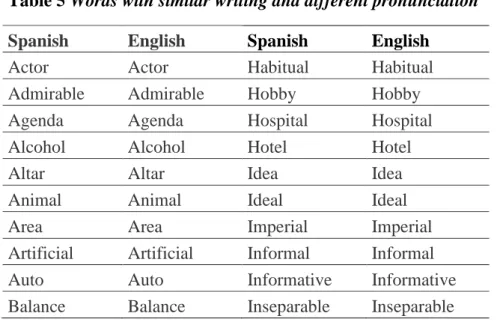
Table 5 Words with similar writing and different pronunciation
Spanish English Spanish English
Actor Actor Habitual Habitual
Admirable Admirable Hobby Hobby
Agenda Agenda Hospital Hospital
Alcohol Alcohol Hotel Hotel
Altar Altar Idea Idea
Animal Animal Ideal Ideal
Area Area Imperial Imperial
Artificial Artificial Informal Informal
Auto Auto Informative Informative
26
Bar Bar Inspector Inspector
Base Base Interminable Interminable
Bridge Bridge Invisible Invisible
Brutal Brutal Irregular Irregular
Cable Cable Judicial Judicial
Café Café Legal Legal
Canal Canal Liberal Liberal
Cáncer Cancer Literal Literal
Capital Capital Local Local
Carbon Carbon Menú Menu
Central Central Metal Metal
Cerebral Cerebral Miserable Miserable
Chocolate Chocolate Mortal Mortal
Circular Circular Motel Motel
Civil Civil Motor Motor
Club Club Múltiple Multiple
Collar Collar Municipal Municipal
Colonial Colonial Musical Musical
Coma Coma Natural Natural
Combustión Combustion Noble Noble
Conclusión Conclusion Normal Normal
Conductor Conductor Nostalgia Nostalgia
Confusión Confusion Ópera Ópera
Considerable Considerable Oral Oral
Control Control Oriental Oriental
Cordial Cordial Original Original
Criminal Criminal Panorama Panorama
Crisis Crisis Particular Particular
Cultural Cultural Pastor Pastor
Debate Debate Peculiar Peculiar
Decision Decision Perfume Perfume
Diagonal Diagonal Personal Personal
Dimension Dimension Plural Plural
Director Director Popular Popular
Doctor Doctor Principal Principal
Drama Drama Probable Probable
Elemental Elemental Región Region
Enigma Enigma Regional Regional
27
Explosión Explosion Religion Religion
Expulsion Expulsion Reunión Reunion
Extensión Extension Revision Revision
Exterior Exterior Social Social
Final Final Solar Solar
Flexible Flexible Televisión Television
Formal Formal Terrible Terrible
Frontal Frontal Terror Terror
Fundamental Fundamental Total Total
General General Transcendental Transcendental
Génesis Genesis Triple Triple
Global Global Tropical Tropical
Ritual Ritual Unión Unión
Rural Rural Universal Universal
Secular Secular Usual Usual
Sentimental Sentimental Verbal Verbal
Serial Serial Versión Version
Sexual Sexual Vertical Vertical
Similar Similar Violín Violin
Simple Simple Visible Visible
Singular Singular Visual Visual
Vital Vital Vulgar Vulgar
Vulnerable Vulnerable
Note: Some look alike in the two languages, but they pronounce differently. Others look more or less the same, but there are different letters. Fortunately, there is an order in how it is changed.
Resource: Genesis Yanez
Near Perfect Cognates
Here the near perfect cognates are divided into separate lists based on their behaviour:
The following near perfect cognates follow the rule for nouns ending ‘tion’ in English
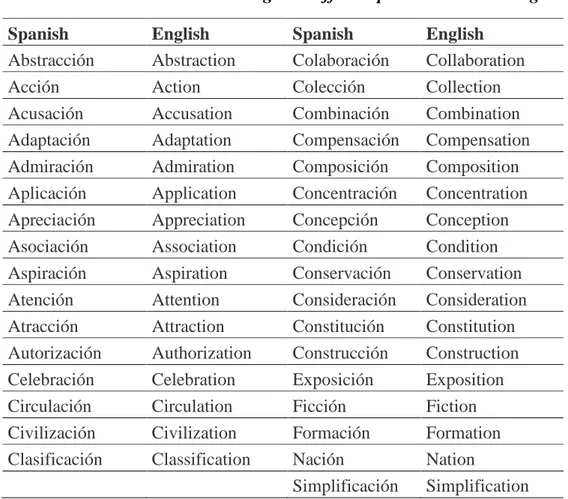
28 Table 6 Words with similar writing and different pronunciation ending in “tion”
Spanish English Spanish English
Abstracción Abstraction Colaboración Collaboration
Acción Action Colección Collection
Acusación Accusation Combinación Combination
Adaptación Adaptation Compensación Compensation
Admiración Admiration Composición Composition
Aplicación Application Concentración Concentration
Apreciación Appreciation Concepción Conception
Asociación Association Condición Condition
Aspiración Aspiration Conservación Conservation
Atención Attention Consideración Consideration
Atracción Attraction Constitución Constitution
Autorización Authorization Construcción Construction
Celebración Celebration Exposición Exposition
Circulación Circulation Ficción Fiction
Civilización Civilization Formación Formation
Clasificación Classification Nación Nation
Simplificación Simplification
Note: Some look alike in the two languages, but they pronounce differently. Others look more or less the same, but there are different letters. Fortunately, there is an order in how it is changed.
Resource: Genesis Yanez
The following near perfect cognates follow the rule for English nouns ending
‘ary’ can be converted to Spanish by replacing with a ‘ario’.
Table 7 Words with similar writing and different pronunciation ending ‘ary’
Spanish English Spanish English
Adversario Adversary Estuario Estuary
Aniversario Anniversary Primario Primary
Arbitrario Arbitrary Rosario Rosary
Comentario Commentary Salario Salary
Complementario Complementary Secretario Secretary
Contrario Contrary Solitario Solitary
Diario Diary Vocabulario Vocabulary
Glossario Glossary Temporario Temporary
29 The following near perfect cognates follow the rule for English adjectives
ending ‘ic’ can be converted to Spanish by replacing with an ‘ico’.
Table 8 Words with similar writing and different pronunciation ending “ic”
Spanish English Spanish English
Académico Academic Erótico Erotic
Alcohólico Alcoholic Exótico Exotic
Artístico Artistic Fantástico Fantastic
Auténtico Authentic Genérico Generic
Automático Automatic Genético Genetic
Básico Basic Geométrico Geometric
Característico Characteristic Heroico Heroic
Clásico Classic Irónico Ironic
Cómico Comic Mágico Magic
Democrático Democratic Médico Medic
Dinámico Dynamic Mosaico Mosaic
Diplomático Diplomatic Orgánico Organic
Doméstico Domestic Pánico Panic
Dramático Dramatic Plástico Plastic
Económico Economic Poético Poetic
Electrónico Electronic Público Public
Romántico Romantic Sistemático Systematic
Trágico Tragic
Note: Some look alike in the two languages, but they pronounce differently. Others look more or less the same, but there are different letters. Fortunately, there is an order in how it is changed.
Resource: Genesis Yanez
The following near perfect cognates follow the rule for English adjectives
ending ‘ous’ can be converted to Spanish by replacing with a ‘oso’.
Table 9 Words with similar writing and different pronunciation ending “ous”
Spanish English Spanish English
Curioso Curious Numeroso Numerous
Delicioso Delicious Precioso Precious
Glorioso Glorious Religioso Religious
Misterioso Mysterious Tedioso Tedious
30 The following near perfect cognates follow the rule for nouns ending ‘ct’ in English can be converted to Spanish by replacing with a ‘cto’.
Table 10 Words with similar writing and different pronunciation ending “ct”
Spanish English Spanish English
Abstracto Abstract Correcto Correct
Acto Act Exacto Exact
Artefacto Artefact Excepto Except
Compacto Compact Insecto Insect
Conflicto Conflict Perfecto Perfect
Contacto Contact Producto Product
Note: Some look alike in the two languages, but they pronounce differently. Others look more or less the same, but there are different letters. Fortunately, there is an order in how it is changed.
Resource: Genesis Yanez
Those words are the most popular and useful word that are very similar in
Spanish and English. For that reason, it is very important to mention that the influence
of Spanish as a mother tongue facilitates the learning of the English language. Creating
a didactic guide will help the students of 4th grade class at Balmara Unidad Educativa
Bilingue.
However, there are some words that have similar writing in Spanish and English, but
they have different meaning. For example:
Table 11 Words with similar writing and different meaning
English Meaning Spanish
Advice Consejo Aviso
Argument Discusión Argumento
Artifact Tcnología Artefacto
31
Notorious Mala fama Notorio
Remove Quitar Remover
Note: Some look alike in the two languages, but they pronounce differently. Others look more or less the same, but there are different letters. Fortunately, there is an order in how it is changed.
Resource: Genesis Yanez
To contrast there are a group of words that express a different meaning, but they
have a similar spelling as Spanish words. Those examples have been working with
students from 4th grade with the purpose that they can convey the message of some reading in a correct way.
Table 12 Misleading Words
Actual: does not mean “actual”, instead “real”. Advice: does not mean “aviso”, instead “consejo”. Argument: is “discusión” does not mean “argumento”.
Artifact: does not mean “artefacto”, instead “defecto” (tecnología). Carpet: does not mean “carpeta”, instead “alfombra”.
Character: does not mean carácter en Psicología, instead en Informática (cada unidad de un mapa de caracteres).
Commercial: does not mean “comercial”, instead “anuncio” (como sustantivo). Contestant: does not mean “contestatario”, instead “concursante, oponente”. Deception: does not mean “decepción”, instead “engaño”.
Desperado: does not mean “desesperado”, instead “bandido”. Exit: does not mean “éxito”, instead “salida”.
Ingenuity: does not mean “ingenuidad”, instead “ingenio, inventiva, maña”. Letter: does not mean “letra”, instead “carta”.
Masonry: is “albañilería”, does not mean “masonería”.
32 Physician: does not mean “físico”, instead “médico”.
Pretend: is “fingir”, does not mean “pretender”. Remove: does not mean “remover”, instead “quitar”. Resume: does not mean “resumir”, instead “continuar”. Lily: does not mean “lila”, instead “lirio” y “azucena”.
Retreat: does not mean “retratar”, instead “retirarse” o “retroceder”. Soap: does not mean “sopa”, instead “jabón”.
Sensible: does not mean “sensible”, instead “razonable, sensato”. Sympathetic: does not mean “simpático”, instead “compasivo”.
Note: Words that have similar writing but different pronunciation and can have a wrong meaning in readings
Resource: Genesis Yanez
Lexicon for Reading Skills
The problems students face when reading in high school sulfur varies depending
upon the group. Many studies during the past years 34,000 children and found that
approximately 20% have significant reading disabilities. During annual standardized
assessments to quantify the progress of American school children in various content
areas, the United States Department of Education revealed that America’s school
children read significantly below the expected proficient level.
If either of these skills are lacking, comprehension diminishes. There is strong
evidence to support explicit vocabulary instruction as a means to increase reading
comprehension, which is needed in all content area classes. Additionally, research
indicates that students need multiple exposures to words at least 21 times, before they
are able to understand what they mean. (Denton, 2008)
Many Ecuadorian English language instructors seem to be frustrated by the fact
that students from schools do not read in Spanish very often and do not feel any
33 very little literature and the topics are sometimes far removed from the experiences of
teenagers. As a result, there is not much motivation to read in English and principally in
4th grade.
Reading in the target language, is one of the best ways to learn and to begin to
like students consider that short stories seem to be the most suitable choice of material
to develop our students reading stories often contain a rich variety of language, they
also constitute authentic and fun material, as well as include universal values and a real
model of language use.
Reading material is attractive because the students are able to start right at the
very beginning and the students are usually eager to find out how the conflict in the
story is resolved. The length of most short stories is ideal to manage in our 45-minute
classes and fit very well with large groups.
The present research project can provide useful information for other teachers at
Balmara Unidad Educativa for the 4th grade that are interested in designing a vocabulary booklet including according to type of reading tests for this stories in their classes and
can lead to gaining all the benefits mentioned before. Teaching English using short
stories using Schema and writing new words.
This research work is of relevance for English language teaching in Balmara
Unidad Educativa Bilingue. The present study aims to provide some guidance on how
to use according to type of reading tests for these stories as a resource for enhancing
34 READING SKILLS HELP THE COMPREHENSION OF THE LANGUAGE
Reading comprehension is one of the pillars of the act of reading. When a person
reads a text he engages in a complex array of cognitive processes. For that is very
important the reading skills in students of 4th grade. It is simultaneously using his awareness and understanding of phonemes (individual sound “pieces” in language),
phonics (connection between letters and sounds and the relationship between sounds,
letters and words) and ability to comprehend or construct meaning from the text. This
last component of the act of reading is reading comprehension. It cannot occur
independent of the other two elements of the process. At the same time, it is the most
difficult and most important of the three.
Without comprehension, reading is nothing more than tracking symbols on a
page with your eyes and sounding them out. Imagine being handed a story written in
Egyptian hieroglyphics with no understanding of their meaning. You may appreciate the
words aesthetically and even be able to draw some small bits of meaning from the page,
but you are not truly reading the story. The words on the page have no meaning. They
are simply symbols. People read for many reasons but understanding is always a part of
their purpose. Reading comprehension is important because without it reading doesn’t
provide the reader with any information.
As you can see, reading comprehension is incredibly complex and multifaceted.
Because of this, readers do not develop the ability to comprehend texts quickly, easily
or independently. Reading comprehension strategies must be taught over an extended
period of time by parents and teachers who have knowledge and experience using them.
It might seem that once a child learns to read in the elementary grades he is able to
tackle any future text that comes his way. This is not true. Reading comprehension
35 the middle grades and high school, parents and teachers need to continue to help their
children develop reading comprehension strategies. As their reading materials become
more diverse and challenging, children need to learn new tools for comprehending these
texts.
Content area materials such as textbooks and newspaper, magazine and journal
articles pose different reading comprehension challenges for young people and thus
require different comprehension strategies. The development of reading comprehension
is a lifelong process that changes based on the depth and breadth of texts the person is
reading.
Another factor having great influence on success in reading comprehension is
vocabulary knowledge.
“Virtually all second language reading researchers agree that vocabulary
development is a critical component of reading comprehension”. (Grabe, 2009)
The more proficient the reader, the faster access to the vocabulary item and its recall he
will have. The way in which the reader perceives vocabulary items in a text may,
however, differ significantly. It happens with students of 4th grade class at Balmara Unidad Educativa.
He may process them either automatically or with control. Automatic processing
comprises the automatic detection and recognition of visual information contained in
the passage. What is vital, this processing disregards other kinds of information
provided by the text. (Asher, 2006)
In automatic processing, visual recognition of words constituting the text occurs
automatically, without any attention and control on the side of the reader, and thus, a
36 interference. Since this process does not require any attention of the reader, the
associative connections must be stored in long-term memory to be easily activated.
Instinctive activation of automatic processing can, thus, occur only after extended
practice.
The aids for text comprehension can be presented not only in textual form, but
also in visual or auditory form, or in their combination. Additional visual information
can aid text comprehension, because it is generally an analogous representation of the
information contained in the text. Thus, the connection between the visual information
and the mental model can be directly established, which can bolster the process of text
comprehension.
There is, however, a difference between learning from the text and learning from
pictures, as the information is provided in different ways. In the text, knowledge is
presented in symbolic structures of a language and is processed sentence by sentence,
that is, sequentially. Information conveyed by pictures, on the other hand, is presented
in “visuospatial structure” (Grabe, 2009) thus analogy can be made directly, based on
common structural properties of visual representations. To put it bluntly, text
comprehension entails the construction of propositional representations without which
the construction of a mental model would not be possible.
The comprehension of an image operates only on the establishing of the direct
connection between the picture and the corresponding mental model. Being less
complicated, and thus a faster process, the comprehension of images seems to greatly
37
Psychological Foundation
Vocabulary knowledge is important for reading, but also implies how that word
fits into the world. Consequently, researchers and practitioners alike seek to identify,
clarify, and understand what it means for students to know what a word means. The
sheer complexity of vocabulary acquisition, as evidenced by reviewing critical
components such as receptive vocabulary versus productive vocabulary, oral vocabulary
versus print vocabulary.
Considering language engagement, (Cummins, 2008), studied the language
interaction between teachers and students during typical preschool emergent literacy
activities such as alphabet recognition, letter-word association, and vocabulary games.
They found a substantial variance in time spent on emergent literacy activities (from
four to 90 minutes; from half-day to full day sessions; and from two to five days per
week).
Their research shows that there are defined differences in vocal develop, from
language-centered environments, where children were immersed in oral language,
reading, and writing experiences to environments where children engaged in
predominantly non-literacy learning activities.
An interesting related finding was that students experience very different
learning opportunities even when they are classmates in the same learning environment.
This suggests the importance of considering background knowledge and experience on
learning outcomes.
Vocabulary teaching is one of the most important components of any language
class. The main reason is the fact that it is a medium, which carries meaning; learning to