
Collaborative systems based on reputation
98
0
0
Texto completo
(2) PONTIFICIA UNIVERSIDAD CATÓLICA DE CHILE ESCUELA DE INGENIERÍA. COLLABORATIVE SYSTEMS BASED ON REPUTATION. ANA EMILSE FERNÁNDEZ ONTIVEROS. Members of the Committee:. JENS HARDINGS PERL JAIME NAVÓN COHEN JOSÉ PINO URTUBIA RICARDO PAREDES MOLINA. Thesis submitted to the Office of Research and Graduate Studies in partial fulfillment of the requirements for the Degree of Master of Science in Engineering Santiago de Chile, September 2009.
(3) "But seek first the kingdom of God and his righteousness; and all these things shall be added unto you." (Mt 6:33). ii.
(4) ACKNOWLEDGMENTS. First of all I would like to thank God for loving me so much, for all the things He has given me and for always being by my side. He let me attain this achievement by becoming my source of strength and by placing many wonderful people in my path.. This work would not have been possible without the support and encouragement of Dr. Jens Hardings, under whose supervision I chose the topic and began to work on this thesis. He has been a great support over the past two years, encouraging the research and especially the publication of two papers abroad, with financial support to travel to present and present our work. I am indeed grateful to him, most particularly for the help and comprehension in the tough moments I had to go through during my research.. I would also like to thank my entire family for their constant support and love throughout my time in university. My parents have always been with me leading the way by being great examples of people and professionals. I would very much like to thank my mother Beatriz, my father Mario and my sister María Belén, but very especially my stepfather Ismael, who always trusted in me and helped me very much with the present work. Without their help, this work would have never been as satisfying as it was. Thank you all for loving me so much.. ii.
(5) TABLE OF CONTENTS. DEDICATORY ............................................................................................................ ii ACKNOWLEDGMENTS............................................................................................ ii LIST OF TABLES ....................................................................................................... v LIST OF FIGURES ..................................................................................................... vi RESUMEN ................................................................................................................. vii ABSTRACT .............................................................................................................. viii 1.. INTRODUCTION .............................................................................................. 1 1.1 1.2 1.3 1.4. 2.. Objectives ................................................................................................... 3 Hypothesis .................................................................................................. 4 Methodology .............................................................................................. 4 Structure of This Thesis ............................................................................. 5. TRUST AND REPUTATION SYSTEMS ......................................................... 6 2.1 Trust ........................................................................................................... 6 2.1.1 Definition of Trust ........................................................................... 6 2.1.2 Trust and Relationships ................................................................... 7 2.2 Internet Today ............................................................................................ 9 2.2.1 Evolution of the Internet ................................................................ 10 2.2.2 Virtual Communities...................................................................... 11 2.2.3 Interaction with Strangers .............................................................. 12 2.3 Reputation Systems .................................................................................. 13 2.3.1 Definition of Reputation Systems .................................................. 13 2.3.2 Trust and Reputation Systems ....................................................... 15 2.3.3 Characteristics of Reputation Systems .......................................... 15 2.3.4 Architecture of Reputation Systems .............................................. 17. 3.. PROPOSED REPUTATION METRIC ............................................................ 23 3.1 Existing Reputation Metrics ..................................................................... 24 3.2 Proposed Reputation Metric ..................................................................... 27.
(6) 3.2.1 Level of Recent Activity ................................................................ 29 3.2.2 Past Qualifications ......................................................................... 31 4.. TRUST-BASED REPUTATION SYSTEMS IN MANETs ............................ 33 4.1 Mobile Ad Hoc Networks ........................................................................ 34 4.1.1 Proactive Routing Protocols .......................................................... 36 4.1.2 Reactive Routing Protocols ........................................................... 39 4.1.3 Hybrid Routing Protocols .............................................................. 42 4.1.4 Summary of the Main Routing Protocols ...................................... 44 4.2 Proposed Trust-Based Routing Algorithm ............................................... 46 4.3 Simulation Results for a Five-Node Community ..................................... 51 4.4 Complexity Studies .................................................................................. 53 4.5 Discussion ................................................................................................ 55. 5. REPUTATION SYSTEMS IN PUBLIC PARTICIPATION ........................... 57 5.1 5.2 5.3 5.4. 6. Reputation Systems and Democracy ........................................................ 60 Social Background and Requirements ..................................................... 62 Deployment of the System ....................................................................... 65 Analysis and Future Work........................................................................ 71. CONCLUSIONS .............................................................................................. 75. REFERENCES ........................................................................................................... 78 A P P E N D I X E S .................................................................................................. 85 APPENDIX A : SCREENSHOT OF APPLICATION..................................... 86 APPENDIX B : GLOSSARY ........................................................................... 87 APPENDIX C : ACCEPTANCE EMAIL ........................................................ 88.
(7) LIST OF TABLES. Table 4-1: Routing algorithms of existing protocols ................................................. 45 Table 4-2: Connection scores for a five-node community ......................................... 51 Table 4-3: Complexity comparison ............................................................................ 53. v.
(8) LIST OF FIGURES. Figure 2-1: Architecture of a reputation system ........................................................ 19 Figure 2-2: Centralized reputation systems in past transactions ................................ 19 Figure 2-3: Centralized reputation systems in potential transactions ........................ 20 Figure 2-4: Distributed reputation systems in past transactions ................................ 21 Figure 2-5: Distributed reputation systems in potential transactions ......................... 21 Figure 4-1: Typical transmission in a MANET ......................................................... 34 Figure 4-2: Transmission and ratings between nodes ................................................ 50 Figure 4-3: Average BER for path between two nodes ............................................. 52 Figure 5-1: Diagram of the functioning of Facebook applications ............................ 67 Figure 5-2: Evolution of trust for different users ....................................................... 71. vi.
(9) RESUMEN. Los sistemas de reputación han ganado una creciente importancia en los últimos años, pero sus aplicaciones han estado centradas en sitios de subastas comerciales. Este trabajo presenta dos aplicaciones para los sistemas de reputación en escenarios diferentes que han sido pobremente explorados por este concepto: redes móviles inalámbricas y participación ciudadana.. Este trabajo presenta un sistema de reputación genérico que calcula la reputación de sus participantes con una combinación de retroalimentación explícita e implícita, dando mayor importancia al comportamiento más reciente, para así representar la confianza de un nodo en el sistema.. El primer caso de aplicación es en redes móviles inalámbricas con la presentación de una heurística de ruteo que utiliza la reputación de los nodos que son parte de la comunidad. El segundo caso de aplicación incorpora un sistema de reputación para la participación ciudadana de manera de poder identificar los usuarios más calificados y así, las mejores ideas que surgen de la ciudadanía y que podrían ser usadas como políticas futuras.. Palabras Claves: Sistemas de reputación, confianza, redes inalámbricas, participación ciudadana. vii.
(10) ABSTRACT. Reputation systems have gained an increasing importance over the past years but its applications have been centered in commercial auction websites. This work presents two application cases for reputation systems in different scenarios that have been poorly explored areas by this concept: mobile ad hoc networks and citizen participation.. This work presents a generic reputation system that computes the reputation of its participants by a combination of explicit and implicit feedback giving more importance to the most recent behavior in order to represent the trustworthiness of a node in the system.. The first application case is in mobile ad hoc networks by the presentation of a routing heuristic that uses the reputation of the nodes that are part of the community. The second application case incorporates a reputation system for citizen participation in order to identify the most qualified users and therefore, the best ideas that arise from citizenship that could be used as part of future policies.. Keywords: Reputation systems, trust, wireless networks, citizen participation.. viii.
(11) 1. 1.. INTRODUCTION. Information technologies (IT) have advanced considerably in the past years, allowing significant changes in the way processes are being developed in areas as diverse as general-purpose Internet searches, personal communications and ecommerce.. Reputation systems are becoming very popular by the day and its uses have been multiple but mainly centered in online commercial transactions. The significance of this work is the application of a reputation system in two poorly explored areas by this concept: mobile ad hoc networks and public participation.. Due to the topography of most mobile ad hoc networks, in order to send a message between two nodes, multiple hops between nodes may be needed. The routing path for the message is crucial for its correct delivery; therefore the nodes involved in communication must be trustworthy nodes. The incorporation of the reputation of nodes can help solving the problem of the routing process by including only the nodes with higher level of trust which will lead to a more safety transmission process.. One of the purposes of this thesis is to present a protocol in order to increase the security of a mobile ad hoc network, understood as the reliability in the delivery of.
(12) 2. messages. The provided solution is a trust-based algorithm that identifies an appropriate routing path for the transmission of a package, based on the reputation of intermediate nodes. Such work was presented by the authors in (Fernández and Hardings, 2009).. Although IT already is being used in plenty areas of politics, there is still a gap in the usage of IT in terms of what it can provide to the world of politics, we are not yet taking enough advantages of these tools. Reputation systems are already being used in successful commercial online applications; nevertheless it has not yet been adequately implemented in the fields of politics and citizen participation. In particular, one of the most interesting issues regarding the use of IT in politics is still a promise: using IT to make a closer interaction between citizens and elected.. The second purpose of this work is to show how an information system based on the reputation of its users can be applied to citizen participation, democracy and politics, in order to solve the problem of making direct involvement of people in every political decision of interest to them. We present a reputation system that promotes trust among participants based on online social networks that targets the scale of a municipal government, in which the citizens have a more direct relationship with the elected authorities and the traditional media do not offer much help in the communication process between citizens and their representatives. By using this system, the objectives are the assessment of the.
(13) 3. authorities‟ performance and the proposition of innovations, discussions and ideas and, when they have merit, enable these to be used as part of future policies. Such work was also presented by the authors in (Fernández and Hardings, 2009) with the aim to promote participation and e-democracy between peers.. 1.1. Objectives. The general objective of this thesis is to show that the usage of reputation systems can have an important impact in application areas beyond commercial auction websites and can be applied in at least two different scenarios.. The specific objectives for this work are the following: Identification of the design guidelines for the construction of a trust-based system by proposing an adequate reputation metric that appropriately represents the level of trustworthiness of a person or node in the system. Application in two different areas. In the first area, the objective is to identify a satisfactory routing algorithm using the reputation of the nodes that are part of the community in a wireless network. In the second area, the objective is the implementation of a reputation system prototype in politics to stimulate citizen participation..
(14) 4. 1.2. Hypothesis. The first hypothesis of this work is that the simulation of a mobile ad hoc network becomes more efficient by the incorporation of the reputation of the nodes that are gathered in a community. The second hypothesis is that it is possible to have a collaborative system based on reputation in order to be applied into citizen participation.. 1.3. Methodology. To achieve the objectives stated for this work, there were three different steps that had to be taken into account: revision of the state of the art in reputation systems, definition of a generic reputation system and the implementation of a prototype.. After the research was on reputation metrics we finally came up with a novel metric that summarizes a user‟s past behavior, giving more importance to his recent performance in the system by the aggregation of two factors: past activity and ratings from others.. The implementations were made according to the respective scenario. For the wireless network environment, simulations over the routing protocol were.
(15) 5. performed. For the citizen participation scenario, we developed a prototype implemented in the student center of the engineering school at the local university.. 1.4. Structure of This Thesis. The work developed for this thesis has been structured into five different chapters. Chapter 1 is the introduction of this work and includes the hypothesis, objectives and the methodology followed. Chapter 2 refers to the concept of trust between users and the challenges emerged by the new era of the Internet and how reputation systems can be applied in order to help solving this problem. Chapter 3 is about the existing reputation metrics, that are the models needed to calculate the reputation, and presents a novel reputation metric. Chapters 4 and 5 are two different application cases of the proposed metric. Chapter 4 presents a trust-based routing protocol to increase the security in wireless communications, more specifically in mobile ad hoc networks, some simulation results over a five-node community and a complexity comparison between the proposed routing algorithm and the main routing protocols. Chapter 5 presents a collaborative reputation system for public participation and an implementation case for such system in a local university environment. Finally the conclusions and the future steps of this work are included in Chapter 6..
(16) 6. 2.. TRUST AND REPUTATION SYSTEMS 2.1. Trust. 2.1.1 Definition of Trust. The concept of trust has tried to be explained by many diverse fields such as anthropology, economics, organizational behavior, psychology, and sociology since very old times going back at least to Confucius who told his disciple Tszekung: „Three things are needed for government – weapons, food and trust. If a ruler can‟t hold on to all three he should give up the weapons first and the food next. Trust should be guarded to the end. Without trust we cannot stand.‟ (Confucius).. In the last decades there has been an explosion of interest in the concept, partly because of evidence of its decline in western societies and partly because of the intense interest in theories of social capital (Newton, 1999).. An author that described trust in an integrated view was Mayer (Mayer et al., 1995) who defined the concept as „the willingness of a party to be vulnerable to the actions of another party based on the expectation that the other will perform a particular action important to the trustor, irrespective of the ability to control that other party.‟.
(17) 7. (Newton, 1999) defines trust as the belief that others will not deliberately or knowingly do us harm, if they can avoid it, and will look after our interest, if this is possible.. (Rousseau et al., 1998) defined trust as a psychological state comprising the intention to accept vulnerability based upon positive expectations of the intentions or behavior of another. An important attribute of trust is vulnerability (McKnight et al., 2002), (Pavlou and Gefen, 2005) because trust always exists in uncertain environments.. An outstanding point is that we do not either trust or distrust, but do so to varying degrees (Newton, 1999), that is to say that trust is a variable that ranges along a continuum.. 2.1.2 Trust and Relationships. The simplest type of trust is the one particularized in small communities which share characteristics such as the fact that they are relatively reduced in size, clearly bounded and strongly bonded communities consisting of similar kinds of people who are dependent upon each other and who interact closely together. The members of such communities are socialized into a comparatively homogeneous.
(18) 8. culture in which social sanctions are very powerful and difficult to escape because the community is clearly bounded (Newton, 1999). The great merit of this kind of specific trust is that it binds the community strongly but it also carries the disadvantage that out-groups and strangers are likely to be distrusted (Gambetta, 1988).. In real world we do have long-time identities and most interactions are between well-known partners, therefore trust builds naturally in long-term relationships. According to (Resnick et al., 2002) this is due to two different causes. First, when you interact with someone over time, the history of past interactions informs you about the other party's abilities and disposition. And secondly, the expectation of reciprocity or retaliation in future interactions creates an incentive for good behavior. Axelrod refers to this as the „shadow of the future‟ (Axelrod, 1984), an expectation that people will consider each other‟s past in future interactions which means that shadow constrains behavior in the present.. In modern large-scale societies the concept of trust is far more generalized involving strangers. In these societies much social interaction is between people who neither know one another nor share a common social background therefore trust is much harder to build between strangers..
(19) 9. Strangers do not have known past histories or the prospect of future interactions, and they are not subject to a network of informed individuals who will punish bad and reward good behavior toward any of them. If we do not know our partner ourselves, when we want to know about someone else we often ask others for a reference, hence trust is often based on rumors or on experiences a friend made. As a result of this, future interactions with an entity can be influenced by past interactions. We tend to call this the reputation of the partner.. We can refer to trust as a personal and subjective phenomenon that is based on several factors or evidence, and that some of those carry more weight than others. Personal experience typically carries more weight than second hand trust referrals or reputation, but in the absence of a personal experience, trust often has to be based on referrals from other users (Josang, 2007).. 2.2. Internet Today. The Internet is the latest in a series of technological breakthroughs in interpersonal communication, following the telegraph, telephone, radio, and television. It combines innovative features of its predecessors, it is interactive, people can overcome great distances to communicate with others almost instantaneously such.
(20) 10. as bridging great distances and it is a mass medium, content and advertising can reach millions of people at the same time (Bargh and McKenna, 2004).. 2.2.1 Evolution of the Internet. The Internet has been growing at an exponential rate in since its creation. For many years computer users have used the Internet to share data, collaborate on their work, and exchange messages. Recently, millions of computer users worldwide have begun to explore the Internet and engage in commercial online activities (Hagel and Amstrong, 2007), (Lee et al., 2006). Internet today has changed the way we perform most of our daily activities. Between its main effects we can find: globalization, crescent popularity of virtual communities and interaction with unknown people.. The Internet has unique, even transformational qualities as a communication channel, including relative anonymity and the ability to easily link with others who have similar interests, values, and beliefs (Bargh and McKenna, 2004). Internet has facilitated communication and thus closes ties between family and friends, especially those too far away to visit in person on a regular basis. The Internet can be fertile territory for the formation of new relationships as well, especially those.
(21) 11. based on shared values and interests as opposed to attractiveness and physical appearance as is in the off-line world (Hatfield and Sprecher, 1986).. 2.2.2 Virtual Communities. Virtual communities have gained importance over time as a new business model for online collaboration, as demonstrated by the proliferation of trading and educational communities. In an increasingly networked society, with ever more need for global and flexible ways of professional interactions, virtual communities are natural candidates to fill collaborative gaps in traditional, hierarchical organizations (De Moor and Weigand, 2007).. A community has been defined as a group of people who share social interactions, social ties, and a common space (Kozinets, 1992); as a social network of relationships that provide sociability support, information, and a sense of belonging (Wellman, 2001), and as a set of relationships where people interact socially for mutual benefit (Smith, 2002). The key seems to be strong and lasting interactions that bind community members and that take place in some form of common space (Wenger et al., 2002). A virtual community differs from other communities only in that its common space is the cyberspace. Virtual communities therefore describe the union between individuals or organizations who share.
(22) 12. common values and interests using electronic media to communicate within a shared semantic space on a regular basis (Bannon, 1996).. 2.2.3 Interaction with Strangers. With the enormous growth of the Internet and e-commerce, online trust has become an increasingly important issue. The Internet has created vast new opportunities to interact with strangers. The interactions can be fun, informative, and even profitable. But they also involve risks (Resnick et al, 2000). Deciding whether to trust something or somebody nowadays is not an easy task because people and organizations are not always well intentioned, as they used to be in the beginnings of the Internet community era, mainly motivated by personal gain and financial profit.. Over the Internet, players have to cope with much higher amount of uncertainty from quality of products and trustworthiness of participants. Between the causes of this phenomenon are the fact that there is an enormous amount of people from different cultures and the anonymity given by the possibility to change one‟s identity. Online service provision commonly takes place between parties who have never transacted with each other before, in an environment where the service consumer often has insufficient information about the service provider and about the goods and services offered (Josang, 2007)..
(23) 13. In most cases the consumer is forced to accept the risk of prior performance, i.e. to pay for services and goods before receiving them, which can leave him in a vulnerable position. The consumer generally has no opportunity to see and try products before he buys. The service provider, on the other hand, knows exactly what he gets, as long as he is paid in money.. One way to address this uncertainty problem is to use feedback ratings about past behavior to help make recommendation and judgment on decision about who to trust. The inefficiencies resulting from this information asymmetry can be mitigated through trust and reputation. The purpose is that consumer will feel confident in advance about the product or service he will receive as long as he trusts the seller.. 2.3. Reputation Systems. 2.3.1 Definition of Reputation Systems. The concept of reputation has been used in many fields such as, economy, sociology, and computer science, but only recently, the literature has been emphasizing the advantages of using reputation systems for the establishment of trust relationships in large scale networks (Boukerche et al., 2004), (Buchegger and Boudec, 2002), (Cahill et al., 2003), (Pirzada et al., 2004)..
(24) 14. Reputation can be considered as a collective measure of trustworthiness, in the sense of reliability, based on the referrals or ratings from various members in a community (Josang, 2007). An individual's subjective trust can be derived from a combination of received referrals and personal experience.. Keeping that in mind we can build a system that collects information about the quality of interactions, processes this information and distributes them. Referring to (Zhou and Hwang, 2007), we call such a system „reputation system‟. A reputation system collects, distributes, and aggregates feedback about participants‟ past behavior. Such systems provide the mechanisms to capture and spread information about which users are more reliable than others, according to rates assigned by other users of the system. (Resnick et al., 2000) refers to these types of systems as systems help people decide who to trust, encourage trustworthy behavior, and deter participation by those who are unskilled or dishonest.. The basic idea is to let parties rate each other and use the aggregated ratings about a given party to derive a reputation score, which can assist other parties in deciding whether or not to transact with that party in the future (Josang and Haller, 2007). Based on the knowledge of past behavior it is up to each agent to form his opinion on his potential transaction partner..
(25) 15. 2.3.2 Trust and Reputation Systems. Reputation systems are well suited for stimulating social control within online communities or markets and are an important building block for achieving trust within large distributed communities, especially when mutually unknown agents engage in ad-hoc transactions (Schlosser et al, 2004). Trust and reputation systems represent a significant trend in decision support for Internet mediated service provision. Reputation systems can be called „collaborative sanctioning systems‟ to reflect their collaborative nature, and are related to collaborative filtering systems.. Reputation systems help establish mutual trust between different nodes by assigning each of them a reputation value. These systems use past transaction feedback over the assumption that past behavior will be an indicator of future behavior. Reputation systems seek to restore the shadow of the future to each transaction by creating an expectation that other people will look back upon it (Resnick et al. 2000). According to the previous definition we will refer to a trustworthy agent when such agent has a high reputation value in its community.. 2.3.3 Characteristics of Reputation Systems. (Resnick et al. 2000) identified three minimum properties that any reputation system should have, which are:.
(26) 16. Entities should be long-lived. The longevity of agents means that there has to be an expectation of future interaction. It should be impossible or very difficult for an agent to change identity or pseudonym for the purpose of erasing the connection to its past behavior. Feedback about current interactions is captured and distributed. Such information must be visible in the future. In the offline world, capturing and distributing feedback is costly and most reputations travel haphazardly by word of mouth, through rumors, or through the mass media. The Internet can vastly accelerate and add structure to the process of capturing and distributing information. Past feedback guides future decisions. People must pay attention to reputations.. In order to have a quality reputation system, (Dingledine et al., 2000) have proposed the following set of basic criteria for judging the system:. Accuracy for long-term performance. The system must reflect the confidence of a given score. It must also have the capability to distinguish between a new entity of unknown quality and an entity with poor longterm performance. Weighting toward current behavior. The system must recognize and reflect recent trends in entity performance. For example, an entity that has.
(27) 17. behaved well for a long time but suddenly goes downhill should be quickly recognized as untrustworthy. Robustness against attacks. The system should resist attempts of entities to manipulate reputation scores. Smoothness. Adding any single rating should not influence the score significantly.. 2.3.4 Architecture of Reputation Systems. The network architecture determines how ratings and reputation scores are communicated between participants in a reputation system. There are two main types of reputation systems which are centralized and distributed architectures.. a). Centralized Reputation Systems. In centralized reputation systems, information about the performance of a given participant is collected as ratings from other members in the community who have had direct experience with that participant. There is a reputation center that functions as a central authority which collects all the ratings, typically derives a reputation score for every participant and makes all the scores publicly available. The main idea is that a particular participant can decide whether or not to transact with a particular party. The idea is that transactions with reputable participants are.
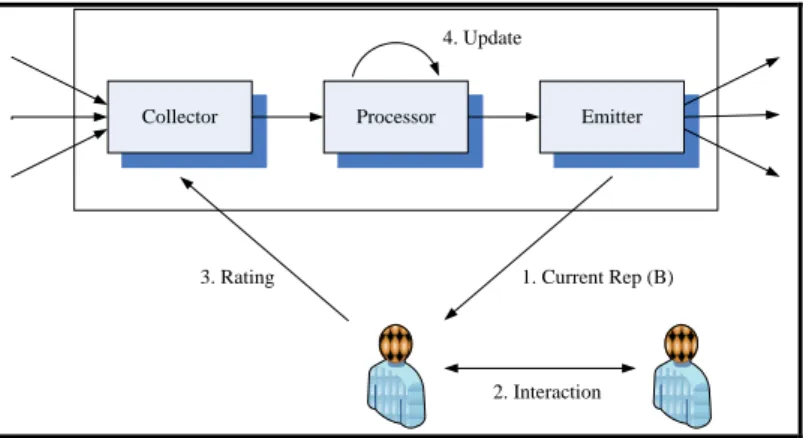
(28) 18. likely to result in more favorable outcomes than transactions with disreputable participants (Josang et al., 2007). Within a global centralized reputation system, there is only a single reputation value per agent at a time which could possibly be a multidimensional value.. The main components and actors of a centralized reputation system are shown in Figure 2-1. After each transaction, the agents provide ratings about each other's performance in the transaction. The target of a rating is called ratee. The collector gathers ratings from agents called raters. This information is processed and aggregated by the processor. The algorithm used by the processor to calculate an aggregated representation of an agent‟s reputation is the metric of the reputation system. The emitter makes the results available to other requesting agents so updated reputation scores are provided online for all the agents to see, and can be used by the agents to decide whether or not to transact with a particular agent. For example if agent A wants to transact with agent B, he will first retrieve the current reputation of B in order to know the trustworthiness of such agent. If the interaction is executed A becomes a rater and will rate agent B. Such rating is then collected and processed in order to update the reputation..
(29) 19. 4. Update. Collector. Processor. Emitter. 3. Rating. 1. Current Rep (B). 2. Interaction. Figure 2-1: Architecture of a reputation system. Bellow, Figure 2-2 shows a typical centralized reputation framework, where A and B denote transaction partners with a history of transactions in the past, and who consider transacting with each other in the present. The ratings post transactions go to the reputation center which is in charge of gathering them and making them available for potential transactions, as shown in Figure 2-3.. A. C. D. B. A. E. Reputation Center. Figure 2-2: Centralized reputation systems in past transactions.
(30) 20. A. B. Reputation Scores. Reputation Center. Figure 2-3: Centralized reputation systems in potential transactions. b). Distributed Reputation Systems. The second types of systems are the distributed reputation systems. In a distributed system there is no central location for submitting ratings or obtaining reputation scores of other participants. Instead, there can be distributed stores where ratings can be submitted, or each participant simply records the opinion about each experience with other parties, and provides this information on request from relying parties (Josang et al, 2007). A relying party, who considers transacting with a given target party, must try to obtain ratings from as many community members as possible who have had direct experience with that target party. This is illustrated in Figure 2-4 and Figure 2-5 below..
(31) 21. A. C. D. B. A. E. Figure 2-4: Distributed reputation systems in past transactions. D. E. C. Ratings. A. B. Figure 2-5: Distributed reputation systems in potential transactions. The relying party computes the reputation score based on the received ratings. In case the relying party has had direct experience with the target party, the experience from that encounter can be taken into account as private information, possibly carrying a higher weight than the received ratings..
(32) 22. Reference (Josang et al, 2007) states the main differences between centralized and. distributed. protocols. and. systems, a. in. reputation. regards. with. computation. the. engine. degree used. of by. centralized the. central. authority. The main concern of distributed system is the existence of many copies of the tables in the front end processors which would introduce too. much. complexity. for. a. simulation. system. according. with. this. project. Therefore in order to reduce the complexity, for the present work we will focus only on centralized reputation systems for both application cases..
(33) 23. 3.. PROPOSED REPUTATION METRIC. Reputation systems need metrics in order to calculate the reputation of its participants, that is, a way to obtain a qualification for each individual, using information stored in the system. Many reputation models have been proposed for online environments systems throughout the past years, but no accepted common model of reputation exists yet.. In general, the reputation is meaningful only inside the particular system or model in which it is calculated but in spite of that the scope it can reach could be very wide. This allows variation of parameters used in the calculation that can be used to avoid abuses and adapt the system to changing conditions and improve the model constantly.. The reputation of users can be captured via either implicit or explicit user feedback. In the implicit approach the reputation of users is inferred by observing behavior patterns. This approach requires less intervention from users, captures short-term participation and continuous updates reputation of users. However modeling user reputation on the basis of implicit feedback has a major limitation: the underlying assumption is that the implicit contribution is directly proportional to how much they like it. Consequently, explicit feedback is the favored approach for gathering information about users (Amatriain et al, 2009). Although this.
(34) 24. approach adds a burden on the users and different users might respond differently to incentives (Harper et al., 2005), it is generally accepted that explicit data is more reliable in most situations.. On the other hand implicit feedback is the basis input of the concept of „Web 2.0‟ which claims the opposite as remarked in (Joachims et al., 2007). Therefore we believe that the best approach would be to have a reputation metric that combines the explicit and implicit approaches.. 3.1. Existing Reputation Metrics. The simplest form of computing reputation scores is simply to sum the number of positive ratings and negative ratings separately, and to keep a total score as the positive score minus the negative score. This is the principle used in eBay's reputation forum which is described in detail in (Resnick and Zeckhauser, 2002). The main advantage of this metric is that anyone can understand the principle behind the reputation score due to its simplicity, but at the same time has the disadvantage of being too primitive and therefore gives a poor picture of the participants' trustworthiness..
(35) 25. A slightly more advanced scheme proposed in (Schneider et al, 2000) is to compute the reputation score as the average of all ratings. Average systems compute the reputation of an agent as the average of all ratings the agent has received, making this average value the global reputation of this agent. The idea of this metric is that agents behave the same way most of their lifetime. Unusual ratings have only little weight in the computation of the final reputation. This principle is used in the reputation systems of numerous commercial web sites such as Epinions and Amazon.. Bayesian systems take binary ratings as input (i.e. positive or negative) and compute reputation scores by statistically updating the beta probability density functions. The updated reputation score is computed by combining a previous reputation score with the new rating (Josang and Ismail, 2002), (Withby, 2000). The advantage of Bayesian systems is that they provide a theoretically sound basis for computing reputation scores, but has the disadvantage that it might be too complex for average people to understand (Josang et al., 2007).. EigenTrust Systems combine the local reputation values of each agent iteratively to a global reputation (Kamvar, 2003). This is done by modifying a target agent‟s reputation values by the opinions of surrounding agents. These opinions are weighed according to the local reputation values a certain agent has about its.
(36) 26. neighbors. During this process the individual reputations are iteratively accumulated to one single global reputation for each agent.. Blurred Systems compute a weighted sum of all ratings. The older a rating is, the less it influences the current reputation. An approach in a peer-2-peer environment is described in (Selcuk et al., 2004). This metric is based on the observation that agents do change their behavior during their lifetime. The assumption is that they will behave more probably like they did in their most recent transactions than they did in transactions long ago in the past.. The Dirichlet probability distribution is a multinomial Bayesian probability distribution that represents a generalization of the binomial Beta reputation system. The multinomial aspect of Dirichlet reputation systems means that any set of discrete rating levels can be defined. This provides great flexibility and usability, as well as a sound basis for designing reputation systems (Josang et al., 2007). The mathematical representation of reputation systems based on the Dirichlet distribution allows graded ratings to be directly expressed and reflected in the derived reputation scores (Josang et al., 2007). Although the Dirichlet distribution might seem mathematically complicated, the computation of the distribution itself never actually has to be done to accumulate ratings or to compute reputation scores..
(37) 27. Systems that compute trust or reputation by transitive iteration through looped or arbitrarily long chains can be called flow models. Some flow models assume a constant reputation weight for the whole community, and this weight can be distributed among the members of the community. Participants can only increase their reputation at the cost of others. For example Google's PageRank (Page et al., 1998) belongs to this category. In general, a participant's reputation increases as a function of incoming flow, and decreases as a function of outgoing flow. In the case of Google, many hyperlinks to a web page contribute to increase the PageRank whereas many hyperlinks from a web page contribute to decrease the PageRank for that web page.. 3.2. Proposed Reputation Metric. As we already mentioned, a reputation system requires a reputation metric to calculate the reputation of its participants. This reputation can be captured via implicit user feedback, by observing behavior patterns, or via explicit user feedback.. In our model we identified two main factors that should influence on the reputation of a user in the system which are:.
(38) 28. Implicit user feedback. Explicit user feedback.. Each type of feedback represents a multidimensional vector which will depend on the scenario where the system is being developed. The implicit approach will summarize the level of recent activity given for example, by the amount of answers in a certain debate. As for the explicit approach we could find the past ratings given by other users.. The chosen model is based in the one described in (Ren and Boukerche, 2008). The essential distinction between that metric and ours is that this novel metric considers explicit feedback as qualifications from other nodes, assigning more importance to the most recent ones.. The trust for user a will be calculated as described below in Equation (3.1) in which RQ a is the past qualifications from others of user a (explicit feedback) and F a is the level of recent activity of user a (implicit feedback).. Trust a. RQ a. 1 F a. RQ a. 1 1. (3.1). Eventually the trust of users will be a value that represents their level of trustworthiness in the system..
(39) 29. 3.2.1 Level of Recent Activity. We will define F as a function that determines the level of recent activity of a certain node. The level of recent activity for user a will be obtained from the Equation (3.2) where RP a is the participating reputation of user a , RL a is the leadership reputation of user a , T a is the residential time of user a and k is a discount factor between 0 and 1 that will be chosen in order to decrease the level of participation when the time spent in the system is longer and increase it when the time is shorter. F a. a). RP a RL a k T. a. (3.2). Participating Reputation. Stimulating users to participate responding to reputation queries is a relevant issue because users in the open system have individual interests and are generally reluctant to serve others for free (Zhang et al., 2004). A way to solve the lack of interest problem is by a credit-based approach; in particular whenever a user participates in the system he should gain extra points.. Based on this approach we believe that users should be rewarded for their participation in the system. In other words, a user can increment his reputation score by participating actively in the system..
(40) 30. A good way to measure the participation is by the relative contribution factor which will be the amount of actions executed by a user over the amount of total actions. We will denote CiP as the relative contribution factor for participation which has been divided in m areas, where m represents the amount of participation dimensions measured by the system, and its values will satisfy 0. CiP. 1 for i. 1,..., m . Each contribution should have different importance in. the system, for such reason we will identify. i. as the importance weight of CiP. which values will go between 0 and 1. We then define the participating reputation R P of user a as shown in Equation (3.3) below. m. RP a. i. CiP a. (3.3). i 1. b). Leadership Reputation. Certain users have the ability to generate participation in others and such ability should be rewarded by the system. In a similar way to participating reputation, C iL represents the contribution factor for leadership which will be sorted out in n different areas, where n represents the amount of leadership dimensions and its values will satisfy 0. CiL. 1 for i. 1,..., n . We will define. i. as the weight of. C iL in the system which values will go between 0 and 1. Equation (3.4) presents. the leadership reputation RL of user a which is defined as:.
(41) 31. n. RL a. i. CiL a. (3.4). i 1. 3.2.2 Past Qualifications. Users in the system can be qualified by others for a performed activity. Agent a will be rated and given a qualification q. Q where Q. 1,0 which represent a. positive or negative qualification respectively.. (Dellarocas, 2004) has shown that storing feedback information on the most recent time interval is enough; and that summarizing feedback information for more than one window of time interval does not improve the reputation system. For that reason each user a in the system will have a time-sorted list Qa of his last h qualifications where Qa 1 is the oldest rate and Qa h is the most recent. When a new qualification h 1 arrives, the oldest one comes out of the list like a FIFO array.. Agents will behave more probably like they did in their most recent transactions. Therefore we chose a metric called BlurredSquared (Schlosser et al., 2004) which computes a weighted sum of all ratings. The older a rating is, the less it influences the current reputation. In our particular case the reputation will only be calculated.
(42) 32. with the last h qualifications. The peer reputation R Q of user a will then be defined as described below in Equation (3.5). h. RQ a j 1. Qa j 2 h j 1. (3.5).
(43) 33. 4.. TRUST-BASED REPUTATION SYSTEMS IN MANETS. (Rasmusson and Janssen, 1996) were the first to use the term „hard security‟ for traditional mechanisms like authentication and access control, and „soft security‟ for what they called social control mechanisms, like reputation systems which complement traditional information security mechanisms.. Reputation is an interdisciplinary concept that has been used in many different contexts from social to finance. (Schneider et al., 2000) explain how information about reputation assists in daily human interactions. They provide a solution to evaluate a user‟s trustworthiness in a mobile and wearable community.. Finding reliable agents over the Internet is vital when referring to the exchange of packages. Nodes that have communicational problems due to the integrity of the signal or the distance between the two-point communication will tend to interrupt a transmission or deliver an inappropriate message, for such reason the proper identification of good nodes will certainly improve the global communication leaving aside the nodes that do not keep up with the desired requirements. This especially applies to wireless networks which need other trustworthy nodes for establishing a secure transmission..
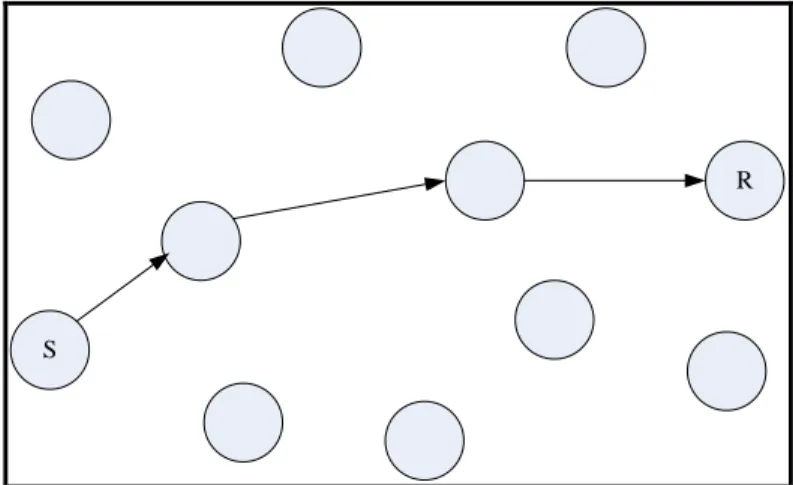
(44) 34. 4.1. Mobile Ad Hoc Networks. A mobile ad hoc network (MANET) is a multi-hop wireless network where all nodes cooperatively maintain network connectivity. Due to the limited transmission range of wireless nodes, as well as the rapid change in network topology, multiple hops may be needed for one node to exchange data with another across the network.. A typical example of a MANET network is shown in Figure 4-1, in this case with eleven nodes. Node S and R represents the sender and receiver nodes respectively and the information sent requires two intermediate nodes in order to cooperate for the transmission of the message.. R. S. Figure 4-1: Typical transmission in a MANET.
(45) 35. A rapid growth of research interests in mobile ad hoc networking (MANET) has emerged in the last decade by many different organizations and institutes. MANETs characterize for the diverse application of these networks in many different scenarios such as battlefield and disaster recovery together with the infrastructureless and the dynamic nature of these networks demands new set of networking strategies to be implemented in order to provide efficient end-to-end communication (Abolhasan et al., 2004).. MANETs employ the traditional TCP/IP structure to provide end-to-end communication between nodes. However, due to their mobility and the limited resource in wireless networks, each layer in the TCP/IP model requires redefinition or modifications to function efficiently in MANETs.. One interesting research area in mobile ad hoc networking is routing. The limited resources in MANETs have made designing of an efficient and reliable routing strategy a very challenging problem (Abolhasan et al., 2004) and for such reason has received a tremendous amount of attention from researchers. Not only the reduced amount of resources but also the requirement of being able to adapt to several changing network conditions such as: network size, traffic density and network partitioning, is that an efficient and intelligent routing strategy is essential in mobile ad-hoc networks. This has led to development of many different routing.
(46) 36. protocols for MANETs. (Abolhasan et al., 2004) classified these algorithms into three different groups:. Global / Proactive Routing Protocols On Demand / Reactive Routing Protocols Hybrid Routing Protocols. Each group has a number of different routing strategies, which employ a flat or a hierarchical routing structure and diverse characteristic features explained in the following sections.. 4.1.1 Proactive Routing Protocols. In the first category, called global or proactive routing protocols, the routes to all the destination (or parts of the network) are determined at the start up, and maintained by using a periodic route update process. Each node maintains routing information to every other node (or nodes located in a specific part) in the network. The routing information is usually kept in a number of different tables and such tables are periodically updated whenever the network topology changes.. All proactive routing protocols use the shortest path as their routing algorithm. The difference between these types of protocols exists in the way the routing.
(47) 37. information is updated, detected and the type of information kept at each routing table (Abolhasan et al., 2004). In addition, each routing protocol may maintain different number of tables.. One proactive routing protocol is the Destination-Sequenced Distance Vector (DSDV) algorithm (Perkins and Bhagwat, 1994) which is a modification of the Distributed Bellman-Ford (DBF) algorithm (Bellman, 1957), (Ford and Fulkerson, 1962) that guarantees routes free of loops. It provides a single path to a destination, which is selected using the distance vector shortest path routing algorithm. In order to reduce the amount of overhead transmitted through the network, two types of update packets are used that are referred to as a „full dump‟ and „incremental‟ packets. The full dump packet carries all the available routing information and the incremental packet carries only the information changed since the last full dump. The incremental update messages are sent more frequently than the full dump packets. The main problem of this algorithm is that DSDV still introduces large amounts of overhead to the network due to the requirement of the periodic update messages, and the overhead grows according to O(n 2 ) . This is the main reason why the protocol will not scale in large networks since a large portion of the network bandwidth is used in the updating procedures.. The Wireless Routing Protocol (WRP) (Murthy and Garcia-Luna-Aceves, 1995) also guarantees loops freedom and it avoids temporary routing loops by using the.
(48) 38. predecessor information. However, WRP requires each node to maintain four routing tables which introduces a significant amount of memory overhead at each node as the size of the network increases. Another disadvantage of WRP is that it ensures connectivity through the use of hello messages. Such messages are exchanged between neighboring nodes whenever there is no recent packet transmission as each node is required to stay active at all times. This will also consume a significant amount of bandwidth and power.. Another proactive protocol that improved the routing overhead of the previous two algorithms is the Distance Routing Effect Algorithm for Mobility (DREAM) (Basagni et al., 1998). In DREAM, each node knows its geographical coordinates through a GPS. These coordinates are periodically exchanged between each node and stored in a routing table called a location table. Exchanging location information presents the advantage of consuming significantly less bandwidth than exchanging complete distance vector information, which means that this algorithm is more scalable in mobile ad-hoc networks. Routing overhead is further reduced in DREAM by making the frequency at which update messages are disseminated proportional to mobility and to distance effect therefore stationary nodes do not need to send any update messages.. After a brief description of three of the most important proactive routing protocols we can summarize that most global routing algorithms utilize only the shortest path.
(49) 39. algorithm to determine the routing of a message. Besides the differences between them caused mainly by the way they update the routing tables that store the paths information, these types of protocols do not scale very well. This is because their updating procedure consumes a significant amount of network bandwidth (Albohasan et al., 2004).. 4.1.2 Reactive Routing Protocols. In the second group, called on demand or reactive protocols, routes are determined when they are required by the source using a route discovery process. On-demand routing protocols were designed to reduce the overheads in proactive protocols by maintaining information for active routes only. This means that routes are determined and maintained for nodes that require sending data to a particular destination. Route discovery usually occurs by flooding a route request packets through the network.. Reactive protocols can be classified into two categories, as remarked by (Abolhasan et al., 2004), which are: source routing and hop-by-hop routing.. The first category of the reactive routing protocol is the source routed on-demand protocols (Toh, 1996), (Johnson and Maltz, 1996) in which each data packet carries the complete source to the destination address. Therefore, each intermediate.
(50) 40. node forwards the corresponding packets according to the information stored in the header of each packet. This means that the intermediate nodes do not need to maintain up-to-date routing information for each active route in order to forward the packet towards the destination. Moreover, nodes do not need to maintain connectivity with neighbors through periodic messages. The major drawback with source routing protocols is that in large networks they do not perform well. This is due to two main reasons; as the number of intermediate nodes grows, then so does the probability of route failure and the amount of overhead carried in every header of each data packet. Therefore, in large networks with significant levels of multihoping and high levels of mobility, these protocols may not scale well (Abolhasan et al., 2004).. The second category is the hop-by-hop routing or also known as point-to-point routing (Das et al., 2003), in which each data packet only carries the destination address and the next hop address. Every intermediate node uses its routing table to forward each data packet towards the destination. The main benefit of this strategy is that routes are adaptable to the dynamically changing environment of MANETs, since each node can update its routing table when they receive fresher topology information and hence forward the data packets over improved routes. Using fresher routes also means that fewer route recalculations are required during data transmission. The disadvantage of this strategy is that each intermediate node must.
(51) 41. store routing information for each active route and this may require the use of messages to be aware of a node‟s surrounding neighbors.. An example of a reactive routing protocol is the Ad Hoc On-Demand Distance Vector (AODV) proposed in (Das et al., 2003) that is based on DestinationSequenced Distance-Vector routing (DSDV) and the Dynamic Source Routing (DSR) (Johnson and Maltz, 1996) algorithm. It uses the periodic beaconing and sequence numbering procedure of DSDV and a similar route discovery procedure as in DSR. In AODV the packets carry the destination address which means that AODV has potentially less routing overheads than DSR. The other difference is that the route replies in DSR carry the address of every node along the route, whereas in AODV the route replies only carry the destination IP address and the sequence number. The advantage of AODV is that it is adaptable to highly dynamic networks. However, node may experience large delays during route construction, and link failure may initiate another route discovery, which introduces extra delays and consumes more bandwidth as the size of the network increases (Albohasan et al., 2004).. The protocol Signal Stability Adaptive (SSA) (Dube et al., 1997) selects routes based on signal strength and location stability. The routes selected in SSA may not be the shortest path to the destination but on the other hand, they tend to live longer, which means that fewer route reconstructions are needed. One.
(52) 42. disadvantage of SSA when compared to DSR and AODV is that intermediate nodes can not reply to route requests sent toward a destination, which may potentially create long delays before a route can be discovered (Albohasan et al., 2004). Another disadvantage of SSA is that no attempt is made to repair routes at the point were the link failure occurs. In SSA the reconstruction occurs at the source which may introduce extra delays.. Location-Aided Routing (LAR) algorithm (Ko and Vaidya, 1998) is a flooding protocol that attempts to reduce the routing overheads present in the traditional flooding algorithms by using location information. The main principle LAR is that each node knows its location through a GPS. In (Ko and Vaidya, 1998) two different LAR schemes were presented. Both methods limit the control overhead transmitted through the network and hence conserve network bandwidth. In most cases, this algorithm can determine the shortest path to the final destination since the route request packets travel away from the source and towards the destination. The main disadvantage of this protocol is that each node is required to carry a GPS device which is not always available in all MANETs.. 4.1.3 Hybrid Routing Protocols. Finally the third category is known as the hybrid routing protocols which combine the basic properties of the first two classes of protocols into one. That is, they are.
(53) 43. both reactive and proactive in nature. These protocols are designed to increase scalability by allowing nodes with close proximity to work together to form some sort of a backbone to reduce the route discovery overheads. This is mostly achieved by proactively maintaining routes to near nodes and determining routes to far away nodes using a route discovery strategy. Most hybrid protocols are zonebased, which means that the network is partitioned or seen as a number of zones by each node.. Zone Routing Protocol (ZRP) (Hass and Pearlman, 1999) is an example of a hybrid routing protocol. In ZRP the nodes have a routing zone, which defines a range (in hops) that each node is required to maintain network connectivity proactively. Therefore, for nodes within the routing zone, routes are immediately available. For nodes that lie outside the routing zone, routes are determined on-demand (i.e. reactively), and it can use any on-demand routing protocol to determine a route to the required destination.. Unlike ZRP, Zone-Based Hierarchical Link State routing protocol (ZHLS) (Joa-Ng and Lu, 1999) utilizes a hierarchical structure. The network is divided into nonoverlapping zones, and each node has a node ID and a zone ID, which is calculated using a GPS. The hierarchical topology is made up of two levels: node level topology and zone level topology. This algorithm scales well to large networks.
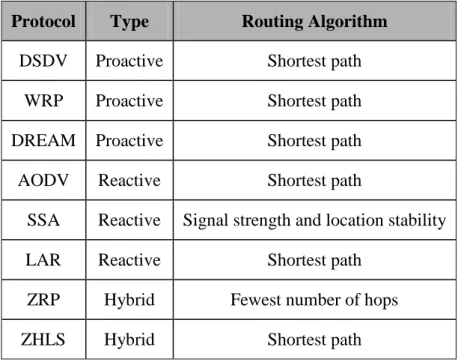
(54) 44. because it is highly adaptable to dynamic topologies and it generates far less overhead than pure reactive protocols.. Other hybrid algorithms are for example the Distributed Spanning Trees (DST) routing protocol presented in (Radhakrishnan et al., 1999) and the Distributed Dynamic Routing (DDR) described in (Nikaein et al., 2000), both tree-based protocols.. Hybrid routing protocols have the ability to provide higher scalability than pure reactive or proactive protocols because they attempt to minimize the number of rebroadcast nodes by defining a structure that permit nodes to work together to organize the routing. By working together the best or the most suitable nodes can be used to perform route discovery. Hybrid routing protocols attempt to eradicate point of failures and to create bottleneck nodes in the network which is achieved by allowing any number of nodes to perform routing or data forwarding when the preferred path is not available.. 4.1.4 Summary of the Main Routing Protocols. The algorithms presented in the previous sections are summarized in Table 4-1 below according to their type and the reputing algorithm they employ to transmit a package to its final destination..
(55) 45. Table 4-1: Routing algorithms of existing protocols Protocol. Type. Routing Algorithm. DSDV. Proactive. Shortest path. WRP. Proactive. Shortest path. DREAM. Proactive. Shortest path. AODV. Reactive. Shortest path. SSA. Reactive. Signal strength and location stability. LAR. Reactive. Shortest path. ZRP. Hybrid. Fewest number of hops. ZHLS. Hybrid. Shortest path. The existing routing protocols consider basically three types of routing algorithms: shortest path, signal strength and location stability, and the fewest number of hops. The behavior of nodes in past transactions is not taken into account therefore valuable information about the reliability of the nodes is not being considered. In this work we present an approach to a routing algorithm based on the level of trustworthiness of the nodes in a community..
(56) 46. 4.2. Proposed Trust-Based Routing Heuristic. A trust-based reputation system in a mobile ad-hoc network helps establish trust between different nodes by the allocation of reputation values to every node. Such system uses past transaction feedback as an indicator of future behavior of nodes. When a node that is part of a MANET has a high trust value, it means that such node is a trustworthy node in the network and therefore should be part of future communications. In a MANET network based on trust, nodes will use their community partners to communicate between each other and the nodes chosen will depend on their level of trust.. In section 4.1 we discussed over the existing routing protocols for mobile ad hoc networks. In general, flat routing algorithms, which mean non hierarchical algorithms, can be simple to implement, however it may not scale very well for large networks (Iwata et al., 1999). In order to make flat addressing more efficient, the number of routing overheads introduced in the networks must be reduced. One way to do this is to use a device such a GPS (Albohasan et al., 2004).. The network model proposed in this work makes the following assumptions for the trust-based system:.
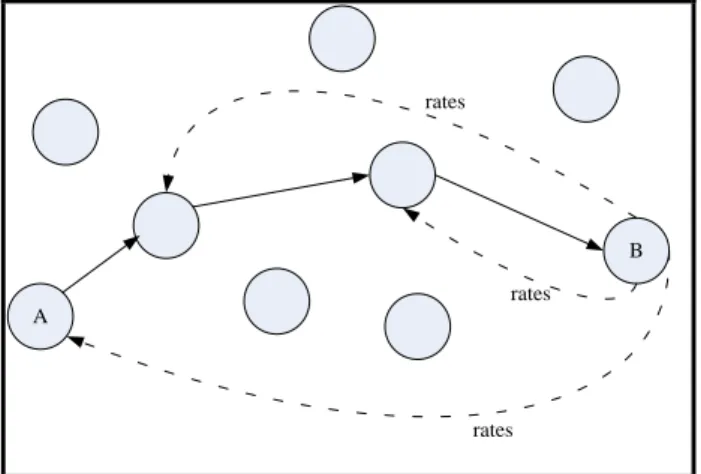
(57) 47. The geographic position of each node is known all the time. This can be easily implemented by having a GPS device in every node. Nodes can communicate with each other using a multi-hop architecture. The reputation of nodes is managed centralized and all nodes have access to the central trust system at all times. The network must be equipped with an infrastructure of authorities for the assignment of authentication certificates.. A node to be part of a network has to be properly authenticated by an association between its identity and its public key. Public key certificates are usually used for this purpose. Certificates will be associated with an identifier of the node such as IP address or MAC address. Thus we propose a mechanism of assignment of a unique certificate for each node by a certifying authority.. Nowadays, key management schemes based on public key cryptography are not suitable for MANET networks because of its computation inefficiency and nodes resources constraints. Hence we propose to use a symmetric key distribution scheme between mobile nodes like the one proposed in (Dahshan and Irvine, 2008). Such scheme distributes symmetric keys between mobile nodes in two steps: the distribution of certificates during the route request process and the dissemination of symmetric keys during the route reply process..
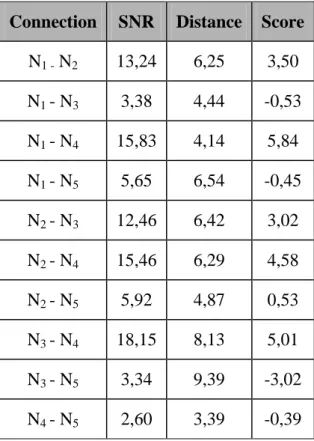
(58) 48. In our model we identified two reputation factors that are directly correlated with the trust of a node in a MANET: activity level and past behavior. The activity level of a node is directly correlated with his level of participation in the transmission of messages. The past behavior of a node reflects his performance in the exchange of packages that the node was involved in. Considering these two factors we can apply the reputation metric proposed in Section 3.2, in this case to improve the security of a mobile ad hoc network.. To send a package between two peers it is necessary to find the appropriate path for the message in order to reach its goal with the highest probability of success. Once the path is selected, the message is sent. The algorithm proposed in this paper identifies the best path for a message based in three factors: reputation of nodes, distance between them and integrity of the wireless connection.. The strength of the wireless connection between two nodes A and B is expressed by the signal-to-noise ratio (SNR). The connection between these two nodes has a score ScoreAB which is calculated as a weighted sum of the distance between them d AB and the strength of the signal SNRAB , with. 0,1 a scalar between zero and. one. Such score is then obtained according to Equation (4.1).. ScoreAB. SNRAB. 1. d AB. (4.1).
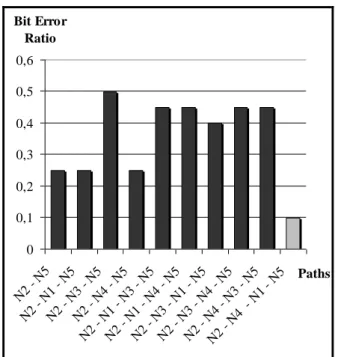
(59) 49. In this work we present a novel routing heuristic named Trust-Based Routing Algorithm (TRA) which is used for the transmission of a package from an initial node to a final node in a MANET network. This protocol returns the path with the highest level of trust for such message according to the reputation of each node and their participation in previous communications.. In the beginning an initialization of the path and current node is performed. After that an iterative instruction is performed while the current node is different from the final node. Inside that loop we identify the good neighbors of the current node using the connection score and for all selected nodes we choose the one with the highest trust. By „neighbors‟ of a node we mean all nodes in the network that are one-hop distance from the node. After that selection we include the chosen node into the path and then jump to the node with highest credibility. Finally the function returns the path with the highest level of trust. This algorithm is shown next. path [ ] ← insert (initial_node); current_node ← initial_node; while (current_node ≠ final_node) do selected_nodes[ ]← good_neighbours (current_node); max_trust ← selected_ nodes[0]; for j = 0…size (selected_ nodes[] do if (selected_ nodes[j] = final_node) then max_trust ← selected_ nodes[j]; else if (trust (selected_ nodes[j]) > trust (max_trust)) then max_trust ← selected_nodes[j]; path [ ] ← insert (max_trust); current_node ← max_trust; return path[];.
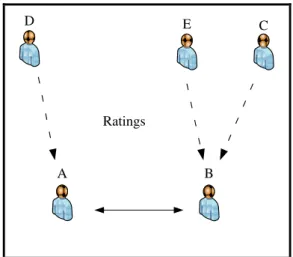
(60) 50. Every received message is checked to verify its integrity. In a real-world implementation this could be done by a checksum. According to the integrity of the message received a qualification will be given to all nodes that are part of the selected path. Figure 4-2 shows a transmission between nodes A and B which involves two other nodes as part of the path. Node B after receiving the message rates the three nodes involved in the communication.. rates. B rates A. rates. Figure 4-2: Transmission and ratings between nodes. The reputation of nodes will change depending on their level of participation in the number of messages exchanged as well as the integrity of the messages they send to other nodes. Eventually the reputation of peers will tend to represent their level of trustworthiness in the community. The higher the reputation is the better node for communication. A high reputation means that such node is a secure node to transmit messages in comparison with other nodes in the network with lower reputation..
(61) 51. 4.3. Simulation Results for a Five-Node Community. Each node was given a random position in a two dimension map between (0,0) and (10,10) . The SNR of connections between every two nodes was also assigned randomly because it is not necessarily related to distance since obstacles could be placed in the way and oscillated between 0 and 20. Every connection between any two nodes has a particular score as is shown in Table 4-2. For simulation we used. 0,5 for the score formula described in Equation (4.1).. Table 4-2: Connection scores for a five-node community Connection. SNR. Distance. Score. N1 - N2. 13,24. 6,25. 3,50. N1 - N3. 3,38. 4,44. -0,53. N1 - N4. 15,83. 4,14. 5,84. N1 - N5. 5,65. 6,54. -0,45. N2 - N3. 12,46. 6,42. 3,02. N2 - N4. 15,46. 6,29. 4,58. N2 - N5. 5,92. 4,87. 0,53. N3 - N4. 18,15. 8,13. 5,01. N3 - N5. 3,34. 9,39. -3,02. N4 - N5. 2,60. 3,39. -0,39.
(62) 52. For this five-node community we simulated an event between two nodes (in this case N 2 sends a message to N 5 ). The algorithm identified the best path as: N2. N4. N1. N 5 . In Figure 4-3 we show the average bit error ratio (BER) for all. paths between those two peers. We can see that any alternative path has a higher average bit error ratio than the one selected by the algorithm which is colored differently from the rest.. Bit Error Ratio 0,6 0,5 0,4 0,3 0,2 0,1. N N2 2 - -N N N1 5 2 - -N N N3 5 N 2 2 - -N - N N4 5 N 1 -N 2 - N - N3 5 N 1 -N 2 - N - N4 5 N 3 -N 2 - N - N1 5 N 3 -N 2 - N - N4 5 N 2 4- -N -N N 5 4 3- N N5 1 -N 5. 0 Paths. Figure 4-3: Average BER for path between two nodes. To simulate the final BER, each link has a convolutional code with a rate of ½. The mobile channel was set with a frequency of 900 Hz and a velocity of 500 meters per hour. The BER for each path is calculated between the message sent by the initial node and the message received by the final node..
(63) 53. 4.4. Complexity Studies. Two well-known complexity parameters are the Time Complexity (TC), defined as the number of steps required to perform a protocol operation, and the Communication Complexity (CC), defined as the number of messages exchanged in performing the operation. Below Table 4-3 shows a comparison between tha main existing routing algorithms and TRA, the novel protocol proposed in this thesis. These complexity computations are supported by (Park and Corson, 1997) and (Albohasan et al., 2004) to which the reader is referred for details.. Table 4-3: Complexity comparison Protocol. TC. CC. AODV. O(2d). O(2x). DSDV (link failure). O(x). O(Dx). DSDV (periodic update). O(l). O(|L|). DUAL (link addition, cost decrease). O(d). O(|L|). DUAL ( link failure, cost increase). O(x). O(6Dx). GB (connected, postfailure). O(2l). O(lDx). ∞. ∞. ILS. O(d). O(2|L|). LAR. O(2d). O(2x). LMR (connected, postfailure). O(2l). O(2Dx). GB (disconnected, postfailure).
(64) 54. <∞. <∞. SSA. O(2d). O(2x). TRA. O(d). O(2|L|). WRP (link addition, cost decrease). O(d). O(|L|). WRP ( link failure, cost increase). O(h). O(Dx). LMR (disconnected, postfailure). The complexity parameters mentioned previously are the number of network links. L , the network diameter d , the number of nodes in a network x , the length of the longest directed path in the affected network segment l , the height of the routing tree h , and the maximum nodal degree D .. The routing protocol proposed in this paper has a similar complexity to ILS for it presents a time complexity of O d and a communication complexity of O 2 L . This last value is due to the need of a past-transaction feedback about the reputation of a node in a package transmission. Although the complexity of algorithms such as DUAL is lower, the increase in complexity is minor compared to the enormous benefits reported by the use of ratings over past transactions. The proposed algorithm presents a low complexity accompanied by the identification of reliable nodes in the network which is very valuable for the general security in a wireless network..
Figure

+7

Documento similar
In addition, precise distance determinations to Local Group galaxies enable the calibration of cosmological distance determination methods, such as supernovae,
Public archives are well-established through the work of the national archive services, local authority-run record offices, local studies libraries, universities and further
Keywords: iPSCs; induced pluripotent stem cells; clinics; clinical trial; drug screening; personalized medicine; regenerative medicine.. The Evolution of
Illustration 69 – Daily burger social media advertising Source: Own elaboration based
Astrometric and photometric star cata- logues derived from the ESA HIPPARCOS Space Astrometry Mission.
The photometry of the 236 238 objects detected in the reference images was grouped into the reference catalog (Table 3) 5 , which contains the object identifier, the right
In addition to traffic and noise exposure data, the calculation method requires the following inputs: noise costs per day per person exposed to road traffic
We have also used a different tumour model to analyse the mitogenic signalling from apoptotic cells. We have so far tested the role of
