
Early Carboniferous siliciclastic carbonates in east central Iran versus coeval carbonates of north Iran: record of latest Tournaisian early Visean tectonic events
16
0
0
Texto completo
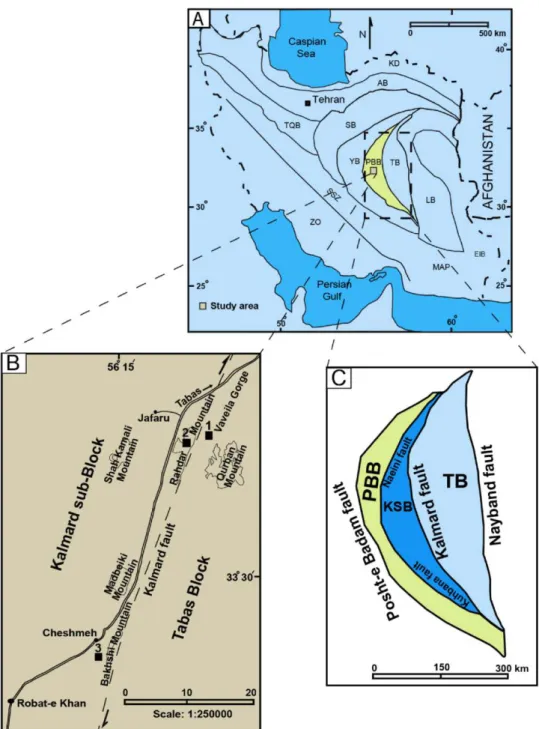
(2) Arefifard & Vachard- Early Carboniferous siliciclastic-carbonates in East-central Iran. 30. INTRODUCTION The Carboniferous Early Mississippian-Late Pennsylvanian successions are sporadically and discontinuously exposed in Iran, but in the Alborz Mountains have been widely studied (e.g. Mosaddegh 2003, Falahatgar 2008, Bahrammanesh et al. 2011, Falahatgar & Mosaddegh 2012, Zandkarimi et al. 2014). The bulk of the recent geological studies is focused on central and northern Iran structural blocks, the age and geologic origin of which are poorly elucidated (Angiolini et al. 2007, Brenckle et al. 2009, Berra et al. 2014). This study concerns the poorly known Kalmard area. There are some widely accepted events and phenomena that seem to have characterized the Carboniferous Period: (a) the Early Carboniferous transition between the Devonian greenhouse and Permian-Carboniferous icehouse (Dickins 1996, Crowell 1999), (b) sea level was high during the Late Devonian and Early Carboniferous (Sandberg et al. 2002), (c) glaciers covered most parts of Gondwana during the Late Carboniferous (Isbell et al. 2003a, b), (d) this ice age (or LPIA) corresponds to sea level decline in mid- and late Carboniferous times (Ross & Ross 1988), and (e) a major bio-event corresponds to this climate change with major extinctions of conodonts and ammonoid faunas as well as foraminifers, corals and crinoids turnovers (House 1993, Walliser 1995). It is noteworthy that, although no Late Carboniferous glacial deposits have been reported from Iran, the impact of sea level fall on depositional environment is undisputable (Aghanabati 2008). In most parts of Iran, the Lower Carboniferous rocks are mainly composed of carbonates, locally interbedded with dark shale and marlstone. They contain a variety of foraminifers, brachiopods, ammonoids, trilobites, bryozoans, and crinoids. For instance, in Shotori Range, in the Tabas block, the Late Devonian-Early Carboniferous Shishtu Formation is informally subdivided into two members: Shishtu-1 and Shishtu-2 (Ruttner et al. 1968). The latter subformation is Early Carboniferous (Tournaisian-Visean) in age and it is composed of dark gray brachiopod-bearing limestone interbedded with pink shales. This subformation is unconformably overlaid by light green shales with intercalations of sandstones and limestones of the Visean-Moscovian Sardar Formation (Stocklin et al. 1965). In northern Iran, there is a succession of dark gray limestones with intercalations of dark marls in its lower part which is known as the Mobarak Formation. The age of the Mobarak Formation is considered Tournaisian-Visean based on its microfossil content (Bozorgnia 1973, Vachard 1996, Zandkarimi et al. 2014). Palaeomagnetic data from north and central Iran reveals that the Iranian blocks were located close to the Arabian margin of the Gondwana during the Late Ordovician-Earlieast Carboniferous and they have drifted away from Gondwana margin since the Permian (Muttoni et al. 2009). However, there are some palaeontological evidence suggesting the palaeoequatorial and the warm-water Palaeo-Tethyan Ocean affinity of biota during Mississipian in northern and central Iran (Kalvoda 2002, Webster et al. 2003, Brenckle et al. 2009). The Early Carboniferous deposits were affected by epeirogenic episodes and widespread uplifts, more or less coeval with some phases of the Hercynian orogeny, as well as sea level fluctuations. These processes lead to the emersion of the Lower Carboniferous platform, followed by erosion during Late Carboniferous and Early Permian when glacio-eustatic variation and marginal marine conditions dominated (Stöcklin 1968, Darvishzadeh 1992, Husseini 1992). In central Iran, the Lower Carboniferous deposits show various lithofacies. indicating that the water covered structural blocks separated by deep-seated faults in this period (Aghanabati 2008). The study area of this research work is in the Kalmard area of east-central Iran (Fig. 1). The Lower Carboniferous deposits belong to the Gachal Formation, initially divided into four members A-D in ascending order (Aghanabati 1977). The Member A starts with quartz sandstone and is overlain by brachiopod-bearing dolomitic limestone interbedded with marly limestone; the Member B is composed mainly of dolomite; the Member C includes gypsum with dolomite, and the Member D includes fossiliferous limestone. Based on the brachiopod contents, the Member A has been attributed to the late Tournaisian (Aghanabati 1977). The foraminiferal contents of Member B is poor and not significant, assigned to the Tournasian-Visean (Aghanabati 1977, 2004). Member C is lacking fossils and according to its stratigraphical position can be dated as Middle to Late Visean. Member D has been referred to the late Mississippian based on previously reported brachiopods, conodonts and foraminifers. In recent years, a fifth Member E has been added to the Gachal Formation. It was previously considered as a part of the Khan Formation in the Kalmard area but since it yields Early Carboniferous foraminifers, it has been attributed to the upper part of the Gachal Formation (Haftlang 1998, Gorgij 2002). This Member E is composed of siliciclastic and carbonate rocks. Gorgij (2002) has proposed a late Visean-Serpukhovian age for Member E based on some small foraminifers. Vachard and Arefifard (2015) demonstrated that the complete sequence of the Gachal Formation in the studied sections is actually limited to the Tournaisian-Visean boundary interval (MFZ8-MFZ9 biozones). This paper focuses on three reference sections of the Gachal Formation that are located in the Kalmard area, on both sides of the Kalmard fault (Fig. 1B). In Tang-e Vaveila on the east side of the Kalmard fault, there is no evidence of gypsum representing the Member C but in one section, on the western side of the Kalmard fault (Bakhshi section), the Member C is recognizable. Moreover, these sections show well-exposed outcrops of Member D possessing abundant and diverse foraminiferal and algal biotas. The purpose of this contribution is to present the results of a study performed to describe and analyze microfacies, depositional environment, and sequence stratigraphy of the Gachal Formation, then to compare these microfacies and depositional environmental features with its time-equivalent deposits (Mobarak Formation) in north Iran. However, a better understanding of the depositional environments in a large scale will require high-resolution sedimentological and sequence stratigraphy studies in both north and central Iran. GEOLOGICAL OVERVIEW Iran has been divided into several structural units; each unit is characterized by its distinctive stratigraphy, magmatic activity, metamorphism, orogenic events and tectonics. Central Iran is one of the most complex structural zones, according to the definition of Stöcklin (1968), it is bordered by the Alborz Mountains in the north and the Lut Block in the east. Nabavi (1976) considered the northern part of the Lut Block as part of central Iran and the Sanandaj-Sirjan Zone in the southsouthwest. Alavi (1991) divided central Iran into four blocks: the Lut Block (LB), Tabas Block (TB), Posht-e Badam Block (PBB) and the Yazd Block (YB). Strike-slip dextral faults (Nayband, Kuhbanan, Kalmard and Posht-e Badam) separate these blocks from each other (Fig. 1A)..
(3) Boletín del Instituto de Fisiografía y Geología 85, 2015. 31. Figure 1. A Generalized tectonic map of Iran (after Alavi 1991) showing the study area. B: Location of studied sections (1, 2 and 3) in the Kalmard area. C: Enlarged map showing Tabas and Posht-e Badam Blocks and Kalmard Sub-Block (KSB) and their faulted boundaries. Abbreviations: AB = Alborz; KD = Kopeh-Dagh; LB = Lut Block; PBB = Posht-e Badam Block; TB = Tabas Block; TQB = Tabriz-Qom Block; YB = Yazd Block; ZO = Zagros Orogen.. The Kalmard area in central Iran (Fig 1B) is located within the Posht-e Badam Block and bounded by the Kalmard (in the east) and Naeini-Kuhbanan (west) faults. This area was considered as part of the Tabas block due to the resemblance with Precambrian basement between Kalmard and Tabas areas (Aghanabati, 2004). Because of the location of the Kalmard area between two active faults, Aghanabati (1977, 2004) has designated this area as an isolated sub-block within the Tabas Block (Fig 1C). As a result of the activity and vertical movement of these two faults, the Kalmard area was a mobile zone in the Palaeozoic (Aghanabati 2004). The area was uplifted or subsided as horsts or grabens, as a result of the tectonic activity of these two faults during the Late Paleozoic. Severe subsidence in the Tabas Block led to the deposition of more. than 7000 m-thick Palaeozoic epicontinental marine sediments whereas the Palaeozoic deposits in the Kalmard area are only 950 m-thick (Berberian 1983). The differences in thickness and sedimentary facies between these two adjacent areas indicate that the Kalmard and Tabas faults were both active during the Palaeozoic (Aghanabati 1977, Berberian & King 1981, Berberian 1983). MATERIALS AND METHODS Three sections were measured and sampled for facies analysis. About 200 samples were collected and 215 thin sections were prepared. Facies nomenclature and description are based on Dunham (1962) and Pettijohn et al. (1987). For facies.
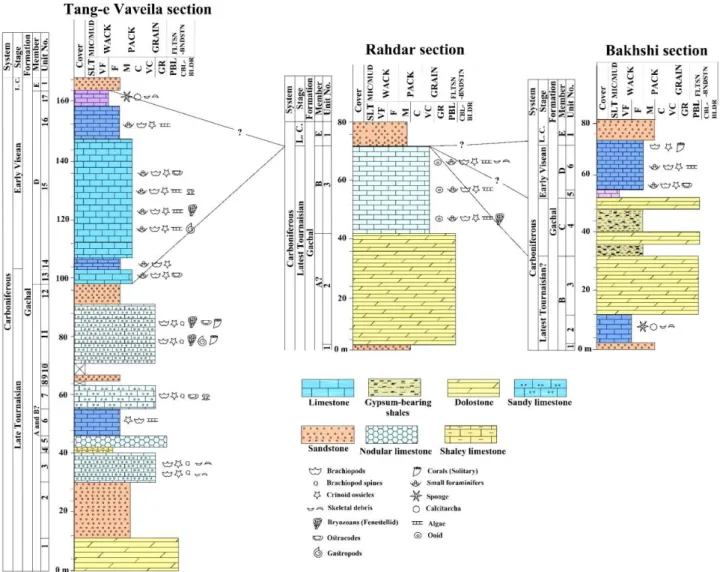
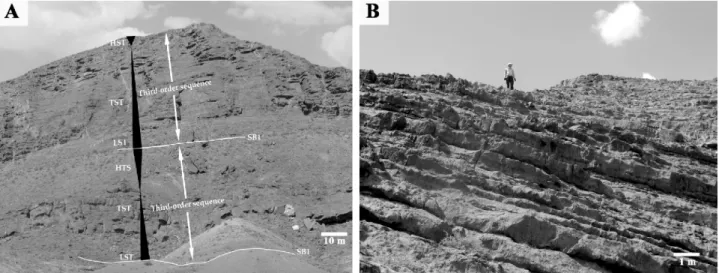
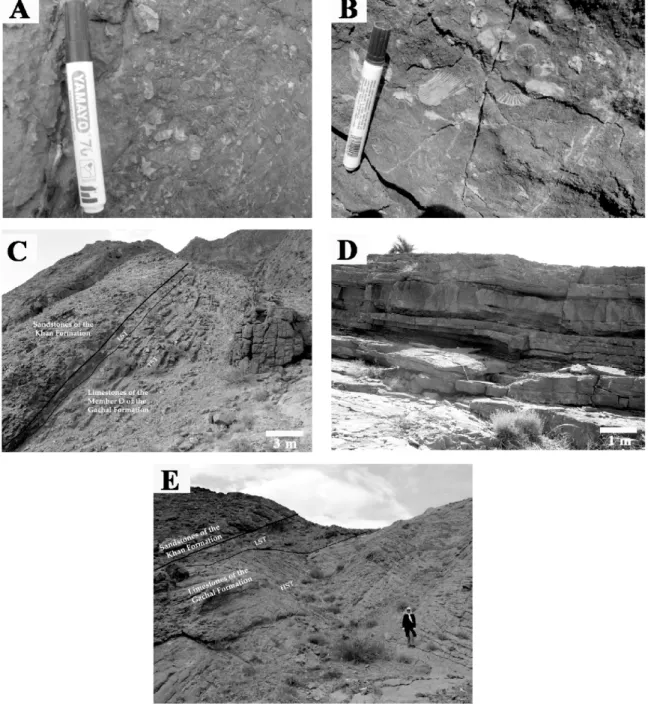
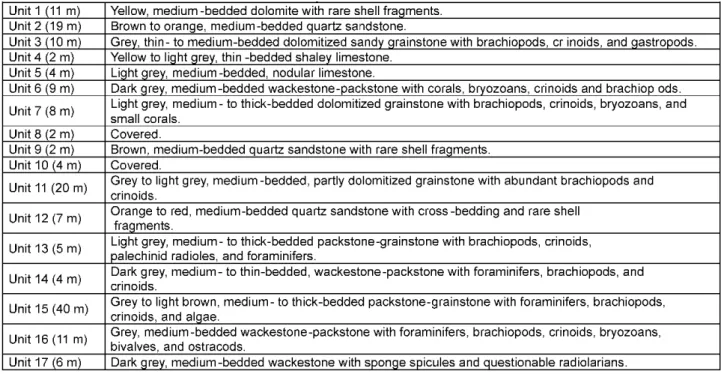
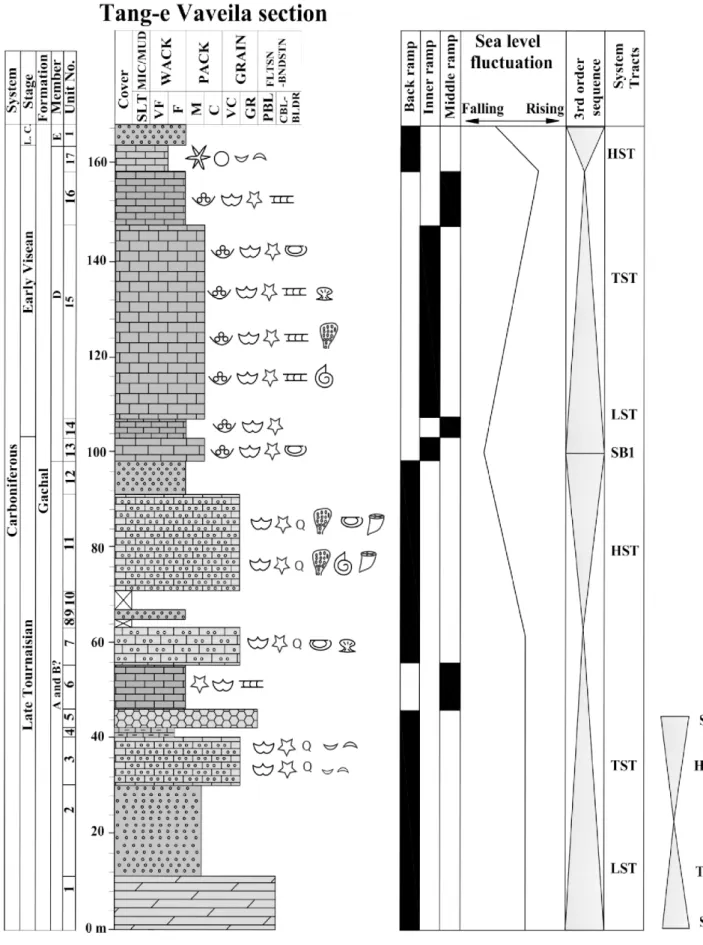
(4) Arefifard & Vachard- Early Carboniferous siliciclastic-carbonates in East-central Iran. 32. Figure 2. Stratigraphic correlation of the studied sections in the Kalmard area, east-central Iran. Abbreviations: C = Coarse; CBL-BLDR = CobbleBoulder; F = Fine; FLTSN-BNDSTN = Floatstone-Boundstone; GR = Granular; GRAIN = grainstone; L.C. = Lower Carboniferous (younger than Early Visean); M = Medium; MIC/MUD = Micrite/Mudstone; PACK = Packstone; PBL = Pebble; SLT = Siltstone; VC = Very coarse; VF = Very fine; WACK = Wackestone.. interpretation we follow Tucker & Wright (1990), Burchette & Wright (1992) and Flügel (2010). The identification of third order depositional sequences follows Catuneanu (2006) and Catuneanu et al. (2009). STRATIGRAPHY Three stratigraphic sections of the Gachal Formation in the Kalmard area were measured and sampled for this study (Fig. 1B): (1) the Tang-e Vaveila section, 55 km west of Tabas town, (2) the Rahdar section, 60 km west of Tabas town, and (3) the Bakhshi section southwest of Kalmard Karevansaray, nearly 92 km west of Tabas town. The Gachal Formation in our three sections is bounded by two disconformities: (a) at the base with the Late Devonian sandy dolomites of the Rahdar Formation, and (b) at the top, with the Early Permian quartz sandstones of the Khan Formation. The basal disconformity between the Gachal and Rahdar formations is emphasized by subaerial erosion features, such as channels or paleosoils, whereas fluvial channels are developed on the base of Khan Formation. The Gachal Formation in the Tang-e Vaveila section, 164 m-thick, is generally divided into three parts (Figs. 2-3, 4A-B, Tab. 1). Each part starts with siliciclastic deposits, which are. overlain by carbonates. The grain size of the siliciclastic components ranges from coarse to fine sand which decreases upward and grades into sandy limestone. The carbonate part of this section consists of shallow water medium- to thick-bedded packstone-grainstone as well as wackestone-packstone. These limestones include brachiopods, corals, bryozoans, gastropods, ostracods, crinoid ossicles, palechinid radioles, foraminifers, and algae. Small foraminifers and algae only appear in the upper third of the succession. In the Rahdar section, the Gachal Formation is about 72 m thick. Its lower part is composed of medium to coarse grained dolomite and rare dolomitic limestone yielding remains of brachiopod and crinoid stems, a quartz sandstone is observed at the base. The upper part of the Gachal Formation contains medium-bedded oolitic grainstone (Figs. 2, 4E, Tab. 2). In the Bakhshi section, the 73 m-thick Gachal Formation starts with quartz sandstone overlain by grey thin- to mediumbedded stylolitic wackestone which is followed by cream, medium-bedded, coarse- to medium-grained dolomite. Gypsum-bearing shales interbedded with medium-bedded dolomitic limestone form the middle part of the Gachal Formation in the Bakhshi section. The upper part of this Formation is composed of massive- to thick-bedded wackestone-packstone including foraminifers, corals,.
(5) Boletín del Instituto de Fisiografía y Geología 85, 2015. 33. Figure 3. Tang-e Vaveila section. A: The Member D of the Gachal Formation showing the third-order depositional sequences, with NE view. B: Carbonates of the upper part of the Gachal Formation, bioclastic wackestone-packstone with foraminifers, brachiopods, crinoids and algae.. brachiopods and crinoids (Figs. 2, 4C-D, Tab. 3). From overall stratigraphic description of the Gachal Formation in these above-mentioned sections (Fig. 2), it can be inferred that there are some facies changes between these three sections. The members A and B of the Gachal Formation at Tang-e Vaveila section are thicker and composed mostly of sandy bioclastic limestone and bioclastic wackestone/packstone. In the Rahdar and Bakhshi sections, dolomite form the major part of these members and the rest include ooidal limestone (at Rahdar section) and bioclastic wackestone at Bakhshi section. The Member C which consists of dolomite interbedded with gypsum-bearing shales is only recorded in the Bakhshi section. Bioclastic wackestonepackstone of the Member D is widely spread at Tang-e Vaveila section, showing less thickness in the Bakhshi section and with no record at Rahdar section. Wendt et al. (2005) measured and described lithologically the Gachal Formation at Rahdar and Bakhshi sections. There are some similarities and differences between the description of Wendt et al. (2005) and the ours in this report. This can be explained by the different location for the sections. For instance, the lower part of the Gachal Formation in Wendt et al. (2005) is composed of skeletal limestones which we did not find in our section at Bakhshi. In Wendt et al. (2005), thickbedded dolomites capped by gypsum-bearing shales have been reported from the middle portion of the Gachal Formation at the Bakhshi section, and dolomite without gypsum-bearing shales at Rahdar section. A relatively similar lithology was recorded in our measured sections at Rahdar and Bakhshi for the middle part of the Gachal Formation as described by Wendt et al. (2005). The upper part of the Gachal Formation description by Wendt et al. (2005) contains mixed siliciclasticcarbonates with bioclasts in its carbonate portion, whereas in our report the upper part of the Gachal Formation at Bakhshi section includes bioclastic wackestone-packstone and at Rahdar section contains ooidal limestones. BIOSTRATIGRAPHY Foraminiferal and algal assemblages in each studied section are relatively homogeneous. Every identified assemblage indicates a precise age which are all assigned to a narrow interval around the Late Tournaisian-Early Visean boundary,. “Obruchevian (?Radaevkian)” of Kulagina et al. (2003) = MFZ8-MFZ9 biozones of Poty et al. (2006, with MFZ = Mississippian foraminiferal zone). In an ascending biostratigraphical order, these three assemblages include the Rahdar assemblages (late MFZ8 = latest Tournaisian), the Tang-e Vaveila assemblages (Late MFZ8-Early MFZ9 = Tournaisian-Visean boundary interval), and the Bakhshi assemblages (MFZ9 = Early Visean). Detailed data regarding small foraminifera assemblages from the three studie sections have been discussed elsewhere (Vachard and Arefifard 2015). FACIES ANALYSES AND INTERPRETATION Petrographic analyses and microfacies examination of the studied sections of the Gachal Formation lead to the recognition of eight facies types and their subtypes. In the Tang-e Vaveila section the carbonate portion of the Gachal Formation is texturally composed of wackestone, packstonegrainstone, grainstone and dolomite. The grains are peloids, sand-sized quartz, fragmented bioclasts including brachiopods, bryozoans, crinoids, gastropods, bivalves, ostracodes, sponge spicules, calcitarcha, foraminifers and algae. In the Rahdar section, oolitic grainstone and dolomite are the only carbonate microfacies. In the Bakhshi section, the textural types of limestone include mudstone and wackestone. The grains include peloids and bioclasts (foraminifers, brachiopods, crinoids, algae, sponge spicules, calcitarcha). The siliciclastic part in all the three sections is composed of quartz sandstones. The carbonate facies of the Gachal Formation reported here are organized in three parts of a ramp depositional environments: back ramp, inner ramp, and middle ramp. Back ramp Mudstone: This facies is composed of medium-bedded, dark grey limestone with rare fossils. In some thin sections, aggrading neomorphism (Munnecke & Samtleben 1996, Tucker 2001) has caused micrite to be partially altered to microsparite or sparite. Very fine-grained skeletal grains and peloids, less than 5%, are present. This facies was observed in the unit 5 of the Bakhshi section. It is compared with standard microfacies type SMF 23 (Flügel 2010) (Fig. 5A)..
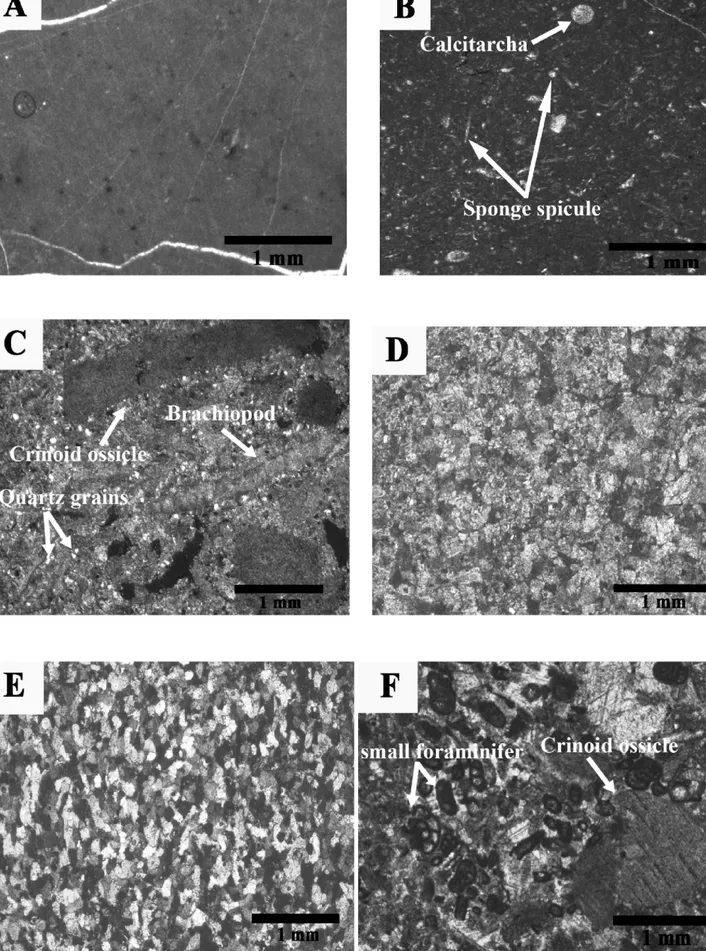
(6) 34. Arefifard & Vachard- Early Carboniferous siliciclastic-carbonates in East-central Iran. Figure 4. Tang-e Vaveila and Bakhshi sections. A: Unit 3 of the Gachal Formation in Tang-e Vaveila section, sandy bioclastic grainstone. B: Unit 7 of the Gachal Formation in Tang-e Vaveila section showing corals from dolomitized grainstone bearing additionally brachiopods, crinoids, and bryozoans. C: Boundary between limestones of Member D of Gachal Formation and basal sandstones of Khan Formation, Bakhshi section. D: Limestones of Member B of Gachal Formation, Bakhshi section. E: Boundary between oolitic grainstones of Gachal Formation and basal sandstones of Khan Formation, Rahdar section.. Interpretation: The lime mudstone with very rare skeletal grains is indicative of a low-energetic stressed marine environment, presumably with elevated salinity, although there is no evidence of pseudomorphs after gypsum, anhydrite or halite crystals. The mudstone shows no evidence of subaerial exposure. Its vertical association with lagoon and open marine deposits supports its deposition probably in a shallow subtidal to lower tidal flat setting of a back ramp (Tucker & Wright 1990). Bioclastic sponge spicule and calcitarcha wackestone: This facies is composed of grey, thin to medium limestone beds with cherty lenses and nodules along bedding planes. Sponge spicules, calcitarcha (= calcispheres sensu Versteegh et al.. 2009), brachiopods and crinoid stems are the main allochems. Bivalves and ostracods are minor allochems and represent only up to 2% of the components. This facies is observed in the unit 17 of the Tang-e Vaveila section and the unit 1 of the Bakhshi section (Fig. 5B). It is comparable with SMF 8 (Flügel 2010). Interpretation: Devonian and Carboniferous calcitarchs are abundant in restricted and semi-restricted lagoonal environments and in back-reef setting (Flügel 2010). Sponge spicule with less diverse fauna suggests deposition in more restricted environment (Franseen 2006). Sandy bioclastic grainstone: This facies is typified by light grey to grey, medium bedded carbonate beds with skeletal.
(7) Boletín del Instituto de Fisiografía y Geología 85, 2015. 35. Table 1. Lithologic description of the Gachal Formation, Tang-e Vaveila section, Kalmard area, Iran.. Table 2. Lithologic description of the Gachal Formation, Rahdar section, Kalmard area, Iran.. Table 3. Lithologic description of the Gachal Formation, Bakhshi section, Kalmard area, Iran.. debris cemented by sparite. The fauna consists of brachiopods, crinoids and bivalves. Fine- to medium-grained, moderatelyto well-sorted, angular to sub-rounded, monocrystalline quartz is another constituent of this facies (> 10%). Sedimentary structures includes cross-bedding. The moderately- to wellsorted allochems are cemented by blocky, syntaxial and drusy sparites. Dolomitization has locally caused the alteration of sparite to dolosparite. This facies encompasses the basal part of the units 3, 11, and 13 of the Tang-e Vaveila section and marks the beginning of carbonate deposition during highstands (Fig. 5C). Interpretation: The grain supported texture, the absence of micrite, the cross-bedded strata and siliciclastic influx indicate deposition in a high energy environment (Olivier et al. 2008, Flügel 2010) and in an upper intertidal setting due to its vertical association with lagoonal facies. Diagenetic dolomite: This facies is composed of cream to light grey, medium bedded dolostone. Internal structure and crystal shape are indicative of dolosparite, composed of anhedral crystals with non-planar faces and having a xenotopic fabric. The original sedimentary textures in these dolosparites are not. preserved. This facies is observed in the unit 5 of the Tang-e Vaveila section, the unit 2 of the Rahdar section, and the unit 3 of the Bakhshi section (Fig. 5D). Interpretation: Vertical association of these dolomites with lagoonal facies points to deposition in a shallow water environment. This dolosparite was formed at high temperatures, and has replaced limestone (Gregg & Shelton 1990) due to late burial and recrystallization (Narkiewicz 2009). Quartz sandstone: Brown to orange, medium beds are characteristic in the field. Quartz grains are fine to coarse, moderately- to well-sorted, and angular to sub-rounded in shape. All the quartz grains are monocrystalline and constitute about 90% of the rock volume. The skeletal grains are minor constituents, with less than 5%. This facies is present in the units 2 and 9 of the Tang-e Vaveila section and the unit 1 of both Rahdar and Bakhshi sections (Fig. 5E). Interpretation: The high compositional and textural maturity of the quartz sandstones, as well as cross-bedding and lamination indicate a high energy depositional environment. Besides, and.
(8) 36. Arefifard & Vachard- Early Carboniferous siliciclastic-carbonates in East-central Iran. Figure 5. Photomicrographs of facies types of the Gachal Formation. A: Mudstone, sample GD1. B: Bioclastic sponge spicule calcitarcha wackestone, sample T126. C: Sandy bioclastic grainstone, sample T58. D: Diagenetic dolostone, sample T14. E: Quartz sandstone, sample T11. F: Bioclastic foraminiferal packstone, sample T98..
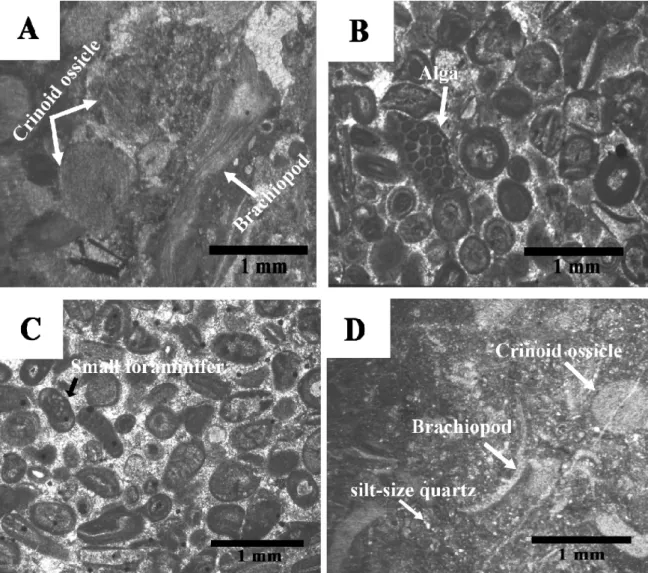
(9) Boletín del Instituto de Fisiografía y Geología 85, 2015. 37. Figure 6. Photomicrographs of facies types of the Gachal Formation. A: Blastic packstone/grainstone with diverse biota, sample T28. B-C: Ooidal grainstone sample R24. D: Bioclastic wackestone/packstone, sample T115.. the vertical succession of the sandstones with carbonate tidal facies implies that sedimentation should have occurred in an upper intertidal to lower supratidal environment. Inner ramp Bioclastic packstone/grainstone with diverse biota: This facies is typified by light grey to yellowish grey, medium to thick limestone beds. The skeletal grains consist of brachiopods, crinoid ossicles, bryozoans, gastropods and algae in a micritic matrix. Some bioclasts are coated or micritized. Minor allochems are peloids (< 10%) and quartz (< 5%). In some cases, poorly to moderately sorted, rounded to sub-rounded peloids (about 10%) form peloid bioclastic crinoidal brachiopod packstone/grainstone. Also, in some samples the presence of more than 30 % of small foraminifer changed the type of the facies into bioclastic foraminiferal packstone/grainstone (Fig. 5F). Sedimentary structures are low-angle lamination and normal grading. This facies is moderately- to well-sorted. Dolomitization occurs in some beds of former bioclastic packstone. This facies is observed in the units 7 and 15 of the Tang-e Vaveila section (Fig. 6A). It is comparable with the SMF 10 (Flügel 2010). Interpretation: This facies was deposited in a medium- to high-. energy environment, possibly above the fair weather wave base. Fragmentation of bioclasts is due to reworking by wave or tidal processes. The diverse fossil contents suggests normal marine conditions. According to the diversity and relative abundance of the stenohaline biota, this facies indicates a shoal-related subtidal setting. Ooidal grainstone: These deposits are composed of light grey, medium-bedded ooid-bearing limestone beds. They commonly show cross-bedding and cross-lamination. Wellsorted ooids form 60 to 70% of the rock volume. These single tangentially structured ooids were mostly formed around small foraminifers, bioclasts, rounded clasts, and peloids. The skeletal debris consists of brachiopods, palechinid radioles, crinoid ossicles, bryozoans, rare bivalves, algae, very rare gastropods, and foraminifers. The cements are drusy and blocky sparites. This facies is observed in the unit 3 of the Rahdar section (Fig. 6B-C). It is comparable with the SMF 15 (Flügel 2010). Interpretation: Tangential structures are commonly originated in high-energy marine settings on oolitic shoals, tidal bars and beaches (Flügel 2010). The sedimentary structures and components of this facies indicate a high energy environment above the fair weather wave base and in an inner ramp setting.
(10) Arefifard & Vachard- Early Carboniferous siliciclastic-carbonates in East-central Iran. 38. (Laya and Tucker 2012). Grainstones with similar feature have been reported from Early Carboniferous deposits in Belgium (Flügel 2010). Middle ramp Bioclastic wackestone/packstone: This facies is composed of grey to dark grey massive to medium limestone beds with subrounded skeletal grains including foraminifers, crinoid ossicles, brachiopods, palechinid radioles and algae within the micrite matrix. Minor allochems are intraclasts (2%). Skeletal grains show micritized boundaries. Some fossils are well preserved. This facies shows local bioturbation. The presence of peloids (up to 15%) in some cases turns this facies to peloidal bioclastic wackestone-packstone. This microfacies occurs in the units 4, 14 and 16 of the Tang-e Vaveila and the unit 6 of the Bakhshi section (Fig. 6D). It is comparable with the SMF 8 (Flügel 2010). Interpretation: The combination of complete and fragmentary elements of diversified marine biota, normal grading and overlying hummocky cross-stratification suggest a depositional environment from below storm wave base up to fair weather base (Chuanmao et al. 1993, Wright & Tucker 1990, Flügel 2010). The fragmentation of some bioclasts should be due to bioturbation. DEPOSITIONAL ENVIRONMENT The Gachal Formation is characterized by cyclic sequences composed of siliciclastic and carbonate deposits which are common in Permo-Carboniferous rocks (Mack & James 1985, Yancey 1991, Stemmerik & Worsley 2000, Arefifard & Isaacson 2006). Mixed siliciclastic and carbonate deposition on shelves, on which land-derived siliciclastic sediments are trapped in nearshore and inner shelf environments, and simultaneous deposition of pure carbonate sediments take place in subtidal as well as intertidal settings (Flügel 2010). The nature of the shoreline deposits basically reflects the. relationship between the amount of input of land-derived sediments and the ability of marine processes to redistribute them. The interplay of the two processes produces a continuous spectrum of shoreline types ranging from the complete dominance of terrestrial sediments to the other extreme, where marine processes are dominant over a negligible influx of detritus (Selley 2004). The boundaries between siliciclastic sediments and carbonates show gradational contacts as evidenced in the Gachal Formation. Microfacies distribution of the Gachal Formation in the Kalmard area reveals that deposition was restricted to back, inner and middle parts of the ramp but there is no outer ramp deposits. According to facies distribution of the Gachal Formation, a mixed siliciclasticcarbonate ramp environment is interpreted for the depositional setting of the Gachal Formation (Fig. 7). The carbonate facies in the Gachal Formation in the Tang-e Vaveila section consists mainly of protected back ramp to storm dominated middle ramp deposits. Open marine and lagoonal facies are capped by tidal flat facies. The limestones are composed mostly of bioclasts (crinoids, brachiopods, gastropods, corals, algae, sponge spicules) and peloids. The bioclastic packstone-grainstone shows the highest biodiversity and moderate to high energy in inner ramp setting. The bioclastic wackestone with a hummocky cross-stratification and complete to broken fossils reveal the existence of midramp deposits seaward of bioclastic packstone-grainstone of the inner ramp setting. In the Rahdar and Bakhshi sections the dolomitic units hamper microfacies analysis and interpretation of the sedimentary environment. In the Rahdar section the ooid grainstone which is the only shoal or tidal bar deposits in the Gachal Formation, is located on the windward side of a inner ramp. In the Bakhshi section, mudstone and sponge spicules and calcitarcha wackestone are indicative of back ramp deposits, and bioclastic wackestone with hummocky crossstratification indicates mid-ramp setting. Depositional sequence The Latest Tournaisian-Early Visean Gachal Formation in the.
(11) Boletín del Instituto de Fisiografía y Geología 85, 2015. 39. Figure 8. Stratigraphy and depositional sequences (third-order) of the Gachal Formation at the Tang-e Vaveila section. Facies analyses reveal deposition in back-, inner- and mid-ramp settings. In the Tang-e Vaveila section the third order cyclic sequences of mixed siliciclastic-carbonates are well identifiable. For legend and abbreviations see Fig. 2..
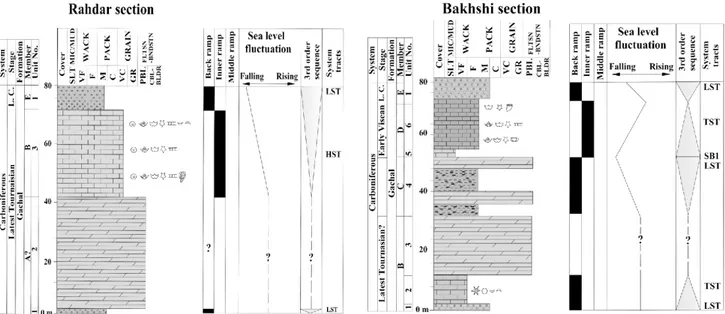
(12) 40. Arefifard & Vachard- Early Carboniferous siliciclastic-carbonates in East-central Iran. Figure 9. Stratigraphy and depositional sequences (third-order) of the Gachal Formation at the Rahdar and Bakhshi sections. The dolomitic nature of some parts of the section hampers facies analysis, interpretation of depositional environment and sequence stratigraphy. For legend and abbreviations see Fig. 2.. Kalmard area reveals a cyclic sedimentation that is well documented in the Tang-e Vaveila and Bakhshi sections. It shows interbedded clastics and carbonates in repeated cyclic arrangements (Figs. 8,9) representing large scale shallowingupward third order sequences. Each cycle records transgression and regression. In the Tang-e Vaveila section, two third order sequences can be identified. Sequence 1 is latest Tournaisian in age and consists of the units 1 to 11, 92 m-thick (Fig. 8). It was deposited during a transgression over the Late Devonian Rahdar Formation which is not exposed in the Tang-e Vaveila section. The LST deposits of the Sequence 1 include quartz sandstones found at the base of the transgressive systems tract (TST) deposits. The TST deposits of sequence 1 occur in the units 2-6 in the Tang-e Vaveila section. This TST is characterized by bioclastic packstone-grainstone and bioclastic wackestone containing foraminifers, brachiopods, crinoids, ostracodes, bivalves, corals and algae. TST deposits are recognized by subtidal and open marine facies. In the Tange Vaveila section, the transition from deepening-upwards facies (units 1-6) to shallowing-upwards facies (units 7-12) indicates that the sediment accumulation rates exceed the rate of relative sea-level rise during HST. In the Tang-e Vaveila section, quartz grains as a component appear along with other allochems in the upper part of the sequence 1 and become the dominant constituents as siliciclastics increased and carbonates diminished. In consequence, during the HST tidal flat deposits progradate over subtidal shoal and open marine facies. The lower and upper boundaries of sequence 1 are both of type 1 in the Tang-e Vaveila section. The Maximum Flooding Surface is not observed but it may be represented by bioclastic wackestone-packstone with no evidences of quartz grains in the unit 6 of the Tang-e Vaveila section. Sequence 2 (third order cycle) of the Gachal Formation in the Tang-e Vaveila section (units 13-17, 59 m-thick) is Early Visean in age (Fig. 8). Like the sequence 1, the sequence 2 starts with LST deposits composed of sandstones which are found at the base of the TST deposits. The TST of sequence 2 at this section include unit 13 to most part of the unit 16 and the HST deposits are uppermost part of the unit 16 and the unit 17. Sequence 2 shows the same development like sequence 1.. Sequence stratigraphic analysis of the Gachal Formation in the Rahdar and Bakhshi sections is unresolved due to dolomitization (Fig. 9). However, we assume that in the Rahdar section, one third order sequence including the units 1-3 (72 mthick) can be identified. Like sequence 1 in the Tang-e Vaveila section, the LST deposits include quartz sandstones at the base of TST deposits. The TST deposits of this sequence are hard to be recognized because of the dolomites of the unit 2 in the Rahdar section. Unit 3 which is predominantly composed of oolitic grainstone can be considered as HST. The lower and upper boundaries of this sequence are both of type 1. In the Bakhshi section, two third order sequences are probably present. Sequence 1 starts with sandstones at the base of TST deposits. The TST deposits of the sequence 1 are hardly recognizable because on top of bioclastic wackestone indicative of lagoonal environment (unit 2), dolomitisation makes it difficult to trace microfacies changes. The gypsumbearing shales and dolomites of the unit 4 were considered as corresponding to the late stage of HST of sequence 1. The TST deposits of the second third order sequence in the Bakhshi section includes the units 5 and 6 which are composed of mudstone and bioclastic wackestone-packstone representative of tidal flat and open marine environments. The HST deposits are not recognized and might have been removed by erosion. The quartz sandstone above limestones of the unit 6 are LST deposits of the next sequence. The upper and lower boundaries of the sequence 2 in the Bakhshi section are both of type 1. COMPARISON OF THE GACHAL FORMATION WITH COEVAL DEPOSITS OF N IRAN The global drop in sea level at the end of the Devonian was followed by a sea level rise and transgression during the Early Carboniferous. This transgression led to the formation of the widespread epicontinental seas and Mississippian carbonate deposition (Conrad et al. 1986, Dennison et al. 1986, Ahr 1989, Perri & Spalletta 2000, Menning et al. 2006). The Early Carboniferous was a preferable time for development of carbonate ramps in geologic record (Ahr 1989). Such style of carbonate deposition has been recorded from Early.
(13) Boletín del Instituto de Fisiografía y Geología 85, 2015. Carboniferous strata in Britain (Wright 1986, Somerville et al. 1989, Wright & Faulkner 1990), western Europe (Lees 1982, Wright 1994), the United States (Ahr 1989, Handford 1986), China (Shao et al. 2011) and Algeria (Madi et al. 1996). The Early Carboniferous Mobarak Formation shows different outcrops in the central and eastern Alborz, northern Iran. At its type section, the Mobarak Formation is divided into four units but in most outcrops it is generally composed of black shales interbedded with thin limestones in its lower part followed by massive limestones in its upper part. Since the introduction of this formation by Assereto (1963) the microfaunal contents has been studied in detail (e.g. Bozorgnia 1973, Vachard 1996, Mosaddegh 2003, Brenckle et al. 2009, Zandkarimi et al. 2014). In recent biostratigraphic studies based on foraminiferal biozonation the Mobarak Formation in the Valiabad section has been assigned to the latest Tournaisian-Late Visean (Zandkarimi et al. 2014). However, the age of the topmost portion varies from Early Visean in south-central Alborz to Late Visean in north-central Alborz (Bozorgnia 1973, Vachard 1996, Brenckle et al. 2009). This age variation has been explained by the erosional surfaces at the top of the formation (Wendt et al. 2005) or sea level drop from Late Carboniferous glaciation (Haq & Schutter 2008, Brenckle et al. 2009). Facies analysis and depositional environment of the Mobarak Formation indicate a carbonate ramp (Mosaddegh et al. 2006, Falahatgar & Mosaddegh 2012). The Gachal Formation in the Kalmard area, central Iran reveals some lithologic differences with the Mobarak Formation as it is composed of mixed siliciclastic-carbonate deposits in a repeated cyclic arrangement. This type of sedimentation is solely reported from Kalmard area during Early Carboniferous in Iran. Although the Mobarak Formation contains no siliciclastics, facies analyses of carbonate contents show some similarities between both formations. For instance, tidal flat, lagoon, shoal/barrier and open marine facies are traceable in both formations but due to the relatively pure carbonate nature of the Mobarak Formation, more diverse carbonate facies are found in the latter (Mahari 1992, Mosaddegh 2000, GhouchiAsli & Lasemi 2006, Falahatgar & Mosaddegh 2012). In the Mobarak Formation especially mid and outer ramp facies are well represented. The Tournaisian interval deposits in the Jaban section, southwestern Central Alborz Basin, show a ramp profile with four main facies belts representing outer-, mid-, inner- and coastal-ramp environments (Sardar Abadi et al. 2015). In the mixed siliciclastic-carbonates of the Gachal Formation outer ramp facies in the studied sections are missing and only inner and mid ramp facies are observable. However, a mixed Mississippian siliciclastic-carbonate ramp has been reported from southwestern Spain in which facies ranges across inner-, mid- and outer-platform environments (Cózar et al. 2006). Ramps generally tend to form where clastic input, cool climate, and/or hypersalinity hamper rapid carbonate production. In a case of too high subsidence, the ramp should be small and would develop with short duration (Ebdon et al. 1990). As mentioned earlier, the Kalmard area was tectonically active during Paleozoic due to the vertical movement of two main faults (i.e. Kalmard and Naeini faults). These faults forced the rising of the platform, led to the erosion of the continental block, and created the silicilastic influx into the deposits of the Gachal Formation. Thickness variation of the different members of the Gachal Formation on either sides of the Kalmard fault and missing of the evaporites on the eastern side of the Kalmard fault in the Tang-e Vaveila section stress the importance of the fault activities.. 41. Despite the importance of fault movement and tectonic activity in the Kalmard area during the deposition of the Gachal Formation, the influence of eustatic changes in the development of the accommodation space and the accumulation of the carbonates can be excluded. Late Paleozoic studies revealed that even in sections affected by tectonic activities eustatic cyclicity still is influential and overprint especially the upper parts of the cycles (Batt et al. 2007, Grader et al. 2008). Each section of the Gachal Formation has sandstone to subtidal carbonates, and then to more offshore shelly carbonates (indicative of TST) which is evidence of the effect of eustatic cyclicity. It is possible that the cyclicity in the Gachal Formation was primarily the result of local tectonic activity leading to creation of accommodation space with a eustatic overprint. Early latest Tournaisian-Early Visean regression event in Kalmard area The Member C of the Gachal Formation includes gypsum with dolomite and represents a regression episode in latest Tournaisian-early Visean. Aghanabati (1977, 2004, 2008) attributed this regression event to a reported regression in the Early Carboniferous Mobarak Formation in Alborz, northern Iran. In the southern side of the Alborz, the age of the topmost portion of the Mobarak Formation is not younger than Late Visean (Zandkarimi et al. 2014) and, presumably, the emergence of the southern side of the Alborz took place in the Late Visean and lasted till Permian. Based on foraminiferal age determinations, the Early Carboniferous regression event in Alborz took place in the late Visean. The foraminiferal contents of the Gachal Formation reveal that the age of the Member C cannot be younger than Early Visean (Vachard and Arefifard 2015). Therefore, it seems that the regression event in the Kalmard area is another event, older than that in the Alborz, that would have occurred in Early Visean. This early Visean regression event has not been documented in other parts of Iran. In the Kalmard area, the consequences of this event have marked signs which can be manifested in gypsum-bearing shales and dolomites of the Member C of the Gachal Formation. In the Tang-e Vaveila section in the eastern side of the Kalmard fault, this regression event is not evident as there is no hiatus between latest Tournaisian and Early Visean deposits, and no record of the Member C of the Gachal Formation. But in the western side of the Kalmard area in the Bakhshi section gypsum-bearing shales and dolomites are present, revealing this early Visean regression event. The absence of the Member C deposits of the Gachal Formation appears to correspond to the tectonic activity and the faults effects in this area during this time interval. CONCLUSION 1. Petrographic analyses and microfacies examination of the Gachal Formation in the studied sections led to the identification of eight facies types which were deposited in back-, inner- and middle-ramp settings. 2. The Gachal Formation in the Kalmard area was deposited in a mixed siliciclastic-carbonate ramp environment. This formation is characterized by cyclic sequences composed of siliciclastic and carbonate deposits. 3. The Gachal Formation is represented by third order cyclic.
(14) Arefifard & Vachard- Early Carboniferous siliciclastic-carbonates in East-central Iran. 42. sequences of siliciclastic and carbonates which are well recognized, especially in the Tang-e Vaveila section. The dolomitic nature of some parts of the Rahdar and Bakhshi section makes difficult their sequence stratigraphy analysis. 4. The mixed siliciclastic-carbonate lithology of the Latest Tournaisian-Early Visean Gachal Formation is exclusively limited to the Kalmard area during this time interval while in northern Iran (Alborz), the Latest Tournaisian-Late Visean Mobarak Formation consists mostly of carbonates with some interbedded shales. However, microfacies of the carbonate units of the Gachal Formation show some similarities with those of the Mobarak Formation although mid- and outer-ramp facies are more dominant in the Mobarak Formation. 5. Vertical fault movements in the Kalmard area during the Carboniferous are responsible for the rising of the platform providing siliciclastic input. Furthermore, the thickness differences of the different members of the Gachal Formation and missing of the member C in two sections (Tang-e Vaveila and Rahdar) can be related to the faults activities. 6. Despite previous reports, the regressive facies of the Member C of the Gachal Formation is not contemporaneous with the late Visean regression in Alborz (N Iran), but it is linked to synsedimentary tectonics.. Acknowlegments: A first draft of this paper was reviewed by Ian Somerville, Michael Stephenson, and Moujahed Al-Husseini, who enriched the language and provided interesting comments. We deeply appreciate the input of Alain Izart who made valuable comments and suggestions. The authors thank Hans-Georg Herbig (University of Cologne, Germany) and a further anonymous reviewers for their constructive comments as referees of the journal. Further, we wish to thank editor Horacio Parent for very careful editing of the paper.. REFERENCES Aghanabati A., 1977. Etude géologigue de la région de Kalmard (W. Tabas). – Geological Survey of Iran Report 35: 1-230. Aghanabati A., 2004. Geology of Iran. – Geological Survey of Iran, 586 p. Aghanabati A., 2008. Stratigraphic Lexicon of Iran (DevonianPermian). – Geological of Survey Iran, 1297 p. Ahr W.M., 1989. Sedimentary and tectonic controls on the development of an early Mississippian carbonate ramp, Sacramento Mountains area, New Mexico. – Society of Economic Paleontologists and Mineralogists Special Publication 44: 203-212. Alavi M., 1991. Tectonic map of the Middle East. – Geological Survey of Iran. Angiolini L., Gaetani M., Muttoni G., Stephenson M.H. & Zanchi A., 2007. The biotic affinity of N Iran during Carboniferous-Early Permian times: was N Iran in the periGondwanan fringe? – European Geosciences Union General Assembly 2007. Arefifard S. & Isaacson P.E., 2011. Permian Sequence stratigraphy in east-central Iran: Microplate records of PeriTethyan and Peri-Gondwanan events. – Stratigraphy 8: 6183. Assereto R., 1963. The Paleozoic formations in Central Elburz (Iran), preliminary note. – Rivista Italiana di Paleontologia e Stratigrafia 69: 503-543.. Bahrammanesh M., Angiolini L., Antonelli A.A., Aghababalou B. & Gaetani M., 2011. Tournaisian (Mississippian) brachiopods from the Mobarak Formation, North Iran. – GeoArabia 16: 129-192. Batt L.S., Pope M.C., Isaacson P.E., Montanez I.P. & Abplanalp J., 2007. Late Mississippian Antler foreland basin carbonates and siliciclastics, east-central Idaho and southwestern Montana: distinguishing tectonic and eustatic controls. In: Lukasik, J. & Simo, T.T. (eds.): Controls on carbonate platform and reef development. – Society of Sedimentary Geology Special Publication 89: 147-170. Berberian M., 1983. Continental Deformation in Iran Plateau (Contribution to the seismotectonics of Iran, part IV). – Geological Survey of Iran Report 52: 1-625. Berberian M. & King, G.C.P., 1981. Toward a paleogeography and tectonic evolution of Iran, Canadian Journal of Earth Sciences 18: 210-285. Berra F., Zanchi A., Malaspina N., Javadi H.R., Koohpeyma M., Angiolini L., Vachard D. & Zanchetta S., 2014. Evidence for an Upper Palaeozoic North-Palaeotethyan succession in Central Iran: The Siah Godar Complex of Jandaq. European Geosciences Union General Assembly 2014. Bozorgnia F., 1973. Paleozoic foraminiferal biostratigraphy of central and east Alborz Mountains, Iran. Publication of National Iranian Oil Company (Geological Laboratory), 185 p. Brenckle P.L., Gaetani M., Angiolini L. & Bahrammanesh M., 2009. Refinements in biostratigraphy ,chronostratigraphy, and paleogeography of the Mississippian (Lower Carboniferous) Mobarak Formation, Alborz Mountains, Iran. – GeoArabia 14: 43-78. Burchette T. P. & Wright V.P., 1992. Carbonate ramp depositional systems. – Sedimentary Geology 79: 3-57. Catuneanu O., 2006. Principle of Sequence Stratigraphy. Elsevier, New York, 386 p. Catuneanu O., Abreu V., Bhattacharya J., Blum M., Dalrymple, R., Eriksson P., Fielding C.R., Fisher W., Galloway, W., Gibling M. et al., 2009. Towards the standardization of sequence stratigraphy. – Earth-Science Reviews 92: 1-33. Chuanmao L., Friedman G.M. & Zhaochang Z, 1993. Carbonate storm deposits (tempestites) of Middle to Upper Cambrian age in the Helan Mountains, northwest China. – Carbonates and Evaporites 8: 181-190. Conrad J., Massa. D. & Weyant M., 1986. Late Devonian and early Carboniferous transgression on the northern African platform. – Annales de la Société Géologique de Belgique 109: 113-122. Cózar P., Somerville I.D., Rodríguez S., Mas R. & MedinaVarea P., 2006. Development of a late Viséan (Mississippian) mixed carbonate/siliciclastic platform in the Guadalmellato Valley (southwestern Spain). – Sedimentary Geology 183: 269-295. Crowell J.C., 1999. Pre-Mesozoic Ice Ages: Their Bearing on Understanding the Climate System. – Geological Society of America Memoir 192: 1-106. Darvishzadeh A., 1992. An analysis of Furon's Ural, Iran and Madagascar axis and Hercynian Orogeny in Iran. – Journal of Earth Sciences 6: 22-31. Dennison J.M., Beuthin J.D. & Hasson K.O., 1986. Latest Devonian-earliest Carboniferous transgressions, central and southern Appalachians, USA. – Annales de la Société Géologique de Belgique 109: 123-129. Dickins J.M., 1996. Problems of a Late Palaeozoic glaciation.
(15) Boletín del Instituto de Fisiografía y Geología 85, 2015. in Australia and subsequent climate in the Permian. – Palaeogeography, Palaeoclimatology, Palaeoecology 125: 185-197. Dunham R.J., 1962. Classification of carbonate rocks according to depositional texture. In: Ham W.E. (ed.): Classification of Carbonate Rocks. – American Assocciation of Petroleum Geologists Memoir 1, 108-121. Ebdon C.C., Fraser A.J., Higgins A.C., Mitchener B.C., Strank A.R.E., 1990. The Dinantian stratigraphy of the East Midlands: a seismostratigraphic approach. – Journal of Geological Society of London 147: 519-36. Falahatgar M., 2008. Microbiostratigraphy and microfacies of the Mobarak Formation (Lower Carboniferous) in Kiyasar section, South-East of Sari, Northern Iran. MSc. thesis (unpublished), Payame Noor University of Shiraz, Iran, 123 p. Falahatgar M. & Mosaddegh H., 2012. Microfacies and paleoenvironments of the Lower Carboniferous Mobarak Formation in the Kiyasar section, northern Iran. – Boletin del Instituto de Fisiografia Geologia 82: 9-20. Flügel E., 2010. Microfacies of Carbonate Rocks: Analysis, Interpretation and Application, 2nd Edition. SpringerVerlag, Berlin, 984 p. Franseen E.K., 2006. Mississippian (Osagean) shallow-water, mid-latitude siliceous sponge spicule and heterozoan carbonate facies: An example from Kansas with implications for regional controls and distribution of potential reservoir facies. – Current Research in Earth Sciences 252: 1-23. Gorgij M.N., 2002. Biostratigraphy and sequence stratigraphy of Carboniferous deposits in central Iran. Ph.D. Thesis, Isfahan University, Isfahan, Iran, 205 p. Grader G.W., Isaacson P.E., Diaz-Martinez E. & Pope M.C., 2008. Pennsylvanian and Permian Sequences in Bolivia: Direct Responses to Gondwana Glaciation. In: Fiedler G.C.R., Frank T.D. and Isbell J.L. (eds.): The Late Paleocoic Gondwanan Ice Age: Timing, extent, duration and stratigraphic records. – Geological Society of America Special Paper 441: 143-160. Gregg J.M. & Shelton K.L., 1990. Dolomitization and dolomite neomorphism in the back reef facies of the Bonneterre and Davies Formation (Cambrian), southeastern Missouri. – Journal of Sedimentary Petrology 60: 495-562. Ghouchi-Asli E. & Lasemi Y., 2006. Carbonate and siliciclastic storm deposits within the Upper Devonian Geyrud Formation in Touyeh area, eastern Alborz, northern Iran. In: Aretz & Herbig (Eds.) Carboniferous Conference Cologne. From Platfrom to Basin, Sept. 4-10 2006. – Kölner Forum für Geologie und Paläontologie 15: 5. Haftlang, R. 1998. Stratigraphy of Upper Paleozoic rocks in Kalmard area. M.Sc. Thesis, Azad University, Tehran, Iran, 150 p. Handford C.R., 1986. Facies and bedding sequences in shelfstorm-deposited carbonates - Fayetteville Shale and Pitkin Limestone (Mississippian), Arkansas. – Journal of Sedimentary Petrology 56: 123-1 37. Haq B. & Schutter S., 2008. A chronology of Paleozoic sealevel changes. – Science 322, 64-68. House, M.R. 1993. Fluctuations in ammonoid evolution and possible environmental controls. In: House M.R. (ed.): The Ammonoidea: Environment, Ecology, and Evolutionary Change. – The Systematics Association Special Volume 47:. 43. 13-34. Husseini M.I., 1992. Upper Palaeozoic tectono-sedimentary evolution of the Arabian and adjoining plates. – Journal of the Geological Society of London 149: 419-429. Isbell J.L., Miller M.F., Wolfe K.L. & Lenaker P.A., 2003a. Timing of late Paleozoic glaciation in Gondwana: Was glaciation responsible for the development of northern hemisphere cyclothems? In: Chan M.A. & Archer A.A. (eds.): Extreme Depositional Environments: Mega End Members in Geologic Time. – Geological Society of America, Special Paper 370: 5-24. Isbell J.L., Lenaker P.A., Askin R.A., Miller M.F. & Babcock L.E., 2003b. Reevaluation of the timing and extent of late Paleozoic glaciation in Gondwana: Role of Transantarctic Mountains. – Geology 31: 977-980. Kalvoda J., 2002. Late Devonian-early Carboniferous Foraminiferal fauna: Zonations, Evolutionary Events, Palaeobiogeography abd Tectonic Implications. – Folia, Geologia 39: 1-213 p. Kulagina E.I., Gibshman N.B. & Pazukhin V.N., 2003. Foraminiferal zonal standard for the Lower Carboniferous of Russia and its correlation with the conodont zonation. – Rivista Italiana di Paleontologia e Stratigrafia 109: 173185. Laya J.C. & Tucker M.E., 2012. Facies analysis and depositional environments of Permian carbonates of the Venezuelan Andes: Palaeogeographic implications for N o r t h e r n G o n d w a n a . – P a l a e o g e o g r a p h y, Palaeoclimatology, Palaeoecology 331: 1–26. Lees A., 1982. The paleoenvironmental setting and distribution of the Waulsortian facies of Belgium and southern Britain. In: Bolton K., Lane H.R. & LeMone D.V. (eds.): Symposium on the Paleoenvironmental Setting and Distribution of the Waulsortiun Fucirs, El Paso Geological Society and University of Texas at El Paso, Texas, 16 p. Mack G.H. & James W.C., 1985. Cyclic sedimentation in the mixed siliciclastic-carbonate Abo-Hueco transitional zone (Lower Permian), Southwestern New Mexico. – Journal of Sedimentary Petrology 56: 635-647. Madi A., Bourque P.-A. & Mamet B.L., 1996. Depth-related ecological zonation of a Carboniferous carbonate ramp: Upper Viséan of Béchar Basin, Western Algeria. – Facies 35(1): 59-79. Mahari R., 1992. Microfacies and sedimentary environment of the Mobarak Formation (Eastern Tehran). Unpublished MSc. Thesis, Islamic Azad University, Tehran branch, Iran, 123 p. Menning M., Alekseev A.S., Chuvashov B.I., Davydov V.I., Devuyst F.X., Forke H.C., Grunt T.A., Hance L., Heckel P.H., Izokh N.G., Jin Y.G., Jones P.I., Kotlyar G.V., Kozur H.W., Nemyrovska T.I., Schneider J.W., Wang X.D., Weddinge K., Weyer D. & Work D.M., 2006. Global time scale and regional stratigraphic reference scales of central and west Europe, east Europe, Tethys, south China, and North America as used in the Devonian-CarboniferousPermian Correlation Chart 2003 (DCP 2003). – Palaeogeography, Palaeoclimatology, Palaeoecology 240: 318-372. Mosaddegh H., 2000. Microfossils, Microfacies, Sedimentary Environment and Sequence Stratigraphy of the Mobarak Formation in Central Alborz. Unpublished Ph.D. thesis, Tehran Teacher Training University, Iran, 269 p. Mosaddegh H., 2003. Microbiostratigraphy of Mississippian (Lower Carboniferous) strata (Mobarak Formation) in Central Alborz, North of Iran. Abstracts of the Fifteen.
(16) 44. Arefifard & Vachard- Early Carboniferous siliciclastic-carbonates in East-central Iran. International Congress on Carboniferous and Permian Stratigraphy, Utrecht: 360-361. Mosaddegh H., Rahimi B. and Aharipour R., 2006. Sequence Stratigraphy and Depositional Environment of the Lower to Middle Carboniferous Strata (Mobarak and Ghesel-Ghal'eh formations) in Central and East Alborz, North of Iran. In: Aretz & Herbig (eds.): Carboniferous Conference Cologne. From Platform to Basin, 2006. - Kölner Forum für Geologie und Paläontologie 15: 89-90. Munnecke A. & Samtleben C., 1996. The formation of micritic limestones and the development of limestone-marl alternations in the Silurian of Gotland, Sweden. – Facies 34: 159-176 Muttoni G., Mattei M., Balini M., Zanchi A., Gaetani M. & Berra F., 2009. The drift history of Iran from the Ordovician to the Triassic. In: Brunet M.F., Wilmsen M. & Granath, J.W. (eds.): South Caspian to Central Iran Basins. – Geological Society of London Special Publication 312: 729. Nabavi M., 1976. Introductory to the Geology of Iran. Geological Survey of Iran, 109 p. [in Persian]. Narkiewicz M., 2009. Late burial dolomitization of the Devonian carbonates and a tectonothermal evolution of the Holy Cross Mts area (Central Poland). – Mineralogia, Special Papers 35: 51-59. Olivier N., Pittet B., Werner W., Hantzpergue P. & Gaillard C., 2008. Facies distribution and coral-microbialite reef development on a low-energy carbonate ramp (Chay Peninsula, Kimmeridgian, western France). – Sedimentary Geology 205: 14-33. Perri M.C. & Spalletta C. 2000. Late Devonian-Early Carboniferous transgressions and regressions in the Carnc Alps (Italy). – Records of the Western Australian Museum Supplement 58: 305-319. Petijohn F.J., Potter P.E. & Siever R., 1987. Sand and Sandstone. Springer-Verlag, New York, 553 p. Poty E., Devuyst F.-X. & Hance L., 2006. Upper Devonian and Mississippian foraminiferal and rugose coral zonations of Belgium and Northern France, a tool for Eurasian correlations. – Geological Magazine 143: 829-857. Ross C.A. & Ross J.R.P. 1988. Late Paleozoic transgressiveregressive deposition. – Society of Economic Paleontologists and Mineralogists Special Publication 42: 227-247. Ruttner A., Nabavi M. & Hajian, J., 1968. Geology of the Shirgesht area (Tabas area, East Iran). – Geological Survey of Iran Report 4: 1-133. Sandberg C.A., Morrow J.R. & Ziegler W., 2002. Late Devonian sea-level changes, catastrophic events, and mass extinctions. – Geological Society of America Special Paper 356: 473-487. Sardar Abadi M., Da Silva A.-C., Mossadegh H., Spassov S. & Boulvain F., 2015. Lower Carboniferous ramp sedimentation of the Central Alborz Basin, northern Iran: integrated sedimentological and rock-magnetic studies. In: DaSilva A.-C., Whalen M.T., Hladil J., Chadimova L., Chen D., Spassov S., Boulvain F. & Devleeschouwer X. (eds.): Magnetic Susceptibility Application: A Window onto Ancient Environments and Climatic Variations. – Geological Society of London Special Publication 414: 119. Selley R.C., 2004. Ancient Sedimentary Environments: And Their Sub-surface Diagnosis. Routledge, 320 p. Shao L., Wang D., Cai H., Wang H., Lu J. & Zhang P., 2011. Ramp facies in an intracratonic basin: A case study from the Upper Devonian and Lower Carboniferous in central. Hunan, southern China. – Geoscience Frontiers 2: 409-419. Somerville 1. D., Strank A. R. E. & Welsh A., 1989. Chadian faunas and flora from Dyserth: depositional environments and palaeogeographic setting of Visean strata in northeast Wales. – Geological Journal 24: 49-66. Stemmerik L. & Worsley D., 2000. Upper Carboniferous cyclic shelf deposits, Kapp Kire Formation, Bjornoya, Svalbard: response to high frequency, high amplitude sea level fluctuations and local tectonism. – Polar Research 19: 227249. Stöcklin J., Eftekhar-Nezad J. & Hushmand-Zadeh A., 1965. Geology of the Shotori Range (Tabas area, East Iran). – Geological Survey of Iran Report 3: 1-69. Stöcklin J., 1968. Structural history and tectonics of Iran, A review. – American Association of Petroleum Geology Bulletin 52: 1229-1258. Tucker M.E., 2001. Sedimentary Petrology: An Introduction to the Origin of Sedimentary Rocks. Wiley, 262 p. Tucker M.E. & Wright V.P., 1990. Carbonate Sedimentology. Blackwell, London, 482 p. Vachard D., 1996. Iran. In: Wagner R., Winkler Prins C.F. & Granados L.F. (eds.): The Carboniferous of the World, vol. 3. - Instituto Tecnológico GeoMinero de España & Nationaal Natuurhistorisch Museum: 489-521. Vachard D. & Arefifard S., 2015. Foraminifers and algae of the late Tournaisian-early Viséan boundary interval (MFZ8-9) in the Gachal Formation (Central Iran). – Revue de Micropaléontologie 58: 185-216. Versteegh G. J. M., Servais T., Streng M., Munnecke A. & Vachard D., 2009. A discussion and proposal concerning the use of the term calcispheres. – Palaeontology 52: 343-348. Walliser O.H., 1995. Global events in the Devonian and Carboniferous. In: Walliser O.H. (ed.) Global Events and Event Stratigraphy, Springer, Berlin, 225-250. Webste G.D., Maples C.G., Mawson R. & Dastanpour M., 2003. A cladid dominated Early Mississippian crinoid and conodont fauna from Kerman Province, Iran and revision of the Glossocrinids and Rhenocrinids. – The Palaeontological Society Memoir 60: 1-36. Wendt J., Kaufmann B., Belka Z., Farsan N. & Karimi Bavandpur A., 2005. Devonian/Lower Carboniferous stratigraphy, facies patterns and palaeogeography of Iran. Part II. Northern and central Iran. – Acta Geologica Polonica 55: 31-97. Wright V.P., 1986. Facies sequences on a carbonate ramp: the Carboniferous Limestone of South Wales. – Sedimentology 33: 221-241. Wright V.P., 1994. Early Carboniferous carbonate systems: an alternative to the Cainozoic paradigm. – Sedimentary Geology 93: 1-5. Wright V.P. & Faulkner T.J., 1990. Sediment dynamics of Early Carboniferous ramps: a proposal. – Geological Journal 25: 139-144. Yancey T., 1991.Controls on carbonate and siliciclastic sediment deposition on a mixed carbonate-siliciclastic shelf (Pennsylvanian Eastern Shelf of north Texas). – Kansas Geological Survey Bulletin 233: 263-272. Zandkarimi K., Najafian B., Vachard D., Bahrammanesh M. & Vaziri S.H., 2014. Latest Tournaisian-late Visean foraminiferal biozonation (MFZ8-MFZ14) of Valiabad area, northwestern Alborz (Iran); geological implications. – Geological Journal [DOI : 10.1002/gj2616]..
(17)
Figure
+6
Documento similar