ANALYSIS AND DESIGN OF MULTIRATE SYNCHRONOUS SAMPLING SCHEMES FOR
SPARSE MULTIBAND SIGNALS
M. E. Domínguez-Jiménez
N. González-Prelcic
ABSTRACT
We consider the problem of developing efficient sampling schemes for multiband sparse signals. Previous results on multicoset sampling implementations that lead to universal sampling patterns (which guarantee perfect reconstruction), are based on a set of appropriate interleaved analog to dig-ital converters, all of them operating at the same sampling frequency. In this paper we propose an alternative multirate synchronous implementation of multicoset codes, that is, all the analog to digital converters in the sampling scheme oper-ate at different sampling frequencies, without need of intro-ducing any delay. The interleaving is achieved through the usage of different rates, whose sum is significantly lower than the Nyquist rate of the multiband signal. To obtain universal patterns the sampling matrix is formulated and analyzed. Ap-propriate choices of the parameters, that is the block length and the sampling rates, are also proposed.
Index Terms— Multicoset sampling, multirate sampling, compressive sampling, multiband sparse signal, universal pat-tern, Kruskal rank.
> — > •Zi=c/fs
[fir/A
ADCn
[A=fJL
ADCj
x(t)
f
l,-£„fs[frrfJL
M IT Xtp-l~Cp-lÓs
J^p-ry
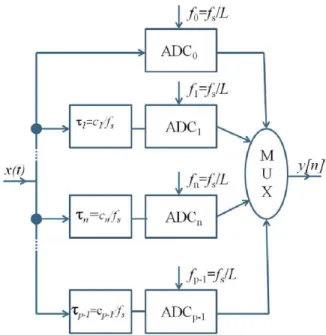
Fig. 1. Block diagram of the most commonly used TI-ADC system.
1. INTRODUCTION
Time-Interleaved Analog-to-Digital Converters (TI-ADCs) have been proposed for the implementation of universal mul-ticoset sampling patterns, which guarantee the recovery of a multiband sparse signal (i.e., only a small number of fre-quency subbands are occupied) from a small number of sam-ples. Figure 1 shows the block diagram of this architecture, where fs = Í/T denotes the Nyquist rate, p the number of
branches, T¿ are different delays and L is the length of the block signal that has to be reconstructed. The locations of the K active subbands are not known a priori., but making usage of the sparsity of the signal and appropriately selecting
Work supported by the European Regional Development Fund (ERDF) and the Spanish Government under projects TEC2009-08133, TEC2010-21245-C02-02/TCM and CONSOLIDER-INGENIO 2010 CSD2008-00010, and the Galician Regional Government under projects "Consolidation of Re-search Units" 2009/62 and 2010/85.
the delays and the block length, the multiband signal can be reconstructed if p>K [1,2,3].
The scheme proposed in [2] can also be implemented with a TI-ADC architecture similar to that of Fig. 1, with a ran-dom selection of the delays. The main drawback of ranran-dom selection approaches is that they require to have L ADCs con-stantly working. In contrast, fixed channel selection methods allow to reduce the number of branches of the hardware sys-tem p, to the number of active bands K, with the correspond-ing reduction in area size and power consumption.
Thus, in [1], a fixed branch selection is assumed. The uni-form sampling grid (at Nyquist rate) is divided into blocks of L consecutive samples, and then only p out of these L samples are acquired. This can be implemented with thep branches of the TI-ADC system in Fig. 1, using T¿ = c{T with integers
0 < c0 < ci < < cp_i < L — 1 and equal sampling
out-put channels lead to the reconstruction of the original signal, although the authors of [1] do not provide a design criterion for this; in [4], it is proven that any sampling pattern is uni-versal if L is prime, but the issue of finding an appropriate set {cfc}fc=o (a ¡nulticoset code) for any given value of L is stated
to be a combinatorial problem.
However, in [3], the matrix involved in the correspond-ing reconstruction equation is deeply analyzed, which makes possible to define a method for the design of universal mul-ticoset sampling patterns, that is, patterns which guarantee perfect reconstruction of the sparse multiband signal within the framework of compressive sampling. Thus, p is selected from the number of active bands, and delays are obtained as consecutive numbers from an arithmetic progression of differ-ence d coprime with the block length L. Differdiffer-ence d can be either positive or negative, and smaller or greater than L. This is the first systematic method proposed for this goal; previous multicoset codes were either obtained by direct search [5] or relied on the choice of a prime value of L [4].
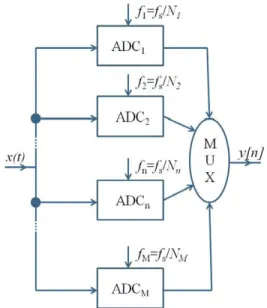
In this paper we propose and analyze an alternative and more flexible architecture to generate universal patterns: a multirate synchronous sampling scheme with M branches, as depicted in Figure 2. In this case we have a set of TI-ADCs working synchronously and using different sampling frequencies for each ADC (with the sum of of these different sampling rates lower than the Nyquist rate); the design prob-lem becomes the search for the sampling frequencies and the block length that lead to universal sampling patterns. A sam-pling scheme based on this architecture was first proposed in [6], but the focus was on the development of a recon-struction scheme for a set of different and arbitrarily chosen sampling frequencies; no criterion was proposed on how to choose the sampling frequencies. In [7, 8, 9] a multirate syn-chronous sampling scheme with coprime subsampling factors was also proposed, but not with a reconstruction objective but for the estimation of the autocorrelation function of a wide-sense stationary signal. Finally, a multirate sampling scheme was also proposed in [10], but in this case delays between ADCs were assumed, and the work was also focused on the reconstruction procedure, not in the design of the sampling scheme.
2. PROBLEM STATEMENT
As in [1], we assume a complex-valued K—sparse multiband signal (the number of active bands is K) x(t), bandlimited to [0, fs]. The upper bound B for the bandwidth of these bands
is known. The sampling stage is implemented as in Fig. 2. Thus, for each block of L Nyquist-rate samples, p of them are acquired, with indices 0 < c0 < c\ < • • • < cv-\ < L — 1.
Following [1], we define the sampling pattern C = {cfc}fc=o- The reconstruction of the multiband signal from
the acquired samples requires the selection of L, p and C
[Á=fM
ADCi
lfi=fM
ADC, ''
Fig. 2. Block diagram of a synchronous multirate system.
such that X(f) can be reconstructed based on
1
y(f) = Yf
Ax(f)i
with
yk(f) = XCk(e^T), fc = 0 , . . . , p - l
/
LT
xt(f) = X / + — ) , Z = 0 , . . . , L - 1
and where A is a p x L Vandermonde matrix with elements
akj=exp Í j—ckl V fe = 0). . .)p - l) / = ( ) , . . . , L - 1 . (1)
It is noted in [1] that x(f) can be recovered from y(f) if L < fg/B, p > K and A has Kruskal-rank1 equal to p.
For given L and p, a sampling pattern C that results in a fully Kruskal-rank A is termed universal [1].
In this work we will consider the case where these indices are selected from the sampling positions provided by a set of different uniform sampling sequences Xi[n] at rates fs/Niy
(i = 0 . . . M — 1): In other words, this means considering indices of the form nNi, i = 0, • • • , M — 1. Note that not all the samples generated by the set of ADCs have to be used for the reconstruction of the original signal. Our goal will be obtaining the sampling frequencies, i.e. the subsampling factors Ni and the block length that lead to a fully Kruskal-rank matrix.
3. ANALYSIS OF THE RECONSTRUCTION MATRIX FOR A SYNCHRONOUS MULTIRATE SAMPLING
SCHEME
3.1. The simplest case: only one ADC
In this case the sampling pattern is simply obtained by ex-tracting 1 out of Ni samples in each block of length L = pN\. This is an obvious selection for L, since in this way, we obtain
p different samples from each block [0, L - 1]:
cfc = kNu k = 0, ...,p - 1. (2)
Let us study the K-rank of the corresponding matrix A. Our first result guarantees that A has not full K-rank (p); on the contrary, its K-rank is always minimum:
Theorem 1. Let L = pNi and let us define p samples in [0, L-l]as
Ck kNi k = 0,...,p-l.
The selection L = NiN2 coincides with the natural
repeti-tion cycle of the indices genrated by two converters working synchronously at different rates.
We will assume that Ni, N2 are coprime; this way, we
have a total amount of p = Ni + N2 — 1 different samples (if N\, N2 are not coprime, there are coincident samples: kN2 = mNi for some k < N^ and m < N2). Under this assumption,
we provide the next result on the K-rank of the Vandermonde matrix A :
Theorem 2. Let L = N\N2 with 2 < Ni, N2 coprime
num-bers. Let us consider the N\ + N2 — 1 different samples
ck = kN2 k = 0,...,N1-l (3)
Cm+jV! = mNx m = 0,..., N2 - 2. (4)
If we choose a subset {c¿} ofp samples extracted from these ones, andp > 4, then the K-rank of A is not maximum (p).
In particular, if we consider all these Ni+N2 — 1 samples, then the K-rank of A is not maximum (p).
Then the corresponding p x L Vandermonde matrix A has K-rank equal to 1.
Proof. Let us denote w = e x p ( ^ j) the primitive L - r o o t of
1. The ( k + 1 ) -th row of A contains the powers of the complex number wk = e x p (^jck) . In this case this number is
wk = exp
2TT
~L jkNt « p . >
Note that
<. = 1 = wl
This implies that A has two equal columns: the first one (whose elements are w°k = 1) and the (p + l)-th column
(whose elements are w\ = 1). Therefore the K-rank of A
is 1 < p. D
Remark: This result asserts that there is no universal sampling pattern of the kind (2) if the block size is L = pN\. When L is multiple ofp, only 1 active subband can be recon-structed.
In the next Section we will study the existence of uni-versal sampling patterns for a multirate synchronous system with only two branches and the selection for the block length
L = NiN2.
3.2. The two ADCs case
We will now consider another approach, with L = N1N2. Unlike the last case (L = pNi, where the p samples were obtained as the output of 1 subsampler), in this case we will consider the output of 2 converters: one which extracts the samples of the kind kN2, k = 0,- • • ,Ni — Í, and another
one which provides the samples mN\ m = Í,..., N2 - 1.
Proof. The complex numbers
2TT
wk = exp ( — jck k = 0,...,N1 + N2
are roots of 1. In fact, for k = 0,..., N-i -1, they are N-i - r o o t s
of 1, because
'2TT , \ (2-K ,
wk = exp ( —jkN2 1 = exp I — jk ^ = 1.
And for k = Nu • • • , Ni + N2 - 2, they are N2 - r o o t s of 1
2TT
wm+N2 = exp ( —jmNi
2-K
e xP I JfJm
„N2
This means that all wk are roots of the polynomial
Q (z) = (zNi _ 1) (ZW2 _ !) = ZN1+N2 _ ZN, _ ZN2 + L
In other words, for any k = 0 , .
N!+N2 Wi
, ^ 1
..N2
No
From a matricial point of view, this means that there are 4 columns of A which are linearly dependent. In fact, recall from Equation (1) that the (m + l)-th column of A contains the m - t h powers of wk, w™\ hence, the last equation assures
that the {Nx + N2 + l)-th column of A, its (A^ + l)-th
col-umn, its (N2 + l)-th column and its first column are linearly
dependent. Note that the index column A^i + N2 +1 is smaller
than or equal to L because A^i + N2 < 2 m a x (Ni, N2) < L.
The existence of 4 columns of A which are linearly de-pendent implies that the K-rank is at most 3. Then if we ex-tract a number of samples p > 4 then the K-rank will not be maximum. Moreover, if we choose all the samples, the K-rank will not be maximum either: as p = N\ + N2 — 1 then
Example: If L = 15 = 3-5, we generate 3 + 5 — 1 = 7 different samples: (0,3,6,9,12) and (7,14). But the previ-ous proof shows that any of those samples provides a root of the polynomial
Q (z) = (z5 - 1) (z3 -l)=z8 z3 + l
which means that the 7 x 15 matrix A has 4 linearly dependent columns: the ones indexed by 0, 3, 5,8. This means that the K-rank at maximum is 3. The same holds if we extract p > 4 out of those 7 samples: the K-rank of the corresponding p x 15 matrix will be at most 3.
Remark: We have proven that the synchronous sampling for L = NlN2 (Nu N2 coprime) yields Nx + N2 -1 different
samples, but if we extract from these a pattern {ck} of more
than 3 samples, the K-rank will never be maximum. Thus, the unique solution for the synchronous sampling is just to consider p =1,2 or 3 samples. But notice that, even for that case, nothing assures that the maximum K-rank (p) will be reached.
It would be nice to guarantee that, by taking just p = 3 samples we would obtain K-rank equal to 3. But the following result assures that it is not possible either, if N1,N2 > 2:
Theorem 3. Let L = N\N2 with N\,N2 coprime.
1. If we just extract p = 3 different samples (say, 0, kN\ and mN2) then the K-rank is not maximum (3)
2. The K-rank is not maximum either, when we extract 3 samples of the kind kN-¡_, mN2 and m'N2 (being N^ <
N2).
3. IfNi,N2 > 2, then the K-rank is not maximum either,
when we extract 3 samples of the kind kNi, k'N\ and mN2.
Proof. 1. Let us study the case of p = 3 different samples: 0, kN\ and mN2. The matrix A has dimensions 3 x L.
We now show that not any 3 x 3 submatrix of order 3 of A is invertible: in fact, if Ni = min (N-¡_, N2) then the
submatrix built with the 3 columns indexed by 0, Ni, 2JV!is
1 wkN?
1 w m N^ i
1 1
.,kNf „2kN?
which obviously does not have rank 3. We have only used that wNlN2 = wL = 1 and the fact that 2NX < L
which is true because N2
2NV
> NÍ > 2 so L = N2Ni >
2. If N-¡_ = min (N-¡_, N2), the same happens if we choose
different samples kNi, mN2 and m'N2 : the same
sub-matrix, built with the 3 columns indexed by 0, A^i, 2A^i,
has not maximum rank either:
„kNf
1 „m'./V2./V1
2k Nf
3. Let us finally consider the case kN\, k'N\ and mN2:
the columns indexed by 0, N2 and 2N2 would give a
3 x 3 matrix with the first and second rows filled by l's (hence, not invertible):
wkNtN2 wk'NlN2
WmN2
w2kNlN2 x w^'NlN2 \
W2mN2 J
/ I = 1
Vi
1 1
wmNf
1 1
w2mN?
Note that in this case the index of the last column, 2N2
is smaller than L because 2N2 < N\N2 = L.
D
Hence for L = NiN2 with coprime N1:N2 > 2 the
K-rank is at maximum 2.
Finally let us consider the case L = 2N2 = 2N with N
odd. Fortunately, the following result assures that it is possi-ble to reach maximum K-rank with p = 3 samples:
Theorem 4. Let L = 2N with N an odd prime, and let us
consider an odd number 1 < m < N. Then the sampling pat-tern N — m,N,N + m, is universal, since it yields maximum K-rank (3).
Proof. Any 3 x 3 submatrix of A is of the form
w{N-m)k
wNk
w(N+m)k
w{N-m)k'
wNk'
w(N+m)k'
w{N-m)k"
wNk„
w{N+m)kll
We will prove that this submatrix is invertible for any 0 < k < k' < k" < L — 1. By extracting the factors
w(N-m)k^ w(N-m)k' ^ w(N-m)k"
respectively, from the first, second and third column, its rank is the same as the rank of
wmk
.2mk wmk'
w2k'
wmk" „ .2mkff
The latter matrix is a Vandermonde matrix of the numbers wmk, wmk , wmk". It is invertible if and only if those 3
num-bers are different. But if it happened to be wmk = wmk , then
mk = ink' mod L, say, m(k — k') = 2Nr, r G Z. As m is odd, we have that
m((k-k')/2) = Nr, r G Z.
is that (k — k') /2 = 0, leading to k = k' which is a con-tradiction, because k < k' by hypothesis. The contradiction comes from the assumption that the submatrix can be singu-lar. Hence, any submatrix of order 3 is nonsingular, and A
has maximum rank (3). D
Examples:
• An easy way to obtain the maximum K-rank is by tak-ing L = 6 = 2-3. As 3 is prime, we can just extract 3 samples: 3 - 1, 3,3 + 1 (say, the samples indexed as 2, 3,4). This method is equivalent to applying 2 syn-chronous samplers in blocks of length L = 6: a sub-sampler takes 1 out of 2 samples (providing the samples indexed 0,2,4) and the other one picks 1 out of 3 sam-ples (providing the ones indexed 0, 3). If each one dis-cards its first sample, we just extract the sampling pat-tern 2,3,4. Our contribution here guarantees that those 3 samples are sufficient for reconstructing p = 3 bands.
• Another example: for L = 10 we can consider sam-pling pattern 2, 5, 8, or the samsam-pling pattern 4,5,6. Each one guarantees the reconstruction of 3 subbands.
In summary, we provide an easy way to obtain 3 bands of sparse multiband signals. It suffices to take blocks of length L = 6, or in the general case, blocks of length L = 2N > 6 (with N prime) and choose 3 samples as stated in Theorem 4. However, no more than 3 subbands can be reconstructed when taking L = A^ N2, as we have already proven.
4. CONCLUSIONS
We have analyzed the reconstruction problem of sparse multi-band signals when using a synchronous multirate sampling scheme. For the simplest case of using only one ADC at rate fs/Nu if the block length is a multiple of the subsampling factor Ni we demonstrate that only 1 subband can be recov-ered. On the other hand, when using two synchronous con-verters with different sampling rates and the block length is obtained as the product of the two coprime subsampling fac-tors, we conclude that we can reconstruct at most 3 subbands, regardless of using a great number of samples. Moreover, the number of recovered subbands can be even smaller (equal to 2 or 1). In order to overcome this problem, we propose a new selection of the block length that leads to a sampling pat-tern which guarantees the reconstruction of any 3 subbands. As a further reseacrh, new selections of the block length as a function of the subsampling factors have to be proposed and studied, in order to guarantee that any number of active bands in the multiband signal can be reconstructed from the sub-Nyquist pattern generated with a synchronous multirate sampling scheme.
5. REFERENCES
[1] M. Mishali and Y. C. Eldar, "Blind multiband signal re-construction: Compressed sensing for analog signals," IEEE Trans. Signal Process., vol. 57, pp. 993-1009, Mar. 2009.
[2] J. Laska et al., "Random sampling for analog to infor-mation conversion of wideband signals," in IEEE Dallas Circuits Syst. Workshop (DCAS), 2006.
[3] M.E. Domíngez-Jiménez and N. González-Prelcic, "De-sign of universal multicoset sampling patterns for com-pressed sensing of multiband sparse signals," in IEEE Int. Conf. Acoust., Speech, Signal Process. (ICASSP), 2012.
[4] T. Tao, "An uncertainty principle for cyclic groups of prime order," Math. Res. Lett, vol. 12, no. 1, pp. 121—
127, 2005.
[5] R. Venkataramani and Y. Bresler, "Perfect reconstruc-tion formulas and bounds on aliasing error in sub-Nyquist nonuniform sampling of multiband signals," IEEE Trans. Inf. Theory, vol. 46, pp. 2173-2183, Sep. 2000.
[6] M. Fleyer, A. Linden, M. Horowitz, and A. Rosenthal, "Multirate synchronous sampling of sparse multiband signals," IEEE Trans. Signal Process., vol. 58, pp. 1144-1156, Mar. 2010.
[7] P. Pal and P.P. Vaidyanathan, "Coprime sampling and the music algorithm," in IEEE Digit. Signal Process. Workshop, 2011.
[8] P.P. Vaidyanathan and P. Pal, "Sparse sensing with co-prime samplers and arrays," IEEE Trans. Signal Pro-cess., vol. 59, pp. 573-586, Feb. 2011.
[9] P.P. Vaidyanathan and P. Pal, "Theory of sparse coprime sensing in multiple dimensions," IEEE Trans. Signal Process., vol. 59, pp. 3592-3608, Aug. 2011.