Four temptations against urban renewal: an approach to four
current urban processes
Carlos Rosa Jiménez, PhD. Arch.
Mª José Márquez Ballesteros, PhD. Arch.
Pedro Martín Bravo, Master.
University of Malaga, “Andalucía Tech” International Campus of Excellence Email: [email protected]; [email protected];
Abstract: The new paradigm of urban social and economic rehabilitation is replacing the current sprawl growth model. But four temptations must be considered:
1) The high-density. This process is possible in sprawl model, but its quantification does not seem to be clear, because after a certain threshold of occupancy per unit area, the city seems to collapse and social and environmental benefits disappear, appearing reversal processes city to country in search of a minimum quality of life standards. There is not a model for appropriate density. It depends on the way of life of population, the traditional city model.
2) The replacement. Architectonic and urban rehabilitation must be preferred to replacement, except for certain cases to be legally taxed. But as the city cannot be densified and orderly, without the prior replacement of the building, may fit this temptation. Even replacing the building can be made without considering high building standards
3) The gentrification. There is a wide doctrine and experience about this phenomenon with serious social consequences. It is very tempting to replace the building, due to improve requirement of broad levels of quality, entering a game of speculation, so common in our real estate market.
4) The eco-city. Comprehensive projects are building spaces with low levels of energy consumption. Fall into this temptation means to continue the extensive city model we have been developing, creating new cities far from the existing but incorporating saving measures, and continuing resource consumption.
Keywords: Rehabilitation, overdensification, building replacement, gentrification, eco-city
Introduction. Carretera de Cádiz and the rehabilitation as a new paradigm for urban obsolescence.
This paper resumes some conclusions of “Towards a sustainable model of urban and architectonic integral rehabilitation in Carretera de Cádiz district (Málaga)” research project funded by Andalusia Regional Government and concluded in 2010.
few years. Currently, important public infrastructures have been ended in this area as a new promenade and the underground which open an opportunity for analyzing integral rehabilitation as new paradigm.
We are at a paradigm shift in urban planning. The Cerdà’s Barcelona plan-project (1859) was the paradigm for acting in the growth-renewal of bourgeois city, articulated by the proposed extension of the street-grid or the street-opening as renovation project for historic district. In both cases, streets were a symbol and triumph of hygiene, sanitation and urban scene. After Second World War, industrial city represents the paradigm towards a productive and industrial development of urban areas and its architecture. Sophisticated management tools for planning were implemented. But there was no change regarding growth and renewal process: most cities grew to become metropolitan areas or urban regions, and historic district were renewed with equal intensity.
The city rehabilitation is a socio-cultural event. The Henri Lefèvre’s Le Droite à la ville (1968) was parallel to Historic District’s socio-cultural recovering, and both have focused an important part of 70’s to 90’s urban debate. Currently, socio-environmental recovery of urban periphery focuses urban issue, and this paper is aimed to review the socio-environmental recovery of city obsolescence.
Obsolescence is a widespread problem, the UN report State of the World's Cities 2008/2009-Harmonious Cities (2008) warns of inequality problems in many cities worldwide. As cities have grown in size and population, their spatial, social and environmental harmony of urban dimensions has decreased. In recent 30 years, more and more developed-world cities have reduced their population instead of growing, as Liverpool and other 49 cities in the UK, a hundred Russian cities or 39 US cities. By 2050, the population of 46 countries, -including Germany, Italy and Japan and most of the former Soviet states-, is also expected to be reduced. The reasons for this decline appear to be mainly economic and perhaps sociological (falling birth rate), and others such as air quality and environmental pollution (Ocáriz & Prats, 2009, pp.55-56).
Shrinking cities as Detroit are an example of economic downturn. This city suffers since 1970 a decline and decay process due to automobile industrial restructuring and the lack of opportunities; so, people flee, leaving behind a landscape of abandoned houses and obsolete infrastructure and equipment (Fernandez, 2011).
In Spain, most of important cities have the same problem of messy settlements, substandard housing and spatial segregation. Three type-cases can be distinguished (Hervás Más, 2009):
a) Historical district with serious problems of rehabilitation b) 1960s-1970s housing estates
c) Marginal urban areas
Carretera de Cádiz is an example how fast construction of 60-70’s neighborhoods surrounding city has degenerated into rapid obsolescence. This is due to different causes: the construction conditions, an inadequate maintenance and necessary repairs of buildings, loss of comfort-conditions by new up-loaded quality standards, traffic problems or new equipment needs (Arriola Aguirre, 2005). Obsolescence is a morphological problem, often associated with progressive emptying of buildings and urban areas by social classes, which look for better settlements. Once process starts, it feeds on itself and becomes progressively worse due to functional, social and economic degradation and deterioration.
maintenance causes physical degradation and building ruin. The feed-back process is accelerated just to stigmatize the neighborhood and surrounding areas.
Although a direct and determinist relationship between urban environ and social problems is discussed. Ardura & Gómez (2009) defend a link between social composition and lack of opportunities because certain physical factors can affect the social composition (location, isolation, residential monofunctionality or housing typology). Thus, the renovation or rehabilitation process for physical environment improvement appears as a second-degree factor that with a legal framework and tax incentives can affect in social mixing. Also, physical factors as the space-between in open block estates seem to rise problems such as drug use, vandalism, crime and insecurity which promotes a negative image that stigmatize the neighborhood.
An example of this process is Barcelona. In 1996, Spanish population was 1.479.746 inhabitants and foreign was 29.059; in 2006, the proportion is 1.359.942 versus 269.595. The key seems to be in population between 18 to 35 years-old, with income and education levels above average, but due to elevated house prices, they have to satisfy their housing needs moving to suburban or metropolitan area. Instead, the immigrant population is seeking shelter in informal markets with substandard housing (Hervás, 2009).
Gentrification: the urban rehabilitation investment with social exclusion.
This social-exclusion process of neighborhoods can be part of a general cycle related to gentrification phenomenon. Gentrification is the first process to prevent in neighborhood regeneration. M. Pacione (1990) considers gentrificationt as an urban transformation process where the original population of an area or neighborhood deteriorated, but value for money and located near the city center or other advantages, is displaced by another higher purchasing one, which decided to settle there.
Smith, from 1979, links it onto a process regulated by real state lobbies with influence on housing market, credit institutions or large developers, distinguishing three operators in rehabilitation: the promoter who rehabilitates for sale, the self-promoter rehabilitating to live and for rehabilitating rent. A new revision by Sartagal Bataller (2000) argues this process is part of the so-called life-cycle neighborhood theory, in which urban spaces respond to a cycle, with phases of growth, decline and revitalization or renewal potential.
Image 1. Historic evolution of Carretera de
Carretera de Cádiz is currently suffering this process in early phase. First stage starts with transformation of agricultural land in demand to industrial economy, targeting large immigration urban sectors from rural areas, masses of workers and production activities, encouraged by transport revolution (cars, trains, buses, etc..). The rapid need of dwellings is satisfied with a very high density bloc urban development funded by public aids. This mass housing production city was a symbol of modernity and the beginning of urban space devaluation caused by a low level of equipment and facilities developed, and the output of the real estate capital of land owners-constructors of buildings. This division provides a model of social space with the working class around the city center and the upper classes in the suburban area.
Carretera de Cádiz is in a second stage or obsolescence phenomenon which is characterized by urban space degradation, because of the abandonment of middle class workers, produced by industrial tissue destruction due to new post-industrial economy, the improving of private transport network of roads and highways and the main factor: housing degradation resulting by no-maintenance or divestment of its inhabitants. Specifically, the second generation (sons of first owners who keep living there) who has economic availability is tending to invest in new block well-equipped neighborhoods or suburbs. An accelerated ruin of buildings feeds this process which is exacerbated by cases of lower and unstructured class occupation or immigrants searching for low rents. Currently there are no social problems, but indifference of Public Administration can change this situation into it.
According to Smith (1978), Carretera de Cádiz is next to gentrification due to recent economic crisis which has downed house price. The potential income difference allows obtaining of large capital gains that is the main driver of this process. After a period of disinvestment and devaluation, differences between degraded sector value and the location potential value would increase with an important attraction of large investors. In this way, large capital amounts are circulating seeking real estate investment opportunities, and the recapitalization of undervalued sectors. Smith relates the degraded center investments with falling-profit rate in suburban investment. Best real estate investment opportunities are in areas with highest growth potential, not in those with higher land prices.
The third and last stage is further gentrification when urban areas are renovating form industrial and capitalist model to service-tourism financial one. It provokes the rising cost of land and buildings, with a lower and middle class rejection and attracting more affluent classes. To start the urban price upgrading is necessary a trigger, which is sometimes promoted by Regional or Central Administration investment due to weak local private capital. Once process starts, the contagion-effect is responsible for expanding it. The rehabilitation or reconstruction is essential to adapt the housing to a high standard of living. The homes are nearly or totally demolished.
This last stage has been initiated by public infrastructural investments. Probably, our main concern is whether public investment for urban regeneration can strengthen gentrification. Thus, the rehabilitation policy must be integral and including social regeneration to avoid gentrification.
Eco-cities: a hidden construction activity or a demonstrative example?
Therefore, the real value of city is as demonstrative value and research item. Extensive eco-city development would increase land resource consumption. For that reason, in England, the intellectual debate has rejected these projects (Smith, P., 2009).
Eco-city concept is a well orientation about how sustainable district can be. Is eco-city a utopian model of sustainable city? European Union has developed a research project named Ecocity (Gafrron et al., 2009) as an urban design manual. The great value of this work is to define a range of parameters to design an Eco-district (table 1) that has been adapted to rehabilitation of existing district: "The criteria that characterize an eco-city can be applied in a newly created district or in one already built", but difficulties are greater in second scenario than first one.
Table 1: Recommended parameters in an eco-district.
The Carretera de Cadiz research project made an adaptation of Ecocity criteria to the particularities of districts: 28 indicators (table 2) were chosen to consider specific inherited urban reality; new ones were added in attendance to the characteristics of high density units analyzed.
Table 2: Adapted sustainable indicators for existing district assessment.
N. Theme Sub-theme Parameter
1P Planning Innovation in planning
2U Urban structure Morphology Density
3U Land use Mixed use in building
4U Mixed use in neighborhood
5U Residual space rate
6U Road surface rate
7U Economic activity Shops and Stores
8U Public space and green areas Living index
9U Green areas and public space
quality
10U Green areas accessibility
11U Ecological quality
12T Transport Private transport facilities Low traffic solutions
13T Road surface by population
14T Length of cycle routes by
population
15T Public transport accessibility Public transit coverage
16T Acoustic contamination Exposure to traffic noise during daytime (> 55 dBA)
17T Exposure to traffic noise during
nighttime (> 50 dBA)
18T Parking Parking endowments
19T Percentage of road that assumes
the provision of parking
Parameter Recommended
20F Energy flow Energy efficiency Urban pattern efficiency
21F Proportion of buildings facing
south
22F Insulation level
23F GHG emissions Renewable energy rate
24E Building Typology and housing supply Diversity of adapted residential typology
25E Maintenance status of building
26E Accessibility, flexibility and innovation for coexistence
Accessibility in building and residential solutions for elderly, including intergenerational housing, flexibility in transforming interior spaces.
27S Socio-economy Social diverstiy Diversity of population in terms of age, cultural background, professional status and lifestyle
28S
Equipment Provisions of social services (children, seniors and groups of people in need)
(Source: by authors)
The second conclusion is the final aim of rehabilitation must be the consolidation or creation of sustainable communities in existing city and the Eco-City has to be a desirable target but not the obligated goal.
The balance between renewal and an appropriate density-
The Spanish cities are more likely to become future sustainable cities, because they are closer to Mediterranean model (compact, diverse, multifunctional and heterogeneous city) than sprawl conurbations (Rueda, 1997). Carretera de Cadiz as open block district built in 1950’s and 1970’s requires major rehabilitation attention. According to 2001 home census (INE), 47% of residential buildings belong to that period and hold 57% Spanish population. They have lack of equipment, inadequate design and maintenance of public spaces. Its population has the highest unemployment rates (Rubio del Val, 2010).
De Luxán (2008) argues that improving passive measures in buildings built before NBE-CT-79 (energy efficiency standard) to achieve current legislation, is possible a 60% energy saving, equivalent to 23 tons of oil. The percentage of energy consumption for a renovated building is too high compared to rehabilitation.
However, urban renewal or new development generates substantial economic benefits and stimulate private investment, but rehabilitation retracts private investors, creating the need for greater investment by public sector. In any case, sustainable urban regeneration generates many jobs (direct and indirect), making on a profitable performance, but not speculative (CC.OO, 2010).
40 years, 2010-2050, the investment would be about 23.2 million euros per year, 45.143 euros per household, 410 euros per capita.
The matter is that a total rehabilitation of Carretera de Cadiz will maintain the high level of density which is a serious problem for residents. Three possibilities must be considered:
a) The existing density or “Undoing the city”: high levels of population density demand actions to reduce it onto similar eco-district parameters. In this situation, the rehabilitation of existing urban reality only with energy reduction criteria can maintain an unsustainable social community.
b) The declining industrial as “Urban solidarity” areas: avoiding its transformation into residential neighborhood, increasing the density problem.
The existing density or “Undoing the city”.
Table 3. Comparative analysis between housing and population density (2010 Census) in
Carretera de Cádiz higher density neighborhood (Recommended housing density is remarked).
(Source: by authors)
Carretera de Cadiz has neighborhood as La Luz, Vistagranca, San Andrés, which double the housing density recommended of 100 houses per hectare (table 3). These high-density neighborhoods do not have enough quality standards for residents. The adaptation to eco-district standards requires a decrease in number of homes for which we propose two alternatives:
a) “Undoing the city”. Demolition of buildings to obtaining free areas, especially those in poor condition. It supposes the relocation of the existing population in other areas of the city.
b) Prohibiting or use control of housing on ground floors, especially those with difficult lighting and ventilation, for conversion to non-residential uses. The replacement of residential use by offices or administrative use, providing services to the community, can be a solution to problem, increasing also the diversity of uses.
0 100 200 300 400 500 600 700 800 900
Housing density (units/ha)
Declining industrial areas or “Urban solidarity”.
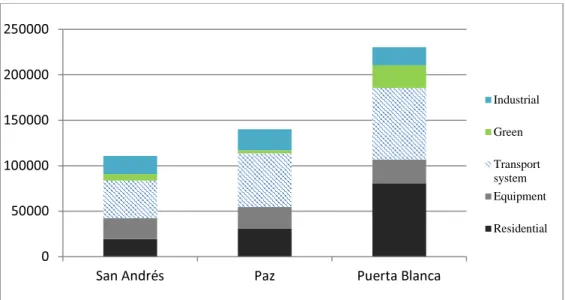
These high-density neighborhoods have "opportunity areas". They are obsolete industrial fabrics, which are subject to estate expectations boosted by the great benefits prior to the real state bubble. As shown in Table 4, the neighborhoods with industrial areas have significant land reserves to project clearances and nonresidential activities that allow mixed-use development. However, the local administration has approved its conversion into residences increasing housing density and population. It is necessary to implement the concept of urban solidarity which incorporates surrounding needs into development and design of an urban sector.
Table 4. Land use in high-density district of Carretera de Cádiz with declining industrial areas.
(Source: by authors)
Conclusions.
This paper is a revision of a research project which aim was to analyze the rehabilitation of high-density neighborhoods of Carretera de Cadiz (Málaga, Spain) and their relationship with four current processes of urban renewal:
a) The rehabilitation policy must be integral and including social regeneration to avoid gentrification.
b) The final aim of rehabilitation must be the consolidation or creation of sustainable communities in existing city and the Eco-City has to be a desirable target but not the obligated goal. Eco-City has an important demonstration value, but never must be an alternative model to develop in extension.
c) Renewal can be useful for “Undoing the city”: high levels of population density demand actions to reduce it onto similar eco-district parameters. In this situation, the rehabilitation of existing urban reality only with energy reduction criteria can maintain an unsustainable social community.
d) The “Urban solidarity” is an interesting concept that must be considered for developing new urban sectors in existing city.
0 50000 100000 150000 200000 250000
San Andrés Paz Puerta Blanca
Industrial
Green
Transport system
Equipment
References.
Ardura, A. & Gómez, A., 2009. Nuevos procesos de rehabilitación urbana integral de barrios de bloque abierto en Madrid y Barcelona como ecosistema de regeneración urbana. City Futures
2009 Madrid, Spain 4-6 June 2009. Avaible at:
www.cityfutures2009.com/PDF/76_Ardura_Urquiaga_Alvaro.pdf. [Accessed 02 February 2013].
Arriola Aguirre, P. M. 2005. La rehabilitación urbana: una necesidad complementaria de la ciudad capitalista postindustrial. Alicante: Biblioteca Virtual Miguel de Cervantes, p. 22. Available at http://www.cervantesvirtual.com/obra/la-rehabilitacin-urbana-una-necesidad-complementaria-de-la-ciudad-capitalista-postindustrial-0/
[Accessed 02 February 2013].
CC.OO. (Comisiones Obreras), 2010. Rehabilitación y renovación urbana sostenible. [pdf] Available at:
http://www.ccoo.es/comunes/recursos/1/doc19726_Rehabilitacion_Urbana_Sostenible.pdf [Accessed 20/10/2012]
Cuchí, A., 2010. Cambio Global España 2020/50 Sector edificación. La imprescindible reconversión del sector frente al reto de la sostenibilidad. [Pdf] Madrid: Centro Complutense de Estudios e Información Medioambiental de la Fundación General de la Universidad Complutense de Madrid. Available at www.cambioglobal.es.
[Accessed 01 April 2013]
Fernandez, M., 2010. Tras la crisis, el gran reto es la rehabilitación y la renovación urbana. In La ciudad viva [Blog] 11/02/2010. Available at http://www.laciudadviva.org/blogs/?p=3948. [Accessed 03 December 2012]
Gafrron, P., Huismas, G. and Skala, F. (cor.), 2008. Proyecto Ecocity: manual para el diseño de ecociudades en Europa. Vol I. La ecociudad: un lugar mejor para vivir. 1ª edición. Bilbao: Bakeaz, Centro Documentación Estudios para la Paz.
Hervás Más, J. J., 2009. Las actuaciones de dotación y renovación del suelo urbanizado. La Regeneración de la ciudad. El Consultor de los Ayuntamientos y de los Juzgados (5) p.732. La Ley, grupo Wolters Kluwer. Available at http://riunet.upv.es/handle/10251/8396
[Accessed 01 April 2013]
Luxan de, M., 2008. La perspectiva integral de la rehabilitación urbana. In Actas del Congreso Nacional del Medio Ambiente CONAMA 9. SD-mviv. La rehabilitación urbana integral. Los barrios periféricos. Ministerio de Vivienda, p. 48.
Ocáriz Salazar, J. & Prats Palazuelo, F., 2009. Cambio Global España 2020/50. Programa ciudades. Hacia un pacto de las ciudades españolas ante el cambio global. [Pdf] Madrid: Fundación CONAMA. Available at: www.cambioglobal.es.
[Accessed 01 April 2013]
Pacione, M., 1990. Urban problems. An Applied Urban Analysis. London: Routledge.
Información Medioambiental de la Fundación General de la Universidad Complutense de Madrid. Pp. 180-192. Available at: www.cambioglobal.es.
[Accessed 01 April 2013]
Rueda, S., 1997. La ciudad compacta y diversa frente a la conurbación difusa. [Online] 30/06/1997. Available at: http://habitat.aq.upm.es/cs/p2/a009.html ].
[Accessed 01 April 2013]
Sargatal Bataller, M.A, 2000. El estudio de la gentrificación. Biblio 3W. Revista Bibliográfica de Geografía y Ciencias Sociales, (228). Universidad de Barcelona. Available at: http://www.ub.edu/geocrit/b3w-228.htm.
[Accessed 01 April 2013]
Smith, N., 1979. Toward a theory of gentrification: a back to the city movement by capital, not by people. Journal of the American Planning Association. (45).
Smith, N., 2006. Gentrification Generalized: From Local Anomaly to Urban “Regeneration” as Global Urban Strategy. In M. Fisher and G. Downey (eds.). Frontiers of Capital: Ethnographic Reflections on the New Economy. Durham: Duke University Press. (pp. 191-208)
Smith, P. F., 2009. Buidling for a Changing Climate. The Challenge for Construction, Planning and Energy. Routledge: London. (chapter 8. Eco-towns: opportunity or oxímoron?)