ENGLISH AS A FOREIGN LANGUAGE LEARNING AND TEACHING
A RESEARCH PROJECT PRESENTED TO
THE PROGRAM OF B.A. IN TEACHING ENGLISH AS A FOREIGN LANGUAGE SCHOOL OF EDUCATION
UNIVERSIDAD NACIONAL ABIERTA Y A DISTANCIA COLOMBIA
IN PARTIAL FULFILLMENT
OF THE REQUIREMENTS FOR THE DEGREE OF LICENCIADO EN INGLÉS COMO LENGUA EXTRANJERA
BY
NESTOR FERNANDO ORBES MORIANO
DECEMBER, 2018
ABSTRACT
The purpose of this research is to experience a new educational form of teaching and learning, English. It is based on the use of Colombian Sign Language as an aid to teaching and learning English. For this project, it was very important to have a small population easy to handle and familiarized with deaf people because in this way students would feel comfortable when learning a basic vocabulary in Colombian Sign Language. The practice consisted in teaching a few words and gestures in Colombian Sign Language to the students, so they could build in their minds a kind of draft to follow their ideas to express them. The use of Colombian Sign Language in the teaching of English is feasible and helps improve students’ language skills. Although the practice is mainly aimed at hearing students, it was shown through practice that inclusion can be done with deaf people and it is not necessary to exempt them or exclude them from learning English, as they can more easily assimilate the English language. The practice of teaching English using sign language is a great advantage for English teachers, as they attract the attention of students and their interest in the subject often lost by the monotony and the use of traditional practices.
ACKNOWLEDGMENTS
TABLE OF CONTENTS
ABSTRACT... ii
ACKNOWLEDGMENTS ... iii
LIST OF TABLES AND FIGURES ... vii
INTRODUCTION ...1
Significance of the Study ... 2
Statement of the Problem ... 2
Objectives... 3
General Objective ... 3
Specific Objectives ... 3
LITERATURE REVIEW ...4
Bilingualism in Colombia ... 4
Analysis of Different English Teaching Approaches ... 8
The Oral Approach... 8
The Audiolingual Method ... 10
Communicative Language Teaching (CLT) ... 12
The Natural Approach... 14
Total Physical Response (TPR) ... 17
Sign Language... 28
METHODO LOGY...37
Research Approach ... 38
Forms ... 38
Consent Forms ... 38
Observation Protocol Form (OPF) ... 39
Instruments... 39
Setting ... 39
Population ... 40
Procedure ... 40
RESULTS ...43
Placement Test ... 43
Findings on Video Recordings... 45
Students’ Portfolio ... 47
Final Satisfaction Survey ... 47
DISCUSSION ...50
CONCLUSION ...52
REFERENCES ...54
APPENDIX A: PRINCIPAL´S CONSENT FORM ...58
APPENDIX B: PARENTS’ INFORMED CONSENT FORM MODEL ...59
APPENDIX C: SIGNED CONSENT FORMS (SAMPLE) ...60
APPENDIX D: OBSERVATION PROTOCOL FORM (OPF) ...61
APPENDIX E (PLACEMENT TEST) ...63
APPENDIX G (VIDEOS)...68
Teaching Experiences Recorded on Video ... 68
First Video Description ... 68
Second Video Description ... 70
Third Video Description ... 71
APPENDIX H (PORTFOLIO TASKS) SAMPLES ...73
LIST OF TABLES AND FIGURES
Figure 1. Some. ...34
Figure 2. Arrive...34
Figure 3. Late ...35
Figure 4. Meeting ...35
Table 1. Relation of Participants in the Placement Test ...43
Figure 5. Gender of Students. ...44
Figure 6. Score of Students. ...44
Figure 7. Relation between Grammar and Vocabulary. ...45
Figure 8. Question 7...47
Figure 9. Question 8...48
Figure 10. Question 9...48
CHAPTER 1
INTRODUCTION
Many English as Foreign Language (EFL) learners may experience different problems when submitting a placement test. I went through this situation ten years ago; it happened while an English teacher was interviewing me and at that precise moment, I suffered a mental block. I was so nervous; I was not able to talk not even to think about what was being asked. Somehow, my inability to recall my English-speaking skills helped me to recall my knowledge of
Colombian Sign Language (CSL). Moreover, CSL helped me go through my interview and speak fluently. Hence, I started using CSL as my own strategy for communicating English, which has been very useful so far.
Finally, Chapter Five presents the conclusions and suggestions of this research to the EFL community.
Significance of the Study
The results of the project are beneficial for the whole society concerned in learning English as a Foreign Language (EFL). Moreover, Colombian Sign Language might be used for other English teachers who seek that their students learn and at the same time enjoy English learning. Therefore, Colombian Sign Language can be considered as a bridge, which permits both the learning and the teaching of a foreign language in a pleasant environment with the students.
On the other hand, the importance of this project lies on its singularity inside the Colombian context, in other words it is unique. Furthermore, it is a new approach and a new instrument of inclusion, which allows deaf students to be included inside the classroom and not to be exempt due to their condition. Thus, it is a good opportunity for English teachers to be prepared to face the new challenges posed by education by incorporating the use of Colombian Sign Language on their teaching practice.
Statement of the Problem
bilingualism program was published in recent years as a strategy for competitiveness. It is clear, that in Colombia there is a great need to improve in EFL. Although environmental conditions do not allow improvement in English, because Colombia is a country where the dominant language is Spanish, students also do not have the opportunity to practice with others, making it more difficult to learn and improve it too. In this regard, in order to meet this need, the use of CSL has been thought of as a strategy for learning the English language. It acts as a bridge, which helps learners remember the English words, and at the same time, puts in the brain pictures without recur to translation in Spanish. Considering this, the next research question has arisen: How to improve the learning of English as a Foreign Language by teaching the Colombian Sign Language to the students of the Instituto San Rafael de Calarcá?
Objectives
General Objective
To improve the English as a Foreign Language Learning and Teaching process in ninth grade students of El Instituto San Rafael de Calarcá using Colombian Sign Language (CSL) as a didactic strategy.
Specific Objectives
To determine the ninth graders’ English level in all four skills, according to the Common European Framework of Reference for Languages (CEFR) through a placement test in El
Instituto San Rafael de Calarcá.
To use Colombian Sign Language in the English classroom with ninth graders of El Instituto San Rafael de Calarcá.
CHAPTER 2
LITERATURE REVIEW
This chapter will discuss published information on this research, explaining the pertinent literature and offering a section for each area of study. This begins by exploring Bilingualism in Colombia and the importance of EFL in our country. It also points out an Analysis of different English teaching approaches, which aim to choose Total Physical Response (TPR) approach with the use of hands and gestures and its effects on memory and learning. Finally, this chapter displays different information on Sign Language and specifically Colombian Sign Language, its history and use in the country.
Bilingualism in Colombia
the very enactment of new law, several institutions adopted English teaching as a foreign language.
Mejia (2011) stated that this program in Colombia “… offers all students in the country the possibility of becoming bilingual in English and Spanish as part of a vision of increased productivity in a globalized world” (p. 7). Also, she says that this program has been highly criticized for scholars, because is an imposition taken from models of other countries which context is completely different from this one (Mejía, 2011).
Nevertheless, the need to learn English is latent, according to the Colombian Ministry of Education´s policies (MEN, 2006), the main goal of this program is to achieve citizens capable of communicating with English, in such a way that they can insert the country in the processes of universal communication, in the global economy and in cultural openness, with internationally comparable standards. Establishing what students should know and be able to do to demonstrate a level of B1 proficiency, by the end of the eleventh grade. (MEN, 2006)
In 2006, the ministry of education formulated a document entitled The Basic Standards of Competence in Foreign Languages: English based on the Common European Framework of Reference for Languages (CEFR). The reason to adopt this framework was “the fact that it was the result of ten years of research, and that it provided a common language to establish foreign language performance levels throughout the Colombian educational system, particularly in relation to international standards.” (Mejia, 2011 p. 8)
the world, determined by free trade agreements, the globalization of cultural industries and the development of the knowledge society. The main challenge of the bilingualism national program is that, students reach the required level for the respective stage of formal education, that is, Basic, Medium and Superior and in non-formal education, establishing international standards for each one of the levels (MEN, 2005). The Ministry formulated the National Program of Bilingualism, which has as a challenge that students develop competence in English, in formal education (Basic, Medium and Superior) and in non-formal, establishing international standards for each of the levels. Likewise, two stages were determined for the National Program of Bilingualism. In the first, it is intended to achieve a basic command of English as a second language for students of Basic and Media, and a higher level for those of Superior. In the second, the development of bilingualism in the country will be sought.
English (a level above that of students). In the second stage, the teaching of English should be established from pre-school education, to develop a greater command of the language in Colombians. Therefore, in the first stage. steps must be taken to have a competent faculty that addresses this work. (MEN, 2005)
In a different study, Sanchez (2013) highlights that English Colombian level is too low. He shows how the results demonstrate that Colombians have low English language proficiency, fact that can be corroborated by calculating the proportion of students and teachers grouped in levels associated with diminished language skills, as well as the average scores obtained by Colombians on international tests for nonnative English speakers.
This situation is persistent, and conveyed in the evolvement of students' recent
performance on standardized English tests, which has characterized itself by the absence of significant progression. This reflects the decreased likelihood of fulling the goals related to foreign language proficiency levels in Colombia, proposed by the Ministry of Education, hence an adjustment recommendation. (Sánchez, 2013, p.1)
Considering this, it is important to seek other alternatives to improve and arise the English level on students.
and Inclusive English environment; All these factors enhance the reasons why people in Colombia should take seriously the opportunity to learn English, kids and teachers as well, do not have a good learning environment to gain good English competences, this might be a cause the students are not proficient in English. So, other didactics should be explored in order to they have access to the foreign language quickly or at least students have another means to learn English in a better way (p. 47). These outcomes and this study, led us to explore different methods which were useful as a guide, in order to find the best method suitable for this project.
Analysis of Different English Teaching Approaches
There are too many different language teaching approaches analyzed specially by Jack C Richards and Theodore Rodgers (1986) some them are the oral, approach, audiolingual method, communicative language teaching, the natural approach and total physical response. We must take into account that teachers have a wide range of possibilities to choose the best teaching methods in order to accomplish and meet the needs of students. That is why is necessary to make a short review about different teaching approaches in order to choose the best and well adapted with the purpose of this project, besides it is important to let to know the different approaches in order to have a wide knowledge and a wider point of view about different teaching methods and to understand why TPR was chosen as the main approach for this project. To begin, let us examine with the first one:
The Oral Approach
very large number of textbooks are based on it” (p. 31) also, according to Richards and Rodgers, (1986) two of the leaders of this approach were Harold Palmer and A. S. Hornby. There are main contents related to this approach, they are grammar control and vocabulary control. The
vocabulary control explores the role of vocabulary in language learning, in consensus with different linguists, vocabulary was seen as an essential component of reading proficiency. So, they created lists of vocabulary to take into account for developing the course material or as aids for teaching English as a foreign language.
The Grammar control focuses on the grammatical content of a language course. “Palmer viewed grammar as the underlying sentence patterns of the spoken language ” (Jack C. Richards and Theodore Rodgers 1986 p. 33). So, Palmer and other linguists analyzed English and
classified its major grammatical structures into sentence patterns, later useful to help internalize the rules of English sentence structure.
The oral approach has main characteristics described by. Richards and Rodgers (1986) namely: Language teaching begins with the spoken language. Material is taught orally before it is presented in written form. The target language is the language of the classroom. New language points are introduced and practiced situationally. Vocabulary selection procedures are followed to ensure that an essential general service vocabulary is covered. Items of grammar are graded following the principle that simple forms should be taught before complex ones. Reading and writing are introduced once a sufficient lexical and grammatical basis is established. (p. 34).
According to Richards and Rodgers (1986) For the oral approach, speech was considered as the basis of language. It is inductive, because “the meaning of words is not given through explanation but words must be induced according a situation” (p. 36).
If we give the meaning of a new word, either by translation into the home
language or by an equivalent in the same language, as soon as we introduce it, we weaken the impression which the word makes on the mind. (Billows as cited in Jack C. Richards and Theodore Rodgers 1986, p. 36).
For the oral approach, it is expected that learners deduce the meaning of words from the situation. The objectives of this oral approach are to teach a practical command of the four basic skills of language, Accuracy in both pronunciation and grammar is regarded as crucial, and errors are to be avoided at all costs. The syllabus basically is structural where a word list is used within a situation which refers to the manner of presenting and practicing sentence patterns. All this situation and words are presented through examples, and translation is not used. The main practice is made by “guided repetition and substitution activities, including chorus repetition, dictation, drills, and controlled oral-based reading and writing tasks”. (Richards and Theodore Rodgers 1986, p. 38). The learner’s role is only to listen and repeat what teacher says according textbooks contents. Teacher´s role is essential, he has to create situations and modeling on the students to repeat after him. This approach in conclusion requires repetition and memory in order to achieve the use of language automatically.
The Audiolingual Method
According to. Richards and Rodgers (1986) the audiolingual method had its beginning during the world war II, when to learn a foreign language became a huge need for the U.S army. Richards and Rodgers (1986) described how this approach arose:
was still linked to the Reading Method) was prompted by the launching of the first Russian satellite in 1957. They wanted to prevent Americans from becoming isolated from scientific advances made in other countries. (p. 47)
Theory of learning that comprehends audiolingual method is behaviorism, it states that behavior helps for language learning depending on three main elements; they are stimulus, response and reinforcement, according to Jack C Richards and Rodgers (1986) “Reinforcement is a vital element in the learning process, because it increases the likelihood that the behavior will occur again and eventually become a habit”. (p. 50)
Among the main principles of audiolingualism depicted by Jack c Richards and Rodgers (1986), are: a) Foreign language learning is basically a process of mechanical habit formation. Good habits are formed by giving correct responses and Language is verbal behavior - that is, the automatic production and comprehension of utterances - and can be learned by inducing the students to do likewise. b) Language skills are learned more effectively if they are learned in spoken form first, before the written form. c) Analogy is used rather than analysis. This involves the processes of generalization and discrimination. And d) The meanings that the words of a language have for the native speaker can be learned only in a linguistic and cultural context (p. 51). The audiolingualism is mainly focused on speech training and listening comprehension that is oral skills.so the students must work out oral proficiency by means repetition, imitation and memorization. Dialogues and drills form the basis of audiolingual classroom practices.
The audiolingualism had its period of most widespread use in the 1960s, but scholars like Noam Chomsky rejected the structuralist approach to language description as well as the
innovation, formation of new sentences and patterns in accordance with rules of great abstractness and intricacy" (Chomsky as cited in Jack C Richards and Rodgers, 1986).
Chomsky argued that such a learning theory could not possibly serve as a model of how humans learn language, since much of human language use is not imitated behavior but is created anew from underlying knowledge of abstract rules. Sentences are nor learned by
imitation and repetition but generated from the learner´s underlying competence. (Richards and Rodgers, 1986, p. 59). Language learning in this method is mechanical and can be boring for students. So, this makes it necessary to look for some other methods that meet the needs of today´s students.
Communicative Language Teaching (CLT)
According to Jack C. Richards, Theodore S. Rodgers, (2001) Its origins are found in the 1960´s, “Chomsky had demonstrated that the current standard structural theories of language were incapable of accounting for the fundamental characteristic of language - the creativity and uniqueness of individual sentences” (Jack C. Richards, Theodore S. Rodgers, 2001, p. 153). The last theory during this time, that is, the audiolingualism had been rejected.
So, British applied linguists saw the need stated by Richards and Rodgers, (2001) to “focus in language teaching on communicative proficiency rather than on mere mastery of structures” (p. 153). At this point, Wilkins's contribution was an analysis of the communicative meanings that a language learner needs to understand and express. Wilkins described two types of meanings, Wilkins (as cited in Jack C. Richards, Theodore S. Rodgers, (2001) states that “notional categories (concepts such as time, sequence, quantity, location, frequency) and
Later Wilkins wrote a book called Notional Syllabuses (Wilkins 1976), with great impact on the development of Communicative Language Teaching. Of course, there were more than one protagonist in this development, such as the work of the Council of Europe; the writings of Wilkins, Widdowson, Candlin, Christopher Brum fit, Keith Johnson, and other British applied linguists helped to develop the new approach called the communicative approach or
communicative language teaching. (Jack C. Richards, Theodore S. Rodgers, 2001)
This approach had the next aims described by Richards and Rodgers (2001): “(a) make communicative competence the goal of language teaching and (b) develop procedures for the teaching of the four language skills that acknowledge the interdependence of language and communication”. (p. 155)
Language is a communicative act, where according to Hymes (as cited in Richards and Rodgers (2001) people need to develop the communicative competence. So, we can say this theory becomes eclectic, that is, it uses different elements of other theories but focused on communication, according to Littlewood (1981) (as cited in as cited in Richards and Rodgers, 2001) he stated, "One of the most characteristic features of communicative language teaching is that it pays systematic attention to functional as well as structural aspects of language."
(Littlewood 1981, as cited in as cited in Richards and Rodgers, 2001)
Some principles known for this theory are: Activities that involve real communication promote learning and Language that is meaningful to the learner supports the learning process. (Johnson 1982 as cited in p. 161 by Jack Richards and Rodgers, 2001).
personal identification, education, shopping or describing something or making some requests and so on. all this was used to specify what was needed in a real communication environment.
Candlin, M. P. (1980) describes the learner's role within CLT in the following terms: The role of learner as negotiator- between the self, the learning process, and the object of learning-emerges from and interacts with the role of joint negotiator within the group and within the classroom procedures and activities which the group undertakes. The
implication for the learner is that he should contribute as much as he gains, and thereby learn in an interdependent way. (p. 100)
Likewise, Candlin, M.P. (1980) describe the teacher´s role in this communicative process, so they stablished two main roles for teachers: “the first one is to be facilitators in the communicative process and the second one is to act as an independent participant within the learning-teaching group” (p. 100)
There are other roles to be performed by teacher in CLT such as counselor and group process manager. This approach entails the communicative act as means of language learning, teachers can act and perform their lesson plans according the needs of the learners, and most important is that practice in real contexts can lead to a good language learning.
The Natural Approach
According to Richards and Rodgers (2001) stated that the natural approach was defined by Stephen Krashen and an Tracy Terrell in 1983. Krashen and Terrell’s language view is communication as the “primary function of language and they refer to the Natural Approach as an example of a communicative approach” (Richards and Rodgers, 2001, p. 179).
Richards and Theodore Rodgers 2001, p. 179) Krashen and Terrell’s proposal, emphasized in the “primacy of meaning” (Richards and Rodgers 2001, p. 180) where it stresses the importance of vocabulary, the lexicon, and grammar determines how to lexicon is exploited to produce messages. Terrell quoted Dwight Bollinger to support this view:
The quantity of information in the lexicon far outweighs that in any other part of the language, and if there is anything to the notion of redundancy it should be easier to reconstruct a message containing just words than one containing just the syntactic relations. The significant fact is the subordinate role of grammar. The most important thing is to get the words in. (Bollinger, in Terrell 1977 cited by Richards and Rodgers 2001, p. 180)
So, the language vision that Krashen and Terrell have is language as a “vehicle for communicating meanings and messages” (Richards and Rodgers 2001, p. 180) which consists of lexical items, structures, and messages.
Summarizing what Richards and Rodgers (2001) explained about the theory of learning, according to Krashen and Terrell is based on an “empirically grounded theory of second
communicate”. (Richards, J., & Rodgers, T. (2001), p. 181) this hypothesis also, is limited by three factors: time, focus on form, and knowledge of rules.
The third hypothesis is called the natural order hypothesis. Richards and Rodgers (2001) says about it:
The acquisition of grammatical structures proceeds in a predictable order. Research is said to have shown that certain grammatical structures or morphemes are acquired before others in first language acquisition of English, and a similar natural order is found in second language acquisition (p. 182).
So, if students have low affective filter it means they are more receptive than those who have a high affective filter, because this means that they are going through different problems such as anxiety, fear or embarrassment.
Finally, the natural approach has been conceived to be applicable to a wide variety of situations, its language teaching objectives depends “on learner needs and the skill (reading, writing, listening, or speaking) and level being taught” (Richards and Rodgers, 2001, p.184). In a class room, teachers will be focused on presenting comprehensible input in the target language to the students, furthermore, they need to create a relaxed environment in order students feel
comfortable and to give students the opportunity to respond in a simple way. Richards and Rodgers (2001) says:
Techniques recommended by Krashen and Terrell are often borrowed from other methods and adapted to meet the requirements of Natural Approach theory. These include command-based activities from Total Physical Response; Direct Method
activities in which mime, gesture, and context is used to elicit questions and answers; and even situation-based practice of structures and patterns (p. 186).
Total Physical Response (TPR)
approach who did do so, this approach is called total physical response, or TPR which is described down below.
TPR according to Richards and Rodgers (2001) basically “is a language teaching method built around the coordination of speech and action; it attempts to teach language through physical motor activity”. (p. 73) Developed by James Asher, He claims that “speech directed to young children consists primarily of commands, which children respond to physically before they begin to produce verbal responses. Asher feels that adults should recapitulate the processes by which children acquire their native language ” (Richards and Rodgers 2001, p. 73). Moreover, Asher shares a positive point about TPR which is interesting for this research, Richards and Rodgers 2001) stated “A method that is undemanding in terms of linguistic production and that involves game like movements reduces learner stress, he believes, and creates a positive mood in the learner, which facilitates learning” (p.73). In addition, Asher stablished a strong relationship between the motor activity and the memory recall, he stated “TPR can also be linked to the “trace theory” of memory in psychology (Katona 1940 as cited in Richards and Rodgers, 2001), which holds that the more often or the more intensively a memory connection is traced, the stronger the memory association will be and the more likely it will be recalled. Retracing can be done verbally (e.g., by rote repetition) and/or in association with motor activity. Combined tracing activities, such as verbal rehearsal accompanied by motor activity, hence increase the possibility of successful recall”. (Richards and Rodgers, (2001) p. 73-74).
On the other hand, James Asher (1966) described five pilot studies that explore the effects of the learning strategy of the total physical response under a variety of conditions using Japanese and Russian with adults and children. James Asher dealt with the problem of fluency on students in a foreign language. Only a few Students in small classes were considered as fluent, Asher, citing an instructor in Monterrey California said; “after 12 months of intensive language training for 8 to 10 hours a day in small classes of six students, only one in twenty graduates was what one may describe as fluent.” (James Asher 1966, p. 79)
In Asher´s view (1966) TPR was proposed as a partial solution to the fluency problem due to the language learning is an “intricate human problem” and is a process that needs to be rediscovered day after day. As reported by Asher (1966) In Pilot studies, where students learned Japanese, “it was demonstrated that students had a long-term retention for Japanese in short time” (p.79). For instance, the procedure was made with one experimental group which used the TPR method, and three groups acting as control groups. The results given by Asher (1966) were that “the experimental group, who used the strategy of the total physical response, had
significantly better retention than each control group” (p. 80)
The same case happened with the experimental group when they learn Russian.in this case as well the Japanese experiment, the results were similar. Asher (1966) said: “At least with adults from a college population the strategy of the total physical response seemed to be vastly more effective as a learning format” (p. 81).
paper what students listen. Asher (1966) stated: “The results suggest that dramatic facilitation in learning listening skill for a second language is related to acting out during retention test”. (p. 84)
There are other authors apart Rodgers, Richards or Asher who have performed the TPR as a good method for teaching a foreign language due to its flexibility and active way to learn. Among those authors there is the Dr. Sühendan Er (2013) who used the TPR method in Early Childhood Foreign Language Teaching Environments. He considered TPR the most suitable method for learning a foreign language due to is performed through activity, and young learners felt attracted for different activities such as songs, games and stories where the action is the main characteristic in the face to face environment, also, although young learners still cannot read and texts were not used, young learners were able learn by listening and acting what they herd.
In his text Dr. Sühendan Er (2013) explained several reasons to use TPR. Dr. Sühendan Er based his study on James Asher´s methodology, and the most remarkable and appealing of this method is the language learning through motor activity and speech at the same time. One of the reason stated by Dr. Sühendan Er (2013) is that TPR “Appeals to a number of learning styles” (p. 1767). Scott and Ytreberg (as cited in Sühendan Er, 2013), “children’s own
understanding comes through hands and eyes and ears and their physical world is dominant at all times” (Scott and Ytreberg as cited in Sühendan Er, 2013, p. 1767).
Sühendan Er (2013) also explained that learning through different kinesthetic activities help to students to connect memory through actions. This a good reason that made TPR suitable to be used with students to learn English using sign language as didactic tool of language learning. Another reason to use TPR, explained by Dr. Sühendan Er (2013) is “Text
environment materials to explain clearly to the students, so they can understand the classes Sühendan Er (2013). TPR is enjoyable, fun, and interesting, Mirici, ( as cited in Sühendan Er 2013 )“do not put learners under stress and they always have fun and they can always keep their interest in the process” (Mirici, as cited in Sühendan Er 2013). As a conclusion citing Fahrurrozi (2017) “learning process by using Total Physical Response (TPR) can improve students
‘vocabulary learning outcomes. The implication of this study is that teaching vocabulary using the Total Physical Response is more effective ” (Fahrurrozi 2017, p. 1)
Considering what was studied about TPR, and reflecting on its good results, it was decided to choose it as an approach as object of study for this project. Moreover, is more related to CSL than with any other method mentioned above, due to both TPR and CSL uses gestures and actions and movements in order to learn. This study was focused on CSL as a bridge that allows the brain to connect and remember ideas whether they are written or spoken, because CSL uses movements as communication means. this make CSL an active way to learn English
language instead of a passive way. But before to arrive to the analysis of CSL as a tool used to teach English, it is important to learn some benefits that gestures have in the communicative act.
Following this line of thought, Frick-Horbury, D., & Guttentag, R. E. (1998) studied the effects of restricting hand gesture production on lexical retrieval and free recall. on this work they stated:
Iconic gestures are used to represent the imageable meaning of the verbal content of a word, as in opening a clenched fist to illustrate the word blossoming. Metaphoric gestures involve using a concrete gestural representation of an abstract word or phrase; for
example, the phrase a direct limit might be accompanied by one finger moving
1985). Body-focused gestures, or motor movements, are forms of self-stimulation that are thought to focus a person's attention on a verbal task whenever there is interference with verbal production (Frick-Horbury, D., & Guttentag, R. E. 1998, p.1)
In addition, the text by Frick-Horbury, D. and Guttentag, R. E. (1998) highlights that the use of gestures is useful when remembering lists of sentences when speaking. Other authors cited in text by Frick-Horbury, D., & Guttentag, R. E (1998) such as: (Woodall & Folger, and
Riseborough (1981) support the idea of improvement of tasks such as recalling or recognition if verbal event is accompanied with gestures. Frick-Horbury, D., & Guttentag, R. E (1998) stated,
One possible reason that gestures might aid lexical access at times of verbal retrieval failure is that the gesture may be part of the memory representation of the lexical item, and retrieval of the motor component could serve as a mechanism for elaboration of lexical production. Butterworth and Hadar (1993, cited in Krauss, Chen, & Chawla, 1996) suggested that gestural enactment holds the conceptional activation in memory while the lexical search occurs. This is consistent with the position of Saltz and Donnenwerth-Nolan (1981) that during the act of processing a verbal event, motoric images are also activated as they represent one aspect of the word's semantic meaning (p.2)
better, controlled and conscious practice might result in a good English learning process, such practice can be translated in the use of Colombian sign language.
María Teresa, González, Carlos, & Lucero, Boris. (2009). In the same line Wesp et al (as cited in María Teresa, González, Carlos, & Lucero, Boris., 2009) explained an experiment where proved that people gesticulate more when they have to describe a picture using their memory than when they should only describe it based on what they observe. The authors suggest that the spatial image serves for the function of the working memory during the lexical search and that the gestures help to maintain it. also, other study by Cross and Franz (2003,as cited in María Teresa, González, Carlos, & Lucero, Boris., 2009) showed that people remember more than they hear if the speaker communicates with gestures congruent with verbal language. The process consisted of three experimental situations: In the first, a person in a video- clip expressed 27 sentences with gesture congruent to the language. In the second speech, the person appeared expressing 27 sentences with non-congruent gesture. In the third speech, appearing the person saying 27 phrases without gesture. Subsequently, subjects were asked to emit the phrases they remembered. The participants evoked mostly the phrases spoken with congruent gestures. Retention decreased significantly for sentences without gestures and was negative in sentences accompanied by incongruous gestures (Wesp et al as cited in Muñoz, Gonzales and Lucero (2009, p. 37). Finally, these three authors, Muñoz, González & Lucero. (2009) conclude that “There is evidence that shows that gestures influence working memory capacity, being linked to visuospatial elements as well as auditory elements, supporting the retention of verbal
information, increasing long-term retention capacities and strengthening learning processes.” (p. 43)
When people talk, they gesture. Typically, gesture is produced along with speech and forms a fully integrated system with that speech. When gesture is produced on its own and assumes the full burden of communication, it takes on a language- like form. In contrast, when gesture is produced in conjunction with speech and shares the burden of communication with that speech, it takes on an unsegmented, imagistic form, often conveying information not found in speech. Gesture can be part of language or it can itself be language, altering its form to fit its function. (p. 34)
For instance, the author Goldin- Meadow. S (2006) gives us a good example about the effectiveness of gestures in communication process, she refers to a deaf child in a hypothetical case, whose “hearing losses” cause him difficulties to acquiring spoken language and the parents have chosen not to expose him to a signed language. Goldin- Meadow. S (2006) stated:
The child is deprived of a model for language. We might expect such a child to be unable to communicate. But we would be wrong. Children in such circumstances do
As it is noted, gestures not only can convey an idea but also are useful because they create a mental image of the words to which they are related and this causes the information to be recorded and remembered by our brain whenever we need it.
In the communication process, we almost always do gestures unintentionally, because they are part of our life, gestures emphasize our ideas or words. Repeatedly at school teacher encourage their students when reading, to try to picture or imagine what they are reading, because this makes more vivid a tale or a history or give clear insight that the reading wants to convey. For instance, take this example of the daily life, one man is talking by cellphone on the street, he cannot express his ideas being motionless, you can realize if he is in bad mood, or happy or sad, maybe if he wants his partner to find something at house, he points out the place where it is, unnoticed that the other person is not watching him, but why people do this? Because gestures are an important part of our communication and express ideas and help to retain much information. Also, when people want to express something and do not have the right words to explain it, People can recur to the memory and gestures to explain it clearly, for instance, what comes up to our mind when somebody says the word Chop, mince or crumble? Is it not true that the first thing that comes up to our mind is a picture of the action? If we are asked to explain those words, we start to move our hands doing the gesture of such word.
This exercise helps to record those imagery in people´s mind, here is where the
our brain an understandable input. In this respect Stephen Krashen (1982) explained one out five hypotheses which is called the “input hypothesis”, in his efforts to answer the question, how do we acquire language? he stated:
We acquire, only when we understand language that contains structure that is a little beyond where we are now. How is this possible? How can we understand language that contains structures that we have not yet acquired? The answer to this apparent paradox is that we use more than our linguistic competence to help us understand. We also use context, our knowledge of the world, our extra-linguistic information to help us understand language directed at us (Stephen Krashen 1982, p. 21).
Initially, the input must be basic for the student to understand, but It must always contain new elements to be enriched. It is what Stephen Krashen (1982) calls it, I + 1, namely what the student already knows and a little more. The input also should not be grammatically sequenced, it must be natural, without subordinating the acts of communication to the grammar (Ministerio de Educación Nacional. (n.d) p.7). It is important to say, that, if learners do not understand what they are learning, they will never learn a second language, the input must be understandable, and accurate, so, in this case, students will be acquiring a language, which will strengthen the
structure of the English language, which is the target language. Gestures through CSL will give the students a clear input and it will help to remember words without any difficulty.
Alibali, & Kita (2010) also, quoted some researchers such as Cook, Mitchell and Goldin-Meadow (2007) they found that children who were required to gesture as they learned a
mathematical concept “retained their new knowledge better than children who were not required to gesture”. (Alibali, & Kita, 2010, p.2). Alibali, & Kita (2010) also, proposed that “gesture serves to highlight a particular type of information, namely, perceptual-motor information, which is very likely to be expressed in gestures” (Alibali, & Kita, 2010, p.3). In their research they realized that children who were banned the use of gestures, such prohibition affected badly their speech production. Quoting to Rauscher, Krauss, and Chen (as cited in Alibali, & Kita, 2010, p.5) they reported a similar phenomenon in participants who narrated an animated cartoon that they had just viewed. When gesture was prohibited, narrators spoke more slowly and produced more dysfluencies. However, this effect was found only in utterances that included spatial prepositions. (Rauscher, Krauss, and Chen as cited in Alibali, & Kita, 2010, p5) The conclusion about gesture effects research was “gestures contribute to thinking by helping speakers decide what to attend to and what to say” (Alibali, & Kita, 2010, p.19).
To give a clear explanation about the main purpose of this project considering the use of CSL as a tool to improve English learning, it is imperative to explore the CSL history in
Colombia.
Sign Language
Sign language is a natural language of gesture-spatial configuration, and visual
perception (or even tactile by certain people with deaf-blindness), thanks to sign language, deaf people can establish a communication channel with their social environment, since it is made up of other deaf people or by anyone who knows the sign language used. Whereas with oral
through a gesture-visual-spatial channel. In general, sign languages are independent of oral languages and follow their own line of development. Worldwide, there are different types of sign languages, since they depend on the cultural environment where they are developed. Although there may be some similarities between sign languages, each culture and country has its own sign language. According to the web page www.jw.org there are 94 different kinds of sign languages around the world.
The watchtower magazine (2009) furthermore describes how the deaf people learn using sign language,
Sign Language is a perfect vehicle for deaf people. A person uses signs to set up concepts in the space surrounding his body. His movements in that space along with his facial expressions follow the rules of grammar of sign language. Thus, emerges a visual language that makes it possible to convey information to the eyes (p. 25).
As we can see, a deaf person reads the world through his eyes and put all those images into the brain which are useful and through his hands can convey concepts or any information he wants to express. In fact, every movement whether with hands, shoulder, or face, are part of the grammar of sign language. every movement in sign language has meaning.
Colombian Sign Language (CSL)
interact with listeners who do not know it. In Colombia it is called Colombian Sign Language (CSL).
It is important to highlight that Colombian sign language is not a unique language around the world, moreover the manual configuration is not the same compared with other forms of sign languages in the world.
According to an independent researcher from CONICET, holds that:
there is one per country, but in some cases, there are two, as in Mexico, Brazil, Bali or the United States. One is urban, and usually the second belongs to the community of native peoples, such as the Maya Sign Language. Each community, by necessity, developed its own. (Massone, M. I., 2012 p. 1)
Watchtower Magazine (August 2009) explained the importance of sign language in deaf people, also, watchtower explained how deaf people see the world and understand it through their eyes. “Sign language has nothing in common with Braille, and it is not simply pantomime. There is not one universal sign language. Moreover, deaf people do have regional accents when signing” (Watchtower, 2009, p. 24).
This is one main reason this project was focused on CSL to teach English. Sign language is linked to the region and culture, and as well as one form of sign language cannot be
understood in other countries, the only one form of sign language to be studied in Colombia is the Colombian sign language. Some people may wonder, it would not be logical, if people want to learn English, to learn American sign language as well? The answer is not, because
History of Colombian Sign Language in Colombia
Rodríguez, M., & Velásquez G., R. (2000). made a historical summary of the sign language, they stated:
The article emphasizes in the historical and grammatical aspects of sign language in general; at a particular level shows both aspects in the Colombian Sign Language. It also aims to show that the social recognition of sign language has generally been linked to academic spaces and institutions. (Rodríguez, M., & Velásquez G., R. 2000 p.1)
Summarizing in general, the sign language was affirmed as the language of apes, mimic, and not accepted socially until 1960; that year William Stokoe demonstrated grammatically that sign languages can express complex thoughts and abstract ideas and convey information. Historica lly, the use of sign languages, as it is expressed for Rodríguez, M., & Velásquez G., R. (2000). Sign languages were created at the time deaf people could meet and share their use.
In the year 1198 (Sanchez, 1990) Pope Innocent III authorized the marriage of a mute person, arguing that " the person who cannot speak, in signs can be manifested." For the first time, the deaf person was socially recognized in his communication. (p. 2)
Oviedo (as cited in Rodríguez, M., & Velázquez G., R. (2000) In Colombia the records of the history of the Sign Language are linked to the education of the deaf; data are known since 1924 when El Instituto De Nuestra Señora De La Sabiduria, offered educational programs aimed at young deaf people. In these educational programs were used oral methods that ruled in France, which focused on the teaching of spoken language, writing, and lip-facial reading (L.L.F.).
& Velásquez G., R. (2000). Their study has been carried out generally mechanical way, that is to say, with the transfer of grammatical categories without contextualizing them to the diverse cultural and social means; has been subjected to the influence of Spanish spoken and written.
According to Rodriguez and Velasquez (2000) around 1990, the concept of bilingua l education for the deaf was implemented at a high school called El Nuevo Mundo, this was a private school were five-year children attended. And this experience opened the door to deaf people who served as assistants within the class, so, the Spanish and CSL were accepted as languages inside the school, this allowed children to understand classes in their mother tongues. This pedagogical project recognized the LSC as a language with its own grammar and deaf adults as educational agents. (p.94)
On the other hand, in the dictionary of Colombian sign language, produced by INSOR (2006) some complementary information is found about the sign language history, for instance, they clarify that in Colombia the sign language had the influence of different actors in the
process, they stated that in 1957 was founded the first association in Bogota and the other in Cali one year later. It seems that these sign systems were influenced by the Spanish sign language, through immigrants or deaf Colombians educated in Spain, in the 50s. and for the presence of protestant missionaries in 70s with the American sign language. The Colombian sign language is varied, it has its own grammar and structure and in spite of the diverse influences in the territory, the language is well known in the whole country. there is a common base and understanding between all of these varieties (p. 14).
reaffirm and enhance the importance of sign language used in Colombia. Their study also contributes to its dissemination, and, most importantly, by having greater linguistic understanding about it, teaching methods can be improved, not only for people with hearing impairment, but also for family members, friends of these, interpreters and, in general, any person interested in learning it. (Dictionary of Colombian Sign Language –Insor, 2006, p.14).
Colombian Sign Language Structure
Ayala, J. (2010), quoting Oviedo 2001, explains some sections on Oviedo´s Research regarding the grammar of sign language. He tells Oviedo (as cited in Cardona. A Jaime 2010) “seeks to provide an explanation of the grammatical structure of the LSC, and formulates three components of this language”; the articulatory matrix, the segmental matrix and the matrix of non-manual features” (p.2) The articulatory matrix, which has to do specifically with the position of the hand, its moving parts, its location and orientation.
The segmental matrix refers to the type of segments in which a sign can be analyzed and the characteristics of the action developed in each case. three types of segments are recognized in this matrix namely, of movement, detention and transition. Means where a sign begins and where it ends.
The matrix of non-manual features that contains all the information of gestural character is made with the eyes, the mouth, the nose, the cheeks, the eyebrows, the head and the body, and that reinforces and complements the sign in the matrixes mentioned before. This matrix
The next pictures elicited from the Colombian Sign Language dictionary (2006) show in simple sentences, an example of the grammatical order of CSL compared with English language structure.
Sample of CSL Grammar
Some people arrived late to the reunion ………. English language structure Some (x3) -to arrive – late – reunion ………. glosses in CSL
SOME
Figure 1. Some. Adapted from Diccionario Básico De La Lengua De Señas Colombiana [Basic Sign Language Dictionary] (page 5) by INSOR 2006, Bogotá.
TO ARRIVE
LATE
Figure 3. Late. Adapted from Diccionario Básico De La Lengua De Señas Colombiana [Basic Sign Language Dictionary] (page 152) by INSOR 2006, Bogotá.
MEETING
Figure 4. Meeting. Adapted from Diccionario Básico De La Lengua De Señas Colombiana [Basic Sign Language Dictionary] (page 392) by INSOR 2006, Bogotá.
In the Figures 1 to 4 from INSOR (2006) is noticed the similarity between English and CSL grammar. It is not affirmed that in all sentences have the same similarity, but the two grammar structures are almost following the same order. This similarity, makes possible that CSL can serve as a useful tool to teach English to students and at the same time, students can feel comfortable when learning it.
good complement and allows the speaker to do the both activities at the same time without confusing at all.
CHAPTER 3
METHODOLOGY
This chapter considers related studies and designs the methodology chosen by the author to respond to the research question: How to improve the learning of English as a Foreign
Language by teaching the Colombian Sign Language to the students of the Instituto San Rafael de Calarcá? The research followed the Pedagogy line, Didactics and Curriculum established by the School of Education at Universidad Nacional Abierta y a Distancia (UNAD). This is a cross and specific line which is defined as follows: Pedagogy, Didactics and Curriculum Which is aimed to Visualize autonomous learning models of pedagogy from the traditional scenarios and with a focus towards pedagogical practices in virtual learning environments (ECEDU UNAD, 2018, p.1) this project is considered inside this investigation line because it fosters to use new didactics and methodologies based on Colombian signed Language (CSL) to improve the pedagogical experience in both, a face to face environment and in virtual environment, it fits with the new inclusion laws, such as Law 982 by C.R (2005). where states that national
Research Approach
The mixed method has its foundation in pragmatism paradigm, according to Creswell, J. W. (2003). involves the two methods, the quantitative and qualitative methods and they
complement each other. They are different methods for different inquiry components.
This project is portrayed in the mixed method because it has qualitative information and quantitative information. The intervention with students gathers videos, interviews, tests, workshops about work in class which show the students ‘progress and were instruments to get the final conclusions. In this case, the methodology was to focus the efforts to make a pilot trial with the students of san Rafael from Calarca Quindío, ninth degree, they learned practical signs used to communicate among the Colombian deaf society. At this point it is known that sign language is used for communication by deaf people, the sign language fulfills with the
characteristics required for a language, so in this case students learned not random gestures but specific signs at the time they learned the sentences in English and associated the signs with the pronunciation, creating a mind map to follow at the time of speaking. The movements made for students, created a relaxed environment dismissing fear, embarrassment and any other barrier that shrinks back the students to learn and to speak English. The process was controlled in the computer lab.
Forms
Consent Forms
signed (see Appendix C).
Observation Protocol Form (OPF)
The OPF (see Appendix D) was used as follows. First, for liability purposes, each of the EFL students was assigned a code number to avoid recording names. They were registered S1, S2, S3, S4, and so on. Then, it was important to register the age to verify the cognitive
development of the students for further analysis. Finally, in the first section the date was registered to authenticate the observations. The OPF recorded the more relevant observation of the group, it shows weaknesses, strengths or who were the most outstanding students during the class.
Instruments
The instruments employed in this study to collect the data comprised an initial test in order to get to know the English level students had. (see Appendix E). Lesson plans were also used to register date, topic, objective, materials to be used, activities, and assessment of each class (see Appendix F). Some videos were recorded to analyze the teaching experience and to have a registry of them. (see Appendix G) One more instrument, was to have a portfolio for each child in order to collect the student´s tasks and to have a register of their work in class and progress in topics. (see Appendix H) examples of some classroom works. Finally, a survey was carried out, where was asked to the students their concepts about the learning experience and the level of satisfaction with the project and its learning. (see Appendix I)
Setting
Rafael is located to the north of Calarcá to10 km from the municipal headway via “La Línea” - Cajamarca. Created and approved under order 0000363 del 10 – 03 – 2010. The total school´s population makes 65 students until 2017.
In the year 1971; a teaching center is opened in the path of San Rafael. Academic work begins in a house called La Primicia, donated by Jesús Ossa and Julia Fernández, with a population of 15 students. In 1985, the school adopted the Escuela Nueva Activa program, attending the five levels of primary school. In 2003, on September 9 and under Decree 00500 of the Departmental Education Secretariat, the San Rafael Rural Educational Institution was created, with the Institución Educativa Rural San Rafael as its main headquarters and with annexed schools such as Planadas, Santo Domingo Alto, La Divisa and El Túnel. In 2007, through Decree 000293, the Nueva Activa La Primavera School was added. The English
curriculum follows the Basic Standards of Competencies of English provided by the MEN. (PEI Institución Educativa Rural San Rafael)
Population
The group of participants consisted of nine students between 14 to 19 years old, one student was a deaf girl. They come from low-income families, their parents go out to work very early in the morning and go back home at night. Many of them come from single parent families.
Procedure
As it was explained before, the method carried out in the project was the mixed method. Which involves both qualitative and quantitative research. The steps followed in this project were as follow:
1. The intervention with students started on September 7th and it finished on
The first activity consisted on to apply a placement test with 50 questions where tested different skills like grammar and vocabulary.
2. Lesson plans were prepared in advanced to perform the classes. To make the lesson plans, the results of placement test were considered. The lesson plans set the aims and controlled the time of activities in classes.
3. Three main videos of the classes were recorded in different stages to analyze the progress of students.
4. The teaching method carried out with students was a kind of eclectic method, because different strategies were used, but the most important thing was the Student. It could be said that the method had to do more with TPR and the Student-Centered Approach (SCL) to Learning. According to Collins, J. W., 3rd, & O'Brien, N. P. (Eds.). (2003). This learning model places the student (learner) in the center of the learning process.
5. After having information about the English level of the students. The classes started with the basic rules agreement, where students worked in groups and socialized this basic work rules in classroom. Then a basic vocabulary in both Colombian sign language CSL and English were given. In this process, the teacher showed the students the movement of the sign and at the same time pronounced the respective word or phrase in English. Then students repeated the same movement and likewise they pronounced the word. The vocabulary started with the alphabet, then with short sentences for personal introductions. To the students got used to the CSL vocabulary, the teacher talked to them in CSL and in English too. Spanish was not required because what they did not understand in English the sign gave them the idea about what it was required.
way of evaluation, completely different from traditional approach where teacher demanded from student to recite a lesson perfectly. The students’ portfolio was a construction of the different tasks carried out in classroom, students handed in their tasks and researcher collected and stored each work on individual folders tagged by each student.
7. Finally, the instrument applied to the students to know the level of satisfaction, and learning compared with they knew before the project. The format was simple, it is a qualitative format, with eleven questions, and compared the student’s situation before and after the project.
CHAPTER 4
RESULTS Placement Test
Table 1
Relation of Participants in the Placement Test
A1 0 – 35 Beginner A2 36 – 50 Elementary
Student Gender Score /50 questions
Grammar score/40 questions
Vocabulary score/10 questions
level
S1 deaf Female 12 12 0 A1
S2 Female 16 11 5 A1
S3 Female 10 5 5 A1
S4 Female 18 13 5 A1
S5 Male 8 7 1 A1
S6 Male 15 12 3 A1
S7 Male 12 9 3 A1
Figure 5. Gender of Students.
Figure 6. Score of Students.
Female Male
Total 4 5
0 1 2 3 4 5 6
Student - Gender
Figure 7. Relation between Grammar and Vocabulary.
Findings on Video Recordings
Other instruments used to collect data about teaching experiences during this project were videos. In the first Video which was recorded on September 28th, 2017, is noted that students are working and are very participative with class, also there is a deaf girl included, so, she also participates, she is taking notes in her notebook.
On the other hand, is noted how students can remember vocabulary shown by the teacher, at the same time he is doing Colombian sign language. Also, it is noted they do not need to go to Spanish in order to recall the words, only with the form of the sign they are trying to find the word in English, some of them forgot the word but not completely because for instance, when teacher modeled the sign of pencil case, a few students said “case pencil” and other said “pencil case”, so, although students pronounced the word grammatically incorrect but they recalled what was the word, they did not go to a Spanish dictionary to find it. The rest of students told the word in the correct order.
0 2 4 6 8 10 12 14 16
S1 deaf S2 S3 S4 S5 S6 S7 S8 S9
Relation Grammar -vocabulary
There is a special case with the deaf girl, when she is in front of the board, it is noted that she can read and understand what she sees on the board, she reads the word “cellphone number” and she does the sign.
Also one of her partner also does the sign for dog, and when teacher says “I like” there is no positive answer but when he does the sign language they recognized the word; also they can follow the different orders given in class, it is noted they recognized this orders when he
pronounced the words and at the same time teacher did the signs, it is noted when he says “ pay attention and listen” they clearly translate the words I is own language giving a clear idea they have understood what teacher requires.
It is important to say that not all the time teacher does the sign language because is a resource that teacher can use at their free will. Teacher can decide when to use it in class. In the same case students can opt whether to use it or not.
In the second video which was recorded on October 10th, 2017, there were 8 students, is has been one-month students have been learning English with this new method, so, their progress it is remarkable. For instance, students are capable of to make a short description of their
It was easier for them to comprehend the class students ‘answers give account about their understanding of the class.
Students’ Portfolio
During the ten weeks where students learned English applying C.S.L they developed different tasks which involved, grammar, speaking, writing and listening, all they were
consigned in their personal portfolio, these activities show the progress students had during these different sessions. All works have a sequence where new information is added to the last one, in this way help students to improve to their linguistic competences, in this case students started with self-introductions until family descriptions.
Final Satisfaction Survey
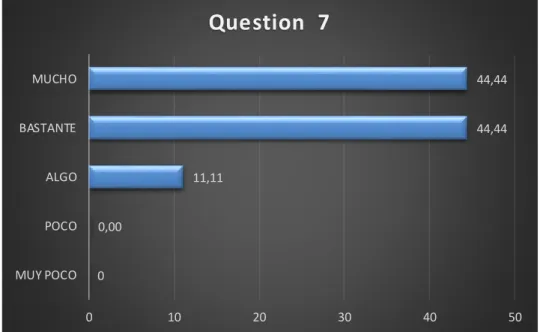
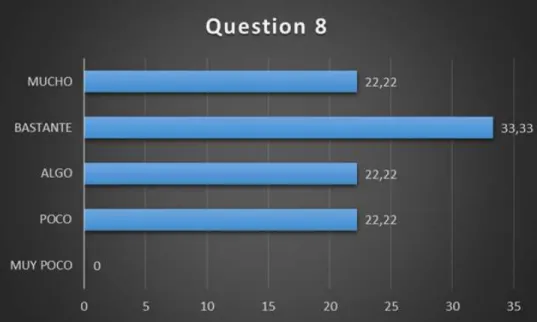
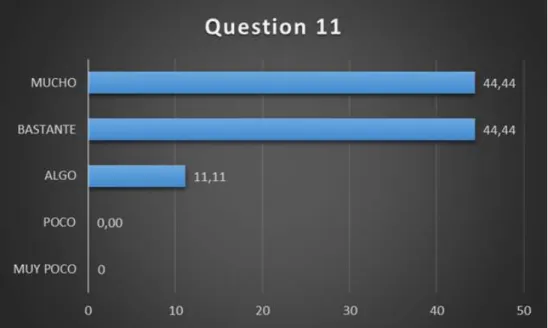
Some questions were asked to check on the students’ satisfaction with the idea of using CSL as a tool to learn English. Here are some of those questions with figures interpreting the results:
Do you think your English vocabulary has improved?
Figure 8. Question 7 0
0,00
11,11
44,44 44,44
0 10 20 30 40 50
MUY POCO POCO ALGO BASTANTE MUCHO
Do you think that the Colombian Sign Language has served to improve your learning of the English language?
Figure 9. Question 8
Do you think the use of Sign Language helps you remember the vocabulary in English?
![Figure 4. Meeting. Adapted from Diccionario Básico De La Lengua De Señas Colombiana [Basic Sign Language Dictionary] (page 392) by INSOR 2006, Bogotá](https://thumb-us.123doks.com/thumbv2/123dok_es/6099438.765506/42.918.161.464.475.677/meeting-adapted-diccionario-básico-colombiana-language-dictionary-bogotá.webp)