Many conditions which threaten mental and physical wellbeing, such as sexually transmitted diseases, traffi c accidents, or behavioral and substance addiction, are caused by risky behavior. However, the tendency to take risks is not unitary, but has diverse dimensions, which, despite being interrelated, diverge in their manifestations (Mischel & Shoda, 1995). The tendency to take risks can differ across life domains - social, fi nancial, etc. – so a person could tend to take risks in some areas and not in others (e.g., practicing unsafe sex, but being conservative in fi nancial investments). From this point of view, research suggests that the attitude towards
risk-taking in decision-making should be considered within a risk-return framework, taking into account the context in which decisions are made (Bell, 1995). Risk-return models assume that risk-taking is the result of the perceived risk and the expected benefi ts of the behavior. The Domain-Specifi c Risk-Taking scale (DOSPERT), developed by Weber, Blais and Betz (2002), fi ts this general model. The scale effectively predicts a range of problematic behaviors, including disordered gambling (Mishra, Lalumière, & Williams, 2010), drug abuse and addiction (Faulkner, 2008), or risky driving behavior (Mizobuchi, Chignell, Canella, & Eizenman, 2013).
The aim of the present study was to adapt the short DOSPERT-30 scale (Blais & Weber, 2006) for the Spanish. This scale has been widely used for measuring the tendency to engage in real-life risk taking behavior. The DOSPERT, unlike other instruments, allows the study of risk propensity in different domains through a single assessment method. Harrison, Young, Butow, Salkeld, and Solomon (2005), in a systematic review, identifi ed the DOSPERT
Spanish validation of the Domain-Speci
fi
c Risk-Taking
(DOSPERT-30) Scale
Luis M. Lozano, Alberto Megías, Andrés Catena, José C. Perales, Sabina Baltruschat and Antonio Cándido
University of GranadaAbstract
Resumen
Background: The aim of the present study was to develop and validate a Spanish version of the short Domain-Specifi c Risk-Taking (DOSPERT-30) scale, measuring risk-taking behavior, risk perception, and expected benefi cial consequences (from taking risks) in fi ve life domains: ethics,
fi nance, health/security, recreational, and social decisions. Method: The scale was back-translated, and administered online to 826 participants. Validity evidence was tested using correlations with construct-related instruments (UPPS-P and SSS-V), as well as using factor analysis. Internal consistency reliability was calculated with the ordinal Alpha coeffi cient, and gender differences were considered. Results: Internal consistency was good, and factor analysis confi rmed the fi ve factors proposed by the authors. With respect to the external validity, high correlations with the positive urgency and the sensation seeking subscales of the UPPS-P, as well as with the thrill and adventure seeking and disinhibition subscales of the SSS-V were found. Finally, gender differences were found in all subscales and domains, with men tending to take more risks, perceive less risk and expect more benefi cial consequences, except for the social domain where an inverse pattern was found. Conclusions: As these fi ndings are in line with the original version, they indicate the scale was successfully adapted.
Keywords: DOSPERT-30 scale; Risk-taking attitude; Risk perception; Expected benefi ts; Questionnaire adaptation.
Validación de la versión española de la escala de toma de riesgos en dominios específi cos (DOSPERT-30).Antecedentes: la escala de toma de riesgos en dominios específi cos (DOSPERT-30) evalúa la propensión a comportamientos de riesgo, la percepción del riesgo y los benefi cios esperados en 5 dominios (ética, fi nanzas, salud/seguridad, recreativo y social). El objetivo del presente estudio fue validar una versión española de esta escala. Método: tras realizar la adaptación mediante una traducción inversa se aplicó el cuestionario a 826 participantes. Se exploró la relación con otros instrumentos (UPPS-P y SSS) y la estructura interna para aportar evidencias de validez. Se calculó el coefi ciente de fi abilidad ordinal para cada dimensión y diferencias de género fueron consideradas. Resultados: se obtuvieron índices adecuados de ajuste a una estructura pentafactorial. Los coefi cientes de fi abilidad para cada dimensión fueron adecuados. Con respecto a las evidencias de validez, se encontró relación con los factores de búsqueda de sensaciones y urgencia positiva (UPPS-P) y con búsqueda de emociones y desinhibición (SSS). Las diferencias de género mostraron que los hombres tomaron más riesgos, percibieron menos riesgo y esperaron más benefi cios en todos los dominios, exceptuando el social, donde la relación fue inversa. Conclusiones: la versión española del DOSPERT-30 presenta buenas propiedades psicométricas y puede considerarse un buen instrumento para el estudio del comportamiento de riesgo.
Palabras clave: escala DOSPERT-30, actitudes toma de riesgo, percepción de riesgo, benefi cios esperados, adaptación de cuestionarios.
Received: April 25, 2016 • Accepted: November 17, 2016 Corresponding author: Alberto Megías
Mind, Brain and Behavior Research Center University of Granada
scale as one of the most effective clinical instruments for assessing health related risk attitudes. This scale could be useful for early detection of risk-prone people, avoiding the consequences of risk taking behaviors (e.g.traffi c accidents) and risk behavior disorders (e.g.pathological gambling disorder). Moreover, it has been used across a wide range of ages (Rolison, Hanoch, Wood, & Liu, 2014), and adapted to several languages (goo.gl/UhmE8C). However, despite its broad impact, to date, there is no published Spanish validation of the DOSPERT-30.
The English DOSPERT-30 scale consists of 3 parallel subscales. Items are common across the three subscales, but differ in how answer choices are worded. In the fi rst scale, risk-taking, the individuals are asked to evaluate how likely they would be to engage in each behavior; in the second one, risk perception, how risky that behavior is considered; and, in the third one, expected benefi ts, the degree to which that behavior would be subjectively perceived as benefi cial. Items refer to different aspects of fi ve life domains: ethics, fi nancial decisions, health and safety, recreational, and social interaction (see Table 1 for more details).
The closeness of risk-taking behavior to impulsivity and sensation seeking (Romer, 2010) suggests that these constructs are useful for verifying external validity of the different subscales and domains of the DOSPERT-30 scale. With this aim in mind, in the present work we used the adapted version of the brief UPPS-P Impulsive Behavior Scale (Cándido, Orduña, Perales, Verdejo-García, & Billieux, 2012) evaluating fi ve dimensions of impulsivity: negative and positive urgency, lack of premeditation, lack of perseverance and sensation seeking. Previous studies have shown that positive urgency is related to pathological gambling and unsafe sex (Cyders et al., 2007), negative urgency to problematic alcohol use, self-harming behaviors and eating disorders (Dir, Karyadi, & Cyders, 2013), and lack of perseverance/premeditation to sexual risk-taking behavior (Simons, Maisto, & Wray, 2010).
Sensation seeking is one of the most thoroughly scrutinized personality traits. This construct is not unidimensional, and most questionnaires for its measurement contain subscales for its several factors. The most frequently used is the Sensation Seeking Scale (SSS) by Zuckerman, Eysenck, & Eysenck (1978). Here, and with the aim of fi nding evidence of external validity of the DOSPERT-30 scale, we chose the SSS-V version validated in Spanish by Pérez and Torrubia (1986).
On the basis of these fi ndings, we expect positive correlations between SSS-V scores and the risk-taking and expected benefi ts DOSPERT-30 subscales, especially in the recreational domain; as well as negative correlations between the SSS-V and the risk perception subscale. Although to date there is no available evidence on the relation between the UPPS-P and DOSPERT-30 scores, the closeness of their respective constructs makes us expect high correlations between scores from these two instruments. Additionally, factor analysis should confi rm the fi ve-domain structure of the three subscales of the questionnaire. In accordance with previous reports on gender differences, we also expect males to be more risk-prone than females (Megías, Cándido, Catena, Molinero, & Maldonado, 2014; Villadangos, Errasti, Amigo, Jolliffe, & García-Cueto, 2016) in all domains, except the social domain (Zou & Scholer, 2016).
The Spanish adaptation and validation of the DOSPERT-30 scale, preserving the psychometric properties of the original version, will allow the prevention and early intervention of risk taking behavior in different contextual domains, such as has been carried out with the English version in the last decade.
Method
Participants
One thousand people responded to the survey. Two hundred and three people were eliminated from the study because they did not respond adequately to control questions or did not complete all parts of the survey. The fi nal sample consisted of eight hundred and twenty-six participants with ages between 17 and 63 (M= 22.67, SD= 6.07), 31% of which were male. The adapted version of the DOSPERT-30 scale, along with the other questionnaires, were uploaded to a University of Granada online platform, implemented in LimeSurvey software (Schmitz, 2012). Participants were informed that confi dentiality and anonymity of the collected data were protected, and they were treated in accordance with the Helsinki declaration and its later amendments (World Medical Association, 2008).
Procedure
The DOSPERT was adapted in accordance with the protocol defi ned by Muñiz, Elosua, & Hambleton (2013). First, the original DOSPERT-30 scale was translated into Spanish by a bilingual translator. Then, the scale was back-translated into English by a second, independent translator. Congruence between the original and the back-translated versions was assessed, and discrepancies were eliminated item-by-item by editing the Spanish version of the scale (Hambleton, 2005; ITC, 2016). The 7-point Likert-type scale used in the original version was maintained for response assessing since this format has the best psychometric properties (Lozano, García-Cueto, & Muñiz, 2008; Muñiz, García-Cueto, & Lozano, 2005).
Instruments
Domain-Specifi c Risk-Taking (DOSPERT-30) scale. We used the Spanish version of the questionnaire resulting from the above adaptation procedure (see Table 1). Six extra questions were interleaved among the items, in order to identify participants not paying enough attention to the task. These items asked participants to answer with a specifi ed response (e.g., “If you are reading this question answer with 3”).
Impulsivity scale UPPS-P (Cándido et al., 2012). The scale consists of 20 4-point Likert-type items. It measures fi ve different dimensions of impulsivity: positive urgency (α= .66), negative urgency (α= .81), lack of premeditation (α= .76), lack of perseveration (α= .80) and sensation seeking (α= .84).
Sensation Seeking Scale SSS-V (Pérez & Torrubia, 1986). The questionnaire consists of 40 items capturing four factors: thrill and adventure seeking (α= .81), experience seeking (α= .67), disinhibition (α= .73), and boredom susceptibility (α= .69). All items are answered dichotomously.
Data analysis
was randomly divided into two subsamples. The fi rst subsample was used to perform a confi rmatory factorial analysis (CFA). The second was used to compute adjustment indexes, after performing respecifi cations depending on the results obtained from the fi rst
subsample. Mplus7.13 (Muthén & Muthén, 2012) was used for this analysis. In the previous analyses the weighted least squares means and variances (WLSMV) estimation method was used. We used this method because it has shown less bias and more accuracy than
Table 1
Spanish version of the DOSPERT-30 scale
(a)Risk-taking
1 2 3 4 5 6 7
Sumamente improbable Moderadamente improbable Algo improbable Incierto Algo probable Moderadamente probable Sumamente probable
(b)Risk perception
Nada arriesgado Ligeramente arriesgado Algo arriesgado Moderadamente arriesgado Arriesgado Muy arriesgado Extremadamente arriesgado
(c)Expected benefi ts
Ningún benefi cio Benefi cios moderados Cuantiosos benefi cios
1. Admitir que tus gustos son diferentes a los de un amigo. (S) [Admitting that your tastes are different from those of a friend] 2. Acampar en un lugar solitario, lejos de la civilización. (R) [Going camping in the wilderness]
3. Apostar un día de salario en las carreras de caballos. (F/J) [Betting a day’s income at the horse races]
4. Invertir el 10% de tu ingreso anual en un fondo de inversión de rentabilidad moderada. (F/I) [Investing 10% of your annual income in a moderate growth mutual fund] 5. Beber 5 o más copas en una sola noche. (S/S) [Drinking heavily at a social function]
6. Defraudar en tu declaración de impuestos. (E) [Taking some questionable deductions on your income tax return]
7. Estar en desacuerdo con una fi gura de autoridad en relación a un asunto importante. (S) [Disagreeing with an authority fi gure on a major issue] 8. Apostar un día de salario en una partida de póker. (F/J) [Betting a day’s income at a high-stake poker game]
9. Serle infi el a tu pareja teniendo relaciones sexuales con otra persona. (E) [Having an affair with a married man/woman] 10. Presentar el trabajo de otra persona como si fuera tuyo. (E) [Passing off somebody else’s work as your own] 11. Esquiar en una pista de difi cultad superior a tu habilidad. (R) [Going down a ski run that is beyond your ability]
12. Invertir el 5% de tu salario anual en un paquete de acciones donde puedes ganar o perder más del 30% de tu inversión. (F/I) [Investing 5% of your annual income in a very speculative stock]
13. Descender los rápidos de un río en una lancha (rafting). (R) [Going whitewater rafting at high water in the spring] 14. Apostar el sueldo de un día en una apuesta deportiva. (F/J) [Betting a day’s income on the outcome of a sporting event] 15. Tener relaciones sexuales sin protección. (S/S) [Engaging in unprotected sex]
16. Revelar un secreto de un amigo a otra persona. (E) [Revealing a friend’s secret to someone else] 17. No utilizar el cinturón de seguridad cuando viajas en coche. (S/S) [Driving a car without wearing a seat belt]
18. Invertir el 10% de tus ingresos anuales en un nuevo negocio. (F/I) [Investing 10% of your annual income in a new business venture] 19. Tomar una clase de paracaidismo. (R) [Taking a skydiving class]
20. Conducir una moto sin usar casco. (S/S) [Riding a motorcycle without a helmet]
21. Elegir una carrera profesional que prefi eres mucho en vez de otra más segura. (S) [Choosing a career that you truly enjoy over a more prestigious one] 22. Defender una opinión impopular en una reunión de trabajo. (S) [Speaking your mind about an unpopular issue in a meeting at work]
23. Tomar el sol sin utilizar crema protectora. (S/S) [Sunbathing without sunscreen]
24. Hacer puenting (Saltar al vació sujetado por una cuerda). (R) [Bungee jumping off a tall bridge] 25. Pilotar una avioneta. (R) [Piloting a small plane]
26. Caminar tú solo por la noche en alguna zona insegura de la ciudad. (S/S) [Walking home alone at night in an unsafe area of town] 27. Mudarte a una ciudad lejos de tu familia. (S) [Moving to a city far away from your extended family]
28. Cambiar de profesión cerca de los cuarenta. (S) [Starting a new career in your mid-thirties]
29. Dejar a tus hijos pequeños solos en casa mientras sales para hacer un recado rápido. (E) [Leaving your young children alone at home while running an errand] 30. No devolver una billetera que encontraste conteniendo 200 euros. (E) [Not returning a wallet you found that contains $200]
Note: The three subscales of the DOSPERT-30 scale were presented with the above shown rating scales and the following instructions: (a) Risk-taking: A continuación se le presenta una serie de actividades. Indique la probabilidad con la que realizaría cada una de ellas. Use la escala de más abajo para indicar la probabilidad de verse implicado en esa actividad (b) Risk perception: La gente frecuentemente ve algún riesgo en situaciones que contienen incertidumbre sobre lo que puede ocurrir y en las que podría existir la posibilidad de sufrir consecuencias negativas. Utilizando la escala que se muestra a continuación indique qué grado de riesgo percibe en las siguientes situaciones (c) Expected benefi ts: Indique los benefi cios que podría obtener en cada una de las siguientes situaciones. Use la escala que se muestra a continuación.
Classifi cation of the domains provided at the end of each item (it is not presented to the participants). E = Ético; F/I = Financiero/Inversión; F/J = Financiero/Juego; S = Social; S/S = Salud/ Seguridad; R = Recreativo.
other methods estimating the factor loadings with ordinal data (Li, 2016). Thereafter, correlations between the different domains of the three subscales of the DOSPERT-30 and the UPPS-P and SSS-V dimensions were computed using correction for attenuation (American Psychological Association, American Educational Research Association, & National Council on Measurement in Education, 2014). Finally, all DOSPERT-30 domains were contrasted across genders using t-tests.
Results
Ordinal reliability coeffi cient
The ordinal Alpha coeffi cient (Elosua & Zumbo, 2008) was employed to calculate reliability of each subscale of the DOSPERT-30 questionnaire (Table 2). 73% of the coeffi cients were larger than .70, which indicates an adequate reliability in this type of questionnaire.
Validity evidence based on internal structure
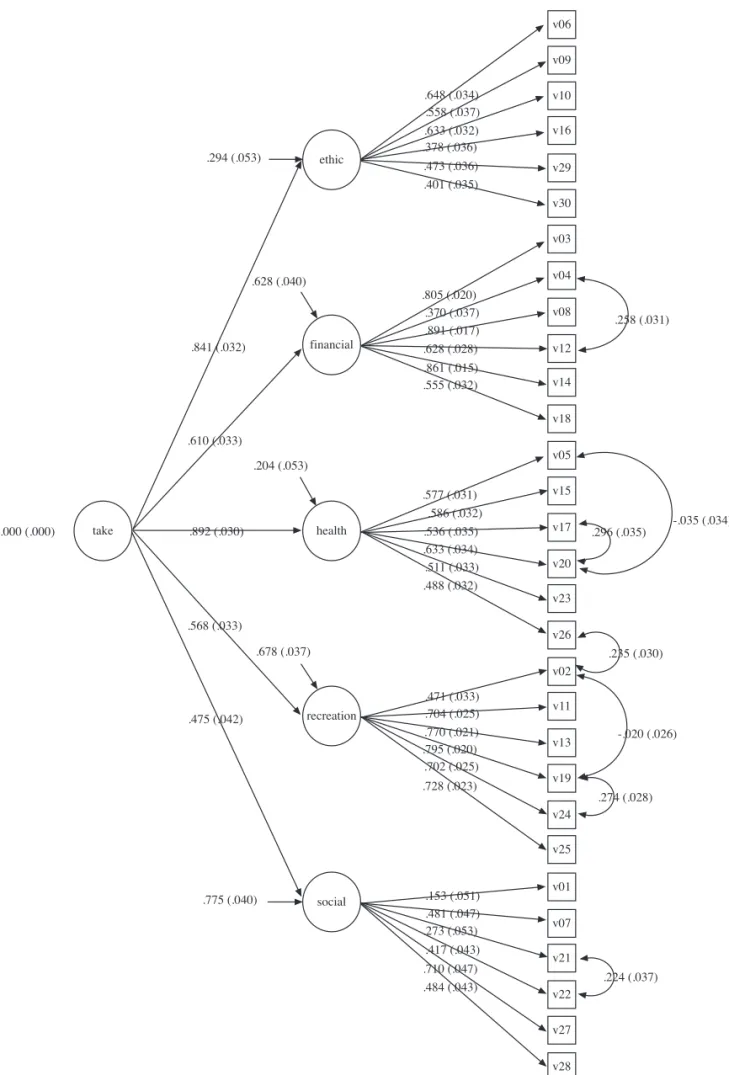
Participants were randomly allocated to one of two subsamples (n1= 411, n2= 415). The fi rst was used to corroborate the factorial structure of the risk-taking subscale proposed by the authors of the DOSPERT-30 scale. Because items are categorical variables (Muthén & Muthén, 2012), the WLSMV estimation method was applied. Seven measurement errors were correlated. The resulting adjustment indexes were statistically signifi cant, χ2(393)= 859.95,
p<.001, RMSEA= .054, 90% CI[.049-.059], Comparative fi t index (CFI)= .93. In this sample, and following the modifi cation indexes, we allowed the correlating of some disturbances (see Figure 1). All the correlated disturbances show that the items are share at least one common omitted cause. The second subsample was used to verify the respecifi cations obtaining the following values:
χ2(393)= 895.32 p<.001, RMSEA= .055, 90% CI[.051, .060], CFI=
.92, which indicate an appropriate fi t (Wang & Wang, 2012). After that, the analyses were repeated with the whole sample to obtain fi t indexes for the total sample (see Figure 1). Good fi t indexes of the model were obtained, χ2(393) = 1397.94, p<.001,
RMSEA= .056, 90% CI[.052-.059], CFI= .92.
The previously described procedure was also applied to the remaining two subscales of the DOSPERT-30 scale, risk perception and expected benefi ts subscales. Fit indexes and respecifi cations of the models are displayed in Table 3.
Evidence of validity based on relationships with other variables
Correlations between the DOSPERT-30 domains for the three subscales and the different dimensions of the UPPS-P and the SSS-V are reported in Table 4. The items of the recreational domain of all risk-subscales show a high correlation with the sensation seeking dimension of the UPPS-P and thrill and adventure seeking dimension of the SSS-V. There are also a high correlations between the disinhibition dimension of the SSS-V and most domains of the risk-scale, especially in the health/ security domain. These fi ndings agree with those obtained with the original version.
Gender differences
Two-tailed Welch t-tests for independent samples yielded signifi cant gender differences in several domains of the three DOSPERT-30 subscales (see Table 5). Men scored higher in all domains of the risk-taking subscale, except in the social domain, where women showed higher scores. In the risk-perception scale, the opposite was observed, women scoring higher in all domains, except in the social domain, where no signifi cant differences were found (CL = 95%). Finally, in the expected benefi ts subscale men scored higher in the fi nancial and health domain, whereas women scored higher in the social domain. For the ethics and recreational domains of the scale no signifi cant differences were
Table 2
Ordinal Alpha reliability coeffi cient of every domain of the three DOSPERT-30 subscales
Subscale Domain Ordinal α
Risk Taking
Ethics Financial Health Recreational Social
.69 .84 .75 .85 .64
Risk perception
Ethics Financial Health Recreational Social
.72 .81 .75 .77 .70
Expected benefi ts
Ethics Financial Health Recreational Social
.66 .89 .78 .87 .69
Table 3
Validity evidence based on internal structure
Subscale Correlations CFI [90%IC]RMSEA
χ2
df p
Risk perception
Item2-Item26 Item4-Item12
Item17-Item20 .903 .060 [.057-.064] 393 1577.27 <.001 Item19-Item24
Item21-Item22
Expected benefi ts
Item1-Item2 Item1-Item7
.943 .050 [.056-.062] 387 1488.71 <.001 Item1-Item10
Item1-Item22 Item2-Item26 Item4-Item12 Item7-Item22 Item8-Item10 Item10-Item14 Item17-Item20 Item19-Item24 Social-Recreational Ethics-Financial
ethic
financial
health
recreation
social
v06
v09
v10
v16
v29
v30
v03
v04
v08
v12
v14
v18
v05
v15
v17
v20
v23
v26
v02
v11
v13
v19
v24
v25
v01
v07
v21
v22
v27
v28 take
.294 (.053)
.628 (.040)
.841 (.032)
.610 (.033)
.204 (.053)
.892 (.030)
.568 (.033)
.678 (.037)
.475 (.042)
.775 (.040)
.648 (.034) .558 (.037) .633 (.032) .378 (.036) .473 (.036) .401 (.035)
.805 (.020) .370 (.037) .891 (.017) .628 (.028) .861 (.015) .555 (.032)
.577 (.031) .586 (.032) .536 (.035) .633 (.034) .511 (.033) .488 (.032)
.471 (.033) .704 (.025) .770 (.021) .795 (.020) .702 (.025) .728 (.023)
.153 (.051) .481 (.047) .273 (.053) .417 (.043) .710 (.047) .484 (.043) 1.000 (.000)
.258 (.031)
-.035 (.034) .296 (.035)
.235 (.030)
-.020 (.026)
.274 (.028)
.224 (.037)
found. Although there is no absolute standard for discriminating between small versus large effects, Cohen’s d are reported (Table 5) as reference points for future studies (Kline, 2005).
Discussion
This study was carried out to validate a Spanish adaptation of the Risk-Taking Domain-Specific scale (DOSPERT-30; Blais & Weber, 2006). Results show that the Spanish version is theoretically consistent with the original, and reaches comparable psychometric standards.
The scale has good internal consistency, as refl ected by ordinal alpha coeffi cients mostly above .70 (between 64-.85 in the
risk-taking subscale, and .70-.89 in the risk perception subscale). These results are similar to those of the original short version, where the reliability coeffi cients ranged between .67-.78 in the risk-taking scale and .66-.84 in risk perception, using the Cronbach’s
α coeffi cient.
The confi rmatory factorial analysis revealed that the model best accounting for participants’ responses is a fi ve-factor model representing different life domains: ethical, fi nancial, health/ security, recreational, and social. These results suggest the same factorial structure reported for the original version of the scale. Therefore, we can corroborate that the adaptation of the questionnaire has been carried out successfully and results from the Spanish version are comparable to results from the original version.
Table 4
Evidence of validity based in relationships with other variables
UPPS SSS
a b c d e TAS ES Dis BS
Risk taking Ethics Financial Health Recreational Social .23/.31 .09/.11 .20/.26 -.02/-.02 -.09/-.13 .33/.49 .22/.29 .37/.52 .14/.19 .00/.00 .21/.29 .23/.29 .36/.48 .68/.85 .25/.36 .24/.33 .16/.20 .28/.36 .17/.21 .03/.04 .24/.32 .15/.18 .22/.28 .09/.11 -.08/-.11 .16/.21 .21/.25 .28/.35 .79/.92 .15/.20 .19/.25 .15/.18 .32/.41 .42/.50 .36/.49 .45/.61 .25/.30 .55/ .71 .36/.44 .19/.27 .28/.40 .20/.26 .25/.34 .14/.18 .09/.13 Risk perception Ethics Financial Health Recreational Social .01/.01 .01/.01 .00/.00 .08/.10 .06/.08 -.07/-.10 -.01/-.01 -.13/-.18 .00/.00 .06/.09 -.15/-.20 -.11/-.14 -.15/-.20 -.37/-.48 -.10/-.14 -.11/-.15 -.10/-.13 -.20/-.26 -.09/-.12 -.02/-.03 -.13/-.17 -.09/-.11 -.14/-.18 -.06/-.07 .09/.12 -.13/-.17 -.11/-.13 -.14/-.17 -.44/-.54 -.06/-.08 -.14/-.18 -.05/-.06 -.13/-.16 -.22/-.28 -.08/-.10 -.33/-.43 -.15/-.19 -.35/-.45 -.24/-.31 -.05/-.07 -.13/-.18 -.09/-.12 -.13/-.18 -.04/-.05 .04/.06
Expected benefi ts
Ethics Financial Health Recreational Social .07/.10 .05/.06 .05/.06 -.06/-.07 -.12/-.16 .19/.29 .16/.21 .17/.24 .09/.12 .02/.03 .17/.24 .21/.26 .18/.23 .52/.64 .21/.29 .11/.15 .14/.17 .19/.24 .10/.12 .00/.00 .18/.24 .14/.16 .21/.26 .07/.08 .01/.01 .12/.16 .18/.21 .14/.17 .57/.66 .13/.17 .17/.23 .11/.13 .21/.26 .39/.46 .34/.45 .36/.50 .21/.25 .38/.48 .25/.30 .11/.15 .15/.22 .14/.18 .13/.17 .07/.09 .02/.03
Note: The table shows the correlation and the corrected correlation. UPPS= Impulsive Behavior Scale; a= Negative Urgency; b= Positive Urgency; c= Sensation Seeking; d= Lack of premeditation; e= Lack of perseverance; SSS= Sensation Seeking Scale; TAS= Trill and adventure seeking; ES= Experience Seeking; Dis= Disinhibition; BS= Susceptibility to Boredom
Table 5
Gender differences calculated with t-test for independent samples
Males Females
t df p d SP M SD M SD
Risk Taking Ethics Financial Health Recreational Social 2.30 4.24 2.42 2.81 2.39 448.73 409.05 824 824 427.94 .02 <.001 .016 .005 .018 0.18 0.35 0.18 0.21 -0.19 .67 .99 .67 .80 .71 16.71 17.50 21.09 26.22 31.11 6.04 6.77 6.51 8.44 5.04 15.69 15.46 19.88 24.40 31.98 5.45 5.44 6.74 8.71 4.30 Risk perception Ethics Financial Health Recreational Social -2.03 -2.49 -4.51 -4.20 1.79 824 824 824 824 824 .043 .013 <.001 <.001 .073 -0.15 -0.19 -0.34 -0.32 0.14 .51 .71 .99 .99 .46 27.60 28.77 30.11 25.04 18.33 5.49 6.07 5.43 5.89 4.91 28.46 29.91 31.89 26.98 17.64 5.74 6.05 5.16 6.26 5.18
Expected benefi ts
Ethics Financial Health Recreational Social 1.52 3.24 3.69 0.95 -3.78 824 437.91 427.87 824 824 .128 .001 <.001 .342 <.001 0.11 0.26 0.29 0.07 -0.28 .31 .93 .97 .15 .96 16.45 21.14 10.67 22.09 23.64 5.07 7.52 3.95 8.12 5.36 15.87 19.37 9.62 21.51 25.15 5.05 6.60 3.37 7.97 5.30
This study also provides new evidence of validity of the DOSPERT-30 in relation to several dimensions of the UPPS-P and SSS-V scales. According to the close relationship between impulsivity and risk-taking (Cyders et al., 2007), these correlations reinforce the DOSPERT scale as a measure of attitude towards risk-taking.
Finally, gender differences observed in the Spanish version are consistent with the original scale (Weber et al., 2002). Men showed a greater tendency to engage in risk-taking behavior and women tended to perceive more risk in all domains, except in the social domain. A potential difference between the original English validation of the DOSPERT and the Spanish one is that, in the English validation, signifi cant gender differences in the social domain were only found in the risk-taking subscale, whereas in the Spanish sample signifi cant differences were observed both in the risk-taking and the expected benefi ts subscales, which suggests certain differences specifi c to the Spanish population. Thus, gender differences should be taken into account when using the DOSPERT scale. In any case, a limitation of this adaptation is that the sample distribution by gender was not uniform (31% were male). Future studies should balance the sample in order to ensure representativity and, moreover, to include additional sociodemographic variables like educational or socioeconomic level.
In summary, the Spanish version of the DOSPERT-30 scale, as adapted for this study, adequately measures risk attitudes in the Spanish population, and presents good reliability and external validity. This instrument can help to complement the assessment
of psychological disorders characterized by alterations in risky behavior. It could also be useful in the prevention of risk-taking behavior, allowing to identify risk-prone people and to implement prevention strategies. This questionnaire provides psychological researchers and professionals of different disciplines with a tool widely used across cultures and countries, which facilitates comparisons and generalization. The scale’s brevity also facilitates its use as an instrument for controlling potential confounding variables in those cases in which the attitude towards risk can modulate the main behavior of interest (e.g. Foster, Shenesey, & Goff, 2009; ). Additionally, its structure, consisting of several domains, facilitates transfer of results when trying predict behavior related to daily-life activities like driving (Mizobuchi et al., 2013), gambling (Mishra et al., 2010), or any others in which risky behavior can cause undesirable effects (Markiewicz & Weber, 2013).
Acknowledgements
Contract grant sponsors Spanish Ministry of Innovation and Science (MICINN) PSI2012-39292 (A. Catena) and PSI2013-45055 (J.C. Perales); Spanish General Directorate of Traffi c (DGT) SPIP2014-01341 (A. Cándido); Postdoctoral Fellowship from Junta de Andalucía (A. Megías); Predoctoral Fellowship from Spanish Ministry of Innovation and Science —PFU— (S. Baltruschat). Finally we want to thank two bachelor students Sofía and Carmen for the development of a pilot study with the scale in paper.
References
American Psychological Association, American Educational Research Association & National Council on Measurement in Education (2014). Standards for educational and psychological testing. Washington, DC: American Educational Research Association.
Balluerka, N., Gorostiaga, A., Alonso-Arbiol, I., & Haranburu, M. (2007). La adaptación de instrumentos de medida de unas culturas a otras: una perspectiva práctica [Test adaptation to other cultures: A practical approach]. Psicothema, 19(1), 124-133.
Bell, D. E. (1995). Risk, return, and utility. Management Science, 41, 23-30.
Blais, A. R., & Weber, E. U. (2006). A domain-specifi c risk-taking (DOSPERT) scale for adult populations. Judgment and Decision Making, 1(1), 33-47.
Cándido, A., Orduña, E., Perales, J. C., Verdejo-García, A., & Billieux, J. (2012). Validation of a short Spanish version of the UPPS-P impulsive behaviour scale. Trastornos Adictivos, 14(3), 73-78.
Cyders, M. A., Smith, G. T., Spillane, N. S., Fischer, S., Annus, A. M., & Peterson, C. (2007). Integration of impulsivity and positive mood to predict risky behavior: Development and validation of a measure of positive urgency. Psychological Assessment, 9, 107-118.
Dir, A. L., Karyadi, K., & Cyders, M. A. (2013). The uniqueness of negative urgency as a common risk factor for self-harm behaviors, alcohol consumption, and eating problems. Addictive Behaviors, 38(5), 2158-2162.
Elosua, P., & Zumbo, B. D. (2008). Coefi cientes de fi abilidad para escalas de respuesta categórica ordenada [Reliability coeffi cients for ordinal response scales.]. Psicothema, 20(4), 896-901.
Faulkner, M. L. (2008). Risk taking behaviors and perceptions as a predictor of college students reactivity to drug related stimuli. Ann Arbor, MI: ProQuest LLC.
Foster, J. D., Shenesey, J. W., & Goff, J. S. (2009). Why do narcissists take more risks? Testing the roles of perceived risks and benefi ts of risky behaviors. Personality and Individual Differences, 47(8), 885-889.
Hambleton, R. K. (2005). Issues, designs and technical guidelines for adapting tests into multiple languages and cultures. In Hambleton, R. K., Merenda, P. F., & Spielberger, S. D. (Eds.), Adapting educational and psychological tests for cross-cultural assessment (pp. 3-38). Mahwah, NJ: Lawrence Erlbaum Associates.
Harrison, J. D., Young, J. M., Butow, P., Salkeld, G., & Solomon, M. J. (2005). Is it worth the risk? A systematic review of instruments that measure risk propensity for use in the health setting. Social Science & Medicine, 60(6), 1385-1396.
ITC [International Test Commission] (2016). The ITC Guidelines for translating and adapting tests (Second edition). Retrieved from www. InTestCom.org.
Kline, R. B. (2005). Beyond signifi cance testing. Washington D.C: American Psychological Association.
Khodarahimi, S. (2014). Sensation-seeking and risk-taking behaviors: A study on young Iranian adults. Applied Research in Quality of Life, 10, 721-734.
Li, C. (2016). Confi rmatory factor analysis with ordinal data: Comparing robust maximum likelihood and diagonally weighted least squares. Behavior Research Methods, 48(3), 936-949.
Lozano, L. M., García-Cueto, E., & Muñiz, J. (2008). Effect of the number of response categories on the reliability and validity of rating scales. Methodology: European Journal of Research Methods for the Behavioral and Social Sciences, 4(2), 73-79.
Megías, A., Cándido, A., Catena, A., Molinero, S., & Maldonado, A. (2014). The passenger effect: Risky driving is a function of the driver-passenger emotional relationship. Applied Cognitive Psychology, 28(2), 254-258.
Mischel, W., & Shoda, Y. (1995). A cognitive-affective system theory of personality: Reconceptualizing situations, dispositions, dynamics, and invariance in personality structure. Psychological Review, 102, 246-268.
Mishra, S., Lalumière, M. L., & Williams, R. J. (2010). Gambling as a form of risk-taking: Individual differences in personality, behavioral preferences for risk, and risk-accepting attitudes. Personality and Individual Differences, 49(6), 616-621.
Mizobuchi, S., Chignell, M., Cannella, D., & Eizenman, M. (2013). Individual Differences in Driving-Related Multitasking. Paper presented at the 3rd International Conference on Driver Distraction and Inattention, Gothenburg, Sweden.
Muñiz, J., Elosua, P., & Hambleton, R. K. (2013). Directrices para la traducción y adaptación de los tests: segunda edición [International Test Commission Guidelines for test translation and adaptation: Second edition]. Psicothema, 25(2), 151-157.
Muñiz, J., García-Cueto, E., & Lozano, L. M. (2005). Item format and the psychometric properties of the Eysenck personality questionnaire. Personality and Individual Differences, 38(1), 61-69.
Muthén, L. K., & Muthén, B. O. (2012). Mplus User’s Guide (7th ed). Los Angeles, CA: Muthén & Muthén.
Pérez, J., & Torrubia, R. (1986). Fiabilidad y validez de la versión española de la escala de búsqueda de sensaciones (Forma V) [Reliability and validity of a Spanish version of the sensation seeking scale (version V)]. Revista Latinoamericana de Psicología, 1, 7-22.
Rolison, J. J., Hanoch, Y., Wood, S., & Liu, P. J. (2014). Risk-taking differences across the adult life span: A question of age and domain.
The Journals of Gerontology. Series B, Psychological Sciences and Social Sciences, 69(6), 870-880.
Romer, D. (2010). Adolescent risk taking, impulsivity, and brain development: Implications for prevention. Developmental Psychobiology, 52(3), 263-276.
Schmitz, C. (2012). LimeSurvey: An open source survey tool. LimeSurvey Project Hamburg, Germany. Retrieved from http://www. limesurvey. org.
Simons, J. S., Maisto, S. A., & Wray, T. B. (2010). Sexual risk taking among young adult dual alcohol and marijuana users. Addictive Behaviors, 35(5), 533-536.
Villadangos, H., Errati, S., Amigo, I., Jollife, D., & García-Cueto, E. (2016). Characteristics of emphaty in young people measured by the Spanish validation of the Basic Empathy Scale. Psicothema, 28, 227-234.
Wang, J., & Wang, X. (2012). Structural equation modeling. Applications using Mplus. Somerset, NJ: John Wiley&Sons.
Weber, E. U., Blais, A. R., & Betz, N. E. (2002). A Domain-Specifi c Risk-Attitude scale: Measuring risk perceptions and risk behaviors. Journal of Behavioral Decision Making, 15, 263-290.
World Medical Association (2008). Declaration of Helsinki: Ethical principles for medical research involving human subjects. Seoul, South Korea: Author.
Zou, X., & Scholer, A. A. (2016). Motivational affordance and risk-taking across decision domains. Personality and Social Psychology Bulletin, 42(3), 275-289.