THE INTERNATIONALISATION OF EMERGING MARKET HIGHER
EDUCATION PROVIDERS: EXPLORING TRANSNATIONAL PROVISION
Eliza Russell
Master in International Business
Department of International Business, School of Management
Universidad EAFIT, Medellin, Colombia
[email protected]
ABSTRACT
The delivery of transnational higher education by emerging market providers is a relatively new phenomenon. While much has been written about mainly British, U.S. and Australian providers delivering higher education programs offshore, this paper explores the transnational delivery of education by two universities from emerging markets: Mexico's Sistema Tecnológico de Monterrey (Tec de Monterrey) and Malaysia's Limkokwing University of Creative Technology. By developing a comprehensive listing of the universities' transnational engagement and motivations, and comparing them to traditional and contemporary firm internationalisation theories, the paper is able to highlight some of the key similarities and differences between the theory and practise in the context of emerging market transnational education providers. The paper finds that, despite the unique character of the sector, the patterns of internationalisation of Sistema Tecnológico de Monterrey and Limkokwing University of Creative Technology are similar to those of firms in other industries. Furthermore, recent theories explaining the internationalisation of developing country multinationals help to understand the speed at which both universities have internationalised and some of the business and non-business advantages gained from delivering programs abroad.
INTRODUCTION
Transitional education (TNE) is defined as ―any teaching or learning activity in which the leaners are in a different country (the host country) to that in which the institution providing the education is based (the home country)‖
(Gate, 1997:1). Since the early 1990s, TNE has been critical in delivering educational services in countries where demand for quality higher education has outstripped supply. While institutions from developed countries deliver the vast majority of TNE, this research aims to explore the emerging trend of developing country institutions providing transnational education. The paper will focus on the characteristics of the Sistema Tecnológico de Monterrey (Tec de Monterrey) and Limkokwing University of Creative Technology (Limkokwing)’s expansion into the TNE space and attempt to identify possible motivations for this expansion in relation to traditional firm internationalisation theory. The paper will use the term transnationalisation in order to distinguish between expansion into transnational delivery of educational programs and internationalisation, which in the context of higher education, can encompass aspects such as international mobility of students and international research collaboration.
Tec de Monterrey currently has seven offshore campuses in Latin America and the United States. Its international presence also includes ten International Linkage Offices in the United States, Europe and Asia; online courses delivered to students in various countries; and alliances with several foreign universities and community-based institutions for TNE delivery. Limkokwing's international presence is also significant, with campuses in Asia, Africa and the United Kingdom, as well as TNE partnerships with several foreign educational institutions.
main research question of this study is as follows: Can existing firm internationalisation theories describe how and why universities from emerging markets provide transnational education? The paper concludes that Tec de
Monterrey and Limkokwing's transnationalisation can partly be explained by current firm internationalisation theories, but that the effects of non-business objectives have also influenced their decisions.
LITERATURE REVIEW
The process of emerging market firm internationalisation has been the topic of much recent research (Cuervo-Cazurra, 2011a, 2011b, 2012; Mathews, 2006; Gaur, Kumar & Singh, 2014; Kumar, Mudambi & Gray, 2013). While some traditional firm internationalisation theories propose a process of incremental
internationalizationbased on risk and psychic distance (the differences between countries that may impact the transfer of information) (Johanson & Wiedersheim-Paul, 1975), or a process owed to the ownership, location and internalisation advantages possessed by a firm (Dunning, 1979), more recent theories seek to explain the growing number of emerging market firms that internationalise and the way they do so.
In 1975, Johanson and Wiedersheim-Paul proposed that firms choose a mode of operation in a host country that limits the perceived risk. This idea was endorsed by Johanson and Valhne in 1977. The authors propose that due to risk, the incremental internationalisation process begins with exports, before sales subsidiaries and eventually production subsidiaries are established abroad. As sales subsidiaries are set up, psychic distance becomes less important, and market size becomes more important.
Johanson and Vahlne revisit the incremental internationalisation model in 2009. In their updated version of the incremental internationalisation model, their focus is on ―insidership‖, rather than psychic distance. They
highlight the importance of business networks through which trust and knowledge have been obtained. The knowledge gained through these relationships can help a firm to identify and develop new opportunities.
Internationalisation is seen as a way to strengthen a firm’s position rather than to overcome barriers and is usually pursued within a firm’s own networks. This model, as well as other network-based theories (Elo 2005; Fletcher 2008; Johanson & Mattsson, 1988), acknowledges the changes to the global business environment and market structure that have taken place since Wiedersheim-Paul’s 1975 model. Additionally, theories relating specifically to the internationalisation of service firms support the notion that the use of external networks can help service firms to internationalise (Capar & Kotabe, 2003; Castell, 1996; Murray & Kotabe, 1999).
Mathews (2006) also addresses the importance of relationships and networks to firm internationalisation, specifically addressing the recent rise of Asian multinationals. His linkage, leverage, learning (LLL) framework suggests that developing country multinational companies (DMNCs) use a process of linkages (acquiring advantages externally, via outward orientation and strategic asset access), leverage (connecting to partners to obtain resources and using networks), and learning (upgrading via repetition and improvement). For these reasons, Mathews (2006) emphasises the speed at which DMNCs internationalise. Similarly, Cuervo-Cazurra (2011a, 2011b, 2012) describes the advantages DMNCs possess, highlighting their superior ability to deal with problematic social and political systems, poor infrastructure and governance. This enables them to enter and dominate in other countries with similar conditions, as well as in countries where these problems do not exist. He also asserts that unlike Johanson and Wiedersheim-Paul incremental model (1975), DMNCs have the choice between expanding into countries with low psychic distance but low market attractiveness or alternatively, into advanced economies with high market attractiveness but high psychic distance. Furthermore, Cuervo-Cazurra (2012) argues that some DMNCs follow non-business objectives as a result of the differences in the desires of their owners.
power‖ through the ―selling‖ of national culture, citing the Chinese Confucius Institutes as an example (p.64). Gacel (2000) notes that as well as economic incentives, many institutions are motivated by knowledge-sharing, curriculum development and the goal of international accreditation, which brings prestige and international recognition. Similarly, Huang (2007) highlights the significance of cultural connections in the choice of host country when an educational institution invests internationally. Huang (2007) highlights that in the case of
Chinese institutions, their transnational activities have mainly taken place in countries with large Chinese diaspora or with significant historical ties. Other research (Didou Aupetit & Jokivirta, 2007; Naidoo, 2009) also links the choice of host country by transnational providers to home country diaspora communities.
Having reviewed the literature, this paper proposes to study the characteristics of Tec de Monterrey and
Limkokwing´s transnationalisation process and how we can relate firm internationalisation theories to these cases.
RESEARCH METHODOLOGY
This research is a qualitative, descriptive cross-case study investigating the transnationalisation process of Tec de Monterrey and Limkokwing within the framework of existing firm internationalisation theory. The case study, as characterised by Reddy and Agrawal (2012), draws data from available secondary, non-copyrighted and
copyrighted sources. The data for this research has been drawn from various Tec de Monterrey and Limkokwing webpages, industry magazines, the media and academic journals. The advantage of sourcing data from various published sources is it results in the triangulation of evidence, which provides ―stronger substantiation of constructs and hypotheses‖ (Eisenhardt, 1989, p.538). However, the limited availability and accuracy of the
information gathered from these sources cannot always be assured. Tec de Monterrey and Limkokwing were chosen because of the relative availability of data and because these cases are likely to extend emergent theory, an important aspect of the case study (Eisenhardt, 1989).
The data collected relates to Tec de Monterrey and Limkokwing’s corporate profile and transnationalisation. The internationalisation theories with which the data will be compared have been chosen because they offer a broad perspective on the motivations behind internationalisation of the firm, in both a global and developing country context. According to Eisenhardt (1989), choosing a diverse range of theories can lead to conflicting results and ―a more creative, frame-breaking mode of thinking‖ (p.544) that may result in deeper insights.
The descriptive approach chosen, described by Yin (2014) as a complete description of a single phenomenon within its context and with the intention of developing and explaining empirical generalisations, will allow observations to be summarised and compared to existing theories.
FINDINGS
The emergence of the transnational education industry took place in the 1990s, as international trade agreements and deregulation allowed higher education providers to ―offshore‖ their educational programs by outsourcing to a foreign partner or setting up a branch campus themselves (McBurnie & Ziguras, 2007). The industry continues to grow, particularly in the UK, USA and Australia, where transnational education forms an increasingly important part of universities’ internationalisation strategies (HM Government Department for Business, Innovation and Skills, 2013; Skidmore & Longbottom, 2011). In Mexico, the industry is still relatively small, both in terms of Mexico as host and home country (Didou Aupetit & Jokivirta, 2007). Conversely, Malaysia is the world’s second largest host of foreign transnational education providers in terms of revenue (OBHE, 2012). However the
provision of offshore education by Malaysian universities in foreign markets is far less common (Naidoo, 2009).
Sistema Tecnológico de Monterrey
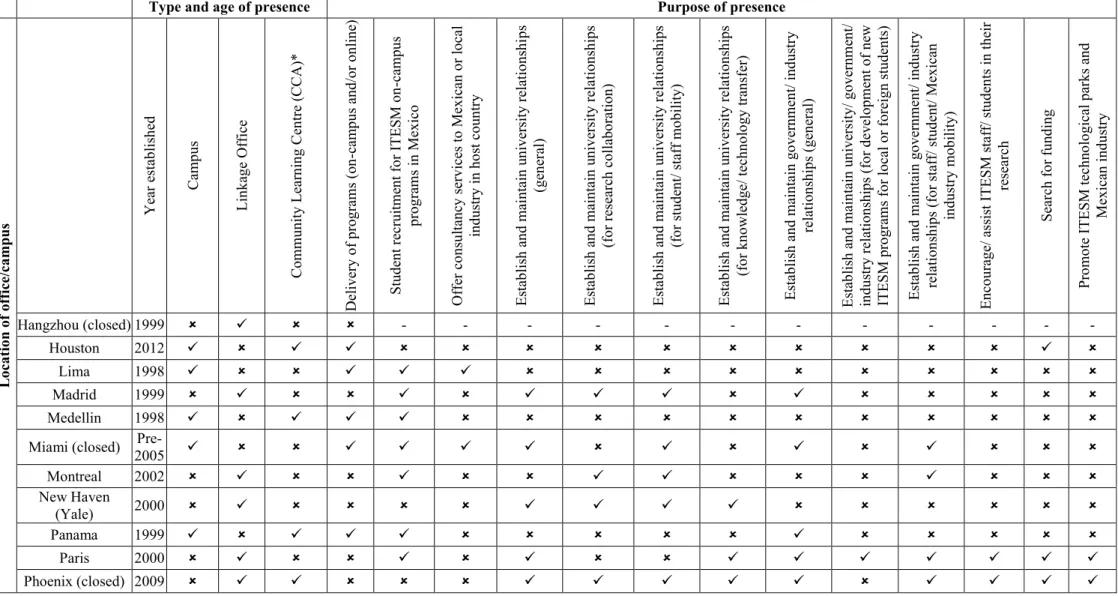
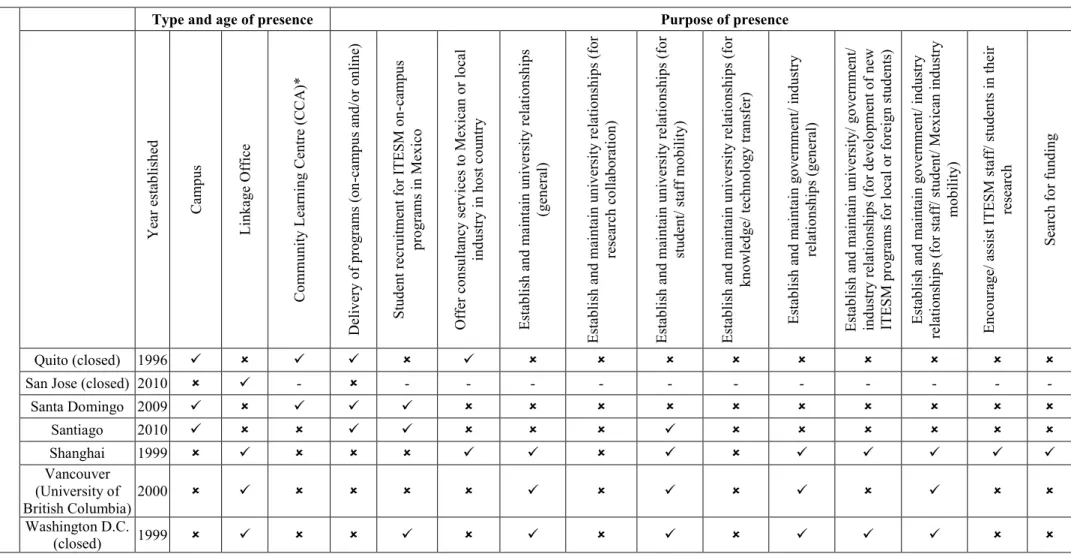
Universidad TecVirtual and TecSalud. Together, they offer a range of educational programs, in both on-campus and online modes (See Table 1). Tec de Monterrey is the largest private university and largest provider of online education in Latin America (Ensinck, 2009). It currently has 350 international agreements, which include student and staff mobility, research collaboration and transnational education (Instituto Tecnológico y de Estudios Superiores de Monterrey, 2012), and operates seven offshore campuses in Latin America and the United States, which offer academic, professional development and executive education programs (Sistema Tecnológico de Monterrey, 2012). It also provides programs via alliances in 197 Community Learning Centres in Latin America and the United States, which offer basic and further education to students in disadvantaged communities (Ortiz, 2011). Additionally, it operates ten International Linkage Offices in Latin America, the United States, Europe and
A
sia, which do not offer TNE programs but serve various other purposes. Table 2 details ITESM’s offshore operations and the stated reasons for their existence. Although Tec de Monterrey has engaged internationally since its establishment, it was not until 1996 that it launched transnational operations, with its first internationalcampuses in Ecuador (Sistema Tecnológico de Monterrey, 2012). The year before the Ecuador campus was opened, the university released its Mission 2005, which stated that:
Developing countries need to enter the world of science and technology, offer their services and products in transnational markets and implement comprehensive strategies to increase their level of competence. New technologies also encourage new perspectives to allow access to the highest level of science and technology. (Tec de Monterrey, n.d., own translation)
The mission also stated its intention to incorporate technology-based learning into its curriculum in order to strengthen its reputation and become internationally coemptive. To achieve this, Tec de Monterrey proposed the development of a virtual university, a portal that could deliver online courses internationally and might support its desire to gain international recognition. TecVirtual was set up in 1997 (Sistema Tecnológico de Monterrey, 2013b), followed by the establishment of a further international campus in Panama and the first of its International Linkage Offices in the United States, China and Spain in 1999 and France and Canada the following year
(Sistema Tecnológico de Monterrey, 2012). While the International Linkage Offices did not offer programs themselves, they were and continue to be part of a broader internationalisation strategy to support international industry and university engagement, research collaboration, student and staff mobility and in some cases, to recruit students or to seek investment and funding.
In 2001, in alliance with various government, industry, university and social organisations, Tec de Monterrey began establishing the first of its Community Learning Centres in Mexico, before several were established in the United States, Guatemala, Colombia, Panama, Paraguay, Dominican Republic and Ecuador. The centres are operated by local institutions which, by signing a Memorandum of Understanding and paying a membership fee, purchase the license to offer Tec de Monterrey’s online educational products to students for free. Operators also have access to Tec de Monterrey’s operating manuals and support and training for staff (Universidad TecVirtual del Sistema Tecnológico de Monterrey, 2012).
Tec de Monterrey continues to offer transnational education programs through its offshore campuses. Just over 2 per cent of all Tec de Monterrey students who are currently enrolled in face-to-face programs are enrolled offshore (Instituto Tecnológico y de Estudios Superiores de Monterrey, 2012). Tec de Monterrey also offers various dual degree programs through its international university partners, which also constitute transnational delivery.
Limkokwing University of Creative Technology
Limkokwing Institute of Creative Technology was established in 1991 in Kuala Lumpur, Malaysia, by design, media and public relations entrepreneur Lim Kok Wing with the objective of providing creative education and skilled graduates to a country recovering from the 1980s recession (Limkokwing University of Creative
Technology, 2014b). In 2003, the institute was granted university status by the Malaysia’s Qualifications Agency, becoming Limkokwing University of Creative Technology. Its main campus in Cyberjaya was opened the
Table 1
Sistema Tecnológico de Monterrey and Limkokwing University of Creative Technology 2013 Operational Overview
Sistema Tecnológico de Monterrey Limkokwing University of Creative Technology
Home country Mexico Malaysia
Ownership Enseñanza e Investigación Superior, A.C. Limkokwing Integrated Group
Number of domestic campuses
31 (Tecnológico de Monterrey)
33 (TecMilenio) 3
Current countries of
operation
Canada Botswana
Chile Cambodia
China China
Colombia Indonesia
Dominican Republic Lesotho
France Malaysia
Mexico Sierra Leone
Panama Swaziland
Peru United Kingdom
Spain Yemen
Switzerland United State of America Foreign entry
modes Exports: International students in Mexico, TecVirtual Exports: International students in Malaysia
Contractual agreements: Dual degrees, Community Leaning Centres, some Linkage
Offices
Contractual agreements: Duel degrees, franchising
Wholly-owned subsidiaries: Foreign campuses,
some Linkage Offices Wholly-owned subsidiaries: Foreign campuses
Current modes of operation
Mode 1 — Cross border trade:
Dual degrees, TecVirtual Mode 1 — Cross border trade: Duel degrees, franchising Mode 2 — Consumption abroad:
International students in Mexico International students in Malaysia Mode 2 — Consumption abroad: Mode 3 — Commercial presence:
Foreign campuses, Linkage Offices, Community Leaning Centres
Mode 3 — Commercial presence: Foreign campuses Mode 4 — Presence of natural persons:
Foreign campuses with Mexican staff Mode 4 — Presence of natural persons: Foreign campuses with Malaysian staff Total number of
students 98,935 30,000
Program levels High school, Diplomas, Professional Diplomas, Degrees, Postgraduates, executive education,
languages
High school, pre-university Foundation course, Diplomas, Professional Diplomas, Degrees and
Postgraduates, languages
Areas of study
Agriculture; architecture; art; business and management; communications; design; health;
humanities and social sciences; information technology; law; science, engineering
Architecture; art; design; fashion; business and management; media and communications; engineering; information technology; multimedia;
sound and music Note. Foreign entry modes as defined by the World Trade Organisation (2013)
Table 2
Sistema Tecnológico de Monterrey Offshore Operations
Lo ca tio n o f o ffice/c amp us
Type and age of presence Purpose of presence
Yea r estab lis hed Ca mpus Lin kag e Of fice Co m m un ity L ea rn in g Cen tre (C CA) * Deliv er y of p ro gr am s ( on -ca m pu s an d/o r on lin e) Stu den t r ec ru itm en t f or IT ES M on -ca m pu s pr og ra m s in Me xico Of fer co ns ultan cy ser vices to Me xican o r l oca l in du str y in h os t c ou ntr y Es tab lis h an d m ain tain u niv er sity relatio ns hip s (g en er al) Es tab lis h an d m ain tain u niv er sity relatio ns hip s (fo r r esear ch co llab or atio n) Es tab lis h an d m ain tain u niv er sity relatio ns hip s (fo r s tu de nt/ st af f m ob ilit y) Es tab lis h an d m ain tain u niv er sity relatio ns hip s (fo r k no wled ge/ tech no lo gy tr an sf er ) Es tab lis h an d m ain tain g ov er nm en t/ in du str y relatio ns hip s ( gen er al ) Es tab lis h an d m ain tain u niv er sity / g ov er nm en t/ in du str y relatio ns hi ps (f or d ev elo pm en t o f n ew IT ESM pr og ram s f or lo ca l o r f or eig n stu den ts) Es tab lis h an d m ain tain g ov er nm en t/ in du str y relatio ns hip s ( fo r s taf f/ stu den t/ M ex ican in du str y m ob ilit y) En co ur ag e/ ass ist I TE SM staf f/ stu den ts in th eir resear ch Sear ch fo r f un din g Pro m ote IT ESM tech no lo gical p ar ks an d Me xican in du str y
Barcelona 2003
Beijing (closed) 2004
Bogotá 1998
Boston 1999
Bratislava (closed) 2004 - - - - - - - -
Brussels (closed) 2005
Buenos Aires
(closed) 2009
Dallas 2002
Fribourg 2005
Guayaquil (closed) 1998
Table 2 continued
Type and age of presence Purpose of presence
Lo ca tio n o f o ffice/c amp us Yea r estab lis hed Cam pu s Lin kag e Of fice Co m m un ity L ea rn in g Cen tre (C CA) * Deliv er y of p ro gr am s ( on -ca m pu s an d/o r o nlin e) Stu den t r ec ru itm en t f or IT ES M on -ca m pu s pr og ra m s in Me xico Of fer co ns ultan cy ser vices to Me xican o r l oca l in du str y in h os t c ou ntr y Es tab lis h an d m ain tain u niv er sity relatio ns hi ps (g en er al) Es tab lis h an d m ain tain u niv er sity relatio ns hip s (fo r r esear ch co llab or atio n) Es tab lis h an d m ain tain u niv er sity relatio ns hip s (fo r s tu de nt/ st af f m ob ilit y) Es tab lis h an d m ain tain u niv er sity relatio ns hip s (fo r k no wled ge/ tech no lo gy tr an sf er ) Es tab lis h an d m ain tain g ov er nm en t/ in du str y relatio ns hip s ( gen er al ) Es tab lis h an d m ain tain u niv er sity / g ov er nm en t/ in du str y relatio ns hi ps (f or d ev elo pm en t o f n ew IT ESM pr og ram s f or lo ca l o r f or eig n stu den ts) Es tab lis h an d m ain tain g ov er nm en t/ in du str y relatio ns hip s ( fo r s taf f/ stu den t/ M ex ican in du str y m ob ilit y) En co ur ag e/ ass ist I TE SM staf f/ stu den ts in th eir resear ch Sear ch fo r f un din g Pro m ote IT ESM tech no lo gical p ar ks an d Me xican in du str y
Hangzhou (closed) 1999 - - - -
Houston 2012
Lima 1998
Madrid 1999
Medellin 1998
Miami (closed) Pre-2005
Montreal 2002
New Haven
(Yale) 2000
Panama 1999
Paris 2000
Phoenix (closed) 2009
Table 2 continued
Type and age of presence Purpose of presence
Yea r estab lis hed Cam pu s Lin kag e Of fice Co m m un ity L ea rn in g Cen tre (C CA) * Deliv er y of p ro gr am s ( on -ca m pu s an d/o r o nlin e) Stu den t r ec ru itm en t f or IT ES M on -ca m pu s pr og ra m s in Me xico Of fer co ns ultan cy ser vices to Me xican o r l oca l in du str y in h os t c ou ntr y Es tab lis h an d m ain tain u niv er sity relatio ns hip s (g en er al) Es tab lis h an d m ain tain u niv er sity relatio ns hip s ( fo r resear ch co llab or atio n) Es tab lis h an d m ain tain u niv er sity relatio ns hip s ( fo r stu den t/ st af f m ob ilit y) Es tab lis h an d m ain tain u niv er sity relatio ns hip s ( fo r kn owled ge/ tec hn olo gy tr an sf er ) Es tab lis h an d m ain tain g ov er nm en t/ in du str y relatio ns hip s ( gen er al ) Es tab lis h an d m ain tain u niv er sity / g ov er nm en t/ in du str y relatio ns hi ps (f or d ev elo pm en t o f n ew IT ESM pr og ram s f or lo ca l o r f or eig n stu den ts) Es tab lis h an d m ain tain g ov er nm en t/ in du str y relatio ns hip s ( fo r s taf f/ stu den t/ M ex ican in du str y m ob ilit y) En co ur ag e/ ass ist I TE SM staf f/ stu den ts in th eir resear ch Sear ch fo r f un din g Pro m ote IT ESM tech no lo gical p ar ks an d Me xican in du str y
Quito (closed) 1996
San Jose (closed) 2010 - - - - -
Santa Domingo 2009
Santiago 2010
Shanghai 1999
Vancouver (University of
British Columbia) 2000
Washington D.C.
(closed) 1999
Note. 142 Community Learning Centres also operating in various parts of the USA and 25 in Latin America (Guatemala, Colombia, Panamá, Paraguay, Dominican Republic and Ecuador) since 2001
Creative Technology, 2008b). Founder, Lim Kok Wing, remains president of the group.
Domestically, Limkokwing is accredited by the Malaysian Qualifications Agency and offers a range of course levels and study areas (See Table 1) at its three Malaysian campuses. The first phase of Limkokwing’s internationalisation began following the arrival of foreign transnational providers in Malaysia. Through a franchising agreement with Australia’s Curtin University, Limkokwing began offering entire degrees to local students, awarded by Curtin. These degrees were an attractive offer particularly to foreign students in Malaysia, who could gain an Australian qualification at a lower cost than studying in Australia. Limkokwing
―aggressively‖ (Limkokwing University of Creative Technology, 2013, p.17) marketed these programs
overseasand began to recruit students from around the world. By the year 2000, around 25 per cent of its student population at its main campus was international, reaching 50 per cent in 2005, 65 per cent in 2009 and 80 per cent in 2012 (Limkokwing University of Creative Technology, 2013).
Meanwhile, Limkokwing also began establishing offshore operations, first in neighbouring Indonesia and China in partnership with local institutions, and in the United Kingdom and Botswana, the latter of which was
launched in partnership with the Motswana government (Maramwidze, 2013). Possibly through his political connections gained while working with future Malaysian Prime Minister Abdullah Ahmad Badawi and future Malaysian Education Minister Haji Shafie Haji Mohd Salleh in the 1980s, and while working in South Africa on Nelson Mandela’s presidential campaign (Lim, 2004), Lim Kok Wing was also able to meet and sign
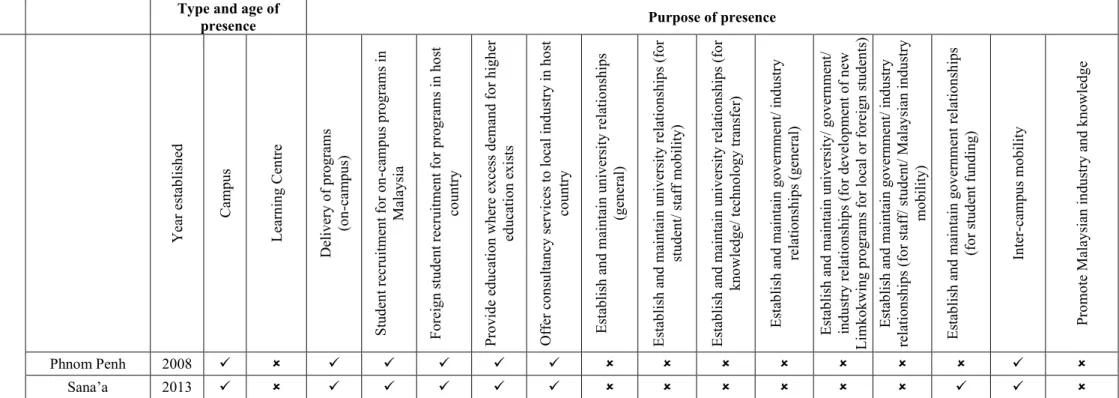
agreements with other foreign governments. The Lesotho and Cambodian campus were soon established, with the Lesotho Government funding scholarships and providing some campus infrastructure (Mosisili, 2008). This was followed by a campus in Swaziland, and more recently in Sierra Leone and Yemen. The reasons
Limkokwing presents for establishing in each foreign market are identified in Table 3.
Limkokwing now has agreements with 282 universities in 77 countries (Limkokwing University of Creative Technology, 2014a), as well as 9 foreign branch campuses and articulation and franchise arrangements with foreign institutions and industry groups. It also offers consultancy services to industry and government both domestically and internationally.
DISCUSSION
Several firm internationalisation theories can help explain both Tec de Monterrey and Limkokwing
internationalisation. Firstly, Tec de Monterrey’s initial stages of internationalisation correspond with Johanson and Wiedersheim-Paul’s (1975) incremental internationalization model, in that, the university’s national expansion and the external demands from government and industry to internationalise led to an increase in mobility of its staff and students internationally and to international research collaboration. Tec de Monterrey’s international university partners helped it gain international recognition before establishing its sales subsidiaries (campuses) abroad. In order to reduce risk and limit language barriers, Tec de Monterrey chose Ecuador as the market for its first campus, a market with close psychic distance to Mexico and with a similar need for the provision of education. The following campuses established in Colombia, Peru and Panama served a similar purpose and support Huang’s (2007) claim that cultural similarity plays a role in a university’s country selection for transnational delivery. The subsequent resource commitment Tec de Monterrey made in the form of
campuses in the United States, where the number of consumers able to purchase education may have been greater than in Latin America, also follows the incremental internationalisation model.
Table 3
Limkokwing University Offshore Operations
Lo ca tio n o f o ffice/c amp us
Type and age of
presence Purpose of presence
Yea r estab lis hed Cam pu s Lea rn in g Cen tre Deliv er y of p ro gr am s (o n-ca m pu s) Stu den t r ec ru itm en t f or on -ca m pu s p ro gr am s in Ma lay sia Fo reig n stu den t r ec ru itm en t f or p ro gr am s in h os t co un try Pro vid e ed uca tio n wh er e ex ce ss d em an d fo r h ig he r ed uca tio n ex ists Of fer co ns ultan cy ser vices to lo ca l in du str y in h os t co un try Es tab lis h an d m ain tain u niv er sity relatio ns hip s (g en er al) Es tab lis h an d m ain tain u niv er sity relatio ns hip s ( fo r stu den t/ st af f m ob ilit y) Es tab lis h an d m ain tain u niv er sity relatio ns hip s ( fo r kn owled ge/ tec hn olo gy tr an sf er ) Es tab lis h an d m ain tain g ov er nm en t/ in du str y relatio ns hip s ( gen er al ) Es tab lis h an d m ain tain u niv er sity / g ov er nm en t/ in du str y relatio ns hi ps (f or d ev elo pm en t o f n ew Lim ko kwin g pr og ram s f or lo cal or fo reig n stu de nts ) Es tab lis h an d m ain tain g ov er nm en t/ in du str y relatio ns hip s ( fo r s taf f/ stu den t/ M alay sian in du str y m ob ilit y) Es tab lis h an d m ain tain g ov er nm en t r elatio ns hip s (fo r s tu de nt f un din g) In ter -ca m pu s m ob ilit y Pro m ote Ma lay sian in du str y an d kn owled ge
Beijing 2007
Denpasar (closed) 2008
Gaborone 2007
Jakarta 1997
2007
London 2007
Maseru 2008
Mbabane 2011
Table 3 continued
Type and age of
presence Purpose of presence
Yea r estab lis hed Cam pu s Lea rn in g Cen tre Deliv er y of p ro gr am s (o n-ca m pu s) Stu den t r ec ru itm en t f or o n-ca m pu s p ro gr am s in Ma lay sia Fo reig n stu den t r ec ru itm en t f or p ro gr am s in h os t co un try Pro vid e ed uca tio n wh er e ex ce ss d em an d fo r h ig he r ed uca tio n ex ists Of fer co ns ultan cy ser vices to lo ca l in du str y in h os t co un try Es tab lis h an d m ain tain u niv er sity relatio ns hip s (g en er al) Es tab lis h an d m ain tain u niv er sity relatio ns hip s ( fo r stu den t/ st af f m ob ilit y) Es tab lis h an d m ain tain u niv er sity relatio ns hip s ( fo r kn owled ge/ tec hn olo gy tr an sf er ) Es tab lis h an d m ain tain g ov er nm en t/ in du str y relatio ns hip s ( gen er al ) Es tab lis h an d m ain tain u niv er sity / g ov er nm en t/ in du str y relatio ns hi ps (f or d ev elo pm en t o f n ew Lim ko kwin g pr og ram s f or lo cal or fo reig n stu de nts ) Es tab lis h an d m ain tain g ov er nm en t/ in du str y relatio ns hip s ( fo r s taf f/ stu den t/ M alay sian in du str y m ob ilit y) Es tab lis h an d m ain tain g ov er nm en t r elatio ns hip s (fo r s tu de nt f un din g) In ter -ca m pu s m ob ilit y Pro m ote Ma lay sian in du str y an d kn owled ge
Phnom Penh 2008
Sana’a 2013
universities in the locations in which they were establishing, particularly in the areas of internationalisation and online learning. This was both beneficial to its international business and its business back home.
In the case of Limkokwing, Johanson and Wiedersheim-Paul’s (1975) model is less relevant. Limkokwing's transnationalisation process has been faster and seemly more sporadic that Johanson and Wiedersheim-Paul (1975) would have predicted. While choice of host country may have been linked to its cultural similarities with China, Indonesia and Yemen or colonial and linguistic ties with the United ingdom and the former British colonies of Botswana, Swaziland, Lesotho and Sierra Leone, the choice to open campuses in Africa at the beginning of Limkokwing's transnationalisation process cannot be explained solely by psychic distance nor by risk avoidance. For example, the establishment of an extensive campus delivering on-site programs in Botswana in 2007 was a substantial investment of resources and significant commitment in a country with only one other university and limited human talent for operation. Despite a shared British colonial history, significant cultural differences remain. The risk that Limkokwing took was great and contradicts the fundamentals of the stage approach offered by Johanson and Wiedersheim-Paul (1975). However, founder Lim Kok Wing's professional experience and political connections in South Africa facilitated access to the government-regulated higher
education systems of Botswana, Swaziland, Lesotho and Sierra Leone and largely reinforces Johanson & Vahlne's model (2009). "Working closely with African governments" (Limkokwing University of Creative Technology, 2008a), Lim Kok Wing used his political "insidership" (Johanson & Vahlne, 2009) to gain local accreditation and establish agreements that would provide government-funded scholarships to students.
Mathews' LLL theory (2006) can also be applied to some extent to Tec de Monterrey and Limkokwing's
transnationalisation. Tec de Monterrey’s linkages with international university partners and industry allowed it to gain the knowledge to operate more effectively offshore and use its networks to further its objectives. While Tec de Monterrey has not acquired foreign firms, its international relationships and ability to partner with local intuitions, particularly in the case of its Community Learning Centre alliances and dual degrees with US
universities, have allowed it to acquire advantages externally. It has also leveraged relationships with the diaspora community, including local Tec de Monterrey alumni and industry networks, to gain access to opportunities for staff and student internships and mobility, research funding and the opportunity to promote its programs. This supports research into the link between university internationalisation and diaspora communities (Huang, 2007; Didou Aupetit & Jokivirta, 2007; Naidoo, 2009). By gradually opening more International Linkage Offices and partnering with local institutions in locations not necessarily geographically or culturally close, but rather strategically important, Tec de Monterrey’s process of internationalisation has been relatively quick.
Limkokwing’s transnationalisation has also benefited and progressed rapidly due to its linkages with foreign governments, its ability to leverage resources provided by these relationships and to learn from experience in order to replicate its transnational model in other countries. Through government relationships, Limkokwing gained access to market and non-market resources such as government-funded scholarship revenue and local knowledge in Botswana. The incremental establishment of campuses in other African countries demonstrates Limkokwing's ability to continue to establish new government relationships and use experience gained to enter new markets. According to the university:
Both Lesotho and Swaziland provided the opportunity for Limkokwing University to put into practice all that it had learned in Botswana. In setting up the Botswana campus the Limkokwing University used a corps of Malaysians to provide the directions for its Batswana staff and faculty to understand campus development, its operations and its management. The Lesotho and Swaziland campuses was first managed predominantly by Batswana staff and faculty trained by Malaysians and in time academics and staff from within both these countries have begun to take over many of the roles. (Limkokwing University of Creative Technology, 2013)
In Cambodia and Yemen, the links with government were also important. The Phnom Penh campus was opened after "strong encouragement" from the Cambodian Government, who were willing to fast track highway
Creative Technology is coming to Yemen‖, 2013) and, having already established ties with the university through scholarship arrangement for Yemeni students in Malaysia (Mogale, 2014), were willing to facilitate
Limkokwing’s establishment in Sana’a (―Malaysia to set up‖, 2009). In the UK, China and Indonesia however, it seems governments did not play a role in aiding Limkokwing’s establishment. In fact, Limkokwing claims that restrictive government policies surrounding the provision of transnational education in China have hindered its operations (Limkokwing University of Creative Technology, 2013).
In the UK, dual degree relationships with the local universities Anglia Ruskin University and University of Bedfordshire, rather than with governments, may have helped Limkokwing gain access to and leverage local regulatory knowledge. Limkokwing’s campus in the United Kingdom now hosts many students from developing countries, at times allowing Limkokwing to form relationships with governments of those countries.
Limkokwing’s ability to leverage these foreign government relationship can be seen in the recent signing of a Memorandum of Understanding with the Mongolian government. Limkokwing has agreed to sponsor a number of Mongolian students to study at its campus in the United Kingdom in return for the Mongolian Government’s promise ―to facilitate in establishing collaborative relationships with suitable educational partners in Mongolia so that Limkokwing University programmes can be offered and its expertise made available to Mongolian
institutions‖ (Khairuddin, 2014).
In addition to Mathews' (2006) LLL framework, Cuervo-Cazurra’s (2011a, 2011b, 2012) theories assist in
explaining the reason Tec de Monterrey and Limkokwing have succeeded in locations with similar social, political and economic systems as its own, as well as in the United States or United Kingdom, where the universities may not face the social, political and economic challenges faced in developing countries. In the case of Tec de
Monterrey, it is worth noting that its transnational education programs largely target Latin American consumers. In this sense, the relationships between psychic distance and market attractiveness is not so clear cut. The U.S. market, theoretically highly attractive due to high consumer incomes but with high psychic distance from Mexico, is not necessarily dissimilar to Mexico, given Tec de Monterrey's consumers are mainly from the Mexican
diaspora. Additionally, market attractiveness may not play a role in relation to Community Learning Centres, which provide programs to students who do not pay tuition fees and which are operated by philanthropic or government organisations. In any case, Cuervo-Cazurra’s (2011a, 2011b, 2012) assertion that DMNCs are more flexible than AMNCs and are able to operate in various environments given the ―non-market advantages‖ they
have gained in their home country (Cuervo-Cazurra & Genc, 2011), holds true for Tec de Monterrey.
While Tec de Monterrey may be attempting to maximise revue through the sale of transnational programs, recruitment of students to the campus in Mexico and consulting services for local industry, it is also seeking to fulfil several non-business objectives (Cuervo-Cazurra, 2012; Dirlik, 2012; Gacel, 2000) including learning from other universities and international industry in order to transfer that knowledge back home, for the sake of its own teaching and research, and for the sake of their Mexican industry networks, to which it is so closely connected. It seems these non-business motivations are far more important to a university than to firms in other industries.
In the case of Limkokwing, its ability to successfully operate campuses in developing countries where complex social and political problems, lack of institutional support and poor infrastructure exist, supports Cuervo-Cazurra’s (2011a, 2011b, 2012; Cuervo-Cazurra & Genc, 2011) assertions. Furthermore, given the widespread existence of transnational education programs offered by developed country universities worldwide, it is
While Cuervo-Cazurra (2011a, 2011b, 2012), Dirlik (2012) and Gacel (2000) highlight that non-business objectives can often influence a DMNC or university’s decision to internationalise, Limkokwing’s non-business objectives are less evident than those of Tec de Monterrey. Although Limkokwing states that the purpose of the U.K. campus is for student mobility and ―to enable easier access to the country’s highly advanced resources and facilitate the university’s reinvention of education for the specific purpose of advancing the human capital development process of the developing world‖ (Limkokwing University of Creative Technology, 2013), their other campuses do not seem to pose any benefit to Limkokwing other than financial. In Malaysia, globalization and reduced government funding has meant that universities have become more reliant on local and international students for revenue (Lim, 2010). Limkokwing’s offshore programs allow for increased student recruitment and revenue, while also helping to define and market the university’s reputation, which is important for domestic recruitment (Hemsley-Brown & Oplatka, 2006; Lam, Ariffin & Ahmad, 2011, Othman & Othman, 2014).
This research has several limitations. Firstly, data collected was from sources available to the wider public. As universities that financially depend on student recruitment understand the need to maintain a strong reputation, publically-available information about their operations is often carefully constructed. At times, the true purpose of a university's transnational presence may not be disclosed and it can therefore be difficult to completely
understand how its transnationalisation compares to theory.
CONCLUSIONS
This paper has sought to describe Tec de Monterrey and Limkokwing’s transnationalisation. It has identified the different foreign markets in which Tec de Monterrey and Limkokwing operate, when and why they entered these markets, the entry modes chosen and the evolution of their forms of operation. It has found that Tec de Monterrey held various business and non-business objectives when opening its overseas offices and campuses, which include seeking new markets, research funding, partners and knowledge. In contrast, Limkokwing’s transnationalisation seems to have been mainly motivated by financial incentives, except in the case of its U.K. campus.
In comparing the transnationalisation of Tec de Monterrey and Limkokwing with the internationalisation theories, many similarities have been identified. These include the incremental nature of Tec de Monterrey’s expansion, its tendency to operate in countries with low psychic distance, but its ability to also operate in countries with
dissimilar political, social and economic systems and the importance of political ―insidership‖ (Johanson &
Vahlne, 2009). The research has also highlighted Tec de Monterrey and Limkokwing’s desire to link, leverage and learn (Mathews, 2006) from other university and government partners in order to improve its own systems, research, curriculum, networks and ability to replicate its transnationalisation model in other countries. Further to the theories examined, this research demonstrates that the internationalisation process of educational institutions may differ slightly from that of firms from other industries, particularly in their non-business motivations. Tec de Monterrey and Limkokwing’s international presence also highlights the advantages developing country
universities have in operating in countries with similar cultures and educational needs and the advantages developing country universities can gain from operating alongside and learning from developed country universities.
ACKNOWLEDGEMENTS
REFERENCES
Capar, N., & Kotabe, M. (2003). The relationship between international diversification and performance in service firms. Journal of International Business Studies, 34(4), 345–355.
Castell, M. (1996). The rise of the network society. Oxford, England: Blackwell.
Cuervo-Cazurra, A. (2011a). Global strategy and global business environment: The direct and indirect influences of the home country on a firm’s global strategy. Global Strategy Journal, 1(3-4), 382-386
Cuervo-Cazurra, A. (2011b). Selecting the country in which to start internationalization: The non-sequential internationalization argument. Journal of World Business, 46 (4), 426-437
Cuervo-Cazurra, A. (2012). Extending theory by analyzing developing country multinational companies: Solving the Goldilocks debate. Global Strategy Journal, 2(3), 153-167. doi: 10.1111/j.2042-5805.2012.01039.x
Cuervo-Cazurra, A. & Genc, M. (2011). How context matters: Non-market advantages of developing-country MNEs. Journal of Management Studies, 48(2), 441-445
De Wit, H. (1997). Studies in International Education: A Research Perspective. Journal of Studies in International Education, 1(1), 1-8
Didou Aupetit, S. & Jokivirta, L. (2007). Foreign Education Activity in Latin America and the Caribbean: Key Issues, Regulation and Impact. The Observatory on Borderless Higher Education, June. Retrieved from www.obhe.ac.uk/documents/view_details?id=12
Dirlik, A. (2012). Transnationalization and the University: The Perspective of Global Modernity. Boundary 2, 39(3), 47-73. doi: 10.1215/01903659-1730617
Dunning, J. H. (1979), Explaining Changing Patterns of International Production: In Defence of Eclectic Theory.
Oxford Bulletin of Economics and Statistics, 41(4), 269 – 296.
Eisenhardt, K. M. (1989). Building theories from case study research. Academy of Management Review, 14(4), 532–50
Elo, M. (2005). SME Internationalisation from a Network Perspective: An Empirical Study on a Finnish-Greek Business Network. Åbo: Åbo Akademi University Press.
Ensinck, M.G. (2009, October 19). Universidades latinoamericanas desembarcan en el país. El Cronista.
Retrieved from www.iae.edu.ar/iaehoy/Documents/NG_20091019_ElCronista_Corrales_Especial_BS.pdf
Fletcher, R. (1996). Network theory and countertrade transactions. International Business Review, 5(2), 167–189
Gacel, J. (2000). La dimensión internacional de las universidades mexicanas. Educación Superior y Sociedad, 29(3), 77-90
GATE (Global Alliance for Transnational Education). (1997). Certification Manual, Washington, D.C. and Wellington: Author.
Gaur, A.S., Kumar, V., & Singh, D. (2014). Institutions, resources, and internationalization of emerging economy firms. Journal of World Business, 49(1), 12-20.
www.thestar.com.my/News/Education/2013/02/10/All-set-to-roll-in-Yemen.aspx/
Hemsley-Brown, J. & Oplatka, I. (2006). Universities in a competitive global marketplace: A systematic review of the literature on higher education marketing. International Journal of Public Sector Management, 19(4),
316 - 338
HM Government Department of Business, Innovation and Skills. (2013). International Education – Global Growth and Prosperity: An Accompanying Analytical Narrative (Reference BIS/13/1802). London: Author. Retrieved from
www.gov.uk/government/publications/international-education-strategy-global-growth-and-prosperity
Huang, F. (2007). Internationalization of Higher Education in the Developing and Emerging Countries: A Focus on Transnational Higher Education in Asia. Journal of Studies in International Education, 11(3-4), 421-432. doi: 10.1177/1028315307303919
Instituto Tecnológico y de Estudios Superiores de Monterrey. (2012). Informe Anual 2012. Retrieved from www.itesm.mx/wps/wcm/connect/ITESM/Tecnologico+de+Monterrey/Nosotros/Que+es+el+Tecnologico +de+Monterrey/Informe+Anual/
Johanson, J. & Mattsson, L.G. (1988). Internationalization in industrial systems — A network approach. In N. Hood & J.E. Vahlne (Eds.), Strategies in Global Competition, (287-314). London: Croom Helm
Johanson J. & Vahlne, J.E. (1977). Internationalization process of firm - model of knowledge development and increasing foreign market commitments. Journal of International Business Studies, 8(1): 23-32
Johanson, J. & Vahlne, J.E. (2009). The Uppsala internationalization process model revisited: From liability of foreignness to liability of outsidership. Journal of International Business Studies, 40, 1411–1431. doi:10.1057/jibs.2009.24
Johanson, J. & Wiedersheim-Paul, F. (1975). The internationalization of the firm: four Swedish cases. Journal of Management Studies, October, 305-22.
Khairuddin, A, (2014, March 6). London Campus Scholarship Opportunities for Mongolian Students. Retrieved from
www.limkokwing.net/cambodia/news/article/london_campus_scholarship_opportunities_for_mongolian_ students
Kumar, V., Mudambi, R., & Gray, S. (2013). Internationalization, Innovation and Institutions: The 3 I's Underpinning the Competitiveness of Emerging Market Firms, Journal of International Management, 19(3), 203-206. doi: http://dx.doi.org/10.1016/j.intman.2013.03.005
Lam, J.M.S., Ariffin, A.A.M & Ahmad, A.H. (2011). Edutourism: Exploring the Push-Pull Factors in Selecting a University. International Journal of Business and Society, 12(1), 63-78
Lim, K.W. (2004, October 11). Official Opening of Limkokwing University College of Creative Technology / Malaysia Design & Innovation Centre. Retrieved from
http://founder.limkokwing.net/speeches/official_opening_of_limkokwing_university_college_of_creative _technology_ma
Lim, K.W. (2010, April 16). Let’s get real or we’ll get nowhere [Blog post]. Retrieved from
http://founder.limkokwing.net/blog/lets_get_real_or_well_get_nowhere/
http://founder.limkokwing.net/blog/moving_africa_forward_one_country_at_a_time/
Limkokwing aims for 21st Century. (2012, August 31). The Phnom Penh Post. Retrieved from
www.phnompenhpost.com/special-reports/limkokwing-aims-21st--century
Limkokwing University of Creative Technology. (2008a). Committed to empowering the young and transforming the world. Retrieved from www.limkokwing.edu.my/v6/university/president/talented.asp
Limkokwing University of Creative Technology. (2008b). The Entrepreneur. Retrieved from
http://limkokwing.ac.ls/university/president/entrepreneur.asp
Limkokwing University of Creative Technology. (2013). Limkokwing Evolutionary 21st Century University. Retrieved from
http://media.limkokwing.net/pdf/publications/limkokwing_evolutionary_21st_century_university.pdf
Limkokwing University of Creative Technology. (2014a). Global Alliance. Retrieved from
www.limkokwing.net/business/global_alliance
Limkokwing University of Creative Technology. (2014b). Limkokwing Journey. Retrieved from
www.limkokwing.net/malaysia/about/history
Limkokwing University of Creative Technology is coming to Yemen. (2013, February 12). Universities News. Retrieved from
www.universitiesnews.com/2013/02/12/limkokwing-university-of-creative-technology-is-coming-to-yemen
Malaysia to set up Limkokwing University branch in Sana'a. (2009, December 5). Yemen News Agency (SABA). Retrieved from www.sabanews.net/en/news199807.htm
Maramwidze, A. (2013, December 20). First private university eyes foreign student growth. University World News. Retrieved from www.universityworldnews.com/article.php?story=20131219155250388
Mathews, J.A. (2006). Dragon multinationals: New players in the 21st century. Asia Pacific Journal of Management, 23, 5-27. doi: 10.1007/s10490-006-6113-0
McBurnie, G. & Ziguras, C. (2007). Transnational Education: Issues and trends in offshore higher education. Milton Park, Oxon: Routledge.
Mogale, O. (2014, January 24). Education Malaysia visits Limkokwing. Retrieved from
www.limkokwing.net/kuala_lumpur/news/article/education_malaysia_visits_limkokwing
Morgan, J. (2011, February 3). Branching out. Times Higher Education. Retrieved from
www.timeshighereducation.co.uk/415018.article
Mosisili, P.B. (2008, October). Official Opening of Limkokwing Lesotho. Retrieved from limkokwing.ac.ls/official_opening/speech_pm.asp
Murray, J. Y., & Kotabe, M. (1999). Sourcing strategies of US service companies: A modified transaction-cost analysis. Strategic Management Journal, 20, 791–809. doi:
10.1002/(SICI)1097-0266(199909)20:9<791::AID-SMJ49>3.0.CO;2-U
Naidoo, V. (2009). Transnational Higher Education. Journal of Studies in International Education, 13(3), 310‐330
http://www.obhe.ac.uk/newsletters/borderless_report_may_2012/2012_global_forum
Ortiz, A. (2011). Centros Comunitarios de Aprendizaje: 10 años de ser puente hacia la sociedad del conocimiento.
Sistema Tecnológico de Monterrey. Retrieved from
www.itesm.mx/wps/wcm/connect/snc/portal+informativo/por+tema/educacion/not7jun11xanivesariocca
Othman, R. & Othman, R. (2014). Higher Education Institutions and Social Performance: Evidence from Public and Private Universities. International Journal of Business and Society, 15(1), 1-18
Reddy, K. S. & Agrawal, R. (2012). Designing case studies from secondary sources – A conceptual framework.
International Management Review, 8(2), 63-70.
Sistema Tecnológico de Monterrey. (2012). Internacionalización. Retrieved from http://sitios.itesm.mx/va/formacionintegral/internacionalizacion/home.html
Sistema Tecnológico de Monterrey. (2013b). Historia. Retrieved from
www.itesm.mx/wps/wcm/connect/ITESM/Tecnologico+de+Monterrey/Nosotros/Que+es+el+Tecnologico +de+Monterrey/Historia/
Skidmore, M. & Longbottom, J. (2011). The future of transnational education. The Observatory on Borderless Higher Education, 8. Retrieved from
www.obhe.ac.uk/newsletters/borderless_report_november_2011/future_transnational_education
Tec de Monterrey. (n.d.). El Tecnológico de Monterrey hacia el 2005. In El Modelo Educativo del Sistema Tecnológico de Monterrey. Retrieved from http://sitios.itesm.mx/va/dide/modelo/home_espanol.htm
Universidad TecVirtual del Sistema Tecnológico de Monterrey. (2012). Centro Virtual de Aprendizaje. Retrieved from www.centroscomunitariosdeaprendizaje.org.mx/
Watson, L. (2012). Limkokwing: the university that changed the rules [Kindle DX version]. Retrieved from Amazon.com
World Trade Organization. (2013). The General Agreement On Trade In Services: An Introduction. Retrieved from http://www.wto.org/english/tratop_e/serv_e/gsintr_e.pdf
Yin, R. (2014). Getting started: How to know whether and when to use the case study as a research method. In