
Search for heavy long lived charged particles with the ATLAS detector in pp collisions at root s=7 TeV
19
0
0
Texto completo
(2) ATLAS Collaboration / Physics Letters B 703 (2011) 428–446. R-hadron samples were generated with g̃ masses from 300 to 700 GeV. As discussed in Ref. [2] several scattering and hadronization models can be used to describe the g̃ R-hadron spectrum and interactions with the detector material. Three different scattering models, the first described in Ref. [7], the second in Ref. [8] and the third in Ref. [9], and three different g̃-ball fractions (0.1, 0.5 and 1.0) are studied in this analysis. The different scattering models produce different fractions of candidates that arrive at the MS as charged particles while the g̃-ball fraction affects the number of candidates interacting as charged particles in the ID. All Monte Carlo events passed the full ATLAS detector simulation [10,11] and were reconstructed with the same programs as the data. All signal Monte Carlo samples are normalized to the integrated luminosity of the data, using cross-sections calculated to next to leading order, using the PROSPINO program [12]. 3. The ATLAS detector The ATLAS detector [13] is a multipurpose particle physics apparatus with a forward–backward symmetric cylindrical geometry and near 4π coverage in solid angle.1 The ID consists of a silicon pixel detector, a silicon microstrip detector, and a transition radiation tracker. The ID is surrounded by a thin superconducting solenoid providing a 2 T magnetic field, and by highgranularity liquid-argon sampling electromagnetic calorimeters. An iron scintillator tile calorimeter provides hadronic coverage in the central rapidity range. The end-cap and forward regions are instrumented with liquid-argon calorimetry for both electromagnetic and hadronic measurements. The MS surrounds the calorimeters and consists of three large superconducting air-core toroids each with eight coils, a system of precision tracking chambers, and detectors for triggering. ATLAS has a trigger system to reduce the data taking rate from 40 MHz to ∼200 Hz, designed to keep the events that are potentially the most interesting. The first-level trigger (level-1) selection is carried out by custom hardware and identifies detector regions and a bunch crossing for which a trigger element was found. The high-level trigger is performed by dedicated software, seeded by data acquired from the bunch crossing and regions found at level-1. The components of particular importance to this analysis are described in more detail below. 3.1. The muon detectors The MS forms the outer part of the ATLAS detector and is designed to detect charged particles exiting the barrel and end-cap calorimeters and to measure their momenta in the pseudorapidity range |η| < 2.7. It is also designed to trigger on these particles in the region |η| < 2.4. The chambers in the barrel are arranged in three concentric cylindrical shells around the beam axis at radii of approximately 5 m, 7.5 m, and 10 m. In the two end-cap regions, muon chambers form large wheels, perpendicular to the z-axis and located at distances of | z| = 7.4 m, 10.8 m, 14 m, and 21.5 m from the interaction point. The precision momentum measurement is performed by Monitored Drift Tube (MDT) chambers, using the η coordinate. These chambers consist of three to eight layers of drift tubes and achieve an average resolution of 80 μm per tube. In the forward region. 1 ATLAS uses a right-handed coordinate system with its origin at the nominal interaction point in the centre of the detector and the z-axis coinciding with the axis of the beam pipe. The x-axis points from the interaction point to the centre of the LHC ring, and the y-axis points upward. Cylindrical coordinates (r, φ ) are used in the transverse plane, φ being the azimuthal angle around the beam pipe. The pseudorapidity is defined in terms of the polar angle θ as η = − ln tan(θ/2).. 429. (2 < |η| < 2.7), Cathode-Strip Chambers are used in the innermost wheel. A system of fast trigger chambers, consisting of Resistive Plate Chambers (RPC) in the barrel region (|η| < 1.05), and Thin Gap Chambers in the end-cap (1.05 < |η| < 2.4), delivers track information within a few tens of nanoseconds after the passage of the particle. The trigger chambers measure both coordinates of the track, η and φ . When a charged particle passes through an MDT tube the electrons released by ionization drift toward the wire. The hit radius is obtained from the hit time, using a known relation between the drift distance and the drift time. A segment is reconstructed as a line which is tangential to the cylinders of constant drift distance in the different layers. The drift time is estimated by subtracting the muon time of flight, t 0 , from the measured signal time. Slow particles arrive at the MDT later than muons, and if this longer time of flight is not taken into account, the drift distances are overestimated. The RPC chambers have an intrinsic time resolution of ∼1 ns while the digitized signal is sampled with a 3.12 ns granularity, allowing a measurement of the time of flight. When a charged particle passes through an RPC chamber the hit time and position are measured in the η and φ directions separately. 3.2. The tile calorimeter The tile calorimeter is a sampling calorimeter covering the barrel part of the hadronic calorimetry in ATLAS. It is situated in the region 2.3 < r < 4.3 m, covering |η| < 1.7, and uses iron as the passive material and plastic scintillators as active layers. Cells are grouped radially in three layers. The tile calorimeter provides a timing resolution of 1–2 ns per cell for energy deposits typical of minimum-ionizing particles (MIPs). The time measurement is described in detail in Ref. [14]. The time of flight and hence the velocity of a candidate can be deduced from time measurements in the tile calorimeter cells along its trajectory. In this analysis, only cells with a measured energy deposition greater than 500 MeV are considered. The resolution of time measurements improves with increasing deposited energy. 4. Reconstruction of long-lived charged particle candidates Penetrating LLPs leave signals similar to muons except for their timing, and therefore their reconstruction is based on muon reconstruction. However, a late-arriving particle may be lost in standard muon reconstruction if its signals are not associated in time with the collision bunch crossing. Late arrival of the particle also spoils segment fitting in the MDTs. The slepton search uses a dedicated muon identification package [15] which starts from ID tracks and looks for corresponding hits in the MS, identifying candidates even when the segment reconstruction is imperfect, and refits the ID and MS hits in a combined track. Trigger detector hits arriving late with respect to the collision bunch crossing are also used. The next part of the LLP reconstruction is to estimate the particle velocity from the RPC, tile calorimeter and MDT [16]. The track is refitted after β has been determined, resulting in a better momentum resolution since it uses a set of hits which are corrected to take into account the late arrival of the LLP at the different sub-detectors. The R-hadron search employs a reconstruction method that relies only on the MS. The reconstruction is seeded by a feature found by the muon trigger, without requiring a match with the ID. This branch of the reconstruction collects hits and makes segments starting from the position and momentum of the trigger candidate in the middle station of the MS and extrapolates the track to the other stations. Once all segments are reconstructed, β is estimated..
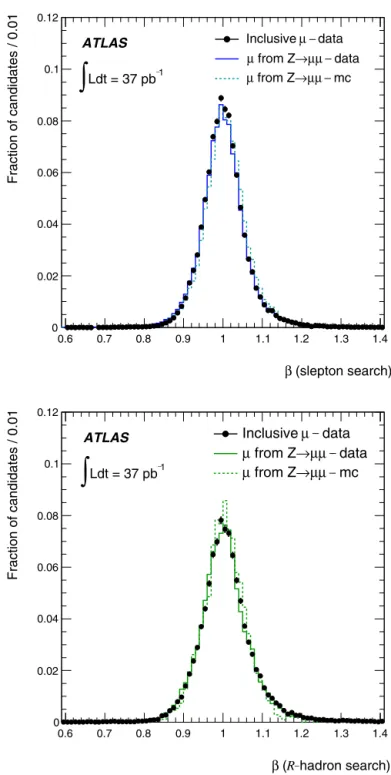
(3) 430. ATLAS Collaboration / Physics Letters B 703 (2011) 428–446. A candidate which is not found by the muon trigger, i.e. if it arrives late at the trigger chambers and its hits are not associated with the collision bunch crossing, is not reconstructed in the MS-standalone method, leading to a loss of efficiency at low β . 4.1. β estimation The value of β for each candidate is estimated by minimizing the total χ 2 between the available timing measurements from the sub-detectors, and the timing expected from the hypothesized β value. Contributions to the χ 2 are calculated as follows. MDT segments: An MDT segment is reconstructed as a line tangent to the circles of constant drift distance in the different layers, after the radii are estimated from the drift time using a known relation R (t drift ), where t drift is estimated as t measured − t 0 . Slow particles have a longer time of flight, and a better segment fit is obtained with the correct t 0 . For each test β , new MDT segments are built from a set of hits in a road around the extrapolated track, using the t 0 corresponding to the arrival time of a particle traveling with velocity β , R (t measured − t 0 (β)). The χ 2 representing the difference between the inferred position of the particle in the set of tubes and the segment position in the tube is minimized. For a low β particle, this method recovers hits on segments that could be lost when fitting the segment assuming β = 1. This estimate of the MDT β is used in the R-hadron search. MDT hits on track: For the slepton search, the time estimate from the MDT segment method can be improved by performing a full track fit to the ID and MS hits. The estimated particle trajectory through each tube is significantly more accurate after the full track fit than in the segment finding stage. The time of flight of the particle to each tube is obtained using the difference between the time of flight corresponding to the refitted track position in the tube, t R and the time actually measured, t 0 = t measured − t R . The χ 2 between the measured time of flight and the time of flight corresponding to the arrival time of a particle traveling with the test β is minimized. RPC and tile calorimeter: The position and time are independent measurements for each hit (or cell). The χ 2 minimization is performed using the measured times of hits on the candidate track. The time of flight measurement quality is sensitive to the time resolution of the detector. In a perfectly calibrated detector, any energetic muon coming from a collision in the interaction point will pass the detector at t 0 = 0. The t 0 distributions in the different sub-detectors are measured and their means used to correct the calibration. The observed width of these distributions after correction is used as the error on the time measurement in the β fit and to smear times in the simulated samples. The β distributions of candidates obtained in the combined minimization are shown in Fig. 1, after the β -quality selection described in Section 5. For the slepton search the mean β value is 0.997 and the resolution is σβ = 0.048. For the R-hadron search the mean value is β = 1.001 and the resolution is σβ = 0.051. 4.2. Signal resolution expected in data Since β is estimated from the measured time of flight, for a given resolution on the time measurement, a slower particle has a better β resolution. To simulate correctly the time resolution corresponding to the current state of calibration, hit times in simulated samples are smeared to reproduce the resolution measured in the data, prior to the β estimation. Fig. 1 shows the β distribution for selected Z → μμ decays in data and in Monte Carlo with smeared hit times. It can be seen that the smearing mechanism reproduces the measured muon β distribution. The same timesmearing mechanism is applied to the signal Monte Carlo samples.. Fig. 1. Distribution of β for all candidates in data (points with error bars), muons from the decay Z → μμ in data (full lines) and smeared Monte Carlo (dashed lines), in the estimation used in the slepton search (upper) and in the estimation used in the R-hadron search (lower).. 5. Candidate selection 5.1. Trigger selection This analysis is based on events collected by two types of muon trigger chains. The trigger for the slepton search requires MS tracks to be matched with ID tracks in the high-level trigger. The estimated p T is obtained from the combination of both systems, and is required to satisfy p T > 13 GeV. The trigger for the R-hadron search requires an MS-standalone muon trigger with p T > 40 GeV. The standalone triggers have less accurate p T estimates than the combined ones..
(4) ATLAS Collaboration / Physics Letters B 703 (2011) 428–446. 431. Table 1 Candidates in data compared to the simulated GMSB signal passing the selection stages in the slepton search. The Monte Carlo signal prediction is normalized to the data luminosity using the next to leading order cross-section. Data. Before selection Trigger selection Event selection Candidate quality β quality β < 0.95. – 959 921 57 382 5134 3470 582. Λ [TeV] = 30. 35. 40. mτ̃ [GeV] = 101.9. 116.3. 131.0. 160.7. 146.4 119.1 107.0 91.4 70.4 51.8. 61.7 50.4 45.6 38.8 29.5 21.7. 28.7 23.3 21.4 18.3 14.0 11.2. 7.3 6.5 6.0 5.2 3.9 3.0. 50. Table 2 Candidates in data compared to the simulated R-hadron signal passing the selection stages in the R-hadron search. The Monte Carlo signal prediction for the sample with the scattering model of Ref. [7] and a g̃-ball fraction of 0.1 is normalized to the data luminosity.. Before selection Trigger selection Event selection Candidate quality β quality β < 0.95. Data. m g̃ [GeV] = 300. 400. 500. 600. 700. – 168 043 150 771 6334 4998 830. 4542 1146 1140 504 443 420. 761 174 173 75 66 64. 177.7 37.6 37.4 15.7 13.9 13.5. 46.4 9.1 9.0 3.8 3.3 3.2. 14.2 2 .4 2 .4 1 .0 0 .8 0 .8. The events are selected online by requiring at least one level-1 muon trigger. As level-1 muon triggers are accepted and passed to the high-level trigger only if assigned to the collision bunch crossing, late triggers due to late arrival of the particles are lost. However, late triggers due to late arrival of slow particles from the collision bunch crossing are also lost. The level-1 trigger efficiency for particles arriving late at the MS is difficult to assess from data, where the overwhelming majority of candidates are muons. Therefore the trigger tracking efficiency is estimated from Z → μμ data, while the effects of timing are estimated from simulated Rhadron and GMSB events passing the level-1 trigger simulation, which includes the timing requirements of the trigger electronics. The estimated trigger efficiencies for GMSB slepton candidates are between 80% and 81%. The R-hadron search is much more adversely affected by the loss of trigger efficiency for late candidates, since the reconstruction is seeded by the trigger, and so even if an event is triggered by another object, the candidate will be lost. For R-hadrons that could be reconstructed because they are charged in the MS, the trigger efficiencies range between 55% for m g̃ = 300 GeV to 38% for m g̃ = 700 GeV. The estimated trigger efficiency with respect to all R-hadrons produced in the scattering model of Ref. [7] varies from 25% for m g̃ = 300 GeV to 17% for m g̃ = 700 GeV. The effect of the trigger efficiencies can be seen in Tables 1 and 2 for the signal and data in the slepton and R-hadron searches respectively. 5.2. Offline selection Collision events are selected by requiring a good primary vertex with more than two ID tracks, and with | z0vtx | < 150 mm (where z0vtx is the z coordinate of the reconstructed primary vertex). Cosmic ray background is rejected by removing tracks that do not pass close to the primary vertex in z. For candidates with an associated ID track, candidates with | z0trk − z0vtx | > 10 mm are re-. moved, where z0trk is the z coordinate at the distance of closest approach of the track to the origin. If no ID track is associated with the candidate, then it is still rejected if | z0trk − z0vtx | > 150 mm. Pairs of candidates with approximately opposite η and φ are also removed. The analysis searching for sleptons requires two candidates in each event, because two sleptons are produced, and both have a high probability to be observed in the MS. However, only one. of them is required to pass the LLP selection. This requirement reduces background from W production and QCD, but Z → μμ decays remain. Any candidate that, when combined with a second muon, gives an invariant mass within 10 GeV of the Z mass is rejected. In the R-hadron search, no requirement of two candidates per event is made, because R-hadrons may be neutral in the MS, or be lost by triggering in the next bunch crossing. Nevertheless, pairs consistent with the Z mass are still rejected in the R-hadron search. The above requirements are grouped in Tables 1 and 2 under the label “event selection”. The slepton search requires candidates to have p T > 40 GeV, well above the efficiency plateau for the trigger threshold of 13 GeV. A p T requirement of 60 GeV is applied for all candidates in the R-hadron search, so as to be in the MS-standalone triggerefficiency plateau. Candidates with p T > 1 TeV are rejected. This removes a few candidates with badly reconstructed momenta in both searches. Each candidate is required to have |η| < 2.5. These requirements are grouped in Tables 1 and 2 under the label “candidate quality”. The estimated β is required to be consistent for measurements in the same sub-detector, based on the RMS of β calculated from each hit separately. The estimated β is also required to be consistent between sub-detectors. A β measurement in at least two subdetectors is required for |η| < 1.7. These requirements are grouped in Tables 1 and 2 under the label “β quality”. Finally, in order to reject most muons, the combined β measurement is required to be in the range β < 0.95. 6. Background estimation The background is mainly composed of high p T muons with mis-measured β . The estimation of the background mass distribution is made directly from the data and relies on two premises: that the signal to background ratio before applying requirements on β is small and that the probability density function (pdf) for the β resolution for muons is independent of the source of the muon and its momentum. For each muon candidate passing the β quality requirement, a random β is drawn from the muon β pdf. If this β is inside the signal range, β < 0.95, a mass is calculated using the reconstructed momentum of the muon and the random β . The statistical error of the background estimation is reduced by repeating the procedure.
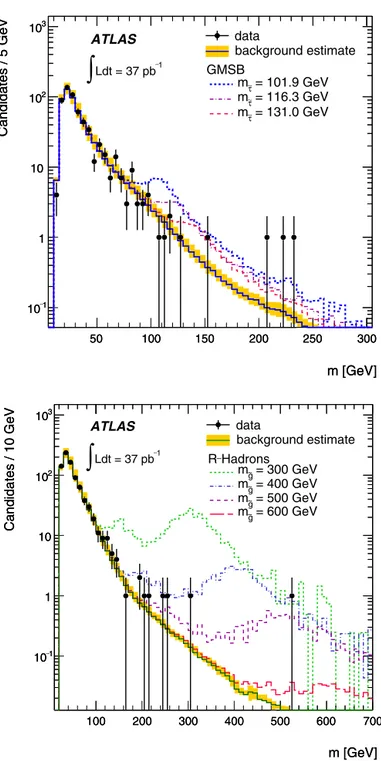
(5) 432. ATLAS Collaboration / Physics Letters B 703 (2011) 428–446. many times for each muon and dividing the resulting distribution by the number of repetitions. The mass histogram obtained this way represents the background estimation. The β distribution is different in different detector regions for three main reasons: different η regions are covered by different technologies (|η| < 1.05 for RPC, |η| < 1.7 for tile calorimeter, |η| < 2.5 for MDT); the time of flight method is more precise when the distance between the interaction point and the detector element is larger; the measurement in some regions of the detector is less precise due to fewer detector layers and magnetic field inhomogeneities. The background estimation is performed in η regions so that the β resolution within each region is approximately the same. The muon β pdf in each η region is given by the histogram of the measured β of all muons in the region. The regions also differ in the muon momentum distribution, since for any p T cut, p is larger as η increases. Therefore the combination of p with random β is done separately in each region and the resulting distributions are added together. The efficiency of the requirements described in Section 5.2 to reject cosmic rays is estimated from data collected with a cosmic muon trigger in the empty bunches and periods without collisions, dropping the requirement of a good primary vertex. The number of remaining cosmic ray muons are estimated from the number of candidates rejected by these requirements in the collision sample and the rejection efficiency. This results in 1.3 ± 0.2 cosmic rays in the R-hadron search sample. The estimated cosmic ray contamination in the slepton search sample is 0.7 ± 0.2 candidates.. 7.2. Background estimate. Several possible sources of systematic uncertainty have been evaluated.. A total of 15% (20%) uncertainty on the background is estimated for the slepton (R-hadron) search resulting from individual contributions discussed below. A systematic variation of the β distribution within each of the detector regions used in the background estimation may lead to a systematic error on the background estimation. To quantify the variability of the β distribution within a region and its effect on the background estimate, each region is sub-divided into smaller regions and the variation of their β distribution is used as a variability estimate. This leads to the dominant uncertainty in the background estimate. The possibility that a β -distribution dependence on the candidate momentum or source would result in a systematic uncertainty on the background estimate was tested. The candidates in each η region were divided by their momentum into two bins with similar counts. The independence of the β pdf from the source of the muons is confirmed using Z → μμ samples. Estimating the background using the pdf from the low or high momentum bins or from muons from Z → μμ results in negligible systematic uncertainties. Finally, the background estimation is based on a limited statistics sample, that of all candidates that passed the candidate quality requirements, before the cut on β . The tail of the background mass distribution has a significant contribution from a few high momentum events, and a statistical error arises from this. In order to calculate the sensitivity of the limits to the statistics of the momentum distribution, the candidate sample was divided randomly into two samples and the background estimate derived from each sample separately. The resulting uncertainty in the slepton search ranges from 1.04 candidates for m > 90 GeV to 0.14 candidates for m > 140 GeV, while the errors from sample statistics in the Rhadron search are negligible.. 7.1. Signal yields. 7.3. Theoretical cross-sections. 7. Systematic uncertainties. The total experimental systematic uncertainty in the signal yields is 6% on average. The sources and their individual contributions are described below. An uncertainty of 3.4% is assigned to the measurement of the integrated luminosity [17]. The systematic uncertainty associated with the trigger selection is estimated in Ref. [18] to be 0.73% (0.35%) and 0.74% (0.42%) in the barrel (end-cap) for the two trigger chains used in the slepton search. An uncertainty of 5% is estimated for the R-hadron search using similar methods. The trigger simulation models in detail the timing requirements of the trigger electronics and the efficiency loss due to particles arriving late at the MS. Differences between data and Monte Carlo trigger efficiency due to the difference in time resolutions between data and simulation were tested and are negligible. The signal β resolution expected in the data is estimated by smearing the hit times according to the spread observed in the time calibration. The systematic uncertainty due to the smearing process is estimated by scaling the smearing factor up and down, so as to bracket the distribution obtained in data. A 6% (2%) systematic uncertainty is associated with the smearing process for the GMSB models in the barrel (end-cap). For the g̃ R-hadrons, the effect of the smearing is negligible. The systematic uncertainties due to track reconstruction efficiency and momentum resolution differences between ATLAS data and simulation are estimated to be 0.5% for GMSB events and between 0.8% and 1.3% for R-hadrons in the different hadronization and interaction models.. The PROSPINO program [12] is used to calculate the signal cross-sections at next to leading order and two sources of theoretical systematic uncertainties were considered: the renormalization and factorization scales are changed upward and downward by a factor of two. This results in a systematic error of 7% for GMSB cross-sections and 15% for g̃ cross-sections [2]. The parton density functions of CTEQ6.6 [19] are used, and the uncertainty due to variations in the parton distribution functions is estimated to be 5%. 8. Results Fig. 2 shows the candidate mass distribution for data and the estimated background with its systematic uncertainty. Good agreement is observed. The CLs approach [20] for counting experiments is used to derive the limits for the production cross-section of GMSB slepton and g̃ R-hadron events. The limits are obtained by comparing the expected number of events with a candidate above a given mass cut with the actual number of events with a candidate above the same mass cut observed in the data. For each model, the mass cut is chosen to give the best expected limit. The mass cuts for the different models are summarized in Tables 3 and 4 together with the expected signal and background in each case. The expected number of signal candidates for an integrated luminosity of 37 pb−1 is added to the background estimation and compared to the data in Fig. 2 for the GMSB and R-hadron models. The production cross-section for τ̃ events and cross-section limit is shown in Fig. 3, as a function of the τ̃ mass for the slepton search.
(6) ATLAS Collaboration / Physics Letters B 703 (2011) 428–446. 433. Fig. 2. Candidate estimated mass distribution for data, expected background including systematic uncertainty, with simulated signals added, in the slepton (upper) and R-hadron (lower) searches.. Table 3 Mass cut and expected number of events as a function of the τ̃ mass in the slepton search. The systematic uncertainties on the signal yield and background estimate are 6% and 15% respectively. mτ̃ [GeV]. Mass cut [GeV]. Expected signal. Expected background. Data. 101.9 116.3 131.0 160.7. 90 110 120 130. 35.9 13.6 7.3 2.0. 19.2 9.8 7.2 5.4. 16 8 5 4. (upper). Stable τ̃ are excluded at 95% CL up to a mass of 136 GeV, in GMSB models with N 5 = 3, mmessenger = 250 TeV, sign(μ) = 1 and tan β = 5. Fig. 3 (lower) shows the limit obtained for sleptons. Fig. 3. The expected production cross-section for GMSB events with N 5 = 3, mmessenger = 250 TeV, sign(μ) = 1 and tan β = 5, and the cross-section upper limit at 95% CL for the slepton search as a function of the τ̃ mass (upper) and for sleptons produced in electroweak processes only (lower).. Table 4 Mass cut and expected number of events as a function of the g̃ mass in the Rhadron search. The systematic uncertainties on the signal yield and background estimate are 6% and 20% respectively. mτ̃ [GeV]. Mass cut [GeV]. Expected signal. Expected background. Data. 300 400 500 600 700. 250 350 350 350 350. 254.4 36.2 8.7 2.2 0.6. 2 .3 0.7 0.7 0.7 0.7. 3 1 1 1 1.
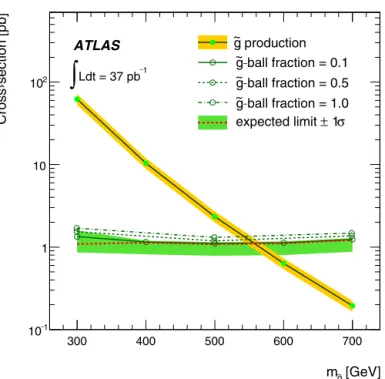
(7) 434. ATLAS Collaboration / Physics Letters B 703 (2011) 428–446. We acknowledge the support of ANPCyT, Argentina; YerPhI, Armenia; ARC, Australia; BMWF, Austria; ANAS, Azerbaijan; SSTC, Belarus; CNPq and FAPESP, Brazil; NSERC, NRC and CFI, Canada; CERN; CONICYT, Chile; CAS, MOST and NSFC, China; COLCIENCIAS, Colombia; MSMT CR, MPO CR and VSC CR, Czech Republic; DNRF, DNSRC and Lundbeck Foundation, Denmark; ARTEMIS, European Union; IN2P3–CNRS, CEA-DSM/IRFU, France; GNAS, Georgia; BMBF, DFG, HGF, MPG and AvH Foundation, Germany; GSRT, Greece; ISF, MINERVA, GIF, DIP and Benoziyo Center, Israel; INFN, Italy; MEXT and JSPS, Japan; CNRST, Morocco; FOM and NWO, Netherlands; RCN, Norway; MNiSW, Poland; GRICES and FCT, Portugal; MERYS (MECTS), Romania; MES of Russia and ROSATOM, Russian Federation; JINR; MSTD, Serbia; MSSR, Slovakia; ARRS and MVZT, Slovenia; DST/NRF, South Africa; MICINN, Spain; SRC and Wallenberg Foundation, Sweden; SER, SNSF and Cantons of Bern and Geneva, Switzerland; NSC, Taiwan; TAEK, Turkey; STFC, the Royal Society and Leverhulme Trust, United Kingdom; DOE and NSF, United States of America. The crucial computing support from all WLCG partners is acknowledged gratefully, in particular from CERN and the ATLAS Tier-1 facilities at TRIUMF (Canada), NDGF (Denmark, Norway, Sweden), CC-IN2P3 (France), KIT/GridKA (Germany), INFN-CNAF (Italy), NL-T1 (Netherlands), PIC (Spain), ASGC (Taiwan), RAL (UK) and BNL (USA) and in the Tier-2 facilities worldwide. Fig. 4. The expected production cross-section for R-hadron events and the crosssection limit at 95% CL as a function of the g̃ mass for the R-hadron search in the scattering model of Ref. [7] and for different g̃-ball fractions. The expected limit and its 1σ band are shown for 0.1 g̃-ball fraction.. produced only by electroweak processes, which have a smaller dependence on the model parameters other than the slepton mass. Sleptons produced in electroweak processes are excluded up to a mass of 110 GeV. Previous limits on stable sleptons are all below 100 GeV [21]. These limits are only applicable to models where the τ̃ or sleptons are the next to lightest SUSY particle, and their lifetime is sufficiently long to traverse the ATLAS experiment. In this case, the limits obtained for the above models are expected to have limited dependence on tan β and N 5 . Fig. 4 shows the limits for g̃ R-hadrons in the scattering model of Ref. [7]. Such R-hadrons are excluded at 95% CL up to a mass of 544 GeV for a g̃-ball fraction of 0.1. Models with g̃-ball fractions of 0.5 and 1.0 are excluded up to masses of 537 GeV and 530 GeV respectively. Previous less stringent limits were set by the Tevatron [22] and by the CMS Collaboration [23] which used the MS to select candidates, but not to measure β . For a g̃-ball fraction of 0.1, the ATLAS Collaboration in Ref. [2] sets limits that are higher then the limits presented here, not using the MS. 9. Summary and conclusion A search for long-lived charged particles reaching the muon spectrometer was performed with 37 pb−1 of data collected with the ATLAS detector. No excess is observed above the estimated background and 95% CL limits on τ̃ and R-hadron production are set. Stable τ̃ ’s are excluded up to a mass of 136 GeV, in GMSB models with N 5 = 3, mmessenger = 250 TeV, sign(μ) = 1 and tan β = 5. Sleptons produced in electroweak processes are excluded up to a mass of 110 GeV. Gluino R-hadrons in the scattering model of Ref. [7] are excluded up to masses of 530 GeV to 544 GeV depending on the fraction of R-hadrons produced as g̃-balls. Acknowledgements We thank CERN for the very successful operation of the LHC, as well as the support staff from our institutions without whom ATLAS could not be operated efficiently.. Open access This article is published Open Access at sciencedirect.com. It is distributed under the terms of the Creative Commons Attribution License 3.0, which permits unrestricted use, distribution, and reproduction in any medium, provided the original authors and source are credited. References [1] G.F. Giudice, R. Rattazzi, Phys. Rep. 322 (1999) 419. [2] ATLAS Collaboration, Search for stable hadronising squarks and gluinos at the ATLAS experiment at the LHC, arXiv:hep-ex/1103.1984, 2011. [3] M. Fairbairn, et al., Phys. Rep. 438 (2007) 1, arXiv:hep-ph/0611040. [4] N. Arkani-Hamed, S. Dimopoulos, J. High Energy Phys. 0506 (2005) 073; G.F. Giudice, A. Romanino, Nucl. Phys. B 699 (2004) 65, arXiv:hep-ph/0406088. [5] G. Engelhard, J.L. Feng, I. Galon, D. Sanford, Y. Felix, SPICE: Simulation package for including flavor in collider events, arXiv:0904.1415 [hep-ph], 2009. [6] G. Corcella, I.G. Knowles, G. Marchesini, S. Moretti, K. Odagiri, P. Richardson, M.H. Seymour, B.R. Webber, JHEP 0101 (2001) 010, arXiv:hep-ph/0210213. [7] R. Mackeprang, A. Rizzi, Eur. Phys. J. C 50 (2007) 353; A.C. Kraan, Eur. Phys. J. C 37 (2004) 91. [8] R. Mackeprang, D. Milstead, Eur. Phys. J. C 66 (2010) 493. [9] G. Farrar, R. Mackeprang, D. Milstead, J. Roberts, JHEP 1102 (2011) 018. [10] GEANT4 Collaboration, S. Agostinelli, et al., Nucl. Instrum. Meth. A 506 (2003) 250. [11] ATLAS Collaboration, Eur. Phys. J. C 70 (2010) 823, arXiv:1005.4568 [hep-ph]. [12] W. Beenakker, R. Hopker, M. Spira, PROSPINO: A program for the production of supersymmetric particles in next-to-leading order QCD, arXiv:hep-ph/9611232, 1996. [13] ATLAS Collaboration, JINST 3 (2008). [14] R. Leitner, et al., Time resolution of the ATLAS tile calorimeter and its performance for a measurement of heavy stable particles, ATL-TILECAL-PUB-2007002, 2007. [15] S. Tarem, Z. Tarem, N. Panikashvili, O. Belkind, MuGirl – Muon identification in the ATLAS detector from the inside out, in: Nuclear Science Symposium Conference Record, 2006, IEEE, vol. 1, May 2007, pp. 617–621. [16] S. Tarem, S. Bressler, H. Nomoto, A. Di Mattia, Eur. Phys. J. C 62 (2009) 281. [17] ATLAS Collaboration, Updated luminosity determination in pp collisions at √ s = 7 TeV using the ATLAS detector, ATLAS-CONF-2011-011; ATLAS Collaboration, Eur. Phys. J. C 71 (2011) 1630. [18] ATLAS Collaboration, Measurement of the muon charge asymmetry from W √ bosons produced in pp collisions at s = 7 TeV with the ATLAS detector, arXiv:1103.2929 [hep-ex], 2011. [19] J. Pumplin, et al., JHEP 0207 (2002) 012. [20] A.L. Read, Modified frequentist analysis of search results (the CLs method), CERN-OPEN-2000-205, 2000..
(8) ATLAS Collaboration / Physics Letters B 703 (2011) 428–446. [21] OPAL Collaboration, G. Abbiendi, et al., Phys. Lett. B 572 (2003) 8; DELPHI Collaboration, P. Abreu, et al., Phys. Lett. B 478 (2000) 65; L3 Collaboration, M. Acciarri, et al., Phys. Lett. B 456 (1999) 283; ALEPH Collaboration, R. Barate, et al., Phys. Lett. B 433 (1998) 176.. 435. [22] D0 Collaboration, V.M. Abazov, et al., Phys. Rev. Lett. 102 (2009) 161802; CDF Collaboration, T. Aaltonen, et al., Phys. Rev. Lett. 103 (2009) 021802. [23] CMS Collaboration, J. High Energy Phys. 1103 (2011) 024, arXiv:1101.1645 [hep-ex].. ATLAS Collaboration. G. Aad 48 , B. Abbott 111 , J. Abdallah 11 , A.A. Abdelalim 49 , A. Abdesselam 118 , O. Abdinov 10 , B. Abi 112 , M. Abolins 88 , H. Abramowicz 153 , H. Abreu 115 , E. Acerbi 89a,89b , B.S. Acharya 164a,164b , D.L. Adams 24 , T.N. Addy 56 , J. Adelman 175 , M. Aderholz 99 , S. Adomeit 98 , P. Adragna 75 , T. Adye 129 , S. Aefsky 22 , J.A. Aguilar-Saavedra 124b,a , M. Aharrouche 81 , S.P. Ahlen 21 , F. Ahles 48 , A. Ahmad 148 , M. Ahsan 40 , G. Aielli 133a,133b , T. Akdogan 18a , T.P.A. Åkesson 79 , G. Akimoto 155 , A.V. Akimov 94 , A. Akiyama 67 , M.S. Alam 1 , M.A. Alam 76 , S. Albrand 55 , M. Aleksa 29 , I.N. Aleksandrov 65 , F. Alessandria 89a , C. Alexa 25a , G. Alexander 153 , G. Alexandre 49 , T. Alexopoulos 9 , M. Alhroob 20 , M. Aliev 15 , G. Alimonti 89a , J. Alison 120 , M. Aliyev 10 , P.P. Allport 73 , S.E. Allwood-Spiers 53 , J. Almond 82 , A. Aloisio 102a,102b , R. Alon 171 , A. Alonso 79 , M.G. Alviggi 102a,102b , K. Amako 66 , P. Amaral 29 , C. Amelung 22 , V.V. Ammosov 128 , A. Amorim 124a,b , G. Amorós 167 , N. Amram 153 , C. Anastopoulos 29 , N. Andari 115 , T. Andeen 34 , C.F. Anders 20 , K.J. Anderson 30 , A. Andreazza 89a,89b , V. Andrei 58a , M.-L. Andrieux 55 , X.S. Anduaga 70 , A. Angerami 34 , F. Anghinolfi 29 , N. Anjos 124a , A. Annovi 47 , A. Antonaki 8 , M. Antonelli 47 , A. Antonov 96 , J. Antos 144b , F. Anulli 132a , S. Aoun 83 , L. Aperio Bella 4 , R. Apolle 118,c , G. Arabidze 88 , I. Aracena 143 , Y. Arai 66 , A.T.H. Arce 44 , J.P. Archambault 28 , S. Arfaoui 29,d , J.-F. Arguin 14 , E. Arik 18a,∗ , M. Arik 18a , A.J. Armbruster 87 , O. Arnaez 81 , C. Arnault 115 , A. Artamonov 95 , G. Artoni 132a,132b , D. Arutinov 20 , S. Asai 155 , R. Asfandiyarov 172 , S. Ask 27 , B. Åsman 146a,146b , L. Asquith 5 , K. Assamagan 24 , A. Astbury 169 , A. Astvatsatourov 52 , G. Atoian 175 , B. Aubert 4 , B. Auerbach 175 , E. Auge 115 , K. Augsten 127 , M. Aurousseau 145a , N. Austin 73 , R. Avramidou 9 , D. Axen 168 , C. Ay 54 , G. Azuelos 93,e , Y. Azuma 155 , M.A. Baak 29 , G. Baccaglioni 89a , C. Bacci 134a,134b , A.M. Bach 14 , H. Bachacou 136 , K. Bachas 29 , G. Bachy 29 , M. Backes 49 , M. Backhaus 20 , E. Badescu 25a , P. Bagnaia 132a,132b , S. Bahinipati 2 , Y. Bai 32a , D.C. Bailey 158 , T. Bain 158 , J.T. Baines 129 , O.K. Baker 175 , M.D. Baker 24 , S. Baker 77 , F. Baltasar Dos Santos Pedrosa 29 , E. Banas 38 , P. Banerjee 93 , Sw. Banerjee 172 , D. Banfi 29 , A. Bangert 137 , V. Bansal 169 , H.S. Bansil 17 , L. Barak 171 , S.P. Baranov 94 , A. Barashkou 65 , A. Barbaro Galtieri 14 , T. Barber 27 , E.L. Barberio 86 , D. Barberis 50a,50b , M. Barbero 20 , D.Y. Bardin 65 , T. Barillari 99 , M. Barisonzi 174 , T. Barklow 143 , N. Barlow 27 , B.M. Barnett 129 , R.M. Barnett 14 , A. Baroncelli 134a , A.J. Barr 118 , F. Barreiro 80 , J. Barreiro Guimarães da Costa 57 , P. Barrillon 115 , R. Bartoldus 143 , A.E. Barton 71 , D. Bartsch 20 , V. Bartsch 149 , R.L. Bates 53 , L. Batkova 144a , J.R. Batley 27 , A. Battaglia 16 , M. Battistin 29 , G. Battistoni 89a , F. Bauer 136 , H.S. Bawa 143,f , B. Beare 158 , T. Beau 78 , P.H. Beauchemin 118 , R. Beccherle 50a , P. Bechtle 41 , H.P. Beck 16 , M. Beckingham 48 , K.H. Becks 174 , A.J. Beddall 18c , A. Beddall 18c , S. Bedikian 175 , V.A. Bednyakov 65 , C.P. Bee 83 , M. Begel 24 , S. Behar Harpaz 152 , P.K. Behera 63 , M. Beimforde 99 , C. Belanger-Champagne 166 , P.J. Bell 49 , W.H. Bell 49 , G. Bella 153 , L. Bellagamba 19a , F. Bellina 29 , M. Bellomo 119a , A. Belloni 57 , O. Beloborodova 107 , K. Belotskiy 96 , O. Beltramello 29 , S. Ben Ami 152 , O. Benary 153 , D. Benchekroun 135a , C. Benchouk 83 , M. Bendel 81 , B.H. Benedict 163 , N. Benekos 165 , Y. Benhammou 153 , D.P. Benjamin 44 , M. Benoit 115 , J.R. Bensinger 22 , K. Benslama 130 , S. Bentvelsen 105 , D. Berge 29 , E. Bergeaas Kuutmann 41 , N. Berger 4 , F. Berghaus 169 , E. Berglund 49 , J. Beringer 14 , K. Bernardet 83 , P. Bernat 77 , R. Bernhard 48 , C. Bernius 24 , T. Berry 76 , A. Bertin 19a,19b , F. Bertinelli 29 , F. Bertolucci 122a,122b , M.I. Besana 89a,89b , N. Besson 136 , S. Bethke 99 , W. Bhimji 45 , R.M. Bianchi 29 , M. Bianco 72a,72b , O. Biebel 98 , S.P. Bieniek 77 , J. Biesiada 14 , M. Biglietti 134a,134b , H. Bilokon 47 , M. Bindi 19a,19b , S. Binet 115 , A. Bingul 18c , C. Bini 132a,132b , C. Biscarat 177 , U. Bitenc 48 , K.M. Black 21 , R.E. Blair 5 , J.-B. Blanchard 115 , G. Blanchot 29 , T. Blazek 144a , C. Blocker 22 , J. Blocki 38 , A. Blondel 49 , W. Blum 81 , U. Blumenschein 54 , G.J. Bobbink 105 , V.B. Bobrovnikov 107 , S.S. Bocchetta 79 , A. Bocci 44 , C.R. Boddy 118 , M. Boehler 41 , J. Boek 174 , N. Boelaert 35 , S. Böser 77 , J.A. Bogaerts 29 , A. Bogdanchikov 107 , A. Bogouch 90,∗ , C. Bohm 146a , V. Boisvert 76 , T. Bold 163,g , V. Boldea 25a , N.M. Bolnet 136 , M. Bona 75 , V.G. Bondarenko 96 , M. Boonekamp 136 , G. Boorman 76 , C.N. Booth 139 , S. Bordoni 78 , C. Borer 16 , A. Borisov 128 , G. Borissov 71 , I. Borjanovic 12a , S. Borroni 132a,132b , K. Bos 105 , D. Boscherini 19a , M. Bosman 11 , H. Boterenbrood 105 , D. Botterill 129 , J. Bouchami 93 , J. Boudreau 123 , E.V. Bouhova-Thacker 71 , C. Boulahouache 123 , C. Bourdarios 115 , N. Bousson 83 , A. Boveia 30 , J. Boyd 29 ,.
(9) 436. ATLAS Collaboration / Physics Letters B 703 (2011) 428–446. I.R. Boyko 65 , N.I. Bozhko 128 , I. Bozovic-Jelisavcic 12b , J. Bracinik 17 , A. Braem 29 , P. Branchini 134a , G.W. Brandenburg 57 , A. Brandt 7 , G. Brandt 15 , O. Brandt 54 , U. Bratzler 156 , B. Brau 84 , J.E. Brau 114 , H.M. Braun 174 , B. Brelier 158 , J. Bremer 29 , R. Brenner 166 , S. Bressler 152 , D. Breton 115 , D. Britton 53 , F.M. Brochu 27 , I. Brock 20 , R. Brock 88 , T.J. Brodbeck 71 , E. Brodet 153 , F. Broggi 89a , C. Bromberg 88 , G. Brooijmans 34 , W.K. Brooks 31b , G. Brown 82 , H. Brown 7 , P.A. Bruckman de Renstrom 38 , D. Bruncko 144b , R. Bruneliere 48 , S. Brunet 61 , A. Bruni 19a , G. Bruni 19a , M. Bruschi 19a , T. Buanes 13 , F. Bucci 49 , J. Buchanan 118 , N.J. Buchanan 2 , P. Buchholz 141 , R.M. Buckingham 118 , A.G. Buckley 45 , S.I. Buda 25a , I.A. Budagov 65 , B. Budick 108 , V. Büscher 81 , L. Bugge 117 , D. Buira-Clark 118 , O. Bulekov 96 , M. Bunse 42 , T. Buran 117 , H. Burckhart 29 , S. Burdin 73 , T. Burgess 13 , S. Burke 129 , E. Busato 33 , P. Bussey 53 , C.P. Buszello 166 , F. Butin 29 , B. Butler 143 , J.M. Butler 21 , C.M. Buttar 53 , J.M. Butterworth 77 , W. Buttinger 27 , T. Byatt 77 , S. Cabrera Urbán 167 , D. Caforio 19a,19b , O. Cakir 3a , P. Calafiura 14 , G. Calderini 78 , P. Calfayan 98 , R. Calkins 106 , L.P. Caloba 23a , R. Caloi 132a,132b , D. Calvet 33 , S. Calvet 33 , R. Camacho Toro 33 , P. Camarri 133a,133b , M. Cambiaghi 119a,119b , D. Cameron 117 , S. Campana 29 , M. Campanelli 77 , V. Canale 102a,102b , F. Canelli 30 , A. Canepa 159a , J. Cantero 80 , L. Capasso 102a,102b , M.D.M. Capeans Garrido 29 , I. Caprini 25a , M. Caprini 25a , D. Capriotti 99 , M. Capua 36a,36b , R. Caputo 148 , C. Caramarcu 25a , R. Cardarelli 133a , T. Carli 29 , G. Carlino 102a , L. Carminati 89a,89b , B. Caron 159a , S. Caron 48 , G.D. Carrillo Montoya 172 , A.A. Carter 75 , J.R. Carter 27 , J. Carvalho 124a,h , D. Casadei 108 , M.P. Casado 11 , M. Cascella 122a,122b , C. Caso 50a,50b,∗ , A.M. Castaneda Hernandez 172 , E. Castaneda-Miranda 172 , V. Castillo Gimenez 167 , N.F. Castro 124a , G. Cataldi 72a , F. Cataneo 29 , A. Catinaccio 29 , J.R. Catmore 71 , A. Cattai 29 , G. Cattani 133a,133b , S. Caughron 88 , D. Cauz 164a,164c , P. Cavalleri 78 , D. Cavalli 89a , M. Cavalli-Sforza 11 , V. Cavasinni 122a,122b , F. Ceradini 134a,134b , A.S. Cerqueira 23a , A. Cerri 29 , L. Cerrito 75 , F. Cerutti 47 , S.A. Cetin 18b , F. Cevenini 102a,102b , A. Chafaq 135a , D. Chakraborty 106 , K. Chan 2 , B. Chapleau 85 , J.D. Chapman 27 , J.W. Chapman 87 , E. Chareyre 78 , D.G. Charlton 17 , V. Chavda 82 , C.A. Chavez Barajas 29 , S. Cheatham 85 , S. Chekanov 5 , S.V. Chekulaev 159a , G.A. Chelkov 65 , M.A. Chelstowska 104 , C. Chen 64 , H. Chen 24 , S. Chen 32c , T. Chen 32c , X. Chen 172 , S. Cheng 32a , A. Cheplakov 65 , V.F. Chepurnov 65 , R. Cherkaoui El Moursli 135e , V. Chernyatin 24 , E. Cheu 6 , S.L. Cheung 158 , L. Chevalier 136 , G. Chiefari 102a,102b , L. Chikovani 51 , J.T. Childers 58a , A. Chilingarov 71 , G. Chiodini 72a , M.V. Chizhov 65 , G. Choudalakis 30 , S. Chouridou 137 , I.A. Christidi 77 , A. Christov 48 , D. Chromek-Burckhart 29 , M.L. Chu 151 , J. Chudoba 125 , G. Ciapetti 132a,132b , K. Ciba 37 , A.K. Ciftci 3a , R. Ciftci 3a , D. Cinca 33 , V. Cindro 74 , M.D. Ciobotaru 163 , C. Ciocca 19a,19b , A. Ciocio 14 , M. Cirilli 87 , M. Ciubancan 25a , A. Clark 49 , P.J. Clark 45 , W. Cleland 123 , J.C. Clemens 83 , B. Clement 55 , C. Clement 146a,146b , R.W. Clifft 129 , Y. Coadou 83 , M. Cobal 164a,164c , A. Coccaro 50a,50b , J. Cochran 64 , P. Coe 118 , J.G. Cogan 143 , J. Coggeshall 165 , E. Cogneras 177 , C.D. Cojocaru 28 , J. Colas 4 , A.P. Colijn 105 , C. Collard 115 , N.J. Collins 17 , C. Collins-Tooth 53 , J. Collot 55 , G. Colon 84 , P. Conde Muiño 124a , E. Coniavitis 118 , M.C. Conidi 11 , M. Consonni 104 , V. Consorti 48 , S. Constantinescu 25a , C. Conta 119a,119b , F. Conventi 102a,i , J. Cook 29 , M. Cooke 14 , B.D. Cooper 77 , A.M. Cooper-Sarkar 118 , N.J. Cooper-Smith 76 , K. Copic 34 , T. Cornelissen 50a,50b , M. Corradi 19a , F. Corriveau 85,j , A. Cortes-Gonzalez 165 , G. Cortiana 99 , G. Costa 89a , M.J. Costa 167 , D. Costanzo 139 , T. Costin 30 , D. Côté 29 , R. Coura Torres 23a , L. Courneyea 169 , G. Cowan 76 , C. Cowden 27 , B.E. Cox 82 , K. Cranmer 108 , F. Crescioli 122a,122b , M. Cristinziani 20 , G. Crosetti 36a,36b , R. Crupi 72a,72b , S. Crépé-Renaudin 55 , C.-M. Cuciuc 25a , C. Cuenca Almenar 175 , T. Cuhadar Donszelmann 139 , S. Cuneo 50a,50b , M. Curatolo 47 , C.J. Curtis 17 , P. Cwetanski 61 , H. Czirr 141 , Z. Czyczula 117 , S. D’Auria 53 , M. D’Onofrio 73 , A. D’Orazio 132a,132b , P.V.M. Da Silva 23a , C. Da Via 82 , W. Dabrowski 37 , T. Dai 87 , C. Dallapiccola 84 , M. Dam 35 , M. Dameri 50a,50b , D.S. Damiani 137 , H.O. Danielsson 29 , D. Dannheim 99 , V. Dao 49 , G. Darbo 50a , G.L. Darlea 25b , C. Daum 105 , J.P. Dauvergne 29 , W. Davey 86 , T. Davidek 126 , N. Davidson 86 , R. Davidson 71 , E. Davies 118,c , M. Davies 93 , A.R. Davison 77 , Y. Davygora 58a , E. Dawe 142 , I. Dawson 139 , J.W. Dawson 5,∗ , R.K. Daya 39 , K. De 7 , R. de Asmundis 102a , S. De Castro 19a,19b , P.E. De Castro Faria Salgado 24 , S. De Cecco 78 , J. de Graat 98 , N. De Groot 104 , P. de Jong 105 , C. De La Taille 115 , H. De la Torre 80 , B. De Lotto 164a,164c , L. De Mora 71 , L. De Nooij 105 , M. De Oliveira Branco 29 , D. De Pedis 132a , P. de Saintignon 55 , A. De Salvo 132a , U. De Sanctis 164a,164c , A. De Santo 149 , J.B. De Vivie De Regie 115 , S. Dean 77 , D.V. Dedovich 65 , J. Degenhardt 120 , M. Dehchar 118 , M. Deile 98 , C. Del Papa 164a,164c , J. Del Peso 80 , T. Del Prete 122a,122b , M. Deliyergiyev 74 , A. Dell’Acqua 29 , L. Dell’Asta 89a,89b , M. Della Pietra 102a,i , D. della Volpe 102a,102b , M. Delmastro 29 , P. Delpierre 83 ,.
(10) ATLAS Collaboration / Physics Letters B 703 (2011) 428–446. 437. N. Delruelle 29 , P.A. Delsart 55 , C. Deluca 148 , S. Demers 175 , M. Demichev 65 , B. Demirkoz 11,k , J. Deng 163 , S.P. Denisov 128 , D. Derendarz 38 , J.E. Derkaoui 135d , F. Derue 78 , P. Dervan 73 , K. Desch 20 , E. Devetak 148 , P.O. Deviveiros 158 , A. Dewhurst 129 , B. DeWilde 148 , S. Dhaliwal 158 , R. Dhullipudi 24,l , A. Di Ciaccio 133a,133b , L. Di Ciaccio 4 , A. Di Girolamo 29 , B. Di Girolamo 29 , S. Di Luise 134a,134b , A. Di Mattia 88 , B. Di Micco 29 , R. Di Nardo 133a,133b , A. Di Simone 133a,133b , R. Di Sipio 19a,19b , M.A. Diaz 31a , F. Diblen 18c , E.B. Diehl 87 , J. Dietrich 41 , T.A. Dietzsch 58a , S. Diglio 115 , K. Dindar Yagci 39 , J. Dingfelder 20 , C. Dionisi 132a,132b , P. Dita 25a , S. Dita 25a , F. Dittus 29 , F. Djama 83 , T. Djobava 51 , M.A.B. do Vale 23a , A. Do Valle Wemans 124a , T.K.O. Doan 4 , M. Dobbs 85 , R. Dobinson 29,∗ , D. Dobos 42 , E. Dobson 29 , M. Dobson 163 , J. Dodd 34 , C. Doglioni 118 , T. Doherty 53 , Y. Doi 66,∗ , J. Dolejsi 126 , I. Dolenc 74 , Z. Dolezal 126 , B.A. Dolgoshein 96,∗ , T. Dohmae 155 , M. Donadelli 23b , M. Donega 120 , J. Donini 55 , J. Dopke 29 , A. Doria 102a , A. Dos Anjos 172 , M. Dosil 11 , A. Dotti 122a,122b , M.T. Dova 70 , J.D. Dowell 17 , A.D. Doxiadis 105 , A.T. Doyle 53 , Z. Drasal 126 , J. Drees 174 , N. Dressnandt 120 , H. Drevermann 29 , C. Driouichi 35 , M. Dris 9 , J. Dubbert 99 , T. Dubbs 137 , S. Dube 14 , E. Duchovni 171 , G. Duckeck 98 , A. Dudarev 29 , F. Dudziak 64 , M. Dührssen 29 , I.P. Duerdoth 82 , L. Duflot 115 , M.-A. Dufour 85 , M. Dunford 29 , H. Duran Yildiz 3b , R. Duxfield 139 , M. Dwuznik 37 , F. Dydak 29 , D. Dzahini 55 , M. Düren 52 , W.L. Ebenstein 44 , J. Ebke 98 , S. Eckert 48 , S. Eckweiler 81 , K. Edmonds 81 , C.A. Edwards 76 , N.C. Edwards 53 , W. Ehrenfeld 41 , T. Ehrich 99 , T. Eifert 29 , G. Eigen 13 , K. Einsweiler 14 , E. Eisenhandler 75 , T. Ekelof 166 , M. El Kacimi 135c , M. Ellert 166 , S. Elles 4 , F. Ellinghaus 81 , K. Ellis 75 , N. Ellis 29 , J. Elmsheuser 98 , M. Elsing 29 , R. Ely 14 , D. Emeliyanov 129 , R. Engelmann 148 , A. Engl 98 , B. Epp 62 , A. Eppig 87 , J. Erdmann 54 , A. Ereditato 16 , D. Eriksson 146a , J. Ernst 1 , M. Ernst 24 , J. Ernwein 136 , D. Errede 165 , S. Errede 165 , E. Ertel 81 , M. Escalier 115 , C. Escobar 167 , X. Espinal Curull 11 , B. Esposito 47 , F. Etienne 83 , A.I. Etienvre 136 , E. Etzion 153 , D. Evangelakou 54 , H. Evans 61 , L. Fabbri 19a,19b , C. Fabre 29 , R.M. Fakhrutdinov 128 , S. Falciano 132a , Y. Fang 172 , M. Fanti 89a,89b , A. Farbin 7 , A. Farilla 134a , J. Farley 148 , T. Farooque 158 , S.M. Farrington 118 , P. Farthouat 29 , P. Fassnacht 29 , D. Fassouliotis 8 , B. Fatholahzadeh 158 , A. Favareto 89a,89b , L. Fayard 115 , S. Fazio 36a,36b , R. Febbraro 33 , P. Federic 144a , O.L. Fedin 121 , W. Fedorko 88 , M. Fehling-Kaschek 48 , L. Feligioni 83 , D. Fellmann 5 , C.U. Felzmann 86 , C. Feng 32d , E.J. Feng 30 , A.B. Fenyuk 128 , J. Ferencei 144b , J. Ferland 93 , W. Fernando 109 , S. Ferrag 53 , J. Ferrando 53 , V. Ferrara 41 , A. Ferrari 166 , P. Ferrari 105 , R. Ferrari 119a , A. Ferrer 167 , M.L. Ferrer 47 , D. Ferrere 49 , C. Ferretti 87 , A. Ferretto Parodi 50a,50b , M. Fiascaris 30 , F. Fiedler 81 , A. Filipčič 74 , A. Filippas 9 , F. Filthaut 104 , M. Fincke-Keeler 169 , M.C.N. Fiolhais 124a,h , L. Fiorini 167 , A. Firan 39 , G. Fischer 41 , P. Fischer 20 , M.J. Fisher 109 , S.M. Fisher 129 , M. Flechl 48 , I. Fleck 141 , J. Fleckner 81 , P. Fleischmann 173 , S. Fleischmann 174 , T. Flick 174 , L.R. Flores Castillo 172 , M.J. Flowerdew 99 , F. Föhlisch 58a , M. Fokitis 9 , T. Fonseca Martin 16 , D.A. Forbush 138 , A. Formica 136 , A. Forti 82 , D. Fortin 159a , J.M. Foster 82 , D. Fournier 115 , A. Foussat 29 , A.J. Fowler 44 , K. Fowler 137 , H. Fox 71 , P. Francavilla 122a,122b , S. Franchino 119a,119b , D. Francis 29 , T. Frank 171 , M. Franklin 57 , S. Franz 29 , M. Fraternali 119a,119b , S. Fratina 120 , S.T. French 27 , R. Froeschl 29 , D. Froidevaux 29 , J.A. Frost 27 , C. Fukunaga 156 , E. Fullana Torregrosa 29 , J. Fuster 167 , C. Gabaldon 29 , O. Gabizon 171 , T. Gadfort 24 , S. Gadomski 49 , G. Gagliardi 50a,50b , P. Gagnon 61 , C. Galea 98 , E.J. Gallas 118 , M.V. Gallas 29 , V. Gallo 16 , B.J. Gallop 129 , P. Gallus 125 , E. Galyaev 40 , K.K. Gan 109 , Y.S. Gao 143,f , V.A. Gapienko 128 , A. Gaponenko 14 , F. Garberson 175 , M. Garcia-Sciveres 14 , C. García 167 , J.E. García Navarro 49 , R.W. Gardner 30 , N. Garelli 29 , H. Garitaonandia 105 , V. Garonne 29 , J. Garvey 17 , C. Gatti 47 , G. Gaudio 119a , O. Gaumer 49 , B. Gaur 141 , L. Gauthier 136 , I.L. Gavrilenko 94 , C. Gay 168 , G. Gaycken 20 , J.-C. Gayde 29 , E.N. Gazis 9 , P. Ge 32d , C.N.P. Gee 129 , D.A.A. Geerts 105 , Ch. Geich-Gimbel 20 , K. Gellerstedt 146a,146b , C. Gemme 50a , A. Gemmell 53 , M.H. Genest 98 , S. Gentile 132a,132b , M. George 54 , S. George 76 , P. Gerlach 174 , A. Gershon 153 , C. Geweniger 58a , H. Ghazlane 135b , P. Ghez 4 , N. Ghodbane 33 , B. Giacobbe 19a , S. Giagu 132a,132b , V. Giakoumopoulou 8 , V. Giangiobbe 122a,122b , F. Gianotti 29 , B. Gibbard 24 , A. Gibson 158 , S.M. Gibson 29 , L.M. Gilbert 118 , M. Gilchriese 14 , V. Gilewsky 91 , D. Gillberg 28 , A.R. Gillman 129 , D.M. Gingrich 2,e , J. Ginzburg 153 , N. Giokaris 8 , R. Giordano 102a,102b , F.M. Giorgi 15 , P. Giovannini 99 , P.F. Giraud 136 , D. Giugni 89a , P. Giusti 19a , B.K. Gjelsten 117 , L.K. Gladilin 97 , C. Glasman 80 , J. Glatzer 48 , A. Glazov 41 , K.W. Glitza 174 , G.L. Glonti 65 , J. Godfrey 142 , J. Godlewski 29 , M. Goebel 41 , T. Göpfert 43 , C. Goeringer 81 , C. Gössling 42 , T. Göttfert 99 , S. Goldfarb 87 , D. Goldin 39 , T. Golling 175 , S.N. Golovnia 128 , A. Gomes 124a,b , L.S. Gomez Fajardo 41 , R. Gonçalo 76 , J. Goncalves Pinto Firmino Da Costa 41 , L. Gonella 20 ,.
(11) 438. ATLAS Collaboration / Physics Letters B 703 (2011) 428–446. A. Gonidec 29 , S. Gonzalez 172 , S. González de la Hoz 167 , M.L. Gonzalez Silva 26 , S. Gonzalez-Sevilla 49 , J.J. Goodson 148 , L. Goossens 29 , P.A. Gorbounov 95 , H.A. Gordon 24 , I. Gorelov 103 , G. Gorfine 174 , B. Gorini 29 , E. Gorini 72a,72b , A. Gorišek 74 , E. Gornicki 38 , S.A. Gorokhov 128 , V.N. Goryachev 128 , B. Gosdzik 41 , M. Gosselink 105 , M.I. Gostkin 65 , M. Gouanère 4 , I. Gough Eschrich 163 , M. Gouighri 135a , D. Goujdami 135c , M.P. Goulette 49 , A.G. Goussiou 138 , C. Goy 4 , I. Grabowska-Bold 163,g , V. Grabski 176 , P. Grafström 29 , C. Grah 174 , K.-J. Grahn 41 , F. Grancagnolo 72a , S. Grancagnolo 15 , V. Grassi 148 , V. Gratchev 121 , N. Grau 34 , H.M. Gray 29 , J.A. Gray 148 , E. Graziani 134a , O.G. Grebenyuk 121 , D. Greenfield 129 , T. Greenshaw 73 , Z.D. Greenwood 24,l , I.M. Gregor 41 , P. Grenier 143 , J. Griffiths 138 , N. Grigalashvili 65 , A.A. Grillo 137 , S. Grinstein 11 , Y.V. Grishkevich 97 , J.-F. Grivaz 115 , J. Grognuz 29 , M. Groh 99 , E. Gross 171 , J. Grosse-Knetter 54 , J. Groth-Jensen 171 , K. Grybel 141 , V.J. Guarino 5 , D. Guest 175 , C. Guicheney 33 , A. Guida 72a,72b , T. Guillemin 4 , S. Guindon 54 , H. Guler 85,m , J. Gunther 125 , B. Guo 158 , J. Guo 34 , A. Gupta 30 , Y. Gusakov 65 , V.N. Gushchin 128 , A. Gutierrez 93 , P. Gutierrez 111 , N. Guttman 153 , O. Gutzwiller 172 , C. Guyot 136 , C. Gwenlan 118 , C.B. Gwilliam 73 , A. Haas 143 , S. Haas 29 , C. Haber 14 , R. Hackenburg 24 , H.K. Hadavand 39 , D.R. Hadley 17 , P. Haefner 99 , F. Hahn 29 , S. Haider 29 , Z. Hajduk 38 , H. Hakobyan 176 , J. Haller 54 , K. Hamacher 174 , P. Hamal 113 , A. Hamilton 49 , S. Hamilton 161 , H. Han 32a , L. Han 32b , K. Hanagaki 116 , M. Hance 120 , C. Handel 81 , P. Hanke 58a , J.R. Hansen 35 , J.B. Hansen 35 , J.D. Hansen 35 , P.H. Hansen 35 , P. Hansson 143 , K. Hara 160 , G.A. Hare 137 , T. Harenberg 174 , S. Harkusha 90 , D. Harper 87 , R.D. Harrington 21 , O.M. Harris 138 , K. Harrison 17 , J. Hartert 48 , F. Hartjes 105 , T. Haruyama 66 , A. Harvey 56 , S. Hasegawa 101 , Y. Hasegawa 140 , S. Hassani 136 , M. Hatch 29 , D. Hauff 99 , S. Haug 16 , M. Hauschild 29 , R. Hauser 88 , M. Havranek 20 , B.M. Hawes 118 , C.M. Hawkes 17 , R.J. Hawkings 29 , D. Hawkins 163 , T. Hayakawa 67 , D. Hayden 76 , H.S. Hayward 73 , S.J. Haywood 129 , E. Hazen 21 , M. He 32d , S.J. Head 17 , V. Hedberg 79 , L. Heelan 7 , S. Heim 88 , B. Heinemann 14 , S. Heisterkamp 35 , L. Helary 4 , M. Heller 115 , S. Hellman 146a,146b , C. Helsens 11 , R.C.W. Henderson 71 , M. Henke 58a , A. Henrichs 54 , A.M. Henriques Correia 29 , S. Henrot-Versille 115 , F. Henry-Couannier 83 , C. Hensel 54 , T. Henß 174 , C.M. Hernandez 7 , Y. Hernández Jiménez 167 , R. Herrberg 15 , A.D. Hershenhorn 152 , G. Herten 48 , R. Hertenberger 98 , L. Hervas 29 , N.P. Hessey 105 , A. Hidvegi 146a , E. Higón-Rodriguez 167 , D. Hill 5,∗ , J.C. Hill 27 , N. Hill 5 , K.H. Hiller 41 , S. Hillert 20 , S.J. Hillier 17 , I. Hinchliffe 14 , E. Hines 120 , M. Hirose 116 , F. Hirsch 42 , D. Hirschbuehl 174 , J. Hobbs 148 , N. Hod 153 , M.C. Hodgkinson 139 , P. Hodgson 139 , A. Hoecker 29 , M.R. Hoeferkamp 103 , J. Hoffman 39 , D. Hoffmann 83 , M. Hohlfeld 81 , M. Holder 141 , A. Holmes 118 , S.O. Holmgren 146a , T. Holy 127 , J.L. Holzbauer 88 , Y. Homma 67 , T.M. Hong 120 , L. Hooft van Huysduynen 108 , T. Horazdovsky 127 , C. Horn 143 , S. Horner 48 , K. Horton 118 , J.-Y. Hostachy 55 , S. Hou 151 , M.A. Houlden 73 , A. Hoummada 135a , J. Howarth 82 , D.F. Howell 118 , I. Hristova 41 , J. Hrivnac 115 , I. Hruska 125 , T. Hryn’ova 4 , P.J. Hsu 175 , S.-C. Hsu 14 , G.S. Huang 111 , Z. Hubacek 127 , F. Hubaut 83 , F. Huegging 20 , T.B. Huffman 118 , E.W. Hughes 34 , G. Hughes 71 , R.E. Hughes-Jones 82 , M. Huhtinen 29 , P. Hurst 57 , M. Hurwitz 14 , U. Husemann 41 , N. Huseynov 65,n , J. Huston 88 , J. Huth 57 , G. Iacobucci 49 , G. Iakovidis 9 , M. Ibbotson 82 , I. Ibragimov 141 , R. Ichimiya 67 , L. Iconomidou-Fayard 115 , J. Idarraga 115 , M. Idzik 37 , P. Iengo 102a,102b , O. Igonkina 105 , Y. Ikegami 66 , M. Ikeno 66 , Y. Ilchenko 39 , D. Iliadis 154 , D. Imbault 78 , M. Imhaeuser 174 , M. Imori 155 , T. Ince 20 , J. Inigo-Golfin 29 , P. Ioannou 8 , M. Iodice 134a , G. Ionescu 4 , A. Irles Quiles 167 , K. Ishii 66 , A. Ishikawa 67 , M. Ishino 66 , R. Ishmukhametov 39 , C. Issever 118 , S. Istin 18a , Y. Itoh 101 , A.V. Ivashin 128 , W. Iwanski 38 , H. Iwasaki 66 , J.M. Izen 40 , V. Izzo 102a , B. Jackson 120 , J.N. Jackson 73 , P. Jackson 143 , M.R. Jaekel 29 , V. Jain 61 , K. Jakobs 48 , S. Jakobsen 35 , J. Jakubek 127 , D.K. Jana 111 , E. Jankowski 158 , E. Jansen 77 , A. Jantsch 99 , M. Janus 20 , G. Jarlskog 79 , L. Jeanty 57 , K. Jelen 37 , I. Jen-La Plante 30 , P. Jenni 29 , A. Jeremie 4 , P. Jež 35 , S. Jézéquel 4 , M.K. Jha 19a , H. Ji 172 , W. Ji 81 , J. Jia 148 , Y. Jiang 32b , M. Jimenez Belenguer 41 , G. Jin 32b , S. Jin 32a , O. Jinnouchi 157 , M.D. Joergensen 35 , D. Joffe 39 , L.G. Johansen 13 , M. Johansen 146a,146b , K.E. Johansson 146a , P. Johansson 139 , S. Johnert 41 , K.A. Johns 6 , K. Jon-And 146a,146b , G. Jones 82 , R.W.L. Jones 71 , T.W. Jones 77 , T.J. Jones 73 , O. Jonsson 29 , C. Joram 29 , P.M. Jorge 124a,b , J. Joseph 14 , T. Jovin 12b , X. Ju 130 , V. Juranek 125 , P. Jussel 62 , V.V. Kabachenko 128 , S. Kabana 16 , M. Kaci 167 , A. Kaczmarska 38 , P. Kadlecik 35 , M. Kado 115 , H. Kagan 109 , M. Kagan 57 , S. Kaiser 99 , E. Kajomovitz 152 , S. Kalinin 174 , L.V. Kalinovskaya 65 , S. Kama 39 , N. Kanaya 155 , M. Kaneda 29 , T. Kanno 157 , V.A. Kantserov 96 , J. Kanzaki 66 , B. Kaplan 175 , A. Kapliy 30 , J. Kaplon 29 , D. Kar 43 , M. Karagoz 118 , M. Karnevskiy 41 , K. Karr 5 , V. Kartvelishvili 71 , A.N. Karyukhin 128 , L. Kashif 172 , A. Kasmi 39 , R.D. Kass 109 , A. Kastanas 13 , M. Kataoka 4 , Y. Kataoka 155 , E. Katsoufis 9 , J. Katzy 41 ,.
(12) ATLAS Collaboration / Physics Letters B 703 (2011) 428–446. 439. V. Kaushik 6 , K. Kawagoe 67 , T. Kawamoto 155 , G. Kawamura 81 , M.S. Kayl 105 , V.A. Kazanin 107 , M.Y. Kazarinov 65 , J.R. Keates 82 , R. Keeler 169 , R. Kehoe 39 , M. Keil 54 , G.D. Kekelidze 65 , M. Kelly 82 , J. Kennedy 98 , C.J. Kenney 143 , M. Kenyon 53 , O. Kepka 125 , N. Kerschen 29 , B.P. Kerševan 74 , S. Kersten 174 , K. Kessoku 155 , C. Ketterer 48 , J. Keung 158 , M. Khakzad 28 , F. Khalil-zada 10 , H. Khandanyan 165 , A. Khanov 112 , D. Kharchenko 65 , A.G. Kholodenko 128 , A. Khomich 58a , T.J. Khoo 27 , G. Khoriauli 20 , A. Khoroshilov 174 , N. Khovanskiy 65 , V. Khovanskiy 95 , E. Khramov 65 , J. Khubua 51 , H. Kim 7 , M.S. Kim 2 , P.C. Kim 143 , S.H. Kim 160 , N. Kimura 170 , O. Kind 15 , B.T. King 73 , M. King 67 , R.S.B. King 118 , J. Kirk 129 , G.P. Kirsch 118 , L.E. Kirsch 22 , A.E. Kiryunin 99 , D. Kisielewska 37 , T. Kittelmann 123 , A.M. Kiver 128 , H. Kiyamura 67 , E. Kladiva 144b , J. Klaiber-Lodewigs 42 , M. Klein 73 , U. Klein 73 , K. Kleinknecht 81 , M. Klemetti 85 , A. Klier 171 , A. Klimentov 24 , R. Klingenberg 42 , E.B. Klinkby 35 , T. Klioutchnikova 29 , P.F. Klok 104 , S. Klous 105 , E.-E. Kluge 58a , T. Kluge 73 , P. Kluit 105 , S. Kluth 99 , E. Kneringer 62 , J. Knobloch 29 , E.B.F.G. Knoops 83 , A. Knue 54 , B.R. Ko 44 , T. Kobayashi 155 , M. Kobel 43 , M. Kocian 143 , A. Kocnar 113 , P. Kodys 126 , K. Köneke 29 , A.C. König 104 , S. Koenig 81 , L. Köpke 81 , F. Koetsveld 104 , P. Koevesarki 20 , T. Koffas 29 , E. Koffeman 105 , F. Kohn 54 , Z. Kohout 127 , T. Kohriki 66 , T. Koi 143 , T. Kokott 20 , G.M. Kolachev 107 , H. Kolanoski 15 , V. Kolesnikov 65 , I. Koletsou 89a , J. Koll 88 , D. Kollar 29 , M. Kollefrath 48 , S.D. Kolya 82 , A.A. Komar 94 , J.R. Komaragiri 142 , Y. Komori 155 , T. Kondo 66 , T. Kono 41,o , A.I. Kononov 48 , R. Konoplich 108,p , N. Konstantinidis 77 , A. Kootz 174 , S. Koperny 37 , S.V. Kopikov 128 , K. Korcyl 38 , K. Kordas 154 , V. Koreshev 128 , A. Korn 14 , A. Korol 107 , I. Korolkov 11 , E.V. Korolkova 139 , V.A. Korotkov 128 , O. Kortner 99 , S. Kortner 99 , V.V. Kostyukhin 20 , M.J. Kotamäki 29 , S. Kotov 99 , V.M. Kotov 65 , A. Kotwal 44 , C. Kourkoumelis 8 , V. Kouskoura 154 , A. Koutsman 105 , R. Kowalewski 169 , T.Z. Kowalski 37 , W. Kozanecki 136 , A.S. Kozhin 128 , V. Kral 127 , V.A. Kramarenko 97 , G. Kramberger 74 , O. Krasel 42 , M.W. Krasny 78 , A. Krasznahorkay 108 , J. Kraus 88 , A. Kreisel 153 , F. Krejci 127 , J. Kretzschmar 73 , N. Krieger 54 , P. Krieger 158 , K. Kroeninger 54 , H. Kroha 99 , J. Kroll 120 , J. Kroseberg 20 , J. Krstic 12a , U. Kruchonak 65 , H. Krüger 20 , T. Kruker 16 , Z.V. Krumshteyn 65 , A. Kruth 20 , T. Kubota 86 , S. Kuehn 48 , A. Kugel 58c , T. Kuhl 174 , D. Kuhn 62 , V. Kukhtin 65 , Y. Kulchitsky 90 , S. Kuleshov 31b , C. Kummer 98 , M. Kuna 78 , N. Kundu 118 , J. Kunkle 120 , A. Kupco 125 , H. Kurashige 67 , M. Kurata 160 , Y.A. Kurochkin 90 , V. Kus 125 , W. Kuykendall 138 , M. Kuze 157 , P. Kuzhir 91 , O. Kvasnicka 125 , J. Kvita 29 , R. Kwee 15 , A. La Rosa 172 , L. La Rotonda 36a,36b , L. Labarga 80 , J. Labbe 4 , S. Lablak 135a , C. Lacasta 167 , F. Lacava 132a,132b , H. Lacker 15 , D. Lacour 78 , V.R. Lacuesta 167 , E. Ladygin 65 , R. Lafaye 4 , B. Laforge 78 , T. Lagouri 80 , S. Lai 48 , E. Laisne 55 , M. Lamanna 29 , C.L. Lampen 6 , W. Lampl 6 , E. Lancon 136 , U. Landgraf 48 , M.P.J. Landon 75 , H. Landsman 152 , J.L. Lane 82 , C. Lange 41 , A.J. Lankford 163 , F. Lanni 24 , K. Lantzsch 29 , S. Laplace 78 , C. Lapoire 20 , J.F. Laporte 136 , T. Lari 89a , A.V. Larionov 128 , A. Larner 118 , C. Lasseur 29 , M. Lassnig 29 , W. Lau 118 , P. Laurelli 47 , A. Lavorato 118 , W. Lavrijsen 14 , P. Laycock 73 , A.B. Lazarev 65 , A. Lazzaro 89a,89b , O. Le Dortz 78 , E. Le Guirriec 83 , C. Le Maner 158 , E. Le Menedeu 136 , C. Lebel 93 , T. LeCompte 5 , F. Ledroit-Guillon 55 , H. Lee 105 , J.S.H. Lee 150 , S.C. Lee 151 , L. Lee 175 , M. Lefebvre 169 , M. Legendre 136 , A. Leger 49 , B.C. LeGeyt 120 , F. Legger 98 , C. Leggett 14 , M. Lehmacher 20 , G. Lehmann Miotto 29 , X. Lei 6 , M.A.L. Leite 23b , R. Leitner 126 , D. Lellouch 171 , J. Lellouch 78 , M. Leltchouk 34 , V. Lendermann 58a , K.J.C. Leney 145b , T. Lenz 174 , G. Lenzen 174 , B. Lenzi 29 , K. Leonhardt 43 , S. Leontsinis 9 , C. Leroy 93 , J.-R. Lessard 169 , J. Lesser 146a , C.G. Lester 27 , A. Leung Fook Cheong 172 , J. Levêque 4 , D. Levin 87 , L.J. Levinson 171 , M.S. Levitski 128 , M. Lewandowska 21 , A. Lewis 118 , G.H. Lewis 108 , A.M. Leyko 20 , M. Leyton 15 , B. Li 83 , H. Li 172 , S. Li 32b,d , X. Li 87 , Z. Liang 39 , Z. Liang 118,q , B. Liberti 133a , P. Lichard 29 , M. Lichtnecker 98 , K. Lie 165 , W. Liebig 13 , R. Lifshitz 152 , J.N. Lilley 17 , C. Limbach 20 , A. Limosani 86 , M. Limper 63 , S.C. Lin 151,r , F. Linde 105 , J.T. Linnemann 88 , E. Lipeles 120 , L. Lipinsky 125 , A. Lipniacka 13 , T.M. Liss 165 , D. Lissauer 24 , A. Lister 49 , A.M. Litke 137 , C. Liu 28 , D. Liu 151,s , H. Liu 87 , J.B. Liu 87 , M. Liu 32b , S. Liu 2 , Y. Liu 32b , M. Livan 119a,119b , S.S.A. Livermore 118 , A. Lleres 55 , J. Llorente Merino 80 , S.L. Lloyd 75 , E. Lobodzinska 41 , P. Loch 6 , W.S. Lockman 137 , S. Lockwitz 175 , T. Loddenkoetter 20 , F.K. Loebinger 82 , A. Loginov 175 , C.W. Loh 168 , T. Lohse 15 , K. Lohwasser 48 , M. Lokajicek 125 , J. Loken 118 , V.P. Lombardo 4 , R.E. Long 71 , L. Lopes 124a,b , D. Lopez Mateos 34,t , M. Losada 162 , P. Loscutoff 14 , F. Lo Sterzo 132a,132b , M.J. Losty 159a , X. Lou 40 , A. Lounis 115 , K.F. Loureiro 162 , J. Love 21 , P.A. Love 71 , A.J. Lowe 143,f , F. Lu 32a , H.J. Lubatti 138 , C. Luci 132a,132b , A. Lucotte 55 , A. Ludwig 43 , D. Ludwig 41 , I. Ludwig 48 , J. Ludwig 48 , F. Luehring 61 , G. Luijckx 105 , D. Lumb 48 , L. Luminari 132a , E. Lund 117 , B. Lund-Jensen 147 , B. Lundberg 79 ,.
(13) 440. ATLAS Collaboration / Physics Letters B 703 (2011) 428–446. J. Lundberg 146a,146b , J. Lundquist 35 , M. Lungwitz 81 , A. Lupi 122a,122b , G. Lutz 99 , D. Lynn 24 , J. Lys 14 , E. Lytken 79 , H. Ma 24 , L.L. Ma 172 , J.A. Macana Goia 93 , G. Maccarrone 47 , A. Macchiolo 99 , B. Maček 74 , J. Machado Miguens 124a , D. Macina 49 , R. Mackeprang 35 , R.J. Madaras 14 , W.F. Mader 43 , R. Maenner 58c , T. Maeno 24 , P. Mättig 174 , S. Mättig 41 , P.J. Magalhaes Martins 124a,h , L. Magnoni 29 , E. Magradze 54 , Y. Mahalalel 153 , K. Mahboubi 48 , G. Mahout 17 , C. Maiani 132a,132b , C. Maidantchik 23a , A. Maio 124a,b , S. Majewski 24 , Y. Makida 66 , N. Makovec 115 , P. Mal 6 , Pa. Malecki 38 , P. Malecki 38 , V.P. Maleev 121 , F. Malek 55 , U. Mallik 63 , D. Malon 5 , S. Maltezos 9 , V. Malyshev 107 , S. Malyukov 29 , R. Mameghani 98 , J. Mamuzic 12b , A. Manabe 66 , L. Mandelli 89a , I. Mandić 74 , R. Mandrysch 15 , J. Maneira 124a , P.S. Mangeard 88 , I.D. Manjavidze 65 , A. Mann 54 , P.M. Manning 137 , A. Manousakis-Katsikakis 8 , B. Mansoulie 136 , A. Manz 99 , A. Mapelli 29 , L. Mapelli 29 , L. March 80 , J.F. Marchand 29 , F. Marchese 133a,133b , G. Marchiori 78 , M. Marcisovsky 125 , A. Marin 21,∗ , C.P. Marino 61 , F. Marroquim 23a , R. Marshall 82 , Z. Marshall 29 , F.K. Martens 158 , S. Marti-Garcia 167 , A.J. Martin 175 , B. Martin 29 , B. Martin 88 , F.F. Martin 120 , J.P. Martin 93 , Ph. Martin 55 , T.A. Martin 17 , B. Martin dit Latour 49 , M. Martinez 11 , V. Martinez Outschoorn 57 , A.C. Martyniuk 82 , M. Marx 82 , F. Marzano 132a , A. Marzin 111 , L. Masetti 81 , T. Mashimo 155 , R. Mashinistov 94 , J. Masik 82 , A.L. Maslennikov 107 , M. Maß 42 , I. Massa 19a,19b , G. Massaro 105 , N. Massol 4 , P. Mastrandrea 132a,132b , A. Mastroberardino 36a,36b , T. Masubuchi 155 , M. Mathes 20 , P. Matricon 115 , H. Matsumoto 155 , H. Matsunaga 155 , T. Matsushita 67 , C. Mattravers 118,c , J.M. Maugain 29 , S.J. Maxfield 73 , D.A. Maximov 107 , E.N. May 5 , A. Mayne 139 , R. Mazini 151 , M. Mazur 20 , M. Mazzanti 89a , E. Mazzoni 122a,122b , S.P. Mc Kee 87 , A. McCarn 165 , R.L. McCarthy 148 , T.G. McCarthy 28 , N.A. McCubbin 129 , K.W. McFarlane 56 , J.A. Mcfayden 139 , H. McGlone 53 , G. Mchedlidze 51 , R.A. McLaren 29 , T. Mclaughlan 17 , S.J. McMahon 129 , R.A. McPherson 169,j , A. Meade 84 , J. Mechnich 105 , M. Mechtel 174 , M. Medinnis 41 , R. Meera-Lebbai 111 , T. Meguro 116 , R. Mehdiyev 93 , S. Mehlhase 35 , A. Mehta 73 , K. Meier 58a , J. Meinhardt 48 , B. Meirose 79 , C. Melachrinos 30 , B.R. Mellado Garcia 172 , L. Mendoza Navas 162 , Z. Meng 151,s , A. Mengarelli 19a,19b , S. Menke 99 , C. Menot 29 , E. Meoni 11 , K.M. Mercurio 57 , P. Mermod 118 , L. Merola 102a,102b , C. Meroni 89a , F.S. Merritt 30 , A. Messina 29 , J. Metcalfe 103 , A.S. Mete 64 , S. Meuser 20 , C. Meyer 81 , J.-P. Meyer 136 , J. Meyer 173 , J. Meyer 54 , T.C. Meyer 29 , W.T. Meyer 64 , J. Miao 32d , S. Michal 29 , L. Micu 25a , R.P. Middleton 129 , P. Miele 29 , S. Migas 73 , L. Mijović 41 , G. Mikenberg 171 , M. Mikestikova 125 , M. Mikuž 74 , D.W. Miller 143 , R.J. Miller 88 , W.J. Mills 168 , C. Mills 57 , A. Milov 171 , D.A. Milstead 146a,146b , D. Milstein 171 , A.A. Minaenko 128 , M. Miñano 167 , I.A. Minashvili 65 , A.I. Mincer 108 , B. Mindur 37 , M. Mineev 65 , Y. Ming 130 , L.M. Mir 11 , G. Mirabelli 132a , L. Miralles Verge 11 , A. Misiejuk 76 , J. Mitrevski 137 , G.Y. Mitrofanov 128 , V.A. Mitsou 167 , S. Mitsui 66 , P.S. Miyagawa 82 , K. Miyazaki 67 , J.U. Mjörnmark 79 , T. Moa 146a,146b , P. Mockett 138 , S. Moed 57 , V. Moeller 27 , K. Mönig 41 , N. Möser 20 , S. Mohapatra 148 , B. Mohn 13 , W. Mohr 48 , S. Mohrdieck-Möck 99 , A.M. Moisseev 128,∗ , R. Moles-Valls 167 , J. Molina-Perez 29 , J. Monk 77 , E. Monnier 83 , S. Montesano 89a,89b , F. Monticelli 70 , S. Monzani 19a,19b , R.W. Moore 2 , G.F. Moorhead 86 , C. Mora Herrera 49 , A. Moraes 53 , A. Morais 124a,b , N. Morange 136 , J. Morel 54 , G. Morello 36a,36b , D. Moreno 81 , M. Moreno Llácer 167 , P. Morettini 50a , M. Morii 57 , J. Morin 75 , Y. Morita 66 , A.K. Morley 29 , G. Mornacchi 29 , M.-C. Morone 49 , S.V. Morozov 96 , J.D. Morris 75 , L. Morvaj 101 , H.G. Moser 99 , M. Mosidze 51 , J. Moss 109 , R. Mount 143 , E. Mountricha 136 , S.V. Mouraviev 94 , E.J.W. Moyse 84 , M. Mudrinic 12b , F. Mueller 58a , J. Mueller 123 , K. Mueller 20 , T.A. Müller 98 , D. Muenstermann 29 , A. Muijs 105 , A. Muir 168 , Y. Munwes 153 , K. Murakami 66 , W.J. Murray 129 , I. Mussche 105 , E. Musto 102a,102b , A.G. Myagkov 128 , M. Myska 125 , J. Nadal 11 , K. Nagai 160 , K. Nagano 66 , Y. Nagasaka 60 , A.M. Nairz 29 , Y. Nakahama 29 , K. Nakamura 155 , I. Nakano 110 , G. Nanava 20 , A. Napier 161 , M. Nash 77,c , N.R. Nation 21 , T. Nattermann 20 , T. Naumann 41 , G. Navarro 162 , H.A. Neal 87 , E. Nebot 80 , P.Yu. Nechaeva 94 , A. Negri 119a,119b , G. Negri 29 , S. Nektarijevic 49 , A. Nelson 64 , S. Nelson 143 , T.K. Nelson 143 , S. Nemecek 125 , P. Nemethy 108 , A.A. Nepomuceno 23a , M. Nessi 29,u , S.Y. Nesterov 121 , M.S. Neubauer 165 , A. Neusiedl 81 , R.M. Neves 108 , P. Nevski 24 , P.R. Newman 17 , R.B. Nickerson 118 , R. Nicolaidou 136 , L. Nicolas 139 , B. Nicquevert 29 , F. Niedercorn 115 , J. Nielsen 137 , T. Niinikoski 29 , A. Nikiforov 15 , V. Nikolaenko 128 , K. Nikolaev 65 , I. Nikolic-Audit 78 , K. Nikolics 49 , K. Nikolopoulos 24 , H. Nilsen 48 , P. Nilsson 7 , Y. Ninomiya 155 , A. Nisati 132a , T. Nishiyama 67 , R. Nisius 99 , L. Nodulman 5 , M. Nomachi 116 , I. Nomidis 154 , M. Nordberg 29 , B. Nordkvist 146a,146b , P.R. Norton 129 , J. Novakova 126 , M. Nozaki 66 , M. Nožička 41 , L. Nozka 113 , I.M. Nugent 159a , A.-E. Nuncio-Quiroz 20 , G. Nunes Hanninger 86 ,.
Figure
Documento similar
33 (a) Institute of High Energy Physics, Chinese Academy of Sciences, Beijing; (b) Department of Modern Physics, University of Science and Technology of China, Anhui; (c) Department
6 High Energy Physics Division, Argonne National Laboratory, Argonne, IL, United States of America 7 Department of Physics, University of Arizona, Tucson, AZ, United States of
6 High Energy Physics Division, Argonne National Laboratory, Argonne, IL, United States of America 7 Department of Physics, University of Arizona, Tucson, AZ, United States of
The observed data sample was used to calculate upper limits on the HSCP production cross section for each considered model and mass point.. The cross section upper limits at 95% CL
78 Department of Physics and Astronomy, University College London, London, United Kingdom. 79 Louisiana Tech University, Ruston
Institute of High Energy Physics, Chinese Academy of Sciences, Beijing; (b) Department of Modern Physics, University of Science and Technology of China, Anhui; (c) Department
87 The University of Michigan, Department of Physics, 2477 Randall Laboratory, 500 East University, Ann Arbor, MI 48109-1120, United States 88 Michigan State University, Department
4 (a) Department of Physics, Ankara University, Ankara, Turkey; (b) Istanbul Aydin University, Istanbul, Turkey; (c) Division of Physics, TOBB University of Economics and
