
Teacher made materials focused on significant learning to foster oral interaction
118
0
0
Texto completo
(2) TEACHER-MADE MATERIALS FOR ORAL INTERACTION. ii. __________________. Note of acceptance. Astrid Núñez Pardo M.A. Thesis Director Julio César Gómez B. PhD. Juror.
(3) TEACHER-MADE MATERIALS FOR ORAL INTERACTION. iii. Acknowledgments. A very special expression of gratefulness to my thesis director, professor Astrid Núñez Pardo, for her support, trust on my work and valuable research advice that gave a light to continue refining my study. I would also like to thank to all the professors from The Master´s Program whose classes and theoretical insights provided me with the skills and information needed to develop my research study and improve as a professional. Finally, I must express my very profound gratitude to my family and to my wife Yenni Rincón for maintaining unfailing support and incessant encouragement throughout these four semesters of study and through the process of researching and writing this thesis. This achievement would not have been possible without them. Thank you..
(4) TEACHER-MADE MATERIALS FOR ORAL INTERACTION. iv. Abstract This qualitative action research study reports the contribution of teacher-made materials, focused on the significant learning approach, to the development of oral interaction in ninth graders at Rufino José Cuervo School. The data gathering instruments were teacher’s field notes, students’ artefacts, video recordings and a survey conducted prior the implementation. The results of this study revealed that the parameter of particularity underlying teacher-made materials favored the development of contextualized and relevant communicative activities that led to oral interaction in the EFL class. In addition, significant learning workshops promoted a relaxed atmosphere where students learned from their experiences and themselves. This class dynamics had a positive impact on students’ self-esteem and confidence. Finally, the implementation of workshops facilitated oral communication because they also made emphasis on students’ relationships so that the learning process relied on students´ exchanges with their equals. Keywords: Teacher-made materials, significant learning experiences, oral interaction.
(5) TEACHER-MADE MATERIALS FOR ORAL INTERACTION. v. Resumen Esta investigación-acción de carácter cualitativa reporta la contribución de los materiales creados por el docente, centrados en el aprendizaje significativo, para el desarrollo de la interacción oral en estudiantes del grado noveno de la institución educativa distrital Rufino José Cuervo. Entre los instrumentos para recolectar datos se incluyeron los trabajos realizados por los estudiantes (artefactos), las notas de campo del docente, las grabaciones de audio y de video, y una encuesta realizada antes de la implementación. Los resultados de este estudio revelaron que el parámetro de particularidad, que subyace en los materiales creados por el docente, favoreció el desarrollo de actividades comunicativas contextualizadas y pertinentes que condujeron a la interacción oral en la clase de inglés como lengua extranjera. Además, las experiencias de aprendizaje significativo promovieron un ambiente relajado donde los alumnos aprendieron de estas experiencias y de ellos mismos. Estas dinámicas de clase tuvieron un impacto positivo en la autoestima y la confianza de los estudiantes. Por último, la implementación de los talleres facilitó la comunicación oral porque enfatizaron las relaciones de los estudiantes para que el proceso de aprendizaje se apoyara en las interacciones de los estudiantes con sus iguales. Palabras clave: Desarrollo de materiales, aprendizaje significativo, interacción oral.
(6) TEACHER-MADE MATERIALS FOR ORAL INTERACTION. vi. Resumen Analítico en Educación - RAE General Information Type of document: Access to the document: Document tittle:. Magister Thesis Universidad Externado de Colombia Teacher-made Materials focused on Significant Learning to foster Oral Interaction. Author: Thesis Director: Publication : Sponsor Unit: Key Words:. Freddy Alejandro Segura Astrid Núñez Pardo, M.A. March 27, 2018 - 108 pages. Universidad Externado de Colombia Teacher-made materials, significant learning experiences, oral interaction, public school. Description This qualitative action research study accounts for the way teacher-made materials, focused on the significant learning approach, contributed to foster oral interaction in ninth graders at a Public School in Bogotá. To collect data, different instruments were considered: teacher’s field notes, students’ artefacts, video recordings and a survey conducted before the implementation. To develop this study, three theoretical constructs were considered. The first one is Materials Development from which some theoretical insights from relevant authors were reported such as Gilmore, (2007); Montijano, (2014), Núñez, and Téllez, (2008 and 2009); Núñez et al., (2013); Richards, (2006); Rico (2005), Gómez (2015), Thomas, (2014) and Tomlinson, (1998, 2011 and 2012). The second theoretical construct is Significant Learning. The study considers Fink´s taxonomy of significant learning (2003), (2013) and an appraisal of Ausubel’s Meaningful Learning theory (1963). Finally, in relation to oral interaction, among the authors that are mentioned for this review are Long and Porter, (1985); Cazden, (2002); Oliver and Philp, (2014) and Tuan and Nhu, (2010). The findings from this study revealed that the parameter of particularity, underlying teacher-made materials, promoted the development of contextualized and relevant communicative activities that supported oral interaction in the EFL class. Furthermore, significant learning experiences in the classroom fostered a stress-free class environment that facilitated students´ learning from their experiences and themselves. This class atmosphere had a positive impact on students’ self-esteem and confidence. Lastly, the application of these materials enabled oral interaction because made emphasis on students’ relationships so that the learning process relied on students´ exchanges with their equals. References Ausubel, D. (1963). The psychology of meaningful verbal learning. Oxford. Grune & Stratton. Cazden, C. (2002). Classroom Discourse: The Language of Teaching and Learning. Portsmouth, NH: Heinemann. Fink, L. (2003). What is '''Significant Learning"? University of Oklahoma Significant Learning Website, Program for Instructional Innovation at the University of Oklahoma..
(7) TEACHER-MADE MATERIALS FOR ORAL INTERACTION. vii. Fink, L. (2013). Creating significant learning experiences: An integrated approach to designing college courses. John Wiley & Sons. Forman, E., Minick, N., & Stone, C. (1993). Contexts for learning: Sociocultural dynamics in children's development. Oxford University Press. Gilmore, A. (2007). Authentic materials and authenticity in foreign language learning. Language teaching, 40(02), 97-118. Gómez, L. (2015). The cultural content in EFL textbooks and what teachers need to do about it. Profile Issues in Teachers Professional Development, 17(2), 167-187. Long, M., & Porter, P. (1985). Group work, interlanguage talk, and second language acquisition. TESOL quarterly, 207-228. Montijano M. (2014). Textbook use training in EFL teacher education. Utrecht Studies in Language & Communication, (27), 267. Núñez, A., & Téllez, M. (2009) ELT materials: The key to fostering effective teaching and learning settings. Profile Issues in Teachers Professional Development, 11(2), 171-186. Núñez, A., Téllez, M., & Castellanos, J. (2012). A framework for materials development: a path for in-service teachers to build up the instructional design of their research projects. Núñez, A., Téllez, M. & Castellanos, J. (2013). Proposal for the research line materials development and didactics ascribed to the research group: Critical pedagogy and didactics for social transformation. Bogotá: Universidad Externado de Colombia. Núñez, A., Téllez, M., Castellanos, J. & Ramos, B. (2009). A materials development guide for EFL pre- service, novice, and in- service teachers. Bogotá: Editorial Universidad Externado de Colombia. Oliver, R., & Philp, J. (2014). Focus on oral interaction. Oxford University Press. Richards, J. C. (2006). Materials development and research—making the connection. RELC Journal, 37(1), 5-26. Rico, C. (2005). Searching for coherence in language teaching: the issue of teaching competencies. Colombian Applied Linguistics Journal, (7), 95-107. Thomas, C. (2014). Meeting EFL learners halfway by using locally relevant authentic materials. In English Teaching Forum (Vol. 52, No. 3, pp. 14-23). Tomlinson, B. (1998). Materials development in language teaching. (First ed.). Cambridge University Press. Tomlinson, B. (2012). State-of-the-art article: Materials development for language learning and teaching. Language Teaching, 45(2), 143-179. Tomlinson, B. (2014). Humanizing the Coursebook. Developing materials for language teaching, 139-155. London: Bloomsbury Academic. Tuan, L., and Nhu, N. (2010). Theoretical review on oral interaction in EFL classrooms. Studies in literature and language, 1(4), 29. Ur, P. (1996). A course in language teaching. Practice and theory. Great Britain: Cambridge University Press. Content The current study comprises five chapters. Chapter I deals with the research and statement of the problem. This chapter also introduces the research questions, objectives, a section devoted to related studies, the setting and rationale. Chapter II contains the literature review that sustains this study. Chapter III, on the one hand presents the research design where the reader can see the approach and type of the study as well as the participants of this study and the instruments for data gathering. On the other hand, this chapter informs the reader about the instructional design.
(8) TEACHER-MADE MATERIALS FOR ORAL INTERACTION. viii. where the stages, strategies and objectives for the pedagogical intervention are stated. Chapter IV describes the results from the data analysis and present the findings supported theoretically. Finally, Chapter V contains the conclusions and pedagogical implications of this study in a public school from Bogotá. Methodology The methodological design comprises two stages that came before the implementation of the materials for learning English as a foreign language. The first one is the research design and next one is the instructional design. In the research design, It is specified the approach and the type of study. Also, in this section it is described the participants of this study and the students’ artefacts, the teacher’s field notes, and the video recordings that made up the data gathering instruments for this study. The instructional design comprises the descriptions of the pedagogical intervention and its main and specific instructional objectives and an explanation of the following aspects: the intervention as an innovation, the theory of the nature of language and language learning, the methodological approach and the connection of the pedagogical intervention with the research question. Besides, The methodological design also concerns with the instructional stages, the topic selection, the design of teacher-made workshops to foster oral interaction and the implementation of the pedagogical intervention. Conclusions First, in relation to Materials development, the designed and implemented Teacher-made workshops addressed students’ real linguistic and cultural needs, promoted also the conscious application of learning strategies and triggered students´ oral interaction by generating an ideal environment where students felt comfortable to speak and to learn the L2. Significant learning incorporated dynamism to the class. As a result, students felt comfortable to share ideas, feelings and emotions and to interact in class without any constraint. Finally, students used L2 to communicate orally. Also, Students' self-correction in L1 had a positive impact on their use of English for communicative purposes and for learning the L2..
(9) TEACHER-MADE MATERIALS FOR ORAL INTERACTION. ix. Contents Acknowledgments......................................................................................................................... iii Abstract ......................................................................................................................................... iv Resumen ......................................................................................................................................... v Resumen Analítico en Educación - RAE .................................................................................... vi Introduction ................................................................................................................................... 1 Chapter I ........................................................................................................................................ 3 Research Problem ......................................................................................................................... 3 Statement of the Problem ................................................................................................................ 3 Research Question ........................................................................................................................... 4 Research Objectives ........................................................................................................................ 4 General objective: .................................................................................................................... 4 Specific objectives: .................................................................................................................. 4 Related Studies ................................................................................................................................ 5 Setting.............................................................................................................................................. 8 Rationale.......................................................................................................................................... 9 Chapter II..................................................................................................................................... 11 Literature Review ........................................................................................................................ 11 Materials Development ................................................................................................................. 11 Materials development requirements. .................................................................................... 12 Authentic versus non-authentic materials. ............................................................................. 13 Materials and typology. ......................................................................................................... 14 Teachers’ autonomy in MD. .................................................................................................. 16 Teacher-made materials. ........................................................................................................ 18 Significant Learning ...................................................................................................................... 19 From Meaningful to Significant learning. ............................................................................. 19 Significant learning experiences. ........................................................................................... 20 Oral Interaction ............................................................................................................................. 22 Interaction. ............................................................................................................................. 22 Approaches to interaction in the classroom. .......................................................................... 23 Oral interaction. ..................................................................................................................... 23 Types of oral interaction. ....................................................................................................... 24 Chapter III ................................................................................................................................... 26 Methodological Design ................................................................................................................ 26 Research Design ............................................................................................................................ 26 Approach. ............................................................................................................................... 26 Type of Study. ........................................................................................................................ 28 Participants. ............................................................................................................................ 29 Data gathering instruments. ................................................................................................... 31 Instructional Design ...................................................................................................................... 33 Pedagogical intervention. ....................................................................................................... 34 SLA principles. ...................................................................................................................... 34 Instructional objectives: ................................................................................................................ 37 Main objective: ...................................................................................................................... 37 Specific objectives: ................................................................................................................ 37 Intervention as innovation: .................................................................................................... 37.
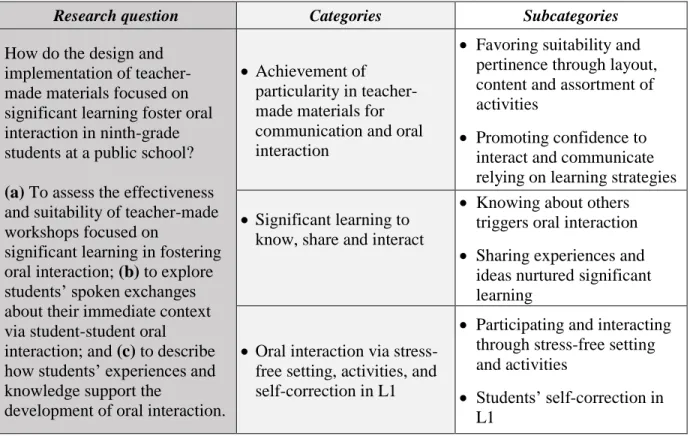
(10) TEACHER-MADE MATERIALS FOR ORAL INTERACTION. x. Theory of the nature of language and language learning: ...................................................... 38 Methodological approach underlying the pedagogical intervention: ..................................... 40 Connection of the pedagogical intervention with the research question. .............................. 40 Instructional Phases. .............................................................................................................. 41 Sample of workshop for the pedagogical intervention .......................................................... 45 Chapter IV ................................................................................................................................... 57 Data Analysis and Findings ........................................................................................................ 57 Data Analysis Procedure ............................................................................................................... 57 Research Categories and Subcategories ........................................................................................ 60 Achievement of particularity underlying teacher-made materials for communication and oral interaction. ............................................................................................................................. 60 Significant learning to know, share and interact. ................................................................... 69 Oral interaction via stress-free setting, activities, and self-correction in L1. ........................ 77 Chapter V ..................................................................................................................................... 84 Conclusions and pedagogical implications ................................................................................ 84 Conclusions ................................................................................................................................... 84 Pedagogical Implications .............................................................................................................. 87 Limitations ............................................................................................................................. 89 Question for Further Research ...................................................................................................... 90 References ..................................................................................................................................... 91 Appendixes .................................................................................................................................. 102 Appendix A: Needs Analysis Survey .......................................................................................... 102 Appendix B: Informed Consents ................................................................................................. 105 Appendix C: Video Recording Format ....................................................................................... 107 Appendix D: Field Notes Format ................................................................................................ 108 List of Tables Table 1.- Dee Fink´s significant learning categories for this study …..…………..……...…...… 21 Table 2.- Categories and subcategories of the research study ….…….………………..……….. 60.
(11) TEACHER-MADE MATERIALS FOR ORAL INTERACTION. 1. Introduction The present qualitative action research study explored how the design and implementation of teacher-made materials, focused on significant learning, foster oral interaction in ninth grade students at a public school in Bogotá. The materials designed for the pedagogical intervention aimed at generating significant learning conditions, through two workshops made up of ten lessons, for students to use English for oral interaction. The teacher-made materials specially address learners’ needs because “they are undeniably the best materials students may enjoy” (Montijano, 2014, p. 25). I also designed those workshops to respond to the particular needs of the teaching context and to compensate the absence of textbooks in the institution where the pedagogical intervention took place. Therefore, the materials made by the teacher meant to generate an ideal atmosphere to use English for communicative purposes by making students to interact orally and to enjoy while they learn from each other. According to my teaching experience, I have seen that most students in the school I teach find neither attractive nor interesting the English language subject. Likewise, they have not seen any practical purpose of what they learn at school because most classes of English as a foreign language (EFL henceforth) in the public sector have traditionally focused on grammar and decontextualized vocabulary lessons. Through the implementation of significant learning workshops, the students are the ones who bring their knowledge to the class and share it with their peers, thus, creating an interactive group’s dynamic that promotes students’ oral interaction. In the foreign language area, a legal framework in Colombia has established pedagogical orientations for the teaching and learning of English in public schools. In this regard, it is necessary to mention the General Guidelines for the Teaching of English as a Foreign Language (Lineamientos Generales para la Enseñanza del Inglés como Lengua extranjera, 1999); The.
(12) TEACHER-MADE MATERIALS FOR ORAL INTERACTION. 2. National Bilingual Program (NBP) (2004-2010) (Programa Nacional de Bilingüismo) and the National English Program “Colombia Very Well” (2015-2025) (Programa Nacional de Inglés: Colombia Very Well. These programs have made strong emphasis on the use of English for communicative practice, giving priority to speaking as an objective of the learning process. It is inevitable to mention the problem that arises concerning this legal framework. Giroux (1990) stated that there is a threat represented by a series of educative reforms that reflect the lack of trust on public school teachers and their skills to lead an intellectual and moral change in favor of the youths. In view of this, I find these guidelines unrealistic and biased because they establish and reproduce foreign practices and establish higher standards of proficiency without considering the local contexts. Teacher-made materials is a posture to resist the burden of such regulations on teachers and students’ lives. On the whole, these pedagogical guidelines however constitute a referent for the development of communicative processes in the classroom in relation to the English language, and as such, this research has as a referent these guidelines and educational legal framework. The current document has five chapters. Chapter I comprises the research and statement of the problem. This chapter also presents the research questions, objectives, a section devoted to related studies, the setting and rationale. Chapter II includes the literature review that supports this study. Chapter III relates to the methodological design. First, it includes the research design where the reader can see the approach and type of the study underlying my research as well as the participants of this study and the instruments for data gathering. Secondly, it is the instructional design where I specify the stages, strategies and objectives for the pedagogical intervention. Chapter IV accounts for data analysis and findings supported theoretically. Finally, Chapter V deals with the conclusions and pedagogical implications of this study in the public-school context..
(13) TEACHER-MADE MATERIALS FOR ORAL INTERACTION. 3. Chapter I Research Problem Statement of the Problem One of the origins of the problem that has hindered the use of English for communicative purposes in most public schools is the development of bilingualism in the domestic sphere. The National Bilingual Programme (2004-2019) has not taken into account the real linguistic and academic needs of local communities especially in public schools. In this respect, Littlejohn (2012) expressed: My own view is that this is precisely where we need to start in language teaching, by resisting the manner in which uniformity is being imposed, and by wrestling back curriculum decisions into the hands of those directly involved – teachers and learners. (p. 295) In view of this, teacher-made materials constitute an attempt to offset those pedagogical impositions emanated from standardized educative reforms in Colombia. For instance, The Basic Standards for Competences in Foreign Languages (2006c) stated as a main objective that Colombians develop communicative skills for the country to be involved in processes of universal communication and the global economy, (MEN, p. 6). This objective reduces the foreign language to a mere instrumental use in function of globalization, the economy and the development of the country. The problem that arises then is that this program has not deemed the problematic situations faced by English teachers and students’ needs in public schools. Fostering oral interaction in the classroom becomes a tough task for teachers, since grammar is what influences the English curriculum at this public school. Therefore, the English language in the classes leans towards meaningless lessons with the use of decontextualized materials and unknown places for students; similarly, there is not a sense of its importance for.
(14) TEACHER-MADE MATERIALS FOR ORAL INTERACTION. 4. communicative purposes. This situation brings discontent towards the English language and, as a result, students do not feel identified with the class’ contents and activities suggested by their teachers. Thus, learners in this context and under these circumstances do not have the chance to interact orally. Because of this, oral interaction is perceived as something difficult to achieve. To diagnose this problem, I decided to take class observation notes of my teaching practices and kept them in a reflective journal. I also developed three loop-writing activities, conducted a survey (see Appendix A), and revised archival documents of the institution such as the institutional educative program (PEI its acronym in Spanish) and the English Program Curriculum (2007). These instruments, along with the revision of Colombian Legal Framework and educative reforms, led me to state a research question, the objectives and realized the actual situation of the teaching practice of English as a foreign language (EFL hereafter) in a public institution. Therefore, I designed and implemented ten significant learning (Fink, 2003 and 2013) lessons, included in two teacher-made (Ur, 1996; Montijano, 2012) workshops to stimulate students to participate actively, to interact orally and to enjoy the experience of being in an English class. Research Question How do the design and implementation of teacher-made materials, focused on significant learning lessons, foster oral interaction in ninth graders at a public school in Bogotá? Research Objectives General objective: To explore the contribution of designing and implementing teachermade materials focused on significant learning to foster oral interaction in ninth grade students at a public school in Bogotá. Specific objectives: (a) To assess the appropriateness and usefulness of teacher-made workshops focused on significant learning in fostering oral interaction; (b) to explore students’.
(15) TEACHER-MADE MATERIALS FOR ORAL INTERACTION. 5. spoken exchanges about their immediate context via student-student oral interaction; and (c) to describe how students’ experiences and knowledge support the development of oral interaction. Related Studies Within the local academic contexts in secondary courses at public schools, many studies involve materials development and oral interaction as some of their main theoretical constructs. In case of significant learning, it is worth it to clarify that local studies in secondary grades rarely explore significant learning. This approach is usually applied in college and universities (Fink 2003; 2013). Considering that significant learning resembles meaningful learning in some respects, I decided to include local studies that have explored the implementation of meaningful learning. In relation to materials development and meaningful learning, in a qualitative action research study, Mosquera (2017) studied the impact of teacher- made materials, based on meaningful learning, to develop writing skills in 35 tenth graders from Normal Superior de Florencia, Caquetá, Colombia. The researcher collected data with students’ artefacts, teacher’s field notes and surveys. The findings suggest that the implementation of teacher-made materials promoted the development of learning activities that foster language learning and use. In addition, meaningful learning was important to contextualize contents, experiences and to encourage students to accomplish the learning activities in the workshops. Besides, students helped each other during the completion of assignments. Mosquera’s research was relevant to my study because it gives prevalence to teacher-made materials as an effective way to promote learning activities that contextualize contents, places and experiences. It is also pertinent to my research because relies on the fact that students contribute to each other to complete activities and to reach common goals..
(16) TEACHER-MADE MATERIALS FOR ORAL INTERACTION. 6. In addition, a qualitative action research study conducted by Castañeda (2015) had as its main objective the analysis of the contribution of the contextualized materials, based on meaningful learning, to the process of reading comprehension in fifteen eleventh graders from Paulo VI School IED, a public school in Bogotá. The data gathering instruments were teacher’s field notes, students’ artefacts, video recordings and a needs analysis survey conducted prior the implementation. The results of her study showed that contextualized materials along with the meaningful learning approach made students´ reading comprehension process more entertaining, stimulating and easier because those materials relied on learners’ previous knowledge and preferences. This study is pertinent to my study in the sense that it reveals the importance of designing and implementing materials that really focus on students’ needs and interests in considering their knowledge, experiences and feelings as a way to learn English pleasantly. Regarding materials development and oral interaction, in a qualitative action research study, Rincón (2016) aimed to assess the effect of workshops, based on conversation gambits, on seventh graders’ oral interaction at Liceo Dirigentes del Futuro in Bogotá, Colombia. The data gathering instruments were field notes, audio recordings and artefacts. Study findings suggest that the implementation of workshops, based on conversation gambits, influenced positively students´ motivation and encourage them to enhance their oral interaction. Lastly, learners understood that the use of conversation gambits could generate an effective, enjoyable and lively oral interaction with classmates. This study aids my research as it allowed me to realize the influence of the implementation of workshops on students´ motivation and drive to interact orally with classmates. Moreover, in a qualitative action research study, Silva (2015) explored oral interaction by designing curricular units focused on task-based learning materials in sixth graders between the ages of 11 to 14 years old from a public school in Barrancabermeja Colombia. The researcher.
(17) TEACHER-MADE MATERIALS FOR ORAL INTERACTION. 7. collected data through three instruments: informal discussion, video tapes and field notes. Among the findings of the study, the researcher showed that the curricular units shifted the teacherstudent interaction to student-student interaction, which fostered students´ self-confidence. In addition, teamwork nurtured interaction and oral interactions contributed to know their weaknesses in the structure of the language. Silva´s study is relevant to my study because it gives emphasis to student-student interaction and its contribution to boost students´ self-confidence. Her study also highlights the importance of group work to establish a kind atmosphere that leads to oral interaction. Regarding meaningful learning and oral interaction, Buitrago and Ayala (2008) carried out a qualitative, action research study whose main purpose was to propose meaningful activities that generate a relaxed atmosphere to promote oral communication in English by reducing students’ anxiety. This study took place at José Asunción Silva public school in Bogotá where researchers considered working with a group of sixteen female and seventeen male students from tenth grade, whose ages ranged from fifteen to nineteen years old. The researchers employed surveys, class observation, field notes and recordings as data gathering instruments. Among the findings, the authors suggested that some strategies and activities such as dances, linguistic games, drama, songs, sketches, presentations of little tasks, and contextualizing language activities related to students’ lives reduced language anxiety and promoted oral interaction in the classroom and in the school. This research is important for my study since it shows that teenagers are frequently anxious when interacting in English orally. Because of this, generating relaxing environments to promote classroom oral interaction through meaningful activities is a task many teachers ought to endeavor to lessen students’ anxiety towards English classes. Finally, with reference to oral interaction and materials development, Campaña (2014) in her qualitative action research study analyzed the progress of twenty eleventh grade students’ oral.
(18) TEACHER-MADE MATERIALS FOR ORAL INTERACTION. 8. interaction with the use of cooperative learning activities and some cultural issues. This research took place at Colegio Técnico Distrital Paulo Freire, a public school located in the Usme Locality in the south of Bogotá. Data collection was possible through surveys, field notes, and videotape recordings. This study reflects student´s point of view regarding the learning of English. The researcher found that her students interacted more in-group activities and that contextualized materials made students feel more motivated to speak in English. The contribution of this study to mine is that it draws attention on materials for language instruction that encourage teenagers to interact orally by implementing a variety of strategies. Setting The IED Rufino José Cuervo (RJC henceforth) is a public institution located in Tunjuelito area in the south of Bogotá city. The students that attend the school come from low to middle social class’ families who dwell in this area. They attend three hours of English weekly in average, which results in 120 hours per year. In these classes, the instruction is in English but most of the time is in Spanish because the majority of students have a low level of English or have not had any single contact with English at all. The instruction in the other subjects of the curriculum is exclusively in Spanish. The English learning classes are based on a program that emphasizes grammar and some vocabulary items. It is worth mentioning that students neither use nor bring any textbook for any subject. Thus, the information given in the classes is responsibility of the teacher who considers the program contents from the school. Though in this school, teachers have a program that orientates teachers in terms of contents and topics to be taught, they are not forced to follow such program since they also determine what is more convenient for a particular group of students..
(19) TEACHER-MADE MATERIALS FOR ORAL INTERACTION. 9. In this regard, I have seen that most of the students I have taught enjoy interactive classes where they exchange meaningful ideas instead of memorizing grammar rules that have not been effective in supporting communicative practices in the classroom. The Rufino José Cuervo (RJC hereafter) school has stated in its mission the strengthening of the English language as one of its main goals. Because of the little importance given to the foreign language in the school before the statement of the current school’s mission, the majority of students have seen English as something irrelevant. The RJC School takes the inter-structuring model as a pedagogical approach. Based on this model, learning processes rely on a dialogical relation to build knowledge through interactions in the classes. Rationale Throughout my teaching practice, I have seen that a good way to promote oral communication and interaction is to propose activities that reflect students´ needs, interests and their own experiences, so that they identify with the contents of the English class and feel attracted to speak in the foreign language. In doing so, I expect that, through the design and implementation of my own materials, students become autonomous in their process learning and can use English for practical and communicative purposes. Because of this, I consider this research benefits the local community as it develops innovative ways to foster oral interaction in an EFL context. The fact that not many teachers-researchers have developed studies of this kind of materials for the context I am teaching now, I consider that this study can be a referent for those teachers who are engaging in the rewarding task of developing their own materials for language learning. This study shows how the materials designed by teachers, can influence students’.
(20) TEACHER-MADE MATERIALS FOR ORAL INTERACTION. 10. attitudes and class dynamics and environment, thus, making a change in relation to traditional grammar-based practices to teach English. Finally, this study also contributes to the research line on Materials Development and Didactics ascribed to the group Critical Pedagogy and Didactics for Social Transformation Since the pedagogical intervention addresses the principles of “Justice, equity and inclusion”, “autonomy and empowerment”, and “quality assurance and professional development” (Núñez, Téllez & Castellanos, 2013) (p. 6-8). The implications of such principles are evident in this study in many aspects. Despite the English classes, where the implementation took place, are oriented based on an entirely grammar syllabus, I have the autonomy to decide what is best for a particular group of students. It has a positive impact on my labor as a teacher-researcher and materials developer, which also has a positive effect on students learning process. The principle of “Justice, equity and inclusion”, underlying teacher-made workshops, approaches students' actual contexts and experiences as well as their linguistic, social and cultural needs. In this sense, it is imperative to underline the importance of learning from experiences. Besides that, the workshops I designed aim to boost students' enthusiasm towards the English language and towards the process of using English for oral interaction. Additionally, for this study I made an endeavor to be constantly reflective on my own teaching practices, which improved my teaching skills and helped me develop professionally since what I do and design influences directly the context where I teach. Finally, the “quality assurance” from this study counts on a MD framework proposal that has relied on the RJC school´s pedagogical model: the interstructuring model. This model holds a constructivism view of learning and considers that students and teachers construct knowledge in an active and interstructuring way from a pedagogical dialogue (De Zubiria, 2004). Taking into account the elements previously stated I consider that the present study has contributed for the guiding principles of the Research Line on Materials Development and Didactics cited above..
(21) TEACHER-MADE MATERIALS FOR ORAL INTERACTION. 11. Chapter II Literature Review This review involves the constructs that inform my research: Materials development (MD hereafter), significant learning and oral interaction in the EFL classroom. To have a clearer idea of the implication of these constructs for this research, I provide a detailed analysis and present relevant theories relating to these three concepts. Regarding MD I report ideas from relevant authors such as Gilmore (2007), Gómez (2015), Montijano (2014), Núñez and Téllez, (2008 and 2009), Núñez et al. (2013), Richards (2006), Rico (2005), Thomas (2014), Tomlinson (1998, 2011 and 2012) and Ur (1997). Regarding significant learning, this review considers Fink´s taxonomy of significant learning (2003 and 2013) and an appraisal of Ausubel’s meaningful learning theory (1963). Finally, concerning oral interaction, authors that are mentioned for this review are Cazden (2002), Long and Porter (1985), Oliver and Philp (2014), and Tuan and Nhu (2010). Materials Development MD has received multiple definitions by different authors. Among those, it is worth mentioning those from Núñez and Téllez (2015), Núñez et al. (2013), and Tomlinson (1998, 2011 and 2012), One of such definitions states that “materials development is both a field of study and a practical undertaking” (Tomlinson, 2011, p. 2). As a field of study, it focuses on the tenets and procedures for designing, implementing and evaluating language-teaching materials. As a practical task, it contends with the production, adaptation and evaluation of materials teachers do for their classrooms or materials writers do for sale or distribution (Tomlinson, 2011). As Núñez and Téllez (2015) contended, “Language pedagogy and applied linguistics have recently recognized that MD is a field of study focused on the effect of materials on the teaching-learning.
(22) 12. TEACHER-MADE MATERIALS FOR ORAL INTERACTION process of a foreign language” (p. 57). Some, on the contrary, venture to claim that MD is worthless of a rigorous study. For instance, Samuda (2005) considered it “an essentially. atheoretical activity and thus unrewarding as an area of research” (p. 232). In my opinion, MD requires from teachers a careful implementation of strategies to corroborate the usefulness and significance of materials and their appropriateness in students’ learning. It demands an effort to assess constantly the relevance of materials developed for their classes and to determine the effectiveness in students learning process. Thus MD, as I see it, is an area of research that requires awareness of multiple theories regarding the design, development, implementation and evaluation of materials for language learning. Regarding my own teaching experience, I have realized that materials that underestimate population´s needs and interests easily discourage learners. In contrast, if we want our students to play an active role in class, materials made by teachers, which consider students´ realities through meaningful activities, facilitate the use of English for communicative purposes and motivate students to learn the foreign language. In this sense, this research study supports the making of innovative materials to foster students’ oral interaction by means of raising their confidence and reflecting on their learning process. Materials development requirements. Developing materials demands from teachers a set of aspects that interplay for the realization of students’ language learning goals. It entails “reflection, awareness of and MD rationale, affect, motivation, teachers’ beliefs, creativity, and commitment are the components that interplay in MD (Núñez and Téllez, 2015, p. 57). In view of that, the exercise of developing teacher-made materials implies reflecting on both students’ and teacher’s needs; theoretical knowledge of MD; empathy towards students and delight for the teaching practice; enthusiasm and originality to design suitable language learning materials; insights on significant learning and teaching; and responsibility towards the educational.
(23) TEACHER-MADE MATERIALS FOR ORAL INTERACTION. 13. community. For these reasons, the workshops I designed, allowed students to achieve learning goals since these meet their needs, interests and experiences. Apart from this, when complying with each of these latter MD requirements, the teacher reveals qualities of being an ethical professional with social responsibility whose understanding of students’ weaknesses and susceptibilities allow him/her to feel identified with such problems. Authentic versus non-authentic materials. Authentic materials are those originally created to entertain, inform or advice. In other words, they are samples of written or spoken texts that do not mean to teach a language (Tomlinson, 1998). In contrast, non-authentic materials are determined by intentional actions to teach the foreign language. Examples of these materials are course books, worksheets, a reading to introduce a grammar item or a dialogue to exemplify speaking patterns. There has been an important debate among material developers, instructors and theorists in relation to the effectiveness of materials authenticity for language teaching. Some authors argue in favor of the suitability of authentic materials. Thomas (2014) has supported the use of authentic materials that reflect learners’ local aspects. She emphasized multiple benefits from using these materials. Among those, authentic materials face up students with meaningful language. Just as authentic materials present advantages to teachers and benefits to students, many authors also question their use. Widdowson (1984) stated that authentic materials are not purposeful, non-contextual and are problematic for learners. In this sense, Richards (2005) considered that authentic materials are difficult particularly for beginner or low-level learners, and do not fit students’ expectations or needs. He finds that it is problematic when teachers incorporate authentic speaking samples in their classes because these have “virtually no value pedagogically” (p. 12). For me, and relating to my own teaching experience, teachers should.
(24) TEACHER-MADE MATERIALS FOR ORAL INTERACTION. 14. carefully present authentic materials to the class. At times, teachers decide to introduce language through a song or a movie and then unknown terms or phrases incorporated in these samples deserve a meticulous explanation to the students, something that is time consuming and make students go astray from what was the original objective of the class. As can be seen, the controversy is intense. To reconcile both stances, Gilmore (2007) argued that “from the classroom teacher’s perspective, rather than chasing our tails in pointless debate over authenticity versus contrivance, we should focus instead on learning aims” (p. 98). This idea gives prominence to the teacher’s view in relation to what it is beneficial for a particular group of students. Authentic materials should comply with teaching processes and learners´ needs, as long as it happens, they will help students achieve learning goals. Materials and typology. Materials for ELT are resources that teachers employ to teach the target language. To this respect, Tomlinson (2012) broadly identified “informative, …, instructional, …, experiential, …, eliciting, …, and exploratory materials, … (p. 143). Although, informative materials are predominant in English language lessons, my attempt with teachermade materials is that students practice, use and experience the language meaningfully, and that they can make discoveries about the language. Thus, for the purpose of this study, the teachermade materials proposed fall into the category of being contrived, informative, instructional, experiential, eliciting materials. In general, materials are pedagogical resources that range from textbooks to songs, or even the use of the board (Tomlinson, 1998). Other materials like “course books, videos, graded readers, flash cards, games, websites and mobile phone interactions” (Tomlinson, 2012 p. 143) can also be a source of input deliberately used in class that support teachers to present new language input in the classroom. For Núñez and Téllez (2015, 2009) and Núñez, Téllez, Castellanos, and Ramos (2009) materials may be learning exercises or activities, tasks, lessons,.
(25) TEACHER-MADE MATERIALS FOR ORAL INTERACTION. 15. worksheets, didactic units, modules, workshops, or books. In this sense, teachers, regarding their context and students´ needs and backgrounds, require implementing pertinent materials to provide language input to students. Núñez, et al. (2013) offered a more inclusive definition of materials where they state that these are “socio-cultural resources that facilitate not only linguistic interaction but also cultural exchanges between the various human groups” (p. 10). In my view, and reflecting on my students´ reality, this is what materials for language instruction have to do, to address students’ attitudes and their socio-cultural contexts. For the aforementioned feature, when developing materials, it is vital to reckon the sociocultural contexts in which the learning and teaching processes take place. Forman, Minick, and Stone (1993), Gómez (2015), Rico (2005), and Rueda (1998) to name a few, claimed that the development of teaching materials has to reflect sociocultural aspects and local needs of populations, learners and even teachers. Thus, “Culture cannot be ignored in program designs and teaching and … cannot be disregarded in the design of communicative textbooks” (Gómez, 2015, p. 168). According to Rico (2005), “Colombian teachers implement many things in their classrooms without realizing the impact of those implementations in the theoretical and practical field” (p. 96). Therefore, materials for language learning should entail a sociocultural standpoint. Accordingly, the materials I make as a teacher generate alternatives towards students’ wellbeing by means of contextualizing the English learning and addressing learners’ lives and everyday experiences for students to interact orally with confidence in the EFL classroom, which is the result of thinking in advance about the effect of those materials in my students’ English learning. The vast array of materials for language learning include some other kind of resources. In this regard, teachers design or adapt a variety of materials to fit students’ needs, interests and abilities. These materials should also fulfill the institutional requirements of curricula or official state exams (Rico, 2005). Considering this, it is useful to refer to some of these materials for.
(26) TEACHER-MADE MATERIALS FOR ORAL INTERACTION. 16. language learning. To begin with, teachers can design in house materials and take advantage of some of their benefits. Bedwell (2012) argued that “the main advantage of the in house-approach is that it is completely responsive to local needs” (p. 1). This is something difficult to attain with commercial or published materials that do not respond to the needs of a specific target population. In the world of materials for language teaching and learning, we can also find adapted materials that according to Duarte and Escobar (2008), “Can positively influence students’ motivation when learning a foreign language” (p. 63). These can also help teachers whose limited amount of time deters them from designing their own materials. Another classification of materials is given by Mayora (2013) who stated that materials are classified by purpose (authentic, non-authentic) by format (Paper-based, audiovisual, and electronic) and by creator (in house-commercial). Some authors support the teachers own design of materials. Howard and Major (2004) claimed that “despite the current rich array of English Language teaching material commercially available, anecdotal evidence suggests that many teachers continue to produce their own materials for classroom use” (p. 50). Therefore, when teachers develop their own materials it is time-consuming, nevertheless, this is a unique experience where teachers can cater for specific learning objectives and learning styles (Núñez, Pineda & Téllez, 2004). Thus, apart from generating a proper atmosphere through significant learning experiences to learn English, making my own materials is also a challenging and rewarding experience that benefits my teaching practice and my students’ learning, which is also the result of autonomy as it is a desirable condition for teachers´ professional growth. Teachers’ autonomy in MD. Although MD, as a field of study, has continuously regarded learners’ needs, a crucial point in this study is to consider teachers’ needs too. Then, for.
(27) TEACHER-MADE MATERIALS FOR ORAL INTERACTION. 17. innovative MD for language instruction, it is essential to analyze not only students’ needs but to deem teachers’ necessities in the academic context for the sake of the teachers as material developers and the entire educative community. Teachers, through the design of innovative, resourceful, and time-consuming materials and lesson planning partly alleviate students’ educational, cultural and even social needs. Meanwhile, the educational system has compelled the teacher to become a simple curriculum administrator. A system that reduced the learning process to the achievement of visible objectives predetermined by the educative technology and the instructional design as well as a teaching based on content transmission (Tamayo, 2006). This condition has left teachers at the mercy of external conditions and without sense of their real social purposes. A desirable condition for teachers to comply successfully with their social function and, in this case, as material developers for language instruction is autonomy. In this sense, Pearson and Moomaw (2005) stated: If teachers are to be empowered and exalted as professionals, then like other professionals, teachers must have the freedom to prescribe the best treatment for their students … and the freedom to do such has been defined by some as teacher autonomy. (p. 38) As long as teachers have the freedom to define what is appropriate for a determined group of learners and that in fact they apply their knowledge and expertise autonomously, they will be capable of generating materials that benefit the community. Material developers have emphasized that materials for language instruction ought to cope with students’ requests and learning necessities. Apart from this, legal or institutional constraints have influenced negatively the teaching processes. Institutions and societies should empower teachers and allow them to be autonomous, so that they freely create materials and implement them without restrictions. This situation can generate alternatives to students as these.
(28) TEACHER-MADE MATERIALS FOR ORAL INTERACTION. 18. teacher-made materials promote attractive atmospheres to learn English through significant learning experiences. Teacher-made materials. I consider teacher-made materials as an important aspect for this study, given that these are designed by me, as I know well my students, their needs and their social contexts. In fact, as affirmed by Ur (1996), “Good teacher-made materials are arguably the best there are: relevant and personalized, answering the need of the learners in a way no other material can” (p. 192). Consequently, in relation to this type of materials, there is an account of the advantages and challenges when teachers engage in the task of making their own EFL materials. Firstly, Ur (1996) claimed that teachers tend to use teacher-made materials for many reasons. For example, teacher-made materials provide the teachers with what they need as no other kind of material can do, these materials also address to the needs of a group, and teachers use them “simply in the sake of variety” (p. 192). In the same way, Montijano (2014) suggested that teacher-made materials are relevant, tailored for students, and respond more than any other kind of materials to their necessities. In addition, these materials influence in a positive way the class atmosphere and some other elements related to the teaching practice. Following Montijano’s insights, when educators implement teacher-made materials, “the classes become more inspiring and the curriculum becomes more stimulating” (p. 281). Accordingly, when teachers have the opportunity to make their materials and implement them, without legal or institutional constraints, it implies a huge degree of autonomy, which is a desirable condition to achieve professional growth. This autonomy influences the quality of materials teachers make for language instruction. Among the challenges, Montijano (2014) contended that “designing teacher made materials takes time, effort and unquestionably makes tough demands of practitioners who must hold both.
(29) TEACHER-MADE MATERIALS FOR ORAL INTERACTION. 19. the awareness and understanding of the manifold interwoven variables affecting teaching theory” (p. 281). These challenges more than an obstacle represent a motivation for teachers because, when dealing with the different variables interfering in the pedagogical practice, one must grow personally and professionally and this development benefits the institution and students too. This is also a rewarding aspect from sorting out those challenges. These reasons are fundamental to consider teacher-made materials as an essential component that contributes to teacher professional development (Núñez & Tellez, 2009; Núñez, Téllez & Castellanos, 2012; Núñez, Téllez & Castellanos, 2017) In addition, proposing these alternative materials is an attempt to humanize the English teaching as a socio-cultural matter that gives prevalence to learners’ experiences and ways of life. It all leads to a class dynamic where students learn from their shared knowledge through significant learning experiences. Significant Learning Most of this research reflects the importance of significant activities, lessons, contexts and learning in general. An essential aspect for developing oral interaction in the classroom is that learners find an attractive atmosphere to enjoy and feel confident to speak English. Then, EFL teaching seeks that students share experiences, feelings and ideas in the classroom. For this, significant learning lessons and experiences are essential aspects of the learning process. From Meaningful to Significant learning. Ausubel´s (1963) meaningful learning theory states that learning is possible because students relate new events to already existing information. Thus, learners´ experiences, anecdotes and representation of their own reality and environments become fundamental for learning as these connect to contents presented to learners in the class. Given these conditions, students easily retain and apply the new information. Ausubel emphasized that teachers should consider students’ previous knowledge to support meaningful learning. When teachers are aware of this, they may promote better teaching practices..
(30) TEACHER-MADE MATERIALS FOR ORAL INTERACTION. 20. Despite its influence on understanding learning processes, Ausubel’s meaningful learning theory has a limitation. This is because it is unsatisfactory in accounting for how students learn in current contexts where modern technologies proliferate in the information society (Palomar & García, 2010). These authors claimed that teaching and learning processes have focused on the interactions, culture and identity to understand how people learn. According to these authors, the limitation of Ausubel’s theory lies on the fact that it comprises three elements: Teacher – student – contents, and disregard essential aspects for learning such as culture and interactions (Palomar & García, 2010). In such case, I leaned towards a more inclusive approach that comprises the interactions involved in cultural processes. For this, significant learning offers the basis that helps make a connection between students’ lives and the contents of the teacher-made workshops. Significant learning experiences. In this regard, it is necessary to consider not only students´ prior experiences and interests to connect them to class’ contents, but also the importance of culture and interactions among teachers and students to generate opportunities to learn English. In this sense, this study regarded some categories from Dee Fink´s taxonomy of Significant learning (2003 and 2013). Although, significant learning experiences relate often to college or university courses, in this research, this approach endeavors to apply these to secondary students. The following categories reveal the importance of social interactions and the culture. According to Fink (2003), “For learning to occur, there has to be some kind of change in the learner. No change, no learning. And significant learning requires … some kind of lasting change that is important in terms of the learner’s life” (p. 3). Hence, students have to interact in their socio-cultural context to make possible these changes. This is why I opted for integration, human dimension and caring from Fink´s Taxonomy of significant learning as categories that serve for my research´s purposes..
(31) 21. TEACHER-MADE MATERIALS FOR ORAL INTERACTION. Table 1 Dee Fink´s significant learning categories for this study Integration Students make connections among different ideas, experiences and life ambits. Special value: When learners make these connections, it confers them a sort of intellectual power. Value for present study: The integration of different aspects of students’ lives encourages them to participate actively in class, as their ideas will be valuable.. Human dimension. Learning about self and others allows students to interact efficiently. Students notice the relevance of what they have learned. This category tells that students approach to others’ attitudes and feelings, then, they can interact effectively. Special value: This category expresses the significance of the human dimension of what they are learning. Value for present study: When students feel attracted to know more about others´ thoughts, feelings and experiences, they will interact more effectively. They will ask and answer questions that involve personal information. Table 1. Adapted from Fink (2003 & 2013). Caring This knowledge is significant because students change their perception of something they learned in class. As Fink stated: “Any of these changes means students now care about something to a greater degree or in a way than they did before” Special value: In Fink´s words “when students care about something, they then have the energy for learning more about it and making it a part of their lives.” Thus, this learning becomes significant. Value for present study: When students get interested in class contents, they will relate this knowledge to their personal lives.. Although Fink (2003 & 2013) proposed six categories in his taxonomy of significant learning, for this study the three categories described above in Table 1 adjust to the objectives of this research study. Fink presented the special value for each category. Table 1 also tells why these categories of significant learning are valuable for my study. Given the importance of the socio-cultural context to generate significant environments for learning and interactions in the classroom, these three categories are relevant since they offer a basis to understand contextualized and significant learning. Furthermore, these kinds of learning support the.
(32) TEACHER-MADE MATERIALS FOR ORAL INTERACTION. 22. implementation of objectives for the lessons in the pedagogical intervention. These objectives represent the value of significant learning to develop oral interaction in the classroom. Oral Interaction An objective to achieve through this research study is to promote oral interaction in ninth grade students from a public school. First, it is necessary to identify what are the implications of oral interaction in this context, what it is, and how interactive processes relate to this study. As oral interaction has a theoretical background that involves many ideas that are essential to elucidate, this section presents these to have a clear understanding of the implications of this construct for the present study. Interaction. The concept of interaction as such has multiple views and meanings as it refers not only to spoken language, but also to written communication. One of those meanings defines interaction as “the heart of communication; it is what communication is all about” (Brown, 2001, p. 165). In fact, Brown gave prominence to interaction as an essential aspect in human communication. However, what human communication involves is difficult to express in simple terms. Brown showed also the dimension of interaction for every aspect of our lives. He proposed the following: Interaction is the collaborative exchange of thoughts, feelings, or ideas between two or more people, resulting in a reciprocal effect on each other. Theories of communicative competence emphasize the importance of interaction as human beings use language in various contexts to “negotiate” meaning, or simply stated, to get one idea out of one person´s head into the head of another person and vice versa. (p. 165) As Brown (2001) contended, interaction implies the exchange of useful and meaningful information. When the information is neither useful nor significant, interaction does not carry out successfully. This definition also indicates that the exchanges of information must be relevant for.
(33) TEACHER-MADE MATERIALS FOR ORAL INTERACTION. 23. participants in a conversation. When dealing with oral interaction in the classroom, students should feel that what they speak is important for them and their peers. In addition, this latter definition implies that interaction processes in the classroom should reflect students’ immediate sociocultural backgrounds too. Approaches to interaction in the classroom. Indeed, a sociocultural point of view of interaction is what may lead to successful interactive processes in the classroom. Before illustrating the significance of a sociocultural perspective for interactions, it is worth analyzing customary approaches on this matter. Hall (2001) referred to traditional views on interaction and their attempt to impel learners to grasp formal aspects of language such as its grammatical structures. She evoked those traditional standpoints, for example: input-oriented research, negotiation-oriented research, and output-oriented research. The author further asserted that these views on interaction “as discrete, stable, bounded sets of linguistic systems” (p. 21). Such views deem interactive processes as individually based, by which foreign language structures are integrated and internalized (Hall, 2001). As a response to these discrete views on interaction, renowned authors developed a sociocultural perspective to analyze interactions from different disciplines. This is why “considerable attention has been focused on cultural differences in patterns of interaction and their possible influence on students’ engagement with their teacher and with academic tasks” (Cazden, 2002, p. 68). The school is a place where people from different socio-cultural backgrounds interact; in these contexts, students and teachers share ideas, experiences, and opinions. Through these interactive processes, each of the individuals has the desire of learning from each other, and they may probably learn about something unknown, yet appealing and thought provoking. Oral interaction. The main function of spoken language is interactional, in the sense that through oral communication we begin and sustain social relations (Brown, & Yule, 1983). A.
(34) TEACHER-MADE MATERIALS FOR ORAL INTERACTION. 24. common and practical way to perform this communication is by oral interaction. It refers to the use of the spoken language between people in dialogues or conversations. Participants in these conversations take turns to speak either asking or replying, what implies that oral interaction is collaborative and mutual (Oliver, & Philp, 2014). These assertions highlight oral interaction as an effective way people communicate ideas, feelings and socialize. Types of oral interaction. An aspect that is essential to understand is the process of classroom oral interaction among students and the teacher. One way it occurs is through teacher/student(s) interaction, and the other one between and among students (Tuan & Nhu, 2010). Regarding teacher/student interaction, Sinclair and Coulthard (1975) studied classroom oral interaction and recognized a common interaction pattern known as IRF, where (I) stands for the initiation by the teacher; (R), which is the student´s reply or response; and (F) which means teacher´s feedback. This one is the most common type of interaction in the classroom and according to Tuan & Nhu (2010) in this pattern, “The teacher is central to the classroom interaction while students are passive listeners” (p. 31). In fact, the IRF pattern of oral interaction, feedback is usually corrective and ends the possibilities to ask different kinds of questions that may encourage students’ participation. The idea of a communicative classroom, where every student is an active participant and collaborates with the group´s dynamic, is that they are central to the learning process whereas the teacher is a facilitator, an outcome difficult to achieve through teacher-student interaction and specially through IRF pattern of oral interaction. In relation to student/student interaction, we evince this interactive process through pair or group work. Long and Porter (1985) developed a series of arguments in favor of group work. The authors further asserted that group work is useful “for increasing the quantity of language practice opportunities, for improving the quality of student talk, for individualizing instruction, for creating a positive affective climate in the classroom, and for increasing student motivation”.
(35) TEACHER-MADE MATERIALS FOR ORAL INTERACTION. 25. (pp. 207–208). Concerning these benefits, I agree that group work, when it comes from a wellplanned and organized lesson, will have positive effects on students’ oral interaction. It all depends on how teacher structures the class and the lesson, and how he/she gives opportunities to learners to share their ideas in the classroom. For this particular research, student-student interaction plays an important role in the development of the lessons because this kind of interaction serves the purpose of generating an ideal atmosphere in class that promotes oral interaction. Oral interaction, as presented here, emphasizes the importance of the sociocultural background as an aspect that contributes to the exchange of experiences and anecdotes between students and teacher. In fact, this sociocultural component generates an ideal environment that fosters oral interaction. In addition to promoting interaction in the classroom, it is necessary to adapt lessons objectives to students’ needs and personal interests. It is important to say that whereas IRF pattern of oral interaction is corrective and relies on teacher centeredness lessons, group work maximizes learners´ opportunities to use English orally for communicative purposes and helps them achieve learning goals. It is also crucial for this research study to reflect on classroom oral interaction processes to understand how students get involved in and/or improve their oral performance in the public-school context. Having discussed the three constructs that constitute this research, Materials Development, Significant Learning and oral interaction, the next chapter offers some insights in relation to the methodological design of this study..
Figure
Documento similar
