
Grammatical accuracy improvement in virtual learning environments using screencast feedback
123
0
0
Texto completo
(2) Running head: GRAMMATICAL ACCURACY IMPROVEMENT IN VIRTUAL LEARNING ENVIRONMENTS THROUGH SCREENCAST FEEDBACK. Grammatical accuracy improvement in virtual learning environments using screencast feedback. Diana Mireya Cuéllar Sánchez. Research Report submitted in partial fulfillment of the requirements for the degree of Master in English Language Teaching for Self-Directed Learning. Directed by: Prof. Claudia Acero Rios. Department of Foreign Languages and Cultures Universidad de La Sabana Chía, Colombia October 2016. 1.
(3) GRAMMATICAL ACCURACY IMPROVEMENT IN VIRTUAL LEARNING ENVIRONMENTS THROUGH SCREENCAST FEEDBACK. 2. Declaration. I hereby declare that my research report entitled:. Grammatical accuracy improvement in virtual learning environments using screencast feedback . is the result of my individual work done as declared and specified in the text;. . is neither substantially the same as nor contains substantial portions of any similar work submitted or that is being concurrently submitted for any degree or diploma or other qualification at the Universidad de La Sabana or any other university or similar institution except as declared and specified in the text;. . complies with the word limits and other requirements stipulated by the Research Subcommittee of the Department of Foreign Languages and Cultures;. . has been submitted by or on the required submission date.. Date: 04/10/2016 Full Name: Diana Mireya Cuéllar Sánchez Signature:.
(4) GRAMMATICAL ACCURACY IMPROVEMENT IN VIRTUAL LEARNING ENVIRONMENTS THROUGH SCREENCAST FEEDBACK. 3. Acknowledgements. I would like to thank all those people who made this thesis possible and an unforgettable experience for me.. I would like to express the deepest sense of gratitude to my beloved mother for her love and continuous support and encouragement whenever I was in need.. I acknowledge my gratitude to my research counselor, Claudia Acero Rios, for her patience, motivation, guidance, invaluably constructive criticism and friendly advice during the project work..
(5) GRAMMATICAL ACCURACY IMPROVEMENT IN VIRTUAL LEARNING ENVIRONMENTS THROUGH SCREENCAST FEEDBACK. 4. Abstract This research was carried out with 49 undergraduate students enrolled in a Colombian, virtual, public university. It aimed to analyze the grammatical accuracy improvement of students when writing short descriptive texts after they received feedback through screencasts. This study was a mixed action research since qualitative and quantitative methods to gather data were used; this approach allowed the researcher to use four types of instruments: a pre intervention survey, students’ short descriptive texts, a teacher’s journal and a post intervention survey. Data was analyzed using Descriptive Statistics and Grounded Theory. Findings revealed that students who were developing their language competencies in a virtual learning environment benefited through the use of image and audio in a single resource, which allowed the teacher to combine oral and written comments, provide observations on specific issues, and suggest how errors should be corrected. In like manner, screencast feedback proved to be a strategy that not only allowed students to have the opportunity to understand and improve their grammatical errors when writing short descriptive texts but also the teacher to make appropriate and punctual suggestions. Key words: confidence, grammatical accuracy, screencast feedback, virtual language environment.
(6) GRAMMATICAL ACCURACY IMPROVEMENT IN VIRTUAL LEARNING ENVIRONMENTS THROUGH SCREENCAST FEEDBACK. 5. Resumen Esta investigación se llevó a cabo con 49 estudiantes de pregrado matriculados en una universidad colombiana, pública y virtual. El objetivo era analizar la mejora en la exactitud gramatical en los estudiantes al escribir textos descriptivos cortos después de recibir retroalimentación a través de grabaciones con captura de pantalla. Este estudio fue una investigación acción- mixta donde se usaron métodos cualitativos y cuantitativos para recopilar datos; este enfoque permitió que el investigador usara cuatro tipos de instrumentos: una encuesta previa a la intervención, textos descriptivos cortos de los estudiantes, el diario del docente y una encuesta posterior a la intervención. Los datos fueron analizados utilizando la Estadística Descriptiva y la Teoría Fundamentada. Los resultados revelaron que la retroalimentación a través de captura de pantalla permitió al docente dar explicaciones adecuadas y puntuales sobre errores gramaticales específicos en los textos descriptivos de los estudiantes, así como ejemplos y sugerencias sobre cómo los errores debían ser corregidos mediante el uso simultáneo de voz y la imagen y la combinación de comentarios orales y escritos. Además, los estudiantes que estaban desarrollando sus competencias lingüísticas en un entorno virtual de aprendizaje se beneficiaron a través del uso de grabaciones de pantalla, porque tenían la oportunidad de reproducir la imagen y audio en un único recurso, escuchar la explicación del docente, entender qué y cómo se tenía que mejorar sus errores gramaticales y sentir el apoyo emocional proporcionado por el profesor a través de un seguimiento personalizado.. Palabras claves: Ambientes virtuales de aprendizaje, captura de pantalla, confianza, exactitud gramatical..
(7) GRAMMATICAL ACCURACY IMPROVEMENT IN VIRTUAL LEARNING ENVIRONMENTS THROUGH SCREENCAST FEEDBACK. 6. Table of contents Introduction ................................................................................................................................... 12 Statement of the Problem ........................................................................................................... 14 Research Question ..................................................................................................................... 19 Objectives .................................................................................................................................. 19 Rationale .................................................................................................................................... 20 Theoretical Framework.................................................................................................................. 24 Grammatical Accuracy in Writing ............................................................................................. 24 Short Descriptive Text ............................................................................................................... 28 Virtual Language Environment ................................................................................................. 29 Errors and Feedback .................................................................................................................. 34 Screencast to provide feedback .................................................................................................. 41 State of Art ................................................................................................................................. 45 Research Design ............................................................................................................................ 48 Type of Study............................................................................................................................. 48 Context ....................................................................................................................................... 49 Participants................................................................................................................................. 51 Teacher’s Role ........................................................................................................................... 52 Data Collection Instruments and Procedures ............................................................................. 52 Surveys. ......................................................................................................................... 52 Students’ texts. .............................................................................................................. 54 Teacher’s journal. .......................................................................................................... 54 The Data Collection Procedures ................................................................................................ 55 Validation of the Instruments .................................................................................................... 56 Ethical Considerations ............................................................................................................... 57.
(8) GRAMMATICAL ACCURACY IMPROVEMENT IN VIRTUAL LEARNING ENVIRONMENTS THROUGH SCREENCAST FEEDBACK. 7. Timeline ..................................................................................................................................... 57 Pedagogical Intervention ............................................................................................................... 58 Data Analysis and Results ............................................................................................................. 65 Data Management Procedures ................................................................................................... 65 Data Analysis Procedures .......................................................................................................... 65 Quantitative data analysis .......................................................................................................... 66 Qualitative data analysis. ........................................................................................................... 72 Open coding .................................................................................................................. 72 Axial coding .................................................................................................................. 73 Selective coding ............................................................................................................ 74 Conclusions and Pedagogical Implications, Limitations and Further Research ........................... 87 Conclusions ................................................................................................................................ 87 Pedagogical Implications ........................................................................................................... 90 Limitations ................................................................................................................................. 92 Further Research ........................................................................................................................ 93 References ..................................................................................................................................... 95.
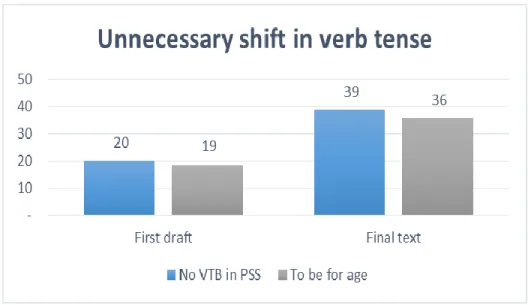
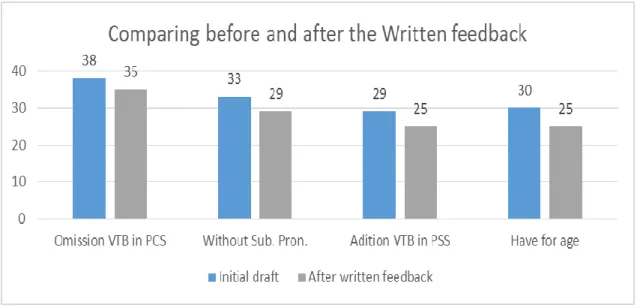
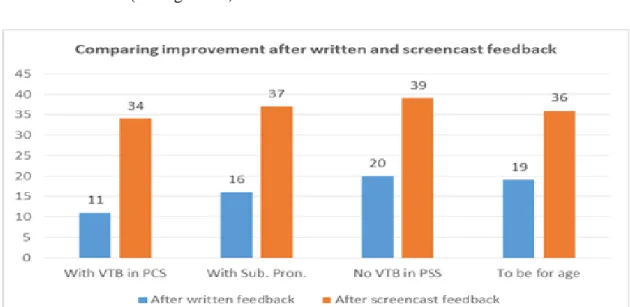
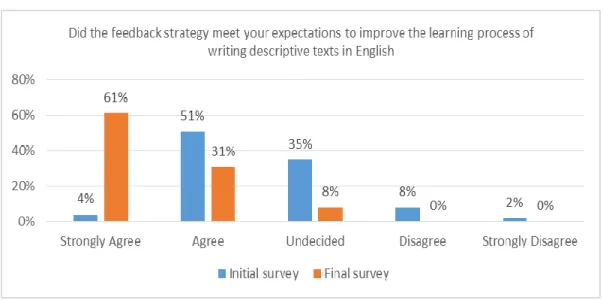
(9) GRAMMATICAL ACCURACY IMPROVEMENT IN VIRTUAL LEARNING ENVIRONMENTS THROUGH SCREENCAST FEEDBACK. 8. List of Figures Figure 1. Written feedback to a student using different colors in the virtual forums. ......... 16 Figure 2. Colored-written feedback ...................................................................................... 19 Figure 3. English course homepage. .................................................................................... 50 Figure 4. Data collection procedure. ................................................................................... 55 Figure 5. Collaborative learning environment. English A1- 2015-1. ................................ 58 Figure 6. Pedagogical implementation stages. ..................................................................... 59 Figure 7. Writing assignment instructions on the forum. .................................................... 61 Figure 8. Writing process and Screencast feedback stage .................................................... 62 Figure 9. Links posted in the virtual forums. ....................................................................... 64 Figure 10. Results from initial and final text for sentence fragment. .................................. 67 Figure 11. Results from initial and final text for unnecessary shift in verb tense. ............... 68 Figure 12. Quantitative analysis question # 4 initial and final survey ................................. 69 Figure 13. Results from written feedback. .......................................................................... 70 Figure 14. Data after written and screencast feedback. ....................................................... 71 Figure 15. Results from initial and final survey. Question # 7 and 9, respectively. ........... 72.
(10) GRAMMATICAL ACCURACY IMPROVEMENT IN VIRTUAL LEARNING ENVIRONMENTS THROUGH SCREENCAST FEEDBACK. 9. List of Tables Table 1 Examples from Students’ Most Common Errors .................................................... 17 Table 2 Lunsford and Lunsford’s most common formal errors in 2006 .............................. 35 Table 3 Lee’s Major Error Feedback Techniques ................................................................ 39 Table 4 Hyland and Hyland’s Categories for Written Comments ....................................... 40 Table 5 Sample Discrimination and Percentages of Age and Gender .................................. 51 Table 6 Topics to Be Reviewed ............................................................................................ 59 Table 7 Writing Chart. Taken from English 0 at UNAD ..................................................... 62 Table 8 Indicators from the open coding phase .................................................................... 73 Table 9 Categories and Sub- Categories Emerged From Axial Coding ............................... 74 Table 10 Core Category and Subcategories ......................................................................... 75.
(11) GRAMMATICAL ACCURACY IMPROVEMENT IN VIRTUAL LEARNING ENVIRONMENTS THROUGH SCREENCAST FEEDBACK. 10. List of Appendices Appendix A. Unit Content Sample ..................................................................................... 103 Appendix B. Participants’ Consent Letter .......................................................................... 104 Appendix C. Students’ Descriptive Text ............................................................................ 105 Appendix D. Teacher’s Journal Sample ............................................................................. 107 Appendix E. Initial Survey ................................................................................................. 108 Appendix F. Final Survey................................................................................................... 110 Appendix G. Research Project Timeline ............................................................................ 112 Appendix H. Descriptive Text Rubric ................................................................................ 113 Appendix I. Writing Guide Sample .................................................................................... 114 Appendix J. Students´ Screencast Feedback Samples ........................................................ 119 Appendix K. Quantitative Results from the Initial and Final Surveys ............................................................................................................................................ 120 Appendix L. Students´ Writing Errors ............................................................................... 122.
(12) GRAMMATICAL ACCURACY IMPROVEMENT IN VIRTUAL LEARNING ENVIRONMENTS THROUGH SCREENCAST FEEDBACK. List of Abbreviations Abbreviations. Meaning. DTs. Descriptive text. FL. Foreign Language. PCS. Present continuous sentences. PSS. Present simple structure. SLW. Second Language Writing. Sub. Pron. UNAD. Subject pronoun Universidad Nacional Abierta y a Distancia. VLE. Virtual learning environment. VLEs. Virtual learning environments. VTB. Verb to be. WF. Written feedback. 11.
(13) GRAMMATICAL ACCURACY IMPROVEMENT IN VIRTUAL LEARNING ENVIRONMENTS THROUGH SCREENCAST FEEDBACK. 12. Introduction Information and Communication Technology (ICT) has become significant in the way teachers transform their practice, how students learn and how teaching and learning are mediated differently. As stated by Landazabal (July 31st, 2006) in her presentation Mediation in Virtual Learning Scenario: Analysis of Metacognitive Strategies and Communication Tools, “the virtual environments have expanded the possibility of innovative educational practices” as a response to the social needs for educational changes. Such needs emerge from request of potentiating new approaches to learning, using virtual platforms where students and teachers can experience new tools for meeting and communicating, as well as a different way of organizing, attending and guiding lectures, discussions, or exams based on technological configurations. Therefore, ICT in education is an innovative alternative in universities, which enables educators to think of new scenarios and opportunities for teaching. Nowadays, it is imperative to take advantage of modern technological facilities to benefit education especially the task of English language instruction. Mainly, the development of writing skills, since students at university level are required to produce accurate and clear written material (e.g. stories, worksheets, or descriptions) to demonstrate learning; to help in the communication process between teachers and students in as much as writing is commonly used in electronic mails, bulletin boards, forums and chatrooms in virtual language environments (VLEs). Hence, teachers face a real challenge; they need to explore different patterns as well as new teaching strategies to perform a relevant role in the learning process through a permanent monitoring that guides and motivates students to improve their English, specifically their writing skill..
(14) GRAMMATICAL ACCURACY IMPROVEMENT IN VIRTUAL LEARNING ENVIRONMENTS THROUGH SCREENCAST FEEDBACK. 13. It is a fact that if a teacher wants students to have a well-organized text, writing in VLEs, requires according to Cardona and Novoa (2013), “multiple thinking processes such as brainstorming, selection and organization of ideas, facts, thoughts or opinions” (p. 8). Therefore, teachers have to boost and facilitate content apprehension processes with meaningful virtual activities where students can practice grammar structures and vocabulary to use in a text; as well as to consider different techniques to provide feedback and support the development of writing skill through the implementation of technological tools offered by Web 2.0. In effect, ICT not only helps students in the improvement of writing, it also help teachers to face the challenge of aiding learners to write a text. Moreover, it provides varied useful tools to the teacher to monitor students’ writing process by implementing permanent, clear, to the point and personalized feedback, so that writers improve their writing accuracy and their confidence as writers. Feedback is an essential and powerful strategy that allows guidance to help students achieve learning, as Brookhart has stated, “giving feedback based on the particular qualities of a student’s work, means the information itself will be of maximum usefulness in the process of writing drafts” (2008, p. 48). In that sense, feedback motivates students who usually expect comments about their work, allowing meaningful application of what they have learned from the feedback to the construction of a final product, since students receive guidance about how to improve their texts. As feedback could be provided by means of written or oral comments, different techniques such as direct annotations on the drafts or the forums; therefore, in this study teacher-researcher administered personalized feedback through videos to students who were enrolled in a virtual English course at Universidad Nacional Abierta y a Distancia (UNAD)..
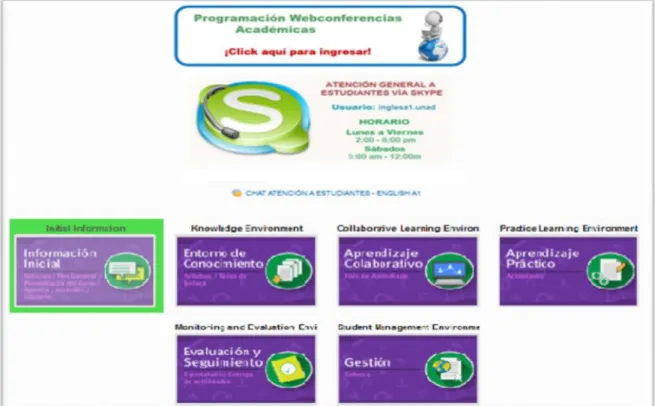
(15) GRAMMATICAL ACCURACY IMPROVEMENT IN VIRTUAL LEARNING ENVIRONMENTS THROUGH SCREENCAST FEEDBACK. 14. This university has been characterized by the permanent use of ICT as mediators of learning activities and acknowledges the importance of learning a foreign language particularly English. It has been established in the UNAD’s National English Program that “ICT strengthen reading, listening, speaking and especially writing skill development” and “enhance learners’ awareness and abilities to become better writers” (author’s translation. National English Program, 2012, p. 3) through the performing of different activities in its virtual platform named UNAD virtual. Writing at UNAD is a major component in most of the activities and the main way teachers and students interact. Furthermore, as students require permanent support and monitoring, teachers should devote significant time and effort revising writings in the forums to have students’ mistakes corrected in a timely, motivational and sensitive way, so that learners can understand the explanations. Consequently, this study illustrates a mixed action research focused on the use of ICT - mainly screencasts - as a strategy to provide feedback in VLEs focused on the teaching and learning process of learners’ writing skills – evidenced in descriptive texts-, through the use of a computer service called Jing®; a free screenshot and screencast software that enabled the teacher-researcher turn screen output into a video to provide the necessary support to students through personalized feedback. Statement of the Problem This study was developed in an English online course, in the free and open-source software learning management system, Moodle 2.5. This course had 3 units with different reading and grammar exercises to practice the course content, as well as nine (9) activities to be developed and assessed along the learning process. Regarding this study, learners had a written activity located in the virtual forum, where individually they had to write a short descriptive text. Initially, they had their first drawback since students who were in English.
(16) GRAMMATICAL ACCURACY IMPROVEMENT IN VIRTUAL LEARNING ENVIRONMENTS THROUGH SCREENCAST FEEDBACK. 15. A1 at UNAD did not have samples for a clear idea of what descriptive writing was, so, they had to create their own texts with no samples. This is in contrast to what some researchers such as Rodriguez have pointed out about providing models during the writing process. For him, “students need models to practice” (as cited in Nunan, 1999, p. 273), they need to be exposed to similar samples of the type of text they are require to produce, they need to know the structure, think about ideas and get them onto paper to have a final product. Then, the teacher-researcher’s daily and empirical observation to the students’ writings, allowed her to identify the difficulties students experienced when they wrote descriptive texts (DTs): First, learners wrote short sentences as they translated from Internet tools or using a dictionary, disregarding whether they were following the correct grammar structure or words. Second, most of the errors shown referred to their limited control of the studied simple grammatical structures and sentences patterns, competence that according to the Common European Framework (CEFR, 2002, p. 24) students should develop in A1 level, which evidently represents a serious problem regarding their grammatical accuracy. In fact, students used to receive written feedback by their teacher about the errors in their texts. This feedback was mainly provided through direct and indirect comments about the performance of the first draft. Indeed, teacher – researcher implemented direct feedback to locate and provide in a written way, the correct linguistic forms of the students’ errors; this type of feedback was administered in Spanish as soon as the first draft was uploaded in the virtual forums. The other technique to correct errors was through indirect feedback, it was given to students by indicating where the errors were without correcting them. For this purpose, a set of conventions was established and communicated to students: . highlighted red when students had to change the word into the correct one;.
(17) GRAMMATICAL ACCURACY IMPROVEMENT IN VIRTUAL LEARNING ENVIRONMENTS THROUGH SCREENCAST FEEDBACK. . crossed out black when a student had to delete an unnecessary word;. . highlighted blue when the word formed used was incorrect;. . an aquamarine symbol (0) when there was a missing word. 16. Color-coded conventions were used as a strategy to let students know their errors, so that they could correct them. However, despite of the fact that the teacher-researcher constantly provided students with written feedback, the errors still persisted. It was evident in the students’ first drafts that they had some errors such as the use of simple grammatical structures and sentences patterns (see Figure 1).. Figure 1. Written feedback to a student using different colors in the virtual forums.. The teacher-researcher then analyzed the mistakes students usually committed and after a revision of literature concerning the main interest of this study, some of the problems identified corresponded to the categories Lunsford and Lunsford (2008, p. 795) found in their study with writing samples from first-year composition students. In this current study, mainly two types of errors were detected: First, sentence fragment which.
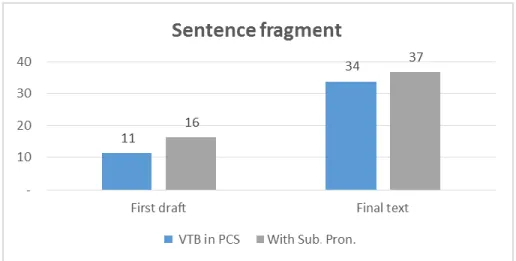
(18) GRAMMATICAL ACCURACY IMPROVEMENT IN VIRTUAL LEARNING ENVIRONMENTS THROUGH SCREENCAST FEEDBACK. 17. refers to an incomplete sentence, generally happens when students’ texts usually lacked a subject or a verb; second, unnecessary shift in verb tense that according to Lunsford and Lunsford (2008), learners frequently shift verbs from one tense to another with no clear reason. Consequently, participants usually used a wrong tense or verb form. As it can be seen in Table 1, fragmentation of sentences was evident because students usually forgot to write the subject pronoun, which in most of the cases was the first person, I, as it can be seen in students 1, 3 and 4. Also the complete verb form was ignored, in this case students 2 and 4 did not write the Verb to be (VTB) in present continuous sentences (PCS). Moreover, students 2, 3 and 4 made an unnecessary shift in verb tense, frequently they used a wrong verb to express age, they wrote the Verb to have instead of to be; additionally, learners regularly wrote the wrong tense to talk about activities with present simple structures (PSS) because they added the VTB, as students 1 and 3 did. Table 1 shows some examples of the most common grammatical errors found in students’ descriptive texts. Table 1 Examples from Students’ Most Common Errors. Sentence fragment grammatical errors Unnecessary shift in verb tense - No subject. Am twenty years old. Wrong tense I´m study …. Student 1 - No complete verb. Neighborhood STA TERESITA Student 2 - No complete verb. I doing Student 3. - No subject. live in Chia Listen to music. Wrong verb form I have twenty six years Wrong tense or verb form I have 36 years I am study Psychology.
(19) GRAMMATICAL ACCURACY IMPROVEMENT IN VIRTUAL LEARNING ENVIRONMENTS THROUGH SCREENCAST FEEDBACK. Student 4. - No subject. Study Psychology Do the household work. 18. Wrong verb form I have 25 years. - - No complete verb. and watching TV. Based on this first observation done by the teacher-researcher, these errors might have come from the following three main causes. First of all, although the three units that comprise the course included grammar exercises, these were decontextualized and repetitive, focused only on explaining English grammar structures in Spanish. Students did not have opportunities to practice writing through those exercises because most of the time they had to complete multiple choice, matching or true or false tasks (see Appendix A). The second cause was identified in the preliminary needs analysis through a questionnaire. Students argued feeling insecure when asked to write a text because they did not know enough vocabulary, connectors or grammar structures that should be used for a simple and accurate text. They also reported not knowing how to correct their own writing and not recognizing the correct answer from their errors. The third cause was the feedback type provided by the teacher and the gap of time that is so prevalent in VLEs. Besides, feedback was usually given in written form specifying what students had to correct as seen in Figure 2. Feedback was usually written in Spanish, because it was difficult for the teacherresearcher to explain effectively in written form the correct use of a word or a grammatical rule in a VLE, and also because students’ language level was not advanced enough to understand teacher’s written explanations. Constantly, the teacher resorted to using different colors to correct or indicate errors (Figure 2). Nevertheless, this kind of feedback was not enough for students, it was not assimilated as a whole and sometimes texts were.
(20) GRAMMATICAL ACCURACY IMPROVEMENT IN VIRTUAL LEARNING ENVIRONMENTS THROUGH SCREENCAST FEEDBACK. 19. partially corrected, it happened because most of the participants in this study were not used to have asynchronous tools1 to communicate with teacher and classmates. As a result, these asynchronous tools, with which written feedback was given, were limited in their scope for effective guidance to students in the right way to develop their writing skills. The aforementioned situation serves as the basis for the following research question and objectives guiding this research project.. Figure 2. Colored-written feedback. Research Question To what extent do A1 undergraduate students improve their grammatical accuracy when writing short descriptive texts after they receive screencast feedback in a VLE? Objectives The objectives to achieve in this research were:. 1. Asynchronous learning on the other hand can be carried out even when the student or teacher is offline. Coursework and communications delivered via web, email and messages posted on community forums.
(21) GRAMMATICAL ACCURACY IMPROVEMENT IN VIRTUAL LEARNING ENVIRONMENTS THROUGH SCREENCAST FEEDBACK. -. 20. To analyze the improvement of A1 undergraduate students´ grammatical accuracy when writing short DTs in VLE after they receive screencast feedback.. -. To identify students’ perception towards the strategy and progress in their grammatical accuracy when writing short DTs.. Rationale This study was carried out at a Colombian public university named Universidad Nacional Abierta y a Distancia (UNAD), which follows the guidelines established in its Solidary Academic Teaching Program (PAPS in Spanish) where the “ideal of national, public and autonomous university are in the open and distance modality for the 21st century, ICT allows students and teachers to participate in new scenarios of knowledge transformation” (author’s translation. PAPS, 2008, p. 6), where meaningful and independent learning environments are relevant to change relations and pedagogical practices; besides, its programs enhance the “mastery of a foreign language in order to facilitate technology training, professional or post gradual enrichment” (author’s translation. PAPS, 2008, p. 105). This university works with a fully virtual methodology, where students can use the different visual or multimedia resources available on the platform. In this sense, UNAD must ensure that students who learn English in VLEs are gaining the necessary skills to compete as citizens and workers in the 21st century. One of these skills is writing, indeed it is one of the most important communication channels to interact in online education. However, beginner learners see writing as a tough, complex and demanding task. This is in accordance with White and Arndt who said that “writing is a complex, cognitive process that requires sustained intellectual effort” (as cited in Nunan, 1999, p. 273). Also, Cleary (2012), has stated that students usually perceive writing as a.
(22) GRAMMATICAL ACCURACY IMPROVEMENT IN VIRTUAL LEARNING ENVIRONMENTS THROUGH SCREENCAST FEEDBACK. 21. “native skill, that cannot be learned” (p. 774) and only native people can master it correctly. It is a fact that students’ English language difficulties, their lack or low proficiency of grammar or punctuation affects the quality of writing, limits their ability to express ideas and “their confidence levels decrease” (Cleary, 2012, p. 774); in other words, students become less confident in themselves, because they consider they are not good writers. However, Clearly (2012) stated that “efficacy at writing tasks increases at students practice” (p. 774). Also, Turbill and Bean (2006) speak on this point that if students want to achieve better writing communicative goals, “teachers must give time to providing opportunities to use and practice what students are learning” (p, 36); that is, to give learners the chance to write about topics they know, such as themselves or their world; so that they could feel confident and with opportunities to experience a sense of achievement and success. In the same way, educators at UNAD need to prioritize new teaching practices that encourage writing and improve the way feedback is provided, building a better understanding of students´ writing skills, the connections and feelings among their learning needs as individuals, as well as the establishment of an open and clear communication to develop a good learning atmosphere in the virtual class. This development can be gained through the online tools offered on the web, in words of Lee “writing instruction supported by electronic tools and resources can enable students to improve their writing practice, and can empower students as authors” (as cited in Cleary, 2012, p. 775). For that reason, this study focused on the implementation of screencast feedback as an appealing, motivating and successful learning strategy that allowed the teacher-researcher the combination of oral and written comments to help students potentiate their understanding of the explained.
(23) GRAMMATICAL ACCURACY IMPROVEMENT IN VIRTUAL LEARNING ENVIRONMENTS THROUGH SCREENCAST FEEDBACK. 22. grammar issues, and contributed to the support and monitoring that the teacher performs in the forums and students’ interest in improving their writing in online English courses. Exploring and implementing screencast feedback strategy under the conditions of a Colombian, virtual, public, university such as UNAD, in which English language learning has been framed according to the Common European Framework of Reference for Language, and where teachers must include and support students with different strategies, techniques and tactics that ensure high levels of accompaniment, academic assistance, interaction in the target language and relevant feedback, allowed the teacher-researcher to put into practice an appropriate teaching and learning strategy that could be seen as a relevant tool to be used in VLEs provided by the UNAD to their community, since virtual education clearly emphasizes important aspects such as the permanent teacher’s asynchronous accompaniment2 as well as an assertive and mediated communication with the student through online tools. This also concurs with Edwards, Dujardin, and Williams (2012) who have established that “integrated viewing and hearing removes the need for cross-referencing between the written feedback and the point in the essay to which it relates which may help students to better understand tutor’s feedback” (p. 96), Additionally, as UNAD welcomes in the different academic programs “diverse type of learners” (Saravia-Shore, 2008, para. 3) due to the varied social, cultural and geographical backgrounds, the screencast feedback is relevant for this study because it facilitates the language learning in several contexts due to the opportunities this type of education entails; its implementation agrees with the current need that teachers and students Asynchronous accompaniment: It is the teachers’ accompaniment to students in the development of the activities in the course forums, course internal messaging and other resources which are not dependent on the simultaneous participation of teachers and students. It is expected to promote the construction of knowledge, development of critical thinking and significant, collaborative and autonomous learning processes (author’s translation. Teachers’ accompaniment at UNAD, 2015, p. 5). 2.
(24) GRAMMATICAL ACCURACY IMPROVEMENT IN VIRTUAL LEARNING ENVIRONMENTS THROUGH SCREENCAST FEEDBACK. 23. should learn to interact and learn through new technologies that are revolutionizing our world. In other words, the screencast feedback strategy contributes first, to a further and permanent support in language and communication to students who are enrolled in virtual education who come from different cities of the country, with diverse cultural, technological and linguistic schemas that can affect their learning process; and second to the support and monitoring teacher does and students’ interest in improving their writing in online English courses, since learners consider that a conversational academic comment is more easily understood than formal, written-academic feedback..
(25) GRAMMATICAL ACCURACY IMPROVEMENT IN VIRTUAL LEARNING ENVIRONMENTS THROUGH SCREENCAST FEEDBACK. 24. Theoretical Framework This chapter presents the main constructs considered for this research, starting from a general review of grammatical accuracy in writing, short descriptive text (DT), virtual learning environments (VLEs), as well as errors and feedback. After that, the teaching strategies of using screencast to provide feedback are described. Finally, related research studies that have applied screencast feedback in international and national contexts are specified in detail. Grammatical Accuracy in Writing Writing is one of the most important skills in educational and professional contexts as well as a difficult skill to acquire for English language learners. In fact as Nunan said, writing is “probably the most difficult thing to do in language” (1999, p.271), since it is not a spontaneous skill and it does not allow to exploit some devices that are used in spoken language such as gestures, tone of voice among others. In effect, writing to be effective and to avoid miscommunication has to consider some relevant elements as the context, the enduser, and certain linguistic and pragmatic features of the language. This concurs with Cumming who has argued that “teaching low proficiency EFL students to write whole texts is often fraught with difficulties” (as cited in Firkins, Forey & Sengupta, 2007, p. 341), such difficulties can be considered to what Ellis stated as “understanding and internalizing grammatical features” (2006, p. 88) as learners need to master vocabulary, grammatical patterns and sentence structures to create a feasible meaning; in other words, to write an accurate and comprehensible text. In this study, it is necessary to know the concept of both grammar and accuracy to recognize the importance that these terms trigger in the writing process. They are important aspects of any good piece of writing to have a readable text, as well as to avoid.
(26) GRAMMATICAL ACCURACY IMPROVEMENT IN VIRTUAL LEARNING ENVIRONMENTS THROUGH SCREENCAST FEEDBACK. 25. misunderstandings, and to help other persons understand a text easily. According to Harmer (2001) the “grammar of a language is the description of the ways in which words can change their forms and can be combined into sentences in that language” (p. 12). Other researchers such as Richards, Platt, and Weber (1985) determined grammar as “a description of the structure of the language and the way in which linguistic units such as words or phrases are combined to produce sentences in the language” (p. 251). For the purpose of this study, it was necessary to recognize that the language is systematically organized by its grammar and its structures which are indissolubly linked to meaning and communication. Students must be aware that any text can make sense without shaping grammatical structures. In the same way, accuracy is relevant insomuch as it is related to a learner's level of writing including the use of grammar; so, if a student makes errors in every other word in a text, there would be a serious loss of meaning and it would be an unclear writing for the reader. Thus, accuracy is defined by the Cambridge Online Dictionary (n.d.) as “the ability to do something without making errors or the fact of being exact or correct”. Also, The British Council (n.d) considers accuracy as “how correct learners’ use of the language system is”; it refers to the use of grammar, pronunciation, vocabulary and other elements in context. According to the above definitions, accuracy, for this study, is the ability to write without making any grammatical, vocabulary, punctuation or any other error in a short text. That students could use nouns, adjectives or verbs, to express a message to the reader in an accurate way and thus feel the vivid sensory details that the writer wants to transmit. For some researchers such as Ahangari & Barghi (2012), grammar is an important aspect that makes it possible to talk about language and “aims at uplifting accuracy in learners for better communication” (p. 6). Nowadays grammar is a skill to be practiced and.
(27) GRAMMATICAL ACCURACY IMPROVEMENT IN VIRTUAL LEARNING ENVIRONMENTS THROUGH SCREENCAST FEEDBACK. 26. developed in different academic context, since it enables students to communicate accurately, meaningfully, and appropriately. However, theorists as Harmer has pointed out that one of the greatest writing performance limitations in English for most learners is that “they lack the ability to use appropriate grammar in their English language writing” (2001, p. 99). Also, Lush has stated that “learners have difficulty both in applying the English grammar rules to form grammatically correct sentences, and in knowing when and where to use these sentences and to whom” (as cited in Puengpipattrakul, 2009, p. 90). That is to say that one of the biggest barriers to writing in English for most learners is their lack of ability to use appropriate grammar rules in their writings, even if they have studied English tenses in primary or high school. As a matter of fact, teachers usually want students to be successful language writers, able to communicate in any situation, with full comprehension, confident and effective language. For that reason, grammatical accuracy must be seen as a continuum development in language instruction, where learners search for the acceptability, quality and precision of the message conveyed. This is in accordance with Celce-Murcia who emphasized the “importance of a reasonable degree of grammatical accuracy in academic writing” (1991, p. 465), to help students communicate effectively and accomplish communication goals in written form according to the contexts and the end-user. Grammatical accuracy is an essential feature if students are to achieve their educational and professional goals due to the requirements of the Common European Framework of Reference for Languages (CEFR, 2002) for the development of this skill. According to this international standard a person writing with the highest level “maintains consistent grammatical control complex language” (p. 114); so, the grammar of the text should not interfere with the understandability of the text. To do that, English grammar.
(28) GRAMMATICAL ACCURACY IMPROVEMENT IN VIRTUAL LEARNING ENVIRONMENTS THROUGH SCREENCAST FEEDBACK. 27. instruction is an essential feature so that students can advance their English level by producing written work that employs the grammatical structures they have learned. Also, the CEFR (2002) in the section productive activities and strategies named the three general different productions students can create in a written way according to the different mastery levels: “Overall written production, creative writing and reports and essays” (p. 61). The CEFR (2010) determined for the first two productions (overall written production and creative writing) some descriptors to guide teachers and students to have the minimum requirements to write a text for A1 students. It has to be highlighted that “reports and essays” are written products for learners who are between B1 and C2 level according to the CEFR. Regarding overall written production, students “can write simple isolated phrases and sentences” (p. 62); in reference to Creative Writing, students “can write simple phrases and sentences about themselves and imaginary people, where they live and what they do” (p. 62). With these described guidelines, teacher can lead learners who have a very basic English level or who usually write texts with a limited control of a few simple grammar structures and sentence patterns, isolated words and phrases related to specific situations to develop the writing skill and create an acceptable text, writing simple sentences with the correct vocabulary and grammar structures. In other words, to achieve the written proficiency goals they have to start mastering an A1 level according to the CEFR. As it can be seen, grammar is associated with the accurate use of language for effective written communication, that is to say that learners should always follow grammar rules to maintain clarity and avoid ambiguity in expressions; in that sense, as Ahangari and Barghi (2012) have stated, both “grammar and accuracy contribute to construct validation of language” (p. 7). It means that grammatical accuracy is obtained when each word in a.
(29) GRAMMATICAL ACCURACY IMPROVEMENT IN VIRTUAL LEARNING ENVIRONMENTS THROUGH SCREENCAST FEEDBACK. 28. sentence represents the meaning the writer intends to convey and arrange in the correct order it has to be; so, accuracy in communication is important, and grammar facilitates that. In summary, students need to develop the lexical and grammar skills required in each writing activity. The grammar rules help the learners develop more logical and clearer sentences, so they can become more accurate in the language and therefore in the message. Moreover, writing enhances language acquisition owing to the fact that learners have to plan what they are going to write, select the topic, use the appropriate words (nouns, adjectives, verbs) and sentences in context to communicate their ideas effectively and apply the grammar they have learned in class. The Short Descriptive Text This type of writing was implemented considering that it encouraged students to use new vocabulary to describe a person, a place or a thing in detail. The BBC (2011) has defined descriptive texts as “words that tell you what something is like. The writer tries to help you imagine or ‘see’ a person, place or thing” (Descriptive text section, para. 1); also, a descriptive text is considered by Ellis, Standal and Rummel (1989) as the simplest and easiest writing form compared to narrative, recount, or procedure, particularly for the beginning writers. For this study descriptive writing is according to Baker, Brizee, and Angeli (2013) “a genre that asks the student to describe something (object, person, place, experience, emotion, situation, etc.)” (What is a Descriptive Essay? section, para. 1). Thus, this genre encourages students’ ability to have a written account of a particular experience, illustrating with simple words parts, qualities, or characteristics that the writer has in mind. Language does not need to be wordy for this type of text, Smalley, Ruetten & Kozyrev (2001) have suggested that students are required to “list the characteristics of.
(30) GRAMMATICAL ACCURACY IMPROVEMENT IN VIRTUAL LEARNING ENVIRONMENTS THROUGH SCREENCAST FEEDBACK. 29. something and usually deals with the physical appearance of the described thing” (p 80); in other words, students try to describe exactly how a setting looks or how a character behaves. So, learners picture images of the imagery or real object they are describing in a written way and arrange them in some kind of logical pattern to convey to a reader the sound, taste, and smell of things or objects being depicted. In summary, what the writer intends in a descriptive text is that by reading it, the reader can easily form a mental picture of what is being written about, and be part of the experience being described. Some researchers as Wardiman, Jahur, and Sukiman (2008) have specified the generic structure of descriptive text (DT) into two parts: (a) “introduction as paragraph that introduces the character, and (b) description as the paragraph that describes the character” (p. 16). Therefore, the writer should provide readers with detailed information about a particular person, place or thing to show the agent to be described, its characteristics with the appropriate words, so that the readers can make sense of what has been described. Consequently, writing a DT implies two important elements: “An element to identify the character” (identification) and “other one to portray parts, qualities, or characteristics” (description) (p. 16). Additionally, the most common language features to be used in this type of text are: a certain object to talk about, adjectives to clarify the noun, simple present tense for telling the facts of object descriptions, and action verbs to show a specific activity. In this study, the text structure was determined with an opening paragraph introducing the subject to be described, followed by a series of paragraphs each one describing the subject’s features and a final concluding section. Virtual Learning Environments English language teaching has dramatically changed with the remarkable entry of technology. It has impacted teachers to change from traditional teaching methods that favor.
(31) GRAMMATICAL ACCURACY IMPROVEMENT IN VIRTUAL LEARNING ENVIRONMENTS THROUGH SCREENCAST FEEDBACK. 30. teacher-centered classrooms to more updated pedagogical models that give students a significant role in the learning process, not only in face -to- face environments, but also in those mediated by technology where learning is carried out through online activities generated by tutors using the opportunities that the virtual platforms provide; so that, greater learning opportunities are given to students to gain confidence in the practice of the language. Technology has also impacted students who learn English and develop their skills in online contexts, in as much as they need further language support and practice than that required in face -to- face environments to develop their listening, reading, speaking, and writing skills. To do so, teachers can easily find several tools to facilitate the language learning process and make it more effective. Notably technology has contributed to providing new tools to benefit education and virtual learning environments have played a positive role in the new concept of the English class. According to the Oxford University Press Online Resource Center (n.d.) a “VLE is a system for delivering learning materials to students via the web. This system includes assessment, student tracking, collaboration and communication tools” (What is a Virtual learning environment? section, para. 1). Also, Barajas and Owen (2000) have suggested that a “VLE is based on different combinations of telematics and multimedia tools” (p. 39). For the purpose of this study, a VLE is a set of teaching and learning tools designed to contribute to a student's learning experience together with computers and the internet in the learning process. Currently learners of a foreign language are in constant search of the best methods and techniques to learn a language; usually, they use the combination of traditional resources and multimedia, which provide numerous opportunities and material for language learners to practice with authentic examples of the target language and culture. This is in.
(32) GRAMMATICAL ACCURACY IMPROVEMENT IN VIRTUAL LEARNING ENVIRONMENTS THROUGH SCREENCAST FEEDBACK. 31. accordance with Maltby and Mackie (2008) who have stated that “online education has changed the relationship that a student has with their course of study” (p. 58). First, education mediated through online resources, offers foreign language (FL) learners the possibility to review content, repeat lessons and correct errors without time constraints. It also allows them to review material (guides, videos, readings, etc.) as many times as they need it. In words of Gearhart (2008) “online education is a flexible learning environment” (p. 36) that enables students to learn at their own pace through different learning strategies; this also concurs with Freman and Capper who have affirmed that “the web is acclaimed for the flexibility and variability of the materials it provides and is acknowledged to have the potential to add to even the best classroom practices” (as cited in Zhao, 2003, p. 405). Second, because the use of this new way of learning allows universities to use a web-based platform, as an opportunity not only to widen access to their courses while improving the quality of education, but also to approach those students who cannot go to an institution of higher education due to geographic or time restrictions; that is, the university becomes an inclusive institution, where people can access the virtual platform from anywhere without traveling to a physical location. In addition, a significant characteristic of VLEs is that communication, interaction, assessment, and other teaching and learning actions are developed through different activities and strategies that are used in face-to-face environments. In fact, it is necessary that the course content, written and oral exercises, formative and summative assessment as well as feedback for the VLEs should be clear and concise enough. First, to support learners in their foreign language learning processes through teachers’ permanent assistance and monitoring; second, to facilitate their learning with significant activities,.
(33) GRAMMATICAL ACCURACY IMPROVEMENT IN VIRTUAL LEARNING ENVIRONMENTS THROUGH SCREENCAST FEEDBACK. 32. understandable and affordable material as well as guides or instructions, timely interaction and feedback. As it can be seen, the importance of the different resources that VLEs offers to enhance foreign language learning has increased; based on this, Zhao (2003) has pointed out that “access and exposure through technology to engaging, authentic and comprehensible yet demanding materials in the target language is essential for successful language learning” (p. 23). However, it is not as easy as it seems, that process will also require a prolonged period of study, patience, and time that not only depends on the type of materials or resources provided on the virtual campus but also on each student’s characteristics, self-motivation and feedback provided by the teacher to help them construct their own learning path. The online resources and campus presence ease not only learning but also guidance by the teacher; truly, both students and teachers benefit from the adoption of a wide variety of online tools that support the teaching-learning process in VLEs. According to Motteram (2013) a “VLE makes it possible for teachers to more easily provide the necessary engagement with language that allows learners to improve linguistic skills such as writing, listening or pronunciation, in ways that have proved very difficult in the past in traditional environments” (p. 132). Thereby, teachers are indispensable as guides in VLEs to provide support and in the same way, to foster growth and understanding of the language being taught. It is important to recognize that in VLEs language is used in spoken and most of the time in written form. According to Lanham, technological revolution has integrated “computers into the humanities and particularly into the writing curriculum” (as cited in Schultz, 2000, p. 121). For him, “students we teach are going to do most of their writing.
(34) GRAMMATICAL ACCURACY IMPROVEMENT IN VIRTUAL LEARNING ENVIRONMENTS THROUGH SCREENCAST FEEDBACK. 33. and much of their reading on an electronic screen. Now they live in a world of electronic text” (Lanham as cited in Schultz, 2000). For that reason, teaching writing has significantly changed “from an end-product approach” (Lanham as cited in Schultz, 2000, p. 121) where the teacher reads and grades the paper students had written without the possibility of different feedback strategies of a rough draft, “to a process approach” (Lanham as cited in Schultz, 2000, p. 121) where through online resources, the written process and feedback have improved for both teachers and students. Now, it is a practice where students can have various drafts and comments done by the teacher and partners before the final version and evaluation. In the same way, Komalasari (2013) has pointed out that “writing skill is needed to demonstrate the learners' understanding of the experiences or the courses” (p. 26), but Warschauer (2007) stated that in VLEs writing “is used for both communication between teacher and students as well as long distance exchanges between students in different locations” (p. 910). It implies that writing is very common in virtual educational context since it is not only a necessary means to interact with their academic peers or teachers through the virtual forums and chats, but also because most of the homework to be done is in written form. This also concurs with Dillenbourg (2000) who pointed out that “the writing activity is per se the educational goal, but in many cases, it is just the end point which drives a variety of earlier activities such as site visits, observations, experiments, integrated in the VLEs” (p. 7). In other words, a learning activity in VLEs refers to something richer than in an individual courseware. It transforms students into information producers. Now, students are not only active, but also actors in their own learning process..
(35) GRAMMATICAL ACCURACY IMPROVEMENT IN VIRTUAL LEARNING ENVIRONMENTS THROUGH SCREENCAST FEEDBACK. 34. Errors and Feedback Errors. In the process of acquiring a language or mastering a skill, errors are inevitably and they are a necessary part of language acquisition. Several studies, including those from Thailand done by Pongsiriwet (as cited in Puengpipattrakul, 2009), have specified that a person cannot learn a language without making errors. But, what is an error? According to Corder (1967), “an error takes place when the deviation arises as a result of lack of knowledge. It represents a lack of competence” (p. 961); in other words, it happens when learners do not know the correct rule of the language and try to use what they assume is the correct form, but unfortunately in that context or situation, it is the wrong form. In the same way, teachers should not expect students to learn without making errors. It would be unrealistic to consider errors as undesirable when basic writers are trying to learn a skill, this is in accordance with Corder (1967) who said that learners’ error can “provide to the researcher evidence of how language is learned or acquired, what strategies or procedures the learner is employing in the discovery of the language” (p.167). Hence, errors should be seen as a sign of the learner's progress in language learning; as Ringbom (1987) stated, errors are “insight into how far a learner has progressed in acquiring a language and showing how much more the learner needs to learn” (p. 69). In that sense, errors should be seen by the teacher as an important part of the learning process, since teachers can follow students’ progress at every point of the course, analyze and decide what remains for them to learn. Now, considering the development of writing skill, Pongsiriwet’s research (2001) has confirmed that “in their attempt to master the writing skill, learners inevitably make errors. One of the major difficulties at writing in English lies with the grammar of the.
(36) GRAMMATICAL ACCURACY IMPROVEMENT IN VIRTUAL LEARNING ENVIRONMENTS THROUGH SCREENCAST FEEDBACK. 35. language, which has been found to be a major source of writing errors” (p.3); therefore, a linguistic error in writing is usually a concern for teachers and researchers, since most of the time learners have different types of grammar errors when composing a text. Richards and Renandya have stated that “learners must be able to communicate their thoughts towards appropriate language use and communicative strategies” (as cited in Hinnon, 2010, p. 167). It can be seen that errors are very common and they are part of the language learning process; for that reason, students and teachers can use these errors to recognize the inaccuracies and improve the language performance, writing well-structured sentences to be used in short DTs. In the same way, teachers should analyze the type of error students have in their texts to know which the most common errors are, and to define the strategies to help learners reduce them in their writings. In the year 2008 Lunsford and Lunsford, after two years of data gathering and analysis, designed a list of the most common formal errors, as shown in table 2: Table 2 Lunsford and Lunsford’s most common formal errors. 1. 2. 3. 4. 5. 6. 7. 8. 9. 10. 11. 12. 13.. Error or Error pattern Wrong word Missing comma after an introductory element Incomplete or missing documentation Vague pronoun reference Spelling error (including homonyms) Mechanical error with a quotation Unnecessary comma Unnecessary or missing capitalization Missing word Faulty sentence structure Missing comma with a nonrestrictive element Unnecessary shift in verb tense Missing comma in a compound sentence.
(37) GRAMMATICAL ACCURACY IMPROVEMENT IN VIRTUAL LEARNING ENVIRONMENTS THROUGH SCREENCAST FEEDBACK. 36. 14. Unnecessary or missing apostrophe (including its/it’s) 15. Fused (run-on) sentence 16. Comma splice 17. Lack of pronoun-antecedent agreement 18. Poorly integrated quotation 19. Unnecessary or missing hyphen 20. Sentence fragment. These errors are relevant due to the fact that it helps teachers know the current state of the learners’ knowledge concerning the 20 categories for written texts; as well as to evaluate themselves and the processes they carry out in the classroom and in the virtual learning environments to teach the different pragmatic and grammatical features of the language. If teachers know which errors are the most common, they can help students improve their weaknesses regarding a specific error pattern. Additionally, learners should understand that the type of writing errors mentioned above are not a problem but rather a significant opportunity to identify areas of improvement and become self-involved in their improvement process. Usually in the writing learning process, learners wish to write well; however, students find it difficult to imagine themselves as writers because they realize that their lack of linguistic knowledge restricts their composition. For this reason, they need help in understanding and avoiding errors in their writings. Unfortunately, students cannot usually correct their errors by themselves. They need some additional information in view of the fact that there is a lack of understanding by the language learner. As Buley-Meissner (1981) stated, “students will make mistakes but they also will make progress - if their teachers guide and encourage them in the right ways” (p. 4). In that sense, errors are directly related to the teacher’s role in guiding the improvement of students’ writing, since teachers play an.
(38) GRAMMATICAL ACCURACY IMPROVEMENT IN VIRTUAL LEARNING ENVIRONMENTS THROUGH SCREENCAST FEEDBACK. 37. important part in the learning process as they help students correct and make fewer errors through the use of different corrective feedback strategies. Feedback. In Second Language Writing (SLW), feedback can be defined according to Keh (1990) as “input from a reader to a writer with the effect of providing information to the writer for revision” (p. 294). Then, feedback is usually given to boost students’ acquisition of accurate language. For this purpose, learners (in general) need a clear path to know if they are accomplishing academic goals. Activities such as repetitive text or rewriting need to be avoided, because they do not contribute to improvement and demotivate students when they do not see results despite their efforts. Feedback must be concrete, specific, and useful so that students could accept, understand and remember the correct information about their errors for future assignments. Researchers such as Hyland and Hyland (2006b) have described how “feedback is widely seen as crucial for encouraging and consolidating learning […] In classrooms feedback is a key element of the scaffolding provided by the teacher to build learner’s confidence and the literacy resources to participate in target communities” (p. 83). In the context of VLEs specifically for higher education, where students are the main characters in the learning process, feedback provided by the teacher is an important aspect in the development of language skills, due to the fact that it allows students to understand and progress in their confidence as writers and their learning experience. Other researchers such as Ndon (2010) has also stressed the importance of using feedback as a tool to provide guidance through formative commentary, stating that “feedback should focus on improving the skills needed for the construction of end products more than on the end products themselves” (p. 236). In words of Debuse et al. “feedback is decisive for students to understand and receive support for their own learning process and.
(39) GRAMMATICAL ACCURACY IMPROVEMENT IN VIRTUAL LEARNING ENVIRONMENTS THROUGH SCREENCAST FEEDBACK. 38. develop the level of insight needed to understand their own strengths and weaknesses” (as cited in Mathisen, 2012, p. 98). Thereby, feedback is considered in language learning as a powerful tool that helps students not only learn more efficiently through information provided on their performance but also be motivated about their learning process in as much as teachers praise learners for effective language use. Additionally, feedback has also been considered as an essential component for the development of foreign language writing skills, specifically in VLEs where it is very common to use the written language as a primary means of communication and interaction among the different participants. However, some students usually have difficulties when writing in a foreign language and correspondingly, recognizing and correcting the errors in their texts by themselves. Thereupon, learners expect teachers provide permanent support and monitoring on their assignments so as to have good written texts. This is in accordance with Hyland and Hyland’s studies which have proved that “students are more likely to find teacher feedback useful when it engages the student writer and when it is contextualized— that is, given in consideration of individual student needs” (as cited in Lee, 2008, p. 146). For that reason feedback plays an essential role to improve students’ writing skills since through suggestions, explanations, explicitness and analysis on content and form, learners can have a positive progress regarding the texts’ structure, accuracy and other linguistic elements. Students who are enrolled in VLEs also expect to receive permanent feedback since they do not have the opportunity to meet the teacher in face to face contexts to review and correct their texts. With this in mind, teacher must be careful with the information presented to students trying not to be overcritical of their writings which could affect the quality of both content and form of future texts. With regard to this, Harmer (2001, p. 110).
(40) GRAMMATICAL ACCURACY IMPROVEMENT IN VIRTUAL LEARNING ENVIRONMENTS THROUGH SCREENCAST FEEDBACK. 39. has established some techniques to hand back students’ written work and help learners write a more successful text: - Responding: With this device teachers should say how the text appears, how successful it has been and how it can be improved; - Coding: Codes or symbols that make correction much neater, less threatening and more helpful than marks or comments, they may refer to issues such as word order, spelling, or verb tense. A most recent study carried out by Lee (2008) has explained the “major error feedback techniques” (p. 154), and its use. Lee (2008) has also suggested three types of feedback: “Direct, indirect with direct location of errors and indirect feedback with indirect location of errors” (see Table 3). All of them can be implemented and useful to give information to students considering variables such as: the type of students, the activities and assignments. Lee stated that if they are beginners it is better to provide direct feedback because learners are not able to self-correct their errors. Table 3 shows the difference between direct or indirect feedback. This study focused on direct feedback that in Lee’s words (2003) “refers to overt correction of student errors, that is, teachers locating and correcting errors for students and indirect feedback refers to teachers indicating errors without correcting them for students” (p. 154). Direct feedback eases beginner students to correct more errors when they are directly located by them; moreover, this allows to strengthen students' self-confidence and at the same time learners feel motivated to continue correcting and learning from their errors. Table 3 Lee’s Major Error Feedback Techniques Type of error feedback. Explanation.
(41) GRAMMATICAL ACCURACY IMPROVEMENT IN VIRTUAL LEARNING ENVIRONMENTS THROUGH SCREENCAST FEEDBACK. Direct feedback. . Locate and correct errors. Indirect feedback (Direct location of errors). . Locate errors Locate errors and identify error types. . Indirectly locate errors. . Indirectly locate errors and identify error types. Indirect feedback (Indirect location of errors). 40. Feedback must be carefully designed and teachers must know how to organize and present it to students so that they are not so demotivated as to discontinue their writing learning process. With this in mind, it is necessary that teachers recognize the different feedback categories that researchers have acknowledged as appropriate to be applied; a good example is Hyland and Hyland’s “categories for written comments” in 2001. They determined three main categories: Praise, criticism and suggestion (Table 4). The first one refers “to help reinforce appropriate language behaviors and foster students’ self-esteem […]. It […] suggests a more intense or detailed response than simple agreement” (Hyland & Hyland, 2001, p. 186); also, praising what a student does is important particularly for less able writers to reinforce good writing. Criticism emphasizes on negative aspects present in the text, but researchers as Connor and Lunsford have found that “if learners receive too much criticism through the feedback, motivation and self-confidence as writer may be damaged” (as cited in Hyland & Hyland, 2001, p. 186), and suggestions are “explicit recommendation for remediation” in other words it is a realizable action so that students can correct their errors. Table 4 Hyland and Hyland’s Categories for Written Comments.
(42) GRAMMATICAL ACCURACY IMPROVEMENT IN VIRTUAL LEARNING ENVIRONMENTS THROUGH SCREENCAST FEEDBACK. 41. ‘An act which attributes credit to another for some characteristic,. Praise. attribute, skill, etc., which is positively valued by the person giving feedback.’ Criticism. ‘An expression of dissatisfaction or negative comment on a text’.. Suggestion. A relatively clear and accomplishable action for improvement, which is sometimes referred to as “constructive criticism”.. Explanation It is a commentary in which an explanation is made regarding the grammatical issue that has the error and explains how to correct it. Note: Adapted by the researcher.. They analyzed praise, criticism and suggestion. It has to be highlighted that these categories were adapted to the study context and a category was added: Explanation. It refers to a clarification regarding the grammatical issue of the error and explains how to correct it. The original categories were designed only for written feedback in face-to-face environments, and students enrolled in VLEs, need a deeper exposition or illustration of different linguistic aspects to correct their errors, so the new category was born. Screencasts to provide feedback Nowadays information and communication technologies (ICT) offer the possibility to take advantage of different tools to support, monitor and facilitate the teaching-learning process both in face-to-face and virtual learning contexts. As Stevenson and Liu (2010) have pointed out, ICT tools “provide students with opportunities for greater learner control, active construction of knowledge, and access to collaborative learning environments” (p. 235). But certainly, in VLEs it is more necessary and valuable the use of a range of tools for tutorials, formative and summative assessment, collaborative work, etc., to provide understandable content and enable an effective communication among teachers and.
Figure

+7

Documento similar
Collaborative Networks and Sustainability in Education 4.0: An Approach to Achieve Complex Thinking Competencies in Higher Education. In Working Conference on Virtual
For a short explanation of why the committee made these recommendations and how they might affect practice, see the rationale and impact section on identifying children and young
The expansionary monetary policy measures have had a negative impact on net interest margins both via the reduction in interest rates and –less powerfully- the flattening of the
Jointly estimate this entry game with several outcome equations (fees/rates, credit limits) for bank accounts, credit cards and lines of credit. Use simulation methods to
Although virtual pointing techniques typically deliver superior performance than their virtual hand counterparts, they require appropriate continuous visual feedback about the scene
This study presents the findings of a year-long e-mail exchange between learners of English at Nebrija University in Madrid and learners of Spanish at Trinity College Dublin during
The main conclusions from the research carried out in the first case are that students who perform the activity with virtual reality (experimental group) perform better on average
The results in question 5, show that most research refers to experiences in virtual learning environments, followed by online courses and the educational level where more research
