
Cultural diversity during the last 2000 years in southern Africa
39
0
0
Texto completo
(2) Claroscuro Nº 16 (2017). Centro de Estudios sobre Diversidad Cultural. Cultural diversity during the last 2000 years in southern Africa Diversidad cultural durante los últimos 2000 años en África del Sur. Thomas N. Huffman Resumen Durante la Edad de Hierro (200- 1820 d. C.) el pueblo Bantu-hablante, dominaba el paisaje Sudafricano. Ellos eran agricultores mixtos, cosechaban cultivos domésticos y pastoreaban ganado mayor y menor. Para la temprana Edad del Hierro (400-900 d. C.), diferentes estilos de cerámica denotan diferentes identidades de grupo, pero la organización de asentamientos muestra que estas personas compartieron la misma cosmovisión. El estilo cerámico también documenta la interacción entre los diferentes grupos. En la Media Edad del Hierro (900-1300 d. C.), la interacción con los comerciantes musulmanes en el valle de Limpopo creó una riqueza comercial excedente que, junto con la agricultura local, llevó a la institucionalización de las clases sociales y de un liderazgo sagrado. En el siglo XVI, los comerciantes portugueses comenzaron a colonizar partes del África del sur, describiendo por primera vez la famosa cultura de Zimbabwe. Además de los extranjeros musulmanes y portugueses, los bantúes interactuaron con los pastores locales de Khoekhoe y los cazadores recolectores San. En un principio, los San pueden haber sido emprendedores incluidos en las redes regionales, que intercambiaban artículos codiciados como sal y pieles con los aldeanos bantúes. Más tarde, en el siglo XVI, los San parecen haberse convertido en siervos marginalizados de la sociedad "civilizada". Por otro lado, los Khoe mantuvieron un alto estatus desde el principio, presumiblemente porque eran pastores ganaderos. Los elementos lingüísticos, como los clics, demuestran los casamientos mixtos entre los pueblos hablantes de Khoe, San y Nguni que comparten datos genéticos.. Palabras clave Agricultores Bantu- Khoekhoe- San- Estados comerciantes Shona- África del sur. School of Geography, Archaeology and Environmental Studies, University of the. Witwatersrand, Johannesburg, South Africa. E-Mail: [email protected] HUFFMAN, Thomas. N (2017) “Cultural Diversity during the last 2000 years in southern Africa”, Claroscuro. Revista del Centro de Estudios sobre Diversidad Cultural 16: 1-38. Recibido: 14 de Junio de 2017. Aceptado: 26 de Agosto de 2017. 1.
(3) Cultural Diversity during the last 2000 years …. Thomas N. Huffman. Abstract During the Iron Age (AD 200-1820), Bantu-speaking people dominated the southern African landscape. They were all mixed-farmers, cultivating domestic crops and herding large and small stock. For the Early Iron Age (AD400-900), different ceramic styles denote different group identities, but settlement organization shows that these people shared the same worldview. Ceramic style also documents interaction between different groups. In the Middle Iron Age (AD 900-1300), interaction with Muslim traders in the Limpopo Valley created surplus trade wealth that together with local agriculture led to institutionalized social classes and sacred leadership. In the sixteenth century, Portuguese traders began to colonize parts of southern Africa, describing for the first time the famous Zimbabwe culture. In addition to Muslim and Portuguese foreigners, Bantu people interacted with local Khoekhoe pastoralists and San hunterforagers. At first, San may have been entrepreneurs embedded in regional networks, trading desirable items such as salt and skins to Bantu villagers. Later, by the sixteenth century, San appear to have become serfs marginalized from ‘civilized’ society. Khoe, on the other hand, maintained a high status from the beginning, presumably because they were cattle pastoralists. Linguistic elements, such as clicks, document intermarriage between Khoe, San and Nguni-speaking peoples that parallel genetic data. Keywords Bantu farmers- Khoekhoe- San- Shona trading states- southern Africa. Southern Africa (south of the Zambezi River) has one of the longest archaeological records in the world. Before European occupation in the sixteenth century, people with at least four different cultural traditions lived there and often interacted (Fig. 1). These people included San hunterforagers (the indigenous population), Khoekhoe pastoralists (immigrants from East Africa), Bantu mixed-farmers (immigrants from West Africa) and Shona trading states (a local evolution). These different traditions appear in the archaeological record as different material-culture clusters, different settlement organizations and different uses of the landscape. To place these traditions in perspective, I begin with a few theoretical comments.. 2.
(4) Claroscuro Nº 16 (2017). Centro de Estudios sobre Diversidad Cultural. Fig. 1. Southern Africa showing general locations of San hunter-foragers, Khoekhoe pastoralists, Bantu farmers and Shona trading states, and people mentioned in text.. Cultural tradition By different cultural traditions, I first mean a worldview―an aggregate of symbols that give meaning and expression to social organization, a series of rules to govern behaviour and a set of values to guide choice. Such a worldview constitutes a system of beliefs about people, society and the natural world that passes down successive generations. I then mean the associated behaviour that is recognized by others as distinctive. Although both are emic in origin, cultural traditions are not the sameas ethnic identity. When Culture History was the predominate paradigm, the limited geographical distributions of archaeological cultures 3.
(5) Cultural Diversity during the last 2000 years …. Thomas N. Huffman. were thought to match ethnic groups, such as tribes: both were presumed to be relatively isolated, discrete, homogeneous, stable and static wholes (Jones 1997). At that time, archaeological cultures were based on a list of material-culture traits that were thought to be more-or-less equal for group identity, such as projectile points, stone tools, pottery, grind stones and houses. From this perspective, small artifacts, which could be traded, were equated with such complex entanglements as spatial organisations that were active components of social organisation (Rapport 1969). Because archaeologists study material culture, it is easy to over-emphasize the importance of physical objects versus social aspects of culture. Culture and worldview, however, are far removed from a list of material-culture traits. Such traits can be symptomatic of different kinds of society, say rank-based versus class-based, but they can never be definitive: only social phenomena can define social formations. For this and other reasons, material-culture traits do not correspond easily with social formations: physical items can only implicate social aspects under certain conditions. Rather than cultural entities, archaeological cultures are artificial constructs. Within southern Africa, anthropologists prefer to apply ethnic identity to multicultural situations, such as urban centres, not to spatially discrete, artificial archaeological entities (Hammond Tooke 2000). For my purpose, cultural traditions are not about ethnicity where membership depends on acceptance by other members. Instead, cultural traditions represent a larger scale ethno-linguistic identity where membership depends on a common language and common worldview. Boundaries at any one time and place are therefore not important for definitions. To outline the four traditions, I use historical linguistics, contemporaneous historical descriptions, and ethnographic data derived from descendent communities. Ethnographic data are particularly important. To understand cultural choices, we have to understand to some degree the other society’s worldview: indeed, if we do not have an indigenous interpretative framework, we impose our own ― a pervasive. 4.
(6) Claroscuro Nº 16 (2017). Centro de Estudios sobre Diversidad Cultural. problem throughout archaeology. It is worth noting that all ethnographies are inevitably biased by the social context of the recorders and of the informants. Valid data about worldviews, however, can nevertheless be extracted from eyewitness accounts. Once extracted, the ethnographicallyderived descriptions then become models to recognize cultural traditions in the archaeological record. Note that people with these different traditions have interacted, in some cases for centuries, and so the descriptions are somewhat idealized. I use the past tense for the ethnographic present.. Cultural diversity San hunter-foragers Like hunter-foragers elsewhere, San (or Bushman) lived in small mobile social units. Generally speaking, households were organized into loose bands integrated by kinship ties without permanent leaders. To ease conflict, people could shift residences easily, and so camp and band memberships were fluid. Nevertheless, people in most camps were related by blood or marriage to a core of brothers and sisters. With regard to subsistence procurement, men were usually hunters and women foragers; although. men. collected. such. things. as. honey. and. mongongo. (Ricinodendron rautaenii) nuts and women could snare small animals. Their well-known egalitarian ethos fostered cooperation, rather than competition, and various rules structured sharing meat and other produce. When sufficient resources were available, people came together for communal activities, which in turn provided opportunities for marriage arrangements and other interaction. Overall, then, San followed an aggregation-dispersal pattern typical of hunter-gatherers worldwide (Barnard 1992; Guenther 1986; Lee and De Vore 1976; Silberbauer 1981; Wilmsen 1989; Yellen 1977). Besides the shifting settlement pattern, San maintained an extensive trade network with each other and with non-San (Weissner 1983a and b). Evidence for this system may well be present in some rockshelter burials 5.
(7) Cultural Diversity during the last 2000 years …. Thomas N. Huffman. where children have the richest gravegoods, perhaps because the elderly passed on exchange items to their grandchildren (Hall and Binneman 1987). Whatever the best interpretation, hunter-foragers were not isolated.Degrees of isolation, interaction and cultural change have been vigorously disputed, in what has become known as the Kalahari debate (e.g. Solway and Lee 1990; Wilmsen and Denbow 1990).Because cultural traditions play an active role in promoting or resisting specific changes, interaction with other cultures does not automatically lead to change. In the case of the San, although part of a larger social formation (as the revisionists noted), San nevertheless maintained much of their traditional lifeways when not herding cattle for Bantu owners. In the recent past, Kalahari San shunned rock shelters (because of biting insects, etc.) and instead usually stayed in temporary open camps (Fig. 2). These camps were near water sources, but not next to them for fear of carnivores and scaring game. Here, people slept in simple brush shelters next to a family fire in a circle around a communal open space. The organization of a typical household was simple and minimal: an extended family slept inside the shelter, while cooking, eating and artifact production took place outside, around the family fire. For ritual purposes, people would cluster around a fire in the communal centre.. 6.
(8) Claroscuro Nº 16 (2017). Centro de Estudios sobre Diversidad Cultural. Fig. 2. San men scraping animal hide. Note simple brush shelter in right background. Courtesy the Marshall family.. Even though settlements were relatively simple, the spiritual world was rich and complex. In this regard, researchers have now documented a set of pan-San beliefs and rituals (e.g. Barnard 1992; Lewis-Williams and Biesele 1978; Smith 2006). Most San believed in a great god, a lesser god (often a trickster), their wives and children, as well as spirits of the dead and many mythological beings. This rich spiritual world was the domain of ritual practitioners (shamans or medicine people).Through altered states of consciousness shamans received spiritual power for such tasks as healing, rain control, out-of-body travel and controlling game. As is now well known, the most important avenue to altered states was through the famous ‘trance’, or medicine, dance―the prime ritual in Bushman life (e.g. Katz 1982). The medicine dance is the key to understanding what is commonly called Bushman rock art (Lewis-Williams 1981). This art has a well-earned reputation for aesthetic appeal and symbolic complexity. It has been 7.
(9) Cultural Diversity during the last 2000 years …. Thomas N. Huffman. possible to unravel this complexity, at least in outline, through the careful use of some 12 000 pages of text recorded in the late nineteenth century in English and the now-extinct! Xam (Southern San) language (e.g. Bleek and Lloyd 1911). Among other aspects, trance images figure prominently in the art, along with animals of power, such as eland, elephant, giraffe and rhino. Note that these images are not a record of daily life, for the figures do not match the faunal remains recovered from associated cave deposits. Although we are only concerned with the last 2000 years, there is no doubt that the ancestors of San hunter-foragers were in the region for several thousand years. Indeed, San are the original inhabitants of southern Africa. Archaeologically, their presence is marked by a characteristic microlithic tool kit, including thumbnail scrapers for processing hides, as well as bored stones for digging-stick weights and bone link-shafts used in composite arrows for bow hunting: together these and other artifacts characterise the Later Stone Age (LSA) (Deacon and Deacon 1999; Parkington 1980; Phillipson 1985; Walker 1995). Through careful analysis of artifact assemblages, it has been possible to recognize the difference between aggregation and dispersal sites (e.g. Wadley 1992). From a linguistic viewpoint, San languages present a formidable classificatory problem because of their diversity in clicks and non-click consonants: many are mutually unintelligible. Moreover, San people lack an overarching name, and each group has its own. Because San have lived in southern Africa for the entire LSA (c. 20000 years), such diversity is to be expected. According to recent linguistic research (e.g. Güldemann 2008), however, a common ancestry for southern African click languages is most unlikely. Rather than a common local ancestry, San languages have a separate origin from a Proto-Khoe-Kwadi linguistic family which has roots elsewhere in Africa. Khoekhoe pastoralists In contrast to the diversity within San languages, Khoe languages are closely related, reflecting a shorter period within southern Africa. Although 8.
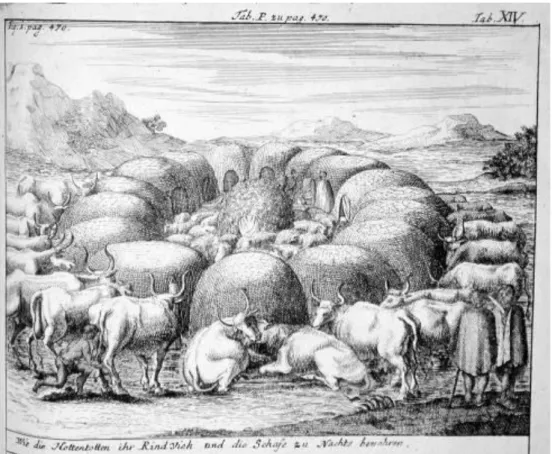
(10) Claroscuro Nº 16 (2017). Centro de Estudios sobre Diversidad Cultural. each tribe had a separate name, the people also had a single term for themselves–the Khoekhoe. In further contrast, the Khoekhoe worldview included an ideology of subsistence based on herding cattle and small stock (see. Lombard. and. Parsons. 2015. for. a. discussion. of. dairy. products).Subsistence distinctions, however, are more complicated because some hunter-foragers today speak Khoe languages. I concentrate here on the herders. Dutch settlers traded with Khoekhoe (i.e. Hottentots) starting in the sixteenth century, but most Khoe-speaking societies no longer exist. In the past, Khoekhoe society recognised lineages, clans and tribes, organised hierarchically, with each tribe led by an independent and relatively powerful chief (Barnard 1992; Schapera 1930). Historic drawings (Fig. 3) show that bee-hive shaped houses were covered in mats and arranged around a circular space, with sheep inside and cattle outside, usually tethered around the outer edge (Boonzaier et al. 1996). Alternatively, the cattle of one man slept in front of his mat house (Smith 1992: 201-203). Among Nama, a cooking shelter was associated with the mat house (Webley 1986) and in some places pastoral sites included stone animal kraals (Bollong, Sampson and Smith 1997; Kinahan 2001). As with pastoralists elsewhere, Khoekhoe moved their animals from time to time in a transhumance cycle from aggregated stations to dispersed stockposts, depending on water and other resources. In contrast to hunter-foragers, pastoralists often camped next to water sources to provide easy access for their livestock.. 9.
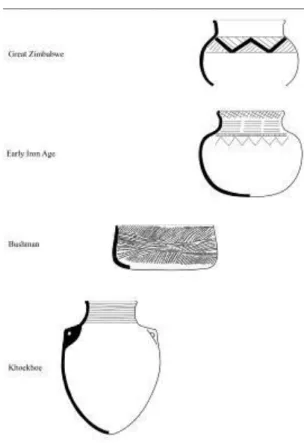
(11) Cultural Diversity during the last 2000 years …. Thomas N. Huffman. Fig. 3. Khoekhoe settlement in the Cape. From Peter Kolb 1731.. In parallel with hunter-foragers, herders also engaged in considerable hunting and gathering. As a result, they also used the bow and arrow and had a lithic tool kit. Generally, the tool kit differed from contemporaneous San LSA assemblages in the much lower frequency of formal microliths and sometimes raw material (Smith et al. 1991). Historic Khoekhoe also made a distinctive pottery (thin walled, grit tempered, bag shaped, pointed bottoms and lugs) that was in marked contrast to recorded San pottery (thick, crude fiber tempered bowls) (Fig. 4. Bollong, Sampson and Smith 1997). While these differences in ceramics and tool kits make sense as cultural markers, their archaeological distribution reflects a complexity that archaeologists have had difficulty clarifying. This difficulty is first due to the poor correlation of this kind of material culture with living social formations. 10.
(12) Claroscuro Nº 16 (2017). Centro de Estudios sobre Diversidad Cultural. (especially when ideology and kinship are important factors). Furthermore, many Stone Age archaeologists have employed a culture-ecology paradigm that emphasized modes of production over social relations (for an exception see Kinahan 2001). Besides this theoretical hurdle, different hunter-forager and pastoralist behaviours have helped to create the archaeological record: for example, the aggregation-dispersal pattern of hunter-gatherers; hunters with stolen or gift animals; specialized hunting camps; isolated burial and caches, as well as the transhumance cycle of pastoralists; pastoral hunting camps; and stockposts tended by San clients. Although contested, archaeological evidence may indicate a transition from hunting and foraging to pastoralism in the Namib (Kinahan 1991, 1996). The way hunter-foragers in the Kalahari toady entrust goats to exchange partners for social rather than consumption purposes provides another model for the acquisition of domestic animals in the past (Russell 2017).. Fig. 4. Different pottery styles associated with the four cultural traditions.. 11.
(13) Cultural Diversity during the last 2000 years …. Thomas N. Huffman. Pastoral origins in southern Africa have been as robustly contested as the Kalahari Debate. Until recently, Khoekhoe origins were once commonly attributed to interaction between hunter-foragers and Iron Age Bantu mixed-farmers. New data force a major revision of this thesis. Most importantly, domestic sheep and cattle remains predate the earliest Iron Age activity by three to four hundred years (Orton et al. 2013; Robbins et al. 2008), the DNA of Khoekhoe cattle differs from that of Iron Age herds (Horsburgh et al. 2013), and while Khoekhoe and San cannot be separated by their respective DNA signals (Soodyall 2008), some show affinities to Sandawe-speakers (a click-based language) in East Africa (Breton, et al. 2014). Moreover, Khoekhoe pottery (other than the debated Bambata facies) bears no genetic relationship to local Early Iron Age styles (Huffman 2007). Evidence from linguistics (e.g. Güldemann 2008) and anthropology (e.g. Barnard 2008) support the movement south of several small groups of East African people at different times, while subsequent interaction led to the complicated linguistic and cultural pattern seen in the recent past. The earliest dates are still contentious. Good data comes from various rockshelters in the southern Cape with characteristic pottery, sheep bones and dung horizons stratified above typical LSA levels (Klein 1986). Other sites along the Atlantic seaboard have yielded sheep and cattle some 2000 years old (Orton et al. 2013), while domestic animals in the interior have a similar date (Robbins et al. 2008). For some reason, San artists recorded the new sheep but not cattle (e.g. fig. 9.16 in Mitchell 2002). Perhaps, it was because they valued fat. Rock art is another media to consider: herder rock art is somewhat different to Bushman art (Fig. 5). Rather than finely-drawn naturalistic animals and people, abstract geometrics (finger dots, slashes and circles), clothing (aprons) and handprints are more characteristic (Smith and Ouzman 2004). Like Bushman art, some images may derive from altered states of consciousness and some sites may have been used by both groups (e.g. Hollmann 2013); so it is sometimes difficult to separate the two traditions. Khoekhoe art is on record in areas where it was expected. 12.
(14) Claroscuro Nº 16 (2017). Centro de Estudios sobre Diversidad Cultural. linguistically, such as the Northern Province (Eastwood and Smith 2005), but also in places where it was not, such as near Johannesburg (Wilcox and Pager 1967). Recently discovered pastoral stonewalling in the same area adds credence to the identification. Elsewhere, abstract herder art is sandwiched between typical Bushman art in the same rockshelter (Hall and Smith 2000), and the different images represent two separate traditions.. Fig. 5. Rock art in the Limpopo Valley: Khoekhoe above; San below.. 13.
(15) Cultural Diversity during the last 2000 years …. Thomas N. Huffman. As the rock art and linguistic data demonstrate, Khoekhoe have interacted with Bushmen for some time. People with both traditions interacted with Bantu-speaking people. Bantu mixed-farmers Bantu. languages. throughout. southern. Africa. are. relatively. homogenous in that they are all related by common vocabularies and a distinctive system of noun classes marked by prefixes and what is called a concordial agreement pattern, that is the noun class determines the form of the verb and so on (Doke 1945). For our purpose, the most important division is between Western Bantu languages, centred in the Congo Basin, and Eastern Bantu, spoken in East and southern Africa (Herbert and Huffman1993): both have an origin in West Africa, somewhere near the Nigeria/Cameroon border (Greenburg 1955). They did not evolve from San or Khoe languages. Moreover, genetic and physical characteristics of Bantu speakers differ from the small light-skinned pedomorphic hunter-forgers and taller herders with narrow crania. Although there is much overlap, biological evidence, like linguistics, does not support an origin of black farmers within southern Africa (Hausman 1982; Tobias 1972; see Soodyall 2006 for more references). In the last two millennia (the Iron Age), various Eastern Bantuspeaking people have inhabited southern Africa (Fig. 6), including presentday Nguni (Berglund 1976), Sotho-Tswana (Schapera 1938), Shona (Holleman 1952) and Venda (Stayt 1931). These groups are not tribes, chiefdoms or nations but language clusters recognised by the people themselves: the names, however, are European. In contrast to both hunters and herders, Eastern Bantu people lived in settled communities with a hierarchy of courts, ranging from homestead heads to neighbourhood headman to chiefs, senior chiefs and sometimes paramount chiefs. These people cultivated such crops as sorghum, millets, cowpeas and ground beans, and herded cattle as well as sheep and goats. Since European. 14.
(16) Claroscuro Nº 16 (2017). Centro de Estudios sobre Diversidad Cultural. contact, they have also kept pigs and donkeys and cultivated maize. In addition, present-day groups hunt many different large and small mammals as well as gather many wild plants and insects (e.g. Quin 1959). This similarity in wild food resources with hunter-foragers and pastoralists is another reason why archaeological identifications should go beyond simple modes of production.. Fig. 6. Southern Africa showing locations of main Bantu languages.. 15.
(17) Cultural Diversity during the last 2000 years …. Thomas N. Huffman. Within Eastern Bantu societies, Nguni speakers emphasized cattle while Sotho-Tswana emphasized cultivation (Hammond-Tooke 1993): both, however, shared remarkably similar worldviews. Indeed, they were all ranked-based societies with a patrilineal ideology about procreation, a preference for cattle as bride wealth, male hereditary leadership and a belief in the positive role of ancestors in daily life (Kuper 1982). These interrelated concepts were expressed in a gendered spatial organization known as the Central Cattle Pattern (Fig. 7). The centre of the settlement, the domain of men, encompassed cattle kraals (corrals, byres) where men and other important people were buried, as well as sunken grain pits for long-term storage, a public smithing area and a court where men resolved disputes and made political decisions. Residue from court activities, such as ash from the court fire, animal bones and broken pottery from the consummation of beer, formed a court midden. The outer residential zone, the domain of women, incorporated the households of individual wives with their house, kitchen and private grainbins, as well as pits for the short-term storage of female-associated crops (such as ground beans), middens of household rubbish, the graves of women and children and an enclosure for sheep and goats. As a minor difference, sheep and goats were kept on the outer edge of Nguni homesteads, while Sotho-Tswana kept them at the front of the residential complex: both groups associated small stock with women. Note that the village-as-cemetery differs from the isolated burials of hunter-foragers (except for rock shelters) and the conical stone cairns of some pastoralists (Dreyer and Meiring 1937).. 16.
(18) Claroscuro Nº 16 (2017). Centro de Estudios sobre Diversidad Cultural. Fig. 7. Central Cattle Pattern today: Nguni above; Sotho-Tswana below (courtesy National Culture History Museum, Pretoria).. In some areas Bantu farmers engraved settlement plans on nearby rocks (Maggs 1995). Occasionally, they used the shape of the rock as a micro-terrain with cattle paths ascending the slopes to connect various homesteads and kraals. These engravings depict idealized versions of the Central Cattle Pattern and the specific version closely parallels the local walling type. All these engravings date to the Late Iron Age. The Late Iron Age (AD 1000-1820) encompasses the prehistory of Nguni and Sotho-Tswana speakers. Linguistic data (Louw and Finlayson. 17.
(19) Cultural Diversity during the last 2000 years …. Thomas N. Huffman. 1990), as well as similarities in kinship terminology (Hammond-Tooke 2004), avoidance customs (Herbert 1990) and pollution concepts (Berglund 1976) show that both groups lived in East Africa during the Early Iron Age. The Nguni association of cattle with men versus women and farming (Hammond-Tooke 1993) was due in part due to developments in East Africa and this is why anthropologists have compared Nguni customs to the East African cattle complex. While in southern Africa, Nguni began building stonewalled settlements that followed the principles of the Central Cattle Pattern (Davies 1974; Whitelaw 2015). They introduced various settlement types to the Free State (Maggs’ 1976 Type N), Gauteng (Mason 1986) and Mpumalanga (Schoeman 1998) where Sotho-Tswana speakers adopted the practice. In the process, many Nguni speakers (generally called Koni) adopted the Sotho-Tswana language (Huffman 2007). We know from this record that the large stonewalled towns typical of Sotho-Tswana (Boeyens 2000) were recent phenomena arising from the troubled times known as the difaqane/mfecane. In the conventional view of the upheaval, Shaka and the Zulu were prime causes, but further research shows that they were actually a result (Hamilton 1995). The causes included a wide variety of factors, such as competition for European trade and concomitant increase in cattle raiding, as well as a growing dependence on New World maize followed by a debilitating drought. The results of these interactions affected the lives of a million people. Interactions with San and Khoekhoe were considerably more modest. Under special circumstances, for example, hunter-foragers occasionally performed rain-control rituals for farmers (Whitelaw 2015). Moreover, clicks were incorporated as replacement sounds in Nguni avoidance words (Herbert 1993), while genetic data show that Southern Nguni inter-married people of San and Khoekhoe descent. Perhaps the mutual emphasis on cattle facilitated this process with Khoekhoe. Sotho-Tswana interaction with San in Botswana, on the other hand, was not so equal. Today and in the recent past, San (or BaSarwa) were treated as serfs, marginalized from. 18.
(20) Claroscuro Nº 16 (2017). Centro de Estudios sobre Diversidad Cultural. ‘civilized’ society (Schapera 1930). As a rule, female San married Bantu males but not vice versus, nor would Bantu females take San husbands. Inter-marriage was thus largely one-sided. Some archaeological data indicate similar unequal relations in the sixteenth century. Sotho-Tswana settlements near the border of Botswana and South Africa, for example, yielded lithic dumps, one behind a copper furnace which in turn was located behind a woman’s house (Hall 2000). Foragers produced the debitage using LSA microlithic technology, rather than farmers who are known for producing large abraded flakes; and the clusters were probably the result of cleaning a primary knapping area, rather than storing stone for later access. The location behind female huts is in marked contrast to Early Iron Age settlements. The Early Iron Age (AD 200-900) embraces the first appearance of Bantu farmers (Mitchell 2002; Phillipson 1985) and from the beginning, farmers interacted with hunter-gatherers. At Broederstroom near Pretoria (Mason 1986: 211-216), for example, typical LSA scrapers were found in middens associated with central cattle kraals. The scrapers thus came from the senior men’s area. Presumably, these scrapers were used for hide processing by San men. Access to carbohydrates (e.g. sorghum beer) and various iron tools probably attracted hunter-gatherers to farmer villages where they in turn supplied such produce as honey, salt and wild meat. In the Broederstroom area, hunter-gatherers may have even changed their aggregation-dispersal pattern to accommodate the new resource (Wadley 1996: 214-215). Something similar occurred in KwaZulu-Natal (Mazel 1989: 141-142). Thus, in contrast to later times, foragers may have been entrepreneurs embedded in regional networks, trading desirable items as well as their labour to Bantu villagers. Perhaps, the different spatial locations in Early and Late Iron Age settlements parallel a shift in farmer attitudes about foragers as traders to foragers as serfs. Broederstroom villagers may have also interacted with pastoralists, for unusual lugged pottery occurs in a ceramic assemblage that is otherwise typical of the Early Iron Age. 19.
(21) Cultural Diversity during the last 2000 years …. Thomas N. Huffman. Bantu farmers throughout eastern and southern Africa shared a common ceramic style (Maggs 1980; Posnansky 1961). At the broadest scale, this common style is referred to as the Chifumbaze Complex (Phillipson 1977). Ceramic units within this Complex help to establish large-scale group identities; Sotho-Tswana ceramics, for example, differ from that of Nguni and Shona speakers (Huffman 2007). These identities were due in part to the repeated use of the same limited range of motifs in the same vessel positions. In Historic times, this repetitive code was embedded in a larger design field encompassing such objects as drums, stools and milk pails, as well as beadwork, basketry and mural art (Evers 1988). Such group statements are in marked contrast to the individuality of Bushman pottery (Sampson 1988). There, the specific identity of the potter appears to have been important, presumably for an exchange system that valued the original source. Although ceramic facies reflect and are part of group identity, they nevertheless help to recognize ethnic-level interaction during the Middle Iron Age (AD 900-1310). This period specifically refers to events and processes in the Limpopo Valley which led to the evolution of the Zimbabwe culture. During this period, two ceramic styles coexisted (Calabrese 2007), representing a case of ethnic stratification: one style was made by the descendents of Early Iron Age people in the valley and the other by the new Leopard’s Kopje occupants who took over the landscape and established a new chieftainship (Fig. 8). Among other things, the new occupants took control of the East Coast ivory and gold trade. I turn now to this final example of pre-colonial diversity.. 20.
(22) Claroscuro Nº 16 (2017). Centro de Estudios sobre Diversidad Cultural. Fig. 8. Ceramic sequence for Mapungubwe cultural landscape. Note overlap between Zhizo and K2 facies.. Shona trading states The Zimbabwe culture has been known to the Western World since the sixteenth century (Fig. 9), and a detailed chronology, named after important capitals, is now available: Mapungubwe (Meyer 1998) –AD 1220 to 1310; Great Zimbabwe (Caton-Thompson 1931)– AD 1300 to 21.
(23) Cultural Diversity during the last 2000 years …. Thomas N. Huffman. 1450;Khami (Robinson 1959) – AD 1450 to 1640; and Danangombe (MacIver 1906) – AD 1690 to 1820. Although these capitals form a sequence, their occupations overlapped significantly.. Fig. 9. Location of Shona trading states and capitals mentioned in text.. Portuguese accounts written during the Khami period about the Mutapa kingdom (Pikirayi 1993) make it clear that the Zimbabwe culture was the product of a Shona-speaking society (Documents 1962-1972). These documents also show that the political economy was based on long-distance. 22.
(24) Claroscuro Nº 16 (2017). Centro de Estudios sobre Diversidad Cultural. trade. Among other goods, local gold, ivory, rhino horn and leopard skins were traded to Arabia, India and China in return for such exotics as glass beads, cloth and glazed ceramics. Of the exotics, glass beads (Wood 2000) are the most important archaeologically (note that relatively few have been recorded outside the Zimbabwe culture area), while gold was the crucial export. Indeed, visible gold reefs were concentrated in the greenstone belts of Zimbabwe and Botswana (Summers 1969), and this was the deciding factor in the location of trading states. The Portuguese accounts began a 500 year-long ethnographic record that allows us to understand the Zimbabwe culture in some historical and cultural detail. First, sacred leadership characterized a society stratified into two socio-economic classes: nobles and commoners (Huffman 1996). By a noble class we mean a high-status group, in contrast to all others, with wellrecognized rights, duties and behaviour. Senior families of different lineages across the culture area formed a single bureaucratic upper class, restricting wealth, status and political power to themselves. Commoners, in contrast, lacked the same access to wealth, status and power. By sacred leadership we mean a mystical association between leaders and the land and a related link between leaders, their ancestors and God. It is to God a sacred leader must turn, through the royal ancestors, to ensure fertility of people and the land. Thus, a noble leader's power was based in part on the claim that his ancestors could intercede directly with God. In tandem with this claim, Zimbabwe people believed that the ancestors appointed, or at least approved, their leaders (any son of the king and a noble wife), and sacred leaders were not hereditary in the strict sense (for a debate on this and other points see Chirikure and Pikirayi 2008 and Huffman 2011). With regard to spatial organization, sacred leaders remained aloof in a private palace located conceptually at the back, east side of the settlement (Fig. 10). These stone-walled palaces provided ritual seclusion from physical and supernatural danger, which sacred leaders required because of indigenous concepts about pollution (see Ngubane 1977), and leaders were expected to be aloof (Van Warmelo 1932). These palaces contained a 23.
(25) Cultural Diversity during the last 2000 years …. Thomas N. Huffman. limited number of diagnostic structures. The largest was an audience chamber where supplicants could meet the leader in private. To meet the leader, visitors had to negotiate with an official who maintained a public office at the edge of the palace. Once inside, visitors had to pass by the traditional diviner. In addition, sacred leaders ruled with the aid of a specially designated brother and sister, and so palaces usually included a compartment for the senior sister. The back portion accommodated a few young wives near an area reserved for national rituals. Guards surrounded the palace, while some, known as the ‘eye’, guarded the king’s back. A law court for disputes among nobles was usually secluded inside the palace. It is worth noting that in the sixteenth century, the Karanga word dzimbahwe meant the home, court and grave of the leader. In this regard, former rulers were buried in rock shelters walled-up to resemble a palace.. 24.
(26) Claroscuro Nº 16 (2017). Centro de Estudios sobre Diversidad Cultural. Fig. 10 Plan (original, courtesy National Museum and Monuments, Zimbabwe) and photo of palace front at Danangombe, Zimbabwe.. As opposed to nobles, ordinary people resolved their disputes in a public arena outside the palace. The designated brother was in charge of this public court and lived near it. Conceptually, this commoner’s court was located to the side of the palace opposite the royal wives’ compound. A special area for the king’s wives was necessary for several reasons. For one, marriages were part of political arrangements. As a matter of principle, the 25.
(27) Cultural Diversity during the last 2000 years …. Thomas N. Huffman. king would have had wives from every district of his kingdom, and he would have had more than any district leader. Secondly, although these women were important avenues to success and status, they were both sources and victims of danger. Other members of the upper class lived around the palace, forming a protective ring that was reinforced at various places by guards and medicines. As more protection, many commoners lived to the west in the front section of the settlement. District leaders, on the other hand, maintained residences in the capital outside this protective zone. As a source of danger, district leaders could not stay within the king’s protected zone. Finally, most commoners lived outside the capital in homesteads organized according to the Central Cattle Pattern. This dual organization for commoners versus elite is archaeological evidence for class distinctions, and continues today in a slightly modified form in traditional Venda capitals (Fig. 11). Venda nobles, one should note, were originally Shona from Zimbabwe (Loubser 1991).. Fig. 11. Chief’s section in Venda village, South Africa.. Because the Zimbabwe culture was an indigenous development, its origins at Mapungubwe deserve further comment. It originated here because seasonal flooding during the Middle Iron Age made the Shashi-. 26.
(28) Claroscuro Nº 16 (2017). Centro de Estudios sobre Diversidad Cultural. Limpopo confluence area the ‘Nile’ of southern Africa. Despite claims to the contrary, the combination of intensive cultivation of the Limpopo flood plains and excess wealth from the gold and ivory trade made the Mapungubwe cultural landscape unique in southern Africa. This is where ranked-base society at the capital K2 transformed into a class-based state at Mapungubwe (Huffman 2009): such a transformation could not have occurred at small settlements with small hinterlands and limited agricultural potential. Both hunter-foragers and herders had been in the area during the Early Iron Age, but their role, if any, is unknown. Rock shelter deposits suggest that, initially, hunter-foragers had amicable relations with Bantu farmers, as they did at Broederstroom. Later, farmers took over one shelter for their own use as a boy’s initiation centre (Hall and Smith 2000; Huffman 2014), and hunter-foragers became increasingly marginalized from the main cultural transformations. Evidence for these transformations is found in three spatial shifts at the capitals. First, cattle were moved out of the centre of K2 (c. AD 1150), reflecting the beginnings of class distinctions; secondly, the leader moved on top of Mapungubwe hill above the commoners (c. AD 1220); and thirdly, the construction of the first stonewalled palace on top of an older rainmaking area (c. AD 1250) marked the appropriation of power inherent to rainmaking hills. In addition to the palace, other stonewalling demarcated entrances to elite areas, noble housing and boundaries of the town centre. These and other similarities with Great Zimbabwe demonstrate that the elite Zimbabwe Pattern originated at Mapungubwe, rather than at Great Zimbabwe itself. This new elite pattern represents the full materialization of sacred leadership and the nationalisation of raincontrol. Afterwards, palaces of sacred leaders were regularly built on top of rainmaking hills. The famous gold burials were contemporaneous with the elite occupation on the summit. Twenty-three graves were found in one area (Fouché 1937; Gardner 1963) and three were associated with gold objects. 27.
(29) Cultural Diversity during the last 2000 years …. Thomas N. Huffman. One was a woman buried in a sitting position facing west (rather than on her left side): she wore at least 100 gold wire bangles around her ankles, while over 12 000 gold beads and at least 26 000 glass beads were probably sewn onto clothing. These burials are the first to contain objects that denote such high status. At about AD 1310, or slightly later, Mapungubwe people abandoned the valley. Isotopic and other data show that there was a widespread and sustained drought at AD 1310±5 (Huffman and Woodborne 2016). According to our survey data, several thousand people living in the region were more-or-less dependent on flood-plain agriculture, and agricultural production was probably tightly scheduled. Lower rainfall and erratic flooding would therefore make a greater impact at this time than similarly poor conditions would have earlier. The social consequences of a fourteenth century drought would have also been severe for ideological reasons. Because sacred leaders were now supposed to be chosen by God through the ancestors, natural disasters expressed supernatural displeasure in a king’s rule. In all, the king would have probably been blamed for the agricultural misfortune, and his right to lead would have been challenged (Murimbika 2006). Indeed, even among ranked-based societies with the Central Cattle Pattern, agricultural failures can cause a chief to lose support, and a succession dispute would have been a real possibility. It was at this time that Great Zimbabwe took over the goldfields to the north of Mapungubwe and undermined its political economy. Thus, natural misfortunes could have huge political ramifications.. Overview At the scale of worldview, the four cultural traditions were distinct. These distinct traditions could be described and recognized archaeologically because of the combined use of historical linguistics, historical documents and the ethnography of descendents. We are particularly fortunate that copious ethnographic data are available. These data, by the way, were not. 28.
(30) Claroscuro Nº 16 (2017). Centro de Estudios sobre Diversidad Cultural. forced on the archaeological record; they were applied as models to see if they fit. Ethnographically-derived models are unquestionably superior to interpretations derived from the archaeological record alone. It is a truism that archaeological data need to be explained; they cannot also be the explanation. Although ethnographic models have their own difficulties, critics have not developed a viable alternative that provides an equally valid window into worldview. The four models apply to a wide variety of archaeological data, including stone tool assemblages, pottery, settlement organization, settlement locations, burials and rock art. Among other things, their application clarifies the diverse origins of the four traditions. San huntergatherers, as expected, evolved within southern Africa, while Khoekhoe pastoralism moved south from East Africa. Thus, contrary to perceived wisdom, Khoekhoe did not have an origin among LSA hunter-foragers in southern Africa. Later, Bantu farmers, originating in West Africa, moved through East Africa on their way south. The tempo and structure of these movements remain for future consideration, but claims that Iron Age Bantu evolved in southern Africa are based on politics, not linguistic or other evidence. Lastly, the Zimbabwe culture was an indigenous transformation in the face of external stimuli. The roles of individuals in this internal transformation also require further research. Although origins were different and the traditions distinct(at least at first), they all co-existed. Indeed, interaction characterizes the entire 2000 years. During the sixteenth century, San hunter-foragers and Khoekhoe pastoralists still lived throughout the region, albeit in limited spaces. Bantu farmers interacted with both San and Khoekhoe and in some cases with different polities of the Zimbabwe culture. Shona polities for their part embraced Muslim traders and then Portuguese soldiers, priests and traders. Unfortunately, Portuguese interference in the political economy destroyed sacred leadership in at least one historically known kingdom. European colonization, with its competition for land and other resources, destroyed many political entities and affected modes of 29.
(31) Cultural Diversity during the last 2000 years …. Thomas N. Huffman. production throughout much of southern Africa. Prior to colonization, however, culture contact did not automatically lead to culture change. San,for example, maintained much of their traditional lifeways even though they had interacted with Bantu speakers for several centuries: under some circumstances hunter-forger ideology was tenacious. Likewise, even though largely Christian, Bantu speakers today still believe in the ancestors and still hold bridewealth in cattle as an important structuring principle. Modernday people are therefore relevant to unravelling the past. Acknowledgements David Lewis-Williams and Gavin Whitelaw commented on the manuscript while Wendy Voorvelt prepared the illustrations. Research over the years has been sponsored by De Beers, SANParks, South African National Research Foundation and the University of the Witwatersrand, Johannesburg. Interpretations presented here do not necessarily reflect the opinions of these sponsors or commentators. Bibliography BARKHAN, Debra and SOODYALL, Himla (2006) “Mitochondrial DNA (mtDNA) and Y chromosome DNA variation in African populations”, in: SOODYALL, Himla (ed.) The prehistory of Africa: tracing the lineage of modern man. Johannesburg: Jonathan Ball, pp. 139-148, 185-187. BARNARD, Alan (1992) Hunters and herders of southern Africa. A comparative ethnography of the Khoisan peoples. Cambridge: Cambridge University Press. BARNARD, Alan (2008) “Ethnographic analogy and the reconstruction of early Khoekhoe society”, Southern African Humanities 20(1): 61-75. BERGLUND, Alex-Ivar (1976) Zulu thought-patterns and symbolism. Cape Town: David Philips. BLEEK, Wilhelm H.I. and LLOYD, Lucy C. (1911) Specimens of Bushman folklore. London: George Allen and Co. BOEYENS, Jan C.A. (2000) “In search of Kaditshwene”, South African Archaeological Bulletin 55(171): 3-17.. 30.
(32) Claroscuro Nº 16 (2017). Centro de Estudios sobre Diversidad Cultural. BOLLONG, Charles A., SAMPSON, C. Garth and SMITH, Andrew B. (1997) “Khoikhoi and Bushman pottery in the Cape Colony: ethnohistory and Later Stone Age ceramics of the South African interior”, Journal of Anthropological Archaeology 16: 269-299. BOONZAIER, Emile, MALHERBE, Candy, SMITH, Andrew and BERENS, Penelope (1996) The Cape herders: a history of the Khoikhoi of southern Africa. Cape Town: David Philip. BRETON, Gwenna, SCHLEBUSCH, Carina M., LOMBARD, Marlize, SJODIN, Per, SOODYALL, Himla and JAKOBSSON, Mattias (2014) “Lactase persistence alleles reveal partial East African ancestry of southern African Khoe pastoralists”, Current Biology 24(8): 852-858. CALABRESE, John A. (2007) The emergence of social and political complexity in the Shashi-Limpopo Valley of southern Africa, AD 900 to 1300. Ethnicity, class, and polity (BAR International Series 1617). Oxford: Archaeopress. CATON-THOMPSON, Gertrude (1931) The Zimbabwe culture: ruins and reactions. Oxford: Clarendon Press. CHIRIKURE, Shadreck and PIKIRAYI, Innocent (2008) “Inside and outside the dry stone walls: revisiting the material culture of Great Zimbabwe”, Antiquity 82: 976-993. DAVIES, Oliver (1974) “Excavations at the walled early Iron Age site in Moor Park near Escourt”, Annals of the Natal Museum 22: 289-323. DEACON, Hilary J. and DEACON, Jeanette (1999) Human beginnings in South Africa: uncovering the secrets of the Stone Age. Cape Town: David Philip. DOCUMENTS (1962-1972) Documents on the Portuguese in Mozambique and Central Africa. 1497-1840 (8 vols). Lisbon: National Archives of Rhodesia and Nyasaland and Centro de Estudos Historicos Ultramarinos. DOKE, Clement M. (1945) Bantu: modern grammatical, phonetical, and lexicographical studies since 1860. London: Oxford University Press. DREYER, Thomas F. and MEIRING, Albert J. D. (1937) “A preliminary report on an expedition to collect old Hottentot skulls”, Soölogiese Navorsing van die Nasionale Museum 1(7): 81-88. EASTWOOD, Edward B. and SMITH, Benjamin W. (2005) “Fingerprints of the Khoekhoen: geometric and handprinted rock art in the Central Limpopo B, southern Africa”, in: BLUNDELL, Geoffrey (ed.) Further approaches to southern African rock art. (South African 31.
(33) Cultural Diversity during the last 2000 years …. Thomas N. Huffman. Archaeological Society Goodwin Series 9): 63-76. EVERS, Timothy M. (1988) The recognition of groups in the Iron Age of southern Africa. Unpublished PhD Dissertation. Johannesburg: University of the Witwatersrand. FOUCHÉ, Leo (ed.) (1937) Mapungubwe: ancient Bantu civilization on the Limpopo. Cambridge: Cambridge University Press. GARDNER, Guy A. (1963) Mapungubwe: Volume II. Pretoria: J.L. Van Schaik. GREENBERG, Joseph H. (1955) Studies in African linguistic classification. New Haven: Compass Publishing. GUENTHER, Mathias G. (1986) The Nharo Bushmen of Botswana: tradition and change. Hamburg: Helmut Buske Verlag. GÜLDEMANN, Tom (2008) “A linguist’s view: Khoe-Kwadi speakers as the earliest food-producers of southern Africa”, Southern African Humanities 20(1): 93-132. HALL, Simon (2000) “Forager lithics and early Moloko homesteads at Madikwe”, Natal Museum Journal of Humanities 12: 33-50. HALL, Simon and BINNEMAN, Johan (1987) “Later Stone Age burial variability in the Cape: a social interpretation”, South African Archaeological Bulletin 42(146): 140-152. HALL, Simon and SMITH, Ben (2000) “Empowering places: rock shelters and ritual control in farmer-forager interactions in the Northern Province” in: LESLIE, Mary, and MAGGS, Tim (eds.) African naissance: the Limpopo Valley 1 000 years ago (South African Archaeological Society Goodwin Series 8): 30-46. HAMILTON, Carolyn (ed.) (1995) The Mfecane aftermath: reconstructive debates in southern African history. Johannesburg: Witwatersrand University Press. HAMMOND TOOKE, David (1993) The roots of Black South Africa. Johannesburg: Jonathan Ball. HAMMOND-TOOKE, W.D. (2000) “Ethnicity and ethnic group in Iron Age southern Africa”, South African Journal of Science 96: 421-422. HAMMOND-TOOKE, W.D. (2004) “Southern Bantu origins: light from kinship terminology”, Southern African Humanities 16: 71-78. HAUSMAN, Alice J. (1982) “The biological evolution of Khoisan populations of southern Africa”, American Journal of Physical Anthropology 58: 315-330.. 32.
(34) Claroscuro Nº 16 (2017). Centro de Estudios sobre Diversidad Cultural. HERBERT, Robert K. (1990) “The sociohistory of clicks in Southern Bantu”, Anthropological Linguistics 32(3-4): 295-315. HERBERT, Robert K. and HUFFMAN, Thomas N. (1993) “A new perspective on Bantu expansion and classification: linguistic and archaeological evidence fifty years after Doke”, in: HERBERT, Robert K. (ed.) Not with one mouth: continuity and change in southern African language studies (African Studies 52(2)). Johannesburg: Witwatersrand University Press, pp. 53-76. HOLLEMAN, Johan F. (1952) Shona customary law. London: Oxford University Press. HOLLMANN, Jeremy C. (2013) “Exploring the Gestoptefontein-Driekuil complex (GDC): an ancient women’s ceremonial centre in Northwest Province. South Africa”, South African Archaeological Bulletin 68(198): 146-159. HORSBURGH, K. Ann, PROST, S., GOSLING, A.L., MATISOO-SMITH, E., HUFFMAN, T. N., MITCHELL, P., STANTON, J., RAND, C. and KLEIN, R. G. (2013) “Something about Khoe/Bantu Modern and Ancient Cattle – complete mt genomes”. Read at the ASAPA Conference, Gaborone, Botswana. HUFFMAN, Thomas N. (1996) Snakes & crocodiles: power and symbolism in ancient Zimbabwe. Johannesburg: Witwatersrand University Press. HUFFMAN, Thomas N. (2007) Handbook to the Iron Age: the archaeology of pre-colonial farming societies in southern Africa. Pietermaritzburg: University of KwaZulu-Natal Press. HUFFMAN, Thomas N. (2009) “Mapungubwe and Great Zimbabwe: The origin and spread of social complexity in southern Africa”, Journal of Anthropological Archaeology 28(1): 37-54. HUFFMAN, Thomas N. (2011) “Debating Great Zimbabwe”, South African Archaeological Bulletin 66(193): 27-40. HUFFMAN, Thomas N. (2014) “Salvage excavations on Greefswald: Leokwe commoners and K2 cattle”, Southern African Humanities 26: 101128. HUFFMAN, Thomas N. and WOODBORNE, Stephan (2016) “Archaeology, baobabs and drought: cultural proxies and environmental data from the Mapungubwe landscape”, The Holocene 26(3): 464-470. JONES, Siân (1997) The archaeology of ethnicity: constructing identities in the past and present. London: Routledge.. 33.
(35) Cultural Diversity during the last 2000 years …. Thomas N. Huffman. KATZ, Richard (1982) Boiling energy: community healing among the Kalahari Kung. Cambridge, MA: Harvard University Press. KINAHAN, John (2001) Pastoral nomads of the Namib Desert: the people history forgot. Windhoek: Namibia Archaeological Trust. KINAHAN, John (1996) “Alternative views on the acquisition of livestock by hunter-gatherers in southern Africa: a rejoinder to Smith, Yates and Jacobson”, South African Archaeological Bulletin 51(164): 106-108. KLEIN, Richard G. (1986) “The prehistory of Stone Age herders in the Cape Province of South Africa” in: HALL, Martin and SMITH, Andrew (eds) Prehistoric pastoralism in southern Africa (South African Archaeological Society Goodwin Series 5): 5-12. KUPER, Adam (1982) Wives for cattle: bridewealth and marriage in Southern Africa. London: Routledge & Kegan Paul. LEE, Richard B. and DEVORE, Irven (eds.) (1976) Kalahari huntergatherers: studies of the Kung San and their neighbours. Cambridge MA: Harvard University Press. LEWIS-WILLIAMS, J. David (1981) Believing and seeing: symbolic meanings in southern San rock paintings. London: Academic Press. LEWIS-WILLIAMS, J. D. and BIESELE, M. (1978) “Eland hunting rituals among northern and southern San groups: striking similarities”, Africa 48(2): 117–134. LOMBARD, Marlize and PARSONS, Isabelle (2015) “Milk not meat: the role of milk amongst the Khoe people of southern Africa”, Journal of African Archaeology 13(2). LOUBSER, Johannes H.N. (1991) “The ethnoarchaeology of Venda-speakers in southern Africa”, Navorsinge van die Nasionale Museum Bloemfontein 7 (8):145-464. LOUW, Jacobus A. and FINLAYSON, Rosalie (1990) “Southern Bantu origins as represented by Xhosa and Tswana”, South African Journal of African Languages 10(4): 401-410. MACIVER, David Randall (1906) Mediaeval Rhodesia. London: Macmillian. MAGGS, Tim M. O’C. (1976) Iron Age communities of the southern Highveld. (Occasional Publication 2) Pietermaritzburg: Natal Museum. MAGGS, Tim M. O’C. (1980) “Msuluzi Confluence: a seventh century Early Iron Age site on the Tugela River”, Annals of the Natal Museum 24: 111-145.. 34.
(36) Claroscuro Nº 16 (2017). Centro de Estudios sobre Diversidad Cultural. MAGGS, Tim M. O’C. (1995) “Neglected rock art: the rock engravings of agriculturist communities in South Africa”, South African Archaeological Bulletin 50(162): 132-142. MASON, Revil (1986) Origins of black people of Johannesburg and the Southern Western Central Transvaal AD 350-1880. (Occasional Paper 16) Johannesburg: University of the Witwatersrand Archaeological Research unit. MAZEL, Aron David (1989) “People making history: the last ten thousand years of hunter-gatherer communities in the Thukela Basin”, Natal Museum Journal of Humanities 1: 1-168. MEYER, Andrie (1998) The archaeological sites of Greefswald: stratigraphy and chronology of the sites and a history of investigations. Pretoria: University of Pretoria. MITCHELL, Peter (2002) The archaeology of southern Africa. Cambridge: Cambridge University Press. MURIMBIKA, McEdward (2006) Sacred powers and rituals of transformation: an ethnoarchaeological study of rainmaking rituals and agricultural productivity during the evolution of the Mapungubwe state, AD 1000 to AD 1300. University of the Witwatersrand, Johannesburg. NGUBANE, Harriet. (1977) Body and mind in Zulu medicine. London: Academic Press. ORTON, Jayson, MITCHELL, Peter, KLEIN, Richard, STEELE, Teresa and HORSBURGH, K. Ann (2013) “An early date for cattle from Namaqualand, South Africa: implications for the origins of herding in southern Africa”, Antiquity 87: 108-120. PARKINGTON, John (1980) “Time and place: some observations on spatial and temporal patterning in the Later Stone Age sequence in southern Africa”, South African Archaeological Bulletin 35(132): 73-112. PHILLIPSON, David W. (1977) The later prehistory of eastern and southern Africa. London: Heinemann. PHILLIPSON, David W (1985) African archaeology. Cambridge: Cambridge University Press. PIKIRAYI, Innocent (1993) The archaeological identity of the Mutapa state: toward an historical archaeology of northern Zimbabwe. Uppsala: Societas Archaeologica Upsaliensis.. 35.
(37) Cultural Diversity during the last 2000 years …. Thomas N. Huffman. POSNANSKY, Merrick (1961) “Iron Age in East and Central Africa – points of comparison”, South African Archaeological Bulletin 16: 134-136. QUIN, P.J. (1959) Food and feeding habits of the Pedi. Johannesburg: Witwatersrand University Press. RAPOPORT, Amos (1969) House, form and culture. Englewood Cliffs, N.J.: Prentice Hall. ROBINSON, Keith R. (1959) Khami ruins. Cambridge: Cambridge University Press. RUSSELL, Thembi (2017) “‘Where goats connect people’: cultural diffusion of livestock not food production amongst southern African huntergatherers during the Later Stone Age”, Journal of Social Archaeology DOI: 10.1177/1469605317701596. SAMPSON, C. Garth (1988) Stylistic boundaries among mobile hunterforagers. Washington DC: Smithsonian Institution Press. SCHAPERA, Isaac (1930) The Khoisan peoples of South Africa: Bushmen and Hottentots. London: George Routledge and Sons. SCHAPERA, Isaac (1938) A handbook of Tswana law and custom. London: Oxford University Press. SCHOEMAN, M.H. Alex (1998) “Excavating Ndzundza Ndebele identity at KwaMaza”, Southern African Field Archaeology 7(1): 42-52. SILBERBAUER, George B. (1981) Hunter and habitat in the central Kalahari Desert. Cambridge: Cambridge University Press. SMITH, Andrew B. (1992) Pastoralism in Africa: origins and development ecology. London: Hurst & Company. SMITH, Andrew B., SADR, Karim, GRIBBLE, John and YATES, Royden (1991) “Excavations in the south-western cape, South Africa, and the archaeological identity of prehistoric hunter-gatherers within the last 2000 years”, South African Archaeological Bulletin 46(154): 7191. SMITH, Benjamin (2006) “Reading rock art and writing genetic history: regionalism, ethnicity and the rock art of southern Africa” in: SOODYALL, Himla (ed.) The prehistory of Africa: tracing the lineage of modern man. Johannesburg: Jonathan Ball, pp. 76-96, 176-181. SMITH, Benjamin W. and OUZMAN, Sven (2004) “Taking stock: identifying Khoekhoen herder rock art in southern Africa”, Current Anthropology 45(4): 499-526.. 36.
(38) Claroscuro Nº 16 (2017). Centro de Estudios sobre Diversidad Cultural. SOLWAY, Jacqueline S. and LEE, Richard B. (1990) “Foragers, genuine or spurious? Situating the Kalahari San in history”, Current Anthropology 31(2): 109-146. SOODYALL, Himla, MAKKAN, Heeran, HAYCOCK, Philip and NAIDOO, Thijessen (2008) “The genetic prehistory of the Khoe and San”, Southern African Humanities 20(1): 37-48. STAYT, Hugh A. (1931) The Bavenda. Oxford: Oxford University Press for the International African Institute. SUMMERS, Roger (1969) Ancient mining in Rhodesia and adjacent areas. (Museum Memoir 3). Salisbury: National Museums of Rhodesia. VAN WARMELO, Nicolaas J. (1932) Contributions towards Venda history, religion and tribal ritual. (Ethnological Publication 3). Pretoria: Government Printer. WADLEY, Lyn (1992) “Reply to Barham: aggregation and dispersal phase site in the Later Stone Age”, South African Archaeological Bulletin 47(155): 52-55. WADLEY, Lyn (1996) “Changes in the social relations of pre colonial huntergatherers after agropastoralist contact: an example from the Magaliesberg, South Africa”, Journal of Anthropological Anthropology 15: 205-217. WALKER, Nick J. (1995) Late Pleistoene and Holocene hunter-gatherers of the Matopos. Uppsala: Societas Archaeologica Upsaliensis. WEBLEY, Lita (1986) “Pastoralist ethnoarchaeology in Namaqualand” in: HALL, Martin and SMITH, Andrew (eds.) Prehistoric pastoralism in southern Africa. (South African Archaeological Society Goodwin Series 5): 57-61. WEISSNER, Polly (1983a) “Social and ceremonial aspects of death among the Kung San”, Botswana Notes and Records 15: 1-5. WEISSNER, Polly (1983b) “Style and social information in Kalahari San projectile points”, American Antiquity 48(2): 253-276. WHITELAW, Gavin D.A. (2015) Economy and cosmology in the Iron Age of KwaZulu-Natal. Unpublished PhD Dissertation, Johannesburg: University of the Witwatersrand. WILCOX, A.R. and PAGER, H.L. (1967) “The petroglyphs of Redan, Transvaal”, South African Journal of Science 63: 492-498. WILMSEN, Edwin N. (1989) Land filled with flies: a political economy of the Kalahari. Chicago: University of Chicago Press. 37.
(39) Cultural Diversity during the last 2000 years …. Thomas N. Huffman. WILMSEN, Edwin N. and DENBOW, James R. (1990) “Paradigmatic history of San-speaking peoples and current attempts at revision”, Current Anthropology 31(5): 489-524. WOOD, Marilee (2000) “Making connections: relationships between international trade and glass beads from the Shashe-Limpopo area.” in: LESLEY, Mary & MAGGS, Tim (eds.) African naissance: The Limpopo Valley 1 000 years ago. (South African Archaeological Society Goodwin Series 8): 78-90. YELLEN, John E. (1977) Archaeological approaches to the present: models for reconstructing the past. New York: Academic Press.. 38.
(40)
Figure


+3


Documento similar
Cultural diversity is made manifest by the diversity of language, of religious beliefs, practices in the arts, in music, in the social structure, in the choice of crops, and in
The classification of the stations by similar net changes in monthly drought indices using the RPCA dis- tinguished five large classes —the southern (centred in Romania and
Money, prices, wages, and ‘profit inflation’ in Spain, the Southern Netherlands, and England during the Price Revolution era, ca.. Turning Trade Marks into Brands: how
Okri, by translating these elements of West African oral tradition into a Western literary discourse, is thus performing an act of cultural translation, and is authorising
The proportion increases to 44 per cent in sub-Saharan Africa and 86 per cent in Oceania (excluding Australia and New Zealand). In sub-Saharan Africa, an additional 23 per cent
Considering housing tenure status as a key factor (Kemeny 2001), this research is guided by three specific objectives: (1) to explore the distinctive feature of
It is against this background that we undertook a systematic review and meta-analysis with the aim of estimating the prevalence of hypertension in adults aged 50 years or older
3) A North African depression. A system of three centers of pressure controls the flows affecting southern Europe and the Mediterranean basin: a trough placed over northern
