PEDAGOGÍA EN INGLÉS
HIGH SCHOOL STUDENTS’ PARTICIPATION AND THE PROVISION OF
CHOICE
Seminario para optar al título de Profesor de Inglés para la Enseñanza Básica y Media y al Grado Académico de Licenciado en Educación
Supervisor: Carol Grace Gómez Merino Piero Antonio Banchero Afani Ignacia Francisca Cárdenas Caro Andrea Isabel Cusicanqui Cordano
Francisca Paola Moya Labraña Catherine Del Carmen Muñoz Córdova
Gisselle Nathalia Young Ruz
ii
ACKNOWLEDGEMENTS
In this section, we would like to show our gratitude towards all the people who supported us during the hard process of becoming English teachers.
First of all, we would like to thank our families for supporting us during these four years in which we prepared ourselves to become teachers. Without them looking after us, it would have been more difficult to go through this stage of our lives. Thank you for providing us with words of support during the difficult times.
We would like to show our gratitude to the person who made all this possible, our supervisor Carol Gómez because without her backing, we would have never accomplished this task. Thank you for guiding us when we were completely lost and showing us that our ideas were not completely non-sense.
We would also like to thank the school who made this study possible, for letting us go into the classes and for putting their confidence in us to prove that the Provision of Choice could be effective during classes.
iii 1.3 The Current Study 2. Literature Review
2.1 Educational Paradigms
2.1.1 The Technical Paradigm 2.1.2 The Critical Paradigm 2.1.3 The Practical Paradigm
2.2 The national Curriculum: Approaches 2.3 Participation
2.3.1 Definition of Participation
2.3.2 Reasons for Students’ non-participation
2.3.2.1 Class Size
2.3.2.2 Timing
2.3.2.3 Course Policies
2.3.2.4 Class Methodology
2.3.2.5 Personal Traits and Fears
2.3.2.6 Classroom Climate
2.4 Choice
2.5 The present Study 3. Methodology
3.1 Overall Design 3.2 Context
3.2.1 Lessons Methodology 3.3 Participants
3.4 Data collection Instruments and Procedures
iv 3.4.1 Survey
3.4.2 Interviews 3.4.3 Field Notes 3.5 Intervention Design 4. Results
4.1 First Interview Results
4.1.1 Perceptions about English 4.1.2 Perceptions about Participation 4.1.3 Perceptions about Classwork and
Materials
4.1.4 Perceptions about Choice 4.2 Observation Results
4.2.1 English 4.2.2 Participation
4.2.3 Classwork and Materials 4.2.4 Choice
4.3 Final Interview results
4.3.1 Perceptions about English 4.3.2 Perceptions about Participation 4.3.3 Perceptions about Classwork and
Materials
4.3.4 Perceptions about Choice 4.4 Overall Results of the Data Set 5. Discussion
5.1 Students’ perceptions about Participation and
the influence of the Provision of Choice 5.1.1 Perceptions about Participation
before and after the Provision of Choice 5.2 Students’ Perceptions about Choice
5.2.1 The Provision of Choice: current and previous studies
5.2.2 Final Remarks 5.3 Personal Reflections
v 5.4 Limitations and Suggestions 6. Conclusion
References Appendix A Appendix B Appendix C Appendix D Appendix E Appendix F
Appendix G 81
vi
LIST OF FIGURES
Figure 3.1. Intervention Design Diagram Figure 4.1. First interview Results
Figure 4.2. Observation Results Figure 4.3. Final interview Results Figure 5.2 Perceptions about Choice
vii ABSTRACT
Participation has been studied by many researchers during the last years. Researchers and important authorities related to the educational field highlight the importance of having students who actively participate inside the classrooms. Participation promotes interaction, which is a key element in the acquisition of a new language, and for this reason, when it comes to English classes, participation becomes even more important. Even though many researchers have been focusing their studies on analyzing in-class
participation, there is a lack of studies in which students’ perceptions about
their own participation are considered. Due to the importance of participation, many people have tried to come out with ideas, class methodologies and techniques that could enhance participation. Little is known about the provision of choice within classes however, studies on the topic have shown that the provision of choice, when offered in an appropriate way, could be beneficial for the creation of a sense of autonomy on students, and more specifically on adolescents. For the aim of the current study to be fulfill, the provision of choice will be considered as the opportunity for the meaningful realization of the
individual’s desires or preferences related to class materials. The purpose of
the current study is to understand high school students’ classroom
viii
know if students’ perceptions about participation and choice had changed after
the intervention. Results showed that in general students considered participation as an important factor inside the classroom; however, they did not feel comfortable participating orally in class. Finally, the results demonstrated
that the provision of choice influenced students’ perceptions about
participation within English sessions.
ix RESUMEN
x
realizada a los cinco participantes de este estudio con el objetivo de conocer la percepción de los estudiantes acerca de la participación, la provisión de elecciones, y con el fin de preparar las próximas intervenciones. Luego, una intervención en la que se le dio la oportunidad de escoger a los estudiantes fue realizada. Por último, se llevó a cabo otra entrevista con el fin de saber si las percepciones de los estudiantes sobre la participación y sobre la posibilidad de elegir habían cambiado después de la intervención. Los resultados mostraron que, en general, los estudiantes consideran la participación como un factor importante dentro del aula; sin embargo, no se sienten cómodos participando de forma oral en clase. Por último, los resultados demostraron que la provisión de elección influenció las percepciones de los estudiantes acerca de la participación en las sesiones de inglés.
Palabras claves: participación, provisión de elecciones, percepciones de los
11
1. INTRODUCTION
1. 1 General Background
Since the seventies, the Chilean educational field has experienced a paradigm shift. An emphasis on the decentralization of school education can be observed in the educational reform in the early eighties. In 1988, a law established the creation of a standardized test called SIMCE to measure students’ learning. During this period, the traditional or technical paradigm,
where the teacher is placed as a source and deliverer of knowledge while the students’ attitude is passive and with no major intervention in their learning,
was used. Although, the state policy aimed at universalizing school education, it took a long time until the educational policies were taken into account as substantial elements that could overcome the educational issues.
During the nineties, Chile faced an economic growth, by which the country attempted to break into the global market being part of important economic agreements in 1994. The government of that period created an advising group called Comité Técnico Asesor del Diálogo Nacional sobre la Modernización de la Educación (National Technical Dialogue Advising Committee for the Modernization of Education). This group was in charge of finding out the requirements related to educational matters that the country needed to improve and solve to modernize education. (Comité Técnico Asesor del Diálogo Nacional sobre la Modernización de la Educación Chilena, designado por S.E el Presidente de la República, Comité Nacional para la Modernización de la Educación designado por S.E. el Presidente de la República, 1995)
To enhance better educational policies for the social and economic growth that Chile attempted in order to meet developed countries’ standards,
12
education for most children by establishing the entire school education cycle as mandatory. Besides, the changes were not only in infrastructure or the number of schools; there also was an interest in changing the way in which the contents were taught.
The seventies method leaned towards behaviorist ideas under a traditional paradigm, which did not give enough chances for the students to actively participate in their own learning. The educational changes in Chile have been made by switching from a technical to a practical paradigm coming up with new visions of teaching approaches that point out the use of English for a communicative purpose.
This paradigm change not only influenced the major educational policies, it also promoted changes in the specific curriculums for the different areas of knowledge. In fact, this change is recognized in the Chilean National English Curriculum, in which it is indicated that the demands that the current society imposes to the graduates from the educational system are varied and multiple, since the changes that the country has experienced as a result of its insertion in the globalized world ask for students to graduate with a linguistic level that allows them to successfully face diverse communicative situations and which, at the same time, favors their active participation in education as well as in the working areas (MINEDUC, Objetivos Fundamentales y Contenidos Mínimos Obligatorios de la Educación Básica y Media, 2014).
13
actors should have an active role. When bringing these ideas of active participants of education to the classroom, it should be understood that in this scenario, mainly formed by teachers and students, teachers as well as students should be active participants. Hence, under the philosophical and methodological views of our national context, an adequate classroom environment should consider participation as a key element.
Going even further in the Chilean curriculum, according to the national proposed classroom scenario, the communicative teaching of the language considers English as a means of communicating meanings and as a tool for interaction, in which the message and the use of the language should both be relevant and interesting for the students (Bases Curriculares, Mineduc, 2014). This is why, highly active, meaningful and participative classes should be held.
1.2 Pedagogical Motivation
As researchers, as well as from the perspective of pre-service teachers the institutions in which it has been possible to either observe or teach English classes share a common reality in relation to class participation. Low participation has been witnessed, and schools are concerned about the problem.
When the participation issue is viewed under the lens of English language teaching, and moreover, under the lens of English language teaching in an English as a Foreign Language (EFL) context, this problem becomes more evident. The main reason is that the opportunities for practicing English in an EFL context are reduced only to classroom interactions. This characteristic of the EFL context evidences how crucial it is to make participation in class time as effective and efficient as possible. As the national curriculum states, the English language is being taught in Chilean schools mainly with a communicative purpose in order to set Chilean citizens at the status of world citizens by giving them the communicative tools of the current universal trade language.
14
particular setting have towards participation. Alongside with this, this study attempts to add a new element to the classroom environment, which has been considered atone with the national curriculum guidelines. This element is choice.
The act of choosing in a learning situation unavoidably places the learners in a position where some aspects of their inner views, such as tastes, preferences and world views, come to light and are used to some extent in their learning process. The idea previously mentioned is closely related to the concept of meaningful learning coined by David P. Ausubel which states the importance for the acquisition of new knowledge for it to be linked with previously acquired elements (Ausubel, 1963). The relevance and necessity of meaningful learning has been expressed from the broader policies down to the new material, such as books, that have been designed for the new curriculum, which contain carefully selected topics that might be meaningful for students at their different stages in life. The importance of meaningful learning is also mentioned in the national curriculum where it is stated that language learning depends on the interaction with others. In this sense, the language should be used in communicative situations which are meaningful and contextualized, similar to the ones faced in real life (MINEDUC, 2014).
As a contribution to these efforts, we would like to offer students the opportunity of choosing, to some extent, during classwork in order to know how this opportunity can influence students’ perception in relation to the theories mentioned previously or any other factor that might appear from their own perspective.
1.3 The Current Study
15
research on the factors that directly affect students’ desires to participate in
class in order to solve the problem of lack of participation in the future.
In general, it could be enlightening to know students’ perspectives on class participation during English sessions due to the fact that students are
rarely asked for their perceptions. Going deeply into students’ own perceptions
could be helpful to find solutions to the worrying problem of lack of participation in English classes. Also, it could be interesting and enlightening to give the opportunity to students to make decisions about their learning.
Choosing could give students a completely new perspective of English classes, and maybe new reasons to improve their in-class participation.
Finally, after this national scenario analysis regarding English language teaching and learning the purpose of this study is to understand high school
students’ classroom participation views, and explore whether the provision of
16
2. LITERATURE REVIEW
In this chapter, literature related to the topics of participation and choice in language learning are revised, including theories that address these topics, as well as previous research in the field of the two concepts. The end of the chapter states the research questions that we aim to answer throughout this study. We will first start giving an overview of the paradigms under which educational views are grounded.
2.1 Educational Paradigms.
From a generally accepted perspective, there are three main basic ideas over which the curriculum philosophy stands. These ideas are called paradigms. These world views are the grounds over which curricula are built. These foundations arise from the different human interests and are considered the bases of human knowledge. According to Habermas (1972) quoted by McKenna (2003), these three interests are called the “technical”, the “critical” and the “practical” interests.
2.1.1. The technical paradigm.
The first one, the technical paradigm, is based on the logic of humans controlling and manipulating their environment to accomplish their need of reproducing themselves. “This paradigm identifies a reality that can be
discovered, measured and manipulated. The technical paradigm is served by the generation of laws allowing control of the environment” (McKenna, 2003 p.217). For education, this paradigm is presented through a set of characteristics;; the educational goals are presented as ‘objectives’ and
thought as ‘product’ of learning, the curriculum is structured around what is
17
students, and in which way they are going to be assessed. It also uses assessment as a mean of control of the achievements of students. “In this approach, the curriculum could be simplified to the following equation: objectives + inputs = output. If the objectives of the course are carefully structured and the inputs (by students, lecturer, textbook, etc.) carefully measured, then one should be able to establish the output or pass rate” (McKenna, 2003 p.217). This is found in the first educational system in history, based on knowledge and the manipulation of content as a way of education for the students. In a more specific case, within EFL context, in the grammar translation method, the information was translated from a language to other only manipulating the content without any further construction of new knowledge.
Through the years, English teaching in Chile has changed from manipulating the contents and only provide information to use the contents to communicate meanings and as a tool for interaction. These change is reflected on the changes that Chile has had regarding the educational system and that can be observed on the English curriculum, which nowadays is mainly focused on the Communicative Language Teaching approach. (MINEDUC, 2014)
2.1.2. The critical paradigm.
18
treats students as objects of assistance; problem-posing education makes them critical thinkers” (Freire, 1970 p. 71). The critical paradigm states that interaction is necessary in order to develop critical thinking and to develop knowledge. This ideas align with Vygotsky’s socio-cultural theory, which describes learning as a social process (Vygotsky, 1986 p. 167) Information and Communication Technologies (ICTs) can be used as a supporting tool for the students, giving the opportunity to engage in discussions, collaborative writing and problem-solving, in this way, students will be given the opportunity to develop their critical thinking while working with others.
2.1.3. The practical paradigm.
The last paradigm is the practical one, it is based on the idea of understanding the environment in order to interact with it and be able to live as a part of it. This way, individuals create a co-construction of knowledge based
on our own interaction with the environment that surrounds us. “Interpretive
(Practical paradigm) curriculum design values academic autonomy where individuals interpret national and institutional policies in the light of their own
classroom experience” (McKenna, 2003 p.217). In the educational
perspective, the practical paradigm has a curriculum based on values, oriented
mainly to “the duty to” in the educational process. The goals are based on the
benefits they have for the students and the teacher is capable of selecting and organizing the content of the classes based on contextualized concepts. This is a way of guiding the students in their own construction of knowledge and helping them to interact with what surrounds them. This paradigm promotes autonomy, creating a dialogue between teacher and student. The assessment aims to understand the process of learning.
For the purpose of this study, we are going to focus on the objectives and principles of the Practical Paradigm, considering as relevant the aspects of “understanding and interacting with the environment” and “selecting
19
participation, in which students need to interact with the environment and b) the provision of choice, in which students’ preferences are taken into account.
2.2 The National Curriculum: Approaches
According to Richards, specialist in second and foreign language teaching (2006), “since the 1990s, the communicative approach has been widely implemented. Because it describes a set of very general principles grounded in the notion of communicative competence as the goal of second and foreign language teaching” (p.22).
We can observe efforts in recent national Chilean curricula of Education towards trying to promote the implementation of approaches that may be considered on the best interest for students to be taught with. As an example, in the Elementary School English Curriculum of 2012, educational approaches such as the Natural Approach were established as framework methods. In the National Curriculum, it is stated that based on the Natural Approach, it is important for the students to face an important amount of comprehensible and meaningful input. Most importantly, this information should be about meaningful and interesting topics, which would contribute to have a good learning environment (MINEDUC, 2014).
Same as with the natural approach, Cooperative Language Learning points out that students should participate in diverse types of activities to develop communication, since when interacting students cooperate with each other to achieve common goals and they create an adequate learning atmosphere, which promotes motivation, enhances self-esteem and reduces anxiety (MINEDUC, 2014).
20
Finally, Task-Based Language Teaching (TBLT) arises as another method claiming very similar issues compared to the previously mentioned methodologies. For instance, TBLT principles claim that meaningful tasks should be included in lessons, as well as activities developed in class time which involve each and every student in active participation and interaction, all this by giving learners the chance to use the language not only for comprehension, but also to communicate ideas and negotiate meaning.
According to MINEDUC (2014), all the approaches mentioned before, grant students with the necessary tools to be able to communicate efficiently. This, plus the importance these methods devote to some particular features of teaching and learning, suggests that the characteristics that they share should be considered when planning. Then, for this study, the main principles that these teaching methodologies have in common will be taken as essential components of language teaching; these are a) having students involved in participation, and b) presenting students a variety of tasks that are interesting for them because if the tasks presented are appealing for the students, it might encourage students to participate more during the English classes.
Based on the above, the topics to be further developed in this study will address the concept of 1) Participation and 2) The provision of Choice for tasks selection.
2.3 Participation
In alignment with Bandura’s (1974) socio-cognitive theory and Vygotsky’s (1978) cognitive development ideas, knowledge takes place when
21
Participation and learning are related as factors of the ongoing process of teaching and learning as described by the sociocultural theory. The foundation of the socio cultural learning theory can be found in Vygotsky’s zone of proximal development ideas. This concept complements Bandura’s idea of interacting as a way of learning with a more knowledgeable other. One of the most important principles of socio cultural theory is that “people do not function in isolation. As social beings, they observe the conduct of others and the occasions on which it is rewarded, disregarded, or punished” (Bandura, 1974, pp.859-860). In the same direction, Vygotsky (1978) states that “human learning presupposes a specific social nature and purposes by which children grow into the intellectual life of those around them” (p. 89) Vygotsky also claims that “learning awakens a variety of internal developmental processes that are able to operate only when the child is interacting with people in his environment and in cooperation with his peers” (Vygotsky, 1978, p. 90)
Several studies (Dancer & Kamvounias, 2005; Wade, 1994; Weaver & Qi, 2005) have evidenced that those learners who engage in participation with others in order to achieve the learning goals through interaction attain a superior understanding, or in other words, learn better and more effectively than those who have been taught through simple repetitive and reinforced performance. These ideas taken from the socio cultural theory (Vygotsky, 1978) are congruent with the overall national educational philosophy which states that through the interaction and participation of diverse tasks, students cooperate with each other in order to achieve goals (MINEDUC, 2014)
22
memorizing grammatical rules. Participation of students during the class is very important for teachers because it provides benefits for both students and teachers (Fassinger, 1995). Additionally, Fritschner (2000) found that students think that participation is an important factor for their learning, considering it an essential issue. Furthermore, students believe that the more they participate the better their grades are (Handelsman, Briggs, Sullivan, & Towleret, 2005). Based on the previously mentioned literature, it can be said that both teachers and students see participation as an important factor inside the classroom because it is an opportunity for students to practice the language and improve their skills. Although students might see participation as a very important issue, not all students participate during the class; for example, Wade (1994) found that students believe that participation is important, and most students would like to participate more during the class. Despite the fact that students see participation as an essential factor in their learning and some students would even like to participate more, Karp & Yoels (1976) stated, based on previous research, that the low participation of students is noticeable inside the classroom and that frequently it is the same group of students who participate. While teachers, researchers and students distinguish participation as important and want to increase the participation rate inside the classroom, students might not participate for several reasons.
23
(1983), cited by Lightbown & Spada (2006), argues that “modified interaction is the necessary mechanism for making language comprehensible. That is, what learners need is not necessarily simplification of the linguistic forms but rather an opportunity to interact with other speakers, working together to reach mutual comprehension” (p. 43). This suggests that from the modified
interaction, which can only be obtained through interaction with other speakers, the learner acquires the language and that “through these interactions, interlocutors figure out what they need to do to keep the conversation going and make the input comprehensible” (p.43).
2.3.1. Definition of participation.
There is more than one definition of participation. For instance, participation is defined as “the fact that you take part or become involved in something” by the Cambridge English Dictionary (Cambridge Dictionary in
Use, 2014), which would only include learners being part of an activity, but not necessarily being active in the completion of that particular task. The Merriam-Webster Dictionary defines participation as “the state of being related to a larger whole” (Merriam-Webster, 2014), which does not give a clear
understanding of what participating would actually include in practice. Another definition of participation is the one given by Burchfield and Sappington (1999), which refers to ‘‘the number of unsolicited responses volunteered’’ (p. 290).
However, for the purpose of this thesis, the one that best fits the concept of participation is a compilation of three different authors’ definition. Then,
participation will be understood as “students’ questions and comments during classwork, which can take a few seconds or an extended period of time, and during which the learner is interested, learning and listening to others” (Cohen, 1991; Fassinger, 1995;; Wade, 1994): ‘others’ referring to the teacher and other students.
24
Because of that, in the following section, some of the reasons for non-participation that previous research has revealed are exposed.
2.3.2. Reasons for student non-participation.
Research on students’ class participation has uncovered a variety of
reasons why learners would be unwilling to be part of class interaction. Among those causes, we can find a) class size, b) timing, c) course policies, d) class methodology, e) personal traits and fears, and f) classroom climate.
2.3.2.1. Class size.
According to Rocca (2010), students tend to participate more in small classes than in large ones. Larger classes might impede communication and cause students to hide from the rest and from being the center of attention. Also, large classes make students feel anxious about the idea of participating (Smith, 1992) and classes over 40 students have shown less student-interaction patterns in comparison with smaller groups of learners (Karp & Yoels, 1976), which reported higher rated of participation (Auster & MacRone, 1994).
Large classes are usually more lecture-like, which means that there are less opportunities given to students to participate, fact that would explain the results mentioned in the above studies (Weaver & Qi, 2005). Besides this, the way seats are arranged in large classes my cause less participation because the traditional row and column seating has been thought for lectures more than for classroom discussions (Brown & Pruis, 1958).
2.3.2.2. Timing.
It is thought that the later in the day the class is held, the less likely students are to participate (Howard & Henney, 1998), but it is not only the time in a day, also in the year that plays an important role. There is also a negative impact on students’ participation towards the end of a semester or the end of
25
online for funny activities to perform at the English classes at the end of the semester, because students are no longer willing to actively participate.
2.3.2.3. Course policies.
Berdine (1986) and Smith (1992) argue that learners will be more willing to participate in class depending on the impact participation has over their grades. Grading students for their participation would cause an increase in their participation rate and patterns, and it has been suggested they should be given extra credits for tasks rather than grading them on the times they participate in class (Fassinger, 2000); however, rewarding them showed that participation increased (Boniecki & Moore, 2003; Smith, 1992).
Another point in course policies is related to rules on participation. Yoakley (1975) found that if students are allowed to take part in the creation of class rules regarding participation, they are more likely to become involved and be active participants. However, leaners are only 10% more likely to participate if participation is mandatory or if they are called on without having volunteered (Rocca, 2009).
Teachers might give grades to students depending on the rate and amount of their participation during classes and even though students might be concerned about their grades, graded participation can have a negative effect on those students who are reluctant to participate during classes.
2.3.2.4. Class methodology.
26
Also, students who would be part of communicative lessons would feel more secure and participate more by engaging in talks and feeling more comfortable with interaction (Crombie, Pyke, Silverthorn, Jones & Piccinin, 2003).
2.3.2.5. Personal traits and fears.
Feeling inadequate in front of others is one of the reasons why students would choose not to participate (Armstrong & Boud, 1983; Fritschner, 2000; Howard & Henney, 1998; Hyde & Ruth, 2002; Karp & Yoels, 1976; Rocca,
2010;; Weaver & Qi, 2005). In fact, several studies on learners’ perceptions of
participation revealed that how comfortable they would feel in front of teachers and classmates would define how motivated they would be to participate in class (Armstrong & Boud, 1983; Fassinger, 1995; Wade, 1994; Weaver & Qi, 2005).
Nervousness and anxiety are also factors that may affect participation in class. It has been found that 70% of students feel apprehension during class time and because of that they do not participate, whereas the remaining 30% equally feels some degree of apprehension but still participate because their beliefs of having something important to say are stronger (Bowers, 1986; Wade, 1994).
Confidence also plays an important role when it comes to participating. Students who are more prepared for class and feel more confident with what they know are more likely to participate (Fassinger, 1995, Wade, 1994). Many authors defend the idea of getting students used to preparing tasks for class, giving homework and planning activities that students have to present in class, but that have been prepared in advance; this way, learners are more familiar with class preparation and feel more confident once they get used to completing their homework and bringing it to class ready (Cohen, 1991; Crone, 1997, Wilcox, 1994).
27
concerned about what their peers may think of them, more than what the teacher would think (Fritschner, 2000). The same situation would happen to students who believe that their linguistic level is low or poor (Kao & Gansneder, 1995).
As teachers in preparation, we have realized that most students feel uncomfortable participating in class because they feel embarrassed. Younger learners, are not afraid of participating and asking questions when they have a concern but older learners, especially adolescents, often reject participation and they seem to be embarrassed to speak in front of their classmates.
2.3.2.6. Classroom climate.
According to Berdine (1986), students who see themselves as a minority inside the classroom will be more reluctant to participate, since this could be related to how confident they are inside the classroom and how they see themselves in relation to the rest of the class. Having a good environment and making students feel equal to their peers would help increase their participation.
It is very common to see students isolated inside the classroom. The fact of not feeling comfortable inside the classroom with the rest of their classmates might make them feel as a foreigner, no having the right to speak up in front of the class.
28 2.4 Choice
Deci & Ryan (1985) in Katz & Assor (2007) define “choicefulness” as “a feeling that emerges when one’s actions and goals are experienced as emanating from one’s authentic self” (p.431). This means that it is experienced
when a person has control over his or her decisions when choosing.
The concept of ‘choice’ can be found in research connected to topics such as learners’ motivation and autonomy mainly. As an example, the
Expectancy-value Model of Achievement (Eccles & Wigfield, 1995; Wigfield & Eccles, 1992; 2000) refers to the positive or negative impact that tasks can have over people’s choices in relation to the costs that these tasks can have for the learner. “The cost associated with choice is thought to stem from the
fact that when choice is made, other options are often eliminated. Choice, according to this model, is an outcome of the motivational process and depends on the students’ tasks-value beliefs and expectations of success”
(Katz & Assor, 2007 p. 430).
Similar to the above, Bandura (1997), in his Social-Cognitive theory, argues that “individual self-efficacy is the major determinant of goal-setting, choice of activity, willingness to expend effort, and persistence” (Katz & Assor, 2007 p. 430). This means that the learner’s sense of autonomy will have an effect on how successful he or she is and also on the decisions made in relation to the completion of particular tasks in relation to choosing what to do and what not to do.
The ‘provision of choice’ to learners is considered as “a practice aimed at supporting autonomy” (Katz & Assor, 2007. p. 431). “For choice to have
beneficial effects, it has to be provided in a manner in which all three needs are met in a meaningful degree” (Katz & Assor, 2007. P. 431). Such three
needs are the need for autonomy, need for relatedness, and need for competence.
29
Kaplan & Friedman, 2005; Katz & Assor, 2003; Reeve, Nix & Hamm, 2003; Ryan, 1993). This sense of autonomy is intensified when the task in which learners are engaged is believed to be connected to them and their interests.
The need for relatedness is connected to the idea that some individuals feel more secure and motivated when they are given the chance to choose; however, for others, this can be detrimental since their level of motivation will be higher if others choose for them (Katz & Assor, 2006).
The last need, the need for competence, claims that when learners are immersed in an environment that demands them to make complex decisions (choices), they could be led to rely on any choice without really choosing, or they could even decide not to choose any (Katz & Assor, 2006). Based on this, it can be said that it is difficult to know when a decision is too complex or too simple for a learner, therefore, more than just one option should be available so that they do not feel frustrated or demotivated. Katz & Assor (2007), posit
that “choosing” involves an opportunity for meaningful realization of the
individual’s desires or preferences” (p. 432). However, even though the
provision of choice is considered as a beneficial practice, while teaching, we
have to be careful when providing choice, since “choosers may experience frustration with complex decision making processes and might subsequently
feel less satisfied with the choices they make.” (p. 434).
Theories and research of the concept of autonomy suggest that
students’ sense of autonomy increases when teachers minimize coercion and
interference, show understanding of students’ perspective and feelings,
provide a relevant rationale for the task, and offer choice by allowing students to participate in task and goal selection and to choose their work methods and the mode of evaluation of their work (Katz & Assor, 2007), which supports all the theories mentioned above.
30 2.5 The Present Study
To test the concept of choice while understanding students’ perceptions of in-class participation might be considered an important contribution for a better understanding of students and also as a contribution on how to use their characteristics as a complement rather than an issue. As it was previously documented, choice as an autonomy-enhancing element would be, if appropriately applied, a positive catalyzer of learners’ inherent characteristics
to active and meaningful learning. Studying participation and the provision of choice could be innovative and useful in order to have a better understanding about the processes through which the learners undergo while learning English. Moreover, aiming to explore the possible effects that providing freedom of choice can have over students’ participation could turn to be a new research topic, since as far as we know, most research that addresses the topic of participation does it in relation to motivation.
The most critical cases of lack of participation have been observed among students who are between the ages of 14 and 15 years old. Those students are going through the stage of life called adolescence. According to Pineda & Aliño (2002), “adolescence is the stage between childhood and
adulthood. Adolescence chronologically starts with the puberty changes and it is characterizes by deep biological, psychological and social transformations” (p. 16). Regarding the same topic, Erikson’s (1959) theory of psychosocial
development has eight distinct stages that in adolescence development depend primarily upon what adolescents do. An adolescent must struggle to discover and find his or her own identity, while negotiating and struggling with social interactions and fitting in, and developing a sense of morality and discerning right from wrong. Adolescents begin to develop a strong affiliation and devotion to ideals, causes, and friends.
31
It is very important that parents set firm and clear guideline for youth. It is just as important that youth are given
chances to be a guiding force in their own lives. They need chances to contribute in their families and communities. Let adolescents know they are respected by inviting them to take part in family and community projects. Ask their opinion and invite them to help with decision-making. (Russell & Bakken, 2002. p.3)
Nevertheless, inside the classroom there is an evident lack of in-class participation, especially from learners who are coursing secondary education grades. Due to the importance of participation mentioned before, and the difficult context in which English has to be taught in Chile, we have decided to study high school students’ perceptions of participation and the possible effects of the provision of choice. As it was previously stated in the introduction chapter (Chapter 1), the purpose of this study is to understand high school students’ classroom participation views, and explore whether the provision of choice could somehow influence their perceptions about participation.
In order to respond to this query, the following are the research questions that this thesis study intends to answer:
1. What are students’ perceptions about classroom participation and how could these perceptions be affected by the provision of choice?
32
3. METHODOLOGY
Throughout this chapter, the components of the methodological framework are explained in detail, so as to justify the selection of the research design and data collection instruments. The participants and the context are specified and justified in terms of their selection to better locate and describe the procedures followed during the investigation process.
3.1 Overall Design
The current study follows a mixed methods research design (see Creswell, 2013). It explores the perceptions of Chilean secondary students of English in relation to their participation in class; this connected to the provision of choice in the selection of class materials.
In this particular case, the nature of the study is explanatory, since it is composed by two phases: a) a quantitative data collection stage, as a tool to purposefully select the participants who will be part of the second stage of the study; and b) a qualitative data collection stage, for an in-depth follow-up qualitative phase (Creswell & Plano Clark, 2007). This second qualitative stage constitutes a case study (see Robson, 2011) based on those students whose survey responses revealed reluctance towards class participation.
This investigation used varied data sources, as well as procedural stages; this, with the purpose of having a better and more descriptive perspective of the phenomenon. As Creswell (2012) states, the data collection procedures in case study design are commonly extensive, using multiple sources of information. Surveys, interviews, and field notes were used to effectively explore the perceptions of students from different perspectives and to understand students’ classroom participation and how it may be influenced
33 3.2 Context
The study was conducted in a subsidized school located in La Cisterna, Santiago. A universe of approximately 1070 students from kindergarten to twelfth grade composes the population of the school. In this school, English is a compulsory subject for students of all grades, and high school students attend four hours of English weekly. This institution in particular was chosen due to the overall methodology used during the English language lessons, which, in terms of lesson objectives and planning, applies constructivist mechanisms, such as using known and unknown contents to build new knowledge, as well as to progressively increment difficulty; however, in terms of content delivery (or class methodology), it applies more behaviorist structures, such as expository lessons, and copy and repetition activities.
This particular reality was considered interesting since it somehow may be half its way to meet the national standards. Since the intervention made comprised class delivery, this context was viewed as ideal, as this was the area which did not meet the Chilean curriculum standards, and this study could be a tool to somehow give clues of the weaknesses in the methodology that has been used, or contribute with descriptive information about the learners, which could then be used as an instrument to improve students’ participation and engagement with the subject.
Another reason taken into account was the low rate of class participation, which according to the teacher’s declarations, ranged from one
to none per pedagogical hour (based on students’ participation times). Finally,
the last reason for performing this research in this particular institution was the openness and willingness from the school’s authorities, teachers and students who freely and eagerly participated in the study.
3.2.1. Lessons methodology
34
exercises. A regular lesson in this institution is formed by the following stages: a) the teacher reads and explains the new content while students copy the presentation, b) some examples are presented, and afterwards students are required to do some exercises on their own c) and finally, the teacher or volunteer students write the right answers on the board and students correct their answers on their notebooks. Occasionally, students are asked to fill in worksheets to practice isolated grammar structures or dialogue chunks. Group work might be included in the lessons three or two times a semester according to the teacher’s comments. This group work may be based on preparing
readymade dialogues, or worksheet completion.
3.3 Participants
From the universe described above, a ninth grade was selected to be the sample in this investigation. The main reason for selecting this group of students among the rest was that all students, as well as the mentor teacher, voluntarily signed the informed consent form (See appendix A) and were willing to participate in the study; and secondly, participation was reported by the mentor teacher as a group issue. However, the previously described group was the initial sample, since due to the nature of this study, a final sample was purposefully selected based on their responses on a survey applied as a first stage in the research.
For the qualitative in-depth stage of the study, a sample of 5 students from the total of 41 students who composed the ninth grade was considered for the application of interviews and field notes. Students were chosen based on a purposeful sampling strategy for being “information rich” participants
35
3.4 Data Collection Instruments and Procedures.
In this mixed methods study, three different sources of data collection were implemented. A survey to the 41 students from the ninth grade was the initial stage of the process (quantitative data), followed by an interview about Choice and Participation to the 5 students who composed the final sample. During the inclusion of the provision of choice, field notes by the researchers were taken based on class observations. Finally, another interview was applied to the sample to know students’ final perceptions and opinions on class
participation and choice. Interviews and field notes were used to collect qualitative data.
3.4.1. Survey.
A survey composed by 15 items, based on a 5 point Likert scale was applied during the first week of class intervention. The survey aimed at examining students’ perceptions of class participation and their characteristics
in terms of their level of participation in English class. Results from the survey revealed the number of students who were more reluctant to participate in the English class (See appendix B).
3.4.2. Interviews.
Interviews took place twice during the intervention process; first at the beginning, right after the results of the survey were obtained, in order to get an in-depth view of what students’ perceptions about class participation and provision of choice were. This took place as individual interviews that lasted approximately five minutes (See appendix D).
36
for students to expand around the concept of participation, provision of choice and any concept that could have appeared during the process. The interview was performed in Spanish with the purpose of giving students the chance to openly and freely express their thoughts.
3.4.3. Field notes.
The observation stage was performed by one of the researchers who was inside the class taking notes of students’ reactions and changes due to the intervention done. This observation was performed during the time the intervention took place, which was for two weeks or eight pedagogical hours. It was considered reasonable to have a researcher observing during the complete process of intervention, since it was necessary to supervise the correct implementation of the activities created for the intervention as the activities developed were performed by the school teacher (See appendix E).
3.5 Intervention design.
37
The first interview was a key element in the process of creating the materials that were applied during the provision of choice intervention. After the first interview, the researchers decided that the best material to be used during the provision of choice were worksheets due to the familiarity students felt to this type of materials. The researchers considered the preferences related to class material expressed during the first interview by the students in order to create different types of worksheets. The worksheets used during the intervention were: comic worksheets, craft worksheets, grammar worksheets, reading worksheets, lyrics worksheets, and dialogue worksheets (See appendix F). In order to apply the provision of choice, five types of the worksheets were offered to the students as options to be chosen in order to exercise the contents of each of the four classes in which the intervention took place. As mentioned before, the classes were taught by the English teacher from the school, therefore the provision of choice was applied by the same teacher.
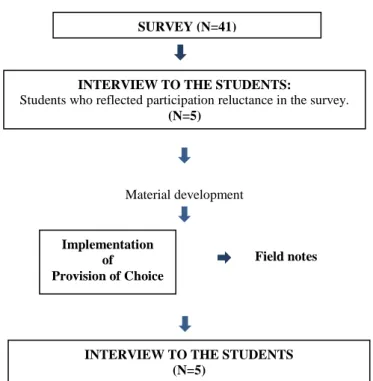
To provide a better understanding of the process that took place during the current study, a diagram of the procedures was developed.
Material development
Figure 3.1. Intervention design diagram. SURVEY (N=41)
INTERVIEW TO THE STUDENTS:
Students who reflected participation reluctance in the survey. (N=5)
Implementation of Provision of Choice
Field notes
38
4. RESULTS
In this chapter the results of the two interviews applied to the 5 participants of the study, as well as the field notes taken during the intervention, which was held during four regular sessions, are presented. As described in the previous chapter, three instruments were used to develop this study, pre and post interviews with the 5 participants as well as field notes of the researchers’ observations during the intervention. In this chapter the data
collected through these instruments is revised.
As mentioned before, in order to select our final sample composed by five students, we used the students’ answers to a Likert scale survey (See
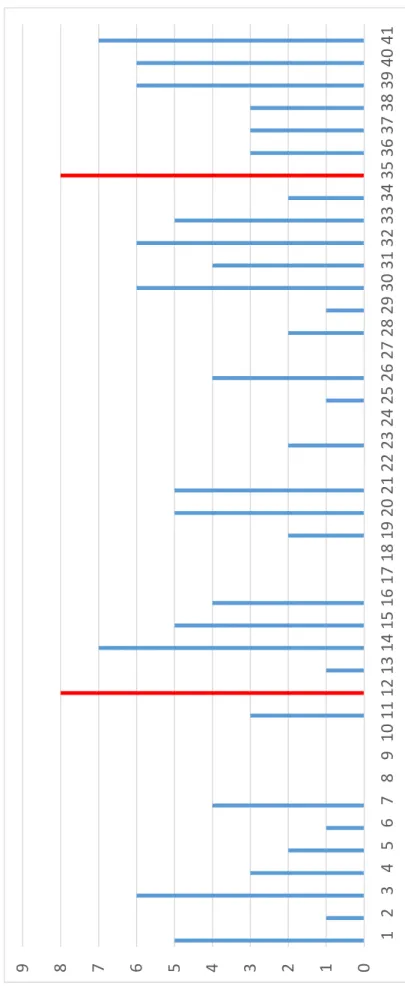
appendix B) about what students believe participation was and their perceptions about it. In general, the answers to the survey showed that students do not like to participate within English lessons. However, and since our aim was to select students that seemed to be more reluctant to participate in class, from the fifteen questions that composed the survey we selected five questions that showed the more critical results. Overall, the great majority of the students answered “strongly agree” or “agree” to question n°2 (I feel
comfortable speaking in front during the English class), question n°9 (when I have doubts about the studied topic I ask aloud), question n°10 (when I know the answer to a question or task, I raise my hand to participate), question n°13 (I always participate in the English class), and question n°14 (I always do the tasks that the teacher gives in class). However, there was a low range of students that answered “strongly disagree” to 1 or more of the questions previously mentioned. From the students who answered “strongly disagree” to the 5 critical questions, there was 1student (student 14) who answered “strongly disagree” to 4 of the 5 critical questions, 2 students (students 40 and 41) who answered “strongly disagree” to 3 of the 5 critical questions, and 6 students (students 3, 11, 12, 15, 16 and 35) who answered “strongly disagree”
to 2 of the 5 critical questions. (See appendix C, section 2, table 1.)
39
results of the survey and we selected the students who answered with “strongly disagree” more often during the whole survey (See appendix C, section 2, table
2.) Coincidently, 2 of the students (students 12 and 35) who had answered with “strongly disagree” to 2 of the 5 critical questions, happened to be 2 of the students who also answered with “strongly disagree” more often during the
survey. Therefore, we selected those 2 final students and we obtained our final sample composed by 5 students (See appendix C, section 2, table 3).
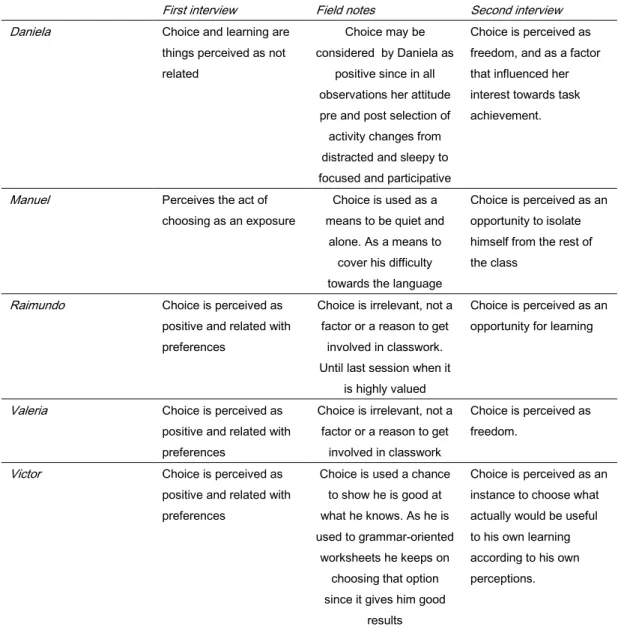
Because of the nature of the instruments applied the data is extensive and sometimes mixed with irrelevant information; hence, for the purposes of the current study and in order to simplify and clarify the data, this chapter presents the results through three tables (one for the first interview results, another for the observation results and a final one for the last interview results). Each of the figures illustrates the results including the same descriptors which are a) Perceptions about English as a language, b) Perceptions about participation, c) Perceptions about classwork, d) Perceptions about class materials, and e) Perceptions about choice. The descriptors are filled in with the information given by each of the 5 participants plus the information of each participant given by the researchers’ field notes in the four sessions in which
this intervention took place. 4.1 First Interview Results
The first chart reports the information given by the 5 participants during the first interview, which was performed by one of the researchers. The interview took place at the school’s library during an English session in which
the students were asked to go outside taking turns. Each interview lasted approximately five minutes and was audio recorded and transcribed. It is important to mention that, students’ names were changed to pseudonyms in
40
Daniela Manuel Raimundo Valeria Victor
Perceptions
41 4.1.1. Perceptions about English.
When looking at figure 4.1, it can be seen that the perceptions about English language are varied among the participants, but most of them value it as a tool for connection with the world beyond Chile. They recognize English as a world language as it can be observed in the following extract from one of the interviews’ transcription:
Entrevistador: ¿Te gusta el inglés?
Víctor: Sí
Entrevistador: ¿Si? ¿Por qué?
Víctor: Porque me gusta aprender otros idiomas….eh… también es una… una forma de hablar con personas de otros países, de comunicarse… y me gusta, me gusta.”
Interviewer: Do you like English?
Victor: Yes
Interviewer: Yes? Why?
Victor: Because I like to learn other languages. It is also a way of talking with people from other countries… to communicate…I
like it, I like it.
42
4.1.2. Perceptions about participation.
With regards to the participants’ perceptions of participation, most of
them perceived it as interaction between the teacher and students. Students’ perceptions of participation vary from believing that it is about ‘answering to the teacher’s questions’ to ‘sharing opinions during class time’.
Entrevistador: Pero en ejemplos, por ejemplo en la sala cuando
alguien participa ¿qué hace?
Manuel: Ayuda al profe con lo que estamos viendo.
Entrevistador: ¿Ayuda al profe con lo que están viendo…?
Manuel: Si, el profe pregunta, y uno le dice.
Interviewer: But giving examples, for example, in class, when
someone participates, what does he or she do?
Manuel: Helps the teacher with what we are doing.
Interviewer: Helps the teacher with what you are doing…?
43
Entrevistador: ¿Cómo definirías participación? O, ¿Qué es para ti
participar en clases?
Víctor: Es… colaborar con algo, ayudar a hacer algo… mmm…
aportar.
Entrevistador: Ya…
Víctor: Dar tu opinión para ver si es que la otra persona, o sea, si
tienes diferencias con la otra persona y así solucionar las cosas
y eso.
Interviewer: How would you define participation? What’s participation
for you?
Victor: It’s… to collaborate with something, to help doing something…mmm… to contribute.
Interviewer: Ok…
Victor: To give your opinion to see if the other person, I mean, to see if
you have differences with the other person and that way try to
solve things, and that.
Most students described participation in class as the act of answering teachers’ questions, interacting with their classmates and giving opinions during the class. Nevertheless, students never mentioned the importance of participation for them to acquire new knowledge, therefore we can imply that students do not consider that participation is an important factor for them to practice and improve their language.
4.1.3. Perceptions about classwork and materials.
44
a sense of responsibility towards classwork, but as it is not compelling, there is no commitment of the participants with it.
Participants did not expand much on this topic. The little information that could be retrieved from them was that they would consider positive that their personal preferences were taken into account when preparing class materials.
Entrevistador: ¿Crees que con otras actividades… así que te pudieras imaginar…participarías más? así como con cuales podrías imaginarte… ¡yo participaría harto con esto!
Daniela: mmm… podría ser como crear como diálogos en inglés… pero como de los gustos… lo que a uno le gusta… pero no frase, así como diálogos, porque me gustan los diálogos…
Entrevistador: ¿así como que el tema sea algo que a ti te guste?
Daniela: ahá… dar así como una… dar reseñas así… que hemos
hecho dar reseñas de libros o explicar de qué se trata una
canción… así me sentiría más cómoda porque es algo que a mí me gusta…
Interviewer: Do you think that maybe with other activities that you
could imagine you would participate more?
Daniela: mmm… maybe like creating dialogues in English…yes, but from likes, of what we like, but not phrases, dialogues…I like
dialogues.
Interviewer: would you like that the topic were something you like?
Daniela: yeah…something like giving a…reviews…like we have had to
45
With the few information provided by the students regarding classwork and materials, we can conclude that students do not feel comfortable with the environment in the classroom.
4.1.4. Perceptions about choice.
Finally, with this first interview, it could be observed that choice is not a strategy used in these participants’ English language sessions since it was not
mentioned by the students as something related to their English language subject. Students mainly associated choice with likes. Only one student, Manuel, associated it negatively with the idea of exposing himself.
Entrevistador: Ya, y tú, ¿con qué actividad te sientes más cómodo
participando?
Manuel: Con ninguna, si no me gusta el inglés
Entrevistador: ¿Con ninguna?
Manuel: Me da lo mismo
Entrevistador: Y en otras clases por ejemplo
Manuel: Nunca participo
Entrevistador: ¿Nunca participas?
Manuel: No me gusta
Entrevistador: No, pero ¿por qué?
Manuel: No sé poh, porque hay muchos en el curso, me pongo
46
Interviewer: Ok, and you, with which activity do you feel comfortable
participating?
Manuel: with none, I don’t like English
Interviewer: With none?
Manuel: I don’t care
Interviewer: And in other classes
Manuel: I never participate
Interviewer: never?
Manuel: no, I don’t like it
Interviewer: no? But why?
Manuel: I don’t know, there’s too much people inside the class I get
nervous!
As a general overview of this first interview, it can be said that the participants have well-constructed and clear perceptions with regards to English as a language, of participation (yet they admit being reluctant to participate in class), and of classwork, which was mainly perceived as necessary, but not fully compelling. When asked about the other descriptors, their perceptions were incomplete, in the case of the provision of choice, students had never been exposed to a similar strategy, and therefore it was difficult for them to describe something that was unknown.
4.2 Observation Results
47
researcher/observer could see regarding the participants’ perception in relation to the different elements being reported.
Daniela Manuel Raimundo Valeria Victor
English as a likes to practice, but
not explain. Looks comfortable with the with the teacher and with classmates. He
Classwork Seems relaxed towards
Victor finds the way to make classwork
interactive, a chance to learn and
prove himself what
Materials From session 2 on, there is clear positively used as a
means for interaction with his
48
since it gives him good results
Figure 4.2. Observation Results.
4.2.1. English.
According to the field notes taken during the four intervened sessions, the English language is mostly used for task completion or related to a must-do activity. During the observations there were no signs of students’ curiosity regarding the language or any extra questions that may have arisen from the diversity of materials presented.
4.2.2. Participation.
The behaviors towards participation observed were varied. They ranged from peer interaction and spontaneous interventions, to using participation as a tool to complete a specific task or as a way of complying with the teacher’s
requests, or just as amusement; and finally as something that may be entertaining yet too expose. An aspect that was perceived from all the participants is that participation can be used as a strategy to clarify doubts.
4.2.3. Classwork and materials.
49
During the sessions the participants had positive attitudes towards materials, all of them had different ways of facing the different tasks. Daniela, Manuel and Victor chose a similar or the same material from the second session on this choice was hand in hand with their interested attitude and a clear intention of achievement. Only Victor was able to complete the tasks in the sessions he attended, which were only three from the four sessions intervened, though. In the case of Raimundo, he only chose in the last session since in the three previous ones he decided not to get involved in the English lesson. In this last session Raimundo chose a hands-on task and worked on it. Considering his performance in the previous sessions, Raimundo seemed to have perceived this last material as compelling.
4.2.4. Choice.
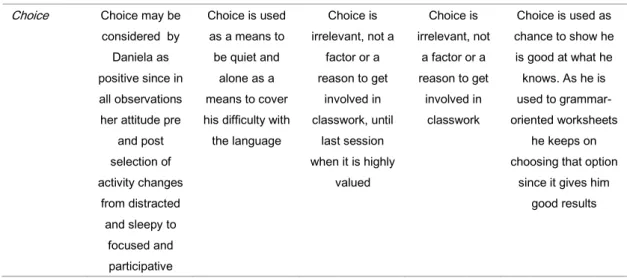
Three of our five participants used choice as a strategy to facilitate their classwork, since they chose what helped them fulfil the task. For the other two (Raimundo and Valeria), it was mostly considered irrelevant, with the exception of Raimundo’s last session where he finally decided to choose.
The field notes mostly reported varied participatory patterns among the participants in hand with a general difficulty towards task achievement, since only one of the five students observed was able to complete the chosen tasks. A relevant aspect reported on the field notes is the attitudinal change observed in some of the participants, more significantly in Daniela, prior and after the delivery of the materials.
4.3 Final interview results.
50