
Evaluation of different treatment techniques in recycled aggregates for use in concrete production
6
0
0
Texto completo
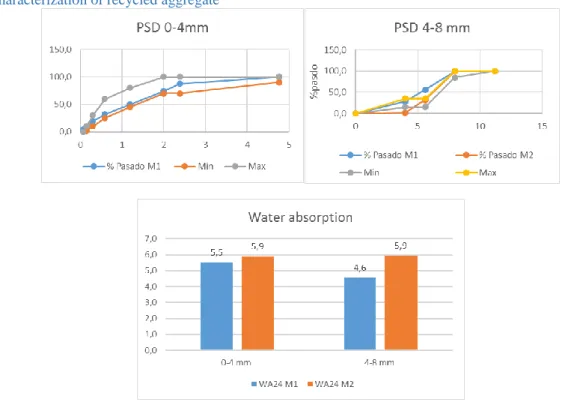
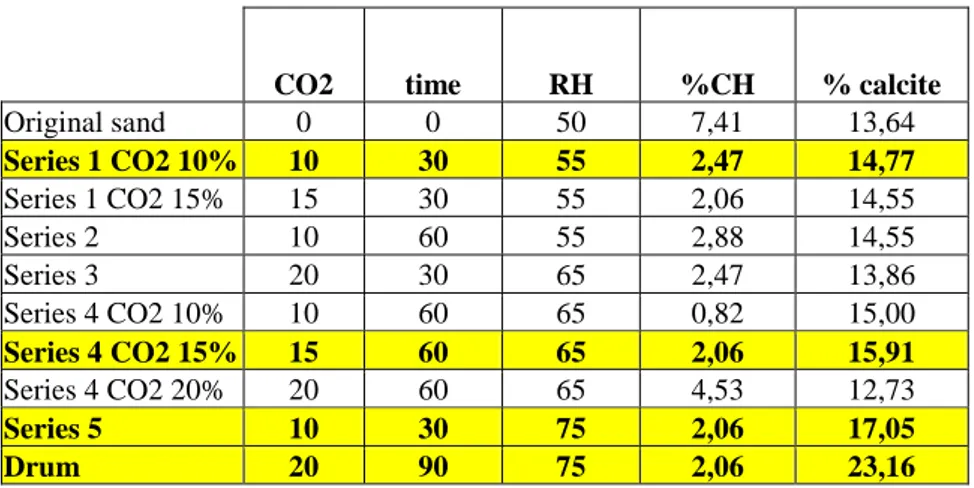
(2) 3.1. Characterization of recycled aggregate. 3.2 Quickly carbonation of fine fraction of ARC recycled fine aggregate For the carbonation of the fine ARC, different environmental conditions were used, in order to find the parameters of the carbonation process that would allow an improvement of the properties of the recycled aggregate. The environmental variables considered are listed in the following table.. Carbonation process. Temperature. Ambient. RH. 55-75%. Concentration of Co2. 10-20%. Carbonation Time. total carbonation. Table 1: Parameters to be measured (Source: own elaboration) For the carbonation process, a hermetic glass chamber with inlet and outlet for CO2 was used, the state parameters were controlled with the help of a weather station. The fine ARC was inside the chamber for 24 hours, the state parameters were worked in different combinations as shown in table 2. To check the carbonation state reached by the fine RCD, the one tested with phenolphthalein was used and the test was carried out. weight loss by indiction (LOI).. Figure 1: Carbonation chamber Taking into account the amount of fine carbonate ARC necessary to perform the different mixtures of mortars and concrete proposed in this research, an accelerated carbonation test was carried out using a Drom as a carbonation chamber and maintaining the best combinations achieved in the carbonation chamber, highlighted in yellow in table 2..
(3) CO2 time RH %CH % calcite Original sand 0 0 50 7,41 13,64 Series 1 CO2 10% 10 30 55 2,47 14,77 Series 1 CO2 15% 15 30 55 2,06 14,55 Series 2 10 60 55 2,88 14,55 Series 3 20 30 65 2,47 13,86 Series 4 CO2 10% 10 60 65 0,82 15,00 Series 4 CO2 15% 15 60 65 2,06 15,91 Series 4 CO2 20% 20 60 65 4,53 12,73 Series 5 10 30 75 2,06 17,05 Drum 20 90 75 2,06 23,16 Table 2: Results of the weight loss trial by indiction for the different combinations. 3.3 Encapsulation of the coarse fraction of recycled aggregate with steam cure For the encapsulation process, a Portland Cement CEM1-22.5 MPa was used, with an a / c ratio between 0.5 for 1 kg of material to be encapsulated. Once encapsulated, the recycled aggregate was placed for 35 min in a vaporizer with controlled temperature and relative humidity parameters. Parameters 40. Cement for encapsulation. 60 3. 3. kg/m. kg/m 0. Temperature. 0. 40 -60. Residence Steam. 20 min. 30 min. 35 min. Table 3 Parameters to be measured. Source: self-made. Figure 2 : Steam curing system 3.4 Production of concrete mixtures with 100% recycled aggregate Different mixtures of concrete were prepared by combining the two treatments carried out on the recycled aggregate using Portland Cement (CEM1 35 MPa) and an active mineral addition based on calcined clay, limestone and gypsum LC2. The Touffar program was used for the design of mixtures.. Aggregate. Cement. Samples. H1 (Reference 1) 100 % recycle. Fine. Coarse. CP. without treating. without treating. X. LC3.
(4) H2 without Carb. treating Recycle fine H3 without Steam treating Recycle coarse H4 (Reference 2) without without treating treating Recycle + LC3 H5 Carb. Steam Recycle combinado H6 Carb. Steam Recycle combinado Table 4: Concrete mix designs. X X X X X. 4 Analysis of results 4.1 Influence of the degree of carbonation of the fine recycled aggregate in mortars. Noncarbonated sand. Drum. Graph 2 Hydration product formation vs CO2 concentration With the analysis of Graph 1 were established as state parameters for the accelerated carbonation of fine recycled aggregate: RH = 75%, CO2 = 20% for a residence time of 24 hours with which 23.16% of Calcite is reached.. Graph 3 Results of the water absorption test to the carbonated fine recycled aggregate.
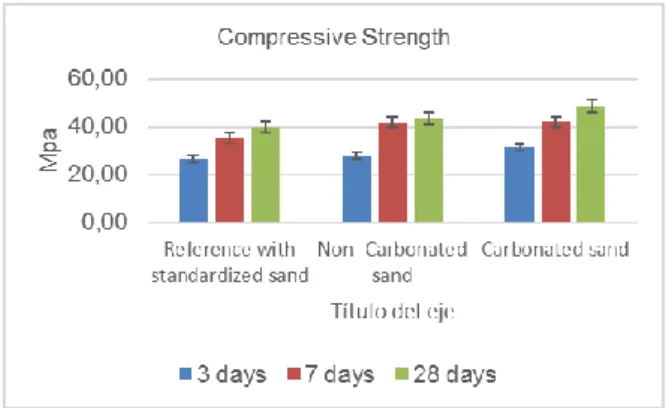
(5) Graph 4 Results of the resistance test in mortars with carbonated fine recycled aggregate 4.2. Influence of steam curing on the properties of encapsulated recycled aggregate. Graph 5 Results of the water absorption test to encapsulated recycled aggregate steam-cured. 4.3. Figure 3: Encapsulated Arid viewed with an Optical Microscope Influence of the different combined treatments on the mechanical properties of concrete. Graph 6 Results of the resistance test to understanding of the concretes produced.
(6) 5 Conclusions The accelerated carbonation of the fine fraction of recycled aggregate allows to lower the values of water absorption and does not compromise the resistance of the mortars and concretes produced. The technique of steam curing of the coarse fraction of recycled arid must be technically improved 6. References 1. (Sánchez, 2011; Chauveinc, 2011, Navarro, 2014; CEDEX Materiales, 2016). 2. (Jiusu Li, Hanning Xiao, Yong Zhou Influence of coatingrecycled aggregate surface with pozzolanic powder on properties of recycled aggregate concrete .Construction and Building Materials 23 (2009) 1287–1291) 3. (K.Y. Ann a, H.Y. Moon, Y.B. Kim, J. Ryou Durability of recycled aggregate concrete using pozzolanic materials. Waste Management 28 (2008) 993–999) 4. (Shi-Cong Kou , Chi-Sun Poon , Long-term mechanical and durability properties of recycled aggregate concrete prepared with the incorporation of fly ash. Cement & Concrete Composites 37 12–19 (2013)) 5. Muñoz Cuellar, Andres Felipe – 2017, Carbonatación acelerada del agregado fino reciclado y su influencia en morteros. Tesis de Master. 6. Morandeau,A., Thiery,M., & Dangla, P. (2014). Investigation of the carbonations mechanism of CH and CS-H in terms of kinetics, microstructure change and moisture porperties. Cement and Concrete Research, 56, 153-170. http://doi.org/10.1016/j.cemconres.2013.11.015 7. Johnson, D.C (2000). Sci Lecture Papers Series Accelerated Carbonation of Waste Calcium silicate Materials. Construction Materials, 1-10. 8. Gunning, P.J. (2011). Accelerated Carbonation of Hazardous Wastes, ( February).
(7)
Figure

Documento similar
Based on this initial premise, solvent-free enzymatic glycerolysis of Echium oil was carried out in three different reaction mixtures: (1) high-pressure- homogenized
Therefore, based on results derived from all optimization assays carried out in the present work, optimal conditions for obtaining OsLu mixtures with a high content
In such cases, the designer can still use a concrete syntax pattern to automate the generation of a modelling environment, for which he needs to map meta-model elements to
Many authors found a better fit to their experimental data using the Modified Gompertz Model (Wang and Wan, 2009; Gaur and Suthar, 2017). This study helps to clarify the choice of
To this end, it is of paramount importance to carefully design the concrete mix (i.e. cement and aggregate types, cement/water and cement/aggregate ratios, use of
The next steps in this research line may be (1) to analyze the use of coarse RA in a precast-concrete plant considering, in addition to the aspects covered in this paper,
resulting from the addition of the ultra fine recycled concrete par- ticles from siliceous concrete waste (URSCA) and limestone con- crete waste (URLCA) were studied during the
Electrochemical noise-time series for specimens subjected to Impressed current cathodic protection of reinforced concrete mixtures (OPC-P and OPCFA-P).. Figure 5 shows the EN signal
