
Development of teaching competencies through the professional teaching practice
109
0
0
Texto completo
(2) TABLE OF CONTENTS. ABSTRACT ............................................................................................................................................ 4 LIST OF FIGURES .................................................................................................................................. 5 LIST OF TABLES .................................................................................................................................... 6 DEFINITION OF TERMS ........................................................................................................................ 8 INTRODUCTION ................................................................................................................................... 9 CHAPTER 1 ......................................................................................................................................... 10 STATEMENT OF THE PROBLEM ......................................................................................................... 10 CHAPTER 2 ......................................................................................................................................... 11 THEORETICAL FRAMEWORK.............................................................................................................. 11 2.1 TEACHER COMPETENCIES ....................................................................................................... 11 2.2. TEACHER DEVELOPMENT ....................................................................................................... 23 2.3. TEACHER TRAINING ................................................................................................................ 26 2.4 LITERARY REVIEW ........................................................................................................................ 32 CHAPTER 3 ......................................................................................................................................... 36 RESEARCH DESIGN............................................................................................................................. 36 3.1 Research Paradigm and Approach .......................................................................................... 36 A whole process where experiences had the most important role took place, therefore, the objective was to systematize those experiences in order to find out the competencies the student teachers developed throughout their practice. .............................................................. 36 3.3 Participants.............................................................................................................................. 40 3.4 Setting ..................................................................................................................................... 40 3.5 Data collection instruments .................................................................................................... 42 CHAPTER 4 ......................................................................................................................................... 46 DATA ANALYSIS ................................................................................................................................. 46 CHAPTER 5 ......................................................................................................................................... 77 2.
(3) 5.1 CONCLUSIONS ............................................................................................................................. 77 Research questions answers and findings .................................................................................... 77 5.2 PEDAGOGICAL IMPLICATIONS AND LIMITATIONS ...................................................................... 78 Further research ............................................................................................................................ 79 REFERENCES ...................................................................................................................................... 81 APPENDIX 1 ....................................................................................................................................... 84 APPENDIX 2 ....................................................................................................................................... 85 APPENDIX 3 ....................................................................................................................................... 88 APPENDIX 4 ....................................................................................................................................... 90 APPENDIX 5 ....................................................................................................................................... 91 APPENDIX 6 ....................................................................................................................................... 95 APPENDIX 7 ....................................................................................................................................... 98 APPENDIX 8 ..................................................................................................................................... 100 APPENDIX 9 ..................................................................................................................................... 102 APPENDIX 10 ................................................................................................................................... 104 APPENDIX 11 ................................................................................................................................... 106 APPENDIX 12 ................................................................................................................................... 108. 3.
(4) ABSTRACT. This research reports the findings of a systematization of experiences whose main purpose was to identify the competencies developed by student teachers during their professional teaching practice. In 2014, students from the Bachelor Program in English Language Teaching at Uniminuto University worked as student teachers in Luigi Pirandello and Instituto Técnico Distrital Republica de Guatemala Schools where they had to deal with different situations in the classroom. Teaching journals, semi-structured interviews, and questionnaires, were used as data collection instruments. Findings suggest that context (public or private) is a determining factor when it comes to the development of teaching competencies. Key words: Systematization of Experiences, Teacher Competencies, Teacher Training and Teacher Development. RESUMEN. Esta investigación indica los hallazgos de una sistematización de experiencias cuyo propósito principal fue identificar las competencias desarrolladas por profesores en formación durante su práctica profesional. En el 2014, estudiantes de la licenciatura en Idioma Extranjero Inglés de Uniminuto trabajaron como practicantes en los colegios Luigi Pirandello y al Instituto Técnico Distrital República de Guatemala donde tuvieron que enfrentar diferentes situaciones en el salón de clases. Diarios de campo, entrevistas semi estructuradas y cuestionarios, y fueron usados como instrumentos de recolección de datos. Los hallazgos sugieren que el contexto (público o privado) es un factor determinante cuando se trata del desarrollo de competencias docentes.. Palabras clave: Sistematización de Experiencias, Competencias Docentes, Entrenamiento y Desarrollo Docente.. 4.
(5) LIST OF FIGURES. Figure 1. Teacher Competencies: Language proficiency factor.. 11. Figure 2. Teacher Competencies: The role of content knowledge.. 12. Figure 3. Teacher Competencies: Teaching Skills.. 12. Figure 4. Teacher Competencies: Contextual knowledge.. 13. Figure 5. Teacher Competencies: Language teachers' identity.. 13. Figure 7.Teacher Competencies: Pedagogical reasoning skills.. 14. Figure 6. Teacher Competencies: Learner-focused teaching.. 14. Figure 8.Teacher Competencies: Theorizing from practice.. 15. Figure 10.Teacher Competencies: Professionalism.. 16. Figure 9.Teacher Competencies: Membership of a community of practice.. 16. Figure 11.Teacher Competencies: Know-how-to-do.. 17. Figure 12.Teacher Competencies: Know-how-to-be.. 19. Figure 13.Teacher Competencies: Know.. 20. Figure 14.Teacher Competencies: Know-how-to-learn.. 22. 5.
(6) LIST OF TABLES Table 1. Categories and questions. ............................................................................................. 47 Table 2. Example of the organization of the data collected. .................................................... 48 Table 3. Reflective Teaching Journals (RTJ), public and private institutions. Lesson Planning. Subcategory: Controlling time..................................................................................... 49 Table 4. RTJ public and private institutions. Lesson Planning. Subcategory: Discarding activities because of time. ............................................................................................................. 50 Table 5. RTJ public and private institutions. Lesson Planning. Subcategory: Reviewing previous topics. ............................................................................................................................... 52 Table 6. RTJ public and private institutions. Lesson Planning. Subcategory: Designing materials. ......................................................................................................................................... 53 Table 7. RTJ public and private institutions. Lesson Planning. Subcategory: Catching attention activities. .......................................................................................................................... 54 Table 8. RTJ public and private institutions. Classroom Management. Subcategory: Giving incentives. ........................................................................................................................................ 56 Table 9. RTJ public and private institutions. Classroom Management. Subcategory: Cooperative teacher’s support. .................................................................................................... 57 Table 10. RTJ public and private institutions. Classroom Management. Subcategory: Lack of class control/using mother tongue to control misbehavior. ................................................. 58 Table 11. RTJ private institution. Classroom Management. Subcategory: Controlling individual behaviors. ....................................................................................................................... 60 Table 12. RTJ private institution. Classroom Management. Subcategory: Supervising students’ work. ................................................................................................................................ 61 Table 13. RTJ private institution. Classroom Management. Subcategory: Group and pair work advantages. ........................................................................................................................... 62 Table 14. RTJ public institution. Classroom Management. Subcategory: Depression under difficult circumstances.................................................................................................................... 63 Table 15. RTJ public institution. Classroom Management. Subcategory: Students’ shyness. ........................................................................................................................................... 63 Table 16. RTJ public and private institutions. Language Teaching. Subcategory: Drilling. 64 Table 17. RTJ public and private institutions. Language Teaching. Subcategory: Code switching to clarify and give instructions. .................................................................................... 65. 6.
(7) Table 18. RTJ public and private institutions. Language Teaching. Subcategory: L2 Fostering. ......................................................................................................................................... 66 Table 19. RTJ private institution. Language Teaching. Subcategory: Modeling. ................. 68 Table 20.RTJ private institution. Language Teaching. Subcategory: Eliciting. ..................... 68 Table 21. RTJ private institution. Language Teaching. Subcategory: Sharing strategies with colleagues. .............................................................................................................................. 69 Table 22. RTJ public institution. Language Teaching. Subcategory: To give positive verbal and non-verbal feedback. .............................................................................................................. 70. 7.
(8) DEFINITION OF TERMS. Cooperative Teachers: They are the teachers at school. They can also give feedback to the student teachers, assign topics and suggest activities. Teaching Journal (TJ): It is a diary filled by teachers and student teachers. It contains several questions and comments about each class. Incidents are recorded there to allow teachers to reflect about their own teaching. Student teachers: They are students from the Bachelor Program in English Language Teaching who work as interns in a school. One of their responsibilities is planning lessons while they are trained. Teacher Competencies: These are the skills and abilities developed by the student teachers through their practice. Teacher competencies allow teachers to create and adapt material, manage the classroom, and to be successful presenting the new language. Teacher Advisor: This is an expert teacher who works as a mentor providing support to the student teachers at the university. This person is in charge of monitoring the student teachers' performance carrying out observations, checking lesson plans and teaching journals.. 8.
(9) INTRODUCTION. The purpose of this research was to identify the teaching competencies developed by student teachers during their professional teaching practice in public and private schools. To achieve this objective a systematization of experiences was carried out. Experiences were systematized starting from reflections which were written after every teaching session. In the first chapter, the question and objective of this study are stated. Information about public and private schools is also given. In the theoretical framework concepts like Teacher competence, Teacher Development and Teacher Training are explained. Previous studies are also offered in the second chapter. The third chapter includes the methodology used for this qualitative research. The importance of performing a systematization of experiences is mentioned. Data collection instruments such as teaching journals, questionnaires and interviews are defined as well; the formats used to carry them out are also presented. In the fourth chapter we offered the results of this research. Conclusions, limitations and suggestions for further studies could be found at the end. There are also some recommendations for bachelor programs to bear in mind before and during teaching practices.. 9.
(10) CHAPTER 1 STATEMENT OF THE PROBLEM. When it comes to create a successful and joyful class, teachers have to take into account students needs, materials, techniques and use of language. In addition, a very important aspect to consider is the context of students. As public and private schools are two different worlds, teachers have to deal with different situations in their classrooms. Teachers also have to be aware of teaching competencies because these are going to be helpful in order to understand what teaching a foreign language is and involves. Last year, students from the Bachelor Program in English Language Teaching at Uniminuto University were sent to three schools in order to start their professional teaching practice. After some time, the student teachers realized that they were planning and carrying out classes differently depending on the context they were working in. Therefore, the need to identify the teaching competencies which student teachers developed, came up. The purpose of this systematization of experiences was to identify the teaching competencies developed by student teachers through their professional teaching practice in two different schools (private and public). A study of this kind can serve as a way to improve the kind of training teacher students receive before and during their teaching practice and to promote the development of teaching competencies. Research question: What competencies did student teachers develop during their teaching practice? Research objective: To identify the teaching competencies developed by student teachers through their professional teaching practice in two different schools (private and public).. 10.
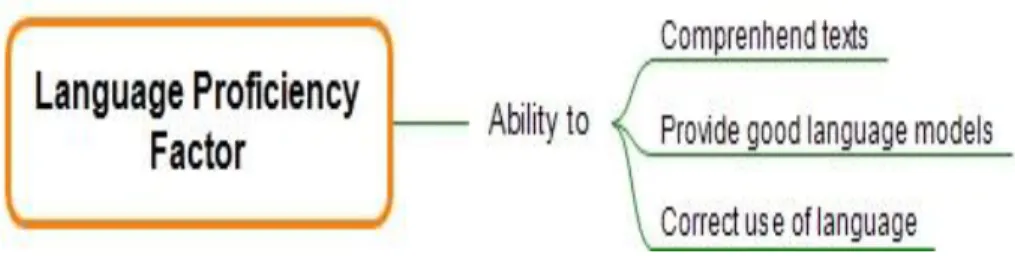
(11) CHAPTER 2 THEORETICAL FRAMEWORK. The development of Teacher Competencies is a process that includes the improvement and growth of certain skills; however it is important to highlight that part of the acquisition of these skills is provided by the Teaching Training programs and the theory learned at university. The other part of this process referred here as Teacher Development focuses on the self-reflection and personal growth teachers build with experience. These three concepts were developed in this chapter as well as three selected categories: Lesson Planning, Classroom Management and Language Teaching which were the core to carry out the systematization of experiences. 2.1 TEACHER COMPETENCIES. Murphy, Shelley, White & Baumann (2011) refer to the concept of teacher competencies as each one of the skills that every language teacher should have and make use of. According to Jack C. Richards (2011) there are some important aspects in terms of competencies that prepare teachers to tackle different situations. The first one is language proficiency which involves the correct use of language. Figure 1. Teacher Competencies: Language proficiency factor.. Created by: Monica Sandoval. Comprehending texts and providing language models are very important aspects because teachers need to keep informed and need to produce their own material taking into. 11.
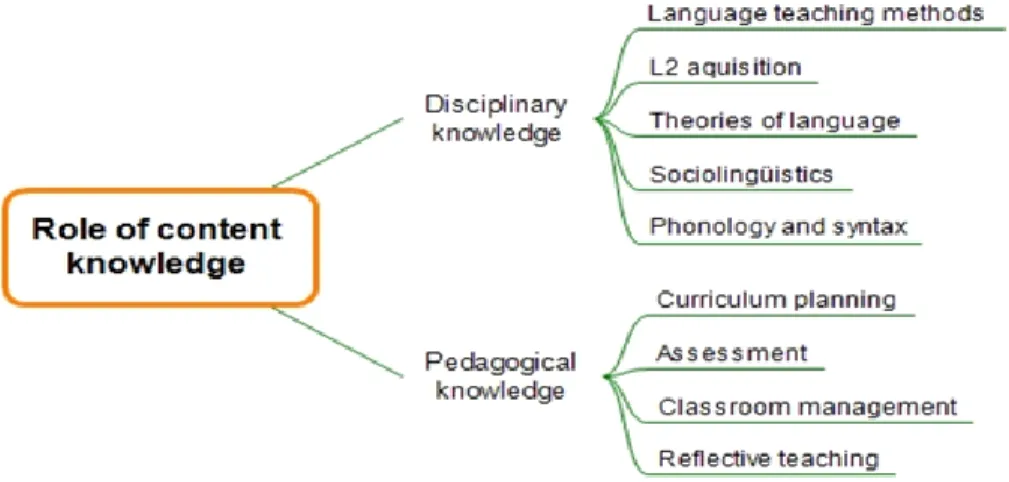
(12) account the level of their students. Teachers have to be creative when they provide explanations and give instructions. The second factor is the role of content knowledge which refers to what language teachers need to know about what they are teaching (what belongs exclusively to their subject matter) both in the disciplinary and pedagogical field. As shown below language teachers must know about their discipline and pedagogy which includes classroom management techniques, syllabus planning and assessment. Figure 2. Teacher Competencies: The role of content knowledge.. Created by: Monica Sandoval. Teaching skills is another important factor. These are usually acquired through observing experienced teachers and also through controlled practice provided by the teacher trainers with micro-teaching and peer teaching activities. Consequently, it demands more complex levels of decision making, including the disposition to improvise, to anticipate and deal with problems during the lessons and to have established routines. Figure 3. Teacher Competencies: Teaching Skills.. 12.
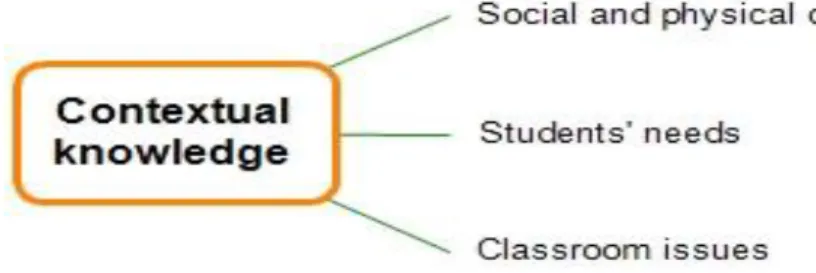
(13) Created by: Monica Sandoval. Moreover, for teachers it is essential to identify the characteristics of the place they are working in. This is called knowledge of the context and it involves the information about the places and situations in which the learning process takes place. This gives teachers the elements they need to develop and create the strategies that fit students’ needs and classroom issues. In this matter Posner (as cited in Richards, 2011, p.11) argues that “A key factor in understanding any teaching situation is the social and physical context – the rules, facilities, values, expectations, and personal backgrounds, which act as resources, constraints, and direct influences on teaching and learning.” Here is also important to adapt to these circumstances because the different teaching contexts show different views of the process of teaching a new language. Figure 4. Teacher Competencies: Contextual knowledge.. Created by: Monica Sandoval. Teacher’s identity is shaped by factors that include personal background, culture, working conditions, gender, age, and through the interactions inside the classroom between the students and other members of the educational context. Identity is also shaped Figure 5. Teacher Competencies: Language teachers' identity.. 13.
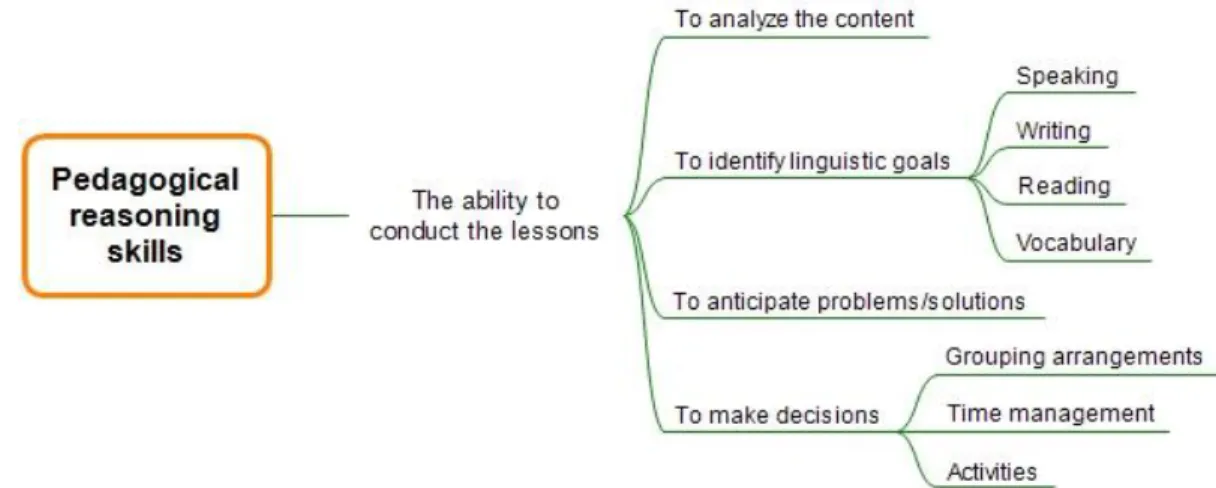
(14) Created by: Monica Sandoval. Achieving the goals of the lesson and maintaining the order and discipline in the classroom is important. It is also necessary to count on tools to reach a good level of engagement, participation, and interaction among our students in the lesson. Richards (2011) highlights the importance of personalizing teaching which means to connect or adapt the content of the classes to learners’ interests by allowing them to choose along with the teacher the topics and contents of the lesson. Figure 6. Teacher Competencies: Learner-focused teaching.. Created by: Monica Sandoval. Pedagogical reasoning skills include planning, problem solving, decision making and improvisation which are skills developed through experience. Figure 7.Teacher Competencies: Pedagogical reasoning skills.. Created by: Monica Sandoval. 14.
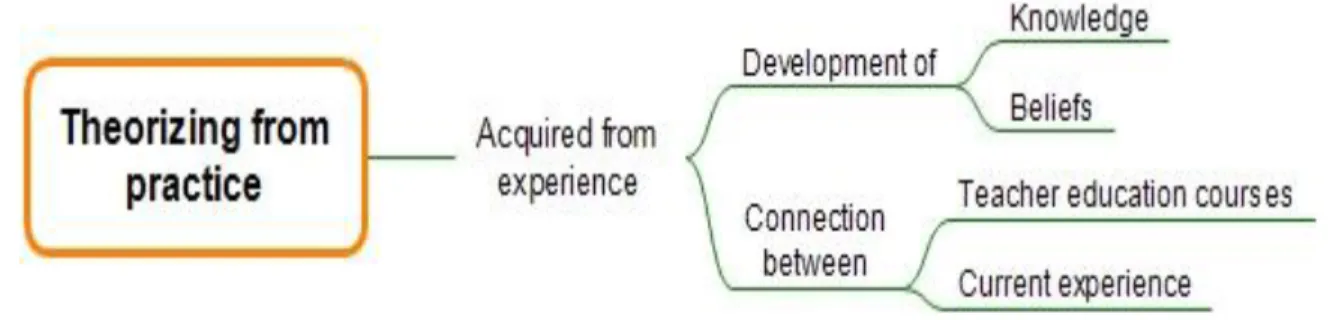
(15) Richards (2011) describes four things teachers are able to do when they put into practice these skills. The first one refers to the ability to analyze the content for the lessons and to identify the ways in which resources can be used. The second one involves identifying the specific linguistic goals depending on the language skill (speaking, writing, reading and vocabulary). The third one is the ability of anticipating problems that may happen and the possible ways to deal with them. The last one is the ability to make the appropriate decisions about grouping arrangements, management of time and organization of the activities during the lessons. Figure 8.Teacher Competencies: Theorizing from practice.. Created by: Monica Sandoval. Teachers need to establish connections between the theory and the practice, conversely, language teaching is not only restricted to what happens inside the classrooms. It includes also the learning community and its members represent a community of practice. A community of practice as referred by Richards (2011) involves a group of people who interact and share common interests; it as well focuses on exploring and solving issues happening in the workplace. This provides teachers with opportunities to work and learn together by participating in group-oriented activities to share responsibilities and problem solving strategies. Johnston (as cited in Richards, 2011) describes different forms in which this collaboration takes place. It can be whether with fellow teachers, university colleagues and with others in the schools. This involves the development of activities based on the textbooks, tests and lesson panning as well as collaborative research or analysis on matters related to second language acquisition or teaching and learning strategies.. 15.
(16) Figure 9.Teacher Competencies: Membership of a community of practice.. Created by: Monica Sandoval. Professionalism is seen through the views of ministries of education, teaching organizations, regulatory bodies, and school principals and teachers’ interpretations of teaching, values, beliefs, and practices. Figure 10.Teacher Competencies: Professionalism.. Created by: Monica Sandoval. In conclusion, depending on the point of view a good teacher is the one who owns the knowledge and has the control in the class. For others, teachers are considered facilitators who are able to challenge students in order to make them more independent, creative and active learners. Richards (2011) gives great importance to each one of the aspects he talks about and highlights the significance of dominating and applying them into a determined context. Richards has classified teaching competencies as it has been mentioned before. There are other classifications made by different authors, for example Estaire and Fernandez (2012) who share the same perspective as Richards. According to Estaire and Fernandez (2012) the teacher competence is the ability to use all the resources available in order to foster the students’ learning. Competencies include different procedures, resources and strategies. For these authors there are four 16.
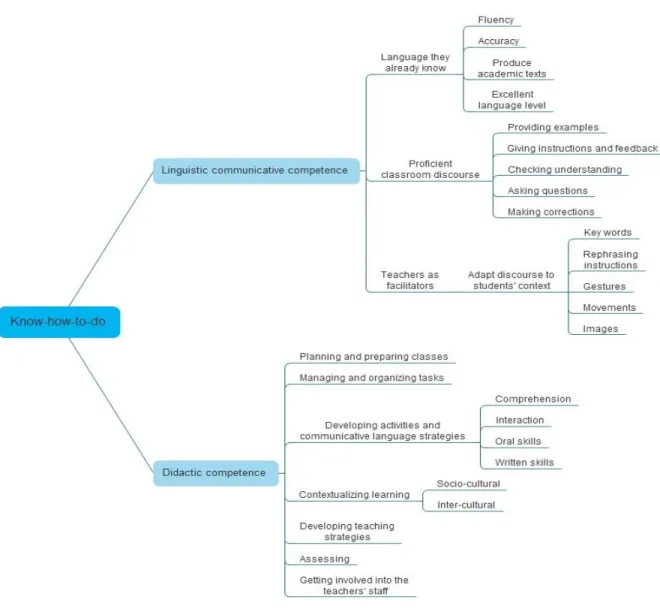
(17) important aspects to be considered in order to talk about competencies: “know-how-to-do”, “know or knowledge”, “know-how-to-be” and “know-how-to-learn”. 1. Know-how-to-do Figure 11.Teacher Competencies: Know-how-to-do.. Created by: Nestor Mancipe. In their research the authors refer to the characteristics a good teacher is requested to have and the actions that involve teaching. For Estaire and Fernandez (2012) there are two competencies: the communicative linguistic competence and the didactic competence.. 17.
(18) The communicative linguistic competence emphasizes on the ability to use the language in the context. Teachers must use the language to produce different kinds of academic texts and they should be able to provide examples, give instructions, check understanding, ask questions, make corrections and give feedback. Teachers are meant to be facilitators and in order to do so, they need to adapt their own discourse to the students’ context by using key words, rephrasing instructions or commands, using gestures or movements and images depending on the students’ characteristics and their level. Didactic competencies involve the knowledge to plan and prepare classes, managing and organizing activities and assessing and evaluating. One of the main competencies that teachers are required to develop is planning and preparing classes. They must include in the lesson plan a clear objective taking into account the students characteristics and their context such as: age, needs, interests, English level and learning styles to select topics, situations or tasks. They should select the appropriate topics, tasks and curricular contents, based on the stated methodology by the school and the suitable materials including the TIC, having in mind students’ interests and needs. Managing and organizing activities requires different abilities like setting proper grouping arrangements, location and movement of the teacher in the classroom, eye contact, gestures and tone of voice. Teachers make use of foreign and mother tongue in class (L1 and L2) to give and clarify instructions. This encourages and motivates students to participate and lose the fear to talk. While assessing and evaluating requires understanding of the already mentioned concepts as well as the requirements needed to carry them out. Teachers should guide and provide constructive feedback. This helps to create a respectful atmosphere where students can overcome affective factors like anxiety, shame and fear.. 18.
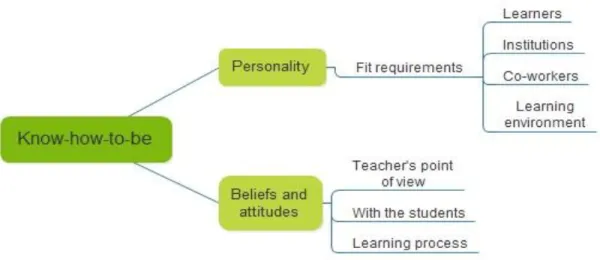
(19) 2. Know-how-to-be Figure 12.Teacher Competencies: Know-how-to-be.. Created by: Nestor Mancipe. The authors refer to the characteristics a good teacher is requested to have. Teaching practice is an opportunity for teachers to start finding out their own style and the way they are going to fit into the society’s needs. Teachers’ knowledge is also relevant, it determines their beliefs and attitudes; those are a consequence of deep reflections and experience. Teachers must be full of curiosity, innovation and patience. Those are important aspects that teachers must acquire in order to tolerate and accept what is different. They should be aware of their own cultural and linguistic diversity and their target language’s. All of the previous aspects cannot be developed if the teacher is not interested in teaching his/her target language and the different issues which come with it.. 19.
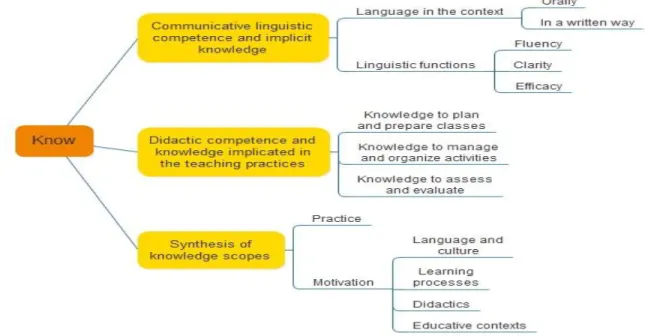
(20) 3. Know Figure 13.Teacher Competencies: Know.. Created by: Nestor Mancipe. The communicative linguistic competence emphasizes the ability to use the language in the context. It happens orally and in a written way in order to accomplish every sort of linguistic functions with fluency, clarity and efficacy adapting them to the teaching practice. The implicit knowledge in this context language use grasps a wide variety of linguistic, discursive and sociolinguistic resources which belong to interaction and comprehension skills. Furthermore, Estaire and Fernandez (2012) name different linguistic resources such as: Grammatical, lexical and semantic, phonologic and orthographic. There are other resources like discursive and sociolinguistic and the authors give key points in order to develop them; cohesion, organization, uses and rules of courtesy and discourtesy, language differences, dialects and accents as well as socio-cultural referents. In addition, there are a number of specific knowledge aspects which are reflected on the development of didactic competences. The knowledge to plan and prepare classes is 20.
(21) very important for this study because it refers to the class development and lesson planning which teachers use taking into account their students’ characteristics such as: age, needs, interests, English level and learning styles. Teachers’ criteria to select topics, situations or meaningful tasks is determining when planning classes. There are other kinds of knowledge which cannot be omitted due to the fact that this research works with a wide range of aspects and categories. Managing and organizing activities requires different abilities like setting proper grouping arrangements, location and movement of the teacher in the classroom, eye contact, gestures and tone of voice. Teachers make use of foreign and mother tongue in class (L1 and L2) to give and clarify instructions, this encourages and motivates students to participate in an organized way and lose the fear to talk. Besides, the authors state that assessing and evaluating requires understanding of the already mentioned concepts as well as the requirements needed to carry them out. It is important for teachers to be aware of the differences between these two processes because in this way they can be applied in the right time and using proper techniques. Knowledge must go along with practice, considering motivation as a main tool which gives emphasis on the next aspects: language and culture, learning processes, language learning processes, and didactic, foreign languages didactic and educative contexts.. 21.
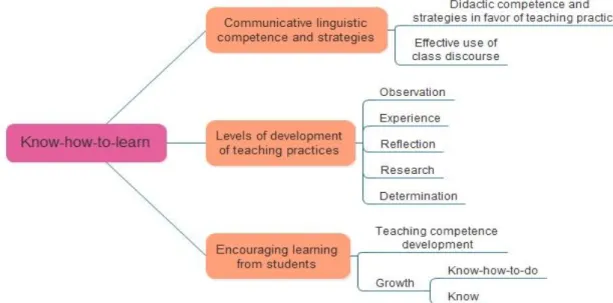
(22) 4. Know-how-to-learn Figure 14.Teacher Competencies: Know-how-to-learn.. Created by: Nestor Mancipe. Estaire and Fernandez (2012) state that strategies drive to the effective use of class discourse (Teacher and student communication). In order to identify the strategies which belong to this discourse, it is necessary to observe again, the specific functions of the foreign language teacher in the interaction with their students: Favor and catch attention, create a stimulating environment, promote active participation, plan, negotiate, describe, illustrate, explain, give examples, give instructions, check comprehension, summarize, ask, suggest, call attention, correct, assess and provide feedback. Likewise, the strategies which can be applied in order to support the teacher’s labor are related to the didactic competence. Planning strategies and following the teaching/learning process which teachers can apply on their daily practice can enhance the cognitive and metacognitive processes. It helps the teacher to contrast his/her role and be aware of the best way to accomplish it. Additionally, the authors state that observation, experience, reflection, research and the determination to encourage learning from students, guides to the teaching competence 22.
(23) development where the growth of “know-how-to-do” and “know” gets involved. It also makes possible that every teacher shapes personal aspects such as attitudes and even, the ideal characteristics of a teacher’s profile. Finally, the training which is given to beginner teachers takes place at universities as well as later studies such as specializations and postgraduates. Teachers keep receiving training after they start teaching and throughout their whole career in order to perform successfully and to improve every day. This research project has more trending towards Richard’s theory because the way this author presents and organizes the teaching competences language teachers should possess serve as support when it came to choose the main categories for the systematization of experiences and contributed as well to the process of analyzing and giving support to the data collected. On the other hand, Estaire and Fernandez have as well their own classification of teaching competencies and share with Richards notions about the key aspects and skills language teachers should master. Teacher development and Teacher training are terms closely linked. However, it is important to state the differences between these two concepts. 2.2. TEACHER DEVELOPMENT. Teacher development goes beyond the term 'training' because it includes different means of helping teachers not only to learn new skills, but also to acquire new insights into their own practice. It also helps them explore other ways of understanding content and resources available by making use of personal and moral dimensions. In this regard Pettis (as cited in Mann, 2005, p.104 ) assert “The role of teacher development refers to context – based awareness of which technique or strategy is appropriate for a particular individual or class in a specific place. It involves change overtime and it is achieved in stages which could be called “teacher performance”. This means that, teacher development is linked also to the teachers’ experiences gained along their career which may include the instructional 23.
(24) aspect and management. Personal development in language teachers must go through moral dimensions, values and ethics that play a significant role in the decisions and choices they make concerning their teaching. In this respect Mori (as cited in Mann, 2005) explores the construction of a culture where teaching is not a simple technical responsibility and has an inherent personal, ethical and moral dimension. Richards (2011) points out that knowledge is not just an amount of input transferred from educators to teachers; that is, to be aware that we construct part of our knowledge as teachers along with the connection with experience, reflection and collaboration, which are the source of our professional and personal growth. Student teachers receive help from their teacher advisors who use strategies to stimulate comprehension and understanding about a specific situation. Nevertheless, the one who makes the decisions about what to do and how to solve his/her issues is the student teacher; the collaborator is there just to guide this process. In this matter Clarcke (as cited in Mann, 2005 p.104) asserts “teacher development and teacher training have to work together as a key to transform education, because both work as a guidance. This can provide stability and security for teachers and it is necessary stage of development for professionals”. It means that even when the student teacher receives tutoring and advices by other teachers, he/she needs to be confident enough to face any possible situations alone, it can be reached through constant training. Context influences the identity-building process of student teachers. They face a new world day by day when their role changes from student to teacher. Changing conditions in the classroom are given by a great deal of factors such as: peer teachers relationships, students' social background, students' level of education, institution facilities and institution approach.. 24.
(25) In this matter, Beijaard, Meijer, Morine-dershimer & Tillema (2005, p.22) stated that: The development of teachers’ professional identity in a context of changing conditions for teaching requires different approaches to teacher learning and teacher evaluation. Firstly, it demands a focus on self- awareness and reflection of teachers to use their workplace when developing their own professional identity. Teacher educators need to model and stimulate such self-awareness and reflection in their work. Secondly, it creates a variety of opportunities for learning in the workplace. To do so, we first need to understand the ways in which teachers’ workplace provides supportive conditions for teacher learning.. In this order of ideas, the place where student teachers do their professional practice is decisive when they are creating their own style and identity as teachers. Schools give student teachers different kinds of materials and resources. This creates a style which relies on the way they plan their lessons and it affects how the class is developed. In Bogota, we can find a variety of contexts which depend on socio economical factors. Private and public schools provide diverse resources and student teachers have to adapt themselves to the different conditions they will find. Some schools provide everything to the teachers (lesson plan, materials, seating arrangements, etc.) while other schools do not have enough resources available for teachers. For that reason they need to create and design their own materials. This helps to develop the teachers’ sense of originality and authenticity. Knowledge construction is a very important aspect in teacher development and it is triggered by interaction which makes part of teachers’ integral training itself. Interaction takes place every time when getting in contact with academic environment. Beijaard et al (2005) suggest three important fields to take into account regarding teachers’ development: Teacher-students relationships, cooperative work with their colleagues and context adaptation. Personal features are mentioned by this author as well as Estaire and Fernandez, they consider this aspect important because it has to do with the way a teacher teaches his/her lessons. Those opinions are relevant for this research because it is possible that personality is the actual factor which determines the teacher’s performance leaving context aside.. 25.
(26) In some cases, interaction with colleagues can result in knowledge construction. Knowledge and adapting skills take place when teachers find a job, a challenging environment or when teachers feel that they are under their colleagues’ level. Beijaard et al argue that (2005, p.15) Colleagues, whether or not they are part of a learning community, play an important role in teachers’ knowledge development. It is helpful, and often necessary, that processes of knowledge construction are embedded in challenging learning environments. In teacher education, teacher educators play a pivotal role in creating such a learning environment. It is argued that teacher educators can be very supportive for beginning teachers on-the-job as well.. Accordingly, teacher development gathers aspects that contribute to knowledge construction, involving the connection with the experiences and interactions teachers have with each member of the school community which leads to collaboration and better work environment. This as well, provides opportunities for growth and reflection on ones’ professional and personal dimensions. In connection to this project, along a process like the teaching practice, it is possible that the student teachers reach certain level of development because as mentioned before acquired through experience and self-reflection. 2.3. TEACHER TRAINING. The role of teacher training is to provide teachers with all the methodological tools and concepts for them to apply and build their teaching. In this regard we also may connect this term with “Teacher education” due to the fact that the way in which teachers are trained or educated can make a difference in student achievement depending on the type of education program and support provided. Therefore it is important to have in mind that the years of teacher training (initial and in service), the teacher’s language skills, the ability to use the materials, time spent in the classroom preparation and frequent monitoring of student progress represent important aspects that have a positive impact on the quality of teachers’ performance as well as students achievement and progress. 26.
(27) Consequently, teacher training involves the acquisition of knowledge language teachers will put into practice when they are immersed in a specific context. Freeman (as cited in Mann, 2005, p.105) affirms that “the teacher might demonstrate a range of strategies and techniques for both correcting students’ errors or for giving them the appropriate type of feedback”. In addition to that he argued that this kind of knowledge and skill is more “trainable” than awareness and attitudes. Mann (2005, p.104) states that “the role of teacher training is to introduce the methodological choices available and to familiarize trainees with the range of terms and concepts that are the “common currency” of language teachers. The trainer typically demonstrates the range of models and techniques available”. Thereby, student teachers are in contact with methodological choices since the beginning of their careers, nevertheless, they put them into practice until they are in their professional practice or when they find a job as teachers; those methodological choices are an essential part when teachers are getting trained because it will define their way to teach. For this particular study, the student teachers received the same training process at university. Therefore, the development of lesson plans, teaching journals, classroom management, setting arrangement, language teaching and others are based on the same methodology received during their training. However, the difference settles down at the very first moment the student teachers began their professional practice because both of them faced different and unexpected situations in two different contexts (public and private). In this research three categories were taken into consideration to systematize and classify the data obtained. These categories are: Lesson Planning, Classroom Management and Language Teaching. It is important to highlight that teacher students in this research received training in these three aspects at university. It is also essential to clarify that without this training it is difficult for teachers to know how to deal with certain situations during the classes due to the fact that the knowledge acquired through the teaching programs contributes to the development of strategies and plans to cope with them.. 27.
(28) Lesson Planning Teachers without experience are usually required to write lesson plans and use them as a guide on their classes. For them, it is very important to design their lesson plans being very thoroughly and having in mind a great deal of aspects such as possible problems, general objectives, English level, materials and personal aims. Also, teachers need to anticipate what they are going to say as well as their students’ answers and behavior, thus a sort of class script is created. In this matter, Brown (2007, p. 152) affirms “For teachers who have never taught before, it is often very useful to write a script of your lesson plan in which your exact anticipated words are written down and followed by exactly what you would expect students to say in return.” Teachers must be very detailed when writing their lesson plans because there are aspects whose success depends on the quality of what was planned, that quality can be reached by introducing students to activities, directing tasks and setting rules. Coherence is one important factor in lesson planning because all of the activities should be connected having an appropriate transition in order to accomplish the learning objectives. Catching students’ attention is not something easy; it requires creativity and effort from the teacher. Usually, when the teacher spends too much time in only one activity, the lesson tends to get boring and so do the students, it causes a loss of class control and therefore, it is possible that the goals proposed cannot be reached. Variety on the activities is a good way to keep students interested because they are constantly excited about what is coming next. Another very important aspect is timing because it determines whether the teacher needs to take time from later lessons to finish the missing activities or not; this may cause a delay in future lessons provoking the whole syllabus not to be completed.. 28.
(29) As seen above, designing a successful and accurate lesson plan is not something easy, it requires time and effort because student teachers are normally under pressure due to the fact that they have to present their lesson plans in a determined period of time. Richards (2011, p. 56) agrees with this statement “More typically, as a student teacher, you will be involved in short-term, week-by-week, day-by-day planning, and it may be difficult to prepare for this before arriving on site to teach and being given specific teaching assignments”. Therefore, it is important that the student teacher becomes familiar with the topics their students are going to work on during the year in order to make the process of planning the lessons easier. A good lesson plan eases classroom management because it helps teachers to foresee and find solutions to issues like timing, behavior, seating arrangements and L1 use. When the class is not planned by the teacher and he/she comes to the class and improvises, students notice that and they could lose interest in the class. Classroom Management Classroom management has been one of the hardest aspects that teachers have to deal with. It is not only about controlling behavior in the classroom but it also involves a number of other aspects such as: seating arrangements, lesson stages, teacher talk, L1 usage and giving instructions. Harmer (2007, p.34) states that: If we want to manage classrooms effectively, we have to be able to handle a range of variables. This includes how the classroom space is organized, whether the students are working on their own or in groups and how we organize classroom time. We also need to consider how we appear to the students, and how we use our most valuable asset – our voice. The way we talk to students – and who talks most in the lesson – it is another key factor in classroom management.. Moreover, a good classroom management requires teachers to face adverse circumstances effectively. Misbehavior, lack of participation in class, refusal to speak in L2 29.
(30) and any possible distractors make part of those circumstances which hinder a good class development. L1 usage is something that just cannot be discarded, it is said that students need as much input as they can receive in order to improve their skills in the L2, nevertheless, it goes beyond; teachers should observe and reflect about their students’ level of proficiency in the foreign language and based on that, decide the amount of L1 they will use in their classes. It is not convenient to use a code that learners do not understand at all. It is important for teachers to give instructions in a very simple way, they also must bear in mind that success depends on the logic the commands have. The level of difficulty should be set according to the students’ language level and understanding must be checked constantly to make sure the instruction giving was provided correctly. On the other hand, teachers must not only care about their speech regardless the fact that it is in L1 or L2 but also about their students’ speech. It is recommendable to interact with students all the time. Interaction is also important to strengthen the student-teacher relationship. Finally, a very important aspect is the attitude the teacher has in class; it helps students feel more motivated, encourages them to work actively and at the same time, builds self-confidence on them. It will be harder to carry out the activities a teacher has prepared if this person comes to the classroom without the willingness to teach a great class. Language Teaching Language teaching is another category which was taken into account in this paper. It is because student teachers reflected on the way they were handling different aspects in the classroom such as: presenting the new language, drilling, feedback issues, eliciting and so on. This category can be defined as all of the knowledge and strategies that teachers can make use of in order to teach a language effectively.. 30.
(31) In this matter, Hall (2011, p. 228) states that "... being a good teacher is likely to be influenced by training, qualifications and experience, including knowledge of the learners' language, culture and their educational system". There are ways to perform a more effective language teaching like giving proficient models of L2, acknowledging students with learning strategies, providing them with further information about English learning and being aware of the learners' difficulties and needs. In addition, a teacher who shares the same mother tongue as his/her students could take advantage of it in order to clarify things and make him/herself better understood. Subsequently, teachers can apply some strategies in order to discover their students’ language level as well as the strongest and weakest skills they have, one of those has great relevance in this study, it is eliciting. A teacher elicits the students’ knowledge when he/she asks them questions before giving any explanation, this way the teacher becomes aware of what they know and what they need to learn or improve. Nevertheless, teaching a language effectively, does not have a specific route to follow nor steps to achieve linguistic goals and be successful. It is because every context has different features; what works in one place, may not work in another one. Thereby, the knowledge and strategies which should be developed by teachers vary according to their workplace. In this order of ideas, Hall (2011, p.38) asserts that "Experience tells us that no two classrooms are the same... What happens in L2 classrooms in different parts of the world or in different social contexts is influenced by, for example, differing institutional policies, resource availability and societal goals and expectations".. 31.
(32) 2.4 LITERARY REVIEW. Four studies from different contexts were chosen to show a background regarding differences in educational factors in public and private schools. Those studies highlight the importance of the level of satisfaction that teachers have working in both contexts as well as the style and personal characteristics that teachers acquire when being immersed in a specific context. The National Center for Education Statistics (NCES), whose function is to collect, analyze and report data related to education in the United States and other countries, carried out a research in 1997 called Public and private schools: how do they differ? This was written by Susan P. Choy and edited by Andrea Livingston, Karyn Madden and Barbara Kridl. Its main objective was to provide an answer to the question of how public and private schools differ by examining some dimensions of both contexts. In order to address this question, two fundamental differences between public and private contexts were considered: schools sources of support and the role of choice in determining or deciding where students go to school. Next, a description of the characteristics or features of the main participants in the education process (students and teachers) is provided, as well as the way they differ in the public and private sectors. In addition a comparison of some specific aspects related to the organization and management of private and public schools was done. It includes the school and classes’ size and information about the people in charge of making policy decisions for the schools and classrooms. Next, the different circumstances or conditions under which teaching and learning take place in public and private schools are explored as well as the dissimilarities between academic programs and support services. Surveys, questionnaires and statistics provided by the NCES were used to collect the data. The differences found showed that public institutions have more personal issues affecting students’ learning than private institutions. In addition teachers in public schools possess certain characteristics which contribute to make teaching effective, including more schooling, teaching experience and wider participation in professional development 32.
(33) activities. On the other hand, teachers in private institutions are more satisfied with their jobs due to the fact that those institutions offer a safest and comfortable environment in which they are able to belong to a community. It is also pointed out that both contexts share similar teaching strategies and face similar situations. In spite of the differences, the institutions’ success is a shared responsibility which belongs to all the members of the learning community. This study is also concerned to find out the differences between teaching and learning in public and private schools and how this affects or enriches learners’ academic and personal lives.. Claudio H. Díaz Larenas, Andrea Victoria Rodríguez Moran and Karen Jocelyn Poblete Rivera conducted an exploratory non-experimental research study in (2011) called Comparing Teaching Styles and Personality Types of EFL Instructors in the Public and Private Sectors. Its main objective was to compare the teaching styles of a group of thirty Chilean teachers of English, half working with the private sector and the other half with the public sector respectively. Two research questions were established: What teaching styles and personality types does a group of EFL teachers from the public and private sector possess? Is there any relationship between the participants’ teaching styles and their personality types?. The researchers also defined three variables such as teaching styles, personality traits and type of school (public and private). With the purpose of collecting the required data, two instruments were proposed to the participants. One of them was a teaching style inventory to determine the most predominant teaching style in each participant (expert, formal authority, personal, facilitator and delegator). The other instrument was a psychological type index which aimed to identify a specific teaching style within personality type. The participants answered both individually. The researchers waited for four months to start analyzing the data. Results showed that the public section teacher participants show a facilitator and mediator teaching style and an extrovert personality type. 33.
(34) However, the private section teacher participants demonstrate a more authoritative and imposing teaching style and an introverted type of personality.. In 2007, Maria McNulty Ferri and Diana Isabel Quinchía Ortiz members of a research group of learning and teaching of foreign languages from Universidad de Antioquia developed a study called Designing a Holistic Professional Development Program for Elementary School English Teachers in Colombia. This study was focused on the school context and placed the teacher in the role of the learner. The program gathered aspects about the curriculum as well as the teachers’ language and students’ pedagogical needs, determining like this the learning and pedagogical activities for the program. The researchers applied a series of activities to the teachers in order to develop their four skills and also asked them to keep a written record about their language development and how to redesign their curriculums keeping in mind the new knowledge about teaching approaches and activities developed through the course of the study. The teachers who participated in the study increased their level of confidence using English and implementing new methodological strategies by getting positive feedback and comments from their learners. Furthermore, their attitude towards English and the possibilities regarding the different ways in which a class can be given had positive changes. The Center of Social Studies (CES) from Universidad Nacional de Colombia conducted a research in 2009. The title of this research paper is Characterization of the Teachers in Public Schools in Bogotá. The main purpose of this was to establish the characteristics of teachers from public schools in Bogotá. This study contributed to develop better educational policies on teacher training and professional development. Researchers identified the difficulties they had to face in the classroom and they worked with a group of principals and coordinators of schools, students from seventh to eleventh grades, and elementary, middle and high school teachers. In order to collect the information, a survey for teachers in public schools in Bogotá was designed. About a quarter of the public schools of Bogotá participated. The results of this teacher survey were compared to data and 34.
(35) assumptions from other studies on similar subjects from countries such as Argentina, Brazil, Peru and Uruguay. Findings were reported on matters such as the age, birthplace, marital status, studies and teachers’ professional profile. In addition, teachers’ perceptions and attitudes towards teaching practice were considered. Some recommendations giving at the end of this research were the importance of further studies in order to gather information about teachers in Bogota. This will allow evaluating and monitoring the results of the public institutions’ activities and actions. It was as well highlighted the need to develop more policies and programs to promote the constant training and growth for teachers.. 35.
(36) CHAPTER 3 RESEARCH DESIGN. 3.1 Research Paradigm and Approach. This research was carried out using different instruments such as teaching diaries, semi-estructured interviews and questionnaires. A Systematization of Experiences was developed because there was a need to codify and systematize the data obtained from the instruments with reflective purposes. Hleap (as cited in Carvajal, 2005) defines systematization as a qualitative investigation that is guided by a interpretative and critical approach. It intends to describe and interpret experiences giving preference to the participants' opinions. A Systematization of Experiences requires to have a qualitative approach because there was a need to understand and analyze the way student teachers behaved depending on the context they were immersed. First, a definition of qualitative research by Denzin & Lincoln (as cited in Guest & Namey, 2013, p.3): Qualitative research is a situated activity that locates the observer in the world. It consists of a set of interpretive, material practices that makes the world visible. These practices transform the world. They turn the world into a series of representations, including field notes, interviews, conversations, photographs, recordings, and memos to the self. At this level, qualitative research involves an interpretive, naturalistic approach to the world. This means that qualitative researchers study things in their natural settings, attempting to make sense of, or to interpret, phenomena in terms of the meanings people bring to them.. A. whole process where experiences had the most important role took place,. therefore, the objective was to systematize those experiences in order to find out the competencies the student teachers developed throughout their practice.. 36.
(37) According to Beatriz Borjas (2003, p.16). Systematization is a critical interpretation of one or several experiences which from its organization and reconstruction discovers or explains the logic experienced process, the factors which have taken part in such process, how they are connected among themselves, and why they have done it that way.. There are some points that are considered important for this research. Systematization is defined by Borjas as an interpretation which is carried out critically, this is a conclusion of an attempt to understand the usefulness of specific experiences. It would not be possible to interpret those experiences if they are not ordered or if they have a lack of logic, it is also important to bear in mind the facts and relationships which somehow affected them. Likewise, Martinic (as cited in Acosta, 2005, p. 7) asserts that systematization of experiences is “a reflection process which pretends to order or organize what the pace, processes and a project results have been, seeking in such dynamics the dimensions that can explain the path taken by this procedure”. Systematization takes place when a subject gets involved into a context and is willing to identify factors such as: environment, participants’ characteristics and actions which can be helpful when it comes to find solutions to problems or differences regarding other contexts. Some of the aspects which the person who systematizes must bear in mind are his/her emotions, perceptions and social relationships. Acosta (2005) utters that these processes allow conducting an analysis about what the participants’ actions, what motives them and the results and the benefits. They also trigger learning processes because they can be addressed to groups of people who share common interests or belong to the same community than the ones who performed the systematization with the purpose suggesting ways to improve future practices. Other people can take advantage of these processes because they can find support in case they want to develop their own projects.. 37.
(38) A systematization of experiences was chosen because it allowed us to share, compare, conclude, learn from our experiences, and search for ways to improve our performance in the classroom. "Systematization has a value for each particular practice because it permits to give a retrospective sight to the past and, from what was learned, guide the future" Morgan y Quiroz (as cited in Borjas, 2013, p.24). Borjas (2003), states that there are three objective-based categories reflected on the systematization process: 1. Those that want to favor the interchange of experiences among different teams. 2. Those that propose the comprehension and reflection of a team over their own work 3. Those that intend to acquire knowledge (or theory) from the practice itself. The second and third objective-based category proposed by Borjas (2013) are the ones which apply to this research because it intends to codify data taken from the teaching practices and extract valuable information with academic purposes. Even though the information acquired was supported by authors and socialized with teachers advisors and other student teachers, the results are open to subjectivity due to the fact that teaching journals are something personal and student teachers wrote about their own feelings and experiences in there. In order to carry out a systematization of experiences, three aspects must be taken into account: the first one is to reconstruct the experience which means to go through the experience that needs to be analyzed. Bernechea and Morgan (2010) argue that: Systematization is the reconstruction of and analytical reflection about an experience. Through systematization, events are interpreted in order to understand them. This supports the production and dissemination of consistent knowledge that is rooted in reality. The systematization allows for the experience to be discussed and compared with other similar. 38.
(39) experiences, and with existing theories and, thus, contributes to an accumulation of knowledge produced from and for practice.. The second aspect is to analyze and interpret the experience, in this part, systematization questions emerge and are answered by reflecting on the past events where the actors took part. Those questions come along with the main categories and they help guide the codification process. Finally, the third aspect refers to communicating the systematization results, however, it does not only consists on answering the research question but also on producing suggestions or actions. Hargreaves & Morgan (2009, p.31). state that A systematization will have been successfully concluded when you have reached a satisfactory answer to the systematization main question. But the conclusions of all systematizations should always be expressed as lessons and end up in new action proposals or recommendations for other persons who want to engage in similar practices. It can also produce inputs for policies or general strategy. Action proposals and recommendations make part of this paper's further research See conclusions. The steps followed during the systematization were: Participate in the experience, register the experience, select the object to systematize and the relevant aspects about the experience, organize information, identify variables and categories, make a critical interpretation, formulate conclusions and communicate lessons learned. This research took place in two different schools located in Bogota. Contextual issues in public and private schools were taken into account.. 39.
(40) 3.3 Participants. This systematization was performed by students of a Bachelor Program in English Language Teaching at Uniminuto University. Their professional teaching practice took place in different public and private schools and students were able to choose whether they wanted to work with elementary, middle or high school students. The student teachers who made part of this research had the opportunity to work with elementary students. Their experiences were different because they did not share the same workplace. After some conversations about academic issues, they found out that the context they were in required them to plan different activities. The participants involved in this professional practice were student teachers and teacher advisors. 3.4 Setting. The period of time for this systematization was established. It was chosen the teaching practice I, which started in February 2014 and finished in June 2014, and teaching practice II, which started in July 2014 and finished in November 2014. Instituto Técnico Distrital República de Guatemala (public) and Luigi Pirandello (private) schools, made part of the research field. We worked as student teachers with elementary students of second and fourth grade respectively (8-10 years old). Luigi Pirandello is a private school located in the neighborhood Villas de Granada (northwestern of Bogotá). It educates children since 1985. There are currently 900 students in two branches of the school available for elementary, middle and high school. Students who want to be part of this institution need to complete an admission test. The aim of Luigi Pirandello School is to educate young people for work. Bilingualism, the development of basic competencies, and transformational leadership are important aspects of the syllabi. The institution is committed to provide a quality service. 40.
(41) that meets the expectations of both parents and students on values such as tolerance, respect, loyalty, responsibility and proactivity. The institution’s projection for the year 2015 is ‘to be a place where children will be educated to acquire significant theoretical and practical learning in order to create their own business projects within the parameters of Transformational Leadership’ The institution’s pedagogical model is teaching for comprehension which means that students are going to be able to use their acquired knowledge as part of their human construction. The pedagogical model aims to develop a special methodology in order to educate young kids and teenagers with the abilities for becoming internationally competitive. This educational model takes into account different elements such as the experience of the school, knowledge, talent and transformational leadership. The institution has educated children during 28 years. There are 24 generations of graduate students. Students begin their process with the guidance of bilingual skilled and experienced teachers while they improve independence, self-discipline and develop their communicative abilities (Reading, Speaking, Listening and Writing). Students are expected to reach a B1 level when they are in their last year of high school. Teachers instead, are required to have a B2 level and other employees must have a basic knowledge of English (A2). The hours of English classes per week in elementary school are eight. However some of the courses are given in English (Mathematics, Social Studies, Science, Geometry and Literature). In middle and high school, students have eleven hours of English. The institution has a laboratory where they are able to practice their skills using computers and each classroom has a Video Beam. In addition, they work with a textbook from Pearson called Big English. On the other hand, República de Guatemala IED is a public school located in Engativá. This school educates children since 1965. It offers elementary, middle and high 41.
(42) school education for children and teenagers within 5 to 18 years old. There are 700 students in elementary school which takes place in the morning. Since 1991 the school was authorized to offer technology programs in high school. Nowadays, students from República de Guatemala IED get a high school diploma in accounting and secretarial studies. The school in association with the SENA offers this program to give students the opportunity to continue their studies after having finished their high school. Learners are trained in finances, human management and business. The aim of the school is to educate citizens with knowledge in business management as well as an entrepreneur attitude in order to handle formal and informal jobs. In the elementary school, students have two hours of English classes. During the school year, all graders have a regular teacher who teaches almost all the subjects including English. The institution does not have a specific model to teach English, so an English syllabus was adapted to meet the requirements taking into account the standards of competence given by the Ministry of National Education. The most important thing for the school is that students learn vocabulary thought activities like giving personal information, memorizing and singing. School begins every day at 6:30 am until 11:30 for elementary students. Students received English classes once a week. The lessons are taught by teachers from other areas that have basic knowledge of English. 3.5 Data collection instruments. Teaching Journal: The tool used in order to carry out the systematization of experiences is the teaching journal or diary. This is a written record where teachers reflect about their classes in order to learn from their teaching experiences. The main purpose of elaborating a teaching. 42.
(43) journal is to make a deep and personal reflection about the way the teacher performed in class and search for ways to improve. According to Zabalza (2004) teaching journals are the documents that teachers use to gather their impressions about what is happening in their classes. This definition applies to the diverse kinds of teaching journals because their main aim is to collect and analyze the information. In addition, Zabalza states that teaching journals are a wonderful resource to elicit own dilemmas regarding professional performance. In this matter, he uses the concept of dilemma to refer to the whole group of adverse situations which the teachers have to face during their classes. Porlan (as cited in Zabalza, 2004) points out that journals allow us to gather meaningful information about the teaching and learning process, to collect historical information about the classroom and what happens inside of it, to identify problems, to reflect about them and to think about the solutions. The use of teaching journals follows two main ways, the first one takes journals as a resource to gather the class pace, and the second one as a research-oriented tool whose purpose is to evaluate didactic processes. Finally, the use of teaching journals helps teachers reflect about their experiences, to give immediate and permanent feedback. After every single class, the university students had to fill their reflective teacher diaries with information about how things went during the lesson. This teaching journal included aspects such as the effectiveness of the materials used, group arrangements, problems encountered, interactional aspects, techniques, engagement and assessment. The formats of the teaching journal were used during professional teaching practice I. In the second semester some modifications were done. The new teaching journal allowed student teachers to record more information. The second teaching journal is divided into sections which were useful to determine the categories used in this study.. 43.
(44) The examples of the teaching journal formats used by the student teachers who made part of this research can be found on appendixes 1 and 2.. Questionnaires: Questionnaires are an easy and practical tool to gather and organize data. Objectivity, rapidity, privacy and a better organization of ideas are among its advantages. They permit to save time because participants answer them whenever they want. Questionnaires can also be sent through e mail or handed out personally. Open questions were used in this qualitative research. Oppenheim (as cited in Beiske, 2002, p.2) affirms that: If a questionnaire is well designed, it will motivate the participants to give accurate and complete information; as such, it should provide reliable and relevant data in return. A questionnaire can serve as an inductive method with the aim to formulate new theory, where open-ended questions are used to explore a substantive area.. In order to carry out this study, it was necessary to apply a questionnaire to other student teachers who also did their professional teaching practice in the same schools. It was important to have their point of view about this process in order to identify the competences developed in both contexts (public and private). It was expected the participation of student teachers enrolled in teaching practice II in the schools chosen. There were four students teachers in Luigi Pirandello School and three student teachers in Instituto Técnico Distrital Republica de Guatemala. However, only three student teachers from the private school and one student teacher from the public one answered the questionnaire. The student teachers’ participation in the private context was higher, and then it was easier to collect information from them and thus, support the statements and experiences reported in this project. On the other hand, as there was a lack of participation of the. 44.
Figure
+7

Documento similar
In addition, precise distance determinations to Local Group galaxies enable the calibration of cosmological distance determination methods, such as supernovae,
Keywords: iPSCs; induced pluripotent stem cells; clinics; clinical trial; drug screening; personalized medicine; regenerative medicine.. The Evolution of
Based on this information schools were advised to organise groups of teachers (and in the two professional development schools to include in the group also student teachers)
Astrometric and photometric star cata- logues derived from the ESA HIPPARCOS Space Astrometry Mission.
The photometry of the 236 238 objects detected in the reference images was grouped into the reference catalog (Table 3) 5 , which contains the object identifier, the right
In addition to traffic and noise exposure data, the calculation method requires the following inputs: noise costs per day per person exposed to road traffic
The aim was to improve the students' level of training before attending laboratory practices, to standardize the evaluation among teachers and to involve students in the
Public archives are well-established through the work of the national archive services, local authority-run record offices, local studies libraries, universities and further
