
Mott transition and integrable lattice models in two dimensions
6
0
0
Texto completo
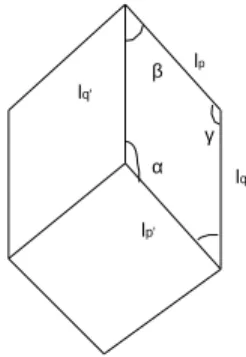
(2) 2 nian (1)becomes that of a XXZ Heisenberg model X [−(Sjx Sjx + Siy Sjy ) + ∆Sjz Sjz ] , HXXZ =. (4). hi,ji. where we have rescaled the terms such that ∆ = U/t. Following [8] we define an interaction star as the set of points where the spins entering in an elementary interaction are localized, i.e., the central site and their nearestneighbors in the XXZ model. The n-th interaction star has an energy EXXZ ([σ]n ) which depends on the spin configuration in the star and on the local Boltzmann weights W ([σ]nP ) . Therefore, the partition function takes Q the form Z = σ n W ([σ]n ), where the sum is taken over all possible configurations of the entire lattice. In two dimensional quantum systems and three dimensional statistical models the integrability is guaranteed by the existence of a set of mutual commuting layer-to-layer transfer matrices Tmn (λ, µ), which is tantamount to the existence of solutions of the so-called Zamolodchikov’s tetrahedron equation(TE) [10][11] : Rabc Rade Rbdf Rcef = Rcef Rbdf Radc Rabc ,. (6). where, for example, the operator L12a acts on V1 ⊗V2 ⊗Fa , V1 , V2 are the auxiliary spaces and Fa is the quantum space. If Fa is the representation space of some algebra A, it is possible to interpret the operators Lij,a as operator-valued matrices acting on V1 ⊗ V2 , and depending ‘parametrically’ on the generators of the algebra A denoted by va and, possibility, on some c-numbers denoted by sa : L12a = L12 (va , sa ) . In this case, the equation (6) can be expressed as a ‘local Yang Baxter’ equation: L12 (va , sa )L13 (vb , sb )L23 (vc , sc ) = L23 (v′ c , sc )L13 (v′ b , sb )L1a (v′ a , sa ) .. R 123 : [αj , βj , γj ] → [α′j , βj′ , γj′ ] ,. (8). where α, β and γ are the angles of the j-th face, and the primed variables refer to the opposite faces. For each. (5). where the operators Rijk define the mapping Rijk : Vi ⊗ Vj ⊗ Vk → Vi ⊗ Vj ⊗ Vk , and Vn is the spin one-half representation space , such that their matrix elements are the Boltzmann weights of the vertex Rijk = W ([σ]ijk )( the indices i, j, k label the interaction star). These can be rewritten as the LLLR − RLLL operator conditions, which express the associativity of the Zamolodchikov algebra: L12,a L13,b L23,c Rabc = Rabc L23c L13,c L13,b ,. these may be reinterpreted as (discrete) charge density waves. For completeness, we now briefly review the new solution (for details see [11]). The solution is inspired in the geometry of transformations applied to an hexahedron (see fig.(1): there are three independent angles on each face and nine angles to fix the spatial orientation of the hexahedron. Therefore, nine independent angles are needed to specify it. Let us consider the mapping,. (7). The tetrahedron equation (5) is highly non-trivial to solve, but recently a new solution to it has been found in [11]. The solution is associated to the finite-dimensional highest-weight representations of the quantum affine ald displaying the three-dimensional strucgebras Uq (sl(2)), ture of quantum groups. It may be understood as a quantization of the spatial fluctuations of geometrical extended objects, and we shall see that in our case that. FIG. 1: Diagram of a hexahedron in which the angles (α, β, γ) and side lenghts (lp , lp′ , lq , lq′ ) for one face are indicated.. quadrilateral face, say the 1′ , the relationship between opposite sides is given by (lp′ , lq′ )t = X(A1 )(lp , lq )t , where X(A1 ) is a matrix acting non trivialy on the face 1′ , that depends on the angles on that face (A1 = (α1 , β1 , γ1 )), and which for a circular lattice reads: k1 a∗1 0 X(A1 ) = −a1 k1 0 0 0 1 where k1 = cos α1 sin β1 , a = cos α1 sin(α1 + β1 ) and a∗1 = cos α1 sin(α1 − β1 ). In the general case, considering three faces , we have: (lp′ , lq′ , lr′ )t = Xpq (A1 )Xqr (A2 )Xrs (A3 )(lp , lq , lr )t . (9) The same result (9) is obtained by using the opposite faces with angles (A′1 ,A′2 ,A′3 ). Therefore , it is easy to see that there exists a functional mapping given by Xpq (A1 )Xqr (A2 )Xrs (A3 ) = R123 (Xrs (A3 )Xqr (A2 )Xpq (A3 )). This relation could be considered as a ’gauge symmmetry’. It can be shown that the mapping R123 satisfies the functional tetrahedron equation (F T E), a ’classical version’ of the tetrahedron equation: ∗ ∗ k2′ a′∗ 1 = k3 a1 − k1 a2 a3 ∗ ∗ ∗ a′∗ 2 = a2 a3 + k1 k3 a2 ∗ ∗ k2′ a′∗ 3 = k1 a3 − k3 a1 a2. k2′ a′1 = k3 a1 − k1 a∗2 a∗3. a′2 = a2 a3 + k1 k3 a2 k2′ a′3 = k1 a3 − k3 a∗1 a2 ,.
(3) 3 p with k ′ = 1 − a2 a∗2 . This map defines a canonical transformation of the Poisson algebra, which in terms of the angles reads: {αi βj } = δij {αi , αj } = 0 {βi , βj } = 0. We now canonically quantize this theory, i.e., by replacing the angles by Hilbert space operators and the Poisson brackets by commutators, so that [α, β] = ζh̄, where ζ is a complex parameter. It can be shown that the quantum operators corresponding to k, a, a∗ , satisfy the commutation relation of the q-oscillator algebra qa† a − q −1 aa† = q − q −1 ka† = qa† k ka = q −1 ak , (10) with quantum deformation parameter q = eζh̄ and k 2 = q(1 − a† a). Upon this quantization, the map R123 becomes a quantum operator satisfying by construction the quantum tetrahedron equation (5). It has been shown in [11] that it is possible to construct the matrix elements hn′1 , n′2 , n′3 |R|n1 , n2 , n3 i in the basis of the Fock space constructed from the q-oscillator algebra. The operator Rijk define an automorphism of the triplets of tensor 3 3 products of the q-oscillator algebra Oq⊗ → Oq⊗ , and it also has the property of being non-degenerate in F ⊗3 . This fact, together with the tetrahedron equation (5), implies the validity of the standard Yang-Baxter equation (which signals the integrability in two dimensions) . In fact, tracing out in the Fock space Fa , the following equations are obtained: Rbc Rbd Rcd = Rcd Rbd Rbc LV b LV c Rbc = Rbc LV c Lvb .. (11) (12). One affinization of the solution of [11] has been given in [12] as follows: consider the layer to layer transfer matrix Tmn (λ, µ) which are related to the L-operators by Qn Q1 Tmn (λ, µ) = i=1 j=m Lj (λi µj ) and may be obtained from an ansatz that solves the local Yang-Baxter equation: 1 0 0 0 0 λ3 k3 a†3 0 L1,2 (u3 , λ3 ) = 0 −q −1 λ3 µa3 µ3 k3 0 −1 0 0 0 −q λ3 µ3 where we have chosen the Fock space Fa as F3 , for convenience. It has been shown that the solution of the affine TE (when all parameters λi are equal to each other) has d where n is an arbitrary integer and symmetry Uq (sl(n)), can be considered as the emergent coordinate of the third dimension. Equations (11)(12) can be associated either to an integrable two-dimensional statistical system or to a quantum system in (1 + 1) dimensions. Therefore, the new solution of the Zamolodchikov equation tells us that is possible to break up the (2 + 1)-dimensional lattice system (in a consistent fashion) into (1+1)-dimensional ones. for each row and column of the lattice or into classical statistical systems in (2 + 0)-dimensions at a fixed time. This result relates the one-dimensional Mott point (i.e., the critical value of t/U in the one-dimensional analogue of (1) and its order parameter) to its two-dimensional counterpart as follows: on the one hand, in each row or column the XXZ spin system with hamiltonian, 1d HXXZ =−. L X. y x z (Six Si+1 + Siy Si+1 ∆Siz Si+1 ) + Hb (13). i=1. where Hb = α(S1z − SLz ) and ∆ = (q + q −1 )/2 and α = (q − q −1 )/2, is know to posses the symmetry Uq (sl(2)) ⊗ Uq (sl(2)) [13]. Note that q = 1 at ∆ = 1, so that the boundary conditions are irrelevant, and we can choose periodic boundary conditions without breaking the quantum group symmetry. The system defined by (13) can be mapped to a one-dimensional nearest neighbors Hubbard (fermionic) system (using a Jordan-Wigner transformation) and may also be bosonized as a Luttinger system, which is a conformal field theory (CFT) [24] with central charge c = 1 [15][16]. It has been shown that this system undergoes a Mott transition at ∆ = 1 [6], becoming an insulator. Morever, at the Mott transition (with q = 1), the quantum group symmetry becomes the ordinary su(2) symmetry (as far as the algebraic and symmetry properties are concerned, we treat su(2) and sl(2) as interchangeable) and the CFT will have symd ⊗ su(2) d (because two CFTs, one for each metry su(2) 1 1 chirality are needed) which becomes su(2)⊗su(2) at long distances. This CFT can be realized by a Wess-ZuminoWitten (WZW) model at level k = 1, or by two chiral bosons (of opposite chirality) compactified on a circle at the self-dual radius (under R-duality)√, where the vertex operators, known as currents J ± = ei 2φ ,are well defined under a shift in the zero-mode of the fundamental bosonic field of the WZW model φ → φ + 2πr (r is the compactification radius). The currents have scaling dimension (1, 0) and together with J 3 (z) = i∂φ, of the same dimend algebra. The R-duality in these sion, satisfy the su(2) 1 systems is well-known ([24]), for which an exchange of r for 1/r leaves the spectrum unchanged but the elementary degrees of freedom are exchanged between charges and vortices. For ∆ = 1 + ǫ, the system (13) develops an energy gap in the spectrum Eg = 4 exp(a/ǫ) and exhibits a charge density wave (CDW) order parameter [6], defined by hρ(i)i = 1/2[1 + (−1)i P ], where P = hψr† (i)ψl (i) + √ √ ψl† (i)ψr (i)i = 1/ ǫ exp (−a/ ǫ) (a is a constant, i labels the lattice site and the expetaction value is taken in the ground state). The corresponding low-energy effective theory is given by the Sine-Gordon theory for the non-chiral effective bosonic field φ, of Lagrangian density: LSG =. √ 1 (∂φ)2 + β cos 2φ . 2. (14).
(4) 4 The last term can be interpreted as having origin in the Umkplap processes naturally arising in the lattice fermionic description, in which √ it is given by hψL ψL ψR√ ψR i (where ψL = exp(−iφL / 2) and ψR = exp(iφR / 2), with φ = φL + φR . As it has been pointed out in [17], for β > 0 (repulsive interactions), the ground state energy is minimized for a constant ground state √ density hφi = π/ 2, which in the fermionic representa† † tion corresponds to hψR ψL i = −hψR ψL i = if , where f is a real function that changes sign under a π/2 rotation around any axis (with appropriate generalizations for the one-dimensional case [17]) . Therefore, this onedimensional system exhibits a d-wave density order parameter, meaning that on the ground state the quantity hψ † (k)ψ(k + π/(a))i breaks individually time reversal, translation invariance by one lattice site and π/2 rotation (around any axis) symmetries, while preserving the composition of any two of them. (Note that † † hψR ψL i = −hψR ψL i yields P = 0, implying a constant density profile. As consequence of the projection-like character of the solution of [11], by consitency, the system on the lattice must be in a (two-dimensional) d-density wave and also will be described by a CFT with c = 1 in all phases. In orther to further account for the charge neutrality of the spin excitations and the additional lattice symmetries [34], the CFT should be taken on the orbifold S 1 /Z2 and modded out by the lattice symmetry D4 . This CFT has been identified as characterizing the critical point of the six-vertex model or the four-state Potts model [18]. On the other hand, the lattice fermion system can be viewed in an alternative way: consider a two-layered system periodic in the ’temporal axis’, and trace out over the temporal dimension. The resulting Yang-Baxter equad d tion has symmetry Uq (sl(2))⊗U q (sl(2)) corresponding to the symmetry of the six-vertex model [13], whose phase diagram depends on the Boltzmann weigths at each vertex of the lattice throught the parameter ∆6v = (a2 + b2 − 2c2 )/2ab, where a = exp(−βEa ), b = exp(−βEb ), and c = exp(−βEc ) are the weights at each vertex. The transfer matrix of the six-vertex model is given by that of the XXZ model through a Wick rotation. At the Mott critical point this implies that (∆ = −∆6v = 1) it is in the antiferroelectric phase.( Note that the spins are also rotated changing the sign of the spin-wave term [15]) Now we would like to write down an effective field theory (EFT) for the model on the square lattice at the Mott critical point [19]. We first choose the effective degrees of freedom, and impose their characteristic symmetries on the theory under construction. In our case, both symmetries are given by the exact solution discussed above. As it was first pointed out by Witten, there is a close relationship between quantum groups, vertex models and Chern-Simons (CS) gauge theories: the expectation values of the Wilson loops can be calculated as statisti-. cal sums of Boltzmann weights in suitable defined vertex models, so that the mathematical structure of quantum groups encodes the topology of planar Wilson loops [22]. However, CS theories posses naturally the symd (with q = exp(2πi/k) where k is the CS metry Uq (sl(2)) d d coupling constant) [26] [27], and not Uq (sl(2))⊗U q (sl(2)) . This mismatch is a consequence of the absence of parity conservation in the CS gauge theories. The simplest CS-type theories that preserve parity are the double CS gauge theories (which contain two u(1) chiral gauge fields of opposite chirality, namely right and left)[20] : Z Z k k SDCS = d3 x aR ∧ daR − d3 x aL ∧ daL (15) 4π 4π where aR (aL ) denotes the right (left) gauge field. This theory is known to be equivalent to the BF theory [21] and it can also be written as a mixed CS theory. Here we are using a ∧ da as a short-hand notation for the lattice version of the CS coupling aµ Kµ,ν aν with Kµ,ν = Smu ǫµ,α,ν dα , Sµ f (x) = f (x + aǫµ ), Sµ f (x) = (f (x + aǫµ ) − f (x))/a, (with a the lattice spacing). At the Mott transition we have k = 1, since the coupling k fixes the unit of charge and the statistics of the excitations, and we find consistency with the fact that the effective degrees of freedom are density waves of the underlying electron system. Note that the u(1) CS theory can be considered as the broken parity phase of the su(2) CS theory, where the relation to the six-vertex model has been established [22] [23]. We now impose periodic boundary conditions to the EFT, i.e., compactify the space domain on a torus. Cutting down the torus along any cycle, induces the loosing of gauge symmetry on the cycle, so that the gauge fields become boundary dynamical degrees of freedom [29][31][30] which are free chiral bosons (c = 1 CFTs), representing charge density waves (CDW) described also by Luttinger systems . In the quantum theory obtained after quantizing these classical bosonic waves, there is a shift in the coupling parameter k that is properly taken into account by the Sugawara construction: k → k + cv , where cv is the dual coxeter number of the symmetry algebra of the gauge group ( cv = 2 for su(2)). However, the identification of the Mott transition is done at the classical level, implying that the topological order remains given by the relation q = exp(2πi/k), with no shift in k. We would now like to show that in the EFT, the emergence of a d-wave order considered before is natural. For this, we focus on the electric-magnetic duality between charges and vortices implicit in the EFT. Let us consider the charge current j µ (x) degrees of freedom in the direct lattice, and corresponding vortex current φµ (Xd ) in the dual lattice (whose sites are in the center on each paquette of the direct lattice). We assume that these degrees of freedom can couple, and the low-energy action for their.
(5) 5 interaction is given by a mixed Chern Simons theory Z Z k k SMCS = d3 x a ∧ da − d3 x b ∧ db + aµ φµ (16) 4π 4π where we have introduced two gauge fields aµ and bµ for the current and vortex degrees of freedom, respectively. The relevant definitions are j µ = k K̂µ,ν aν , φµ = k K̂µ,ν bν , K̂µ,ν = Ŝmu ǫµ,α,ν dˆα , Ŝµ f (x) = f (x + aǫµ ), dˆµ f (x) = (f (x − aǫµ ) − f (x))/a. In the dual lattice, the system dual to the original one is a two-dimensional XXZ spin system with coupling constant ∆−1 . The degrees of freedom corresponding to these spin variables are vortices. For ∆ < 1 the spins in the dual system are frozen, there are no spin waves, and the system is in the antiferomagnetic phase. Therefore, its effective action is given by a CS theory with punctures[14]: SCS. k = 4π. Z. ′. 3. µ. d x a Kµ,ν aλ +. X. φ0 [δ(xd , yd ). p. − δ(xd + 1, y) − δ(xd , yd + 1) + δ(xd + 1, yd + 1)] ,. P′ where aλ is a (different) abelian CS field and p means that the sum is taken over all fundamental domains . Each domain has period 2a and contains four vortices in antiferromagnetic array. Therefore, the classical lowlying states reproduce an antiferromagnetic current pattern. At the quantum level, Gauss’ law selects the physical states from the lattice CS gauge theory with punctures. The quantum order of the ground state of this theory (staggered flux phase) breaks translation and parity symmetries by one lattice site and also time reversal invariance, but it is, however, invariant under the composition of any two symmetry transformations, satisfying the definition of the d-density wave order invariance ([17]). Therefore, the EFT analysis shows that the Mott transition for the system defined by (1) is of topological (i.e., Kosterlitz-Thoulouse type) nature, characterized by the emergence of CS vortices in antiferromagnetic arrays. Note that the resulting theory breaks the Z2 vortex symmetry associated and, therefore, the two-dimensional chirality on each plaquette (15). Finally, we would like to discuss the behavior of the previously considered EFT away from the Mott critical point. By analogy with the CS theory of the quantum Hall effect, we could expect a ground state stable against small doping. In that case, for the simplest Laughlin inverse filling fractions k = m (m odd integer), the ground state is a droplet of incompressible quantum liquid [32] (however, other phases with more exotic quantum orders, like Nematic phases are also possible in other regimes) and is stable under small perturbations away from the center of a given plateu in the conductivity. In the Mott system, we have already assumed that the dynamically generated vortices act as external statistical fields for the new electrons injected in the system by doping (this can. be considered as an extension of the R-duality).At the self-dual point, statistical magnetic fields can be interchanged with statistical electric fields (on a torus). After imposing the lattice symmetries, the low-lying effective Hamiltonian for the injected electrons (in first quantization) is:. H=. X i. [−h̄2. 1 ∂2 ∂2 ( 2 + 2 ) + λi (x2i − yi2 )] , 2m ∂xi ∂yi. (17). where λi can take the values ±λ Therefore, the electric potential changes sign in x = ±y, producing domain walls between regions with different electron densities. Similar results can be obtained using the W4 symmetry, which is related to the relevant perturbations of the Ashkin-Teller and six-vertex models away from the critical point [33][35]. One consequence of having discussed the EFT is that, a-posteriori, the behavior of the electrons can be more easily understood. It can be shown that the interaction term in the hamiltonian (1) in the the continuum limit contains a chemical potential term of the form −µ ρ, with µ = ∆ , which ensures the half-filling condition. Therefore, changing the chemical potencial by doping in δµ modifies the hamiltonian P (in the spin representation (4) by H(∆) → H(∆) + δµ hiji Siz Sjz . At ∆ = 1,the dynamics of the electron system is given by the double CS theory (15), whose hamiltonian can be defined as the temporal component of the stress-energy tensor Hcs = T00 , where Tµν = δScs /δgµν and where gµν is the metric tensor. However, the CS action is topological and, therefore, independent of the metric and Hcs = 0 for each chiral component leading to H(∆ = 1) = 0. This means that doping the system away from the critical point, the dynamics is controlled by an effective Ising hamiltonian. To sum up, our study of the EFT for the model (1) shows that the Mott transition is of topological (i.e, Kosterlitz-Thoulouse type) nature, characterized by the emergence of CS vortices in antiferromagnetic arrays. d ⊗ su(2) d of the critical point implies The symmetry su(2) 1 1 that electric and magnetic vortices can be intercanged, providing effective atractive and repulsive forces. Doping the system produces domain walls, signaling a quantum gas-liquid phase coexistence, which belongs to the Ising universality class.. [1] N.F. Mott, Rev. Mod. Phys. 40 (1968) 677-683. [2] A. Georges, G. Kotliar, W. Krauth, M. J. Rozenberg, Rev. Mod. Phys. 68 (1996) 13. [3] I. B Altfeder and D. M. Chen, Phys. Rev. Lett. 101 (2008) 136405; S. Gwo, S. Miwa, H. Ohnno, J. F. Fan, H. Tokurmoto, Appl. Phys. Lett. 67(21) (1996) 3123. [4] E.H.Lieb, F.Y.Wu, Phys. Rev. Lett. 20 (1968) 1448..
(6) 6 [5] T. Giamarchi, proceedings of the SCES96 conference (1996) (cond-mat/9609114). [6] R. Shankar, Int. J. Mod. Phys.B 4 (1990) 2371 . [7] E. Fradkin Field Theory of Condensed Matter Systems, Addison Wesley, Redwood City, CA, (1991). [8] T. Jaekel and J. M. Maillard, J. Phys A 15 (1982) 1309. [9] A. M. Tsvelik, Quantum Field Theory in Condensed Matter Physics, Cambridge University Press, Cambridge (1995). [10] Zamolodchikov, A. B., Soviet Phys. JETP 52 (1980) 325336. [11] V.V.Bazhanov, V.V.Mangazeev,S.M.Sergeev, J. Stat. Mech. 0807 (2008) P07004. [12] V.V.Bazhanov, S.M.Sergeev. J.Phys.A Math.Gen 39 (2006) 3295. [13] C. Gomez, M. Ruiz-Altaba, G. Sierra Quantum Groups in Two dimensional Physics, Cambridge University Press, Cambridge (1996). [14] M. C. Diamantini, P. Sodano and C. A. Trugenberger, Nuclear. Phys.474 [FS] (1996) 641; Physics A 9 (1994) 969. [15] I. Affleck, Field Theory Methods and Quantum Critical Phenomena, proceedings of Les Houches Summer School, 1988, published in Fields, strings, critical phenomena,E. Brzin and J. Zinn-Justin Eds., North Holland, Amsterdam (1990). [16] J. Voit, Rep. Prog. Phys. 58 (1995) 977-1116. [17] C. Nayak, F. Wilczek, Int. J. Mod. Phys. B 10 (1996) 2125. [18] P. H. Ginsparg, Nucl.Phys. B 295 (1998) 153-170. [19] J. Polchinski, Effective field theory and the Fermi surface, Lectures given at TASI-92, Boulder (U.S.A.), June 1992,. hep-th/9210046. [20] C.A .Trugengerber Topics in planar Gauge Theories ,Lectures given at Lausanne U., Winter 1994-1995. [21] M. C. Diamantini, P. Sodano , C. A. Trugenberger Eur. Phys. J. B 53 (2006) 19. [22] E. Witten, Nuclear. Phys.330 (1990) 285. [23] A. Yu.Alekseev, St. Peterburg Math. J. vol.6 2 (1994) 1, hep-th/9311074. [24] P. H. Ginsparg, Applied Conformal Field Theory, proceedings of Les Houches Summer School, 1988, published in Fields, strings, critical phenomena,E. Brzin and J. Zinn-Justin Eds., North Holland, Amsterdam (1990). [25] E. Guadagnini, M. Martellini and M. Minchev, Nuclear. Phys.336 (1990) 581-609. [26] I. Kogan. Int. J. Mod. Phys. A9 (1994) 3887-3911. [27] G. Grensing, Phys. Lett.B 419 (1998) 258-262. [28] A. Bilal, Proceedings of the Trieste Summer School (1989), World Scientific, Singapore (1990). [29] X.G. Wen, Phys. Rev. B 41 (1991) 11025; Phys. Rev. B 43 (1991) 1238. [30] M. Stone Ann. Phys. 207 (1991) 38-52. [31] E.Witten Comm. Math. Phys. 121 (1989) 351. [32] R. B. Laughlin, Phys. Rev. Lett. 50 (1983) 1395 . [33] F. L. Bottesi and G. R. Zemba, in preparation [34] F.L.Bottesi, and G.R.Zemba ,J.Stat.Mech. 0807 (2008) P07001. [35] J. Gaite Phys.Lett B 380 (1996) 42-48. [36] S. Papanikolaou, R. M. Fernandes, E. Fradkin, P. W. Phillips, J. Schalmanin, and R. Sknepnek,Phys. Rev. Lett. 100 026408 (2008)..
(7)
Figure
Documento similar