Article
Secondary Metabolite Profiling of Species of the
Genus
Usnea
by UHPLC-ESI-OT-MS-MS
Francisco Salgado1, Laura Albornoz1, Carmen Cortéz1, Elena Stashenko2, Kelly Urrea-Vallejo3, Edgar Nagles1, Cesar Galicia-Virviescas1, Alberto Cornejo4, Alejandro Ardiles5,
Mario Simirgiotis6,7 ID, Olimpo García-Beltrán3,* ID and Carlos Areche1,*
1 Departamento de Química, Facultad de Ciencias, Universidad de Chile, Las Palmeras 3425, Nuñoa,
Santiago 7800024, Chile; [email protected] (F.S.); [email protected] (L.A.); [email protected] (C.C.); [email protected] (E.N.);
[email protected] (C.G.-V.)
2 Research Center of Excellence CENIVAM, CIBIMOL, Universidad Industrial de Santander, Building 45, UIS,
Carrera 27, Calle 9, Bucaramanga 680002, Colombia; [email protected]
3 Facultad de Ciencias Naturales y Matemáticas, Universidad de Ibagué, Carrera 22 Calle 67,
Ibagué730001, Colombia; [email protected]
4 Escuela de Tecnología Médica, Facultad de Medicina, Universidad Andrés Bello, Sazié2315,
Santiago 8370092, Chile; [email protected]
5 Facultad de Ciencias de la Salud, Universidad Arturo Prat, Casilla 121, Iquique 1100000, Chile;
6 Instituto de Farmacia, Facultad de Ciencias, Universidad Austral de Chile, Campus Isla Teja,
Valdivia 5090000, Chile; [email protected] or [email protected]
7 Center for Interdisciplinary Studies on the Nervous System, Universidad Austral de Chile, Campus Isla Teja,
Valdivia 5090000, Chile
* Correspondence: [email protected] (O.G.-B.); [email protected] (C.A.);
Tel.: +57-8270-9400 (O.G.-B.); +56-229-787-259 (C.A.)
Received: 1 December 2017; Accepted: 24 December 2017; Published: 27 December 2017
Abstract:Lichens are symbiotic associations of fungi with microalgae and/or cyanobacteria, which are considered among the slowest growing organisms, with strong tolerance to adverse environmental conditions. There are about 400 genera and 1600 species of lichens and those belonging to theUsnea
genus comprise about 360 of these species.Usnealichens have been used since ancient times as dyes, cosmetics, preservatives, deodorants and folk medicines. The phytochemistry of theUsneagenus includes more than 60 compounds which belong to the following classes: depsides, depsidones, depsones, lactones, quinones, phenolics, polysaccharides, fatty acids and dibenzofurans. Due to scarce knowledge of metabolomic profiles ofUsneaspecies (U. barbata,U. antarctica,U. rubicunda
andU. subfloridana), a study based on UHPLC-ESI-OT-MS-MS was performed for a comprehensive characterization of their secondary metabolites. From the methanolic extracts of these species a total of 73 metabolites were identified for the first time using this hyphenated technique, including 34 compounds inU. barbata, 21 inU. antarctica, 38 inU. rubicundaand 37 inU. subfloridana. Besides, a total of 13 metabolites were not identified and reported so far, and could be new according to our data analysis. This study showed that this hyphenated technique is rapid, effective and accurate for phytochemical identification of lichen metabolites and the data collected could be useful for chemotaxonomic studies.
Keywords:lichen;Usnea; natural product; Orbitrap™; UHPLC-MS-MS
1. Introduction
Lichens are symbiotic associations of fungi with microalgae and/or cyanobacteria. Lichens are among the slowest growing organisms with strong tolerance to adverse environmental conditions ranging from plains to the highest mountains of tropical to Arctic regions under xeric to aquatic conditions. Lichens can grow on or within rocks, soil, trees, shrubs, trunks, on bricks, leather and wood. They have been used since ancient times as sources of color dyes, cosmetics, and as medicine for the treatment of bronchitis, asthma, leprosy, burning sensation, spleen enlargement, heart diseases, stomach disorders, liver pain, inflammation, and vomiting [1,2].
Lichens are sources of phenolic secondary metabolites of different types, including phenols (orcinol and β-orcinol), quinones (parietin and emodin), dibenzofurans (pannaric acid), depsidones (salazinic acid), depsones (picrolichenic acid), depsides (homosekikaic acid),γ-lactones (protolichesterinic acid), pulvinic acid derivatives (vulpinic acid), and xanthones (lichexanthone). In addition other constituents as cyclodepsipeptides, phenylalanine derivatives, halogenated compounds, brominated acetylenic fatty acids, and acetogenins, macrolactone glycosides have also been reported from lichens [3,4].
On the other hand, the genusUsneacontains more the 360 species, which are distributed in polar and tropical regions and their morphology is characterized by the presence of a cartilaginous central axis composed by dense fungal hyphae. Usnic acid is the most typical and abundant compound in the genus Usnea, which gives yellow color to thalli. Traditionally, the genus Usneahas been used to treat diarrhea, ulcers, urinary infections, tuberculosis, pneumonia, stomachache, antifungal, and cattle fungal diseases. The phytochemistry fromUsneaspecies has revealed the presence of almost 60 compounds, distributed among depsidones, depsides, depsones, lactones, quinones, polyphenolics, polysaccharides, fatty acids, and dibenzofurans [2].
New techniques like ultra-high performance liquid chromatography-diode array detection (UHPLC-DAD) coupled to an electrospray ionization tandem mass spectrometer (ESI-MS-MS) have emerged for identification and elucidation of metabolites in complex extracts [5–9]. The Q-Exactive Focus is a newly released fast high-resolution mass spectrometer used to detect and quantify small organic compounds (up to 2000 amu). The hyphenated Q-exactive focus instrument is a high-resolution accurate mass (HRAM) instrument which combines UHPLC-DAD with an Orbitrap™, a quadrupole (Q) and a high-resolution collision cell (HCD), which allows high resolution MS fragments [5–7]. This hyphenated technique is a strong weapon in the field of chemical lichenology and some lichens, namely: Ramalina siliquosa,Parmotrema grayana, Heterodermia obscurata, Ramalina terebrata,Everniopsis trullahave been studied under this technique [6,7,9,10].
Continuing our research on lichens, we have analyzed the phytochemical profile of fourUsnea
species for the first time based on UHPLC-DAD coupled with high resolution electrospray ionization tandem mass spectrometry (ESI-MS-MS).
2. Results and Discussion
FourUsneaspecies were studied in order to determine their metabolomics profiles and chemical fingerprints: U. barbata from Longavi, Chile; U. antarctica from Antarctica, U. rubicunda and
U. subfloridanafrom Colombia.
2.1. Metabolomics in Usnea barbata
Depsides
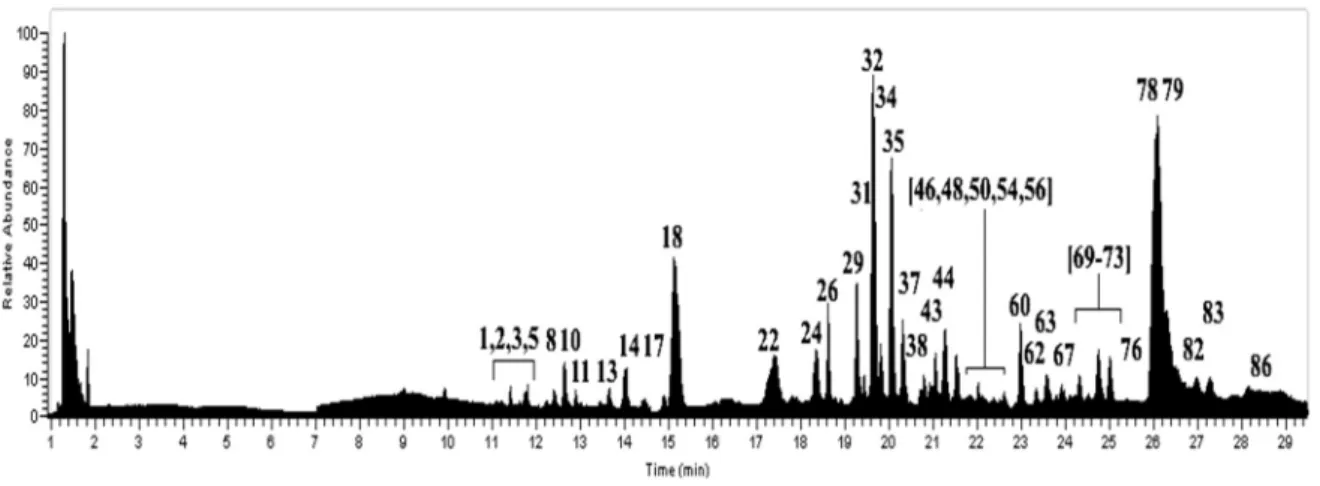
Thirteen depsides were identified (peaks 8, 10, 22, 31, 48, 60, 63, 69–72, 79 and 86) using UHPLC with DAD and high-resolution mass spectrometry (HRMS) and MS2analysis. Peak 8 was identified as barbatolic acid (molecular anion atm/z389.0516) whose fragmentation produced a diagnostic MS2ions atm/z167.0342 and 121.0285. Peaks 10 and 22 were identified as thamnolic acid and haemathamnolic acid isomers, showing [M− H]− ions at m/z419.0619 and 403.0672, respectively. Peak 31 was identified as lecanoric acid, which showed an [M − H]− ion at m/z317.0668. Major diagnostic daughter MS ions of lecanoric acid were [M−H−C8H6O3]−, [M−H−C8H8O4]−and [C7H7O2]− (167.0343, 149.0237 and 123.0444 a.m.u., respectively). Peak 48 with a [M−H]−pseudomolecular ion atm/z467.0985 was identified as gyrophoric acid, which showed diagnostic daughter ions atm/z
317.0667, 167.0345, 149.0238 and 123.0443. Peak 60 was identified as diffractaic acid, whose molecular anion was atm/z373.1294. Its fragmentation produced ions atm/z297.1149 [M−H−C2H4O3]−, 181.0499 [M−H−C11H12O3]−, 177.0549 [M−H−C10H12O4]−, and 137.0600 [M−H−C12H12O5]− confirming this depside. Peak 63 was identified as methyl-8-hydroxy-4-O-demethylbarbatate, which showed an [M − H]− ion atm/z 375.1085. Peak 69 with a [M − H]− ion at m/z387.1452 was identified as divaricatic acid. The parent ion produced major diagnostic MS ions atm/z195.0661 [M−H−C11H12O3]−, 177.0551 [M−H−C11H14O4]−and 151.0759 [C9H11O2]− confirming this depside. Peak 70 presented a pseudomolecular ion atm/z359.1139, which produced fragmented ions at m/z 181.0503, 163.0394 and 137.0601, thus it was identified as barbatic acid. Peak 71 was identified as sekikaic acid (molecular anion atm/z417.1556). The fragmentation of peak 71 produced diagnostic ions atm/z225.0764 [M−H−C11H12O3]−, 209.0815 [M−H−C11H12O4]−, and 165.0915 [M−H−C12H12O5]−. Peak 72 were identified as 8-hydroxybarbatic acid, which showed an [M−H]−ion atm/z375.1088. Peak 79 and 86 were identified as atranorin and chloroatranorin, which showed [M−H]− ions at m/z 373.0929 and 407.0541, respectively. The major diagnostic daughter ions were atm/z177.0187 and 163.0394 a.m.u. for atranorin, while for chloroatranorin ions were atm/z228.9906. These findings are in good agreement with the studies of Le Pogam et al. [8], Musharraf et al. [9] and Parrot et al. [10].
Depsidones
Eight depsidones corresponding to peaks 18, 24, 29, 32, 35, 46, 50, and 73 were identified using UHPLC with DAD and HRMS-MS analysis. Peak 18 was identified as salazinic acid, which showed a [M−H]−ion atm/z387.0359. Its major diagnostic daughter ions were atm/z269.0464, 241.0504, 151.0394 and 123.0445 a.m.u. Peak 24 was identified as connorstictic acid, which showed an [M−H]− ion atm/z373.0565. Peak 29 with a [M−H]−pseudomolecular ion atm/z401.0514 was identified as siphulellic acid, which showed diagnostic daughter ions atm/z253.0505, 149.0238, and 123.0444. Galbanic acid was at the peak 32 (molecular anion atm/z429.0463). The fragmentation of peak 32 produced ions atm/z 269.0456, 149.0237 and 123.0443. Peak 35 with a [M− H]− ion atm/z
371.0409 was identified as norstictic acid. The parent ion produced major diagnostic MS ions at
Lipids
Eleven polyhydroxylated lipids were identified (peaks 26, 34, 37, 38, 43, 54, 56, 67, 76, 82 and 83) using UHPLC-ESI-MS-MS analysis. Peak 26 with an [M − H]− ion at m/z
375.2752 was identified as tetrahydroxyeicosanoic acid. Peak 34 showed an [M − H]− ion at m/z 403.3067 was identified as tetrahydroxydocosanoic acid. Peak 37, 38 and 43 were identified as tetrahydroxytricosanoic acid (C23H46O6), tetrahydroxydocosanoic acid (C22H44O6) and 6-ethyl-6-n-pentylpentadecan-4,5,7,8,15-pentol-15-acetate (C24H48O6), which showed a [M−H]− ion at m/z 417.3221, 403.3066 and 431.3379 respectively. Besides, peak 54, 56 and 67 were identified as tetrahydroxyhexacosanoic acid (C26H52O6), nonahydroxyoctacosanoic acid (C28H56O11) and heptahydroxytricosatrienoic acid (C23H40O9), which showed a [M − H]− ion at m/z 459.3693, 567.3667 and 459.2602 respectively. Finally, peak 76, 82 and 83 presented an [M−H]− ion at m/z 473.2756, 251.2016 and 295.1916, respectively. They were identified as the fatty acids tetrahydroxytrioxotetracosanoic acid (C24H42O9), hexadecadienoic acid (C16H28O2), and dihydroxyheptadecatrienoic acid (C17H28O4), respectively.
Diphenylethers
A diphenylether (peak 62) was detected in the methanolic extract using UHPLC-DAD-MS-MS analysis. Peak 62 was identified asβ-alectoronic acid, which showed a [M−H]−ion atm/z511.1976. Its major diagnostic daughter ions were atm/z369.1339, 247.0969, and 163.0396 a.m.u.
Dibenzofurans
Usnic acid with a [M−H]−ion atm/z343.0823 was evidenced as peak 78. The main daughter ions of peak 78 were [M−H−CH3]−, [M−H−C4H3O2]−and [M−H−C5H3O3]−(328.0591, 259.0609 and 231.0661 a.m.u., respectively).
Unknown Compounds
Ten other compounds were detected (peaks 1–5, peaks 11, 13, 14, 17 and peak 44) but none was identified.
Molecules 2018, 23, 54 4 of 15
83 presented an [M − H]− ion at m/z 473.2756, 251.2016 and 295.1916, respectively. They were identified as the fatty acids tetrahydroxytrioxotetracosanoic acid (C24H42O9), hexadecadienoic acid (C16H28O2), and dihydroxyheptadecatrienoic acid (C17H28O4), respectively.
Diphenylethers
A diphenylether (peak 62) was detected in the methanolic extract using UHPLC-DAD-MS-MS analysis. Peak 62 was identified as β-alectoronic acid, which showed a [M − H]− ion at m/z 511.1976. Its major diagnostic daughter ions were at m/z 369.1339, 247.0969, and 163.0396 a.m.u.
Dibenzofurans
Usnic acid with a [M − H]− ion at m/z 343.0823 was evidenced as peak 78. The main daughter ions of peak 78 were [M − H − CH3]−, [M − H − C4H3O2]− and [M − H − C5H3O3]− (328.0591, 259.0609 and 231.0661 a.m.u., respectively).
Unknown Compounds
Ten other compounds were detected (peaks 1–5, peaks 11, 13, 14, 17 and peak 44) but none was identified.
Figure 1. UHPLC-MS Chromatogram of U. barbata.
2.2. Metabolomics in Usnea antarctica
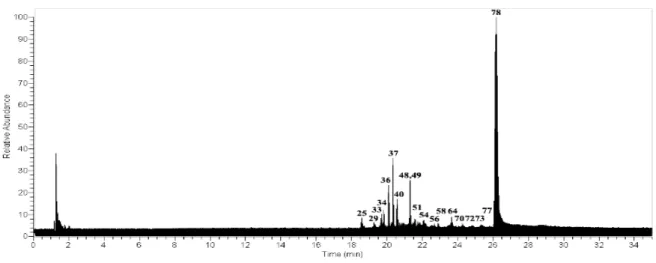
Twenty-one peaks (Figure 2) were identified for the first time in the methanolic extract (Table 1) using UHPLC/ESI/MS/MS in negative mode. Among the classes of compounds identified we can cite depsides, depsidones, lipids, and dibenzofurans.
Depsides
Five depsides were identified (peaks 48, 58, 63, 70 and 72) using UHPLC with DAD and HRMS and MS2 analysis. Peak 48 was identified as gyrophoric acid. Peak 58 and 72 were identified as baeomycesic acid and 8-hydroxybarbatic acid, showing [M − H]− ions at m/z 373.0915 and 375.1070, respectively. Peak 63 and 70 were identified as methyl-8-hydroxy-4-O-demethylbarbatate and barbatic acid respectively. These findings are in good agreement with the studies of Castro et al. [7], Le Pogam et al. [8], Musharraf et al. [9] and Parrot et al. [10].
Depsidones
Four depsidones corresponding to the peaks 24, 36, 40, and 73 were identified using UHPLC with DAD and HRMS-MS analysis. Peak 24 was identified as connorstictic acid. Peak 36 was identified as fumarprotocetraric acid (C22H16O12), which showed an [M − H]− ion at m/z 471.0547. The fragmentation of this peak 36 produced ions at m/z 355.0441, 311.0545 and 115.0023. Peak 40 with a [M − H]− pseudomolecular ion at m/z 387.0705 was identified as hypoconstictic acid, which showed diagnostic daughter ions at m/z 343.0808 and 299.0923. Finally, peak 73 was identified as lobaric acid.
Figure 1.UHPLC-MS Chromatogram ofU. barbata.
2.2. Metabolomics in Usnea antarctica
Depsides
Five depsides were identified (peaks 48, 58, 63, 70 and 72) using UHPLC with DAD and HRMS and MS2 analysis. Peak 48 was identified as gyrophoric acid. Peak 58 and 72 were identified as baeomycesic acid and 8-hydroxybarbatic acid, showing [M − H]− ions atm/z 373.0915 and 375.1070, respectively. Peak 63 and 70 were identified as methyl-8-hydroxy-4-O-demethylbarbatate and barbatic acid respectively. These findings are in good agreement with the studies of Castro et al. [7], Le Pogam et al. [8], Musharraf et al. [9] and Parrot et al. [10].
Depsidones
Four depsidones corresponding to the peaks 24, 36, 40, and 73 were identified using UHPLC with DAD and HRMS-MS analysis. Peak 24 was identified as connorstictic acid. Peak 36 was identified as fumarprotocetraric acid (C22H16O12), which showed an [M−H]−ion atm/z471.0547. The fragmentation of this peak 36 produced ions atm/z355.0441, 311.0545 and 115.0023. Peak 40 with a [M−H]−pseudomolecular ion atm/z387.0705 was identified as hypoconstictic acid, which showed diagnostic daughter ions atm/z343.0808 and 299.0923. Finally, peak 73 was identified as lobaric acid. These findings are in good agreement with the reports of Le Pogam et al. [8], Musharraf et al. [9] and Parrot et al. [10].
Lipids
Nine polyhydroxylated lipids were identified (peaks 30, 33, 34, 37, 43, 49, 51, 54 and 56) using UHPLC-ESI-MS-MS analysis [6,7].
Other Compounds
Finally, an aromatic compound (peak 77) and two dibenzofurans (peak 64 and 78) corresponding to ethyl-4-O-methylolivetolcarboxylate, usnic acid and placodiolic acid were identified in this extract, respectively. Placodiolic acid showed a molecular anion atm/z375.1069. The fragmentation of this compound produced ions atm/z343.0806 [M− H−CH3OH]−, 259.0597 [M− H−C5H8O3]−, and 231.0648 [M−H−C6H8O5]−confirming this dibenzofuran.
Molecules 2018, 23, 54 5 of 15
These findings are in good agreement with the reports of Le Pogam et al. [8], Musharraf et al. [9] and Parrot et al. [10].
Lipids
Nine polyhydroxylated lipids were identified (peaks 30, 33, 34, 37, 43, 49, 51, 54 and 56) using UHPLC-ESI-MS-MS analysis [6,7].
Other Compounds
Finally, an aromatic compound (peak 77) and two dibenzofurans (peak 64 and 78) corresponding to ethyl-4-O-methylolivetolcarboxylate, usnic acid and placodiolic acid were identified in this extract, respectively. Placodiolic acid showed a molecular anion at m/z 375.1069. The fragmentation of this compound produced ions at m/z 343.0806 [M − H − CH3OH]−, 259.0597 [M − H − C5H8O3]−, and 231.0648 [M − H − C6H8O5]− confirming this dibenzofuran.
Figure 2. UHPLC-MS Chromatogram of U. antarctica.
2.3. Metabolomics in Usnea rubicunda
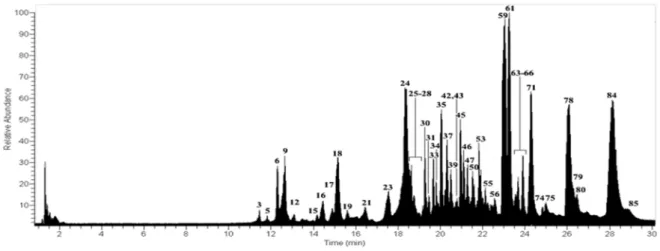
Forty-five peaks (Figure 3) were detected for the first time in the methanolic extract of
U. rubicunda using UHPLC/ESI/MS/MS in negative mode (Table 1). Thirty-eight compounds were
identified in U. rubicunda and among them are depsides, depsidones, lipids, diphenylether and dibenzofurans. These findings are in good agreement with the reports of Cornejo et al. [6], Castro et al. [7], Le Pogam et al. [8], Musharraf et al. [9] and Parrot et al. [10].
Depsides
Nine depsides were identified and assigned to the peaks 6, 15, 19, 31, 53, 63, 71, 74 and 79 using UHPLC-DAD-MS-MS. Peak 6 and peak 15 were identified as conprotocetraric acid and squamatic acid (molecular anions at m/z 375.0724 and 389.0880, respectively). Peak 19 was identified as conhypoprotocetraric acid which showed an [M − H]− ion at m/z 359.0775 and its fragmentation MS2 ion at m/z 253.0870 [M − H − C2H2O5]−. Peak 31, 53, 63, 71, 74 and 79 were identified as lecanoric acid, 4-O-methylnorsekikaic acid, methyl-8-hydroxy-4-O-demethylbarbatate, sekikaic acid, boninic acid and atranorin, respectively.
Depsidones
Ten depsidones corresponding to peaks 9, 16, 18, 21, 23-25, 35, 39, and 50 were identified (Table 1). Peak 9 was identified as siphulellic acid isomer ([M − H]− ion at m/z 401.0517), its fragmentation produced ions at m/z 359.0410 and 240.0427. Peak 16, 18, 21, 23-25, 35, 39 and 50 were identified as protocetraric acid, salazinic acid, constictic acid, hypoconstictic acid, connorstictic acid, menegazziaic acid, norstictic acid, cryptostictic acid, and stictic acid respectively.
Figure 2.UHPLC-MS Chromatogram ofU. antarctica.
2.3. Metabolomics in Usnea rubicunda
Forty-five peaks (Figure3) were detected for the first time in the methanolic extract ofU. rubicunda
using UHPLC/ESI/MS/MS in negative mode (Table1). Thirty-eight compounds were identified in
These findings are in good agreement with the reports of Cornejo et al. [6], Castro et al. [7], Le Pogam et al. [8], Musharraf et al. [9] and Parrot et al. [10].
Depsides
Nine depsides were identified and assigned to the peaks 6, 15, 19, 31, 53, 63, 71, 74 and 79 using UHPLC-DAD-MS-MS. Peak 6 and peak 15 were identified as conprotocetraric acid and squamatic acid (molecular anions atm/z375.0724 and 389.0880, respectively). Peak 19 was identified as conhypoprotocetraric acid which showed an [M−H]−ion atm/z359.0775 and its fragmentation MS2 ion atm/z253.0870 [M− H− C
2H2O5]−. Peak 31, 53, 63, 71, 74 and 79 were identified as lecanoric acid, 4-O-methylnorsekikaic acid, methyl-8-hydroxy-4-O-demethylbarbatate, sekikaic acid, boninic acid and atranorin, respectively.
Depsidones
Ten depsidones corresponding to peaks 9, 16, 18, 21, 23-25, 35, 39, and 50 were identified (Table 1). Peak 9 was identified as siphulellic acid isomer ([M − H]− ion at m/z 401.0517), its fragmentation produced ions atm/z359.0410 and 240.0427. Peak 16, 18, 21, 23-25, 35, 39 and 50 were identified as protocetraric acid, salazinic acid, constictic acid, hypoconstictic acid, connorstictic acid, menegazziaic acid, norstictic acid, cryptostictic acid, and stictic acid respectively.
Lipids
Eighteen polyhydroxylated lipids were identified at the peaks 26, 28, 30, 33, 34, 37, 42, 43, 47, 55, 59, 61, 65, 66, 75, 80, and 84, 85 using UHPLC-ESI-MS-MS analysis.
Unknown Compounds
Seven compounds were detected in this extract by the peaks 2, 3, 5, 12, 17, 27 and peak 45 but none of them were identified.
Other Compounds
Finally, a dibenzofuran (peak 78) corresponding to usnic acid was detected and identified in this extract.
Molecules 2018, 23, 54 6 of 15
Lipids
Eighteen polyhydroxylated lipids were identified at the peaks 26, 28, 30, 33, 34, 37, 42, 43, 47, 55, 59, 61, 65, 66, 75, 80, and 84, 85 using UHPLC-ESI-MS-MS analysis.
Unknown Compounds
Seven compounds were detected in this extract by the peaks 2, 3, 5, 12, 17, 27 and peak 45 but none of them were identified.
Other Compounds
Finally, a dibenzofuran (peak 78) corresponding to usnic acid was detected and identified in this extract.
Figure 3. UHPLC-MS Chromatogram of U. rubicunda.
2.4. Metabolomics in Usnea subfloridana
Forty-five (Figure 4) peaks were detected for the first time in the methanolic extract of U.
subfloridana using UHPLC/ESI/MS/MS in negative mode (Table 1). Thirty-seven compounds were
identified in this species which can be arranged as depsides, depsidones, lipids and dibenzofurans. These findings are in good agreement with the reports of Cornejo et al. [6], Castro et al. [7], Le Pogam [8], Musharraf et al. [9] and Parrot et al. [10].
Depsides
Seven depsides were identified and assigned to peaks 7, 31, 63, 70–72 and 81 using UHPLC-DAD-MS-MS. Peak 7 and peak 31 were identified as haemathamnolic acid isomer and lecanoric acid whose molecular anions were at m/z 403.0675 and 317.0670, respectively. Peak 63, 70, 71 and 72 were identified as methyl-8-hydroxy-4-O-demethylbarbatate, barbatic acid, sekikaic acid, and 8-hydroxybarbatic acid respectively. Besides, peak 81 was identified as perlatolic acid which showed an [M − H]− ion at m/z 443.2077 and its fragmentation produced ions at m/z 223.0973, 205.0867 and 179.1073.
Depsidones
Twelve depsidones corresponding to peaks 9, 18, 20, 21, 23–25, 29, 32, 35, 39 and 73 were identified (Table 1). Peak 9 was identified as siphulellic acid isomer ([M − H]− ion at m/z 401.0518) and its fragmentation produced ions at 359.0410 and 240.0427. Peak 18, 20, 21, 23–25, 29, 32, 35, 39 and 73 were identified as salazinic acid, physodalic acid, constictic acid, hypoconstictic acid, connorstictic acid, menegazziaic acid, siphulellic acid, galbinic acid, norstictic acid, cryptostictic acid, and lobaric acid respectively.
Figure 3.UHPLC-MS Chromatogram ofU. rubicunda.
2.4. Metabolomics in Usnea subfloridana
Forty-five (Figure 4) peaks were detected for the first time in the methanolic extract of
identified in this species which can be arranged as depsides, depsidones, lipids and dibenzofurans. These findings are in good agreement with the reports of Cornejo et al. [6], Castro et al. [7], Le Pogam [8], Musharraf et al. [9] and Parrot et al. [10].
Depsides
Seven depsides were identified and assigned to peaks 7, 31, 63, 70–72 and 81 using UHPLC-DAD-MS-MS. Peak 7 and peak 31 were identified as haemathamnolic acid isomer and lecanoric acid whose molecular anions were atm/z403.0675 and 317.0670, respectively. Peak 63, 70, 71 and 72 were identified as methyl-8-hydroxy-4-O-demethylbarbatate, barbatic acid, sekikaic acid, and 8-hydroxybarbatic acid respectively. Besides, peak 81 was identified as perlatolic acid which showed an [M −H]− ion atm/z443.2077 and its fragmentation produced ions at m/z223.0973, 205.0867 and 179.1073.
Depsidones
Twelve depsidones corresponding to peaks 9, 18, 20, 21, 23–25, 29, 32, 35, 39 and 73 were identified (Table1). Peak 9 was identified as siphulellic acid isomer ([M−H]−ion atm/z401.0518) and its fragmentation produced ions at 359.0410 and 240.0427. Peak 18, 20, 21, 23–25, 29, 32, 35, 39 and 73 were identified as salazinic acid, physodalic acid, constictic acid, hypoconstictic acid, connorstictic acid, menegazziaic acid, siphulellic acid, galbinic acid, norstictic acid, cryptostictic acid, and lobaric acid respectively.
Lipids
Seventeen polyhydroxylated lipids were identified: peaks 34, 37, 41–43, 47, 52, 54, 55, 57, 59, 61, 66, 68, 75 and 84, 85 using UHPLC-ESI-MS-MS analysis.
Unknown Compounds
Eight compounds were detected in this extract: peaks 2, 3, 5, 11, 13, 14, 17 and peak 27 but none of them was identified.
Other Compounds
Finally, a dibenzofuran corresponding to usnic acid (peak 78) was detected and identified in this extract.
Molecules 2018, 23, 54 7 of 15
Lipids
Seventeen polyhydroxylated lipids were identified: peaks 34, 37, 41–43, 47, 52, 54, 55, 57, 59, 61, 66, 68, 75 and 84, 85 using UHPLC-ESI-MS-MS analysis.
Unknown Compounds
Eight compounds were detected in this extract: peaks 2, 3, 5, 11, 13, 14, 17 and peak 27 but none of them was identified.
Other Compounds
Finally, a dibenzofuran corresponding to usnic acid (peak 78) was detected and identified in this extract.
Figure 4. UHPLC-MS Chromatogram of U. subfloridana.
Among the compounds present in the four-species, we found connorstictic acid (peak 24), tetrahydroxydocosanoic acid (peak 34), 6-ethyl-6-n-pentylpentadecan-4,5,7,8,15-pentol-15-acetate (peak 43), tetrahydroxytricosanoic acid (peak 37), methyl-8-hydroxy-4-O-demethylbarbatate (peak 63) and usnic acid (peak 78). Furthermore, in all species except U. antarctic the following compounds were detected: salazinic acid, lecanoric acid, norstictic acid, and sekikaic acid.
According to Singh et al. 2016 [2] to date more than 60 compounds belonging to different classes such as depsides, depsidones, depsones, lactones, quinones, fatty acids, phenols, polysaccharides and dibenzofurans have been reported from Usnea species. In this work we have identified 76 lichen substances using UHPLC-ESI-OT-MS-MS in these four Usnea species. Several fatty acids have been previously reported from Usnea genus: bourgeanic acid, caperatic acid, murolic acid, isomuronic acid, murotic acid, lichesterinic acid, neuropogolic acid, protolichesteric acid, 18R -hydroxydihydroalloprotolichesterenic acid, methyl 3,4-dicarboxy-3-hydroxy-19-oxoeicosanoate, and 2-methylene-3R-carboxy-18R-hydroxynonadecanoic acid.
We found eleven lipids in U. barbata, nine in U. antarctica, eighteen in U. rubicunda and seventeen
in U. subfloridana but the following lipids were reported in all mentioned species
tetrahydroxydocosanoic acid (peak 34), tetrahydroxytricosanoic acid (peak 37), and 6-ethyl-6-n -pentylpentadecan-4,5,7,8,15-pentol-15-acetate (peak 43). Moreover, both in U. rubicunda and U.
subfloridana methyl 3,4-dicarboxy-3-hydroxy-19-oxoeicosanoate (peak 55), neodihydromurolic acid
(peak 59), murolic acid (peak 61), muronic acid (peak 66), norcaperatic acid (peak 75), and caperatic acid (peak 84) were identified, following the same trend as reported in the Usnea genus. The other lipids mentioned here are reported for the first time in these species and in the genus.
So far, twenty-three depsides have been reported from Usnea genus according to Huneck et al. 1996 [3] and Singh et al. 2016 [2]. In this study, we found twenty depsides distributed as: thirteen in
U. barbata, five in U. antarctica, nine in U. rubicunda and seven in U. subfloridana. We identified
Among the compounds present in the four-species, we found connorstictic acid (peak 24), tetrahydroxydocosanoic acid (peak 34), 6-ethyl-6-n-pentylpentadecan-4,5,7,8,15-pentol-15-acetate (peak 43), tetrahydroxytricosanoic acid (peak 37), methyl-8-hydroxy-4-O-demethylbarbatate (peak 63) and usnic acid (peak 78). Furthermore, in all species exceptU. antarcticthe following compounds were detected: salazinic acid, lecanoric acid, norstictic acid, and sekikaic acid.
According to Singh et al. 2016 [2] to date more than 60 compounds belonging to different classes such as depsides, depsidones, depsones, lactones, quinones, fatty acids, phenols, polysaccharides and dibenzofurans have been reported fromUsneaspecies. In this work we have identified 76 lichen substances using UHPLC-ESI-OT-MS-MS in these fourUsneaspecies. Several fatty acids have been previously reported from Usnea genus: bourgeanic acid, caperatic acid, murolic acid, isomuronic acid, murotic acid, lichesterinic acid, neuropogolic acid, protolichesteric acid, 18R-hydroxydihydroalloprotolichesterenic acid, methyl 3,4-dicarboxy-3-hydroxy-19-oxoeicosanoate, and 2-methylene-3R-carboxy-18R-hydroxynonadecanoic acid.
We found eleven lipids in U. barbata, nine in U. antarctica, eighteen in U. rubicunda
and seventeen in U. subfloridana but the following lipids were reported in all mentioned species tetrahydroxydocosanoic acid (peak 34), tetrahydroxytricosanoic acid (peak 37), and 6-ethyl-6-n-pentylpentadecan-4,5,7,8,15-pentol-15-acetate (peak 43). Moreover, both in
U. rubicunda and U. subfloridana methyl 3,4-dicarboxy-3-hydroxy-19-oxoeicosanoate (peak 55), neodihydromurolic acid (peak 59), murolic acid (peak 61), muronic acid (peak 66), norcaperatic acid (peak 75), and caperatic acid (peak 84) were identified, following the same trend as reported in the
Usneagenus. The other lipids mentioned here are reported for the first time in these species and in the genus.
So far, twenty-three depsides have been reported fromUsneagenus according to Huneck et al. 1996 [3] and Singh et al. 2016 [2]. In this study, we found twenty depsides distributed as: thirteen inU. barbata, five inU. antarctica, nine inU. rubicundaand seven inU. subfloridana. We identified barbatolic acid (peak 8), thamnolic acid (peak 10), squamatic acid (peak 15), baeomycesic acid (peak 58), diffractaic acid (peak 60), barbatic acid (peak 70), and atranorin (peak 79), which were previously reported in the genusUsnea. The others depsides identified by us are reported for the first time in the genus.
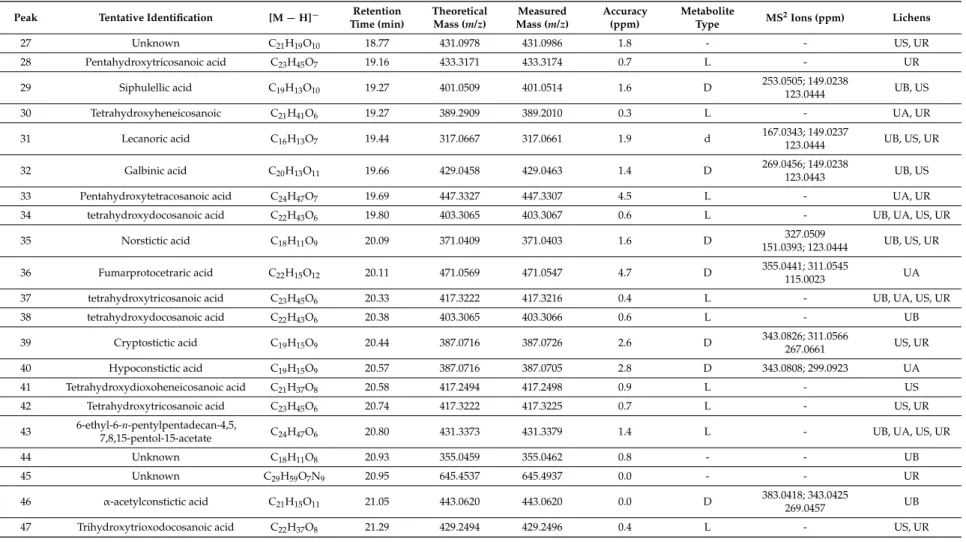
Regarding depsidones, thirteen compounds have been reported in the genusUsnea[2,3], while in this study we could identify seventeen. Among the depsidones reported inUsnea genus and identified by us were: protocetraric acid (peak 16), salazinic acid (peak 18), constictic acid (peak 21), menegazziaic acid (peak 25), galbinic acid (peak 32), norstictic acid (peak 35), fumarprotocetraric acid (peak 36), hypoconstictic acid (40), stictic acid (peak 50), and lobaric acid (peak 73). The other depsidones identified in this study are reported for the first time in the genus.
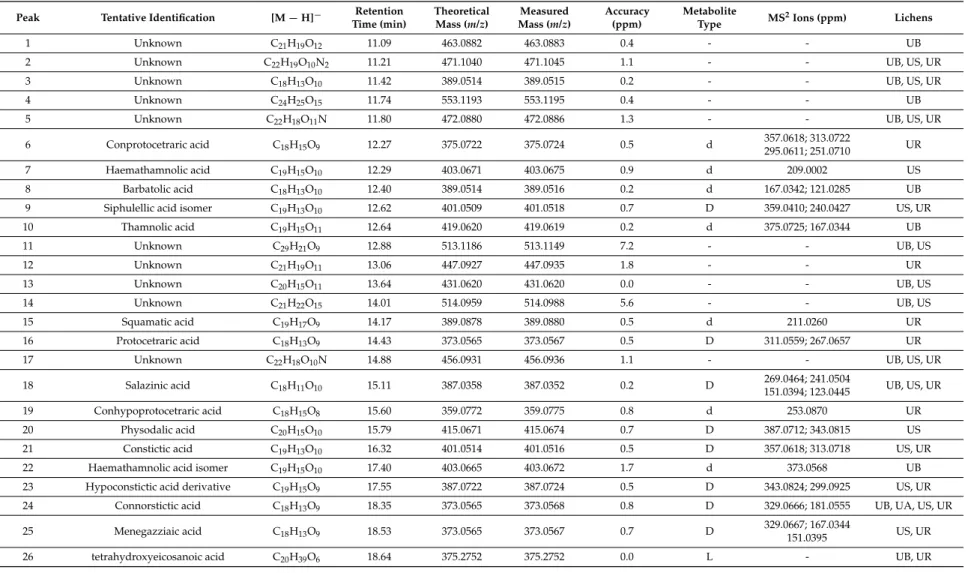
Table 1.Identification of metabolites inUsneaspecies by UHPLC-ESI-MS-MS.
Peak Tentative Identification [M−H]− Retention Time (min)
Theoretical Mass (m/z)
Measured Mass (m/z)
Accuracy (ppm)
Metabolite
Type MS
2Ions (ppm) Lichens
1 Unknown C21H19O12 11.09 463.0882 463.0883 0.4 - - UB
2 Unknown C22H19O10N2 11.21 471.1040 471.1045 1.1 - - UB, US, UR
3 Unknown C18H13O10 11.42 389.0514 389.0515 0.2 - - UB, US, UR
4 Unknown C24H25O15 11.74 553.1193 553.1195 0.4 - - UB
5 Unknown C22H18O11N 11.80 472.0880 472.0886 1.3 - - UB, US, UR
6 Conprotocetraric acid C18H15O9 12.27 375.0722 375.0724 0.5 d 357.0618; 313.0722295.0611; 251.0710 UR
7 Haemathamnolic acid C19H15O10 12.29 403.0671 403.0675 0.9 d 209.0002 US
8 Barbatolic acid C18H13O10 12.40 389.0514 389.0516 0.2 d 167.0342; 121.0285 UB
9 Siphulellic acid isomer C19H13O10 12.62 401.0509 401.0518 0.7 D 359.0410; 240.0427 US, UR
10 Thamnolic acid C19H15O11 12.64 419.0620 419.0619 0.2 d 375.0725; 167.0344 UB
11 Unknown C29H21O9 12.88 513.1186 513.1149 7.2 - - UB, US
12 Unknown C21H19O11 13.06 447.0927 447.0935 1.8 - - UR
13 Unknown C20H15O11 13.64 431.0620 431.0620 0.0 - - UB, US
14 Unknown C21H22O15 14.01 514.0959 514.0988 5.6 - - UB, US
15 Squamatic acid C19H17O9 14.17 389.0878 389.0880 0.5 d 211.0260 UR
16 Protocetraric acid C18H13O9 14.43 373.0565 373.0567 0.5 D 311.0559; 267.0657 UR
17 Unknown C22H18O10N 14.88 456.0931 456.0936 1.1 - - UB, US, UR
18 Salazinic acid C18H11O10 15.11 387.0358 387.0352 0.2 D 151.0394; 123.0445269.0464; 241.0504 UB, US, UR
19 Conhypoprotocetraric acid C18H15O8 15.60 359.0772 359.0775 0.8 d 253.0870 UR
20 Physodalic acid C20H15O10 15.79 415.0671 415.0674 0.7 D 387.0712; 343.0815 US
21 Constictic acid C19H13O10 16.32 401.0514 401.0516 0.5 D 357.0618; 313.0718 US, UR
22 Haemathamnolic acid isomer C19H15O10 17.40 403.0665 403.0672 1.7 d 373.0568 UB
23 Hypoconstictic acid derivative C19H15O9 17.55 387.0722 387.0724 0.5 D 343.0824; 299.0925 US, UR
24 Connorstictic acid C18H13O9 18.35 373.0565 373.0568 0.8 D 329.0666; 181.0555 UB, UA, US, UR
25 Menegazziaic acid C18H13O9 18.53 373.0565 373.0567 0.7 D 329.0667; 167.0344151.0395 US, UR
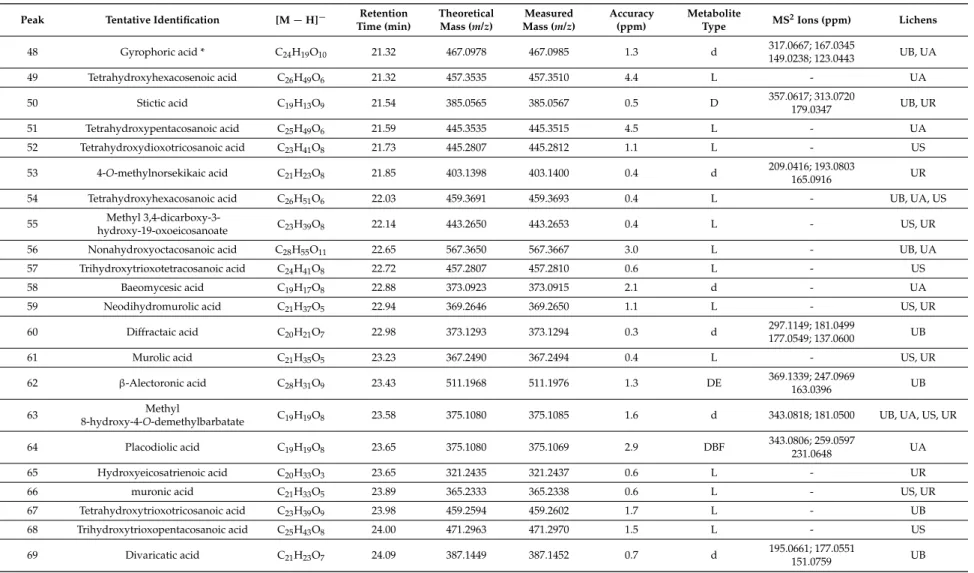
Table 1.Cont.
Peak Tentative Identification [M−H]− Retention Time (min)
Theoretical Mass (m/z)
Measured Mass (m/z)
Accuracy (ppm)
Metabolite
Type MS
2Ions (ppm) Lichens
27 Unknown C21H19O10 18.77 431.0978 431.0986 1.8 - - US, UR
28 Pentahydroxytricosanoic acid C23H45O7 19.16 433.3171 433.3174 0.7 L - UR
29 Siphulellic acid C19H13O10 19.27 401.0509 401.0514 1.6 D 253.0505; 149.0238123.0444 UB, US
30 Tetrahydroxyheneicosanoic C21H41O6 19.27 389.2909 389.2010 0.3 L - UA, UR
31 Lecanoric acid C16H13O7 19.44 317.0667 317.0661 1.9 d 167.0343; 149.0237123.0444 UB, US, UR
32 Galbinic acid C20H13O11 19.66 429.0458 429.0463 1.4 D 269.0456; 149.0238123.0443 UB, US
33 Pentahydroxytetracosanoic acid C24H47O7 19.69 447.3327 447.3307 4.5 L - UA, UR
34 tetrahydroxydocosanoic acid C22H43O6 19.80 403.3065 403.3067 0.6 L - UB, UA, US, UR
35 Norstictic acid C18H11O9 20.09 371.0409 371.0403 1.6 D 151.0393; 123.0444327.0509 UB, US, UR
36 Fumarprotocetraric acid C22H15O12 20.11 471.0569 471.0547 4.7 D 355.0441; 311.0545115.0023 UA
37 tetrahydroxytricosanoic acid C23H45O6 20.33 417.3222 417.3216 0.4 L - UB, UA, US, UR
38 tetrahydroxydocosanoic acid C22H43O6 20.38 403.3065 403.3066 0.6 L - UB
39 Cryptostictic acid C19H15O9 20.44 387.0716 387.0726 2.6 D 343.0826; 311.0566267.0661 US, UR
40 Hypoconstictic acid C19H15O9 20.57 387.0716 387.0705 2.8 D 343.0808; 299.0923 UA
41 Tetrahydroxydioxoheneicosanoic acid C21H37O8 20.58 417.2494 417.2498 0.9 L - US
42 Tetrahydroxytricosanoic acid C23H45O6 20.74 417.3222 417.3225 0.7 L - US, UR
43 6-ethyl-6-7,8,15-pentol-15-acetaten-pentylpentadecan-4,5, C24H47O6 20.80 431.3373 431.3379 1.4 L - UB, UA, US, UR
44 Unknown C18H11O8 20.93 355.0459 355.0462 0.8 - - UB
45 Unknown C29H59O7N9 20.95 645.4537 645.4937 0.0 - - UR
46 α-acetylconstictic acid C21H15O11 21.05 443.0620 443.0620 0.0 D 383.0418; 343.0425269.0457 UB
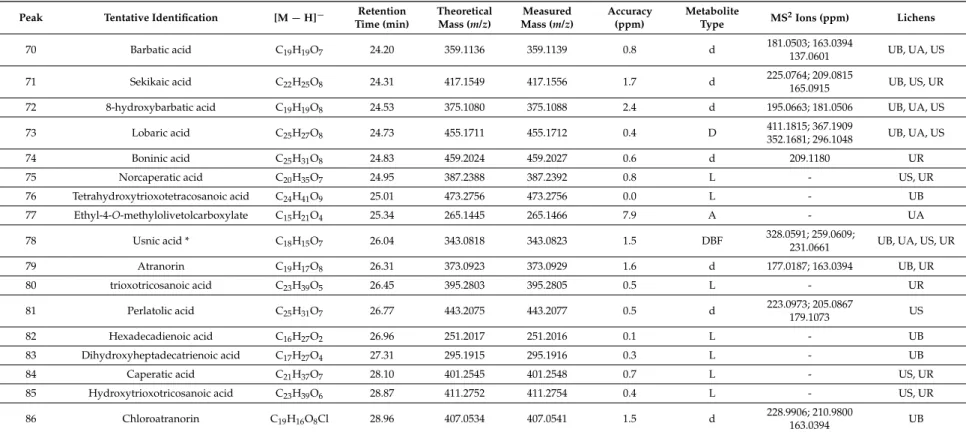
Table 1.Cont.
Peak Tentative Identification [M−H]− Retention Time (min)
Theoretical Mass (m/z)
Measured Mass (m/z)
Accuracy (ppm)
Metabolite
Type MS
2Ions (ppm) Lichens
48 Gyrophoric acid * C24H19O10 21.32 467.0978 467.0985 1.3 d 149.0238; 123.0443317.0667; 167.0345 UB, UA
49 Tetrahydroxyhexacosenoic acid C26H49O6 21.32 457.3535 457.3510 4.4 L - UA
50 Stictic acid C19H13O9 21.54 385.0565 385.0567 0.5 D 357.0617; 313.0720179.0347 UB, UR
51 Tetrahydroxypentacosanoic acid C25H49O6 21.59 445.3535 445.3515 4.5 L - UA
52 Tetrahydroxydioxotricosanoic acid C23H41O8 21.73 445.2807 445.2812 1.1 L - US
53 4-O-methylnorsekikaic acid C21H23O8 21.85 403.1398 403.1400 0.4 d 209.0416; 193.0803165.0916 UR
54 Tetrahydroxyhexacosanoic acid C26H51O6 22.03 459.3691 459.3693 0.4 L - UB, UA, US
55 hydroxy-19-oxoeicosanoateMethyl 3,4-dicarboxy-3- C23H39O8 22.14 443.2650 443.2653 0.4 L - US, UR
56 Nonahydroxyoctacosanoic acid C28H55O11 22.65 567.3650 567.3667 3.0 L - UB, UA
57 Trihydroxytrioxotetracosanoic acid C24H41O8 22.72 457.2807 457.2810 0.6 L - US
58 Baeomycesic acid C19H17O8 22.88 373.0923 373.0915 2.1 d - UA
59 Neodihydromurolic acid C21H37O5 22.94 369.2646 369.2650 1.1 L - US, UR
60 Diffractaic acid C20H21O7 22.98 373.1293 373.1294 0.3 d 177.0549; 137.0600297.1149; 181.0499 UB
61 Murolic acid C21H35O5 23.23 367.2490 367.2494 0.4 L - US, UR
62 β-Alectoronic acid C28H31O9 23.43 511.1968 511.1976 1.3 DE 369.1339; 247.0969163.0396 UB
63 8-hydroxy-4-OMethyl-demethylbarbatate C19H19O8 23.58 375.1080 375.1085 1.6 d 343.0818; 181.0500 UB, UA, US, UR
64 Placodiolic acid C19H19O8 23.65 375.1080 375.1069 2.9 DBF 343.0806; 259.0597231.0648 UA
65 Hydroxyeicosatrienoic acid C20H33O3 23.65 321.2435 321.2437 0.6 L - UR
66 muronic acid C21H33O5 23.89 365.2333 365.2338 0.6 L - US, UR
67 Tetrahydroxytrioxotricosanoic acid C23H39O9 23.98 459.2594 459.2602 1.7 L - UB
68 Trihydroxytrioxopentacosanoic acid C25H43O8 24.00 471.2963 471.2970 1.5 L - US
Table 1.Cont.
Peak Tentative Identification [M−H]− Retention Time (min)
Theoretical Mass (m/z)
Measured Mass (m/z)
Accuracy (ppm)
Metabolite
Type MS
2Ions (ppm) Lichens
70 Barbatic acid C19H19O7 24.20 359.1136 359.1139 0.8 d 181.0503; 163.0394137.0601 UB, UA, US
71 Sekikaic acid C22H25O8 24.31 417.1549 417.1556 1.7 d 225.0764; 209.0815165.0915 UB, US, UR
72 8-hydroxybarbatic acid C19H19O8 24.53 375.1080 375.1088 2.4 d 195.0663; 181.0506 UB, UA, US
73 Lobaric acid C25H27O8 24.73 455.1711 455.1712 0.4 D 411.1815; 367.1909352.1681; 296.1048 UB, UA, US
74 Boninic acid C25H31O8 24.83 459.2024 459.2027 0.6 d 209.1180 UR
75 Norcaperatic acid C20H35O7 24.95 387.2388 387.2392 0.8 L - US, UR
76 Tetrahydroxytrioxotetracosanoic acid C24H41O9 25.01 473.2756 473.2756 0.0 L - UB
77 Ethyl-4-O-methylolivetolcarboxylate C15H21O4 25.34 265.1445 265.1466 7.9 A - UA
78 Usnic acid * C18H15O7 26.04 343.0818 343.0823 1.5 DBF 328.0591; 259.0609;231.0661 UB, UA, US, UR
79 Atranorin C19H17O8 26.31 373.0923 373.0929 1.6 d 177.0187; 163.0394 UB, UR
80 trioxotricosanoic acid C23H39O5 26.45 395.2803 395.2805 0.5 L - UR
81 Perlatolic acid C25H31O7 26.77 443.2075 443.2077 0.5 d 223.0973; 205.0867179.1073 US
82 Hexadecadienoic acid C16H27O2 26.96 251.2017 251.2016 0.1 L - UB
83 Dihydroxyheptadecatrienoic acid C17H27O4 27.31 295.1915 295.1916 0.3 L - UB
84 Caperatic acid C21H37O7 28.10 401.2545 401.2548 0.7 L - US, UR
85 Hydroxytrioxotricosanoic acid C23H39O6 28.87 411.2752 411.2754 0.4 L - US, UR
86 Chloroatranorin C19H16O8Cl 28.96 407.0534 407.0541 1.5 d 228.9906; 210.9800163.0394 UB
A pioneering work to determine the components in crude extracts of lichens using MS/MS was done by Leuckert and Holzmann [11]. At that study its authors identified usnic acid, diffractaic acid, gyrophoric acid, lecanoric acid, orsellinic acid, ovoic acid, thamnolic acid, hypothamnolic acid, divaricatic acid, fumarprotocetraric acid, protocetraric acid, homosekikaic acid and sekikaic acid by their specific fragmentation patterns, without an isolation methodology, in the following lichens:Alectoria ochroleuca,Umbilicaria torrefacta,Thamnolia vermicularis,Ophioparma ventosa, Cladonia cryptochlorophaea and Cladonia rei. The Tomasi group [10] has reported a chemical study of eight chemotypes ofRamalina siliquosausing LC-ESI-MS/MS and identified ten compounds—conhypoprotocetraric acid, salazinic acid, peristictic acid, cryptostictic acid, protocetraric acid, stictic acid, norstictic acid, hypoprotocetraric acid, 4-O-demethylbarbatic acid, usnic acid—and twenty-two more, which were detected but not identified. In another study, nine compounds were identified using a HPLC-MS/MS approach in nine lichens belonging to the genusLichina,Collema
andRoccella[12]. Among themβ-orcinol, orsenillic acid, choline sulphate, roccellic acid, montagnetol, lecanoric acid, erythrin, lepraric acid and acetylportentol were identified based on their fragmentation pathways. Choudhary et al. 2015 [9] studied the lichens Parmotrema grayana and Heterodermia obscuratausing HPLC-ESI-QqTOF-MS/MS on negative ion mode. A total of fifteen compounds were detected and identified from the dichloromethane and methanolic extracts. Finally, Le Pogam et al. [8] proposed the rapid identification of lichen extracts using laser desorption/ionization time of flight mass spectrometry instead of electrospray ionization. The analyzed samples wereDiploicia canescens,
Evernia prunastri,Ophioparma ventosa,Pseudevernia furfuracea,Roccella fuciformis,Xanthoria parietina, Cladonia portentosa,flavocetraria nivalis,Lecidella asema,Ramalina siliquosa,Vulpicida pinastriandUsnea filipendulaand, in general in each studied species 2–5 compounds were detected. For example in the lichenUsnea filipendulaonly salazinic acid and usnic acid were detected.
Regarding the biological activity of Usnea species, several methanolic extracts ofU. filipendula,
U. antarctica,U. barbata,U. complanta,U. longissima,U. lapponica,U. ghattensis,U. fasciata,U. rubicunda,
U. siamensis, andU. articulatehave been evaluated for anticancer, antioxidant, antiviral, antibacterial, antimycobacterial, anti-inflammatory, cytotoxicity, antigenotoxic, antitumoral, antifungal, antiulcer, antiplatelet, antithrombotic, hepatoprotective and melanogenesis inhibitory activity [2].
In the study conducted in the four species of the genusUsneaeighty six compounds were identified in total, and of these only six compounds (connorstictic acid (24), tetrahydroxydocosanoic acid (34), tetrahydroxytricosanoic acid (37), 6-ethyl-6-n-pentylpentadecan-4,5,7,8,15-pentol-15-acetate (43), methyl 8-hydroxy-4-O-demethylbarbatate (63) and usnic acid (78), Figure5) were reported previously in the four species;. The speciesU. barbata,U. subfloridanaandU. rubicundashowed nearly 45 metabolites distributed among the lipid, depsidone, depside, diphenylether, dibenzofuran and chromone classes, while
U. barbatawas the only species to show the presence ofβ-alectoronic acid (62). The speciesU. antarctica
from the Antarctic continent showed the presence of only 21 compounds distributed in six families of secondary metabolites arranged as aromatic, lipid, depsidone, depside, dibenzofuran and chromone classes and unlike the other species studied in this lichen we could detect aromatic compounds.
Molecules 2018, 23, 54 13 of 15
Figure 5. Chemical structures of similar compounds in U. antarctica, U. barbata, U. subfloridana and
U. rubicunda.
3. Materials and Methods
3.1. Lichen Material
The lichen specimen Usnea barbata (30 g) was collected at “Longavi”, VII Region, Talca, Chile, in 2015, while U. antarctica (50 g) was collected in Ardley Island, Chilean Antarctic, in 2014. Voucher specimens number: UB-19092015 and UA-01032014 were deposited in the Extreme Natural Product Laboratory. Prof. Dr. Reinaldo Vargas confirmed their identity. The species U. rubicunda (21 g) and
U. subfloridana (20 g) were collected in “Combeima river basin”, Ibagué-Tolima, Colombia by Prof. O. Garcia and Prof. A. Torres-Benítez, voucher specimens (COL-015 and COL-016) were deposited in the herbarium of Universidad Distrital Francisco José de Caldas and Prof. Alejandra Suárez Corredor confirmed their identity.
3.2. UHPLC-Orbitrap-ESI-MS-MS
3.2.1. Sample Preparation
About 3 g of each lichen species were macerated with methanol (three times, 30 mL each time, 3 days/extraction). The solutions were concentrated to obtain 10 mg (U. barbata), 8 mg (U. antarctica), 18 mg (U. rubicunda) and 22 mg (U. subfloridana) of extracts, respectively.
3.2.2. Instruments
A Thermo Scientific Dionex Ultimate 3000 UHPLC system equipped with a quaternary Series RS pump and a Thermo Scientific Dionex Ultimate 3000 Series TCC-3000RS column compartments with a Thermo Fisher Scientific Ultimate 3000 Series WPS-3000RS autosampler and a rapid separations PDA detector controlled by Chromeleon 7.2 Software (Thermo Fisher Scientific, Waltham, MA, USA and Dionex Softron GmbH, a part of Thermo Fisher Scientific, Bremen, Germany) hyphenated with a Thermo high resolution Q Exactive focus mass spectrometer (Thermo, Bremen, Germany) were used for analysis. The chromatographic system was coupled with the MS with a Heated Electrospray Ionization Source II (HESI II). Nitrogen (purity > 99.999%) obtained from a Genius NM32LA nitrogen generator (Peak Scientific, Billerica, MA, USA) was employed as both the collision and damping gas. Mass calibration for the Orbitrap™ was performed once a week, in both negative and positive modes, to ensure a working mass accuracy lower than or equal to 5 ppm. Cafeine and n-butylamine (Sigma Aldrich, St. Louis, MO, USA) were the calibration standards for positive ions and buspirone hydrochloride, sodium dodecyl sulfate, and taurocholic acid sodium salt (Sigma Aldrich) were used to calibrate the mass spectrometer. These compounds were dissolved in a mixture of acetic acid, acetonitrile, water and methanol (Merck, Darmstadt, Germany) and were
Figure 5.Chemical structures of similar compounds inU. antarctica,U. barbata,U. subfloridanaand
3. Materials and Methods
3.1. Lichen Material
The lichen specimenUsnea barbata(30 g) was collected at “Longavi”, VII Region, Talca, Chile, in 2015, whileU. antarctica(50 g) was collected in Ardley Island, Chilean Antarctic, in 2014. Voucher specimens number: UB-19092015 and UA-01032014 were deposited in the Extreme Natural Product Laboratory. Prof. Dr. Reinaldo Vargas confirmed their identity. The species U. rubicunda(21 g) and U. subfloridana (20 g) were collected in “Combeima river basin”, Ibagué-Tolima, Colombia by Prof. O. Garcia and Prof. A. Torres-Benítez, voucher specimens (COL-015 and COL-016) were deposited in the herbarium of Universidad Distrital Francisco Joséde Caldas and Prof. Alejandra Suárez Corredor confirmed their identity.
3.2. UHPLC-Orbitrap-ESI-MS-MS
3.2.1. Sample Preparation
About 3 g of each lichen species were macerated with methanol (three times, 30 mL each time, 3 days/extraction). The solutions were concentrated to obtain 10 mg (U. barbata), 8 mg (U. antarctica), 18 mg (U. rubicunda) and 22 mg (U. subfloridana) of extracts, respectively.
3.2.2. Instruments
A Thermo Scientific Dionex Ultimate 3000 UHPLC system equipped with a quaternary Series RS pump and a Thermo Scientific Dionex Ultimate 3000 Series TCC-3000RS column compartments with a Thermo Fisher Scientific Ultimate 3000 Series WPS-3000RS autosampler and a rapid separations PDA detector controlled by Chromeleon 7.2 Software (Thermo Fisher Scientific, Waltham, MA, USA and Dionex Softron GmbH, a part of Thermo Fisher Scientific, Bremen, Germany) hyphenated with a Thermo high resolution Q Exactive focus mass spectrometer (Thermo, Bremen, Germany) were used for analysis. The chromatographic system was coupled with the MS with a Heated Electrospray Ionization Source II (HESI II). Nitrogen (purity > 99.999%) obtained from a Genius NM32LA nitrogen generator (Peak Scientific, Billerica, MA, USA) was employed as both the collision and damping gas. Mass calibration for the Orbitrap™ was performed once a week, in both negative and positive modes, to ensure a working mass accuracy lower than or equal to 5 ppm. Cafeine andn-butylamine (Sigma Aldrich, St. Louis, MO, USA) were the calibration standards for positive ions and buspirone hydrochloride, sodium dodecyl sulfate, and taurocholic acid sodium salt (Sigma Aldrich) were used to calibrate the mass spectrometer. These compounds were dissolved in a mixture of acetic acid, acetonitrile, water and methanol (Merck, Darmstadt, Germany) and were infused using a Chemyx Fusion 100 syringe pump (Thermo Fisher Scientific, Bremen, Germany). XCalibur 2.3 software (Thermo Fisher Scientific, Bremen, Germany) and Trace Finder 3.2 (Thermo Fisher Scientific, San José, CA, USA) were used for UHPLC control and data processing, respectively. Q Exactive 2.0 SP 2 from Thermo Fisher Scientific was used to control the mass spectrometer.
3.2.3. LC Parameters
3.2.4. MS Parameters
The HESI parameters were as follows: sheath gas flow rate 75 units; aux. gas unit flow rate 20; capillary temperature 400◦C; aux gas heater temperature 500◦C; spray voltage 2500 V (for ESI−); and S lens RF level 30. Full scan data in positive and negative was acquired at the resolving power of 70,000 FWHM (full width half maximum) atm/z200. For the compounds of interest, a scan range of
m/z100–1000 was chosen; the automatic gain control (AGC) set at 3×10⁶and the injection time set to 200 ms. Scan-rate was set at 2 scans s−1. External calibration was performed using a calibration solution in positive and negative modes. For confirmation purposes, a targeted MS/MS analysis was performed using the mass inclusion list, with a 30 s time window, with the Orbitrap spectrometer operating both in positive and negative mode at 17,500 FWHM (m/z200). The AGC target was set to 2×10⁵, with the maximun injection time of 20 ms. The precursor ions are filtered by the quadrupole which operates at an isolation window ofm/z2. The fore vacuum, high vacuum and ultrahigh vacuum were maintained at approximately 2 mbar, from 105 and below 1010 mbar, respectively. Collision energy (HCD cell) was operated at 30 kv. Detection was based on calculated exact mass and on retention time of target compounds, as shown in Table1. The mass tolerance window was set to 5 ppm for the two modes.
4. Conclusions
In the present study, the use of hyphenated UHPLC-ESI-OT-MS-MS applied toUsneamethanolic extracts resulted in the identification of 73 compounds for the first time. The study indicates that lipids, depsides, depsidones, and dibenzofurans were the main compounds detected. This report represents a contribution to the better understanding of the phytochemistry ofUsneaspecies.
Supplementary Materials:The following are available online. Table S1: Structure of the compounds identified
by UHPLC-ESI-MS-MS fromUsneaspecies.
Acknowledgments:This work was supported from INACH grants RT-13-13 and MT-03-14, Fondecyt Regular No. 1150745, grants 16-443-SEM and 17-477-SEM Universidad de Ibagué-Gobernación del Tolima.
Author Contributions:C.A. and O.G.-B. conceived and designed the experiments; F.S., L.A., C.C., C.G.-V., K.U.-V., A.C., A.A., E.N. and M.S. performed the experiments; C.A., O.G.-B. and M.J.S. analyzed the data; E.S., C.A., O.G.-B. and M.S. wrote the paper.
Conflicts of Interest:The authors declare no conflict of interest. The funding sponsors had no role in the design of the study; in the collection, analyses, interpretation of data; in the writing of the manuscript, and in the decision to publish the results.
References
1. Upreti, D.K.; Divakar, P.K.; Shukla, V.; Bajpai, R.Recent Advances on Lichenology; Springer: New Delhi, India, 2015. 2. Paliya, B.S.; Bajpai, R.; Jadaun, V.; Kumar, J.; Kumar, S.; Upreti, D.K.; Singh, B.R.; Nayaka, S.; Joshi, Y.; Singh, B.N.; et al. The genus Usnea: A potent phytomedicine with multifarious ethnobotany, phytochemistry and pharmacology.RSC Adv.2016,6, 21672–21696.
3. Huneck, S.; Yoshimura, I.Identification of Lichen Substances; Springer: Berlin, Germany, 1996.
4. Rankovic, B. (Ed.) Lichen Secondary Metabolites: Bioactive Properties and Pharmaceutical Potential; Springer: New York, NY, USA, 2015.
5. Simirgiotis, M.J.; Quispe, C.; Areche, C.; Sepúlveda, B. Phenolic compounds in Chilean Mistletoe (Quintral,
Tristerix tetrandus) analyzed by UHPLC-Q/Orbitrap/MS/MS and its antioxidant properties.Molecules2016,
21, 245. [CrossRef] [PubMed]
6. Cornejo, A.; Salgado, F.; Caballero, J.; Vargas, R.; Simirgiotis, M.; Areche, C. Secondary metabolites in
Ramalina terebratadetected by UHPLC/ESI/MS/MS and identificaction of parietin as tau protein inhibitor.
Int. J. Mol. Sci.2016,17, E1303. [CrossRef] [PubMed]
8. Le Pogam, P.; Schinkovitz, A.; Legouin, B.; Le Lamer, A.C.; Boustie, J.; Richomme, P. Matrix-Free UV-laser desorption ionization mass spectrometry as a versatile approach for accelerating dereplication studies on Lichens.Anal. Chem.2015,87, 10421–10428. [CrossRef] [PubMed]
9. Musharraf, S.G.; Kanwal, N.; Thadhani, V.M.; Choudhary, M.I. Rapid identification of lichen compounds
based on the structure-fragmentation relationship using ESI-MS/MS analysis. Anal. Methods 2015, 7,
6066–6076. [CrossRef]
10. Parrot, D.; Jan, S.; Baert, N.; Guyot, S.; Tomasi, S. Comparative metabolite profiling and chemical study of
Ramalina siliquosacomplex using LC–ESI-MS/MS approach.Phytochemistry2013,89, 114–124. [CrossRef] [PubMed]
11. Holzmann, G.; Leuckert, C. Applications of negative fast atom bombardment and MS/MS to screening of
lichen compounds.Phytochemistry1990,29, 2277–2283. [CrossRef]
12. Parrot, D.; Peresse, A.T.; Hitti, E.; Carrie, D.; Grube, M.; Tomasi, S. Qualitative and spatial metabolite profiling
of lichens by a LC-MS approach combined with optimised extraction. Phytochem. Anal. 2015,26, 23–33.
[CrossRef] [PubMed]
Sample Availability:Samples of the lichens are available from the authors.