A VIRTUAL LEARNING OBJECT (VLO) AS A TOOL TO TEACH READING
FOR SPECIFIC PURPOSES TO COMMUNICATION AND JOURNALISM
STUDENTS AT FUNDACIÓN UNIVERSITARIA UNINPAHU
SANDRA CECILIA HERNÁNDEZ URREGO
Thesis Director
Mgtra Nohora Patricia Moreno García
UNIVERSIDAD PEDAGÓGICA NACIONAL
FACULTAD DE HUMANIDADES
DEPARTAMENTO DE LENGUAS
MAESTRÍA EN LA ENSEÑANZA DE LENGUAS EXTRANJERAS
ANÁLISIS Y PROGRAMACIÓN DE LA COMUNICACIÓN DIDÁCTICA
A VIRTUAL LEARNING OBJECT (VLO) AS A TOOL TO TEACH READING
FOR SPECIFIC PURPOSES TO COMMUNICATION AND JOURNALISM
STUDENTS AT FUNDACIÓN UNIVERSITARIA UNINPAHU
SANDRA CECILIA HERNÁNDEZ URREGO
Thesis Director
MA Nohora Patricia Moreno García
A thesis submitted as a requirement to obtain the degree of Magister en
Enseñanza de Lenguas Extranjeras
UNIVERSIDAD PEDAGÓGICA NACIONAL
FACULTAD DE HUMANIDADES
DEPARTAMENTO DE LENGUAS
MAESTRÍA EN LA ENSEÑANZA DE LENGUAS EXTRANJERAS
ÁNALISIS Y PROGRAMACIÓN DE LA COMUNICACIÓN DIDÁCTICA
Note of acceptance
Master Nohora Patricia Moreno García
Thesis Director
_____________________________________
Juror
_____________________________________
Derechos de autor
“Para todos los efectos, declaro que el presente trabajo es original y de mi total autoría; en aquellos casos en los cuales he requerido del trabajo de otros autores o investigadores, he dado los respectivos créditos”. (Artículo 42, parágrafo 2, del Acuerdo 031 del 4 de diciembre de 2007 del Consejo Superior de la Universidad Pedagógica Nacional).
Acknowledgements
This thesis project would have not been possible without the love, mercy, and faith of my
Lord, Señor de los Milagros. Thank you, God, for being by my side. I love you so much.
This study is dedicated to my mom Cecilia Urrego, my dad Hernando Hernández, my
brother Oscar Hernández, and my sister Clara Isabel Hernández, Rafael Osorio, her
husband, and her children Juan Pablo Osorio and Gabriel Osorio, for inspiring me to be a
better person and professional every single day. I want to express my deep gratitude and
love to my family for its constant support, love, understanding, and patience through all
these years. I love you so much!
Last but not least, I want to give special thanks to Master Nohora Patricia Moreno, director
of my thesis for her invaluable support in the development of this project. A brilliant
professional that has taught me to always give my best in every little thing I do. I felt so
lucky to have her as a tutor because I learnt how to improve my pedagogical role and be a
top professional.
FORMATO
RESUMEN ANALÍTICO EN EDUCACIÓN - RAE
Código: FOR020GIB Versión: 01
Fecha de Aprobación: 10-10-2012 Página 6 de 184
1. Información General
Tipo de documento
Tesis de grado maestría de investigación
Acceso al documento
Universidad Pedagógica Nacional. Biblioteca Central
Titulo del documento
AVirtualLearning Object(VLO
) as a tool to teach
reading for specificpurposes to communication and journalism students
at fundación
universitaria uninpahu
.
Autor(es)
Hernández Urrego,
Sandra Cecilia
DirectorMoreno
García,
Nohora Patricia
Publicación
Bogotá.
U
niversidad Pedagógica
N
acional.
2017, 184 p.
Unidad PatrocinanteU
niversidad Pedagógica
N
acional
Palabras Claves
VIRTUAL LEARNING OBJECT (VLO), READING STRATEGIES,
ENGLISH FOR SPECIFIC PURPOSES (ESP), DESIGN OF A
VIRTUAL TOOL.
2. Descripción
Arias, L. D. (2012).Impact of a Web 2.0 Mediated Course in the Professional Development of a group of Future English Teachers. Folios, 33, (2), 51-73.
Barraza, J. (2014).Using interactive graphical and technological strategies for EFL reading comprehension:
A case study involving engineering students. Colombian Applied Linguistics Journal Vol 16, No1. 29-39.
Beatty, K. (2012). Teaching and Researching Computer Language Learning. Cambridge: Cambridge University Press. Benson, P. (2001). Teaching and Researching Autonomy in Language Learning.Harlow, England:Longman Doing Your Research Proyect. New York, USA: Open University Press-McGraw Hill Education.
Benson, P. (2001). Teaching and Researching Autonomy in Language Learning.Harlow, England:Longman Doing Your Research Proyect. New York, USA: Open University Press-McGraw Hill Education.
Bell, J. (2005). Doing Your Research Proyect. New York, USA: Open University Press-McGraw Hill Education.
Chamot. A. U., Keatly, K., Foster, C., Gonglewsky, M., Bartoshescky, A. (2006). Developing autonomy in language learners: Learning strategies in higher education. National Capital Resource Center. George Town University. George Washington University. Center for Applied Linguistics. Retrieved on february 2, 2016 From: http://www.nclrc.org/guides/HED/.
Clavijo, A., Hine, N., & Quintero, L. (2008). The Virtual Forum as an Alternative way to Enhance Foreign Language Learning. PROFILE Issues in Teachers Professional Development, 9 (1), 219-236.
Coiro, J (2003).Exploring Literacy on The Internet. The Readeing Teacher,56(5), 458-464. Colombia Aprende. Nuevas Formas de Enseñar y Aprender, 2008. Retrieved August 28, 2015 from website : http://www. colombiaaprende.edu.co/html/directivos/1598/article-99368. Cole, J., & Foster, H. (2008). Using Moodle. Teaching with the Popular Open Source Course management system. United States of America: O’Really Community Press.
Corbin. & Strauss, A. (2008). Basics of Qualitative Research: Techniques and Procedures For Developing Grounded Theory. 3rd Edition. Thousand Oaks, CA: Sage.
Craves, M. (2003).Reading Keys. Thailand: Macmillan Publishers Limited.
Delmoral, M. & Cernea, D. (2005). Diseñando Objetos de Aprendizaje como facilitadores de la construcción del conocimiento. Retrieved from
http://www.uoc.edu/symposia/spdece05/pdf/ID16.pdf
Dhieb, L. (2008). Designing an E-Learning ESP Course. Possibilities and Challenges. CALL-EJ online, 9 (2), 1-7.
Duddley Evans, T.,& St Jhon, M (2007). Developments in English For Specific Purposes AMulti-Dsiciplinary Approach. Cambridge: Cambridge University Press.
Freeman, D.(1998). Doing Research: From Inquiry Understanding.Canada: Heinle & Heinle Publishers.
Flórez, E., Pineda, J., & Marín, N. (2012). EFL Student’s perceptions about a Web- Based English Reading Comprehension Course. Journal Profile, 14(2),113-129.
Fundación Universitaria UNINPAHU. (2009). Reglamento estudiantil -Pregrado. Bogotá D.C. Centro de producción de artes gráficas INPAHU.
Gee, J. P. (2008).Social Linguidtic and Lietracy. Ideaolgy in Discourses.Great Britain: The Cromwell Press.
Grabe, W. (2009). Reading in a second language : moving from theory to practice. New York: Cambridge University Press.
Hellekjær, G. O. (2009a). Academic English reading proficiency at the university level: A Norwegian case study. Reading in a Foreign Language, 21(2), 198-222.
Hernández Sampiery, R. (2014). Metodología de la investigación. México: McGraw-Hill.
Hernández C. (2010). Formación en Estrategias de enseñanza y Aprendizaje en Investigación. Universidad Cooperativa de Colombia Bogotá.
Hutchinson, T., & Waters A (2006). English For Specific Purposes Cambridge: Cambridge University Press.
Hyland, K. (2006). English For Specific Purposes. Influences and Impacts. Norwell, Mass: Springer.
Johnson, B., & Christensen, L. (2004). Educational Research: Quantitative, Qualitative, and Mixed Approaches. USA. Pearson Education, Inc.
Koda, K. (2004). Insights into Second Language reading - A Cross-Linguistic Approach. New York: Cambridge University Press.
Retrieved from November 09, 2016:
http://www.educacontic.es/blog/creacion-de-libros-interactivos-multimedia-lim
Mckay, S. (2006). Researching Second Language Classroom. New Jersey: Lawrence Erlbaum. Merriam, S.B. (2009). Qualitative Research a Guide to Design and Implementation. San
Francisco, California: Jossey-Bass.
Ministerio de educación nacional de Colombia. (Octubre- Diciembre de 2005). Altablero. Retrieved 12 de Junio de 2014 from http://www.mineducacion.gov.co/1621/article-97498.html Nappa, N., & Pandiella, S. (2012). Estudio y aplicación de objetos de aprendizaje a traves del uso de recursos educativos abiertos. EDUTEC, 39(1)1-17.
Neufeld, P. (2005). Comprehension Instruction in Content Area Classes he Action. The Reading Teacher. ILA, Journal International Reading Association 59(4), 1-11.
Nitu, R. (2002). Designing an ESP Course – A case study. Dialogos, 6, 154-157.
Osorio, B., Muñoz, J. Álvarez, F. Arévalo, C. (2008). Metodología para elaborar Objetos de aprendizaje e integrarlos a un sistema de gestión de aprendizaje. Retrieved from
http://186.113.12.12/discoext/collections/0046/0009/02860009.pdf
Osorno, J. A., & Lopera, A.(2012). Interaction in an EFL Reading Comprehension Distance Web-Based Course. Ikala, Revista de Lenguaje y Cultura, 17(1), 45-59.
Pang, J. (2008). Research on good and poor reader characteristics: Implications for L2 reading research in China. Reading in a Foreign Language, 20(1).
Sagor, R. (2000). Guiding School Improvement with Action Research. Virginia: ASCD. Seliger, H. & Shohamy, E. (2008). Second Language Research Method. Virginia Smith, F (1997).Reading without nonsense. New York: Teachers Cllege Press.
Soler, E. (2006).Constructivismo, Innovación y Enseñanza Efectiva. Caracas, Venezuela: Equinoccio.
Swan, K. (2003). Learning effectiveness: what the research tells us. In J. Bourne & J. C. Moore (Eds) Elements of Quality Online Education, Practice and Direction. Needham, MA: Sloan Center for Online Education, 13-45
The RAND Reading Study. (2002). Reading For Understanding : Toward a Research and Development Program in Reading Comprehension. Santa Monica, California : RAND Education.
Wallace, M. (2006). Action Research For Language Teachers. Cambridge: Cambridge University Press.
Wang, S K., & Reeves, T. (2006). The effect of a Web-Based Learning Environment on Student Motivation. Educational Technology Research & Development.
Warschauer. (1998). Computers and Language Learning. An overview.Language Teaching.Retrieved from:
http:hstrik.ruhosting.nl/wordpress/wp-content/uploads/2013/03/Warschauer-Healey-1998.pdf
Wiley D.(2001).Connecting learning objects to instructional design theory: A definition, a metaphor and a taxonomy, 2001. Retrieved July 28, 2015 from website:
http://www.elearning-reviews.org/topics/ technology/learning-objects/2001-wiley-learning- objects-instructional-design-theory.pdf.
4. Contenidos
El siguiente proyecto de investigación se divide en siete capítulos:
El capítulo1 incluye las generalidades del trabajo. Primero se presenta la introducción y el planteamiento del problema. Luego se mencionan los objetivos y las preguntas de investigación que guiaron el estudio; finalmente se describe la justificación del mismo en términos de
necesidades y pertinencia.
En el capítulo 2, se presenta primeramente el estado del arte de la investigación; es decir los diferentes contextos en los cuales se ubica la investigación, que para este estudio se
organizaron de la siguiente manera: contexto internacional y colombiano. Se presenta el marco teórico que iluminó el estudio. En primer lugar, se describe el proceso de lectura (Reading as a process) seleccionado para este estudio enfocado al programa Comunicación Social y
Periodismo. Luego, la incorporación de las Tecnologías de la Información y la Comunicación (TICs) en la enseñanza de la lectura en inglés con propósitos específicos ESP; a continuación se describe la herramienta virtual VLO para la enseñanza de estrategias de comprensión lectura; así mismo se define el uso de las herramientas virtuales en el aprendizaje y enseñanza del idioma inglés con propósitos específicos. Finalmente, se presenta la perspectiva teórica sobre cómo diseñar herramientas virtuales en torno a la comprensión de lectura enfocados en áreas específicas.
En el capítulo 3 se presenta el marco metodológico del estudio. Primero, se define el paradigma dentro del cual está situado el estudio; en este caso, el paradigma es cualitativo.
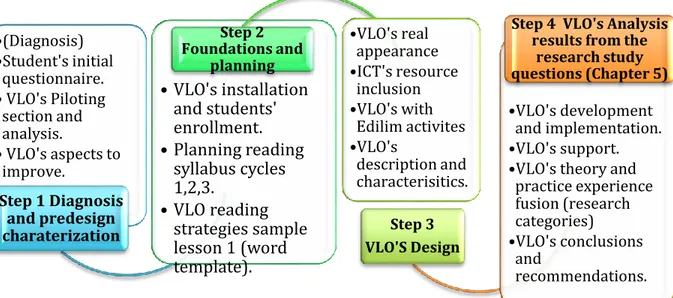
En el capítulo 4, se presenta el diseño pedagógico instruccional y tecnológico del proyecto. Primero se describe detalladamente el modelo pedagógico utilizado y luego se explica el paso a paso del diseño de los sílabos de lecturas integrados en tres ciclos para crear e implementar el Objeto Virtual de Aprendizaje (OVA).También se presentan los pasos para el diseño tecnológico del VLO, a saber, paso 1, diagnóstico por parte de los estudiantes sobre sus consideraciones en torno a la lectura, uso previo de herramientas virtuales y pre-diseño del VLO. Paso 2,
fundamentos y planeación del VLO. Paso 3, diseño del VLO y paso 4, análisis de la
implementación del VLO, sustentación y resultados. Se describe el proceso de instalación del VLO con en el espacio y link facilitado por la Universidad Pedagógica de Nacional,
itaemoodle.pedagogica.edu.co. Luego se ilustra el proceso para matricular a los estudiantes al VLO. Finalmente, se muestra la transición del sílabo del formato en el documento de Microsoft Word al formato digital del programa EDILIM free software, usando el ciclo de lectura No.1 y la lección número 1 como ejemplo.
En el capítulo 5, se presenta el análisis de los datos y los hallazgos de la investigación. Primero se incluye una descripción de la estrategia empleada y perspectiva teórica que se utilizó para el análisis de los datos. Luego se describe de manera detallada el proceso de categorización: identificación de categorías y sub-categorías de acuerdo con las opiniones y respuestas de los participantes.
En el capítulo 6, finalmente se discuten las conclusiones para cada pregunta de investigación, basadas en los resultados obtenidos.
5. Metodología
La investigación presentada en esta tesis de grado se desarrolló en cuatro (7) etapas: Reflexión sobre el proceso de comprensión lectora y enseñanza de estrategias de lectura aplicadas al inglés para propósitos específicos; lo cual implicó la selección de un modelo de lectura que se ajustara a las necesidades del proyecto.
Establecimiento de objetivos y preguntas de investigación.
Diseño Instruccional: selección del modelo pedagógico a utilizar, así como la creación y validación del sílabo del curso, desarrollado en 4 pasos 1) Diagnóstico para el pre- diseño del objeto virtual de aprendizaje, 2) Fundamentación y planeación, 3) Diseño del (OVA), 4) Análisis y resultados complementados en el capítulo 5 del estudio.
Diseño Tecnológico: diseño de cada una de las actividades y herramientas especificadas en el sílabo, incluyendo el diseño gráfico y personalización de la plataforma MOODLE.
5. Implementación de la acción y recolección de datos: corresponde al momento de la
UPN y posteriormente se pidió el consentimiento de los estudiantes que participaron en la investigación.
Se aplicaron dos cuestionarios, uno al comienzo del estudio y otro al final; se realizaron tres entrevistas semi-estructuradas a los participantes, una al final de cada ciclo del proyecto. Por otro lado, se recolectaron las planillas de notas en la plataforma MOODLE y se aplicó un test inicial de comprensión lectora al inicio de la investigación y un test final, al final de la misma.
Finalmente se realizó un análisis de los datos recolectados utilizando el enfoque, identificación de categorías, y respuesta a las preguntas de investigación.
6. Conclusiones
En respuesta a las preguntas de investigación, las siguientes conclusiones surgieron , luego de analizar los resultados hallados y levar a cabo todo el proceso de investigación:
El diseño e implementación del Objeto Virtual de Aprendizaje (VLO) permitió que los estudiantes aprendieran a utilizar las estrategias de lectura para comprender artículos de periódicos y textos en el idioma inglés con propósitos específicos, adquiriendo y complementando a su vez vocabulario tanto académico como técnico relacionado con su profesión, Comunicación Social y Periodismo en la Fundación Universitaria Uninpahu.
Los estudiantes resaltaron los beneficios que tiene el objeto virtual de aprendizaje en relación con el diseño de las actividades y los tres ciclos de lectura por medio de las imágenes, juegos y herramientas virtuales incluidas para favorecer la comprensión de los artículos y temas desarrollados, haciendo énfasis en que no tenían que depender de traductores online, facilitándose así su proceso de lectura. Lo anterior permitió que los estudiantes aumentaran su nivel de comprensión lectora en inglés, teniendo en cuenta los resultados del test inicial, para el que la gran mayoría de los estudiantes tenía dificultades al momento de comprender un artículo en inglés. Una vez finalizada la participación de los estudiantes en VLO journalist readers, estos resultados cambiaron favorablemente mostrando un mayor progreso y mejores resultados de los estudiantes en el test final con notas de bueno y excelente, demostrando que la integración de las estrategias de lectura con las actividades propuestas en el VLO son de gran ayuda para fortalecer el proceso de lectura de los estudiantes.
Revisado por: Nohora Patricia Moreno Garcia.
Fecha de elaboración del
This qualitative research study was conducted under a socio-constructive perspective as a
qualitative descriptive study to characterize, describe and explore student’s perceptions
using a Virtual Learning Object (VLO), through teaching reading strategies for specific
purposes of Social Communication and Journalism students in second semester English
course level 2 at Universidad Uninpahu.15 participants used the virtual tool and integrate
the readings proposed in their professional program showing their experience in the data
collection process through, initial and final test, initial and final questionnaire, an interview,
Moodle’s reports and teacher’s journal. The data analysis showed that participants learned
how to apply reading strategies to read newspapers articles and texts in English language
for specific purposes. Participants highlighted the benefits that a virtual learning object has
with regard to reading activities design, games, images and virtual tools included in the
VLO to strength their understanding when reading articles. The data also showed that
students assumed an active role in order to complement their reading skill that
demonstrated a further progress based on their needs and interests, which the VLO was a
different way of reading and learning developing confidence in their reading process. After
discussing the findings of the research study in the light of theory, the implications and
some considerations for further research are presented.
Tabla de contenido
Introduction ... 20
CHAPTER 1 ... 23
Statement of the problem ... 23
Research Questions ... 25
General objective ... 25
Specific objectives ... 25
Rationale... 25
CHAPTER 2 ... 28
Literature review and theoretical framework ... 28
CHAPTER 3 ... 53
Research design ... 53
Research Paradigm ... 53
Researcher’s Role... 58
Data Collection Instruments and Procedures ... 59
Tests ... 60
Questionnaires ... 61
Interviews ... 63
Virtual Learning Object reports within ITAE Moodle’s services ... 64
CHAPTER 4 ... 69
Virtual learning object instructional pedagogical and technological design ... 69
Pedagogical Model ... 69
Steps for virtual learning object instructional pedagogical and technological
design ... 71
Step 1 Diagnosis and predesign characterization ... 72
VLO’S Piloting section ... 73
... 75
VLO’S Piloting section analysis... 76
Step 2 Foundations and Planning ... 77
... 80
... 80
... 80
... 80
Step 2 Planning ... 81
Step 3 Virtual Learning Object (VLO) Design ... 85
ICT’s resource inclusion ... 87
CHAPTER 5 ... 94
Data analysis and findings ... 94
Procedures for data analysis ... 94
Categories of the analysis ... 95
... 97
Category 1 Virtual Learning Object as an enhancing tool ... 97
Category 2: Perceptions of the implementation and use of the Virtual Learning Object (VLO), complement and opportunities ... 102
Category 3: VLO reading strategies as facilitators in ESP ... 113
Category 4: VLO as a motivational tool towards reading articles in ESP ... 117
Category 5: Virtual Learning Object as a promoter of Independent Learning... 123
CHAPTER 6 ...127
Conclusions and Recommendations ...127
Further Research... 133
...142
Reading 3: If Netflix Is Indeed Insourcing TV Production Then It May Change TV
Forever. ...173
Reading 3: If Netflix Is Indeed Insourcing TV Production Then It May Change TV
Forever. ...173
Appendix 16. Sample Reading Syllabus Cycle 1, 2, and 3 ... 176
Reading cycle 1 ... 176
Reading cycle 2 ... 176
Topic:55 Best Tips for a Successful Magazine Cover
...176
... 177
Reading cycle 3 ... 177
Topic The radio
...177
Why listening to the radio gives us more pleasure than watching TV or using a
laptop ...177
Filmmaker, It's not a job it's a lifestyle... 180
Figure 2 VLO’s Rubric Piloting Section………68
Figure 3 Uploading Users………..………..………..72
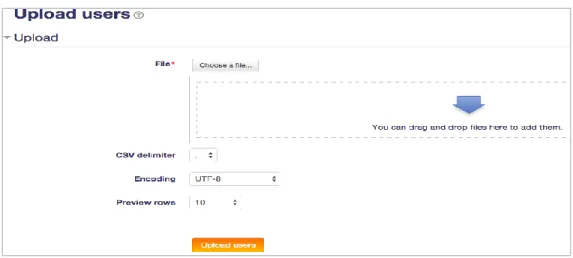
Figure 4 Upload CSV Document………..……….73
Figure 5 Students’ Enrollments in the MOODLE Platform………..73
Figure 6 Teacher’s Profile………74
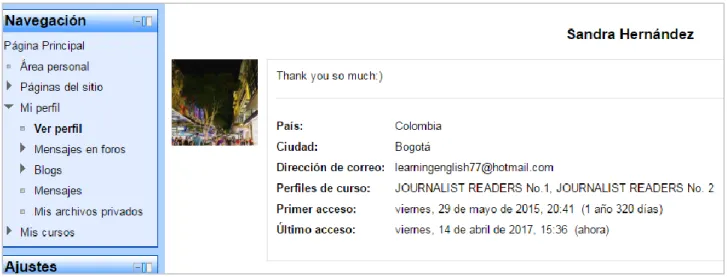
Figure 7 Sample of Student’s Profile…………..………74
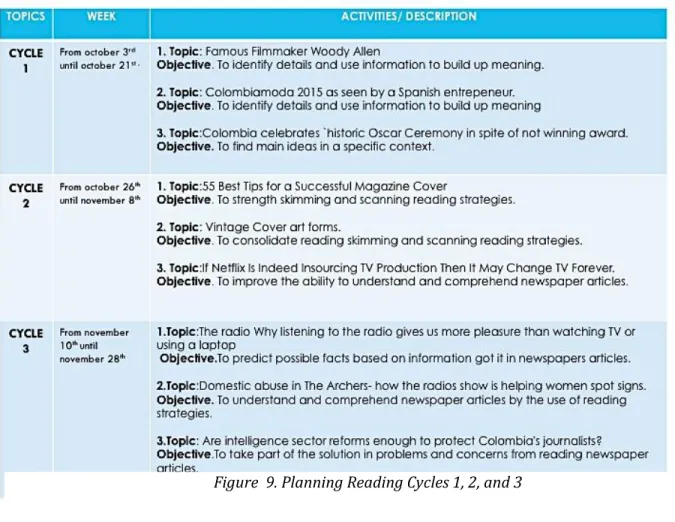
Figure 8 Planning reading cycles 1, 2, and 3……….………...………76
Figure 9 Panel Login ... 83
Figure 10 VLO's Presentation Online ... 83
Figure 11 VLO's Cover ... 84
Figure 12 Sample VLO's Reading Cycles Content and Activities ... 86
Figure 13 VLO's Taps Communication and Help Tools ... 86
Figure 14 VLO’s Evaluation and Progress……….………..87
Graphic 1 Step of Virtual Learning Object Instructional Pedagogical and Technological Design
... 66
Graphic 2 Representation of Categories and Sub-categories Resulting from Data Analysis….91 Graphic 3 Initial Test vs. Final Test ... 111
List of tables
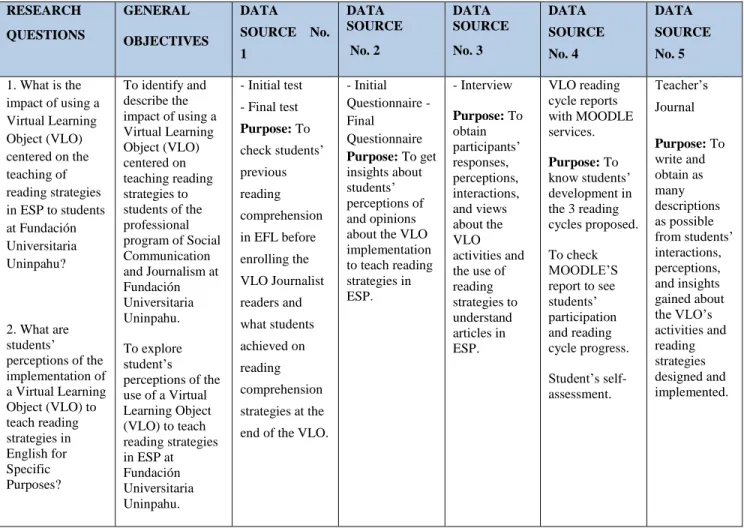
Table 1 Reading Definition Authors ... 31Table 2 Data Collection Matrix ... 54
Table 3 Virtual Learning Object (VLO's) Implementation of Data Instrument ... 62
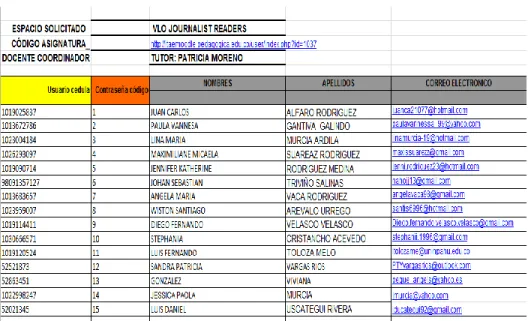
Table 4 CSV Document list………...………72
Table 5 ICTs' Resources ... 86
Table 6 VLO's ICT Resources... 87
Appendix 3 Sample Term Test English 2 Second Semester………. 137
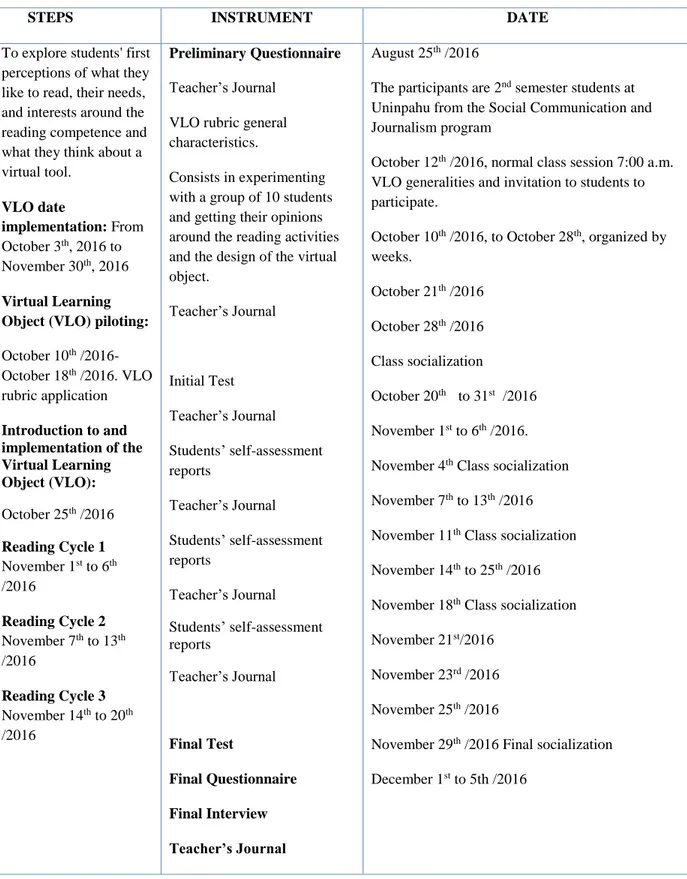
Appendix 4 Virtual Learning Object (VLO) Calendar ... 139
Appendix 5 Initial Test before VLO's students' enrollment………..140
Appendix 6 Initial Questionnaire………..143
Appendix 7 Final Test after students' VLO's participation………146
Appendix 8 Questionnaire after students' VLO's participation……….………151
Appendix 9 VLO Interview……….155
Appendix 10 Sample Teacher's Journal ... 157
Appendix 11 Categories for the analysis... 159
Appendix 12 Questionnaire Question 19 independent analysis ... 165
Appendix 13 Categories for the analysis ... 166
Appendix 14 VLO's Report Self- Assessment and Progress ... 167
Appendix 15 Self-assessemnt reports Cycles 1, 2, and 3 ... 169
Appendix 16 Sample Reading Syllabus Cycle 1, 2, and 3 ... 170
Appendix 17 Sample Reading Cycle 1 Lesson (Word Template)……….171
Appendix 18 Virtual Learning Object Initial and Final Test Analysis ... 175
modalities to complement reading comprehension strategies for English courses in undergraduate students at universities. Nappa and Pandiela (2012), explain the Virtual learning Objects (VLO) web resources bring many benefits for teaching and learning. First, they develop social interaction and reading skills, they encourage independent learning and transfer English content in an
interactive way. Students have the opportunity to communicate, exchange ideas, and work with other classmates through different activities.
Second, Virtual learning Objects (VLO) motivate students to learn and build their self-confidence as the teacher is always there to provide support and resolve students’ concerns because
they allow students to have an individualized instruction and interaction with the teacher. Motivation is also another special component in Virtual learning Objects (VLO) web resources. Osorio, Muñoz, Álvarez and Arévalo (2008), highlight important advantages of web resources that need to be taken into account such as: Accessibility, flexibility, reusability, durability, educability, interactivity, and adaptability, that can be focused on the teaching of reading comprehension strategies to promote learner’s self-confidence, increase learners’ goal-oriented education, create a
pleasant classroom environment, and recognize students’ effort.
I agree with Osorio because in my experience as an English teacher at Fundación Universitaria Uninpahu, I always recognize and reward my students’ efforts and abilities, so that they feel that they are part of a positive atmosphere where they could learn the language and therefore, develop their reading skills in a social community of learning.
This research project follows a qualitative descriptive research study which attempts to describe student’s perceptions about the use and implementation of a Virtual learning Object (VLO)
of using a virtual learning object (VLO) centered on teaching reading strategies.
The use of the (VLO) as proposed by Barraza, (2014) has several advantages in
incorporating interactive and technological tools for ESP reading comprehension strategies. Some of the advantages deal with the development of analysis and reflective strategies, clarifying doubts, and self-assessment. Also, (VLO) virtual learning objects help in generating interests and
motivation , as the tools permanently have accessibility, flexibility, reusability, durability, interoperability, educability, management, generativity, interactivity, and adaptability.
For the development of reading strategies as a process through the use and implementation of the (VLO) in ESP, I situated reading based on the proposal by The RAND Reading study, (2002), as an active and constructive meaning making process following the three macro
CHAPTER 1
Statement of the problem
The insertion of new technologies has arrived thanks to advances in information and virtual tools, which has made the educational context evolve to integrate these into educative environments to encourage teachers to develop innovative pedagogical experiences taking into account students’ needs and interests.
Following the aforementioned ideas, there are established guidelines for learning English as a foreign language and requirements related to the English courses offered by Fundación
As these aspects are essential for keeping integration of English courses at Uninpahu; thus, finding suitable reading strategies to help students comprehend articles with specific purposes seemed to be important, in order to provide them with the necessary tools to comprehend and understand those texts. Therefore, this research study contributed to the construction of knowledge through the implementation of collaborative learning, guided by the teacher during the academic space allocated weekly for the development and use of a Virtual Learning Object (VLO). This object was chosen as the means to carry out the project by using and integrating the EDILIM program, that is a free software with an interactive virtual learning environment called LIM, in which different activities are created, developed, and edited for the creation of virtual learning objects and other technological tools. These tools are meant to aid in developing and understanding newspaper articles with a specific purpose, taking advantage of virtual tools such as time flexibility, easy access from anywhere, anytime, and their support to learning English as a foreign language focused on reading skills, since students are required to read about topics related to the content of their professional program.
Bearing in mind that advances and innovations in teaching and learning English as a Foreign Language are transforming teaching practices in higher education; focusing on student’s needs and interests to provide them with an effective learning experience (Beatty 2010). Therefore, a Virtual Learning Object (VLO) was chosen as the means to carry out this project by using
Research Questions
What are students’ perceptions of the implementation of a Virtual Learning Object (VLO) to teach reading strategies in English for Specific Purposes (ESP)?
What is the impact of using a Virtual Learning Object (VLO) centered on the teaching of reading strategies in ESP to students at Fundación Universitaria Uninpahu?
General objective
To characterize students’ perceptions of the use of Virtual Learning Object (VLO) when teaching reading comprehension strategies for ESP to students of the professional program Social Communication and Journalism at Fundación Universitaria Uninpahu.
Specific objectives
To identify and describe the impact of using a virtual learning object (VLO) centered on the teaching of reading strategies to students of the professional program Social Communication and Journalism at Fundación Universitaria Uninpahu.
To explore students’ perception of the use of a Virtual Learning Object (VLO) to teach reading strategies in ESP at Fundación Universitaria Uninpahu.
Rationale
The development of this research study intended to explore students’ reading
At the moment of this research, Fundación Universitaria Uninpahu implemented its programs in face to face practices and did not take into account other learning and teaching strategies within the technological tools that could give other learning opportunities to those enrolled in the programs. Integrating new methodologies was a challenge that would enable us to see how the uses of Information and Communication Technology (ICTs) could contribute to academic improvement and better outcomes.
In the process of teaching and learning English as a foreign language, it is recommended to provide students with more intensity for the understanding of reading strategies and comprehension because according to the class time at Fundación Universitaria Uninpahu, it was necessary to establish a curricula standard to be consistent with international guidelines for the study of English. This project aimed at implementing an alternative from virtual tools, where students complemented their knowledge through interactive activities, puzzle, games, crosswords, word search, among others, that enabled them to improve their reading process as an essential part of their professional development, where learning and teaching processes take advantage of ICT resources for education.
This research study aimed at taking advantage of a Virtual Learning Object (VLO) tool to strengthen and provide students’ with reading comprehension strategies to cope with difficulties in terms of the appropriation of the concepts and information presented in newspaper articles. Thus, this would allow them to get more confidence when reading an article in English related to their profession. The participants were the main actors of this beneficial educative experience framed by the relations established between technology and education when a high pedagogical emphasis on this project was made to build a (VLO) for journalist readers, based on a teaching and didactic design mediated by technological tools that promoted both independent and collaborative learning. Besides, the VLO was designed under thestructure of social-constructivism, where interaction with others and independent learning represents a new way of learning.
CHAPTER 2
Literature review and theoretical framework
Recent Studies
In the international context Davood J, (2015), carried out a mixed research study with a group of 14 teachers and 4 groups of a total of 60 students at an Iranian Senior High School, whose purposes were to identify students and teacher’s perceptions towards the effects of integrating ICT resources into reading comprehension processes through Computer Assisted Language Learning (CALL) sample reading passages in a multimedia package with a variety of interactive activities such as jigsaws, decision making with graphics and items, word lists matching definitions and meaning in order to increase learning opportunities and check the benefits of using ICT while reading extensively in EFL.
Barraza, J (2014) conducted a qualitative descriptive case study with a group of 26 Spanish speaking students who were mechanical and electrical engineers from the civil mining in Santiago de Chile; their aim was to describe and analyze the effects of the use of interactive, graphic, and technological strategies in the level of English reading comprehension, in order to attain more evidence to support the claim that the use of graphic organizers enhances the level of students’ reading comprehension. To reach this objective, the VirtualLab contained two reading strategy sections; first, reading activities to monitor students’ comprehension through questions. Second, activities with graphic organizers called (GOs) as visual models in order to classify, comprehend, and apply the text information to get main and specific facts. The data collection instruments used in this study were two questionnaires at the beginning and at the end of the implementation and observations during six sessions with the Virtual Lab.
The reading content selected focused on engineering topics from Oxford and Cambridge texts in English for Specific Purposes (ESP). These texts were chosen taking into account students’ needs and interests, as well as reading difficulties such as figuring out unknown words, getting main ideas, and identifying the text structure. The findings of this study showed that most of the students agreed that they took advantage of the use of the VirtualLab USACH reading activities described in four relevant aspects: Their reading learning experience, reading strategies, overall reading
effectiveness, and the advantage of using interactive activities and graphic reading organizers as an enjoyable and practical learning experience.
The data obtained came from the use of personal blogs, thematic wikis, social forums, and debates which showed that students explored specific topics in a web space provided and a blog used for a weekly debate. Based on this, the teacher-researchers found three main relevant aspects in this study: First, learners integrated their perspectives about their own culture comparing and sharing their own and foreign lifestyles among Colombians and Canadians, while using the target language for regular communication. Second, teachers focused on pedagogical activities that allowed students to have a space to meet and interact taking into account countries time schedules.
Third, through students meetings and virtual interactions consolidated a community promoting collaborative and democratic participation language environment. I took into account this study planned in two different countries and monitoring a Virtual Forum to describe and analyze student’s perceptions exchanging cultural stories integrating reading activities and
vocabulary consolidation which is relevant to this research project because was highlighted the importance of vocabulary interactive activities such as puzzles, word search and images matching to increase reading comprehension facilitating extracting meaning from leaners reading process in the given context. Additionally, this study shows the interactional implications displayed between students from the two different countries entailing collaborative work and democratic participation building interactional and academic spaces.
These three research studies included a variety of issues to complement this research project for three main reasons. First, the teacher’s researchers from previous studies explained that the
academic texts better and get self-confidence in their reading performance, motivating themselves to foster their English language skills.
In the Colombian context, research studies have been carried out in relation to the use of virtual tools in the EFL classroom. One of them is Osorno and Lopera (2012), who used a Web-based reading comprehension course in order to facilitate and analyze a group of 21 first semester students of a specialization program in Law at Universidad de Antioquia in Medellín, Colombia. The researcher’s purposes were to implement the web-based reading course which consisted of interactive activities and exercises around reading strategies such as prediction, skimming,
scanning; and graph interpretation. These allowed students to interact with the web-based friendly environment through selective reading activities that improved their reading skills. Participants took 120-hours in reading sessions in the academic space Moodle and they followed the planning
The data were gathered through the use of questionnaires, observations, in-depth interviews, a teacher’s journal, focus groups, and tools that the MOODLE includes. The advantages presented were
that students had an active interaction and learned with the reading activities and they were able to apply reading strategies to identify main ideas, distinguish fact and opinion, summarize texts, recognize relations of comparisons and contrast, cause and effect information, and they understood in a better way the topics related to law, as a key factor to gain mastery in their reading process. On the opposite side, students mentioned that the exercises and workshops were very long with the need of having deadline extension and time as a constant concern to complete the activities proposed.
To sum up, in order to comprehend the way virtual tools work, this study is useful to my research project because it shed interesting light into the role of interaction in a web-based EFL reading
comprehension course, in order to provide students with a variety of reading benefits such as: Interactive reading activities to identify main ideas, relationships of comparison and contrast in a text, language improvement, an individualized guide process, a friendly environment with virtual tools , time flexibility, and the advantages of different teacher’s role; in turn, all of this promotes more interaction and
participation among students in order to have academic dialogues around topics related to their needs and interests.
A second research study was conducted by Flórez E, Pineda J, and Marín N, (2012), with a group of 38 graduate students between 23 and 44 years old at the School of Languages at Universidad de
Antioquia in Medellín, Colombia with limited experience in web-based courses. The aim was to explore student’s perceptions of distance-based learning on reading skills. Since the University implemented the
certification requirement of foreign language proficiency tests, teachers considered the need of designing a web-based reading activities modality to complement students’ test needs specifically in reading comprehension skills. The data were gathered based on a descriptive and exploratory case-study and two semi-structured interviews were planned in order to include questions that emerged during the
by participants was in Spanish, to make sure students answered the questions clearly sharing their perception and opinion towards the reading course.
Two main relevant aspects were found through this study. First, this proposal was a bridge for teachers to be familiar with technological reading activities, bearing in mind students’ performance, the level of achievement of their goals in relation to the course objectives, the content, and the incorporation of ICT. Second, this study provided a new learning experience that focused on reading comprehension skills, along with the implementation of reading strategies; thus, participants’ perceptions remained before, during, and after the reading to understand different topics and develop a different teaching and learning pedagogical practice.
Arias (2012), conducted a research study on the perceptions, feelings, and challenges that students have regarding English activities supported by Web 2.0 tools: Blogs, podcasts, and wikis about the professional development of EFL of a group of future English teachers. A group of 18 sixth semester students from the B.A Spanish and Foreign languages program at Universidad Pedagógica Nacional participated in a mixed method research study. Along with the interviews, an oral pre-test, a written post-test, and students’ blogs and podcasts were applied as a relevant part of the data obtained. Among the findings, researchers could identify three relevant aspects: First, in relation to the pedagogical aspect, participants knew the benefits that Web 2.0 has in terms of providing different virtual tools to support students’ learning, increasing their motivation, allowing innovation in the activities, and getting more
Theoretical Framework
This section deals with the theoretical background of the present study, which includes the following four main constructs: A Virtual Learning Object to teach reading strategies in English for Specific Purposes ESP, reading comprehension strategies as a process and its processes before, during, and after the reading, implementation of ICTs into the reading process in ESP, and the design of a Virtual Learning Object within the reading process in ESP.
Virtual Learning Object (VLO) to teach reading strategies
A Virtual Learning Object (VLO) is defined in the portal Colombia Aprende (Colombia Aprende, 2015), “As a virtual learning and pedagogical mediator intentionally designed for a learning purpose and
serves players in the various educational modalities. It is integrated into all structured material in a significative form, associated with an educative objective which corresponds to a digital character resource that can be distributed and consulted through the Internet.” It is complemented by Wiley (2001), who explains that Virtual Learning Objects (VLO) allow the transit of learning models, based on the construction of knowledge as an architecture that permits the implementation ofan Intelligent
Teaching-LearningEnvironment, which in turn actas an useful tool,eachwithits objectives,
intentionsplansandmutuallyinteract, learn and propose their ideas through the use of different
technological tools that are integrated in the VLO.
Barraza, (2014) suggests some advantages of incorporating interactive and technological strategies for ESP reading comprehension. First, they encourage independent learning, developing analysis and reflection, clarifying doubts, transferring content, all of which can be used as control
Another great advantage is that students have an individual interaction with the teacher to reinforce and implement the concepts studied in class, and to review and play in such a way to generate interest in the subject and metacognitive abilities.
As Wiley (2001) asserts, (VLO) not only engage students in learning, but they also help them to expand the cognitive skills that they use to understand, select, organize, develop, and interpret the information they find in the VLO web resource and the metacognitive skills that allow students to regulate their own learning process, through which they develop and carry out tasks in three dimensions. First, the size of reflection, where the subject recognizes and evaluates his/her own metacognitive structures, methodological possibilities, processes, skills, and disadvantages. Second, the dimension where the student is aware of his/her performance and applies his/her previous knowledge to solve the task. Third, the dimension of assessment where students value the strategies used for the solution of tasks and the degree to which they meet their goals. It this way students can apply different reading strategies through the use of a VLO and develop metacognitive habits in which they learn how to assess and regulate the EFL process.
Additionally, according to Delmoral and Cernea (2005), who explain that the nature of a VLO and web resources comes from social constructivism, as their main core theory. It consists on the idea that students learn better when they work in groups and when they are engaged in a social process, as learners negotiate meaning and exchange ideas to construct knowledge. In this sense, offering the opportunity to teachers and students to interact and work collaboratively and providing constructive feedback to each other, there is a sense of community between them and a vital participatory role with the possibility to cover a wider learning-teaching spectrum than the conventional learning-teaching in the classroom.
designed to meet specific needs and interests in a group of learners challenged to comprehend different types of texts in EFL for their professional programs. Besides, students have the opportunity to achieve objectives in collaboration with others, rather than studying on their own; making their learning experience more effective and efficient as teachers apply the complementary tools provided. Finally, VLO as a pedagogical mediator associated with teachers and students’ collaboration, provides a better learning experience in a vital participatory role when there is support and interaction in learning reading strategies in EFL related to content, language activities, and feedback.
Reading comprehension strategies as a process
Reading comprehension strategies can be understood in several ways. One of them, is as a constructive meaning-making process that is defined broadly as the process of constructing a supportable understanding of a text. In this brief definition, there are two important features of the comprehension process. First, seeking to comprehend a text is an active, intentional thinking process through which the reader constructs meaning, Neufeld, P. (2005). Second, while students’ understanding of a text happens, this understanding varies as a result of their background knowledge and experiences; thus, the reader extracts and constructs meaning through interaction and involvement with written language.
Reading is considered by some authors as “An interactive problem-solving process of making meaning from texts” Hughes (2004); for other researchers, it implies the interaction between the text, the readers,
and the purpose of the reading for itself and for some others, it is a dialogue between the text and the reader. It means that this concept implies an agreement with the previous knowledge and the experiences of readers connected with the social and cultural context; in Huldenson’s words (1994), reading means:
It means that reading is a mental process that involves the reader’s acting through the
interpretation of the text and this understanding depends on the background of a person and the purpose of the reading.
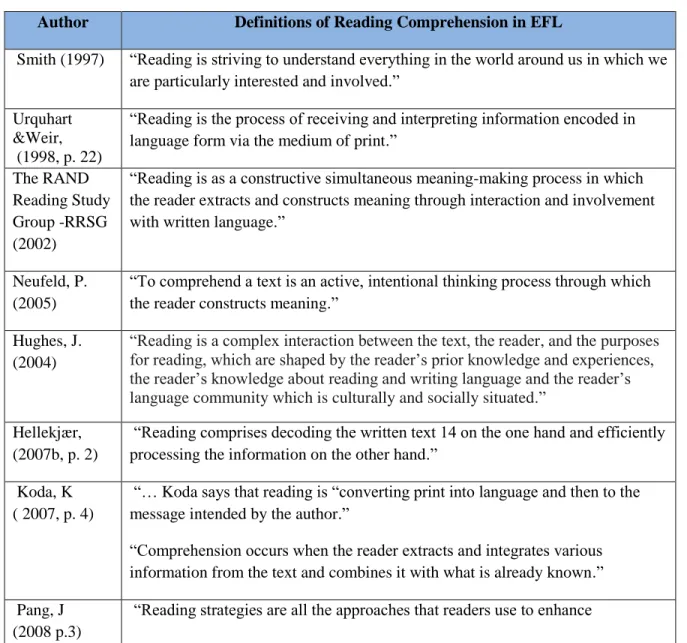
Reading comprehension has been an important issue beyond the field of education, which has gained relevance in the field of language education in the last decades. In order to approach the concept of reading, I consider relevant to see what a variety of researchers have said. To this respect, I present a compilation of some of the most relevant definitions to the present study:
Table 1. Reading Definition Authors
Author Definitions of Reading Comprehension in EFL
Smith (1997) “Reading is striving to understand everything in the world around us in which we are particularly interested and involved.”
Urquhart &Weir, (1998, p. 22)
“Reading is the process of receiving and interpreting information encoded in language form via the medium of print.”
The RAND Reading Study Group -RRSG (2002)
“Reading is as a constructive simultaneous meaning-making process in which the reader extracts and constructs meaning through interaction and involvement with written language.”
Neufeld, P. (2005)
“To comprehend a text is an active, intentional thinking process through which the reader constructs meaning.”
Hughes, J. (2004)
“Reading is a complex interaction between the text, the reader, and the purposes for reading, which are shaped by the reader’s prior knowledge and experiences, the reader’s knowledge about reading and writing language and the reader’s language community which is culturally and socially situated.”
Hellekjær, (2007b, p. 2)
“Reading comprises decoding the written text 14 on the one hand and efficiently processing the information on the other hand.”
Koda, K ( 2007, p. 4)
“… Koda says that reading is “converting print into language and then to the message intended by the author.”
“Comprehension occurs when the reader extracts and integrates various information from the text and combines it with what is already known.” Pang, J
(2008 p.3)
understanding.” Grabe, W
(2009, p. 14)
Suggests and explains a list of processes that define reading, all of these processes that are integrated in the art of reading
1. A rapid process 2. An efficient process 3. A comprehending process 4. An interactive process 5. A strategic process 6. A flexible process 7. A purposeful process 8. An evaluative process 9. A learning process 10. A linguistic process.
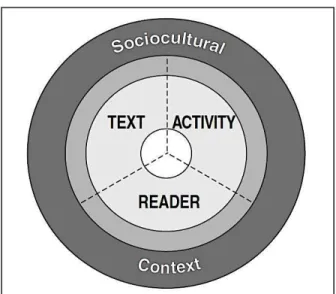
As it is mentioned above, reading is a mental process that involves the reader’s interpretation; reading comprehension is the act of understanding what we read and that process occurs before, during, and after a person reads a written text or visual information, among others. The readers engage in a cognitive simultaneous process in which they extract and construct meaning through interaction and involvement with written language. The construction of meaning entails both participation and transaction among three main elements: reader, text, and activity. These three elements are situated within a socio-cultural context that shapes students’ experiences, socio-cultural practices, and background knowledge. Besides, the learners bring diverse social-cultural identities to their own reading comprehension process to
interpret information and create a personal meaning, RAND Reading Study Group RRSG (2002), it is an Educational Department in the U.S. that focused on developing a proposal for a research agenda on reading comprehension and literacy; this research project follows its proposal of reading model.
One of the most recognized processes of reading is when students need to know how toproceed in order to develop an optimal reading comprehension of a text. For this reason, it is essential to allow students to develop the appropriate reading strategies to better understand a text. This process appears as an answer that facilitates the connection between the reader, the text, and the activity according to RAND study (2002); this reading process changes through different micro-developmental processes called pre-reading, during-pre-reading, and post-reading which shows the transition of what the reader brings to reading and what the reader takes from reading.
out of the world and learning more about it.” However, it is very demanding because it is not as easy as the process of understanding what we found in a text. Having good comprehension without looking up the dictionary or plunging into the reading in case the information was difficult to comprehend, implies to make a decision for solving the possible problems that appear when a student is reading a text.
According to RRSG (2002) reading is presented in a heuristic comprehension process by
describing three micro developmental processes: pre-reading, during reading, and after reading because of the following reasons: First of all, the variety of reading strategies that the model offers allows students to become active, purposeful readers able to monitor their own reading comprehension process. For
instance, when students interact with the text, they recognize new vocabulary, organize and evaluate information, and establish connections with their own socio-cultural context shaping their background knowledge. A second reason is that reading strategies can be integrated with ICT to help learners
understand specialized articles and texts in ESP. Each micro-developmental process element interweaves and integrates the reading elements: The reader, the text, and the activity, interacting permanently with the others; however, when analyzing them in single units, the dynamics of each one can be better understood though the following information.
The reading strategies model contributes directly to learning and use of the language; in addition, it is carried out at the same time with the reading process and it is categorized into three micro-period groups: Pre-reading, during, and after reading. RAND study (2002) researchers suggest the micro-period reading strategies bring another beneficial factor to strengthen readers’ skills such as: Memory challenges, that work with the intention to retrieve information and help to build up learning in a long or a short- term memory, according to the person. The second, the cognitive processes, which help people to obtain the ability to learn concepts, definitions, techniques, procedures; in fact, it is the one that proves and
demonstrates how much a student knows about a specific topic or subject to use linguistics or other clues for adjusting or approximating messages.
The theory proposed relies on its assertion that reading is a process of interaction of different dimensions of text organization and social process which are involved in the text meaning construction, as is
represented in the following figure:
)
Reading comprehension processes before, during, and after reading
Before reading
Readers activate background knowledgeto thinkabout the topic and use the cultural information to interpret the text, to later interact with it to confirm or support what the participant’s previous
knowledge of the topic was. In this micro-period students give a general idea of the text and teachers introduce the topic and motivate students to read. The function of these activities is to activate and build up new schemata and reading activities help them to have a better comprehension of the text. Then the comprehension stage starts in their minds and continues growing according to their experiences and knowledge, and little by little readers construct meaning in response to the text; also in the top down process, students are the ones who decide what to retain and what not to, or just go on. In this part students apply their cognitive styles in the text; that means that they employ intelligence and experience for understanding it.
However, the RAND study presents its model based on three premises: The reader, the text, and the activity. The development of these premises has its foundations in the articulations with the micro-developmental reading processes before the reading, during the reading, and after the reading. The reader connects the lexical aspects, the verbs, the situation or the actions presented in the articles to locate the events in time and information. In that way, teachers should help students guiding them with a general topic and directing them towards proper schemata of extracting information, where they can
accommodate relevant linguistic knowledge of it, it means that teachers consider schemata not only as a cognitive construct but also as a social psychological one, in which mental organization is involved and it is attached to particular values and attitudes to the knowledge students have. Neufeld (2005) explains it in other words, “students must be familiarized with the discourse and linguistic aspects in a text and the
be an obstacle for understanding a reading and comprehension is affected or when they are not familiar with the reading context.
RAND study researchers (2002) recommend to develop the process of reading before it begins because it is more effective; similarly, it is convenient to deal with the text in short or single sections, but not with the complete text. Teachers should help students face unknown words and contextualize them with the reading, giving them examples that can be associated with the text presented in order to better comprehend the passage.
Hence, Reading Study Group -RRSG (2002), explains that at this stage the reader, the text, and the activity are connected and there is variability in the reader’s performance in terms of their capabilities and dispositions toward reading. This variability is presented based on readers’ differences such as fluency in word recognition, oral language ability, goals, and purposes. These variables interact among them and with the type of text to which the reader is exposed to, and later, they are used as determinants to measure the reader’s performance in a given reading task to build his/her prior linguistic knowledge. RAND researchers say that a reading text provides opportunities to encourage the development of the student’s speaking ability and the use of study topics such as grammar, vocabulary, paragraph structure,
and so on. Additionally, variability in readers also depends on the socio-cultural context students interact with and read. For instance, Gee(2008) claims that students construct their identities as readers through their ways of behaving, interacting, valuing, thinking, believing, and reading; thus, this is due to students as a part of a cultural community in which they learn how to read.
reading comprehension process to develop, engage, and check students’ performance, as they are immersed in a culture with specific traits regarding the reading process, which permeates the means, the motivations, and the outcomes of the reading experience.
During reading:
Readers monitor their comprehension byquestioning their understanding and reflecting upon main ideas and information about the general topic. In addition, they make predictions to find the possible meanings of the text and they also paraphrase the text while reading. Furthermore, readers use the
skimming and scanning strategies to preview the text. RAND study researchers (2002) state that skimming is done to get a general idea of the text, as a quick look over a reading to get general
information and it helps students to identify what the text is about, what kind of information is included, and its organization, even though it requires a good reading competence. On the other hand, scanning is done to look for specific information within the text, to have a general impression of it. Through the use of these reading strategies, readers also identify key words or vocabulary pertinent to comprehension, where they can improve their speed in reading and teachers should teach them to identify the relevant information to their purpose, in order to provide worthy tools for students to improve their reading comprehension. In my research study, the use of reading strategies was essential because students needed to know and be able to use them in their practice.
The RAND Reading Study Group -RRSG (2002) highlights the second premise that is the text. The authors argue that the new nature of literacy is changing due to the incorporation of the electronic text in different online learning environments. Therefore, the authors have broadened the definition of the text by claiming that the electronic text has brought new challenges and advantages to the reading
Regarding how to present texts to readers in a more interactive way to facilitate the reading comprehension process, there are important aspects to take into account. First, the VLO offers readers support when they interact with complex texts, by providing specialized glossary with clear definitions of words as well as visual illustrations through videos, games, visual tools, and helpful links. The inclusion of these kinds of interactive texts is considered a key part of the during the reading micro-period process, because students start to classify types of vocabulary or groups of words with a meaning that they have to learn as a whole. In this part, it is necessary to teach students that some words are joined with others and that the meanings can change in different ways, when they are non-isolated like compound words, phrasal verbs, verbs with prepositions, and others. The idea is to teach them to identify relevant words and ignore the irrelevant ones, as the scanning reading strategy, in order not to spend time, and get far from the real comprehension of the text following reading strategies.
about the topic of the text, to talk about its possible development and introduce the use of key words on it.”
Moreover, the RAND Reading Study Group -RRSG (2002), explains that there is variability in the text when creating and designing reading lessons or courses. The authors argue that it is important to understand that texts have different categories and dimensions. These include texts with varying degrees of engagement for a particular type of readers, discourse genre, discourse structure, media forms such as interactive and virtual tool forms to understand in a more dynamic way vocabulary- syntax and content, understood as an age-appropriate selection of subject matter and cultural practices. Therefore, teachers need to consider these categories when assigning texts to specific readers, since it is essential to balance strategically students’ interest in the subject matter, help them with particular challenges to achieve the pedagogical goals of the lessons, and understand texts.
After reading:
It is relevant to consider the reading process that this research study mainly relies on; namely, the student’s needs and interests with the VLO’s activity integration for the use of reading strategies and the
enhancement of the comprehension of newspaper articles and texts. The feelings, points of view,
and identify key vocabulary for the construction of the reading comprehension process, in which the vocabulary presented in the article or text shapes students’ understanding of the text. For these reasons, it is necessary to develop different reading strategies to complement reading comprehension gradually with an involvement process adapted to the students’ needs and interests.
In the same way, it is important to mention that the reading strategies selected for my research project were useful, as in the activities proposed there was an integration of memory, metacognitive, and compensation strategies. Students made associations by placing new words, using images, mind maps, word search activities, and puzzles among others, using key words. Thus, through a variety of reading activities students were able to practice and reinforce the topics presented recognizing, repeating reading
Strategies and patterns, getting the idea quickly, skimming and scanning, transferring, and using some compensation strategies, such as using linguistic and other clues and adjusting or approximating to text messages. All of these strategies were applied with the proper instruction to allow students to recognize them and at the same time, with the use and application of them, to improve their reading comprehension in the reading of their favorite news articles selected.
The RRSG researchers (2002) suggest that after teaching reading strategies, they found relevant benefits. First, reading strategies can be developed by establishing the difference between the skimming and scanning reading strategies, where students have to identify lots of linguistic signals and use them in their reading process, as a mechanism to implement some kind of order on these signals. RAND study proposal (2002) considers this is required to construct meaning in a text integrating the
micro-developmental processes before, during, and after the reading moments connected with the reader, the text, and the activity because they are effective techniques for activating the schemata and the relationship of reading as a process.
on information, knowledge, emotions, experiences, and culture; in other words, the schemata faces participants’ real world. This depends on the efficient interaction between linguistic knowledge and knowledge of the world, considering two aspects: Content schemata and formal schemata. The first one includes what we know about the world and the second one consists of our knowledge about discourse structure; thus, the information students are going to read, has been arranged in their memories in order to fulfill their expectations. In other words, they will be likely to remember facts that they really learned.
I have presented some of the most relevant contributions of theory to reading strategies as a process, following the RAND study work, and reading as an active constructive meaning-making process in which the construction of meaning entails the micro-developmental reading strategies before, during, and after reading and the three dimensions: The reader, the text, and the activity, which are a combination of students’ experiences and beliefs. These help them to support the background content area presented in a text and to integrate other elements in the process of reading, highlighted in the RAND study (2002) model. An example of these are schemas, which help readers to organize the language and to predict what will happen next, due to the fact that once students read the first part of a text, they activate their reading schemata. Then, when they continue reading, students confirm if the activation was right or not; if it is wrong, it is necessary to adjust the information with the teacher’s help.
Finally, I would like to highlight that after applying reading strategies, readers change their reading procedure becausethey expand and evaluate their understanding of the text in a more critical way, relating it to their own life experiences and socio-cultural context. Apart from that, the reader summarizes and discusses characteristics of the text with teachers and classmates. Comprehending a text also comprises a macro-developmental process that shows how readers mature and advance through reading, including their strengths, cognitive development, and the experience gained by interacting with more complex texts while taking advantage from instruction and reading activities developed.
reading comprehension is done for a purpose in order to achieve an objective. Therefore, a reading activity should include three main parts; first, purpose, second, process, and third, consequences. Firstly, the purpose of a reading activity is influenced by the interest and prior knowledge of the reader; this can change as students interact with the text because they may encounter questions or information that can make the initial purpose incomplete or irrelevant. Moreover, when teachers direct the purpose for example, reading the paragraphs and completing the exercises, readers can accept it and try to address it; but if the purpose seems irrelevant or not interesting to them, this might lead to an unsuccessful reading comprehension where readers may not read purposively.
To sum up, reading comprehension strategies, as a process, involve a systematic series of operations to go over the text; some of these are decoding, linguistic level understanding through visual aids and interactive activities, semantic processing, and monitoring. At this point, readers have gained and increased their knowledge about a certain topic or subject when they interact with the text and apply reading strategies related to their goals and how she/he learns to them appropriately, it describes the reading process despite the reader’s motivation and what his/her act of reading is like when using their skills to understand a text. Reading strategies complement the reading comprehension heuristic activity, which is carried out within the socio cultural environment where students live and learn to read.
Additionally, the authors of the RAND study highlight the importance of literacy as a social activity; they claim that reading comprehension has been viewed as a part of cultural and historical activities, not only because it is acquired through social interactions, but also because it represents how a specific cultural group interprets the world and transmits information which will eventually determine the overall reading experience.
Implementation of ICTs into the reading process of English for Specific Purposes (ESP)