
TítuloGive me liberty or give me money: the fiscal decentralization and autonomy of regional governance in Slovakia
14
0
0
Texto completo
(2) Jaroslav Mihálik et al. / European Journal of Government and Economics 8(1), 96-109.. characterized by the fact that there is a level represented by the districts alongside with the local and regional levels or provinces. Multi-level systems of territorial self-government are present, for example also in France, the United Kingdom and other European countries. In addition to the most important self-governing level organized within cities and municipalities, gradual development also led to an increase in the importance of a second level of territorial selfgovernment, which is the regional tier. As Loughlin, Hendriks and Lidström (2011) argue, the world has been modified since the 20th century which was typical mainly by the dominant interest in national sovereignty and centralized governments. The current period is characterized by new systems of governance strengthening the role of sub-national levels of public policymaking as well as the relationship of representation and collective self-determination. In this regard, the effectiveness and democratic aspect of policymaking in multi-level governance have attained specific and very important status in the political arrangements of most European countries and have led into deep restructuralization of the regional and local governments. Such trends may be observed across multiple European countries and according to authors (Sturm – Dieringer, 2005), the decentralization and regionalization tendencies are present in all European countries during the last decades. Deriving from this, it is evident that this process is currently not only from the Slovak perspective but is more of a global and standard feature. In the Slovak perspective, the discussion about the regional governance is generally limited to arguments about improper areas and sizes of individual self-governing regions specifically due to historical and natural reasons (Nižňanský, 2005; Klimovský, 2006; Sloboda, 2006; Machyniak, 2013; Nižňanský and Hamalová, 2013; Mikuš, 2014). According to Šteiner and Kozlayová (2010) the major problem of regional governance is not vested only in numbers and spatial issues but a more relevant aspect – the competention area. They point out, in particular, the low-level use of regional development instruments, either in the area of policy-making or cooperation with other actors at this level, while also presenting recommendations for improving the management of regional development. Some authors are concerned with partial problems in the form of funding and regional differences in their studies (Sloboda, 2006; Fabianová, 2010; Bobáková, 2015). A recent analysis made by the International Monetary Fund (Caselli and Ralyea, 2017) stipulates that Slovakia has one of the highest regional disparities among OECD and EU countries. The authors argue that although the country has received significant EU transfers devoted mainly to foster regional convergence, the absorption of EU funding during the 20072013 period has been greatly delayed. Yet they agree that a greater degree of fiscal decentralization helps increase the rate of EU funds absorption. This is much in line with our presented research on the fiscal decentralization in Slovakia which brings forward the issue of regional budgeting dependency on state budget allocation and transfers established from the central government. Although regional governments are responsible, pursuant to law, for the comprehensive integrative development of the respective region, their own direct impact over the economic, social and environmental development is substantially low. While the competences decentralization process reflects the subsidiarity principle of administrative units, fiscal decentralization has become a vital point of discussion due to its measures and limits.. 97.
(3) Jaroslav Mihálik et al. / European Journal of Government and Economics 8(1), 96-109.. In our research, we argue that fiscal decentralization and financial autonomy of Slovak regions cannot be accomplished based on the empirical findings which demonstrate the high levels of financial dependence of the regions multiplied by the effects of recent changes in the composition of the regional budget. The research study is conducted as a case study informing about the regional fiscal decentralization and autonomy in Slovakia. We analyze and develop the approaches, legal norms and practice of fiscal decentralization while considering the criteria of financial transfers from the central government. Particularly, we focus on the developments in fiscal decentralization together with the recent changes in budget allocations to regional governments which came into force in 2014. This had caused the change in nature of the research rationale from measuring the regional fiscal autonomy to fiscal dependence. The data collection reflects the time periods from the beginning of the process of fiscal decentralization in 2005 until the recently available final balance sheets of the 8 regional territorial units in 2016.. 2. An overview of the regional self-government financing in Slovakia. To be able to talk about functional regional self-government, it is essential it manages sufficient financial resources. In terms of the Slovak Republic, the framework of regional financing has undergone continuous changes. These are made through legal norms determining the financial rules applicable on the regional level. There is a full spectrum of legislative acts involving the financial distribution and transfers allocation while it has been outlined in Article 65 of the Constitution. It is to be noted that financial resources should cover the performance of transferred as well as original competences (Sivák et al., 2007). This requirement, apparently, has not been fulfilled which according to our research has direct impact on the creation of the financial framework of the regional self-governments. This principle of financial responsibility which is based on the shift of responsibility in lowerlevel decision-making to the provision of public goods and services and their funding is also highlighted by Litvack and Seddon (1999). According to them, if a local or regional government has a good capacity to fulfil its functions and tasks, it must have an adequate own income or income from the central government, as well as the power to decide on its use. The very same article of the Constitution defines that self-governing region (also known as Higher Territorial Unit - HTU) as a legal entity that, under the conditions stipulated by law independently manages its own assets and financial means (Article 65, Constitution of the Slovak Republic). The financing of the HTU is based mainly on own revenues and state subsidies while the law determines which taxes and fees create the income. The funding base of the HTU is budget prepared for a period of one marketing year (Tej, 2007).. Self-governing regions draw up and approve the budget broken down into the current, capital budget and financial operations. This is an important document in which the HTU has the duty to ensure fulfilment of all obligations under specific regulations. The budget creates the main means. 98.
(4) Jaroslav Mihálik et al. / European Journal of Government and Economics 8(1), 96-109.. of financial management of self-governing regions and financing the tasks and functions of selfgoverning regions. In the reporting process, a key role is played by the final balance sheet alongside the budget. Since its existence, the structure of regional self-government revenue has undergone several modifications. In the short period after the establishment of the second level of territorial selfgovernment, the method of its financing was based on the principle of close interdependence with the central level, which provided municipalities with funds in the form of special grants. Since 2005, regional governments have a higher degree of financial autonomy when they can independently decide on the use of tax revenue (Cíbik, 2014) which consists of a share tax or a personal income tax and, until 2014, a tax on motor vehicles. The share of personal income tax is the most significant item of municipalities in terms of their income and currently the only tax revenue of self-governing regions. This tax is levied by the state, which distributes it to individual self-governing regions on the basis of the criteria set out in Figure 1.. Figure 1. Criteria determining the reallocation of funds from the state budget to HTUs. Source: Government Regulation no. 668/2004 Coll. About the distribution of revenue from the income tax of the territorial self-government. The system of financing introduced in 2005 was based on fixed criteria according to which the personal income tax is distributed among individual municipalities, cities and self-governing regions and becomes their own income. Another major part of the revenues was the tax on motor vehicles, which was actually the own income of self-governing regions. The amendment to the Act on Taxes from Motor Vehicles of August 2014 has a change in this section, which came into force on 1 January 2015 and from that date does not include this tax in the tax revenue portfolio of self-governing regions. The higher degree of financial autonomy of self-governing regions was manifested not only in the fact that the regional authorities could decide on the actual amount of the motor vehicle tax but also on whether the tax applied by the legislator would be imposed on the territory of the self-governing region. As a result of these steps, the responsibility of local self-. 99.
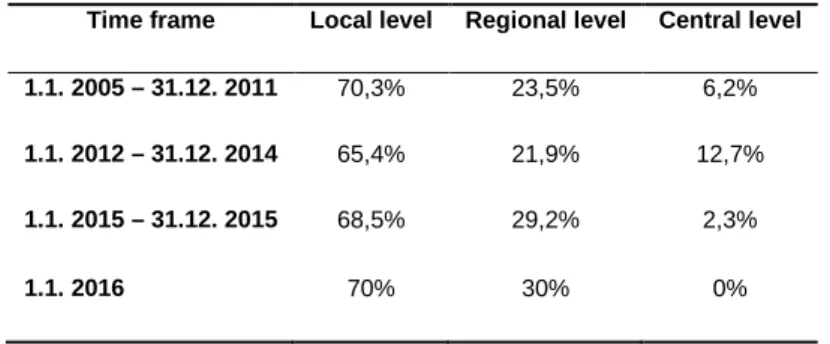
(5) Jaroslav Mihálik et al. / European Journal of Government and Economics 8(1), 96-109.. government for the management and development of individual regions (Čavojec and Sloboda, 2005) was increased in comparison to the period 2002 – 2004. The facultative nature of the taxes that the self-governing regions enjoyed since 2005, in particular, the tax on motor vehicles, is reflected in an increase in the tax powers of self-governing regions and, ultimately, as one of the objectives of fiscal decentralization. Yet another change in financing has been introduced by fiscal decentralization – share tax and income tax revenue. The income tax of persons has so far gone through several changes, the overview of which is shown in Table 1. In the period 2005 to 2011, the self-governing region was allocated a share of 23.5% of the total amount of this tax (Act No. 564/2004 Coll., §3). The remainder is further distributed among municipalities, cities and the state. Since 2012, the fiscal decentralization system has determined that the total amount of income tax belongs to the selfgoverning region, with a yield of 21.9%. At time there was a change when part of the income tax was transferred to the state. The share of self-governing regions in the personal income tax thus decreased by 1.6% compared to the previous period. At the beginning of 2015, there was a further change in the proportion of income tax revenue for self-governing regions from 21.9% to 29.2%. This substantial increase in the percentage is due to a change in the fiscal system, the essence of which is to compensate for the fact that the State has taken over the self-government of their own income from the tax on motor vehicles.. Table 1. The distribution of income tax since 2005 in the multi-level governance Time frame. Local level. Regional level. Central level. 1.1. 2005 – 31.12. 2011. 70,3%. 23,5%. 6,2%. 1.1. 2012 – 31.12. 2014. 65,4%. 21,9%. 12,7%. 1.1. 2015 – 31.12. 2015. 68,5%. 29,2%. 2,3%. 70%. 30%. 0%. 1.1. 2016. Source: Authors´ processing according to Act no. 564/2004 Coll. On the Budget Determination of the Income Tax on Local Government Income and on Amendments to Some Acts, Act No. 548/2011Coll. Amending Act no. 595/2003 Coll. On Income Tax, as amended, and amending certain laws, approved by the Government Bill amending Act no. 595/2003 Coll. On Income Tax as amended, and amending certain acts of 30 October 2014, Act No. 361/2014 Coll. On the taxation of motor vehicles and on the amendment of certain laws.. The third stage of the financial system of regional self-government in Slovakia is characterized by the withdrawal of a single local tax (motor vehicle tax) from the exclusive competence of the HTU and its subsequent assignment to the central national tax collection portfolio for which the tax authorities are responsible. At the same time, we are experiencing an increase in the redistribution coefficient from the share tax for self-governing regions to compensate for the outflow of motor vehicle tax.. 100.
(6) Jaroslav Mihálik et al. / European Journal of Government and Economics 8(1), 96-109.. Table 2. Development of the tax share for regional self-government in the Slovak Republic from 2013 to 2016 (in €) Year. Income tax. Motor vehicle tax. Total tax revenue. 2013. 411 845 497,30. 139 116 513,20. 550 962 010,50. 2014. 426 657 757,47. 166 351 882,48. 593 009 639,95. 2015. 626 393 932,80. 13 785 662,77. 640 179 595,57. 2016. 666 615 180,00. -. 666 615 180,00. Source: Authors´ processing according to final balance sheets of the HTUs 2013-2016. The current structure of income and revenues for HTUs is composed as follows: -. non-taxable income from the ownership and transfer of ownership of the assets of the HTU and from the activities of the higher territorial unit and its budgetary organizations;. -. interest and other income from the funds of the HTU;. -. penalties for violation of financial discipline imposed by the HTU;. -. donations and revenues of voluntary collections for the benefit of a HTU;. -. shares in other taxes of the state administration under a separate regulation;. -. subsidies from the state budget for reimbursement of costs incurred by the state administration in accordance with the law on the state budget for the respective financial year and subsidies from state funds;. -. other subsidies from the state budget in accordance with the law on the state budget for the respective financial year;. -. purposeful subsidies from the municipal budget or from the budget of another HTU for the implementation of contracts according to special regulations;. -. funds from the European Union and other funds from abroad provided for a specific purpose;. -. other income provided for by special regulations (Act No. 583/2004 Coll.).. A separate category in this area is the government tax rate. This is a personal income tax, that is, a share tax whose income is currently distributed between the two levels of territorial selfgovernment, as shown in Table 1. The Slovak legislation regulates it as an own income but this does not correspond to the international standards of tax autonomy. Its current setting is the reason why this share tax does not meet the parameters of own income or autonomous revenue. Foreign authors (Sutherland, Price and Joumard, 2005; Blöchliger and King, 2006; Sacchi and Salotti, 2014) and the European Commission divide tax revenues into two areas. The first is the autonomous tax, the revenues of which the territorial unit can correct or change the key parameters. The second group is share tax where the regional governments have no impact over its revenues. By default, personal income tax belongs to share taxes rate because the HTUs are not able to directly influence important variables such as tax rates, tax bases or tax deductions. Self-governments´ revenues, in general, serve to quantify how much income the territorial units actually have. The basic feature of own income is the ability to actively influence their height. In the case of own tax revenues, the basis lies in the fact that the territorial unit determines the. 101.
(7) Jaroslav Mihálik et al. / European Journal of Government and Economics 8(1), 96-109.. tax rate, the tax base and tax concessions or autonomous exceptions (Blöchliger and King, 2006). From this point of view, we can assume the HTUs own revenues as those stipulated by law except for the share of income tax. The share of current own revenues in total income then reflects the degree of autonomy of individual units of territorial self-government. The percentage of financial independence demonstrates how much of the total revenue the regional authority can actively influence its decision, independent of the central level. This provides an opportunity to assess autonomy in the revenue area and expresses the extent to which the municipality or the HTUs are independent.. 3. Data and Methods. Looking at the final accounts of individual HTUs as well as their budgets, we can observe that ordinary incomes constitute a relatively large income component of their budgets. However, if we clean current own revenues from funds flowing from income tax, we find that own revenues make up only a small part of the total income of the HTUs. First of all, we had the ambition to demonstrate this fact by computing the financial independence of the HTU from 2005 to 2016 and capturing it graphically. Consequently, we realized that a more appropriate way to demonstrate the minimum proportion of own revenues in the budgets of self-governing regions would be to modify the formula for calculating financial independence. Instead of financial independence, we focused on the degree of financial dependence on current domestic grants, transfers and subsidies in public administration, and we also included the share tax. Financial dependency identifies the degree of binding the budgets of self-governing regions to the state budget without the possibility to actively influence the amount of these financial flows. Regional self-government is fully dependent in this area and depends on central level decisions, which, as the only one, has the power to change the amount of funds that go to the budgets of self-governing regions through ordinary subsidies, grants and transfers within the public administration system. The same is true for the revenue from the share tax. In determining financial dependency, we started from the indicator of financial autonomy modified for our needs. This means, when comparing financial independence we focus on the ratio of own revenues to total income currently, and in the case of financial dependence we have decided to examine the value of the antagonistic variable - standard foreign/external incomes. By identifying financial dependency, we can illustrate the degree of dependence of self-governing regions on current subsidies, grants and transfers that occur in the financial system of public administration in Slovakia. These financial resources come from the central level and its institutions and represent the flow of resources that primarily serve to perform the transferred competences from the state to the self-governing regions. In this respect, the HTUs represent the "deconcentrates" of the central government which carry out a range of delegated competencies and their implementation is paid from the state budget through the budgets of individual ministries. In such a case, the central government uses the structure of regional self-governments to implement the transferred competencies from the state administration, while 100% оf their. 102.
(8) Jaroslav Mihálik et al. / European Journal of Government and Economics 8(1), 96-109.. performance is paid in the form of special transfers. Financial dependency reflects the extent to which the regional self-government budgets are linked to current transfers within the public administration. However, the HTUs cannot actively influence this financial flow making it fully dependent on central government decisions. In the calculation of financial dependency, we also included the proportion of self-governing regions in the revenues from income tax among the current transfers within public administration. The reason is our belief that setting it up in its present form rather advises it to non-specific subsidies. We focus on the fact that in the evaluation of tax autonomy, we could not associate the share tax in Slovakia with the category of own tax revenues which form the core of standard incomes (Blöchliger and King, 2006; Jílek, 2008).. The financial dependence itself is calculated using the following formula, which will be followed by specific data from Final Balance Accounts and Budgets of HTUs:. We have included standard grants, subsidies and transfers from the state budget to cover the costs of the transferred state administration in accordance with the state budget law for the respective budgetary year and subsidies from state funds, transfers from the state budget in accordance with the state budget law to the competent state budget year, specific subsidies from the municipal budget or from the budget of another HTU for the implementation of contracts according to special regulations. The income tax revenues represent the revenue from the share tax in the state administration under a special regulation. In the discussion, objections may arise in the case of inclusion of income tax revenues for regional governments in ordinary non-specific subsidies. If the income from the share tax was perceived as own income of the HTU, it would radically increase financial autonomy while reducing the degree of financial dependency. Also, the argument based on the fact that the income tax funds are not primarily intended for the performance of the transferred competences may also appear. This is true; however, the practice has shown that the funds from income tax are mainly paid for normal, i.e. operating expenses. The revenue from the share tax is used to cover the costs of securing the running of the administration and covers the costs of energy, wages, insurance, materials and the like. Total revenue is the sum of current income, capital gains and income from financial operations for a particular financial year. Subsequently, we have adjusted the final accounts and budgets of all self-governing regions for the period 2005 - 2016 in the modified formula for the calculation of the financial dependency. At the time of processing our work, the self-governing regions have not yet processed the final account balance for 2016, so the calculation starts from the expected reality of the fulfilment of individual self-governing regions.. 103.
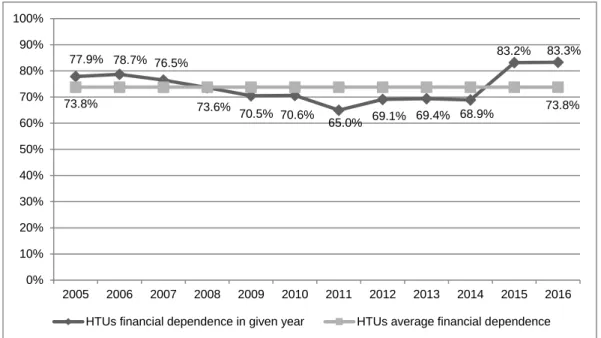
(9) Jaroslav Mihálik et al. / European Journal of Government and Economics 8(1), 96-109.. 4. The fiscal (in)dependence and autonomy of regional governance in Slovakia. Table 3 summarizes the financial dependency ratio of specific Slovak regional governments for the period 2005-2016.. Table 3.The rate of financial dependence of HTUs during the years 2005-2016 (%) Year HTU BSK. 2005. 2006. 2007. 2008. 2009. 2010. 2011. 2012. 2013. 2014. 2015. 2016. Average. 64,6. 65,2. 64,9. 60,2. 58,3. 69,2. 59,2. 61,1. 58,8. 63,2. 88,1. 87,9. 66,7. BBSK. 79,4. 77,1. 76,8. 73,4. 75,7. 73,8. 72,9. 73,2. 68,7. 71,9. 86,4. 85,3. 76,3. KSK. 84,3. 94,8. 73,4. 68,7. 71,3. 69,9. 67,1. 69,9. 70,0. 69,2. 76,2. 73,9. 74,0. NSK. 74,4. 73,8. 76,4. 71,4. 68,2. 68,9. 57,6. 67,7. 69,0. 67,2. 79,9. 85,5. 71,6. PSK. 85,7. 84,5. 83,8. 86,2. 74,3. 67,9. 64,1. 71,5. 73,1. 71,2. 77,1. 86,4. 77,3. TSK. 84,9. 82,8. 81,5. 84,4. 63,8. 80,6. 79,8. 72,7. 76,8. 78,2. 89,8. 92,5. 80,6. TTSK. -. -. -. -. -. 72,5. 48,8. 66,2. 70,9. 72,6. 84,3. 82,8. 71,1. ZSK. 72,1. 72,9. 79,3. 71,3. 82,1. 62,7. 71,1. 70,6. 68,6. 57,9. 83,8. 72,1. 72,0. Average. 77,9. 78,7. 76,5. 73,6. 70,5. 70,6. 65,0. 69,1. 69,4. 68,9. 83,2. 83,3. 73,8. Legend: BSK – Bratislava HTU, BBSK – Banská Bystrica HTU, KSK – Košice HTU, NSK – Nitra HTU, PSK – Prešov HTU, TSK – Trenčín HTU, TTSK – Trnava HTU, ZSK – Žilina HTU.. The higher the value we have found, the more the Slovak self-governing regions are financially dependent on transfers from the state budget, while the central government keeps the decisionmaking about the amount and the yield of these transfers. Our research reveals significant interregional and time differences in financial dependency. For example, Bratislava HTU has developed as the least dependent on standard transfers, subsidies and grants within the public administration in Slovakia. Its average value of financial dependence for the last twelve years was 66.7%. On the other hand, three HTUs (Trnava, Nitra and Žilina) follow a significant distance within their average values. Trenčín HTU, particularly, has been the most dependent region on funds from standard subsidies, transfers and grants. Its average rate of dependence on current transfers from the state budget over the monitored period has been more than 80%. The development of the average rate of financial dependency from 2005 to 2016 of all eight self-governing regions is shown in Figure 2. At the same time, it illustrates the average level of financial dependency of all regions over the twelve-year period, i.e. the entire segment of regional self-governance during the years 2005-2016. Financial dependency rates have fallen since 2006. The lowest average rate of financial dependence of self-governing regions was recorded in 2011. Subsequently, by 2014, the average rate of financial dependency increased slightly. In 2015, we identified an unusually high increase in financial dependency, an increase of 14.3% over the previous year. This huge leap was caused by the reform of tax revenues for HTUs. The tax from motor vehicles was deducted which was offset by an increase in the redistribution coefficient of the share tax. This had, on the one hand, a negative impact on the reduction of financial autonomy and, on the other, it contributed to increasing the financial dependence of self-governing regions on the central government. The financial dependence on current financial means from the central. 104.
(10) Jaroslav Mihálik et al. / European Journal of Government and Economics 8(1), 96-109.. government for the whole segment of regional self-governance in Slovakia in the period 20052016 was determined by analysis and calculation at 73.8%. This means that, during this period, the revenue component of the regional self-government budgets was closely tied to state budget funds, funds that are not decided by the HTUs, but are fully in the hands of the central government.. 100% 90%. 70%. 83.2%. 77.9% 78.7% 76.5%. 80%. 73.8%. 73.6%. 60%. 70.5% 70.6%. 65.0%. 83.3%. 73.8%. 69.1% 69.4% 68.9%. 50% 40% 30% 20% 10% 0% 2005. 2006. 2007. 2008. 2009. 2010. HTUs financial dependence in given year. 2011. 2012. 2013. 2014. 2015. 2016. HTUs average financial dependence. Figure 2: The rate of financial dependence of HTUs in a given year and the average rate of financial dependency for the years 2005-2016 (%). Source: Authors´ processing. However, one should add that, if the average financial dependence of HTUs is at 73.8%, it does not automatically mean that the regional self-government is on average 26.2% autonomous in the area of its income (Figure 2). The difference between these values is based on revenue operations in the area of capital income and financial operations, with which both indicators measure the financial situation of self-governing regions. In fact, the degree of financial independence, excluding income tax shares, was down to 2014 at a low level, with an average median of 11-16% based on partial calculations. After removing the tax on motor vehicles from the portfolio of exclusive regional government powers, this already low share of own revenue fell dramatically. On the basis of the process of fiscal decentralization and subsequent financial dependency calculation, it can be stated that the regional self-governance in Slovakia shows a high financial dependence over funds coming from the state budget in the form of standard subsidies, grants and transfers. Their height can actively influence the central government level on which "good will" the regional self-governing units are fully dependent. We could also take a slight look at the fact that the self-governing regions perform the activities of state administration, which have been identified and funded by the central government. With a very high degree of financial dependence, such as territorial self-government the self-governing element of a self-governing unit, its original competences and its own income base, is pushed into the background. Therefore, elected. 105.
(11) Jaroslav Mihálik et al. / European Journal of Government and Economics 8(1), 96-109.. representatives, with a precisely defined portfolio of delegated competencies and whose performance is accountable to a central government that fully finances them. Consequently, it is questionable whether it is important for long-term maintenance of the situation where regional self-government fails to fulfil its basic self-government functions, because it does not have a sufficiently profitable income of its own and, on the contrary, is burdened with the exercise of a large number of competences by the state administration.. 5. Conclusion. Based on the analysis of the financial dependence it can be stated that in the case of the regional level of territorial self-government, the principles stemming from the fiscal decentralization are not applied. We believe that the current state is even contrary to the theory of fiscal decentralization (Musgrave and Musgrave, 1994; Oates, 2008; Jílek, 2008; Cíbik, 2014; Provazníková, 2015). These principles were crucial for the implementation of the public administration reform and the establishment of regional level self-government. Regional self-government shows a high financial dependence from state resources, which we consider to be a problem because the self-governing nature of this territorial unit is threatened as it fulfils the tasks that are determined and financed by the central government. The self-government aspect represented by the original competencies and own income base is minimized. The dependence of regional self-government on central power is manifested not only in the financial sphere but also in the area of competence. Requirements for addressing both transferred and original competencies are often ignored or rejected by the central government and its ministries. A key issue in the area of independence is the fact that regional self-government is not perceived as a central power partner, but in several cases, it has rather elements of a subordinated entity. The current state of independence of regional self-government is most strikingly characterized by the current model of its financing. Our analysis points out that the extent of the competencies is insufficiently covered by the volume of funds, while the state of the property, with which the competencies were transferred to the particular HTUs have created the modernization debt. As a result, desirable efficiency shall also be achieved as well as the pressure to effectively deal with funds and the use of multi-source funding. On the other hand, there may be an increase in indebtedness and a poor quality of the given competencies or their non-provision, insufficient capacities management and low standards set by regional self-government. An unfavourable moment is the financing model mentioned above, as regional governments receive a major share of the tax that is shared between local and regional governments. This tax shows six distribution criteria, where the resulting value is still multiplied by the coefficient set for the given HTU. The coefficient was set so that the economically stronger regions had lower distribution than economically weaker ones. This is gradually being balanced, but the gap between the regions has not been significantly narrowed yet; on the contrary, they have even deepened. Therefore, we propose to modify the system of financing of self-governing regions, which should aim at gradually releasing the competence of self-governing regions by reducing specific state subsidies. 106.
(12) Jaroslav Mihálik et al. / European Journal of Government and Economics 8(1), 96-109.. linked to performance of specific functions and their replacement by general state subsidies individual self-governing regions could decide independently, in what sphere and to what extent will use the funds. It can be concluded that, since its inception, regional self-government suffered from uncertainty as to how much funding will be transferred to its budget from the income tax, and despite the fiscal decentralization that has taken place, this situation persists to this day. Instability and changes in determining the percentage are reflected in the exercise of their powers and strategies as well as the removal of one's own tax. The local government has lost the real possibility of influencing financial flows, and this has affected the quality and quantity of services provided. It is, therefore, necessary to make adjustments that would increase the economic sovereignty of regional self-governments and create real conditions to address the long-standing problems of the financial system with a view to stabilizing financial resources over a longer period by adjusting fiscal relations between state and local levels. We believe that an increase in resources, as well as the possibility of participation in the creation of central financial plans for taxation and subsequent redistribution, should be the basis for better functioning. The process of deinstitutionalization and privatization, i.e. the transition from the construction of facilities to the provision of services, is essential, in order to create an environment in which a citizen can choose from a wide variety of different service providers wherever it is efficient and appropriate. Decisions on changes in the competency and financial framework must also discuss the interdependence of the two levels of self-government, with which the issue of a comprehensive reform of territorial self-government is closely linked.. References. Act No. 564/2004 Coll. on the Budget Determination of the Income Tax on Local Government Income and on the amendment of some laws. Act No. 583/2004 Coll. on the financial rules of territorial self-government and on the amendment of some laws. Barnes, W.R. & Foster, L. A. (2012). Toward a More Useful Way of Understanding Regional Governance. A paper for presentation at the September 2012 conference of the European Urban Research Association. Vienna: Austria. Blöchliger, H. & King, D. (2006). The Fiscal Autonomy of Sub-Central Governments. Paris: OECD. Bobáková, V. (2015). Zadlžovanie regionálnej samosprávy, Slovak Journal of Public Policy and Public Administration, 2015, Vol. 2, No. 2, pp. 153 – 166. Caselli, F. & Ralyea, J. (2017). Slovak Republic: selected issues. IMF Country Report No. 17/72. Washington, D.C.: International Monetary Fund. https://doi.org/10.5089/9781475587937.002 Cíbik, L. (2014). Slovensko a fiškálna decentralizácia. Acta Oeconomica Universitatis Selye, 2014, Vol. 3, No. 2, pp. 24 – 32. Čavojec, J. & Sloboda, D. (2005). Fiškálna decentralizácia a obce. Bratislava: Konzervatívny inštitút M. R. Štefánika.. 107.
(13) Jaroslav Mihálik et al. / European Journal of Government and Economics 8(1), 96-109.. Fabianová, K. (2010). Finančná samostatnosť vyšších územných celkov na Slovensku. In Šoltés, V. (ed.). National and regional economics VIII. Košice: Technical University, pp. 227 – 234. Halásková, M. (2009). Veřejná správa v Evropské Unii. Opava: OPTYS. Horváth, P., Cíbik, L., & Švikruha, M. (2018). Finančná závislosť územnej samosprávy na Slovensku. Scientific Papers of the University of Pardubice, Series D. 2018, Vol. 25, No. 42 (1/2018), pp. 67 – 79. Jílek, M. (2008). Fiskálni decentralizace, teorie a empirie. Praha: ASPI Wolters Kluwer. Klimovský, D. (2006). Regionálna samospráva v rokoch 2002 – 2005: skúsenosti a súvislosti v politickej reflexii. In Mesežnikov, G. (ed.). Regionálne voľby 2005 – Súvislosti a výsledky. Bratislava: IVO. Litvack, J. & Seddon, J. (1999). Decentralization. Briefing notes. Washington, DC: World Bank Institute. Loughlin, J., Hendriks, F., & Lidström, A. (2011). The Oxford Handbook of Local and Regional Democracy in Europe. New York: Oxford University Press. https://doi.org/10.1093/oxfordhb/9780199562978.001.0001 Machyniak, J. (2013).Transformácia verejnej správy na Slovensku po roku 1989 - výzvy a realita. In Ondrová, D. et al. (ed.).Teória a prax verejnej správy. Košice: Univerzita Pavla Jozefa Šafárika v Košiciach. Mikuš, D. (2014). Vybrané aspekty prvej etapy decentralizácie verejnej správy na Slovensku. Acta Oeconomica Universitatis Selye, 2014, Vol. 3, No. 2, pp. 102 – 108. Musgrave, R. A. & Musgrave, P. B. (1994). Veřejné finance v teorii a praxi. Praha: Management Press. Nižňanský, V. (2005). Decentralizácia na Slovensku. Bilancia nekonečného príbehu 1995 – 2005. Bratislava: Úrad vlády SR. Nižňanský, V. & Hamalová, M. (2013). Decentralizácia a Slovensko. Bratislava: VŠEMVS. Oates, W. E. (2008). On the Evolution of Fiscal Federalism: Theory and Institutions. National Tax Journal, 2008, 61(2), pp. 313-343. https://doi.org/10.17310/ntj.2008.2.08 Pierre, J., & Peters, B. G. (2000). Governance, Politics and the State (Political Analysis). New York: Palgrave Macmillan. Provazníková, R. (2015). Financování měst, obcí a regionů: teorie a praxe. Praha: GRADA Publishing. Rhodes, R. A. W. (2007). Understanding Governance: Ten Years On. Organization Studies, 2007, Vol. 28, No. 8, pp. 1243 – 1264. https://doi.org/10.1177/0170840607076586 Sacchi, A. & Salotti, S. (2014). How Regional Inequality Affects Fiscal Decentralisation: Accounting for the Autonomy of Subcentral Governments, Environment and Planning C. Politics and Space, 2014, Vol. 32, No. 1, pp. 144 – 162. https://doi.org/10.1068/c1241r Sivák, R. et al. (2007). Verejné financie. Bratislava: IURA EDITION. Sellers, J. M., & Lidström, A. (2007). Decentralization, Local Government and the Welfare State. Governance, 2007, Vol. 20, No. 4, pp. 609 – 632. https://doi.org/10.1111/j.14680491.2007.00374.x Sloboda, D. (2006). Slovensko a regionálne rozdiely. Teórie, regióny, indikátory, metódy. Bratislava: Konzervatívny inštitút M.R. Štefánika.. 108.
(14) Jaroslav Mihálik et al. / European Journal of Government and Economics 8(1), 96-109.. Sturm, R., & Dieringer, J. (2005). The Europeanization of Regions in Eastern and Western Europe: Theoretical Perspectives. Regional & Federal Studies, 2005, Vol. 15, No. 3, pp. 279 294. https://doi.org/10.1080/10438590500223251 Sutherland, D., Price, R., & Joumard, I. (2005). Fiscal rules for sub-central governments: design and impact. OECD Economics Department Working Paper 465. https://doi.org/10.2139/ssrn.870443 Šteiner, A., & Kozlayová, A. (2010). Dobré spravovanie rozvoja regiónov - výzva pre Slovensko. Košice: Karpatský rozvojový inštitút. Tej, J. (2007). Správa a manažment. Prešov: ManaCon. Žárska, E., & Kozovský, D. (2008). Teoretické a praktické aspekty fiškálnej decentralizácie. Bratislava: EKONÓM.. 109.
(15)
Figure



+2
Documento similar