
The Linguistic Internationalization of Higher Education: A Study on the Presence of Language Policies and Bilingual Studies in Spanish Universities
16
0
0
Texto completo
(2) Monográfico III. mayo 2018. 1. Introduction The desire to enhance the international profile of universities has become one of the most frequently pursued objectives in the Spanish context. The necessity to equip students with specific professional competences for the international market (Coleman, 2006) and the possibility of attracting international students has led to the flourishing of bilingual studies and of initiatives to promote languages other than the first language at the university (Ramos, 2013). Spanish universities, then, are trying to adapt to the professional demands of globalization and to multicultural environments in which English is the lingua franca. However, increased attention to other languages in higher education institutions (HEIs) is not unique to the Spanish context. In most of Europe, and in many other countries, universities offer studies in English, in what has been commonly labelled EMI (English-Medium Instruction) or more recently in the form of ICLHE programmes (Integration of Content and Language in Higher Education), both models with the objective of providing students with the languages necessary to face international demands (Wilkinson, 2004; Doiz, Lasagabaster, & Sierra, 2013; Fortanet, 2013; Smit & Dafouz, 2013; Valcke & Wilkinson, 2017). With respect to the European context, Wächter and Maiworm (2008) analysed the availability of studies in English in European universities and found that 400 universities in 2007 offered this possibility, which meant an increase of 340% with respect to the situation in 2002. Some years later, the same authors updated the information and concluded that: “the number of identified English-taught programmes went up from 725 programmes in 2001, to 2,389 in 2007 and to 8,089 in the present study” (Wächter & Maiworm, 2014: 16). Despite the massive interest in developing a strategy to offer teaching in English, the attention of scholars has been frequently directed to the challenges of this kind of programme, focusing on how to successfully implement them. The emphasis in these studies, however, has not been on the elaboration of a general policy to assure the quality of these programmes nor on the design of a language policy transcending instruction in English, with initiatives to consolidate the use of other languages among all the stakeholders involved in the internationalization process. As an example, an analysis of the plenary sessions, talks, and poster presentations in the last three Conferences organized by the ICLHE Association in Maastricht 2013, Brussels 2015 and Copenhagen 2017, reveals that very little attention was given to the design of global language policies in universities. There is a large number of factors influencing the implementation of a given model of bilingual education. For example, the objectives have to be carefully chosen, the universities need to rely on adequate human (teachers) and material (budget) resources, students are required to possess a minimum linguistic level, and also any initiative should be part of a well-designed and organized global plan for the whole university (Pavón & Gaustad, 2013). However, this interest should not be the only one as there are other domains that have to be enhanced equally in our desire to foster attention to languages, for example the pedagogical dimension as well, as moving towards linguistic internationalization goes beyond offering studies through English or through any other language. Given the fact that the amount of studies regarding initiatives towards internationalization that are closely connected to the use of languages is not abundant, we believe that there is a need to identify the existence of language policies and the choice of bilingual studies in. 32.
(3) A. M. Ramos-García and V. Pavón Vázquez The Linguistic Internationalization of Higher Education. the Spanish tertiary education. In this paper, we will look at the initiatives and decisions that Spanish universities have taken and are taking in order to enhance their international profile, particularly regarding the delineation of language policies, and at the same time depict the situation regarding the offer of bilingual studies in this context. In this analysis, we will first direct our vision to the ideation of language policies at the international and Spanish level, and to the implementation of bilingual studies in universities as one of the instruments to promote internationalization. In the second part of the article we will review the existence of such language policies in Spanish universities and we will broadly depict the current situation of bilingual studies in the same context.. 2. Language. policies. 2.1. Global language policies The first challenge of university authorities might be to establish, and subsequently communicate to stakeholders, solid reasons behind the need for a language policy in higher education internationalization policies. These reasons are likely to be varied and will often revolve around the need to attract international students and encourage staff and student mobility. However, as Mellion (2008) points out, the international profile of a university cannot be solely quantified in terms of the number of students or teachers involved in mobility. There are other types of internationalization processes that should be taken into consideration, for example the quality of publications and the creation of collaborative networking in professional and research areas. Together with all these aspects, therefore, the implementation of bilingual studies cannot be considered an important driver, and much less an indispensable condition, for the internationalization of higher education. The design of language policies at the university may be a difficult undertaking since it is linked to a series of complex dimensions (Marsh & Laitinen, 2004). Scholars have frequently debated the necessity to delineate language policies at a global or national level, with specific interest on the role of the foreign languages in education (Cancino, Dam, & Jaeger, 2011; Halonen, Ihalainen, & Saarinen, 2014; Shohamy, 2006; van der Walt, 2013); but the literature on language policies at the university level is scarce (Lauridsen, 2013). One of the attempts to delineate the actions and initiatives that universities should undergo in this process is that presented by Marsh, Pavón, and Frigols (2013). In this proposal, the authors provide a series of recommendations about the elaboration of a language policy with the objective of describing: “key actions and processes that are required to successfully launch and operate higher education degree programmes provided in English” (2013: 9). The authors divided a set of 26 recommendations (‘levers’ in their words) into several parts: governance and strategy, which includes specific advice on the creation of a language policy or plan; programme management, with special attention to the roles of students, teachers and staff coordination; professional integration, focusing on the necessity of international networking and cooperation, the use of adequate methodologies, and the obligation to use a sound quality assurance and accreditation processes; and learning in media-rich environments, particularly devoted to the importance of digital and virtual. 33.
(4) Monográfico III. mayo 2018. resources, and social media. While this proposal appears complicated for HEIs, particularly at initial design stages, it provides useful information about internationalization processes and may represent an important tool in systematizing university degrees taught through the medium of English (Bamond & Strottman, 2015: 6). Another interesting proposal aimed at identifying the aspects that have to be addressed in the process of constructing language policies is what Smit and Dafouz (2014) call EMEMUS (English-Medium Education in Multilingual University Settings).These authors suggest that the implementation of English-taught studies should be based on the design of a theoretically grounded framework of several core dimensions (2014: 2). The six dimensions identified are accessed individually from the central notion of discourse, and cover: a) roles of English, describing the central role of English, whether as a subject in English for Academic Purposes or in English-medium instruction; b) academic disciplines, the crucial relevance of working with the different types of discourse related to the diverse disciplinary areas; c) language management, or the need to avoid a lack of explicit regulations in universities regarding languages; d) agents, the consideration of the variety of agents involved in the planning and implementation of language policies; e) practices and processes, mostly regarding the construction of knowledge and the development of academic literacy skills; and f) internationalization and ‘glocalization’, the obligation for the university to move beyond student and teacher mobility in order to provide access to multilingual and multicultural competences. The EMEMUS model presents a coherent elaboration of the theoretical background, concepts and key dimensions, and provides a truly comprehensive rationale for a potential dynamic application; but as the authors recognize in their concluding remarks, the framework also needs to be tested and applied in real contexts. 2.2. Language policies in the Spanish context The elaboration of language policies in Spanish universities has been a matter of individual efforts and initiatives rather than of the existence of common regulations or guidelines. In fact, as Fernández-Costales and González-Riaño (2015) point out, the political, academic or linguistic decisions have been mostly isolated and not generally based on the existence of empirical studies. With the exception of some bilingual regions (where the application of language policies in order to help the development of the two official languages has been a political and social objective during several decades), in monolingual regions there have not been many attempts to implement language polices. Only during the last few years has the internationalization process at Spanish universities indirectly forced many of them to look into the development of languages, especially English, other than the first language. Again, these initiatives represented insulated attempts to draw global attention to languages as a means of enhancing the process of internationalization. However, there has been a growing interest in deciding important aspects, such as the linguistic accreditation of students, the training of suitable teachers, or specific internationalization preparation for administrative staff. The creation of ACLES, the Spanish Association of Language Centres at Spanish universities, and the shaping of different language groups (mesas lingüísticas) within the CRUE (Board of Rectors of Spanish Universities - Conferencia de Rectores de las Universidades Españolas), have become decisive milestones in the process of recognizing the importance of languages. Additionally, the publication of the strategies. 34.
(5) A. M. Ramos-García and V. Pavón Vázquez The Linguistic Internationalization of Higher Education. for the internationalization of the Spanish universities (MECD, 2014: 23), recommended increasing the number of studies taught in English and promoting the learning of English for university stakeholders (Action 2.4.). All these actions fostered an interest to establish common guidelines, objectives and procedures in order to devise a common language policy in different Spanish universities. As a result, in 2017 the CRUE published a document for the implementation of a language policy in Spain (Bazo et al., 2017), in which the main objective was to organize shared initiatives and to apply homogeneous criteria in order to promote linguistic internationalization. The document is divided in three separate sections: accreditation, training and incentives, which at the same time cover each of the three important groups of stakeholders (students, teachers and administrative staff). In accreditation, the document presents the importance of possessing adequate linguistic levels for students and teachers in the case of mobility programmes or for the participation of both groups in bilingual studies, as well as the linguistic requirements for administration staff to contribute to the internationalization profile of the university. The second dimension addressed, describes the challenges of the three groups of stakeholders with respect to the training actions that would be needed in order to equip them with the necessary competences to manipulate complex academic contents, to participate in mobility programmes, and to effectively function in different professional and multicultural contexts. This section also includes a proposal of courses and training activities specific for each one of the stakeholders. The third area proposes a series of suggestions for the creation of a global programme of incentives for students, teachers and administrative staff in order to encourage their participation in the actions towards the process of internationalization and in order to reward their efforts. Although the document emanates from the CRUE and has been developed with the objective of establishing a series of uniform guidelines for all Spanish universities, the authors clearly state that it has to be used as a framework of reference and not as a checklist, and, most importantly, it should be supported and applied by the different universities according to their characteristics and contexts: “The recommendations proposed here would need the overt backing and the coordination from those more directly involved in decision-making at the universities” (2017: 21). 2.3. Implementation of bilingual studies: objectives and models In addition to the most evident and previously mentioned reasons behind the creation of HEI bilingual policies, we can identify a further series of pedagogical motives. These motives include the acquisition of multicultural competences by students, which will be useful for their professional lives (Aguilar & Muñoz, 2014); the improvement in the cognitive processes deriving from the oral and written manipulation of highly complex academic material (Smith, 2004); and, the contribution to the professional development of teachers (González-Álvarez, O’Dowd & Valcke, 2015). Thus, educational policy regarding languages at the European Union explicitly supports the implementation of innovative educational initiatives towards the teaching of curricular contents using other additional languages at all levels, including Higher Education (European Commission, 2012). Along with the decision regarding the reasons, motivations, and consequently, the objectives, another relevant resolution is related to the choice of model of bilingual education selected. The two main types of bilingual programmes adopted by Spanish universities are:. 35.
(6) Monográfico III. mayo 2018. a) ‘English-taught studies’, in which 100% of the curriculum is taught through the foreign language; and b) ‘bilingual studies’, in which 50% of the credits are taught through the foreign language. Irrespective of the kind of programme selected, one of the most controversial decisions lies in the choice of instruction. Some may opt for an English-medium instruction (EMI) model (Dearden, 2014), whereas others prefer to apply an Integration of Content and Language in Higher Education (ICLHE) model (Smit & Dafouz, 2013), which is the adaptation for the university level of the CLIL (Content and Language Integrated Learning) approach (Coyle, Hood, & Marsh, 2010). This becomes a pivotal determination as it involves crucial structural and methodological implications. Whereas EMI is the most frequently chosen option in contexts where the development of the language is not an objective for consideration, ICLHE is the preferred model when one of the goals is, explicitly or implicitly, to support and promote the use of the academic language of the students. The decision whether to use one model or the other is particularly important because it must be based on the objectives and the characteristics of the context (Pavón & Gaustad, 2013). For example, the cultural acceptance of these programmes, or the linguistic proficiency of the students are factors that have to be analysed and weighed carefully. These factors may heavily influence the outcomes of the programme and must be considered in decision-making processes pertaining to model selection. Moreover, in EMI the vehicle of instruction used by both teachers and students simply implies switching from one language to another, which means that all agents should possess a high proficiency in that language. In contrast, with ICLHE the attention to the development of the language means that collaboration between content specialists and language teachers becomes an indispensable element for the success of the programme. The qualifications of language teachers are particularly relevant with regards to the use of text typologies (Lorenzo, 2008), which is an area that is crucial for the manipulation of the academic language necessary for the passive and active verbalization of content; it is also optimal for the pedagogical dimension because teachers need to deploy methodological instruments to compensate for the risks of using a language that is not mastered at the same level as the first language (Arnó-Macià & Mancho-Barés, 2015). Language teachers with experience in the field of languages for specific purposes are invaluable in ICLHE contexts, as they can help and advise content specialists on the most effective strategies to deal with complex academic material.. 3. Method 3.1. Objectives The main objective of this study is to identify the existence of initiatives towards the delineation of language policies in Spanish universities and, at the same time, to depict the general tendencies of the implementation of bilingual degrees in the same context. In order to do so, two specific objectives have been elaborated: a) to identify the presence and main characteristics of language policies evolved in the Spanish universities; b) to give an account of the general nature of bilingual degrees offered by the universities in Spain.. 36.
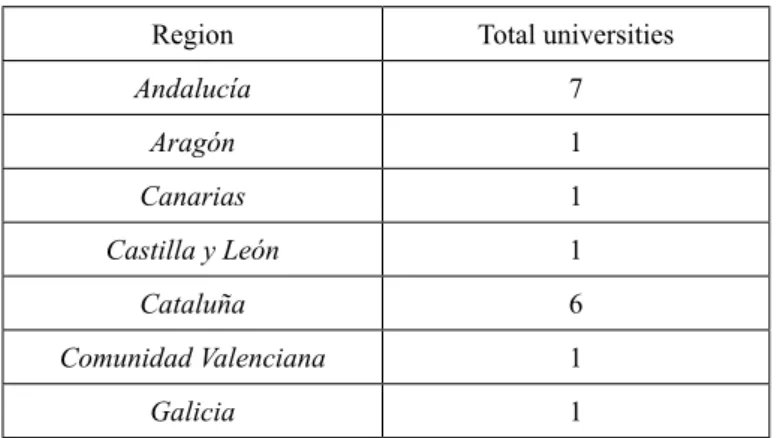
(7) A. M. Ramos-García and V. Pavón Vázquez The Linguistic Internationalization of Higher Education. 3.2. Context All the Spanish universities that have participated in this study are members of the CRUE. A total number of 76 universities have been analysed, 50 state universities and 26 private universities. The universities with language policies, including the guidelines to design bilingual studies, have developed them according to criteria originating from their own plans and objectives; therefore, the different plans are fairly heterogeneous. 3.3. Data collection procedure Accessing the data presented a series of initial problems. The most important one was that in the majority of the cases universities did not have an internal institution devoted to ideate and evince the initiatives concerning the role of languages. Embryonic or full language policies and lists of courses offered in foreign languages were difficult to find. Secondly, this information was normally included in other sections or internal institutions, mainly in the internationalization offices. In order to preserve the objectivity of the data gathering procedure, in other words, that the process was the same for all the universities, we opted for the same model of accessing the data. Following this principle, the main process utilized for gathering the data has been inspection of the information shown by the universities and complemented by the information given by the Spanish Service for Education Internationalization (Servicio Español Para la Internacionalización de la Educación [SEPIE]) in their websites1. However, in the cases where there was no information regarding the presence of documents or information related to the delineation of language policies, initiatives towards linguistic internationalization, or to present the availability of bilingual degrees, we proceeded to gather the information through direct contact, whenever possible, with the internationalization and teaching organization services.. 4. Results. and discussion. 4.1. Language policies The analysis of the data gathered provides us with relevant information relative to: a) the existence and type of university language policies; and b) the distribution of degrees around the country (complemented with information about the languages chosen for instruction/teaching). It should be said that an examination of the language policies encountered reveals that most universities have started their particular bilingual teaching and learning initiatives without specific guidelines and regulations directly or indirectly related to the existence of a sound language policy (see Table 1 below). In recent years, as internationalization has become a key issue university institutions are directing their attention to the design of their own language policies. However, these 1 SEPIE website: https://www.educacion.gob.es/ruct/consultaestudios?actual=estudios. 37.
(8) Monográfico III. mayo 2018. preliminary policies are, in the majority of the examples analysed, no more than a set of mixed intentions offering some brief guidelines. In many of the cases, then, the delineation of the language policy is just a mere statement of intentions that does not have the form of a systematic language policy, it does not apply to the whole institution, in most of the cases it has not been published as such, and when it has, it does not follow the guidelines provided by CRUE. As far as a simple numerical analysis is concerned, the review of the existence of language policies shows that only 18 out of 76 universities in Spain have published any sort of accessible document serving as language policy: A Coruña, Alicante, Almería, Autónoma de Barcelona, Barcelona, Cádiz, Córdoba, Girona, Granada, La Laguna, Lleida, Málaga, Pablo de Olavide, Rovira y Virgili, Salamanca, San Jorge, Sevilla, and Vic. Table 1. Distribution of language policies in the different regions in Spain 2 Region. Total universities. Andalucía. 7. Aragón. 1. Canarias. 1. Castilla y León. 1. Cataluña. 6. Comunidad Valenciana. 1. Galicia. 1. After analysing the different documents in the cases where the language policy was published, it may be stated that the criteria established by CRUE (Bazo et al., 2017) have been followed to a certain extent in the seven most recent plans (those published in 2016/2017): Almería, Barcelona, Córdoba, La Laguna, Rovira y Virgili, and Salamanca. Therefore, they emphasize the three main aforementioned issues: accreditation, training and incentives for those involved in the process (students, teachers and administrative staff). The University Pablo de Olavide has recently approved a language policy, but the text is not yet available. Older language policies or ‘plans’ present different structures and measures to be adopted in the trend set by the European Higher Education Area (EHEA) mainstream. Hence, they usually attempt to foster language learning (mainly English, but also mention other languages such as French, Italian, and German), training, language accreditation, and using languages either as a vehicle for communication or research dissemination (Cádiz, Málaga, San Jorge). Some of those documents emphasize the role of English as a lingua franca in HEIs and there is a tendency to publish supplementary instructions ‘promotion plans’ in order to foster the teaching through English and other languages (Alicante, Autónoma de Barcelona, Salamanca, Vic) and e-learning (Sevilla). 2 Regions are maintained in Spanish.. 38.
(9) A. M. Ramos-García and V. Pavón Vázquez The Linguistic Internationalization of Higher Education. Therefore, universities have started to implement different measures towards internationalization (mostly internationalization ‘at home’) without planning a global language policy for the institution as a whole, as previously mentioned. In most cases, the spread of EMI or ICLHE started as a bottom-up process in Faculties or Schools before there was a clear common policy. The reasons why there are many universities that still have not delineated language policies are diverse, but the main difficulty is probably caused by the inability of university authorities to foresee the potentiality of these initiatives as a powerful driver to increase the international qualities of the university. In addition, we find a lack of specialists in this area or, worse, the universities are not listening to them and do not commonly have the necessary confidence in their expertise to ideate and pilot such policies and programmes. In other cases, two different causes can explain why many universities are failing to move towards internationalization. In some cases, there would appear to be a certain degree of reluctance to implement bilingual programmes when outcomes are uncertain. In some others, the opponents to offering subjects in a foreign language may exert a notable influence and may contribute to slowing down the implementation of these policies. This extreme is proven by the fact that most universities still lack a language policy statement nowadays (n=58). Nevertheless, some of those HEIs refer to their language policy or to the importance of languages in the institution itself, or may have produced certain guidelines referring to teaching through other languages different from Spanish, but those instances were not considered in the study as no document has been passed as a language policy. Finally, it should be said that there is a tradition of fostering language policies and language normalization initiatives from institutions in bilingual regions. Universities in these contexts have traditionally developed a linguistic policy, although the interpretation is slightly different, as they usually refer to the co-official language(s) in the first place and other languages receive a secondary or additional consideration. An example of how bilingual regions organize themselves linguistically is the joint Pla de política linguistic (Language policy plan) from Xarxa Vives d’universitats, a group formed by all Catalan-speaking universities in Cataluña, Comunidad Valenciana and Baleares, or the interuniversity plan for the three Galician universities. 4.2. Bilingual Degrees The second objective of this study was to account for Spanish bilingual degrees. It should be noted that degrees inextricably related to languages (Modern Languages or Translation and Interpreting, for example, among many others) and/or subjects related to English for Specific Purposes (ESP) have been omitted because they have traditionally been delivered in different languages, and the attention is driven in this study to teaching in English (or any other language) in non-linguistic disciplines. Most universities prefer English but there are some that allow students to choose from several courses delivered in different languages such as English, Italian, French, or German. Those degrees have been included under the label ‘bilingual’. As mentioned previously, those. 39.
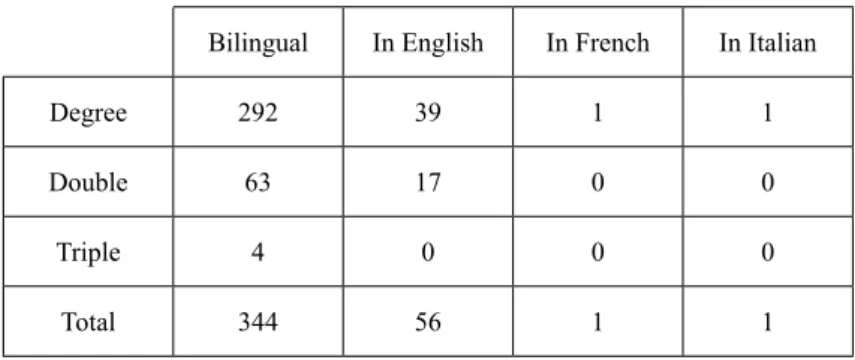
(10) Monográfico III. mayo 2018. degrees offer half of their subjects in English and half in Spanish. The label ‘English’-or any other language- is used to describe in those cases in which the whole degree is delivered in that language. Methodological interpretations are not clear as the distinction between EMI or ICLHE may be not accurately distinguished among participants in those experiences. Some universities allocate a percentage of ‘bilingualism’ (sometimes progressive, i.e. increasing as the programme expands) with the intention of reaching a specific degree of language use in coexistence with the mainstream language. Others refer to courses in English (no matter which methodological approach is selected for the experience). Therefore, from the data gathered, it can be tentatively stated that labelling is not as exact as it should be from a methodological point of view and this issue causes some difficulties when classifying information. With these constraints in mind, Table 2 provides the number of degree courses identified (single, double and triple bachelor’s degrees) which are currently taught in Spain through languages other than Spanish. Table 2. Degrees taught in other languages in Spain Bilingual. In English. In French. In Italian. Degree. 292. 39. 1. 1. Double. 63. 17. 0. 0. Triple. 4. 0. 0. 0. Total. 344. 56. 1. 1. Data shows that there are 292 bilingual degrees, 39 are fully delivered in English, and one in French and another in Italian; 63 double degrees that are bilingual, 17 in English and 4 triple bilingual degrees. The number may not be considered high if compared to the total amount of degrees delivered in Spanish universities, but according to 2016 data they ascend to 402. However, the tendency shows that the increase has been (and still is) rapidly growing (Ramos, 2013). The most popular degree to be implemented in other languages is Business Administration and Management (Grado en Administración y Dirección de Empresas) as is shown in Table 3 below. This popularity seems to be predictable given the importance of languages (in particular English) in the fields of economy and finance. As can be observed from the information shown, there are 16 Business Administration degrees and 6 double degrees that are bilingual (50/50 Spanish and English). These data are complemented with the fact that there are a significant number of double degrees that are taught fully in English (13). It exemplifies the distribution inside the field of Business Administration (single and double degrees) and the modalities in which it is taught (bilingual or fully in English).. 40.
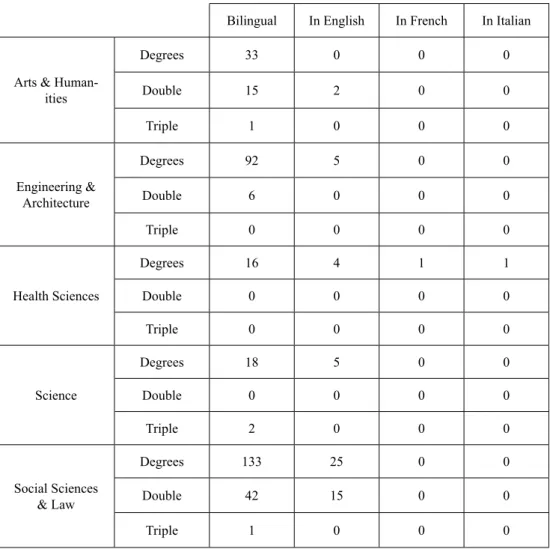
(11) A. M. Ramos-García and V. Pavón Vázquez The Linguistic Internationalization of Higher Education. Table 3. Distribution in a degree: bilingual and English-taught Degree. Bilingual. In English. Business Administration and Management (BA). 14. 4. International BA. 1. 0. Technological Management. 1. 1. Global Bachelor’s Degree in Business Management and Entrepreneurship. 0. 1. Double degree in BA + Economics + International Business. 5. 3. Double degree in BA + Computer Engineering. 0. 1. Double degree in BA + Law. 1. 1. Double degree in BA + Industrial Technologies Engineering. 0. 1. Double degree in BA + Management Programme. 0. 1. Double degree in BA + International Managerial Profile Specialist. 0. 1. Double degree in BA + International Relations. 0. 1. Double degree in BA + Marketing and Commercial Communication. 0. 1. Double degree in BA + Tourism. 0. 1. Double degree in BA + European Business. 0. 1. Double degree in BA + International Economics. 0. 1. The distribution of bilingual experiences is quite unbalanced among fields or branches of knowledge: Arts & Humanities, Engineering & Architecture, Health Sciences, Science, and Social Sciences and Law; it particularly favours Social Sciences and Law (see Table 4). On a different and additional note, it should be noted that language-related degrees have not been included here.. 41.
(12) Monográfico III. mayo 2018. Table 4. Bilingual experiences in fields of knowledge. Arts & Humanities. Engineering & Architecture. Health Sciences. Science. Social Sciences & Law. Bilingual. In English. In French. In Italian. Degrees. 33. 0. 0. 0. Double. 15. 2. 0. 0. Triple. 1. 0. 0. 0. Degrees. 92. 5. 0. 0. Double. 6. 0. 0. 0. Triple. 0. 0. 0. 0. Degrees. 16. 4. 1. 1. Double. 0. 0. 0. 0. Triple. 0. 0. 0. 0. Degrees. 18. 5. 0. 0. Double. 0. 0. 0. 0. Triple. 2. 0. 0. 0. Degrees. 133. 25. 0. 0. Double. 42. 15. 0. 0. Triple. 1. 0. 0. 0. The degrees included in Engineering and Architecture and Science have mainly been designed to offer several subjects in English (or other languages as German or Italian). Therefore, we have included them in the bilingual setting, as most of the times universities design modules together with semesters abroad to have a wider range of subjects. Social Sciences and Law degrees seem to be the most popular to be partially implemented in English. Thus, it could be inferred that those degrees might be more in demand in the labour market within a globalized and multicultural world. All the different engineering degrees and Engineering Schools have led the move towards bilingual education. In most cases they follow the aforementioned trend of offering many different subjects in English. Some schools have a wide option and some others a scarce one.. 42.
(13) A. M. Ramos-García and V. Pavón Vázquez The Linguistic Internationalization of Higher Education. 5. Conclusion Visibility of internationalization measures through official websites seems to be the crux of the matter for higher education institutions in Spain even nowadays (Ramos, 2013). The current scenario is that in many cases state universities are trying to follow some of the examples coming from private universities, where the language of delivery of the subjects is clearly and unequivocally stated for every degree. Access to information regarding English-taught subjects or degrees is extremely easy from the main official webpage in the latter, and they effectively use the bilingual studies as their flagship to attract potential students. As for state universities, they are gradually trying to catch up, but for many others this is simply an unfinished endeavour. That said, a significant increase in the number of English-taught programmes has been observed since the Spanish Ministry of Education and Culture launched a set of strategies towards internationalization in 2014 (MECD, 2014), but there is still a substantial amount of work ahead as far as enhancing the visibility of these actions is concerned. Although some universities have a list of subjects taught in English that can be consulted, whether publicly accessible or not, and a description of the methodological approaches, in many cases this information cannot be found as it either may not have been developed or it may not be published. As we have seen, the number of universities in Spain with a consolidated and visible language policy is scarce, although they are gradually taking notice of the need to regulate initiatives towards internationalization and to give languages a more relevant role. However, in our view, the analysis of the data gathered suggests that many institutions have decided to refer to their language policy in an attempt to be politically correct, in the sense of trying to appear committed to the implementation of these initiatives and acting as if they were truly implementing that kind of policy. The reasons supporting the necessity to plan a global language policy for the university are many. To begin with, it is vital to articulate adequate measures to recruit qualified teachers and to train them correctly if needed. In addition, the accreditation process of language levels for both students and teachers should be defined with clarity. Finally, a programme of incentives for these two groups should be offered to compensate the extra effort invested. At the same time, any language policy must have a global projection and be grounded on principles of homogeneity and equity for all the Faculties, Schools, and type of courses. Additionally, planning, decisions, and initiatives should be organized and taken on the basis of a careful analysis of the material and human resources available; this is the only way to assure quality and sustainability. Finally, it is necessary that the university help and support particular proposals coming from schools or groups of teachers, with the commitment of activating appropriate mechanisms and providing adequate resources so that these initiatives could aspire to complement the offer of the whole university. With regard to the implementation of bilingual studies, it is clear that Spanish universities are increasingly considering the potentiality of these studies as one of the main drivers for the internationalization profile of the university. Along with the benefits that these programmes can bring, we must also remember the contribution of graduate students to the professional market and to society in general. This means that employability should be one of the factors that has to be carefully considered before deciding which areas will be offered as bilingual courses. As a particular case, the escalating number of bilingual education programmes at. 43.
(14) Monográfico III. mayo 2018. the pre-university level is provoking a huge demand for professionals specifically trained for this purpose (Delicado & Pavón, 2016). The identification of the objectives is, therefore, one of the paramount decisions prior to the planning of bilingual studies. It is not only that the universities must have a clear idea of why they are designing language policies, but also that there should be a previous and thoughtful consideration of the goals that have to be set for the language policy in general and for the bilingual studies in particular. Also, the pedagogical model that has been chosen and the methodologies and strategies utilized should be strictly adapted to the context to make them effective. Thus, it may be the case that a given university decides to ideate a global language policy in which the main idea is to offer bilingual studies but without starting from a careful and detailed analysis of the necessities and available resources. On the other hand, there may be groups of teachers in particular contexts interested in piloting experiences related to teaching through a foreign language, or even Faculty and School plans elaborated with the objective to promote this kind of teaching as a means to improve students’ professional competencies. These two initiatives, notwithstanding their potential positive effects, may have no effect in the long term if they are not combined. On the one hand the universities cannot oblige or even convince teachers to teach through another language, and on the other Faculties and Schools cannot sustain alone a quality programme without being supported by the university. Global language policies must combine both kinds of initiatives: top-down decisions and bottom-up activities should be part of the same process. It has to be noted that the description and analysis of the language policies and bilingual studies carried out in this paper owes much to the possibility of accessing the data. By no means do the authors intend to picture the situation as the current scenario, but just as the current scenario that could be accessed. Quite often, embryonic projects and programmes were found in institutions and organizations with no direct connection to languages or internationalization agencies, and hence it must be the case that some of the initiatives could not be accessed. Finally, we think that this is a potentially fruitful field of research as there is a mismatch between the effort that the HEIs are placing on internationalization and language policy making and its visibility. Similarly, the information gathered and analysed allows us to tentatively conclude that there are discrepancies between the number of credits taught in English, which increase remarkably every year, and the information available from universities webpages.. 6. References Aguilar, M. & Muñoz, M. (2014). The effect of proficiency on CLIL benefits in Engineering students in Spain. International Journal of Applied Linguistics, 24(1), 1-18. Arnó-Macià, E. & Mancho-Barés, G. (2015). The role of content and language in content and language integrated learning (CLIL) at university: Challenges and implications for ESP. English for Specific Purposes, 37, 63-73. Bamond, V. & Strotmann, B. (2015). Book overview and Q&A with David Marsh, Víctor PavónVázquez, & María Jesús Frigols-Martín [Review of the book The higher education language landscape: Ensuring quality in English language degree programmes, Valencia, Spain: VIU]. Higher Learning Research Communications, 5(1), 4-10.. 44.
(15) A. M. Ramos-García and V. Pavón Vázquez The Linguistic Internationalization of Higher Education Bazo, P., Centellas, A., Dafouz, E., Fernández, A. González, D., & Pavón, V. (2017). Documento marco de política lingüística para la internacionalización del sistema universitario español. Madrid: Conferencia de Rectores de Universidades Españolas (CRUE). Cancino, R., Dam, L. & Jaeger, K. (2011). Policies, Principles, Practices: New Directions in Foreign Language Education in the Era of Educational Globalization. Cambridge: Cambridge Scholars Publishing. Coleman, J. (2006). English-Medium Teaching in European Higher Education. Language Teaching, 39, 1-14. Coyle, D., Hood, P. & Marsh, D. (2010). CLIL: Content and Language Integrated Learning. Cambridge: Cambridge University Press. Dearden, J. (2014). English as a Medium of Instruction: A Growing Global Phenomenon. Oxford: British Council. Delicado, G. & Pavón, V. (2016). Training primary pre-service teachers for CLIL: innovation through collaboration. Pulso, 39, 35-57. Doiz, A., Lasagabaster & D., Sierra, J.M. (Eds.) (2013). English-Medium Instruction at Universities: Global Changes. Bristol: Multilingual Matters. European Commission (2012). Languages 2010 and beyond. Brussels: Council of Europe. Fernández-Costales, A. & González-Riaño, X.A. (2015). Teacher Satisfaction Concerning the Implementation of Bilingual Programmes in a Spanish University. Porta Linguarum, 23, 93-108. Fortanet-Gómez, I. (Ed.) (2013). CLIL in Higher Education: Towards a Multilingual Language Policy. Bristol: Multilingual Matters. González-Álvarez, D., O’Dowd, R., & Valcke, J. (2015, September). Training and assessing university teachers for teaching in English. Paper presented at the 27th EAIE Conference, Glasgow. Halonen, M., Ihalainen, P. & Saarinen, T. (2014). Language Policies in Finland and Sweden. Interdisciplinary and Multi-sited Comparisons. Bristol: Multilingual Matters. Lauridsen, K. (2013). Higher Education Language Policy. European Language Council. Available from: http://www.celelc.org/activities/Workinggroups/ResourcesWorkingGroups/HELanguagePolicy-Final2013wsummary.pdf?1370253478, accessed 25 October, 2017. Lorenzo, F. (2008). Instructional discourse in bilingual settings: an empirical study of linguistic adjustments in content and language integrated learning. Language Learning Journal, 36(1), 21-23. Marsh, D. & Laitinen, L. (2004). Medium of instruction in European higher education: Summary of research outcomes of European Network for Language Learning amongst Undergraduates (ENLU). Task Force 4. Jyväskylä: UniCOM, University of Jyväskylä. Marsh, D., Pavón, V. & Frigols, M.J. (2013). The Higher Education Languages Landscape: Ensuring Quality in English Language Degree Programmes. Valencia: Valencian International University. MECD (2014). Estrategia para la Internacionalización de las Universidades Españolas. Madrid: Ministerio de Educación, Cultura y Deporte. Mellion, M.J. (2008). The challenge of changing tongues in business university education, in R. Wilkinson & V. Zegers (Eds.) Realizing Content and Language Integration in Higher Education (pp. 212-227). Maastricht: Maastricht University. Pavón, V. & Gaustad, M. (2013). Designing bilingual programmes for Higher Education in Spain: Organisational, curricular and methodological decisions. International CLIL Research Journal, 1(5), 82-94. Ramos, A.M. (2013). Higher education bilingual programmes in Spain. Porta Linguarum, 19, 101-111. Shohamy, E.G. (2006). Language Policy: Hidden Agendas and New Approaches. Oxford: Routledge.. 45.
(16) Monográfico III. mayo 2018. Smit, U. & Dafouz, E. (2014). Towards a dynamic conceptual framework for English-medium education in multilingual university settings. Applied Linguistics, 37(3), 397-415. Smit, U. & Dafouz, E. (Eds.) (2013). Integrating Content and Language in Higher Education. AILA Review, 25. Amsterdam: John Benjamins. Smith, K. (2004). Studying in an additional language: What is gained, what is lost and what is assessed?, in R. Wilkinson (Ed.) Integrating Content and Language: Meeting the Challenge of a Multilingual Higher Education (pp. 78-93). Maastricht: Maastricht University Press. Valcke, J. & Wilkinson, R. (Eds.) (2017). Integrating Content and Language in Higher Education: Perspectives on Professional Practice. Franckfurt am Main: Peter Lang. Van der Walt, C. (2013). Multilingual Higher Education: Beyond English-medium Orientations. Bristol: Multilingual Matters. Wächter, B. & Maiworn, F. (Eds.) (2008). English-Taught Programmes in European Higher Education. Bonn: Lemmens. Wächter, B. & Maiworn, F. (Eds.) (2014). English-Taught Programmes in European Higher Education. Bonn: Lemmens. Wilkinson, R. (Ed.) (2004). Integrating Content and Language: Meeting the Challenge of a Multilingual Higher Education. Maastricht: Maastricht University Press. Universidad Autónoma de Barcelona (2011). Plan de lenguas de la UAB (2011-2015). Available from: http://www.uab.cat/Document/102/1023/CampusPlaLlengues20112015_es.pdf, accessed 10 October, 2017.. 46.
(17)
Figure
Documento similar