
TítuloHigh throughput biofiltration for odour control at water purification plant
8
0
0
Texto completo
(2) 60. VITALY ZHUKOV, ANDREY VEPRITZKY, LEONID MITIN AND VLADIMIR POPOV. control enabling simple biofiltration plants to perform quite satisfactory and comply with existing legislation and end-user expectations. Trickling bed biofilters offer a number of advantages over conventional biological methods to treat off-gases. In some cases the contact time between the VOC laden air and the biocatalyst in trickling bed biofilters may be reduced to below 10 s range (Gabriel and Deshusses, 2003) thus minimizing the overall system footprint, dimensions and power requirements. For a number of years we are perfecting the design of the trickling biofilters (Zhukov et al., 1998; Popov and Bezborodov, 1999) and explore their potential in various applications: e.g. water soluble VOCs used in flexographic printing (Popov et al., 2004) , chlorinated compounds (Popov et al., 2005), formaldehyde (Popov et al., 2000), BTEX (Bezborodov et al., 1998), etc. Here we report an All-in-One high-throughput biotrickling filter for odour control applications and present its preliminary performance characteristics at Moscow Water Works.. 2 MATERIALS AND METHODS 2.1 MICROORGANISMS As a base of the microbiological consortium used to populate the carrier in the biofilter the thionic bacterium Thiobacillus novellas has been used which efficiently degraded hydrogen sulfide. It was complimented by other strains from the in-house collection capable to utilise mercaptanes and volatile compounds present in the emissions of the water purification plants. All the strains used have been tested in a specialised certified laboratory properly authorised to perform such studies and were proved to be non-pathogenic, non-virulent and non-toxic for mammals. 2.2 CARRIER An inert polymer carrier with open-pore foam-like structure was used to immobilize the microbial consortium. 2.3 ANALYTICAL METHODS AND MONITORING Biofilter performance was monitored organoleptically and instrumentally. The personnel present on site evaluated the intensity of the smell at the outlet of the biofilter. The inlet and outlet concentrations of H2S (main source of the obnoxious odour) were routinely measured on-site electrochemically by a portable electrochemical analyzer Colion-1. The electrochemical cell analyzer was from time to time calibrated against a standard laboratory calorimetric procedure for quantifying SH-compounds. Prior to standard laboratory assay the SH-containing compounds were trapped by passing the predetermined volume of the air through the cartridges filled with glass spheres covered with solution of lead or mercury acetate..
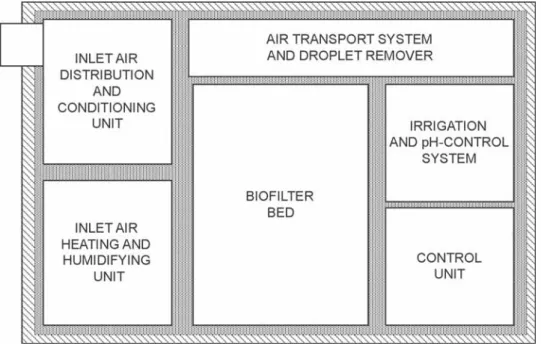
(3) HIGH THROUGHPUT BIOFILTRATION FOR ODOUR CONTROL AT WATER PURIFICATION PLANT. 61. The assay of the gas mixtures was performed via GC/MS with Shimadzu GC2010 instrument equipped with GCMS-QP2010 Thermal Desorber (Markes International Ltd., UK) and capillary columns. The sample for GC/MS was obtained by adsorbing the volatiles by aspirating the controlled volume of air through a Tenax© column.. 3 RESULTS AND DISCUSSION 3.1 CONSTRUCTION OF THE BIOFILTER To make biofilter more user-friendly and versatile a novel layout of the plant was used. An All-in-One principle was followed. All the main functional units of the plant: inlet air distribution and conditioning system; biofilter bed; irrigation and pHcontrol system; air transport system and droplet remover; control unit; etc. are enclosed within a standard 20-feet container (6000x2400x24000 mm) (Figure 1). The plant is properly thermo-insulated that enables outdoor installation. This is most important for the regions with a severe climate to which Russia evidently belongs to. When not in operation the plant can run in a stand-by mode maintaining its internal temperature regimes and thus precluding freezing or overheating.. Figure 1. Schematic outline of the All-in-One biotrickling filter..
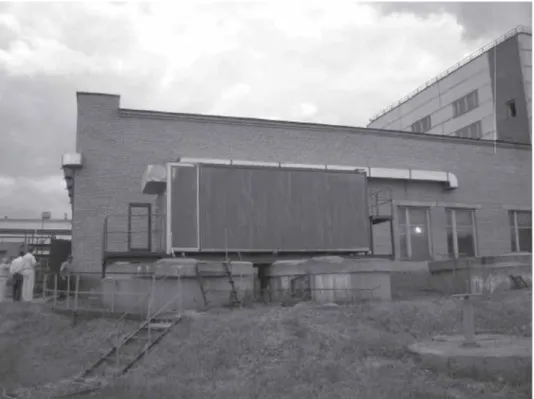
(4) 62. VITALY ZHUKOV, ANDREY VEPRITZKY, LEONID MITIN AND VLADIMIR POPOV. The plant is very simple to start and operate. It requires just proper tap water and power supply and connection to the on-site existing drainage/sewage system. The air ducts are easily fitted to the inlet flange of the system. The system can be regarded of the type «install-and-run». The main parameters of the plant are shown in Table 1, while its general view and location on site appear in Figure 2. Table 1. Parameters of the biofiltration plant. Parameter and unit Nominal air flow, m3/h EBRT, s Optimal inlet concentrations of volatiles, mg/m3 Pressure drop, Pa Installed power, kWt Irrigation flow, m3/h Maximal air linear velocity, m/s Consumption of tap water (including evaporation), l/h Power consumption for outdoor installation (summer / winter), kWt*h Temperature of the incoming air, °C Allowed ambient temperature, °C Dimensions (HxLxW), mm Operating foot-print, m2 Dry weight, kg Wet weight (operating), kg. Value 4,000 – 11,000 3-10 < 250 350 – 1,250 < 18,5 < 12,5 < 0,70 < 110 < 3.5 / 15.5 0 – 50 (-20) – (+40) 2,475x6,300x2,400 14,5 < 3,700 < 10,500. The compact arrangement of all the components of the biofilter within one unit provides a number of technological advantages: easy transportation, erection and mounting; easy interfacing with the infrastructure existing on site (power, water, sewage, etc.); easy maintenance and service. The plant can be easily scaled up by adding either additional filtration beds or by adding extra complete units. 3.2 OPERATION OF THE BIOFILTER Main operation facilities of the sewage department of the Moscow Water Works are located rather close to the housing area. It is not feasible to relocate them, thus management of Moscow Water is looking for efficient and cost-effective technology that will enable to secure that neighbouring households do not complain about the irritating odours. An extensive programme of testing and pilot runs was launched that.
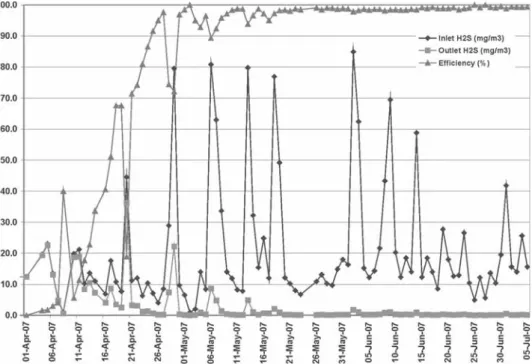
(5) HIGH THROUGHPUT BIOFILTRATION FOR ODOUR CONTROL AT WATER PURIFICATION PLANT. 63. enabled Moscow Water to select a trickling biofilter technology as the best available technology to control odours. The final phase of tests with a full-scale biofiltration plant, Figure 2, is currently in progress.. Figure 2. Biofilter at the premises of Moscow Water Works.. The biofilter was mounted close to the workshop for the residue sedimenting and dewatering that produces concentrated malodourous emissions. More than 70 components that varied in concentration quite considerably over time were identified in the emission by GC/MS technique. The dominant one was methane (1500-1600 mg/m3), while hydrogen sulfide – the major irritating pollutant was present in 12-16 mg/ m3 concentration with peaks up to 60-90 mg/ m3. The profile of the inlet and outlet H2S concentrations measured on-line with electrochemical sensor is presented in Figure 3. The results of the start-up and several months monitoring confirmed reliability of the technology. After about one month acclimation period the plant reached its target performance efficiency and is able to remove >98-99 % of the hydrogen sulfide coping with the spike emissions of about 30-80 mg/m3..
(6) 64. VITALY ZHUKOV, ANDREY VEPRITZKY, LEONID MITIN AND VLADIMIR POPOV. The instrumental GC – GC/MS assays showed that such pollutants as mercaptanes, amines, limonene, aromatic compounds were degraded with the efficiency of >99 % and could not be determined at the biofilter outlet (Table 3). Thioglycolic acid – one of the major pollutants with an average concentration of 5.5-6.0 mg/ m3 and peaks up to 10 mg/ m3 was usually degraded with efficiency of 80-99 %. Considerable depletion of the methane content - 40-70 % was also noted.. Figure 3. Start-up and performance of the trickling biofilter for odour control operating at Moscow Water Works. EBRT = 6 s.. The long-term (up to one year period) monitoring of the biotrickling filter plant is required to draw sound conclusions on the efficiency and the running costs. However already preliminary results show that the new All-in-One biotrickling filter could provide a viable solution to odour control at municipal water treatment plants..
(7) HIGH THROUGHPUT BIOFILTRATION FOR ODOUR CONTROL AT WATER PURIFICATION PLANT. 65. Table 2. Efficiency of VOC degradation in the biofilter. Compound 1. Methane 2. Isobutyl amine 3. Ethyl sulfide 4. Thioacetic acid 5. Thioglycolic acid 6. Dioxane 7. Toluene 8. Ethylene diamine 9. Methyl mercaptane 10. Butyric acid 11. Dibutyl amine 12. Ethanol amine 13. Limonene 14. Dibutyl sulfide. Retention time, min 00:55 01:09 01:43 01:57 02:19 02:37 02:47 02:53 02:59 03:54 05:27 05:38 08:26 08:50. Peak area, Inlet 11226.2 72.32 5.89 211.80 86.32 22.84 32.53 27.11 21.65 6.67 8.50 11.24 13.19 3.61. arb.un. Outlet 2557.85 – – 47.54 – – – – – – – – – –. Conversion, % 77 >99 >99 78 >99 >99 >99 >99 >99 >99 >99 >99 >99 >99. 4 ACKNOWLEDGEMENTS The project was supported in part by a grant from the Russian Federal Agency of Science and Innovations 02.447.11.3001. The authors thank management of Moscow Water, in particular Dr. Dmitry Danilovich and Mr. Michael Kozlov, for co-operation and good will.. REFERENCES Bezborodov, A.M., Rogojin, I.S., Ushakova, N.A., Kurlovitch, A.E. and Popov, V.O. (1998) Optimization of the microbiological technology for purification of air emissions from the mixture of benzene, toluene and xylene. Appl. Biochem. Microbiol.(Russia) 34: 265-269. Devinny, J.S., Deshusses, M.A. and Webster, T.S. (1999) Biofiltration for air pollution control. Boca Raton: Lewis Publishers. 299 p. Gabriel, D. and Deshusses, M.A. (2003) Retrofitting existing chemical scrubbers to biotrickling filters for H2S emission control. Proc. Natl. Acad. Sci. USA. 100: 6308-6312..
(8) 66. VITALY ZHUKOV, ANDREY VEPRITZKY, LEONID MITIN AND VLADIMIR POPOV. Popov, V, and Bezborodov, A. (1999) Industrial technology for microbiological abatement of air emissions. Appl. Biochem. Microbiol. (Russia) 35: 570-577. Popov, V.O., Bezborodov, A.M., Cross, P. and Murphy, A. (2000) Industrial trickling bed biofilters for abatement of VOCs from air emissions. In (ed. Ed.D.Wise e.a.) Remediation of Hazardous Waste Contaminated Soils, Marcel Decker Inc., 2nd ed., pp 449-473. Popov, V.O., Bezborodov, A.M., Cavanagh, M. and Cross, P. (2004) Evaluation of industrial biotrickling filter at the flexographic printing facility. Env. Prog. 100: 39-44. Popov, V., Khomenkov, V., Zhukov, V., Cavanagh, M. and Cross, P. (2005) Design, construction and long-term performance of novel type of industrial biotrickling filters for VOC and odour control. In: (Kennes C. and Veiga M.C., Eds), International Congress on Biotechniques for Air Pollution Control, La Coruòa, Spain, pp. 257–262. Popov, V.O. and Zhukov, V. (2005) Odour removal in industrial facilities. In (Shareefdeen Z. and Singh A., Eds.), Biotechnology for Odour and Air Pollution Control. Springer-Verlag, Heidelberg-New-York, Germany, pp. 305-326. Zhukov, V.G., Rogojin, I.S., Ushakova, N.A., Zagustina, N.A., Popov, V.O. and Bezborodov, A.M. (1998) Development of the technology of air deodouration and its field testing with the use of a pilot plant. Appl. Biochem. Microbiol. (Russia) 34: 370-376..
(9)
Figure
Documento similar
Si se asume que las personas con alto deseo de control son más vulnerables a la ilusión de control (Burger y Cooper, 1979) y se asume, al menos tentativa- mente, que los
In this study, we aimed at evaluating high- throughput array-CGH profiling of urinary DNA of blad- der cancer patients as a means contributing to further characterize
(A) measured throughput relative to the theoretical MIMO maximum throughput for a given reference channel with no radio channel impairments, (B) measured throughput relative to
Percentage of fruit size category for each treatment (TW-C: Transfer Water- Control; TW-RDI: Transfer Water-regulated deficit irrigation; RW-C: Reclaimed Water-Control; RW-RDI:
In Figure 4.16 A) the interior of a pyrolyzed pineapple with 10% sat. of FeCl 3 on acetone can be observed, along with a histogram representing the diameter of the analyzed particles
Serrano, “A Control Theoretic Approach for Throughput Optimization in IEEE 802.11e EDCA WLANs,” Springer Mobile Networks and Applications, vol. Azcorra, “A Control Theoretic
From the above results we conclude that our algorithm achieves optimal performance also when non-saturated sta- tions are present in the WLAN, in contrast to the static op-
In this study, oviposition intensity and the within-plant distribution of Orius insidiosus (Heteroptera: Anthocoridae) and Nabis americoferus (Heteroptera: Nabidae) eggs on
