
Ambidexterity in drafting of architectural projects
48
0
0
Texto completo
(2) “You never know enough, hence the known provides the unknown and its call”. E. Chillida.. ACKNOWLEDGEMENTS To all the ones always there.. ABSTRACT. The approach of this project focuses on analizing the specific contributions of matching explotation and exploration in architectural project drafting, as well as stating the application of ambidexterity in architectural projects as a source of competitive advantage, starting from knowledge theory and organizational learning, by means of a case study.. KEYWORDS. Ambidexterity, exploitation, exploration, architectural, projects.. 2 Ambidexterity in drafting of architectural projects. mjsm.
(3) TABLE OF CONTENTS. 1.INTRODUCTION………………………………………………………………........4. 2.THEORETICAL BACKGROUND………………………………………………....6 2.1 Introduction 2.2 Exploration, exploitation and ambidexterity 2.3 Exploration, exploitation in drafting of architectural projects 2.3.1 Drafting of architectural projects 2.3.2 Exploration, exploitation. 3.METHOD……………………………………………………………………………17. 4.ANALYSISOFTHE RESULTS……………………………………………….......20. 5.DISCUSSION….…….…………………………………………………………..…34. 6.CONCLUSION…….……………………………………………………………....39. 7.REFERENCES(bibliography)…………………………………………………...42. 8.WEBGRAPHY….…….……………………………………………………………47. 9.TABLE OF TABLES 9.1 Table of evolution of file openings………………………………..37. 3 Ambidexterity in drafting of architectural projects. mjsm.
(4) 1. INTRODUCTION My enhanced interest about business management professorship has made me deal with this project, since it provides an interesting schedule throughout the degree. Besides, I would like to combine two skills I have studied in my life: architecture – my job – and administration and business management – my training; without Montserrat Boronat’s mentoring and guiding, this would not have been possible.. We will analyze some of the specific contributions related to resource and capacities theory, dynamic capacity theory, organizational learning and knowledge theory, analyzing their importance on an architectural study and their results.. The main objective of this project is focused on an analysis, based on knowledge theory, stating the idea that the combination of exploitation and exploration, concerning different conditions of the organization, can be a source of competitive advantage, i.e., the role of organizational ambidexterity as the capacity of exploiting and exploring knowledge simultaneously (Raisch and Birkinshaw, 2008; Simsek, 2009; Tushman, Smith and Binns, 2011).. On the one hand, we will define knowledge exploitation as March (1991) proceeds in his works, where he associates exploitation with an orientation of the company towards efficiency, productivity increasement, control and certainty, centered on the capacity of improving and reducing variety. On the other hand, we will define March’s exploration (1991) as research, discovery, autonomy, innovation, variety, risk, experimentation and flexibility.. 4 Ambidexterity in drafting of architectural projects. mjsm.
(5) The information of these concepts is quite new and contemporary, so we will investigate how these concepts are applicated in architectural project drafting.. This project is divided into four main parts; first of all, by means of a theoretical description, we will define the applicable concepts, identify the applicable variables – concerning architectural project drafting, describe the applicable method and the kind of company of the sample, analyze the results and conclude.. 5 Ambidexterity in drafting of architectural projects. mjsm.
(6) 2. THEORETICAL BACKGROUND. 2.1 Introduction. Concerning resource and capacity theory, company success not only focuses on competitive structure effects – industry effect, but also company internal patterns – company effect.. A. company. can. be. considered. as. a. unique. combination. of. heterogeneous resources and capacities, but the key to profitability is not on acting similarly to other companies, but on exploiting the differences (Grant, 2006); this way, we face resource and capacity view (Grant, 1996; Barney, 1991), aiming at identifying company potentiality, establishing competitive advantages by strategic identification and rating of the acquired – or preacquired – resources and capacities.. According to RBV, competitive advantage does not result from the mere possession and control of rare and valuable resources, but rather from the idiosyncratic internal competencies by which a firm translates its resources into superior customer value (Amit and Shoemaker, 1993).. Besides, resources can be tangible and intangible, with very different behavior. They tend to be invisible, with complicated measurement, based on information and knowledge, very difficult to codify, and their cumulation is costly.. 6 Ambidexterity in drafting of architectural projects. mjsm.
(7) Resource and capacity theory has evolved and, currently, some points of view are based on knowledge (Grant, 2006), where the company is conceived as a set of intangible assets centered on intellectual knowledge or capital, so the direction has to be centered on how to generate them and exploit them for value creation.. Organizational knowledge is created through continuous dialogue between tacit and explicit knowledge, as Nonaka (1994) states, while new knowledge is developed by individuals. Organizations play a critical role in articulating and amplifying that knowledge. Innovation can be better understood as a process in which organization creates and defines problems and then actively develops new knowledge to solve them.. These two described types of knowledge are tacit or implicit – informal, personal, social or difficult to be expressed sistematically – and explicit – articulated, codified or somehow stored.. Tacit knowledge is important in architecture studies because it is the basis to know client needs and elaborate prior project; besides, explicit knowledge is applied for basic project drafting and resolution drafting, or for building management.. Concept creation involves a difficult process of externalization, converting tacit knowledge into an explicit concept. This challenging task involves repeated, time-consuming dialogue among members. Mutual trust is an indispensable base for facilitating this type of constructive collaboration (Schrage, 1990).. 7 Ambidexterity in drafting of architectural projects. mjsm.
(8) Organizational learning is the process learned by organizations, can be defined as the process through which organizations change or modify their mental models, rules, processes or knowledge, maintaining or improving their performance (Senge, 1990).. Experimentation can be understood as the degree to which new ideas and suggestions are attended to and dealt with sympathetically into organizational learning capability. It involves trying out new ideas, being curious about how things work, or carrying out changes in work processes. It includes the search for innovative solutions to problems, based on the possible use of distinct methods and procedures.. Knowledge. exploitation,. experimentation. and. the. creation. of. organizational learning environment are very important in architecture studies, since Project drafting efficiency is improved, i.e., the capacity to properly accomplish the process of drafting, so the construction could be accomplished with these memoranda and maps. Besides, knowledge research, concerning change and innovation, makes project drafting suitable for client, lot and environment needs. The simultaneous application of these two activities is named as ambidexterity.. 2.2 Exploration, exploitation and ambidexterity. Exploration refers to the acts of reaching and discovering innovative solutions, whereas exploitation refers to refining and gradual improvement of existing capabilities (O’Reilly & Tushman, 2007). The ability of an organization to both explore and exploit is referred to as organizational ambidexterity.. 8 Ambidexterity in drafting of architectural projects. mjsm.
(9) Studies have shown that ambidexterity leads to sustained competitive advantage (Crossan, Lane, & White, 1999).. Companies must be constantly renewed to survive in current marketing, changing all the time. Seeing how crisis took the control of worldwide economy, businessmen should show that there are some solutions nowadays. They must look for advice from experts, observe how other businesses are doing, and, needless to say, analyze the market, the needs and preferences of the people. If today one product is the newest, tomorrow it will probably be old-fashioned and, if a firm wants to survive and to have success, it might take that into account and try to anticipate events.. According to Li Liu et al (2012), organizations adapt to environmental uncertainties through exploration and exploitation. Exploration includes the search for experimentation with new approaches, processes or procedures, with an aim to find new solutions or develop new products or services (O’Reilly & Tushman, 2007). Exploitation refers to efforts to refine and gradually improve existing capabilities as much as possible (O’Reilly & Tushman, 2007).. Ambidexterity could be reached through different points of view; structural and temporal separation approaches create conditions that allow exploration and exploitation to be effectively managed within a single business unit and ultimately achieve ambidexterity if integrated well (Gupta et al., 2006).. According to Gibson (2004), different activities provide different company effects; exploitation focuses them on the short term and on efficiency, but it can generate inertia, obsolescence and conformism, limiting future survival. On the other side, excessive emphasis can generate too many novelties, if investment return is not taken into account.. 9 Ambidexterity in drafting of architectural projects. mjsm.
(10) Cao, Gedajlovic and Zhang (2009) highlight organizational ambidexterity compression and relate exploitation to exploration, since the concept is surrounded by two dimensions: company ambidexterity leverage – exploration absolute magnitude – and ambidexterity balance – the company maintains a similar emphasis between exploration and exploitation.. Balance is important; when dealing with exploitation-oriented companies, they construct routines that let them learn in experienced terms, repeating the behavior and making it gradually efficient by using it, so the probability of better results is increased (Levintah and March, 1993) despite limiting the research of an exploring orientation that helps the company answer future challenges (Lavie and Rosenkopf, 2006).. Nevertheless, the same authors state that new-knowledge receptivity is boosted if companies are focused on exploration, promoting learning and exploration.. Ambidexterity can be defined as the capacity of the companies to learning maintenance through these two activities, where exploitation and exploration are difficult to be balanced. Moreover, both capacities require different resources and practices.. 2.3 Exploration, exploitation in drafting of architectural projects. 2.3.1 Drafting of architectural projects. Dealing with architectural projects, Josep Quetglàs - Majorcan architect, Rafael Moneo’s disciple and architecture reviewer – states that arquitecture is an abstract idea becoming a concrete form by means of a constructive process;. 10 Ambidexterity in drafting of architectural projects. mjsm.
(11) Álvaro Siza - senior Portuguese architect, Pritzker arquitecture prize in 1992 – stipulates that things have to come naturally, not forcedly; Helio Piñón – architect from Onda, FAD prize in 1983 and 1993, says that projecting is predetermining how something is going to be – deciding, controlling, not merely desiring, i.e., arquitecture is the process of materializing an idea by means of a constructive process, naturally, controlling how it has to be like.. Moreover, throughout my career, I have collected seven basic projection premises:. 1. The project must belong to the place. 2. Any style is valid if it matches the idea. 3. Architecture must have presence always. 4. Buildings must have one window as minimum. 5. Buildings must accomplish neighbors’s courtesy rules. 6. Artesanry must be incorporated. 7. Geometry mistakes must not be made.. Concerning business management, integrated project management is the art of coordinating human resources and materials through project vital cycle, reaching pre-arranged configuration, scope, timeliness, quality and satisfaction objectives of project interested parties.. Following up, the process of architecture project drafting can be divided into two phases – concept and design, facing construction, defining exploration and exploitation variables; edification agents should be described. According to Law 38/1999, November, the 5th, Edification Order, an arquitect is a planner, i.e., an agent who, according to the promoter – and to. 11 Ambidexterity in drafting of architectural projects. mjsm.
(12) technical and land regulation – drafts the project. Besides, the project is the set of documents through which the technical requirements of the given constructions are defined and determined; moreover, this agent will have to technically justify the proposed solutions, concerning the specifications required by the applicable technical regulation. The promotor is defined as any individual, physical or juridical, public or private, who, individually or collectively, decides, impulses, programmes and finances, with own or alien funds, edification works, either for self profit or for its future disposal, submission or third-party transfer under any title. The constructor is the agent who assumes, contractually facing the promoter, the compromise of executing – with human or material means – the works, or part of them, according to the project and the contract. The promoter is the person who orders a project to an architect; the architect, providing an initial personal interview and a lot visit, has to manage client’s needs. He has to know the regulations of the area where the building is going to be built, either residential or entitled. Besides, he has to be aware of promoter’s budget, in order to adequate the materials to the economic disposal. The constructor is the person who materializes the architectural project from his organization. The moment of the realization of the preliminary project is the most magic moment; it starts from an infinite-dimension melting-pot blank sheet of paper, gradually reaching the different solutions to be showed to the client. Starting from a blank sheet, imagination is used and, gradually, with creativity, the architect is molding the possible ideas to value that particular environment, that lot and those client’s specific needs. When materializing the. 12 Ambidexterity in drafting of architectural projects. mjsm.
(13) idea, from the project highlighted on maps and memoranda, innovation is surged, rehearsing and applying new constructive solutions. The architect has stopped being that lonely worker, dealing with multiskilled teams with people from different origin and training, where those people work together on a shared process: project drafting. Essentially, this process has to be matured, and delegation, autonomy and team work are boosted. The design of the work place tends to be a creative space, where furniture, equipment and lights are high-standing, creating an environment related to the architect’s original style. Once the promoter approves the preliminary project, project drafting is present; the size of the studio is important for project drafting, since complex, big projects will probably need fusions or alliances. Project drafting is based on two parts: basic project and execution project; basic project asks for construction licenses, taking time to execution project drafting. Optionally, both are mutually drafted and the license is directly applied for. Concerning general contests, a preliminary project is submitted together with an economic escrow; the winning team proceeds with project drafting. Generally speaking, basic projects contain a memory, some plans and a budget, which shows land file, general data, descriptive memory, constructive memory, basic documents of edification technical code, budget brief and situation, plants, elevation and section plans. Execution project contains a memory, some plans and a listed budget, which shows land file, general data, descriptive memory, constructive memory, memory annexed documents, basic documents of edification technical code,. 13 Ambidexterity in drafting of architectural projects. mjsm.
(14) extra regulations, structural calculus annexed files, budget and the plans of the structure, facilities and constructive details, a condition statement, waste management study, geotechnical study which is agreed upon a specialized company by means of the promoter, and a safety-health study. The construction cannot be executed without project drafting. Building needs promoter’s order, and, then, preliminary project, project drafting – signed by its drafting architect – and construction management by the managing architect of the construction – and the technical architect, together with the constructor or contractor. All this process has to accomplish a strict regulation; either national – edification technical code – or local – land regulation. 2.3.2 Exploration, exploitation Turner and Lee-Kelley (2013) state that the project management context is an ideal one in which ambidexterity can be studied, because it necessarily involves blending rigor of project management principles with the practical problem-solving and innovation required to execute real-world projects, which are all, to some degree, unique. Robinson (2011) defines what an architectural project is; starting from imagination, beyond-sense things appear, developing, by means of creativity, original, valuable ideas, using new, innovative ideas. Robinson (2011) shows that, in architecture studies, organizational innovation tends to be promoted, since creativity shares diversity, loves collaboration, takes its time, it is an adaptable, flexible culture, and it is developed in a creative work space. This way, at this stage of preliminary project drafting, creativity and human capital experience are essential, as well as client’s needs adaptation, 14 Ambidexterity in drafting of architectural projects. mjsm.
(15) even new client seeking – concerning studio survival, and client needs satisfaction differently to competence, taking some advantage. Turner et al. (2014) state that projects can be understood as knowledgebased activities, and it is important to differentiate between existing knowledge – it can be brought to a new project to enable its execution - and the requirement to generate new knowledge as part of the work itself. Any project that contains novelty, ambiguity, or unknown requirements needs new knowledge generation as part of the process. Capacity, and flexibility, for solutions are very important, as well as software – project drawing, structure-facilities modelling and calculating, subdued by proper regulations. Besides, technical skills of human capital – know-how, i.e., of multiskilled team project drafting, are very important for efficiency; similarly, knowledge-sharing skills are good for problem-solving, as well as compromising in quality and its improvement. When project drafting, many decisions need to be reached, positively and negatively. The initial stage is very important, since existing knowledge is used in order to generate new knowledge, shared by all the members in the team. Concerning business management, innovation is the sum of the generation and the implementation of ideas. In arquitectural processing, the generation of ideas surges from the preliminary project, basic project drafting and execution project drafting; the implementation of ideas is based on building management and its execution or construction: every arquitectural process is innovative, unique for every client and environment.. 15 Ambidexterity in drafting of architectural projects. mjsm.
(16) In terms of knowledge problems, Klein and Meckling (1958) looked at the performance of defense technology development programmes and argued that it is impossible to know, at the beginning of a long development process, which of numerous design options will lead to the best solution (see Brady, Davies and Nightingale, 2012). Among the options and choices to the final design, they will be optimal for the environment in which eventually operate. Turner et al. (2014) say that projects are a particular challenge in which the work cannot be structured easily, a clear path to delivery is rarely evident, and various forms of complexity are present. They consider ambidexterity as an intelligent balancing of exploitation and exploration. As Geraldi et al. (2011) said, their terms are important like the output (what is done) and the process (how it is done). Exploration and exploitation are necessary for successful architectural project drafting and executing. Taking into account that this environment provides the exploration of new technologies, new ways of client satisfaction, new client groups, creativity and human capital experience, and flexible solutions, and that exploitation is defined as quality-improvement compromise, offer related to client needs, technical skills and knowledge-sharing skills, both activities can be analyzed in architectural studies under three points of view.. 16 Ambidexterity in drafting of architectural projects. mjsm.
(17) 3. METHOD The following empirical method consists in analyzing the concepts of exploration and exploitation when drafting an architectural project, checking how several factors are connected through a case study.. The study case is going to be developed on a sample of three differentsize architectural studios. The information is going to be collected through evidences by means of a personal interview, where some questions are going to show the variables which generate practices on the concepts of exploitation and exploration. The use of different architectural studios in this project, as well as the own experience and observation of its author, have been able to contrast the information obtained in the interviews, hence following some of the basic recommendations of case study methodology (Yin, 1983).. The measurement of the different concepts is developed through the measurement ways of other authors, i.e., Lubatkin, Simsek, Ling and Veiga’s scales (2006), on new-technology exploitation skills, research of new ways of client satisfaction, new client groups, quality-improvement compromise or offer related to client needs.. Other items are collected, based on Turner et al.’s scales, since the previous scales do not collect them and they were necessary around this kind of companies, due to the fact that, in conventional literature, they were not collected in any scale, patterns related to human capital creativity and experience, solution flexibility, technical skills or knowledge-sharing skills, as previously mentioned in theoretical concepts of exploitation and exploration applied to architectural project drafting, or fusions and alliances, studio size or manager schedule formalization. In terms of a case study, providing interviews. 17 Ambidexterity in drafting of architectural projects. mjsm.
(18) with an open questionnaire, this measurement form is a guide, since open questions are expected and the interviewee is going to show his point of view and tell how the differents tasks are accomplished in his studio; then, the items are going to guide through the open questions.. This project is focused on analyzing how project drafting project is developed; although the three analyzed studios have been transformed after crisis, changing their juridical and organizational form, the interviews have pretended to obtain information about this architectural project drafting.. The first architectural study is a kind of consultancy studio, with 18 members from different skills; it is formed by two architects, two civil engineers, two industrial engineers, an agricultural engineer, two public-work technical engineers, two technical architects, six draftsmen and an administration and business management college graduate. It is focused on different works and projects; not only civil engineering – treatment plants, waste or urbanization treatment plants, but also architecture – single-family home and high-rise housing, or singular buildings, constantly applying for public-administration contests.. The second architecture studio is formed by 13 members: five architects, two technical architects, four draftsmen and two business college graduates; it is based on architectural works, mainly single-family and high-rise edification.. The last studio is formed by three members: two architects and a draftsman; it is focused on architectural works, mainly single-family homes.. The collected information in this project comes from different sources, mainly scientific investigation articles, precise interviews with the master. 18 Ambidexterity in drafting of architectural projects. mjsm.
(19) architects of the studios and other secondary sources – cultivated interviews by the Official College of Architects about its job status, editorial articles or the author of this project’s own experience and observation.. The scientific articles have been useful to obtain reliable information in order to understand the concepts of exploitation and exploration, and the concept of ambidexterity, to be used on this study case.. The interview has showed how the different described variables – used for project drafting – are able to work, so the interview guiding questionnaire can show some of the same aspects other authors have dealt with and included for their scientific studies, as previously mentioned.. After precise interviewing, the information has been processed in order to manage the analysis of the results.. 19 Ambidexterity in drafting of architectural projects. mjsm.
(20) 4. ANALYSIS OF THE RESULTS. On this point, the different patterns provided in the theorical background are going to be analyzed, how these factors can determine ambidexterity in architectural project drafting and how the different steps are connected to the studied variables and the results, since the main goal of this project deals with an analysis based on knowledge theory, in order to state that, under different organizational conditions, matching exploitation and exploration provides a source of competitive advantages.. Following up, this project faces ambidexterity and exploration and exploitation, regarding a positive influence on results, invoice increasing or professional order increasing.. EXPLORATION. New technology research skills. Technology is an important factor, able to determine – in the average and long term – company success, the practical application of software tools, numerical process automatization, multimedia project mastering and online service management.. Concerning architectural project drafting, updated software is very important in order to plan drawing, modelling the structure and facilitating facility calculus and regulation accomplishment.. When using new technology, team capacity shows the project manager – after knowing individual skills – how to ICT master. However, difficulty is not on. 20 Ambidexterity in drafting of architectural projects. mjsm.
(21) digital instrument usage – software and hardware, but on the proper choice of those instruments and on their proper usage depending on the reached goals.. A computer plan is convenient, since it allows proper planning, proper software-hardware-communication. investment. and. proper. technological. options.. The strategic impact of new-technology exploration can improve the relative position of the company and change the sector structure, modifying the organizational value chain.. Research of new ways of client satisfaction. It is typically necessary to explore alternative solutions and processes to identify a satisfactory solution that will address clients’ needs within the project constraints. As the project progresses, the focus shifts to exploitation as the project solutions become familiar and the capability is developed to learn from initial experiences and streamline processes (March, 1991).. Daniel Silberfaden, Architectural Faculty dean in Palermo University, says, "the design and construction of contemporary housing require a new look due to social, economical, technological and environmental changes. Currently, housing is related to several new factors as teleworking, demographic changes which impacted on housing dimensions and their different ways of space usage. Solution array is being widely modified. Previously, housing was mainly designed for nucleous families. However, the current model is plural; new dynamics appear".. 21 Ambidexterity in drafting of architectural projects. mjsm.
(22) The architect has to adapt to new times, constantly fitting the environment and being able to satisfy client’s new needs – related to new ways of life. The client needs a valuable service, either emotional or economical, so increasing his perceived value is important; the client, and the client’s order, are unique and important, so the client needs a precise, different service.. As Arrevol comments on his blog, “Architects are often considered as artists, but nobody understands our speeches and we forget that we are designing for other people and not for ourselves. We have to understand who is around us, their needs, their views and objectives, and design not for other architects, but to the people living our design”.. In the long term, an architectural project will last if it seeks for new ways of client satisfaction.. Searching new client groups (contact network). Client prospection has to firstly identify the ideal client, and identify the valuable proposal connected to him. It is necessary to know how and where to identify new clients, and how to find contact data.. Long-lasting contact is important to be reached, mainly with potential clients, and it is important that the clients know the company.. In architecture, it is complicated, since it is a service where, in general terms, the client comes to the company; offline, business partnerships need to know the company, some works need to be edited on specialized magazines, other professional colleagues need to collaborate with the company, and satisfied clients have to recommend the company.. 22 Ambidexterity in drafting of architectural projects. mjsm.
(23) Concerning extremely visual projects, social networking is important for potential clients to watch project results, so the maximum rate of people should be aware of the company. Besides, the website needs to be optimized, creating a client-oriented website, instead of an architect-oriented website, and improving the branding or the brand image the studio would need, since the Internet is an open window to the world.. The architect has to be able to deal with project drafting, promote his finished work and seek new clients and orders.. Individual human capital (creativity and experience). Organizational success depends on its adaptive leverage; human capital is important, as well as creativity, concerning flexibility and constant-change adaptation. Proper organization allows creative teams, and proper knowledge management, together with problem-solving, allow company improvement. Creativity joins experience, since knowledge – it keeps growing through problem solving – approves and rejects solutions, and solves problems positively.. Creativity is distinguished by some basic ideas like fluency, frequency, idea modification and flexibility. The professional, joining a project drafting team, has to be able to transform his work skills, so new ideas appear. He has to apply creativity to the whole drafting process, offering new solutions and providing new idea; besides, experience lets him repeat successful solutions.. The development of human capital creativity can be reached by applying some principles, like dialogue promoting, team work, good work environment and own knowledge. It is very important for human capital to be provided with. 23 Ambidexterity in drafting of architectural projects. mjsm.
(24) knowledge-developing resources, by means of an environment which promotes aptitudes and facilitates new-solution sources, through new mental schemes and new ways of thinking. As professor Francisco Pérez – IVIE investigator - says, when investing on knowledge, human capital, technological development, innovation, design or brand, it is not about topics; this way, empirical evidence is conclusive. The products incorporating these ingredients are more valued in marketing, are sold at bigger prices and are able to take more profit of the resources that developed countries own abundantly: human, technological and business capital. Besides, creative organizations have creative leaders, with a future point of view. For projecting, it is necessary for team members to deal with autonomy, in order to think, believe, decide, plan, evaluate and improve, since these skills will generate value through creation and knowledge transference; and, as my project teacher, Juan María Moreno, said, an architect cannot be considered a complete professional before his forties, even later.. Flexibility for solution seeking (organization). Flexibility is a set of skills able to let the organization adapt to the environment, as well as fast, efficient and varied answer, in order to be adapted to the different changes which affect the organization.. Concerning Castillo López et al. (2006), the dimensions of strategic flexibility can be classified following three criteria: flexibility objectives or intentions, the means used for flexibility development and flexibility results. When relating to human resources, it can be reached under three points of view: productive dimension, where the employees show their adaptability and. 24 Ambidexterity in drafting of architectural projects. mjsm.
(25) determine the company flexibility from training, acquired knowledge, versatility and task rotation; organizational structure dimension; management team heterogeneity, coexistence of different points of view and changes, capacity of detecting new information sources, decision process, task distribution and internal communication processes and channels provide fast, agile answer facing environmental changes, altering business results; human dimension, focused on human resource practices providing adaptation and orienting human resource behavior through identity and leadership, regarding better competitive advantages. In terms of resource-capacity theory, flexibility can be analyzed oriented to the leverage in which the company joins organizational skills, and improved skills to increase organizational performance.. In project drafting, flexibility is the capacity of drafting team members to project environment adaptation, providing a fast, efficient answer to the client, since every project is understood as something unique, with many responding variables; this could be possible if the study provided organizational skills, and if it generated and retained drafting team members’ talent.. EXPLOITATION. Quality-improving compromise. According to Lubatkin, Simsek, Ling and Veiga’s scales (2006), organization has a great range of processes and systems which define and guide its operations.. Regarding notable architecture project drafting, Garvin (1984) states that it has to be based on the user, where quality is in observer’s eyes, since clients. 25 Ambidexterity in drafting of architectural projects. mjsm.
(26) have different needs; Reeves and Bednar (1994) define quality as a way of equalling or exceeding client’s expectations, as user’s needs satisfaction; a personal quality point of view according to client’s particular preferences. Concerning service quality dimensions, Zeithaml et al. (1993) show that tangible elements, reliability, response capacity and sympathy can be identified. In project drafting, quality-improvement compromise has to be centered on reliable, careful, skilful service, prone to user-helping, with a range of knowledge and care from drafting team member, providing reliability and selfconfidence, conforming a precise, individual customer care.. In architecture studies, total quality can be managed, based on client’s guidance,. people’s. guidance,. leadership. and. drafting. compromise,. organizational global vision and ongoing improvement.. Concerning. quality-improvement. compromise,. following. learned. guidelines, quality-improvement compromise requires client’s needs, and project drafting according to his needs. On the other hand, it is good for drafting team members to be empowered to reach decisions, team working and up-anddown communicating. The project manager has to deal with new leadership terms, more participating and qualified.. Lastly, ongoing improvement implies strategy-process regulation, and the use of a systematic process PDAC-like, regarding planning, execution, control and action.. Offer-rating for satisfied clients. Companies have to focus on new-client seeking, but they have to pay attention to current-client and new-client maintenance. Service leverage is very. 26 Ambidexterity in drafting of architectural projects. mjsm.
(27) important, so a unique service has to be offered, very personalized when project drafting, where precise tracking and personal relationships have to be enhanced. It is very important for the architect to know his client as much as possible.. Following Renart (2004), company real business is not client making, but client maintenance and client profit maximization; so, the offer has to be adapted to his needs hence satisfy him, so marketing strategies have to be altered from transactional, obsolete, to relational marketing.. Relational marketing defends the creation, after first-project closing, of stable, continuous relationships, developing a set of actions which allow relationship, satisfaction and loyalty improvement. Relational focus has to be proposed in every project drafting phase, from client seeking to his complete satisfaction and loyalty.. This kind of marketing is defined as interactivity, personalized actions, register and memory of data and preferences, client orientation, valuable client discrimination and their value creation.. Relational. focus. constitutes. a. diferentiation. strategy,. so. client. management is hard to imitate due to competence, and allows offer to keep client satisfaction; besides, the potential value of a satisfied client is multiplied by the number of years he is going to keep being a client.. Individual human capital (technical training). It is known as innovation and projectable experience. Polanyi (1967) says that individuals accumulate tacit and explicit knowledge, and bring this. 27 Ambidexterity in drafting of architectural projects. mjsm.
(28) expertise to their work (human capital); this can be their particular skills, experience, judgement, and so forth.. The Arquitect International Union describes an architect’s profile, together with his knowledges and fundamental capacities, as follows:. - Capacity of creating architecture designs able to satisfy aesthetic and technical needs environmentally-sustainable. - Knowledge in history, architecture and art theory, technology and connected human sciences. - Knowledge of Arts, as an influence on architecture design quality. - Knowledge of urban design, planning and the aptitudes required by planning processes. - Knowledge of people-building, building-environment and building-space relationship. -. Knowledge. of. environmentally-sustainable. design. means.. - Knowledge of architecture and the role of architects in society, mainly on social descriptive memorandum drafting. - Knowledge of investigation methods and management of design-project descriptive memoranda. - Knowledge of structural design, construction and engineering problems, according to building design. - Knowledge of physical, technological problems, and building function, providing internal conditions of comfort and climate protection. - Proper design skills necessary to satisfy user’s needs concerning the limits settled by cost and edification regulation. - Knowledge of industries, entities, regulation and procedures for design concepts to become buildings and integration plans in global planning. - Knowledge of project finance, administration and cost control.. 28 Ambidexterity in drafting of architectural projects. mjsm.
(29) Besides, in architecture, and in project management, the analysis prior to in situ design, schematic design, design ellaboration and documentation, construction documentation and contract administration has to be managed.. Social capital (knowledge sharing). Ortoll, E. (2003), professor in Studies of Sciences of Information and Communication, says that knowledge is based on skills facilitating knowledge creation and sharing, as well as life-time learning (O'Sullivan, 2002).. Following up, she defines informational competence as "the capacity of recognizing a piece of information needs and identify, locate, evaluate, organize, communicate and use effective information, problem-solving and lifetime learning" (AASL, 1998).. In knowledge-based society, the main point of view aims at intellectual elements; then, the next step consists of analyzing knowledge and capacity able to let workers acquire, use and interact effective information and knowledge, regarding strategic information and knowledge in order to organizational value, providing knowledge and capacities as a self-trained, sharing element, i.e., better individual, organizational capacities need new effective skills in social informational context.. It is important for project drafting members to understand the processes in which the study is immerse, recognize and identify the information sustaining those processes. The have to know how to use applications and systems able to explore the information, concerning project drafting, and, by means of research-analysis skills, obtain and share information with the rest of team members, providing valuable knowledge on study goals.. 29 Ambidexterity in drafting of architectural projects. mjsm.
(30) Know-how. In architecture – and in this project – Know-how is the set of technicaladministrative knowledge, indispensables for project drafting, not protected by a patent, but essential for successful studies.. Apart from academic-technical knowledge, information about company strategy, client data, knowledge and experience are also included.. Moreover, project-drafting architect and team members have to be experienced in problem-solving, leading and managing the technical efforts, making under-pressure decisions, self-confident communicating, working with administration in order to join technical-administrative knowledge, motivating, guiding and focusing the efforts towards concrete results.. All these patterns, forming their profile or role, are included in know-how, together with previously described technical knowledge, compiled throughout their student training and constituting their technical skills.. FUSIONS AND ALLIANCES Among multiple company expanding options, consultants tend to promote strategic-collaboration flexible, adaptative solutions, instead of traditional fusion-acquisition mixture. Alliances are more flexible, imply less legal obligations and can be produced for concrete orders. National Bureau of Economic Research (NBER) states that fusions destroy value, concerning a 20-year-long study on big companies.. 30 Ambidexterity in drafting of architectural projects. mjsm.
(31) The managing architect has to know how to project-order rating, analyze if his work team – by means of know-how and technical skills – can face it and ask for external help if it is not on its way. Consequently, when project drafting, the client always needs an answer, so capacities need to be rated; if difficult projects, big projects, delicate timeliness or technical complexity appear, and an efficient answer is difficult to be reached, he has to join complementary teams, since client’s satisfaction cannot be forgotten. Dealing with successful alliances, he needs honest attitude, analysis of the kind of contract he is going to sign, and avoidance of alliances based on CEO friendship-relationship; close relationships are not totally prone to alliances. STUDIO SIZE. Studio size is oriented to possible alliances; it is very important to determine possible orders. Needless to say, the more bigger studio, the more bigger projects, beyond single-family homes or high-rise homes. A multi-skilled studio will be able to deal with different kinds of ordering.. Contests, public works, endowment buildings – hospitals, schools, universities, i.e., complex orders, require a bigger studio size; the proportion among studio size, budget and project size is always direct. Task formality is more necessary concerning big studios, so they need more coordination procedures. O’Reilly and Tushman (2007) state that managing ambidexterity is manager’s behavioral orientation towards combining exploration and exploitation within a certain period of time. Manager’s task. 31 Ambidexterity in drafting of architectural projects. mjsm.
(32) arrangement and functional interface participation can be understood as a filter to company ambidexterity.. Manager task formalization. Formalization of manager’s task refers to the degree to which rules and codes describe a particular task; it provides guides for decision-making, and for conveying decisions, instructions, and information at the degree to which the manager has to conform to the task description (Hage 1695, Pugh et al., 1963).. Task formalisation helps to describe the elements, the people and the timeliness around task accomplishment; for project drafting managing, tasks need to be known, together with assigned taks and project timeliness.. He has to be skilful to assign tasks to every member according to knowledge and skills, i.e., to lead and know staff expected behavior.. Preliminary project is very creative; tasks cannot be formal, since ideas flow around, looking for good solutions. Without a good preliminary project, the project will be mediocre.. However, basic-execution project drafting allows formal tasks, although project personalized, since all the necessary documentation responds to Edification Technical Code, so formalized procedures are very interesting, possibly helped by some information management systems.. Project manager has to know how to formalize his tasks and the rest of the team’s tasks, and that decision is made differently concerning different. 32 Ambidexterity in drafting of architectural projects. mjsm.
(33) studies. Some managers just manage, and other managers, apart from managing, join the drafting team.. Interfunctional interface participation. Participation in cross-functional interfaces by a manager will be positively related to this manager’s ambidexterity; good managing needs to know the whole project drafting and, even delegating, he has to know how to draft every one of its parts.. Consequently, project drafting manager needs to know how to draft every of its parts, since, gradually, he is going to be the project representative; it is interesting for him to know how to coordinate the drafting team according to his experience and technical skills.. As previously mentioned, he can either join draft team or not, but, joining functional interfaces and joining certain parts in project drafting, the project will be more precise and defined.. Similarly, this depends on order sizing, difficulty, simultaneous projects and timeliness; it is on manager’s own decision, without fixed rules, and on dealing with better works and client’s satisfaction.. 33 Ambidexterity in drafting of architectural projects. mjsm.
(34) 5. DISCUSSION. In this project, it is important to show the importance explorationexploitation project drafting; theoretical concepts have been described, together with the study of three cases performed by personal interviews – as described in the method, and the following conclusions have been reached:. EXPLORATION. According to new-technology exploration skills, the three studios are centered on new software facilitating project drafting tasks, although the biggest studio applies information system management tools.. According to new client satisfaction ways, they have observed new housing dynamics referring to environmental conditions, energetic efficiency and Edification Technical Code application, although the way single-family homes are projected keeps showing too conventional patterns. All of them consider client’s needs satisfaction as fundamental, and the client as their final goal, conceiving the accomplishment of their needs and desires as the most difficult pattern to reach, considering high work team attention in terms of project understanding, arranging some meetings with the client before preliminary project planning, mainly when dealing with single-family homes.. Client seeking varies depending on studio size; the biggest studio attends trade fairs, while middle studios arrange weekly meetings with businessmen where they join agendas, and little studios do not arrange any tasks to be known. They never analyze the social-networking impact, joining differentiation problems in little studios, between studio and person, although they three have a clear brand image to be projected.. 34 Ambidexterity in drafting of architectural projects. mjsm.
(35) Concerning human capital, the three studios consider their project drafting team as experienced, providing autonomy to create and decide, while middle studios are more production-limited as further delegation is not possible; every studio creates its own creative environment: some of them create a good work environment based on respect, other people promote dialogue and participation by balancing each member’s capacities, and other people are based on calm and group design sharing.. Concerning flexible solutions, little studios are more flexible; bigger studios are less flexible with more different tasks. Everybody deals with human resource practices, promoting business identity and leadership. Fast answers are provided to clients, when this is a determining work factor, since they consider that a fast answer does not solve real problems because there are more important factors.. EXPLOITATION. Concerning quality-improvement compromise, big studios are not worried about equalling or exceeding client’s expectations; middle studios find it hard to exceed client’s expectations, and little studios try to exceed client’s expectations according to constructive quality. All the studios are aware of individual client’s care, since they consider that thinking about a concrete architecture work without thinking about the client is impossible. Big and middle studios promote communication and participation among team members, and little studio provides informal communication depending on the context.. In order to offer adaptation and client satisfaction, the big studio provides satisfaction surveys and long-term interviews, while the rest does not maintain precise contact. According to new-client strategy, big studios search clients. 35 Ambidexterity in drafting of architectural projects. mjsm.
(36) online, while little studios work word of mouth. They three have dealt with a client asking for other projects shortly after.. Concerning individual human capital technical skills, they deal with in situ previous analysis when project performing, mainly data recording and visiting. All of them get involved in scheming or planning prior to project drafting, mainly on big studios. Documentation and regulation are thought to be necessarily accomplished prior to project drafting, and the biggest studio connects to ISO 9001 policy.. Social capital shows different knowledge-sharing skills; if the studio is big, the team members have taught courses to other members; the rest does not perform this way, but all the team members know the project information and tend to occasionally work in pairs, apart from the biggest studio – rather individual work.. Concerning know-how, all of them think that their team is able to make under-pressure decisions – actually, some members are better. Technical knowledge is quiet specialized, and all the team members can deal with partial client-supplier data.. The three studios have worked together with other teams and are satisfied with the result, although, when being asked about their team on any kind of project, they are sincere and tend to hesitate. They think multi-skilled teams are able to face big projects. The manager assigns the tasks prior to project drafting, and all of them have their average documents formalized; besides, the big studio also formalizes its procedures concerning ISO 9001 regulations. They like participating actively in partial project drafting, and prefer. 36 Ambidexterity in drafting of architectural projects. mjsm.
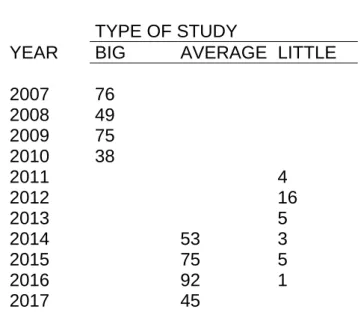
(37) to project better than manage, although good management is very important for good results.. Table 1: evolution of file opening. YEAR 2007 2008 2009 2010 2011 2012 2013 2014 2015 2016 2017. TYPE OF STUDY BIG AVERAGE LITTLE 76 49 75 38. 53 75 92 45. 4 16 5 3 5 1. Source: own elaboration.. Table 1 shows the historical annual file number; we can see how the big studio, gradually, was losing some orders, and, finally, due to crisis, it closed, although, currently speaking, the team is working autonomously – either individually or in group, according to the project.. The middle studio also disappeared due to economical framing, and one of the three partners is ongoing individually, with an increasing number of projects.. 37 Ambidexterity in drafting of architectural projects. mjsm.
(38) The little studio is in changing process, dealing with curation and production of contemporary art exhibitions.. In these cases, although these companies have disappeared, they have been reinvented and adapted to environmental conditions under different points of view.. 38 Ambidexterity in drafting of architectural projects. mjsm.
(39) 6. CONCLUSION. The main objective of the project is the analysis of architecture project drafting as an important pattern in exploration and exploitation.. Following the analysis of these cases, the studios, by means of their project drafting practices, develop exploitation and exploration skills.. Concerning exploration, new-technology research is present; bigger studios develop precise research. Apart from studio rating, they are aware of client’s satisfaction, and new-client research skills are different. All of them provide autonomous teams and create their own creative environment, as well as flexible solutions – bigger studios provide specified tasks.. Dealing with exploitation, they tend to avoid client’s expectations excesses; bigger studios perform better practices to adapt the offer to the clients, and provide better research capacity. They exploit and develop the technical skills of individual human capital, considering data registering as a very important pattern, as well as project planning. Better studios have better procedure establishment. The biggest studio provides good knowledge-sharing, but, in all the studios, project information is known. Technical and administrative knowledge is quiet specialized and the teams know how to work under pressure, but this tends to depend on the individuals.. These results, ignoring the current economical status, cannot be extrapolated. Spanish economical increase has been based on work productivity increase, from 1961 to 2011, and, according to Rafael Myro (2013), factor-product marketing has not been flexible enough, and a pseudo-artificial job increase has been performed, related to excessive construction sector. 39 Ambidexterity in drafting of architectural projects. mjsm.
(40) expansion. and. other. factors,. provoking. cyclic. fluctuations. and. big. macroeconomical imbalances. The increase model, based on real-estateproperty activities, according to Gandoy and Picazo (2013), explains the construction increase, from the mid 90s to 2007.. This factor has affected the number of architecture project drafting very much; concerning Spanish Land Management Ministry data, taking into account the number of final-work certificates, a considerable decrease is appreciated from 2007 to 2016, e.g., in 2007, 641,419 homes were finished, and, in 2016, around 40,119.. Summing up, ambidexterity is applied to project drafting – exploration and exploitation, affecting architecture project drafting positively. Although companies have had to reinvent by means of other juridical and organizational ways, in architecture project drafting both concepts achieve a combination of those aspects. Big studios deal with wide management practices but they provide specialized work and more procedural patterns; without the combination of both characteristics, little studios would not reach competitive advantages either.. The analysis of this project has obtained some results stating that the middle studio provides the best competitive advantage, getting to survive from crisis, while the little and middle studios have not survived, not only because of ambidexterity lack, but also because of other effects.. The big studio, due to the excessive cost of company infrastructure maintenance, unable to conjugate the necessities in terms of market conditions, and losing orders resoundingly, with all its workers hired as salaried, found more difficulties. They were unable to adapt to crisis in order to explore new. 40 Ambidexterity in drafting of architectural projects. mjsm.
(41) horizons,. although,. currently. speaking,. its. members. keep. working. autonomously and occasionally collaborating on projects; concerning this decentralization formula, they have not been able to keep working democratically and somehow assure the survival of part of the original company.. The middle studio shows invoicing evolution, from 2012 to 2016, from 60,000 to 180,000 euros, tripled in five years. The projects have doubled, from 53 to 94, so it has been able to exploit and explore at the same time, and come back with a lonely single partner, opening new markets despite bad current status, i.e., they created a company dedicated to adapting reduced-accessibility people homes. Besides, part of the employees of the original company worked as freelancers, and infrastructure was smaller than the one in the big company.. The little studio, mainly dedicated to single-family home project drafting, has not reached any crisis-adapted formula, although it has been somehow reinvented and survives on changing process from its original occupation, with its dedication to curatorship and contemporary art exhibition production.. Dealing with study cases, the project has been somehow limited; for general conclusions, the sample would have to be extrapolated to a wider set, based. on. statistical. and. econometrical. studies,. expanded. in. future. investigations.. Throughout this study case, the factors have been studied, showing that they are performed in architectural project drafting.. 41 Ambidexterity in drafting of architectural projects. mjsm.
(42) 7. REFERENCES (bibliography). Amit, R. and Paul H. Shoemaker (1993). “Strategic Assets and Organizational Rent.” Strategic Management Journal, 14 (January), 33-46.. Barney, JB. (1991). “Firm resources and sustained competitive advantage”. Journal of Management, 17(1), 99-120.. Brady, T., & Davies, A., (2004). “Building Project capabilities: From exploratory to exploitative learning”. Organization Studies, 25 (9), 1601-1621.. Brady, T., Carver, S., Kutsch, E., Lee-Kelley, L., Maylor, H., and Turner, N., (2014). “Ambidexterity and Knowlegde Strategy in Major Projects: A Framework and Illustrative Case Study.” Project Management Journal. 45(5), 44-45.. Cao, Q., Gedajlojvic, E. y Zhang, H. (2009). “Unpacking Organizational Ambidexterity: dimensions, contingencies and synergistic effects”. Organization Science, 20 (4), 781-796.. Castillo López, Luz María (2006). “La flexibilidad como capacidad asociada al recurso humano generadora de desempeño organizacional superior”. Master thesis, Universidad Nacional de Colombia - Sede Manizales.. Crossan, M., Lane, H., & White, R. (1999). “An organizational learning framework: From institution to institution”. Academy of Management Review, 24(3), 522-537.. 42 Ambidexterity in drafting of architectural projects. mjsm.
(43) García, J.L., Myro, R. (2013). Economía Española, una introducción. Ed. tme, Civitas-Thomson Reuters, Navarra, 3rd edition. Chapters 2 and 6.. Geraldi,. J.G.,. Kutsch,. E.,. &. Turner,. N.. (2011).. “Towards. a. conceptualization of quality in information technology projects”. International Journal of Project Management, 29 (5), 557-567.. Gibson , C.B., & Birkinshaw, J. (2004) . The antecedents, consequences and mediating roles of organizational ambidextery. Academy of Management Journal, 47(2), 209-226.. Garvin, D.A. (1984). What does “Product quality” really mean? Sloan Management Review, 26(1), 25-43.. Guerras, L.A. and Navas, J.E. (2007). La dirección estratégica de la empresa, teoría y aplicaciones. Ed. Aranzadi, Thompson-Civitas, Navarra 4th edition. Chapters 6 and 7.. Gupta, A., Smith, K., & Shalley, c. (2006). “The interplay between exploration and exploitation”. Academy of Management Journal, 49(2), 693-706.. Hage, J. (1965). An axiomatic theory of organizations. Admi. Sci. Quart. 10, 289-320.. Iborra, M., Dolz C., Dasí A. y Safón V. (2013). “La ambiestría organizativa en las pequeñas empresas: estudio de su evolución, antecedentes y efectos en el desempeño”. Revista internacional administración y finanzas, 6(6).. 43 Ambidexterity in drafting of architectural projects. mjsm.
(44) Klein, B., & Meckling, W. (1958). “Application of operations research to develoment decisions”. Operations Research, 6(3), 352.. Nonaka, I. (1994). “A dynamic Theory of Organizational Knowledge Creation”. Organization Science, 5 (1), 4-37.. Lavie, D. y Rosenkopf, L. (2016). “Balancing exploration and Exploitation whithin and across organizations”. The Academy of management Annals, 4(1), 109-155.. Organic Law 38/1999, November, the 5th, of Edification Order. Boletín Oficial del Estado, November, the 6th, 1999, chapters 2 and 3.. Levinthal, D. and March, J. (1993). “Myopia of learning”. Strategic Management Journal, 14, 95-112.. Liu, L., Leitner, D. (2012). “Simultaneous Pursuit of Innovation and Efficiency in Complex Engineering Project - A Study of the Antecedents and Impacts of Ambidexterity in Project Teams”. Project Management Journal, 43 (6), 97-110.. Lluís G. Renart Cava. (2004). “CRM: Tres estrategias de éxito” ebusiness Center PricewaterhouseCoopers & IESE. 7-21.. Lubatkin,. M.H.,. Simsek,. Z.,. Ling,. Y.. and. Veiga. J.F.. (2006).. “Ambidexterity and performance in small-to medium-sized firms: the pivotal role of top management team behavior integration”. Journal of Management, 32(5), 646-672.. 44 Ambidexterity in drafting of architectural projects. mjsm.
(45) March, J.G. (1991). “Exploration and exploitation in organizational learning”. Organization Science, 2 (4), 71-87.. O’Reilly, C., & Tushman, M. (2007). Ambidexterity as a dynamic capability: Resolving the innovator´s dilemma (Stanford Graduate School of Business, RP No. 1963). Polanyi, M. (1967). The tacit dimension. Garden City, NY: Doubleday.. Raisch, S. and Birkinshaw, J. (2008). “Organizational Ambidexterity: antecedents, outcomes and moderators”. Journal of Management, 34(3), 375409.. Reeves, C.A. and Bednar, D.A. (1994). “Defining quality: alternatives and implications”. Academy of Management Review 19 (3), 419-445.. Robinson, K. (2011). “Out of minds; learning to be creative”. Capstone.. Schrage, M. (1990). Shared Minds: The New Technologies of Collaboration, New York: John Brockman.. Senge, P. (1990). “The leader’s new work: building the learning organization”. MIT Sloan Management Review, Fall.. Turner, N., Swart, J. & Maylor, H. (2013). “Mecanisms for managing ambidexterity: A review and research agenda”. International Journal of Management Review, 38(4), 8-30.. Zeithmal, V.A., Parasuraman, A. and Berry, L.L. (1993). “Calidad total en la gestión de servicios”, Díaz de Santos, Madrid. Chapter 2.. 45 Ambidexterity in drafting of architectural projects. mjsm.
(46) 8. WEBGRAPHY. Valencia Architecture ETS instructional conference website, concerning architecture digital learning. http://etsamadrid.aq.upm.es/dca/arquitectura-v2020/congreso (01/31/2017). Palermo University website, concerning new families on architectural new rules. http://www.palermo.edu/arquitectura/upenlosmedios/nuevas_familias.html (01/31/2017). Bsarethinkingarchitecture blog, on architectural client management. http://www.bsarethinkingarchitecture.com/2010/03/25/el-cliente-del-arquitecto%C2%BFcomo-debe-de-ser-el-trato/ (01/31/2017). Invespromo clientes website, on 22 ways-places for new-client research. http://invespromo.com/como-encontrar-nuevos-clientes-online-offline/ (01/31/2017). Arrevol. arquitectos. blog,. on. client. satisfaction.. http://www.arrevol.com/contacto (01/31/2017). El País digital, Francisco Pérez’s article, Valencia University professor and Ivie investigation director. http://elpais.com/diario/2005/12/12/cvalenciana/1134418690_850215.html (03/25/2017). 46 Ambidexterity in drafting of architectural projects. mjsm.
(47) Palermo University website, article of International Union of Architects. http://www.palermo.edu/arquitectura/arquitectura/perfil_uia.html (03/25/2017). Uoc.edu website, Eva Ortoll’s article, on knowledge and informational competence management in work places. http://www.uoc.edu/dt/20343 (03/25/2017). 47 Ambidexterity in drafting of architectural projects. mjsm.
(48) 48 Ambidexterity in drafting of architectural projects. mjsm.
(49)
Figure
Documento similar