i
PENINSULA OF SANTA ELENA STATE UNIVERSITY
FACULTY OF EDUCATION AND LANGUAGES
LANGUAGE SCHOOL
ENGLISH TEACHING CAREER
“INTERACTIVE GAMES TO ENRICH THE ENGLISH
VOCABULARY IN THE STUDENTS OF EIGHTH BASIC
GRADE AT UNIDAD EDUCATIVA SALINAS SIGLO XXI,
SALINAS PROVINCE OF SANTA ELENA. SCHOOL YEAR
2016-2017”.
RESEARCH PAPER
As a prerequisite to obtain a:
BACHELOR´S DEGREE IN ENGLISH
AUTHOR: CARLOS ALCÍVAR YAGUAL SUÁREZ
ADVISOR: AB. LEONARDO CHÁVEZ GONZABAY, MSC.
SANTA ELENA – ECUADOR
ii
UNIVERSIDAD ESTATAL PENÍNSULA DE SANTA ELENA
FACULTAD DE CIENCIAS DE LA EDUCACIÓN E IDIOMAS
CARRERA DE LICENCIATURA EN INGLÉS
“INTERACTIVE GAMES TO ENRICH THE ENGLISH
VOCABULARY IN THE STUDENTS OF EIGHTH BASIC
GRADE AT UNIDAD EDUCATIVA SALINAS SIGLO XXI,
SALINAS PROVINCE OF SANTA ELENA. SCHOOL YEAR
2016-2017”.
TRABAJO DE TITULACIÓN
Como un pre-requisito para obtener el título de:
LICENCIADO EN INGLÉS
AUTOR: CARLOS ALCÍVAR YAGUAL SUÁREZ
TUTOR: AB. LEONARDO CHÁVEZ GONZABAY, MSC.
SANTA ELENA – ECUADOR
iii
PENINSULA OF SANTA ELENA STATE UNIVERSITY
FACULTY OF EDUCATION AND LANGUAGES
LANGUAGE SCHOOL
ENGLISH TEACHING CAREER
“INTERACTIVE GAMES TO ENRICH THE ENGLISH
VOCABULARY IN THE STUDENTS OF EIGHTH BASIC
GRADE AT UNIDAD EDUCATIVA SALINAS SIGLO XXI,
SALINAS PROVINCE OF SANTA ELENA. SCHOOL YEAR
2016-2017”.
RESEARCH PAPER
As a prerequisite to obtain a:
BACHELOR´S DEGREE IN ENGLISH
AUTHOR: CARLOS ALCÍVAR YAGUAL SUÁREZ
ADVISOR: AB. LEONARDO CHÁVEZ GONZABAY, MSC.
SANTA ELENA – ECUADOR
iv
ADVISOR´S APPROVAL
In my role as Advisor of the research paper under the title “INTERACTIVE
GAMES TO ENRICH THE ENGLISH VOCABULARY IN THE STUDENTS OF
EIGHTH BASIC GRADE AT UNIDAD EDUCATIVA SALINAS SIGLO XXI,
SALINAS PROVINCE OF SANTA ELENA. SCHOOL YEAR 2016-2017.”,
prepared by CARLOS ALCÍVAR YAGUAL SUÁREZ, undergraduate student of
the English Teaching Career, Faculty of Education and Languages at the Peninsula
de Santa Elena State University, I declare that after having guided, examined and
reviewed the project, I approve it in its entirety. It meets the academic requirements
and I recommend its submission to be reviewed by the Tribunal Academy.
Sincerely
v
STATEMENT OF AUTHORSHIP
I, CARLOS ALCÍVAR YAGUAL SUÁREZ with ID number. 0910001403
undergraduate student from the Peninsula of Santa Elena State University, Faculty
of Education and Languages, as a prerequisite to obtain a Bachelor´s degree in
English, in my role as author of the research paper title “INTERACTIVE GAMES
TO ENRICH THE ENGLISH VOCABULARY IN THE STUDENTS OF EIGHTH
BASIC GRADE AT UNIDAD EDUCATIVA SALINAS SIGLO XXI, SALINAS
PROVINCE OF SANTA ELENA. SCHOOL YEAR 2016-2017.”, certify that this
work is of my authorship, except for the quotes and reflections used in this research
paper.
___________________________
Carlos Alcívar Yagual SuárezI.D # 0910001403
vi
BOARD OF EXAMINERS
_________________ ____________________
Lcd. Aníbal Puya Lino, MSc. Lcd. Glenda Pinoargote Parra, M.A. Ed.
FACULTY OF EDUCATION AND ENGLISH TEACHING CAREER DIRECTOR LANGUAGES DEAN
__________________________ __________________________
Ab. Leonardo A. Chávez Gonzabay, MSc. Lcd. Jeannette Cevallos Alcívar, MSc. ADVISOR SPECIALIST PROFESSOR
______________________________ Ab. Brenda Reyes Tomalá, MSc.
vii
DEDICATION
I dedicate this work to my family who has been the main fact to reach this life
objective.
To God for giving me wisdom, health, knowledge, patience and the necessary time
to make my dream become reality.
To my teachers and classmates for their support that was useful in order to develop
this research work.
viii
ACKNOWLEDGMENT
First of all, I thank all the professors of UPSE who during the past 5 years gave
their dedication for preparing me as a professional for the future. Especially, I thank
them for their patience and their advices which helped me to acquire all the
knowledge that now I can share with others.
A special recognition to my advisor Ab. Leonardo A. Chávez Gonzabay who
always gave me his support and guidance during this hard process. All of his advice
helped me to finish this research work successfully.
ix
D E C L A R A C I Ó N
EL CONTENIDO DEL SIGUIENTE TRABAJO DE GRADUACIÓN ES MI
RESPONSABILIDAD; LA PROPIEDAD INTELECTUAL PERTENECE A LA
UNIVERSIDAD ESTATAL PENÍNSULA DE SANTA ELENA.
_________________________________________________________
CARLOS ALCÍVAR YAGUAL SUÁREZ
AUTOR
D E C L A R A T I O N
THE CONTENT OF THE FOLLOWING GRADUATION WORK IS MY
RESPONSIBILITY; THE INTELECTUAL PROPERTY BELONGS TO
PENINSULA DE SANTA ELENA STATE UNIVERISTY.
_________________________________________________________
CARLOS ALCÍVAR YAGUAL SUÁREZ
x
TABLE OF CONTENT
COVER ... i
ADVISOR´S APPROVAL ... iv
STATEMENT OF AUTHORSHIP ...v
BOARD OF EXAMINERS ... vii
DEDICATION ... vii
ACKNOWLEDGMENT ... viii
DECLARATION ... ix
TABLE OF CONTENT ...x
CHARTS PAGE ...xv
GRAPHS PAGE ... xvi
PICTURES PAGE ... xvii
ILLUSTRATIONS PAGE ... xviii
ATTACHMENTS PAGE ... xviii
ABSTRACT ... xviii
INTRODUCTION ... xix
CHAPTER I THE PROBLEM ...1
1.1 Problem Statement ...1
1.2 Context of the Problem ...2
1.2.1 Problem Tree ...4
1.3 Research Question...5
1.4 Rationale ...5
1.5 Research Objective ...7
1.6 Idea to Defend ...7
xi CHAPTER II
THEORETICAL FRAMEWORK ... 9
2.1 PHILOSOFICAL BASIS ... 9
2.1.1 Communicative Approach to Teach... 10
2.2 EDUCATIONAL BASIS ... 12
2.2.1 Literature Review ... 12
2.2.2 English Teaching ... 16
The Importance of Teaching English ... 17
English Teaching at General Basic Education ... 18
2.2.3 What is the CEFR? ... 19
CEFR Reference Levels in the Ecuadorian Educational System ... 19
Levels of Proficiency and its Application per School Year ... 20
2.2.4 Profile Level A1 ... 20
Specific Objectives of the Proficiency Level of Eighth Grade ...21
Listening skills ... 21
Reading skills ... 21
Speaking skills ... 22
Writing skills ... 22
2.2.5 INTERACTION ... 22
What is Interaction in the language classroom? ... 22
Interaction and its importance ... 24
Role of Interactive activities ... 25
Ways of promoting interactive activities ... 25
Tips of effective activities ... 26
Role of teachers and students ... 27
2.2.6 GAMES ... 28
What are games? ... 28
Games in a foreign language ... 29
xii
Educational games ... 32
Educational card games... 32
Word games ... 33
Motivation through games ... 33
2.2.7 VOCABULARY ... 34
What is vocabulary? ... 34
Types of Vocabulary? ... 36
Active Vocabulary ... 36
Pasive Vocabulary ... 37
Receptive Vocabulary ... 37
Productive Vocabulary ... 37
Listening Vocabulary ... 38
Speaking Vocabulary ... 38
Reading Vocabulary ... 38
Writing Vocabulary ... 38
2.3 LEGAL BASIS ... 38
The Constitution of Ecuador ... 39
Law of Intercultural Education ... 40
Childhood and Adolescent Code ... 40
CHAPTER III METHODOLOGY...42
3.1 Research Design ...42
3.1.1 METHODS ...42
Qualitative Method ...42
Inductive Method ...43
Observational Method ...43
3.1.2 LEVEL OR TYPE OF RESEARCH ...44
xiii
Bibliographic Research ...44
Applied Research ...45
3.2. POPULATION...45
3.3 DATA COLLECTION ...46
3.3.1. Techniques ...46
Focus Group ...46
Interview ...46
3.3.2 Instruments ...47
Camera, video – camera ...47
Questionnaire ...47
3.3.3 DATA COLLECTION PLAN ...48
3.3.4 DATA PROCESSING PLAN ...49
3.4 DATA ANALYSIS ...50
3.4.1 Observation of students of Eighth Basic Grade Course. ...50
Analysis of the Observation of Eighth Basic Grade Course ...51
3.4.2 Interview directed to the specialists ...51
3.4.3 Interview directed to the specialists ...55
Analysis of the Interviews directed to the specialists ...58
3.4.4 Interview directed to the principal from Unidad Educativa Salinas Siglo XXI ... 59
Analysis of Result: Principal from Unidad Educativa Salinas Siglo XXI ... 62
3.4.5 Interview directed to English teachers from Unidad Educativa Salinas Siglo XXI ... 63
Analysis of Result: English Teachers from Unidad Educativa Salinas Siglo XXI ... .68
3.4.6 Survey directed to Students of Eighth Basic Grade at Unidad Educativa Salinas Siglo XXI ... 69
3.4.7 Focus Group Directed to Students of Eigthth Basic Grade at Unidad Educativa Salinas Siglo XXI ... 78
Analysis of the focus group of the Students ...81
3.5 CONCLUSIONS AND RECOMMENDATIONS ...81
xiv
3.5.2 Recommendations ...82
CHAPTER IV THE PROPOSAL ...84
4.1 NAME OF THE PROPOSAL...84
4.2 DESCRIPTION OF THE PROPOSAL ...84
4.2.1 Information and Location ...84
4.2.2 Design and Development of the Proposal ...86
4.2.3 Interactive Games Activities ...88
4.2.4 Activities ...89
Set of Activities to Enrich Vocabulary ...89
4.2.5 Pre-Test Results ...99
4.3 Achievements and Expect Results ...100
4.3.1 Achievements ...100
4.3.2 Expect Results ...102
4.3.3 Analysis of the Final Result of Pre-Test and Post Test...103
4.3.4 Percentage of Improvement ...104
4.3.5 Pre- test and Post test Results ...104
4.3.6 Strategies of Improvements ...106
4.4 CONCLUSIONS AND RECOMMENDATIONS ...106
4.4.1 Conclusions ...106
4.4.2 Recommendations ...107
4.5 Timetable ...109
4.6 Resources ...110
Bibliography...111
xv CHARTS
Chart N° 1: Population ... 45
Chart N° 2: Data Collection plan ... 48
Chart N° 3: Data processing plan ... 49
Chart N° 4: Daily observation sheet ... 50
Chart N° 5: Results of Question 1 ... 69
Chart N° 6: Results of Question 2 ... 70
Chart N° 7: Results of Question 3 ... 71
Chart N° 8: Results of Question 4 ... 72
Chart N° 9: Results of Question 5 ... 73
Chart N° 10: Results of Question 6 ... 74
Chart N° 11: Results of Question 7 ... 75
Chart N° 12: Results of Question 8 ... 76
Chart N° 13: Results of question 9 ... 77
Chart N° 14: Focus group questions ... 79
Chart N° 15: Beneficiaries ... 85
Chart N° 16: Content of the actvities ... 88
Chart N° 17: Pre-test results ... 99
Chart N° 18: Post test result ... 102
Chart N° 19: Final result of Pre-test and Post test ... 103
Chart N° 20: Percentage of improvement ... 104
Chart N° 21: Test results ... 105
Chart N° 22: Strategies of Improvement ... 106
Chart N° 23: Timetable ... 109
Chart N° 24: Resources ... 110
Chart N° 25: Daily observation sheet ... 128
xvi GRAPHS
Graph N° 1: Results of Question 1 ... 69
Graph N° 2: Results of question 2 ... 70
Graph N° 3: Results of question 3 ... 71
Graph N° 4: Results of Question 4 ... 72
Graph N° 5: Results of Question 5 ... 73
Graph N° 6: Results of Question 6 ... 74
Graph N° 7: Results of Question 7 ... 75
Graph N° 8: Results of Question 8 ... 76
Graph N° 9: Results of question 9 ... 77
Graph N° 10: Statical graphic of the final test results ... 105
PICTURES Picture N° 1: Activity 1 ... 89
Picture N° 2: Activity 2 ... 90
Picture N° 3: Activity 3 ... 91
Picture N° 4: Activity 4 ... 92
Picture N° 5: Activity 5 ... 93
Picture N° 6: Activity 6 ... 94
Picture N° 7: Activity 7 ... 95
Picture N° 8: Activity 8 ... 96
Picture N° 9: Activity 9 ... 97
Picture N° 10: Activity 10 ... 98
Picture N° 11: Interview with the specialist ... 135
Picture N° 12: Interview with the specialist ... 135
Picture N° 13: Interview with the principal ... 136
Picture N° 14: Interview with English teacher ... 136
xvii
Picture N° 16: Focus group with the students ... 137
Picture N° 17: Survey to the students ... 138
Picture N° 18: Survey to the students ... 138
Picture N° 19: Diagnostic with the students ... 139
Picture N° 20: Activity with the students ... 139
Picture N° 21: Activity with the students ... 140
Picture N° 22: Activity with the students ... 140
Picture N° 23: Activity with the students ... 141
Picture N° 24: Activity with the students ... 141
ILLUSTRATIONS Illustration N° 1: Problem tree ... 4
Illustration N° 2: Level of Proficiency Branching Approach ... 20
Illustration N° 3: Interactive Games ... 86
ATTACHMENTS Attachment N° 1: Anti-plagiarism Report ... 117
Attachment N° 2: Analysis Urkund ... 118
Attachment N° 3: Adviser Certicate of the Research Work ... 119
Attachment N° 4: Institutions Consent Letter ... 120
xviii
PENINSULA OF SANTA ELENA STATE UNIVERSITY
FACULTY OF EDUCATION AND LANGUAGES
LANGUAGE SCHOOL
ENGLISH TEACHING CAREER
“INTERACTIVE GAMES TO ENRICH THE ENGLISH VOCABULARY IN THE STUDENTS OF EIGHTH BASIC GRADE AT UNIDAD EDUCATIVA SALINAS SIGLO XXI, SALINAS PROVINCE OF SANTA ELENA. SCHOOL YEAR 2016-2017.
Author: Carlos Alcívar Yagual Suárez
Advisor: Ab. Leonardo A. Chávez Gonzabay, MSc.
ABSTRACT
The main objective of this research work was to enrich the English vocabulary to students of eighth basic grade at Unidad Educativa Salinas Siglo XXI, Salinas Province of Santa Elena. School Year 2016-2017, through the implementation of interactive games. The actions were aimed to enrich the students’ vocabulary and increase their motivation to learn the English language. This research work involved the use of qualitative and quantitative methods. The researcher worked collaboratively with the English experts, the principal, English teacher and the students. The participants taking into account of this research work were 24 students of eighth basic grade at Unidad Educativa Salinas Siglo XXI, Salinas Province of Santa Elena. School Year 2016-2017. The data of this research work was qualitative and quantitative. The qualitative data was obtained by observing the teaching and learning process during the implementation of the actions and the application of the focus group strategy for interviewing the students about the implemented actions. The qualitative data was in the form of field notes and interview records. Meanwhile, the quantitative data was gained by assessing the students’ vocabulary through the pre-test and post-test. Therefore, the quantitative data was implemented with the objective to obtain students grades in the pre-test and post-test. The instrument for collecting the data was a vocabulary rubric. Additionally, the research results showed that the interactive games were effective to enrich the students’ vocabulary and they were useful to increase the students’ motivation to learn the English language. It was shown that the students seemed to be more enthusiastic and active in the teaching learning process. They also showed improvement on their pronunciation in words and phrases.
xix INTRODUCTION
Speaking English and its importance in the world, is to say that it is one of the most
important languages, and that over time has not lost its space simply because it has
been gaining more people who want to master this language in different parts of the
world and in sectors such as education, health, business, politics, religion and
others.
In the field of education, in Ecuador, the English language should be considered a
valuable subject since it is the most spoken language in the world. the Ministry of
Education in Ecuador has clears goals for general basic education (EGB),and
unified General baccalaureate (GBU) that is to make students reach a proper exit
profile level A2, dominating with a great success the skills such as speaking,
listening, reading and writing; of course adding vocabulary as well, making use of
an appropriate pedagogy methodologies and also having qualified professionals in
the area of English and in this way break the daily routine and monotony that affect
the teaching learning process.
The national curriculum for foreign languages in Ecuador emphasizes the relevance
of learning languages and especially the importance of communication. Because of
this fact, it is vitally important for teachers to create a positive learning
environment, and try to expand the interest among their students in both the foreign
language and culture because that is important to a successful language learning
xx
This is the reason of implementing interactive games in education. Almost
everybody loves playing whether learners are young or old. From early childhood
playing is an enormous part of most children’s lives and it plays a big part of their
development as well. When playing most games participants are almost forced into
communicating with each other in order to make the game work. The need for
communication during games, and the informal setting games provide encourages
students to be unafraid to talk, this way they will practice their fluency which is a
valuable communication skill.
Therefore, games can aid to achieve these goals and satisfy the requirement of the
national curriculum that language learning should be enjoyable for students. With
this in mind, the implementation of interactive games will allow students enrich
their vocabulary, improve their pronunciation and even increase their motivation to
learn English through an interactive and a fun way focusing on teacher´s creativity.
The current research work is organized in four chapters that are detailed below:
Chapter I, The Problem: It contains the problem that is studied, it is the deficiency of the English vocabulary in students of eighth basic grade at Unidad Educativa
Salinas Siglo XXI, Salinas Province of Santa Elena. School Year 2016-2017
Chapter II, Theoretical framework: it contains the theoretical basis that support this research work focus on previews research, online resources, UPSE library and
xxi Chapter III, Methodology: it contains the different methodologies applied in this research work such as interviews, surveys, observation and focus group, which
contributed to identify the deficiency of vocabulary in the students
The Chapter IV, The Proposal: it includes the implementation of interactive games to enrich the English vocabulary, and the percentages of improvement that
the students reach applying interactive games as a pedagogical resource to teach
1 CHAPTER I
THE PROBLEM
“INTERACTIVE GAMES TO ENRICH THE ENGLISH VOCABULARY IN
THE STUDENTS OF EIGHTH BASIC GRADE AT UNIDAD EDUCATIVA
SALINAS SIGLO XXI, SALINAS PROVINCE OF SANTA ELENA. SCHOOL
YEAR 2016-2017.
1.1PROBLEM STATEMENT
I was assigned to oversee and to help out with the Eighth Grade students age 12
from the Unidad Educativa Salinas Siglo XXI from Salinas. As soon as the class
started I noticed that the English teacher did not have control of the class. Students
were not seating in their assigned desks and were not opening any books. It was
clearly noticeable that students were uninterested in the English class.
After a few minutes I noticed that students did not speak a single word in English
and the teacher was trying to give directions in the students´ native language. In
addition, I noticed that students did not know the Basic English commands to
maintain control in the classroom and students lack knowledge of the basic colors
names and basic classroom nouns. The class seems boring and the teacher was not
2
class, students rushed outside the classroom without paying attention to the
teacher´s instructions for the next class.
1.2 CONTEXT OF THE PROBLEM
In Santa Elena province, there are lots of state institutions; one of them is Unidad
Educativa Salinas Siglo XXI, which is located in the province of Santa Elena. This
institution has 3 English teachers and there are 24 students in each class. The
teachers of this institution have been using methodology that bores students and do
not accomplish to get a meaningful learning.
For instance, there are teachers who do not want to change their traditional way
they teach a subject and even more teachers do not use different methods and
strategies, making the classes repetitive day after day. This traditional way to teach
gets students bored and as a consequence they lose motivation for learning. Also
there are professional limitations, and as a result, this turns out to be a drawback, in
that, there is a deficit in the teaching and learning process.
On the other hand, the students of eighth basic grade have problems related to
learning new vocabulary, they have to improve their pronunciation, they feel scared
when they have to speak in English as a result they do not want to speak in front of
the class they do not want to be part of any class activity. Since they are not
3
they do not give importance to the English language, they do not have appropriate
time to practice the vocabulary and this fact is because all high school classes lasts
just forty five minutes every day, therefore when speaking session is scheduled, it
is difficult to make the whole class to practice vocabulary.
Moreover, the environment in which the teaching learning process takes place is
not appropriate due to the fact that in this institution the buildings in which the
students take classes are too small for the number of students assigned to each class
subject, more so, the classroom setting is anti-pedagogical not just for English, but
also for other subject as well. In addition, there are not appropriate pedagogical
resources and teaching material regarding to the levels and the student´s needs.
This project is aimed at those Eighth Grade students who are afraid of learning
English because of their mistakes. Therefore, interactive games can be a good
pedagogical strategy for the enrichment of knowledge, increase vocabulary and
even to improve pronunciation in students, thus all these facts are the main issues
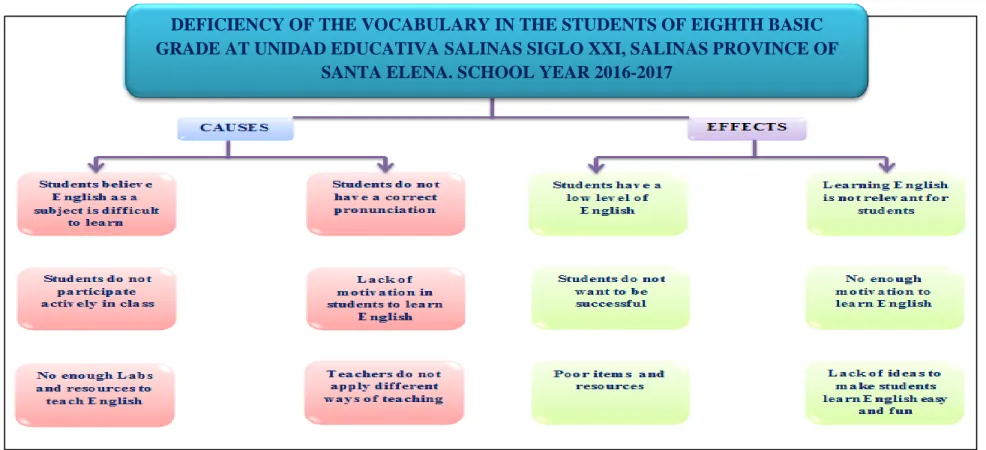
4 1.2.1 Problem Tree
Illustration 1: Problem Tree
Author: Carlos Alcivar Yagual Suárez.
Source: Unidad Educativa “Salinas Siglo XXI”
DEFICIENCY OF THE VOCABULARY IN THE STUDENTS OF EIGHTH BASIC GRADE AT UNIDAD EDUCATIVA SALINAS SIGLO XXI, SALINAS PROVINCE OF
5 1.3 RESEARCH QUESTION
The research question which guided this study is the following:
What impact interactive games have in the process of teaching and learning
English?
1.4 RATIONALE
The deficiency of vocabulary is a problem in which most students in today’s school
are involved. Thus teachers do not give enough emphasis to increment students´
vocabulary, even though, it is important to communicate with others in a spoken
way. However, speaking in English is considered as one of the most difficult skill
to learn for every person, and this is the most essential with ESL students that have
to learn it and manage it in order to keep a conversation.
Therefore, applying games in classes of teenagers can cause students to become
active agent of knowledge for the whole learning process, this certainly catches
students´attention and even they tend to acquire more than they do in traditional
classes. Students feel free during the procedure of the game and this is a positive
thing of the process, in that, they can come up with new ideas more easily along
with their partners. Since without vocabulary, it is difficult to carry out the
communication process, thus the more vocabulary people obtain the easier will be
6
intonation and rhythm with fluency and accuracy in a spoken way when necessary
and for different purpose in the real life.
The application of interactive games based on communicative strategies can be a
new approach to teach in order to avoid monotonous or traditional methods of
teaching for improving the four English language skills (listening, speaking, writing
and reading) and even boost the vocabulary that plays a relevant role in the learning
of English as a second language for the students.
Therefore, the implementation of interactive games will allow students to promote
their knowledge, vocabulary and improve their pronunciation through an interactive
and fun way in which students have to play games in order to retain words as they
can, of course, relate to the topic recently learned in class and using different items
from the environment in order to apply the creativity of the teacher to use all of
those things for playing fun games in the classroom.
Moreover, it is going to help to engage students and make them feel motivated to
learn English, also it will help students who do not want to talk in front of their
classmates so that they have to work separately and demonstrate that they can speak,
too. With the application of interactive games the professors will apply new way of
teaching and use it as a teaching strategy for the betterment of increasing vocabulary
7
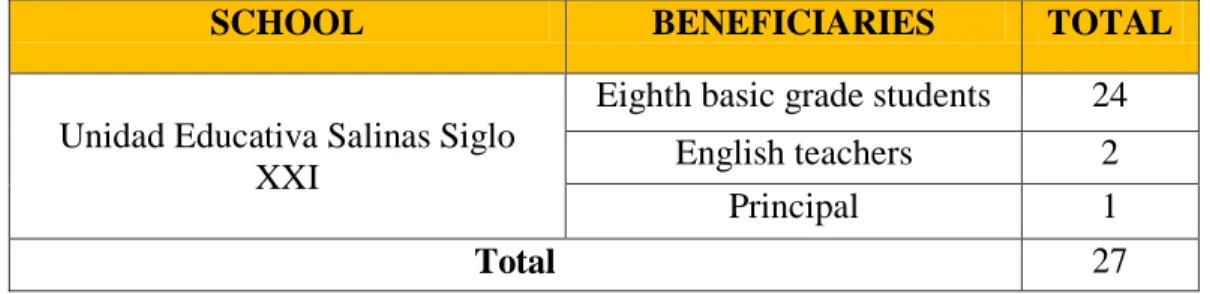
Additionally, the direct beneficiaries of this project are the community, the students
of eight grade, the English teachers and even teachers who impart another subject
in this educational institution who can take into consideration to use this approach
to teach. As a result using this approach, the students of Unidad Educativa Salinas
Siglo XXI will be able to enrich the English vocabulary, and the good manage of
interactive games might enhance students’ interaction, motivation and engagement.
1.5 RESEARCH OBJECTIVE
To analyze the importance of the implementation of interactive games with
communicatives strategies and activities focused on the enrichment of the English
vocabulary in the students of Eighth Basic Grade at Unidad Educativa Salinas Siglo
XXI.
1.6 IDEA TO DEFEND
Interactive games with communicative strategies and activities will enrich the
English vocabulary in the students of Eighth Basic Grade at Unidad Educativa
Salinas Siglo XXI.
8
1. To analyze the theoretical framework in order to implement interactive
games for enhancing the learning of the English vocabulary.
2. To identify the current methodological process focused on the learning
English vocabulary in students of Eighth Basic Grade at Unidad Educativa
Salinas Siglo XXI.
3. To apply interactive games which promote the enrichment of the English
vocabulary in the students of Eighth Basic Grade at Unidad Educativa
9 CHAPTER II
THEORETICAL BASIS
2.1 PHILOSOPHICAL BASIS
Recently the standards of education have been changed in this century, for instance
the new teaching methods and techniques have caused some changes in the way
students are learning in the classroom. Therefore, the teaching process has suffered
transformations in its teaching methodology. Thus the constructivism is a theory
that proposes that the learning environment has to support multiples perspectives
or the interpretation of the reality, building knowledge, and activities based on
valuable experiences in the context (Jonassen, 1995).
The constructivism implies that active learning enable to learners to construct their
own knowledge and make their own meaning of what is being thought. One of the
most relevant principles with the constructivism is that action oriented through
cooperative learning (such as group work, pair work or any other form of learning),
active and creative participation in classroom activities, learning by preparing some
projects as well as learning by teaching (when the learner is asked to take over
teacher’s role) have been treated as the major task related to the action oriented
10
(Piaget, 1977) established that learning occurs by an active construction of
meaning. Meanwhile, (Kelly, 1991) asserted that we look at the world through
mental patterns or constructs that we create. Therefore people develop ways of
understanding or construing the world based on their experiences. Moreover,
(Zemelman, Daniels and Hyde, 1993) suggested that learning in all subjects’ areas
imply constructing and inventing new ideas. Also they recommended that this
theory should be applying into the curriculum due to applying this in the classroom
teacher can create an environment in which learners can construct their own
understandings.
Therefore, the application of the constructivism can be relevant in the teaching
learning process. For instance (Vigotsky, 1978) asserted that social constructivism
model stress the importance the learning in context, constructing understanding
through interaction with others in the social environment in which the knowledge
is applied. Additionally, in the classroom the constructivism involves professors
can apply innovative activities (collaborative and creative) that allow students to
learn while they enjoy within an interactive environment, the teaching learning
process.
2.1.1 Communicative Approach to Teach
Learning vocabulary is so relevant for English language learners due to depend on
11
the words in a speaking or in writing manner. Therefore the communicative
language teaching approach (CLT) is being applied in many non-native countries
in order to improve the communicative ability and increase the motivation in
students for learning, incorporating communicative activities in the classroom
(Ahmad and Rao, 2013)
The main goal of the communicative approach is to make students use the language
to communicate. Thus communication implies using language functions as well as
grammar structures, moreover language is used in a social context should be
appropriate to setting, participants and topics (Freeman, 1990).
(Brown, 2001) established the language is applied in the real context. Moreover the
target of language is a vehicle for the communication in the classroom, not only the
object of study. Therefore communicative competence is the method’s goal.
Additionally students use the language a great deal through communicatives
activities for instance role-plays, games and problem solving task. As a result
applying this approach student will be able to develop their communicative
competence in order to communicate in a correct way using the language
appropriate when necessary in a real context in daily life.
12 2.2.1 Literature Review
This literature review embraces all the facts, theories and thoughts that enlighten
this research paper from the problem to the outcomes, and the procedure of the
proposal. The contents are the theoretical framework, the educational basis which
show the appropriate knowledge to differ the different perspective of each reader;
and as a result, this will aid teachers and students in the development of the teaching
and learning process by making the right decisions.
Nowadays, teaching English has become in one of the most important fact in the
Ecuadorian context in which the teachers play the main role in this process in order
to develop this. Therefore, there are several didactic materials and resources that a
teacher can use in class in order to teach English as a second language for improving
the motivation in students and the environment in which the teaching learning
process is carried out. For instance, some teachers prefer to use several games in
their classes as an introductory part of the lesson, during the procedure or even in
the last few minutes of the lesson as feedback.
Thus, there are different ways that educator may have utilized; however, needless
to say that sometimes they do it just because there is nothing else to do. This, at the
end, will turn out to be a disadvantage, in that; ELLs would like to have games in
13
games, for instance, games help and encourage many learners to sustain their
interest and work (Wright, Betteriridge & Buckby, 1984).
Hence, operating games must strengthen the students’ will in being attentive of the
upcoming contents. (Wright, Betteriridge & Buckby, 1984) claimed that games
also help the teacher to create contexts in which the language is useful and
meaningful. In fact, this might be the reason of why some educators are still
employing games to gain the interest of the students as part of the process, there is
no doubt to share Ersoz´s opinion which is Games employ meaningful and useful
language in real context (Ersoz, 2000).
(Mora and Lopera, 2001) asserted that fun activities have always been one of
everybody’s favorite things to do in a class, both for teachers and students. Thus,
this is one of the things that both part of the learning enjoy the most; teacher, as an
instructor, needs to have the ability to handle with taking the willingness of the
students to model and incorporate some topics that will support them in the
development of the language.
However, there are some cases that ELLs would rather have the disposal of being
in charge in any interactive games as it is mentioned in (Henner-Stanchina and
Riley, 1978) students are expected to interact primarily with each other rather than
with the teacher. Sure enough, sometimes it is better to let ELLs interact each other,
14
(Thanh and Thu, 2003) mentioned that there are advantages and effectiveness in
learning vocabulary in various ways. This is another positive side which can
promote the oral production, in that, ELLs may not make use of communication if
they do not possess enough vocabulary to produce or even receive the message.
It is probable that ELLs do not want to interact each other due to the fact that English
language is tough; and for this reason they do not desire to take part of the class.
But there is a different perspective from Ariza (2001) which is participation in class
has increased as a result of the development of games and students look more
confident and is willing to speak more often during the class.
Therefore, (Cameron, 2001) asserted that teachers should provide more strategies,
including games, for learners to develop their oral production during their language
learning sessions. Thus teenagers ought to be handled with strategies that enable
them to develop this language. For this reason, games should be regarded as to be
one way to direct the oral production.
(Mora and Lopera, 2001) claimed that the use of interactive activities like games in
class contributes to the development of a series of language skills and competencies.
When applying games in classes of teenagers make them be awaken for the whole
learning process, this undoubtedly catches students their attention and even they
15
(Chen, 2005) stated that games make the learners more willing to ask questions and
think creatively. Almost all the games are fun, it is probable that applying games
make some students be more participative and most importantly they need to speak
to follow up the game.
Students feel free during the procedure of the game and this is a positive thing of
the process, in that, they can come up with new ideas more easily along with their
partners. Games can lower anxiety, thus making the acquisition of input more likely
(Amato, 1988).
(Uberman, 1998) asserted that interactive activities such as games are extremely
motivating and entertaining, and they can give shy students more opportunities to
express their opinions and feelings.
Sure enough, these can make students be confident and relaxed when they are
acquiring a new knowledge in practice, this author has the same opinion about it;
yet, he added something else which is focused on timid students that are afraid of
speaking in front of their classmates, students have one chance to be free in sharing
their feeling by means of the interactive games.
16
Lenguage acquisition focus on learning vocabulary has been consider an important
fact for those who wants to learn English as a second language therefore in
education it plays a relevant role. Moreover learning a language is crucial, in that.
Therefore, ELL might be able to dominate and use it, they are likely considered as
the first element in the development in their daily labor.
The methodological procedure proposed to emphasize the importance in the
sufficient linguistic information and language practice using a variety of exercises
that allow different techniques to acquire knowledge.
The English curriculum allows students to learn what they would find it easy
through the use of educational materials and a variety of suggestions which are
related to specific notions, functions and content that allows them to express simple
ideas activities.
Teaching English as a foreign language requires that the teacher is professionally
prepared for their daily work; learners have a complete education, which includes
cultural knowledge, psychology, education; and interacting with themselves. This
will allow students to be active, creative and organized facilitators. Additionally
teachers also need to know the most important aspects of language study and the
similarities or differences that exist between foreign and native language.
17
The Ministry of Education in Ecuador aims to provide students with both foreign
language knowledge and the skills needed to succeed in today´s globalized world.
English is the international language that will allow ELLto access knowledge and
information and that will become an instrument of personal and professional
empowerment to build a more prosperous equitable society.
Moreover, the free textbook in public institutions will contribute to the learning
process in a positive manner for every student will have an additional resource to
aid them in their language acquisition process.
The Ministry of Education has also created teacher’s standards aligned to TESOL,
establishing the benchmark of what teachers need to know. The B2 benchmark
from the Common European Framework of Reference (CEFR) states the minimum
language proficiency level for pre-service and in- service English teachers.
Finally, through a rigorous evaluation of teachers’ development along with the
Ministry of Education will assist current service to English teachers in order to
improve their actual language proficiency levels. It is probable that by means of
these innovations of new standards, new curriculum, and new textbooks, students
and teachers will likely be more motivated in their classrooms.
18
English language is recognized as the first lingua franca of the world at present,
which is used for several purposes for instance academic, scientific, technological
and social, therefore speaking English is an essential tool to interact and
communicate in today’s globalized world. For instance, the Ministry of Education
in Ecuador mentions three important issues for developing the students’ skills they
are:
1. English language as a tool is important which equips individuals to
understand people and their cultures beyond linguistic and geographical
limits.
2. To align the English curriculum focuses on the CEFR: learning, teaching,
assessment CEFR so that it provides a common basis for the elaboration of
a curriculum and a syllabus.
3. The communicative approach is the most recognized and accepted norm in
the field of language teaching and learning because it is focused on the
theoretically well informed principles related to the nature of the language
of language teaching and learning. (National Curriculum Guidelines EFL
Min.Edu, 2014, p. 5)
19
The CEFR is a planning tool that provides guidance for teacher, examiner,
educational administrator, teacher trainers, textbook writers, it has a crucial the role
in language and education policy worldwide because it describes what learners
should be able to do at different stages of language process and what knowledge
and skills students need to develop to communicate effectively in the target
language Council of Europe (2003).
The six levels proposed by the CEFR are the follow:
1. A1-A2 Basic users of the language
2. B1-B2 Independent users of the language
3. C1-C2 Proficient users of the language. (National Curriculum Guidelines
EFL Min.Edu, 2014, p. 6)
CEFR Reference Levels in the Ecuadorian Educational System
According to the Ecuadorian Educational System based on the CEFR there are three
proficiency levels which have to be applied in the public educational system
gradually through a branching approach as shown in the chart 2 below:
Levels of Proficiency and its Application per School Year
20
Author: Carlos Alcivar Yagual Suárez
Source: National Curriculum Guidelines EFL Min.Edu, 2014, p. 7
2.2.4 Profile Level A1
This is the level which the students of eighth grade have to reach by the end of the
course based on the communicative competence. These are the proficiency
descriptions they ought to obtain:
Understand and use familiar everyday expressions and very basic phrases aimed at
the satisfaction of needs of a concrete type (e.g. basic personal information,
greetings, numbers and prices, directions, habits, etc.); Introduce themselves and
others; Ask and answer questions about personal details such as where they live,
people they know, and things they have. (National Curriculum Guidelines EFL
21 Specific Objectives of the Proficiency Level of Eighth Grade
These two objectives represent the communicative competence that the students of
eighth grade should possess by the time they finish the course based on the English
listening, reading, speaking and writing skills. Students will be able to:
Listening skills:
In simple spoken text, understand expressions, sentences and words related to the
learners’ personal and educational background (e.g. daily life activities, house,
personal information, classroom equipment, curricular subject, classroom
commands, etc.). And also follow speech which is quite slow and carefully
articulated with long pauses for them to assimilate meaning in the personal and
educational domains.
Reading skills:
Understand and identify quite simple informational text (e.g. catalogs, labels,
postcards, massages, etc.) a single phrase at a time, picking up familiar names,
words and basic phrases and rereading as required. Extract the gist and key
22 Speaking skills:
Produce slow, hesitant, planned monologues (i.e. with frequent pauses to search for
expressions, backtracking, errors, etc.) Interact in a simple way by asking and
answering simple questions about the learners’ personal and educational
background. Communication is highly dependent on repetition at a slower rate of
speech, rephrasing, and repair.
Writing skills:
Produce quite simple informational text that can little or no detail, can have little
variety in sentence structure, and may have some usage error.
(National Curriculum Guidelines EFL Min.Edu, 2014, p. 13)
2.2.5 INTERACTION
2.2.5.1 What is Interaction in the language classroom?
Sometimes interaction has to be tough in students especially when this happens to
be in English classrooms. However, teachers have to look for ways to manage this
problem in a good manner, in that, “interaction involves participation, personal
engagement, and the taking initiative in some ways, activities that in turn are
23
1998). So, this means that interaction is the key of being part of the significant
process what teachers are expected to have as outcomes with their students.
Having interaction demands many things in the progress of the learners in their
spoken production one of the aspects that embroils students to have and be aware
of their participation is possessing interpersonal communicative skills (Rivers,
1987). Not all the ESL learners are willing to share ideas, thoughts, or opinions to
build everyone’s perspective, because they were not developed at the right moment
during their childhood.
Interaction can take place depending on the situation that the activity or game
requires. Some of them might be discreet, strident, or lively with a great amount of
people, or few of them (Kramsch, 1987). Thus, these come to happen regarding the
teachers want to do with those types of activities.
(Swain, 1985) stated that “interaction allows the learner to practice the target
language, thus enhancing fluency; to notice or trigger a particular structural form
that needs modifying; to test hypotheses about structural points and to reflect
metalinguistically”.
ELL need to make an effort to take all the fear of interacting out of their mind
because giving up without even practicing is the worst attitude individuals can take.
24
this will probably help them to get over their dread and be focused on promoting
the language acquisition.
Interaction and its importance
Interaction has fantastic rewards that are fundamental to promote the rehearsal of
the target language. (Brown, 1994) specifies some of those profits in interactive
classes: There is a large amount of pair and group work. Students engage
themselves in spontaneous and authentic conversations. Students work for actual
audiences and purposes, not artificial ones. The task-based activities prepares
students for the real word outside of the classroom
It might be true that interaction tends to have abundant of positive things. Since
interactive activities are meant to put into practice, the outcomes as a result will
possibly be the desirable ones, in that, they are prepared to converse to anyone who
are out the classroom. (Richards, 2001) the learning has optimistic results when
interaction is involved, that is to say, it would be much easier to make them foster
the enrichment of vocabulary when the activities have to do with interactions.
Role of Interactive activities
Participation in verbal interaction offers language learners the opportunity to follow
25
lessons and to practice them in context (Pica, Young & Doughty, 1996,). When
interaction is being applied, this does not only employ body, soul, or spirit, this is
also about the employment of the communicative competence of the target language
to reach out the meaningful learning.
The aim of having interactive classes is simply because it is extremely necessary to
include the participation and connection that interaction offers to obtain the
excellent production of the English speaking skills. (Swain, 1985) points that
interaction also makes learners really use the language. Therefore, the more
interaction students are eager to do, the better communicators they will become.
Ways of promoting interactive activities
(Lee, 2004) claims that when interaction comes to happen in the English classes,
this turns out to be a chance to get the target language in a significant manner. In
order to promote the interactive activities through games; as a result they will reach
this: Teachers must promote the desirable ambience and good relations among
students for them to know one another. Individuals must appreciate the uniqueness
of others by encouraging and educating one another.
Both students and teachers must build up their confidence and enjoyment in what
they are doing
26
Classrooms should be interactive by nature and never one-way
(Interactive Activities for Effective Communication in English, Jeyasala, 2014),
Tips of effective activities
(Moss and Ross, 2003) stated some tips to have effective activities to become an
independent and confident person which are:
“Keep teacher talk to a minimum”. This point is prominent at this period of time,
in that, the class is students’ centered, so teachers are no longer the traditional
teacher that spends too much time explaining something rather than giving them
the opportunity to make them practice.
“Literacy-and beginning-level learners, as well as those at intermediate and
advanced levels, are highly competent individuals”. No matter the level they are,
the most important is to know that the students are able to be successful at any level.
“Have fun”. Generally, activities are likely to be fun. Therefore, teacher should take
the advantage to motivate them to learn.
27
Thought that there is a genuine interaction when this requires having an instructor
or educator. The first thing to keep in mind, is to facilitate students and be in the
background. The teacher is the provider of everything that has to do with the activity
and the learning (Brown, 1991). The second one is to monitor students closely
(Brown, 1994) the teacher has to verify the process if they are doing well or wrong.
The third thing is to provide complete authority to students in developing and
carrying out activities (Brown, 2007) the teacher is the mediator to accomplish all
the rules to keep the order of the activity. And the fourth thing is to accept all kinds
and opinions and be tolerant of errors (Cohen, 1994) the teacher is the right person
to give feedback appropriately.
(Jeyasala, 2014) has described students how they have to perform in the interactive
English activities:
1. Self-confidence
2. Personal motivation
3. Ongoing enthusiasm
4. Risk-takers
5. Interactive
2.2.6 GAMES
28
Games have a great deal of definition and the majority of them say the same from
different words and perspective. According to (Webster’s New World Dictionary,
1991), “any specific contest, engagement, amusement, computer simulation, or
sport involving physical or mental competition under specific rules, as football,
chess, or war games”. This interpretation can be taken as an excellent manner to
introduce the language by means of physical movement, and consequently the
interaction could be more dynamic.
(Hadfield, 1996) Asserted that games included rules, a goal and an element of fun.
These are three principal aspects that this author describes when the game is
implemented in order to have a reason to play that game. Besides, he also asserted
that there are two kinds of games which are competitive games and co-operative
games. The first type of game is about achieving first the goal that the competitors
have to do, and the second type consists of having the same purpose to reach the
goal together.
According to (Martínez, M; Pérez, A; Portillo, V, 2007), “games coincide
principally in three aspects: competition, rules and employment”. These authors
have divided in three parts based on how they see the games. Games are made to
have interaction and the term competition is the complement to make it more
interesting, here is the motivation that every one that takes part of the game, this
29
Rules are one of the parts described which is completely necessary to have control
of the game and not let them commit some irregularities. And the last part is placed
more emphasis, in that, the authors want learners to have an inner motivation to get
something more that it is expected.
(Chen, 2005) claimed that “using games promote communicative competence,
language use, and increase learning motivation, cut down nervousness, and being
ingenious”. Games aid students’ performance, each component fulfill the
development of the learners. The communicative competence contributes the
accuracy of the spoken language, in other words all the activities that involve
interaction go around the language in context.
Games in a foreign language
(Webster’s New Dictionary, 1994) defines games as part of an activity that seeks
for three basic things such as skill, strength or even luck, the purpose of this is that
they can enjoy the most by struggling with the person that is against to finally
awaken what they are capable to do. (Byrne, 1984) considers some aspects that need
to be taken into consideration when teachers want to apply interactive games: Pick
some games that are suitable and accord to the contribution of the communicative
30
1. Teachers should be organized all the activities they will be applying in
advance
2. Teachers ought to enlighten everything about the procedure of the game
along with its purpose
3. Students have to see some examples as rehearsals then they will do it
without any problem
4. It is recommended that the teachers should be aware to take account of all
the students in the class.
5. As everyone has participated they should be awarded for their job by jotting
down the points.
Games in the classroom: more than just having fun. Almost all the ELLs get bored
when they cannot find something that really interests them, since games are
employed in the classrooms; they are no longer monotonous in acquiring
knowledge. There are two very important points; the first is that they adore having
fun and do not lose the interest of learning, and the second is that the learning will
be meaningful and last for good. (Mora & Lopera, 2001).
Language learning is hard work, effort is required at every moment and must be
maintained over a long period of time. Games help and encourage many learners to
31
It might be the case that teaching how to develop the oral production is tough, and
games seem to be a good remedy to keep them to be concentrated on the task
because there are an amount of ELLs that easily get distracted with single things.
Some others’ outlook from educators they say that applying game sometimes is
difficult to handle with large group. However, applying games overcome the
necessity of the students.
If games are employed correctly, the learning goes further (Ersoz, 2000), as cited
in (Wright, A., Betteridge, D., & Buckby, M., 1984). Educators are the facilitators
to make ELLs apply the language progressively. It also depends on how the
teachers implement the games for better purposes, as there are a diversity of games,
they should select the accurate ones as to be comfortable during the learning
process.
Introduction games
In this kind of category games, can include: games like “searching for people” and
“stating the names” the first game involves the students walk around the classroom
and find students that have for instance lived on a farm, been to United Stated or
eaten Mexican food thus it implies student have to use the target language to obtain
the necessary information. Meanwhile the second game implies to make a circle
32
name of his or her classmate who are around the circle memorizing each classmate
name that has already introduced in the game.
Educational games
For instance the “mail game” can be a good activity to support this gamer where
the learners have to deliver mail, making sure it arrives to the right places works as
an excellent example of an educational game.
This game consists in to work in any certain theme or places such as home thus the
teacher have to give the topic and the students have to envelop the words with the
specific genre for example bedroom, kitchen, bathroom, etc. then the mail has to
contain letters related to the words on them. Thus the first student to deliver all of
his or her mail would win.
Educational card games
One of them is “bingo” which is a good activity for applying in language teaching
since the teacher can draw words and students only have pictures on their bingo
card or vice versa. It consists in that students have to understand the words to be
able to match them to the right picture.
33
This kind of game is especially good for language teaching. It includes word
searches, puzzles, crosswords where the students obtain the words in their native
mother tongue, but they are hidden in the word search and just match the crossword
puzzle in the target language. Also it involves students apply in an easy way their
target language, using it in “fill in a chart” where the students have to find for
instance an animal, a country, a city or type of food.
Motivation through games
Motivation is consider one of the most relevant factors in language acquisition due
to students want their teacher implement new ways of teaching in which the classes
become interesting, participative enjoyable and fun. For instance Moon (2000)
claimed that motivated learners have a better chance for learning vocabulary
successfully, meanwhile unmotivated students will have a less chance to success.
Therefore for improving learners’ vocabulary, they need to be highly motivated by
playing games to complete a task and with the enjoyment, knowing that learning
the lexis occur smoothly.
(Muna, 2014) suggested that using games to practice vocabulary enhance students’
ability to memorize in an effective way the words due to games provide
comprehensible input while students interact in groups and also the games allow
students to clarify the meaning of the words. For instance this strategy also
34
2001) emphasizes the teachers’ abilities to motivate students by telling the
helpfulness and usefulness of the games in promoting their language level.
2.2.7 VOCABULARY
What is vocabulary?
Vocabulary is a list of words which can be used in different ways such as sentences,
clauses and phrases. Vocabulary refers to the words people use to communicate in
an oral way, being an important component in English language teaching. For
instance (Hguyen and Khuat, 2003) asserted that vocabulary is the set of lexical
items in a language. Thus vocabulary means lexicon, the term lexicon comes from
Greek “lexis” word. Lexis refer to the total stock of meaningful units in a language
not only words and idioms, but only the part of words that express meaning, such
as prefixes and sufixes. Additionaly a good vocabulary is that which :
1. Fills our needs
2. Is varied and is exact
3. Helps us to understand
4. Gives us confidence
5. Why vocabulary is so important?
(Hatch, 1983) claims that the importance of vocabulary in the acquisition of the
language. Vocabulary is an essential issue in language acquisition since it is within
35
realize that their vocabulary is limited due to they have serious problems related to
known words and they are not able to express their ideas, feelings, thoughts and
others; arising the fact for mastering vocabulary. Since learning vocabulary is a
fundamental and useful tool for communication and acquiring knowledge (Putri,
2010).
(Thomas and Collier, 2001) asserted that vocabulary is focused on language and on
the critical importance to typical language learners; the teaching and learning
vocabulary has been underestimated in the field of second language acquisition
throughout its varying stages and so far vocabulary receives quite little attention
than grammar and phonology.
(Thornbury, 2002) stated that “without grammar very little can convey, without
vocabulary nothing can be conveyed”. It means that the vocabulary has strong
relation with the four language kills and its importance takes root on this due to the
appropriate use of the language depend on how a person has developed his or her
vocabulary in order to apply in different context in the real life.
As a conclusion knowing a language involves the mastery of grammatical patterns,
basic speech and essential vocabulary through the four language skills. Thus
language is more powerful when it is applied correctly therefore the more it is used,
36 Types of Vocabulary?
According to (Huyen and Nga, 2003) there are two types of vocabulary: active
vocabulary and passive vocabulary.
Active Vocabulary:
It involves those words over which one people use in their writing and speech. Thus
People know the meaning of those words accurately. Also it refers to the productive
side of language. It consists of the words people use confidently because people
understand their usage and meaning. For instance for giving the proficiency in
written and spoken language, words must progressive be added within the active
vocabulary of the learners. Active vocabulary of a language calls for:
1. The use of right word in the right place.
2. The spontaneous recall of words.
3. Grammatical accuracy (use of correct tenses, word order and inflections)
In speech, fluency and the ability to reproduce correct intonation, sounds,
pronunciation, rhythm and others.
Passive Vocabulary:
It involves those words, meaning of which can be understood when they appear in
37
we are not fully conversant with them. Therefore in passive vocabulary, people do
not know the precise meaning of a particular word and people do not make use of
those words in a communication way. Sometimes people can understand the
meaning of that word only to a certain extent according to the context. Passive
vocabulary refers to receptive side of the language. Passive vocabulary implies:
1. A recognition of vocabulary in writing or speech.
2. An acquaintance with major grammatical forms or items.
3. The skill of simulating rapidly the sense of large word groups
Moreover, (Elfreida and Micheal, 2015) mentioned another both types of
vocabulary. They are receptive and productive vocabulary.
Receptive Vocabulary.- It involves the words whose meaning is known when individuals read or listen.
Productive Vocabulary.- it implies those set of words used is writing and speaking. Meanwhile, (Montgomery, 2007) established four more types of
vocabulary thus they are the following:
Listening Vocabulary .- It involves the words we understand and hear. This author mentioned that by the time we reach adulthood, most of us will understand and