
ERAWATCH country reports 2012 Spain
44
0
0
Texto completo
(2) European Commission Joint Research Centre Institute for Prospective Technological Studies Contact information Address: Edificio Expo. c/ Inca Garcilaso, 3. E-41092 Seville (Spain) E-mail: [email protected] Tel.: +34 954488318 Fax: +34 954488300 http://ipts.jrc.ec.europa.eu http://www.jrc.ec.europa.eu. Legal Notice Neither the European Commission nor any person acting on behalf of the Commission is responsible for the use which might be made of this publication. Europe Direct is a service to help you find answers to your questions about the European Union Freephone number (*): 00 800 6 7 8 9 10 11 (*) Certain mobile telephone operators do not allow access to 00 800 numbers or these calls may be billed.. A great deal of additional information on the European Union is available on the Internet. It can be accessed through the Europa server http://europa.eu/. JRC90710 This document replaces ERAWATCH Country Reports 2012: Spain with ISBN number 978-92-79-34526-5 and PUBSY request number JRC83976. The corrections made in the new document are to add the acknowledgements which were missing. EUR 26284 EN ISBN 978-92-79-38637-4 (pdf) ISSN 1831-9424 (online) doi:10.2791/86251 Luxembourg: Publications Office of the European Union, 2014 © European Union, 2014 Reproduction is authorised provided the source is acknowledged. Printed in Spain.
(3) ACKNOWLEDGEMENTS AND FURTHER INFORMATION This analytical country report is one of a series of annual ERAWATCH reports produced for EU Member States and Countries Associated to the Seventh Framework Programme for Research of the European Union (FP7). ERAWATCH is a joint initiative of the European Commission's Directorate General for Research and Innovation and Joint Research Centre. The Country Report 2012 builds on and updates the 2011 edition. The report identifies the structural challenges of the national research and innovation system and assesses the match between the national priorities and the structural challenges, highlighting the latest developments, their dynamics and impact in the overall national context. In particular, it has benefited from comments and suggestions of Fernando Hervás from JRCIPTS who reviewed the draft report. The contributions and comments from DG-RTD and the ERAWATCH National Contact Point (Laura Hernández Garvayo and Carmen Martín Godín) and Joost Heijs, the author of the ERAWATCH Country Report 2011 are also gratefully acknowledged. The report is currently only published in electronic format and available on the ERAWATCH website. Comments on this report are welcome and should be addressed to [email protected]. Copyright of this document belongs to the European Commission. Neither the European Commission, nor any person acting on its behalf, may be held responsible for the use of the information contained in this document, or for any errors which, despite careful preparation and checking, may appear. The report does not represent the official opinion of the European Commission, nor that of the national authorities. It has been prepared by independent external experts, who provide evidence based analysis of the national Research and Innovation system and policy.. 1.
(4) EXECUTIVE SUMMARY After a period of increasing economic growth and investments in Research and Development (R&D) and Innovation, Spain has severely reduced its R&D investments, threatening to set back the progress made in recent years. Spain made considerable efforts in the period 2002-2008 duplicating its Gross Expenditures on R&D (GERD) in absolute terms and increasing the GERD by Gross Domestic Product (GDP) in relative terms from 0.99% in 2002 to 1.35% in 2008. However, the financial crisis cut short the positive trend. In 2011, the R&D intensity (GERD as a percentage of GDP) decreased to 1.33%, reaching a figure lower than the one in 2008 (1.35%). The Government Budget Appropriations or Outlays on R&D (GBAORD) in Spain and its regions decreased by -12.2% (0.69% of GDP) in 2011, reaching a budget of €7,294m. Data on the general government budget for R&D and innovation (PGE) showed that public investments in R&D and innovation decreased for 2012 by -25.6% (Molero and de No, 2012b). This means that public R&D investments went back to the levels of 2006. In relative terms, the total funds per R&D personnel in Full Time Equivalent (FTE) have changed from €31.9k in 2002 to €41.1k per head in 2009. For 2013, this figure will represent €22.6k per head, which is much lower than the one in 2002 (Molero and de No, 2012c; Molero and de No, 2013). These severe cuts in R&D and innovation investments have raised important concerns among research-related organisations1 about the financial sustainability of the Spanish R&D and innovation system. They also indicate that it will be very difficult for Spain to reach the targets of 3% GERD per GDP set by the Europe 2020 strategy, as the cuts are reducing the opportunities for Spain to change it economic structure and to overcome the current economic crisis. In fact, the new Spanish Strategy for Science, Technology and Innovation (EESTI) (2013-2020) has recently set a new lower target of 2% GERD per GDP for 2020. Spain has a quasi-federal decentralised political system and so its R&D and innovation-related policies are on the same basis. In the past, allocation of competences in R&D and innovation were not clearly assigned to the different administrative levels, which led most regions to develop similar R&D plans and to launch similar and often overlapping instruments, programmes and agencies at both regional and national administrative levels (Erawatch Country Report 2010 and 2011). Some recent developments might improve the coordination of national and regional R&D and innovation policies. For example, the new Law of Science, Technology and Innovation (LCTI 2011) is aimed at improving national and regional coordination through the Council of Science, Technology and Innovation (CPCTI). Three regions accounted in 2011 for 58.3% of all R&D expenditures: Madrid (26.5%), Catalonia (21.9%) and the Basque Country (9.9%) are the leading regions, with a GERD by GDP of 2.0%, 1.5% and 2.1% respectively. All regional authorities (“Comunidades Autónomas”) have registered for the Smart Specialisation Platform (S³P), which “assists Member States and regions to develop, implement and review Research and Innovation Strategies for Smart Specialisation (RIS³)” (RIS³: on-line). In addition, the new EESTI strategy (2013-2020) includes the concept of “smart specialisation” in one of its 6 priority axe (Priority 5). This could help to overcome some fragmentation by prioritising research areas, based on the needs and resources of the regions. The Spanish R&D and innovation system have challenges in their industrial structure, science and technology base and governance structure (OECD, 2006; EW, 2009 and 2011; EC, 2011a). The main industrial structural challenges are: the significant weight of Small and Medium-sized Enterprises (SMEs); a low-tech traditional sector; the lack of multinational enterprises; and a low These organisations include: the Spanish Confederation of Scientific Societies (COSCE), the Spanish Conference of University Rectors (CRUE), the Platform for Dignifying Research (PDI), the Spanish Federation of Young Researchers (FJI) and the National Association of Ramón y Cajal Researchers (ANIRC). These organisations have jointly signed different manifestos (see section 2.5). They are diverse and have different levels of relevance to the research system. 1. 2.
(5) level of patenting activity. The main science and technology base challenges come from: its fragmentation; the lack of flexibility; and low levels of mobility between institutions, countries and sectors. Regarding the main governance challenges, these come from: the lack of institutional coordination (regional and ministerial); the lack of complementarities between research and innovation policies; and the lack of synergies between policy design and implementation. Important efforts have been made in improving the R&D and innovation policy mix over the past years. Successive strategies and plans have tried to address the challenges of the Spanish R&D system and to follow the suggestions of some comprehensive evaluations on this system (e.g. OECD, 2006). The new Spanish R&D and innovation strategy EESTI (20132020) and the new Plan of Scientific and Technical Research and Innovation (PECTI) (20132016) also follow this trend and try to respond to the challenges of the system and the shortcomings of previous plans. The new law (LCTI 2011) has also tried to address these challenges. However, as these very documents recognise, the structural and governance challenges of the Spanish research system remain. The changes in the strategies and plans indicate an increasing emphasis on innovation, publicprivate R&D collaboration, research excellence and other emerging topics, such as the promotion of R&D and innovation on societal challenges or the role of public procurement to promote R&D and innovation.2 The increasing importance of competitive funding, the implementation of a more diversified set of instruments (e.g. tax incentives, venture capital), and the increasing alignment with European objectives are also important changes in the Spanish policy mix. Currently, the most important challenge of the Spanish R&D and innovation system is to reverse the decreasing trend of public R&D and innovation investments. In an environment of budgetary restrictions, it might be appropriate to focus on the strengths of the Spanish R&D system when setting the objectives and priorities and to remove the barriers that have prevented greater efficiency in these areas. According to the Innovation Union Scoreboard Report (EC, 2012), the strengths of the Spanish research system lie in its tertiary education, international scientific co-publications and medium and high tech exports. Focusing on these strengths, it might be appropriate to implement changes in the curricula of universities to foster innovation and entrepreneurship and to increase university-industry relationships. This might improve the match between education and training supply and employment needs, thereby decreasing the levels of unemployment among young people. In order to maintain the level of publications and to improve their quality, it might also be appropriate to promote “excellence” by granting more financial and managerial autonomy to the institutions and research groups with good levels of research performance. Changes in the research system could be implemented by improving the mechanisms to allocate funds by rewarding research groups and institutions that are better aligned with specific objectives. In addition to the funding mechanisms, it would seem necessary to introduce regulatory changes to increase the flexibility for research institutions to manage their own resources. Research institutions are clearly constrained by national regulations in managing their own human resources and require these changes. In addition, some special measures to address the situation of young researchers appear to be necessary. The changes brought by the new law LCTI 2011 appear to be limited in facilitating access by young researchers to permanent research positions. Currently, young researchers with temporary contracts are particularly suffering the consequences of a lack of resources. The lack of execution of public R&D budgets for R&D and innovation (Molero and de No, 2012a) indicates that it is necessary to analyse what instruments and measures are not being sufficiently demanded or used. This will help to reduce and prioritise objectives. Some of these have already been implemented through diverse mechanisms. For example, the Law on Sustainable Economy (2011) introduced public procurement of innovative goods and services as a policy instrument to promote innovation (see Footnote 32). 2. 3.
(6) TABLE OF CONTENTS EXECUTIVE SUMMARY....................................................................................................................... 2 1. INTRODUCTION............................................................................................................................ 5. 2 RECENT DEVELOPMENTS OF THE RESEARCH AND INNOVATION POLICY AND SYSTEM ........................................................................................................................................... 9 2.1 National economic and political ............................................................................................. 9 2.2 Funding trends .......................................................................................................................... 9 2.3 New policy measures .............................................................................................................. 11 2.4 Recent policy documents ....................................................................................................... 12 2.5 Research and innovation system changes ........................................................................... 16 2.6 Regional and/or National Research and Innovation Strategies on Smart Specialisation (RIS3) 18 2.7 Evaluations, consultations ..................................................................................................... 18 2.8 Policy developments related to Council Country Specific Recommendations ............. 19 3. STRUCTURAL CHALLENGES FACING THE NATIONAL SYSTEM .......................... 21. 4. ASSESSMENT OF THE NATIONAL INNOVATION STRATEGY ............................... 25 4.1 National research and innovation priorities ........................................................................ 25 4.2 Evolution and analysis of the policy mixes ......................................................................... 28 4.3 Assessment of the policy mix ............................................................................................... 30. 5. NATIONAL POLICY AND THE EUROPEAN PERSPECTIVE ...................................... 34. References .................................................................................................................................................. 37 List of Abbreviations ................................................................................................................................ 39. 4.
(7) 1 INTRODUCTION Spain has 46.2 million inhabitants (9.2% of the whole population of Europe) and produces around 8% of the GDP of the European Union (EU-27). The GDP per capita (€23,100) in 2011 was 8% below the EU-27 average of €25,100. The crisis in Spain particularly affected the unemployment rate, which rose to the highest in Europe (21.7% in 2011). Spanish GDP decreased by -0.3% in 2010 and increased slightly by 0.4% in 2011 while in the Eurozone these percentages were respectively 2.1% and 1.5%. With regard to the input side of the innovation and science system, Spain made strong efforts in the period 2002-2008, duplicating its Gross Expenditure on R&D (GERD) in absolute terms and increasing the GERD by GDP in relative terms from 0.99% in 2002 to 1.35% in 2008. However, the financial crisis cut short the positive trend. The R&D intensity (GERD as a percentage of GDP) decreased to 1.33% in 2011, which is lower than the one in 2008 (1.35%). Business R&D Expenditures (BERD) decreased respectively by -0.8% in 2010, by -1.5% in 2011. The Government Budget Appropriations or Outlays on R&D (GBAORD) in Spain and its regions decreased by -4.5% (0.79% of the GDP) in 2010 and by -12.2% (0.69% of GDP) in 2011, reaching a budget of €7,294m. For 2012 and 2013 only some data are available on the budget for public expenditure by the central government on R&D and innovation (PGE).3 This state level budget increased from €4,000m in 2003 to €9,673m in 2009. After 2009, the budget started decreasing by -4.1% in 2010, -7.4% in 2011 and -25.6 in 2012, leading to a budget of €6,394m. For 2013 another 7.2% reduction has been applied. It must be pointed out that the state budgets include not only direct expenditures and subsidies for R&D but also loans. In fact, in the last few years the role of loans has increased while the budget for subsidies has decreased, which implies, de facto, a greater decrease. In addition, the non-execution of an important part of the budgets has worsened the situation. In the period 2009-2011, between 21% and 42% of the yearly public government budgets were not executed. Theses severe cuts in R&D and innovation investments have raised important concerns among research-related organisations (see section 2.5) about the financial sustainability of the Spanish R&D and innovation system. They have also reduced the opportunities for Spain to change its economic structure and to overcome the current economic crisis. In addition, they indicate that it will be very difficult for Spain to reach the target of 3% GERD per GDP set by the Europe 2020 strategy. Actually, the new Spanish Strategy for Science, Technology and Innovation (EESTI) (2013-2020) has recently set a new lower target of 2% GERD per GDP for 2020. Spain is a “moderate innovator”4 (EC, 2012 and EC, 2013) and its strengths lie in tertiary education, international scientific co-publications and medium and high tech exports, while its weaknesses are in private investments, public-private linkages, innovation outputs and knowledge-intensive activities. To illustrate its strengths: with increasing levels between 2008 and 2010 (data from the Innovation Union Scoreboard IUSB dashboard), and above the EU-27 average (shown in brackets), Spain is outstanding firstly in its percentage of population aged 3034 who have completed tertiary education, which changed from 39.8% to 40.6% (34.6%); secondly, in the level of international co-publications per million, which changed from 454 to 599 (300); and thirdly in the contribution of medium and high-tech product exports of trade balance total, which changed from 101.97 to 103.05 (101.28). In contrast, the weak figures show that at levels below the EU-27 average, Spain underperformed in the percentage of GDP of private R&D expenditures, by 0.67% in 2011 against the UE-27 level (1.27%); in the number of public-private co-publications per million population, 22.5 against 52.8; in patent applications per billion GDP (in PPS€), 1.43 against 3.9; in patent applications in societal challenges per billion 3 4. Data come from COSCE annual reports. Together with the Czech Republic, Greece, Hungary, Italy, Lithuania, Malta, Portugal and Slovakia (EC, 2013).. 5.
(8) GDP (in PPS€), 0.39 against 0.96; in the percentage of GDP coming from licence and patent revenues from abroad, 0.06% against 0.51%; and in the percentage of knowledge-intensive services exports of total service exports, 21.6% against 45.1%. The number of people employed in R&D activities in 2011 was 215,079 (FTE). After increasing more than 65% from 2002 to 2010 (0.6% from 2009 to 2010), this number decreased in 2011 by -3.1, coming back to total figures lower than the ones of 2008. Based on the FTE data, 41.8% are working in the private sector, 37.6% in Higher Education Institutions (HEIs) and 20.4% in Public Research Organisations (PROs). Taking into account the research performance, universities showed the highest research performance level in the total number of international articles published in 2006-2010 (SCImago). Universities published 68% of total publications, followed by the health sector (26.8%), Public Research Bodies (OPIs) (22.3%), firms (2.2%) and others (2.3%). However, taking into account the quality of publications (“normalised impact”) OPIs showed the highest impact with 1.42, followed by firms (1.2), Universities (1.15) and the health sector (1.13) (COTEC, 2012: 35). The main responsibilities for research and innovation policy design and operational management are concentrated in the Ministry of Economics and Competitiveness (MINECO) – before December 2011 the Ministry of Science and Innovation (MICINN) – which distributed (in 2011) 67.8% of the Spanish State Budget5 on R&D and innovation (FECYT, 2012: 19). The Ministry of Industry, Tourism and Commerce (MITYC) – now MINETUR – accounted for 26.8% of the budget. Other R&D players are the Ministry of Defence (2.4%) and the Ministry of Education (MEC) – now MEDU – with 1.8% of the total R&D-related funds of the Spanish State Budget (FECYT, 2012).6 The MINECO, assisted by the State Secretary for Research, Development and Innovation (SSRDI), is responsible for drafting and managing the main R&D and innovation instruments: the multiannual “strategies” and “plans”. The Spanish Strategy for Science, Technology and Innovation (EESTI) (2013-2020) is the strategy that sets the rationale, objectives and indicators of the Spanish R&D and innovation policy. The Spanish State Plan for Scientific and Technical Research and Innovation (PECTI) (2013-2016) is a multiannual plan that implements the EESTI by setting its priorities, programmes, coordination mechanisms, costs and sources of funding. The new EESTI and PECTI were approved on 1st February 2013. The proposals have merged the two strategies and plans originally envisaged by the new Law of Science, Technology and Innovation (LCTI 2011). The PECTI will replace the National Plan for R&D and Innovation (2008-2011), extended to the end of 2012. The MINECO is supported by the Executive Committee for Science, Technology and Innovation policy (CDCTI) (an interministerial coordination body) and two main advisory bodies, which are the Council of Science, Technology and Innovation (CPCTI) (in charge of the coordination with regional governments and other actors of the R&D system) and the Advisory Council of Science, technology and Innovation (CACTI) (which gathers representatives of the research community, enterprises and tradeunions). The main funding bodies involved in the implementation of R&D and innovation policies are: The Spanish Research Agency (to be created), which aims to be an autonomous entity that will assign R&D funds on scientific merit grounds and the Centre for Industrial Technological Development (CDTI), which is a public corporate entity engaged mainly in the promotion of innovation and technological development for companies. Other institutions, such as the Carlos III Health Institute (ISCIII) also fund research. The Information System of In contrast to the case of the GBAORD data this budget includes not only subsidies and direct or indirect R&D and innovation expenditures but also loans and credits. 6 A similar distribution was applied in 2012: MINECO distributed 68.9% of the Spanish State Budget, MINETUR 25.7%, MDE 2.7% and MEDU 1.83%. In order to be consistent with the data sources used in the assessment, data for 2011 is provided in the text. 5. 6.
(9) Science, Technology and Innovation (SICTI) is responsible for the data collection and analysis for the monitoring of all policy programmes and instruments of the R&D and innovation policy (see Figure 1). Spain has a quasi-federal decentralised political system and so its R&D and innovation-related policies are on the same basis. In the past, allocation of competences in R&D and innovation were not clearly assigned to the different administrative levels which led most regions to develop similar R&D plans and to launch similar and often overlapping instruments, programmes and agencies at both regional ad national administrative levels7 (Erawatch Country Report 2010 and 2011). Some recent developments might improve the coordination of national and regional R&D and innovation policies. For example, the new Law of Science, Technology and Innovation (LCTI 2011) is aimed at improving national and regional coordination through the Council of Science, Technology and Innovation (CPCTI). Some specific policies are more often carried out on a regional level, such as cluster policies and SME-oriented measures. Moreover the regional governments are also in charge of the universities. Three regions accounted in 2011 for 58.3% of all R&D expenditures: Madrid (26.5%), Catalonia (21.9%) and the Basque Country (9.9%) are the leading regions, with a GERD by GDP of 2.0%; 1.5% and 2.1% respectively.8 All Regional authorities “Comunidades Autónomas” have registered to the Smart Specialisation Platform (S³P), which “assists Member States and regions to develop, implement and review Research and Innovation Strategies for Smart Specialisation (RIS³)” (RIS³: on-line). In addition, the new Spanish Strategy for Science, Technology and Innovation (EESTI) (2013-2020) includes the concept of “smart specialisation” in one of its 6 priority axe (Priority 5). This could help to overcome some fragmentation by prioritising research areas, based on the needs and resources of the regions. The Spanish Research System and R&D policy framework have suffered important changes during this year, due to the approval of the new Law of Science, Technology and Innovation (LCTI) on 1st June 2011 and the arrival of a new government (21st December 2011). Although these changes occurred in 2011, some of the main institutional changes took place in 2012 and some envisaged changes have not yet been implemented (e.g. the new Research Agency). The most relevant novelties included in the new LCTI are its emphasis on innovation (which was missing in the so-called Science Law of 1986) and the design of the Spanish Research Agency, which together with the CDTI will become the most important funding agencies for research and innovation respectively. Other important changes will affect researchers’ careers, especially in the case of university-based researchers and those in Public Research Organisations (PROs). The close-down of the Ministry of Science and Innovation (MICINN) is the most relevant change brought by the new government.. Such as the case of scholarships for PhD students; R&D project support for firms, PRO or HEI; National and regional agencies that have to vouch for the researchers and give them a declaration that their experience is suitable for fulfilling certain levels of jobs as researchers. Moreover, several regional R&D policy plans are similar to the national “plan”. 8 Two other remarkable regions are Andalusia with 11.6% of the GERD. However this is a very large region of Spain and in fact its GERD by GDP is 1.1%. The other region is Navarre, a small region, though its GERD by GDP is very high 2% in 2011 (2.7% of Spanish GERD). 7. 7.
(10) Figure 1: The structure of the Spanish research and innovation system. SOURCE: Own elaboration. Key: in orange: State oriented institutions and instruments. In blue: regional oriented institutions and mechanisms. In green: research performers CACTI Advisory Council of Science, technology and Innovation CDTI Centre for Industrial Technological Development CDCTI Executive Committee for Science, Technology and Innovation policy CPCTI Council of Science, Technology and Innovation DGICT Directorate-General of Scientific and Technological Research DGIC Directorate-General of Innovation and Competitiveness EESTI Spanish Strategy for Science and Technology and Innovation. ISCIII Carlos III Health Institute MINECO Ministry of Economy and Competitiveness (before December 2011 Ministry of Science and Innovation (MICINN) MINETUR Ministry of Industry, Energy and Tourism MEDU Ministry of Education, Culture and Sports MDE Ministry of Defence SGCTI General Secretariat of Science, Technology and Innovation SICTI Information System of Science, Technology and Innovation SSRDI State Secretary of Research Development and Innovation PECTI Spanish State Plan of Scientific and Technical Research and Innovation (2013-2016) (*) The PECTI merges the envisaged Spanish National Plan for Scientific and Technical Research (PECT) and the Spanish National Plan for Innovation (PEI) Currently the National Plan for R8D and Innovation 2008-2011 has been extended to the end of 2012. The EESTI merges the planned Spanish Strategy for Science and Technology (EEST) and the Spanish Strategy for Innovation (EEI) (**) Not yet implemented.. 8.
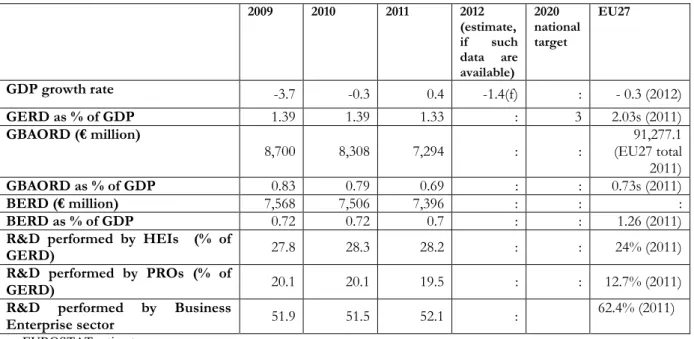
(11) 2 RECENT DEVELOPMENTS OF THE RESEARCH AND INNOVATION POLICY AND SYSTEM 2.1 National economic and political The crisis in Spain has particularly affected the unemployment rate, which rose to the highest in Europe (21.7%) in 2011.9 Spanish GDP decreased by -0.3% in 2010 and increased slightly by 0.4% in 2011 while in the Eurozone these percentages were respectively 2.1 and 1.5%. The debt crisis obliged Spain to apply severe cuts to its public budget, which have specially affected the budgets for R&D and Innovation. GBAORD decreased by -12.2% in 2011. The budget for public expenditures by the central government on R&D and innovation (PGE) decreased in 2012 by -25.6%, thus increasing the trend of previous years’ cuts (see section 2.2 and 3). These severe public budget cuts for R&D and innovation have triggered important institutional and grassroots actions in support of science. Several research-related organisations have raised important concerns about the sustainability of the Spanish R&D system (see section 2.5). Regulatory changes to comply with public deficit targets also affected R&D and innovation system. For example, in order to be able to create the new Spanish Research Agency envisaged by the new Law LCTI it was necessary to include an amendment to the draft of the General State Budget of 2012 as this forbade the creation of any public agency. In the same way, some regulatory measures to correct the public deficit (e.g. Royal Decree-Law 20/2011) have limited staff recruitment and the filling of positions left vacant by retirees. The basic principles of the Spanish Research System and R&D policy framework have suffered important changes due to the approval of new Law LCTI (1st June 2011) and the arrival of a new government (21st December 2011). The new strategy and plan – the Spanish Strategy for Science, Technology and Innovation (EESTI) (2013-2020) and the Spanish State Plan for Scientific and Technical Research and Innovation (PECTI) (2013-2016) – also introduce important changes (see section 2.4).. 2.2 Funding trends After a period of increasing economic growth, which ended in 2008, Spanish GDP decreased by -0.3% in 2010 and increased slightly by 0.4% in 2011 while in the Eurozone these percentages were respectively 2.1 and 1.5% (see Table 1). The forecast Spanish GDP for 2012 is -1.4%, which is much lower than the EU-27 forecast of -0.3%. With regard to the input side of the innovation and science system, Spain made great efforts in the period 2002-2008 when its Gross Expenditure on R&D (GERD) in absolute terms doubled, while in relative terms the GERD by GDP increased from 0.99% in 2002 to 1.35% in 2008, reaching its highest level in 2009 (1.39%). However, the financial crisis cut short this positive trend. In 2010 the R&D intensity (GERD as a percentage of GDP) practically stagnated (1.39%) and decreased to 1.33% in 2011, reaching a figure lower than the one in 2008 (1.35%). The Government Budget Appropriations or Outlays on R&D (GBAORD) in Spain and its regions decreased by -4.5% (0.79% of the GDP) in 2010 and by -12.2% (0.69% of GDP) in 2011, reaching a budget of €7,294m. In relative terms, GBAORD as a percentage of GDP declined from 0.83% in 2009 to 0.69% in 2011 but is still higher than the EU average of 0.73%. Business R&D expenditures (BERD) decreased respectively by -0.8% in 2010 and -1.5% in 2011 leaving the total private expenditures at 9. Data from INE. 9.
(12) €7,369m. BERD as a percentage of GDP was 0.7% in 2011 slightly lower than the one in 2009 0.72% but far from the EU average of 1.26%. By sectors of performance, the distribution of GERD did not change much. The business enterprise sector and Higher Education Institutions (HEIs) slightly increased their shares from 51.9% and 27.8% respectively in 2009 to 52.1% and 28.2% in 2011. These increases went against the decline in shares of PROs. Not-for-Profit Organisations (NPOs) played a minor role, in consisting of the remaining 0.2%. These figures on R&D expenditures indicate that it will be very difficult for Spain to reach the targets of 3% GERD per GDP set by the Europe 2020 strategy. Table 1: Basic Spanish R&D indicators (2009-2012) 2009. 2010. 2011. 2012 (estimate, if such data are available). 2020 national target. EU27. GDP growth rate. -3.7. -0.3. 0.4. -1.4(f). :. - 0.3 (2012). GERD as % of GDP GBAORD (€ million). 1.39. 1.39. 1.33. :. 3. 8,700. 8,308. 7,294. :. :. 0.83 7,568 0.72. 0.79 7,506 0.72. 0.69 7,396 0.7. : : :. : : :. 2.03s (2011) 91,277.1 (EU27 total 2011) 0.73s (2011) : 1.26 (2011). 27.8. 28.3. 28.2. :. :. 24% (2011). 20.1. 20.1. 19.5. :. :. 12.7% (2011). 51.9. 51.5. 52.1. :. GBAORD as % of GDP BERD (€ million) BERD as % of GDP R&D performed by HEIs (% of GERD) R&D performed by PROs (% of GERD) R&D performed by Business Enterprise sector. 62.4% (2011). s - EUROSTAT estimate f- Forecast (:) Non-available. Data Source: EUROSTAT, March 2013 Targets from: http://epp.eurostat.ec.europa.eu/portal/page/portal/europe_2020_indicators/headline_indicators). For 2012 and 2013 only some provisional data are available on the central government’s budget for public expenditures (PGE).10 This state level budget increased from €4,000m in 2003 to €9,673m in 2009. After 2009, the budget began decreasing, by -4.1% in 2010, -7.4% in 2011 and by -25.6 in 2012, leading to a budget of €6,394m. For 2013 another -7.2% reduction was applied. The state budgets include not only direct expenditures and subsidies on R&D but also loans. In fact, in the last few years the share of loans has been increasing, in contrast to that of subsidies, which implies, de facto, an even greater decrease. Considering the growth of the Spanish R&D system, the total funds per R&D personnel (FTE) have changed from €31.9k in 2002 to €41.1k per head in 2009. For 2013, this figure will represent €22.6k per head (€16.2k non-financial) (Molero and de No, 2012c, Molero and de No, 2013). This is a clear step backwards for the Spanish R&D system. The PGE for 2012 returned the public R&D investments to the levels of 2006 (Molero and de No, 2012b). In addition, the non-execution of an important part of the budgets has worsened the situation, and COSCE has denounced this. In the period 2009-2011, between 21% and 42% of the yearly budgets were not executed. Since 2008, the total budget not executed is equivalent to €8,661m, which is higher than the total budget for 2011 (Molero and de No, 2012a). COSCE, in its analysis of the PGE on R&D for 2013 (Molero and de No, 2012c), warns that the envisaged 80% of the total reduction lies in non-financial funds, and this will have a devastating impact on public research and, especially, in 10. Data from COSCE reports.. 10.
(13) basic research (see section 2.5 for the reaction of some research organisations on R&D funding cuts). Competitive project-based funding has gained importance within the Spanish R&D and innovation system.11 The budget for R&D and innovation distributed by the National State Administration (AGE) for 2011 was €3,323.7m, of which 63.4% was distributed through low interest credits and 36.6% was subsidies (FECYT, 2012). The new plan PECTI (2013-2016) clearly states that most of the funds will be distributed through competitive funding mechanisms. Spain boasts a broad set of policy instruments, mostly based on low interest credits, to stimulate greater R&D investment in R&D performing firms. The Spanish system of tax incentives for R&D and innovation has been one of the most generous among OECD countries for the past few years. However, despite the fact that tax incentives are very generous, the bureaucratic procedure for benefitting from these deductions was until recently complex and uncertain. This diminished the incentive effects of the support programme. The Ministry of Treasury has indicated that the average annual cost of tax income forgone by the state was €200-300m in 2002-03 and over €300-400m in 2004-08, decreasing to around €200m in the last few years. This represents around 3-5% of private R&D expenditure in this period, while support in the form of subventions since 2007 has been around 16-18 % (see section 4.2). Spain has recently designed a large number of support schemes to foster public-private cooperation in R&D and innovation. These programmes aim to improve a level of public-private collaboration that has been considered low (OECD, 2006; COTEC, 2012). Industry finances 8% of the R&D expenditures of universities. A specific National Programme (Np) on public-private cooperation has been designed to increase this cooperation. This programme is included in the Instrumental Working Line (IWL) “Articulation and internalisation of the system” of the Spanish National Plan for R&D and innovation (NP). In 2011, the Np on “Public-private Cooperation” distributed €654m 91% of the IWL and had two instruments: INNPACTO and INNPRONTA (FECYT, 2012). Probably the most comprehensive approach to analysing the thematic priority setting of the Spanish policies for R&D and innovation is the distribution of the Spanish GBOARD.12 This indicates that in 2011, over 44.6% of the funds could be considered generic while 53.7% could be directly assigned to specific technological or scientific areas. Generic funds have increased their weight in the last few years from 35.8 in 2006 to 44.6 in 2011. Regarding thematic R&D priorities, the most important one is health, with a participation of 14.2%, followed by industrial production and technology (IPT) at 8.7%, agriculture (7.6%) and transport telecommunications and other infrastructures (TTI) at 5.4%. Comparing the distribution of the last two years, it should be mentioned that Spain has increased its participation in exploration and exploitation of outer space, but decreased its participation in TTI. Compared to the EU average, Spain has a higher participation in health, agriculture, TTI and environment while lower mainly in political and social systems, structures and processes, and IPT. Moreover, on a European level the defence-related GBOARD is more important. The percentage of funds assigned to defence has been decreasing since 2008, representing only 1.7% of the GBOARD in 2011.. 2.3 New policy measures Without considering the new policy measures envisaged in the new strategy EESTI (2013-2020) and plan PECTI (2013-2016) (see next section), the main policy measures on research and In 1983 this form of support accounted for 23% of the R&D-related state budget, while at the beginning of this century this percentage was around 30% of all funds (Sanz. 2005). 12 See EW (2011) for different alternatives to analyse the thematic focus and its advantages and disadvantages. 11. 11.
(14) innovation policy included in the National Plan and in the Spanish Strategy for innovation (e2i) in 2011 were: The Severo Ochoa, which recognizes research centres of excellence The subprogram AVANZA TIC Verdes on innovation projects to foster energy efficiency The INNPRONTA sub-programme, which aims to encourage public-private collaboration on strategic industrial research FEDER-INTERCONNECTA (Andalucía and Galicia), which funds big projects on experimental and strategic development INNTERNACIONALIZA, which funds projects of SMEs to exploit innovative technologies abroad INNVIERTE. A venture capital fund with about €300m for 2011-2013 INNODEMANDA, which funds technologies for public procurement innovation Last year, some programmes suffered delays (e.g. call for proposals of the R&D plan on fundamental research projects and Research Training (FPI)) or significant reductions (e.g. Research Training – FPI and FPU – with a reduction of 200 grants), or were cancelled entirely (e.g. the Jae programme). Also, many regions reduced their budgets for R&D and innovation and cancelled research training grants (e.g. Madrid, Castile and Leon and the Canary Islands). 2.4 Recent policy documents The main new policy documents are: The new Law of Science, Technology and Innovation (LCTI), the new Spanish Strategy for Science and Technology and Innovation (EESTI) (20132020) and the Spanish State Plan of Scientific and Technical Research and Innovation (PECTI) (2013-2016). NEW LAW OF SCIENCE, TECHNOLOGY AND INNOVATION (LCTI) The new Law of Science, Technology and Innovation (LCTI) (1st June 2011) replaced the so-called Law of Science of 1986. The new law aims to improve coordination with regional and European authorities, to take into account the growth of the Spanish R&D and innovation system, to improve research careers and to help the transition to an economy based on knowledge and innovation. It also mentions gender issues and ethics. The emphasis on innovation, which was missing in the Law of 1986, the design of several mechanisms aimed at improving national and regional coordination, and the project of the Spanish Research Agency are the main relevant aspects of the new Law. It modifies the governance and human resources for R&D and improves the mechanisms for the transference of knowledge. Governance of the R&D and innovation system The LCTI organises the governance of the R&D and innovation system as follows. The Ministry of Science and Innovation (MICINN) now – the Ministry of Economy and Competitiveness (MINECO) – is responsible for drafting and managing the R&D and innovation strategies and plans proposals. The LCTI envisaged two strategies and two plans that have recently merged into single documents. . The Spanish Strategy for Science and Technology and Innovation (EESTI) (20132020) is a multiannual plan that sets the rationale, objectives and indicators of the Spanish R&D and innovation policy (see below a specific section for this document). The Spanish State Plan of Scientific and Technical Research and Innovation (PECTI) (2013-2016) is a multiannual plan that implements the EESTI by setting its 12.
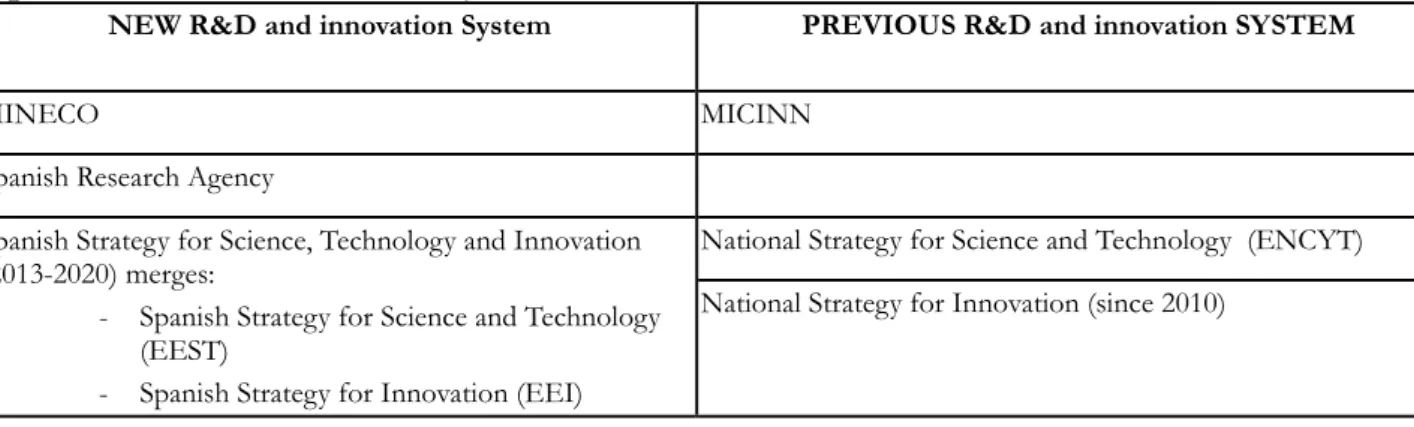
(15) priorities, programmes, coordination mechanisms, costs and sources of funding. Both documents were approved on 1st February 2013 (see below a specific section for this document). The Executive Committee for Science, Technology and Innovation policy (CDCTI) is an inter-ministerial body responsible for the planning, evaluation and coordination of the main Spanish instruments for R&D and innovation. Two main consultative bodies support the design and implementation of the R&D innovation strategies and plans: . Council of Science, Technology and Innovation (CPCTI) – in charge of coordination with regional governments and other actors in the R&D system. It also supports the drafting of the national strategies. Its members are the Secretaries of State of the Ministries with R&D and innovation responsibilities and representatives of each of the regional governments “Comunidades Autónomas”. It replaces the General Council of Science & Technology (GSCT). Advisory Council of Science, Technology and Innovation (CACTI) in which the research community, enterprises and trade unions are represented. It reports on the strategies and plans and offers information, suggestions and opinions. It replaces the Advisory Council for Science and Technology Policy (ACSI). The Ministry, in collaboration with other ministries, drafts the R&D and innovation plans. The CDCT and CACTI report on the drafts before these are subjected to the approval of the Government. The LCTI 2011 envisages the creation of the Spanish Research Agency (to be created). This Agency aims to be an autonomous entity that will assign R&D funds on grounds of scientific merit. The draft of the General State Budget (PGE) of 2012 forbade the creation of any public agency, making it necessary to include an amendment to allow the creation of the Research Agency. The LCTI does not include specific details about the structure and responsibilities of this agency, which will be, together with the Centre for Industrial Development (CDTI), the main funding bodies of the R&D and innovation system. It is assumed that the Agency will be responsible for the research-oriented projects whereas the CDTI will manage policy instruments oriented towards the enterprises. Other organisations, such as the Carlos III Health Institute, also fund research. The Information System of Science, Technology and Innovation (SICTI) is responsible for the data collection and analysis for the monitoring of all policy programmes and instruments of the R&D and innovation policy. The system aims to gather information coming from national and regional actors (the National State Administration – AGE – and the Regional Administrations – “Comunidades Autónomas”). The system is under the umbrella of the MINECO and the Council of Science, Technology and Innovation (CPCTI). The LCTI emphasises the coordination between national and regional information systems through the SICTI and the CPCTI. The Committee of Ethics in Research is an advisory body on the ethics of research and technology. The design of several mechanisms aimed at improving national and regional coordination, such as the Council of Science, Technology and Innovation (CPCTI) and the new information system (SICTI), as well as the project of the Spanish Research Agency are the main changes in the governance of the R&D and innovation system brought by the new law. Figure 1 shows the structure of the Spanish research and innovation system and Table 2 in section 2.5 summarises some of the main organizational changes and equivalences between the new and previous 13.
(16) Spanish R&D and innovation system. Human Resources The LCTI includes four types of private (non-civil servant) labour contracts: (1) to carry out a PhD degree (four years maximum with minimum wages) (Art. 21); (2) of access (five years and maximum of 80 hours of teaching) (Art. 22); (3) for researchers working on research projects (D.a 23a); and (4) for distinguished researchers or scientists, “of great prestige” who will be able to occupy key positions in management or in “important” programmes (which can be permanent) (Art.23). The pre-PhD contract will be delayed till 2014 and the access ones could be conditioned by the State budget and public employment supply. Moreover, it has created a unified professional career. The different official professional scales for scientists with a civil servant status in public research organisations (PROs) will be unified in three, comparable to those of the Spanish National Scientific Research Council (CSIC): (1) research professor, (2) scientific researcher and (3) permanent scientist. This unification facilitates staff mobility between the PROs (see Figure 2 below). The LCTI also improves several aspects in the career of the researchers. The future replacement of the 2+2 system (two years scholarship and then a two year contract) by a four-year employment contract implies the full recognition of certain rights such as unemployment benefits and maternity leave. In addition, the LCTI improves mobility between private and public organisations by allowing an extended leave for a maximum of 5 years and reducing partially the incompatibility for working in private firms (see section below). Figure 2. Scheme of a research career. Pre-PhD. Contract “Contrato Predoctoral” Post-doctoral Contracts Access contract “Contrato de acceso”. Associate Professor “Profesor Contratado Doctor” (Art. 22.4 LCTel). Permanent contract “Personal Laboral fijo de Universidades”. University Professor “Profesor Titular de Universidad”. Permanent contract “Personal Laboral fijo de OPIS”. Research Professor “Científico Titular OPIs”. “Turno Libre. Escala OPIS”. Source: MINECO. Mechanisms for knowledge transfer The LCTI emphasises the role of innovation, technology and knowledge transfer by improving the mechanisms of knowledge transfer, granting property rights to researchers and reducing the incompatibily for researchers employed at public institutions to work in private firms. It aims at improving mechanisms of knowledge transfer by: (1) increasing the value of transfer activities (e.g. by detecting research groups whose knowledge could be applied or by increasing the role of OTRIs) (2) promoting the “units of excellence” (art. 33.1) or (3) developing an open-access 14.
(17) archive with research results. It encourages the creation of Technology Based Enterprises (EBTs) by allowing researchers to work part-time in private firms created by the organisations in which they are working and by eliminating restrictions on the maximum share ownership of a private company (10%) and the restrictions on being a board member in private companies. It modifies the previous Law of Sustainable Economy (Law 2/2011) to allow researchers to profit from their patent earnings. THE SPANISH STRATEGY FOR SCIENCE AND TECHNOLGY AND INNOVATION (EESTI) The Spanish Strategy for Science and Technology and Innovation (EESTI) (2013-2020) establishes the rationale, objectives and indicators of the Spanish R&D and innovation policy. The EESTI merges the two strategies envisaged by the LCTI –the Spanish Strategy for Science and Technology (EEST) and Spanish Strategy for Innovation (EEI) – and replaces to the previous National Science and Technology Strategy (ENCYT) and Spanish Strategy for Innovation (e2i). The new strategy, EESTI, is based on: 5 basic principles; 4 general objectives disaggregated into 18 specific objectives; 6 Priority Axes; and 6 articulation mechanisms. It also sets out indicators to measure the impact of the R&D and innovation policy. Its 5 principles are: (1) Coordination of R&D and innovation policies; (2) Stable framework; (3) Quality and social impact; (4) Efficiency and accountability; (5) Gender issues (See section 4.1 for the general and specific objectives). The EESTI is in line with the Europe 2020 strategy. It is also based on an analysis that identifies 14 challenges13 that are quite similar to the ones identified by the OECD report (2006). THE SPANISH STATE PLAN FOR SCIENTIFIC AND TECHNICAL RESEARCH AND INNOVATION (PECTI) (2013-2016) The Spanish State Plan for Scientific and Technical Research and Innovation (PECTI) (2013-2016) implements the EESTI by establishin its priorities, programmes, coordination mechanisms, costs and sources of funding. The PECTI merges the two strategies envisaged by the LCTI – the Spanish National Plan for Scientific and Technical Research (PECT) and the Spanish National Plan for Innovation (PEI) – and replaces the National Plan for R&D and Innovation 2008-2011, extended to the end of 2012, as well as Ingenio 2010.14 The new PECTI gives special emphasis on its integration into the European Research Area and to the promotion of: “(a) excellent basic research; (b) technological, industrial and firm leadership; and (c) scientific and technical research and innovation capabilities on grand challenges” (PECTI: 5). Following the EESTI format, it is structured into 4 programmes and 18 sub-programmes (see (1) Low intensity of R&D effort; (2) Low private R&D investments; (3) Lack of instruments for financing private R&D; (4) Lack of venture capital; (5) Regional disparity in R&D; (6) Fragmentation of R&D groups; (7) Lack of public-private collaboration; (8) Inefficient mechanisms for Knowledge transfer; (9) Low R&D activity in traditional sectors and SMEs; (10) Small size and number of enterprises doing R&D activities; (11) Inter-sectorial mobility barriers for scientists; (12) Small survival business rates; (13) Low internationalisation of R&D actors (specially firms); (14) Low rate of firms in medium high sectors. 14 Ingenio 2010 established the specific goals to commit with the Lisbon Strategy. These were to increase the ratio of R&D investment by GDP to 2%, to increase the R&D contribution of the private sector up to 55% and to reach the EU-15 average in the percentage of GDP allocated to ICT. 13. 15.
(18) Box 2 in section 4.1).15 In addition, it includes 2 strategic actions – first Health and secondly Digital economy and society. It establishes 6 modes of participation16 and 4 funding instruments – subsidies, loans, venture capital and tax incentives. As in previous plans, it is operationalised through annual programmes. It envisages indicators to evaluate the management and the result of the programmes. The PECTI is based on an analysis of the previous plan that identified 8 main problems.17 The new strategy and plan were approved on 1st February 2013, to follow on the current National Plan on R&D that finished in 2011 and was extended to the end of 2012. Two public consultation processes on the strategy and plan were carried out in October 2012 and December 2012 (see 2.7).. 2.5 Research and innovation system changes The main research and innovation system changes were brought by the LCTI and the change of the government. In addition, it is worth mentioning the social mobilisation in support of science that was triggered by the severe public budget cuts on R&D and innovation. As the previous section specifies, the LCTI brought about some important changes in the Spanish research and innovation system. The emphasis in improving national and regional coordination through the CPCTI and SICTI and the creation of the new Spanish Research Agency are probably the most important changes in the governance structure introduced by this law. Some bodies were re-organised (e.g. the CPCTI) or re-named. (See the previous section for details, Figure 1 for the structure of the system and Table 2 for a summary of some of the main organisational changes and equivalences between the new and previous Spanish R&D and innovation system). The new government (December 2011) closed down the Ministry of Science and Innovation (MICINN) and reallocated the main R&D and innovation responsibilities to the Ministry of Economy and Competitiveness (MINECO). Other Ministries with R&D responsibilities were reorganised or renamed (see Table 2 below). Table 2: Main organisational changes and equivalences between the new and previous Spanish R&D and innovation systems NEW R&D and innovation System MINECO. PREVIOUS R&D and innovation SYSTEM MICINN. Spanish Research Agency Spanish Strategy for Science, Technology and Innovation (2013-2020) merges: - Spanish Strategy for Science and Technology (EEST) - Spanish Strategy for Innovation (EEI). National Strategy for Science and Technology (ENCYT) National Strategy for Innovation (since 2010). The programmes and sub-programmes are similar to the general and specific objectives of the EESTI. (1) R&D and innovation programmes; (2) Human Resources actions; (3) Research infrastructures and equipment; (4) complementary actions; (5) dynamic actions; and (6) collaborative actions. 17 (1) Administrative burden; (2) lack of coordination (inter-institutional; inter-departmental and inter-regional); (3) excessive number of instrument; (4) fragmentation of funding; (5) unrealistic time framework; (6) lack of adequate indicator to follow evaluate the development and impact; (7) lack of dissemination of the results of funded projects; and (8) ministerial organisational changes that created problems in the development of programmes. 15 16. 16.
(19) The Spanish State Plan of Scientific and Technical Research National Plan for R&D and Innovation and Innovation (PECTI) merges: Spanish National Plan for Innovation - Spanish National Plan for Scientific and Technical Research (PECT) - Spanish National Plan for Innovation (PEI) Council of Science, Technology and Innovation (CPCTI). General Council of Science & Technology (GSCT). Advisory Council of Science, technology and Innovation (CACTI). Advisory Council for Science and Technology Policy (ACSI). Information System of Science, Technology and Innovation (SICTI). In 2012, there were important institutional and grassroots public demostrations in support of science. The campaign for “A tick box in the tax declaration” (“Casilla en apoyo de la ciencia en la declaración de la Renta”), the “Open letter for Science in Spain”, followed by the communication “No future without R&D and Innovation” and the simultaneous support actions of 19th December 2012 were probably the most significant ones. These actions denounced the severe public budget cuts on R&D and innovation as making R&D and innovation unsustainable and reducing the opportunities to improve the Spanish economy. “A tick box on the tax declaration” (“Casilla en apoyo de la ciencia en la declaración de la Renta”). On 3rd January 2012 a web campaign started from a science blog that collected signatures demanding a specific tick box in the tax declaration to allow taxpayers to devote 0.7% of their taxes to research.18 Within about a month, the campaign had gathered nearly 300,000 signatures, which were handed to the relevant institution. “Open Letter for Science in Spain”. This letter was the result of a consensus between different research-related organisations – COSCE, CRUE, the Federation of Young Researchers, the grassroots movement “Investigación digna”, and the trade-unions CC.OO. and UGT. The letter demanded that “a new reduction of the investments in R&D and innovation” should be avoided and that R&D and innovation should be included among the “priority sectors”.19 This letter gathered about 40,000 signatures in a week. “No future without R&D and Innovation” is a communication launched during the “Week of Science” (8th-18th November 2012) by the above-mentioned institutions jointly with the “Foro de Empresas Innovadoras”, which denounced the severe public budget cuts on R&D. On those days the Spanish Congress was debating the Public General Budgets for 2013. On 19th December 2012 the organisations that had launched the “Open letter for Science in Spain” called for a series of simultaneous public demonstrations in support of research and Innovation with the slogan “There is a future with R&D and Innovation”. These were followed in several Spanish cities and included a special programme on SER radio, one of the most important radio stations in the country.. Currently, the Spanish tax declaration form includes a tick box that allows tax payers to devote 0.7% of their taxes either to development or religious actions. 19 The Royal Decree-Law 20/2011, an urgent measure to correct public deficit (BOE-A-2011-20638, 31 Dec., 2011, Art. 3) establishes that “the hiring of personnel (…) will be restricted to sectors considered to be a priority”. These sectors will also be allowed to fill the vacancies left by retirees. 18. 17.
(20) 2.6 Regional and/or National Research and Innovation Strategies on Smart Specialisation (RIS3) The concept of “smart specialisation” is gaining importance in the Spanish R&D and innovation system. Smart specialization entails the necessity to prioritise specific areas of research and innovation based on the needs and resources of regions. It is worth mentioning that the new Spanish Strategy for Science, Technology and Innovation (EESTI) (2013-2020) includes the concept in one of its 6 priority axe (Priority 5) as the tool for increasing the competitiveness of the regional systems of Innovation. The Spanish State Plan for Scientific and Technical Research and Innovation (PECTI) (2013-2016) also mentions this concept. However, it is not very clear if it will be a national, regional or a shared competence. Many other regional authorities are using the concept of “smart specialisation” to design or develop their regional strategies. One piece of evidence of the success of the concept is that all Regional authorities or “Comunidades Autónomas” (CAs) have registered for the Smart Specialisation Platform (S³P), which “assists Member States and regions to develop, implement and review Research and Innovation Strategies for Smart Specialisation (RIS³)” (RIS³: on-line). In addition, Navarre and the Balearic Islands have been the subject of case studies on smart specialisation (Ortega-Argilés, 2012). In any case, it is also worth mentioning the case of the Basque Country as a region in which this rational was applied a long time ago. In the early 198os, this region started a series of policies that were designed and implemented in collaboration with the main political, economic and social stakeholders, and it has managed to transform its economic structure and become one of the main R&D regional actors with the highest R&D investment per GDP in Spain (2.1% in 2011), as well as being the region with the lowest level of unemployment (12.1% in 2011. Source).20. 2.7. Evaluations, consultations. Under the mandate of the MINECO, the Spanish Foundation for Science and Technology (FECYT) carried out yearly evaluations of the R&D public calls for proposals from 2006-2010. Currently, the Ministry has decided to carry out evaluations with a longer time frame. The CDTI evaluates most of the business-oriented instruments, but there were not publically available reports on 2012 at the time of writing this report (see section 4.3). Therefore, it could be said that the most important public consultations of the year were carried out in relation to the Draft of the Spanish Strategy for Science and Technology and Innovation (2013-2020) (EESTI) and the Draft of the Spanish State Plan for Scientific and Technical Research and Innovation (20132016) (PECTI), in October and December 2012. As mentioned, the final versions of the EESTI (2013-2020) and PECTI (2013-2016) were approved on 1st February 2013. The consultation on the draft of the Spanish Strategy for Science, Technology and Innovation (EESTI) (2013-2020) was carried out between 9th and 25th October 2012. The document received more than 1,400 comments and suggestions (EESTI: 3). For example, the COSCE (Modrego et al., 2012a) recognised the efforts of the EESTI to improve coordination but identified several main weaknesses in the document: it did not take real actions to address the Source INE. In addition, the RedIRIS, an academic and research network, aimed at improving communication could also help to apply strategies of smart specialization. 20. 18.
(21) current situation of the Spanish R&D and innovation system (e.g. it uses data of 2010); it did not include a realistic time framework; it did not have a clear assignation of responsibilities for genuinely changing the governance system and for improving the efficiency of the system. Some of these comments were partially addressed in the final version of the document. For example, the principles have been reduced from 7 to 5 and the articulation principles from 10 to 6. The consultation on thedrat of the Spanish State Plan for Scientific and Technical Research and Innovation (PECTI) (2013-2016) was carried out between 22nd and 8th December 2012. The document received more than 800 comments and recommendations (PECTI: 5). For example, the COSCE (Modrego et al., 2012b) recognised the efforts of the plan to establish its main aim as improving coordination between design and implementation. However, it clearly stated that the plan “has high expectations that are impossible to reach. This generates a feeling of frustration” (p. 2). The report was quite negative, as it considered, among other issues21, that the design of the plan did not take into account the current situation of the Spanish R&D and innovation system. The main criticisms were the lack of priority-setting in an environment of decreasing public budgets; the lack of precision in establishing the funding methods; the fact that it does not take into account previous failures (e.g. by using instruments for promoting innovation that have not been used or evaluated); the low importance of the expost evaluation mechanisms and vague distribution of responsibilities between funding bodies (the Spanish Research Agency and the CDTI). Some of these comments were partially addressed in the final version of the document. For example, it includes references to the ex-post evaluation, it is more detailed when describing the competences of the funding bodies and includes more detailed, but still general, indicators.. 2.8 Policy developments Recommendations. related. to. Council. Country. Specific. The Council Country-Specific Recommendations (July 2012) recommended that Spain should “review spending priorities and reallocate funds to support access to finance for SMEs, research, innovation and young people” (Recommendation 6: p. 13). The National Reform Programme 2012 and the Stability Programme 2012-15 could be considered in order to assess the measures adopted to tackle these recommendations. These policy documents mainly reinforce the objectives for the Spanish R&D and innovation system of increasing excellence, internationalisation, and regional and public-private collaboration, and they place a higher emphasis on innovation activities. The National Reform Programme 2012 includes in the R&D measures in action number 92. These include the creation of the Spanish Research Agency and the new “strategies” and “plans”. These are recognised as improving the private participation in the Spanish R&D system and improving the indicators on innovation. Actions 24 (health) and 75 (digital agenda) also mention the importance of R&D. The Stability Programme 2012-15 states the importance of improving the levels of innovation and internationalisation in the Spanish Research and Innovation system. It also mentions the LCTI, the Spanish Research Agency and the strategies and plans as specific measures.. More specifically, it considers that the PECTI lacks realistic analysis; clarity and coherence between objectives; design of effective instruments; priority setting; stability; budget allocation and real change in the governance system towards efficiency, evaluation and cooperation among all the stakeholders. 21. 19.
(22) In summary, it is difficult to disentangle the possible specific measures adopted to tackle the Council Country Specific Recommendations (July 2012) from the general measures to design and implement the R&D policy framework (e.g. LCTI or PECTI). It could be said that there is a higher emphasis on innovation in the R&D policy framework. However, public budget cuts to R&D and innovation indicate that the specific recommendations of reallocating funds to support R&D and innovation are clearly not being followed.. 20.
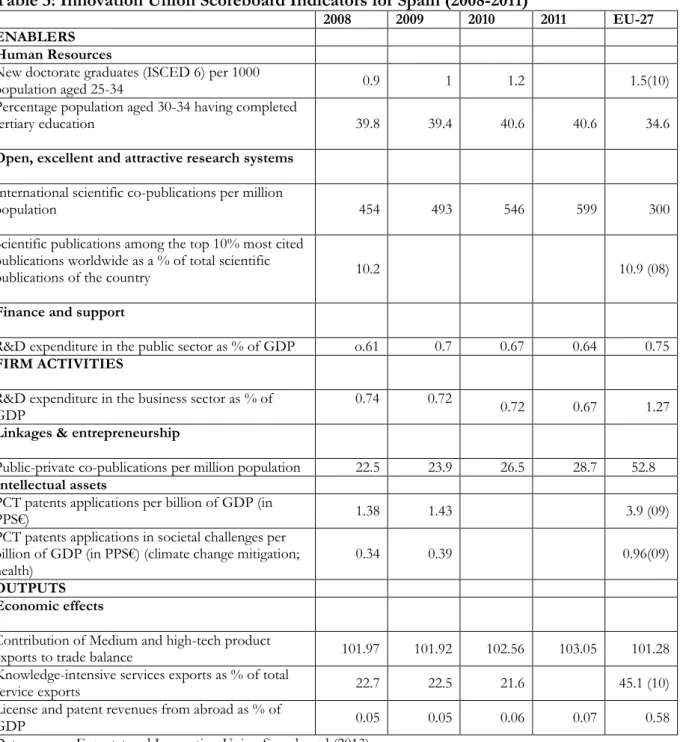
(23) 3 STRUCTURAL CHALLENGES FACING THE NATIONAL SYSTEM Spain is a “moderate innovator”22 (EC, 2012 and EC, 2013) and its strengths lie in tertiary education, international scientific co-publications and medium and high tech exports, while its weaknesses are in private investments, public-private linkages, innovation outputs and knowledge intensive activities. To illustrate its strengths: with increasing levels between 2008 and 2010 (data from the IUS dashboard) and above the EU-27 average (shown in brackets), Spain is outstanding firstly in its percentage of population aged 30-34 who have completed tertiary education, which changed from 39.8% to 40.6% (34.6%); secondly in the level of international co-publications per million, which changed from 454 to 599 (300); and thirdly in the contribution of medium and high-tech product exports to trade balance, which changed from 101.97 to 103.05 (101.28). In contrast, the weak area figures show that at levels below the EU-27 average, Spain underperformed in the percentage of GDP of private R&D expenditures, by 0.67% in 2011 against the EU-27 level (1.27%); in the number of public-private co-publications per million population, 22.5 against 52.8; in patents application per billion GDP (in PPS€), 1.43 against 3.9; in patents applications in societal challenges per billion GDP (in PPS€), 0.39 against 0.96; in the percentage of GDP coming form license and paten revenues from abroad, 0.07% against 0.58%; and in the percentage of knowledge-intensive services exports of total service exports 21.6% against 45.1%. The Spanish research and innovation system relies heavily on public funds, and recent severe public budget cuts are threatening to create new structural challenges and to intensify the existing ones. Spain had a GBAORD as a percentage of GDP of 0.69% in 2011 that was above the EU27 average of 0.73. GBAORD decreased by -4.5% (0.79% of the GDP) in 2010 and by -12.2% (0.69% of GDP) in 2011, leading to a budget of €7,294. As mentioned, data on the central government’s budget for public expenditures on R&D and innovation (PGE) showed that public investments on R&D and innovation decreased in 2012 by -25.6%, thereby increasing the negative trend of previous years (-4,1% in 2010 and -7.4% in 2011). This means that public R&D investments reverted to the levels of 2006 (Molero and de No, 2012b). In relative terms, the total funds per R&D personnel (FTE) have changed from €31.9k in 2002 to €41.1k per head in 2009. For 2013, this figure will represent €22.6k per head (Molero and de No, 2012c; Molero and de No, 2013), which is much lower than the one in 2002. The increasing share of loans against that of subsidies implies, de facto, an even greater decrease. In addition, the non-execution of an important part of the budgets, as this has worsened the situation (between 21% and 42% in the period 2009-2011) (Molero and de No, 2012a). The concentration of the reductions in nonfinancial funds (Molero and de No, 2012c and 2013) could have a very negative impact on public basic research. Important research organisation condemned these severe cuts, as they could destroy the achievements of several years of R&D investments (see section 2.2 and 2.5). Spain, like all developed countries, needs to invest heavily in R&D and innovation if it is to gain and maintain its economic competitive advantage. It has to compete nowadays with industrialised low wage countries and global players such as China or India or the Eastern European EU countries (such as Poland or Romania). The Spanish public authorities and firms have appeared to understand that to build a stronger R&D and innovation system was the only way to become competitive and meet the challenges of a globalised world. In fact, Spain made strong efforts in the period 2002-2008 when its GERD in absolute terms doubled while in 22. Together with the Czech Republic, Greece, Hungary, Italy, Lithuania, Malta, Portugal and Slovakia (EC, 2013). 21.
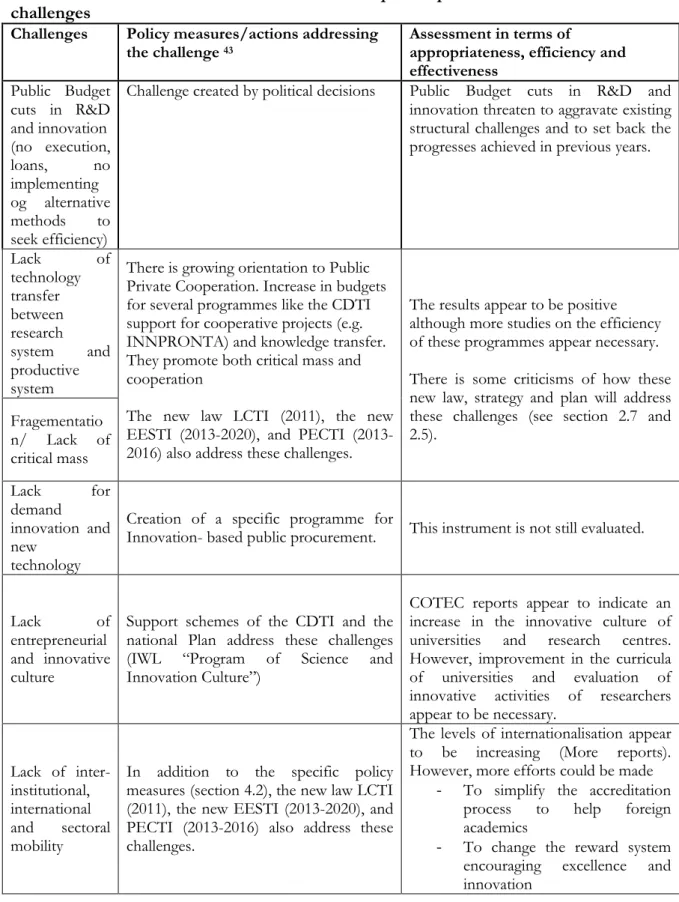
(24) relative terms the GERD by GDP increased from 0.99% in 2002 to 1.35% in 2008. There was also a restructuring of the country’s policy mix on R&D and innovation, including new instruments aimed at tackling the main challenges and overcoming bottlenecks in the Spanish R&D and innovation system (EW, 2011). However, the severe public budget cuts to R&D in recent years appear to contradict the rational of increasing R&D investments, the formal political discourse in support of R&D and innovation expenses, and the Council’s Country-Specific suggestions (see section 2.8). Table 3: Innovation Union Scoreboard Indicators for Spain (2008-2011) 2008 ENABLERS Human Resources New doctorate graduates (ISCED 6) per 1000 population aged 25-34 Percentage population aged 30-34 having completed tertiary education. 2009. 2010. 2011. EU-27. 0.9. 1. 1.2. 1.5(10). 39.8. 39.4. 40.6. 40.6. 34.6. 454. 493. 546. 599. 300. Open, excellent and attractive research systems International scientific co-publications per million population Scientific publications among the top 10% most cited publications worldwide as a % of total scientific publications of the country. 10.2. 10.9 (08). Finance and support R&D expenditure in the public sector as % of GDP FIRM ACTIVITIES. o.61. 0.7. R&D expenditure in the business sector as % of GDP Linkages & entrepreneurship. 0.74. 0.72. Public-private co-publications per million population Intellectual assets PCT patents applications per billion of GDP (in PPS€) PCT patents applications in societal challenges per billion of GDP (in PPS€) (climate change mitigation; health) OUTPUTS Economic effects. 22.5. 23.9. 1.38. 1.43. 3.9 (09). 0.34. 0.39. 0.96(09). Contribution of Medium and high-tech product 101.97 exports to trade balance Knowledge-intensive services exports as % of total 22.7 service exports License and patent revenues from abroad as % of 0.05 GDP Data sources: Eurostat and Innovation Union Scoreboard (2013). 0.67. 0.64. 0.75. 0.72. 0.67. 1.27. 26.5. 28.7. 101.92. 102.56. 22.5. 21.6. 0.05. 0.06. 103.05. 52.8. 101.28 45.1 (10). 0.07. 0.58. The Spanish R&D and innovation system faces challenges in its industrial structure, science and technology base, and governance structure. These main challenges were identified several years ago (OECD, 2006; EW 2009; EC, 2011a) and, despite the efforts, they still remain. For example, the new strategy EESTI (2013-2020) identifies 1423 challenges that are quite similar to the ones 23. See Footnote 13.. 22.
Figure

+2
Documento similar