
Studies on the pulmonary surface active lipoprotein I Isolation and chemical characterization of its constituents
21
0
0
Texto completo
(2) 126. REVISTA DE BIOLOGIA TROPICAL. of the physicochemical characteristics of the SA-peptide moiety will be presented in a later paper.. MATERIAL AND METHODS Ordinary laboratory chemicals used in this research were of analytical reagent grade.. Unless stated otherwise, optical densities for each test were. read with 1 cm quartz cuvettes in the Beckman DB Spectrophotometer. rSOLATION OF THE SA-LIPOPROTEIN COMPLEX. During the experimental part of this study, eight lots of the SA-lipo protein were isolated from fresh lung tissue: two lots from guinea pigs (Hartley strain from the Vivarium of the University of Southern California) ; three lots from human beings. (obtained post-mortem from the Los. Angeles County. University of Southern California Medical Center) ; and three lots from cows (from the Los Angeles Meat Company, Vernon, California) . SA-lipoproteins were isolated from lungs according to ABRAMS. (2) .. Fresh lungs were homogenized in a Servall Omnimixer and lipoprotein materials were separated by means of differential centrifugation in salt gradients utilizing a Servall RC-2 Superspeed refrigerated centrifuge (SS-34 rotor) .. The flotation. and pelleting of the SA-lipoprotein materials were repeated twice.. The pellicle. against 0.85 per cent sodium chloride containing 0.01 per cent of the sodium salt of EDTA. The containing the SA-lipoprotein complex was dialyzed. SA-lipoprotein concentrations. in. these. dialysates. were estimated by drying. aliquots to constant weight. The protein content of dried SA-lipoprotein was estimated on the basis of its nitrogen contento CHEMICAL CHARACTERIZATION OF THE SA-LlPOPROTEIN COMPLEX. In order to establish the chemical composition of the materials isolated in our laboratory, a series of tests were carried out as follows :. Total nitrogen.. This was estimated according to the Technicon Micro. Kjeldahl method ( 56) which involves complete digestion of organic material in a continuous digestion unit. Determination of ammonia in the resulting digest was achieved with a pj:lenol-hypochlorite system, by which ammonia is con verted to a blue-colored compound of indophenol type.. A. factor of 6.25. was used for calculation of protein content from total nitrogen content.. Lipid analysis. The lipid composition of SA-lipopr�tein was studied using lipid extracts obtained at very low temperature with 2 : 1 chloroform. methanol (v/v) by freezing and thawing the mixture thrée times in a solution of 2-ethoxyethanol (Matheson) and dry ice. The chloroform-methanol solvents were removed from the extracts by heating the tubes on a hot plate at 80C.. PhosphoJ'ipids. Phosphorus was estimated according to FrsKE and SUBAROW ( 1 6) . For total phosphorus, the samples were digested at 160C in.
(3) 1 27. ]IMtNEZ: SURFACE·ACTIVE PULMONARY LIPOPROTEIN I.. a. perchloric-sulfuric acid mixture until the solution was dear. (29) .. was subsequently developed by the procedure of BARTLETI (8 ) .. The color. Phospholipids. were calrulated by multiplying lipid phosphorus values by 2 5 ( assuming a 4 per cent of total phosphorus per mol of lecithin) .. Readings of total phosphorus. were done in a Klett-Summerson photoelectric colorimeter, utilizing the NQ. 66 filter. Total cholesterol. The method used here was that recommended by and BERGQUIST (45 ) .. SEARCY. Readings of cholesterol were done in a Klett-Summerson. photoelectric colorimeter with filter NQ 5 0. These were determined according to the method of VAN. Triglycerides.. HANDEL and ZILVERSMIT ( 5 7 ) .. (sodium silico aluminate). Lipids were extracted with the aid of a zeolite. and chloroform ( 1 8 ) ; the glycerol moiety of the. triglycerides was determined according to LAMBERT and NEISH ( 27 ) .. Fatty acids. Determined according to the method proposed by. STERN and. SHAPIRO ( 5 4 ) . ISOLATION AND PURIFICATION OF THE PEPTIDE MOIETY OF THE SA-LlPOPROTEIN. Although SA-lipoproteins were isolated from three different species of mammals, the physical and chemical characterization of the peptide moiety was carried out only with lipoproteins isolated from bovine lung. Comparative delipidation. Delipidation. studies were carried out uti. lizing the methods proposed by FOLCH et al. ( 1 7 ) , the modification of SCANU (40) to the technique of SCANU et al. (42 ) and with a new method devel oped in our laboratory ( 2 5 ) as foIlows :. One volume of the SA-lipoprotein. suspension was extracted with 2 5 volumes of a mixture of 3 : 2 of ethanol diethyl. ether. (v/v). in. a. was cooled to -70C by. flat-bottom, immersion. 2 -ethoxyethanol and dry ice, operated at very low speed.. glass-stoppered. for. four hours. flask. in. a. The mixture container with. then shaken gently in an automatic shaker The cooled lipoprotein-organic solvent mix. ture was then centrifuged at 1 5,000 rpm for 30 minutes at 4C in a Serv aIl refrigerated centrifuge. The precipitate was suspended in a fresh 3 : 2 ethanol ether solution ( 5 0 volumes of organic solvent for each volume of precipitate) and alIowed to stand for twenty-four hours at -20C in the freezer. The delipidized lipoprotein was recovered by centrifugation at 1 5 ,000 rpm for 30 minutes at 4C.. The precipitated peptide material was then washed three. times with the ethanol-ether solution, and finalIy three times with diethyl ether in order to remoVe alI traces of alcohol.. The precipitate was alIowed to dry. under nitrogen and stored at -10C u:ntil used.. Delipidized materials obtained. by three different techniques were analyzed for the presence of phos.pholipids and cholesterol.. Purification 01 SA-peptide.. The dried delipidized lipoprotein material. was rendered soluble by stirring at room temperature with 0 . 1 N sodium hydrox ide for 24 hours.. These ,crude peptide solutions were concentrated and ultra. filtered under p ressure over a, Diaflo Membrane, type UM-l.. The ultrafiltered,.
(4) 128. REVISTA DE BIOLOGIA TROPICAL. concentrated SA-peptide solutions were then successively gel filtered through columns of Sephadex G-20, G-50, and G- 100 of medium particle size. Elutions were performed with 0 . 1 M sodiu:m chloride solutions at pH 1 0.0. Recovery of the peptide was determined by measuring light absorption at 280 mf). of the collected fractions. The SA-peptide concentrations were estimated by drying aliquots to constant weight and the protein content was estimated by measuring its total nitrogen content, andjor by use of the microbiuret method ( 5 ) . Purity of SA -peptide. Analytical ultracentrifugation, electrophoresis and gel filtration were employed to assess the purity of the isolated SA-peptide. In addition, efforts were made to determine whether the carbohydrates present were an intrinsic part of the peptide or resulted from contamination with a glycoprotein. Chf!mical characterization of the SA-peptide moiety. Presence of lipids and carbohydrates on the purified SA-peptide materials was investigated. The content of sialic acid ( as N-acethyl-neuraminic acid) was measured according to WARREN ( 5 8 ) . The technique of DrSCHE and SHETTLES ( 14) , as modified by DISCHE ( 1 3 ) , was used in order to measure the content of fucose (as methyl pentose) . The orcinol test proposed by LU STIG and LANGER ( 3 0 ) , as modified by FRANCOIS et al. ( 19 ) , was utilized for the estimation of neutral hexoses, and hexosamines ( as glucosamine) were determined by the modifica tion of the EIson-Morgan test by RONDLE and MORGAN (39) . Establishment of the p eptide-carbohydrate moiety existence. In order to establish that the presence of carbohydrates in the peptide moiety solutions couId . not arise from protein impurity of high carbohydrate content, the purified SA-peptide was precipitated with 5 per cent trichloroacetic acid or with 0.6 M perchloric acid, to separate it from known glycoproteins (44 ) . Precipitates were collected by centrifugation, washed, suspended in distilled water and measure ments oE the sialic acid content were then perEormed. Amin o a.cid analysis*. One milliliter oE concentrated hydrochloric acid ( 1 2 N) was added to 1.0 to 4.5 mg of delipidized SA-lipoprotein in 1 mI water solution ; the glass tubes were evacuated, sealed under nitrogen, and heated at 1 1 0 + 1 C for 22, 46, or 72 hours. Hydrolysates were dried over NaOH pellets il1 vamo. The dry samples were dissolved in 2.0 mI 0.20 N sodium citrate-HCl buffer, pH 2 .2. Aliquots were �nalyzed by . ion exchange chromatography with the tech nique of MOORE, SPACKMAN, and STEIN ( 36) , in a BeckmanjSpinco model 1 20B amino acid analyzer (49 ) . The analyzer was calibrated with the type 1 amino acid calibration mixture (provided by Beckman lnstruments, lnc., Palo Alto, California) and, in studies oE perEormate-oxidized peptide, with cysteic acid. Chromatography was carried out according to the procedure for .. Standard 509 run" (48) . *. 1 am indebted to Mr. Kim S. Wise ( Laboratory Technician, Department of Bio· chemistry, University of Southern California Dental School) for his help in performing the runs with the amino acid analyzer..
(5) JIMT1NEZ: SU1tFACE-ACtIVE PULMONAIi.'f. ill>OPROTllIN. 129. L. Half-cystine wa'S determined as cysteic acid after oxidizing the SA-pep. tide with performic acid according to the methods of SCHRAM et al., ( 35 ) , as recommended by BAILEY (7) .. MOORE. hydrolyzed in the usual way with 6 N HCl at 1 10. (43 ) ,. The oxidized material was. -+-. 1C for twenty-two hours,. and aliquots were analyzed by ion exchange chromatography with the Beckmanj Spinco model 1 20B amino acid analyzer.. The tryptophan content of the intact SA-peptide moiety was determined. colorimetrically according to procedure and CHAMBERS ( 52 ) . protected from light.. L of the method proposed by SPIES. Reactions were carried out at room temperature and. Optical densities were read at 590 mj-t and transmittancy. values were converted to weight of tryptophan from standard curve C of SPIES. and CHAMBERS ( 5 1 ) .. Calculation of amino acid comp osition.. Data from the Analyzer were. corrected for losses of unstable amino acids during acid hydrolysis.. Values of glutamic acid, aspartic acid, lysine, hydroxylysine, threonine. and serine were obtained by extrapolation to zero time of hydrolysis to account for apparent loss of these compounds.. The amide ammonia content was also. estimated by extrapolation to zero time of hydrolysis. of half-cystine and trytophan were obtained. Values for the contents. by methods. already described.. The moles of each amino acid residu:e were converted into grams of amino acid residue per 100 grams of peptide.. The number of moles ' of each amino acid. present in 100,060 grams of peptide was also calculated, and from these values. minimal molecular weights of the peptide moiety were computed.. The nitrogen. value for each amino acid residue was al'So calculated as per cent of total nitrogen.. Biological activity.. The possibility that either the SA-lipoprotein com. plex or the SA-peptide moiety possess biological activity was explored, especially with rcgard to phosphatase activity. using the Technicon method ( 56) .. Alkaline phosphatase activity was studied. RESULTS ISOLATION AND CHEMICAL ANALYSIS OF SA-LIPOPROTEIN. Normal guinea pig, human and bovine lungs have been found to contain 7.5. -+-. 2 . 5 mg of SA-lipoprotein complex per gram oí wet tissue.. Table 1 shoW'S the cheroical composition of the three species of SA-lipo. proteins isolated in out laboratory from guinea pig (n= 4 ) , human ( n = 6) , and cow ( n = 6) lungs.. The three species of lipoproteins have a practically. identical chemical composition. Peptide moieties represent about 60 per cent oí the whole . SA-lipoproteins. The lipid fractions consist mainly of about 70 per cent phospholipids, 6 per cent total cholesterol, 16 per cent triglycerides and 10 per cent fatty acids.. No attempt was made to estimate the amount. of cholesterol esters, or to separate and determine the components of the phos-.
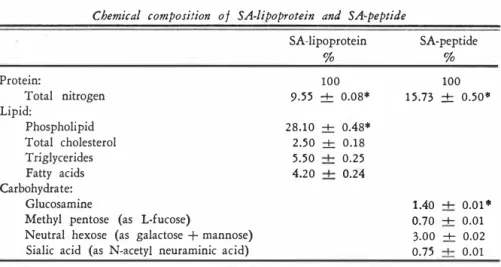
(6) REVISTA. 130. Dll BiOLOGIA TROPiCAL TABLE. 1. Chemical, composition 01 various lung surlace-active lipoproteinsA. Constituent. Guinea PigB. Peptide (N X 6.25 ) Phospholipid Total cholesterol Triglycerides Fatty acids. 59.2 28.2 3.3 5.7 4.6. --\--\--\--\--\-. HumanC. 0.70* 0.50 0.10 0.30 0.20. 60.0 28.0 2.3 5 .6 4. 1. --\--\--\--\--\-. CowD. 0.65* 0.57 0.16 0.24 0.24. 59.7 28.1 2.5 5.5 4.2. --\--\--\--\--\-. 0.59* 0.48 0.18 0.25 0.24. A. Content in 100 mg of dry weight. Average of four determinations. C. Average of six determinations. D. Average of six determinations. * Standard deviations. B.. TABLE. 2. Tolal, cholesterol, phospholipid and total nitrogen content in 1 mi 01 a concentrated suspension of cow /¡mg SA-liPoprotein before and after deliPida#on by three different techniques. Cholesterol Mg % %. Content In SA·lipoprotein Extracted once, Folch Extracted twice, Folch Extracted once, Scanu Extracted once, ]iménez. 2.5 1 .05 0.47. ND ND. 100 42* 31*. Phospholipid Mg % % 28. 1 1.97 0.28 1 .0. Nitrogen Mg % %. 100 7* 1* 3*. ND. 9.6 8.8 8.4 9.1 9.2. Percent of the original concentration. * ND Not detectable by the analytical methods used. TABLE. 3. Chemical composition of SA-lipoprotein and SA-peptide. Protein: Total nitrogen Lipid: Phospholipid Total cholesterol Triglycerides Fatty acids Carbohydrate: Glucosamine Methyl pentose (as L-fucose) Neutral hexose (as galactose + mannose) Sialic acid (as N-acetyl neuraminic acid) *. Standard deviations.. SA-lipoprotein %. SA-peptide %. 100. 100 1 5.73 ± 0.50·. 9.55. --\-. 0.08*. 28.10 2.50 5.50 4 . 20. --\-. 0.48* 0.18 0.25 0.24. --\--\--\-. 1.40 --\- 0.01 * 0.70 --\- 0.01 3.00 --\- 0.02 0.75 --\- 0.01. 100 9 1.7* 87.5* 95.0* 95.8*.
(7) jIMÉNEZ:. SúRFACE·ACTIVE PUiMONAR\' ii1>OPROTEÍN. Í.. 131. pholipid fractions, since these have been fairly well established and reported. (2, 3, 4, 9, 10, 1 5, 24, 26, 33, 38) . Delipidation. Amounts of total cholesterol, phospholipids and total nitrogen present before and after delipidation of 1 mI aliquots of a concentrated suspension of bovine lung SA-lipoprotein are given in Table 2 . Peptide recov eries were 9 1. 7, and 87.5 per cent aÍter one and two successive extractions, re spectively, with the technique of F OLCH ( 1 7) at room temperature. Ninety-five per cent peptide recovery was obtained aÍter one extraction at -lOC according to the technique proposed by S CAN U (40 ) , and finally 95.8 per cent when lipid extraction was carried out according to our technique (25) at -70e. Losses in the literature. of peptide could be partially attributed to mechanical handling of material during delipidation, or to the presence of a peptide-lipid complex soluble in the orgnnic phase, similar to that reported for other lipoproteins. (40 ) .. The presence of. such a complex was not investigated here. Lipid analyses conducted on the delipidized materials have showr.· that. 3 1 per 1 per cent of the phospholipids after two successive extractions. On the other hand, 3 per cent of the original phospholipid. those extracted at room temperature by Folch's technique still contain cent of the original cholesterol and. was found in the delipidized materials after one extraction according to Scanu's technique, but no cholesterol was detected.. Delipidation at. -70C removed. essentially all cholesterol and phospholipids from the SA-lipoprotein materials.. Chemical ana/ysis 01 SA-Peptide.. The delipidation procedure developed. in our laboratory yielded SA-lipoprotein materials apparently free of lipids. The. �. 15.73± 0.05 1.40 + 0.01 per cent glucosamine, 0.70+ 0.01 per cent methyl pentose (as L-fucose) , 3.00 + 0.02 per cent neutral hexose (as galactose + mannose) , and 0.75 + 0.01 per cent sialic acid (as N-acetyl neuraminic acid) , and no detectable lipids. Table 3 shows a eomparative soluble a. purified SA-peptide moiety was shown to consist of. per cent total nitragen,. study of the chemical composition data for both SA-lipoprotein and for its SA-peptide moiety. component.. Among the earbohydrates, neutral hexose is the maj or. No quantitative individual determination of D-galactosamine or. D-maunose, nor of any hexosamine othe! than glucosamine was attempted.. Peptide-carbohydrate mo¡ety. As illustrated in Table 3, sialie add ae 0.7-5 per eent of the weight of the SA-peptide. Studies with. counted for aboUlt. the peptide solutions have shown that the sialic acid eontent did not ehange after. 5 per eent trichloroacetic add or 0.6 molar perehlorie 4) . Amino acid analysis. The amino aeids prese�t in the hydrolysates of. precipitation with either add (Table. the SA-peptide were eluted from the eolumns in the following order :. ;. add, aspartic add, threonine, serine, glutamic add, proline, glyeine. cysteie alanine,. half-cystine, and valine (by means of a sodium dtrate buffer solution of pH. 3.28 ) , methionine, allo-isoleudne, isoleucine, leucine. (glucosamine) , tyrosine,. and phenylalanine (by means of a sodium citrate buffer solution of pH. 4.2 5 ) .. The order of elution of the basic amino acids was: hydroxylysine, lysine, histidine,.
(8) REVISTA DE BÍÜLOGIA TítoPI CAL. 1 32. TABLE 4. Effec! of variúus purifica/ion p" ocedures on sia/ic acid conten! of SA-peptide Sample. Additional purification procedure. 1 2. 1 2. 1 2. Sialic Acid ContentA Weight %. None None Trichloroacetic acidB Trichloroacetic acidB Perchloric acidC Perchloric acidC. 0.74 0.75 0.74 0.76 0.73 0.75. A. Determined on sample hydrolysates acording to WARRE N ( 58 ) . B . Precipitation procedure with 5 % trichloroacetic acid. e. Precipitation procedure with 0.6 M perchloric acid. TABLE. 5. Amino acid recoveries from SA-peptide hydrolysatesA Amino acid Half-cystineB Aspartic acid Threonine Serine Glutamic acid Proline Glycine Alanine Valine Methionine AUo-isoleucine Isoleucine Leucine Tyrosine Phenylalanine Hydroxylysine Lysine Histidine Ammonia (NH2) Arginine. 2 2 Hrs. 4.09 8.14 3.33 3.26 12.52 4.53 4.66 4.52 4.55 2 .84 0. 1 5 4.37 8.40 3.10 4.35 2 .02 5 .78 2 .45 0.80 6.95. Time of hidrolysis 46 Hrs. 70 Hrs. 7.70 3.09 2 .74 1 1 .80 4.60 4.64 4.46 4.86 ( 2.79) 0.12 4.67 8.60 ( 3.08 ) 4.64 1 .90 5 .47 3.31 0.88 6.76. 7.30 2.71 2.3 5 1 1 .30 4.54 4.66 4.47 4.8 7 ( 2.75 ) 0.13 4.83 8.80 ( 3.04) 4.63 1.74 5 .08 2.32 0.95 6.80. Average or extrapolated value 4.09 8.60c 3.60C 3.60C 1 3 . 1 5C 4.55 4.65 4.48 4.76 2.84D 0.13 4.62 8.60 3 .lOD 4.54 2 .20C 6.20C 2.36 0.69C 6.83. + +. + + +. + +. + +. + + +. + +. + + +. + +. +. 0.01* 0.34 0.25 0.37 0.50 0.01 0.02 0.02 0.19 0.03 0.01 0.18 0.10 0.02 0.13 0.11 0.28 0.02 0.02 0.08. A. Values expressed as grams of amino acid residue per 100 grams of peptide. B. Value obtained by averaging the results from two 22-hour hydrolysis periods. Determined on performic acid oxidized peptide. C. These values were obtained by extrapolating to zero time of hydrolysis in order to correct for apparent destruction or, in case of amide groups (NH2 ) , to correct for increased liberation of ammonia from the destruction of amino acids . D. These values are averages of the recoveries after 22 hours of hydrolysis; the parenthe tica,b values are omitted. 11< Standard deviations..
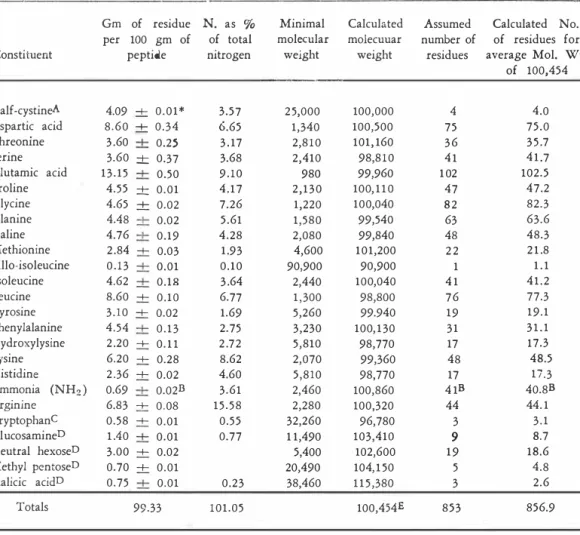
(9) jIMSNEZ:. SURFACE·ACTIVE PULMONAR'! L!POPROTEIN 1.. 13 3. arnmonia, and arginine (by means of a sodium citrate buffer solution of pH 5.28 ) . Data of duplicated experiments after hydrolysis of the SA-peptide for perioJs of 22, 46, and 70 hours at 1 1 0 -+ 1C are given in Table 5. Most amino acids were completely released after twenty·two hours and were not destroyed by increasing hydrolysis time. Since the recoveries of aspartic acid, threonine, serine, glutamic acid, hydroxylysine, and lysine decreased as the hydrolysis time was lengthened, the initial content of these amino acids was obtained by a linear extrapolation (47) to zero time of hydrolysis (Fig. 1 ) . The initial contents of methionine and tyrosine were calculated on the basis of an average of the recoveries after twenty-two hours of hydrolysis. Ammonia values increased with longer periods of hydrolysis owing to the destruction of amino acids and glucosamine. The initial content of ammonia was also obtained by extrapolation to zero time of hydrolysis. The content of half-cystine was established by averaging duplicate values from cysteic acid recoveries after twenty·two hours of hydrolysis of performic acid oxidized peptide. Based on the results outlined in Table 5, the foIlowing correction f.tctors have been applied to amino acid values obtained after twenty-two hours of hydrolysis of SA-peptide : aspartic acid + 5.3 %, threonine + 8 . 1 % , serine + 10.4%, glutamic acid + 5 .0 % , hydroxylysine +8.9 % , and ammonia - 13.7%. During each analysis a small ninhydrin-positive peak was eluted at the s,ame buffer volume as that reported for glucosamine (between leucine and tyrosine) . Since most of the glucosamine is destroyed during acid hydrolysis, calculation of the glucosamine content of SA-peptide was not possible by this method. The content of tryptophan in the intact peptide was found to be in the order of 0.58 -+ 0 .0 1 g residue per 100 g of peptide, as determined colorimetrically by the method of SPIES and CHAMBERS ( 52 ) . In performing the Spies and Chambers reaction for tryptophan with intact SA-peptide, we obtained an appropriate absorption spectrum with a true final solution. Composition of SA-Peptide Moiety. Present estimates of the composition of the SA-peptide moiety are summarized in Table 6. In the second column, mean values for the amino acids and carbohydrates are listed, together with ' their standard deviatlons. The nitrogen content of SA-peptide preparations, 1 5 .73 -+ 0.05 g per cent, was used to derive the figures in the third column. Salient features of the SA-peptide composition include the presence of the amino acid constituents, allo-isoleucine and hydroxylysine, with values of 1 . 1 and 1 7.2 residues per 105 grams of peptide, respe.ctively, and the presence of the carbohydrates glucosamine, neutral hexose, fucose, and sialic !lcid with values of 8.7, 18.5 , 4.8, and 2.6 residues per 105 grams of peptide, respectively. The average molecular weight has been calculated on the basis of 4 half· cystine residues per mole, giving a value of 100,454 for all residues. Also, the average molecular weight was calculated on the basis of 1 allo-isoleucine residue per mole, giving a value of 9 1,272 for all residues, but this value was not used.
(10) REVISTA DE. 134. B10LOGIA T1WPICAL. in the calculation of the number of residues for average molecular weight stated in the seventh column of Table 6.. TABLE 6 Composition and molecular weighJ oi SA-peptide. Consti tuent. Gm of residue per 100 gm of peptide. N. as % of total nitrogen. Minimal molecular weight. Calculated molecuuar weight. Half-cystineA Aspartic acid Threonine Serine Glutamic acid Proline Glycine Alanine Valine Methionine Allo-isoleucine Isoleucine Leucine Tyrosine Phenylalanine Hydroxylysine Lysine Histidine Ammonia (NH2 ) Arginine TryptophanC Gl ucosamineD Neutral hexoseD Methyl pentoseD Sialicic acidD. 4.09 -+ 0.01* 8.60 -+ 0.34 3 .60 -+ 0.25 3.60 ± 0.37 13.15 -+ 0.50 4.55 ± 0.01 4.65 -+ 0.02 4.48 -+ 0.02 4.76 +. 0.19 2 .84 -+ 0.03 0 . 1 3 -+ 0.01 4.62 -+ 0.18 8.60 -+ 0.10 3 . 1 0 -+ 0.02 4.54 -+ 0 . 1 3 2 .20 -+ 0. 1 1 6.20 -+ 0.28 2 .36 -+ 0.02 0.69 -+ 0.02E 6.83 -+ 0.08 0.58 -+ 0.01 1 .40 -+ 0.01 3.00 -+ 0.02 0.70 -+ 0.01 0.75 -+ 0.01. 3.57 6.65 3 . 17 3.68 9.10 4.17 7.26 5.61 4.28 1 .93 0.10 3 .64 6.77 1.69 2.75 2 .7 2 8.62 4.60 3.61 15.58 0.55 0.77. 2 5,000 1,340 2,8 1 0 2,410 980 2,130 1,220 1,580 2,080 4,600 90,900 2,440 1 ,300 5,260 3,230 5,810 2,070 5,810 2,460 2,280 32,260 1 1,490 5,400 20,490 38,460. 100,000 100,500 101, 160 98,8 1 0 99,960 100, 1 1 0 100,040 99,540 99,840 101,200 90,900 100,040 98,800 99.940 100, 1 30 98,770 99,360 98,770 100,860 100,320 96,780 103,410 102,600 104, 1 50 1 1 5,380. Totals. 99.33. 0.23 1 01.05. A. Value determined on performic acid oxidized peptide. B. These values are omitted from the totals. C. Determined colorimetrically on the intact peptide. D. Determined colorimetricaHy. E. Average molecular weight for all residues. >11 Standard deviation.. 100,454E. Calculated No. Assumed number of of residues for residues average Mol. Wt. of 100,454. 19 5 3. 4.0 75.0 3 5 .7 4 1 .7 102.5 47.2 82.3 63.6 48.3 2 1 .8 1.1 41.2 77.3 19.1 31.1 17.3 48.5 17.3 40.8B 44. 1 3.1 8.7 18.6 4.8 2.6. 853. 856.9. 4 75 36 41 1 02 47 82 63 48 22 1 41 76 19 31 17 48 17 4 1B 44 3. 9.
(11) jIMP.NEZ: SURFACE·AC'nVE PULMbNARY LÍPOPROTEIN 1.. 135. Accurate determination o f the small amount o f allo·isoleucine i s difficult because of the minor base-line variations when the usual quantity of hydrolysate was used. (0.5. ml of sample containing the equivalent of. 0.47. mg of peptide) .. The analysis of the acidic and neutral amino acids was also performed wlth rela tively large amounts of hydrolysate an. (2.8. mg of peptide) to obtain as precise. estimate of allo-isoleucine as possible. The weight and nitrogen recoveries given in Table. 6. indicate that the. composition of this peptide has been satisfactorily estimated. BIOLOGICAL ACTlVITY OF SA-LlPOPROTEIN AND OF SA-PEPTlDE. Preparations of SA-lipoprotein complex 'Showed traces of alkaline phos phatase activity, which has been estimated as approxlmace1y trong units per roilligram of dry weight lipoprotein.. 0.01. King-f\.rms. The SA-peptide moiety. preparations showed no alkaline phosphatase activity.. DISCUSSION The chemical characteristics of. various species. of. lung. surface-active. lipoproteins isolated in our laboratory agree with data prc:v luuSlJ reporteu by other investigators. (2, 3, 4, 9, 1 5, 24, 26, 33, 38) .. 'l'hus, !( IS app,uc;ut Ulat. this lipoprotem IS a non-artifactual entity, consistently isO!,,-(�u trom mngs by a variety of techniques. The results of cheroical studies of normal guinea pig, human and bovine lung SA-lipoproteins (1able. 1),. have revt:aled a remarkalJ!c; �lmHarily 01 com. posltlOn, Whlch may reflect a simIlarity of thelr hUlctIons m Che lungs ot these mammals.. A comparison of the chemical composition of the SA-lipoprotein complex with other high-density lipoproteins, su.ch as plasma lipoprotems and mitochon. ( 1 2, 2 1, 2 3, 28, 46) shows that the peptide mOleties 5 "/ -60 per cent of their total dry weight. Phospholipids represent 20-24 per cent of the dty-wtight of plasma proteins, but constitute 28 per cent of the SA-lipoprotein dry-welght. More over, whereas the total cholestetol of plasma lipoprot<.:ins represents 12-17 per cent, in the SA-lipoprotein, this constitutes only 2.6 pe! cent of ltS total dry drial structured proteins. in all of these proteins represented nearly. weight.. It is clear from these findings that a1though the SA lipoprotein may. be classified as a high-density lipoprotein, it difters from other hlgh-density lipoproteins (in particular from plasma lipoproteins) 'Yith respect to the propor tions of its lipid fractions. By means of the delipidation technique developed in our laboratory a peptide containing n o detectable lipids,. proximately. 5.85. 1 5.73. (25 )�. per cent total nitrogen, and ap. per cent carbohydrate was obtained.. The yields of SA-peptide. are considered satisfactory and greater than those obtained by other techniques¡.
(12) 136. REVISTA DE BIOLOGIA TROPICAL. The presence of carbohydrate moieties in other liproproteins has been ' reported previously (1, 6, 32, 40, 42, 53) but this is the first time that a detailed carbohydrate anylisis has been performed on the SA-lipoprotein. The complete analysis furnished here (Table 3 ) indicates that its sugar composition is quantitatively different from that reportcd for other lipoproteins. Thus, for example, egg yolk lipoprotein contains 0.67 per (ent glucosamine, 1.3 per cent neutral hexose, and 0.38 per cent sialic acid ( 1') , and human serwn lipoprotein, 1. 51 per cent gll1cosamine, 0.60 per cent fucose, 0.85 per cent neutral hexose, and 0.48 per ccnt sialic acid (40 ) . I t can be observcd that i n the SA-lipoprotein the neutral hexose content (3.00 per cent) is approximately two and three fold greater than the values for this constituent in egg yolk and human serwn lipoproteins, respectively. Moreover, the sialic acid content (0.75 per cent) of the SA-lipoprotein, is approximately three and two times larger than the values for this constituent in egg yolk and human serum lipoproteins, respectively. Our studies on the purity of the peptide solutions have shown that the sialic acid content did not change after precipitation with two different reagents (Table 4 ) . Although not conclusive, these findings suggest that carbohydrates form an integral part of the SA-peptide molecule and do not result from the presence of glycoprotein impurities. The role of the carbohydrate moiety in the SA-lipoprotein . is not yet clear; it may be considcred as contributing to the stability of the peptide backbone and perhaps to the antigenic specificity of the molecule, as has been proposed for other lipoproteins (41 ) , or it may play some role in the solubility of the molecule in the lung cells that synthesize it. The amino acid composition of the SA-lipoprotein is reported . for the first time in this papero The results of amino acid analysis attest the uniformity of om SA-peptide preparations, ando the amina- acid distribution is consistent with a calculated molecular weight of 100,000 based on a content of four half cystin(; residues per mol(; of peptide. Salient features of the amino acid compo sition are the p resence of hydroxylysine (17.3 residues per mole of peptide) , and th¡; geometrica] isome! of lsoleucine, allo-isoleucin(; (1.1 residues pe! mole of peptide) . Hydroxylysin(;. is generally found. only in collagen and certain connective tissue proteins. The content of this amino acid in the SA-peptide is approximately 2.2 per cent, which is larger than that generally reported for collagen and gelatin (20) . It should b e emphasized that identification of allo isoleucine and hydroxylysine was based on chromatographic experiments, where ninhydrin-positive peaks were consistently eluted at the same buffer volumes as those reported for specific substances by other investigators (36, 48) . Never theless, it is agreed that an absolute identification must be based on independent criteria such as isolation of the compound responsible fo! the peak (22 ) , fol lowed by chemica] and physical characterization, pape! chromatography (59 ) , etc. I f our findings are correct, the presence of these two amino acids may be of great lmportance in future investigations as markers in searching Jor the place of origin of the surfactant lipoprotein. . A comparison of the amino acid composition of SA-lipoprotein with other well known lipoproteins, such as the structural protein from mitochondria.
(13) ]IM2NEZ:. SURFACE-ACTIVE PULMONARY LlPOPROTEIN. 1.. 1 37. (21) and various -serum lipoproteins (28, 31, 46) , reveals qualitative and quantitative differences among them. The differences between the an1ino acid composition of these proteins clearly demonstrate that high-density lipoproteins do not share the same peptide component; their peptide moieties are not identical, and interconversions cannot take place by merely removing or adding lipid constituents. Nevertheless, it should be emphasized that acidic amino acids predominate over basic amino acids in aH the proteins studied, including the SA-lipoprotein. A careful comparison of the amino acid composition of SA-lipoprotein with human and bovine serum mercaptalbumins (50) has been made. Although some similarities were found with regard to the amino acid composition among the SA-lipoprotein and the serum albumins, tremendous discrepancies were also found. Thus, for example, the presence of the amino acids allo-isoleucine and hydroxylysine, as well as of carbohydrate moities in serum albumins, has never been reported. These findings seem to disagree with the conclusions of McCLENEHAN and OLSEN (34) that albumin is closely associated with the pulmonary surfactant molecule and that it may constitute the SA-peptide moiety. Nevertheless, since it has been found that the delipidized SA-poprotein may be electrophoretically separated into two major components (25 ) , one of which is an albumin-like migrating component, and sin ce the amino acid analysis studies were carried out in the whole lipid-free materials (25 ) , a more elaborate study is required to clarify this apparent discrepancy. The fact that only a low level of phosphatase activity is present in the fairly well purified SA-lipoprotein materials is indicative that the main function of this lipoprotein is not as a phosphatase enzyme. On the other hand, it was expected that the SA-peptide would not exhibit alkaline phosphatase activity, since removal of the lipids is apt to denature the lipoprotein and abolish any biological activity. Since there is the possibility of contamination of SA-lipopro tein with other substances, such as phosphatase enzymes, and with the lung thromboplastic lipoprotein (11 ) , which exhibits phosphatase activity, it remains to be seen whether this biological activity represents a characteristic of the SA-lipoprotein or arises from minor impurities. ACKNOWLEDGEMENTS 1 am most grateful to Dr. Samuel E. Allerton of the Allan Hancock Foundation and Department of Biological Sciences of the University of Southern California, los Angeles, for his original suggestion of the problem, continued advice and encouragement, for teaching me many usefuI laboratory techniques, and for reading critically the first draft. The following individuals kindly supplied specimens for the present study : Dr. William M. Blackmore (Director of the Vivarium of the University of Southern California), Dr. Murray B. Gardner (Comparative Pathologist, los Angeles County-University of Southern California Medical Center) , and Mr. Ben lilien (los Angeles Meat Company, Vernon, California) . To all 1 extend.
(14) REVISTA D E BIOLOGIA TROPICAL. 138. my sincere appreciation. 1 al so want to thank Dr. Lucien A. Bavetta, Chairman of the Department of Biochemistry, Sehool of Dentistry, University of Southern California, for the use of his laboratory and equipment during this investigation. 1 al so wish to extend special thanks to Dr. Myles Maxfield and Dr. Jay. M. Savage, for guidance, encouragement, and many personal kindnesses through out my study. Financial support during these studies was provided by a fellowship from the University of Co�ta Rica, and a research assistantship from the Allan Haneock Foundation. University of Southern California. 1 wish to acknowledge, finally, the long sustained encouragement and. support of Dr. Leslie A . Chambers, Director of the Allan Hancoek Foundation.. SUMMARY. Studies on the pulmonary surface-active lipoprotein eompl�x were carried out in order to establi,h. primarily, its biochemieal eharaeteristies. By means of differential centrifugation in salt gradients, surfaee-active lipoprotein complex was obtained from fresh human, guinea pig and bovine lung tissue. The. three. species of. SA-lipoproteins proved. remarkably. similar. in. chemieal composition, in accordanee with their homologous functions. After removal of lipids with an extraction technique developed by the author, the peptide of the cow lung SA-lipoprotein WJs subjected to an exhaus ti ve eharacterization study. total nitrogen, lipids.. 1 5.73 per cent 5.85 per cent carbohydrate, and no detectable. The delipidized peptide contained. approximately. The sialic acid content of the delipidized peptide did not ehange after. precipitation with trichloroacetic acid and perchlorie acid reagents, which sug gests that earbohydrates form an integral part of the SA-peptide molecule and do not resu:lt from th e presence of impurities. Amino acid analysis of SA-peptide revealed the presence of all the amino acids normally found in protein hydrolysates.. In addition, two unusual amino. acid constituents were found, allo-isoleucine and hydroxylysine.. These relatively. uncommon amino acid !=onstituents ,m ay serve as u'Seful markers for identifying the peptide moiety of SA-lipoprotein in future studies. position of SA-lipoprotein differs qualitatively and. The amino acid com. quantitatively. from that. of other well-known lipoproteins and of serum albumin as well. A low level of alkaline phosphatase activity was detected in SA-lipoprotein. No sueh enzymatie activity was found in the SA-peptide moiety.. This biological. activity may be eharaeteristic of the SA-lipoprotein bu:t eould also resutt from contamination with diserete lung alkaline p ho-sp hatase enzymes,.
(15) IIMSNEZ:. SURFACE·ACTIVE PULMONARY LIPOPROTEIN r. .. 1 39. RESUMEN. Se llevaron a cabo estudios de la lipoproteína tensoactiva pulmonar con la finalidad de establecer, principalmente, sus características bioquímicas. Mediante la utilización de técnicas de centrifugación diferencial, en gra dientes de concentración salina, el complej o lipoproteico temoactivo fue ais lado de tej idos pulmonares frescos provenientes de cobayos, humano, y bovinos. Los análisis bioquímicos d e las tres especies de lipoproteínas estudiadas, demostraron que éstas son extremadamente 'Similares en cuanto a su composi ción química, lo que está de acuerdo con sus funciones homólogas. ,La remoción total de los lípidos del complej o lipoproteico fue lograda mediante una nueva técnica desarrollada por el autor. El constituyente péptido de la lipoproteína tensoactiva pulmonar, libre de lípidos, fue sometido a in tenso estudio de caracterización. Dicho estudio mostró que el péptido no posee lípidos y que está constituí do por 1 5 .73 por ciento de nitrógeno total y apro ximadamente 5.85 por ciento de carbohidratos. No se observó cambios en el contenido' del ácido siálico del constituyente péptido cuando éste fue pre cipitado repetidas veces con reactivos de ácido tridoroacético o de ácido per dórico, esto sugiere que los carbohidratos forman parte integral de la molécula de la lipoproteína tensoactiva pulmonar y que su presencia no se debe a im· purezas. El análisi.s de los amino ácidos del constituyente péptido de la lipopro teína reveló la presencia de todos los amino ácidos normalmente encontrados en hidrolizados proteicos. Además se encontraron dos constituyentes poco comu nes : los amino ácidos alo-isoleucina e hidroxilisina. Este hallazgo es corrsidera do de gran utilidad, ya que estos amino ácidos poco comunes podrían servir en el futuro como "marcadores" en la identificación del péptido in vivo. La c0mposición en amino ácidos de la lipoproteína tensoactiva pulmonar ha mos trado diferencias, tanto cualitativas como cuantitativas, con respecto a la compo sición en amino ácidos de otras lipoproteínas, así como de la sera-albúmina. La lipoproteína tensoactiva pulmonar mostró un bajo nivel de actividad enzimática relacionada con la fosfatasa alcalina Dicha actividad biológica podría ser una característica del complej o lipoproteico pulmonar, pero también podría atribuírse a la contaminación con enzimas fosfatásicas presentes en el tejido pulmonar. El constituyente péptico no mostró ninguna actividad biológica. LITERATURE CITED 1.. ABRAHAM, S., L. A. HILLYARD,. 1960.. 2.. & I. L. CHAIKOFF Components of serum and egg yolk lipoproteins: galactose, mannos.e, gluco samine and sialic acid. Arch. Biochem. Biophys., 89 ( 1 ) : 74-78.. ABRAMS, M.. 1966.. E.. Isolation and quantitative estimation of pulmonary surface-active lipoprotein. J. Appl. Physiol., 2 1 (2 ) : 718·720..
(16) REVISTA DE BIOLOGIA TROPICAL. 140. 3.. ABRAMS, M. E. & F. B. TAYLOR. 1964.. Isolation and quantitative estimation of pulmonary surface-active lipoprotein and its interaction with fibrinogen. Physiologist, 7 ( 3 ) : 78.. 4.. ADAMS, F. H.. 5.. ALLERTON, S. S. et al.. 6.. AYRAULT-JARRIER, M.,. 1963.. 1967.. 1963.. 7.. 8.. 9.. 10.. & T. FU]IWARA Surfactant in fetal lamb tracheal fluid. ]. Pediat., 6 3 ( 4 ) : 537-542.. Microbiuret method for protein nitrogen. lished ) .. G. LÉVY, R. WALD & J. POLONOVSKI Séparation par ultracentrifugation des alfa-lipoproteines de sérum humain nor mal. Bull. Soco Chim. Biol., 45 ( 4 ) : 349-359. .. BAILEY, J. L.. 1967.. Techniques In proteÍ/¡ chemistry, 2d ed. Elsevier Publishing Company, New York, 406 pp.. G. R. Phosphorus assay in column chromatography. ]. Biol. Chem., 234( 3 ) : 466468.. BARTLET,. 1959.. BROWN, E. S.. 1962.. Chemical identification of a pulmonary surface-active agent. Fed. Proc., 2 1 ( 2 ) : 438.. CLUTARIO, B. c., A. M. SCARPELLI,. 1966.. CHARGAFF, E., A. BENDICH,. 12.. CORNWELL, D.. 13.. DisCHE, Z.. 1944.. 1961.. 1962.. &. F. TAYLOR. ' Identifiration and source ot surfactant in lung extracts. 565.. 1 t.. 14.. ( Private communication; unpub. Fed. Proc., 2 5 ( 2 ) :. & S. S. COHEN The tbrombol'lastic protein: structure, properties. disintpgration. Chem., 156 ( 1 ) : 161-178.. G.,. &. ]. Biol.. F. A. KRUGER. Molecular complexes in the isolation and characterization of plasma lipopro· teins. J. Lipid Res., 2 ( 2 ) : 1 10-1 34.. Color reactions of carbohydrates. In L. L. Whistler & M. L. Wolfrom, eds., Methods of Carbohydrate Chemistry. Academic Press, New York 589 pp.. DISCHE, Z. & L. B. SHETTLES 1948. A specific color reaction of methyl-pentoses and a spectrophotometric micro. method for their determination. J. Biol. Chem., 175 ( 2 ) : 595-603. 15.. 196�.. 16.. & G. L. rIUBER Surface activity of phospholipid components of dog pulmonary surfactant col lected in vivo. Fed. Proc., 23 ( 1 ) : 1 56.. FINLEY, T . N., T. E. MORGAN, H. C . FLALKOW. & Y. SUBBAROW Colorimetric determination of phosphorus. ]. Biol. Chem., 66( 1 ) : 375-400.. FISKE. D. H.,. 1925..
(17) JIMÉNEZ: SURFACE-ACTIVE PUlMONARY LIPOPROTEIN 1.. 141. 17.. FOLCH, J., M. LEES, & G. H. SLOANE STANLEY 1967. 11. simple method for the isolation and purification of total lipids from an" mal tissues. ]. Biol. Chem., 226( 1 ) : 497-509.. 18.. FORBES, J. e 1930. Determination of cholesterol in blood plasma and serum. ]. Lab. Clin. Med., 16( 4 ) : 520-5 2 1 .. 19.. FRAN�OIS, e , R . D. MARSHAI.L, & A . NEUBERGER 1962. Carbohydrates in proteins. IV. The determination of mannose in hen's-egg al· bumin by radioisotope dilution. Biochem. J., 83 ( 2 ) : 335-340. FRUTON, J. S., & S. SIMMONOS 1959. General biochemistry. John Wiley & Sons, Inc., New York, 1077 pp.. 20.. 21.. GREEN, D. E., & S. FLEISCHER 1963. The role of lipids in mitochondrial electron transfer and oxidative phosphory. lation. Biochim. Biophys. Acta, 70( 5 ) : 5 54-582.. 22.. HAMltTON, f. B., & R. A. ANOERSON 1955. Hydroxylysine: isolation from gelatin and resolution of its diastereoisomer b, ion exchange chromatography. J. Biol. Chem., 2 1 3 ( 1 ) : 249-258.. 23.. HANAHAN, D. J. 1960. lipid chemistry. Tohn Wiley & Sons, lnc. New York, 330 pp. ,. 24.. HARLAN, W. R., J. H. MARGRAF, & S. J. SAlO 1'66. Pulmonary lipid composition of species with and without surfactant. Amer. J. Physiol., 2 1 ( 3 ) : 855-861.. 25.. JIMENEZ, J. M. 1968. Studies on the pulmonary surface-ac/ive lipoprotein : isolation and characler. iza/ion 01 iu peptide moiety. Ph. D. Dissertation, University of Southern California. 148 pp.. 26.. KLAUS, M. H., J. A_ CLEMENTS, & R. J. HAVE L 1961. Composition of surface-active material isolated from beef lung. Proc. Nat. Acaa. Sci. ( Wash.J, 47( 1 1 ) : 1858-1859. UMBERT, M., & A. e NEISH 1950. Rapid method for estimation of glycerol in fermentation solutions. Canaa. J. Res., 2 8 ( 1 ) : 83-89.. 27.. 28.. LEVY, R. S., A. N: LYNCH, E. D. MCGEE, & ]. W. MEHL 1967. Amino acid composition of the proteins from chylomicrons and human lipoproteins. ]. lipid Res., 8 ( 5 ) : 463-472.. serum. 29.. lowRY, O. H., N. R. ROBERTS, K. Y. LEINER, M. 1. Wu, & A. 1. FARR 1954. The quantitative histochemistry of brain. l. Chemical methods. J. Biol. Che",., 207 ( 1 ) : 1-17.. 30.. LUSTlG, B., .& A. UNGER 193 1 . über die Bestimmung und den Gehalt an freiem, Eiweiss. und gebundenem Nichteiweisszucher im normalen und pathologischeo Serum, Liquor und Harn. Biochem_ Z., 242 ( 4 ) : 1·17..
(18) 142. 51.. REVISTA DE BIOLOGIA TROPICAL. MARGOLIS, S., & R. G. LANGDON 1966. Studies on human serum betal-lipoprotein.. l. Biol. Chem., 241 ( 2 ) : 469-476.. 32.. MARsHALL, W. E., & F. A. KUMMEROW 1962. The carbohydrate constituents of human serum beta-lipoprotein: galactose, mannose, glucosamine, and sialic add. Arch. Biochem. Biophys., 98( 2 ) : 271-273.. 33.. MCCLENEHAN, J. B. 1967. Abnormal "surfactant" activity secondary to protein component alteration. Anu. Intern. Med., 66 ( 2 ) : 1055.. 34.. MCCLENEHAN, J. B. & J. D. OHLSEN 1968. Protein component of human surfactant. C/in. Res., 1 5 ( 3 ) : 1 34.. 35.. MOORE, S. 1963. On the determination of cystine as cysteic acid. ¡. Biol. Chem., 238 ( 1 ) : 235· 237.. 36. MOORE, S.: D. H. SPACKMAN, & W. H. STEIN 1958. Chromatography of amino acids on sulfonated polystyrene resins. Chem., 3 0 ( 7 ) : 1 185-1 190.. Analyt.. 37.. MORGAN, T. E., T. N. FINLEY, G. L. HUBE R, & H. FIALKOW 1965. Alterations in pulmonary surface active lipids during exposure to increased Ol! tension. f. C/in. [nvest" 44( 1 1 ) : 1737-1744.. 38.. PATTLE, R. E., & L. C. THOMAS 1961. Lipoprotein composition of the film lining of the lung. NatUl'e (Lond.) 189 (4767 ) : 844.. 39.. RONDEL, C. M. ]., & W. T. J. MORGAN 1955. The determination of glucosamine and galactosamine. Biochem. J., 6 1 ( 2 ) : 586-589.. 40.. ScANU, A. 1966. Forms of human serum high density lipoprotein protein . f. Lipid Res., 7 ( 2 ) : 295-306.. 41.. ScANU, A. 1967. Binding of human serum high density lipoprotein apoprotein with aqueous dispersions of phospholipids. ¡. Bio/. Chem., 242 (4) : 7 1 1-719.. 42.. ScANu, A., L. A. LEWIS, & F. M. BUMPUS 1958. Separation and characterization of the protein moiety of human alphal-lipo. protein. Arch. Biochem.. Biophys., 74( 2 ) : 390-397.. 43.. SCHRAM, E., S. MOORE, & E. J. BIGWOOD 1954. Chromatographic determination of cystine as cysteic add. Biochem. J., 47 ( 1 ) : 33-37 .. 44.. SCHULTZE, H. E. 1962. Influence of bound sialic acid on electrophoretic mobility of human serum proteins. Arch. Biochem. Biophys., Supp. 1: 290-294..
(19) JIMSNEZ:. 45.. SURFACE-ACTIVE PULMONARY LIPOPROTEIN I.. SEARCY, R. L., &: L. M. BERGQUIST 1960. A new color reaction for the quantitation of serum eholesterol. Acta. 5 (2 ) : 192-199.. 143. Clm. Chim.. 46.. SHORE, B. 1957. e- and N- terminal amino acids of human serum lipoproteins. Areh. Bioehem. Biophys., 71 ( 1 ) : HO.. 47.. SMITH, E. L., A. STOCKELL, &: J. R. KIMMEL 1954. Crystalline papain. III. Amino acid eomposition. J. Bio!. Chem. 5 5 1-561.. 207 ( 2 ) :. 48.. SPACKMAN, D. H. 1962. lmtruetion manual AIM-2, arrd harrdbook for Beekman Spineo MoJel 120B amino aeid arralyzer. Published by Spinco Division, Beekman Instruments, Ine. Stanford Industrial Park, Palo Alto, California.. 49.. SPACKMAN D. H., W. H. STEIN, &: S. MooRE 1958. Automatic recording apparatus por use in the ehromatography of amino acids. Analyt. Chem., 30(7 ) : 1 190-1206.. 50.. SPAHR, P. F., &: J. T. EDSALL 1964. Amino acid composition of human and bovine serum mercaptalbumins. J. Biol. Chem., 2 39 ( 3 ) : 850-854.. 5 1.. SPI ES J. R., &: D. C. CHAMBERS 1948. Chemieal deterlOination of tryptophan in proteins. 30-39. ,. .. Arra/yt. Chem., 20( 1 ) :. 52.. SPIES, J. R. &: D. C. CHAMBERS 1949. Chemical determination of tryptophan in proteJns. Arra!yt. Chem., 2 1 ( 10 ) : 1249-1266.. 5 3.. SPIRO, R. G. 1963. Glycoproteins : strueture, metabolism, 269 ( 1 1 ) : 5 66-573.. and biology.. New Engl. J. Med.,. 54.. STERN, I. &: B. SHAPIRO 1953. A rapid and simple method for the determination of esterified fatty acids and for total fatty acids in blood. J. Clirr. Path., 6 (2 ) : 1 58-160.. 55.. TAYLOR, F. B., &: M. A. ABRAMS 1964. Inhibition of clot lysis 'by a surface active lipoprotein from lung and inhibition of its surface activity by fibrinogen. Physiologist, 7 ( 3 ) : 269.. 56.. TECHNICON AUTO-ANALIZER SYSTEM 1965. Micro-Kjeldhal nitrogen, and glutamic oxalac�c transaminase methods. In L. T. Skeggs. lr., ed., Automation irr Ana/ylieal Chemistry, New York: Technioo. Symposia. Mediad Ineorporated. 722 pp.. 57.. VAN HANDEL, E., &: D. B. ZILVERSMIT 1957. Mieromethod for the direct d.eterminatioll al serwn triglycerides. Clirr. Med., 50 ( 1 ) : 1 5 2-151. l. L:tb..
(20) 144 58.. REVISTA DE BIOLOGIA TROPICAL. WARREN, L. 1959. The thiobarbituric. acid assay of sialic acids. ]. 8;01. Chem., 234(8 ) : 1971-. 1975. 59.. R. M., & E. A. TALLEY Elution behavior of naturally occurring ninhydrin-positive compounds during: ion exchange chromatography. Analyt. Chem., 34 ( 1 2 ) : 1 5 5 1 - 1 5 56.. ZACHARlUS, 1962.. Fig. 1.. Recoveries as a function of time of hydrolysis for var ious amino acids and ammonia, given as grams oE residue per 100 grams of SA-peptide..
(21) ¡IMtNEZ:. SURFACE-ACTIVE PULMONARY L1POPROTEIN. L. 145. 12. Q) 'd -.... +->. 0.. 1 0. Q). �. '+-< o rn. 6. ro ""'. 0.0. 8. o o. ..-.. ""' Q) o.. Q) ::1 'd -.... rn Q) ""' '+-< o. 6. rn. 6. ro ""'. O. 4. 2. �-----<--�--�H��d�r�o�x:y�lY�S�in�e��=:::====:::J Amm onia. O L-. -L________L-______-L______��____�. __ __ __. o. 20. 40. 60. T ime o í hydr oly s is in hour s. 80.
(22)
Figure
Documento similar
The origin and amino acid composition of the proteins would influence the digestibility, absorption and the utilization of the amino acids in the host, and therefore
In this respect, a comparison with The Shadow of the Glen is very useful, since the text finished by Synge in 1904 can be considered a complex development of the opposition
1. S., III, 52, 1-3: Examinadas estas cosas por nosotros, sería apropiado a los lugares antes citados tratar lo contado en la historia sobre las Amazonas que había antiguamente
Of special concern for this work are outbreaks formed by the benthic dinoflagellate Ostreopsis (Schmidt), including several species producers of palytoxin (PLTX)-like compounds,
In the previous sections we have shown how astronomical alignments and solar hierophanies – with a common interest in the solstices − were substantiated in the
While Russian nostalgia for the late-socialism of the Brezhnev era began only after the clear-cut rupture of 1991, nostalgia for the 1970s seems to have emerged in Algeria
Díaz Soto has raised the point about banning religious garb in the ―public space.‖ He states, ―for example, in most Spanish public Universities, there is a Catholic chapel
teriza por dos factores, que vienen a determinar la especial responsabilidad que incumbe al Tribunal de Justicia en esta materia: de un lado, la inexistencia, en el
