
STRUCTURE OF NANOPARTICLES AND ELECTROCHEMICAL MEASUREMENTS OF Li/TiO2 MODIFIED BY GRAPHENE FOR STORAGE PERFORMANCE
6
0
0
Texto completo
(2) XXIV International Materials Research Congress 2015 XIV NACE International Congress-Mexican Section. “STRUCTURE OF NANOPARTICLES AND ELECTROCHEMICAL MEASUREMENTS OF Li/TiO2 MODIFIED BY GRAPHENE FOR STORAGE PERFORMANCE” ABSTRACT Samples of Lithium were made with mechanical ball-milling technique (MA) adding TiO2 and Graphene, to improve the electrochemical performance of lithium ion batteries. Drops of graphene oxide (GO) were added to the powders. Microstructures, morphologies and electrochemical results were. investigated. using. SEM,. TEM,. X-ray. diffraction. (XRD),. cyclic. voltammetry and. potentiodynamic studies. Results showed that, the Li samples with graphene oxide content affected the capacity of response without graphene. The alloys exhibit a superior capacity and good cycle stability adding TiO2. The milling ball to powder weight ratio was kept 5 to 1 for all experimental runs. Milling intervals were 0, 4 and 8 hrs; using alternate cycles of 30 minutes milling and 30 min resting.. The nanostructure TiO2 powder, improve the samples to design a better electrode. contributing to reduce degradation of samples. TiO 2 and GO has significant influence on electrochemical performance of Lithium electrodes. The electrochemical measurements in Li could be enhanced by the chemical interactions between TiO 2 and GO. Electrochemical experiments were performed on ACM Instruments Gill AC and a typical three electrode setup was constructed to measure the electrochemical properties of the working electrode; here, platinum was used as the counter electrode and calomel was used as the reference electrode. As an on-going effort to increase the cycle life and energy densities of lithium-ion batteries, structures of the samples were analyzed.. Keywords: Electrochemistry, Lithium Batteries, Mechanical Milling, Energy Storage, Morphology. Página. 2.
(3) XXIV International Materials Research Congress 2015 XIV NACE International Congress-Mexican Section. INTRODUCTION The necessity to increase response and time to hold energy in electronic equipment, cell phones, and automobile devices permits improve materials and ways to create electrodes more efficient. Some alloy materials are made into nanosize materials to achieve their full potential in capacity and life [1]; consequently, extensive research efforts have been made in recent years to improve the capacity retention of anodes by morphology modification, nanoarchitecture fabrication or inactive matrix incorporation [2]. Graphitic structured materials like carbon nanotubes (CNTs), graphite, and graphene have been among the more widely researched materials [3]. The experience obtained with ball milling with other materials, was the aim idea to improve a new electrode made adding GO to powders mixed with Lithium. The electrochemical response made with Lithium adding TiO 2 had a good response, this result permits create a new electrode adding other material in this case Graphene. Some studies, explain that graphene reaction could be a good composition to charge and discharge. Use the Graphene Oxide, was the strategy to create a network between Reduced Graphene Oxide and Li4Ti5O12 particles [4-5].. In this research the way to connect Lithium,. Graphene and Titanium Oxide was ball milling.. EXPERIMENTAL PROCEDURE Electrode Preparation. Materials obtained by Sigma Aldrich: Lithium (99.0% purity), Titanium Oxide, and Graphene Oxide 2Mg/ML dispersion in H2O powders were used. SPEX 8000M was connected to a hardened steel container with 13 mm (Ø) balls as milling media and Ar atmosphere. The milling ball to powder weight ratio was kept 5 to 1 for all experimental runs. Milling intervals were 0, 4 and 8 hrs using alternate cycles of 30 minutes milling and 30 min resting.. Electrochemical Test All tests were performed at room temperature at Gill AC -ACM Instruments equipment was used. In the case of Na2SO4 solution, the OCP were -500 and -490.19 mV SCE for samples, with data points of 1803. The electrochemical corrosion behavior in cyclic polarization was performed. Analysis was done according with ASTM G1 and ASTM G59, using a typical three electrode, saturated calomel as a reference electrode, work electrode (sample made it), and platinum as a reference electrode.. Página. 3.
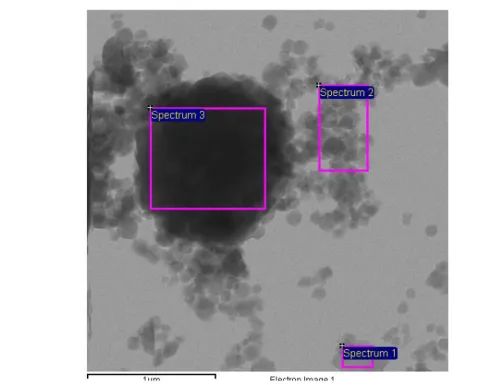
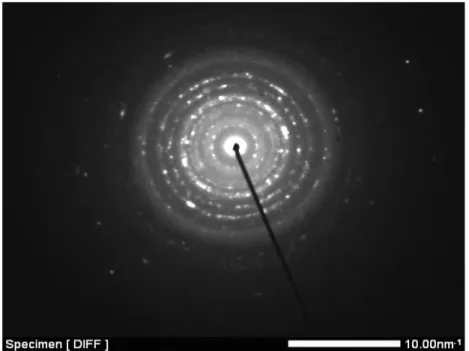
(4) XXIV International Materials Research Congress 2015 XIV NACE International Congress-Mexican Section. RESULTS AND DISCUSSION Ball milling as a tool to improve the electrode composites, the mail idea to try to find a pattern of behavior in time milling was done, but increasing the materials in mixture provoke a confusion in the pattern recognition.. Figure 1 show a particle obtained by TEM analysis that was done by. transmission electron microscope TEM (Philips JEM-2200FS) equipped with energy dispersive spectrometer (EDS).. Figure 1. Pattern of behavior of particle of Li/TiO2/GO.. In Figure 2. Patterns on crystallite were observed, titanium reaction was observed by polycrystalline behavior. The idea to add TiO2 was to increase the corrosion behavior and have a layer of protection, also a pattern. Corrosion reaction was observed around the values of Icorr (mA/cm²): 1.258E-06. Figure 3, shown a potentiodynamic curve; the average that was observed in it.. Página. 4.
(5) XXIV International Materials Research Congress 2015 XIV NACE International Congress-Mexican Section. Figure 2. Patterns of polycrystalline samples.. Figure 3. Potentiodynamic curves of Li/TiO2/GO.. Página. 5.
(6) XXIV International Materials Research Congress 2015 XIV NACE International Congress-Mexican Section. CONCLUSIONS Lithium was a known as excellent batteries materials, but also is known that needs support to improve their functionality adding other materials. Some studies related that TO 2 /graphene has a good response [6-7], in this case of study made electrodes by ball milling not was the best solution in cyclic voltammetry. Results obtained by cyclic voltammetry were not good, but in potentiodynamic curves had a good response. As a future work in necessary use other kind of technology to sinter or coated samples, as other authors suggest [8].. ACKNOWLEDGEMENT This research was financed by PROMEP #OF-13-7029-UACH-PTC-291 and PIFI. The technical assistance by Jair. M. Lugo Cuevas, Gregorio Vazquez Olvera, Ernesto Guerrero and Leticia Mendez Mariscal is gratefully acknowledged. REFERENCES [1] H. Zhao, et al., Nano Today (2015), http://dx.doi.org/10.1016/j.nantod.2015.02.009. [2] Zhongxue Chen, Kai Xie, Xiaobin Hong, Electrochimica Acta 108 (2013) 674– 679 [3]Mina Bastwros , Gap-Yong Kim , Can Zhu, Kun Zhang , Shiren Wang, Xiaoduan Tang ,Xinwei Wang, Composites: Part B 60 (2014) 111–118 [4]Qian Zhang, Wenjie Peng, Zhixing Wang, Xinhai Li, Xunhui Xiong, Huajun Guo, Zhiguo Wang, Feixiang Wu, Solid State Ionics 236 (2013) 30–36 [5]Qingxiang Zhou, Zhi Fang, Analytica Chimica Acta 869 (2015) 43–49 [6]Qingqing Zhang, Rong Li, Mengmeng Zhang, Bianli Zhang, Xinglong Gou, Journal of Energy Chemistry 23(2014)403–410 [7]Guangmin Zhou,YubaoZhao,ChenxiZu,Arumugam Manthiramn, Nano Energy(2015) 12, 240–249 [8]Weijia Hana, LongRena, ZhenZhanga, XiangQia, YundanLiua, ZongyuHuanga, Jianxin Zhonga, Ceramics International 41(2015)7471–7477. Página. 6.
(7)
Figure
Documento similar
storage, no significant differences were observed between the lycopene contents at day 0 after the treatments and at 25 days of storage, with the samples pasteurized for 40
This thesis presents a body of work on the modeling of and performance predictions for carbon nanotube field-effect transistors (CNFET) and graphene field-effect transistors
The method combines the advantages of pruning by ordered aggregation and instance-based pruning; namely the generalization performance of the ensemble is improved, the
This section presents a brief introduction to the physics of uorescence on the nanoscale, and considers the most relevant topics for understanding the results obtained from the
Through this manuscript was presented the behaviour of different compositions of metal- lic glasses as a response to an additional variable, namely pressure for the analysis
The remaining four drivers are perceived to be currently priori- tized as relatively similar and “below average.” In the first round, panel- ists diverged widely on the current
map between the wild type cryo-EM map and its quasi-atomic model, containing only the hexon and penton base structures, revealed the molecular envelopes corresponding to minor
19 Additionally, it was proved that doping porous carbon materials (e.g. graphene or CNT) with heteroatoms like nitrogen can generate effective active sites and further enhance the
