PENINSULA OF SANTA ELENA
STATE UNIVERSITY
FACULTY OF EDUCATION AND LANGUAGES
ENGLISH TEACHING CAREER
“SPEECH APPLICATION TO IMPROVE THE LISTENING
COMPREHENSION SKILL IN THE STUDENTS OF SECOND
BGU AT UNIDAD EDUCATIVA SAN MARCOS,
SANTA ELENA, PROVINCE OF SANTA ELENA SCHOOL
YEAR 2015-2016”
RESEARCH PAPER
As a prerequisite to obtain a:
BACHELOR´S DEGREE IN ENGLISH
AUTHOR:
MARJORIE KATERINE MEREJILDO CRUZ
ADVISOR:
LIC. KLEBER LOOR ZAMBRANO, MSc.
LA LIBERTAD – ECUADOR
PENINSULA OF SANTA ELENA
STATE UNIVERSITY
FACULTY OF EDUCATION AND LANGUAGES
ENGLISH TEACHING CAREER
“SPEECH APPLICATION TO IMPROVE THE LISTENING
COMPREHENSION SKILL IN THE STUDENTS OF SECOND
BGU AT UNIDAD EDUCATIVA SAN MARCOS,
SANTA ELENA, PROVINCE OF SANTA ELENA SCHOOL
YEAR 2015-2016”
RESEARCH PAPER
As a prerequisite to obtain a:
BACHELOR´S DEGREE IN ENGLISH
AUTHOR:
MARJORIE KATERINE MEREJILDO CRUZ
ADVISOR:
LIC. KLEBER LOOR ZAMBRANO, MSc.
LA LIBERTAD – ECUADOR
TABLEOFCONTENT
ADVISOR´S APPROVAL ... III STATEMENT OF AUTHORSHIP ... IV BOARD OF EXAMINERS... V DEDICATION ... VI ACKNOWLEDGMENT ... VII DECLARACIÓN ... VIII TABLE OF CONTENT ...IX PICTURES PAGE ...XII CHARTS PAGE ... XIII GRAPHICS PAGE ... XIV ATTACHMENTS PAGE ... XV ACTIVITIES PAGE ... XVI ABSTRACT ... XVII
INTRODUCTION ... 1
CHAPTER I ... 3
THE PROBLEM ... 3
1.1 TITLE ... 3
1.2 STATEMENT OF THE PROBLEM ... 3
1.3 CONTEXT OF THE PROBLEM ... 7
1.4 RESEARCH QUESTIONS ... 8
1.5 RATIONALE... 8
1.6 RESEARCH OBJECTIVE ... 10
1.7 IDEA TO DEFEND ... 10
1.8 SCIENTIFIC TASK ... 10
CHAPTER II ... 11
THEORETICAL BASIS ... 11
2.1 DEFINITION OF THE TERMS ... 11
2.1.1.SPEECHAPPLICATION ... 11
2.1.2.LISTENING ... 11
2.1.3.SPEECHAPPLICATION ... 11
2.1.4.LISTENINGCOMPREHENSION ... 12
2.2 PREVIOUS RESEARCH ... 12
2.3 PHILOSOPHICAL BASIS ... 13
2.3.1.CONSTRUCTIVISMTHEORY ... 13
2.3.2.SOCIALDEVELOPMENTTHEORY ... 13
2.3.3.THEZONEOFPROXIMALDEVELOPMENT ... 14
2.4.2.KRASHEN`STHEORYOFSECONDLANGUAGEACQUISITION ... 15
2.4.3.LANGUAGETEACHINGTHEORIES ... 16
2.5 LEGAL BASIS ... 19
2.5.1.LEYORGÀNICADEEDUCACIÓNINTERCULTURAL(REGISTRO OFICIAL NO.417 DEL 31 DE MARZO DEL 2011) ... 19
2.6 TREE PLOBLEM ... 21
CHAPTER III ... 22
METHODOLOGY ... 22
3.1. RESEARCH DESIGN... 22
3.1.1.KINDSANDLEVELOFRESEARCHING ... 22
3.1.2QUALITATIVE METHOD ... 23
3.1.3INDUCTIVE- DEDUCTIVE METHOD ... 23
3.1.4SCIENTIFIC METHOD ... 24
3.15OBSERVATION METHOD ... 24
3.2. POPULATION ... 24
3.2.1.SAMPLE... 25
3.3 VARIABLES OPERATIONALIZATION ... 26
3.3.1.DEPENDENTVARIABLE:LISTENINGCOMPREHENSION ... 26
3.3.2.INDEPENDENTVARIABLE:SPEECHAPPLICATION ... 27
3.4 DATA COLLECTION ... 28
3.4.1.SURVEYS ... 28
3.4.2.DIRECTMETHOD ... 28
3.4.3.INTERVIEW ... 28
3.4.4.SURVEY ... 28
3.4.5.INSTRUMENTS ... 29
3.4.6.DATACOLLECTIONPLAN ... 29
3.8 DATA PROCESSING PLAN ... 30
3.5.1.OBSERVATIONOFSECONDBACCALAUREATECOURSE ... 31
3.6 DATA ANALYSIS ... 36
3.6.1.ANALYSISOFRESULTCHART–STUDENTS ... 44
3.6.2.ANALYSISOFTHERESULT–STUDENTS ... 45
3.6.3.ANALYSISOFTHERESULT–TEACHERS... 47
3.6.4.ANALYSISOFTHERESULT–SPECIALIST. ... 49
CHAPTER IV ... 50
TITLE OF PROPOSAL PROJECT ... 50
4.1 NAME OF THE PROPOSAL ... 50
4.2 DESCRIPTION OF THE PROPOSAL ... 52
4.2.1.INFORMATIONANDLOCATION ... 52
4.2.2DESIGNANDDEVELOPMENTOFTHEPROPOSAL ... 52
4.3 OBJECTIVES ... 53
4.3.1.GENERAL ... 53
4.3.2.SPECIFIC ... 53
4.4.1.DESCRIPTIONOFACAPELABOX ... 54
4.4.4.RESULTS ... 80
4.4.5.PRE-TESTANDPOST-TEST ... 81
4.4.6.ANALYSISOFTHERESULTS ... 82
4.5 CONCLUSIONS AND RECOMMENDATIONS. ... 83
CONCLUSIONS ... 83
RECOMMENDATIONS... 83
4.6 ACHIEVEMENT AND EXPECTED RESULTS ... 84
4.7 TIMETABLE ... 85
4.8 RESOURCES ... 81
4.9. REFERENCES ... 82
BIBLIOGRAPHY... 82
VIRTUAL UPSE BIBLIOGRAPHY ... 83
PICTURESPAGE
PICTURENO.1 STUDENTS WORKING WITH ACAPELA ... 91
PICTURENO.2STUDENTS READ THE COMPOSITION WRITTEN IN THE ACAPELA BOX ... 91
PICTURENO.3 STUDENTS ORALLY PRESENTED THE SUMMARY FROM ACAPELA BOX ... 92
PICTURENO.4 STUDENTS CREATING A SUMMARY IN ACAPELA BOX ... 92
PICTURENO.5STUDENTS WORK IN GROUP WITH ACAPELE BOX ... 93
PICTURE6 THE CLASS FINISHED WORKING WITH ACAPELA BOX ... 93
PICTURENO.7STUDENT TALKING ABOUT HIS TOWN PREPARED WITH ACAPELA BOX ... 94
PICTURENO.8STUDENT READING AN ARTICLE TO MAKE A SUMMARY IN ACAPELA BOX ... 94
PICTURENO.9OPEN HOSE, STUDENTS TALKED ABOUT FOOD, SUMMARIES MADE WITH ACAPELA BOX ... 98
PICTURENO.10STUDENTS READING A STORY WITH ACAPELA BOX ... 98
PICTURENO.11.STUDENTS USED ACAPELA BOX TO WRITE SOME STORY ... 99
PICTURENO.12STUDENTS TALKED ABOUT STORY ABOUT OWN COMMUNITY, MADE WITH ACAPELA BOX ... 99
PICTURENO.13INTERVIEW WITH THE TEACHER ... 100
PICTURENO.14INTERVIEW WITH THE TEACHER ... 100
PICTURENO.15INTERVIEW TO THE PRINCIPAL ... 101
CHARTSPAGE
CHART1:POPULATION... 25
CHART 2: INDEPENDENT VARIABLE ... 26
CHART 3: DEPENDENT VARIABLE ... 27
CHART 4: DATA COLLECTION PLAN ... 29
CHART 5: DATA PROCESSING PLAN ... 30
CHART 6: OBSERVATION #1 ... 31
CHART 7: OBSERVATIO #2 ... 31
CHART 8: OBSERVATION #3 ... 32
CHART 9: OBSERVATION #4 ... 32
CHART 10: OBSERVATION #5 ... 33
CHART 11: OBSERVATION #6 ... 33
CHART 12: OBSERVATION #7 ... 34
CHART 13: OBSERVATION #8 ... 34
CHART 14: THE IMPORTANCE OF THE LISTENING SKILLS ... 36
CHART 15: IMPORTANT ACTIVITIES IN CLASS ... 37
CHART 16: PRONUNCIATION AND MEANING OF THE WORDS IN VIDEOS, SONGS AND AUDIO FILES ... 38
CHART 17: ORAL AND WRITTEN COMPOSITIONS ... 39
CHART 18: DIDACTIC UNITS WITH AUDIO FILES ... 40
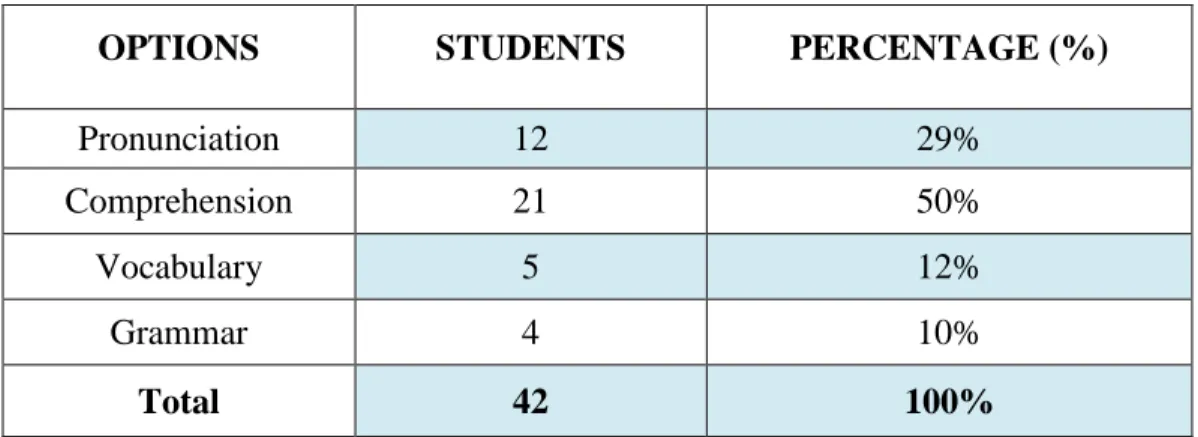
CHART 19: SUB SKILLS TO IMPROVE WITH SPEECH APPLICATIONS ... 41
CHART 20: PREFERENCE BETWEEN A BOOK AND AN AUDIO FILE... 42
CHART 21: CREATE CONTENT AND CHANGE INTO AUDIO FILES ... 43
CHART 22: SURVEY DIRECTED TO STUDENTS ... 44
CHART 23: SURVEY DIRECTED TO TEACHERS ... 46
CHART 24: SURVEY DIRECTED TO SPECIALIST ... 48
CHART NO. 25 BENEFICIARIES ... 51
CHART 26: RESULTS OF THE PRE-TEST RECORDING OF LISTENING ... 78
CHART 27: RESULTS OF POST-TEST APPLIED ACAPELA SPEECH ... 79
CHART 28: COMPARISSON BETWEEN PRE-TEST AND POST-TEST ... 80
GRAPHICSPAGE
GRAPHIC 1: THE IMPORTANCE OF THE LISTENING SKILLS ... 36
GRAPHIC 2: IMPORTANT ACTIVITIES IN CLASS ... 37
GRAPHIC 3: PRONUNCIATION AND MEANING OF THE WORDS IN VIDEOS, SONGS AND AUDIO FILES ... 38
GRAPHIC 4: ORAL AND WRITTEN COMPOSITIONS ... 39
GRAPHIC 5: DIDAC voice by using this kind of option. TIC UNITS WITH AUDIO FILES ... 40
GRAPHIC 6: SUB SKILLS TO IMPROVE WITH SPEECH APPLICATIONS ... 41
GRAPHIC 7: PREFERENCE BETWEEN A BOOK AND AN AUDIO FILE ... 42
ATTACHMENTS PAGE
ATTACHMENT1: OBSERVATION PROTOCOL ... 84
ATTACHMENT2:SURVEYDIRECTEDTOSTUDENTS ... 84
ATTACHMENT3:SPECIALINTERVIEW ... 87
ATTACHMENT4:TEACHERINTERVIEW ... 88
ATTACHMENT5:RUBRIC ... 95
ACTIVITIESPAGE
ACTIVITY1 ... 59
ACTIVITY2 ... 60
ACTIVITY3 ... 61
ACTIVITY4: ... 62
ACTIVITY5 ... 63
ACTIVITY6 ... 64
ACTIVITY7 ... 65
ACTIVITY8 ... 66
ACTIVITY9 ... 67
ACTIVITY10 ... 68
ACTIVITY11 ... 69
ACTIVITY12 ... 70
ACTIVITY13 ... 71
ACTIVITY14 ... 72
PENINSULA OF SANTA ELENA
STATE UNIVERSITY
FACULTY OF EDUCATION AND LANGUAGE ENGLISH TEACHING CAREER
“SPEECH APPLICATION TO IMPROVE THE LISTENING
COMPREHENSION SKILL IN THE STUDENTS OF SECOND BGU AT UNIDAD EDUCATIVA SAN MARCOS, SANTA ELENA, PROVINCE OF SANTA ELENA SCHOOL YEAR 2015-2016”.
Author: Marjorie Katerrine Merejildo Cruz Advisor: Lcdo. Kléber Loor Zambrano, MSc.
ABSTRACT
INTRODUCTION
In the schools of Ecuador, the main problem is that there are not professional
teachers. It means that the teachers who are teaching in school are people who
have learned English probably in some English-speaking countries. Another
group has learned in institutes and they do not have the corresponding knowledge
how to teach a language. Therefore, the big problem is that some English area
coordinators believe that they are going to have great achievement by employing
people who knows only English without the most adequate methodology.
Nowadays there are graduated teachers from language careers but they are not
hired because they do not have the experience or the fluency of speaking English.
Another big problem for the correct acquisition of a language is the low economic
situation of the teachers and students, as a consequence it is difficult for the
teachers to obtain or increase their knowledge about teaching a language by
attending to training courses or workshops. The students are not able to afford the
books with the corresponding audio resources and nowadays most of the books
are reinforced with an online platform, which is logically expensive and the
students from public educational institutions cannot afford.
Fortunately, nowadays there are teachers who are graduating in teaching a
language and they are preparing projects in the province of Santa Elena, they
have the corresponding knowledge to really know the problems about teaching a
language and follow the corresponding process to solve them. The next is the
development of this project using a speech application to improve the students`
listening skill.
The first chapter describes the problem and the corresponding context. The
skills. Maybe the lack of audio visual material can not be solved with the
application of projects. The correct development of the teaching learning process
with the corresponding basic skills is going to be fulfilled by the awareness of the
authorities to implement the audiovisual resources.
The second chapter emphasizes the evolution of the methodologies and also the
international requirements that students have to work on taking international
examinations. In this way the schools are going to have qualified teachers
teaching in the school. The methodology is the greatest problem because most of
people not only teachers transmit their knowledge or information in the way they
were taught. It is seen that in most of the schools they use Behaviorism and an
outdated methodology: grammar translation method. Besides the teachers who
studied for being teachers continue using this old fashioned methodology.
The third chapter refers to the methodological process of getting information
about the collection data in the field. The qualitative data that later changes into
quantitate data is based on the application of a program that allows to transform.
The written texts into audible information. All the quantitative data is illustrated
in statistical charts and statistical graphs with their corresponding interpretation,
conclusions and recommendations.
The fourth chapter described the proposal and it is going to be very useful to
understand the meaning of the words by catching the pronunciation of each one.
In order to learn a foreign language it is necessary to learn from the real native
speakers. It has been the problem for Latin people to learn or acquire. Fortunately
nowadays we have programs which change from written texts into oral speech
with the correct native accent. Another problem to face in my institution is the
lack of technological equipment such as: computers, overhead projectors,
speakers, etc. now with this application we can create our own platforms with all
CHAPTERI
THEPROBLEM
1.1TITLE
“SPEECH APPLICATION TO IIMROVE THE LISTENING
COMPREHENSION SKILL IN THE STUDENTS OF SECOND BGU AT
UNIDAD EDUCATIVA SAN MARCOS, SANTA ELENA, PROVINCE
SCHOOL YEAR 2015-2016.”
1.2STATEMENTOFTHEPROBLEM
Public institutions have to follow the regulations involved in the National
Curriculum Guidelines that is the manual from the Minister of Education to really
assess the learning of English in the different school years related with the levels
of the Common European Framework. Students have to accomplish international
standards at the moment of graduation. The government has provided useful
material such as books but without listening resources.
Nowadays the English language is taught in a very basic way as a consequence of
the lack of economic resources. Another big problem is that there are not
professional English teachers, most of the English teachers only have a
proficiency diploma which enables them to teach English but they have not
learned the correct methodology or pedagogy to teach. As a result from the low
economic conditions, the students do not have adequate material to learn the four
basic skills of a language. The low budgets for the educational institutions does
not allow to have the corresponding equipment to prepare classes according to the
According to the language learning, in the teach a language researcher must
follow the chronological order, listening at the beginning but this job is difficult
due to the practice must be done with audiovisual aids and equipment. This is the
beginning of learning a language in correct way. In the writing skill there are the
same difficulties with reading because they are going to write as the way they
listen, and not correct form as long as the copy from readings where they can read.
Finally the whole group of the skills must be taken into account in every single
class adding the grammar and vocabulary but the teachers who are prepared are
going to focus only in one of these skills.
Mainly it is going to be focused in the development of the listening skill due to it
is the first skill that a human being acquires at the moment he or she is in the
mother`s belly and listens to all the external sounds. In the learning of a language
it is very important that the students acquire it by having the whole understanding
with a good pronunciation. There are immigrants who are illiterate that have
learned a language only by listening and repeating it the best as they can so the
oral but not written language is more practical for a real and fast communication.
So when the teachers are not native speakers it is compulsory to replace the native
pronunciation with all the available resources like in the current time we have the
ICT we can do by special kind of software where the written language can be
changed into spoken one.
In the market nowadays there a lot of programs to change the written language in
to spoken one. As in most of the public schools the books do not have audible
material, it is a good idea from the teachers to use the speech analysis software
because the students can write their ideas or sentences and later they are going to
be able to listen to them and make all the changes they want. Also if the create
readings they can later learn the correct pronunciation, pitch, stress, rhythm, etc.
when the students learn only from the teacher´s pronunciation they are going to
The public institutions in the province of Santa Elena do not have material to
practice the listening skills as the government provides only books, so the
teachers have to research the correct pronunciation of the words from the book.
As it was mentioned before the teachers are not prepared with a correct
methodology and if they have problems with the pronunciation then they are
going to have problems with the intonation, pitch, stress and rhythm. Another
problem that the students have to face is that they are going to be used to their
teachers pronunciation and they are not going to familiarize their ears with the
native pronunciation. These kind of troubles must be faced by the teachers in the
community of San Marcos. In this place there a lot of students who are provided
with books that do not have audio Cds and the teachers have to look for audible
resources and solve the way how to practice the listening skills.
According to the common European Framework, the second year students must
have some communicative competences placed in the B1.2: linguistics
components, sociolinguistic components and pragmatic components, which are
activated by the development of the four basic skills.
According to the B1.2 level in the Common European Framework, from the
National Curriculum Guidelines, del Ministerio de Educación (2014), in the
listening skill: ¨The students will be able to understand the main points of clear
standard speech on familiar matters regularly encountered in the public and
vocational domains (e.g. services, work, etc.).
The students will be able to identify both messages and specific details within the
public and vocational domains, provided speech is clearly articulated. The
listening skill is considered the first skill to be learned in the chronological order.
Unfortunately this kind of standards is not fulfilled in second baccalaureate in
In consequence the problem is that the students can`t develop their listening skill
and the most important skill for their futures lives is the listening comprehension.
It is important to practice the listening skills because it is the input skill that
allows knowing the pronunciation of the words and consequently the real
meaning in the correct context. Unfortunately, the books from the government do
not bring any material to practice listening that is the reason of this project to
provide a program that allows to transform the written texts into audible
information. . This is going to be very useful to understand the meaning of the
words by catching the pronunciation of each one. It is going to be an important
project because the students aren`t going to be able to understand the texts from
the English books but also they are going to make compositions by themselves
and they are going to know and practice the adequate pronunciation made by a
native speaker.
Most of the mistakes that students make are the pronunciation ones but as
teachers know that for practiced a good pronunciation we have only to listen
adequately and repeat the best as possible. And that is pronunciation. In order to
learn a foreign language it is necessary to learn from the real native speakers. It
has been the problem for Latin people to learn or acquire. Fortunately nowadays
we have programs which change from written texts into oral speech with the
correct native accent.
Another problem to face in my institution is the lack of technological equipment
such as: computers, overhead projectors, speakers, etc. now with this application
the researcher can create our own platforms with all the content involving topics
according to our country and own reality. For the development of the project it
will be necessary to use the personal computer and the only one overhead
projector that the school has. At the XXI Century it is compulsory to make the
students use of the current technologies like the Speech Application .the students
were to write the context and later they are going to be able to listen. This kind of
the process applying in the different levels of the Common European Framework,
which is the standardized tests system around the word.
The main objective to encourage the application of the Common European
Framework is to make the students more competitive and make them to be very
communicative among the speakers from other countries. Once the students can
be placed in the different levels of the Common European Framework our
country can be taken into the international communities to increase the tourism,
the worldwide business and the worldwide communication. This is an important
key for the development of the countries and have more international exchanges
that are going to make the country citizens be also more trained to develop their
professional and personal lives.
Now it is outstanding to star with this kind of project in the public schools that
lack of supportive material. Unfortunately the authorities’ aren´t focused in the
development of the teaching learning process in the public process.
1.3CONTEXTOFTHEPROBLEM
The teaching of a second language has been set as a government policy. It has
been considered in the new curriculum for all the levels in elementary schools,
high schools and universities. It is really important nowadays the learning of
English for the whole country development.
With the previous information, the Ministry of Education, we can assume that
Learning of English has improve around the world and logically in order to have
a worldwide communication it is necessary to develop the four basic skills. For
these reasons it is necessary to learn this language, such is the case of the
unfortunately, do not have the corresponding resources such as audios where to
listen the best correct pronunciation
The public schools have a lot of restrictions, the resources are limited, it can be
said that they only listen to their teachers since the supportive materials selected
do not have listening resources. On the other hand this is a school which is far
away from a big city, the teachers are professionals who aren`t specialized in
teaching English.
Essentially in the internal teaching process the problem is in the listening skill,
mainly in the comprehension, that is the reason why this project was designed for
the implementation of the synthesis speech.
1.4RESEARCHQUESTIONS
1. How will the speech applications improve the listening comprehension
skill in the students of second BGU at Unidad Educativa “San Marcos”,
province of Santa Elena, school year 2015-2016?
2. What are the different kinds of exercises to improve the listening
comprehension skills in the students of second BGU at Unidad Educativa
“San Marcos” province of Santa Elena, school year 2015-2016?
1.5RATIONALE
The main goal of a language is to communicate among the speaker and the
Reading, Writing and Speaking they involve grammar and vocabulary, besides
we have to consider also the morphology, syntax and semantics.
The aim of this research is to improve the listening comprehension in the
students of second baccalaureate BGU at Unidad Educativa “San Marcos”, first
by learning to really understand the sounds of the letters, words and sentences,
later the students will be able to effectively understand the meaning of more
complex structures.
The chronological order to learn a language is by listening since all human beings
develop this ability first at the moment they are in the mother’s belly. Later when
they are born they continue developing this skill but also they try to repeat the
sounds from the people in his surrounding produce. It will be later their speaking
skill. Therefore basically this project is aimed to develop by the listening skills.
According to the general criteria from the teachers the most important skill is
listening because it provides not only with information or input but also with the
correct practice of listening and in its pronunciation. The researcher know that the
communication by oral speech is faster than in a written way.
Probably, if it is necessary to communicate by writing and reading it will be a
slower process, but the oral communication is more effective. The written words
can be understood by their symbols or letters but maybe they aren’t going to be
pronounced correctly and with the incorrect pronunciation of any letter we can
misunderstand the message. This is the basic principle to listen correctly and then
transfer into the correct message.
Once again for researcher the most important basic skill of a language is
listening. At the moment, the students do not like to speak, first of all because
they did not listen a correct pronunciation, or the few ones that do speak with an
incorrect pronunciation. It is compulsory also that after using this project for
they are going to feel confident to talk in English because they know they are
listening. At having this kind of application the students are going to be able to
work by themselves, which is the objective of education that the students are
going to be able to discover and study by themselves.
1.6RESEARCHOBJECTIVE
To identify the possible causes of the low students development in the listening
skills, in the second baccalaureate at Unidad Educativa San Marcos, school year
2015 – 2106.
1.7IDEATODEFEND
The students of second BGU at Unidad Educativa “San Marcos”, Santa Elena,
province school year 2015-2016 are going to improve the listening by using the
speech application.
1.8SCIENTIFICTASK
1. To establish the theoretical framework from the research procedure.
2. To identify the current methodological process based on listening skills in
the students of second BGU at Unidad Educativa “San Marcos”.
3. The propose the speech applications that improve the listening skill in the
CHAPTERII
THEORETICALBASIS
2.1DEFINITIONOFTHETERMS
2.1.1.SPEECHAPPLICATION
A spoken expression of ideas, opinions, etc that is made by someone who is
speaking in front of a group of people. According to the Merriam Webster
dictionary.
The researcher can say that the written and spoken words in a group can be
defined as speech, it is important to take into account this word because it is going
to be the product of the process in this project.
2.1.2.LISTENING
According to the Merriam Webster dictionary, is the action to hear what someone
has said and understand that it is serious, important, or true.
The listening skills, is very important because it is the first according to the
chronological order of acquisition the information in a person.
2.1.3.SPEECHAPPLICATION
According to Sydal A. (2004) “text to speech technology permits communication
from computer to man through the natural human communication modality of
speech” (p.99). It is used to translate Speech is the computer-generated simulation
of human speech. It is used to translate written information into aural information
2.1.4.LISTENINGCOMPREHENSION
According to Modi D. (1991), “Listening is the first basic skill, and yet researches in the listening area meagre” (p.8).
The implicit importance of listening comprehension is in the real understanding
of the message and consequently to make the corresponding actions like to
answer or to perform the requirements in the message.
2.2PREVIOUSRESEARCH
These kinds of researchers have been developed around the world, so there is a
couple of them but the most similar is one that I found in Indonesia called
“IMPROVING LISTENING COMPREHENSION THROUGH TEXT TO TEXT SPEECH APPLICATION” in 2009, which is very similar to the project that is going to be carried out in Unidad Educativa “San Marcos”.
It is outstanding to mention that this thesis was presented as a master degree
requirement. Leny Magdalena is an Indonesian teacher who prepared this thesis
to graduate as master, where English is very important not only for getting good
and well-paid jobs but also for having a differentiated entertainment. This thesis
was focused totally in the development of listening skills.
That is why it was selected as a reference to prepare and apply the project by
using the speech application text to text. This kind of application really has
helped to overcome the presence of a native speaker for learning a language. This
2.3PHILOSOPHICALBASIS
2.3.1.CONSTRUCTIVISMTHEORY
This worldwide paradigm establishes that learning is a continuous and active
process of building knowledge, people in an active away are building the proper
representations from the reality. New information is getting together with
previous information creating their own mental representations.
As a result from the development of Behaviorism and the programmed
instruction, constructivism claims that learning is a process of building
knowledge besides acquiring it. A person builds knowledge according to the
personal experiences and from the environment, therefore everybody has a
different kind of perception, construction and process of knowledge. Every
learner is not totally a beginner in learning because he has previous experiences
and different kinds of social, cultural political aspects.
In constructivism it is misunderstood that the teacher must allow the students
construct their knowledge alone. Constructivism establishes that all kind of
knowledge is built from students ‘previous knowledge without considering how it
was taught. The simplest activity contributes to build new knowledge. This kind
of trend is considered in the entire project because it aims the students build their
knowledge. The listening comprehension makes the students first learn the
language in a chronological order and they are going to cement their learning in a
permanent way. The project to be developed in the Unidad Educativa San Marcos
is going to be emphasized in the constructivism trend.
2.3.2.SOCIALDEVELOPMENTTHEORY
This theory claims that the social interaction precedes the development, the final
interaction is very fundamental in the process of development of cognition. On
other hand Piaget says that development precedes learning.
According to Wertsch J. (1985) Vigotsky noted that in social speech the tendency
toward productivity occurs primarily in two types of situation. In the first, the
topic of conversation is equally well known to all interlocutors. The second type
of situation in which predicativity occurs in external social speech is in response
to a question. (p.123)
It is essential to develop the social interaction not only in the students but also in
the community of San Marcos because the high school is the heart of the social
development in this place.
2.3.3.THEZONEOFPROXIMALDEVELOPMENT
This is the distance between a student`s ability guided by an adult and the
students ability to solve a problem in an independent way.
According to Steward E. (2005) two broad themes can be identified in Vigotsky`s
work: (a) the claim that the defining property of human mental activity is its
meditation by tools and signs (primarily by speech); and (b) the claim that higher
mental functioning in an individual has its origins in social activity. (p.11)
The Vigotskyan trend also emphasized the connections that people have with the
environment where they have their actions and interactions. It establishes that
humans have tools to develop from a culture to have interventions with the social
environment. Children used to develop these tools only as communications tools
but later Vygotsky supposed that the internalization of them aimed to more
powerful thinking skills. The Unidad Educativa San Marcos` teachers applied the
zone of proximal development trend in their everyday classes to solve their
2.4EDUCATIONBASIS
2.4.1.LANGUAGELEARNINGTHEORY
2.4.2.KRASHEN`STHEORYOFSECONDLANGUAGEACQUISITION It is mandatory to mention the Krashen`s theory since it establishes the two ways
of second language performance: the acquisition of a language and the
learning of a language.
According to Dorsch M.(2010) “Acquisition, which means a more or less
unconscious process of absorbing language, and learning, which most of the time
means a conscious process of getting the ability to perform a second language.”
(p.1).
The learning of a language is made by the attendance to a formal instruction and
this process is very conscious by learning and getting knowledge about the
language such as their grammar rules.
Krashen establishes five main hypotheses
1. The Acquisition – Learning hypothesis, it is considered that a language is
acquired in a natural and unconscious way, this the reason the acquisition is
going to be permanent knowledge in the brain. On another side the learning is
the prepared and conscious process, which is developed in a class but it is
believed that it is a temporal knowledge in the brain.
2. The monitor hypothesis, the monitor in the learning a second language is the
mother language since it is going to be the monitor or regulator of the learning
of the second language. A person in the brain is going to be comparing every
3. The natural order hypothesis, it is said that the human brain has a natural order
to acquire the different words that a sentence contains, also the child according
to his growing he acquire vocabulary that he progressively know little by
little.
4. The Input hypothesis, it states that a language is acquired by understanding
messages, the acquirer must be also open to the input, and it means the
acquirer is ready to acquire the new information.
5. And the Affective Filter hypothesis, the affective factors are related to
language learning, this is why some students learn and others do not. This
filter must be weak and the learner has a positive attitude towards learning.
2.4.3.LANGUAGETEACHINGTHEORIES
2.4.3.1.THENATURALAPPROACH
According to Candlin C. (2009), says that “According to Krashen is only comprehensible input which facilitates acquisition” (p.9).
As a result of the subconscious way of getting a language it was called the
Natural approach, this kind of teaching is teacher centered, the students are
responsible of their learning, this theory was defended by Krashen. By teaching
the listening skills first it is being applied the Natural Approach of the learning a
language. The first chronological skill to be learned in a natural way is listening
and its corresponding sub skills.
2.4.3.2.THECOMMUNICATIVEMETHOD
It emphasizes that the teachers must teach a language not about the language,
consequently the language fluency. This kind of method is implied in the
communicative competence, which involves both the spoken and written
language and all four language skills.
Some learning strategies allow learners to become self-confident and independent
in learning a language and help to participate in an active way in communication.
According to Littlewood W. (2010) “Just as linguistic form can express a number
of functions, so also can a single communicative function be expressed by a
number of linguistic forms.” (p.2).
Learning a language is based on the focus of language communication. So
language has its social function to reach the real meaning. Speakers communicate
among them either orally or spoken. In the language development can be accepted
the diversity and in the learners who uses the language as a second language and
with their first languages, too.
The culture is considered a toll to shape the speaker`s communicative
competence in their both language.
2.4.3.3.COMPUTERASSISTEDLANGUAGELEARNING
This kind of learning with the assistance of a computer carries out both
bidirectional learning and an individualized learning. The CALL is useful because
it can help to feedback what has been learned in the classroom.
According to Davies G. (2001), “it is clear that there is ample scope for research in CALL. As the technology develops, the potential areas for research increase.”
2.4.3.4.COMMUNICATIVECALL
It had its origins in the communicative approach that was outstanding in 1907s´,
grammar is taught in an implicit way, the most important is to have the student
can produce language in an original and flexible way.
This methodology implies three phases in the first one; computer could check the
students input and feedback, even more, another computer could react to students`
mistakes with remedial activities. The communicative approach is considered in
the second phase to use the language more than analyzing the language, grammar
is taught in an implicit way rather than explanatory way.
The third phase involves the communicative approach criticisms through projects
to obtain direction and coherence. This phase coincided with the development of
the multimedia technology and computer-mediated communication. This
methodology is going to be more considered in the research in Unidad Educativa
San Marcos.
2.4.3.5.ICTFORTEACHINGENGLISH
Nowadays in the era of technology it is mandatory that everybody uses the
technology in its work places. Education has developed the technology and
information tools. Because of its helpfulness and fast performance the students
and teachers can take advantage for learning a language as they can acquire not
only the four basic skills but also another kind of skills creativity, critical
thinking, understanding from all the basic skills of a language.
According to Voogt J. and Knezek G.(2008) “ICTs are most often used in
education in LCDs to support existing teaching and learning practices with new
(and, it should be noted, often quite expensive) tools.” (p.1075). It is not new
about the use of ICTs can be used better in some themes, like technology
mediated language learning is better when the technology is integrated in an
overall activity and in across curricular activity language learning is better for
2.5LEGALBASIS
The Project: “SPEECH APPLICATION TO IMPROVE THE LISTENING
COMPREHENSION SKILL IN THE STUDENTS OF SECOND BGU AT
UNIDAD EDUCATIVA SAN MARCOS, SANTA ELENA, PROVINCE
YEAR 2015-2016” is under protection from the Ecuadorian Political
Constitution, which was approved in Montecristi, on July 23rdnd 24th of 2008,
that establish:
Art. 27. The education is centered in the human being and will guarantee the
holistic development, based in the respect of the human rights, the surrounding
environment and the democracy, it will be participative, obligatory, intercultural,
democratic, inclusive, and diverse of quality and warming. It will encourage the
gender equality, the justice, the solidarity and peace; it will encourage critical
sense, the art and the physical culture. The group and individual entrepreneurship,
and the development of competences and skills to create and work.
Education is indispensable for the knowledge, the application of rights and
building a sovereign country and is the strategic axe for the national development.
2.5.1. LEY ORGÀNICA DE EDUCACIÓN INTERCULTURAL
(REGISTRO OFICIAL NO.417 DEL 31 DE MARZO DEL 2011)
The next summary was made from the chapter III related about the rights and
obligations from the students, articles 7 and 8. The chapter IV related about the
rights and obligations from the teachers, articles 10 and 11.
It can be understood that the government wants to really improve the level of the
Ecuadorian students by pushing and encouraging their teachers to be in a
continuous, permanent and sequential training.
At the moment the new generations that were born with the technology and it is
implement the educational institutions with the latest high tech the teachers must
be ready to work with the latest high tech to properly apply the newest
methodologies in order to make them understand English in the fastest, happiest
and most adequate way the English language.
The articles that were mentioned from the Constitution provide legal bases to
encourage the teachers in the Unidad Educativa San Marcos to develop projects
that involve the application of new technologies in education. Nowadays it is
mandatory to use technology in the educational centers. The project carried out in
this research is really supported by the constitution that also motivates the
teachers to have better classroom activities and they can do it by using the latest
2.6TREEPLOBLEM
Source: Unidad Educativa San Marcos
Author: Marjorie Katerine Merejildo Cruz
Cause I
Lack of visual resources
Cause II
The low training from teacher who are not trained to teach
Cause III
The economic situation from students
Consequence I
The students do not learn correctly because the audiovisual
helps to learn a language in the whole way.
Consequence II
The professionals who are not English teachers do not have idea how to teach a language therefore they most of cases emphasizes on
grammar
Consequence III
It is difficult for the students to have access to technological devices to be in touch with a
CHAPTERIII
METHODOLOGY
3.1.RESEARCHDESIGN
This project was applied at “Unidad Educativa San Marcos”, the authorities, teachers, and students
gave opinions about what causes listening comprehension problems and maybe the possible
solutions presented in this project.
3.1.1.KINDSANDLEVELOFRESEARCHING
3.1.1.1.FIELDRESEARCH
The information of this research was collected in the “Unidad Educativa San Marcos”, was
obtained all the information to carry out this research. After getting all the information from books,
magazines, and the internet, it was analyzed, classified and processed and shown by graphics and
statistical tables. This kind of way was made to collect real and evident information and was
processed and shown in the next charts and graphs.
3.1.1.2.ANALYTHICMETHOD
All the information gotten from any kind of written source such as books, magazines, and the
internet, it was expressed in the literature review chapter. Through this method was possible to
classify the information and was shown in the charts and graphs.
3.1.1.3.OBSERVATION
Through this method was useful to express how the teacher practiced the activities related to
listening comprehension. Based on the observation were prepared the corresponding questions and
each one are interpreted or demonstrated in the charts and statistical data can be seen the
3.1.1.4.QUANTITATIVE
This method allowed the teacher to get information from students, authorities, parents and later
process in graphics and statistical pictures. This method was selected to collect information and
changed into numbers to understand and get an interpretation for its equivalent conclusion and
make recommendations to solve each question difficulties.
3.1.1.5.SCIENTIFIC
Based on the listening comprehension problems, this method permitted to observe the best option
to select the best hypothesis to solve the problems of this study. This method allowed making a
validated way to demonstrate the results of this research.
3.1.2QUALITATIVE METHOD
This method analyzed and interpreted data by observing what person does and says. Example:
Observations to teachers and student at Colegio Mixto Particular “UPSE”.
3.1.3INDUCTIVE- DEDUCTIVE METHOD
This rearch paper focused in both approaches deductive and inductive. Deductive method allowed
to verify a hypothesis by using theory. Through deductive method information about how
Augmented Reality was collected, analyzed and contrasted by authors, and finally to confirm or
reject the hypothesis.
Unlike the inductive method the researcher began by investigating and gathering the data from
different sources and by using numerous sources of evidence: interviews, direct observation and
document analysis in an attempt to make conjecture about the Augmented Reality in students of
second year BGU at Colegio Mixto Particular “UPSE”, La Libertad, Province of Santa Elena.
3.1.4SCIENTIFIC METHOD
The method determined answers to questions in a logical format providing the real improvement of
learning in students of second year BGU at Colegio Mixto Particular “UPSE” using Augmented
Reality to improve English speaking skills.
3.15OBSERVATION METHOD
Observation Method allowed to find out meticulous information about causes and effects of the
problem determining how learner communicative with another, and verifying how much time is
used on various activities associated to the use of the Augmented Reality for the improvement of
the oral skills to students of second year BGU at Colegio Mixto Particular “UPSE”.
3.2.POPULATION
The population was considered the authorities, teachers, students and parents form the second
bachelor at the “Unidad Educativa San Marcos”, in the parish of Colonche, in the province of Santa
Elena. The population in these kind of projects were very small and for this reason the sample was
3.2.1.SAMPLE
The sample for students, was considered the second bachelor degree which have 42 students they
were the experimental group. A test was applied after a didactic unit in order to measure the
learning level.
CHART 1: Population
N° Description Quantity
01 02
03 04 05
Unidad Educativa “SAN MARCOS” English teacher of Unidad Educativa “SAN
MARCOS”
Students of second year
English language teacher
Specialist teacher
1
2
42
1
1
TOTAL INTERVIEWS 47
3.3VARIABLESOPERATIONALIZATION
3.3.1.DEPENDENTVARIABLE:LISTENINGCOMPREHENSION
CHART 2: INDEPENDENT VARIABLE
CONCEPT DIMENSIONS INDICATORS ITEMS
TECHNIQUES AND INSTRUMENTS
Listening
Comprehension:
It is the skill to understand
to catch information by
using the audition organs
Listening
Comprehension
The students preferred
watching videos to
reinforce listening skills.
The students knew the
pronunciation and the
meaning from the words
in the videos, songs and
audios
The students could make
compositions both in
written and spoken way.
What listening activities do
you prefer to do at class?
Would you like to know the
pronunciation and the
meaning from the words in
the videos, songs and
audios?
Would you like to make
compositions both in written
and spoken way?
Questionnair
Interview
Survey
3.3.2.INDEPENDENTVARIABLE:SPEECHAPPLICATION
CHART 3: DEPENDENT VARIABLE
Source: Unidad Educativa “SAN MARCOS” Author: Marjorie Katerine Merejildo Cruz
CONCEPT DIMENSIONS INDICATORS ITEMS
TECHNIQUES AND INSTRUMENTS
Speech Application:
It is a software, which is applied and used in the
conversion of written
language into spoken
language.
Speech
Application
Students use the speech application software to make
compositions to
read and listen to them.
Students use the speech application software to make a summary from watching a video
Students use the speech synthesis software to have
a good
pronunciation
Would you like to have a didactic unit planned with
audio files that you can read and listen to them?
Would you like to make compositions both in written and spoken way?
Would you like to know the pronunciation and the meaning from the words in
the videos, songs and audios?
Questionnaire
Interview
3.4DATACOLLECTION
All the instruments and techniques were focused on the authorities, teachers and
students that were aimed the development and improvement of the listening
comprehension skills.
Among the instruments to be considered were the surveys, interviews, direct
observation.
3.4.1.SURVEYS
The surveys were applied to the authorities in order to know their opinions about
the project.
3.4.2.DIRECTMETHOD
This method allowed to observe the classroom and the application of the speech
application.
3.4.3.INTERVIEW
It was made to the principal of the “Unidad Educativa San Marcos” to get his
opinion about the importance of improving the listening comprehension and the
corresponding creation of the manual.
3.4.4.SURVEY
The survey was prepared with question for the teachers, students and parents to
know their opinions about the implementation of the project based on listening
3.4.5.INSTRUMENTS
It is necessary to mention that some technical instruments were used in the
gathering of the data for instance: laptop, personal computer, smart phones,
camera, they didn’t only helped in the development of the synthesis speech to
improve the listening comprehension but also in the use of them in collecting
evidence of the use of the synthesis speech applications.
3.4.6.DATACOLLECTIONPLAN
Data collection plan was done according to the survey and
interviews.
CHART 4: DATA COLLECTION PLAN
BASIC QUESTIONS EXPLANATION
1. What for? To improve the listening skill of students.
2. From people or objects? Students of second bachillerato Unidad
Educative San Marcos
3. About what aspects? Listening skill
4. Who? Marjorie Katerine Merejildo Cruz
5. To whom? Students, English teacher of Unidad Educativa
San Marcos
6. When? 2015-2016
7. Where? At Unidad Educativa San Marcos
8. How many times? Once a year during the academic year
2015-2016
9. How? Individual and by group
10. What data collection techniques? Observation, interview,
11. With what? Smartphone and laptop
3.8DATAPROCESSINGPLAN
CHART 5: DATA PROCESSING PLAN DETERMINATION OF
A SITUATION DATA SEARCH
DATA COLLECTION AND ANALYSIS DEFINITION AND FORMULATION STATEMENT OF SOLUTIONS
By applying the
corresponding surveys to
students and teachers in
the Unidad Educativa San
Marcos, was established
that the listening
comprehension skills can
be improved by using
speech synthesis
applications.
After being
identified the
problem it was
initiated the process
of searching
supportive
information about
speech synthesis
application that can
be applied to
improve the
listening
comprehension.
The problem was
focused in the third
bachelor degree
because the problem is
general in the high
school, so the students
were surveyed and the
teachers were
interviewed. With the
data was prepared the
corresponding solution
to the problem by
creating the proposal.
Once gathered the
information from the
statistical chapters,
the proposal was
created with the aim
to improve the fields
that the student and
teachers needed to be
implemented as soon
as possible.
The use of the speech
synthesis applications
really are going to
improve the listening
skills because they are
motivating, catching and
useful in the learning of a
language.
3.5.1.OBSERVATIONOFSECONDBACCALAUREATECOURSE
This course was observed for 8 sessions in English class and their behavior about
intervention from. I take notes on each day where I include the interpretation of
students about the class and interactions between students.
CHART 6: OBSERVATION #1 Date: November
07st 2015
Time: 11:20 – 12:40
Description notes Reflective notes
One hour
The students made a summary about the video and they are going to record their voices in the speech. It is going to help them
with the correct
pronunciation.
The students prepared
questions from the summary about healthy food, in this way every students asked and answered questions. The questions were made by using the speech synthesis in order to be very well understood.
Source: Unidad Educativa “SAN MARCOS” Author: Marjorie Katerine Merejildo Cruz
CHART 7: OBSERVATIO #2 Date: November
21st 2015
Time: 11:20 – 12:40
Description notes Reflective notes
One hour
In this course the
students made a
summary about the
reading and they
recorded their voices in the speech. It guided them with the correct
pronunciation related
with places in a city.
The teacher asked question the students in order to feedback and really assess the students’
knowledge, the students
‘pronunciation and the
student`s understanding about places in a city and reported speech.
CHART 8: OBSERVATION #3 Date: November
28st 2015
Time: 11:20 – 12:40
Description notes Reflective notes
One hour
In those activities the students made a summary about the
reading and they
recorded their voices in the speech. It guided them with the correct
pronunciation related
with jobs and
occupations.
This course made a feedback according to the summary of the article including the vocabulary about jobs and
occupations and present
simple tense.
Source: Unidad Educativa “SAN MARCOS” Author: Marjorie Katerine Merejildo Cruz
CHART 9: OBSERVATION #4 Date: December
05st 2015
Time: 11:20 – 12:40
Description notes Reflective notes
One hour
In this session, the teacher socialized the
result obtained by
diagnostic test based and explain about the importance of improve their listening skill.
When this process was
explained, It was observed that students participated or increased different activities in the classroom and all the activities helped to improve the learning.
CHART 10: OBSERVATION #5 Date: December
19st 2015
Time: 11:20 – 12:40
Description notes Reflective notes
One hour
In this class the
studentsread and
recorded their voices in the speech. It guided them with the correct
pronunciation related
with free time
activities.
When I applied this platform I improved or motivated to participate in the development of the listening skill then they had to make a written summary, transfer into the speech software, then listen and present orally in the class.
Source: Unidad Educativa “SAN MARCOS” Author: Marjorie Katerine Merejildo Cruz
CHART 11: OBSERVATION #6 Date: December
26st 2015
Time: 11:20 – 12:40
Description notes Reflective notes
One hour
Based on the summary related to free time activities, in this way
the students made
questions to develop the critical thinking and speaking skill.
In this class the students prepared questions from the summary about free time activities, the students made a short paragraph using the speech synthesis in order to be very well understood about costumes and traditions. Source: Unidad Educativa “SAN MARCOS”
CHART 12: OBSERVATION #7 Date: January 05st
2016
Time: 11:20 – 12:40
Description notes Reflective notes
One hours
In this class I
explained about some definitions of the new words applied in their composition. Because of the topic was to prepare a composition about the importance of technological gadgets they use.
The students really applied the speech application to make their compositions and it is important that the students were guided by the teacher and they are asked questions about technology gadgets they use.
Source: Unidad Educativa “SAN MARCOS” Author: Marjorie Katerine Merejildo Cruz
CHART 13: OBSERVATION #8 Date: January 16st
2016
Time: 11:20 – 12:40
Description notes Reflective notes
One hours
The students repeated the best as possible the vocabulary about crime with the help of the
speech synthesis
software in order to major in pronunciation. The questions were asked by using the
speech synthesis in
order to be very well understood.
The teacher fed backed and really assessed by asking the students to summarize the article with vocabulary about crime. It was necessary and useful the speech synthesis for this activity.
In the last chapters it was noticeable that the students improved the development
of the listening skills by using the speech application. It was remarkable that the
students motivated at the moment they knew they were using new kinds of
technology. Consequently with motivation at the beginning it was something
predictable that the students were going to work enthusiastically in the
assignments. At the end of the project it was totally different the way how the
students made their activities with the speech application. In conclusion the 90 %
of students could develop and improve their listening skills with the speech
application.
Another important aspect to be taken into account was the students need a
workshop to involve better in the use of the multimedia resources since a group of
students were not able to follow the instructions the teacher pointed. It was a
sensations as they acceded to internet for the first time. It is know that they have
computing classes but unfortunately they do not have access to internet. The
internet from the institution is not available for the students, only at the time they
3.6DATAANALYSIS
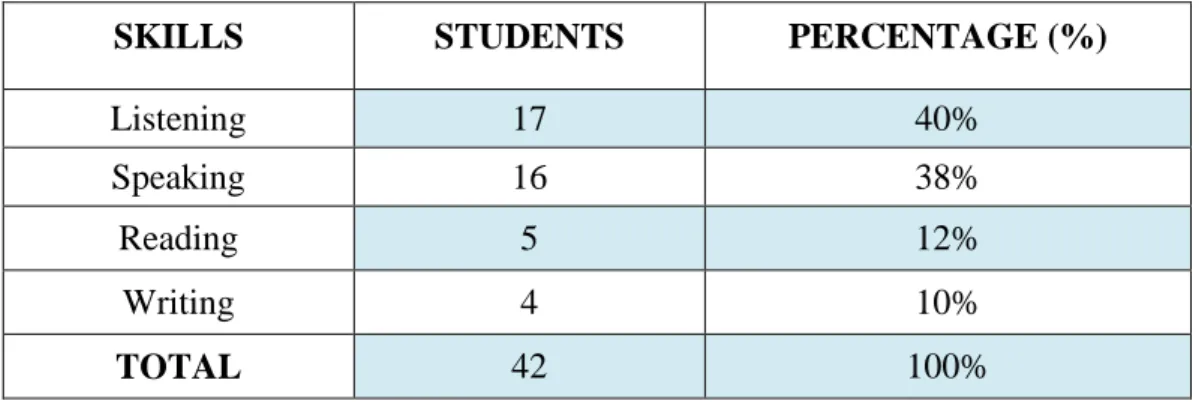
Question 1: Which skill do you think is the most important?
Objective: to identify which skill the students think are most important in English language.
CHART 14: THE IMPORTANCE OF THE LISTENING SKILLS
SKILLS STUDENTS PERCENTAGE (%)
Listening 17 40%
Speaking 16 38%
Reading 5 12%
Writing 4 10%
TOTAL 42 100%
Source: Unidad Educativa “SAN MARCOS” Author: Marjorie Katerine Merejildo Cruz
GRAPHIC 1: THE IMPORTANCE OF THE LISTENING SKILLS
Source: Unidad Educativa “SAN MARCOS” Author: Marjorie Katerine Merejildo Cruz
Analysis: In this question 20 students said that the most important skill is listening and it represents the 48% of this course.
Interpretation: It is clear that the students know that they must focus their learning of a language in the listening activities because they are essential in the
development of the other skill.
40%
38% 12%
10%
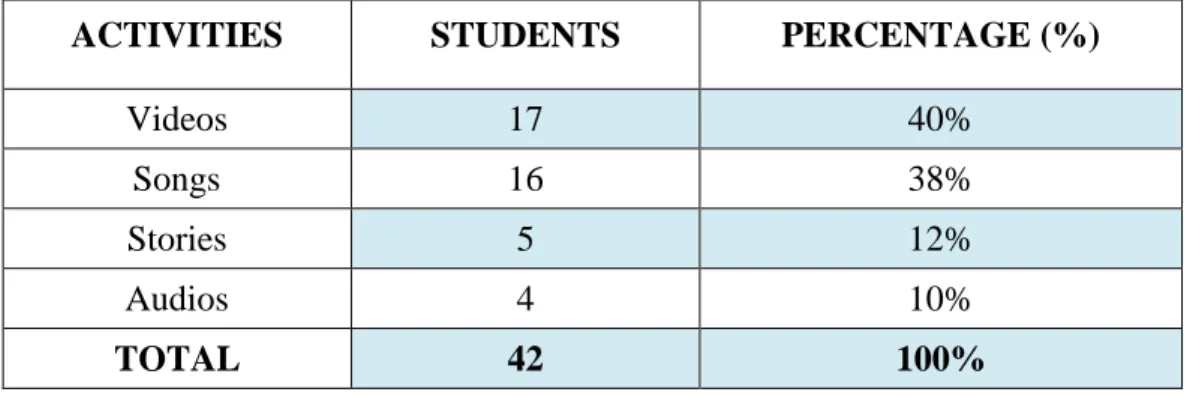
Question 2: What listening activities do you prefer doing at class?
Objective: To determine the importance of different activities in the English learning.
CHART 15: IMPORTANT ACTIVITIES IN CLASS
ACTIVITIES STUDENTS PERCENTAGE (%)
Videos 17 40%
Songs 16 38%
Stories 5 12%
Audios 4 10%
TOTAL 42 100%
Source: Unidad Educativa “SAN MARCOS” Author: Marjorie Katerine Merejildo Cruz
GRAPHIC 2: IMPORTANT ACTIVITIES IN CLASS
Source: Unidad Educativa “SAN MARCOS” Author: Marjorie Katerine Merejildo Cruz
Analysis: In this question 17 students said that they like to watch as listening activity and 16 students like to listen songs it means that the 78% of students
prefer this kind of listening activities but everybody like any kind of listening
activities.
Interpretation: it is outstanding to realize that everybody likes listening activities and they see that is an entertaining activity.
40% 38%
10%
Videos
Questions 3: Would you like to know the pronunciation and the meaning from the words in the videos, song and audio?
Objective: To determine the pronunciation of the each word in this speech
CHART 16: PRONUNCIATION AND MEANING OF THE WORDS IN VIDEOS, SONGS AND AUDIO FILES
OPTIONS STUDENTS PERCENTAGE (%)
Yes 38 90%
No 4 10%
Total 42 100%
Source: Unidad Educativa “SAN MARCOS” Author: Marjorie Katerine Merejildo Cruz
GRAPHIC 3: PRONUNCIATION AND MEANING OF THE WORDS IN VIDEOS, SONGS AND AUDIO FILES
Source: Unidad Educativa “SAN MARCOS” Author: Marjorie Katerine Merejildo Cruz
Analysis: 90% are really eager to understand the meaning of the audio files. They really want to understand what are in the lyrics or transcripts.
Interpretation: : In this question it is amazing to see that almost all the students are interested in knowing what the words in their songs, videos or
audio files mean.
90% 10%
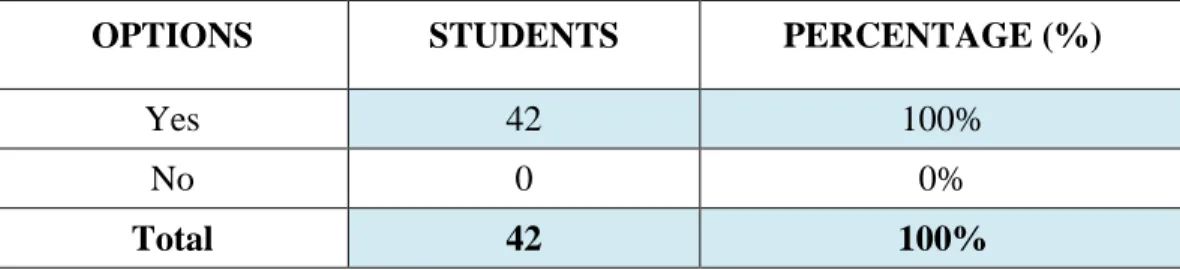
Questions 4: Would you like to make compositions both in written and spoken way?
Objective: Determine how make the composition and spoken correct way.
CHART 17: ORAL AND WRITTEN COMPOSITIONS
OPTIONS STUDENTS PERCENTAGE (%)
Yes 42 100%
No 0 0%
Total 42 100%
Source: Unidad Educativa “SAN MARCOS” Author: Marjorie Katerine Merejildo Cruz
GRAPHIC 4: ORAL AND WRITTEN COMPOSITIONS
Source: Unidad Educativa “SAN MARCOS” Author: Marjorie Katerine Merejildo Cruz
Analysis: 100% of the students want to create their own compositions in written and later listen to them.
Interpretation: In this question, it is clearly understandable that students are motivated to learn the language by creating their own composition.
100% 0%
Questions 5: Would you like to have a didactic unit planned with audio files that you can read and listen to them?
Objective: To determine would you like using the audio file in the listening.
CHART 18: DIDACTIC UNITS WITH AUDIO FILES
OPTIONS STUDENTS PERCENTAGE (%)
Yes 37 88%
No 5 12%
Total 42 100%
Source: Unidad Educativa “SAN MARCOS” Author: Marjorie Katerine Merejildo Cruz
GRAPHIC 5: DIDACTIC UNITS WITH AUDIO FILES
Source: Unidad Educativa “SAN MARCOS” Author: Marjorie Katerine Merejildo Cruz
Analysis: 88% of this class of 42 students wants to really to know how to study with these audio files. 12% are not interested in the development of a didactic
unit using audio files.
Interpretation: the students want to risk the challenge of working with a unit by using audio files to read and t listen them.
88% 12%