1 (Title)
CORPORATE SOCIAL RESPONSIBILITY IN THE MEDIA:
A CONTENT ANALYSIS OF BUSINESS NEWS IN SPAIN
(Running head)
CSR IN THE MEDIA: CONTENT ANALYSIS IN SPAIN
Abstract
The paper presents the findings of a theoretically driven content analysis of the coverage of corporate social responsibility by Expansión, the leading Spanish business journal, in a one-year time frame. The goal of the paper is to help companies understand how they can take advantage of media coverage of CSR by identifying the major stakeholder groups and CSR issues discussed in business news, the positive/negative/mixed tone of the coverage, and the differences that exist in media CSR discourse depending on the industry under scrutiny. The findings are explained under the salience framework of stakeholder theory.
Keywords: corporate social responsibility, stakeholders, media, news, Spain, content analysis
2 1. Introduction
Scholars have argued that the disclosure of corporate social responsibility (CSR) information is part of the dialogue between an ethical company and its stakeholders that helps legitimise corporate behaviour and thus contributes to generating a positive corporate reputation (Michelon, 2011). Based on this idea, over the past years the amount of CSR information provided by companies has grown rapidly (Tench et al., 2007). For example, it has been estimated that more than 80 per cent of Fortune 500 companies include CSR reports on their websites as a way of informing their stakeholders of their CSR commitment and influencing their public image (Lii & Lee, 2012). At the same time, researchers have also frequently explored the CSR discourse used by companies in their own texts, such as their CSR reports, to understand the strategies they use to achieve legitimation (Gill et al., 2008).
However, it is not only the self-presentation of companies that is important in building corporate reputation. Practitioners claim that media also have a significant influence on public opinion in the context of CSR (Carroll & McCombs, 2003). More specifically, an agenda-setting effect of media on the public exists, which suggests that media have a specific ability to influence the salience of CSR issues and their image among the public (McCombs & Reynolds, 2002; Tang, 2012; Zhang & Swanson, 2006).
Nevertheless, media’s CSR discourse has scarcely been analysed in previous literature (Tang, 2012; Tench et al., 2007; Zhang & Swanson, 2006). The agenda-setting role of news media has been much more frequently used to document how media coverage of political issues and candidates influences which issues and candidates the public thinks are the most important (Carroll & McCombs, 2003). In contrast, little is known about which are trending CSR issues, which stakeholders are most frequently addressed in business news, or whether media coverage of CSR is more positively or negatively
3 oriented. Many PR professionals do not know exactly what media’s views, opinions and interests are with respect to CSR (Tench et al., 2007). Actually, there has traditionally been journalistic hostility towards public relations, which is puzzling since journalists depend on PR practitioners for information (Macnamara, 2014). However, for years, journalists have charged that “PR practitioners are unethical, manipulative, one-sided, and deceptive. They also complain that PR practitioners serve special interests rather than the public” (DeLorme & Fedler, 2003, p.99). Thus, PR executives in particular, and companies in general, are unsure as to the ways and means by which they can best engage with media organisations about CSR (Jones et al., 2009).
In this context, a systematic study of the content of media coverage of CSR can potentially facilitate researchers’ and practitioners’ understanding of the CSR media discourse, which will allow companies to take advantage of this knowledge and adapt their CSR strategies accordingly (Tang, 2012). Based on this idea, this paper seeks to examine how business media report CSR and analyse the news context in which CSR is embedded. To do so, the authors present the findings of a theoretically driven content analysis of 265 CSR articles published in 2015 in Expansión, the main Spanish business journal. The goal of this content analysis is to understand: (1) the major stakeholder groups that are discussed in media coverage of CSR; (2) the major CSR issues covered in the articles; (3) the general tone (positive, negative or mixed) of the coverage; and (4) the differences that exist in the coverage of CSR depending on the industry under scrutiny.
The remainder of the paper is structured as follows. Firstly, the authors review the existing literature on media’s discourse of CSR, which leads to the proposal of four research questions that are explored in the paper. Secondly, the method is described by paying special attention to the research design, the content analysis procedure and the sample of news used in the study. Thirdly, the findings of the analysis are presented and discussed.
4 Finally, the authors summarise the most relevant contributions, managerial implications, limitations and future lines of research derived from the study.
2. Literature review
2.1. Agenda-setting effects of business news
Media play a critical role for companies because it is primarily news media that eventually help companies’ CSR goal to materialise, this being to influence their reputation significantly and positively (Zhang & Swanson, 2006). For example, by not covering negative corporate news or by describing such events in a more positive light, editors and journalists can limit the damage caused by corporate scandals. At the same time, if editors are more likely to report on negative events occurring in companies, managers face an interesting challenge because this news can cause severe damage to companies’ record on CSR performance (Luo et al., 2012).
The specific ability to influence the salience of CSR issues and the public agenda concerning this topic has come to be called the agenda-setting role of news media (McCombs & Reynolds, 2002). The core proposition of agenda-setting theory is that the prominence of elements in the news influences the prominence of those elements among the public—that is, the salience of elements on the news agenda influences their salience on the public agenda (Carroll & McCombs, 2003). This process of influence begins with the agenda of an ‘object’ (the thing that we have an opinion about) receiving prominent attention in the news media. For all news media, repeated attention to an object day after day is the most powerful message of all about its salience. The public uses these salience cues from the media to reorganise its own agenda or to decide which issues, people or other objects are most important. Establishing this first salience of objects among the public is called first-level agenda-setting. In media coverage of CSR, the major
5 stakeholders discussed in the news are the most frequent objects under scrutiny (Tang, 2012).
In a second phase in the influence process, named second-level agenda-setting, the salience of the attributes of those objects on the media agenda influences the salience of the attributes on the public agenda. In this process, media tell their audience how to make sense of the object by selectively highlighting certain attributes and downplaying others (McCombs & Ghanem, 2001). “At the first level, agenda-setting effects are on attention. At the second level, setting effects are on comprehension. These attribute agenda-setting effects on public comprehension can be described in terms of two dimensions: substantive and evaluative (or, cognitive and affective, if you will)” (Carroll & McCombs, 2003, p.38).
‘Substantive attributes’ refers to the several characteristics or facets of the object that are interesting to the public and discussed in the news when media cover the object. For instance, Carroll and McCombs (2003) use the example of corporate reputation to explain how scholars frequently identify six key attributes of this object (Fombrun et al., 2000): financial performance, product quality, employee treatment, community involvement, environmental performance and organisational issues. When exploring CSR news, the substantive attributes of stakeholder relationships are all the major CSR issues that the media cover (Tang, 2012). Some of these CSR issues include environmental performance, economic, cultural and educational contribution to local communities, product quality, health and safety, shareholder rights, job creation and stability, employees’ training and development, or compliance with local laws and regulations, among others (Fombrun et al., 2000).
Additionally, the evaluative dimension of media’s attribute agenda refers to media favourability, which can be arranged along an affective dimension, typically defined as
6 positive, negative and neutral/mixed. This evaluative dimension in second-level agenda-setting recognises that news coverage conveys more than just facts: it also conveys feelings and tone (Carroll & McCombs, 2003). Deephouse et al. (2001) refer to these assessments as favourable, unfavourable and neutral. Favourable indicates that a company is praised for its actions or that the company is associated with activities that should raise its reputation. An unfavourable rating identifies that a company is criticised for its actions or is associated with actions that should decrease its reputation. A neutral or mixed rating identifies a story that is the declarative reporting of role performance without evaluative modifiers, or a story that includes both favourable and unfavourable connotations.
Researchers have provided empirical evidence of the validity of the agenda-setting theory through field studies and laboratory experiments. For example, Brosius and Kepplinger (1990) demonstrated that the issue of energy shortages had traditionally had little salience in news or the public agenda in Germany. However, a rapid rise in the coverage of this news by the media at the end of the 1980s resulted in a major shift in the public agenda, and society’s concern for this issue increased significantly. Subsequently, the proportion of the public concerned about the issue declined when the news coverage declined. Similar findings are reported by Wang (2000) and Tang (2012).
2.2. Research questions
Media’s agenda-setting effects are based on several assumptions that lead to the proposal of the four research questions discussed in this section.
The first assumption of the theory is that the more an issue (i.e. object) is covered in the media, the higher its salience (Tang, 2012). Considering the company as the main object of business news, Carroll and McCombs (2003, p.39) present this idea in the form of the
7 following proposition: “The amount of news coverage that a company receives in the news media is positively related to the public’s awareness of the company”. This idea leads to a similar second assumption that explains how “the amount of news coverage devoted to particular (substantive) attributes of a company is positively related to the proportion of the public who define the company by those attributes” (Carroll & McCombs, 2003, p.40). When analysing the context of CSR, these assumptions suggest that exploring the CSR objects and the substantive attributes that define them are the first goals that researchers and practitioners should pursue to understand how agenda setting might be affecting the reputation of companies among the public.
As previously explained in this paper, stakeholders are the objects of agenda setting in the context of CSR. Thus, identification and analysis of the coverage given by media to these stakeholders is the first-level agenda-setting goal of the paper. The stakeholders given more coverage in the news are likely to be considered more important by the public, while those stakeholders receiving less attention in the media tend to be relegated to secondary status (Moon & Hyun, 2009). Additionally, second-level agenda-setting media coverage of different CSR issues will also have an impact on the importance the public accords to these CSR issues (Tang, 2012). This leads to the first two research questions of the study:
RQ1: Who are the major stakeholders discussed in the Spanish business news that cover CSR issues?
RQ2: What are the major CSR issues covered in Spanish business news?
A third relevant assumption of the agenda-setting theory explores the tone of business news—that is, the evaluative attributes in second-level agenda-setting. As presented by Carroll and McCombs (2003, p.41), it is believed that “the more positive that media
8 coverage is for a particular attribute, the more positively will members of the public perceive that attribute. Conversely, the more negative that media coverage is for a particular attribute, the more negatively will members of the public perceive that attribute”. In a similar way, the fourth and last assumption of the theory highlights that “the agenda of substantive and affective attributes associated with a firm in business news coverage, especially those attributes specifically linked with a firm, primes the public’s attitude and opinion about the firm” (Carroll & McCombs, 2003, p.42). In the context of CSR, numerous scholars, such as Wang (2007) or Tang (2012), have defended this idea and find that the tone of a news report about a company’s CSR performance influences the public’s positive or negative judgement of that specific company. In addition, scholars have highlighted that managing the public relations role of CSR communication is one of the most challenging tasks for companies because media tend to hold a negative and often antagonistic attitude towards it, resulting in tensions between public relations practitioners and journalists. It is even suggested that a harmonious relationship between public relations and media may never be achieved (Zhang & Swanson, 2006). Based on these ideas, a third research question is proposed:
RQ3: What is the tone of the coverage of CSR issues in Spanish business news?
Even though the original agenda-setting theory does not explore the role of additional corporate characteristics in determining agenda-setting effects, in this paper the authors argue that some of these features could have significant impacts on how the media approach CSR news and thus on how the public agenda for CSR issues is built. For example, some scholars have defended that a strong record of CSR performance might increase the likelihood of a company being targeted for media coverage (Luo et al., 2012). Extrapolating this example to the industry level, in this paper the authors argue that the overall reputation of industries in the context of CSR will also determine how the media
9 understand CSR issues and how they decide to inform about them, which will result in significant differences in the coverage of CSR depending on the industry under scrutiny.
For instance, scholars have demonstrated that industry membership affects the amount of CSR reporting provided by companies, especially when comparing high and low profile industries (Gamerschlag et al., 2011). As opposed to low-profile industries, high profile industries are those with consumer visibility, a high level of political risk or concentrated intense competition (Roberts, 1992). High profile companies suffer from intense stakeholder pressures to behave ethically and in accordance with CSR principles (Ghazali, 2007). Thus, they have greater incentive to project positive CSR performance through their CSR reporting to stakeholders. This being so, then companies in high profile industries may also be subject to greater media attention than low profile industries because their behaviour is more sensitive to their stakeholder groups, and thus their CSR becomes a trending topic for news coverage. Although classifications are to an extent subjective and ad hoc, most scholars identify basic industries (e.g. petroleum, chemical, and forest and paper companies) as high profile industries (Reverte, 2009). The finance industry can also be considered a high profile industry because it has recently attracted great media coverage due to the international economic recession that has particularly threatened it (Pérez et al., 2015). This circumstance has generated new forms of coercive pressure in exchange for continued legitimacy and it has caused finance companies to increase their intensity of CSR reporting to stakeholders, which has also led to the improvement of their reputation for CSR. Based on these ideas, the last research question of the paper reads as follows:
RQ4: Are there differences in the coverage of CSR in Spanish business news depending on the industry under scrutiny?
10 This study examines the content of Expansión, the leading business newspaper in Spain, based on its audience and diffusion volumes (OJD, 2016), to assess its journalistic discourse on CSR in 2015. Media coverage of CSR from 1 January to 31 December 2015 was identified by searching the online database of the journal using a list of keywords based on the proposal by Pérez et al. (2015). In order to narrow the search, only CSR news related to companies listed on the Spanish Stock Market were collected. Pérez et al. (2015) use Fombrun et al.’s (2000) categorisation of stakeholders to classify CSR in eight groups: (1) community; (2) customers; (3) shareholders; (4) employees; (5) regulators; (6) partners; (7) activists and (8) media. For the purpose of the present study, two new categories were included in the classification to complete the full range of stakeholders identified in the selection of CSR news: (9) corporate governance and (10) multiple stakeholders. Corporate governance was related to news that discussed the structure and the relationships that determine corporate direction and performance (e.g. news that explained changes in the board of directors or news that described the relationship of this board to other primary stakeholders, typically shareholders and management). When talking about multiple stakeholders, the authors meant that the article under scrutiny discussed how CSR issues affected more than one stakeholder group.
The authors also searched for additional keywords related to the major CSR issues that could be discussed in business news. CSR issues, too, were taken from the paper by Pérez et al. (2015). These CSR issues included economic development programmes, environmental policy, systems and performance, educational and cultural contribution, or social and charitable contribution, among others. The complete list of CSR issues explored in the study is presented in Table 1. At the end of the selection process, 359 articles were found. However, some of them referred to the same CSR story but on
11 different dates throughout the year. In these cases, the authors retained only the first article, accounting for a final sample of 265 articles.
After selection of the articles, a content analysis was implemented following the procedure suggested by Bravo et al. (2012). For this task, the authors contacted and trained two independent judges to explore the information discussed in the articles. The independent judges were research fellows hired ad hoc for the study. A training and supervision system for these judges was also established. To this end, after the authors had explained the purposes of the research to the judges, an initial examination of some of the CSR articles was performed by the judges and the authors independently. Afterwards, a meeting was scheduled in order to discuss the most relevant incidents and obtain consensus in the analysis criteria. Subsequently, regular meetings were arranged to discuss new incidents and refine the criteria. Specifically, each piece of news was analysed by the two judges independently and the inter-judge agreement coefficients for the analysed CSR objects and attributes were calculated. The purpose of this estimation was to achieve a sufficient coefficient of concordance to ensure that the empirical study was rigorous. The coefficients of concordance in the objects and attributes analysed were in all cases higher than 80 per cent, acceptable for this type of method and similar to previous literature (Tang, 2012).
The unit of analysis was each individual article on CSR found in the journal. Each article in the sample was coded for the following variables: (1) company; (2) industry; (3) stakeholder group; (4) CSR issue; and (5) tone of the discussion. Similar to Pérez et al. (2015), each article was assigned to a company and one of the following industries: (1) basic; (2) energy; (3) goods; (4) finance; or (5) services (Table 1). The tone of the discussion was coded into positive, negative or mixed. Positive was defined as articles reflecting cohesion, co-operation, stability and strength. Negative news reflected
12 conflicts, disorganisation, instability and weakness. Mixed results reflected both positive and negative sides of a specific CSR issue (Zhang & Swanson, 2006).
Insert Table 1 about here
4. Findings
4.1. Characterisation of news, companies and industries
The 265 articles identified for the study related to 47 companies distributed in the following industries: basic (n=42, 15.8%, 15 companies); energy (n=59, 22.3%, eight companies); goods (n=9, 3.4%, seven companies); finance (n=110, 41.6%, eight companies); and services (n=45, 17.0%, nine companies). Banks were among the companies that attracted more media attention. For example, 25 articles (9.4%) focused on the CSR of Bankia. Santander (n=24, 9.1%), Caixabank (n=22, 8.3%) and BBVA (n=21, 7.9%) were also trending companies in media coverage of CSR. Only two other non-financial companies attracted as much media attention as banks: Iberdrola from the energy industry (n=22, 8.3%) and Telefónica from the services industry (n=21, 7.9%). Thus, the findings show that finance was the most visible industry in the Spanish media’s coverage of CSR, which is explained by the high profile of this industry in the country, derived from its high involvement in the latest international recession (Pérez et al., 2015).
Other industries, such as energy and basic industries, are also high profile and have traditionally received great media and public attention. Accordingly, they have also been frequently targeted by the media (Pérez et al., 2015). At the same time, the findings can also be explained by the large size of the six companies discussed here. As ranked by the Spanish regulator of the stock market, Santander, Telefónica, BBVA, Iberdrola, Caixabank and Bankia are in the top 20 largest companies in the Spanish stock market according to their capitalisation (BME, 2015).
13 4.2. Stakeholder groups
Concerning RQ1, the findings presented in Table 2 show that community was the most visible stakeholder in media coverage of CSR (n=70, 26.4%), followed by customers (n=63, 23.8%), shareholders (n=54, 20.4%) and employees (n=44, 16.6%). Regulators (n=14, 5.3%), partners (n=9, 3.4%), corporate governance (n=9, 3.4%) and multiple stakeholders (n=2, 0.8%) were less frequently discussed in Spanish business news. CSR issues concerning activists and the media were not covered. The findings are mostly in accordance with previous literature. For example, when exploring stakeholder salience in China’s news coverage of CSR, Tang (2012) observes that community was the stakeholder most often mentioned by the media (n=195, 48%), followed by employees (n=105, 25.9%), customers (n=86, 21.2%) and shareholders (n=10, 2.5%). Thus, it seems that consensus exists in international media to define CSR as companies’ responsibilities towards these four stakeholder groups, which are identified as the most relevant in the CSR realm.
Insert Table 2 about here
As for the reason for these stakeholder groups being especially visible in media coverage of CSR, previous scholars have arrived at justifications mostly derived from stakeholder theory (Freeman, 1984). According to this theoretical framework, the salience of stakeholders is dependent on three key attributes: power, legitimacy and urgency (Mitchell et al., 1997). The power of a stakeholder group is a function of the stakeholders’ degree of control over the resources required by a company and how critical these resources are to its continued viability (Elijido-Ten et al., 2010). Legitimacy exists when the stakeholders’ demands conform to the norms, values and beliefs of the wider community (Mitchell et al., 1997). Urgency in the company-stakeholder relationship
14 occurs when stakeholders want their wishes to be fulfilled quickly because their demands are time sensitive and important (Thorne et al., 2003).
For example, the Great Recession of 2007–2008 evidenced the severity of social problems in Spain, such as the solvency concerns of the social security system or the inequality of income distribution due to tax and corporate policies (Valle, 2015). Thus, there has for many years been great social pressure on the national government and public and private companies to address the economic and social consequences of the recession for the community. This fact gives power, legitimacy and urgency to this stakeholder group and justifies the special attention given by media to CSR issues such as corporate investments in economic development programmes or charitable contributions, among others. Additionally, the power-dependence relationship between customers and companies has traditionally fallen in the “stakeholder power” category because companies are highly dependent on this stakeholder group due to its ability to threaten the company’s existence in terms of lost business and cash flows (Elijido-Ten et al., 2010). Similarly, in periods of low profitability and in situations of high debt, the economic demands of shareholders usually take priority over the social demands of other stakeholder groups (Ullmann, 1985). For example, most of the measures and new laws that have been implemented by the Spanish government since the recession are orientated towards improving the exercise of informative transparency to boost shareholders’ confidence in different industries and heal the main weaknesses of companies, namely funding issues (Carballo, 2011).
Finally, the Spanish unemployment rate is currently at approximately 23 per cent. As a consequence of the Great Recession, millions of Spanish employees have been laid off, while contracts among those who have held onto their jobs have become more precarious and many have experienced cuts in hours worked, wages and other benefits as companies
15 seek to reduce labour costs in order to remain afloat. Thus, employees’ claims are also very legitimate and urgent in Spain, and the power of this stakeholder group is restored being gradually through unions and collective negotiation.
4.3. CSR issues
As far as RQ2 is concerned, Table 2 shows that the most visible CSR issues in Spain were shareholder rights (n=48, 18.1%), job creation and stability (n=27, 10.2%), economic development programmes (n=24, 9.1%) and the development of products to meet the special needs of the disadvantaged (n=19, 7.2%). Not surprisingly, the salience of community, customers, shareholders and employees in the Spanish context after the latest international recession led to many pieces of news concerning these stakeholders becoming trending topics in the media coverage of CSR. For example, CSR issues such as job creation and stability (employee issues), economic development programmes (community issue) and the development of products to meet the special needs of the disadvantaged (customer issue) concerned some of the toughest social consequences of the latest recession, addressing unemployment and loss of economic power by businesses and individual consumers. The relevance of shareholder rights for the media is also explained by the fact that only items of business news were explored in the study and the main readers of this news are always shareholders and investors, for whom articles on this CSR issue are especially attractive.
While some of these findings align with previous results in academic literature, the analysis has also revealed some specificities of the Spanish media’s coverage of CSR issues. For example, Tang (2012) identified that providing job opportunities was emphasised by the Chinese media as companies’ most salient responsibility to employees. However, customer concerns focused on product quality and safety almost exclusively, while community concerns were related to primary and secondary education, disaster
16 relief, or health and disability, among others. These differences could be justified by the different stage of economic, social and cultural development usually associated with western and eastern countries, which differentiates the salience of CSR issues in media coverage of CSR.
Finally, it is also interesting to note that communities, customers and partners were the stakeholder groups where media coverage of CSR issues was more varied. This fact implies that there are many CSR issues that companies can communicate to these stakeholder groups that are of interest to the media, such as environmental policies, educational and cultural contributions, social and charitable contributions, competitive prices and payment conditions, customer service, innovations and accessibility or equal opportunities when establishing alliances. However, there was much more polarity in shareholder and employee issues, which means that not everything is relevant to the media and news frequently focuses on one single CSR issue for each stakeholder group. As previously mentioned, these CSR issues were focused on shareholder rights, job creation and stability.
4.4. Tone of the coverage of CSR
RQ3 was concerned with the tone of the coverage of CSR news by Spanish media. The results presented in Table 2 show that the largest portion of business news discussed CSR issues from a positive perspective (n=194, 73.2%), while negative (n=57, 21.5%) and mixed discussions (n=14, 5.3%) were less frequent. These findings, which are clearly in accordance with previous literature (Tang, 2012; Zhang & Swanson, 2006), demonstrate that Spanish media’s coverage of CSR has adopted a largely celebratory tone, with media praising companies for their commitment to stakeholders more than criticising their CSR performance.
17 The authors also created a contingency table to compare the positive, negative or mixed tone of the coverage of CSR among stakeholder groups (Table 3). Hypothesis tests on contingency tables were based on the chi-squared statistic. Significance in this hypothesis test (p<0.10) means that there is a close relationship between the variables in the rows and the variables in the columns of the table. Non-significance (p>0.10) means that any differences in cell frequencies could be explained by chance. The findings show that there were significant differences in the tone used by media to cover CSR issues that concerned different stakeholder groups (44.14<χ2<81.83, p<0.01). For instance, there were more pieces of positive news concerning community issues (n=68, 97.1%), shareholders (n=49, 90.7%), customers (n=47, 74.6%) and multiple stakeholders (n=2, 100%). In contrast, the media were especially critical of the behaviour of companies towards regulators (n=9, 64.3%) and partners (n=6, 66.7%). Thus, more pieces of negative news were identified in these two CSR domains. These findings are mostly in accordance with previous results reported by Tench et al. (2007). According to these scholars, journalists are very likely to cover some issues more positively than others. These issues include environmental practices, social issues, development of communities, organisations being run in a profitable manner, donations to support groups addressing social causes, philanthropy and charitable giving. Conversely, they are not likely to cover organisations obeying the formal laws and regulations of society. Our findings suggest that when they actually cover such issues, they tend to do so in a negative way.
While the negative coverage of regulator and partner issues might not seem especially harmful for companies because of the small amount of news reported on these stakeholders annually, the tone of the coverage of employee issues is more delicate. Employees enjoyed large media coverage, but the tone of the news was very changeable. Table 3 shows how, for this stakeholder group, positive coverage accounted for 38.6 per
18 cent of the news, while negative news accounted for 36.4 per cent and mixed coverage for 25.0 per cent of the articles explored in the paper.
Insert Table 3 about here
4.5. Comparison among industries
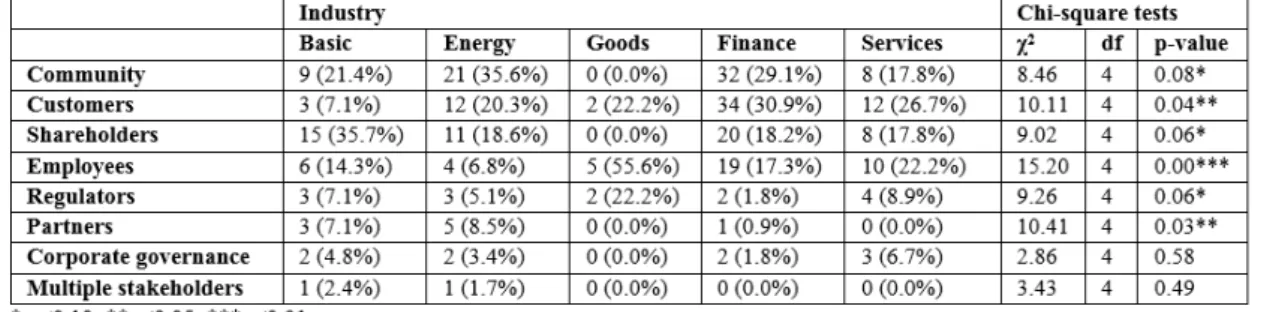
RQ4 aimed to explore the differences that existed in the coverage of CSR depending on the industry under scrutiny in the media. A new contingency analysis comparing stakeholder groups and industries showed that significant differences existed in the coverage of CSR among each of the five industries explored in the paper (Table 4). The findings show that for corporate governance (χ2=2.86, p>0.10) and multiple stakeholders (χ2=3.43, p>0.10), the association between stakeholders and industries was not significant; this was due to the small amount of business news that represented the two stakeholder groups in the analysis.
In contrast, the largest association occurred between employees and industries (χ2=15.20, p<0.01). In this regard, the findings demonstrate that employee issues were especially discussed for goods companies (n=5, 55.6%), followed distantly by service (n=10, 22.2%), finance (n=19, 17.3%), basic (n=6, 14.3%) and energy companies (n=4, 6.8%). To interpret this finding, researchers and practitioners have to understand that companies in the consumer goods industry are the largest and most capital intensive in the economy. Thus, this industry is where most job creation occurs, as it is the most labour intensive. Accordingly, the media can be expected to exhibit greater concern towards employee issues that relate to the goods industry because they may have significantly larger consequences in society.
Significant differences in media coverage of CSR were also observed for customer (χ2=10.11, p<0.05) and partner issues (χ2=10.41, p<0.05). Customer news was the most
19 frequently found for finance (n=34, 30.9%) and service companies (n=12, 26.7%). In this regard, it is well-known that the intangibility, inseparability, heterogeneity and perishability that characterise services frequently cause them to be less standardised and less uniform than tangible goods, and this fact represents significant problems for companies when promoting their products. Thus, it makes sense that CSR issues concerned with customer service, dialogue mechanisms, product quality, innovation or accessibility were much more frequently discussed among service companies than among companies that sell tangible goods. As far as partners are concerned, the findings show that this stakeholder group was most frequently discussed in the energy (n=5, 8.5%) and basic industries (n=3, 7.1%). Companies in the energy and basic industries have frequently operated in oligopolistic markets, which gives them a great deal of discretion to operate within the parameters of the law. Thus, any concern related to equal opportunities when establishing alliances with partners, or news concerning the policies implemented by these companies to pay competitive market prices, was especially relevant in these industries and became a trending topic for the media.
Relatively insignificant differences existed for community (χ2=8.46, p<0.10), shareholder (χ2=9.02, p<0.10) and regulator issues (χ2=9.26, p<0.10), although they were still significant at a 90 per cent confidence level. The coverage of community issues was higher among energy companies (n=21, 35.6%), followed by finance (n=32, 29.1%), basic (n=9, 21.4%), service (n=8, 17.8%) and goods companies (n=0, 0.0%). Previous scholars have demonstrated that companies from industries whose manufacturing process has a negative influence on the environment, such as the basic and energy industries, disclose and report considerably more environmental and social information than companies from other industries (Reverte, 2009). The findings of the present paper demonstrate that the salience of community issues in these industries was also transferred
20 to media coverage of CSR. Similarly, shareholders were among the most frequently discussed stakeholders for companies in basic industries (n=15, 35.7%), while regulators were more relevant among companies in the goods industry.
Insert Table 4 about here
The last contingency analysis implemented in the study compared the tone of the coverage of CSR in the five industries (Table 5). Once again, the findings show that significant differences existed. The highest percentages of positive news were registered in the two industries with more media visibility: energy (n=51, 86.4%) and finance (n=86, 78.2%). These findings suggest that companies in these two industries were managing their relationship with the media very well, enhancing their public relations (PR) strategies and reducing the tensions that have traditionally existed between media representatives and PR practitioners (Zhang & Swanson, 2006). In contrast, negative news was concentrated in the service (n=16, 35.6%) and basic industries (n=14, 33.3%), which is explained by several records of employment regulation that some companies in the two industries opened in 2015 and that threatened the job stability and social benefits of large numbers of employees. The goods industry showed more balanced percentages among positive (n=5, 55.6%), negative (n=2, 22.2%) and mixed articles (n=2, 22.2%). Finally, there were not notable differences in the mixed tone of news among industries because of the small quantity of mixed news that was found in the study.
Insert Table 5 about here
5. Conclusions, limitations and future lines of research
The most relevant findings of this paper show that community, customers, shareholders and employees are the four most salient stakeholder groups for the media. Thus, the CSR issues most frequently discussed in business news relate to these stakeholders, including
21 shareholders’ rights, job creation and stability, economic development programmes and the development of products to meet the needs of disadvantaged customers. At the same time, the tone of the coverage of CSR is mostly positive, although there are substantial differences among the basic, energy, goods, finance and service industries. For example, the media cover the CSR issues of energy and finance companies with an optimistic tone, while they are more critical of the service and basic industries. There are also significant differences among these industries in terms of the stakeholder groups that most frequently attract media attention in the CSR context. Some examples include employee issues, being of special relevance in media coverage of goods companies, customer issues in the coverage of finance and service companies, or community issues for companies in the energy industry. As previously discussed in the paper, most of these findings can be explained with arguments taken from the salience framework of stakeholder theory, which defends that the salience of a stakeholder group depends directly on its power, legitimacy and urgency (Freeman, 1984; Mitchell et al., 1997).
These findings have significant implications for the management and communication of CSR by companies. Firstly, companies have to understand the media as an ally in the promotion of their CSR, because most of their coverage is of a positive nature. Thus, companies need to enhance their relationship with media organisations as much as possible to improve their visibility and reputation more easily, thanks to the power achieved by the media through first- and second-level agenda-setting processes. If adequately managed, PR practices are good ways to improve company-media interactions (Zhang & Swanson, 2006). Nevertheless, the findings also suggest that many CSR issues do not become trending topics for media unless they have negative consequences for one or a number of stakeholders. Tench et al. (2007) find that although journalists demonstrate the likelihood of covering CSR in a positive manner, the stories they most frequently
22 cover are described from a negative angle in 32 per cent of cases, and are around the corporate social irresponsibility theme. These findings demonstrate that journalists will always cover irresponsible actions even when they have a latent willingness to cover more positive or optimistic angles on CSR. Thus, companies should always be alert to detecting hot CSR issues and avoid controversial news that could be covered with a negative tone by the media. In fact, this concern is especially relevant in the case of employee issues. The tone of the coverage of this stakeholder group is very changeable. Thus, companies should take special care of this sphere of their CSR because (1) employees are currently one of the most salient stakeholders in Spain, and (2) job creation and stability are the main CSR issue in media concerning employees.
Secondly—and there even seems to be international consensus concerning the most salient stakeholders in the CSR context—international and industrial differences are observed in the salience of specific CSR issues. This finding suggests that CSR is clearly contextual in nature and companies should be aware of this fact and pay particular attention to the diverse CSR issues that become trending topics in the different countries and the specific industry wherein they operate. For example, in Spain, the most attractive CSR issues for media relate to how companies are dealing with the harshest consequences of the latest economic recession. This being so, companies should identify the issues that have a more positive impact on society after the recession, because the media are always seeking to provide relevant information for their readers, which always happens by providing information on the consequences that corporate actions have on those issues that affect them personally.
Thirdly, the findings have also highlighted that there is a substantial difference between the normative and instrumental perspectives of CSR (McWilliams & Siegel, 2001). More precisely, while the normative approach to CSR refers to many issues that companies
23 should necessarily manage to be considered socially responsible, only a few of these CSR issues are relevant to the media. Thus, if companies want to use CSR from a more instrumental perspective to take greater advantage in terms of media visibility, reputation, etc., then they have to adopt a focused strategy oriented only to the issues that are more frequently reported in business news. This is especially significant in the case of employees’ CSR concerns, where issues such as social benefits, equal opportunities, training and development, or collective bargaining are very important from a normative perspective but are barely visible in business news. Thus, the strategic approach to CSR adopted by companies will determine whether they adopt a broad or narrow CSR reporting perspective.
Finally, this study is not without limitations, and future research should consider them to improve the knowledge on CSR and the media. In this regard, this study takes only a snapshot view of the media’s stance on CSR in Spain because it examines only the content of a specialist business newspaper in the country. Therefore, the findings may not represent the full spectrum of CSR issues covered in Spanish media, as there are other types of general newspaper that also cover CSR issues (general vs. specialist newspapers). In addition to this, the study was concerned only with Spanish news, which limits the generalisability of the results to other research contexts. Also, the study only covers articles published within a time frame of one year. This fact represents a relevant limitation of the study because it means that the findings are likely to be influenced by the specific economic, social or political situation of the country in the year of analysis. Based on these limitations, future researchers should propose analyses that include a broader spectrum of media, countries and time frames that reduce the biases that may be present in this paper.
24 At this point, a reflection on the media’s fulfilment of ethical responsibilities is also necessary. More specifically, there is an important question that remains unexplored in the present paper: can readers be sure that the media are fulfilling their ethical responsibilities when communicating CSR news (Gulyás, 2009; Hou & Reber, 2011)? It is accepted that journalists must strive to present an accurate, well-balanced explanation of the stories they cover: for instance, they have an obligation to present all sides of an issue, to conduct extensive research and to talk to several sources knowledgeable about the subject. If they present only popular opinion, or if they conduct minimal research without fully exploring the subject, they do not give readers the information they need to understand the implications of the event or issue (Wasserman, 2010). Nevertheless, the findings of the present paper do not allow the authors to give an appropriate answer to this question. The content analysis showed a good balance in the number of pieces of news published by Expansión according to stakeholders, CSR issues, industries and tone of coverage, which is good evidence that newspapers are covering a wide variety of news items that fit the multidimensional concept of CSR prevalent today. However, still little is known about how the media arrives at those news items. Thus, future research is needed to explore how the content of CSR news reflects, or does not reflect, the fulfilment of journalistic duties.
6. References
BME (2015). Sociedad de Bolsas. Informe Anual 2015. Bolsas y Mercados Españoles. Available at: http://www.bolsamadrid.es.
Bravo, R., Matute, J., & Pina, J.M. (2012). Corporate social responsibility as a vehicle to reveal the corporate identity: A study focused on the websites of Spanish financial entities. Journal of Business Ethics, 107(2), 129-146.
25 Brosius, H.B., & Kepplinger, H.M. (1990). The agenda-setting function of television news: Static and dynamic views. Communication Research, 17, 183-211.
Carballo, F. (2011). Causes and consequences of the Spanish economic crisis: Why the recovery is taken so long?. Panoeconomicus, 58(3), 309-328.
Carroll, C.E., & McCombs, M. (2003). Agenda-setting effects of business news on the public’s images and opinions about major corporations. Corporate Reputation Review, 6(1), 36-46.
Deephouse, D.L., Carroll, C.E., & McCombs, M.E. (2001). The role of newsroom bias and corporate ownership on the coverage of commercial banks in the daily print media. Paper presented at the 5th International Conference on Corporate Reputation, Identity, and Competititveness, Paris.
DeLorme, D.E., & Fedler, F. (2003). Journalists’ hostility toward public relations: An historical analysis. Public Relations Review, 29(2), 99-124.
Elijido-Ten, E., Kloot, L., & Clarkson, P. (2010). Extending the application of stakeholder influence strategies to environmental disclosures. An exploratory study from a developing country. Accounting, Auditing & Accountability Journal, 23(8), 1032-1059. Fombrun, C.J., Gardberg, N.A., & Sever, J.M. (2000). The reputation quotient: A multi-stakeholder measure of corporate reputation. Journal of Brand Management, 7(4), 241-255.
Freeman, R.E. (1984). Strategic management: A stakeholder approach. Boston, MA: Pittman.
Gamerschlag, R., Möller, K., & Verbeeten, F. (2011). Determinants of voluntary CSR disclosure: Empirical evidence from Germany. Review of Managerial Science, 5, 233-262.
26 Ghazali, N.A.M. (2007). Ownership structure and corporate social responsibility disclosure: Some Malaysian evidence. Corporate Governance, 7(3), 251-256.
Gill, D.L., Dickinson, S.J., & Scharl, A. (2008). Communicating sustainability: A web content analysis of North American, Asian and European firms. Journal of Communication Management, 12(3), 243-262.
Gulyàs, Á. (2009). Corporate social responsibility in the British media industries – Preliminary findings. Media, Culture & Society, 31(4), 657-668.
Hou, J., & Reber, B.H. (2011). Dimensions of disclosures: Corporate social responsibility (CSR) reporting by media companies. Public Relations Review, 37(2), 166-168.
Jones, B.;, Bowd, R., & Tench, R. (2009). Corporate irresponsibility and corporate social responsibility: competing realities. Social Responsibility Journal, 5(3), 300-310.
Lii, Y., & Lee, M. (2012). Doing right leads to doing well: When the type of CSR and reputation interact to affect consumer evaluations of the firm. Journal of Business Ethics, 105(1), 69-81.
Luo, J., Meier, S., & Oberholzer-Gee, F. (2012). No news is good news. CSR strategy and newspaper coverage of negative firm events. Working Paper 12-091. Harvard Business School.
Macnamara, J. (2014). Journalism-PR relations revisited: The good news, the bad news, and insights into tomorrow’s news. Public Relations Review, 40(5), 739-750.
McCombs, M., & Reynolds, A. (2002). News influence on our pictures of the world. In J. Bryant, & D. Zillmann (Eds.), Media effects, 2nd edition (pp. 1-16). Mahwah, NJ: Lawrence Erlbaum Associates.
McWilliams, A., Siegel, D.S., & Wright, P.M. (2006). Corporate social responsibility: Strategic implications. Journal of Management Studies, 43(1), 1-18.
27 Michelon, G. (2011). Sustainability disclosure and reputation: A comparative study. Corporate Reputation Review, 14(2), 79-96.
Mitchell, R.K., Agle, B.R., & Wood, D.J. (1997). Toward a theory of stakeholder identification and salience: Defining the principle of who and what really count. Academy of Management Journal, 22(4), 853-886.
Moon, S.J., & Hyun, K.D. (2009). The salience of stakeholders and their attribute in publication relations and business news. Journal of Mass Media Ethics, 24, 59-75. OJD (2016). Información y Control de Publicaciones (OJD) website. Available at:
http://www.introl.es/.
Pérez, A., García de los Salmones, M.M., & López, C. (2015). Corporate reputation in the Spanish context: An interaction between reporting to stakeholders and industry. Journal of Business Ethics, 129(3), 733-746.
Reverte, C. (2009). Determinants of corporate social responsibility disclosure ratings by Spanish listed firms. Journal of Business Ethics, 88, 351-366.
Roberts, R.W. (1992). Determinants of corporate social responsibility disclosure: An application of stakeholder theory. Accounting, Organizations and Society, 17(6), 595-612.
Tang, L. (2012). Media discourse of corporate social responsibility in China: A content analysis of newspapers. Asian Journal of Communication, 22(3), 270-288.
Tench, R., Bowd, R., & Jones, B. (2007). Perceptions and perspectives: Corporate social Responsibility and the media. Journal of Communication Management, 11(4), 348-370. Thorne, D., Ferrell, O., & Ferrell, C. (2003). Business and society: A strategic approach to corporate citizenship. Boston, MA: Houghton Mifflin Company.
28 Ullmann, A.A. (1985). Data in search of a theory: A critical examination of the relationships among social performance, social disclosure, and economic performance of U.S. firms. Academy of Management Review, 10, 540-557.
Valle, J.M.D. (2015). Post-crisis social rights and social security law in Spain. Spanish Labour Law and Employment Relations Journal, 4(1-2), 55-63.
Wang, T.L. (2000). Agenda-setting online: An experiment testing the effects of hyperlinks in online newspapers. Southwestern Mass Communication Journal, 15(2), 59-70.
Wang, A. (2007). Priming, framing, and position on corporate social responsibility. Journal of Public Relations Research, 19(2), 123-145.
Wasserman, H. (2010). The search for global media ethics. In C. Meyers (Ed.), Journalism ethics: A philosophical approach. New York, NY: Oxford University Press. Zhang, J., & Swanson, D. (2006). Analysis of news media's representation of corporate social responsibility (CSR). Public Relations Quarterly, 51(2), 13-17.
29 Table 1. Industry characterization (based on Pérez et al., 2015)
30 Table 2. Media coverage of CSR in business news
31 Table 3. Comparison of the tone of coverage of CSR among stakeholder groups
Table 4. Comparison of the media coverage of CSR among industries