1
LEARNING ENGLISH WITH A DIDACTIC STRATEGY IN ELEMENTARY SCHOOL
AT GIMNASIO NUEVOS ANDES SCHOOL IN BOGOTA, COLOMBIA
A monograph Presented to
The Program of B.A. in Teaching English as a Foreign Language School of Education
Universidad Nacional Abierta y a Distancia Colombia
In Partial Fulfillment
For the Requirements of the Bachelor in English as a Foreign Language
By
2 ABSTRACT
In a globalized world English has become one of the main tools in communication, at a personal and professional level.
This is why teaching English as a foreign language from a young age/ infancy will be effective for Colombia´s education, however, the strategies used up to now in the different schools that the researcher has been able to work in have been monotonous and they’ve become repetitive, to the point students are demotivated. The goal of this monograph is to give solution to the problem of the lack of didactical strategies implemented in the teaching of English to children. (Miranda & Echeverry, 2010)
This study was made with 3 groups of approximately 12 children from 2 to 10 years old in Bogota between the years 2012-2014, in different private schools with introduction, summer and Saturday classes. This was a qualitative methodology due to its observation and a continuous evaluation of the students’ progressive learning, is to say, the before and after of the used activities, which are included in the books with games and songs adapted by the teachers’ to the age of each child. This generates cognitive, cultural and linguistic benefits for the children.
3
ACKNOWLEDGMENTS
¨In all your ways acknowledge (recognize) Him and He will make your paths straight.¨ (Proverbs 3:6 New simplified Bible)
As I finish one of my main goals since 2011 I want to thank all those who’ve been by my side and have noticed this hard but great process. First of all, I want to thank my creator, my good Heavenly Father as I write this I think of how good you´ve been throughout all these years, You have given me the courage and strength I’ve needed to be able to fulfill one of our dreams I love you and Thank you for all your help and guidance I want to thank Andres Camacho for paying my superior education during all these years, this is also his achievement. I want to thank my mom for reminding me how powerful the GOD that lives in me is and for all the patience she´s had with me. I thanks my sisters and brother for being there for me, especially Lu who helped me when I didn’t understand something. I want to thank my family (Grandparents, Aunts and cousins) for supporting me, for every prayer, for not letting me give up and for always being by my side. Thanks to my auntie, who always prays for me and was always there to cheer me up.
Thanks to those friends who have been next to me through this process, you are all a gift from heaven. Thanks to the different institutions that trusted me and let me work with them. Especially a great school CCA, where I learned so many new things to be a great teacher. Thank you Kandy for all your support and guidance in this process.
I dedicate this achievement to GOD and my family. I dedicate this to the woman who is no longer here, but was always there. How I wish you would be back just to see me achieve this goal, thanks for believing in me and for taking me to a better place. I will forever miss you and thank you for all your love. G-Ma
4
Written Analytical Summary 1. Type of document
Monographe
2. Title of the document
Learning English with didactic strategies in elementary schools in Bogota 3. Author
Jessica Alejandra Camelo Cruz. 4. Key Words
Traditional Education, ESL, Didactic strategies, English, Education, Infancy, Bilingualism, Dynamic strategies.
5. Description
This monograph seeks to answer the current state of the learning process of English in elementary schools.
6. References
The references presented in this document are mostly about guidelines, according to the actual program of the Colombian Education Program, designed to research learning in a dynamic way and the philosophical thoughts and theories that apply to didactic studies. This study reviews and evaluates the methods students are
currently being taught and the results of the various methods. Therefore, this research was focused on bibliographies and that were set up by the Colombian Constitution, using the Ministry of National Education’s Guidelines.
Throughout this document you will find the definition of the keywords as they play a main role in education.
7. Contents
5
Second, it shows the current program that is being taught in the different schools and how this can be improved. It shows what Colombia’s standing in English is compared to other countries.
Third, it shows what a didactic curriculum should have, and how to motivate and guide students so they can enjoy learning a foreign language.
Fourth, it shows how speaking English fluently can open doors of opportunity. Fifth, the methodology that was used to write this monograph.
Seventh, the different content with different data of the learning English process. Finally, some general conclusions and commentaries.
8. Methodology
This research focused on the qualitative observation and evaluations of the students’ progress in English. To write this monograph, the researcher review different methodologies and observed students in different teaching environments in order to write this document. The researcher restudied various teaching theories, to find the best student motivation practices. After evaluating the data, conclusions were drawn in order to make recommendations and guidelines for the elementary school system in Colombia.
9. Conclusions and recommendations
Elementary children respond well to interactive activities that stimulate imagination and creativity. They are willing to try new things and want to have fun with their learning in a safe environment that makes them comfortable to speak. This age group is particularly eager and able to acquire new languages, and the benefits of learning a new language in elementary are numerous.
Because English is the primary language of international business and
6
7
Table de content
Abstract ... 2
Acknowledgements ... 3
Introduction ... 9-10 Justification ... 11-12 Statement of the problem ... 13
Objectives ... 14
General objective ... 14
Specific objectives ... 14
Chapter I ... Theoretical Framework ... 15
Defining Key words ... 15-16 Education in elementary schools in Colombia ... 17-18 Curriculum in elementary schools ... 18-19 Memory and education ... 19
Learning and education ... 20
Games and learning ... 20-21 Multiple intelligences and learning ... 22-23 English in a globalized world, can it affect our children? ... 23-24 Chapter II ... Methodology ... 25-26 Research line ... 27
8
Figure1 PEC ... 29
Figure 2 High school and University English study ... 30
Figure 3 Teacher’s role ... 31
Table1 Comparison between Modern and traditional teaching ... 32-37 Chapter IV ... Discussion ... 38-39 Chapter V ... Conclusion ... 40
References ... References ... 41-46 Appendix ... Appendix 1 ... 47
Appendix 2 ... 47
Appendix 3 ... 48-49 Appendix 4 ... 49-50 Appendix 5 ... 51
Appendix 6 ... 51
Appendix 7 ... 51
Appendix 8 ... 52
Appendix 9 ... 53
9 Introduction
In a globalized world English has become one of the main tools in communication, at a personal and professional level. Over 1 billion people now speak English as a second language. Within Latin America Colombia ranks in the lowest percentile of proficiency in English. In order for Colombia to expand its economic growth and for students to improve their opportunities in the global market it is imperative for Colombia to develop an effective English program for all students. (World economic forum, 2016) Appendix 1: bar graph of Colombia's English level. This is why teaching English as a foreign language from a young age/ infancy will be effective for Colombia's education, however, the strategies used up to now in the different schools have been monotonous and they’ve become repetitive, to the point students are unmotivated. The idea is to be able to evaluate these learning activities and to be able to motivate students to learn the language that opens doors to a new culture, a new life-style and new relations.
The aim of this monograph is to give solutions to the problem of the lack of didactical strategies implemented in the teaching of English to children. The reason for this research is because the researcher had the opportunity to give English classes in different establishments where she was able to change the program and make it fun. This research plans to be able to show the possibilities of a new way of teaching; a didactic, creative and attractive system that appeals to each student in the classroom. The researcher changed and adapted the teaching methods within the classroom and created a dyadic and interactive classroom eliminating the old, monotonous, teaching methods used throughout Colombia. Students enjoyed every moment in class and were able to learn English in a short period of time, which means there are things that our schools can change to make Colombia a bilingual country.
10
was used that included using books with games and songs adapted by the teacher for the age appropriateness of the students. Continuous evaluations of the
student's progress through interviews, class participation and group participation were used to monitor and observe student progress. This generates cognitive, cultural and linguistic benefits for the children.
This monograph starts with different definitions and explanations about what Education is and the didactic methods that can be adapted to the children's needs and the way this can help them improve in a foreign language. Second, it shows the current program that is being taught in the different schools and how this can be improved. It shows what place Colombia occupies in English development compared to other countries. Third, it shows what a didactic curriculum should have and how to motivate and guide students so they can enjoy learning a foreign language. Fourth, it shows the advantages there are to speaking English fluently and all the doors that can be opened through fluency in English. Fifth, the
11 Justification
In Colombia learning English for children in elementary school should be fun and effective. Fun as in engaging, an activity that captures a child’s attentions and motivates them to learn. More and more students are tired of learning English as they feel it is boring and difficult to learn. But, this should not be the reference of learning English in Colombia it should be something that students look forward to and that they enjoy doing. Promoting new learning methods, in which students can be emerged into a language and not simple forced to memorize it for test gives the student more practical tools for his learning process. This means that they should be taken out of the monotonous learning system to which they are used to.
Observing different English classes in different schools, the researcher noticed that each notebook was full of so much information but when students were asked for the meaning of something they were not sure what the correct answer was. That is something that needs improvement, students should not learn anything just for a test but for a better acknowledgement of the language. Students are not supposed to fill in notebooks but they need to learn and deepen in their learning process, this is where didactic methods could improve students learning process.
12
This motivates the teaching and the learning if the material used is the correct one and is used in the correct way, this makes the learning process easier, and it makes the process of learning new vocabulary in a foreign language easier. Using the correct teaching materials and methods will help to motivate the teachers as well as the students. As teachers see their students improve, they themselves become inspired on their teaching ideas. As teachers become more motivated and enthusiastic about their student's learning, this is translated to the students whose acquisition of English will now become much easier and natural.
As an education researcher, it's easy to know children are always willing to learn, with playing activities they gain responsibility, autonomy and respect for the given rules. Given the positive influence of ludic activities, they should be added to the children's learning process. This will make student learn autonomously and teachers will only be guides in the learning process. When they learn through playing, students think over the information that they are saving in their memories, this makes them creators of knowledge and not merely information repeaters.
It is necessary for students to develop a comprehension skill of other languages, from a young age. That is to say, that when they have their bachelor degrees they can be competitive in the working world and that they might have an impact on their community and their country as they have a good knowledge of a foreign language, English. This is why it is so important to document the observations of this research, that less theoretical and more practical ways of teaching English in Elementary Schools, will have a positive impact on Colombian Education.
13
Statement of the problem
In a globalized world is important that our students can have an integral and a good quality education. An education that can provide them a future full of many opportunities and open doors to a better quality of life. So this is why students should be given the possibility of learning English in a fun and didactic way so they can enjoy learning and they can have a good level of English. The idea is that students can learn each skill and improve their English level as the years go by. This is something the Colombian education ministry has tried to improve but haven’t been able to improve. The bilingual problem has a flaw, they need to see the importance of learning a foreign language.
This monograph seeks to answer different questions like: Can children improve their English level through games? How can elementary students be motivated to learn a foreign language? How to make playing part of the English learning process? And how to teach English with didactical methods? These are the main questions that this monograph intends to answer. Therefore, is important to see the flaws that the Colombian education has so this questions can be
14 Objectives
General Objective
• To identify the impact that didactic methods can have in strengthening the learning
of English in children in Elementary School in Colombia.
Specific Objectives
• To create didactic tools that can be useful and easy for the learning process of this foreign language.
• To establish activities that motivate students to develop the different skills in this foreign language.
• To analyze the activities and make sure there adequate for the different group of
15 Chapter 1
Theoretical Framework
For this research, an overall review has been made. This review has been made to be able to diagnose the problem and show different solutions. In order to reach this objective, many terms need to be defined in the education context but also in a global context. Some of these terms are education in elementary school which will show how English is being taught in Colombia. This means reviewing the national rules and guidelines. Also, some terms are to be reviewed as they’re pertinent to this study. So, this review will define concepts related to education and didactics like; speaking and learning, games and learning, motivation and why memory is not a good option.
Defining key words
Traditional Education
As John Dewey stated (1859-1952) “Education is a social process; education is growth; education is not preparation for life but is life itself.” Or as Taylor Gatto (2002) states, “When you take the free will out of education that turns it into schooling.” Education is not to be prepared but something spontaneous that
each student can be welcomed into. The traditional education the teacher is the center of their classroom so it's where teachers talk over and over again and there’s not too much student participation. In this method the teacher is the mode of knowledge and not the facilitator, chalk plays a huge role as it’s a write and copy
16 ESL
As defined by Merriam Webster, ESL (2017) ¨is the teaching of English to people who speak a different language and who live in a country where English is the main language spoken.¨ This abbreviation stand for English as a Second Language, this second language is the first language spoken worldwide this is why Colombian children need to be given the opportunity to speak English as fluently as possible. ESL, is a door opener and a guide to be able to learn about more cultures and even an interest for new languages. ESL, should always be fun, creative and dynamic giving the main role to the students and the teacher can be their guides in this beautiful learning process.
Didactic strategies
A Didactic Strategy is the integration of numerous didactic methods in an Educational Action. This basically states not what is being learned but how it's being learned, how the information is being taught so students can advance in their English learning process. It allows to be able to reach the levels of the taxonomic scale as it is knowledge, understanding, analysis and evaluation. To promote the acquisition of different skills and competences in the communication and
relationships area, which will motivate students to be able to be more open to speak English. For example in the listening, writing, reading and speaking skill. To teach English there are so many methods or strategies that can be used. This is something that can be taught in such a diversified way where teachers can even adapt each class into a different method, once again where students play the main role and feel happy about their learning process in this foreign language. Some
didactical methods are located in the five different strategies which are learning by reading, learning by doing, learning by working, learning by searching and informal
17
Education in elementary schools in Colombia
Dewey states that (2006),¨Education is a process of experience. Because life is growth, education means helping inner growth without being restricted by age. The growth process is the process of adjusting to each phase as well as adding in the development of one's skills.¨ For the Ministry of Education in Colombia, education is ¨ a process of personal, cultural and social permanent learning, based on a comprehensive understanding of the human person, its dignity, and its rights and duties.¨ Mineducación (2017) ¨ Colombia’s education system has made impressive progress over the past two decades, but more needs to be done now to ensure that all children have access to a quality education, according to a new OECD report.¨ OECD (2014). There is a need to improve the quality of the English taught in all the different schools in Colombia.
The laws of bilingualism 115 counts with 9 articles which have been
modified since 1994 and the last modification was in 2013. The 21st article states some ideas that will be listed as follows. First, students should be able to develop correctly the different skills of a foreign language these skills are: speaking, reading comprehension, writing and listening. Second, the total skill development of the already mentioned in a foreign language. Third, the fulfillment of the objectives in the basic education. See Appendix 2 Ed: of the Law 115 of 1994.
18
Many children have answered different surveys to questions like: I like going to school, do I feel satisfied with the relationship I have with my teacher, do I feel satisfied with the way I’m learning, I’m I happy with my grades in school and many more. (A report on the Children’s Worlds survey, 2013-14) Appendix 3: of the different percentages that Colombian children responded to.
To these definitions I add that education should be by practice and not only theory.
Curriculum in elementary schools
In Colombia the English curriculum can be modified depending if it’s a private or public school. The curriculum develops different topics that are
necessary in the learning of English. This topics are basic in which students can develop new vocabulary and be able to show the comprehension they have of the language.
Colombia created a program called ¨Colombia Bilingual¨ and their goal is to increase the learning process of English in the different schools. They have three strategies which are: teachers, materials and monitoring and follow-up. The first one teacher's plans to improve the level of English of the current teacher. Some of the ways they plan to help teacher improve their English level by providing training given by native speakers. The second one which is materials which means that the program provides a kit that is called ¨Colombia Bilingual English Kit¨ which is a kit that plans to help teacher as they prepare their classes. This program is follow-up by the different actors that have been established to check the English learning process. This program is for public schools and it emphasizes mostly in grades 10th through 11th.
19
program from transition all the way through 11th grade. Appendix 4: the curriculums from transition to fifth grade.
Memory and education
There’s two types of memories implicit and explicit. One which can be good for the process of students learning English and one that will be ephemeral. The one that was observed and identified with students notebooks full of information but not knowing what they were really writing, just memorizing for a test is the ephemeral one the explicit one. Hefferline (1964) So, memory is not bad it just need to be used in an implicit way where students use memory to learn and not just to have an A in their evaluations. It’s the type of memory in which through the practice students can truly learn what is being taught. In Colombia’s education system there’s a lot of explicit learning in which students memorize to be able to pass their evaluations. Therefore education needs a clearance in the memory process in which students can learn and be able to use their memory process for more than just a grade, but to remember in the future.
Education and learning
20
Learning on the other side is the active part and this role need to be taken by the students. Students in Colombia need to be known for their empowerment in the learning of English. Students need to be shown the important role they have in the learning process. Not only by the different tools and guidelines they receive but by practicing what they are learning. They need to be able to create their
knowledge with the help of the different teachers, but the teachers are not the one that have the main role they are just guides in this learning process.
¨Education is what survives when what has been learned has been forgotten.¨ B. F. Skinner (1904-1990). Education is the path for students in Colombia to be able to develop a great learning process in this needed foreign language.
Games and learning
As Jean Piaget (1896-1980) said “Our real problem is – what is the goal of education? Are we forming children that are only capable of learning what is already known? Or should we try developing creative and innovative minds,
capable of discovery from the preschool age on, throughout life?” Colombia needs to adjust its curriculum and activities to the use of imagination and creativity. About 40% of children feel motivated to go to school in Colombia, which leaves 60% with no motivation to go to school. (pg.71, a report on the Children’s Worlds survey, 2013-14) Appendix 6: Percentage of children enjoy going to school. Student´s enjoy school when they feel safe and have fun while their playing. (a report on the Children’s Worlds survey, 2013-14) There’s not many game-based programs for smaller children to be able to learn playing in Colombia.
21
The main purpose of this method is to make Colombian children learn while they play with the different curriculums proposed by the different institutions. In some schools of Bogota, where I was able to spend some time in they don’t include this great method which can make the job of the teachers easier and more fun.
Appendix 7: Interest of Game-based learning
Some games that the researcher tried using when introducing a new
methods to teach English to children in Elementary school will be mentioned in the following sentences. An activity like scavenger hunting which can be used with many different subjects in which students practice all skills at once. As they read instructions they will practice their reading skills and develop their comprehension skills. As they speak to their team so they can find the other clues they practice their speaking skill. When the clues state that they have to write the colors and find something red that will have the next clue they will need the writing skill. They practice the listening skill as they listen to their teacher explain the instructions to this great game. There’s many other skills the student acquires while he plays this game. . Besides acquiring new English skills students learn to be a team player in this game, which is one of the top skills needed by employers in the 21st century.
Another game is as simple as an ABC tic TAC toe for the smaller children. This game allows them to memorize a letter while they play with one of their
classmates. So at first they draw the table and choose a letter and they will have to say the name of the letter each time they place their letter on the tic TAC toe
22 Multiple intelligences and Learning
In this field, I will share many quotes from Gardner. They are needed to understand that as human beings, we are all different and many things need to be kept in mind including; how do children learn easier. ¨Anything that is worth
teaching can be presented in many different ways. These multiple ways can make use of our multiple intelligences.¨ Gardner (1971) Colombia needs to adapt these guidelines and curriculum to the needs of each child so they can have a facility to learn and excel in the acquisition of foreign language.
If these eight intelligences can be proposed into the English curriculum, the level of English in Colombia can have a boost. These eight intelligences are verbal-linguistic intelligence which is the ability to analyze information and produce work that involves oral and written language, such as speeches, books, and emails. (Edutopia, 2016) Second, logical mathematical intelligence which is the ability to develop equations and proofs, make calculations, and solve abstract
problems.(Edutopia, 2016) Third, the visual-spatial intelligence which allows people to comprehend maps and other types of graphical information. (Edutopia, 2016) Fourth, musical intelligence which enables individuals to produce and make
meaning of different types of sound. Edutopia (2016) Fifth, Naturalistic intelligence which refers to the ability to identify and distinguish among different types of plants, animals, and weather formations found in the natural world. Edutopia (2016) Sixth, Bodily-kinesthetic intelligence which entails using one's own body to create
products or solve problems. Edutopia (2016) Seventh, Interpersonal intelligence which reflects an ability to recognize and understand other people's moods, desires, motivations, and intentions. Edutopia (2016) Eight, Intrapersonal
intelligence which is the ability to recognize and assess those same characteristics within themselves. Edutopia (2016) Appendix 8: World’s Children: Multiple
23
In this area one of the activities that the researcher used with her class, was the music intelligence which students responded positively. Each morning students would make a round and sing while the teacher made a choreography that later on the students would do on their own as they learned it. As the week passed
students would now know the different parts of their body, shapes, family tree, colors, Abc and so much more which came by learning songs and making a choreography. Students loved this time as it was a time to have fun, dance and sing while unconsciously they were learning so many new vocabulary words, which made the classes a bit easier for the teacher and the students. Even parents had something to say as they would state that their kids would want to listen to English songs after school, to which the teachers decided to make Cd’s for the students to be able to practice their songs. This meant that even at home students were unconsciously practicing their new vocabulary words.
Teaching English in Colombia can include these multiple intelligences by immerging the students into a new culture. In Colombia a range of examples can be given to identify how students can learn the easiest.
English in a globalized world, can it affect our children?
Colombia stands in the 49 spot of 72 countries in its English performance leaving Colombians with a label that states ¨week proficiency in the English
department. This affects the competitively of Colombia, when being compared with other countries, leaving our future graduates with a reduced salary compared to countries with a better proficiency in English. An important figure on this topic is that the bilingualism rate in Colombia is 8%. And throughout the years, even with the different changes no real improvement in this rates has been visible.
24
Colombian children to have open doors and an equal opportunity they need to improve their English level. Teachers need to create didactic and dynamic activities where students feel motivated to learn a new language which will open many doors to the future. “This challenge will require ambitious common learning standards, prioritizing access to early childhood education for the most disadvantaged and empowering teachers to lead this transformation.” OCDE (2016) This is a challenge that teachers need to keep into account and create learning
environments in which Colombian children can excel and be in a better position when they go look for a job, travel or when they meet a foreigner.
Not having a proficient English level can affect our children in Colombia and it’s already affecting many high school and even university students. Many don’t have the English level that other students in other countries have. Also, English is the second language spoken in the world with a total of 1.500 speakers. English is number two after Chinese. Appendix 9: The second most spoken language worldwide in 2017... Which means that many can speak English in a fluent level and where will Colombian children stand if they’re not able to speak fluently like the law of 1994 states they should.
25 CHAPTER II Methodology
According to, Kallet Richard H (2004) the methods section describes actions to be taken to investigate a research problem and the rationale for the application of specific procedures or techniques used to identify, select, process, and analyze information applied to understanding the problem, thereby, allowing the reader to critically evaluate a study’s overall validity and reliability. The methodology section of a research paper answers two main questions: How was the data collected or generated? And, how was it analyzed? The writing should be direct and precise and always written in the past tense. A research or a document review was applied to make this document. This is due to the time the researcher took to research and read the different sources and compare them. Also, the researcher was part of different classes where she tried different methods to observe the students
motivation to learn English. Then, the different observations allowed the researcher to try new methods created by the teachers of each level. Afterwards, the
researcher studied the different thinker’s ideas and methods so this document could be made with didactical methods to teach English in Colombia. This research focuses on the qualitative observation and evaluations of the students’ progress in English. After evaluating the data, conclusions were drawn in order to make
26
observations and with the documents already mentioned the researcher started writing this document.
As I already stated observation plays a great part in this research. So, what can observation be, according to Cohen D, Crabtree B. (2006) ¨Observation is a systematic data collection approach. Researchers use all of their senses to examine people in natural settings or naturally occurring situations.¨ Observation made it easier to understand the students need and how they learned better, taking into account that each group formed 10-15 students so that it could be a more personal learning experience. No pictures or physical diaries were written but planners and reports were given to each parent at the end of their two week English Immersion. Appendix 10: the formats used.
The type of observation used in this research was the participant
observation, as the researcher involved herself in the process of observation. For Bernard ( 2006) Participant observation ¨puts the researcher where the action is and lets you collect data… any kind of data that you want, narratives or numbers.¨ The researcher was involved in the learning research as she gave the immersion classes but also observed the given classes. This type of observation involved the researcher with the students learning process and this is when the researcher noticed that by changing some activities and methods the students showed a new attitude to learning English. A process that is written in a format by the researcher in which shows the process of the students in their desire to learn English
throughout the two weeks.
27 Research Line ECEDU
The topic chosen by the researcher was aligned with the research line of the ECEDU which is defined in the Article 24 of the Research Statutes of the
Universidad National Abierta y a Distancia, UNAD, (2017). ¨The order of the investigation activities, with a thematic axis and with participatory problems which facilitates their integration and continuity of the efforts in an organized and
systematic with the purpose to approach in a cooperative and interdisciplinary way. In a knowledge domain in which investigators, projects, problems, methodologies and investigation activities are linked and these make it possible for an intellectual production to be achieved in the knowledge field.” Unad (2017) The ECEDU has 12 research lines which are all based in education which means this research line wants education to be studied and improved for our future and present students. Infancies, education y diversity.
For this monograph the researcher chose the research line of Infancy, education and diversity. The researcher chose this line as she sees the need of students to be introduced different methods to learn English. The researcher knows that this monograph can be useful to change a monotonous learning into a didactic and creative type of learning. The public that was investigated were
children in elementary grades, where playing can be useful to get students to learn English.
Research Paradigm
28
they learn and make sure they can create activities that are adapted for their age and learning capacities.
As stated throughout this monograph the methodology used for this research project was qualitative observation to follow up in the progress of students who are motivated to learn English due to the great activities proposed. Some of the activities that students can find interesting and motivating are: ABC’s craft making, songs, games, create you Christmas sock, painting, playing while they learn new words and so many more. Appendix 11: Some activities that can be proposed and 1 or 2 English books organized by the researcher.
Observation is used as a main role player as this method can see the
attitude of students as the days pass and the researcher can ask herself questions like: Are the students learning?, Are they enjoying these activities?, What can be changed?, Are students motivated to learn English?, and much more. The
observation process shows the flaws that the repetitive learning process has left in the children. The observation process guides the researcher to change the
activities according to the student’s age and make specific booklets in which they can learn and enjoy at the same time.
After these information was understood the researcher was able to write this monograph.
Strategies
29 Chapter III
Current English plan
The current English plan in Colombia doesn’t include enough didactic
materials in which students can actually learn and have fun at the same time. This is why this research was written, to create methods in which students can have fun while they learn English and not only this but for students to enjoy what they are learning, that they can be motivated to learn a foreign language in which they learn what is being taught and not memorize the information for a test. This research wants to show what the current program is and then talk about the methods proposed by the researcher. Information taken out of the Ministry of education, which proposes a bilingual program in Colombia.
Figure 1 PEC
30
Figure 2 High school and University English study
31 Figure 3 Teacher’s role
32
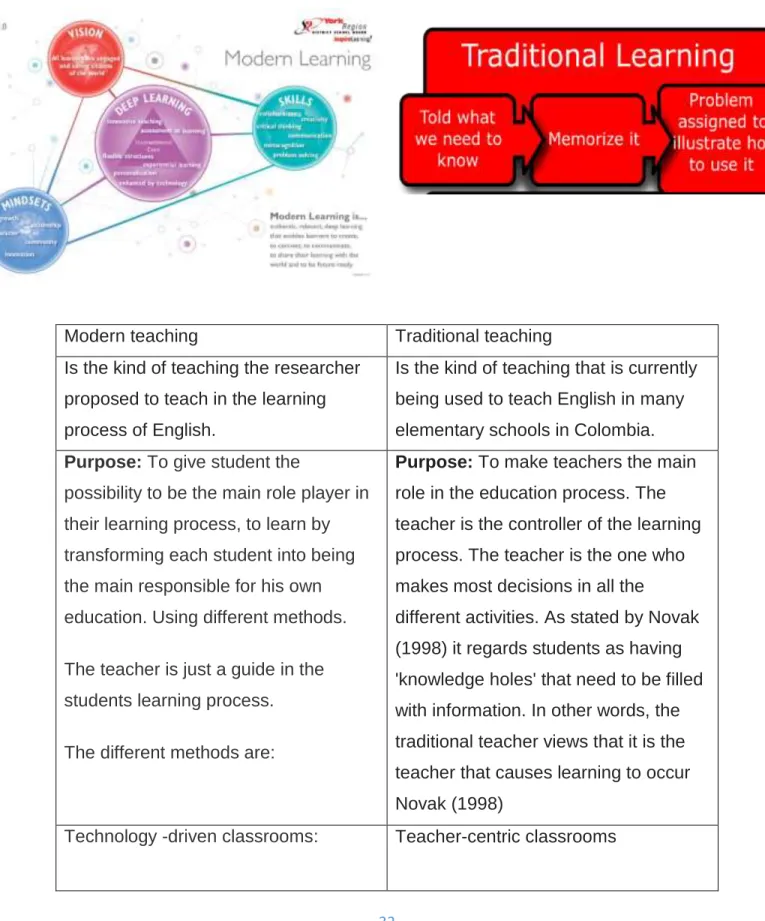
Table 1 Comparison between Modern and traditional teaching
Modern teaching Traditional teaching
Is the kind of teaching the researcher proposed to teach in the learning process of English.
Is the kind of teaching that is currently being used to teach English in many elementary schools in Colombia. Purpose: To give student the
possibility to be the main role player in their learning process, to learn by transforming each student into being the main responsible for his own education. Using different methods.
The teacher is just a guide in the students learning process.
The different methods are:
Purpose: To make teachers the main role in the education process. The teacher is the controller of the learning process. The teacher is the one who makes most decisions in all the
different activities. As stated by Novak (1998) it regards students as having 'knowledge holes' that need to be filled with information. In other words, the traditional teacher views that it is the teacher that causes learning to occur Novak (1998)
33 Classrooms where students can in this case learn English using technology. Some examples are: watching videos about a specific subject and playing English related games.
Continuous comprehensive evaluation:
Students are constantly evaluated to see their progress. In this case in Colombia the English classes can be evaluated weekly to see the children’s process.
Teachers in the mode of knowledge dispensers rather than facilitators In Colombia there’s the need to let students use their imagination to learn English.
Cross-curricular connections:
In English classes teachers can include some math, science or any other
subject and working with other
teachers can be interesting and helpful for students to learn new vocabulary words in each subject.
34 Inquiry-based learning
This method can be used in Colombia with 4th and 5th graders to teach them to try to find solutions when there is something that is not clear for them In English many projects can be made to help students try and enjoy new
methods.
Regimented classrooms
Emphasis on understanding of concepts
In English books like my Abc or
vocabulary binder would help students have a larger vocabulary.
Lack of collaboration and group learning
Student’s need to learn to work in
groups and this is not a possibility in many schools in Colombia-
Linking curriculum with life
In Colombia classes can be made for parents to participate. For example, creating a family tree with their family can help family’s spend more time
More emphasis on examinations and results rather than understanding of concepts
35 together and learn some words in
English.
Emphasis on skill building, life skills and values
Improper alignment between
objectives, activities and assessments
Smart interactive boards
BYOD – Bring your own device
In Colombia children can see their devices as tools in an English learning process.
Differential learning
36 Activity-based learning and learning labs
Collaborative learning
Problem-based learning
This table is a comparison into two methods of teaching and how the
37
comfortable and felt motivated as they noticed that learning was fun by creating, singing, search and playing and not only by writing so many words in a notebook. This should be taken into advantage as these children are in an age in which they learn easier a new language if it’s taught in the correct way. English should be taught as an open door to a world full of a creativity and fun activities, which should be the reference that children have when they think of learning English.
In the other hand, we have the kind of teaching that the researcher noticed that caused the children to be bored and unmotivated. The teaching where the teacher is no longer the guide but the center of the learning process, this place is for the student he’s the main role in an education process. As we can see on the
38 CHAPTER IV
Discussion
As stated throughout this whole monograph, the idea is to show the different methods of teaching English in elementary school. This monograph has shown the low level of English that Colombia currently has around the world and how this affects our children. This monograph has shown there’s many other options to teaching and motivating children than just by traditional methods. As Socrates stated (399 a. C), “I cannot teach anybody anything. I can only make them think” this is the
main role that teachers should develop is the role of guiding students into a new language in which they can think and be able to develop all the skills needed.
In the Introduction the researcher spoke of the globalized world we are currently in. A world where English is a necessity more than an option. Throughout this monograph the researcher stated the importance of speaking English so the students can have the same opportunity any other person around the world has. This opportunity is given when the institutions decide to introduce a bilingual program that is adapted to the child’s needs and that need is to enjoy what they are learning. In the global market it is imperative for Colombia to develop an effective English program for all students. This need is based on the future of our children. As our world evolves so should Colombia and this time English is connected with this globalized world, where our children need to be at the same level as other children in the world.
This is why teaching English as a foreign language from a young age/ infancy will be effective for Colombia's education, however, the strategies used up to now in the different schools have been monotonous and they’ve become repetitive, to the
point students are unmotivated. The idea is to be able to evaluate these learning activities and to be able to motivate students to learn the language that opens doors to a new culture and more.
39
Colombia. Classes where teachers are just the guides of this motivating process in which Colombian children have the opportunity to be fluent in a foreign language. Taking into advantage that learning a foreign language in Colombia it is a right and it should be learned as fluently as possible. This means that Colombian children need to be motivated by a fun English learning process, a process that includes practical things which are easy for children to learn from. Some examples have been proposed in this monograph, like, playing scavenger hunt, playing ABC tic tac toe, creating their own ABC book and more.
40 CHAPTER V
Conclusion
To conclude this monograph was a research paper that showed there are many possibilities to improve English in Colombia. This monograph shows that there are many ways to teach with didactic strategies and that students will enjoy it more than learning with traditional strategies. Instead of learning to copy everything they see on the board the idea is that students can create their learning. When they are asked to write their ABC’s on a piece of paper that is traditional but if they get asked to create their ABC book while they sing their ABC’s in English this is fun
41 References
Bryman, A. (2007). The Research Question in Social Research: What is its Role? International Journal of Social Research Methodology, 10(1), 5-20. doi:
10.1080/13645570600655282
Arboleda H. (2009). Fundamentacion Metodologica. Fundacion Universitaria Luis
Amigo. Retrieved from
http://virtual.funlam.edu.co/repositorio/sites/default/files/repositorioarchivos/2009/1
2/DocumentoIntroductorio.297.pdf
Basic foreign languages abilities: English. Retrieved from http://www.mineducacion.gov.co/cvn/1665/article-115174.html
Bilingualism (2017). The British Encyclopedia. Retrieved from https://www.britannica.com/topic/bilingualism
Criticalthinking" (PDF). (2017). Retreived from www.criticalthinking.org.
Colombia. In EF. Retreived from
http://www.ef.fr/epi/regions/latin-america/colombia/
Crystal, D. (1997). English as a gobal language. Retreived from https://books.google.fr/books?hl=en&lr=&id=ecsLAQAAQBAJ&oi=fnd&pg=PR7&dq
=Crystal,+D.+(1997),+English+as+a+Global+Language,+Cambridge:+Cambridge+
University+Press.&ots=q47YHmVPeE&sig=5QiB_hnTjUXlVLHkJLgOVXiN8uI#v=o
nepage&q&f=false
42 Differential Instruction. Edutopia. Retreived from
https://www.edutopia.org/blogs/tag/differentiated-instruction
Education. In British Encyclopedia. Retreived from https://www.britannica.com/topic/education
Education. In Edutopia. Retreived from https://www.edutopia.org/
Ester Álvarez Ruiz. (2017). Aprender inglés…. ¿jugando? Retrieved from http://uvadoc.uva.es/handle/10324/23168
Estrella Utrera Montes. Juegos para aprender inglés. Retrieved from https://books.google.com.co/books?id=e4esAwAAQBAJ&pg=PA52&dq=aprender+i
ngl%C3%A9s+jugando&hl=en&sa=X&ved=0ahUKEwjqyvP57u3VAhWITCYKHRB
FDW8Q6AEIKTAA#v=onepage&q=aprender%20ingl%C3%A9s%20jugando&f=fals
e
Friedrich Forbes. In Friedrich Forbes. Retrieved from http://www.friedrichfroebel.com/
Flipped-Learning Toolkit: Overcoming Common Hurdles. Edutopia. (2014) Retreived from
https://www.edutopia.org/blog/flipped-learning-toolkit-common-hurdles-jon-bergmann
Game-Based Learning. In Edutopia. Retrieved from
https://www.edutopia.org/blogs/beat/game-based-learning
Game-Based-Learning. In BBC. Retreived from
https://www.teachingenglish.org.uk/article/game-based-learning
George S. Morrison. (2005). Educación infantil. Retrieved from www.educacióninfantil.com
43
http://www.mineducacion.gov.co/1621/articles-85906_archivo_pdf.pdf
Instituto Cervantes (2017). Retreived from http://www.cervantes.es/default.htm
Instituto Cervantes. (2002). Marco común europeo de referencia para las lenguas: aprendizaje, enseñanza, evaluación. Retrieved from http://cvc.cervantes.es/ensenanza/biblioteca_ele/marco/cvc_mer.pdf
Infancy. In British Encyclopedia. Retrieved from
https://www.britannica.com/science/infancy
Integrated Studies: A Short History. Edutopia. (2011) Retrieved from
https://www.edutopia.org/integrated-studies-history
International language standards | Cambridge English. (2016).
Cambridgeenglish.org. Retrieved from
http://www.cambridgeenglish.org/exams/cefr/
Gollan, T. H., Salmon, D. P., Montoya, R. I., & Galasko, D. R. (2011). «Degree of bilingualism predicts age of diagnosis of Alzheimer’s disease in low-education but
not in highly educated Hispanics». Neuropsychological, 49(14), 3826–3830.
doi:10.1016/j.neuropsychologia.2011.09.041.
Ministerio de Educación Nacional. (2006). Formar en lenguas extranjeras: ¡el reto!
Estándares Básicos de Competencias En Lenguas Extranjeras: inglés, (22).
Retrieved from
http://www.colombiaaprende.edu.co/html/mediateca/1607/articles-115375_archivo.pdf
Multiple Intelligences. Retrieved from
http://www.lapaginadelprofe.cl/UAconcagua/formacionprofesional/lasinteligenciam
44
Jean, Piaget, (1961), Formación del símbolo en el niño: imitación, juego y sueño. Imagen y representación, México, S.L. Fondo de cultura económica de España. José Luis Murado Bouso. (1970). Didáctica en inglés en educación superior.
Retrieved from
https://soniaeducadorainfantil.files.wordpress.com/2012/08/diei.pdf
Julian Edge. (1993). Essentials of English language teaching. Retrieved from
https://didactics-a.wikispaces.com/file/view/Essentials+of+English+Language+Teaching.pdf
Kathy Hirsh-Pasek. (2008).Por qué juego? Aprendizaje. Retrieved from
http://www.enciclopedia-infantes.com/juego/segun-los-expertos/por-que-juego-aprendizaje
Larry Ferlazzo. (2012). Do’s & Don’ts for Teaching English-Language Learners. Retrieved from
https://www.edutopia.org/blog/esl-ell-tips-ferlazzo-sypnieski
Learning English Kids. En British Council. Retrieved from http://learnenglishkids.britishcouncil.org/en
Lev Vygotsky. En individual U Toronto. Retrieved from http://individual.utoronto.ca/yasnitsky/texts/Fraser%20&%20Yasnitsky%20(2015).p
df
Ladislav Bognar. (1993). Didactics. Retrieved from file:///C:/Users/HP/Downloads/ZIS_Vol_60_No_31_Bognar_Matijevic.pdf
Mark Weyers (5 December 2006). Teaching the FE Curriculum: Encouraging Active Learning in the Classroom. A&C Black. pp. 15–. ISBN 978-0-8264-8804-6.
45
en Didáctica de la Lengua y la Literatura. Granada: Grupo Editorial Universitario,
Pp.91-120.Retrieved from
http://www.ugr.es/~dmadrid/Publicaciones/Innovacion%20docente%20DLI.pdf
Madrid, D. (2001): “Materiales didácticos para la enseñanza del inglés en Ciencias de la Educación”. En Bruton, A. y Lorenzo, F. J. (eds.): Perspectivas actuales en la metodología de la enseñanza del inglés en las Universidades andaluzas, Revista de Enseñanza Universitaria, nº extraordinario 2001, pp. 213-232, ISSN 1131-5245.
Retrieved from
http://www.ugr.es/~dmadrid/Publicaciones/Materiales%20didacticos%20ensegnan
za%20ingles%20CC%20Educacion.pdf
Maiga Chang. (2009). Learning by playing. Retrieved from https://books.google.com.co/books?id=46OVaWyORxgC&pg=PA74&dq=learn+eng
lish+playing&hl=en&sa=X&ved=0ahUKEwiBj5uE8O3VAhUGySYKHbitDeoQ6AEIL
DAB#v=onepage&q=learn%20english%20playing&f=false
Multiple Intelligences: What does the researcher say? Edutopia. (2013) Retreived from
https://www.edutopia.org/multiple-intelligences-research
National Association for the Education of Young Children. Retrieved from http://www.naeyc.org/
Oscar A. Zapata. (1995).Aprender jugando en la escuela primaria: didáctica de la psicología genética.
Retrieved from www.Piaget.com
National bilingual program in Colombia. En Colombia aprende Retrieved from http://www.colombiaaprende.edu.co/html/productos/1685/article-158720.html
46
http://www.mineducacion.gov.co/1621/articles-132560_recurso_pdf_programa_nacional_bilinguismo.pdf
Ressources. En les petits bilingues. Retrieved from http://www.lespetitsbilingues-jobs.com/resources
Piaget's Theory and Education: Forming the Mind, Not Just Furnishing It. The future of education. UNESCO.
Retreived from
http://unesdoc.unesco.org/images/0000/000061/006133eo.pdf
William M. Peralta. (2016). Estrategias de enseñanza aprendizaje del inglés como lengua extranjera. Retrieved from
47 Appendix
Appendix 1: Level of English in Colombia, compared with other countries.
Retrieved from https://medium.com/world-economic-forum/which-countries-are-best-at-english-as-a-second-language-d4781d077ba6
48
Appendix 3: How Colombian children responded to school related questions
Children’s views on their lives and well-being in 15 countries:
A report on the Children’s Worlds survey, 2013-14
Retrieved from
49
Appendix 4: Some curriculums in elementary school in Colombia
Retrieved from: A booklet guide in English teaching in elementary school in Colombia.
http://aprende.colombiaaprende.edu.co/sites/default/files/naspublic/colombiabilingu
e/dbacurriculo/cartillas_mallas_aprendizaje/Suggested%20English%20Curriculum.
51
Appendix 5: Principles and guideline of Colombia bilingual.
Retrieved from
http://aprende.colombiaaprende.edu.co/sites/default/files/naspublic/colombiabilingu
e/dbacurriculo/cartilla_orientaciones_docentes/Pedagogical%20Principles%20and
%20Guidelines.pdf
Appendix 6: Children’s enjoy going to school.
Retrieved from
http://www.isciweb.org/_Uploads/dbsAttachedFiles/ChildrensWorlds2015-FullReport-Final.pdf
Appendix 7: Interest of Game-based learning
Retrieved from
52
Appendix 8: World’s Children: Multiple Intelligences
Retrieved from
53
Appendix 9: The second most spoken language worldwide in 2017.
Retrieved from
54 Appendix 10: the formats used
DATE ACTIVITY RESOURCES
Monday 18
TOPIC:
GOAL:
ACTIVITIES:
55 Tuesday 19 Wednesday 20 Carnet:
Se les entregará el carnet donde escribirán los principales datos, nombre, edad, donde viven, nombre de sus padres, color favorito, ..….etc.
Ex:
My name is….
I am seven years old. I am from….
I live in ……
My favorite color is…. Or my favorite colors are….
Se usará el verbo to be: (is, are) en la presentación del carnet.
Primero será personal usando el pronombre “I” hacia ellos mismos y luego será hacia los demás usando “she”, “he”, “they”. Ex. They are boys, they are girls.
-Escribirán los datos personales en el Carnet.
Se continuará con el carnet pero se usará el verbo:
Have, Has.
Describirán a los diferentes compañeros usando el verbo has, have:
Ex. She has blue eyes, he has red hair.
Clase con Video Beam:
espacios para llenar.
CARNET.
VIDEO BEAN. Presentaciòn Power Point IS, ARE, HAVE, HAS.
SALA DE
56 Tuesday 21
Friday 22
Se mostrarán imágenes con diferentes caras y rostros, para que los niños describirán oraciones usando: has, have.
Ex: She has black eyes, she has red mouth. Rompecabezas, he, she, you…
Is, are…
Se reforzará los verbos: is, are, has, have en los pronombres: they, we, you, he, she, I, Ex:
I have a bag. I have blue eyes. I am a friend of Jake.
We have some toys. They have long hair.
Resolverán los ejercicios usando have-has. ( habilidad escrita)
Mascaras de personificación para los niños.
Se harán las descripciones de algunas personas:
Hannah Montana,
Se describirá su aspecto físico y se verán otros verbos:
(Like, live, study, eat, play, ) Se enseñarà (s) en los verbos.
Ex: She is Hanna Montana, she is a Singer. She has blond hair. She likes the music. She lives in United States. She eats sándwich.
VIDEO BEAN
GUIAS DE
EJERCICIOS. Rompecabezas.
57 Monday 25
Tuesday 26
Se desarrollará los ejercicios escritos usando el presente simple que se está desarrollando de forma oral.
El uso de los verbos en presente simple: LIKE, HAVE, HAS, EAT, IS, ARE.
Se hará el KARAOKE con la canción que deben completar y cantar de acuerdo a lo que escuchan.
Se usarán los diferentes verbos en presente simple.
Se hará el rompecabezas con verbos, pronombres y complemento.
Ex. I, YOU, SHE, HE, IT HAVE, HAS, EAT, PLAY
SANDWICH, SOCCER, BLACK EYES.
Preguntas en presente simple.
VIDEO BEAN Canciones, letras incompletas.
Rompecabezas.
Presentación en Power Point.
(Video Bean.)
58 Wednesday
27
Where, What, Who, When. Usando is, are, have, play…..
Se verá la presentación en Power Point con las preguntas en Presente Simple.
Se usará el rompecabezas para organizar preguntas con los diferentes verbos.
Se desarrollará una guía de completar. (Habilidad Escrita)
Questions with where Yes – No questions. Verb to be negative.
There is – There are.
Questions with When – What time.
Ex. What`s your name?
What`s his telephone number?
Se hará el juego de roles, Dialogo entre dos estudiantes, (entrevista), unos entrevistarán y otros serán entrevistados.
Uso de rompecabezas según las preguntas usando los diferentes verbos.
Se hará el juego con diferentes alimentos usando there is- there are.
Guia de tarea.
Palabras para realizar un dialogo. (Cartulina)
Presentación en Power Point.
Alimentos.
Guía.
Presentación en Power Point.
59 Thursday
28
Friday 29
Simple Present ( like, want, need, have ) This, that, these, those.
Frequency Adverbs.
Organización de estructura de oraciones en presente simple usando los verbos tratados.
Se hará el juego de la ropa para usar (this, that, these, those )
Se entregará la guía.
Present Simple vs. Present Continuous. Possesive nouns.
Object Pronouns.
Podrán hacer comparaciones entre el presente simple y presente continuo usando diferente vocabulario.
Se hará el concurso cuando los niños van uniendo oraciones en presente simple y presente continuo.
Present Simple vs. Present Continous.
Presentación en Power Point.
Verbs with ing (cartulina)
KARAOKE Computador. Canciones.
Rompecabezas.
60
Canción con estos tiempos, donde deben cantar con el KARAOKE.
Se hará el Rompecabezas donde deben organizar las diferentes oraciones.
Deben realizar la guía de acuerdo a los tiempos vistos.
64 Appendix 12: Learning pyramid
Retrieved from